
Vo IP Tutorial Brian Rosen Distinguished Engineer Neustar

Vo. IP Tutorial Brian Rosen Distinguished Engineer Neustar, Inc.
What Is Internet Protocol? ‣ A way to send data on a high speed network ‣ Data is broken up into packets, which are variable sized ‣ A packet is a sequence of bytes, with a “header” and a “payload” ‣ Data is typically sent serially, bit by bit, byte by byte ‣ IP is a layered protocol
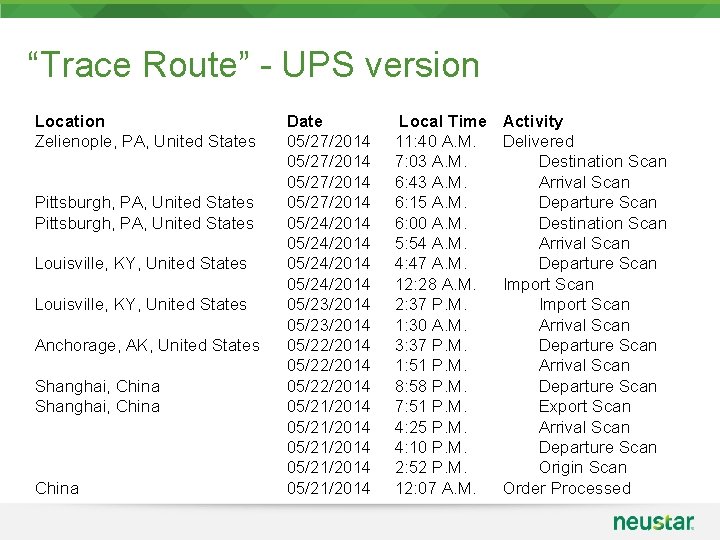
“Trace Route” - UPS version Location Zelienople, PA, United States Pittsburgh, PA, United States Louisville, KY, United States Anchorage, AK, United States Shanghai, China Date 05/27/2014 05/24/2014 05/23/2014 05/22/2014 05/21/2014 05/21/2014 Local Time 11: 40 A. M. 7: 03 A. M. 6: 43 A. M. 6: 15 A. M. 6: 00 A. M. 5: 54 A. M. 4: 47 A. M. 12: 28 A. M. 2: 37 P. M. 1: 30 A. M. 3: 37 P. M. 1: 51 P. M. 8: 58 P. M. 7: 51 P. M. 4: 25 P. M. 4: 10 P. M. 2: 52 P. M. 12: 07 A. M. Activity Delivered Destination Scan Arrival Scan Departure Scan Import Scan Arrival Scan Departure Scan Export Scan Arrival Scan Departure Scan Origin Scan Order Processed
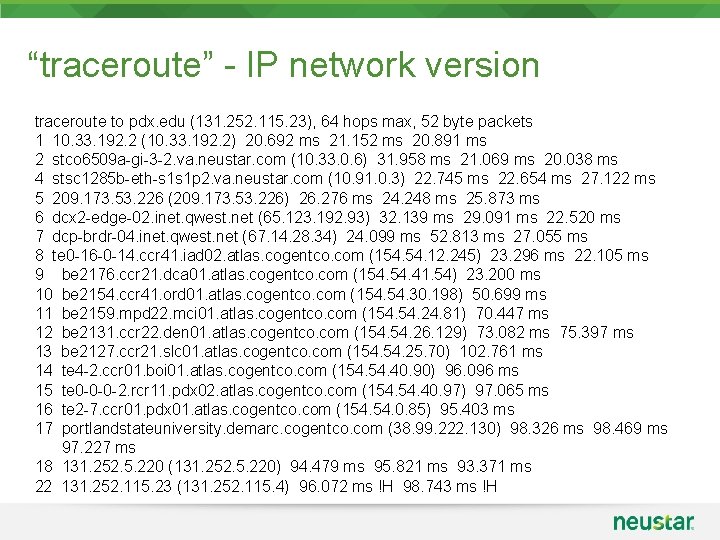
“traceroute” - IP network version traceroute to pdx. edu (131. 252. 115. 23), 64 hops max, 52 byte packets 1 10. 33. 192. 2 (10. 33. 192. 2) 20. 692 ms 21. 152 ms 20. 891 ms 2 stco 6509 a-gi-3 -2. va. neustar. com (10. 33. 0. 6) 31. 958 ms 21. 069 ms 20. 038 ms 4 stsc 1285 b-eth-s 1 s 1 p 2. va. neustar. com (10. 91. 0. 3) 22. 745 ms 22. 654 ms 27. 122 ms 5 209. 173. 53. 226 (209. 173. 53. 226) 26. 276 ms 24. 248 ms 25. 873 ms 6 dcx 2 -edge-02. inet. qwest. net (65. 123. 192. 93) 32. 139 ms 29. 091 ms 22. 520 ms 7 dcp-brdr-04. inet. qwest. net (67. 14. 28. 34) 24. 099 ms 52. 813 ms 27. 055 ms 8 te 0 -16 -0 -14. ccr 41. iad 02. atlas. cogentco. com (154. 12. 245) 23. 296 ms 22. 105 ms 9 be 2176. ccr 21. dca 01. atlas. cogentco. com (154. 41. 54) 23. 200 ms 10 be 2154. ccr 41. ord 01. atlas. cogentco. com (154. 30. 198) 50. 699 ms 11 be 2159. mpd 22. mci 01. atlas. cogentco. com (154. 24. 81) 70. 447 ms 12 be 2131. ccr 22. den 01. atlas. cogentco. com (154. 26. 129) 73. 082 ms 75. 397 ms 13 be 2127. ccr 21. slc 01. atlas. cogentco. com (154. 25. 70) 102. 761 ms 14 te 4 -2. ccr 01. boi 01. atlas. cogentco. com (154. 40. 90) 96. 096 ms 15 te 0 -0 -0 -2. rcr 11. pdx 02. atlas. cogentco. com (154. 40. 97) 97. 065 ms 16 te 2 -7. ccr 01. pdx 01. atlas. cogentco. com (154. 0. 85) 95. 403 ms 17 portlandstateuniversity. demarc. cogentco. com (38. 99. 222. 130) 98. 326 ms 98. 469 ms 97. 227 ms 18 131. 252. 5. 220 (131. 252. 5. 220) 94. 479 ms 95. 821 ms 93. 371 ms 22 131. 252. 115. 23 (131. 252. 115. 4) 96. 072 ms !H 98. 743 ms !H
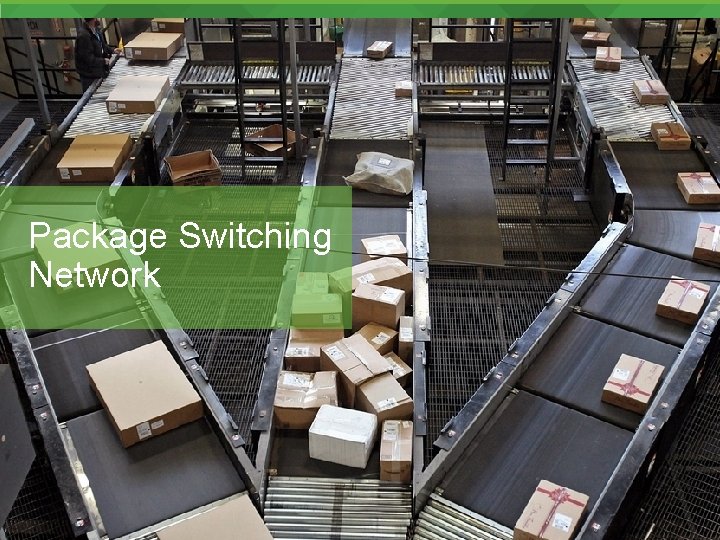
Package Switching Network
Packet Switching Network
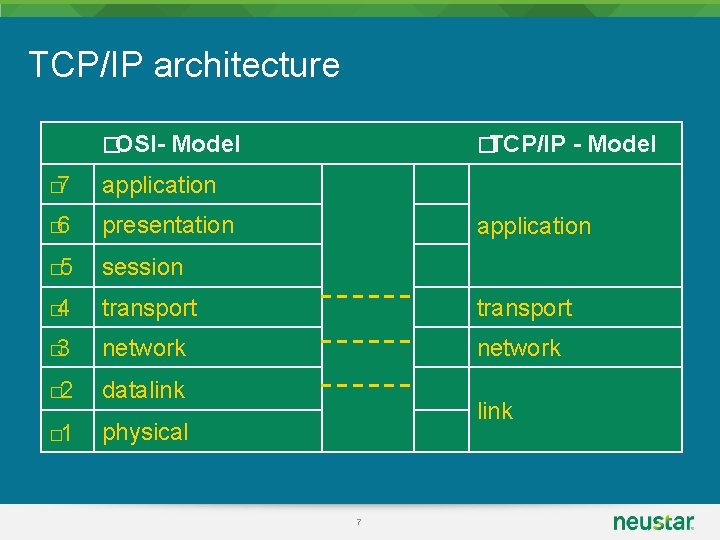
TCP/IP architecture �TCP/IP - Model �OSI- Model 7 application 6 presentation 5 session 4 transport 3 network 2 datalink 1 physical � � � � application link 7
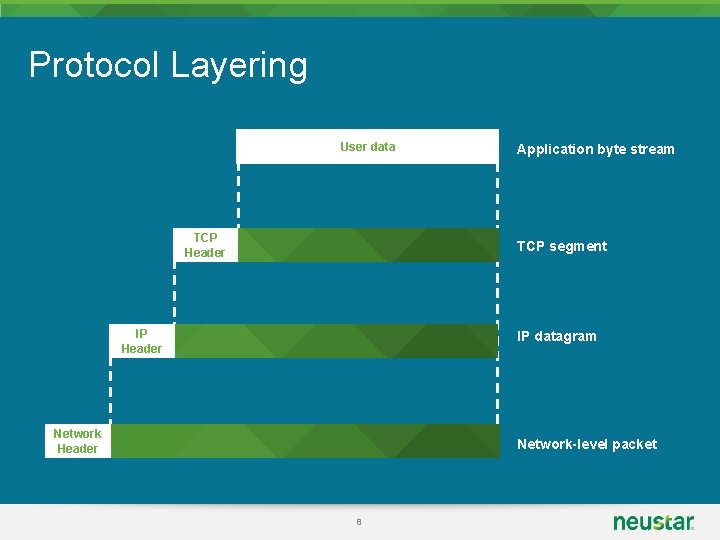
Protocol Layering User data TCP Header Application byte stream TCP segment IP Header IP datagram Network Header Network-level packet 8
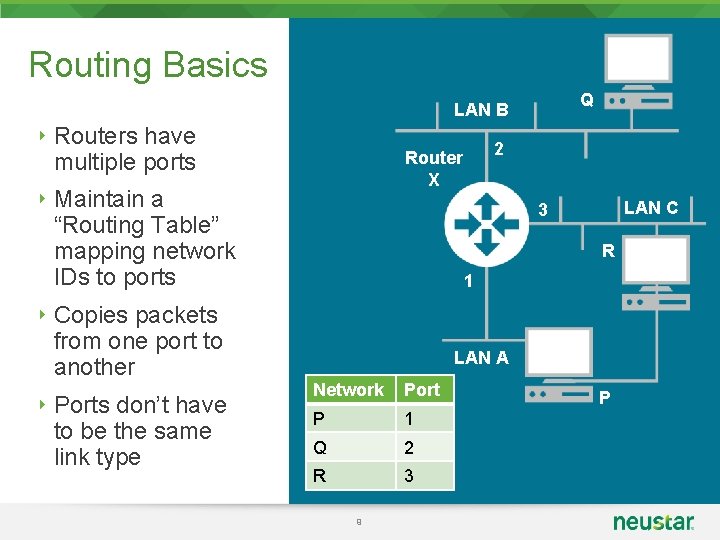
Routing Basics Q LAN B ‣ Routers have multiple ports ‣ Maintain a “Routing Table” mapping network IDs to ports ‣ Copies packets from one port to another ‣ Ports don’t have to be the same link type 2 Router X LAN C 3 R 1 LAN A Network Port P 1 Q 2 R 3 9 P
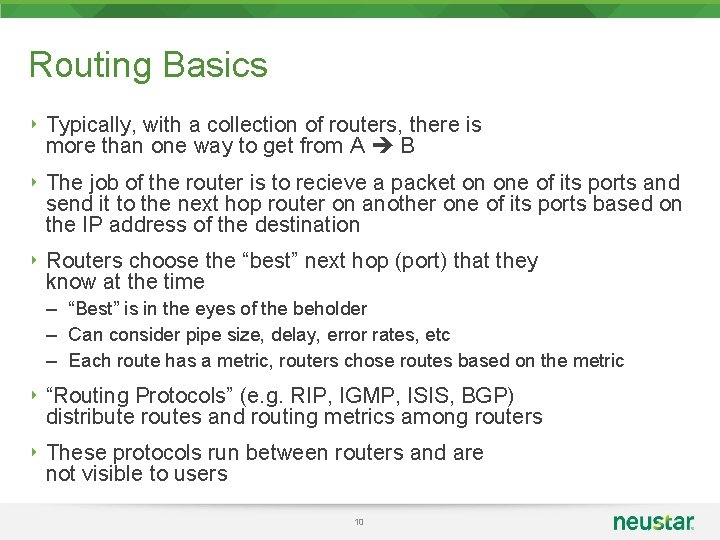
Routing Basics ‣ Typically, with a collection of routers, there is more than one way to get from A B ‣ The job of the router is to recieve a packet on one of its ports and send it to the next hop router on another one of its ports based on the IP address of the destination ‣ Routers choose the “best” next hop (port) that they know at the time – “Best” is in the eyes of the beholder – Can consider pipe size, delay, error rates, etc – Each route has a metric, routers chose routes based on the metric ‣ “Routing Protocols” (e. g. RIP, IGMP, ISIS, BGP) distribute routes and routing metrics among routers ‣ These protocols run between routers and are not visible to users 10
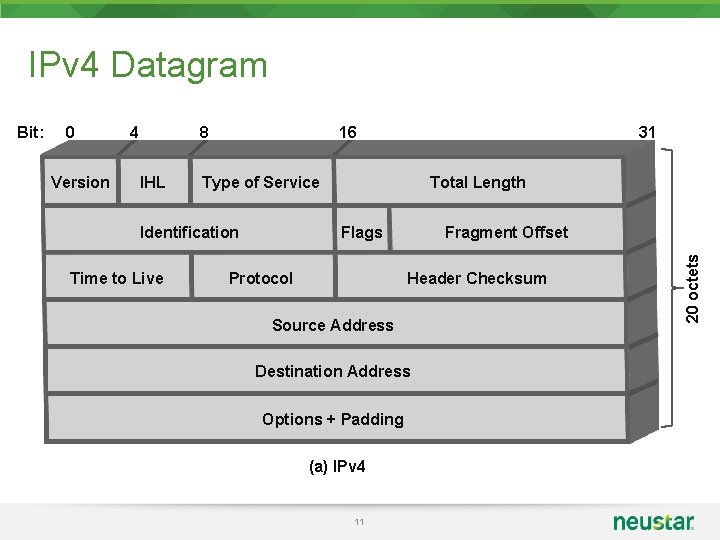
IPv 4 Datagram 0 Version 4 8 IHL 16 Type of Service Identification Time to Live 31 Total Length Flags Protocol Fragment Offset Header Checksum Source Address Destination Address Options + Padding (a) IPv 4 11 20 octets Bit:
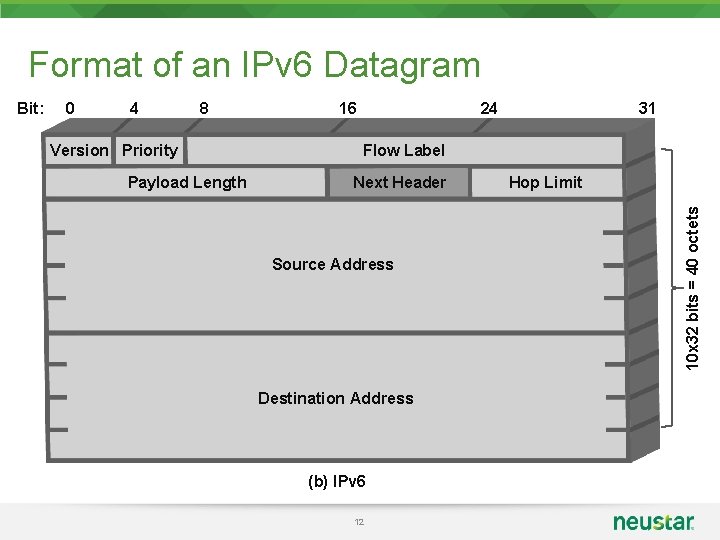
Format of an IPv 6 Datagram 0 4 8 Version Priority Payload Length 16 24 31 Flow Label Next Header Source Address Destination Address (b) IPv 6 12 Hop Limit 10 x 32 bits = 40 octets Bit:
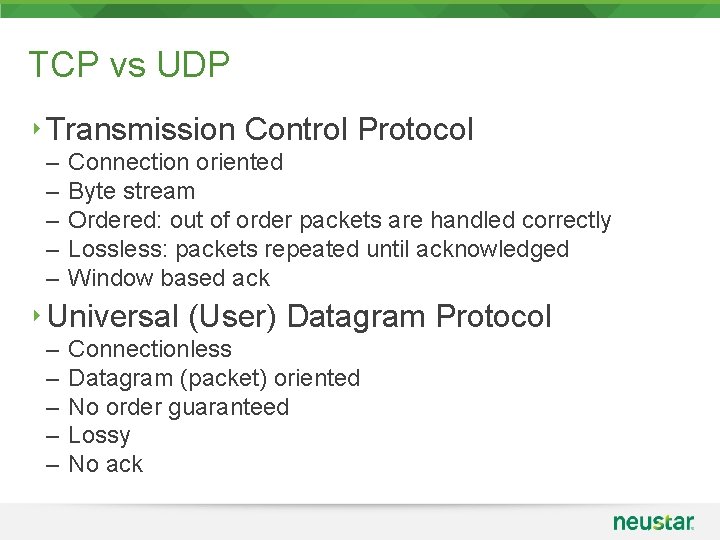
TCP vs UDP ‣ Transmission Control Protocol – – – Connection oriented Byte stream Ordered: out of order packets are handled correctly Lossless: packets repeated until acknowledged Window based ack ‣ Universal (User) Datagram Protocol – – – Connectionless Datagram (packet) oriented No order guaranteed Lossy No ack
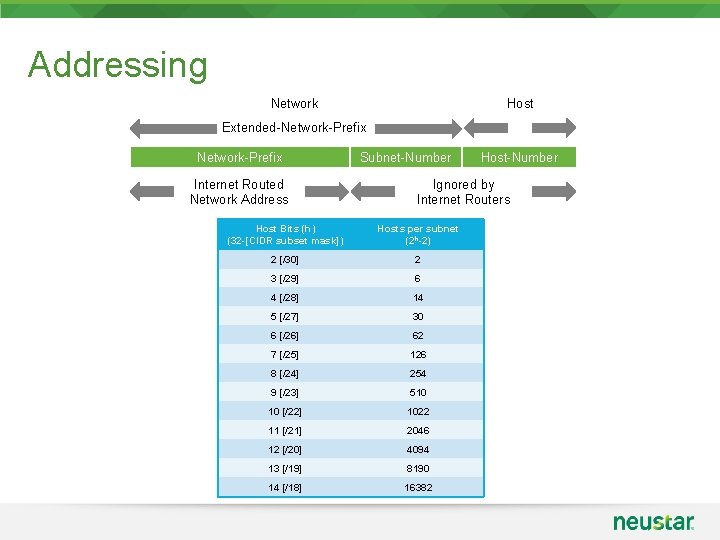
Addressing Network Host Extended-Network-Prefix Internet Routed Network Address Subnet-Number Host-Number Ignored by Internet Routers Host Bits (h) (32 -[CIDR subset mask]) Hosts per subnet (2 h-2) 2 [/30] 2 3 [/29] 6 4 [/28] 14 5 [/27] 30 6 [/26] 62 7 [/25] 126 8 [/24] 254 9 [/23] 510 10 [/22] 1022 11 [/21] 2046 12 [/20] 4094 13 [/19] 8190 14 [/18] 16382
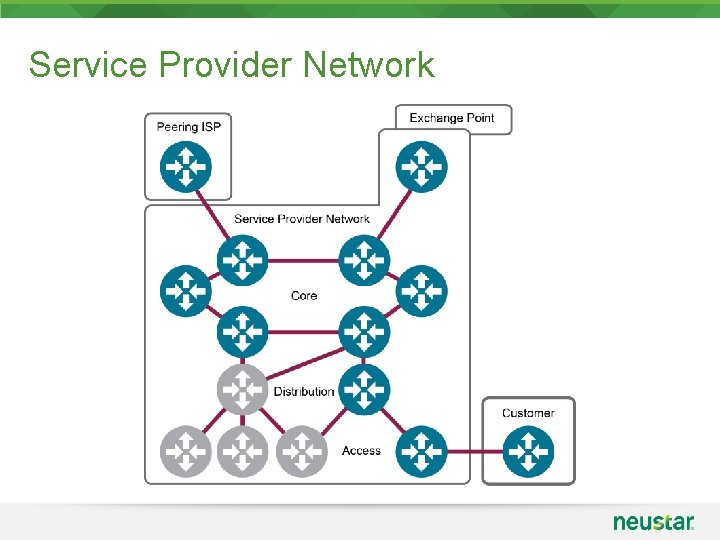
Service Provider Network
Internet Multimedia aka Vo. IP ‣ A way to send real-time two-way media over an IP network ‣ Real Time Protocol (RTP) – media packets ‣ Real Time Control Protocol (RTCP) – monitor & report ‣ Session Initiation Protocol (SIP) – call control ‣ Session Description Protocol (SDP) – media session description 16
Real Time Transport Protocol (RTP) ‣ RTP is a transport protocol that provides end to end delivery services for data with real time characteristics ‣ RTP consists of two closely linked parts – RTP to carry data – RTCP to report the quality of service and to convey information about the participants in an on going session ‣ Applications typically run RTP on top of UDP to make use of its framing, multiplexing and checksum services 17
RTP For Voice ‣ Voice data is digitized, compressed, and packetized ‣ Packetization implies a packetization period (playback time for one packet) – Bigger packets are more efficient (less overhead) – Smaller packets have less delay • Because you have to fill the packet before you send it ‣ Because RTP normally rides on UDP, it is unreliable – Usually, we simply ignore errors – We also drop out of order packets 18
Session Initiation Protocol (SIP) • Internet Standard – RFC 3261 – RFC – http: //www. ietf. org/rfc 3261. txt • Reuse Internet Addressing (URIs, DNS, proxies) – Uniform Resource Identifiers: e. g. http: //www. google. com, sip: brian. rosen@neustar. biz, or sip: sws 1. east. verizon. net – Domain Name Service translates e. g. sws 1. east. verizon. net to IP address 123. 15. 23. 114 – A “proxy” is a signaling entity in the middle of the path that usually echoes a signaling message while routing, enhancing, or policing it • Reuse HTTP Style – Text based, human readible • Makes no assumptions about underlying protocol: – TCP, UDP, etc. 19
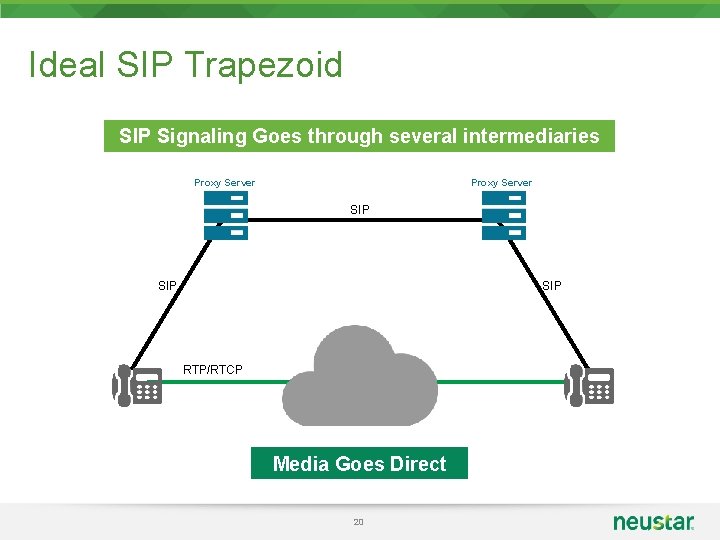
Ideal SIP Trapezoid SIP Signaling Goes through several intermediaries Proxy Server SIP SIP RTP/RTCP Media Goes Direct 20
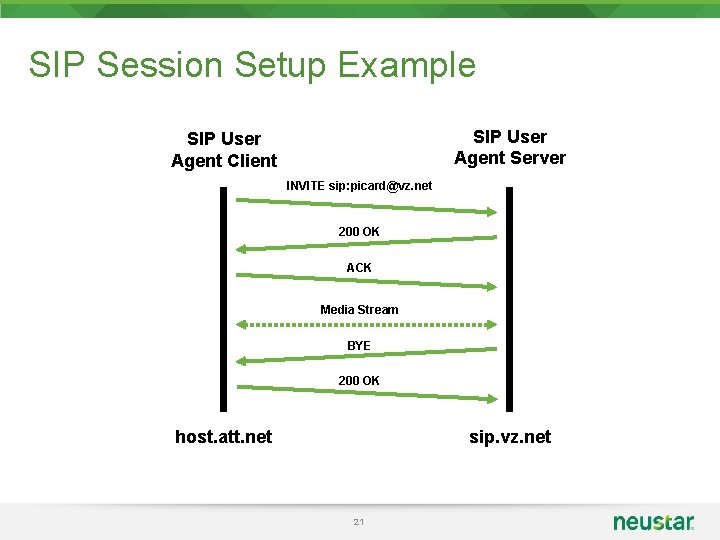
SIP Session Setup Example SIP User Agent Server SIP User Agent Client INVITE sip: picard@vz. net 200 OK ACK Media Stream BYE 200 OK sip. vz. net host. att. net 21
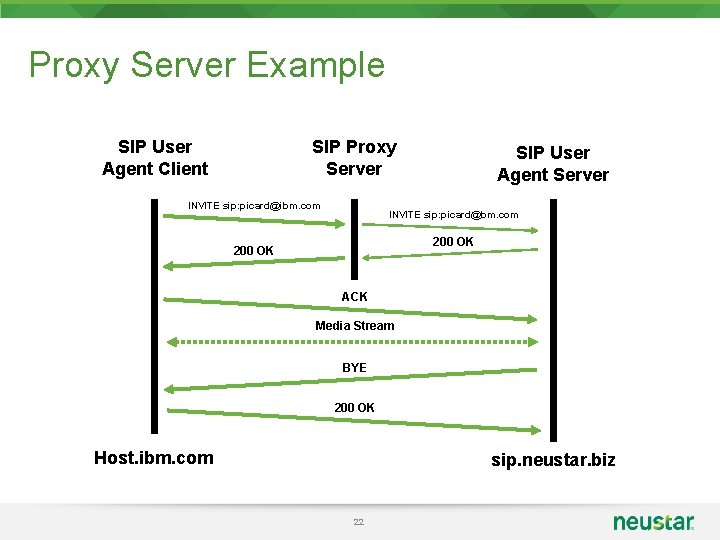
Proxy Server Example SIP User Agent Client SIP Proxy Server INVITE sip: picard@ibm. com SIP User Agent Server INVITE sip: picard@bm. com 200 OK ACK Media Stream BYE 200 OK Host. ibm. com sip. neustar. biz 22
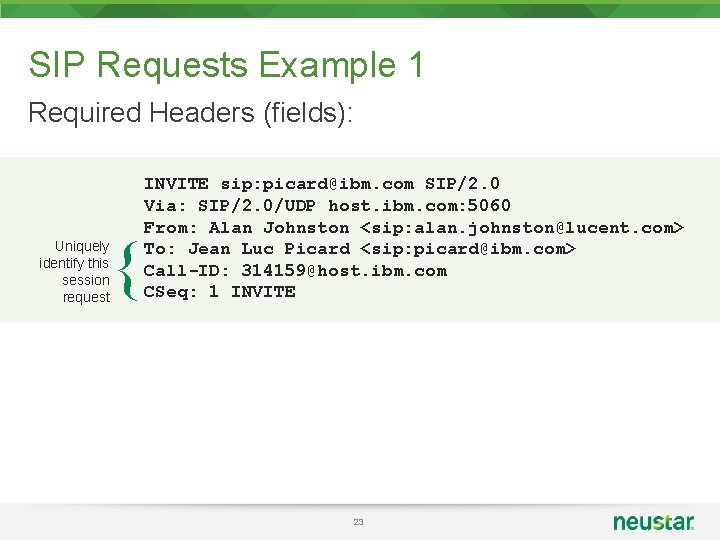
SIP Requests Example 1 Required Headers (fields): } Uniquely identify this session request INVITE sip: picard@ibm. com SIP/2. 0 Via: SIP/2. 0/UDP host. ibm. com: 5060 From: Alan Johnston <sip: alan. johnston@lucent. com> To: Jean Luc Picard <sip: picard@ibm. com> Call-ID: 314159@host. ibm. com CSeq: 1 INVITE 23
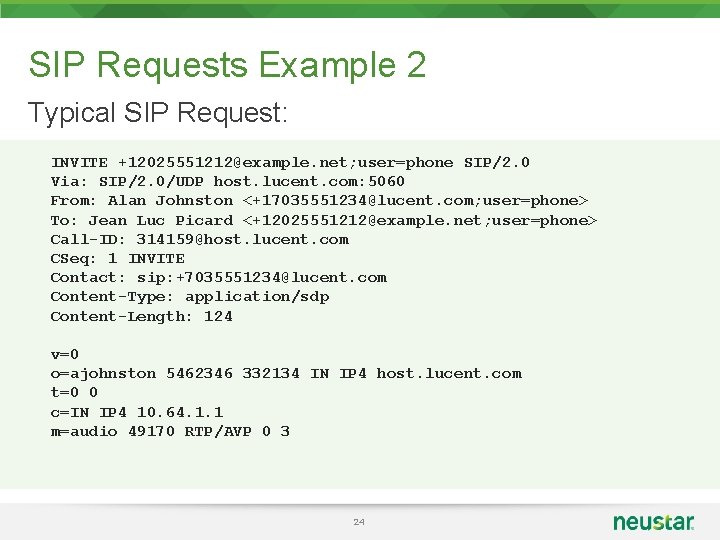
SIP Requests Example 2 Typical SIP Request: INVITE +12025551212@example. net; user=phone SIP/2. 0 Via: SIP/2. 0/UDP host. lucent. com: 5060 From: Alan Johnston <+17035551234@lucent. com; user=phone> To: Jean Luc Picard <+12025551212@example. net; user=phone> Call-ID: 314159@host. lucent. com CSeq: 1 INVITE Contact: sip: +7035551234@lucent. com Content-Type: application/sdp Content-Length: 124 v=0 o=ajohnston 5462346 332134 IN IP 4 host. lucent. com t=0 0 c=IN IP 4 10. 64. 1. 1 m=audio 49170 RTP/AVP 0 3 24
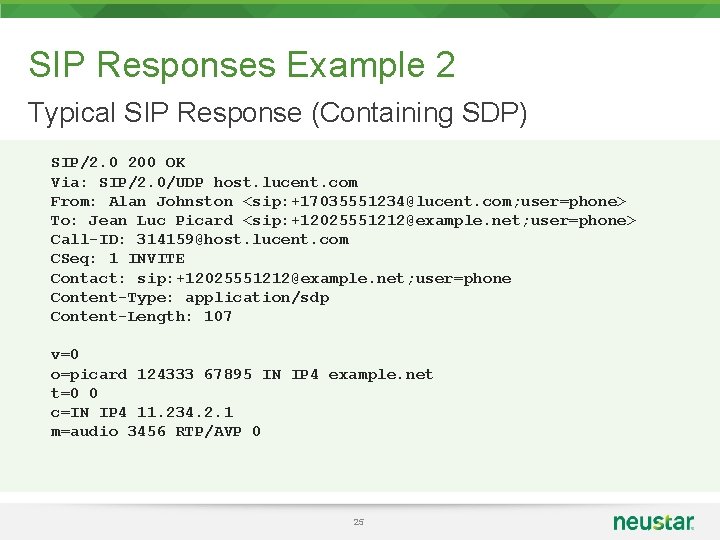
SIP Responses Example 2 Typical SIP Response (Containing SDP) SIP/2. 0 200 OK Via: SIP/2. 0/UDP host. lucent. com From: Alan Johnston <sip: +17035551234@lucent. com; user=phone> To: Jean Luc Picard <sip: +12025551212@example. net; user=phone> Call-ID: 314159@host. lucent. com CSeq: 1 INVITE Contact: sip: +12025551212@example. net; user=phone Content-Type: application/sdp Content-Length: 107 v=0 o=picard 124333 67895 IN IP 4 example. net t=0 0 c=IN IP 4 11. 234. 2. 1 m=audio 3456 RTP/AVP 0 25
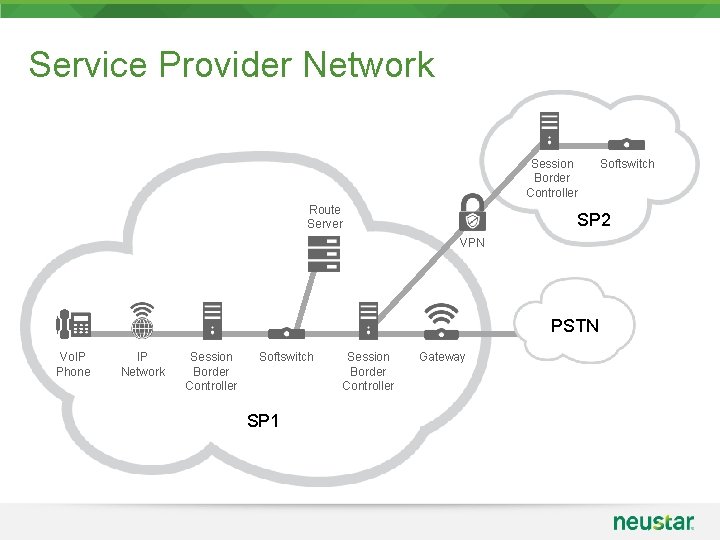
Service Provider Network Session Border Controller Route Server SP 2 VPN PSTN Vo. IP Phone IP Network Session Border Controller Softswitch SP 1 Session Border Controller Softswitch Gateway
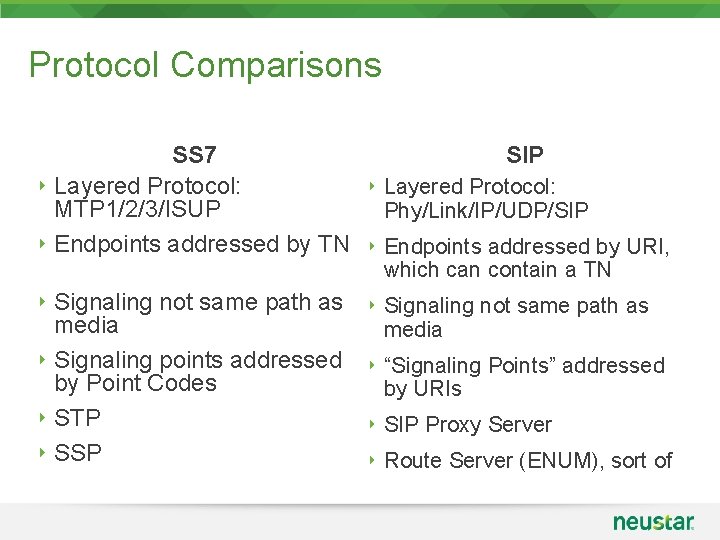
Protocol Comparisons SS 7 SIP ‣ Layered Protocol: MTP 1/2/3/ISUP Phy/Link/IP/UDP/SIP ‣ Endpoints addressed by TN ‣ Endpoints addressed by URI, which can contain a TN ‣ Signaling not same path as media ‣ Signaling points addressed by Point Codes ‣ STP ‣ SSP ‣ Signaling not same path as media ‣ “Signaling Points” addressed by URIs ‣ SIP Proxy Server ‣ Route Server (ENUM), sort of
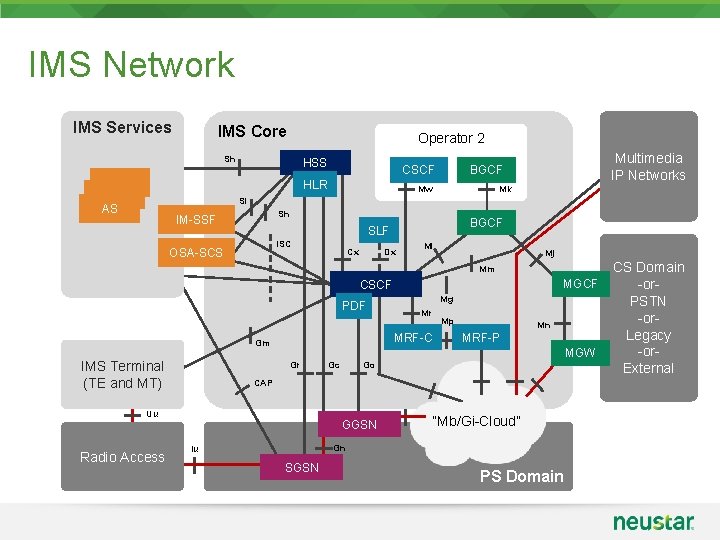
IMS Network IMS Services IMS Core Operator 2 Sh HSS CSCF HLR Multimedia IP Networks BGCF Mw Mk Si AS Sh IM-SSF BGCF SLF ISC OSA-SCS Cx Dx Mi Mj Mm MGCF CSCF PDF Gr Gc Mp Mn MRF-P MGW Go CAP Uu Radio Access Mr MRF-C Gm IMS Terminal (TE and MT) Mg GGSN “Mb/Gi-Cloud” Gn Iu SGSN PS Domain CS Domain -or. PSTN -or. Legacy -or. External
Routing ‣ Today, routing is direct: TN to termination switch ‣ There are medium term proposals to use two steps: TN to effectively SPID, SPID to POI, using ENUM ‣ Both of these are not effective because optimal POI depends on dynamic factors: – Who the originating and termination SP are – Where the caller and called parties are (in network terms) – What the current load and failure conditions are ‣ Routing therefore needs the first step (TN to SPID), but then needs a negotiation between origination and termination parties to determine the optimal route ‣ This is very straightforward computer stuff, not requiring any technology that isn’t ho-hum. ‣ But it’s not just a database – it’s an algorithm and a set of metrics dynamically determined
- Slides: 29