Power Management in IEEE 802 11 YuChee Tseng
- Slides: 30
Power Management in IEEE 802. 11 Yu-Chee Tseng 1/23
Motivation n n Since mobile hosts are supported by battery power, saving battery as much as possible is very important. Power management in 802. 11 n n in infrastructure network vs. ad hoc network PCF vs. DCF 2
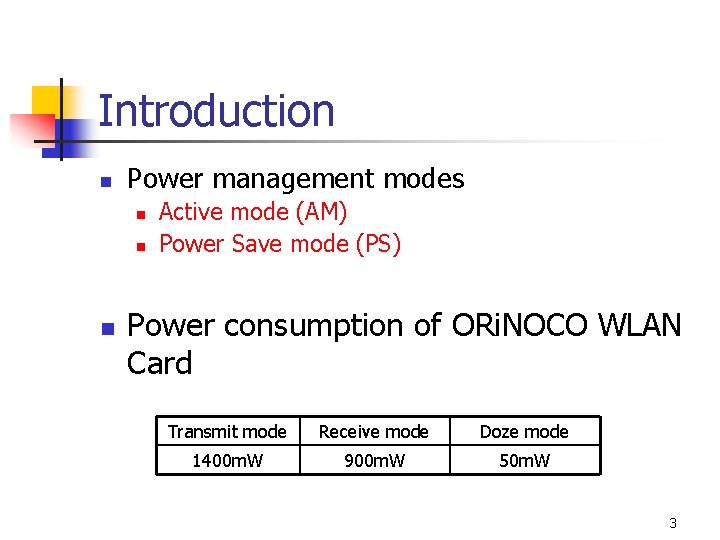
Introduction n Power management modes n n n Active mode (AM) Power Save mode (PS) Power consumption of ORi. NOCO WLAN Card Transmit mode Receive mode Doze mode 1400 m. W 900 m. W 50 m. W 3
Basic Idea n AP or source hosts buffer packets for hosts in PS mode. n AP or sources send TIM periodically. n n n TIM = traffic indication map (a partial virtual bitmap associated with station id) TIM is associated with beacon. Hosts in PS mode only turn on antenna when necessary. n Hosts in PS mode only “wake up” to monitor TIM. 4
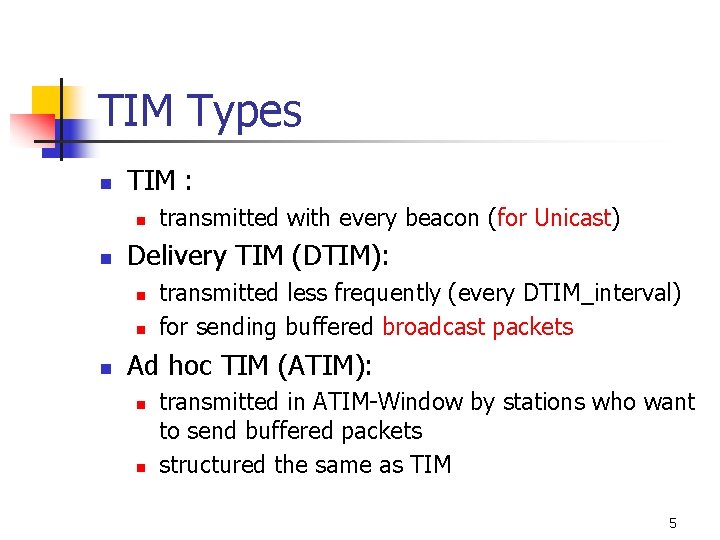
TIM Types n TIM : n n Delivery TIM (DTIM): n n n transmitted with every beacon (for Unicast) transmitted less frequently (every DTIM_interval) for sending buffered broadcast packets Ad hoc TIM (ATIM): n n transmitted in ATIM-Window by stations who want to send buffered packets structured the same as TIM 5
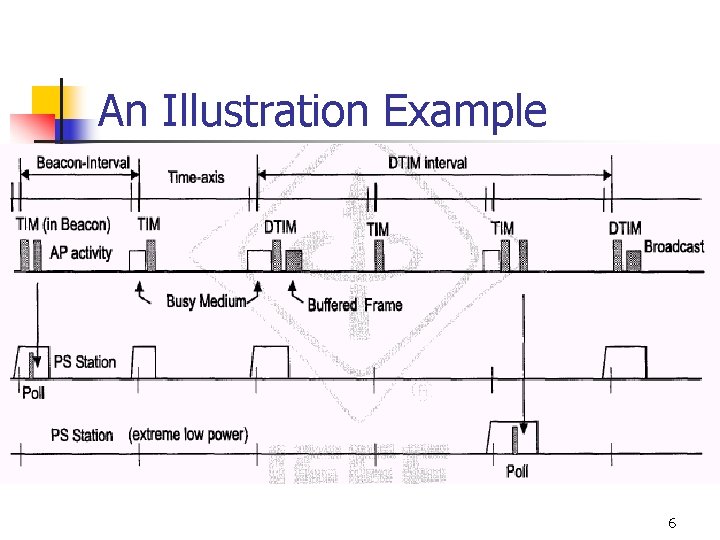
An Illustration Example 6
Access Sequences immediate response n immediate response with fragmentation n deferred response n 7/23
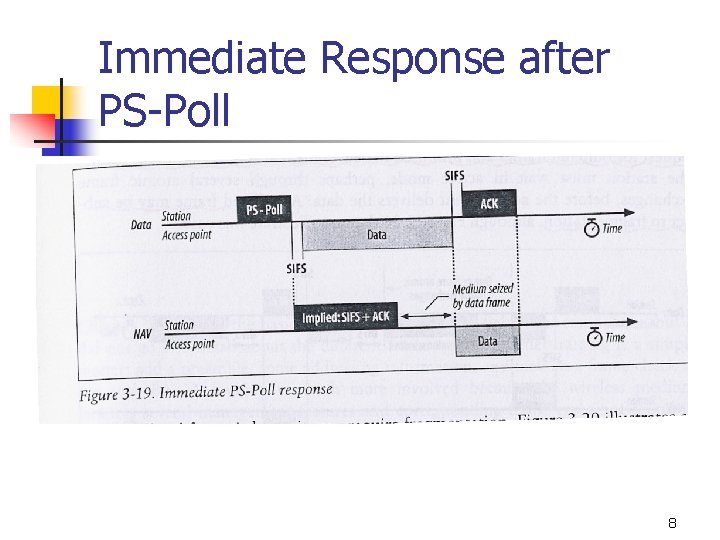
Immediate Response after PS-Poll n fig. 3 -19 8
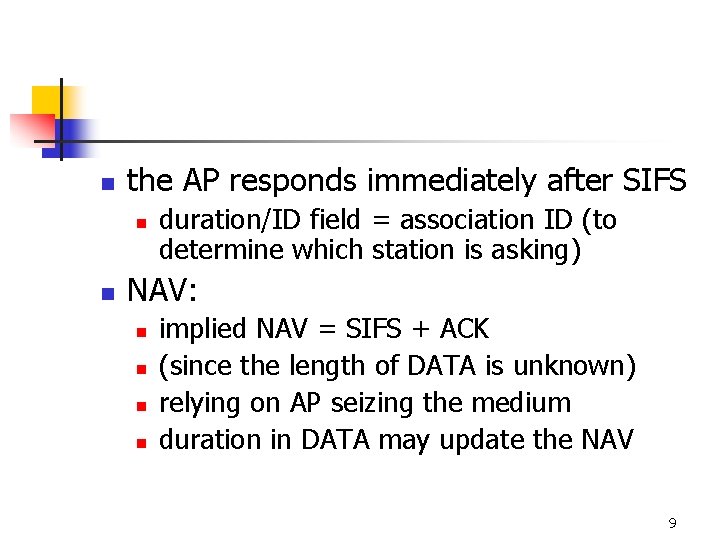
n the AP responds immediately after SIFS n n duration/ID field = association ID (to determine which station is asking) NAV: n n implied NAV = SIFS + ACK (since the length of DATA is unknown) relying on AP seizing the medium duration in DATA may update the NAV 9
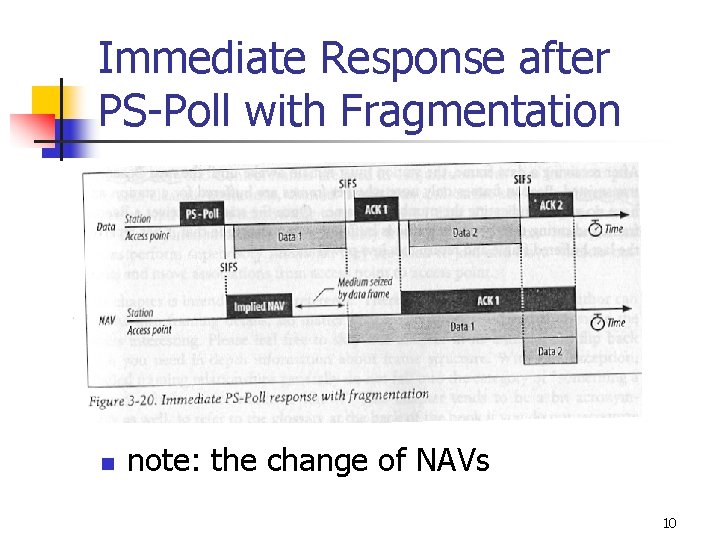
Immediate Response after PS-Poll with Fragmentation n fig. 3 -20 n note: the change of NAVs 10
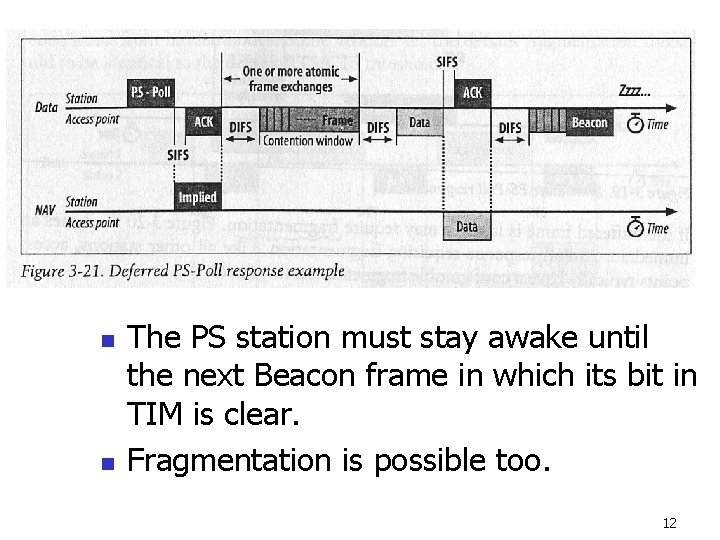
Deferred Response n After being polled, the AP may decide to respond with a simple ACK. n n n although promised, AP does not act immediately AP may do regular DCF activities the PS station must remain awake until it is delivered n under DCF, the packets may be delivered at any time 11
n n n fig. 3 -21 The PS station must stay awake until the next Beacon frame in which its bit in TIM is clear. Fragmentation is possible too. 12
PS in Infrastructure Network 13/23
PS in Infrastructure Network n Assumptions: n TIM interval (beacon interval) and DTIM interval are known by all hosts n n n requires time synchronization Stations in PS mode are known or can be predicted. Two Operational Models: n n under DCF (contention-based) under PCF (contention-free) 14
Under DCF (Infrastructure Mode) n Basic assumption: n n use CSMA/CA to access the channel RTS, CTS, ACK, PS-Poll are used to overcome the hidden-terminal problem 15
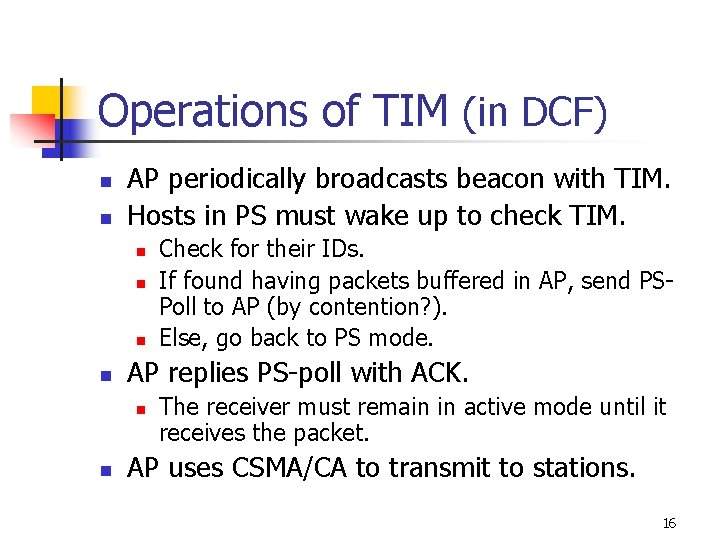
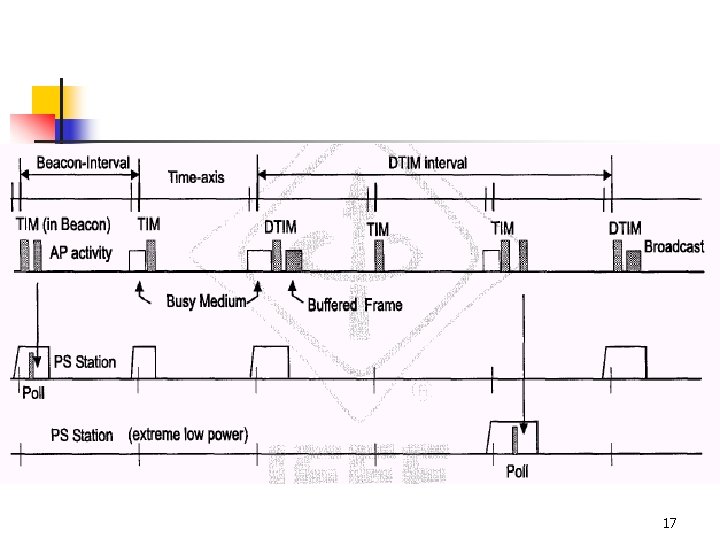
Operations of TIM (in DCF) n n AP periodically broadcasts beacon with TIM. Hosts in PS must wake up to check TIM. n n AP replies PS-poll with ACK. n n Check for their IDs. If found having packets buffered in AP, send PSPoll to AP (by contention? ). Else, go back to PS mode. The receiver must remain in active mode until it receives the packet. AP uses CSMA/CA to transmit to stations. 16
17
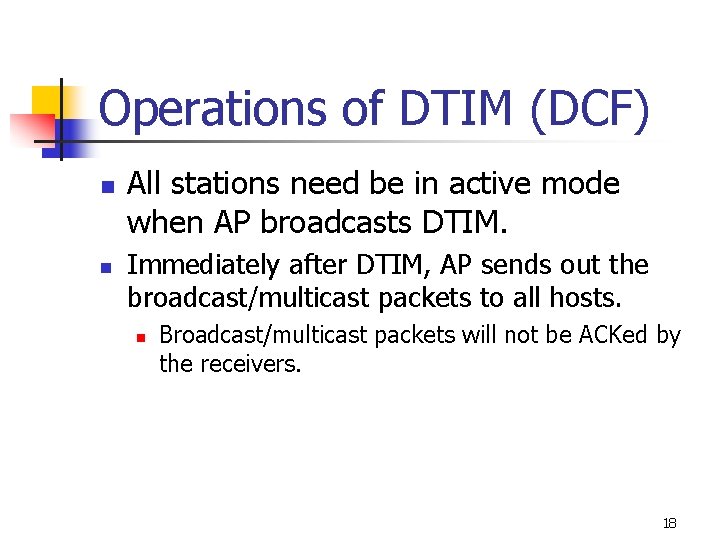
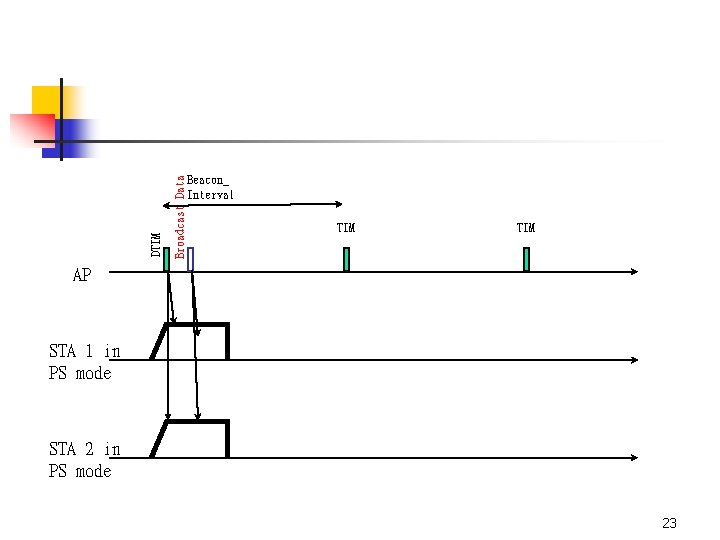
Operations of DTIM (DCF) n n All stations need be in active mode when AP broadcasts DTIM. Immediately after DTIM, AP sends out the broadcast/multicast packets to all hosts. n Broadcast/multicast packets will not be ACKed by the receivers. 18
Under PCF (Infrastructure Mode) n Basic Assumption: n n Point coordinator uses CF-Polling to access the channel. AP only maintains the CF-Pollable stations. 19
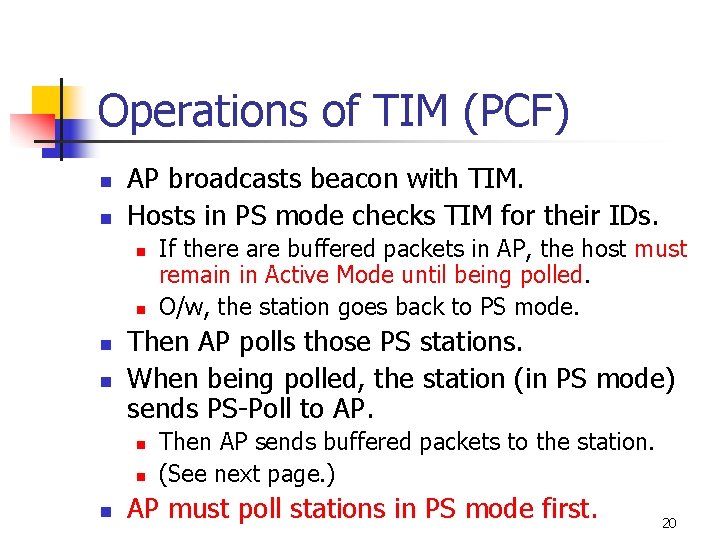
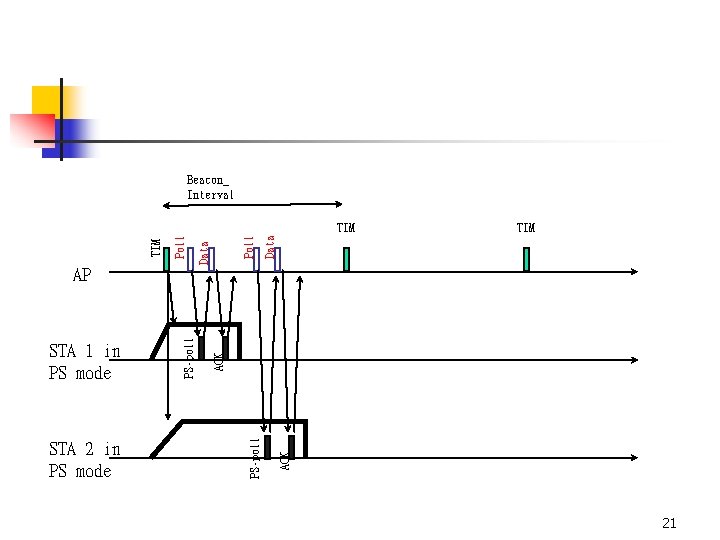
Operations of TIM (PCF) n n AP broadcasts beacon with TIM. Hosts in PS mode checks TIM for their IDs. n n Then AP polls those PS stations. When being polled, the station (in PS mode) sends PS-Poll to AP. n n n If there are buffered packets in AP, the host must remain in Active Mode until being polled. O/w, the station goes back to PS mode. Then AP sends buffered packets to the station. (See next page. ) AP must poll stations in PS mode first. 20
Beacon_ Interval TIM Data Poll TIM ACK PS-poll STA 2 in PS mode ACK STA 1 in PS mode PS-poll AP 21
Operations of DTIM (PCF) n n All CF-pollable stations need be in Active Mode when AP broadcasts DTIM. Immediately after DTIM, AP sends out the buffered broadcast/multicast packets. 22
Broadcast Data DTIM Beacon_ Interval TIM AP STA 1 in PS mode STA 2 in PS mode 23
PS in Ad Hoc Mode (without base station) 24/23
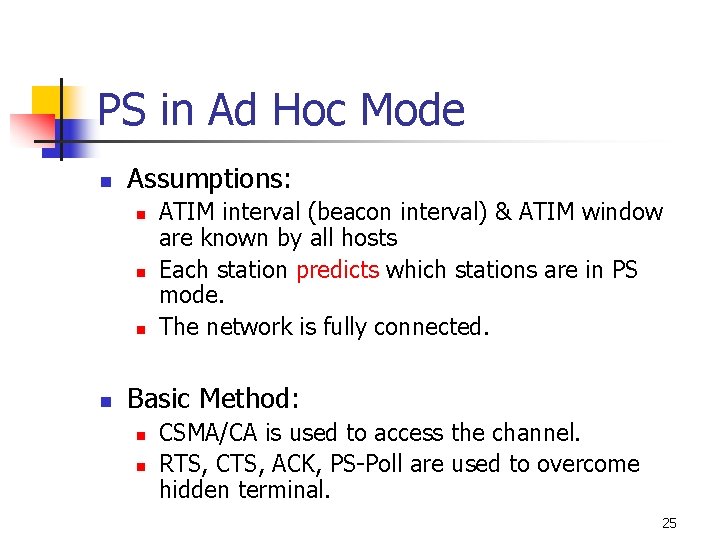
PS in Ad Hoc Mode n Assumptions: n n ATIM interval (beacon interval) & ATIM window are known by all hosts Each station predicts which stations are in PS mode. The network is fully connected. Basic Method: n n CSMA/CA is used to access the channel. RTS, CTS, ACK, PS-Poll are used to overcome hidden terminal. 25
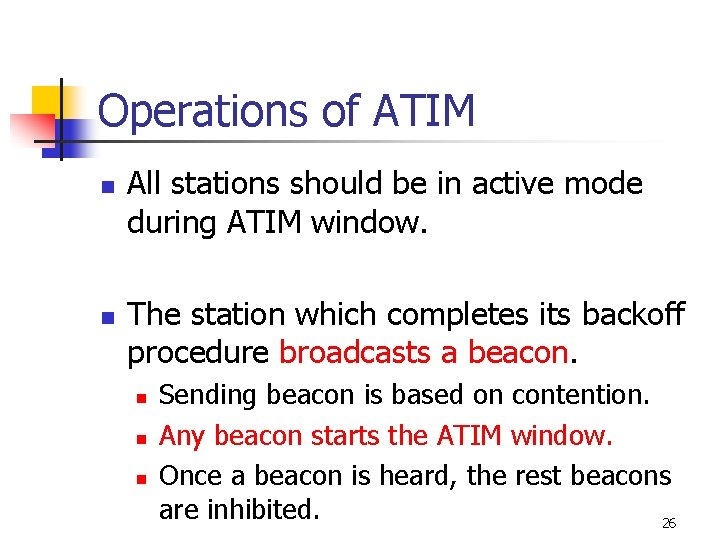
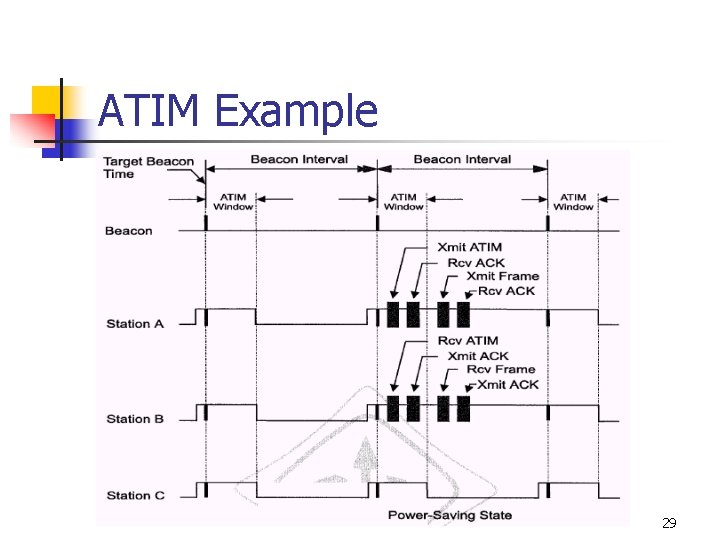
Operations of ATIM n n All stations should be in active mode during ATIM window. The station which completes its backoff procedure broadcasts a beacon. n n n Sending beacon is based on contention. Any beacon starts the ATIM window. Once a beacon is heard, the rest beacons are inhibited. 26
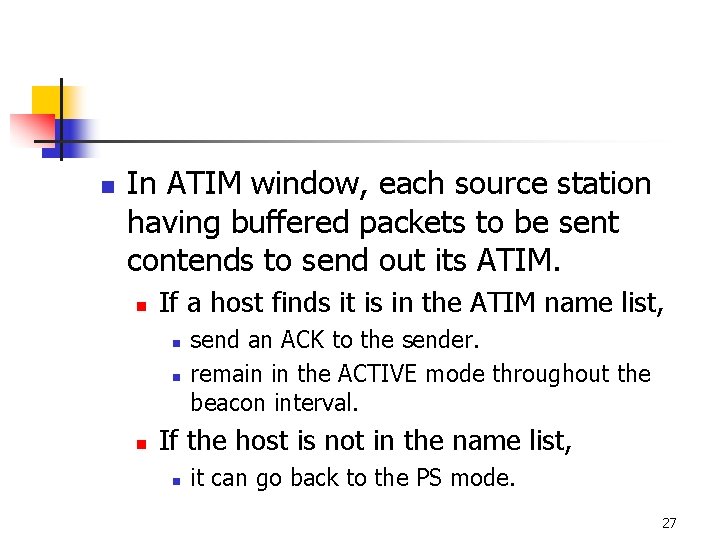
n In ATIM window, each source station having buffered packets to be sent contends to send out its ATIM. n If a host finds it is in the ATIM name list, n n n send an ACK to the sender. remain in the ACTIVE mode throughout the beacon interval. If the host is not in the name list, n it can go back to the PS mode. 27
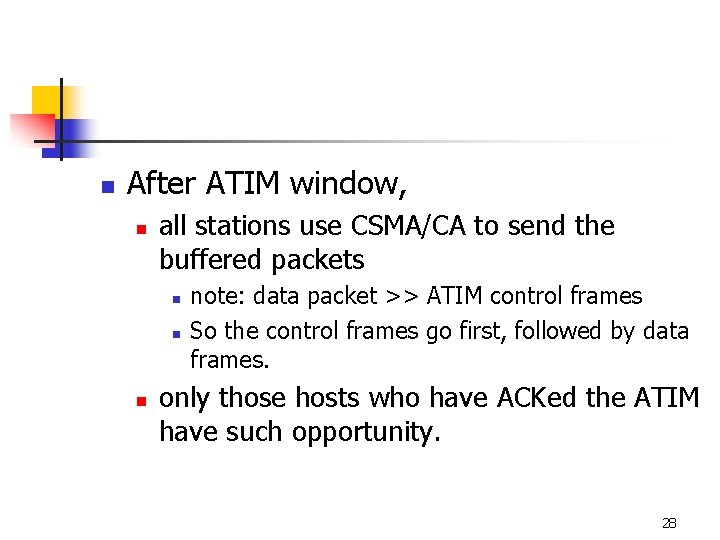
n After ATIM window, n all stations use CSMA/CA to send the buffered packets n note: data packet >> ATIM control frames So the control frames go first, followed by data frames. only those hosts who have ACKed the ATIM have such opportunity. 28
ATIM Example 29
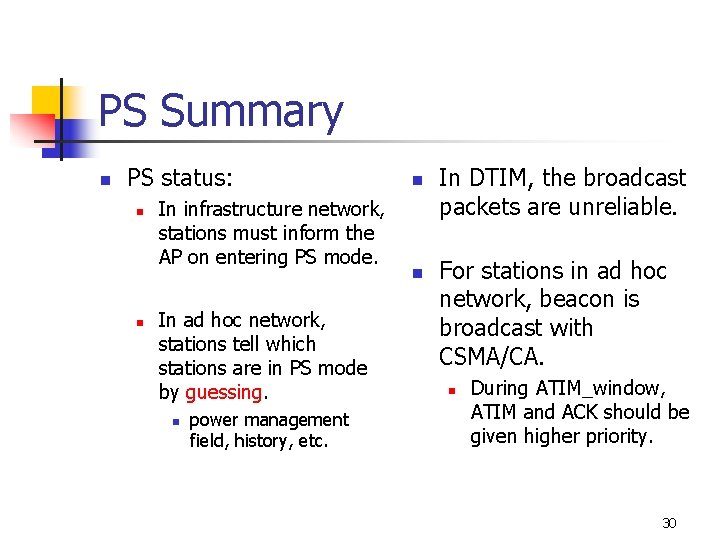
PS Summary n PS status: n n In infrastructure network, stations must inform the AP on entering PS mode. In ad hoc network, stations tell which stations are in PS mode by guessing. n power management field, history, etc. n n In DTIM, the broadcast packets are unreliable. For stations in ad hoc network, beacon is broadcast with CSMA/CA. n During ATIM_window, ATIM and ACK should be given higher priority. 30