From Wireless Transmission to Wireless Networking YuChee Tseng
- Slides: 16
From Wireless Transmission to Wireless Networking Yu-Chee Tseng CS/NCTU 1
Outline n n n History Wireless Network Architecture Benefits of Wireless Networks Concerns of Wireless Communication Wireless Spectrum 2
History of Wireless Networks n Progress of transmission: n n Traditional networks (LAN, MAN, WAN) have provided great convenience: n n n fire and smoke used by Indians ==> messenger on horseback ==> telephone line ==> networks in office, hotel room, or home. But you cannot utilize the service unless you are physically connected to a LAN or a telephone line. ALOHANET by Univ. of Hawaii: n 7 campuses over 4 islands; star-like structure centered at the Oahu island. 3
Progress of Wireless Comm. (cont. ) n In 1985, FCC authorized the use of ISM bands for Industrial, Scientific, and Medical for commercial development. n n n ISM bands = 902 MHz and 5. 85 GHz ISM is very attractive to vendors because NO obtaining FCC license is required. In 80’s, small-size computers started to appear. n n laptop, palmtop, PDA Wireless LAN products populate 4
Standardization and Promotion n wireless LAN: n n n wireless WAN: n n IEEE 802. 11 standard was finalized in July 1997. IEEE 802. 11 a, b, e, g, i, p, r, etc. Packet radio networks (e. g. , RAM) Personal Communication Service (PCS): n n 1. 9 GHz sold $7. 7 billion to TV company in 1995 by VP Al Gore. $15 billion in 1996. 5
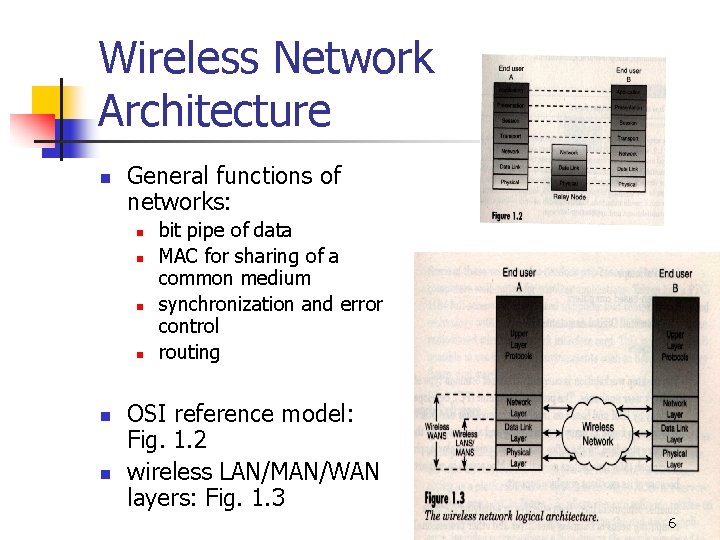
Wireless Network Architecture n General functions of networks: n n n bit pipe of data MAC for sharing of a common medium synchronization and error control routing OSI reference model: Fig. 1. 2 wireless LAN/MAN/WAN layers: Fig. 1. 3 6
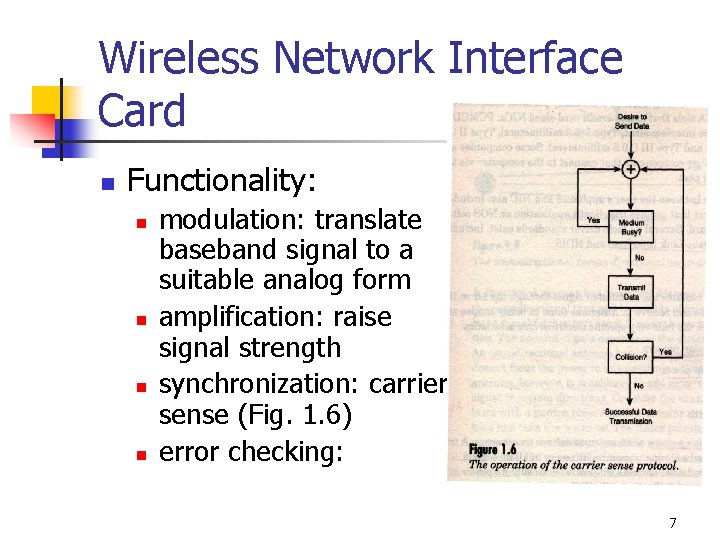
Wireless Network Interface Card n Functionality: n n modulation: translate baseband signal to a suitable analog form amplification: raise signal strength synchronization: carrier sense (Fig. 1. 6) error checking: 7
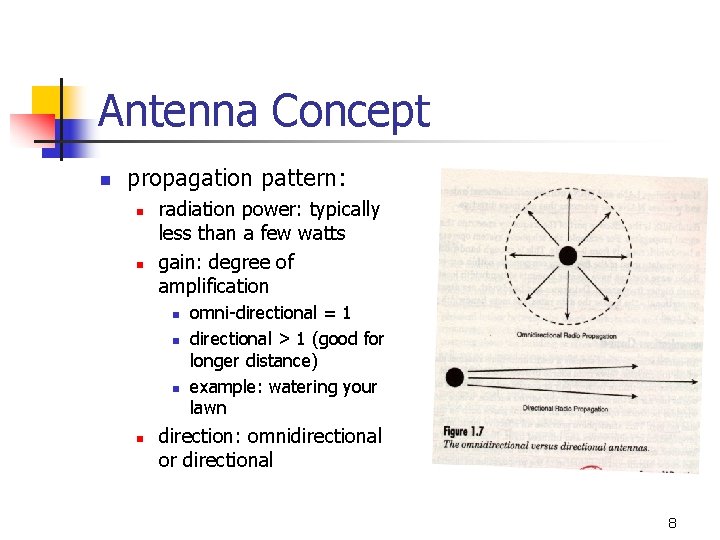
Antenna Concept n propagation pattern: n n radiation power: typically less than a few watts gain: degree of amplification n n omni-directional = 1 directional > 1 (good for longer distance) example: watering your lawn direction: omnidirectional or directional 8
Communication Channel n Air n n Pure nitrogen and oxygen are effective for transmission. rain, fog, snow are obstacles. n Space n Water 9
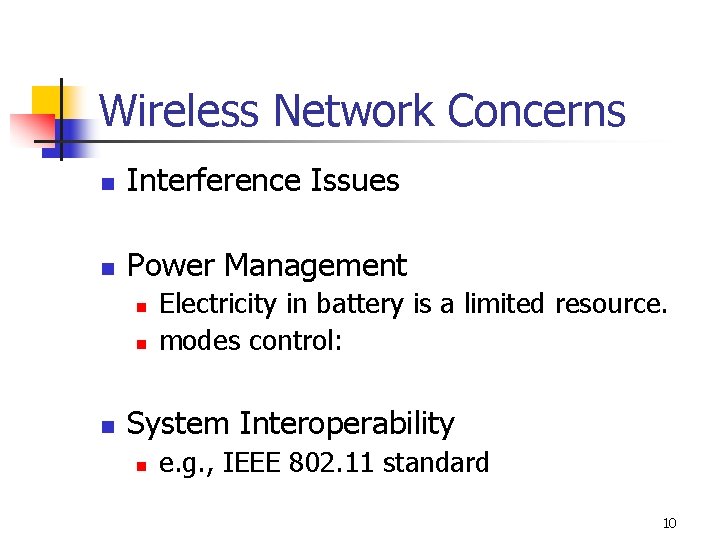
Wireless Network Concerns n Interference Issues n Power Management n n n Electricity in battery is a limited resource. modes control: System Interoperability n e. g. , IEEE 802. 11 standard 10
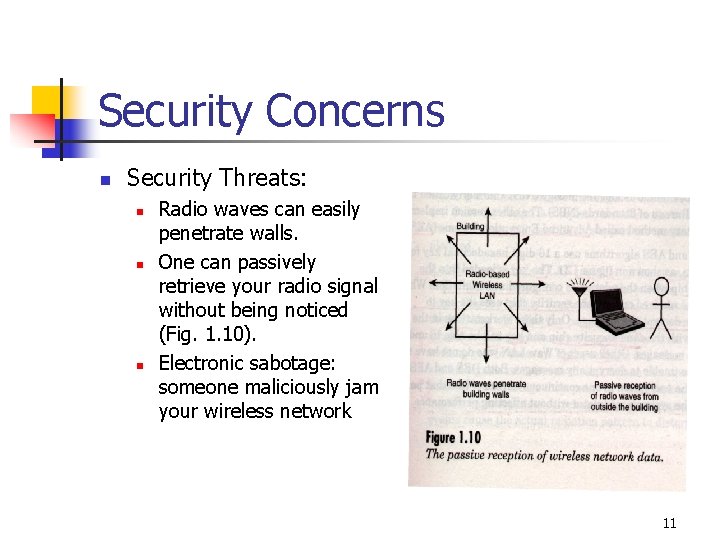
Security Concerns n Security Threats: n n n Radio waves can easily penetrate walls. One can passively retrieve your radio signal without being noticed (Fig. 1. 10). Electronic sabotage: someone maliciously jam your wireless network 11
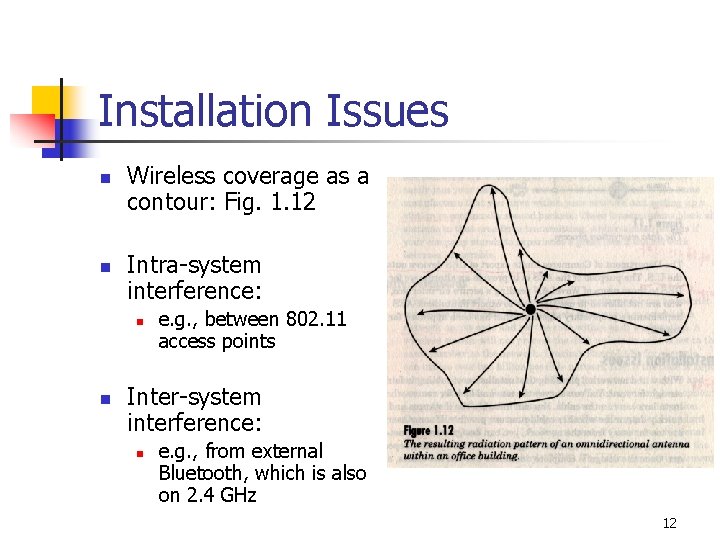
Installation Issues n n Wireless coverage as a contour: Fig. 1. 12 Intra-system interference: n n e. g. , between 802. 11 access points Inter-system interference: n e. g. , from external Bluetooth, which is also on 2. 4 GHz 12
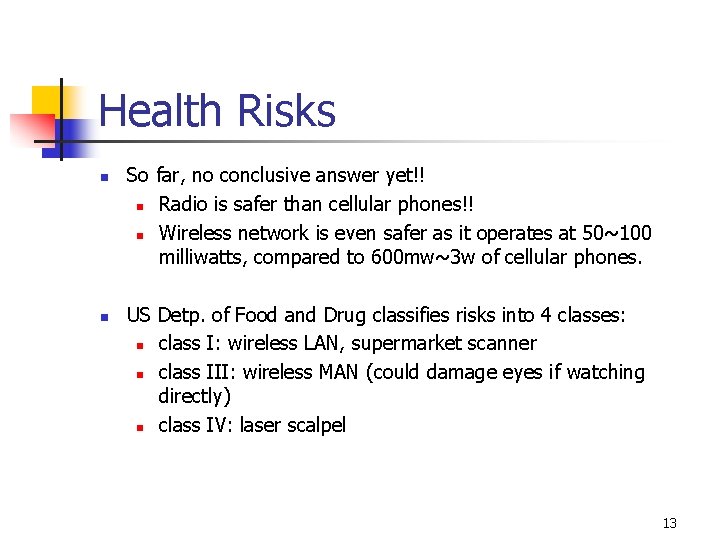
Health Risks n n So far, no conclusive answer yet!! n Radio is safer than cellular phones!! n Wireless network is even safer as it operates at 50~100 milliwatts, compared to 600 mw~3 w of cellular phones. US Detp. of Food and Drug classifies risks into 4 classes: n class I: wireless LAN, supermarket scanner n class III: wireless MAN (could damage eyes if watching directly) n class IV: laser scalpel 13
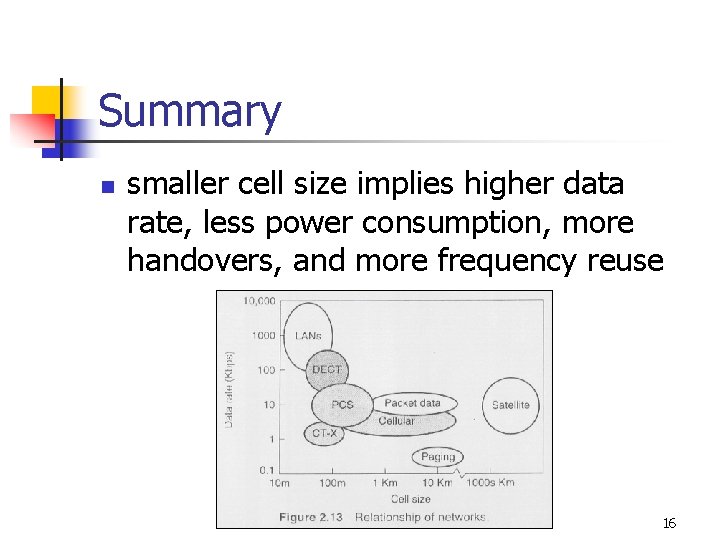
Cell Size vs. Throughput n n n Cell sizes can vary from tens of meters to thousands of kilometers. Data rates may range from 0. 1 K to 50 Mbps Examples: n n n LAN: high rate (11 M), small range (50 m) Satellite: low rate (10 K), extremely large range (1000 Km) Paging: very low rate (1 Kbps), large cell (10 s of Km) 14
n Examples: (cont. ) n Packet Radio Networks: n n n CT-2: n n n cell size can be 10 s of km data rate: 10 to 20 Kbps cell size: 100 meters date rate: order of 10 Kbps PCS: n n cell size: 100 meters to 10 s of km data rate: order of 100 Kbps 15
Summary n smaller cell size implies higher data rate, less power consumption, more handovers, and more frequency reuse 16