How to Write a Technical Report YuChee Tseng


- Slides: 12
How to Write a Technical Report? Yu-Chee Tseng CS/NCTU
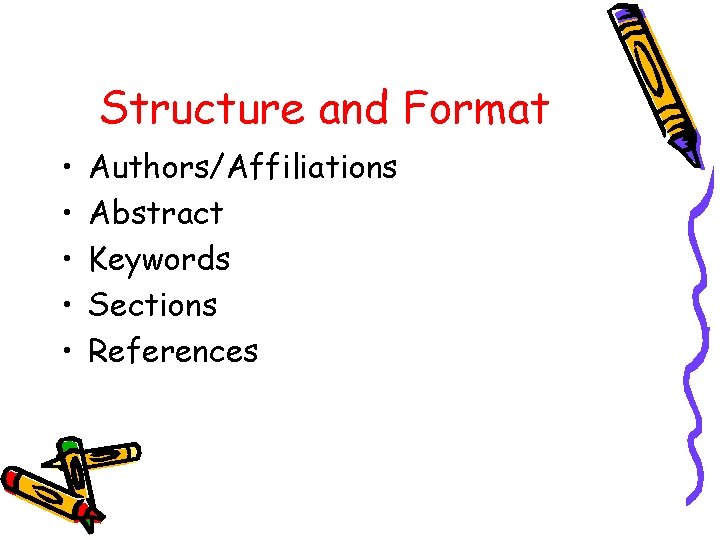
Structure and Format • • • Authors/Affiliations Abstract Keywords Sections References
Abstract • Goals • Contributions • Main Approaches … something that one can remember after reading once
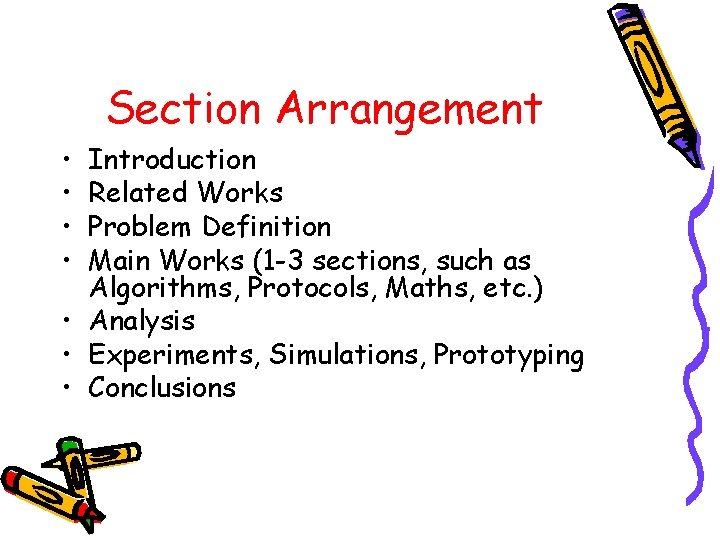
Section Arrangement • • Introduction Related Works Problem Definition Main Works (1 -3 sections, such as Algorithms, Protocols, Maths, etc. ) • Analysis • Experiments, Simulations, Prototyping • Conclusions
Introduction • • technical trends (with citations) applications (with citations) user scenarios (with citations) general related works (with citations) specific related works (with citations) my goal my achievement outline of this report
Related Works • generally related • specifically related • highly related (which we will compare to) • classification of related works
Problem Definition • Statement of the problem to be solved • Use of symbols, notations, equations are very important. • Objective: such as maximize/minimize something • Evaluation metrics (such as speed, network throughput, power consumption, etc. )
Main Work • Around 1 to 3 sections – algorithms, protocols, etc. • Be well-structured – top-down – give overall architecture – step-by-step
Analysis/Simulation/etc. • 1 to 2 sections about – – math, analytical results experimental results simulation results prototyping, testing results • Comparison targets – at least 1, but not too many
Conclusions • 1 – 3 paragraphs – what you have done (being proud of) – how come it is better – future directions
Bibliography • 10 to 40 references • be aware of the format
Homework #0 • 請上網找一至三篇IEEE Transactions on Mobile Computing論文, 寫一份有關論文 大綱的報告.