Power Authority and Legitimacy AP US Government and
- Slides: 41
Power, Authority, and Legitimacy AP US Government and Politics
Examination of Power Give me an example of the use of power. Someone forces you to do something because they are bigger, stronger, or have more money than you. Give me an example of authority. Power, combined with the right to use it.
1. What is the most powerful form of power: government, military, political, economic, etc? 1. In what ways does one exercise power? 1. Who is the most powerful person in: ○ The world? ○ This country? ○ Our area? ○ Hamilton High School? ○ This class (not including the teacher!)?
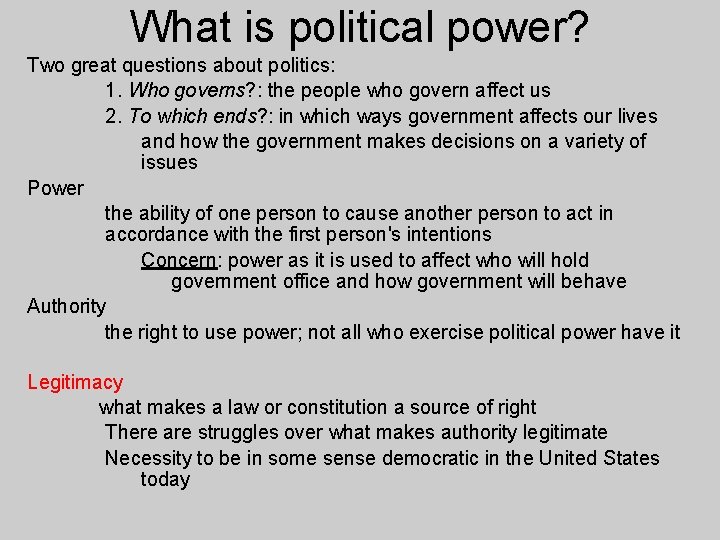
What is political power? Two great questions about politics: 1. Who governs? : the people who govern affect us 2. To which ends? : in which ways government affects our lives and how the government makes decisions on a variety of issues Power the ability of one person to cause another person to act in accordance with the first person's intentions Concern: power as it is used to affect who will hold government office and how government will behave Authority the right to use power; not all who exercise political power have it Legitimacy what makes a law or constitution a source of right There are struggles over what makes authority legitimate Necessity to be in some sense democratic in the United States today
Where does authority come from? • Customs and traditions • Law • Religious Principles or Morality
Why do certain people have the right to exercise authority? • God-given right • Inherited from birth • Superior knowledge • Consent of the governed
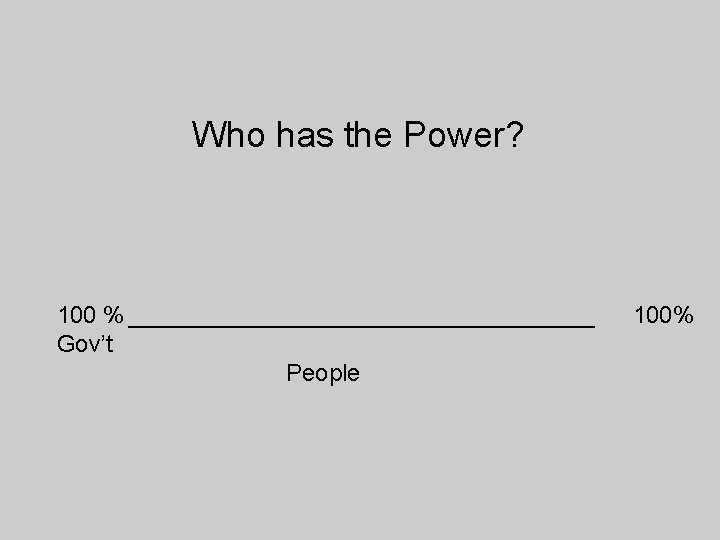
Who has the Power? 100 % __________________ Gov’t People 100%
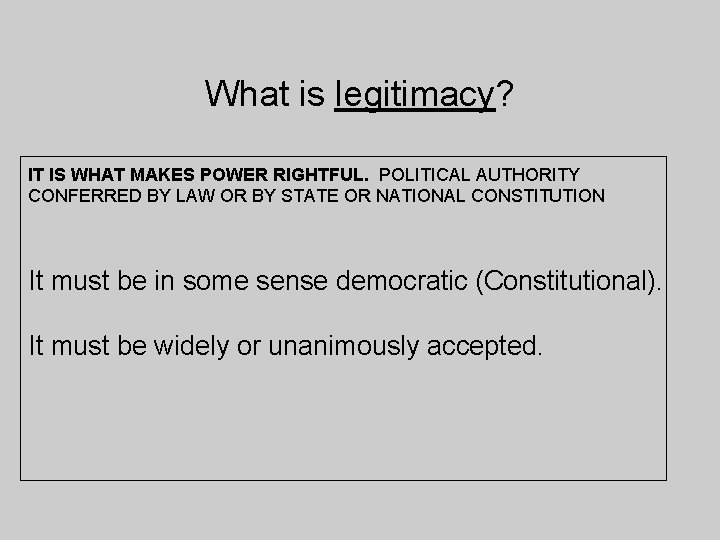
What is legitimacy? IT IS WHAT MAKES POWER RIGHTFUL. POLITICAL AUTHORITY CONFERRED BY LAW OR BY STATE OR NATIONAL CONSTITUTION It must be in some sense democratic (Constitutional). It must be widely or unanimously accepted.
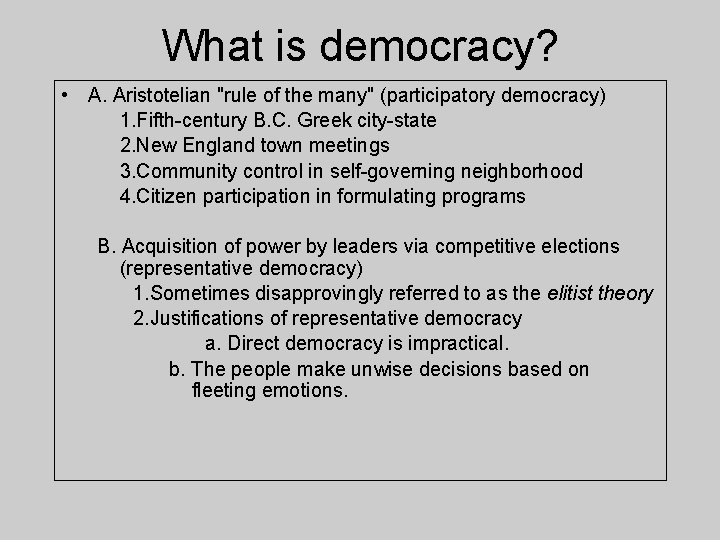
What is democracy? • A. Aristotelian "rule of the many" (participatory democracy) 1. Fifth-century B. C. Greek city-state 2. New England town meetings 3. Community control in self-governing neighborhood 4. Citizen participation in formulating programs B. Acquisition of power by leaders via competitive elections (representative democracy) 1. Sometimes disapprovingly referred to as the elitist theory 2. Justifications of representative democracy a. Direct democracy is impractical. b. The people make unwise decisions based on fleeting emotions.
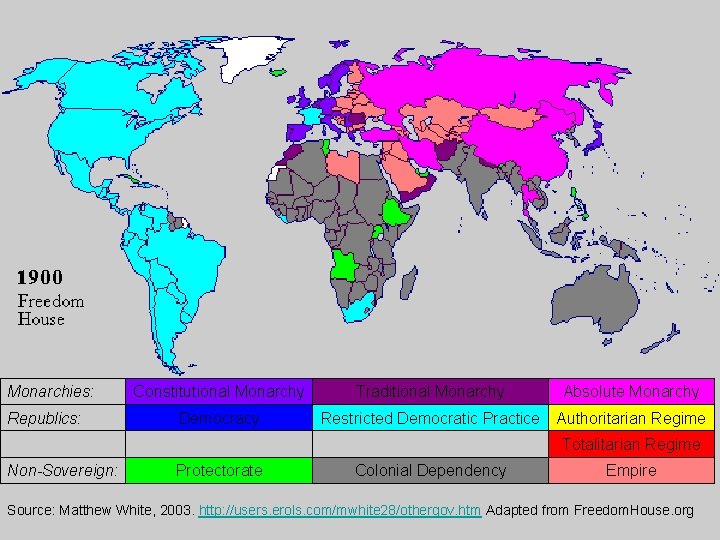
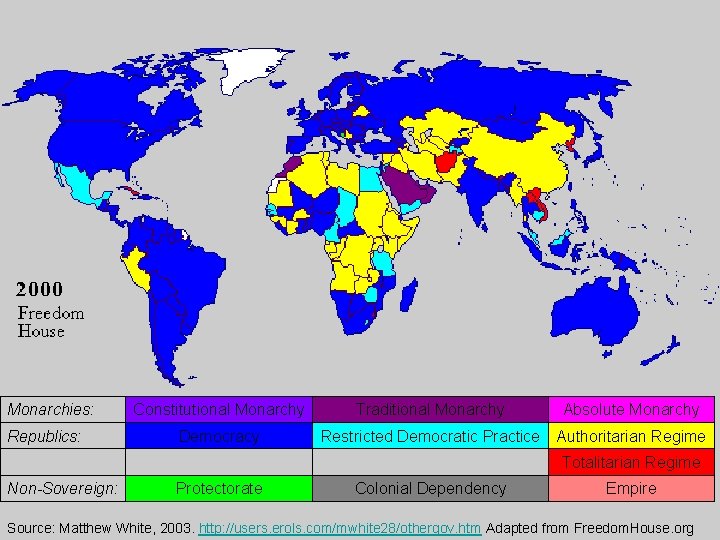
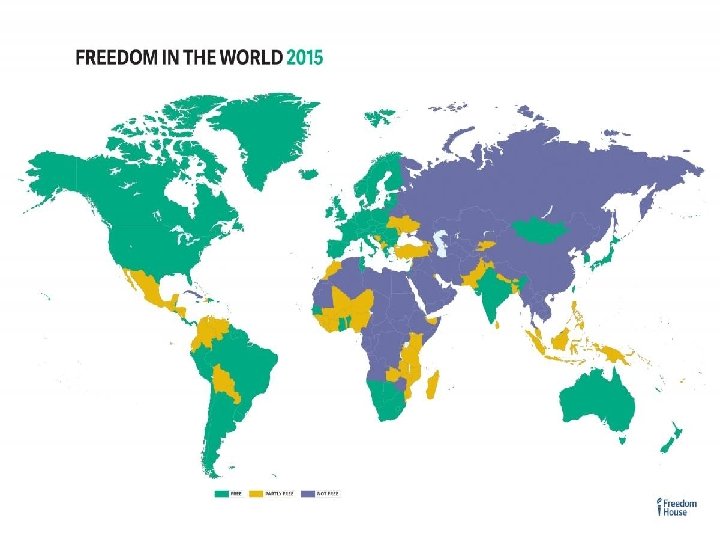
Monarchies: Republics: Constitutional Monarchy Democracy Traditional Monarchy Absolute Monarchy Restricted Democratic Practice Authoritarian Regime Totalitarian Regime Non-Sovereign: Protectorate Colonial Dependency Empire Source: Matthew White, 2003. http: //users. erols. com/mwhite 28/othergov. htm Adapted from Freedom. House. org
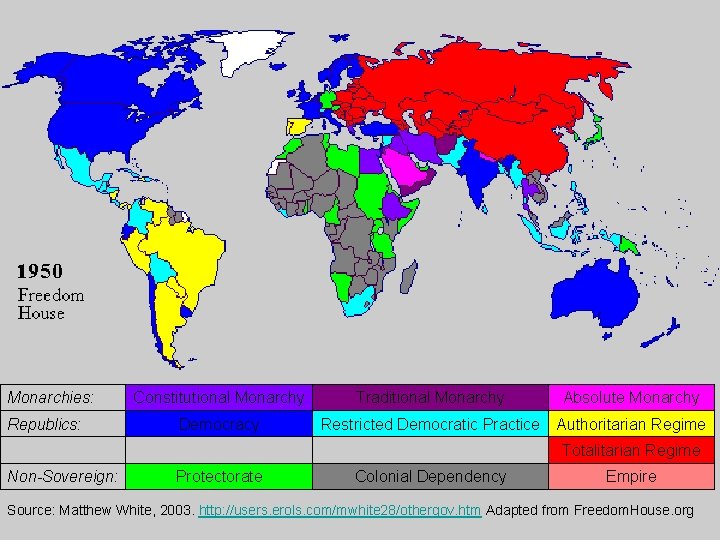
Monarchies: Republics: Constitutional Monarchy Democracy Traditional Monarchy Absolute Monarchy Restricted Democratic Practice Authoritarian Regime Totalitarian Regime Non-Sovereign: Protectorate Colonial Dependency Empire Source: Matthew White, 2003. http: //users. erols. com/mwhite 28/othergov. htm Adapted from Freedom. House. org
Monarchies: Republics: Constitutional Monarchy Democracy Traditional Monarchy Absolute Monarchy Restricted Democratic Practice Authoritarian Regime Totalitarian Regime Non-Sovereign: Protectorate Colonial Dependency Empire Source: Matthew White, 2003. http: //users. erols. com/mwhite 28/othergov. htm Adapted from Freedom. House. org
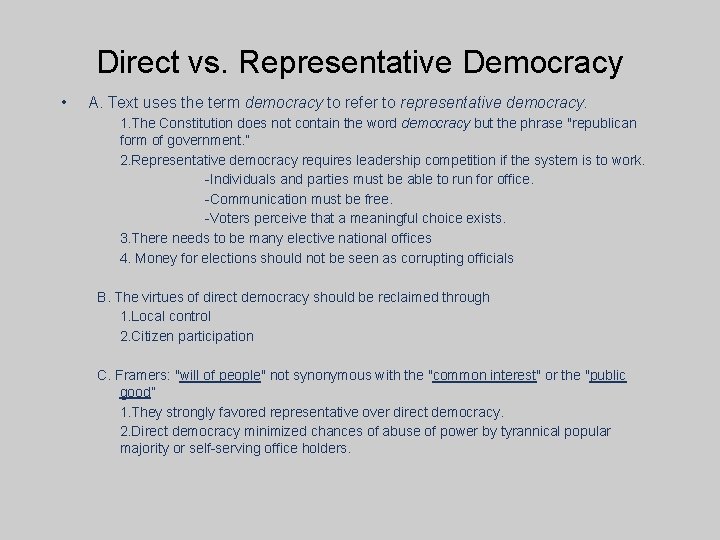
Direct vs. Representative Democracy • A. Text uses the term democracy to refer to representative democracy. 1. The Constitution does not contain the word democracy but the phrase "republican form of government. ” 2. Representative democracy requires leadership competition if the system is to work. -Individuals and parties must be able to run for office. -Communication must be free. -Voters perceive that a meaningful choice exists. 3. There needs to be many elective national offices 4. Money for elections should not be seen as corrupting officials B. The virtues of direct democracy should be reclaimed through 1. Local control 2. Citizen participation C. Framers: "will of people" not synonymous with the "common interest" or the "public good” 1. They strongly favored representative over direct democracy. 2. Direct democracy minimized chances of abuse of power by tyrannical popular majority or self-serving office holders.
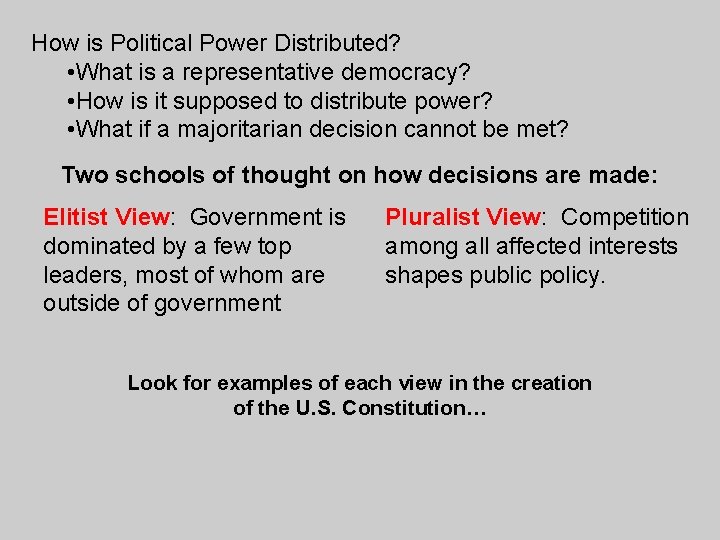
How is Political Power Distributed? • What is a representative democracy? • How is it supposed to distribute power? • What if a majoritarian decision cannot be met? Two schools of thought on how decisions are made: Elitist View: Government is dominated by a few top leaders, most of whom are outside of government Pluralist View: Competition among all affected interests shapes public policy. Look for examples of each view in the creation of the U. S. Constitution…
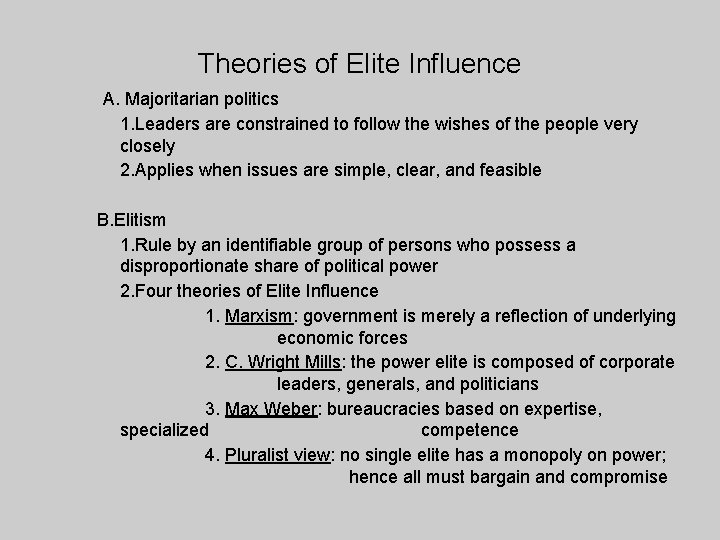
Theories of Elite Influence A. Majoritarian politics 1. Leaders are constrained to follow the wishes of the people very closely 2. Applies when issues are simple, clear, and feasible B. Elitism 1. Rule by an identifiable group of persons who possess a disproportionate share of political power 2. Four theories of Elite Influence 1. Marxism: government is merely a reflection of underlying economic forces 2. C. Wright Mills: the power elite is composed of corporate leaders, generals, and politicians 3. Max Weber: bureaucracies based on expertise, specialized competence 4. Pluralist view: no single elite has a monopoly on power; hence all must bargain and compromise
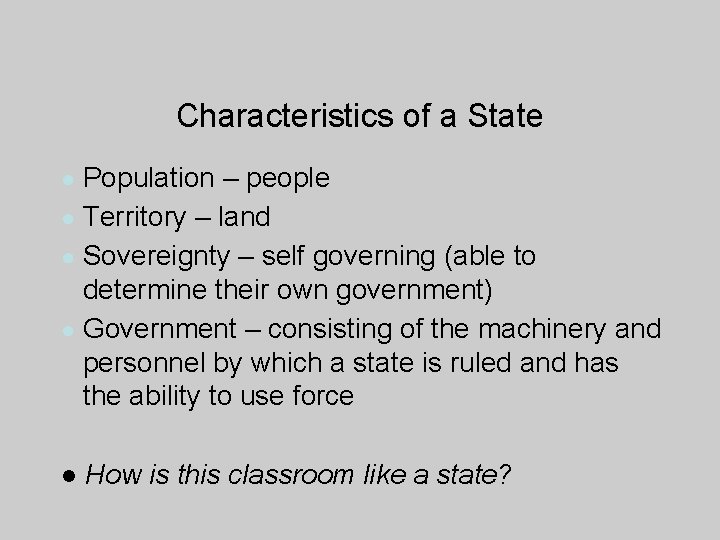
Characteristics of a State ● Population – people ● Territory – land ● Sovereignty – self governing (able to determine their own government) ● Government – consisting of the machinery and personnel by which a state is ruled and has the ability to use force ● How is this classroom like a state?
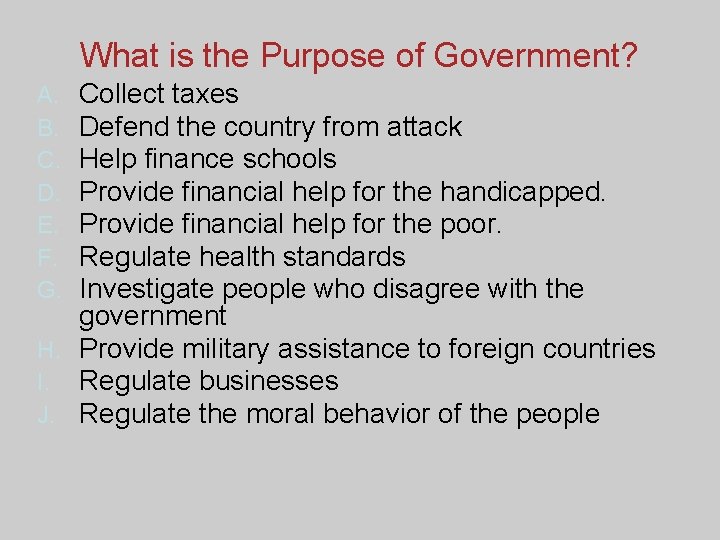
What is the Purpose of Government? Collect taxes Defend the country from attack Help finance schools Provide financial help for the handicapped. Provide financial help for the poor. Regulate health standards Investigate people who disagree with the government H. Provide military assistance to foreign countries I. Regulate businesses J. Regulate the moral behavior of the people A. B. C. D. E. F. G.
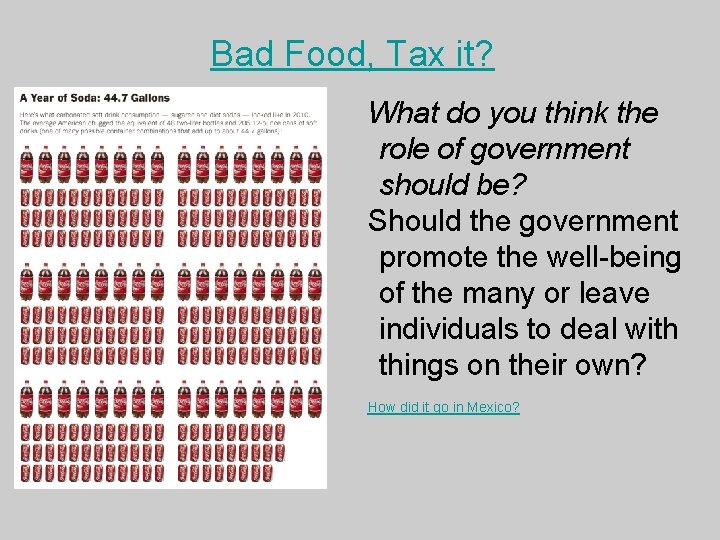
Bad Food, Tax it? What do you think the role of government should be? Should the government promote the well-being of the many or leave individuals to deal with things on their own? How did it go in Mexico?
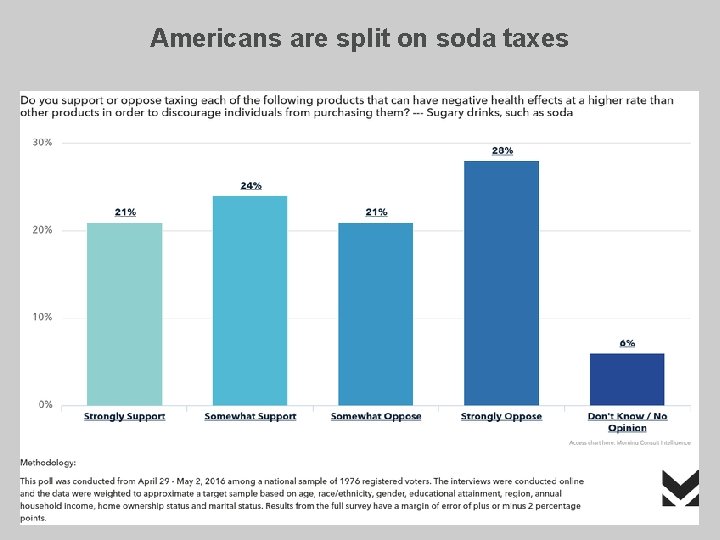
Americans are split on soda taxes
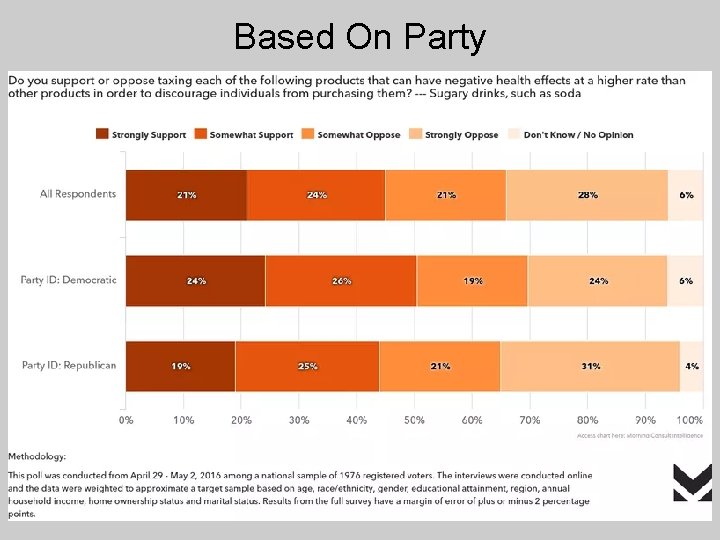
Based On Party
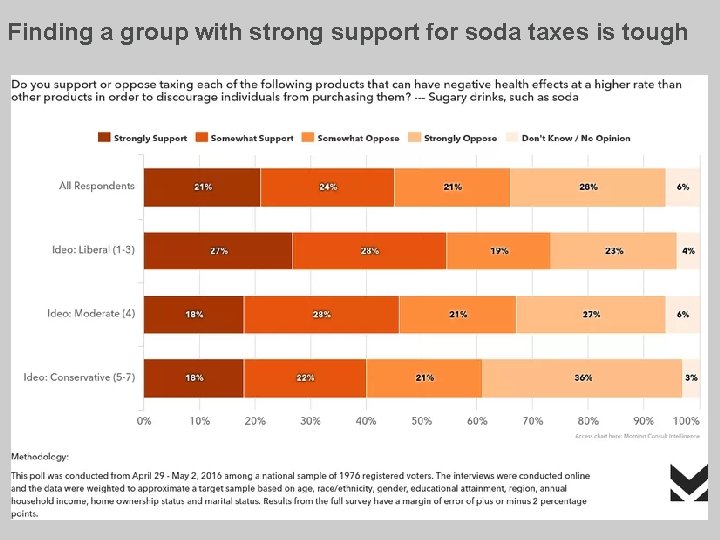
Finding a group with strong support for soda taxes is tough
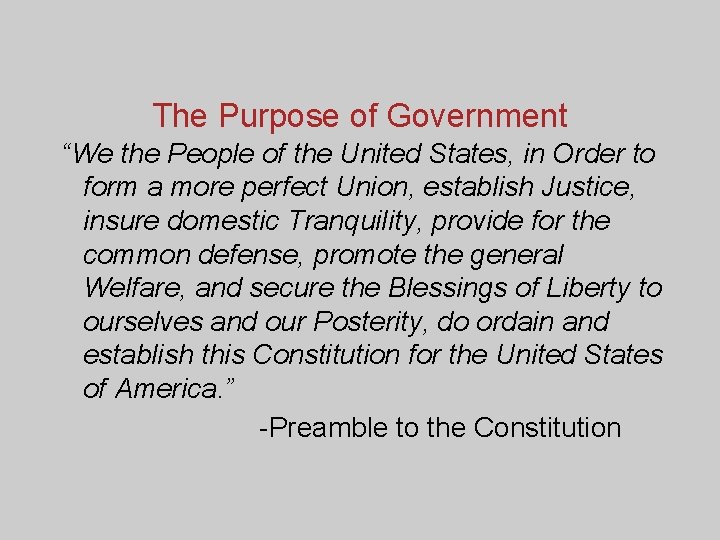
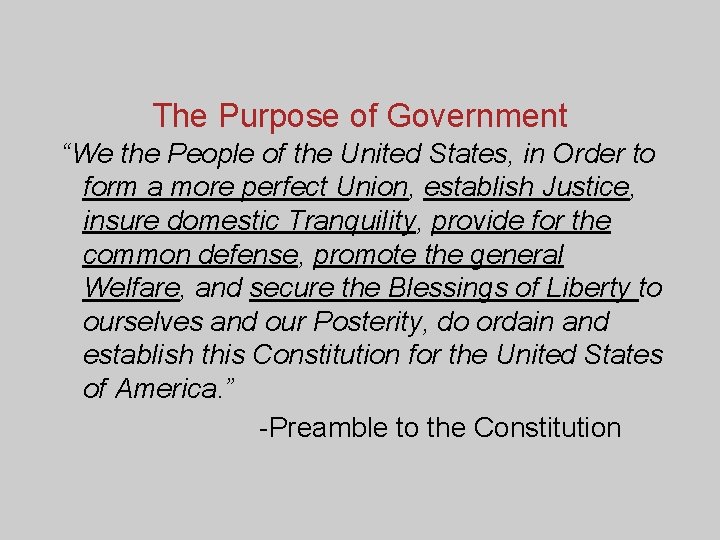
The Purpose of Government “We the People of the United States, in Order to form a more perfect Union, establish Justice, insure domestic Tranquility, provide for the common defense, promote the general Welfare, and secure the Blessings of Liberty to ourselves and our Posterity, do ordain and establish this Constitution for the United States of America. ” -Preamble to the Constitution
The Purpose of Government “We the People of the United States, in Order to form a more perfect Union, establish Justice, insure domestic Tranquility, provide for the common defense, promote the general Welfare, and secure the Blessings of Liberty to ourselves and our Posterity, do ordain and establish this Constitution for the United States of America. ” -Preamble to the Constitution
Human Nature Are humans good or evil?
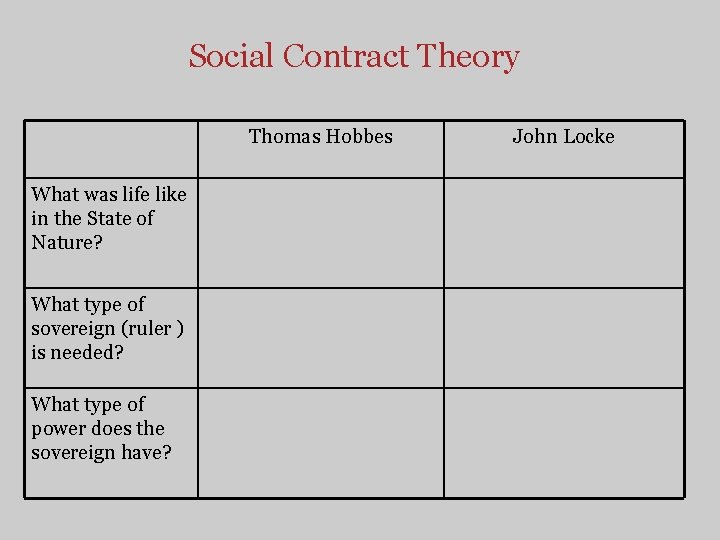
Social Contract Theory Thomas Hobbes What was life like in the State of Nature? What type of sovereign (ruler ) is needed? What type of power does the sovereign have? John Locke
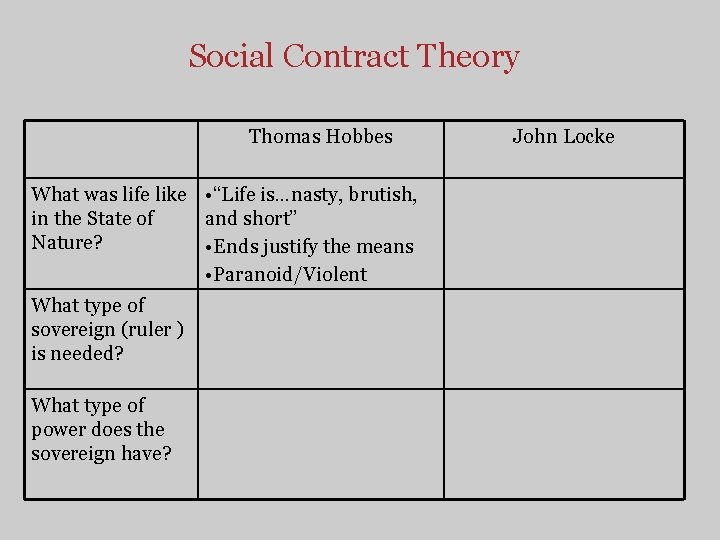
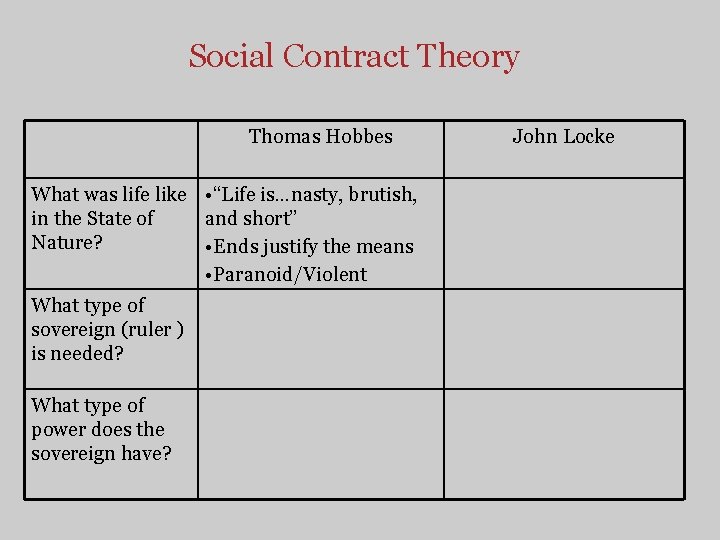
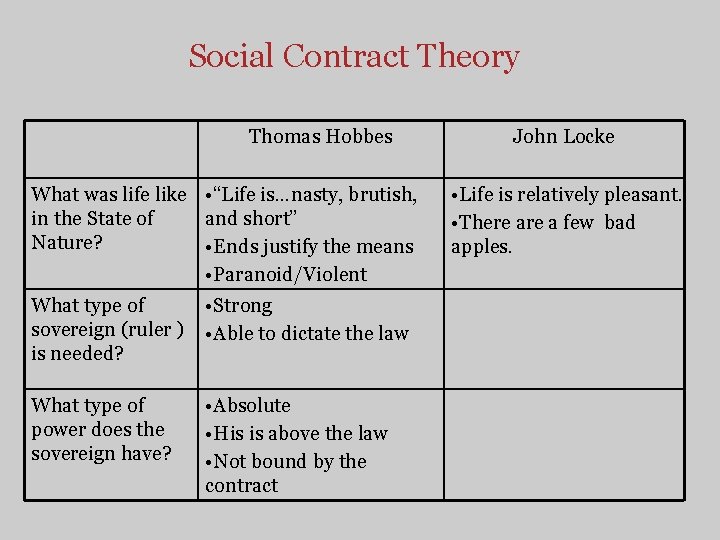
Social Contract Theory Thomas Hobbes What was life like • “Life is…nasty, brutish, in the State of and short” Nature? • Ends justify the means • Paranoid/Violent What type of sovereign (ruler ) is needed? What type of power does the sovereign have? John Locke
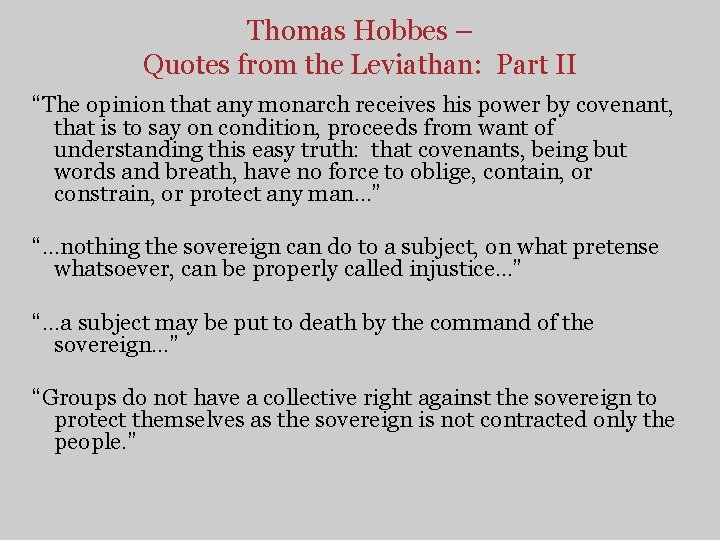
Thomas Hobbes – Quotes from the Leviathan: Part II “The opinion that any monarch receives his power by covenant, that is to say on condition, proceeds from want of understanding this easy truth: that covenants, being but words and breath, have no force to oblige, contain, or constrain, or protect any man…” “…nothing the sovereign can do to a subject, on what pretense whatsoever, can be properly called injustice…” “…a subject may be put to death by the command of the sovereign…” “Groups do not have a collective right against the sovereign to protect themselves as the sovereign is not contracted only the people. ”
Social Contract Theory Thomas Hobbes What was life like • “Life is…nasty, brutish, in the State of and short” Nature? • Ends justify the means • Paranoid/Violent What type of sovereign (ruler ) is needed? What type of power does the sovereign have? John Locke
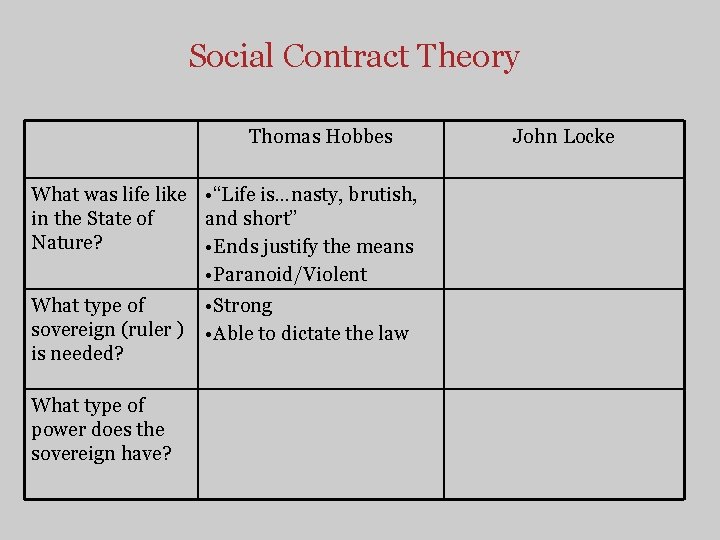
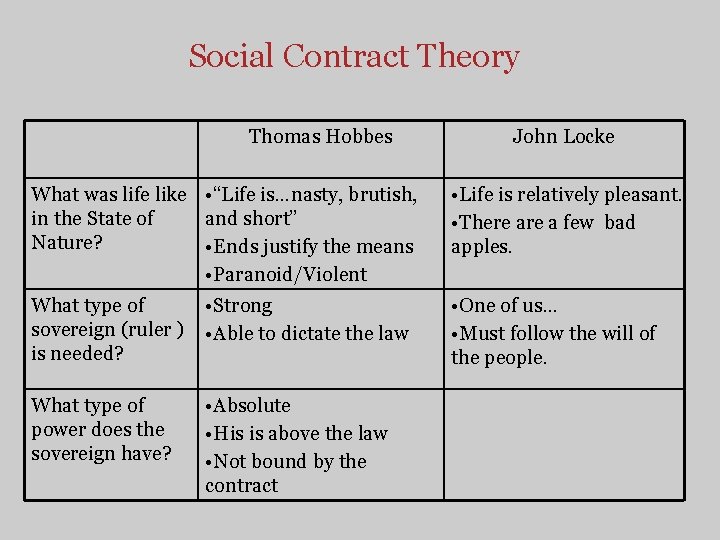
Social Contract Theory Thomas Hobbes What was life like • “Life is…nasty, brutish, in the State of and short” Nature? • Ends justify the means • Paranoid/Violent What type of sovereign (ruler ) is needed? What type of power does the sovereign have? • Strong • Able to dictate the law John Locke
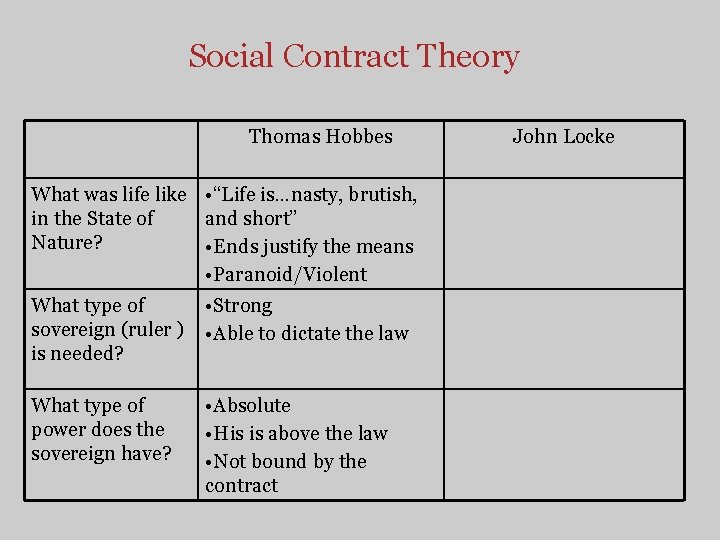
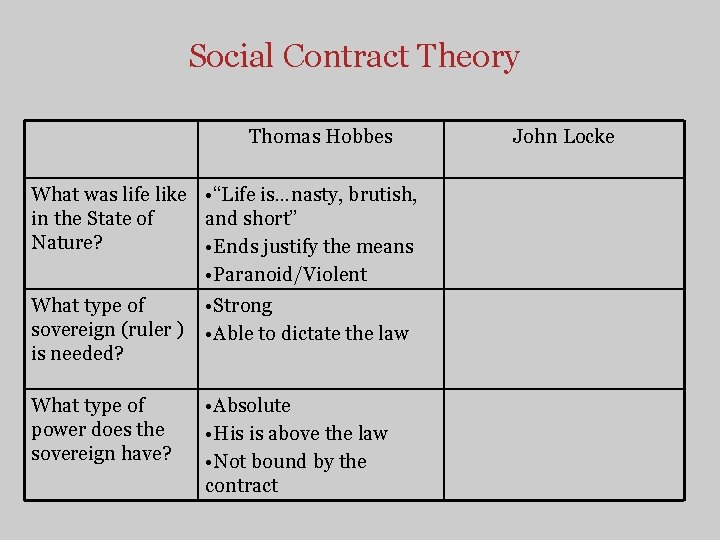
Social Contract Theory Thomas Hobbes What was life like • “Life is…nasty, brutish, in the State of and short” Nature? • Ends justify the means • Paranoid/Violent What type of sovereign (ruler ) is needed? • Strong • Able to dictate the law What type of power does the sovereign have? • Absolute • His is above the law • Not bound by the contract John Locke
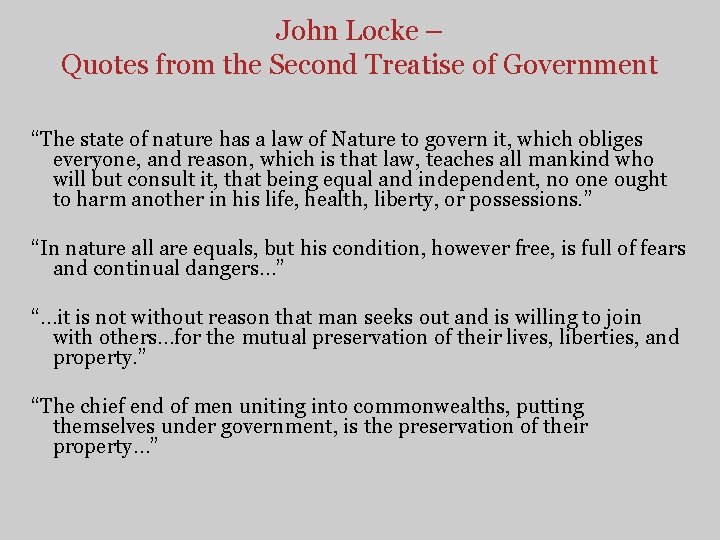
John Locke – Quotes from the Second Treatise of Government “The state of nature has a law of Nature to govern it, which obliges everyone, and reason, which is that law, teaches all mankind who will but consult it, that being equal and independent, no one ought to harm another in his life, health, liberty, or possessions. ” “In nature all are equals, but his condition, however free, is full of fears and continual dangers…” “…it is not without reason that man seeks out and is willing to join with others…for the mutual preservation of their lives, liberties, and property. ” “The chief end of men uniting into commonwealths, putting themselves under government, is the preservation of their property…”
Social Contract Theory Thomas Hobbes What was life like • “Life is…nasty, brutish, in the State of and short” Nature? • Ends justify the means • Paranoid/Violent What type of sovereign (ruler ) is needed? • Strong • Able to dictate the law What type of power does the sovereign have? • Absolute • His is above the law • Not bound by the contract John Locke
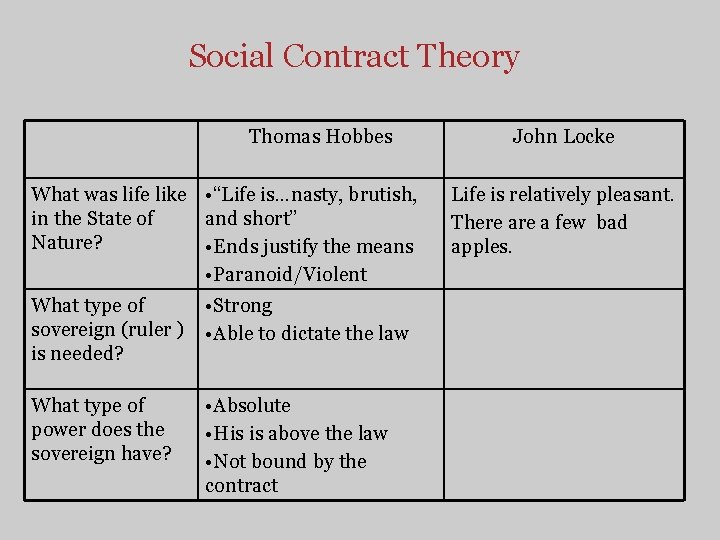
Social Contract Theory Thomas Hobbes What was life like • “Life is…nasty, brutish, in the State of and short” Nature? • Ends justify the means • Paranoid/Violent What type of sovereign (ruler ) is needed? • Strong • Able to dictate the law What type of power does the sovereign have? • Absolute • His is above the law • Not bound by the contract John Locke Life is relatively pleasant. There a few bad apples.
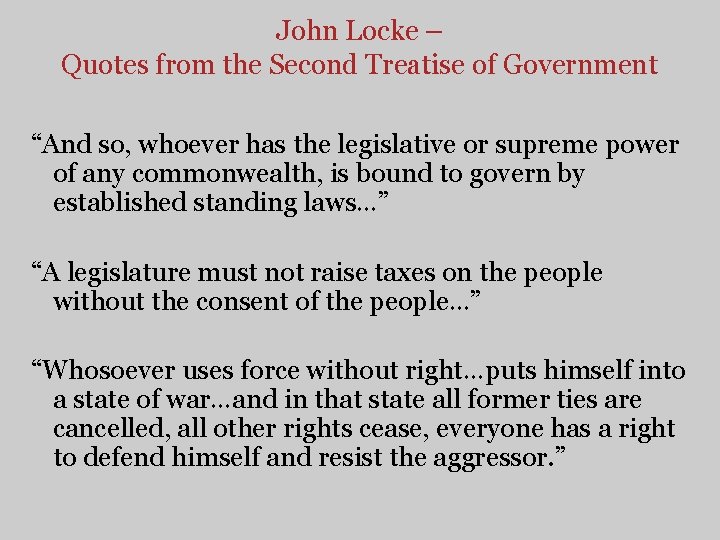
John Locke – Quotes from the Second Treatise of Government “And so, whoever has the legislative or supreme power of any commonwealth, is bound to govern by established standing laws…” “A legislature must not raise taxes on the people without the consent of the people…” “Whosoever uses force without right…puts himself into a state of war…and in that state all former ties are cancelled, all other rights cease, everyone has a right to defend himself and resist the aggressor. ”
Social Contract Theory Thomas Hobbes What was life like • “Life is…nasty, brutish, in the State of and short” Nature? • Ends justify the means • Paranoid/Violent What type of sovereign (ruler ) is needed? • Strong • Able to dictate the law What type of power does the sovereign have? • Absolute • His is above the law • Not bound by the contract John Locke • Life is relatively pleasant. • There a few bad apples.
Social Contract Theory Thomas Hobbes What was life like • “Life is…nasty, brutish, in the State of and short” Nature? • Ends justify the means • Paranoid/Violent What type of sovereign (ruler ) is needed? • Strong • Able to dictate the law What type of power does the sovereign have? • Absolute • His is above the law • Not bound by the contract John Locke • Life is relatively pleasant. • There a few bad apples. • One of us… • Must follow the will of the people.
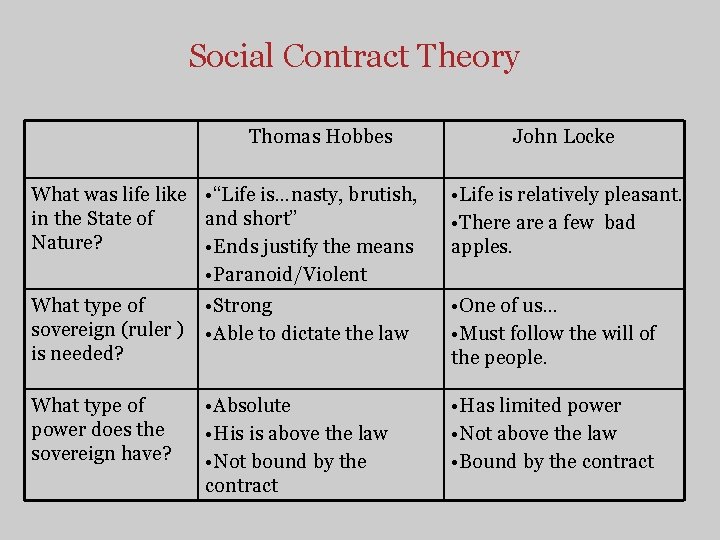
Social Contract Theory Thomas Hobbes What was life like • “Life is…nasty, brutish, in the State of and short” Nature? • Ends justify the means • Paranoid/Violent John Locke • Life is relatively pleasant. • There a few bad apples. What type of sovereign (ruler ) is needed? • Strong • Able to dictate the law • One of us… • Must follow the will of the people. What type of power does the sovereign have? • Absolute • His is above the law • Not bound by the contract • Has limited power • Not above the law • Bound by the contract
Locke v. Hobbes
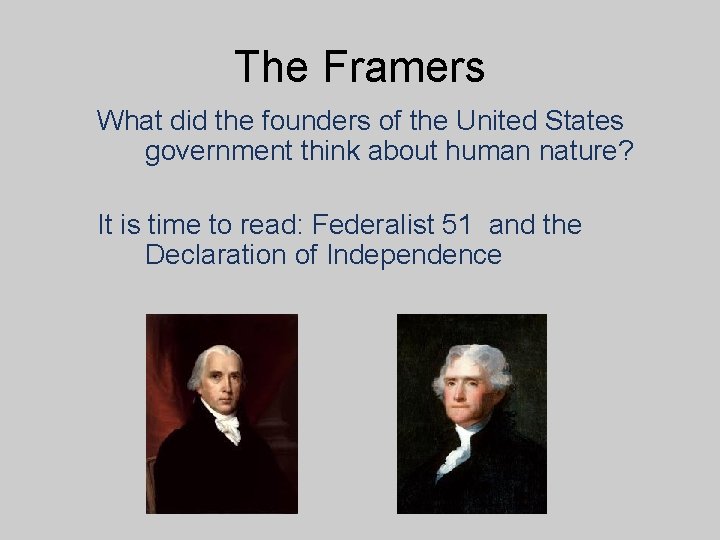
The Framers What did the founders of the United States government think about human nature? It is time to read: Federalist 51 and the Declaration of Independence
Monty Python