Polish Infrastructure for Supporting Computational Science in the
- Slides: 30
Polish Infrastructure for Supporting Computational Science in the European Research Space PL-Grid: National Grid Initiative in Poland Structure and Status Big. View Jacek Kitowski Institute of Computer Science AGH-UST ACK CYFRONET AGH in collaboration with PL-Grid Representatives HP-CAST Madrid, May 10 -13, 2009 EUROPEAN UNION
Outline u PL-Grid Consortium t Systematic approach establishing the Consortium and NGI t Motivation t Rationales t Foundations t International Collaboration u PL-Grid Project in a nutshell t Status u PL-Grid Project t Infrastructure t Workpackages u Summary
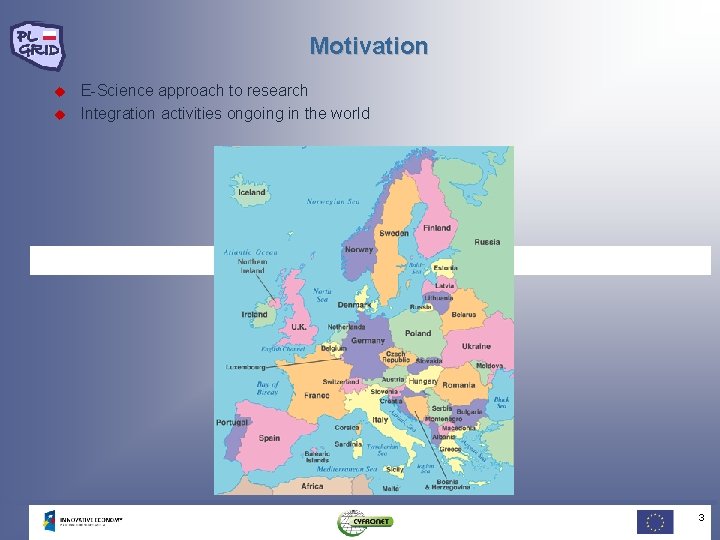
Motivation u u E-Science approach to research Integration activities ongoing in the world 3
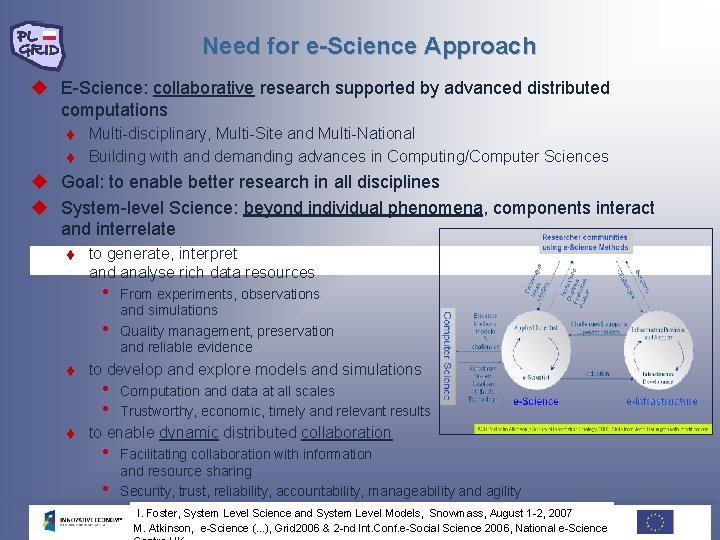
Need for e-Science Approach u E-Science: collaborative research supported by advanced distributed computations t t Multi-disciplinary, Multi-Site and Multi-National Building with and demanding advances in Computing/Computer Sciences u Goal: to enable better research in all disciplines u System-level Science: beyond individual phenomena, components interact and interrelate t to generate, interpret and analyse rich data resources • • t t From experiments, observations and simulations Quality management, preservation and reliable evidence to develop and explore models and simulations • • Computation and data at all scales Trustworthy, economic, timely and relevant results to enable dynamic distributed collaboration • • Facilitating collaboration with information and resource sharing Security, trust, reliability, accountability, manageability and agility I. Foster, System Level Science and System Level Models, Snowmass, August 1 -2, 2007 M. Atkinson, e-Science (. . . ), Grid 2006 & 2 -nd Int. Conf. e-Social Science 2006, National e-Science
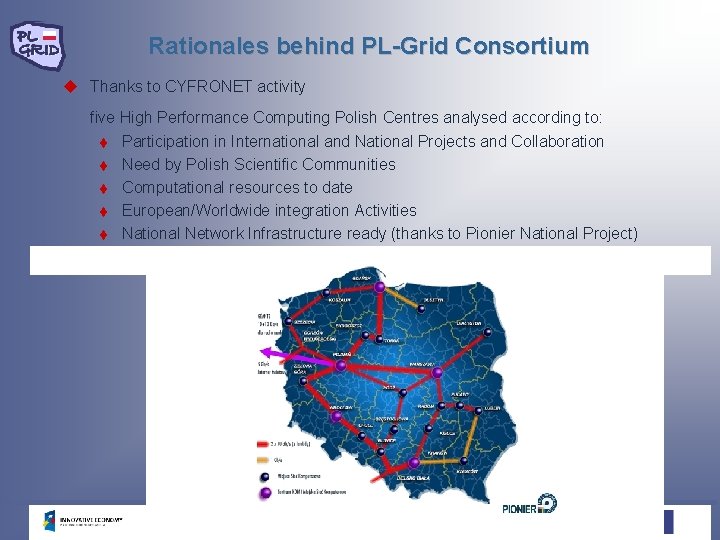
Rationales behind PL-Grid Consortium u Thanks to CYFRONET activity five High Performance Computing Polish Centres analysed according to: t Participation in International and National Projects and Collaboration t Need by Polish Scientific Communities t Computational resources to date t European/Worldwide integration Activities t National Network Infrastructure ready (thanks to Pionier National Project) GEANT 2
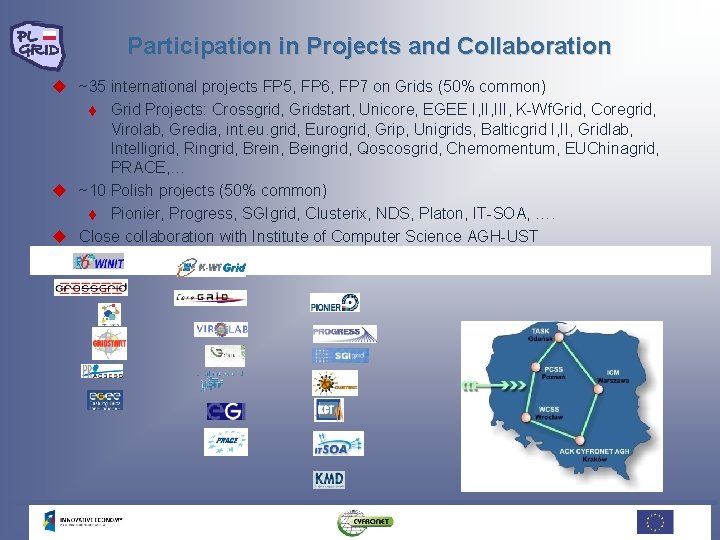
Participation in Projects and Collaboration u ~35 international projects FP 5, FP 6, FP 7 on Grids (50% common) t Grid Projects: Crossgrid, Gridstart, Unicore, EGEE I, III, K-Wf. Grid, Coregrid, Virolab, Gredia, int. eu. grid, Eurogrid, Grip, Unigrids, Balticgrid I, II, Gridlab, Intelligrid, Ringrid, Brein, Beingrid, Qoscosgrid, Chemomentum, EUChinagrid, PRACE, … u ~10 Polish projects (50% common) t Pionier, Progress, SGIgrid, Clusterix, NDS, Platon, IT-SOA, …. u Close collaboration with Institute of Computer Science AGH-UST
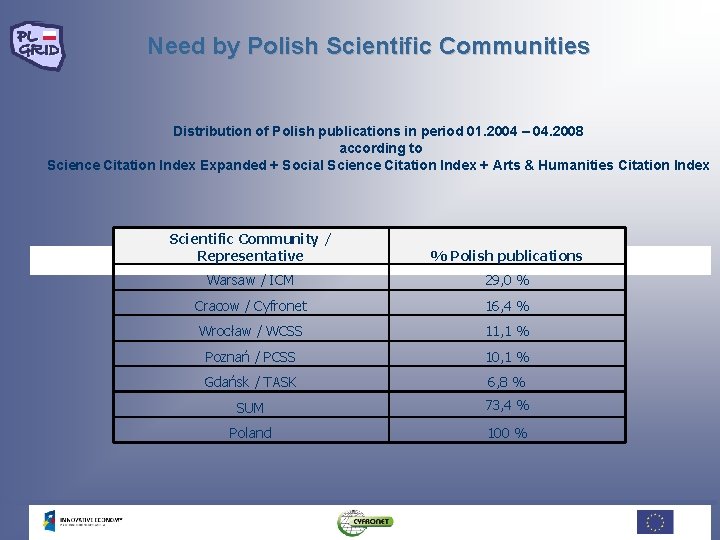
Need by Polish Scientific Communities Distribution of Polish publications in period 01. 2004 – 04. 2008 according to Science Citation Index Expanded + Social Science Citation Index + Arts & Humanities Citation Index Scientific Community / Representative % Polish publications Warsaw / ICM 29, 0 % Cracow / Cyfronet 16, 4 % Wrocław / WCSS 11, 1 % Poznań / PCSS 10, 1 % Gdańsk / TASK 6, 8 % SUM 73, 4 % Poland 100 %
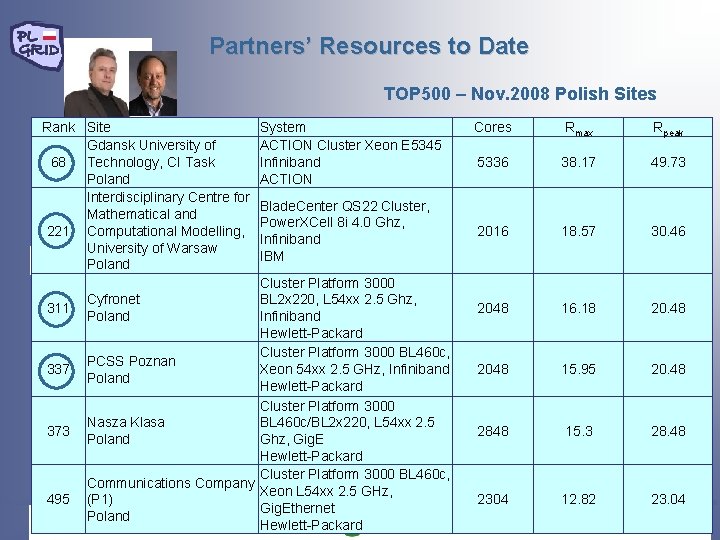
Partners’ Resources to Date TOP 500 – Nov. 2008 Polish Sites Rank Site Gdansk University of 68 Technology, CI Task Poland Interdisciplinary Centre for Mathematical and 221 Computational Modelling, University of Warsaw Poland 311 337 373 495 System ACTION Cluster Xeon E 5345 Infiniband ACTION Blade. Center QS 22 Cluster, Power. XCell 8 i 4. 0 Ghz, Infiniband IBM Cluster Platform 3000 Cyfronet BL 2 x 220, L 54 xx 2. 5 Ghz, Poland Infiniband Hewlett-Packard Cluster Platform 3000 BL 460 c, PCSS Poznan Xeon 54 xx 2. 5 GHz, Infiniband Poland Hewlett-Packard Cluster Platform 3000 Nasza Klasa BL 460 c/BL 2 x 220, L 54 xx 2. 5 Poland Ghz, Gig. E Hewlett-Packard Cluster Platform 3000 BL 460 c, Communications Company Xeon L 54 xx 2. 5 GHz, (P 1) Gig. Ethernet Poland Hewlett-Packard Cores Rmax Rpeak 5336 38. 17 49. 73 2016 18. 57 30. 46 2048 16. 18 20. 48 2048 15. 95 20. 48 2848 15. 3 28. 48 2304 12. 82 23. 04
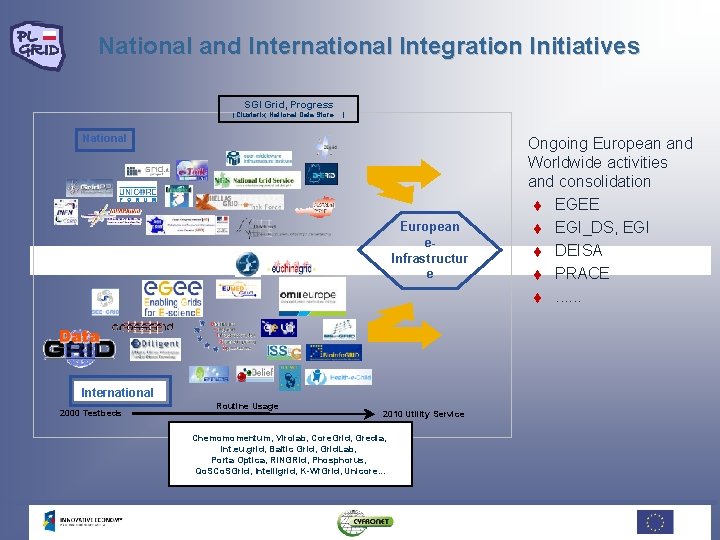
National and International Integration Initiatives SGI Grid, Progress (Clusterix, National Data Store. . . ) National European e. Infrastructur e International 2000 Testbeds Routine Usage 2010 Utility Service Chemomomentum, Virolab, Core. Grid, Gredia, int. eu. grid, Baltic Grid, Grid. Lab, Porta Optica, RINGRid, Phosphorus, Qo. SCo. SGrid, Intelligrid, K-Wf. Grid, Unicore. . . Ongoing European and Worldwide activities and consolidation t EGEE t EGI_DS, EGI t DEISA t PRACE t. . .
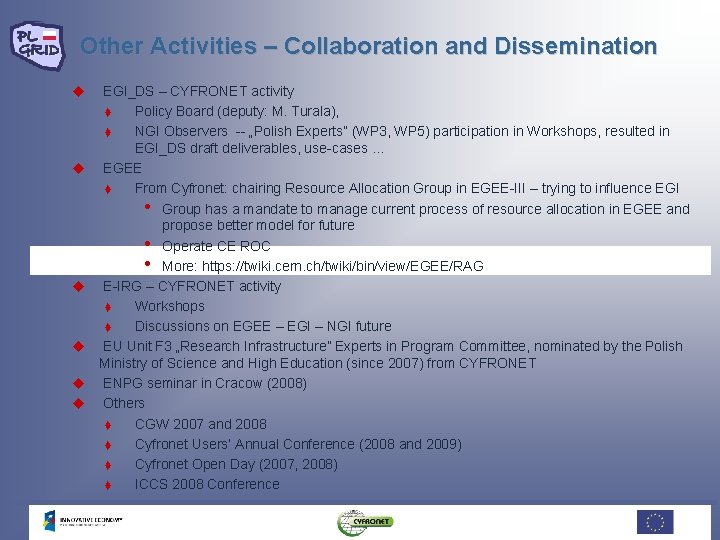
Other Activities – Collaboration and Dissemination u u u EGI_DS – CYFRONET activity t Policy Board (deputy: M. Turala), t NGI Observers -- „Polish Experts” (WP 3, WP 5) participation in Workshops, resulted in EGI_DS draft deliverables, use-cases. . . EGEE t From Cyfronet: chairing Resource Allocation Group in EGEE-III – trying to influence EGI • Group has a mandate to manage current process of resource allocation in EGEE and propose better model for future • Operate CE ROC • More: https: //twiki. cern. ch/twiki/bin/view/EGEE/RAG E-IRG – CYFRONET activity t Workshops t Discussions on EGEE – EGI – NGI future EU Unit F 3 „Research Infrastructure” Experts in Program Committee, nominated by the Polish Ministry of Science and High Education (since 2007) from CYFRONET ENPG seminar in Cracow (2008) Others t CGW 2007 and 2008 t Cyfronet Users’ Annual Conference (2008 and 2009) t Cyfronet Open Day (2007, 2008) t ICCS 2008 Conference
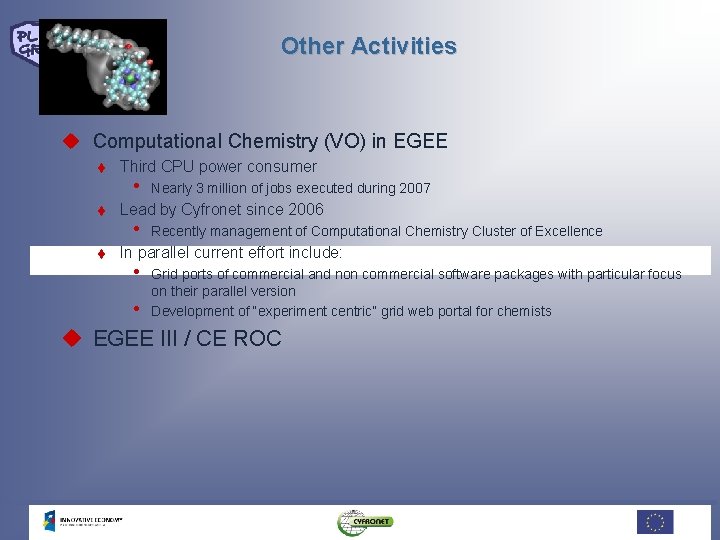
Other Activities u Computational Chemistry (VO) in EGEE t t t Third CPU power consumer • Nearly 3 million of jobs executed during 2007 Lead by Cyfronet since 2006 • Recently management of Computational Chemistry Cluster of Excellence In parallel current effort include: • • Grid ports of commercial and non commercial software packages with particular focus on their parallel version Development of “experiment centric” grid web portal for chemists u EGEE III / CE ROC
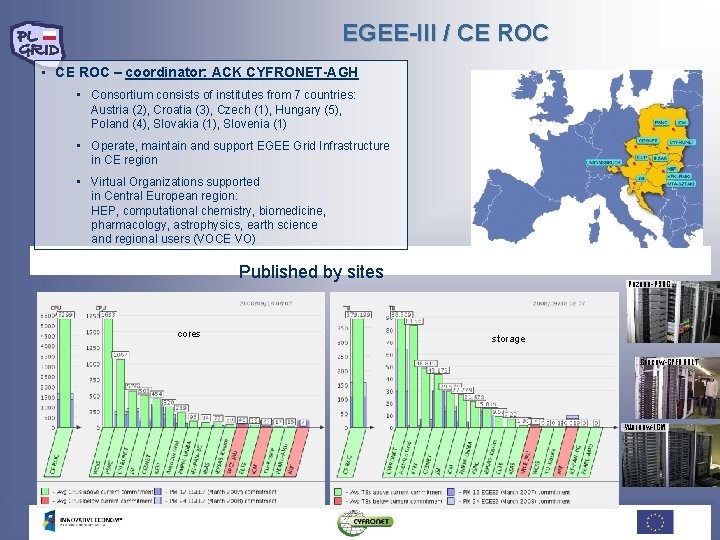
EGEE-III / CE ROC • CE ROC – coordinator: ACK CYFRONET-AGH • Consortium consists of institutes from 7 countries: Austria (2), Croatia (3), Czech (1), Hungary (5), Poland (4), Slovakia (1), Slovenia (1) • Operate, maintain and support EGEE Grid Infrastructure in CE region • Virtual Organizations supported in Central European region: HEP, computational chemistry, biomedicine, pharmacology, astrophysics, earth science and regional users (VOCE VO) Published by sites cores Poznan-PSNC storage Cracow-CYFRONET Warsaw-ICM
PL-Grid Foundations – Summary Polish Infrastructure for Supporting Computational Science in the European Research Space Response to the needs of Polish scientists and ongoing Grid activities in Poland, other European countries and all over the world u Motivation t E-Science approach to research t EGI initiative ongoing in collaboration with NGIs u Creation of Polish Grid (PL-Grid) Consortium: http: //plgrid. pl t Consortium Agreement signed in January 2007 u PL-Grid Project (2009 -2012) t Application in Operational Programme Innovative Economy, Activity 2. 3 (in Sept. 2008) t Get funded March 2, 2009 (via European Structural Funds) u Consortium made up of five largest Polish supercomputing and networking centres (founders) t ACK CYFRONET AGH (Cracow) – Coordinator
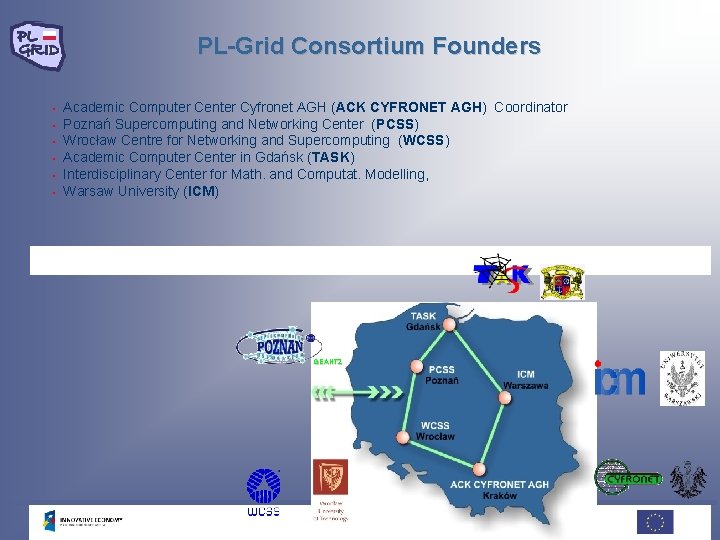
PL-Grid Consortium Founders • • • Academic Computer Center Cyfronet AGH (ACK CYFRONET AGH) Coordinator Poznań Supercomputing and Networking Center (PCSS) Wrocław Centre for Networking and Supercomputing (WCSS) Academic Computer Center in Gdańsk (TASK) Interdisciplinary Center for Math. and Computat. Modelling, Warsaw University (ICM) GEANT 2
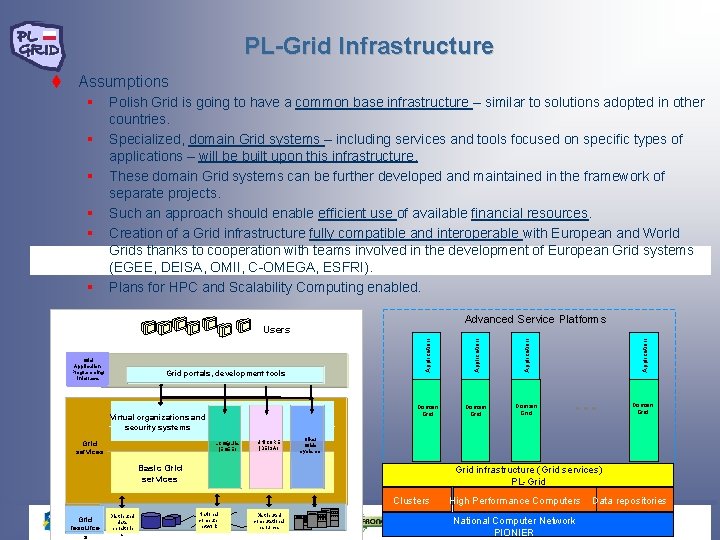
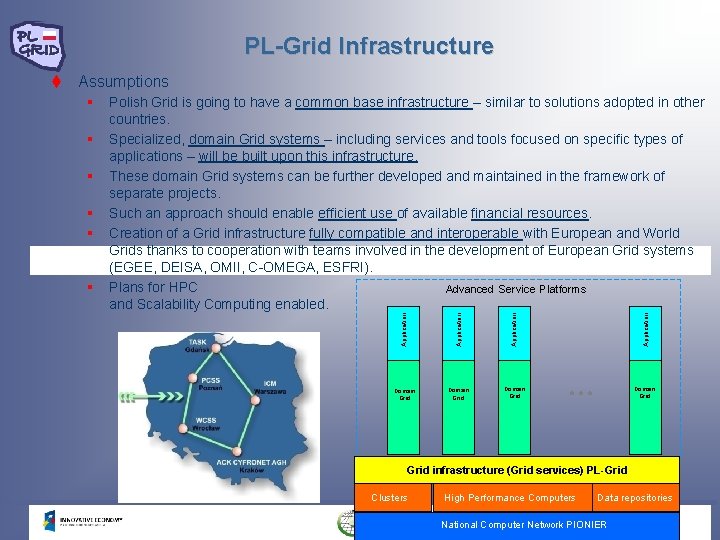
PL-Grid Infrastructure t Assumptions § § § Polish Grid is going to have a common base infrastructure – similar to solutions adopted in other countries. Specialized, domain Grid systems – including services and tools focused on specific types of applications – will be built upon this infrastructure. These domain Grid systems can be further developed and maintained in the framework of separate projects. Such an approach should enable efficient use of available financial resources. Creation of a Grid infrastructure fully compatible and interoperable with European and World Grids thanks to cooperation with teams involved in the development of European Grid systems (EGEE, DEISA, OMII, C-OMEGA, ESFRI). Plans for HPC and Scalability Computing enabled. Advanced Service Platforms Grid services LCG/g. Lite (EGEE) UNICORE (DEISA) Application Virtual organizations and security systems Application Grid portals, development tools Application Grid Application Programming Interface Application Users Domain Grid Other Grids systems Basic Grid services Grid infrastructure (Grid services) PL-Grid Clusters Grid resource s Distributed data repositorie s National computer network Distributed computational resources High Performance Computers National Computer Network PIONIER Data repositories
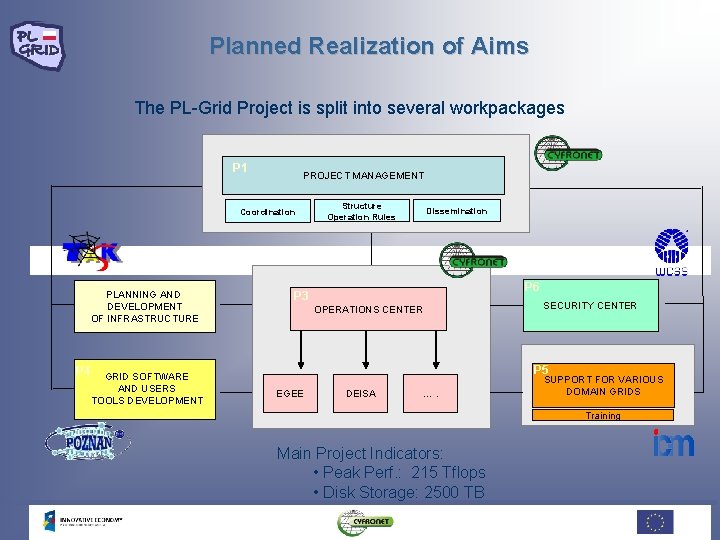
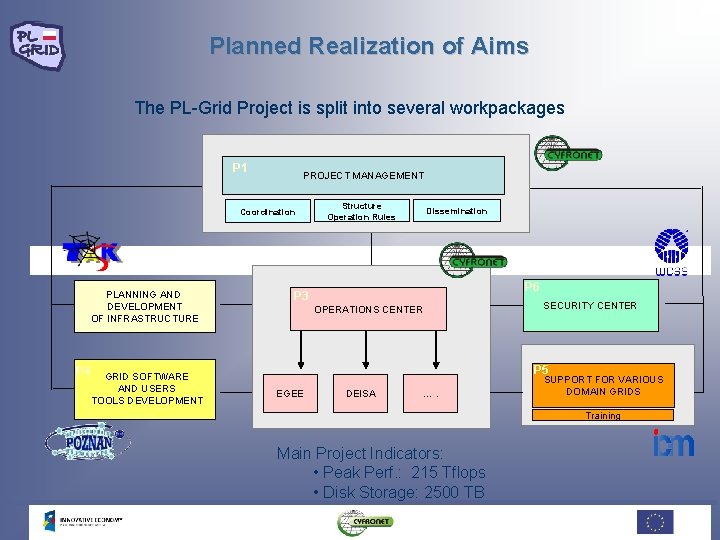
Planned Realization of Aims The PL-Grid Project is split into several workpackages P 1 PROJECT MANAGEMENT Coordination P 2 PLANNING AND DEVELOPMENT OF INFRASTRUCTURE Structure Operation Rules Dissemination P 6 P 3 OPERATIONS CENTER P 5 P 4 GRID SOFTWARE AND USERS TOOLS DEVELOPMENT SECURITY CENTER EGEE DEISA …. SUPPORT FOR VARIOUS DOMAIN GRIDS Training Main Project Indicators: • Peak Perf. : 215 Tflops • Disk Storage: 2500 TB
Challenges u Short term t To start – establishing PL-Grid VO using Partners’ local and EGEE resources t To provide resources for covering operational costs t To select computational/storage resources for PL-Grid infrastructure u Long term – continously t To provide the necessary infrastructure (!!) • Computer rooms, electrical power, many organizational issues t Be prepared / work on approaching paradigms and integration development • HPC – Scalable Computing • Clouds (internal-external, computing clouds, data clouds) • SOA paradigm, knowledge usage …
Thank you
Polish Infrastructure for Supporting Computational Science in the European Research Space PL-Grid: National Grid Initiative in Poland Structure and Status Technical Issues Jacek Kitowski Institute of Computer Science AGH-UST ACK CYFRONET AGH in collaboration with PL-Grid Representatives HP-CAST Madrid, May 10 -13, 2009 EUROPEAN UNION
PL-Grid Infrastructure t Assumptions § Application § Polish Grid is going to have a common base infrastructure – similar to solutions adopted in other countries. Specialized, domain Grid systems – including services and tools focused on specific types of applications – will be built upon this infrastructure. These domain Grid systems can be further developed and maintained in the framework of separate projects. Such an approach should enable efficient use of available financial resources. Creation of a Grid infrastructure fully compatible and interoperable with European and World Grids thanks to cooperation with teams involved in the development of European Grid systems (EGEE, DEISA, OMII, C-OMEGA, ESFRI). Plans for HPC Advanced Service Platforms and Scalability Computing enabled. Application § Domain Grid Grid infrastructure (Grid services) PL-Grid Clusters High Performance Computers Data repositories National Computer Network PIONIER
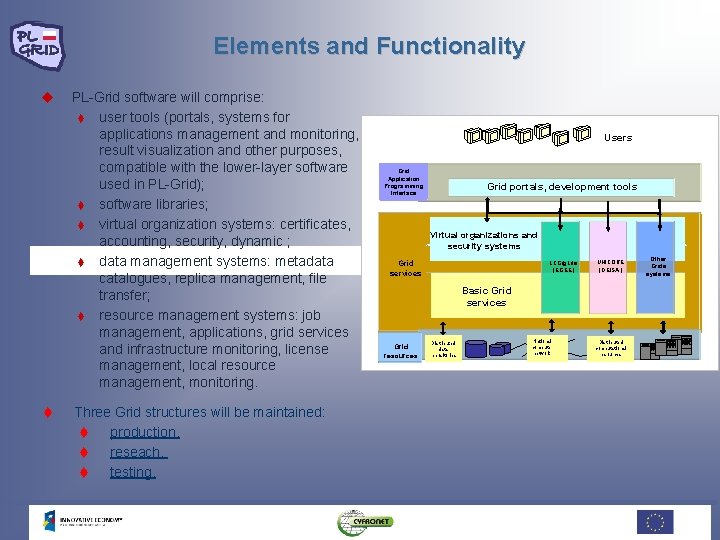
Elements and Functionality u t PL-Grid software will comprise: t user tools (portals, systems for applications management and monitoring, result visualization and other purposes, compatible with the lower-layer software used in PL-Grid); t software libraries; t virtual organization systems: certificates, accounting, security, dynamic ; t data management systems: metadata catalogues, replica management, file transfer; t resource management systems: job management, applications, grid services and infrastructure monitoring, license management, local resource management, monitoring. Three Grid structures will be maintained: t production, t reseach, t testing. Users Grid Application Programming Interface Grid portals, development tools Virtual organizations and security systems Grid services LCG/g. Lite (EGEE) UNICORE (DEISA) Basic Grid services Grid resources Distributed data repositories National computer network Distributed computational resources Other Grids systems
Planned Realization of Aims The PL-Grid Project is split into several workpackages P 1 PROJECT MANAGEMENT Coordination P 2 PLANNING AND DEVELOPMENT OF INFRASTRUCTURE Structure Operation Rules Dissemination P 6 P 3 OPERATIONS CENTER P 5 P 4 GRID SOFTWARE AND USERS TOOLS DEVELOPMENT SECURITY CENTER EGEE DEISA …. SUPPORT FOR VARIOUS DOMAIN GRIDS Training Main Project Indicators: • Peak Perf. : 215 Tflops • Disk Storage: 2500 TB
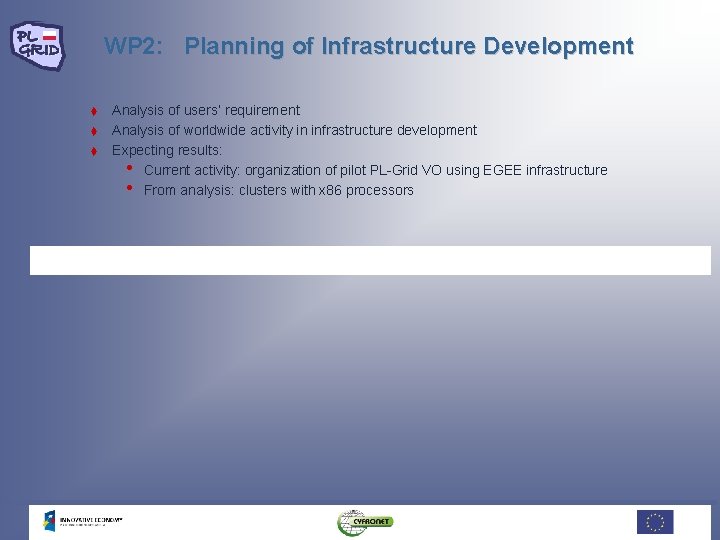
WP 2: Planning of Infrastructure Development t Analysis of users’ requirement Analysis of worldwide activity in infrastructure development Expecting results: • Current activity: organization of pilot PL-Grid VO using EGEE infrastructure • From analysis: clusters with x 86 processors
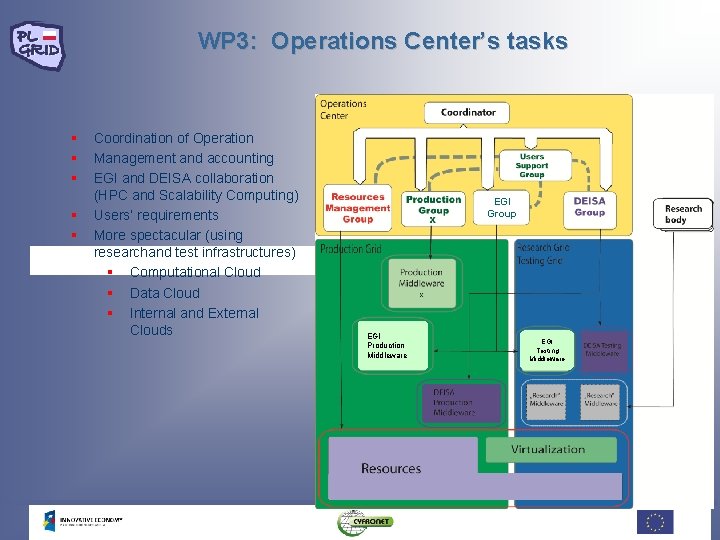
WP 3: Operations Center’s tasks § § § Coordination of Operation Management and accounting EGI and DEISA collaboration (HPC and Scalability Computing) Users’ requirements More spectacular (using researchand test infrastructures) § Computational Cloud § Data Cloud § Internal and External Clouds EGI Group EGI Production Middleware EGI Testing Middleware
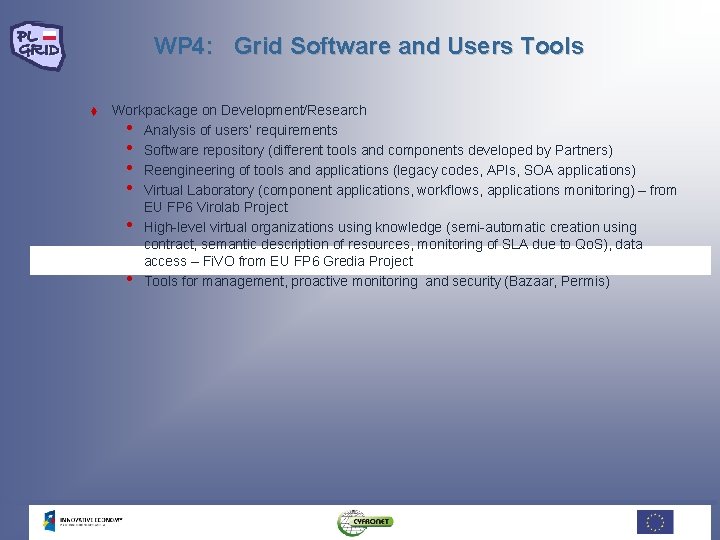
WP 4: Grid Software and Users Tools t Workpackage on Development/Research • Analysis of users’ requirements • Software repository (different tools and components developed by Partners) • Reengineering of tools and applications (legacy codes, APIs, SOA applications) • Virtual Laboratory (component applications, workflows, applications monitoring) – from EU FP 6 Virolab Project • High-level virtual organizations using knowledge (semi-automatic creation using contract, semantic description of resources, monitoring of SLA due to Qo. S), data access – Fi. VO from EU FP 6 Gredia Project • Tools for management, proactive monitoring and security (Bazaar, Permis)
WP 5: Support and Training t t t Users’ support Making commercial software available for the users (license activity) Training, education
WP 6: Security t Users’ support • Authorization, authentication, . . . • Certificates. . .
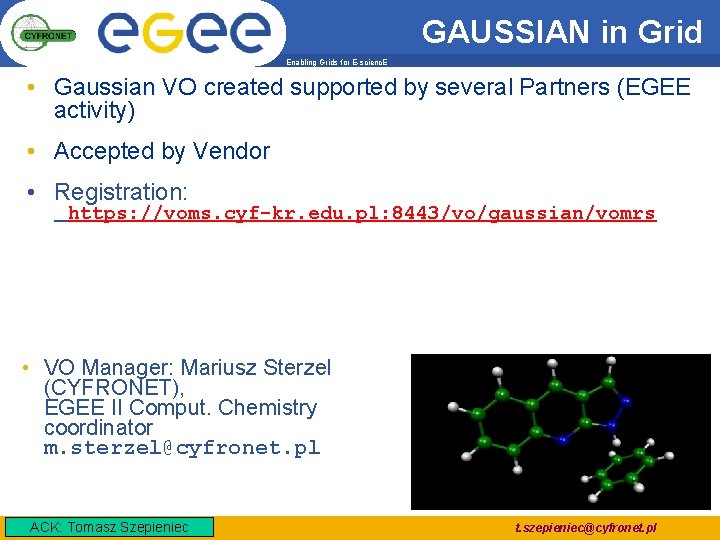
GAUSSIAN in Grid Enabling Grids for E-scienc. E • Gaussian VO created supported by several Partners (EGEE activity) • Accepted by Vendor • Registration: https: //voms. cyf-kr. edu. pl: 8443/vo/gaussian/vomrs • VO Manager: Mariusz Sterzel (CYFRONET), EGEE II Comput. Chemistry coordinator m. sterzel@cyfronet. pl ACK: Tomasz Szepieniec EGEE-II INFSO-RI-031688 t. szepieniec@cyfronet. pl
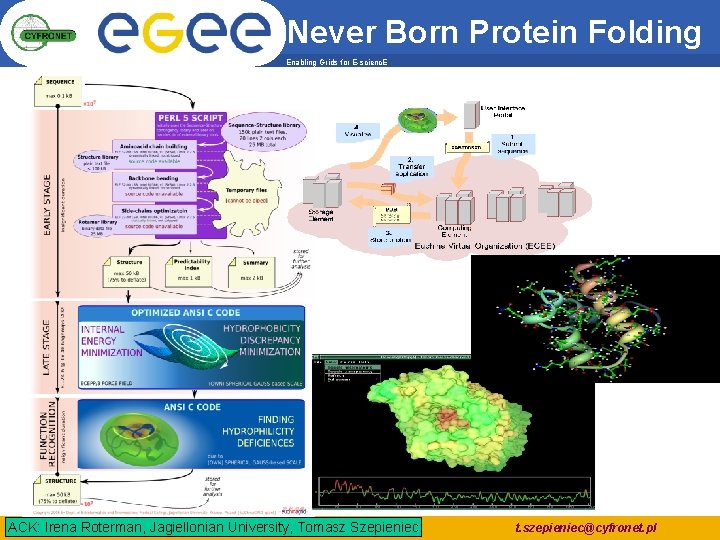
Never Born Protein Folding Enabling Grids for E-scienc. E ACK: Irena Roterman, Jagiellonian University, Tomasz Szepieniec EGEE-II INFSO-RI-031688 t. szepieniec@cyfronet. pl
Activities u Short term t To start – establishing PL-Grid VO using Partners’ local and EGEE resources t To provide resources for covering operational costs t To select computational/storage resources for PL-Grid infrastructure u Long term – continously t To provide the necessary infrastructure (!!) • Computer rooms, electrical power, many organizational issues • Towards Cloud Computing (internal, external) • Towards HPCaa. S and Scalable computing