P Sci Unit 11 Chemical Reactions Chapter 7

- Slides: 35
P. Sci. Unit 11 Chemical Reactions Chapter 7
Review • Chemical change –occurs when one substance changes into another substance. • You will have to know how to write a chemical formula from a name. (last chapter) • ex. Dihydrogen monoxide = H 2 O
Review cont. • Law of Conservation of … • Matter – Matter cannot be created nor destroyed, it can only be changed. • Energy – Energy cannot be created nor destroyed, it can only be changed.
Chemical Reactions • Occur when substances undergo chemical changes to form new substances. • Atoms are re-arranged as bonds are broken and formed.
Chemical Reactions cont. • Nothing is lost or gained • Atoms cannot change to other atoms. • Therefore all equations must have the same number and kind of atoms on both sides of the equation.
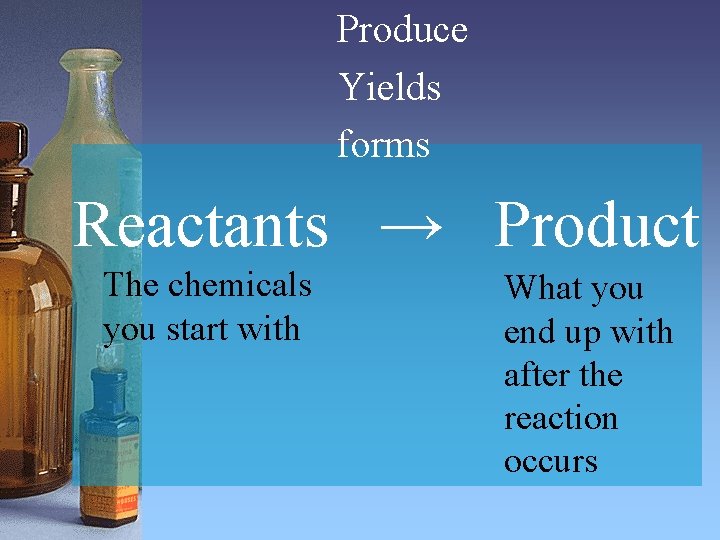
Produce Yields forms Reactants → Product s The chemicals you start with What you end up with after the reaction occurs
Signs of a Chemical Reaction • Production of a gas • Production of a precipitate • Change in color • Production of light or heat
Energy and Reactions • All chemical reactions release or absorb energy – (heat, light, sound or electricity) • To break bonds – takes energy • To form bonds – releases energy
Energy and Reactions cont. • endothermic – when more energy is required to break bonds than is released when new ones are formed. (ex: photosynthesis) • exothermic – less energy is required to break the original bonds than is released when new bonds form. (ex: bioluminescence – fireflies.
Energy is conserved. • Chemical energy is the energy stored in a chemical bond. – Example: isooctane (gas) and oxygen plus a tiny spark will set off an explosion – the energy of the explosion comes from the chemical energy stored in the isooctane bonds.
Balancing Chemical Equations • Chemical Equations summarize reactions by using formulas for each substance. • Because of conservation of matter (mass) the left side (reactants) must equal the right side (products).
Steps for Balancing Equations 1) Write the equation (write the reactants and products as chemical compound formulas and elements) Ex: H 2 + O 2 → H 2 O
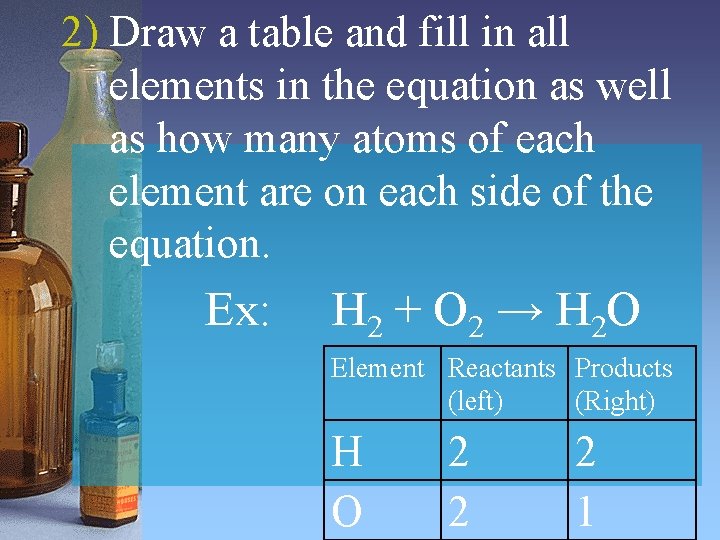
2) Draw a table and fill in all elements in the equation as well as how many atoms of each element are on each side of the equation. Ex: H 2 + O 2 → H 2 O Element Reactants Products (left) (Right) H O 2 2 2 1
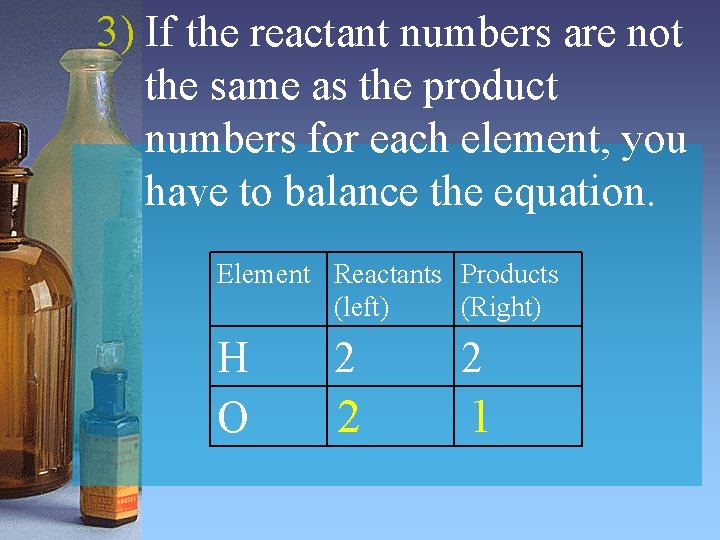
3) If the reactant numbers are not the same as the product numbers for each element, you have to balance the equation. Element Reactants Products (left) (Right) H O 2 2 2 1
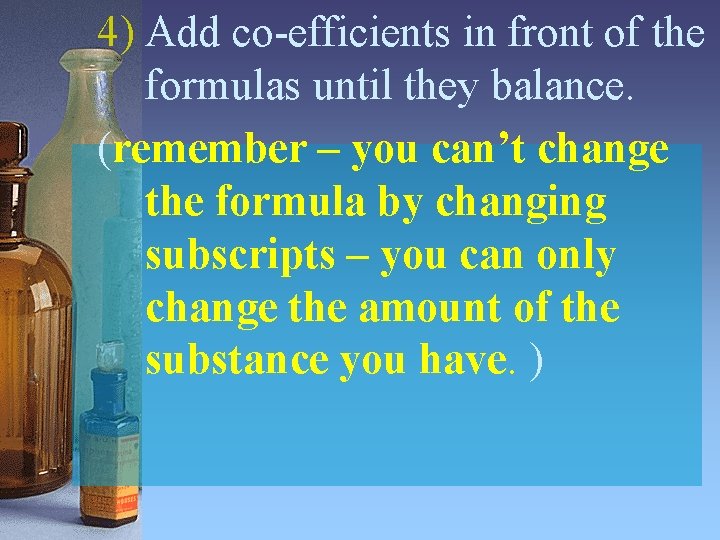
4) Add co-efficients in front of the formulas until they balance. (remember – you can’t change the formula by changing subscripts – you can only change the amount of the substance you have. )
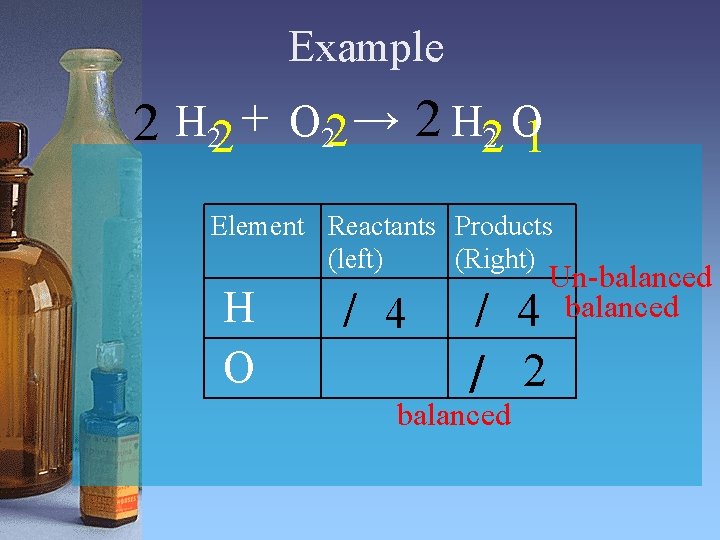
Example 2 H 22 + O 22 → 2 H 22 O 1 Element Reactants Products (left) (Right) H O / 4 / Un-balanced 4 balanced / 2 balanced
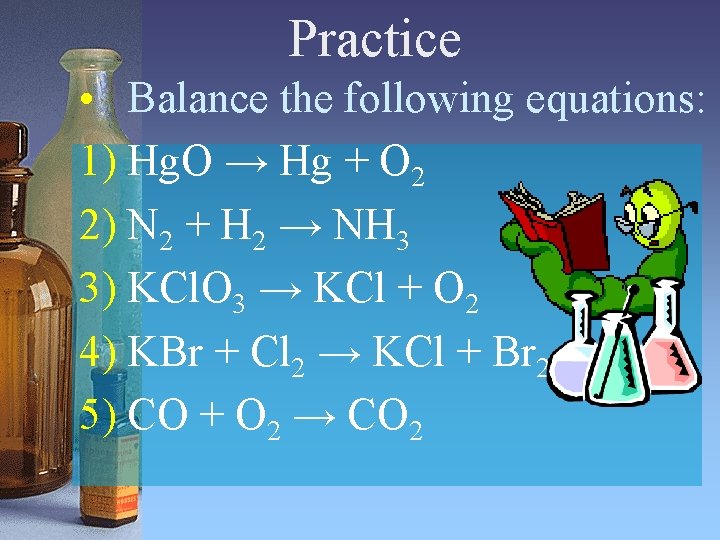
Practice • Balance the following equations: 1) Hg. O → Hg + O 2 2) N 2 + H 2 → NH 3 3) KCl. O 3 → KCl + O 2 4) KBr + Cl 2 → KCl + Br 2 5) CO + O 2 → CO 2
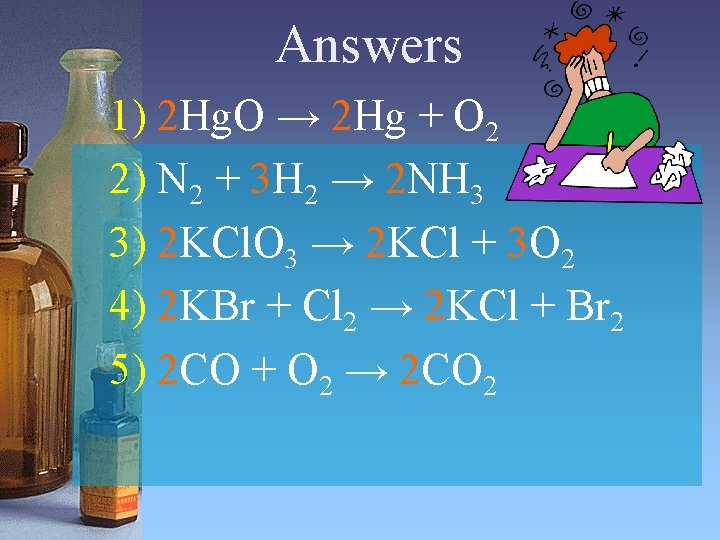
Answers 1) 2 Hg. O → 2 Hg + O 2 2) N 2 + 3 H 2 → 2 NH 3 3) 2 KCl. O 3 → 2 KCl + 3 O 2 4) 2 KBr + Cl 2 → 2 KCl + Br 2 5) 2 CO + O 2 → 2 CO 2
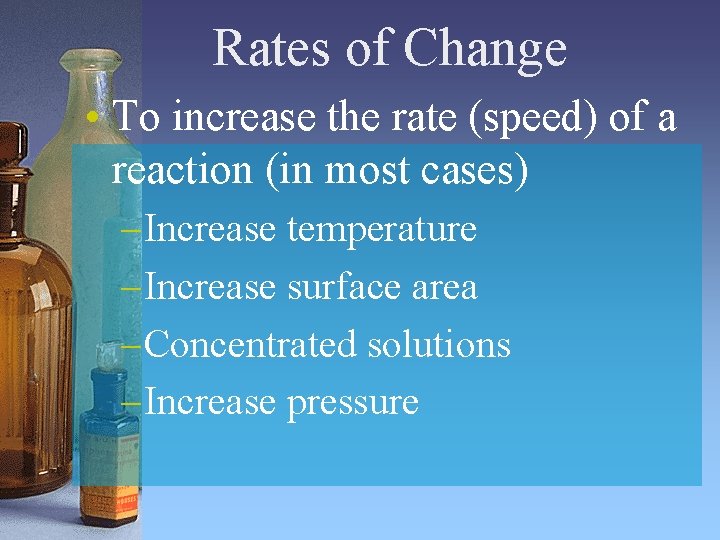
Rates of Change • To increase the rate (speed) of a reaction (in most cases) – Increase temperature – Increase surface area – Concentrated solutions – Increase pressure
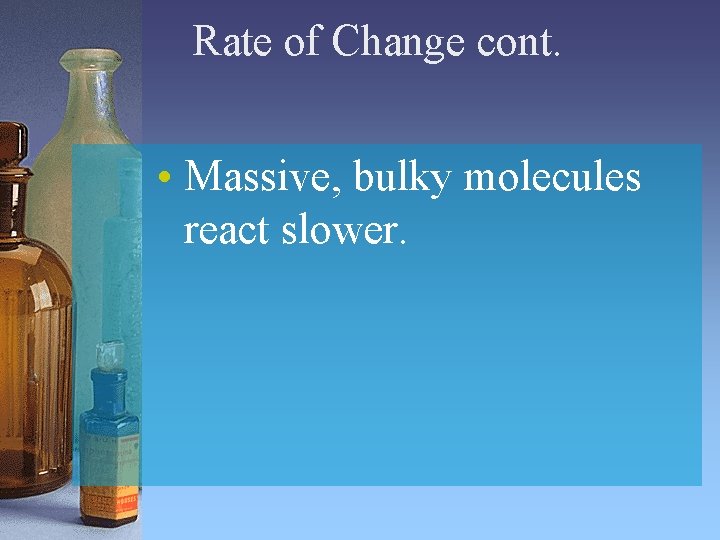
Rate of Change cont. • Massive, bulky molecules react slower.
Catalysts • a substance that speeds up a chemical reaction without being permanently changed itself. • They are not reactants nor products. • Enzymes are proteins that are catalysts for chemical reactions in living things.
Inhibitors • substances that are used to combine with one of the reactants to prevent certain reactions from occurring. • ex. Food preservatives, lemon juice on cut fruit to keep it from turning brown.
Equilibrium Systems • Some reactions are reversible Ex: • Ca. CO 3 + heat ← → Ca. O +CO 2 • Equilibrium results when rates balance. (when the reaction moving → equals the reaction moving ← )
Reaction Types • There are 5 main types of chemical reactions. 1) Synthesis 2) Decomposition 3) Single-displacement (replacement) 4) Double-displacement (replacement) 5) Combustion
Produce Yields forms Reactants → Product The chemicals you start with What you end up with after the reaction occurs
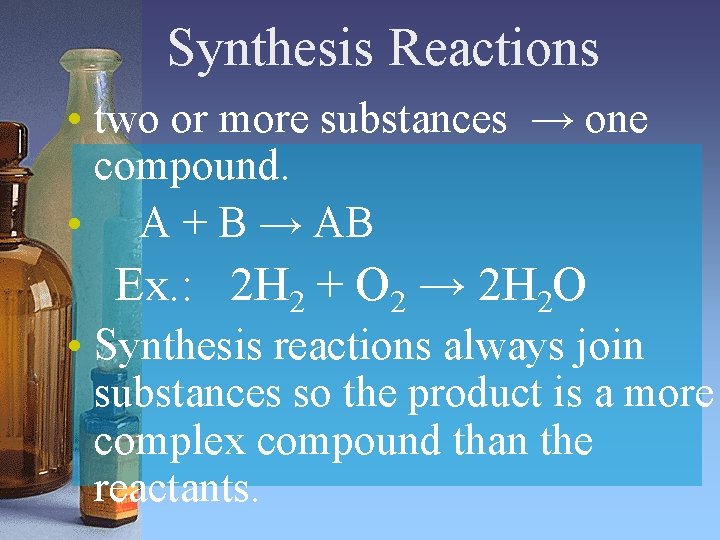
Synthesis Reactions • two or more substances → one compound. • A + B → AB Ex. : 2 H 2 + O 2 → 2 H 2 O • Synthesis reactions always join substances so the product is a more complex compound than the reactants.
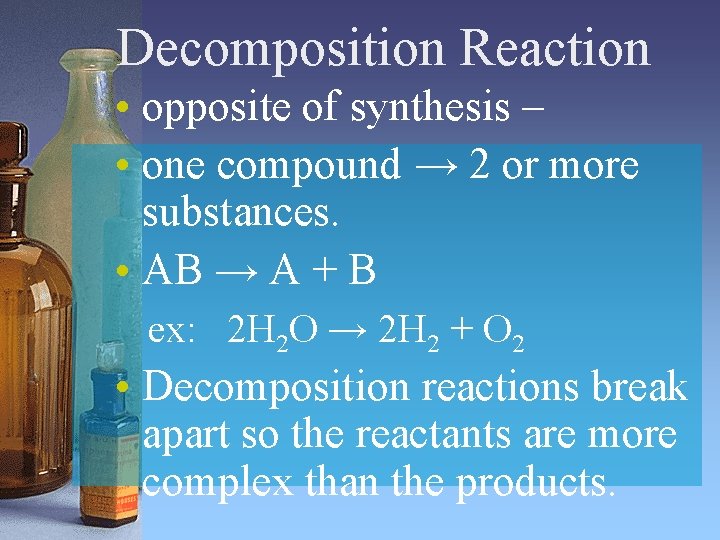
Decomposition Reaction • opposite of synthesis – • one compound → 2 or more substances. • AB → A + B ex: 2 H 2 O → 2 H 2 + O 2 • Decomposition reactions break apart so the reactants are more complex than the products.
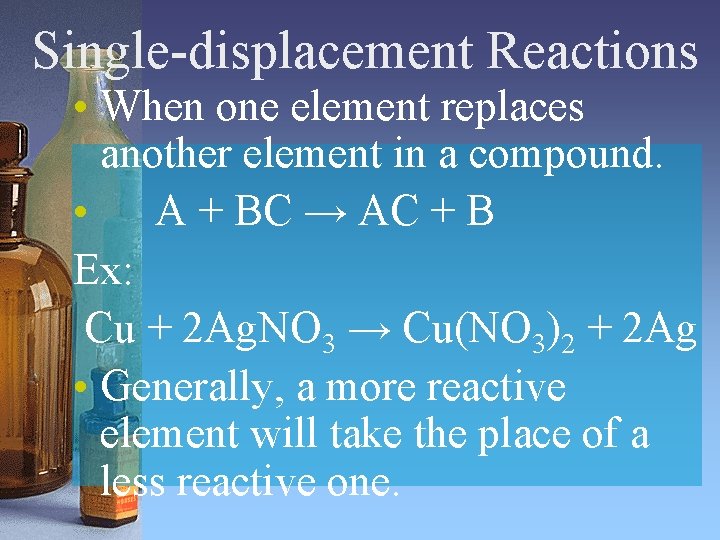
Single-displacement Reactions • When one element replaces another element in a compound. • A + BC → AC + B Ex: Cu + 2 Ag. NO 3 → Cu(NO 3)2 + 2 Ag • Generally, a more reactive element will take the place of a less reactive one.
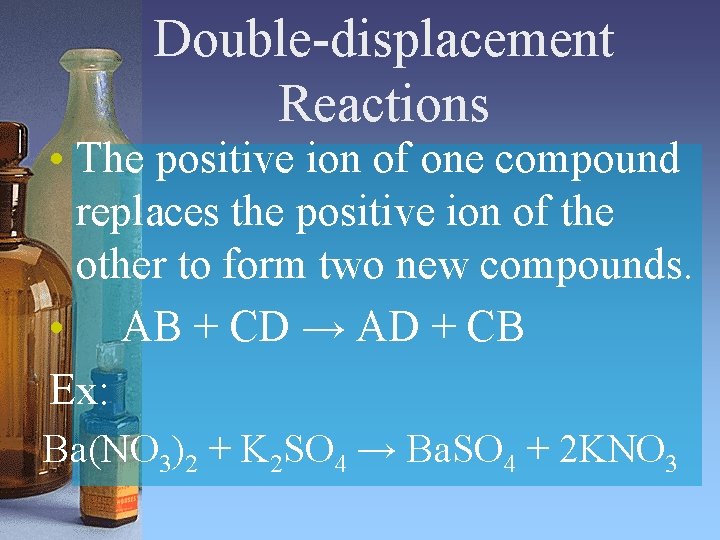
Double-displacement Reactions • The positive ion of one compound replaces the positive ion of the other to form two new compounds. • AB + CD → AD + CB Ex: Ba(NO 3)2 + K 2 SO 4 → Ba. SO 4 + 2 KNO 3
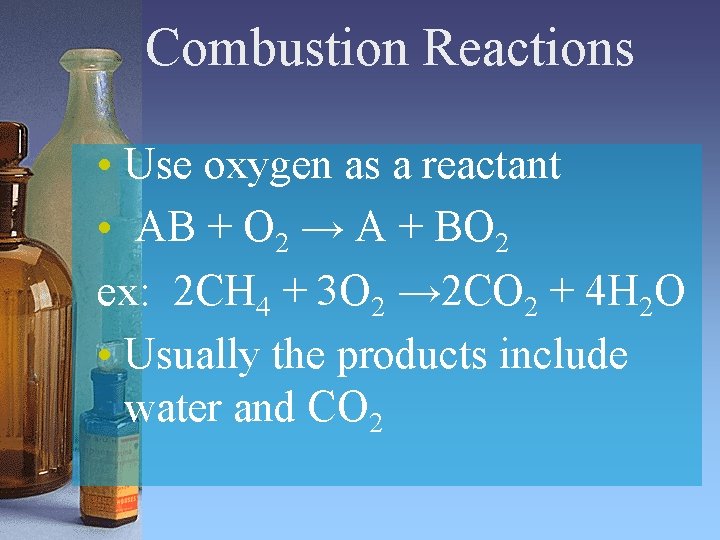
Combustion Reactions • Use oxygen as a reactant • AB + O 2 → A + BO 2 ex: 2 CH 4 + 3 O 2 → 2 CO 2 + 4 H 2 O • Usually the products include water and CO 2
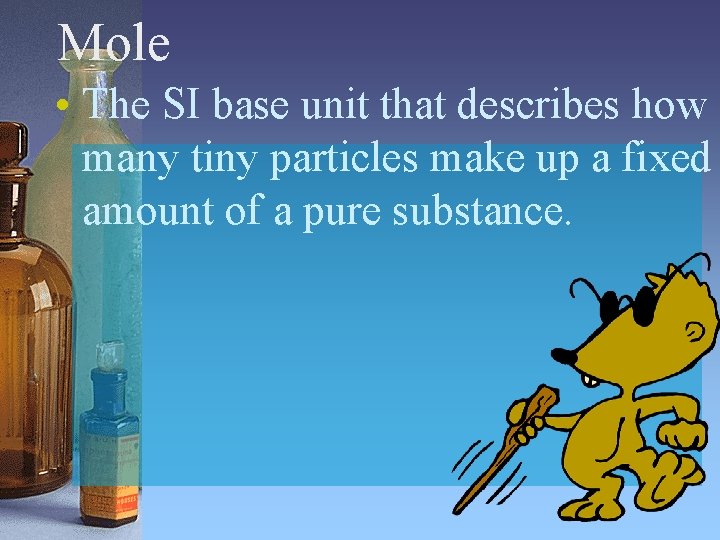
Mole • The SI base unit that describes how many tiny particles make up a fixed amount of a pure substance.
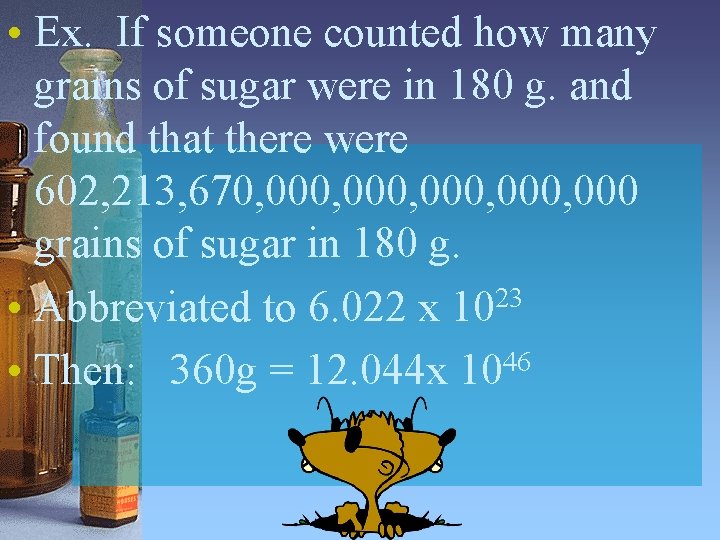
• Ex. If someone counted how many grains of sugar were in 180 g. and found that there were 602, 213, 670, 000, 000 grains of sugar in 180 g. 23 • Abbreviated to 6. 022 x 10 46 • Then: 360 g = 12. 044 x 10
Avogadro’s constant • 6. 022 x = the number of particles in exactly 1 mol (mole) of a substance. • This number is used to calculate the molar mass of a substance. 23 10
Molar mass • The molar mass is used to compare the number of particles of each substance in a chemical reaction.
The End