Over View of Study Design Did investigator assign

- Slides: 63
Over View of Study Design
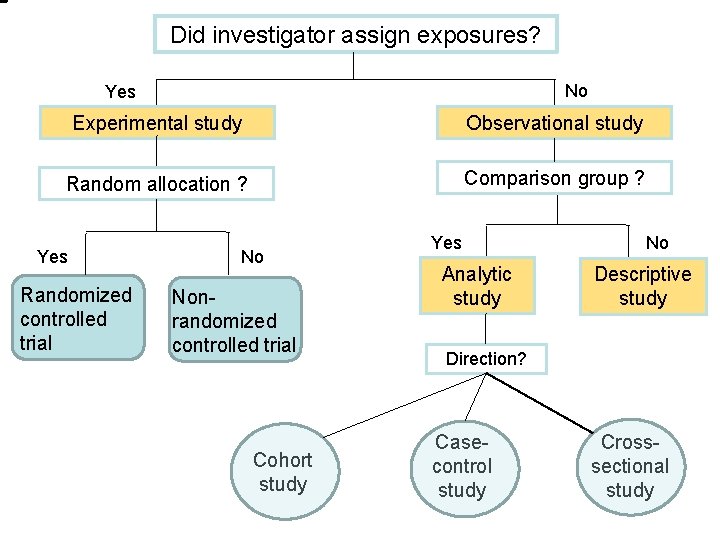
Did investigator assign exposures? No Yes Experimental study Observational study Random allocation ? Comparison group ? Yes Randomized controlled trial No Nonrandomized controlled trial Cohort study Yes Analytic study No Descriptive study Direction? Casecontrol study Crosssectional study
Descriptive Study
Descriptive study • Descriptive study is at the bottom of the research hierarchy, often represents the first scientific toe in new areas of inquiry. • A descriptive study is “concerned with and designed only to describe the existing distribution of variables, without regard to causal or other hypothesis. ” • As there is no comparison group, descriptive study doesn’t allow assessment of associations.
Three key features • Traditional descriptive epidemiology is concerned with describing the general characteristics of the distribution of a disease, in relation to, – Person – Place and – Time Or • Agent, host and environment
The descriptive triad – or pentad? • An alternative approach is to answer five basic “W” questions: – Who? – What? – Why? – When? – Where? – And an implicit sixth question, so what?
WHO has the disease in question? The description of characteristics of person must include age and sex. • Other important variables might be religion, marital status, personality type, race, socioeconomic factors like education, income, or occupation. • It can also include variables like type of medication use, types of food consumption and other life style variables.
WHAT is the condition or disease being studied? • Development of a clear, specific and measurable case definition is an essential step. • If only stringent criteria is followed, targeting more severe cases of disease, milder or earlier cases might be missed. • The trade-off is better specificity or less false positive cases. • E. g. AIDS cases
WHY did the condition or disease arise? • Descriptive studies often provide clues about the cause that can be pursued with more sophisticated research designs. • E. g. Clinical observation of blindness in newborn infants leads to underlying association of high ambient oxygen concentrations in incubators • Observation of cataract, heart defects and deafness in newborns leads association of rubella during pregnancy
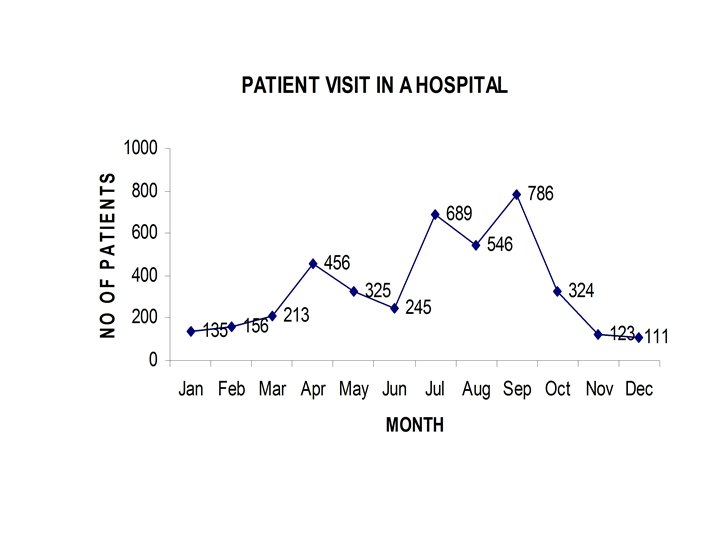
WHEN is the condition common or rare? Time provides important clues about health events. • Outbreak of gastroenteritis soon after ingestion of staphylococcal toxin. • Seasonal pattern of the disease e. g Dengue fever, pneumonia, influenza. • Historical comparison e. g. Small pox • Cyclic trend e. g. Malaria
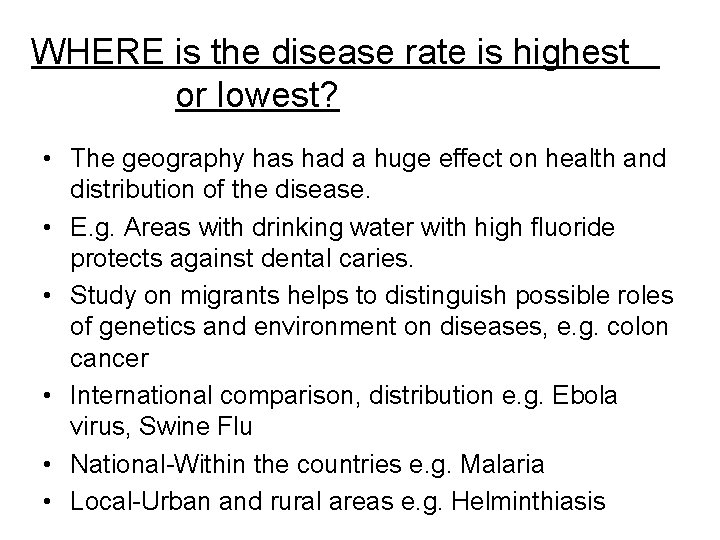
WHERE is the disease rate is highest or lowest? • The geography has had a huge effect on health and distribution of the disease. • E. g. Areas with drinking water with high fluoride protects against dental caries. • Study on migrants helps to distinguish possible roles of genetics and environment on diseases, e. g. colon cancer • International comparison, distribution e. g. Ebola virus, Swine Flu • National-Within the countries e. g. Malaria • Local-Urban and rural areas e. g. Helminthiasis
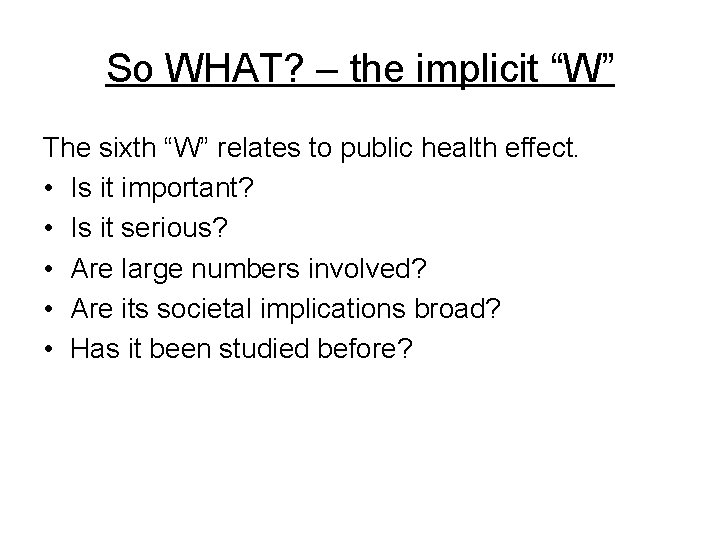
So WHAT? – the implicit “W” The sixth “W” relates to public health effect. • Is it important? • Is it serious? • Are large numbers involved? • Are its societal implications broad? • Has it been studied before?
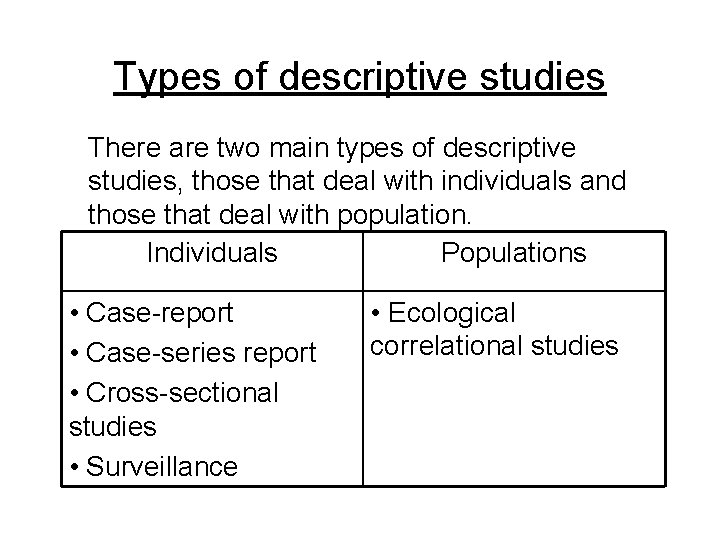
Types of descriptive studies There are two main types of descriptive studies, those that deal with individuals and those that deal with population. Individuals Populations • Case-report • Case-series report • Cross-sectional studies • Surveillance • Ecological correlational studies
Case report and case series • Most basic type of descriptive study of individuals. • It describes the profile of a patient or a group of patients with similar diagnosis. • Usually the clinician finds an unusual feature, that may lead to formulation of a hypothesis. • It is an important interface between the clinical medicine and epidemiology.
Case reports • Most common • Documents unusual medical occurrence • Reporting of a rare tumour (benign hepatocellular adenoma) in women who had taken oral contraceptives persuaded a large case-control study that confirmed strong association • Frisbee finger • Tennis elbow
Case series report • A case series aggregates individual cases with similar diagnosis in one report • Span of short period • Historical importance in epidemiology as often highlights on beginning or presence of an epidemic • Investigation on the activities of affected individuals can lead to formulation of hypothesis
Question on approach • Mere documentation of an interesting medical occurrence? OR • Formulation of a hypothesis? • Might depend upon collection of a case series rather than reliance on a single case report
Example • Five Pneumocystis carinii pneumonia were reported in young men between 1980 -81, which usually occurs in immunosuppressed older cancer patients- Unusual !!!!! • Same year Kaposi’s sarcoma reported in young adults-unusual!!!! This led to revelation that • They were immunosuppressive • Investigation by CDC: A new disease AIDS • Analytic studies revealed Risk factors and transmissible agent
Pertinent questions for descriptive study • WHO develops the disease with excessive frequency? • WHAT is the condition/disease being studied? • WHY did the disease arise? • WHEN is the disease common or rare? • WHERE does the disease develop with excessive frequency? • SO WHAT?
CROSS-SECTIONAL SURVEY • This is also known as prevalence survey • It describes the health of population and provides a snapshot of the population at a particular time • Exposure and outcome (disease) status are assessed at the same time among individuals in a well defined population • “Case-control analogue of a population cohort study” • Temporal sequence is often impossible to work out
CROSS-SECTIONAL SURVEY • The time window can be specific: any season or months of a year • It also can be a fixed point in the course of events which may vary in from person to person e. g. antenatal check up for pregnant women, pre-employment physical examination, retirement etc. • The subjects provide information at a single interview or examination
Information source • • • Census data Vital statistics record Employment health examinations Hospital medical records National survey e. g BINP, NNP etc
Example • National Nutrition Survey • Bangladesh Integrated Nutrition Programme Go door to door. Ask questions. Know the status. Prepare a report. Go for policy implication. E. g. Know the vitamin A status in the under five children
Strength & advantages • A good survey data can be of great value for national health policy making by – Assessing health status – Assessing health care needs of population • • • Less expensive Less time consuming Describes patterns of disease occurrence Helps in allocating resources Helps in formulating research questions
Limitations • It can only assess the relationship between the exposure and disease at a certain time point. • Not possible to identify whether the exposure preceded or resulted from the disease. – Exception: long standing/ unchanged exposure such as sex or blood type • It considers prevalence rather than incidence.
Surveillance • Formal definition, “the ongoing systematic collection, analysis, and interpretation of health data essential to the planning, implementation, and evaluation of public health practice, closely integrated with the timely dissemination of these data to those who need to know. ” • Prevention and control integrated with feedbacks are the key objective
Types of surveillance • Passive surveillance relies on data generally gathered through traditional channels, e. g. death certificates • Active surveillance searches for cases, e. g. maternal deaths • Eradication of small pox was possible due to surveillance and containment
Ecological correlational study • Correlational studies look for associations between exposures and outcomes in populations rather than in individuals • The disease is described in relation to some factor or interest such as age, sex, calendar time, food habits etc. • Correlational studies can be a convenient initial search for hypothesis
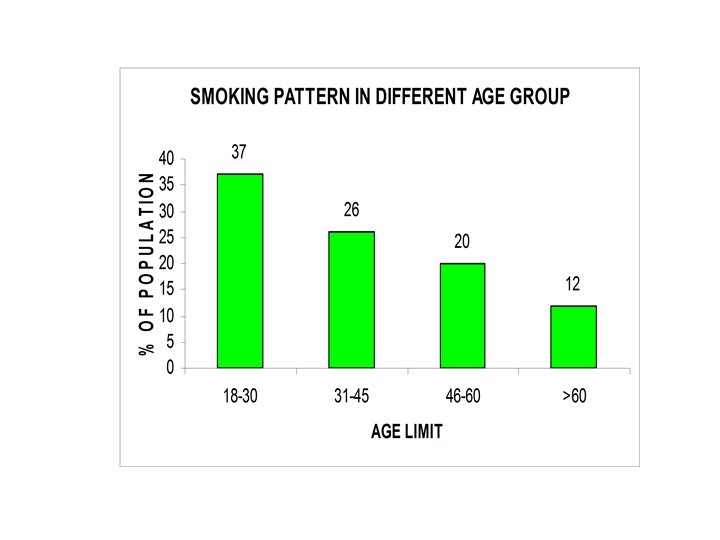
Example • Different groups at a particular time point: As we have seen that the proportion of smokers at different age group • Different times for a particular group: In the elderly population the Chronic Heart Disease has gone down over the years. It may be due to improved health care facilities or by reduction of risk factors
Correlation coefficient • r is the descriptive measure in correlational studies, as long as there is a linear relationship between exposure and disease. • The linear relationship means that for every unit change in exposure there is proportionate change in the disease frequency also. • E. g. Death rates from coronary artery disease correlate with per capita sales of cigarettes.
Strength of correlational study • This is the first step to investigate in the possible exposure disease relationship • Quick and inexpensive • Allows for comparison (with the already available data from different surveys) for different geographic distribution
Limitations of correlational study • Inability to link exposure with disease in particular individuals E. g. Anemia screening were correlated to mortality from malnutrition. There is a strong positive correlation. More the numbers screened less is the mortality from anemia. Question: Does screening decreases mortality from PEM? Answer: NO! We in fact do not know that the persons who were screened, actually experienced lower mortality rates.
Limitations of correlational study • Inability to control of confounding E. g. Having a balcony garden causes dengue. The possibility is that the Aedes mosquito grow in the stagnant water in the flower pot and the bite of Aedes causes Dengue. It is not possible to separate the effects of such potential confoundings from the correlational data.
Limitations of correlational study • Masks the actual relationship - It represents the average exposure levels rather than the actual individual levels. - The exposure can be at times high or it can be low and the relationship might not be linear. It is possible that people with moderate anemia may die earlier than those with mild anemia.
Uses of descriptive studies • Trend analysis – Important to healthcare administrators – Often provided by ongoing surveillances • Planning – Need for hospital beds – Need for resource allocations • Clues about cause – Observation by clinicians, and subsequent development of hypotheses
Limitations of descriptive studies • Overstepping the data – False inference of temporal relationship may cause public-health damage – Investigators might draw causal inferences when none is possible • E. g. oral contraceptive pill vs. ovarian cysts • Electronic fetal monitoring
Analytic studies
Analytic studies • Analytic studies focuses on the determinants of a disease by testing the hypotheses formulated from descriptive studies, with the objective of judging whether a particular exposure causes or prevents the disease
How? • By using an appropriate comparison group
Types of Analytic Studies • Observational study ØThe investigator simply observes the natural course of events • Intervention study ØThe investigator themselves allocate the exposure and then follow the subjects for the subsequent development of disease
Types of observational studies • Two basic types: – Case control study – Cohort study Ø In theory it is possible to test a hypotheses using either design strategy Ø In practice we need to chose one as each design offers certain unique advantages and disadvantages
What is the key difference between these two designs? The process of subject selection
Cohort Study
Cohort study • Subjects are selected and divided into two groups on the basis of the presence or absence of exposure to a particular factor
Two groups of people in cohort study • A group of individuals who are exposed to a particular factor of interest • Exposed • A group of individuals who are not exposed to a particular factor of interest • Unexposed ØThe two groups are followed for a specified period of time ØThe duration of follow-up depends on how common or rare the disease is
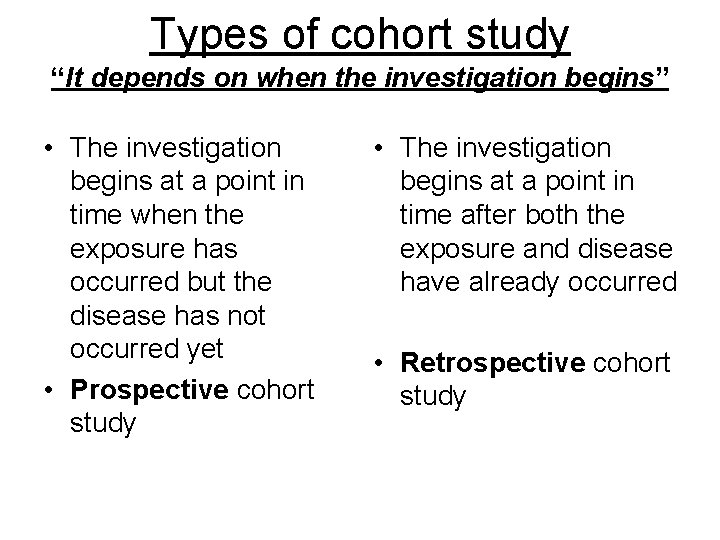
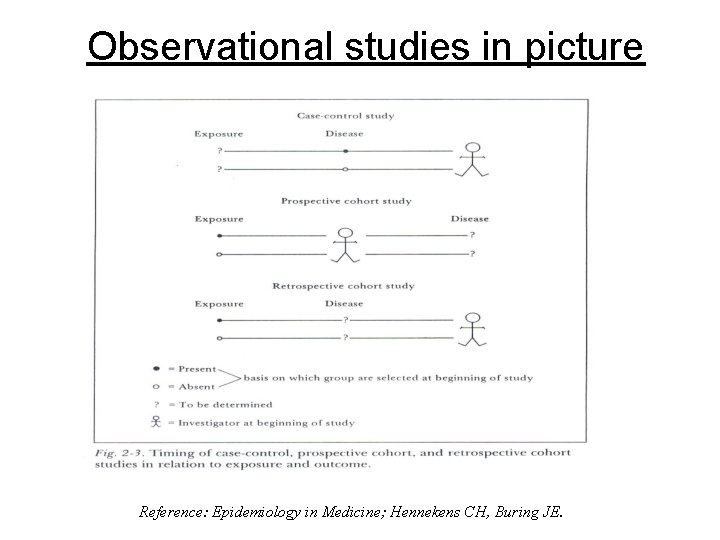
Types of cohort study “It depends on when the investigation begins” • The investigation begins at a point in time when the exposure has occurred but the disease has not occurred yet • Prospective cohort study • The investigation begins at a point in time after both the exposure and disease have already occurred • Retrospective cohort study
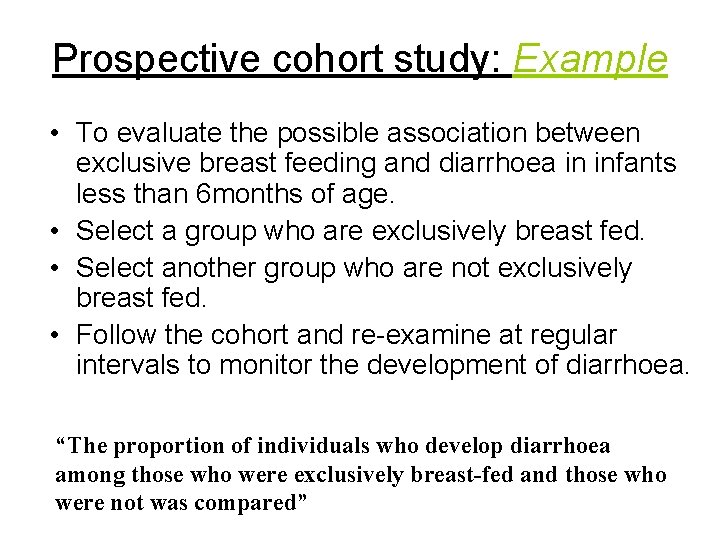
Prospective cohort study: Example • To evaluate the possible association between exclusive breast feeding and diarrhoea in infants less than 6 months of age. • Select a group who are exclusively breast fed. • Select another group who are not exclusively breast fed. • Follow the cohort and re-examine at regular intervals to monitor the development of diarrhoea. “The proportion of individuals who develop diarrhoea among those who were exclusively breast-fed and those who were not was compared”
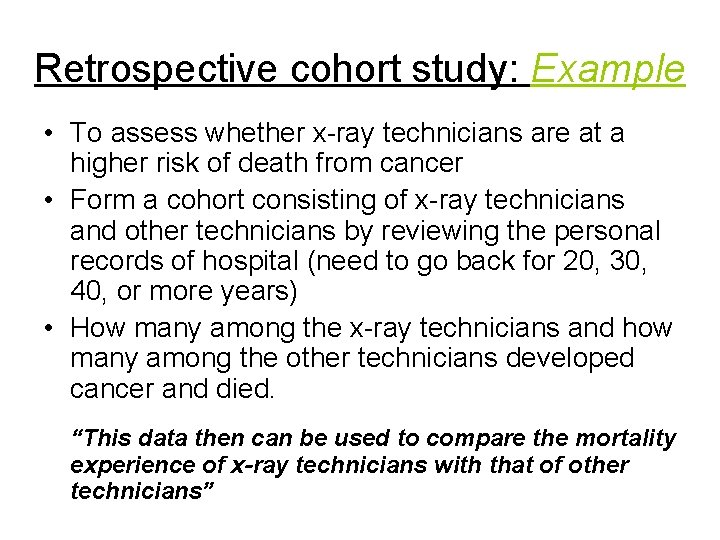
Retrospective cohort study: Example • To assess whether x-ray technicians are at a higher risk of death from cancer • Form a cohort consisting of x-ray technicians and other technicians by reviewing the personal records of hospital (need to go back for 20, 30, 40, or more years) • How many among the x-ray technicians and how many among the other technicians developed cancer and died. “This data then can be used to compare the mortality experience of x-ray technicians with that of other technicians”
Case-Control Study
Case-control study • Subjects are selected and divided into two groups based on whether they have the disease of interest or not
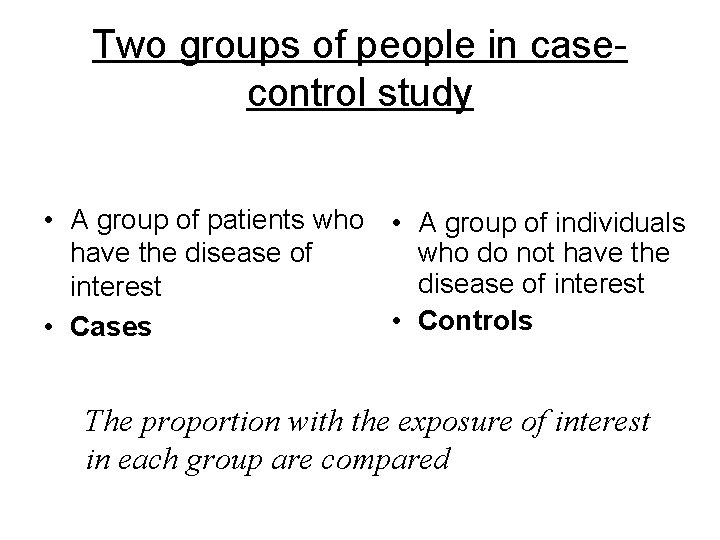
Two groups of people in casecontrol study • A group of patients who • A group of individuals who do not have the disease of interest • Controls • Cases The proportion with the exposure of interest in each group are compared
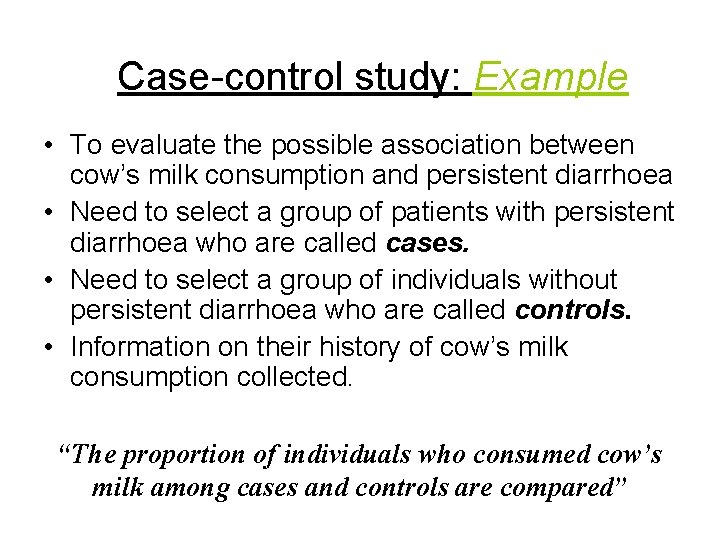
Case-control study: Example • To evaluate the possible association between cow’s milk consumption and persistent diarrhoea • Need to select a group of patients with persistent diarrhoea who are called cases. • Need to select a group of individuals without persistent diarrhoea who are called controls. • Information on their history of cow’s milk consumption collected. “The proportion of individuals who consumed cow’s milk among cases and controls are compared”
Observational studies in picture Reference: Epidemiology in Medicine; Hennekens CH, Buring JE.
Choice of observational study • The nature of the disease under investigation • The type of exposure • The available resources
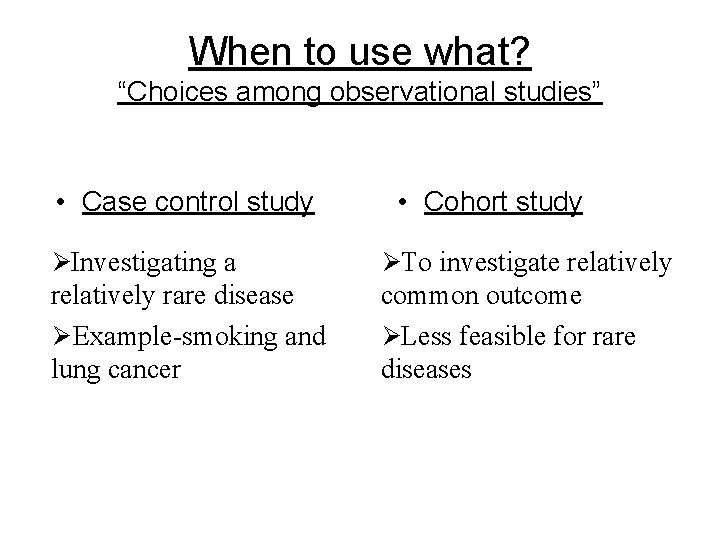
When to use what? “Choices among observational studies” • Case control study • Cohort study ØInvestigating a ØTo investigate relatively rare disease Ø Example-smoking and lung cancer common outcome ØLess feasible for rare diseases
Intervention Studies
Intervention studies • A type of prospective study • The exposure status of each participant is assigned by the investigators themselves • The exposure has been assigned among the participants by doing randomization
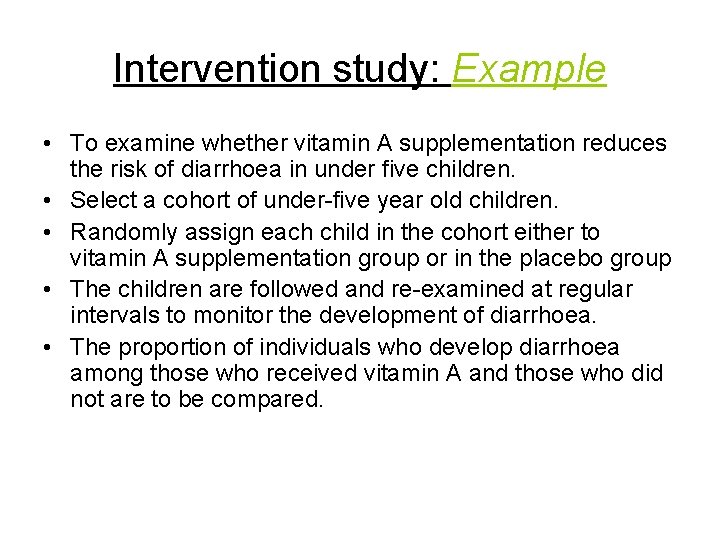
Intervention study: Example • To examine whether vitamin A supplementation reduces the risk of diarrhoea in under five children. • Select a cohort of under-five year old children. • Randomly assign each child in the cohort either to vitamin A supplementation group or in the placebo group • The children are followed and re-examined at regular intervals to monitor the development of diarrhoea. • The proportion of individuals who develop diarrhoea among those who received vitamin A and those who did not are to be compared.
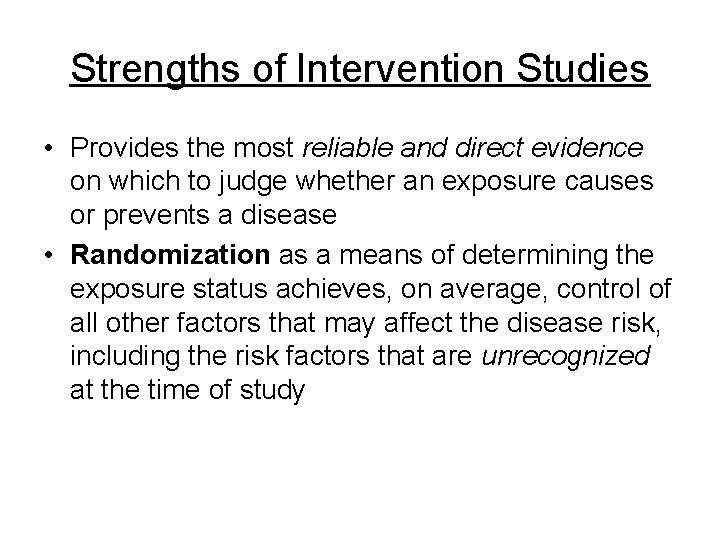
Strengths of Intervention Studies • Provides the most reliable and direct evidence on which to judge whether an exposure causes or prevents a disease • Randomization as a means of determining the exposure status achieves, on average, control of all other factors that may affect the disease risk, including the risk factors that are unrecognized at the time of study
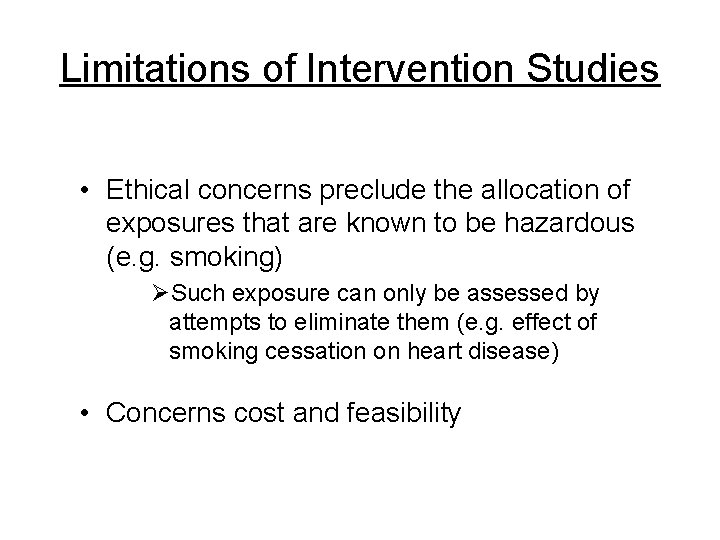
Limitations of Intervention Studies • Ethical concerns preclude the allocation of exposures that are known to be hazardous (e. g. smoking) ØSuch exposure can only be assessed by attempts to eliminate them (e. g. effect of smoking cessation on heart disease) • Concerns cost and feasibility
More on different study in coming weeks….