NIH and New and Early Stage Investigators Joanna
- Slides: 33
NIH and New and Early Stage Investigators Joanna M. Watson, Ph. D Program Director National Cancer Institute
R 01 – The Gold Standard The Research Project Grant (R 01): Ø The original and historically oldest grant mechanism used by NIH. Ø Provides support for health-related research and development based on the mission of the NIH. Ø Can be investigator-initiated or can be submitted in response to a specific Funding Opportunity Announcement (FOA). Ø Is a grant award made to support a discrete, specified, circumscribed project to be performed by the named investigator(s) in an area representing the investigator's specific interest and competencies, based on the mission of the NIH Ø The NIH awards R 01 grants to organizations of all types. Although the Project Director/Principal Investigator writes the grant application and is responsible for conducting the research, the applicant is the research organization.
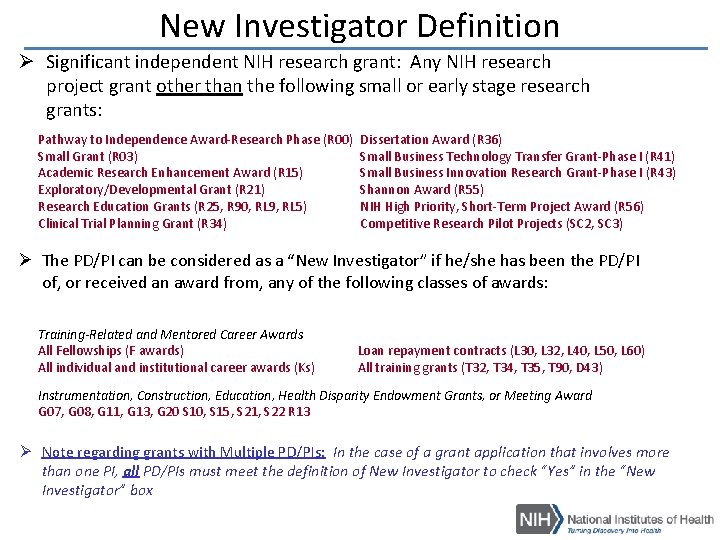
New Investigator Definition A Program Director or Principal Investigator (PD/PI) is considered a New Investigator if he/she has not previously competed successfully as a PD/PI for a “significant independent” NIH research grant.
New Investigator Definition Ø Significant independent NIH research grant: Any NIH research project grant other than the following small or early stage research grants: Pathway to Independence Award-Research Phase (R 00) Dissertation Award (R 36) Small Grant (R 03) Small Business Technology Transfer Grant-Phase I (R 41) Academic Research Enhancement Award (R 15) Small Business Innovation Research Grant-Phase I (R 43) Exploratory/Developmental Grant (R 21) Shannon Award (R 55) Research Education Grants (R 25, R 90, RL 9, RL 5) NIH High Priority, Short-Term Project Award (R 56) Clinical Trial Planning Grant (R 34) Competitive Research Pilot Projects (SC 2, SC 3) Ø The PD/PI can be considered as a “New Investigator” if he/she has been the PD/PI of, or received an award from, any of the following classes of awards: Training-Related and Mentored Career Awards All Fellowships (F awards) All individual and institutional career awards (Ks) Loan repayment contracts (L 30, L 32, L 40, L 50, L 60) All training grants (T 32, T 34, T 35, T 90, D 43) Instrumentation, Construction, Education, Health Disparity Endowment Grants, or Meeting Award G 07, G 08, G 11, G 13, G 20 S 10, S 15, S 21, S 22 R 13 Ø Note regarding grants with Multiple PD/PIs: In the case of a grant application that involves more than one PI, all PD/PIs must meet the definition of New Investigator to check “Yes” in the “New Investigator” box
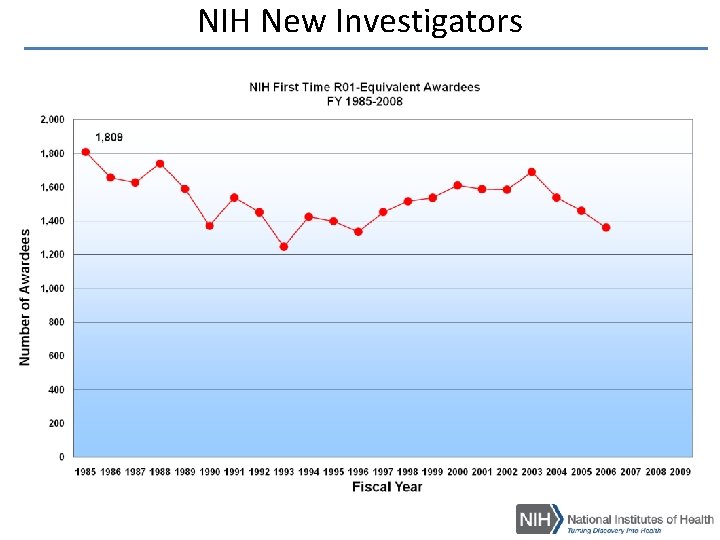
NIH New Investigators
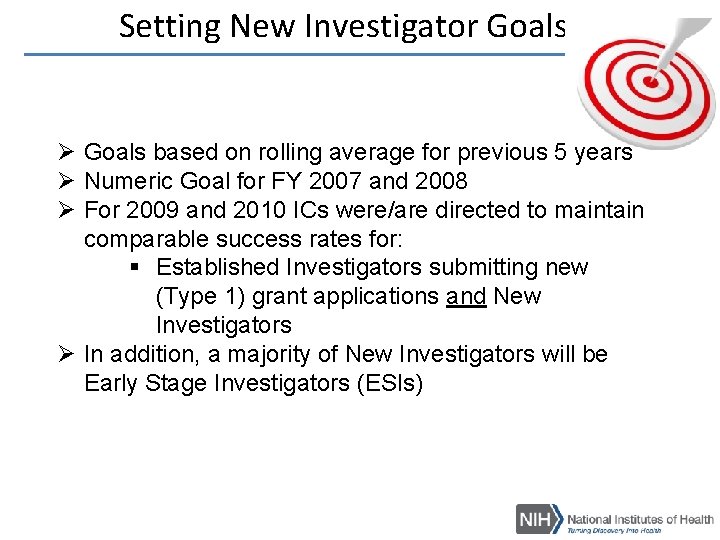
Setting New Investigator Goals Ø Goals based on rolling average for previous 5 years Ø Numeric Goal for FY 2007 and 2008 Ø For 2009 and 2010 ICs were/are directed to maintain comparable success rates for: § Established Investigators submitting new (Type 1) grant applications and New Investigators Ø In addition, a majority of New Investigators will be Early Stage Investigators (ESIs)
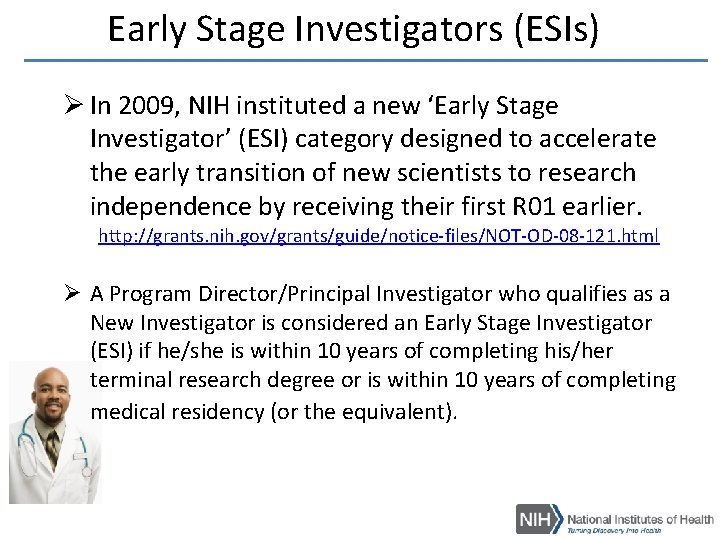
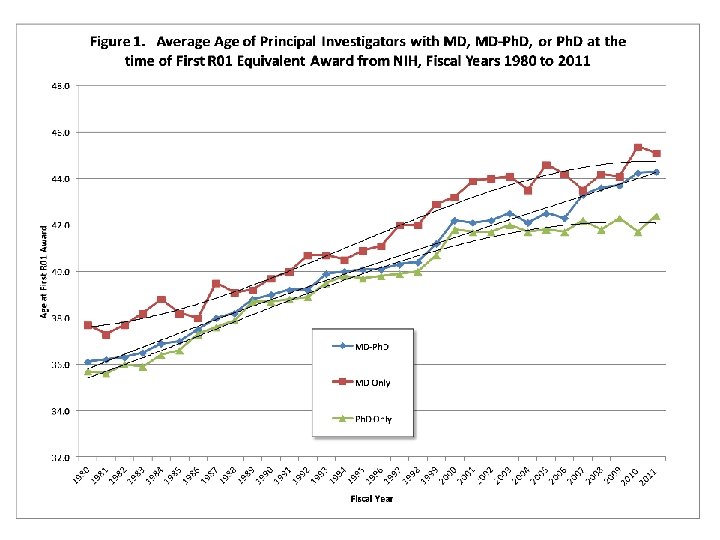
Early Stage Investigators (ESIs) Ø In 2009, NIH instituted a new ‘Early Stage Investigator’ (ESI) category designed to accelerate the early transition of new scientists to research independence by receiving their first R 01 earlier. http: //grants. nih. gov/grants/guide/notice-files/NOT-OD-08 -121. html Ø A Program Director/Principal Investigator who qualifies as a New Investigator is considered an Early Stage Investigator (ESI) if he/she is within 10 years of completing his/her terminal research degree or is within 10 years of completing medical residency (or the equivalent).
Implementation of ESI Definition Ø The NIH modified the collection of information on degree dates and medical residency within the personal profile of the e. RA Commons. Ø PD/PIs must update their personal profile in the e. RA Commons to be considered for the ESI classification. Investigators who enter degree and residency completion dates will be notified of their ESI status by email. Ø Procedures and guidelines for requesting an extension of the period of ESI eligibility are in place to accommodate individuals with various medical concerns, disability, pressing family care responsibilities, or active duty military service (instructions in Commons).
Implementation of ESI definition Ø Applications from ESIs and New Investigators are identified to reviewers so that appropriate consideration of their career stage can be applied during review. Ø Applications from ESIs and New Investigators are “clustered” during review to enable evaluation as a group and distinguish from Established Investigators. Ø An application with more than one PI is identified for consideration of ESI/NI by reviewers only if ALL of the listed PIs qualify as New Investigators. Ø Staff in the NIH institutes and centers are apprised of ESI and New Investigator status and this factor is considered when applications are selected for award. Ø New Investigators are eligible for the “Full Implementation to Shorten the Review Cycle for New Investigator R 01 Applications Reviewed in Center for Scientific Review (CSR) Recurring Study Sections”. http: //grants. nih. gov/grants/guide/notice-files/NOT-OD-07 -083. html Update notice: NOT-OD-11 -057. html
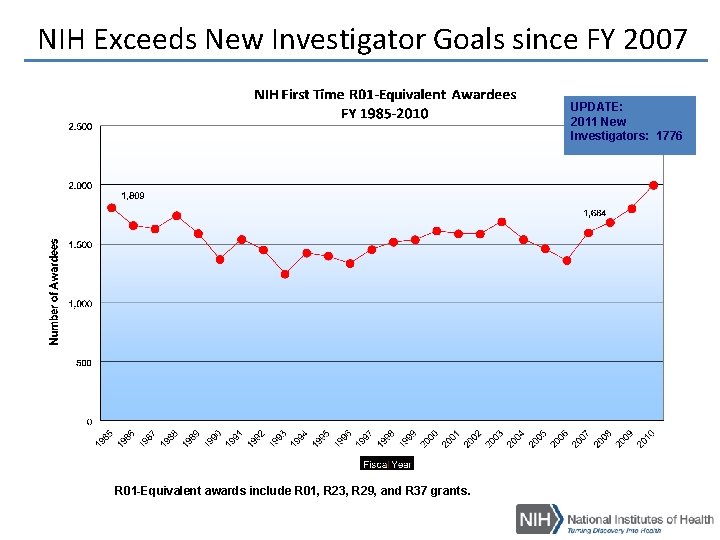
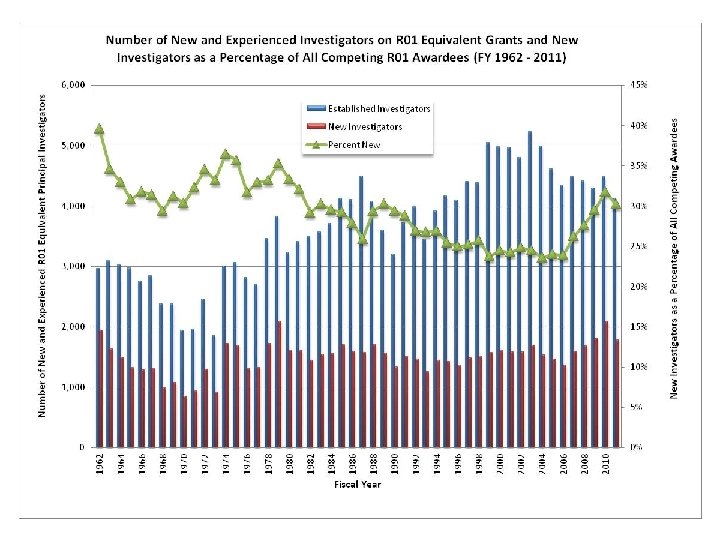
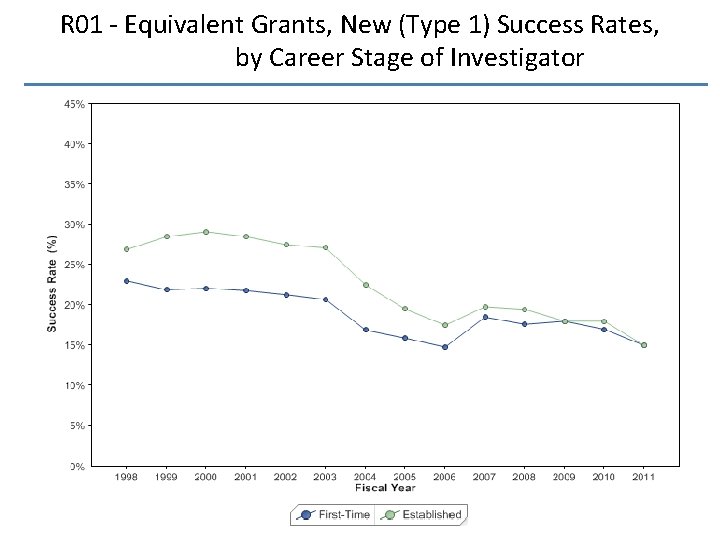
NIH Exceeds New Investigator Goals since FY 2007 UPDATE: 2011 New Investigators: 1776 R 01 -Equivalent awards include R 01, R 23, R 29, and R 37 grants.
R 01 - Equivalent Grants, New (Type 1) Success Rates, by Career Stage of Investigator
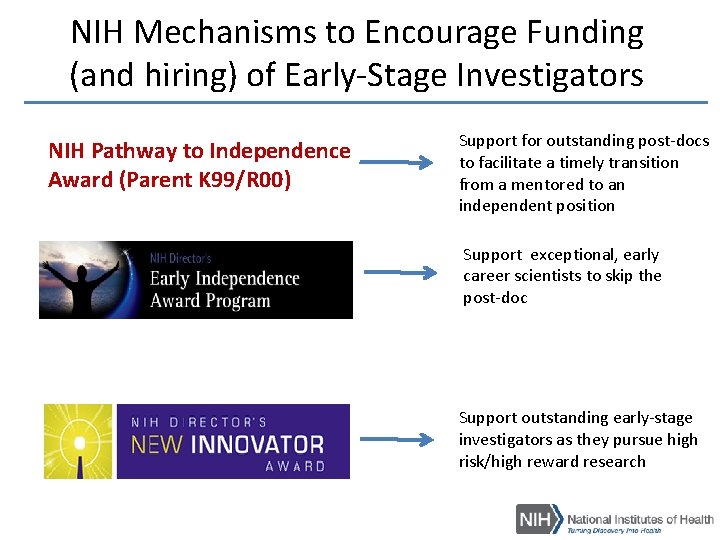
NIH Mechanisms to Encourage Funding (and hiring) of Early-Stage Investigators NIH Pathway to Independence Award (Parent K 99/R 00) Support for outstanding post-docs to facilitate a timely transition from a mentored to an independent position Support exceptional, early career scientists to skip the post-doc Support outstanding early-stage investigators as they pursue high risk/high reward research
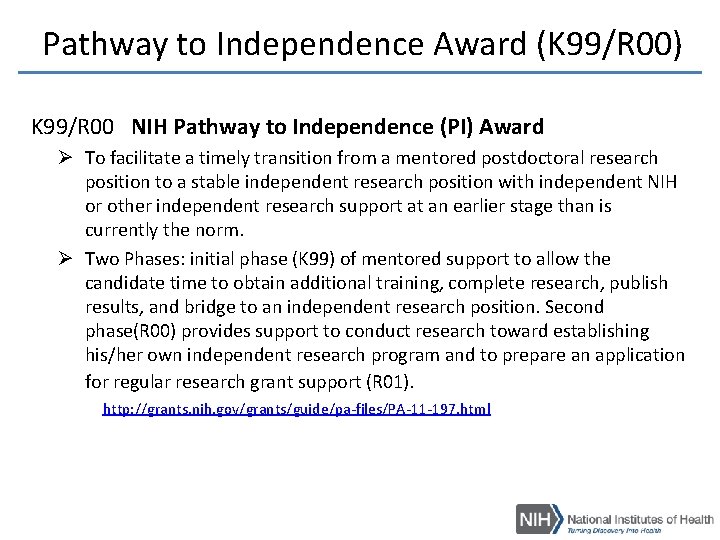
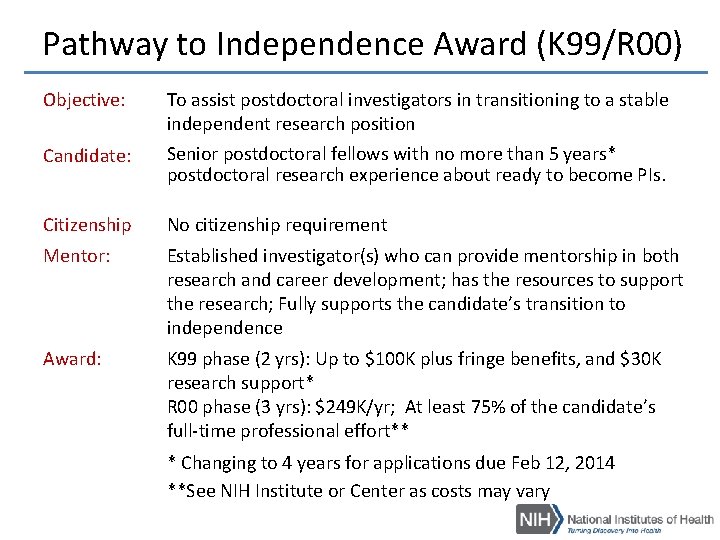
Pathway to Independence Award (K 99/R 00) K 99/R 00 NIH Pathway to Independence (PI) Award Ø To facilitate a timely transition from a mentored postdoctoral research position to a stable independent research position with independent NIH or other independent research support at an earlier stage than is currently the norm. Ø Two Phases: initial phase (K 99) of mentored support to allow the candidate time to obtain additional training, complete research, publish results, and bridge to an independent research position. Second phase(R 00) provides support to conduct research toward establishing his/her own independent research program and to prepare an application for regular research grant support (R 01). http: //grants. nih. gov/grants/guide/pa-files/PA-11 -197. html
Pathway to Independence Award (K 99/R 00) Objective: Candidate: To assist postdoctoral investigators in transitioning to a stable independent research position Senior postdoctoral fellows with no more than 5 years* postdoctoral research experience about ready to become PIs. Citizenship No citizenship requirement Mentor: Established investigator(s) who can provide mentorship in both research and career development; has the resources to support the research; Fully supports the candidate’s transition to independence Award: K 99 phase (2 yrs): Up to $100 K plus fringe benefits, and $30 K research support* R 00 phase (3 yrs): $249 K/yr; At least 75% of the candidate’s full-time professional effort** * Changing to 4 years for applications due Feb 12, 2014 **See NIH Institute or Center as costs may vary
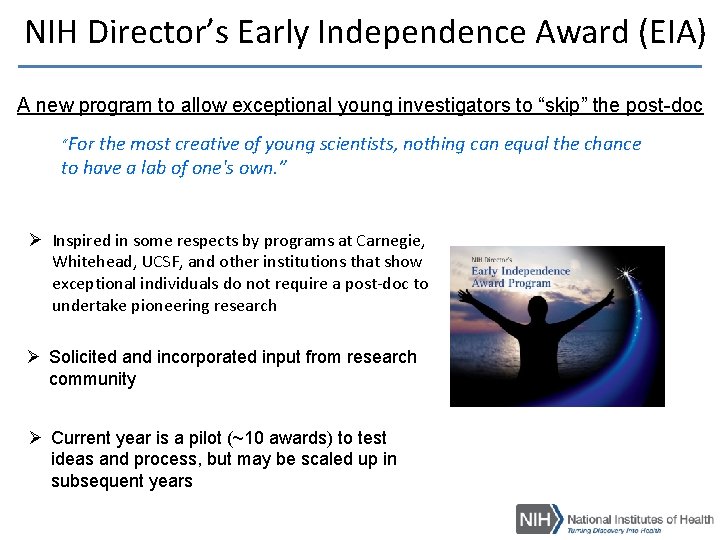
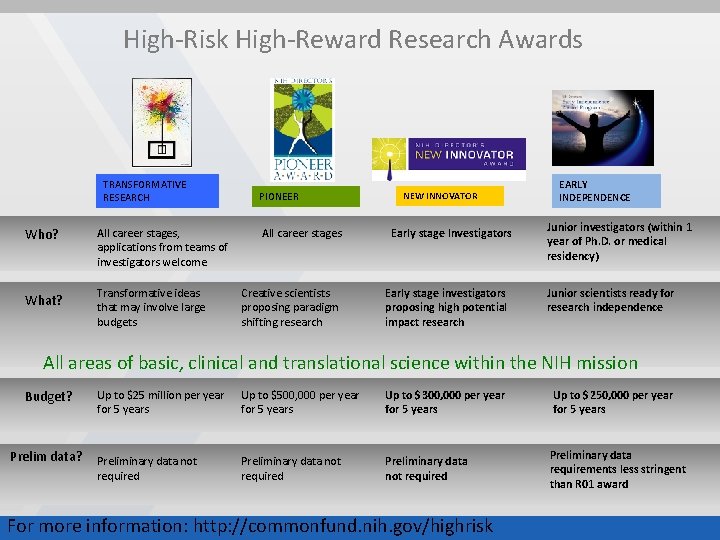
NIH Director’s Early Independence Award (EIA) A new program to allow exceptional young investigators to “skip” the post-doc “For the most creative of young scientists, nothing can equal the chance to have a lab of one's own. ” Ø Inspired in some respects by programs at Carnegie, Whitehead, UCSF, and other institutions that show exceptional individuals do not require a post-doc to undertake pioneering research Ø Solicited and incorporated input from research community Ø Current year is a pilot (~10 awards) to test ideas and process, but may be scaled up in subsequent years
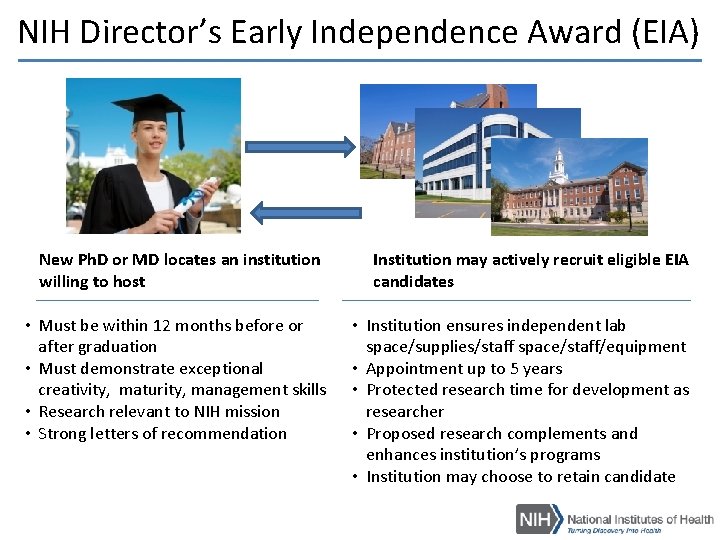
NIH Director’s Early Independence Award (EIA) What’s Novel? New Ph. D or MD locates an institution willing to host • Must be within 12 months before or after graduation • Must demonstrate exceptional creativity, maturity, management skills • Research relevant to NIH mission • Strong letters of recommendation Institution may actively recruit eligible EIA candidates • Institution ensures independent lab space/supplies/staff space/staff/equipment • Appointment up to 5 years • Protected research time for development as researcher • Proposed research complements and enhances institution’s programs • Institution may choose to retain candidate
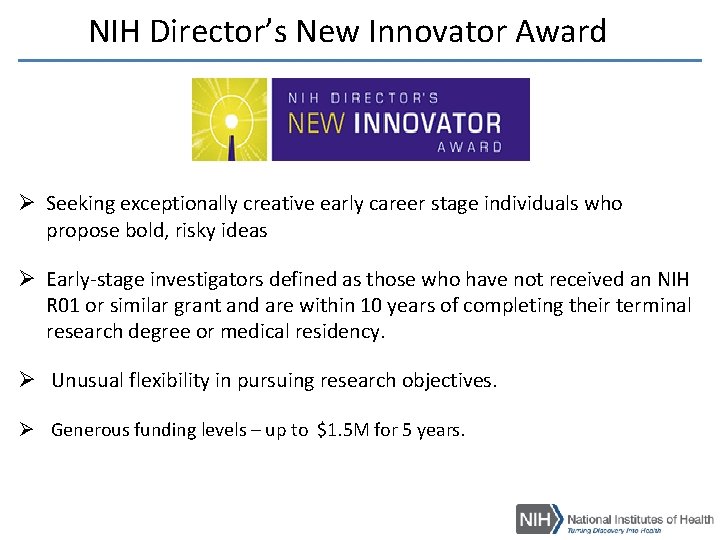
NIH Director’s New Innovator Award Ø Seeking exceptionally creative early career stage individuals who propose bold, risky ideas Ø Early-stage investigators defined as those who have not received an NIH R 01 or similar grant and are within 10 years of completing their terminal research degree or medical residency. Ø Unusual flexibility in pursuing research objectives. Ø Generous funding levels – up to $1. 5 M for 5 years.
High-Risk High-Reward Research Awards TRANSFORMATIVE RESEARCH Who? All career stages, applications from teams of investigators welcome What? Transformative ideas that may involve large budgets PIONEER All career stages Creative scientists proposing paradigm shifting research NEW INNOVATOR Early stage Investigators Early stage investigators proposing high potential impact research EARLY INDEPENDENCE Junior investigators (within 1 year of Ph. D. or medical residency) Junior scientists ready for research independence All areas of basic, clinical and translational science within the NIH mission Budget? Prelim data? Up to $25 million per year for 5 years Up to $500, 000 per year for 5 years Up to $300, 000 per year for 5 years Up to $250, 000 per year for 5 years Preliminary data not required Preliminary data requirements less stringent than R 01 award For more information: http: //commonfund. nih. gov/highrisk
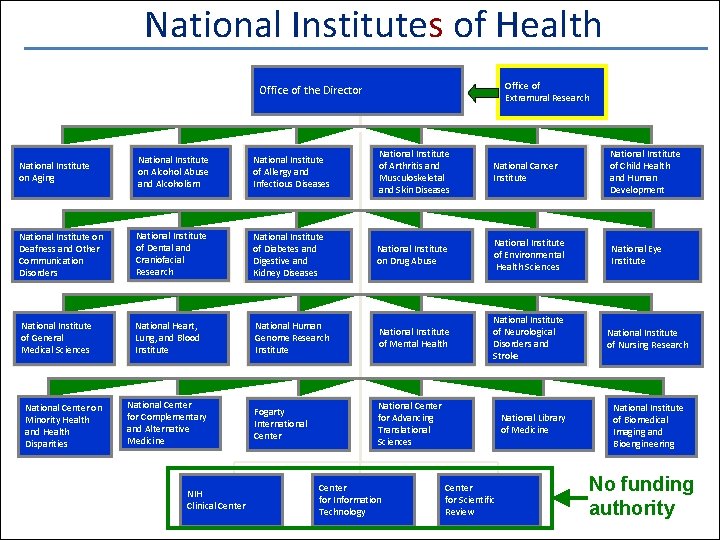
National Institutes of Health Office of Extramural Research Office of the Director National Institute on Aging National Institute on Alcohol Abuse and Alcoholism National Institute of Allergy and Infectious Diseases National Institute of Arthritis and Musculoskeletal and Skin Diseases National Cancer Institute National Institute of Child Health and Human Development National Institute on Deafness and Other Communication Disorders National Institute of Dental and Craniofacial Research National Institute of Diabetes and Digestive and Kidney Diseases National Institute on Drug Abuse National Institute of Environmental Health Sciences National Eye Institute National Institute of General Medical Sciences National Heart, Lung, and Blood Institute National Human Genome Research Institute National Institute of Mental Health National Institute of Neurological Disorders and Stroke Fogarty International Center National Center for Advancing Translational Sciences National Center on Minority Health and Health Disparities National Center for Complementary and Alternative Medicine NIH Clinical Center for Information Technology National Library of Medicine Center for Scientific Review National Institute of Nursing Research National Institute of Biomedical Imaging and Bioengineering No funding authority 21
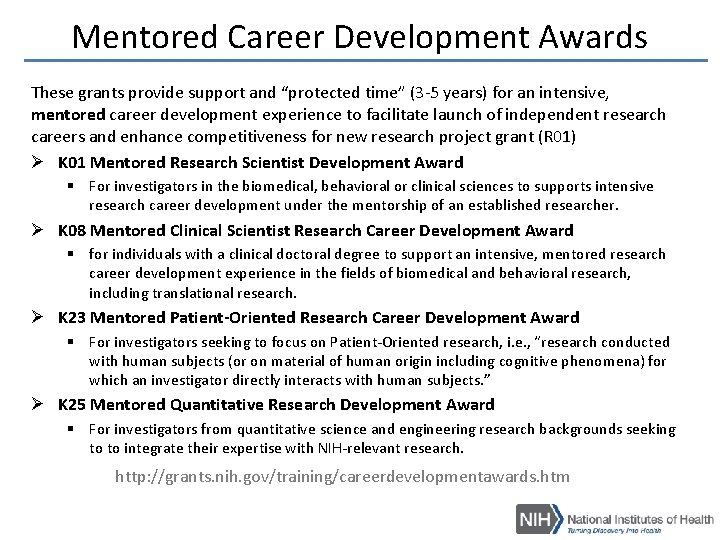
Mentored Career Development Awards These grants provide support and “protected time” (3 -5 years) for an intensive, mentored career development experience to facilitate launch of independent research careers and enhance competitiveness for new research project grant (R 01) Ø K 01 Mentored Research Scientist Development Award § For investigators in the biomedical, behavioral or clinical sciences to supports intensive research career development under the mentorship of an established researcher. Ø K 08 Mentored Clinical Scientist Research Career Development Award § for individuals with a clinical doctoral degree to support an intensive, mentored research career development experience in the fields of biomedical and behavioral research, including translational research. Ø K 23 Mentored Patient-Oriented Research Career Development Award § For investigators seeking to focus on Patient-Oriented research, i. e. , “research conducted with human subjects (or on material of human origin including cognitive phenomena) for which an investigator directly interacts with human subjects. ” Ø K 25 Mentored Quantitative Research Development Award § For investigators from quantitative science and engineering research backgrounds seeking to to integrate their expertise with NIH-relevant research. http: //grants. nih. gov/training/careerdevelopmentawards. htm
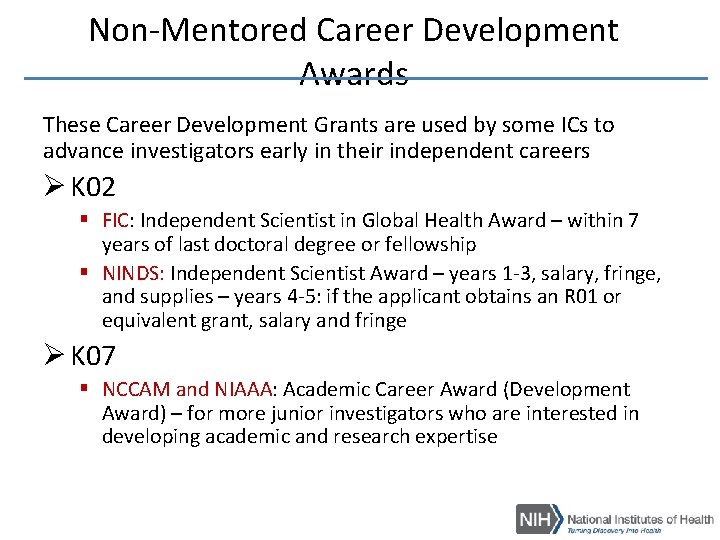
Non-Mentored Career Development Awards These Career Development Grants are used by some ICs to advance investigators early in their independent careers Ø K 02 § FIC: Independent Scientist in Global Health Award – within 7 years of last doctoral degree or fellowship § NINDS: Independent Scientist Award – years 1 -3, salary, fringe, and supplies – years 4 -5: if the applicant obtains an R 01 or equivalent grant, salary and fringe Ø K 07 § NCCAM and NIAAA: Academic Career Award (Development Award) – for more junior investigators who are interested in developing academic and research expertise
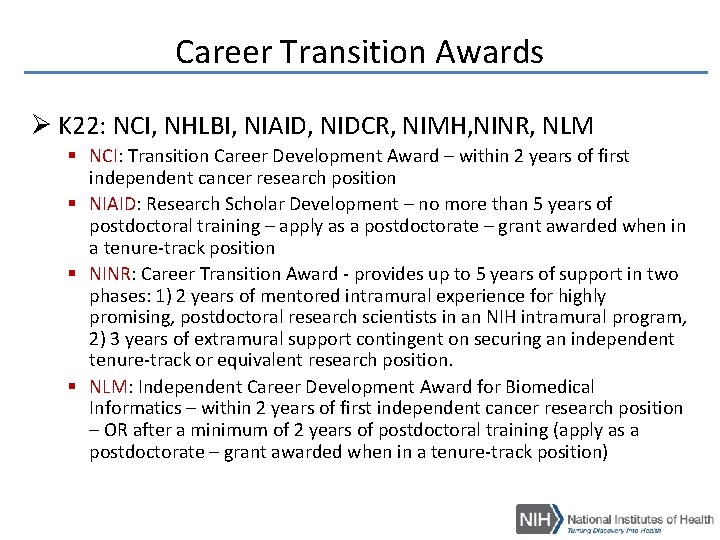
Career Transition Awards Ø K 22: NCI, NHLBI, NIAID, NIDCR, NIMH, NINR, NLM § NCI: Transition Career Development Award – within 2 years of first independent cancer research position § NIAID: Research Scholar Development – no more than 5 years of postdoctoral training – apply as a postdoctorate – grant awarded when in a tenure-track position § NINR: Career Transition Award - provides up to 5 years of support in two phases: 1) 2 years of mentored intramural experience for highly promising, postdoctoral research scientists in an NIH intramural program, 2) 3 years of extramural support contingent on securing an independent tenure-track or equivalent research position. § NLM: Independent Career Development Award for Biomedical Informatics – within 2 years of first independent cancer research position – OR after a minimum of 2 years of postdoctoral training (apply as a postdoctorate – grant awarded when in a tenure-track position)
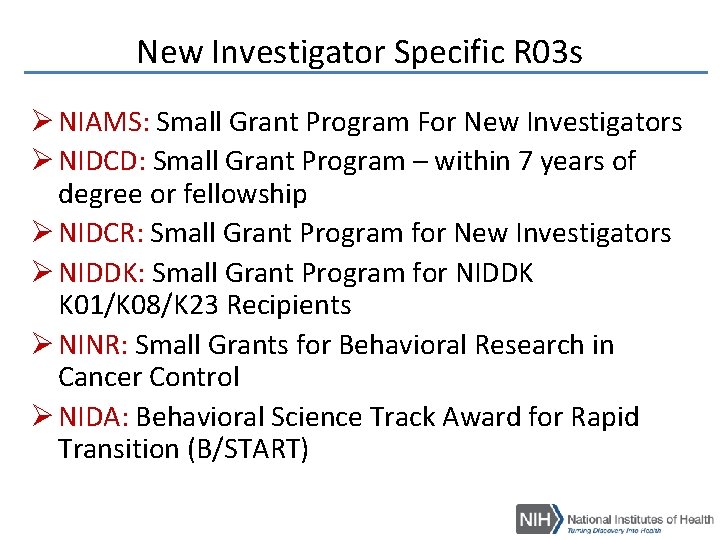
New Investigator Specific R 03 s Ø NIAMS: Small Grant Program For New Investigators Ø NIDCD: Small Grant Program – within 7 years of degree or fellowship Ø NIDCR: Small Grant Program for New Investigators Ø NIDDK: Small Grant Program for NIDDK K 01/K 08/K 23 Recipients Ø NINR: Small Grants for Behavioral Research in Cancer Control Ø NIDA: Behavioral Science Track Award for Rapid Transition (B/START)
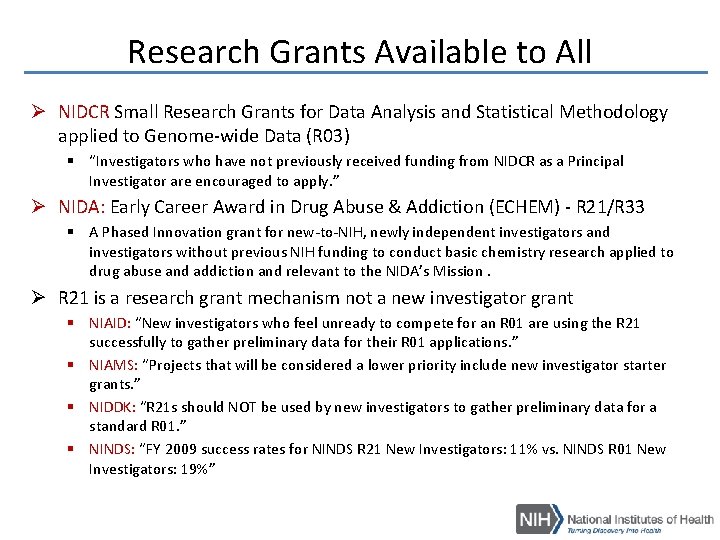
Research Grants Available to All Ø NIDCR Small Research Grants for Data Analysis and Statistical Methodology applied to Genome-wide Data (R 03) § “Investigators who have not previously received funding from NIDCR as a Principal Investigator are encouraged to apply. ” Ø NIDA: Early Career Award in Drug Abuse & Addiction (ECHEM) - R 21/R 33 § A Phased Innovation grant for new-to-NIH, newly independent investigators and investigators without previous NIH funding to conduct basic chemistry research applied to drug abuse and addiction and relevant to the NIDA’s Mission. Ø R 21 is a research grant mechanism not a new investigator grant § NIAID: “New investigators who feel unready to compete for an R 01 are using the R 21 successfully to gather preliminary data for their R 01 applications. ” § NIAMS: “Projects that will be considered a lower priority include new investigator starter grants. ” § NIDDK: “R 21 s should NOT be used by new investigators to gather preliminary data for a standard R 01. ” § NINDS: “FY 2009 success rates for NINDS R 21 New Investigators: 11% vs. NINDS R 01 New Investigators: 19%”
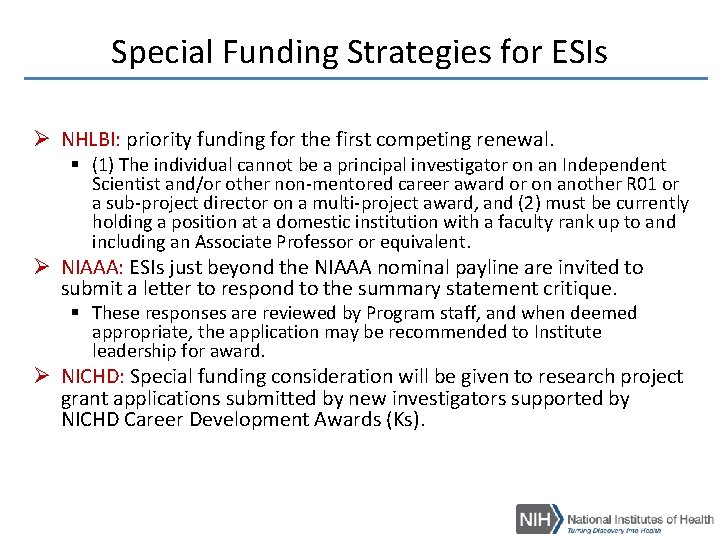
Special Funding Strategies for ESIs Ø NHLBI: priority funding for the first competing renewal. § (1) The individual cannot be a principal investigator on an Independent Scientist and/or other non-mentored career award or on another R 01 or a sub-project director on a multi-project award, and (2) must be currently holding a position at a domestic institution with a faculty rank up to and including an Associate Professor or equivalent. Ø NIAAA: ESIs just beyond the NIAAA nominal payline are invited to submit a letter to respond to the summary statement critique. § These responses are reviewed by Program staff, and when deemed appropriate, the application may be recommended to Institute leadership for award. Ø NICHD: Special funding consideration will be given to research project grant applications submitted by new investigators supported by NICHD Career Development Awards (Ks).
Common Funding Strategies for ESIs Ø Setting a flexible (better) payline for ESI R 01 applications Ø Limiting Institute-specific administrative cuts Ø Supporting ESIs for 5 years (many Institutes only fund 4 year R 01 s) Ø Partial “bridge” funding http: //grants. nih. gov/grants/new_investigators/
Loan Repayment Program Ø Commit to perform research for 2 years, and the NIH repays up to $35, 000 per year of your qualified educational debt and covers the resulting taxes. Ø You must be conducting research in of the following 5 areas: § § § Clinical Research Pediatric Research Contraception & Infertility Research Health Disparities Research Clinical Research for Individuals from Disadvantaged Backgrounds http: //www. lrp. nih. gov/
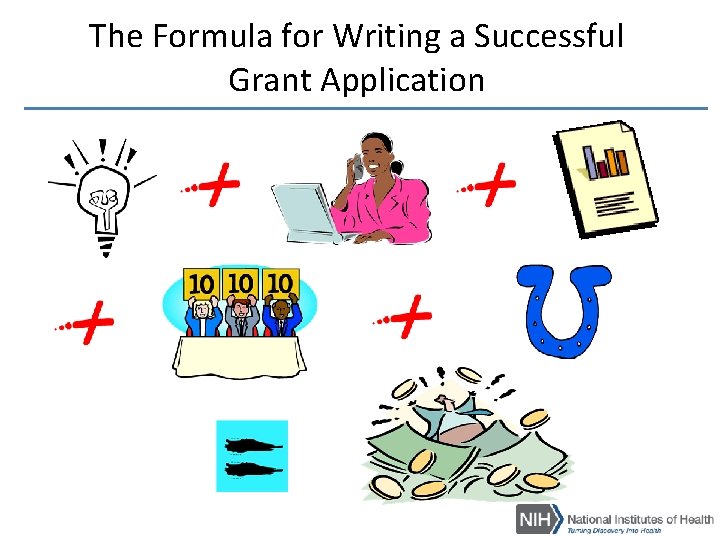
The Formula for Writing a Successful Grant Application
Grant Writing for Success Writing the Application Ø Start early and develop good ideas Ø Seek advice and critical input from colleagues Ø Talk to your NIH Program Official(s) Ø Use the NIH (www. nih. gov) and OER (http: //grants. nih. gov) webpages Ø Follow instructions carefully, remember review criteria
New and Early Stage Investigators — the Program Perspective Ø Get to know the Program Director for your scientific area Ø Contact them about your research ideas § § Fit with institute mission and priorities Best grant mechanism or program Best study section for review Technical assistance with the application process
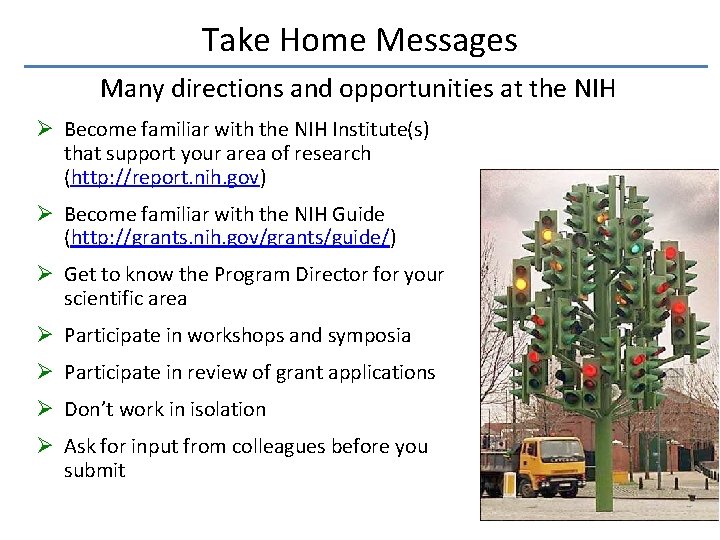
Take Home Messages Many directions and opportunities at the NIH Ø Become familiar with the NIH Institute(s) that support your area of research (http: //report. nih. gov) Ø Become familiar with the NIH Guide (http: //grants. nih. gov/grants/guide/) Ø Get to know the Program Director for your scientific area Ø Participate in workshops and symposia Ø Participate in review of grant applications Ø Don’t work in isolation Ø Ask for input from colleagues before you submit