Outline Announcements Computer Architecture continued Signal handling in
- Slides: 52
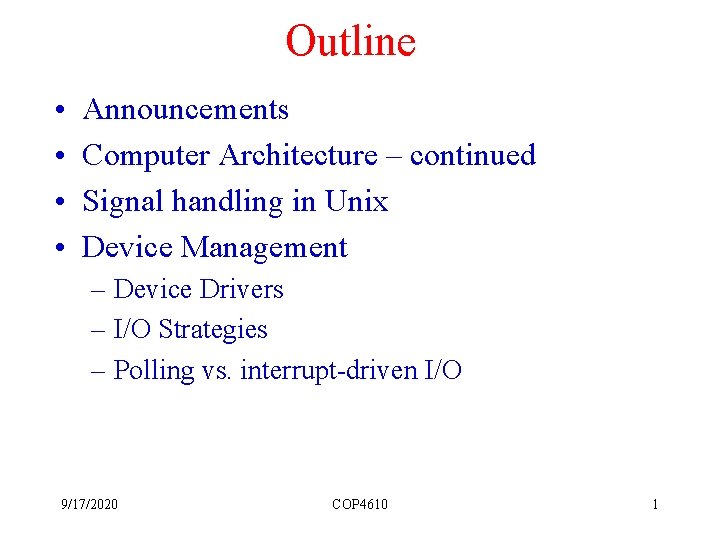
Outline • • Announcements Computer Architecture – continued Signal handling in Unix Device Management – Device Drivers – I/O Strategies – Polling vs. interrupt-driven I/O 9/17/2020 COP 4610 1
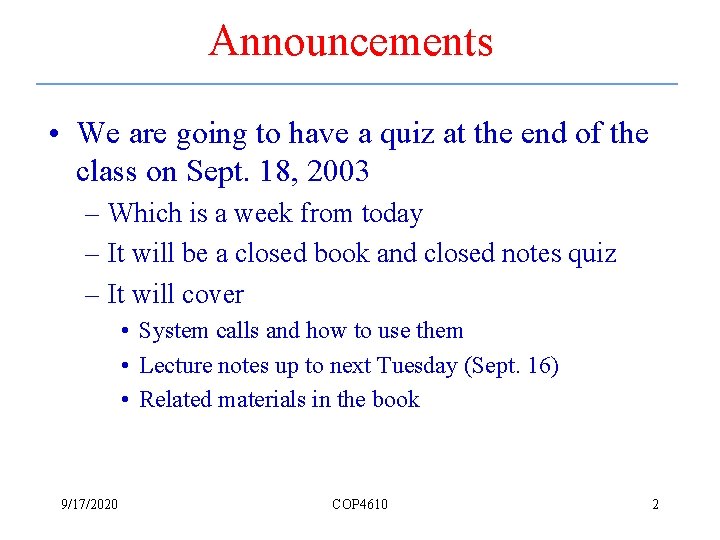
Announcements • We are going to have a quiz at the end of the class on Sept. 18, 2003 – Which is a week from today – It will be a closed book and closed notes quiz – It will cover • System calls and how to use them • Lecture notes up to next Tuesday (Sept. 16) • Related materials in the book 9/17/2020 COP 4610 2
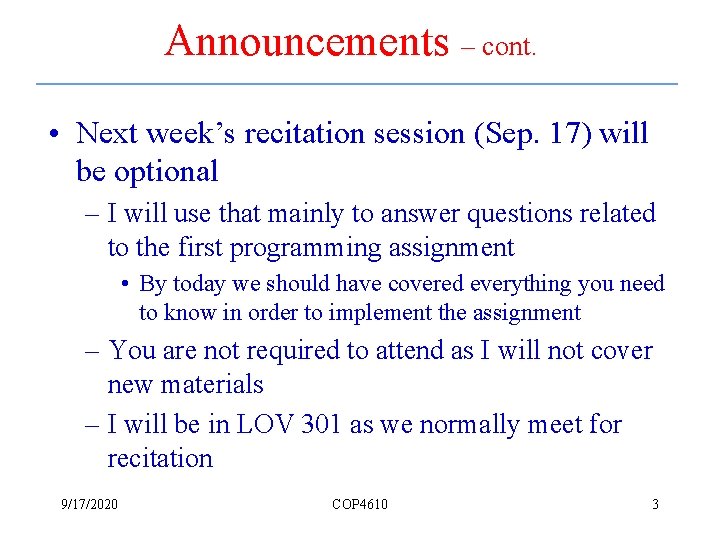
Announcements – cont. • Next week’s recitation session (Sep. 17) will be optional – I will use that mainly to answer questions related to the first programming assignment • By today we should have covered everything you need to know in order to implement the assignment – You are not required to attend as I will not cover new materials – I will be in LOV 301 as we normally meet for recitation 9/17/2020 COP 4610 3
Announcements – cont. • Comments regarding the first programming assignment – You can use simple-shell. cc as a starting point or the code in the textbook • You can use the code segments from examples I distributed • Please note that you are not allowed to copy other’s work • Comments on Homework #1 9/17/2020 COP 4610 4
Device Drivers • The part of OS that implements device management is called collectively as device manager, which includes device drivers and device driver infrastructure – Device drivers can be complex – However, the drivers for different devices implement a similar interface so that a higherlevel component has a uniform interface for different devices 9/17/2020 COP 4610 5
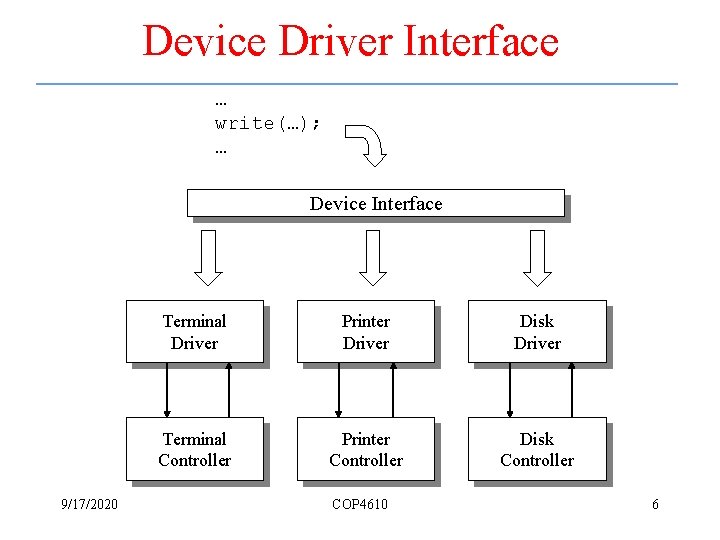
Device Driver Interface … write(…); … Device Interface 9/17/2020 Terminal Driver Printer Driver Disk Driver Terminal Controller Printer Controller Disk Controller COP 4610 6
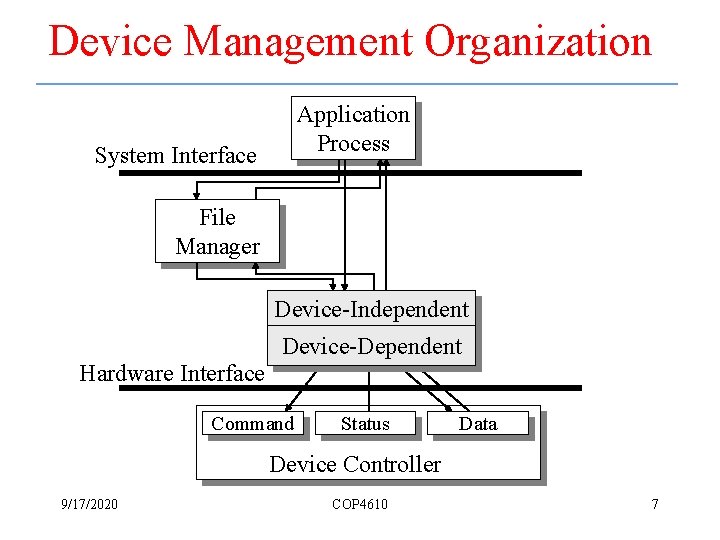
Device Management Organization Application Process System Interface File Manager Device-Independent Device-Dependent Hardware Interface Command Status Data Device Controller 9/17/2020 COP 4610 7
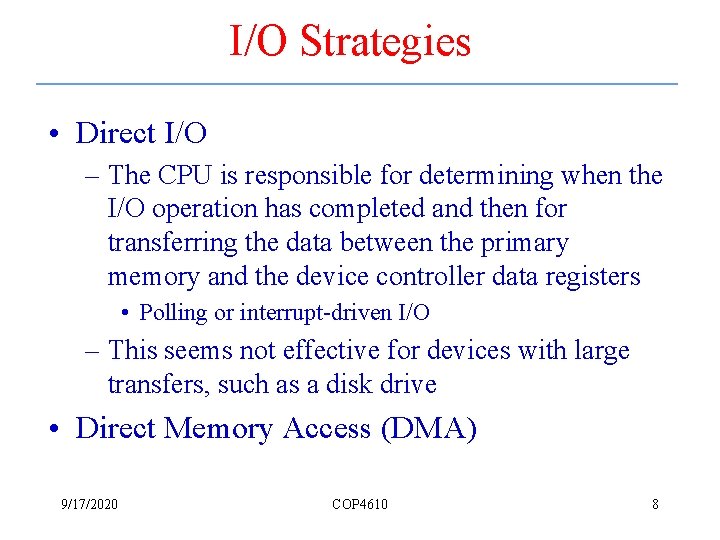
I/O Strategies • Direct I/O – The CPU is responsible for determining when the I/O operation has completed and then for transferring the data between the primary memory and the device controller data registers • Polling or interrupt-driven I/O – This seems not effective for devices with large transfers, such as a disk drive • Direct Memory Access (DMA) 9/17/2020 COP 4610 8
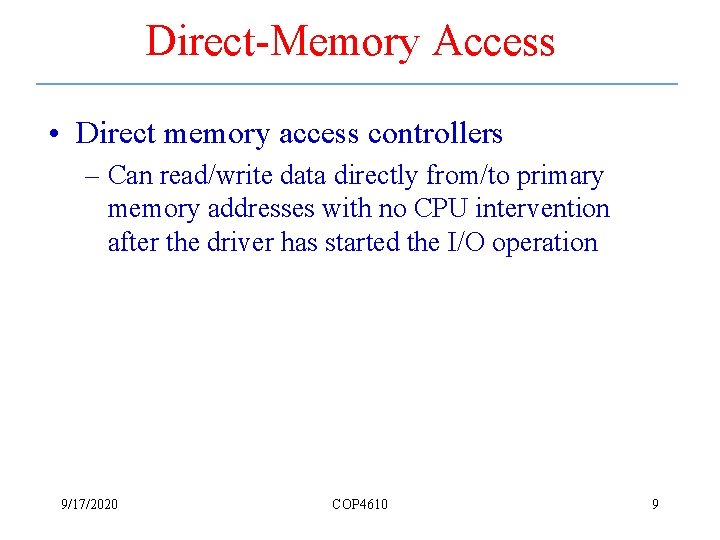
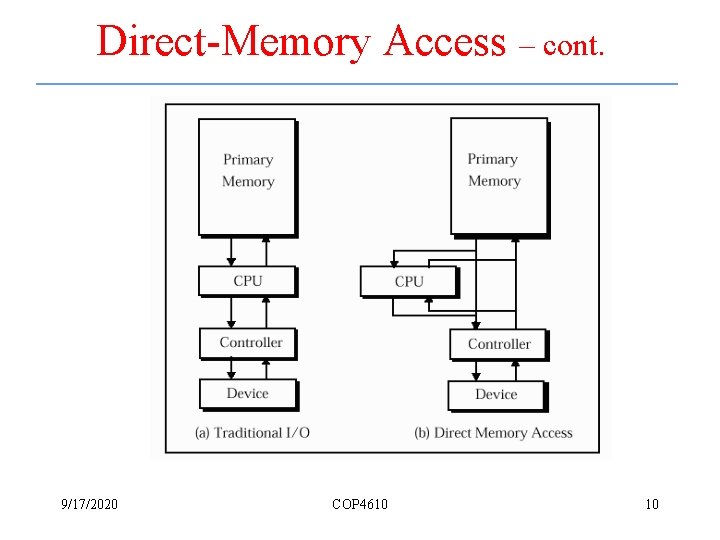
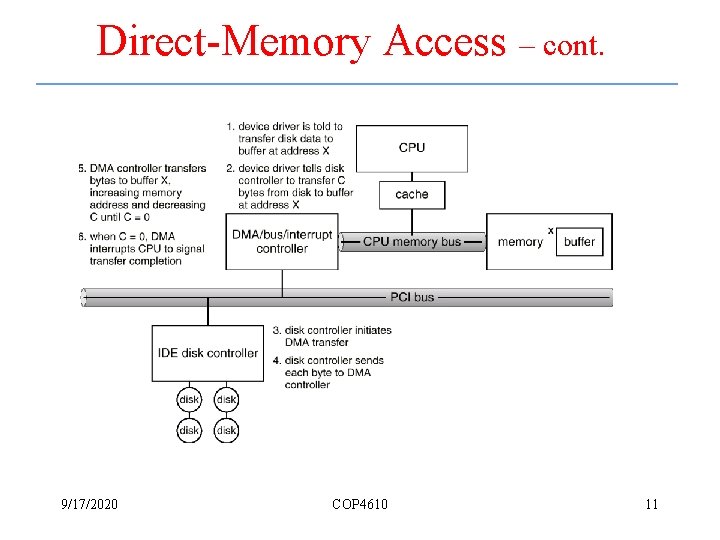
Direct-Memory Access • Direct memory access controllers – Can read/write data directly from/to primary memory addresses with no CPU intervention after the driver has started the I/O operation 9/17/2020 COP 4610 9
Direct-Memory Access – cont. 9/17/2020 COP 4610 10
Direct-Memory Access – cont. 9/17/2020 COP 4610 11
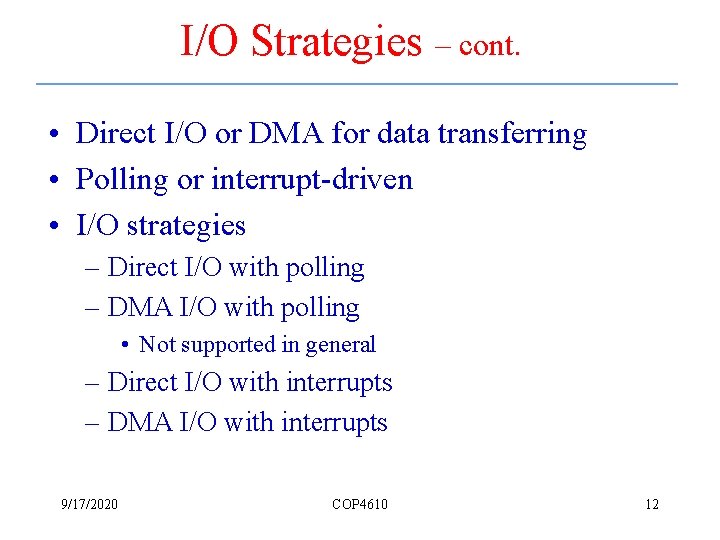
I/O Strategies – cont. • Direct I/O or DMA for data transferring • Polling or interrupt-driven • I/O strategies – Direct I/O with polling – DMA I/O with polling • Not supported in general – Direct I/O with interrupts – DMA I/O with interrupts 9/17/2020 COP 4610 12
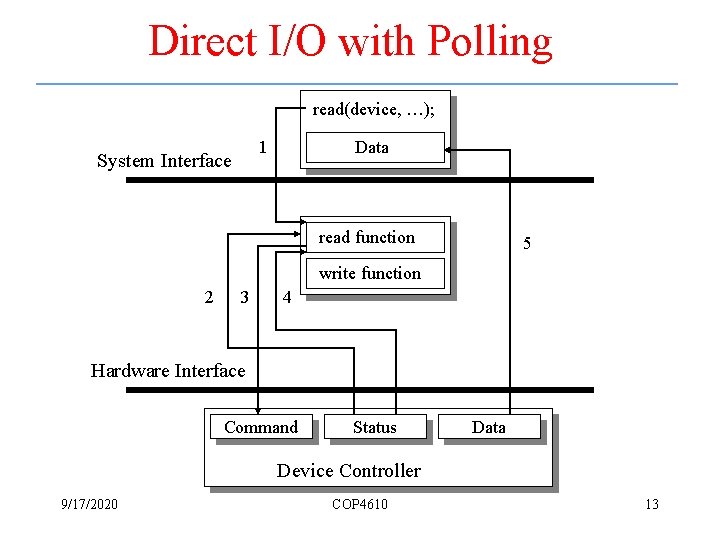
Direct I/O with Polling read(device, …); 1 System Interface Data read function 5 write function 2 3 4 Hardware Interface Command Status Data Device Controller 9/17/2020 COP 4610 13
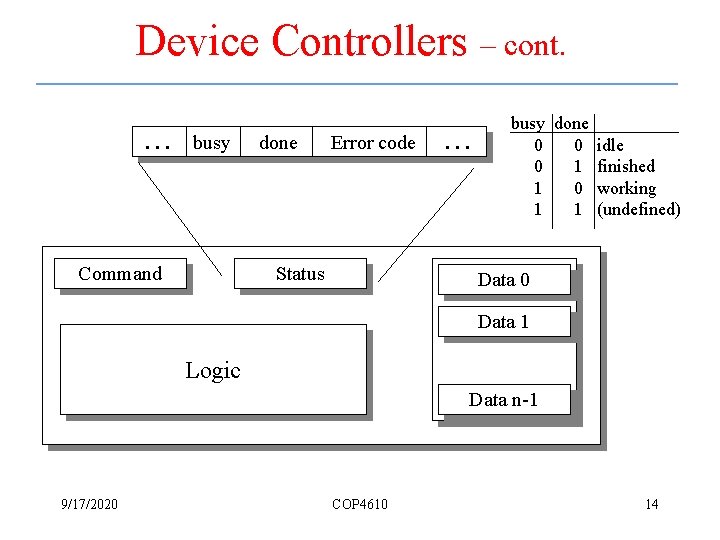
Device Controllers – cont. . busy Command done Error code Status . . . busy done 0 0 idle 0 1 finished 1 0 working 1 1 (undefined) Data 0 Data 1 Logic Data n-1 9/17/2020 COP 4610 14
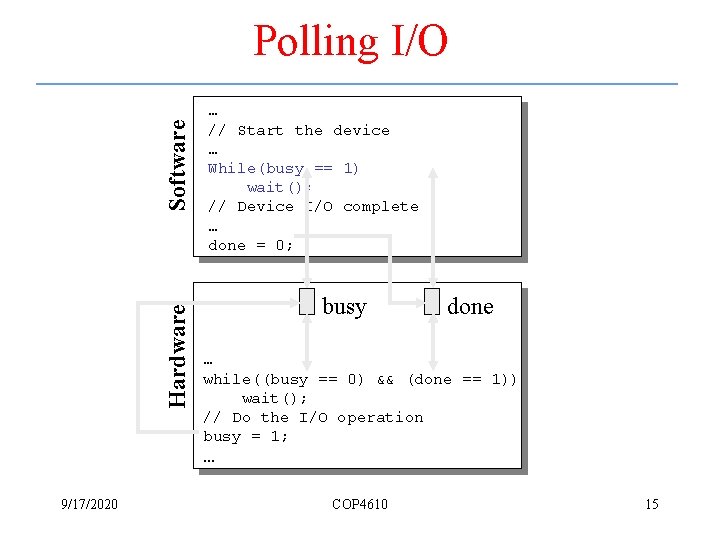
Hardware Software Polling I/O … // Start the device … While(busy == 1) wait(); // Device I/O complete … done = 0; busy done … while((busy == 0) && (done == 1)) wait(); // Do the I/O operation busy = 1; … 9/17/2020 COP 4610 15
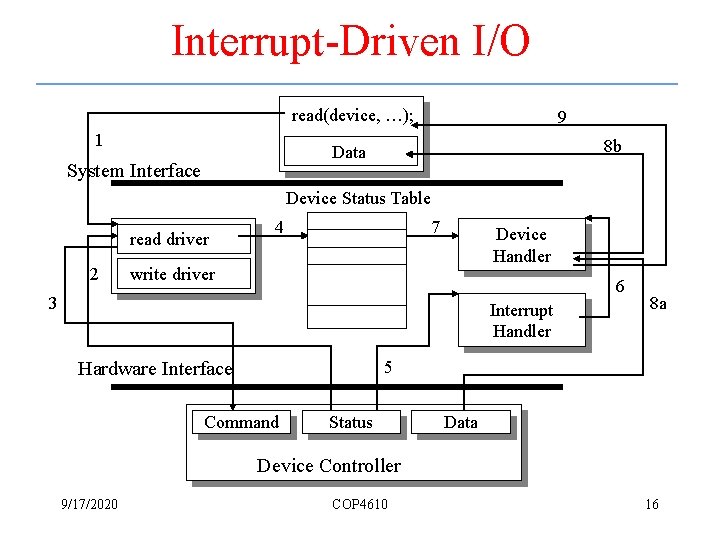
Interrupt-Driven I/O read(device, …); 1 9 8 b Data System Interface Device Status Table read driver 2 4 7 Device Handler write driver 6 3 Interrupt Handler 8 a 5 Hardware Interface Command Status Data Device Controller 9/17/2020 COP 4610 16
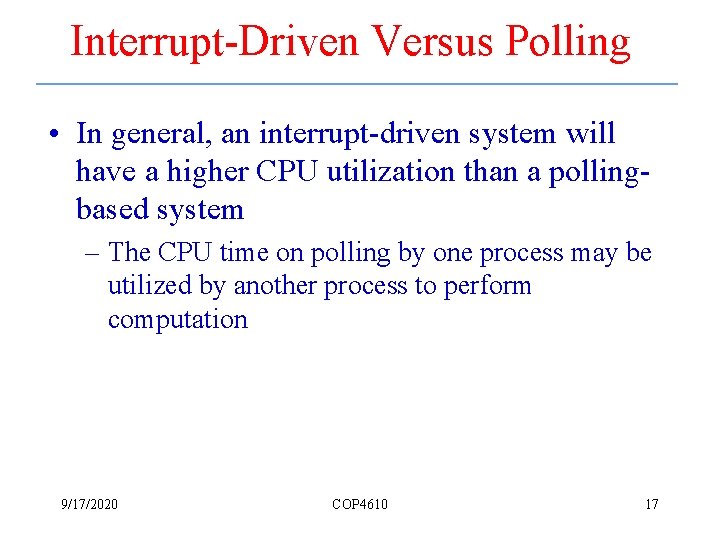
Interrupt-Driven Versus Polling • In general, an interrupt-driven system will have a higher CPU utilization than a pollingbased system – The CPU time on polling by one process may be utilized by another process to perform computation 9/17/2020 COP 4610 17
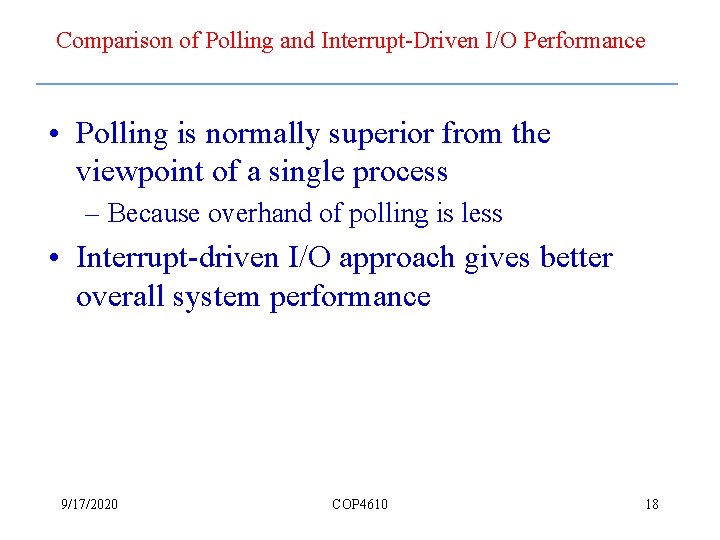
Comparison of Polling and Interrupt-Driven I/O Performance • Polling is normally superior from the viewpoint of a single process – Because overhand of polling is less • Interrupt-driven I/O approach gives better overall system performance 9/17/2020 COP 4610 18
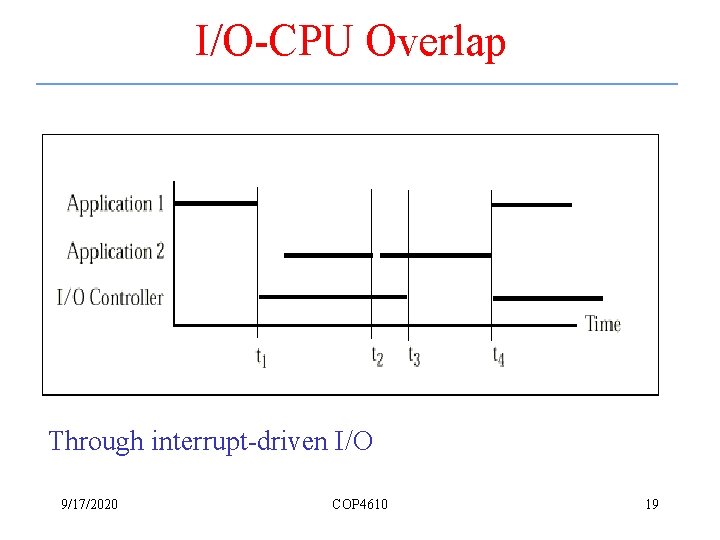
I/O-CPU Overlap Through interrupt-driven I/O 9/17/2020 COP 4610 19
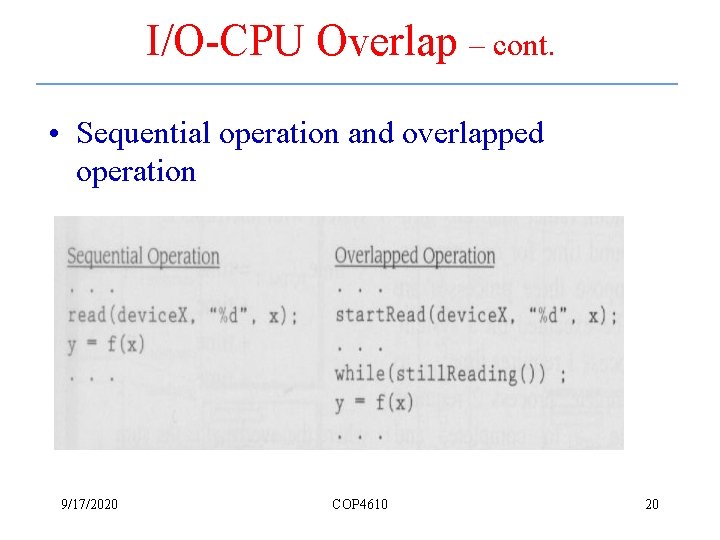
I/O-CPU Overlap – cont. • Sequential operation and overlapped operation 9/17/2020 COP 4610 20
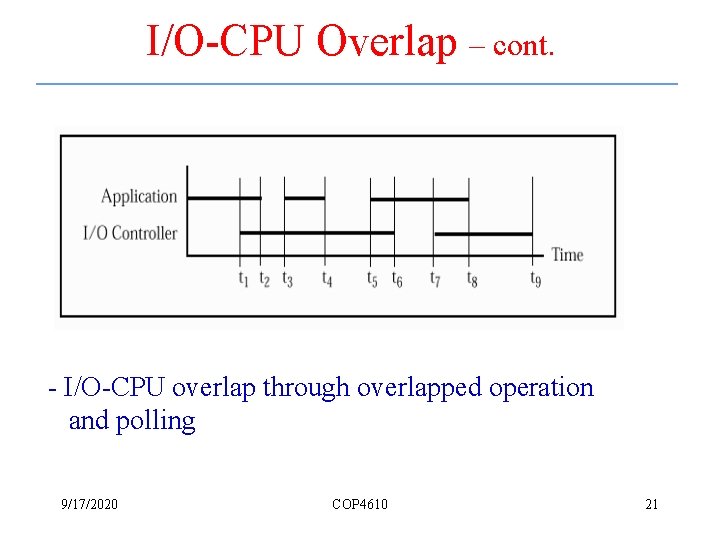
I/O-CPU Overlap – cont. - I/O-CPU overlap through overlapped operation and polling 9/17/2020 COP 4610 21
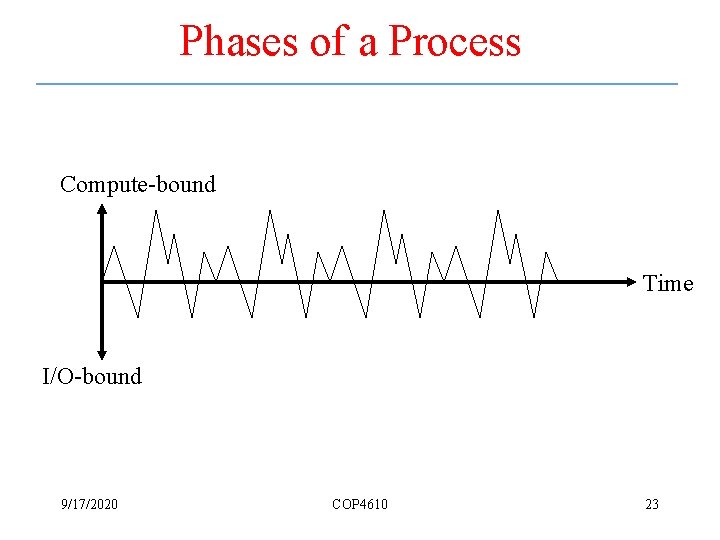
I/O-bound and Compute-bound Processes • I/O-bound process – A process’s overall execution time is dominated by the time to perform I/O operations • Compute-bound process – A process’s time on I/O is small compared to the amount of time spent using the CPU • Many processes have I/O-bound and compute -bound phases 9/17/2020 COP 4610 22
Phases of a Process Compute-bound Time I/O-bound 9/17/2020 COP 4610 23
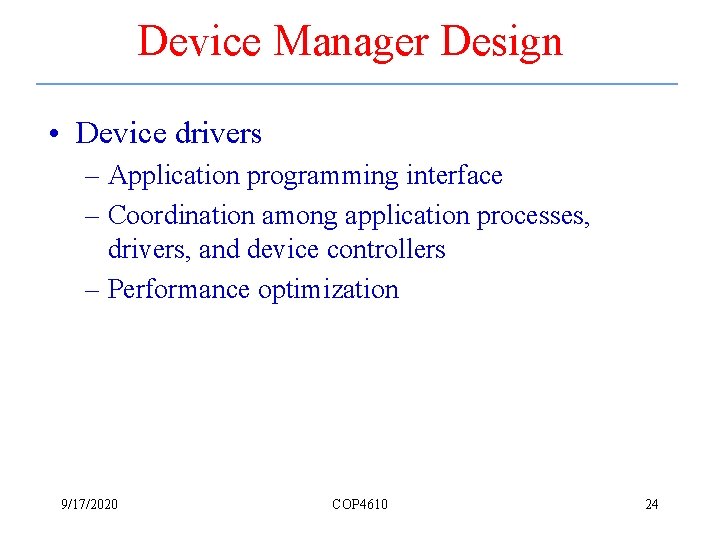
Device Manager Design • Device drivers – Application programming interface – Coordination among application processes, drivers, and device controllers – Performance optimization 9/17/2020 COP 4610 24
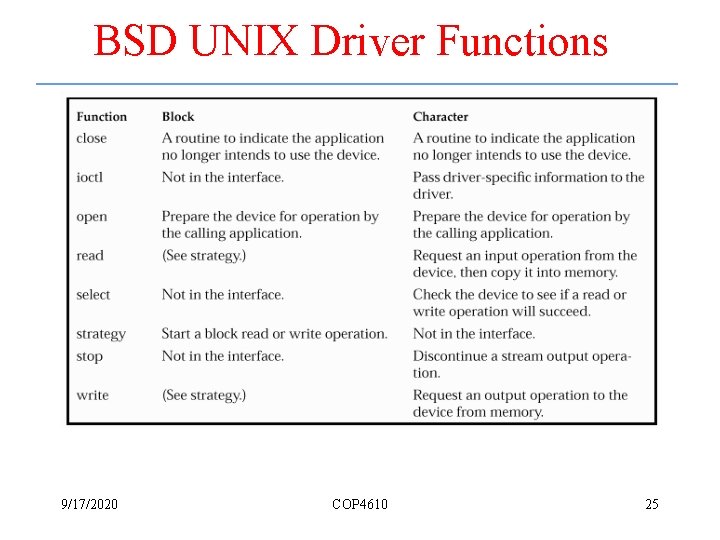
BSD UNIX Driver Functions 9/17/2020 COP 4610 25
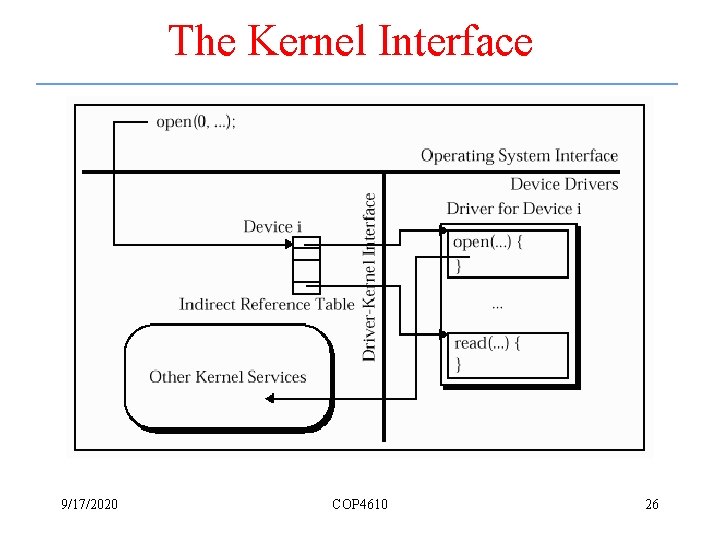
The Kernel Interface 9/17/2020 COP 4610 26
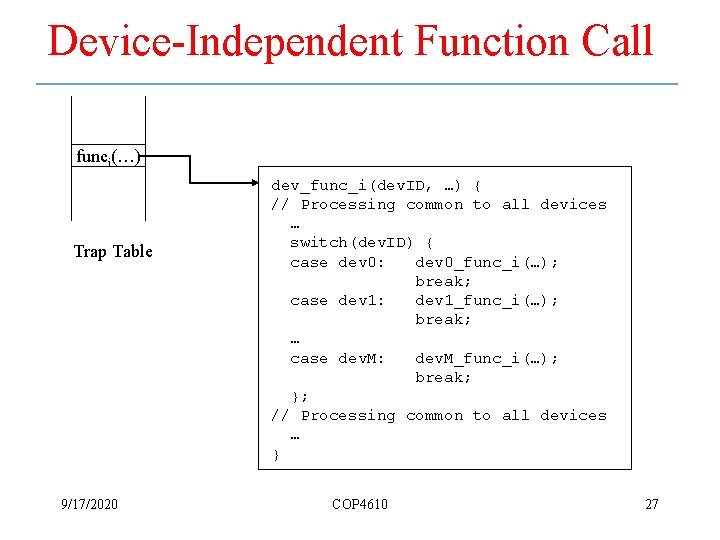
Device-Independent Function Call funci(…) Trap Table 9/17/2020 dev_func_i(dev. ID, …) { // Processing common to all devices … switch(dev. ID) { case dev 0: dev 0_func_i(…); break; case dev 1: dev 1_func_i(…); break; … case dev. M: dev. M_func_i(…); break; }; // Processing common to all devices … } COP 4610 27
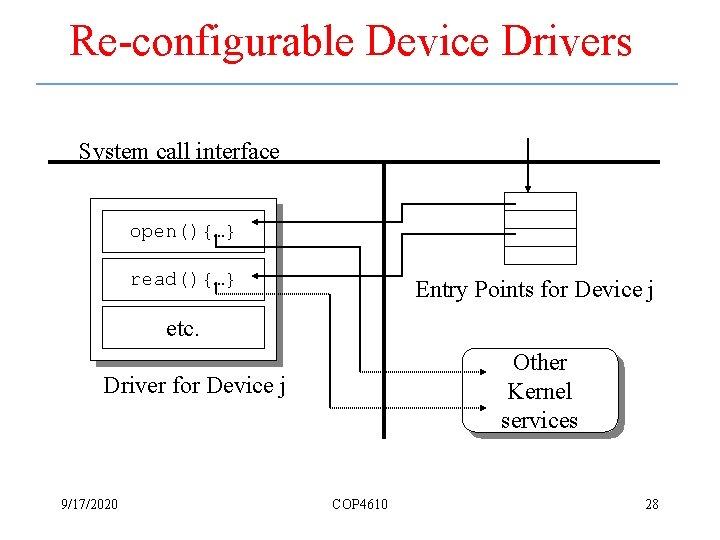
Re-configurable Device Drivers System call interface open(){…} read(){…} Entry Points for Device j etc. Other Kernel services Driver for Device j 9/17/2020 COP 4610 28
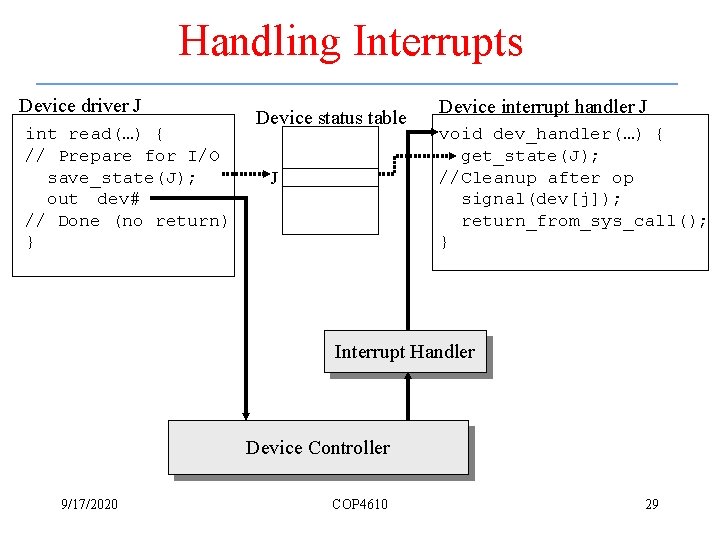
Handling Interrupts Device driver J int read(…) { // Prepare for I/O save_state(J); out dev# // Done (no return) } Device status table J Device interrupt handler J void dev_handler(…) { get_state(J); //Cleanup after op signal(dev[j]); return_from_sys_call(); } Interrupt Handler Device Controller 9/17/2020 COP 4610 29
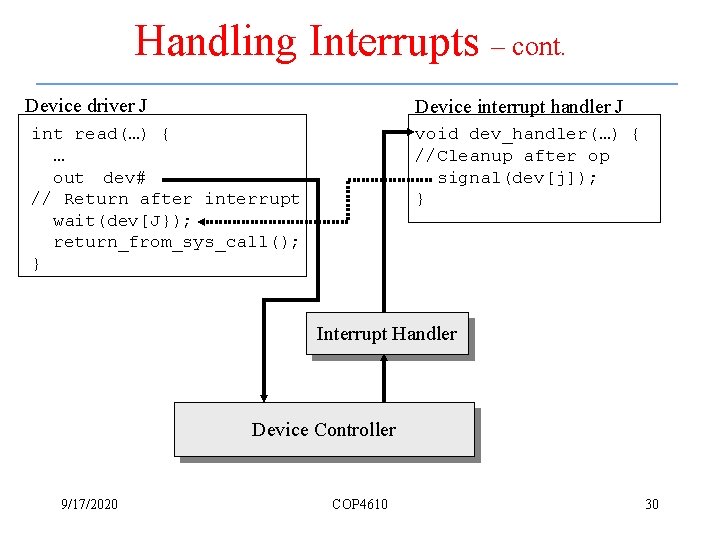
Handling Interrupts – cont. Device driver J Device interrupt handler J int read(…) { … out dev# // Return after interrupt wait(dev[J}); return_from_sys_call(); } void dev_handler(…) { //Cleanup after op signal(dev[j]); } Interrupt Handler Device Controller 9/17/2020 COP 4610 30
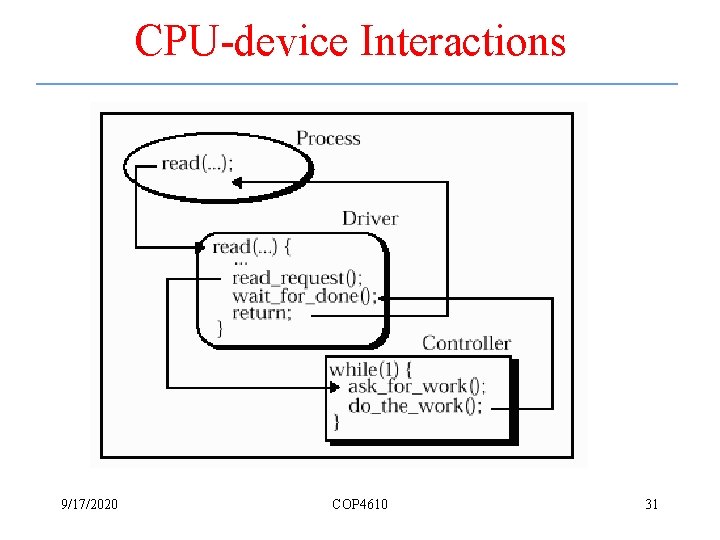
CPU-device Interactions 9/17/2020 COP 4610 31
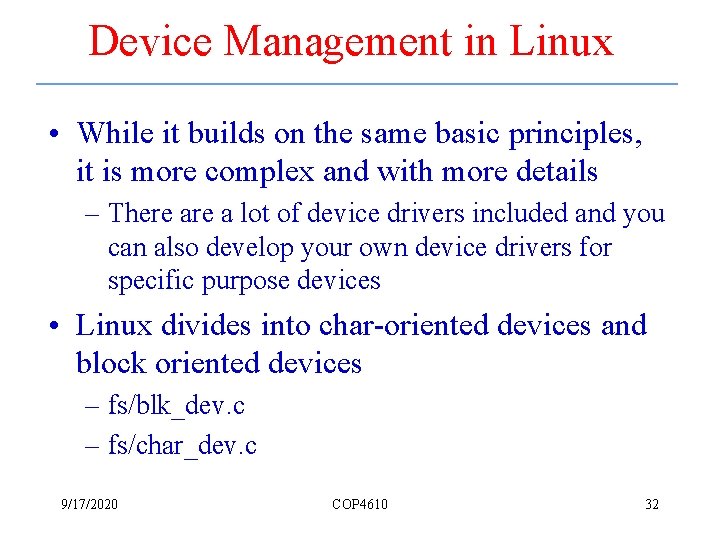
Device Management in Linux • While it builds on the same basic principles, it is more complex and with more details – There a lot of device drivers included and you can also develop your own device drivers for specific purpose devices • Linux divides into char-oriented devices and block oriented devices – fs/blk_dev. c – fs/char_dev. c 9/17/2020 COP 4610 32
Buffering • Buffering – A technique to keep slower I/O devices busy during times when a process is not requiring I/O operations 9/17/2020 COP 4610 33
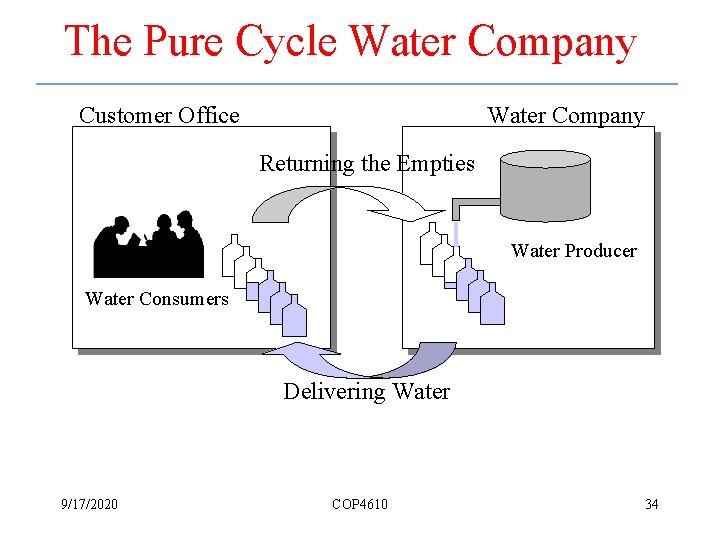
The Pure Cycle Water Company Customer Office Water Company Returning the Empties Water Producer Water Consumers Delivering Water 9/17/2020 COP 4610 34
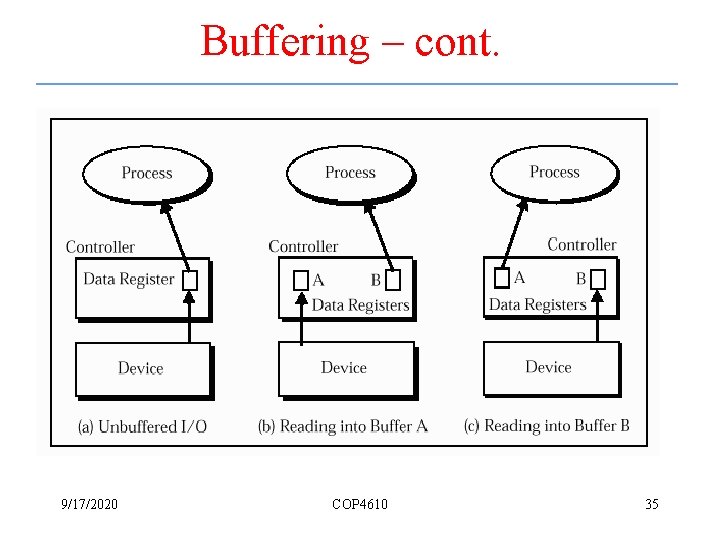
Buffering – cont. 9/17/2020 COP 4610 35
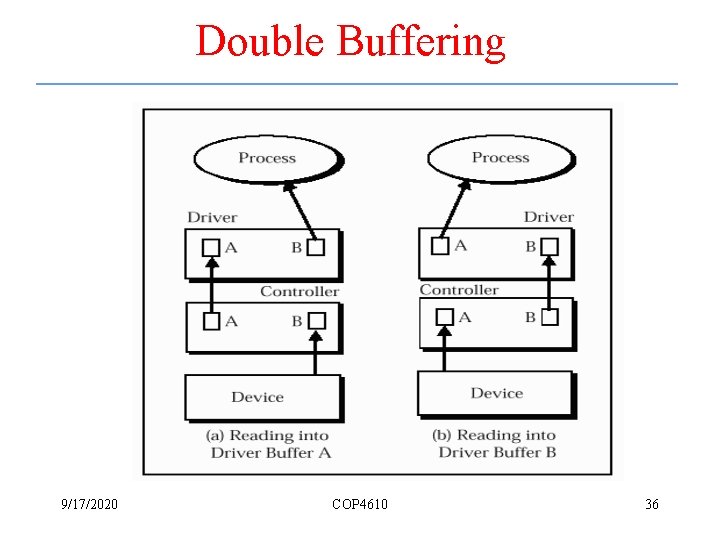
Double Buffering 9/17/2020 COP 4610 36
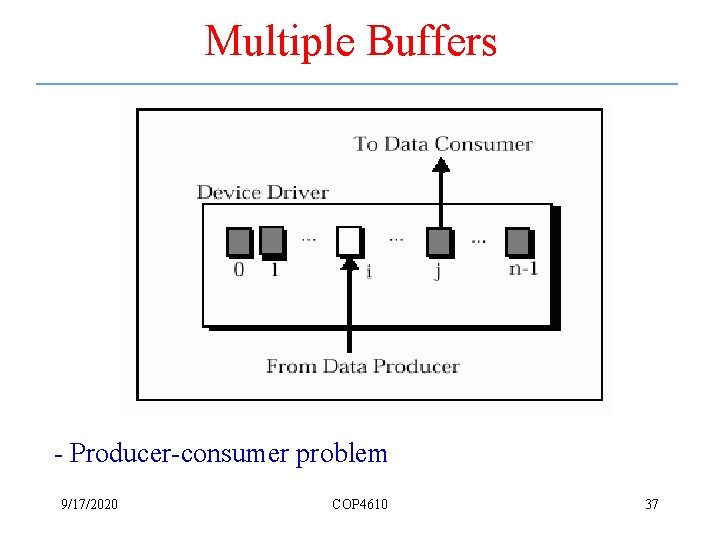
Multiple Buffers - Producer-consumer problem 9/17/2020 COP 4610 37
Spooling • A spool is a buffer that holds output for a device that cannot accept interleaved data streams – Printer is an example 9/17/2020 COP 4610 38
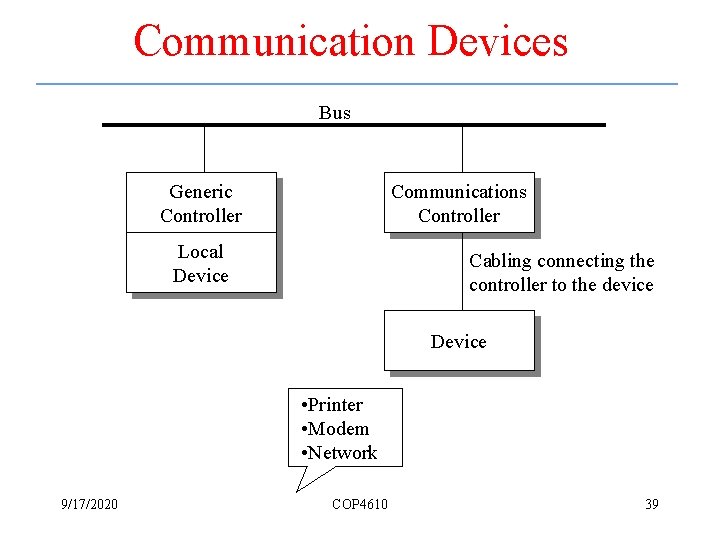
Communication Devices Bus Generic Controller Communications Controller Local Device Cabling connecting the controller to the device Device • Printer • Modem • Network 9/17/2020 COP 4610 39
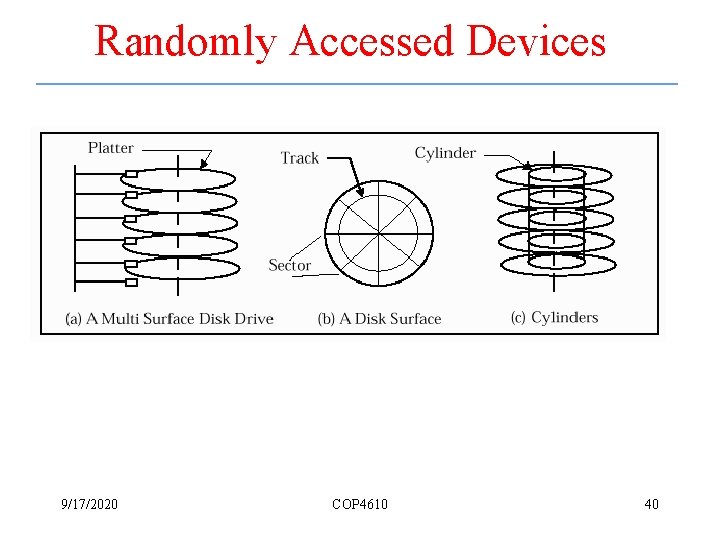
Randomly Accessed Devices 9/17/2020 COP 4610 40
Optimizing Access to Rotating Devices • Access time has three major components – Seek time – the time for the disk arm to move the heads to the cylinder containing the desired sector – Rotational latency – the additional time waiting for the disk to rotate the desired sector to the disk head – Transfer Time - time to copy bits from disk surface to memory 9/17/2020 COP 4610 41
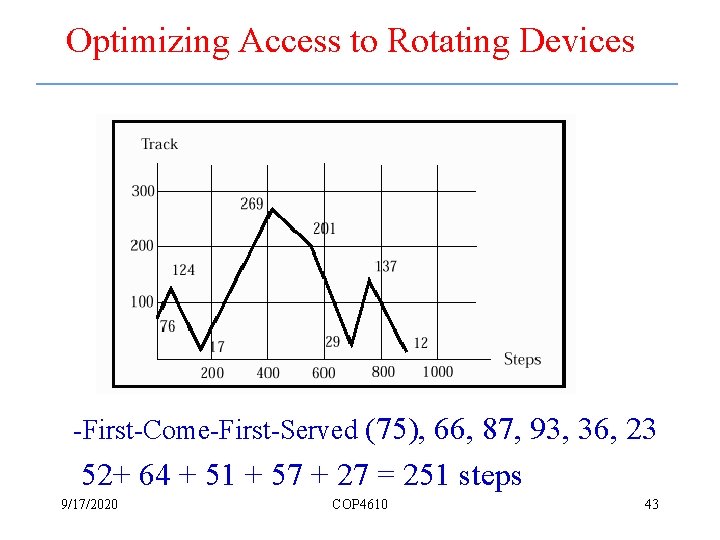
Optimizing Seek Time • Multiprogramming on I/O-bound programs => set of processes waiting for disk • Seek time dominates access time => minimize seek time across the set • Tracks 0: 99; Head at track 75, requests for 23, 87, 36, 93, 66 9/17/2020 COP 4610 42
Optimizing Access to Rotating Devices -First-Come-First-Served (75), 66, 87, 93, 36, 23 52+ 64 + 51 + 57 + 27 = 251 steps 9/17/2020 COP 4610 43
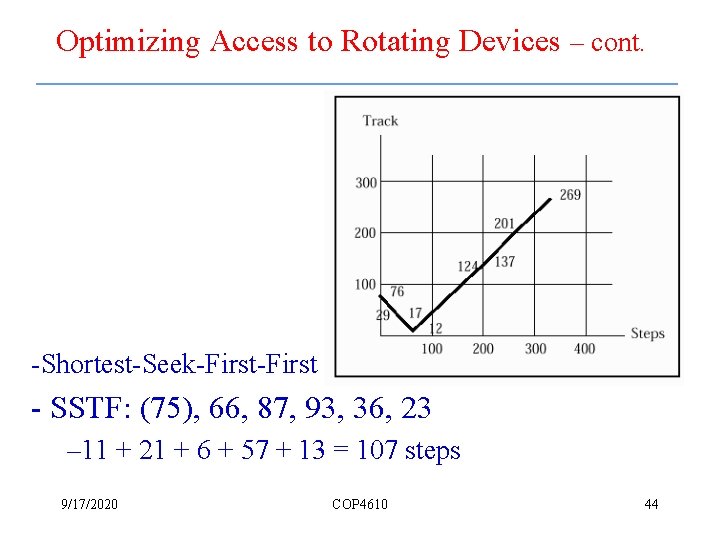
Optimizing Access to Rotating Devices – cont. -Shortest-Seek-First - SSTF: (75), 66, 87, 93, 36, 23 – 11 + 21 + 6 + 57 + 13 = 107 steps 9/17/2020 COP 4610 44
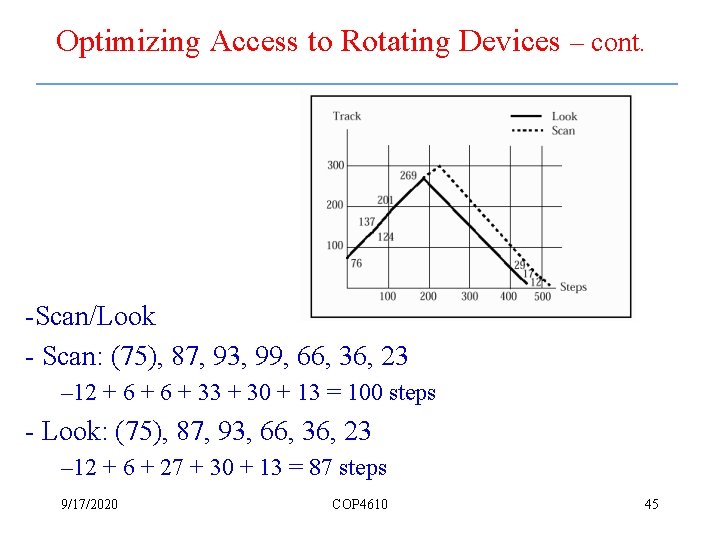
Optimizing Access to Rotating Devices – cont. -Scan/Look - Scan: (75), 87, 93, 99, 66, 36, 23 – 12 + 6 + 33 + 30 + 13 = 100 steps - Look: (75), 87, 93, 66, 36, 23 – 12 + 6 + 27 + 30 + 13 = 87 steps 9/17/2020 COP 4610 45
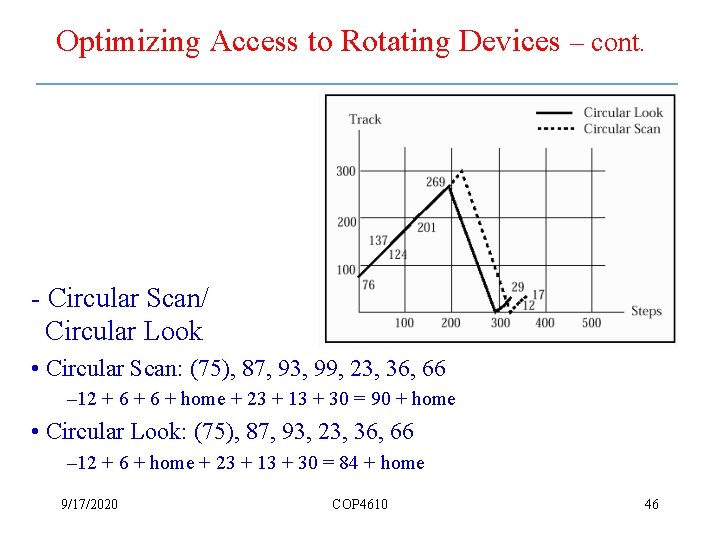
Optimizing Access to Rotating Devices – cont. - Circular Scan/ Circular Look • Circular Scan: (75), 87, 93, 99, 23, 36, 66 – 12 + 6 + home + 23 + 13 + 30 = 90 + home • Circular Look: (75), 87, 93, 23, 36, 66 – 12 + 6 + home + 23 + 13 + 30 = 84 + home 9/17/2020 COP 4610 46
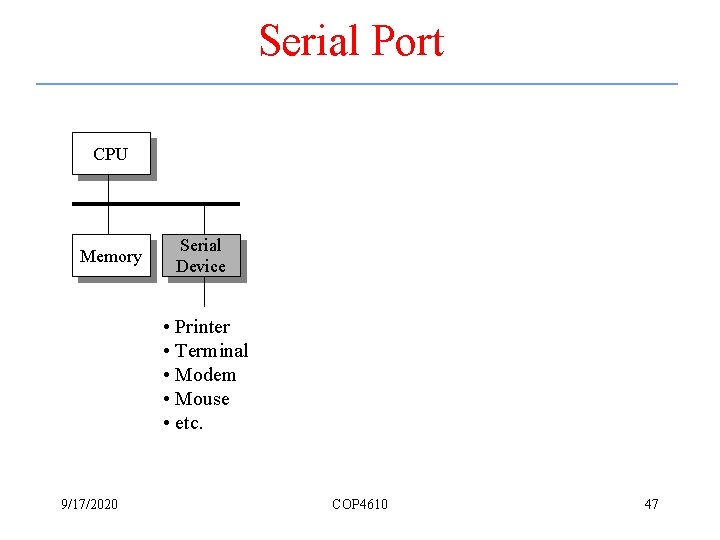
Serial Port CPU Memory Serial Device • Printer • Terminal • Modem • Mouse • etc. 9/17/2020 COP 4610 47
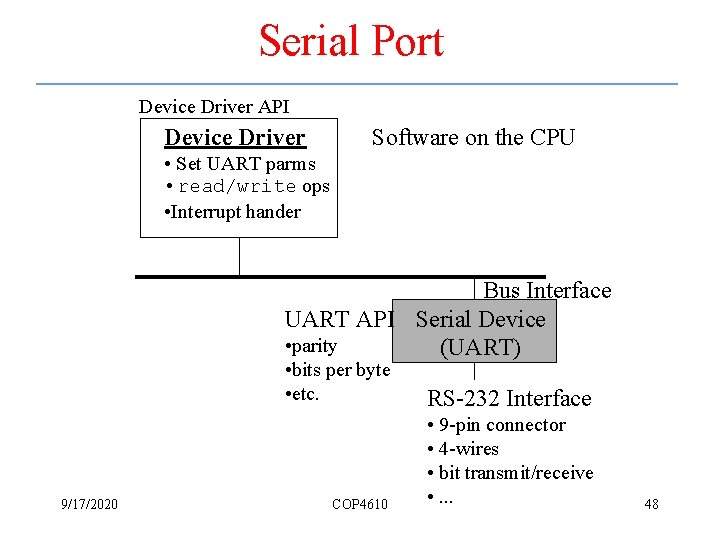
Serial Port Device Driver API Device Driver Software on the CPU • Set UART parms • read/write ops • Interrupt hander Bus Interface UART API Serial Device • parity (UART) • bits per byte • etc. 9/17/2020 COP 4610 RS-232 Interface • 9 -pin connector • 4 -wires • bit transmit/receive • . . . 48
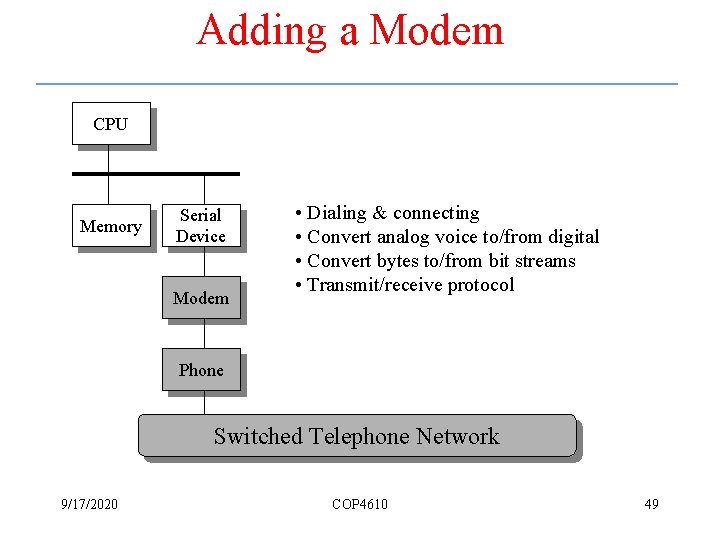
Adding a Modem CPU Memory Serial Device Modem • Dialing & connecting • Convert analog voice to/from digital • Convert bytes to/from bit streams • Transmit/receive protocol Phone Switched Telephone Network 9/17/2020 COP 4610 49
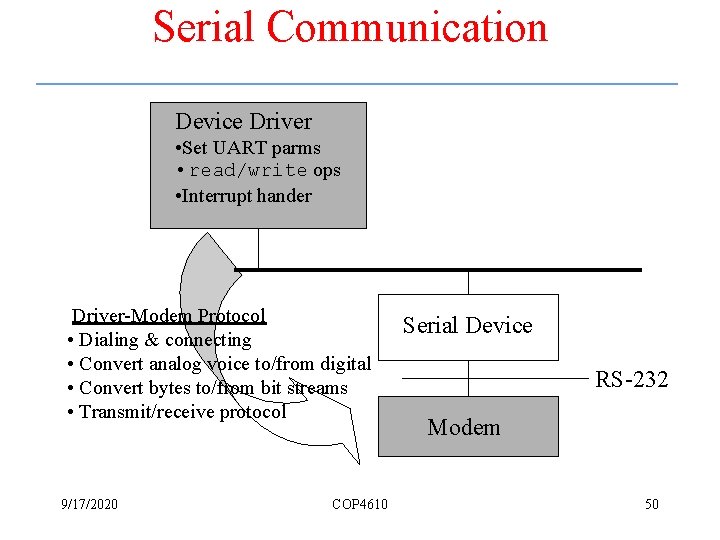
Serial Communication Device Driver • Set UART parms • read/write ops • Interrupt hander Driver-Modem Protocol • Dialing & connecting • Convert analog voice to/from digital • Convert bytes to/from bit streams • Transmit/receive protocol 9/17/2020 COP 4610 Serial Device RS-232 Modem 50
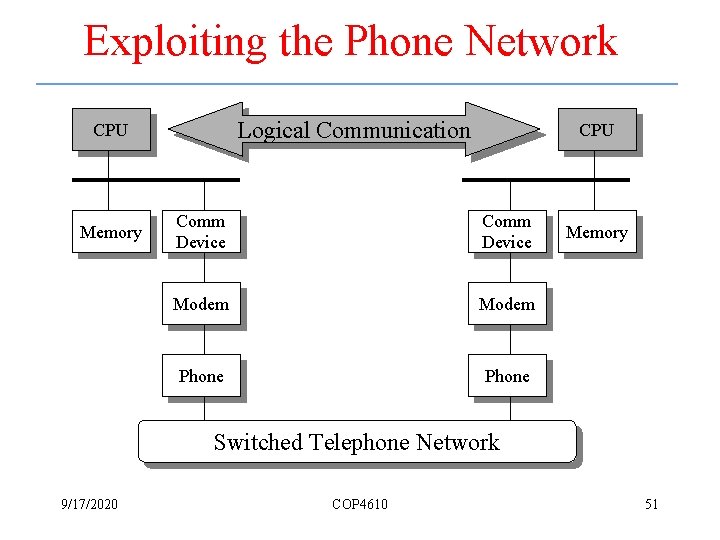
Exploiting the Phone Network Logical Communication CPU Memory CPU Comm Device Modem Phone Memory Switched Telephone Network 9/17/2020 COP 4610 51
Summary • Device Management Organization • I/O Strategies • Device is the bottleneck for I/O-bound processes – Overlap between I/O and CPU will increase the system’s throughput rate 9/17/2020 COP 4610 52