
Overview of Draft Street Address Standard Address Data




- Slides: 55
Overview of Draft Street Address Standard Address Data Standards Working Group Co-Chairs: Martha Lombard Spatial Focus, Inc. Sara Yurman Spatial Focus, Inc. Ed Wells DC OCTO Hilary Perkins Jacobs Civil, Inc. Carl Anderson Fulton County, GA 1
Sponsoring Organizations URISA – Submitting organization NENA – Supporting organization U. S. Census Bureau – Support, ongoing maintenance 2
Urban & Regional Information Systems Association URISA is a non-profit educational and professional association Mission: “To promote the effective and ethical use of spatial information and information technologies for the understanding and management of urban and regional systems. ” 7, 000 national and chapter members in the US and Canada Members from government, private, and academic sectors Slightly more than half are state and local government employees 3
National Emergency Number Association NENA is a professional association of 7, 000 members and 46 chapters dedicated to providing effective and accessible 9 -1 -1 service for North America NENA fosters the technological advancement, availability, and implementation of a universal emergency telephone number NENA promotes research, planning, training, and education NENA's objectives include the protection of human life, the preservation of property, and the maintenance of general community security 4
Other Organizations Represented Local, regional, and state government 911/Emergency management associations Federal agencies GIS software vendors and consultants Universities Other standards organizations 5
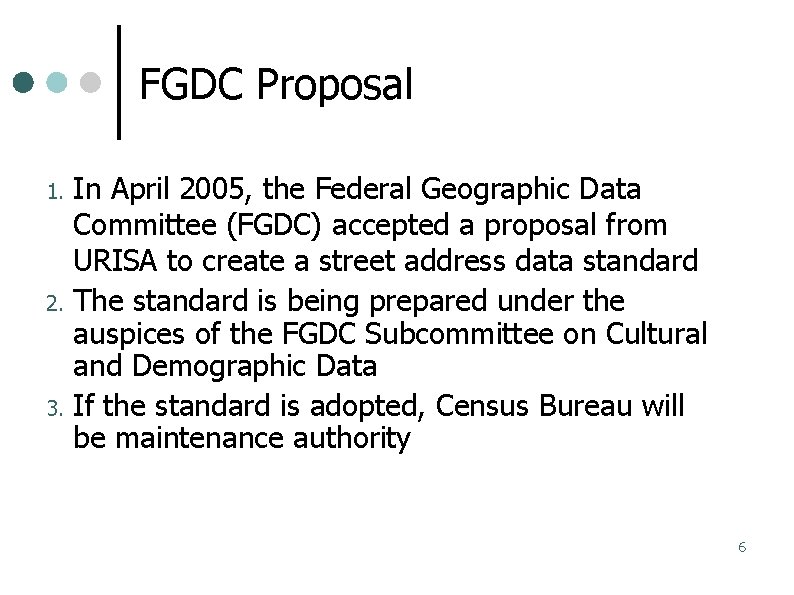
FGDC Proposal In April 2005, the Federal Geographic Data Committee (FGDC) accepted a proposal from URISA to create a street address data standard 2. The standard is being prepared under the auspices of the FGDC Subcommittee on Cultural and Demographic Data 3. If the standard is adopted, Census Bureau will be maintenance authority 1. 6
Work Plan Convene core committees Work primarily by collaborative website Teleconferences monthly Meet two times: August: Street Smart Conference • Austin, TX October: URISA Annual Conference • Kansas City, MO 7
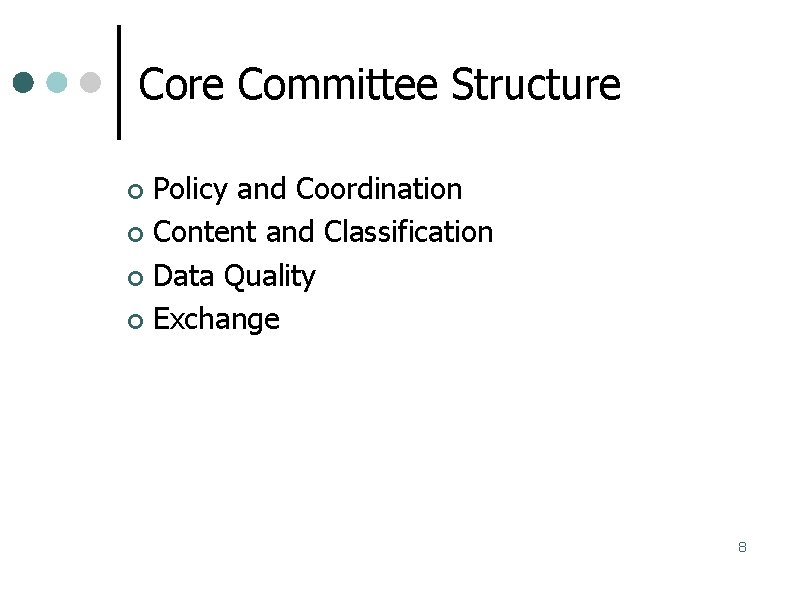
Core Committee Structure Policy and Coordination Content and Classification Data Quality Exchange 8
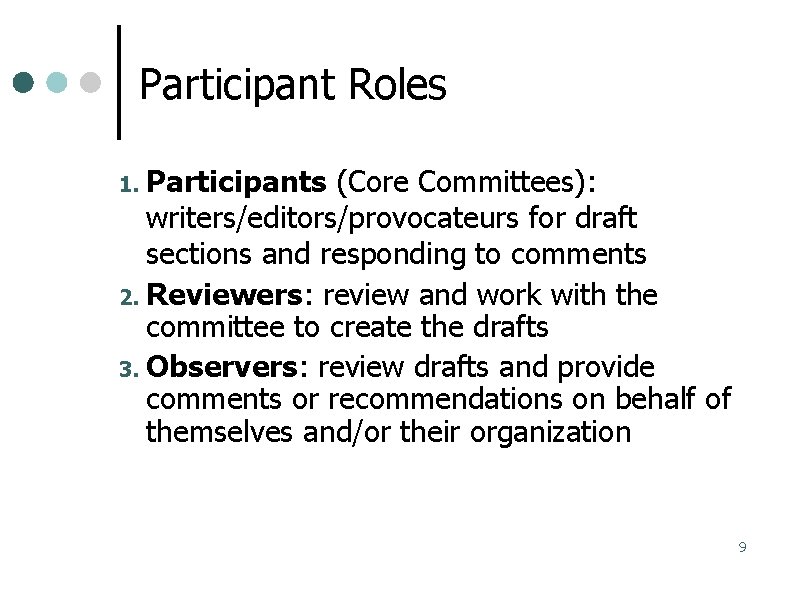
Participant Roles 1. Participants (Core Committees): writers/editors/provocateurs for draft sections and responding to comments 2. Reviewers: review and work with the committee to create the drafts 3. Observers: review drafts and provide comments or recommendations on behalf of themselves and/or their organization 9
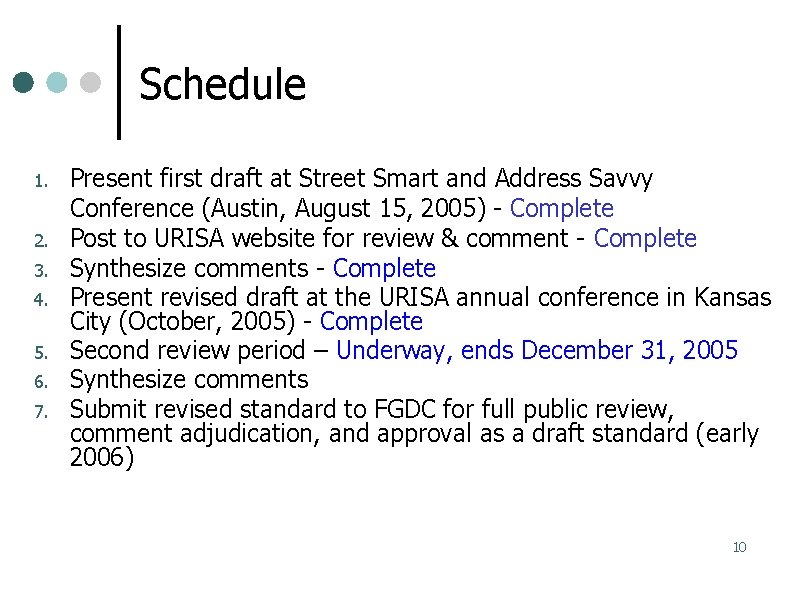
Schedule 1. 2. 3. 4. 5. 6. 7. Present first draft at Street Smart and Address Savvy Conference (Austin, August 15, 2005) - Complete Post to URISA website for review & comment - Complete Synthesize comments - Complete Present revised draft at the URISA annual conference in Kansas City (October, 2005) - Complete Second review period – Underway, ends December 31, 2005 Synthesize comments Submit revised standard to FGDC for full public review, comment adjudication, and approval as a draft standard (early 2006) 10
Introduction to the Draft Standard Provides background information. Defines address. Describes the goals and objectives. Lays out the standards development process. Identifies the maintenance authority. 11
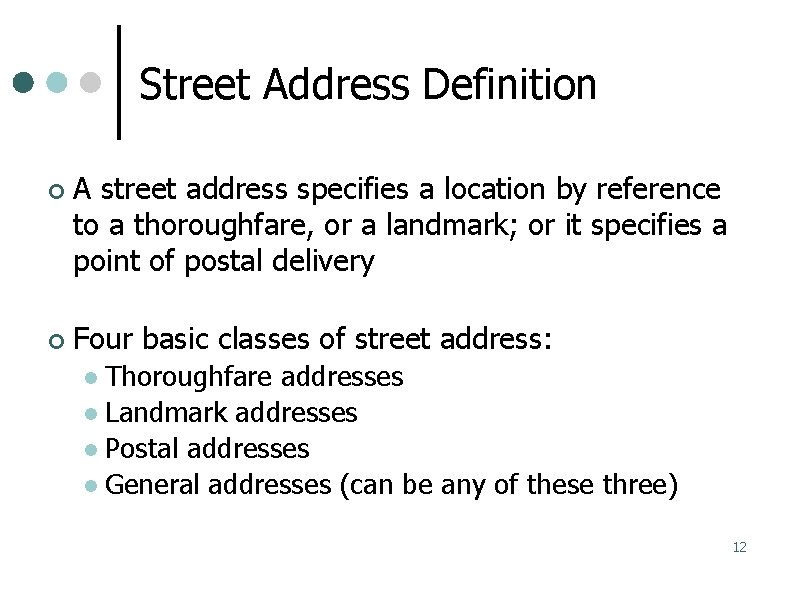
Street Address Definition A street address specifies a location by reference to a thoroughfare, or a landmark; or it specifies a point of postal delivery Four basic classes of street address: Thoroughfare addresses Landmark addresses Postal addresses General addresses (can be any of these three) 12
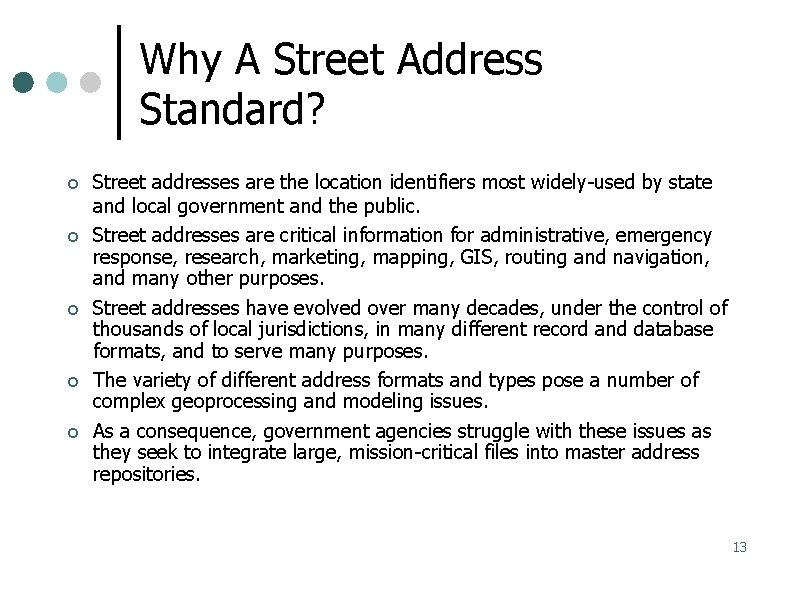
Why A Street Address Standard? Street addresses are the location identifiers most widely-used by state and local government and the public. Street addresses are critical information for administrative, emergency response, research, marketing, mapping, GIS, routing and navigation, and many other purposes. Street addresses have evolved over many decades, under the control of thousands of local jurisdictions, in many different record and database formats, and to serve many purposes. The variety of different address formats and types pose a number of complex geoprocessing and modeling issues. As a consequence, government agencies struggle with these issues as they seek to integrate large, mission-critical files into master address repositories. 13
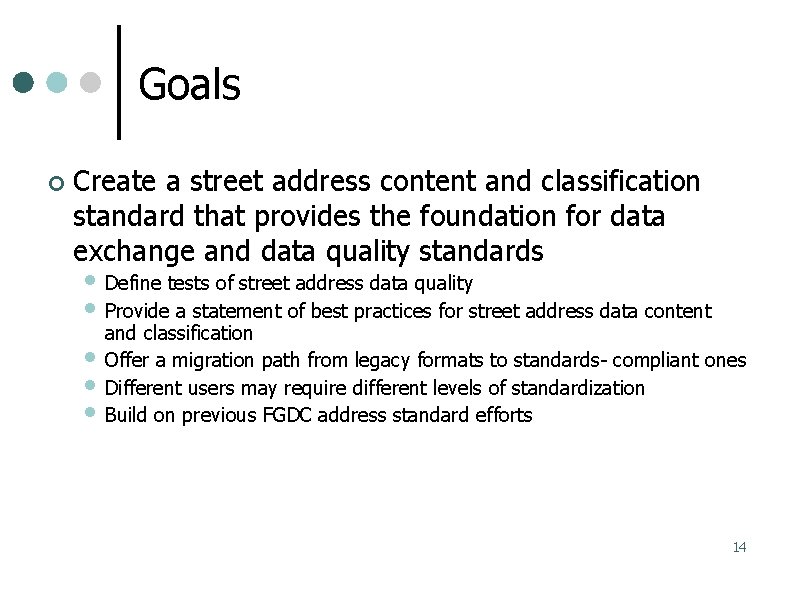
Goals Create a street address content and classification standard that provides the foundation for data exchange and data quality standards • Define tests of street address data quality • Provide a statement of best practices for street address data content • • • and classification Offer a migration path from legacy formats to standards- compliant ones Different users may require different levels of standardization Build on previous FGDC address standard efforts 14
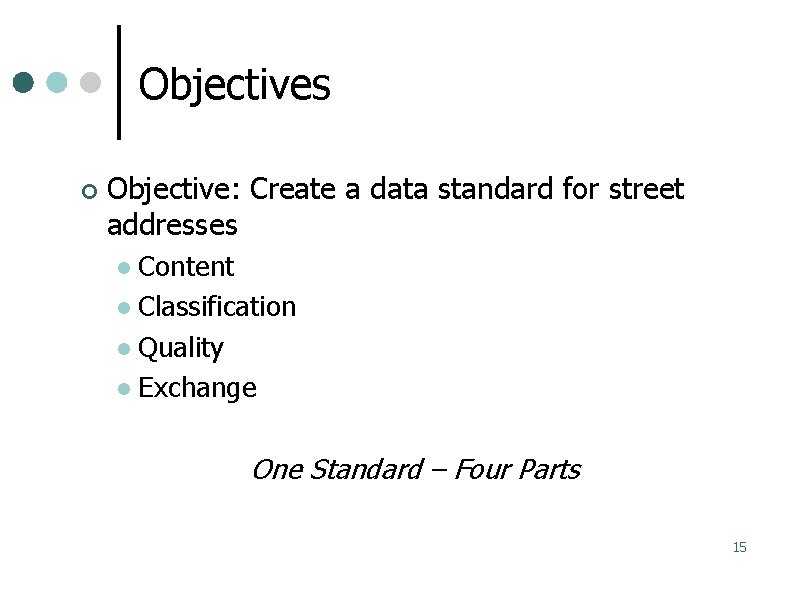
Objectives Objective: Create a data standard for street addresses Content Classification Quality Exchange One Standard – Four Parts 15
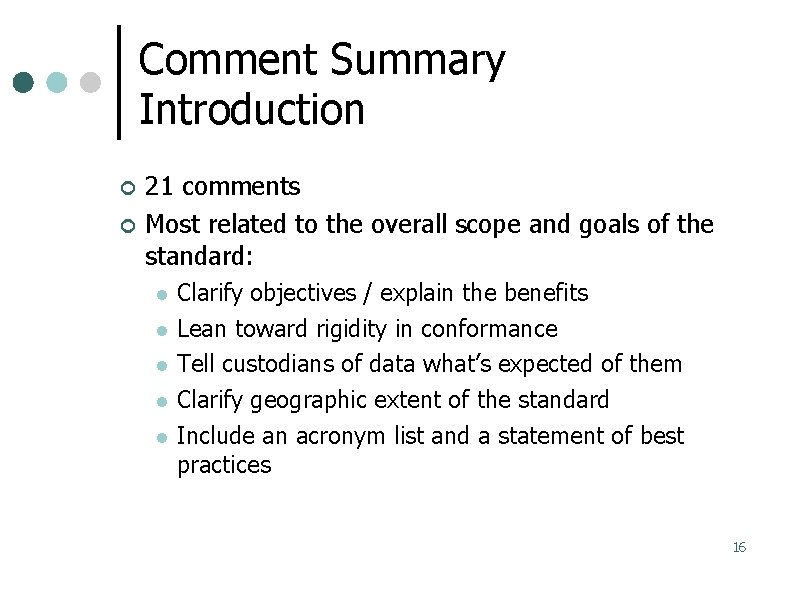
Comment Summary Introduction 21 comments Most related to the overall scope and goals of the standard: Clarify objectives / explain the benefits Lean toward rigidity in conformance Tell custodians of data what’s expected of them Clarify geographic extent of the standard Include an acronym list and a statement of best practices 16
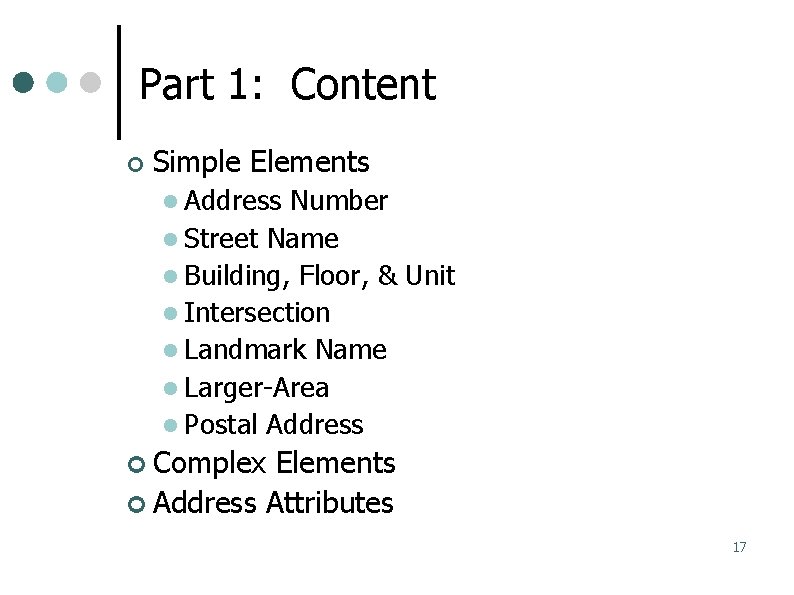
Part 1: Content Simple Elements Address Number Street Name Building, Floor, & Unit Intersection Landmark Name Larger-Area Postal Address Complex Elements Address Attributes 17
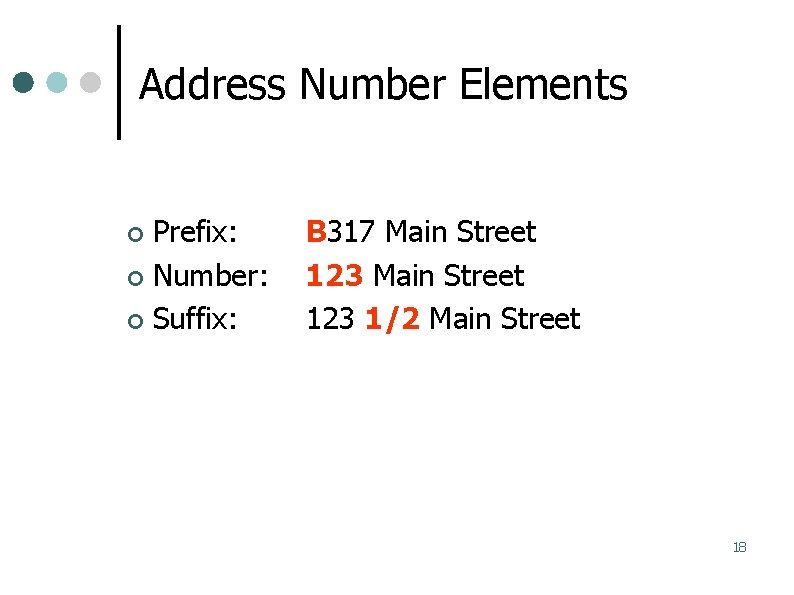
Address Number Elements Prefix: Number: Suffix: B 317 Main Street 123 1/2 Main Street 18
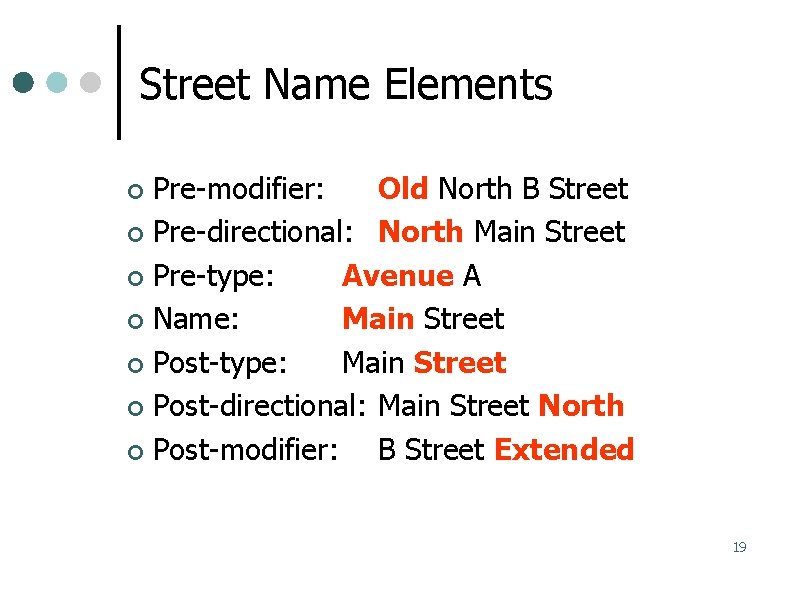
Street Name Elements Pre-modifier: Old North B Street Pre-directional: North Main Street Pre-type: Avenue A Name: Main Street Post-type: Main Street Post-directional: Main Street North Post-modifier: B Street Extended 19
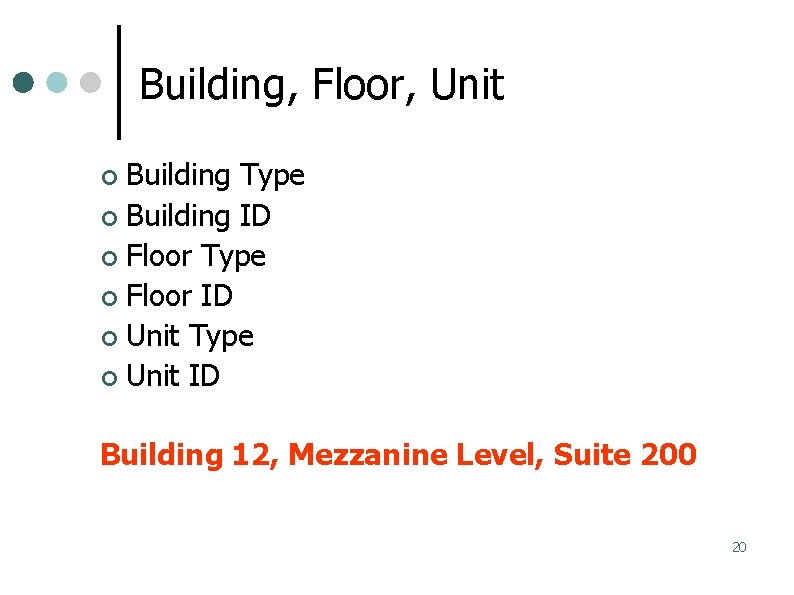
Building, Floor, Unit Building Type Building ID Floor Type Floor ID Unit Type Unit ID Building 12, Mezzanine Level, Suite 200 20
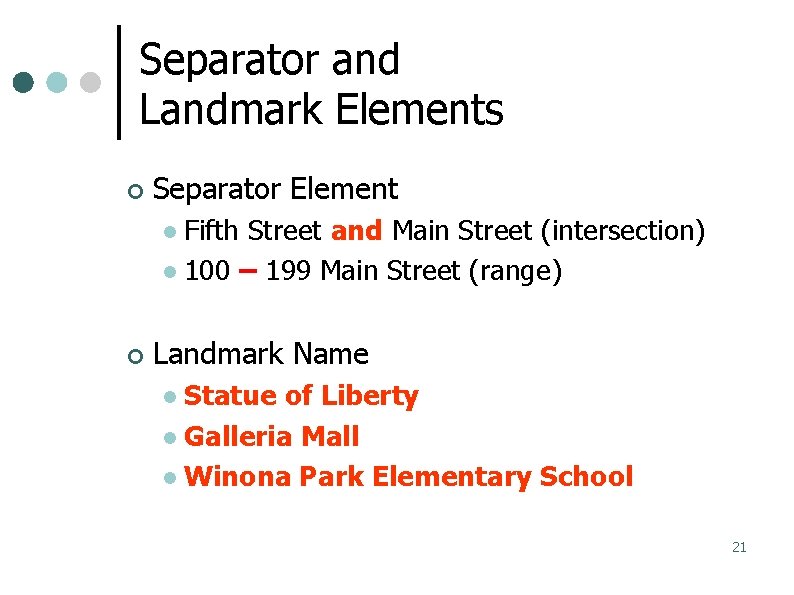
Separator and Landmark Elements Separator Element Fifth Street and Main Street (intersection) 100 – 199 Main Street (range) Landmark Name Statue of Liberty Galleria Mall Winona Park Elementary School 21
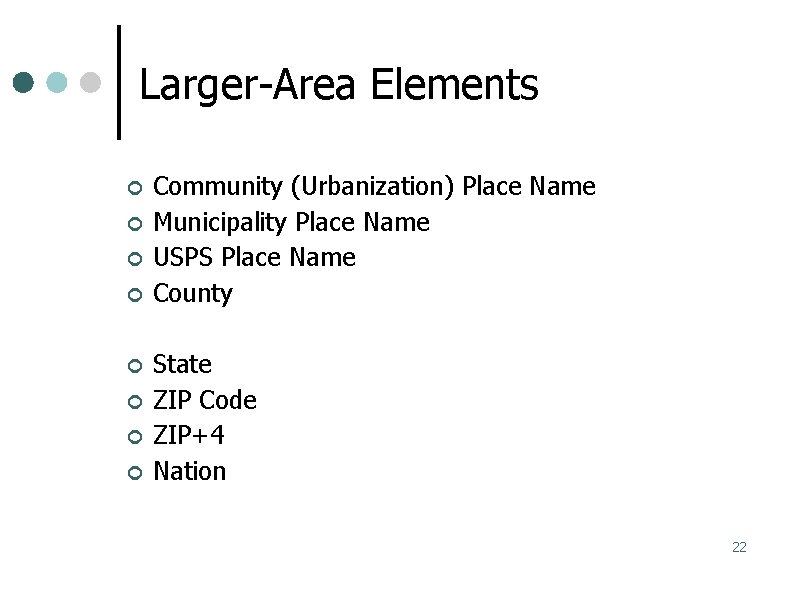
Larger-Area Elements Community (Urbanization) Place Name Municipality Place Name USPS Place Name County State ZIP Code ZIP+4 Nation 22
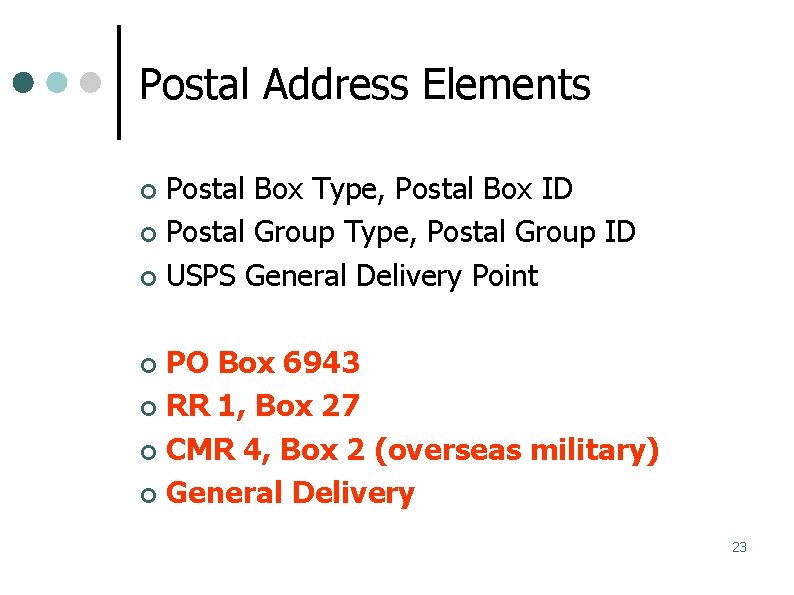
Postal Address Elements Postal Box Type, Postal Box ID Postal Group Type, Postal Group ID USPS General Delivery Point PO Box 6943 RR 1, Box 27 CMR 4, Box 2 (overseas military) General Delivery 23
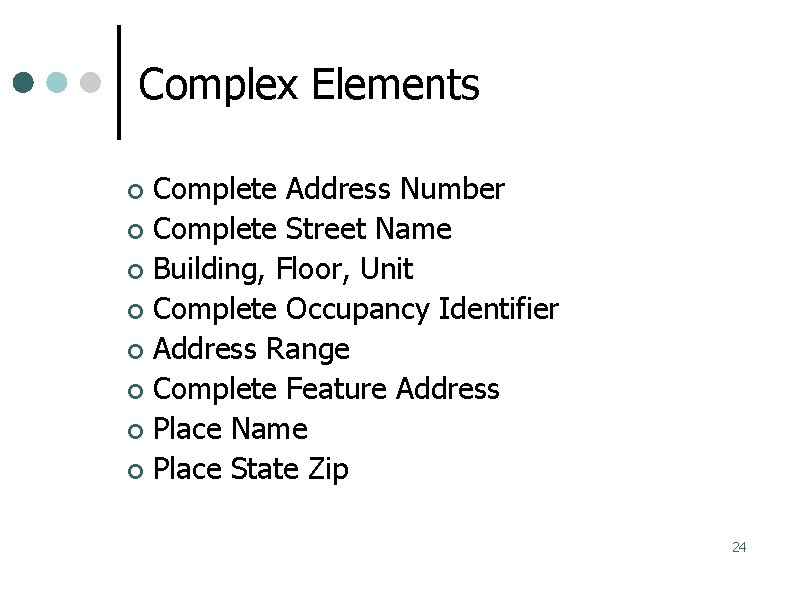
Complex Elements Complete Address Number Complete Street Name Building, Floor, Unit Complete Occupancy Identifier Address Range Complete Feature Address Place Name Place State Zip 24
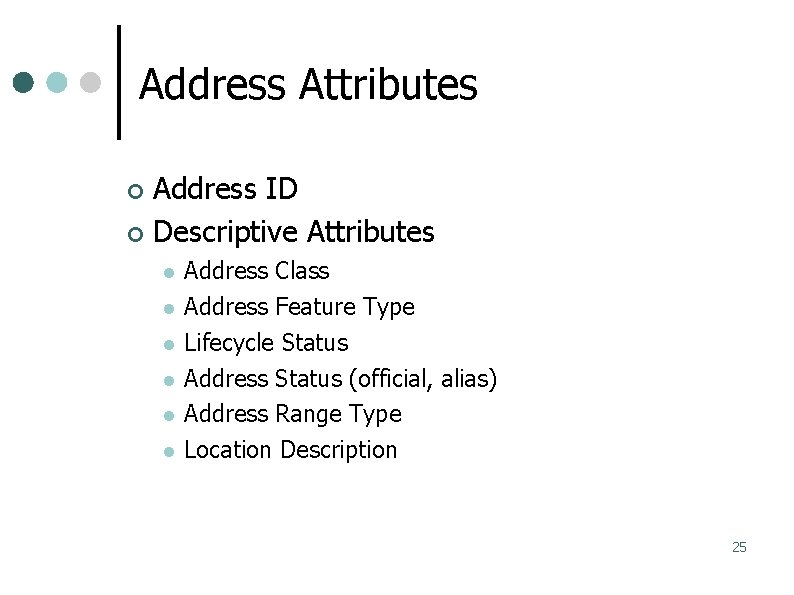
Address Attributes Address ID Descriptive Attributes Address Class Address Feature Type Lifecycle Status Address Status (official, alias) Address Range Type Location Description 25
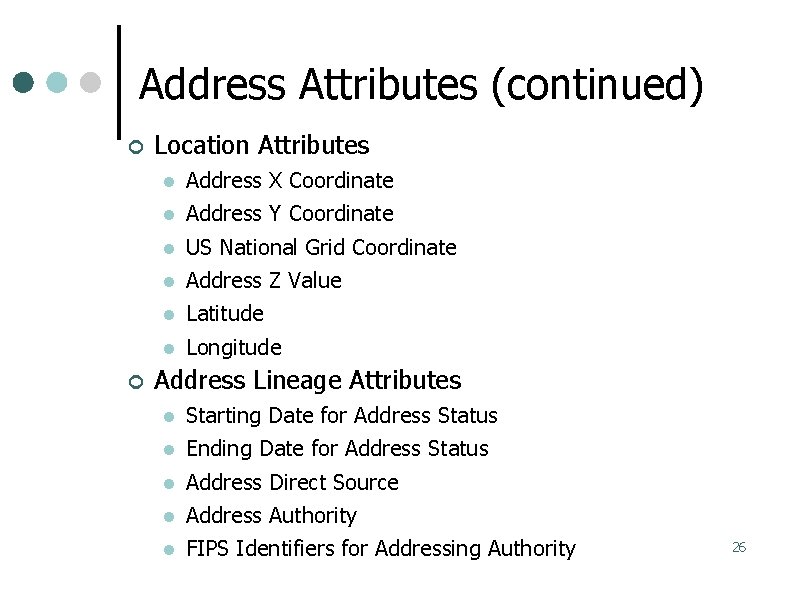
Address Attributes (continued) Location Attributes Address X Coordinate Address Y Coordinate US National Grid Coordinate Address Z Value Latitude Longitude Address Lineage Attributes Starting Date for Address Status Ending Date for Address Status Address Direct Source Address Authority FIPS Identifiers for Addressing Authority 26
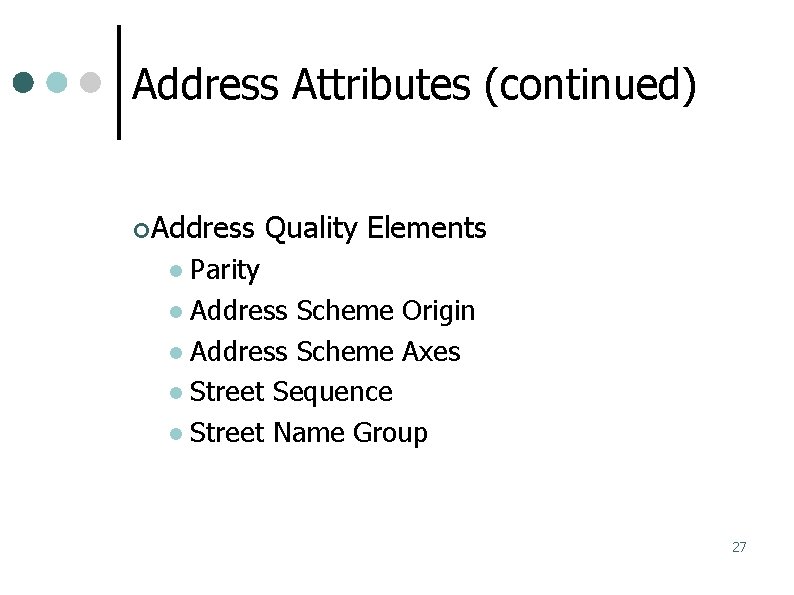
Address Attributes (continued) Address Quality Elements Parity Address Scheme Origin Address Scheme Axes Street Sequence Street Name Group 27
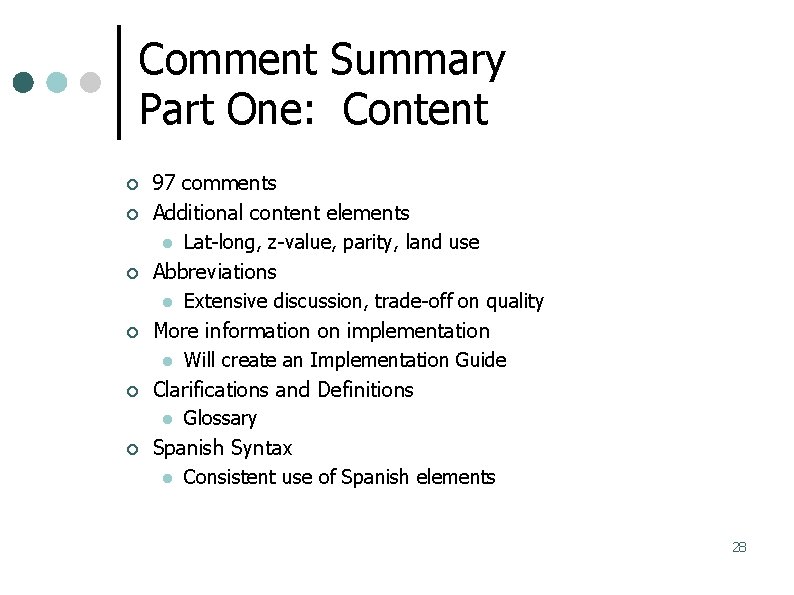
Comment Summary Part One: Content 97 comments Additional content elements Lat-long, z-value, parity, land use Abbreviations Extensive discussion, trade-off on quality More information on implementation Will create an Implementation Guide Clarifications and Definitions Glossary Spanish Syntax Consistent use of Spanish elements 28
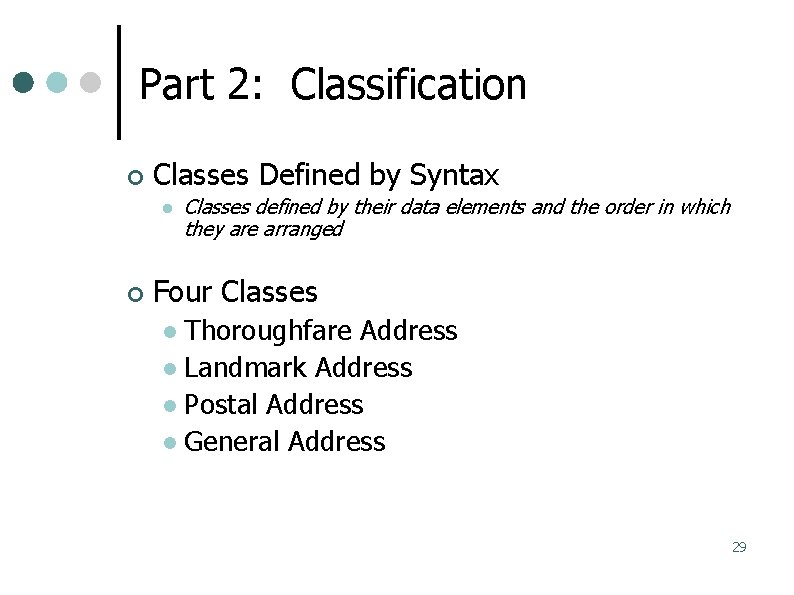
Part 2: Classification Classes Defined by Syntax Classes defined by their data elements and the order in which they are arranged Four Classes Thoroughfare Address Landmark Address Postal Address General Address 29
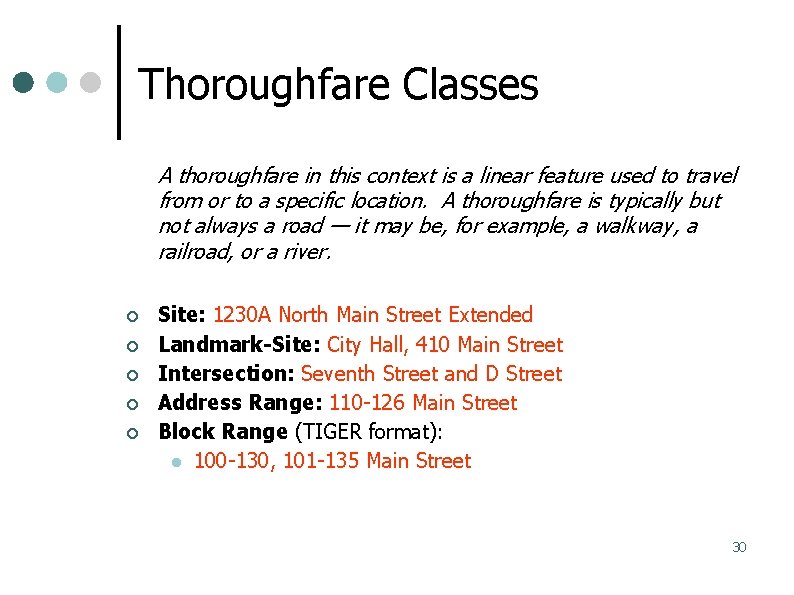
Thoroughfare Classes A thoroughfare in this context is a linear feature used to travel from or to a specific location. A thoroughfare is typically but not always a road — it may be, for example, a walkway, a railroad, or a river. Site: 1230 A North Main Street Extended Landmark-Site: City Hall, 410 Main Street Intersection: Seventh Street and D Street Address Range: 110 -126 Main Street Block Range (TIGER format): 100 -130, 101 -135 Main Street 30
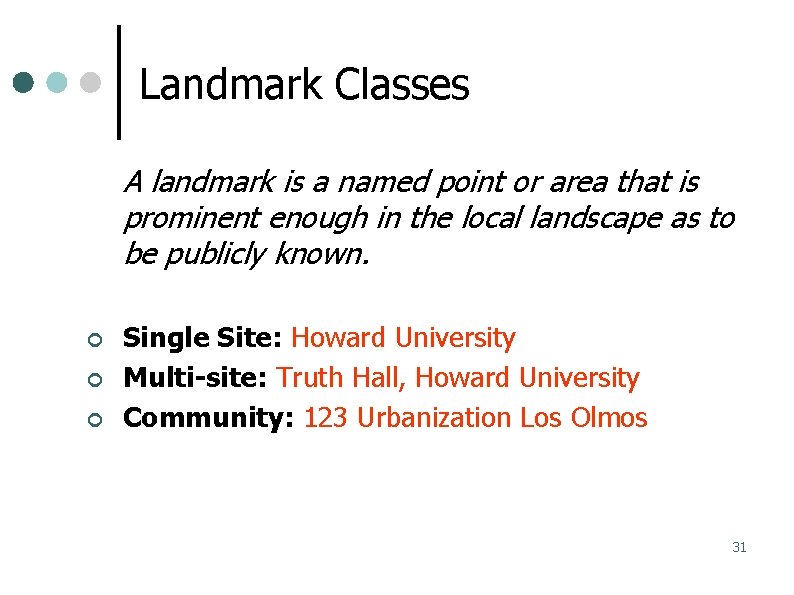
Landmark Classes A landmark is a named point or area that is prominent enough in the local landscape as to be publicly known. Single Site: Howard University Multi-site: Truth Hall, Howard University Community: 123 Urbanization Los Olmos 31
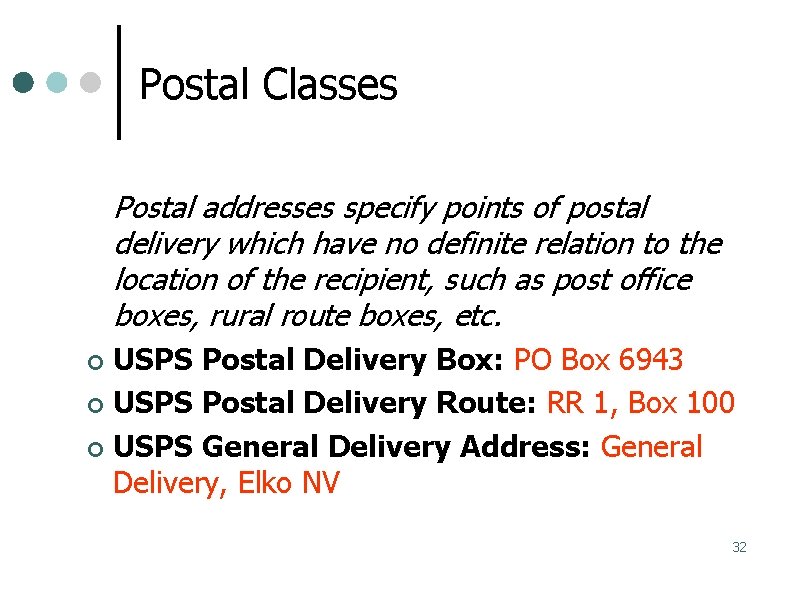
Postal Classes Postal addresses specify points of postal delivery which have no definite relation to the location of the recipient, such as post office boxes, rural route boxes, etc. USPS Postal Delivery Box: PO Box 6943 USPS Postal Delivery Route: RR 1, Box 100 USPS General Delivery Address: General Delivery, Elko NV 32
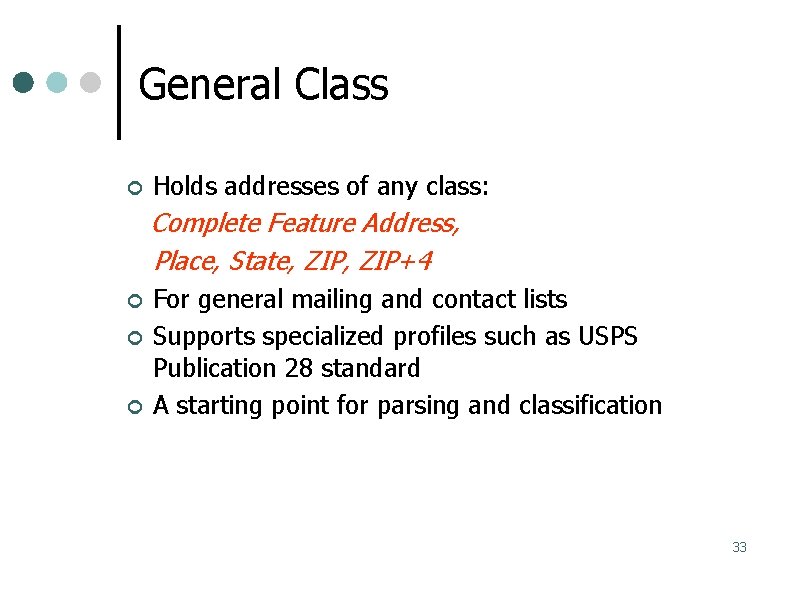
General Class Holds addresses of any class: Complete Feature Address, Place, State, ZIP+4 For general mailing and contact lists Supports specialized profiles such as USPS Publication 28 standard A starting point for parsing and classification 33
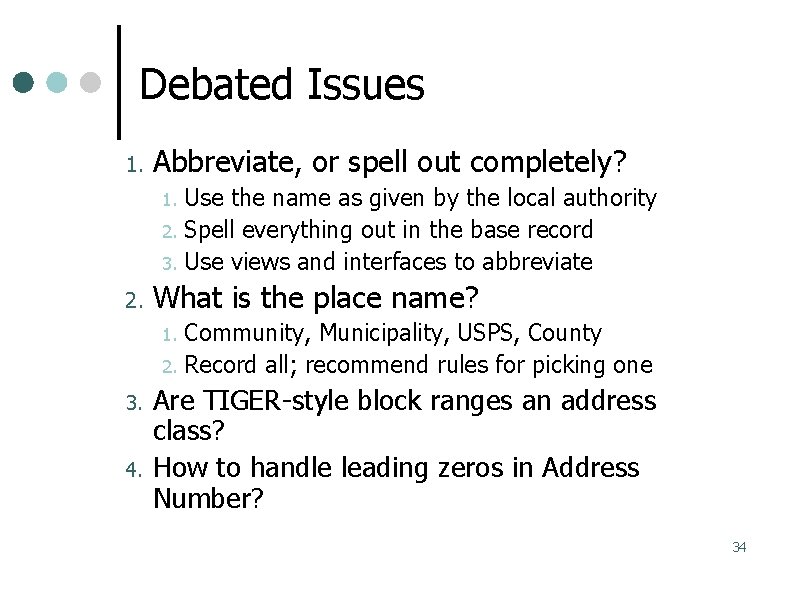
Debated Issues 1. Abbreviate, or spell out completely? Use the name as given by the local authority 2. Spell everything out in the base record 3. Use views and interfaces to abbreviate 1. 2. What is the place name? Community, Municipality, USPS, County 2. Record all; recommend rules for picking one 1. 3. 4. Are TIGER-style block ranges an address class? How to handle leading zeros in Address Number? 34
Comment Summary Part Two: Classification 21 comments Clarification and Definition Glossary More information on implementation Will create an Implementation Guide 35
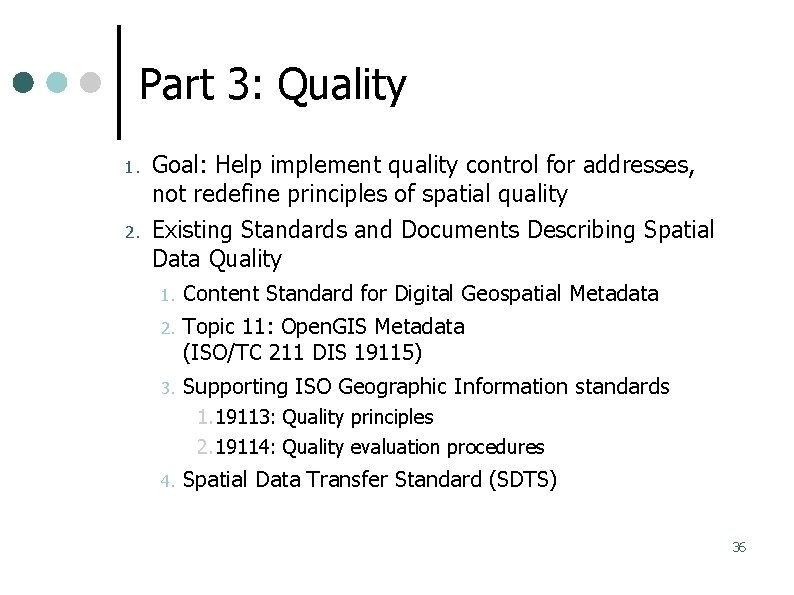
Part 3: Quality 1. Goal: Help implement quality control for addresses, not redefine principles of spatial quality 2. Existing Standards and Documents Describing Spatial Data Quality 1. Content Standard for Digital Geospatial Metadata 2. Topic 11: Open. GIS Metadata (ISO/TC 211 DIS 19115) 3. Supporting ISO Geographic Information standards 1. 19113: Quality principles 2. 19114: Quality evaluation procedures 4. Spatial Data Transfer Standard (SDTS) 36
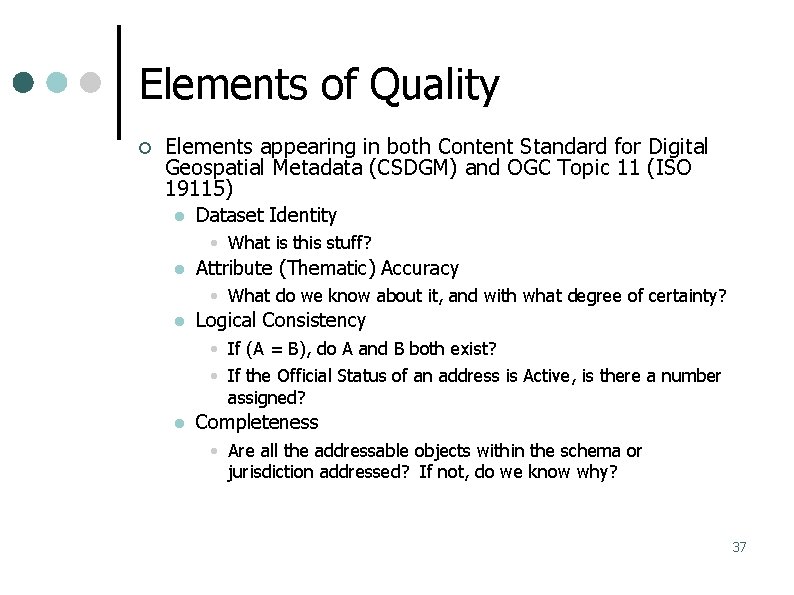
Elements of Quality Elements appearing in both Content Standard for Digital Geospatial Metadata (CSDGM) and OGC Topic 11 (ISO 19115) Dataset Identity • What is this stuff? Attribute (Thematic) Accuracy • What do we know about it, and with what degree of certainty? Logical Consistency • If (A = B), do A and B both exist? • If the Official Status of an address is Active, is there a number assigned? Completeness • Are all the addressable objects within the schema or jurisdiction addressed? If not, do we know why? 37
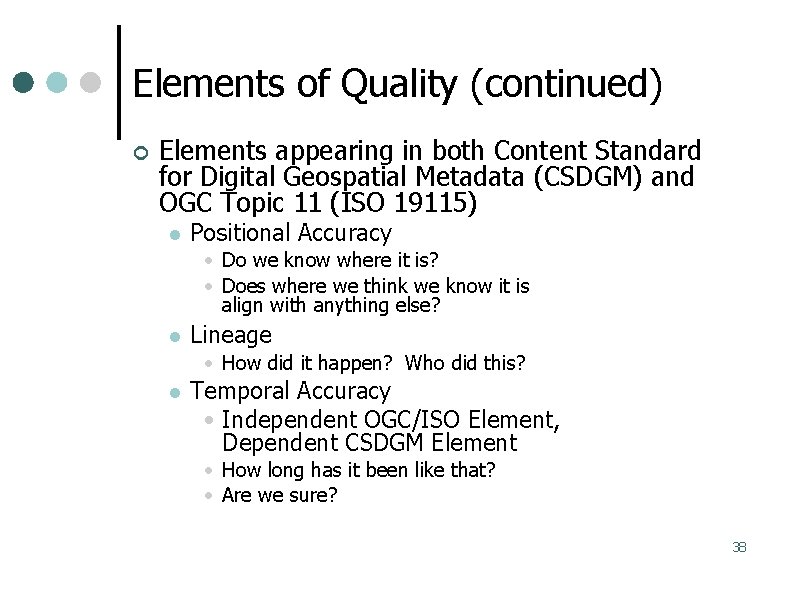
Elements of Quality (continued) Elements appearing in both Content Standard for Digital Geospatial Metadata (CSDGM) and OGC Topic 11 (ISO 19115) Positional Accuracy • Do we know where it is? • Does where we think we know it is align with anything else? Lineage • How did it happen? Who did this? Temporal Accuracy • Independent OGC/ISO Element, Dependent CSDGM Element • How long has it been like that? • Are we sure? 38
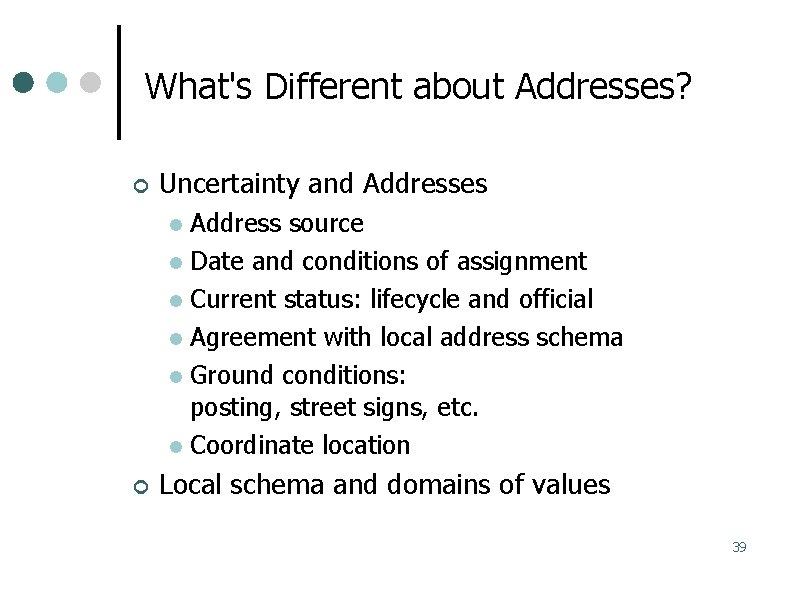
What's Different about Addresses? Uncertainty and Addresses Address source Date and conditions of assignment Current status: lifecycle and official Agreement with local address schema Ground conditions: posting, street signs, etc. Coordinate location Local schema and domains of values 39
Testing Address Quality Tests grouped by Content and Classification: Simple Elements Complex Elements Attributes Address Classes Tests described by: Measure Name Measure Description Report Evaluation Procedure Pseudocode Example (Pseudo SQL) 40
Why SQL? Platform-neutral, portable logic Standard spatial predicates described in the Open. GIS Simple Features Specification for SQL (SFSQL) Has enough logic to describe one implementation of the Evaluation Procedure Generalized, but close enough for spatial database users to adapt quickly 41
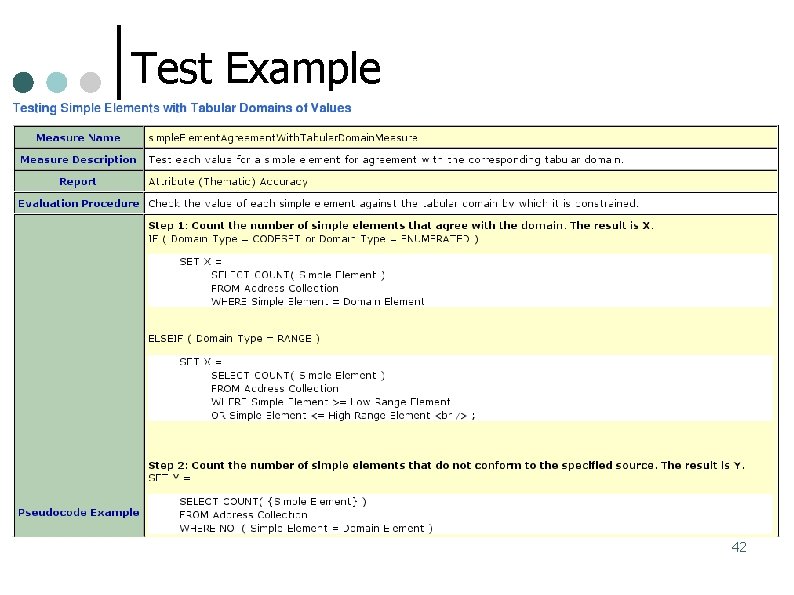
Test Example 42
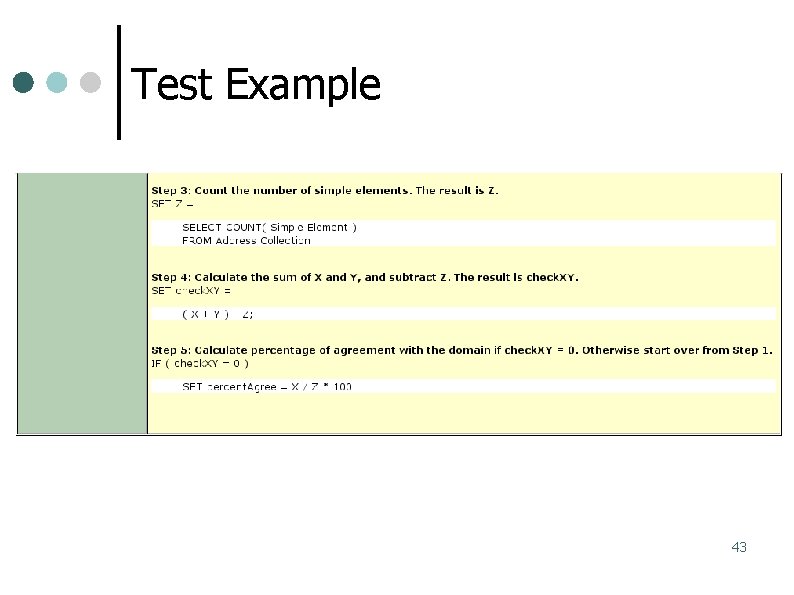
Test Example 43
Comment Summary Part Three: Quality 5 comments This section was provided in outline form only for the first review period. As such the comments focused on what should be included when the section was complete. 44
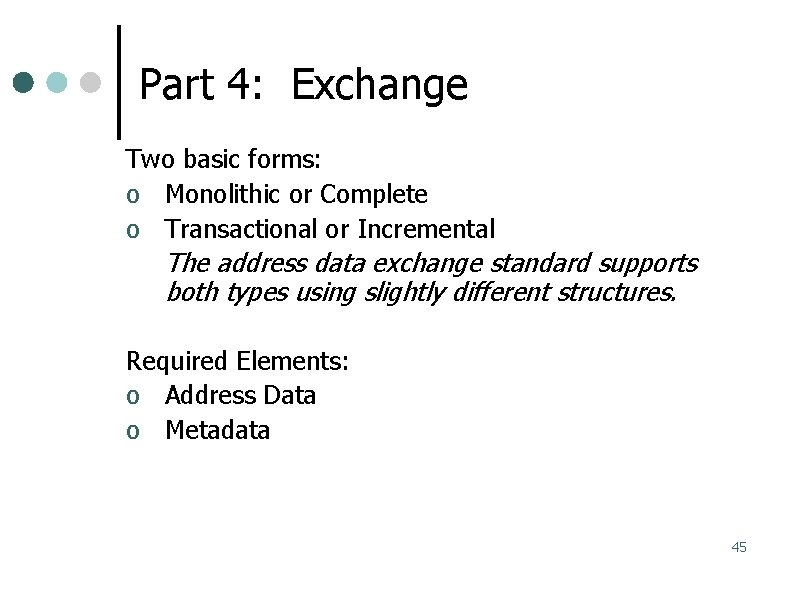
Part 4: Exchange Two basic forms: o Monolithic or Complete o Transactional or Incremental The address data exchange standard supports both types using slightly different structures. Required Elements: o Address Data o Metadata 45
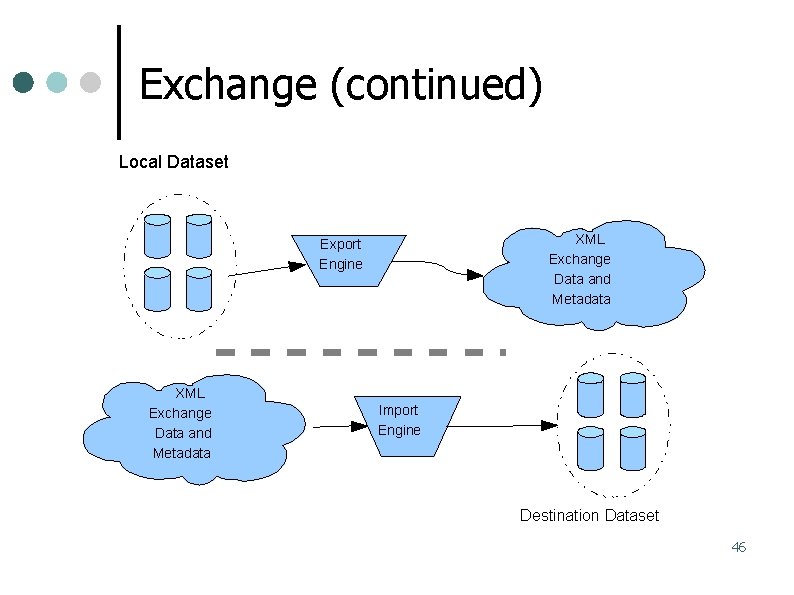
Exchange (continued) Local Dataset XML Exchange Data and Metadata Export Engine XML Exchange Data and Metadata Import Engine Destination Dataset 46
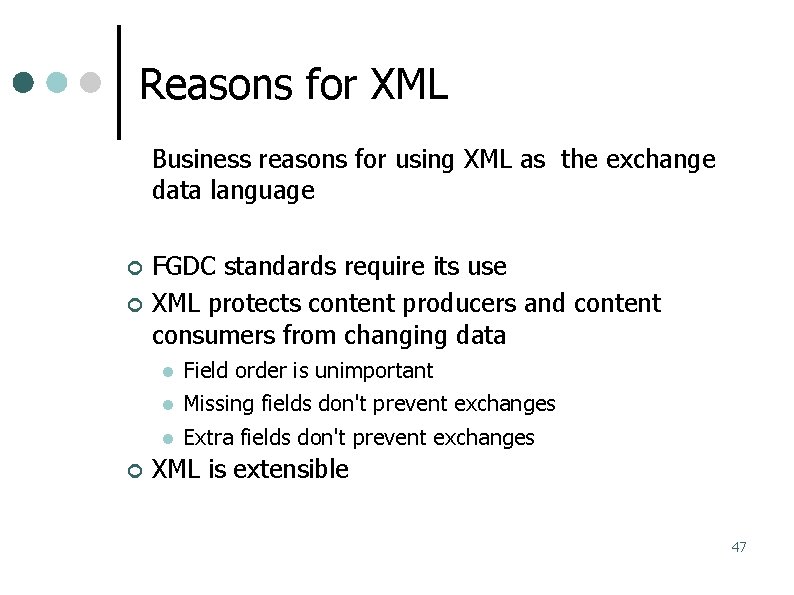
Reasons for XML Business reasons for using XML as the exchange data language FGDC standards require its use XML protects content producers and content consumers from changing data Field order is unimportant Missing fields don't prevent exchanges Extra fields don't prevent exchanges XML is extensible 47
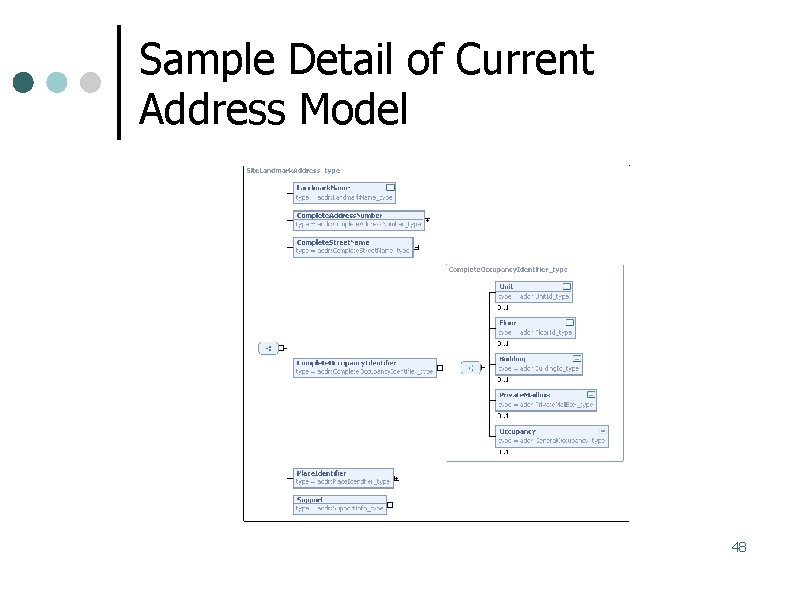
Sample Detail of Current Address Model 48
Preparing to Exchange Data Undo localizations of data (normalize the data) Reparse data into one of the four Address Classes Express data in the XML format of the Standard Prepare metadata describing the data being exchanged 49
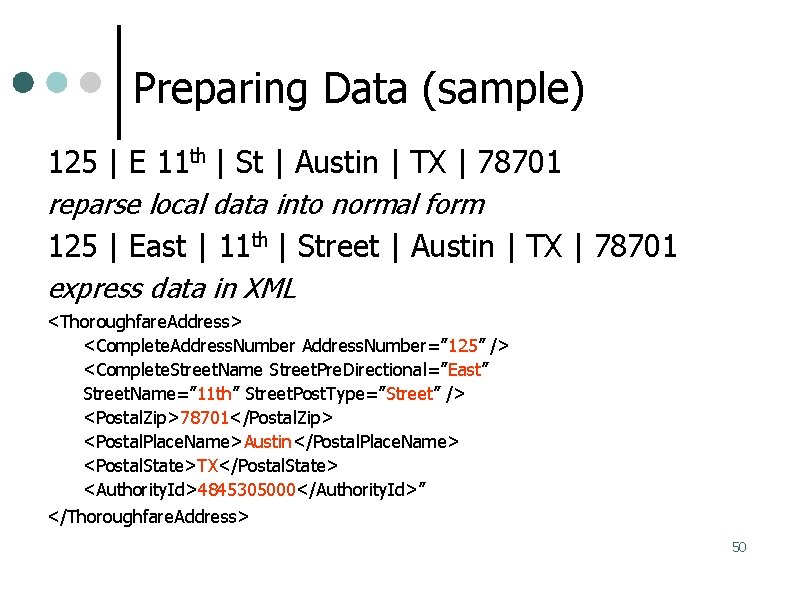
Preparing Data (sample) 125 | E 11 th | St | Austin | TX | 78701 reparse local data into normal form 125 | East | 11 th | Street | Austin | TX | 78701 express data in XML <Thoroughfare. Address> <Complete. Address. Number=” 125” /> <Complete. Street. Name Street. Pre. Directional=”East” Street. Name=” 11 th” Street. Post. Type=”Street” /> <Postal. Zip>78701</Postal. Zip> <Postal. Place. Name>Austin</Postal. Place. Name> <Postal. State>TX</Postal. State> <Authority. Id>4845305000</Authority. Id>” </Thoroughfare. Address> 50
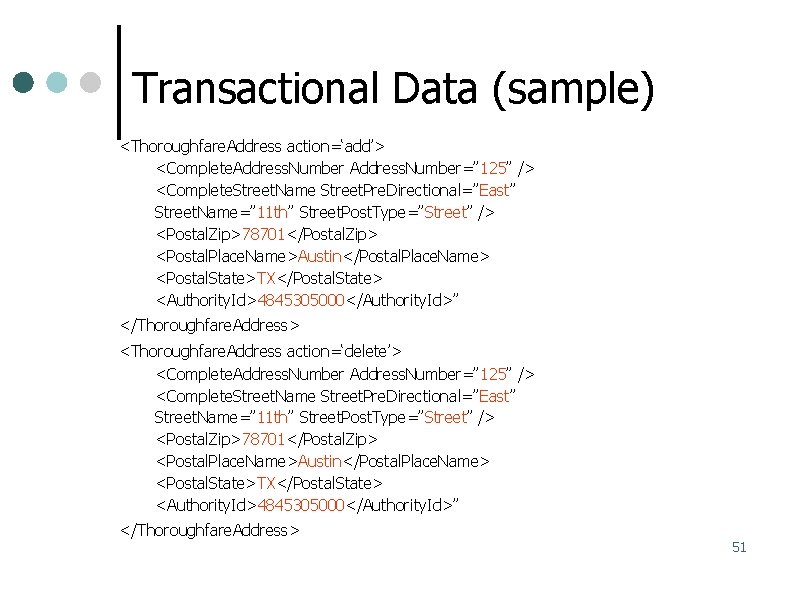
Transactional Data (sample) <Thoroughfare. Address action=‘add’> <Complete. Address. Number=” 125” /> <Complete. Street. Name Street. Pre. Directional=”East” Street. Name=” 11 th” Street. Post. Type=”Street” /> <Postal. Zip>78701</Postal. Zip> <Postal. Place. Name>Austin</Postal. Place. Name> <Postal. State>TX</Postal. State> <Authority. Id>4845305000</Authority. Id>” </Thoroughfare. Address> <Thoroughfare. Address action=‘delete’> <Complete. Address. Number=” 125” /> <Complete. Street. Name Street. Pre. Directional=”East” Street. Name=” 11 th” Street. Post. Type=”Street” /> <Postal. Zip>78701</Postal. Zip> <Postal. Place. Name>Austin</Postal. Place. Name> <Postal. State>TX</Postal. State> <Authority. Id>4845305000</Authority. Id>” </Thoroughfare. Address> 51
Comment Summary Part Four: Exchange 3 comments Better coordination is needed between Data Content & Data Exchange Clarify FGDC metadata requirements 52
Next Steps 1. 2. 3. 4. 5. 6. Synthesize comments from first review period Underway Present revised draft at the URISA annual conference in Kansas City (October, 2005)- Done Post for Comments – November 7, 2005 Second review period – Through December 31 Synthesize comments Submit revised standard to FGDC for full public review, comment adjudication, and approval as a draft standard (early 2006) 53
View the Draft Standard www. urisa. org (November 7, 2006) We invite you to: Review the draft document Comment in online discussion forums 54
Questions & Discussion Contacts: Martha Lombard, GISP Ed Wells, GISP Hilary Perkins, GISP Sara Yurman Carl Anderson info@urisa. org 55