NICHD NEONATAL RESEARCH NETWORK Randomized Controlled Trial of


- Slides: 26
NICHD NEONATAL RESEARCH NETWORK Randomized Controlled Trial of Optimizing Cooling Strategies for Neonatal Hypoxic. Ischemic Encephalopathy Seetha Shankaran, Abbot Laptook, Athina Pappas, Scott Mc. Donald, Abhik Das, Jon Tyson, Kurt Schibler, Brenda Poindexter, Edward Bell, Roy Heyne, Claudia Pedroza, Rebecca Bara, Krisa Van Meurs, Cathy Grisby, Carolyn Huitema, Uday Devaskar and Rosemary Higgins for the NICHD Neonatal Research Network
Disclosures Speaker: Seetha Shankaran 1. Dr. Shankaran and co-investigators have no financial relationships to disclose or Conflicts of Interest to resolve 2. This presentation will not involve discussion of unapproved or off-label, experimental or investigational use of a drug
Background Cooling to 33. 0°C to 34. 0°C for 72 hours for neonatal HIE has decreased death or disability at 18 months in 5 major randomized controlled trials This neuroprotection continues to childhood However, the rate of death or disability in the cooled group remains high (up to 44 -55%) Jacobs SE, Cochrane Database review 2013, Guillet R, Pediatr Research 2012, Shankaran S, New Engl J Med 2012, Azzopardi D, New Engl J Med 2014
Background Preclinical studies have demonstrated that brain injury following hypoxia-ischemia continues and evolves over days and weeks Deeper cooling minimizes brain swelling, preserves energy and suppresses oxidative metabolism Longer cooling may protect against apoptosis and inflammation Busto R, J Cereb blood Flow Metab 1987, Thoresen M, Pediatr Res 1995, Williams JD, Pediatr Res 1997, Iwata O, Ann Neurol 2005, Bennet L, J Physiol 2007, Perlman J, Pediatrics 2006, Johnston MV, Lancet Neurol 2011
Objective and Design To determine if longer duration cooling (120 hours), deeper cooling (32. 0°C) or both is superior to cooling at 33. 5°C for 72 hours in term neonates with HIE A randomized 2 x 2 factorial design clinical trial performed in 18 US centers in the NICHD Neonatal Research Network between October 2010 and November 2013
>36 weeks, <6 h No Blood Gas or p. H 7. 01 -7. 15 or BD 10. 0 -15. 9 Blood Gas p. H <7. 0 or BD >16 Acute Event AND 10 min Apgar <5 OR Ventilation from birth AND SEIZURES OR MODERATE/SEVERE HIE
Design Randomly assigned to 4 hypothermia groups stratified by center and level of encephalopathy 33. 5°C for 72 hours 32. 0°C for 72 hours 33. 5°C for 120 hours 32. 0°C for 120 hours Trial was powered for marginal comparisons of 33. 5°C vs. 32. 0°C and 72 hours vs. 120 hours
Outcomes Primary outcome of death or moderate or severe disability at 18 to 22 months is still ongoing The independent data and safety monitoring committee paused the trial to evaluate safety after the first 50 neonates were enrolled Cardiac arrhythmia Persistent acidosis Major vessel thrombosis and bleeding Death in the NICU
Outcomes Data and safety and monitoring committee monitored safety after every subsequent 25 neonates The trial was closed for emerging safety profile and futility analysis after the eighth review with 364 neonates enrolled of 726 planned This report focuses on safety and NICU deaths by marginal comparisons of 72 hours vs. 120 hours duration and 33. 5°C depth vs. 32. 0°C depth (predefined secondary outcomes)
Treatment: Cooling protocol similar to first RCT except Neonates assigned to 32. 0°C group had temperature initially lowered to 33. 5°C and when stable for 15 minutes, lowered further to 32. 0°C Temperatures were monitored for the first 10 days and hyperthermia treated as per usual care
Analysis Plan Target sample size was 726 subjects (363 per marginal group comparison) based on 2 -tailed type 1 error of 0. 05, 80% power, 5% loss to FU and a comparison of death or disability of 37. 5 and 27. 5% Intention-to-treat analysis Primary and secondary outcomes analyzed by robust Poisson regression models Adjust for center and level of HIE and assess treatment interactions
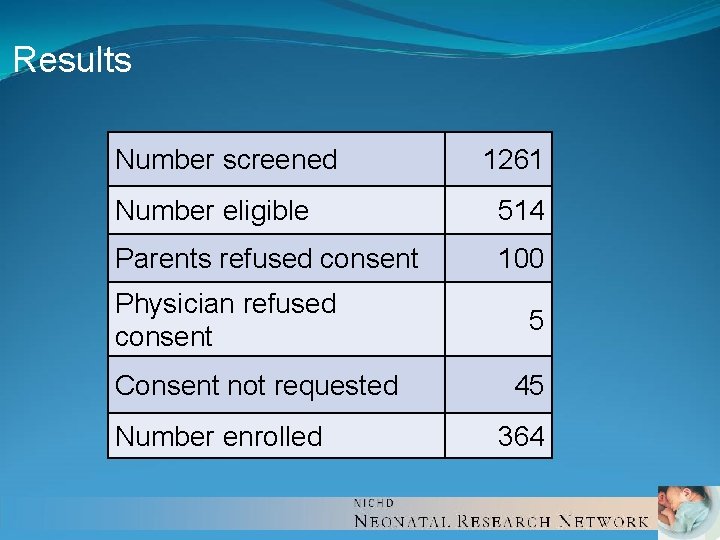
Results Number screened 1261 Number eligible 514 Parents refused consent 100 Physician refused consent Consent not requested Number enrolled 5 45 364
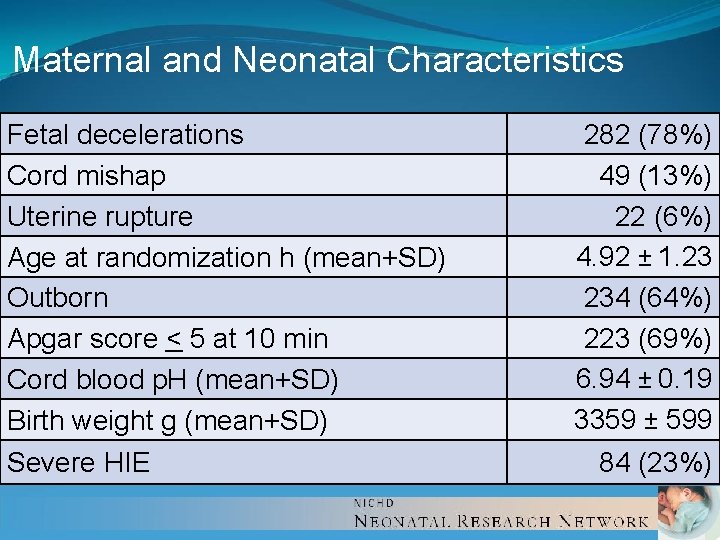
Maternal and Neonatal Characteristics Fetal decelerations Cord mishap Uterine rupture Age at randomization h (mean+SD) Outborn Apgar score < 5 at 10 min Cord blood p. H (mean+SD) Birth weight g (mean+SD) Severe HIE 282 (78%) 49 (13%) 22 (6%) 4. 92 ± 1. 23 234 (64%) 223 (69%) 6. 94 ± 0. 19 3359 ± 599 84 (23%)
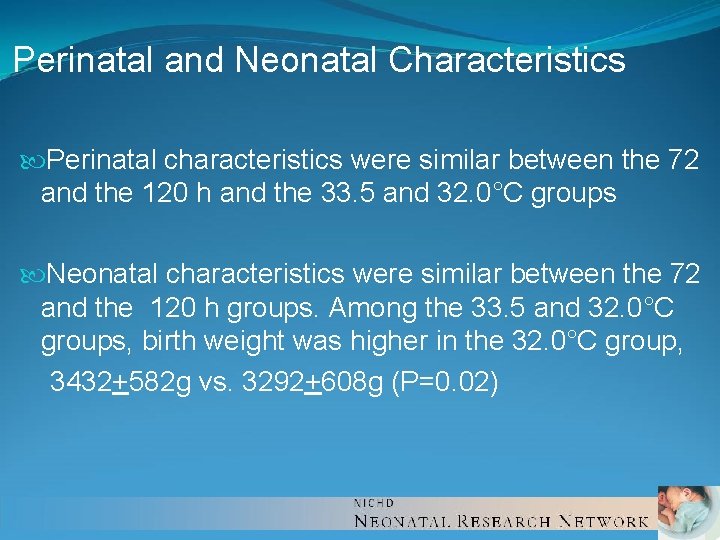
Perinatal and Neonatal Characteristics Perinatal characteristics were similar between the 72 and the 120 h and the 33. 5 and 32. 0°C groups Neonatal characteristics were similar between the 72 and the 120 h groups. Among the 33. 5 and 32. 0°C groups, birth weight was higher in the 32. 0°C group, 3432+582 g vs. 3292+608 g (P=0. 02)
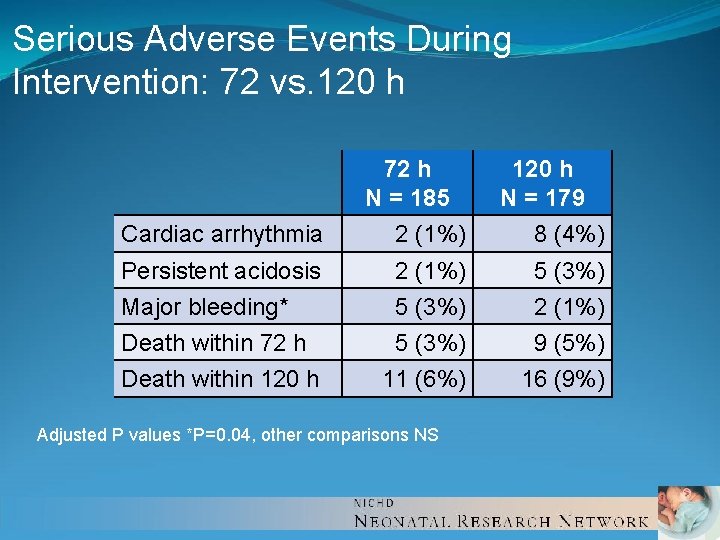
Serious Adverse Events During Intervention: 72 vs. 120 h 72 h N = 185 120 h N = 179 Cardiac arrhythmia 2 (1%) 8 (4%) Persistent acidosis 2 (1%) 5 (3%) Major bleeding* 5 (3%) 2 (1%) Death within 72 h 5 (3%) 9 (5%) Death within 120 h 11 (6%) 16 (9%) Adjusted P values *P=0. 04, other comparisons NS
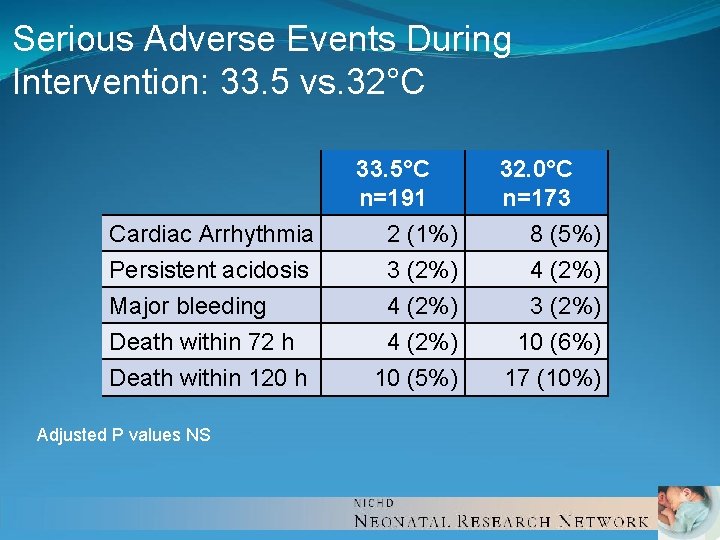
Serious Adverse Events During Intervention: 33. 5 vs. 32°C 33. 5°C n=191 32. 0°C n=173 Cardiac Arrhythmia 2 (1%) 8 (5%) Persistent acidosis 3 (2%) 4 (2%) Major bleeding 4 (2%) 3 (2%) Death within 72 h 4 (2%) 10 (6%) Death within 120 h 10 (5%) 17 (10%) Adjusted P values NS
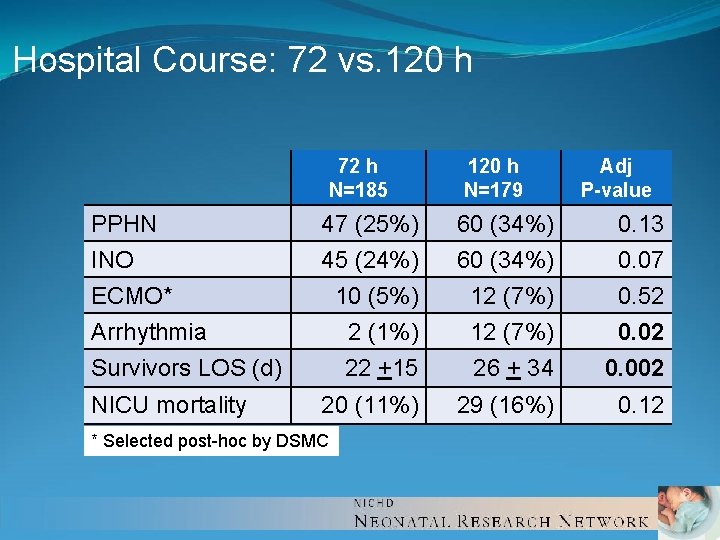
Hospital Course: 72 vs. 120 h 72 h N=185 120 h N=179 Adj P-value PPHN 47 (25%) 60 (34%) 0. 13 INO 45 (24%) 60 (34%) 0. 07 10 (5%) 12 (7%) 0. 52 Arrhythmia 2 (1%) 12 (7%) 0. 02 Survivors LOS (d) 22 +15 26 + 34 0. 002 20 (11%) 29 (16%) 0. 12 ECMO* NICU mortality * Selected post-hoc by DSMC
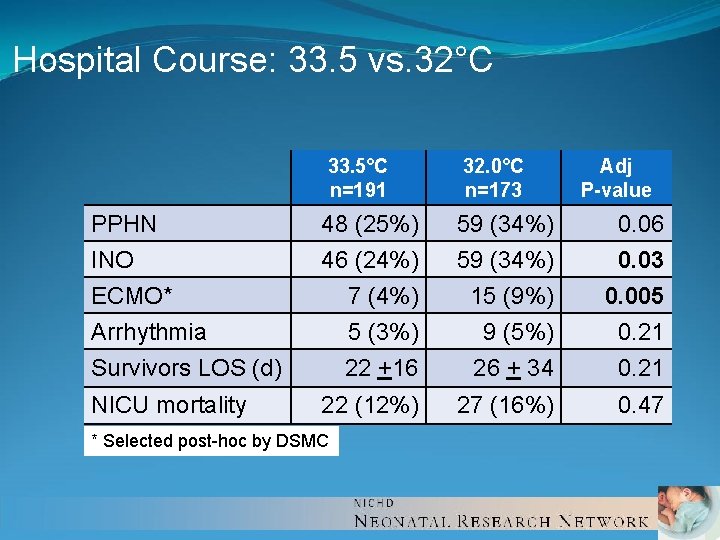
Hospital Course: 33. 5 vs. 32°C 33. 5°C n=191 32. 0°C n=173 Adj P-value PPHN 48 (25%) 59 (34%) 0. 06 INO 46 (24%) 59 (34%) 0. 03 ECMO* 7 (4%) 15 (9%) 0. 005 Arrhythmia 5 (3%) 9 (5%) 0. 21 Survivors LOS (d) 22 +16 26 + 34 0. 21 22 (12%) 27 (16%) 0. 47 NICU mortality * Selected post-hoc by DSMC
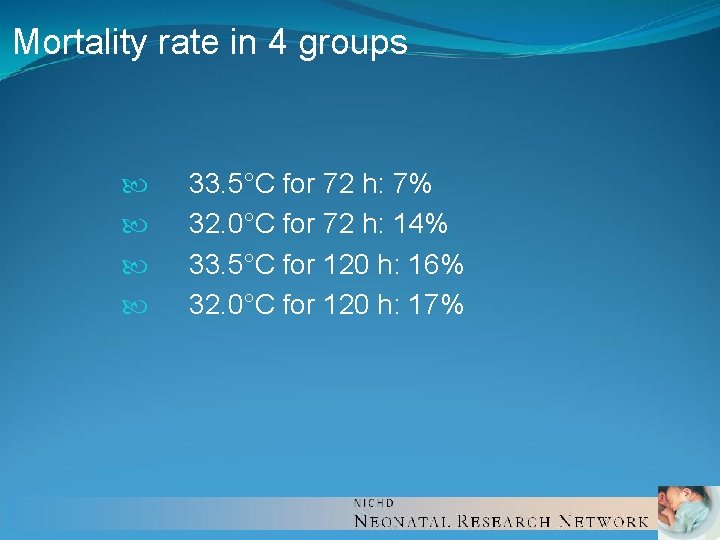
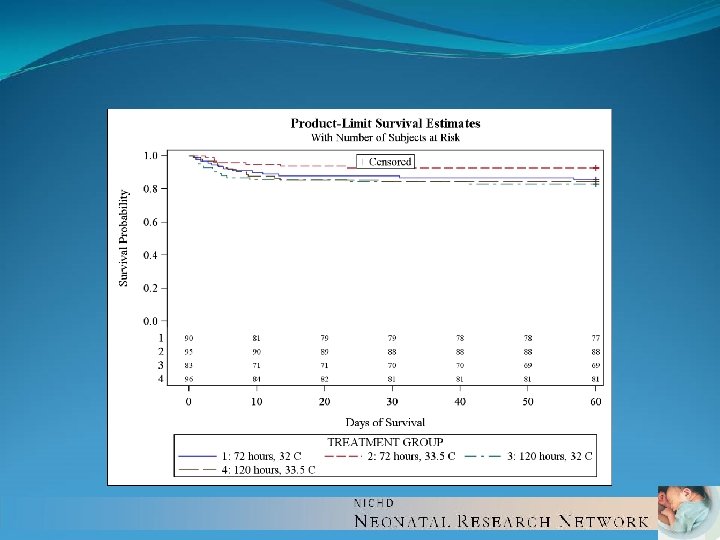
Mortality rate in 4 groups 33. 5°C for 72 h: 7% 32. 0°C for 72 h: 14% 33. 5°C for 120 h: 16% 32. 0°C for 120 h: 17%
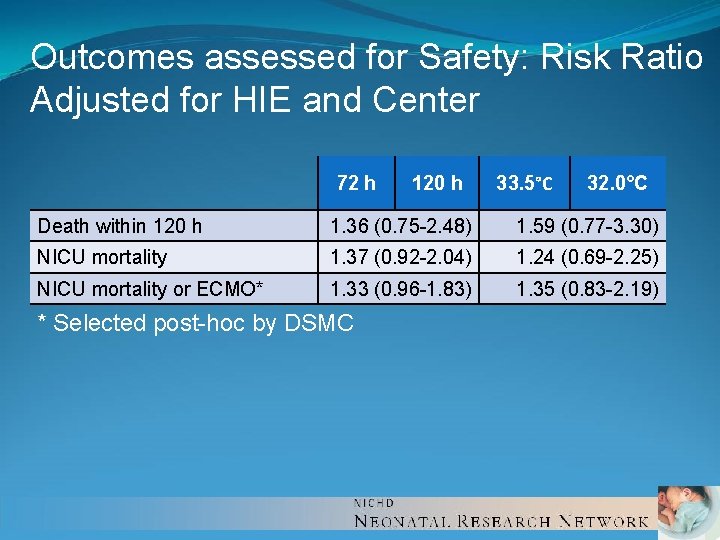
Outcomes assessed for Safety: Risk Ratio Adjusted for HIE and Center 72 h 120 h 33. 5°C 32. 0°C Death within 120 h 1. 36 (0. 75 -2. 48) 1. 59 (0. 77 -3. 30) NICU mortality 1. 37 (0. 92 -2. 04) 1. 24 (0. 69 -2. 25) NICU mortality or ECMO* 1. 33 (0. 96 -1. 83) 1. 35 (0. 83 -2. 19) * Selected post-hoc by DSMC
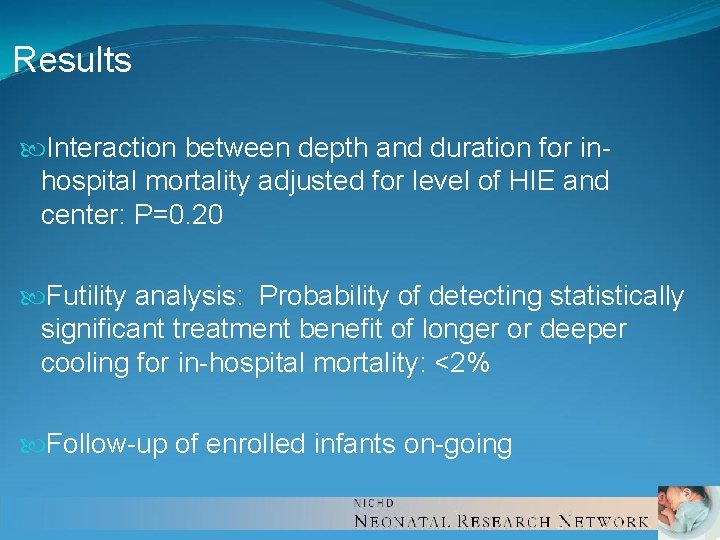
Results Interaction between depth and duration for inhospital mortality adjusted for level of HIE and center: P=0. 20 Futility analysis: Probability of detecting statistically significant treatment benefit of longer or deeper cooling for in-hospital mortality: <2% Follow-up of enrolled infants on-going
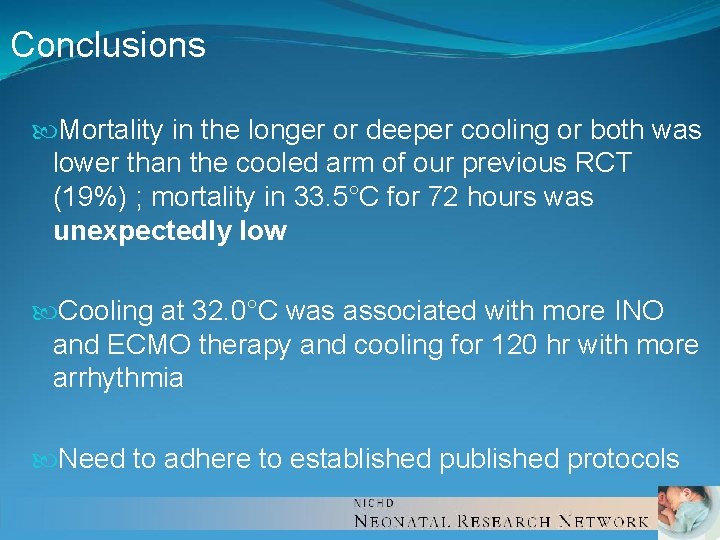
Conclusions Mortality in the longer or deeper cooling or both was lower than the cooled arm of our previous RCT (19%) ; mortality in 33. 5°C for 72 hours was unexpectedly low Cooling at 32. 0°C was associated with more INO and ECMO therapy and cooling for 120 hr with more arrhythmia Need to adhere to established published protocols
Conclusions Among term neonates of at least 36 weeks gestation with moderate or severe HIE, deeper cooling or longer duration of cooling compared with hypothermia at 33. 5°C for 72 hours did not reduce NICU deaths These results have implications for patient care and design of future trials
Neonatal Research Network Centers Brown University Case Western Reserve University Children’s Mercy Hospitals and Clinics, University of Missouri-Kansas City Cincinnati Children’s Medical Center Duke University Emory University Indiana University Nationwide Children’s Hospital, Ohio State University RTI International Stanford University Tufts Medical Center University of Alabama at Birmingham University of California – Los Angeles University of Iowa University of New Mexico University of Pennsylvania University of Rochester University of Texas Southwestern Dallas University of Texas Health Science Center Houston University of Utah Wayne State University Yale University
Thank you Questions? sshankar@med. wayne. edu