Networks ETM 555 1 Computer Networks An interconnected
- Slides: 40
Networks ETM 555 1
Computer Networks • • “An interconnected collection of autonomous end-systems” End Systems: hosts, PCs, dedicated computers, network components • • Connection can be via various means: copper wire, fiber optic cables, microwaves, satellites, ham radio. Distributed Systems: – Existence of multiple autonomous computers is transparent (not visible), machines managed automatically • Network: – Users explicitly log onto a machine, machines managed personally ETM 555 2
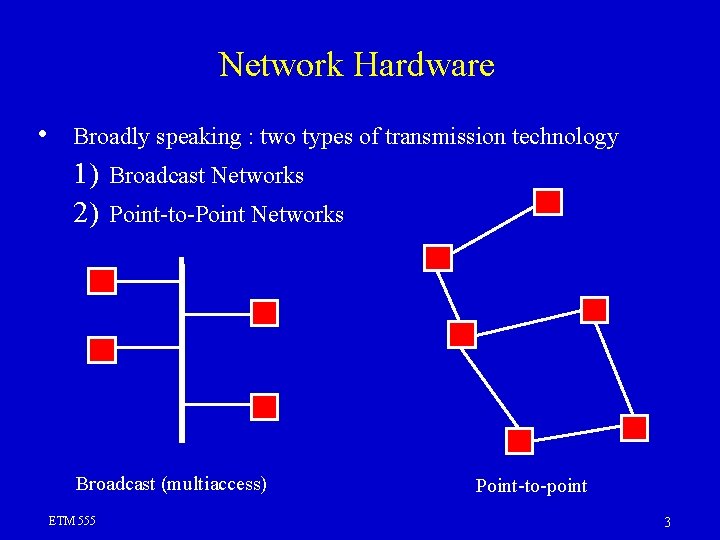
Network Hardware • Broadly speaking : two types of transmission technology 1) 2) Broadcast Networks Point-to-Point Networks Broadcast (multiaccess) ETM 555 Point-to-point 3
Broadcast Networks • • Single communication channel that is shared by all the machines on the network Share wire, frequency etc. Packets (small messages) sent by one mechanism is received by the others. Each machine checks the address field in the provided message. If the address is the same as receiving machine’s address, packet is processed, otherwise it is ignored. • Some arbitration mechanism is needed when more than one machine want to send message at the same time. • Multicasting: transmission to a subset of machines. ETM 555 4
Point-to-Point Networks • Consists of many connections between individual pair of machines. • To go from source machine to destination machine, packet may have to visit intermediate machines. • Various routes (multiple paths) possible Routing algorithms are required. ETM 555 5
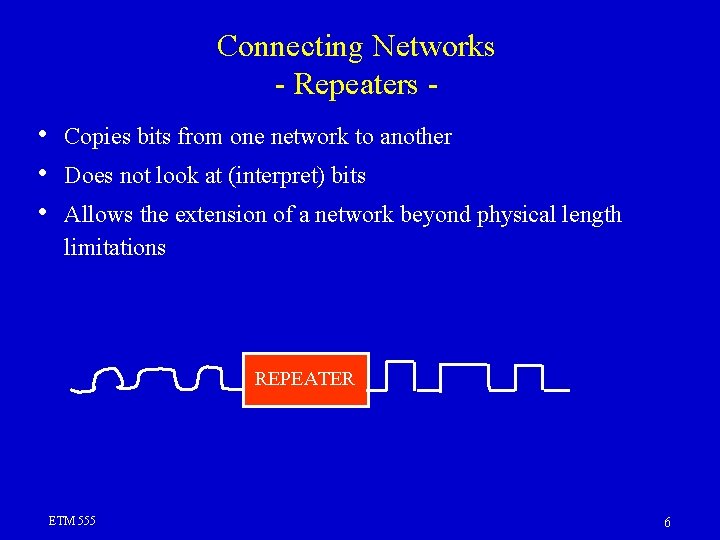
Connecting Networks - Repeaters • • • Copies bits from one network to another Does not look at (interpret) bits Allows the extension of a network beyond physical length limitations REPEATER ETM 555 6
Connecting Networks - Bridges • • • Copies frames from one network to another Can operate selectively – does not copy all forms Extends the network beyond physical length limitations ETM 555 7
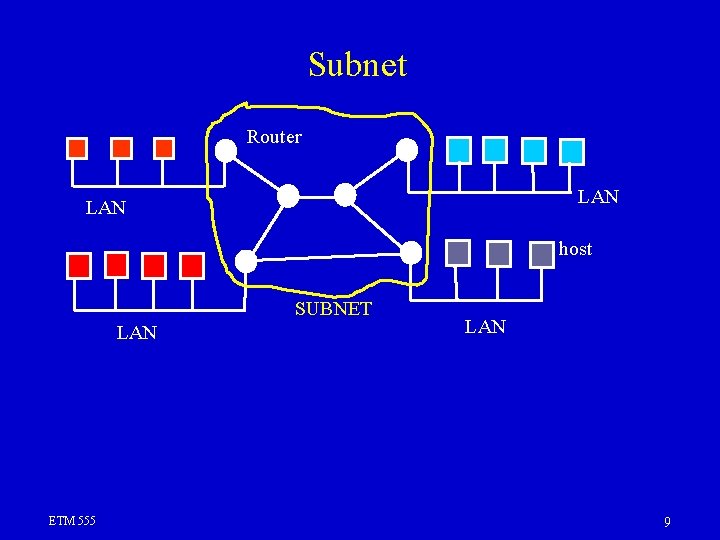
Connecting Networks - Routers • Switching Elements, packet switching nodes, intermediate systems, data switching exchanges • • • Copies packets from one network to another • Subnets in which intermediate routers can store a packet and forward it is called point-to-point or store-and-forward, packet switched. Makes decisions about what route (path) a packet should take If two routers not connected by direct link want to communicate, they do so by using intermediate routers ETM 555 8
Subnet Router LAN host SUBNET LAN ETM 555 LAN 9
Connecting Networks - Gateways • • Operates as a router • Can perform A gateway is a host that is connected to two or more physical networks simultaneously and is configured to switch packets between them – Data conversions – Translation: connect different application protocols – encryption ETM 555 10
Hardware vs. Software • • • Repeaters are typically hardware devices • Many workstations can operate as routers or gateways Bridges can be implemented in hardware or software Routers and gateways are typically implemented in software so that they can be extended to handle new protocols ETM 555 11
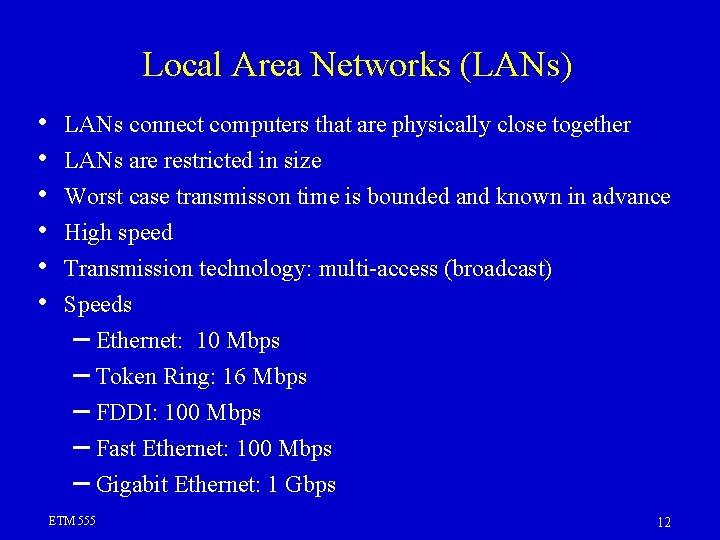
Local Area Networks (LANs) • • • LANs connect computers that are physically close together LANs are restricted in size Worst case transmisson time is bounded and known in advance High speed Transmission technology: multi-access (broadcast) Speeds – Ethernet: 10 Mbps – Token Ring: 16 Mbps – FDDI: 100 Mbps – Fast Ethernet: 100 Mbps – Gigabit Ethernet: 1 Gbps ETM 555 12
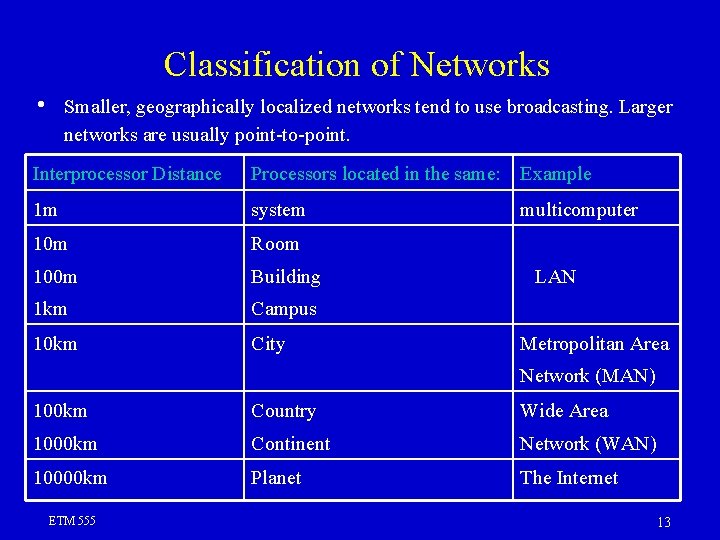
Classification of Networks • Smaller, geographically localized networks tend to use broadcasting. Larger networks are usually point-to-point. Interprocessor Distance Processors located in the same: Example 1 m system 10 m Room 100 m Building 1 km Campus 10 km City multicomputer LAN Metropolitan Area Network (MAN) 100 km Country Wide Area 1000 km Continent Network (WAN) 10000 km Planet The Internet ETM 555 13
Transmission Media • Can be classified as: – Guided : waves are guided along a solid medium such as copper wire, optical fiber etc. – Unguided : wireless transmission, atmosphere, outer space, transmit electromagnetic signals, radio, laser etc. • Design issues in transmission systems: – Data rate, distance, bandwidth, transmission impairments, interference, number of receivers etc. ETM 555 14
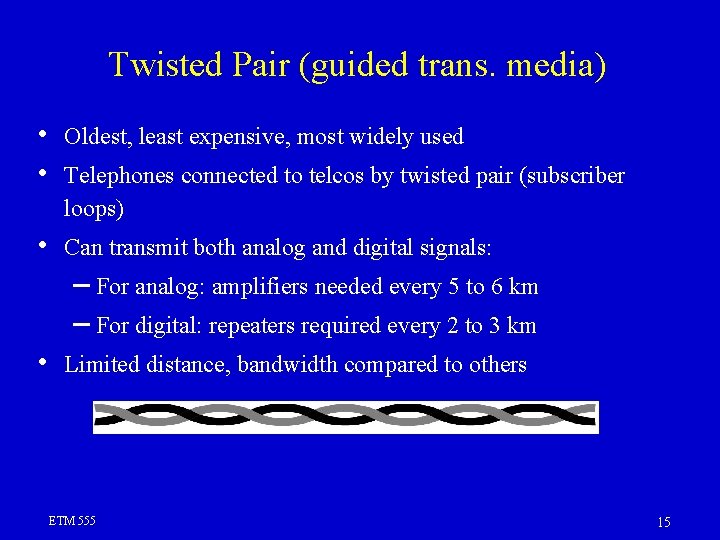
Twisted Pair (guided trans. media) • • Oldest, least expensive, most widely used • Can transmit both analog and digital signals: Telephones connected to telcos by twisted pair (subscriber loops) – For analog: amplifiers needed every 5 to 6 km – For digital: repeaters required every 2 to 3 km • Limited distance, bandwidth compared to others ETM 555 15
Twisted Pair (guided trans media) • 2 kinds: 1) Unshielded (UTP, 10 Base T) is ordinary telephone wire, least expensive transmission media for LANs 2) Shielded: shield twisted pair with a metalic braid/sheating to reduce interference, more expensive • UTP kinds: – Category 3: 3 or 4 twists per foot, (data rates: 16 Mbps) – Category 5: 3 to 4 twists per inch (data rates: 100 Mbps) ETM 555 16
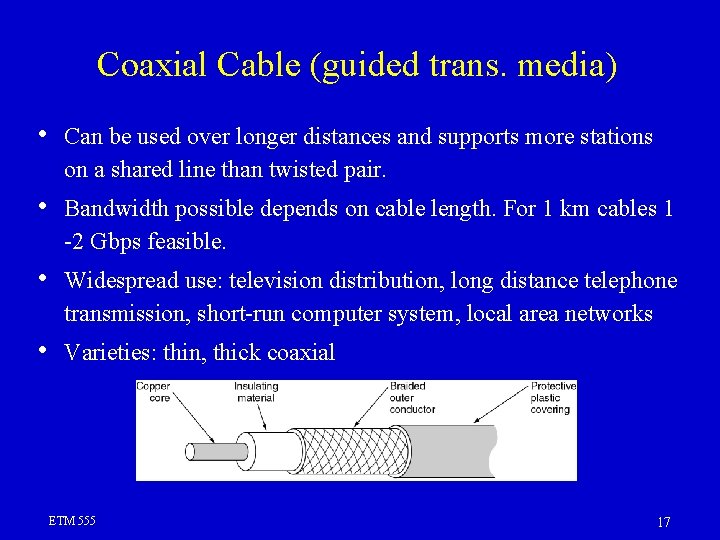
Coaxial Cable (guided trans. media) • Can be used over longer distances and supports more stations on a shared line than twisted pair. • Bandwidth possible depends on cable length. For 1 km cables 1 -2 Gbps feasible. • Widespread use: television distribution, long distance telephone transmission, short-run computer system, local area networks • Varieties: thin, thick coaxial ETM 555 17
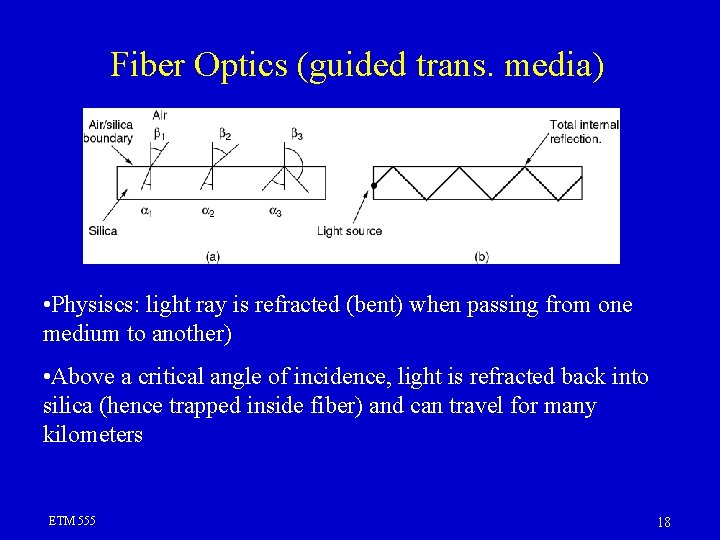
Fiber Optics (guided trans. media) • Physiscs: light ray is refracted (bent) when passing from one medium to another) • Above a critical angle of incidence, light is refracted back into silica (hence trapped inside fiber) and can travel for many kilometers ETM 555 18
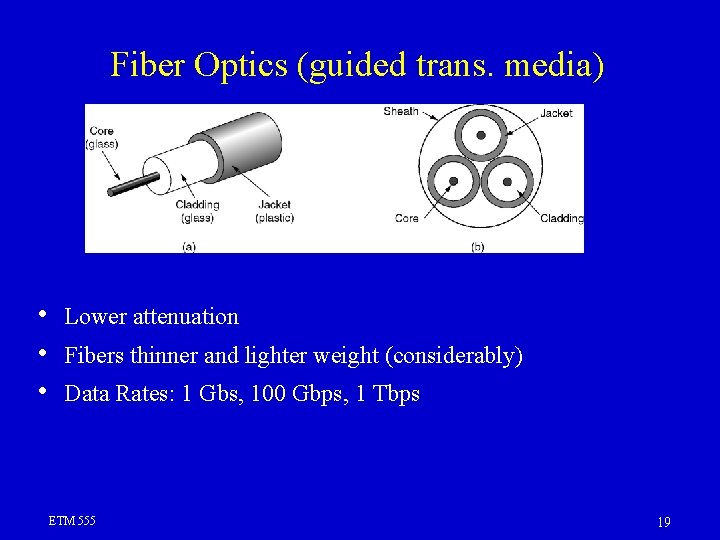
Fiber Optics (guided trans. media) • • • Lower attenuation Fibers thinner and lighter weight (considerably) Data Rates: 1 Gbs, 100 Gbps, 1 Tbps ETM 555 19
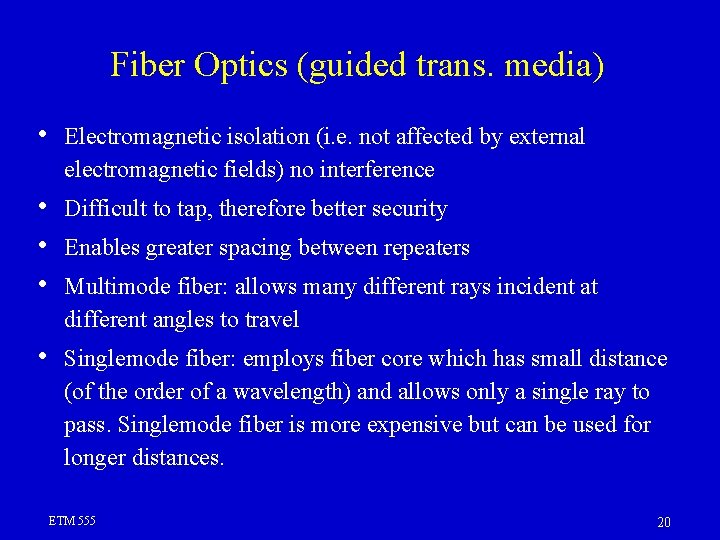
Fiber Optics (guided trans. media) • Electromagnetic isolation (i. e. not affected by external electromagnetic fields) no interference • • • Difficult to tap, therefore better security • Singlemode fiber: employs fiber core which has small distance (of the order of a wavelength) and allows only a single ray to pass. Singlemode fiber is more expensive but can be used for longer distances. Enables greater spacing between repeaters Multimode fiber: allows many different rays incident at different angles to travel ETM 555 20
Global Wireless Network Standards • • • IEEE 802. 15 (Bluetooth) for the Personal Area Network (PAN) • IEEE 802. 20 standard for the Mobile Broadband Wireless Access (MBWA) IEEE 802. 11 (Wi-Fi) for the Local Area Network (LAN) IEEE 802. 16 (Wi. Max) for the Metropolitan Area Network (MAN) ETM 555 21
Bluetooth • • Can link up to 8 devices in 10 -m area Can transmit up to 722 Kbps in the 2. 4 Gh. Z band Low power requirements Radio based communication ETM 555 22
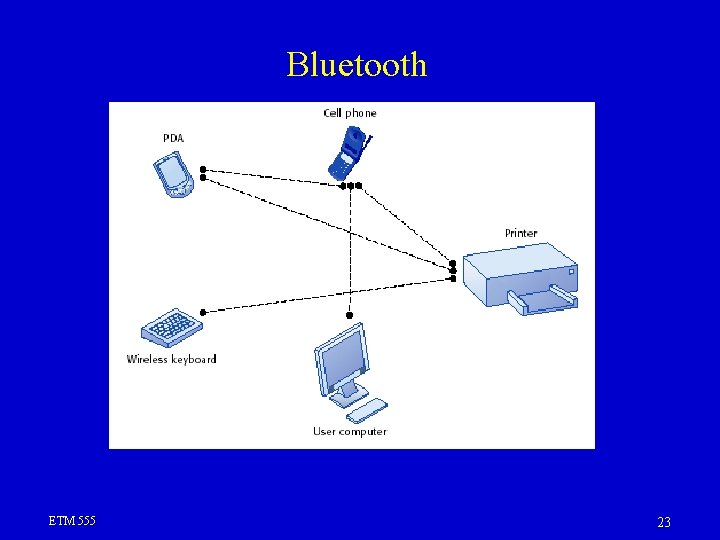
Bluetooth ETM 555 23
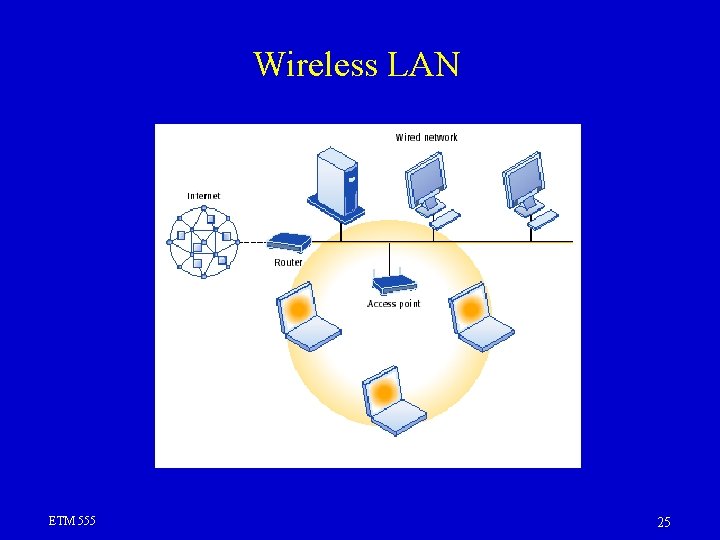
Wi-Fi • Three standards: – 802. 11 a: up to 54 Mbps (10 – 30 meters) – 802. 11 b : up to 11 Mbps (30 – 100 meters) – 802. 11 g : up to 54 Mbps (30 – 100 meters) • Infrastructure mode: Devices use access point to communicate with wired network • Ad-hoc mode (peer-to-peer): Wireless devices communicate directly with each other ETM 555 24
Wireless LAN ETM 555 25
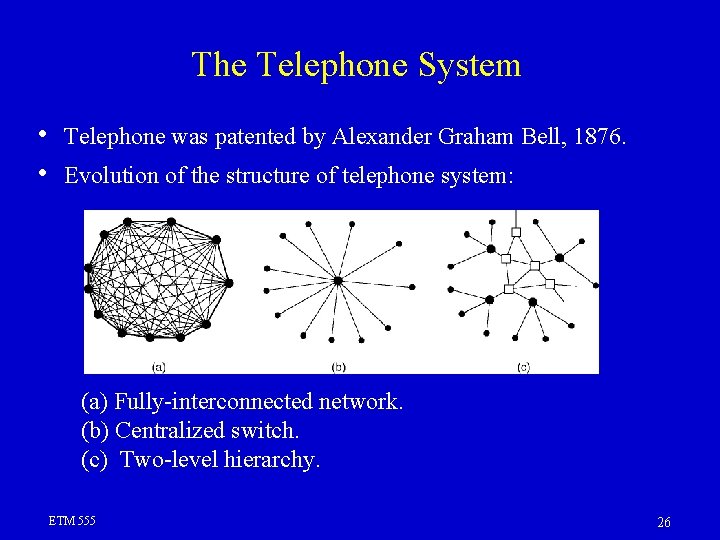
The Telephone System • • Telephone was patented by Alexander Graham Bell, 1876. Evolution of the structure of telephone system: (a) Fully-interconnected network. (b) Centralized switch. (c) Two-level hierarchy. ETM 555 26
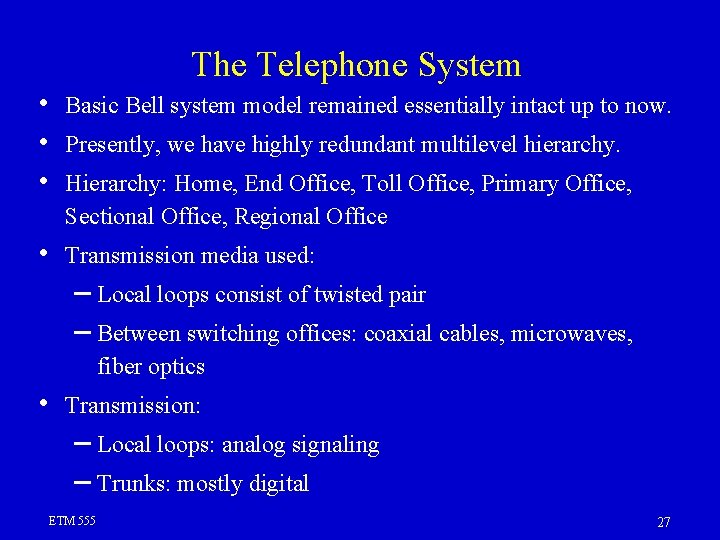
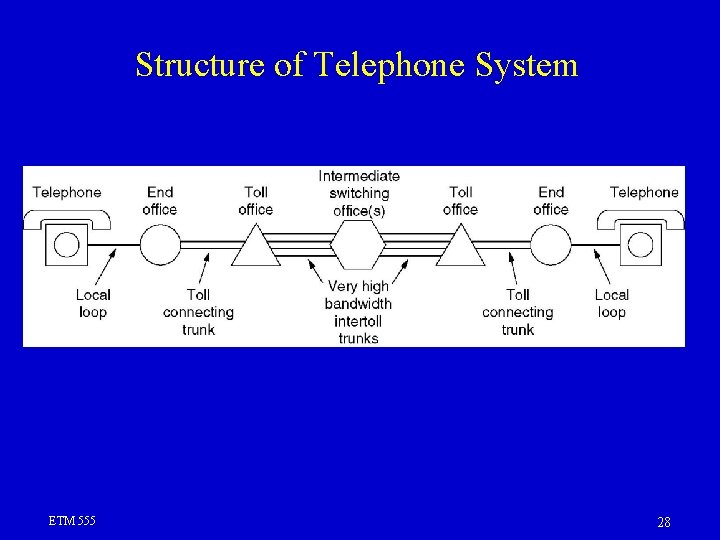
The Telephone System • • • Basic Bell system model remained essentially intact up to now. • Transmission media used: Presently, we have highly redundant multilevel hierarchy. Hierarchy: Home, End Office, Toll Office, Primary Office, Sectional Office, Regional Office – Local loops consist of twisted pair – Between switching offices: coaxial cables, microwaves, fiber optics • Transmission: – Local loops: analog signaling – Trunks: mostly digital ETM 555 27
Structure of Telephone System ETM 555 28
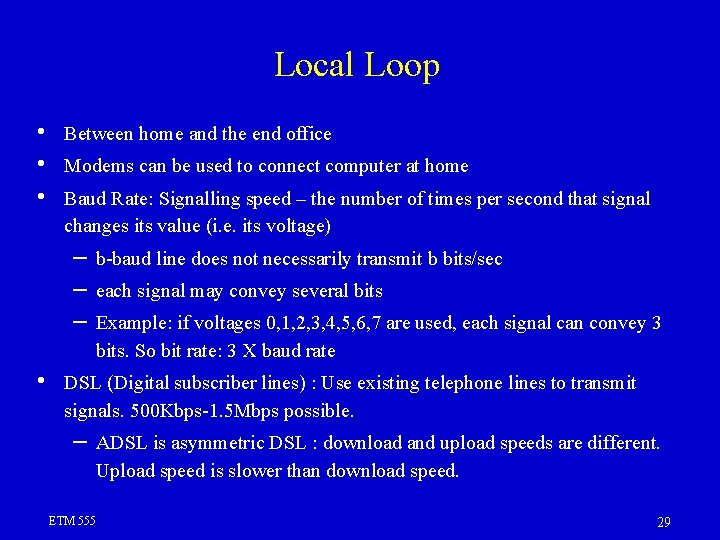
Local Loop • • • Between home and the end office Modems can be used to connect computer at home Baud Rate: Signalling speed – the number of times per second that signal changes its value (i. e. its voltage) – – – • b-baud line does not necessarily transmit b bits/sec each signal may convey several bits Example: if voltages 0, 1, 2, 3, 4, 5, 6, 7 are used, each signal can convey 3 bits. So bit rate: 3 X baud rate DSL (Digital subscriber lines) : Use existing telephone lines to transmit signals. 500 Kbps-1. 5 Mbps possible. – ETM 555 ADSL is asymmetric DSL : download and upload speeds are different. Upload speed is slower than download speed. 29
Trunks and Multiplexing • Cost of installing and maintaining both high-bandwidth and low bandwidth trunk the same (essentially) • • Therefore, choose high-bandwidth trunk installation • Multiplexing schemes: To efficiently use high bandwidth, multiplex many conversations over a single trunk – Frequency Division Multiplexing – Wavelength Division Multiplexing – Time Division Multiplexing ETM 555 30
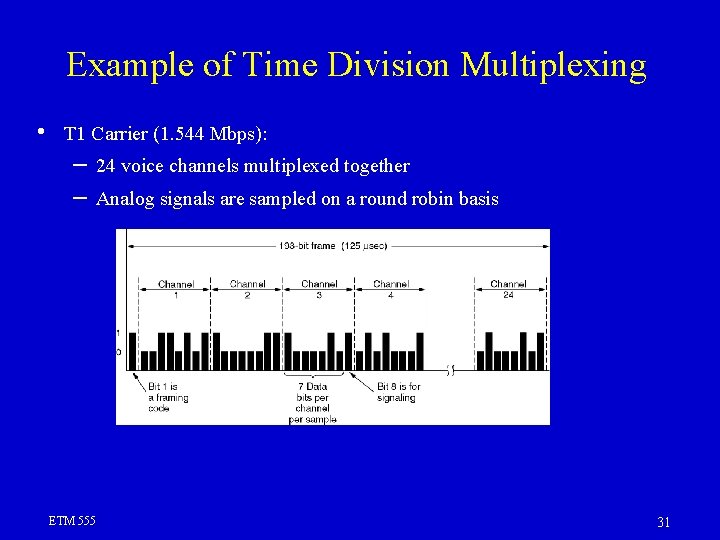
Example of Time Division Multiplexing • T 1 Carrier (1. 544 Mbps): – – ETM 555 24 voice channels multiplexed together Analog signals are sampled on a round robin basis 31
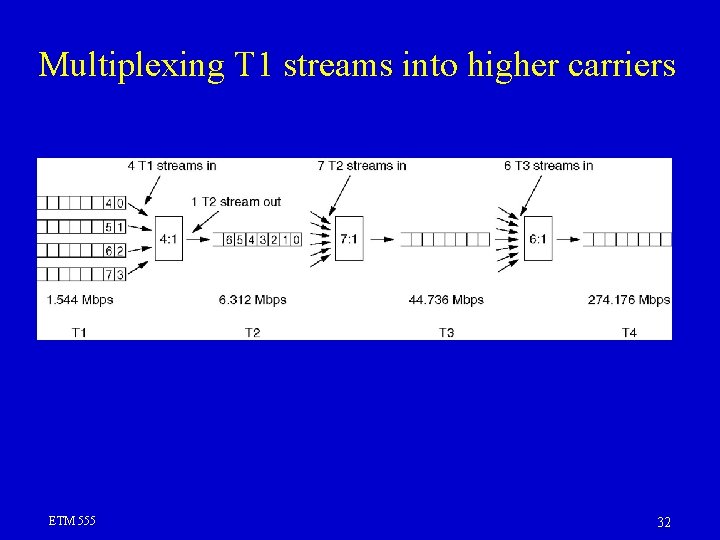
Multiplexing T 1 streams into higher carriers ETM 555 32
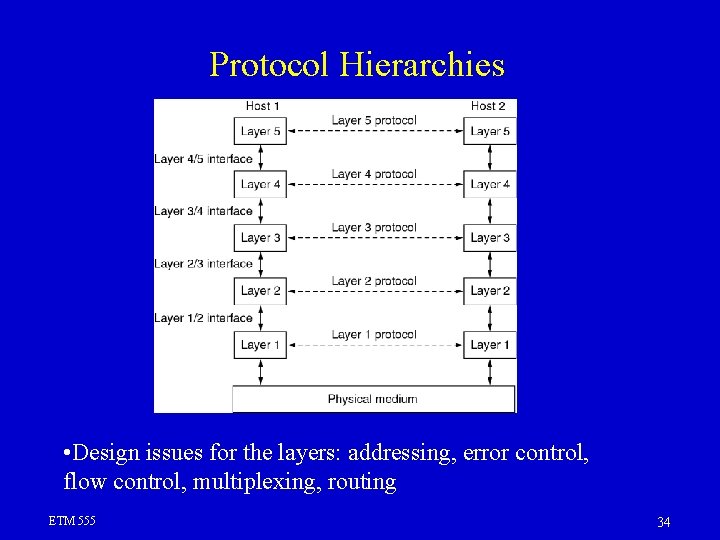
Layered Network Software Architecture Model ETM 555 33
Protocol Hierarchies • Design issues for the layers: addressing, error control, flow control, multiplexing, routing ETM 555 34
OSI Reference Model • Network architecture model based on a proposal developed by International Standards Organization (ISO) • • • OSI: Open Systems Interconnection Standardized protocols for network layers OSI has 7 layers ETM 555 35
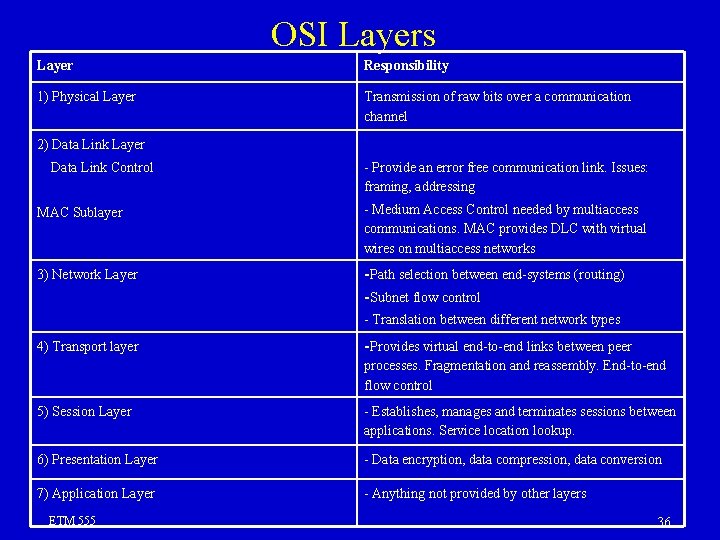
OSI Layers Layer Responsibility 1) Physical Layer Transmission of raw bits over a communication channel 2) Data Link Layer Data Link Control - Provide an error free communication link. Issues: framing, addressing MAC Sublayer - Medium Access Control needed by multiaccess communications. MAC provides DLC with virtual wires on multiaccess networks 3) Network Layer -Path selection between end-systems (routing) -Subnet flow control - Translation between different network types 4) Transport layer -Provides virtual end-to-end links between peer processes. Fragmentation and reassembly. End-to-end flow control 5) Session Layer - Establishes, manages and terminates sessions between applications. Service location lookup. 6) Presentation Layer - Data encryption, data compression, data conversion 7) Application Layer - Anything not provided by other layers ETM 555 36
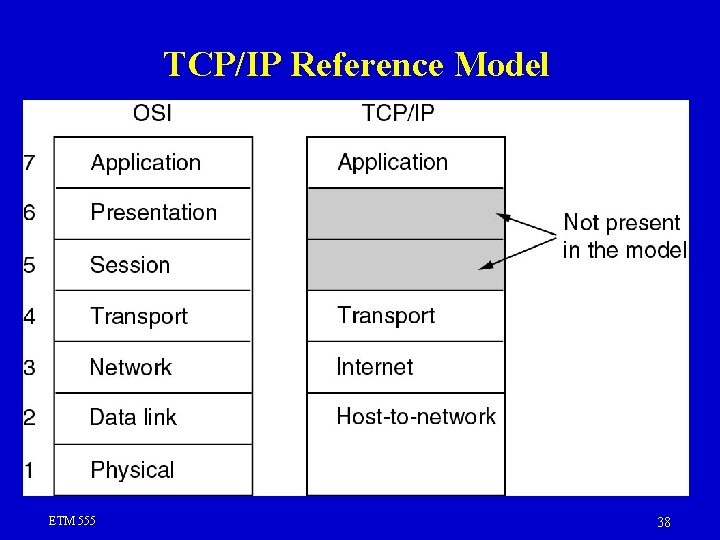
TCP/IP Reference Model • First used in ARPANET (Advanced Research Projects Agency) sponsored by US Department of Defense • • • Now used in worldwide Internet • Internetwork Layer (Internet) : Packet switching network based on a connectionless internetwork layer. Goal: ability to connect multiple networks in a transparent way Requirements: Connections should remain intact as long as source and destination machines are functioning even if some of the intermediate machines, links are out of operation ETM 555 37
TCP/IP Reference Model ETM 555 38
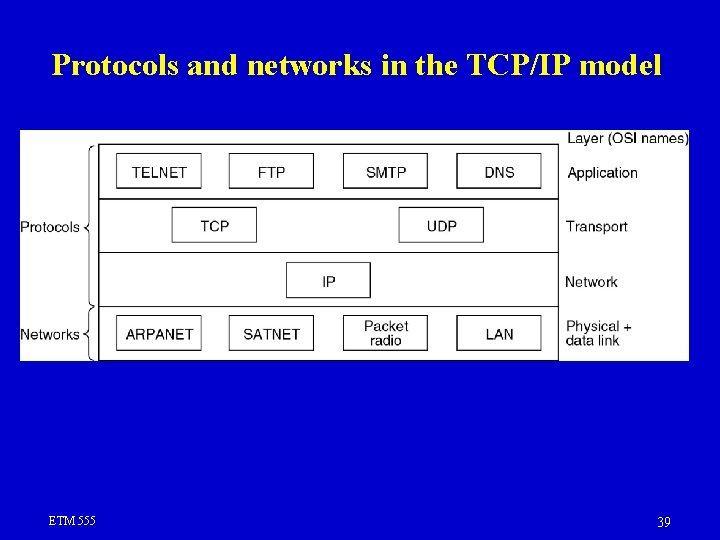
Protocols and networks in the TCP/IP model ETM 555 39
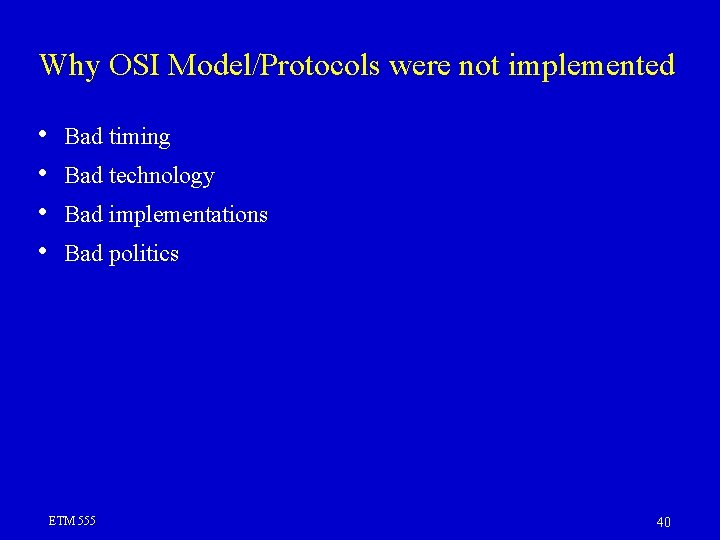
Why OSI Model/Protocols were not implemented • • Bad timing Bad technology Bad implementations Bad politics ETM 555 40