Modeling styles 1 As a set of interconnected
- Slides: 9
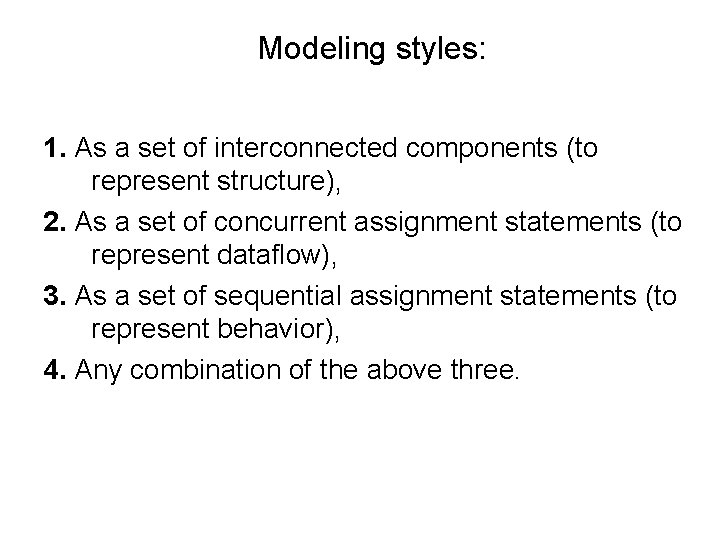
Modeling styles: 1. As a set of interconnected components (to represent structure), 2. As a set of concurrent assignment statements (to represent dataflow), 3. As a set of sequential assignment statements (to represent behavior), 4. Any combination of the above three.
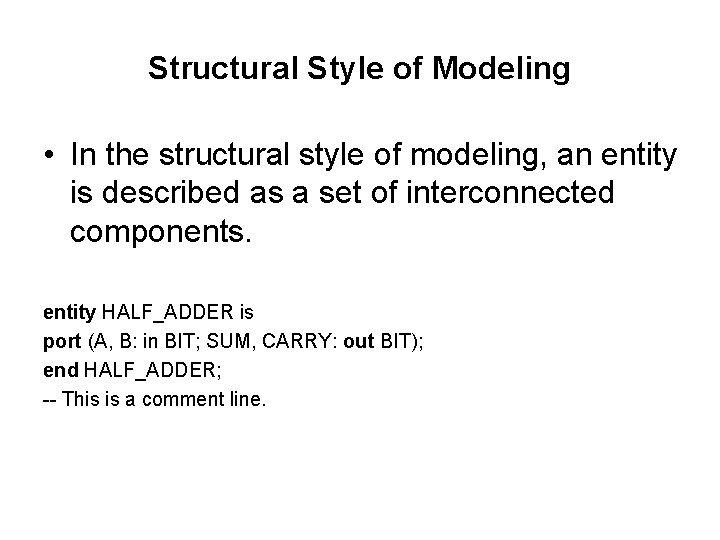
Structural Style of Modeling • In the structural style of modeling, an entity is described as a set of interconnected components. entity HALF_ADDER is port (A, B: in BIT; SUM, CARRY: out BIT); end HALF_ADDER; -- This is a comment line.
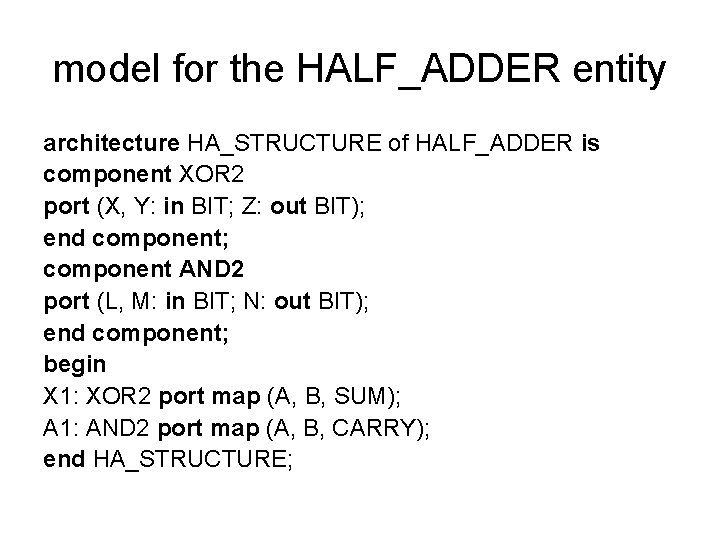
model for the HALF_ADDER entity architecture HA_STRUCTURE of HALF_ADDER is component XOR 2 port (X, Y: in BIT; Z: out BIT); end component; component AND 2 port (L, M: in BIT; N: out BIT); end component; begin X 1: XOR 2 port map (A, B, SUM); A 1: AND 2 port map (A, B, CARRY); end HA_STRUCTURE;
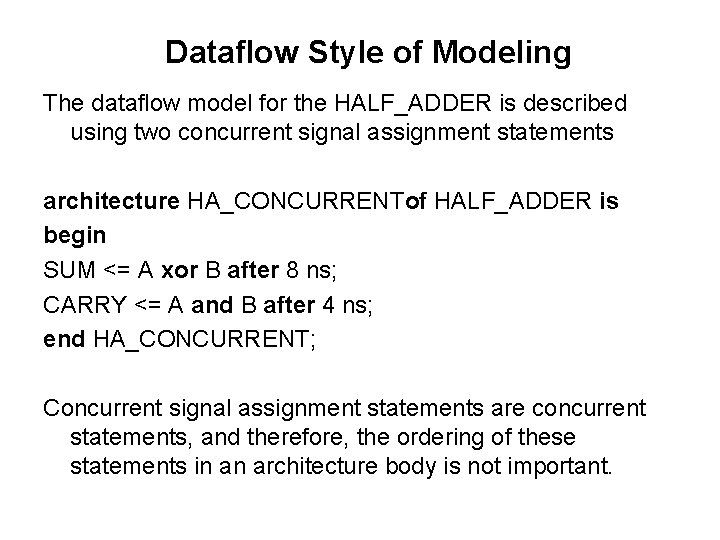
Dataflow Style of Modeling The dataflow model for the HALF_ADDER is described using two concurrent signal assignment statements architecture HA_CONCURRENTof HALF_ADDER is begin SUM <= A xor B after 8 ns; CARRY <= A and B after 4 ns; end HA_CONCURRENT; Concurrent signal assignment statements are concurrent statements, and therefore, the ordering of these statements in an architecture body is not important.
Behavioral Style of Modeling • The behavioral style of modeling specifies the behavior of an entity as a set of statements that are executed sequentially in the specified order. • This set of sequential statements, that are specified inside a process statement, do not explicitly specify the structure of the entity but merely specifies its functionality. • A process statement is a concurrent statement that can appear within an architecture
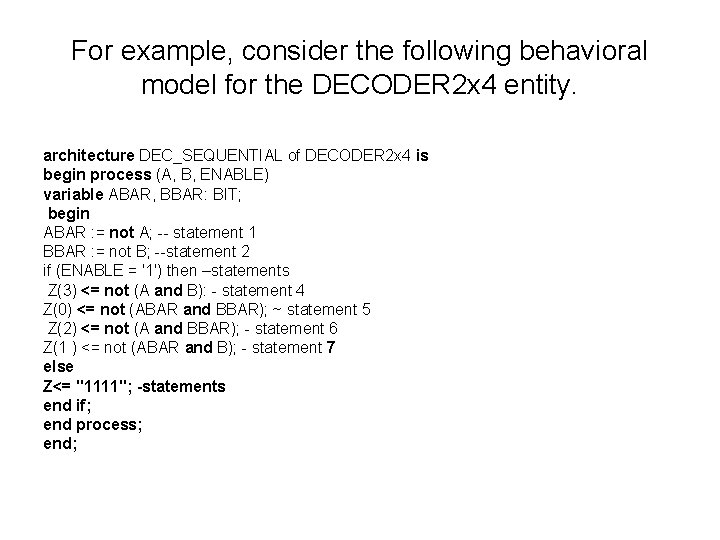
For example, consider the following behavioral model for the DECODER 2 x 4 entity. architecture DEC_SEQUENTIAL of DECODER 2 x 4 is begin process (A, B, ENABLE) variable ABAR, BBAR: BIT; begin ABAR : = not A; -- statement 1 BBAR : = not B; --statement 2 if (ENABLE = '1') then –statements Z(3) <= not (A and B): - statement 4 Z(0) <= not (ABAR and BBAR); ~ statement 5 Z(2) <= not (A and BBAR); - statement 6 Z(1 ) <= not (ABAR and B); - statement 7 else Z<= "1111"; -statements end if; end process; end;
• A process statement, too, has a declarative part (between the keywords process and begin), and a statement part (between the keywords begin and end process). • The statements appearing within the statement part are sequential statements and are executed sequentially. • The list of signals specified within the parenthesis after the keyword process constitutes a sensitivity list and the process statement is invoked whenever there is an event on any signal in this list. • In the previous example, when an event occurs on signals A, B, or ENABLE, the statements appearing within the process statement are executed sequentially.
Mixed Style of Modeling • It is possible to mix the three modeling styles that we have seen so far in a single architecture body. • That is, within an architecture body, we could use component instantiation statements (that represent structure), concurrent signal assignment statements (that represent dataflow), and process statements (that represent behavior).
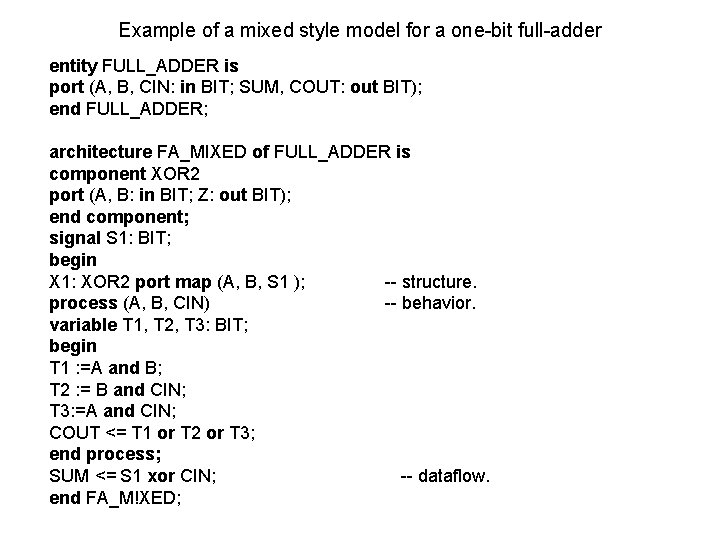
Example of a mixed style model for a one-bit full-adder entity FULL_ADDER is port (A, B, CIN: in BIT; SUM, COUT: out BIT); end FULL_ADDER; architecture FA_MIXED of FULL_ADDER is component XOR 2 port (A, B: in BIT; Z: out BIT); end component; signal S 1: BIT; begin X 1: XOR 2 port map (A, B, S 1 ); -- structure. process (A, B, CIN) -- behavior. variable T 1, T 2, T 3: BIT; begin T 1 : =A and B; T 2 : = B and CIN; T 3: =A and CIN; COUT <= T 1 or T 2 or T 3; end process; SUM <= S 1 xor CIN; -- dataflow. end FA_M!XED;