Negotiation Analytics 30 C 02000 Jyrki Wallenius Lecture

- Slides: 51
Negotiation Analytics 30 C 02000 Jyrki Wallenius Lecture 3: Two-Party Distributive (Win-Lose) Negotiations Original lecture slides: Pirkko Lahdelma
Today’s objectives • To familiarize with the basic concepts of two-party distributive win-lose negotiations: reservation prices, ZOPA (zone of possible agreement), negotiation dance • To understand what kinds of factors complicate the distributive negotiations • To learn how to deal with different negotiation tactics in distributive negotiations
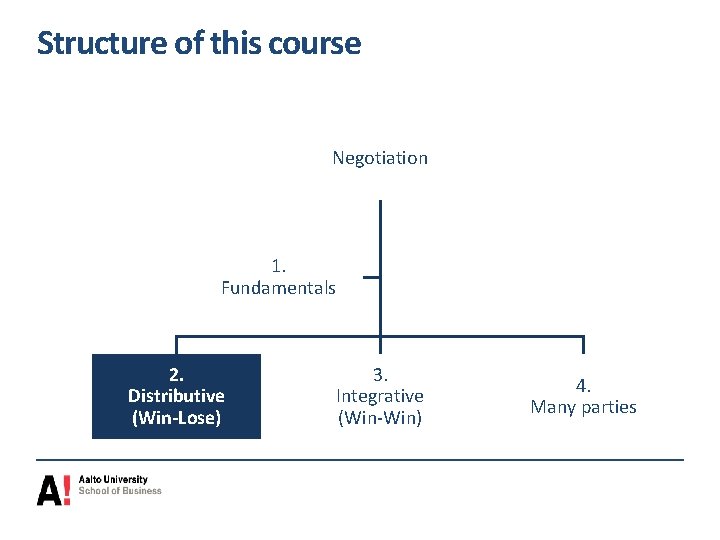
Structure of this course Negotiation 1. Fundamentals 2. Distributive (Win-Lose) 3. Integrative (Win-Win) 4. Many parties
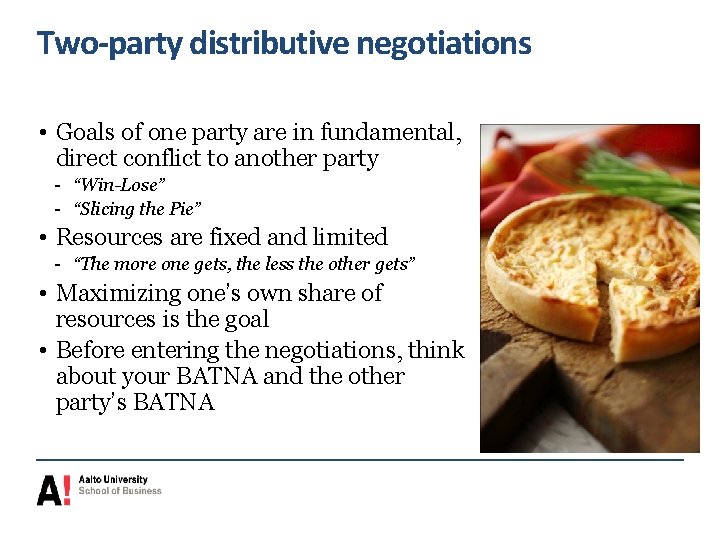
Two-party distributive negotiations • Goals of one party are in fundamental, direct conflict to another party - “Win-Lose” - “Slicing the Pie” • Resources are fixed and limited - “The more one gets, the less the other gets” • Maximizing one’s own share of resources is the goal • Before entering the negotiations, think about your BATNA and the other party’s BATNA
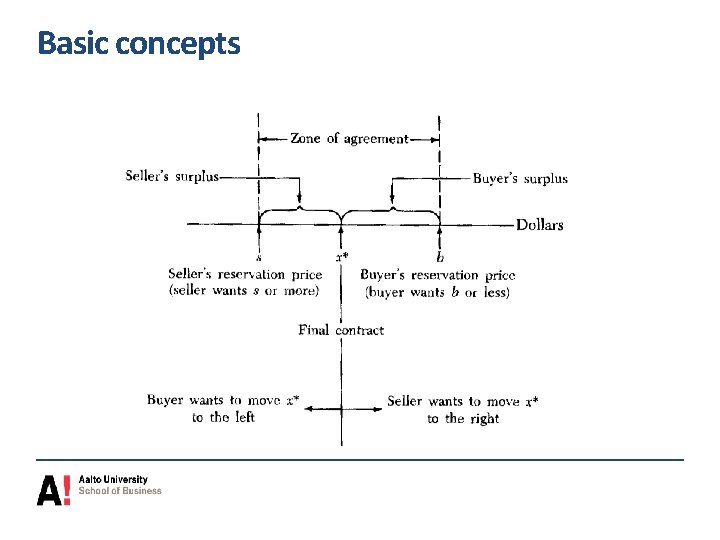
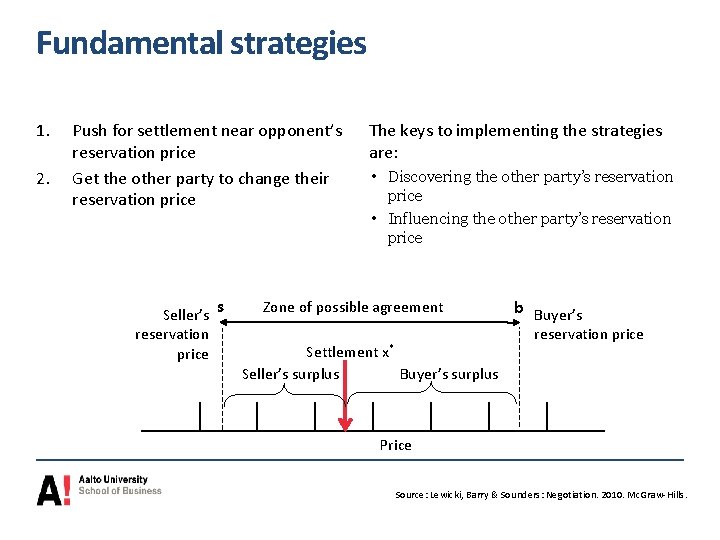
Basic concepts • Final contract value: x* (expressed in terms of one or multiple issues) • Reservation price - Buyer’s reservation price (b): the very maximum (s)he will pay - Seller’s reservation price (s): the very minimum (s)he will sell for • ZOPA – the zone of possible agreement (interval from s to b, b-s > 0, or no ZOPA) • Buyer’s and seller’s surpluses - If x* < b, the difference between buyer’s reservation price and the final contract value (b - x*) is the buyer’s surplus - If x* > s, the difference between the final contract value and seller’s reservation price (x* - s) is the seller’s surplus
Basic concepts
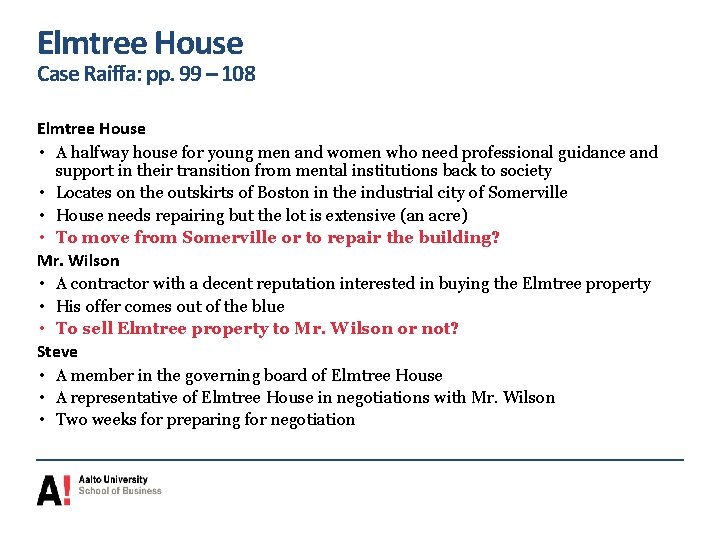
Elmtree House Case Raiffa: pp. 99 – 108 Elmtree House • A halfway house for young men and women who need professional guidance and support in their transition from mental institutions back to society • Locates on the outskirts of Boston in the industrial city of Somerville • House needs repairing but the lot is extensive (an acre) • To move from Somerville or to repair the building? Mr. Wilson • A contractor with a decent reputation interested in buying the Elmtree property • His offer comes out of the blue • To sell Elmtree property to Mr. Wilson or not? Steve • A member in the governing board of Elmtree House • A representative of Elmtree House in negotiations with Mr. Wilson • Two weeks for preparing for negotiation
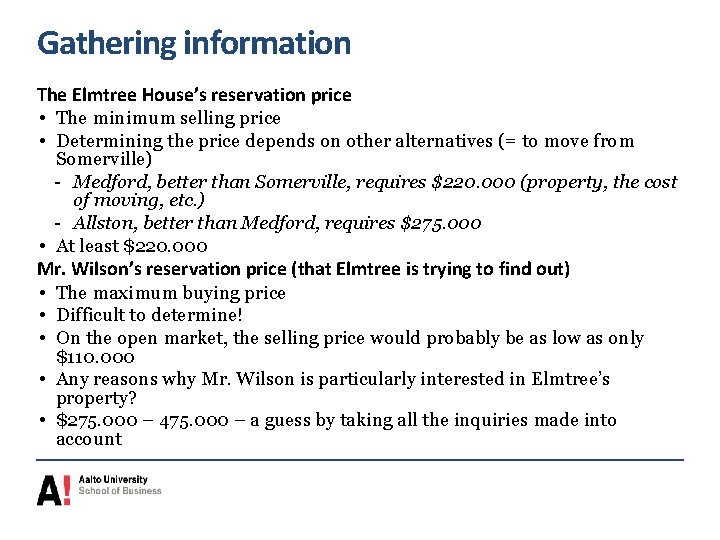
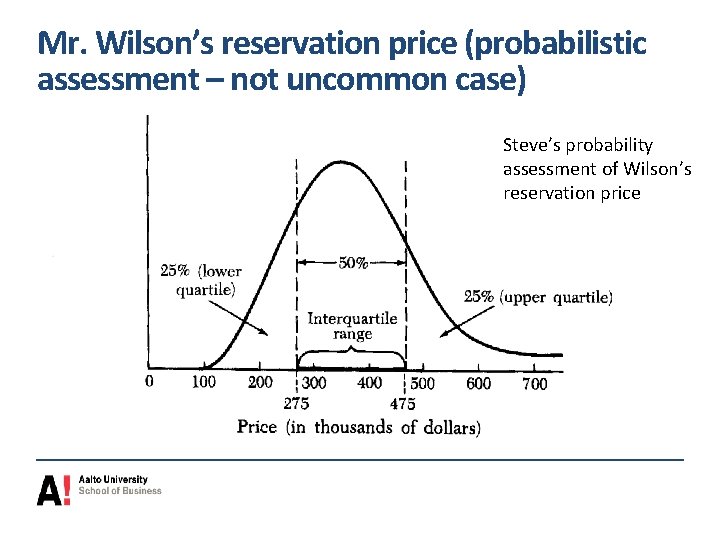
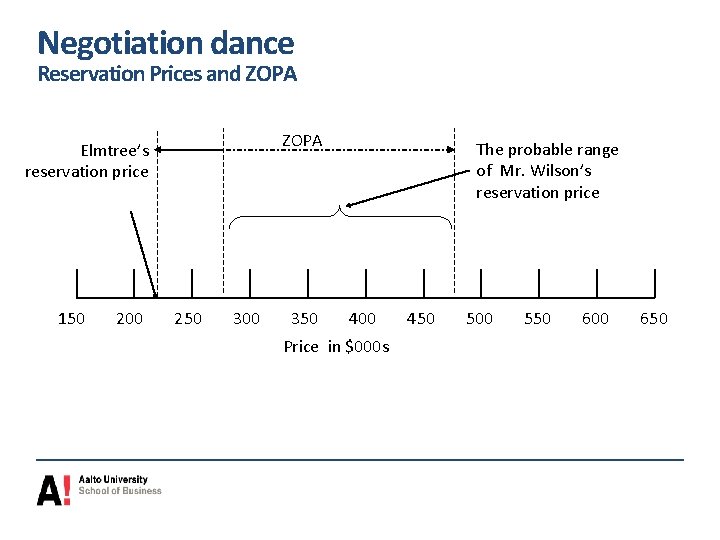
Gathering information The Elmtree House’s reservation price • The minimum selling price • Determining the price depends on other alternatives (= to move from Somerville) - Medford, better than Somerville, requires $220. 000 (property, the cost of moving, etc. ) - Allston, better than Medford, requires $275. 000 • At least $220. 000 Mr. Wilson’s reservation price (that Elmtree is trying to find out) • The maximum buying price • Difficult to determine! • On the open market, the selling price would probably be as low as only $110. 000 • Any reasons why Mr. Wilson is particularly interested in Elmtree’s property? • $275. 000 – 475. 000 – a guess by taking all the inquiries made into account
Mr. Wilson’s reservation price (probabilistic assessment – not uncommon case) Steve’s probability assessment of Wilson’s reservation price
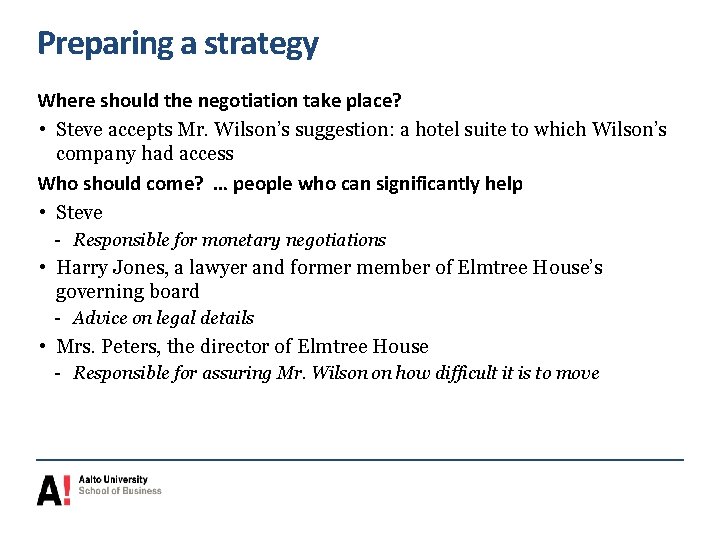
Preparing a strategy Where should the negotiation take place? • Steve accepts Mr. Wilson’s suggestion: a hotel suite to which Wilson’s company had access Who should come? … people who can significantly help • Steve - Responsible for monetary negotiations • Harry Jones, a lawyer and former member of Elmtree House’s governing board - Advice on legal details • Mrs. Peters, the director of Elmtree House - Responsible for assuring Mr. Wilson on how difficult it is to move
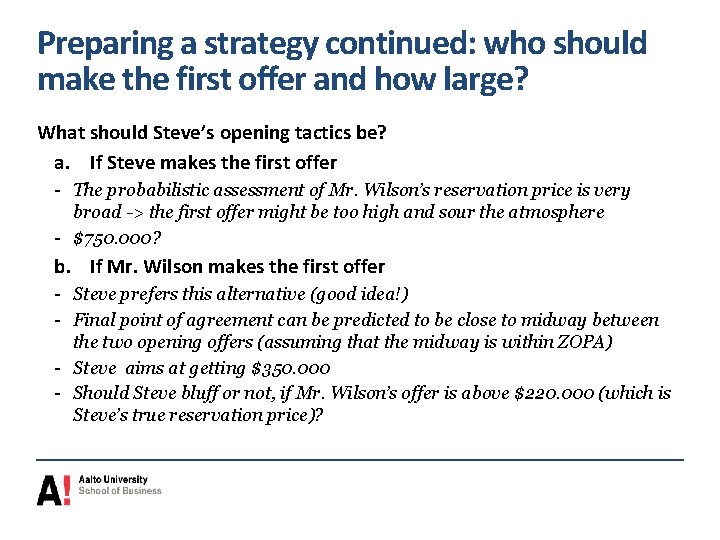
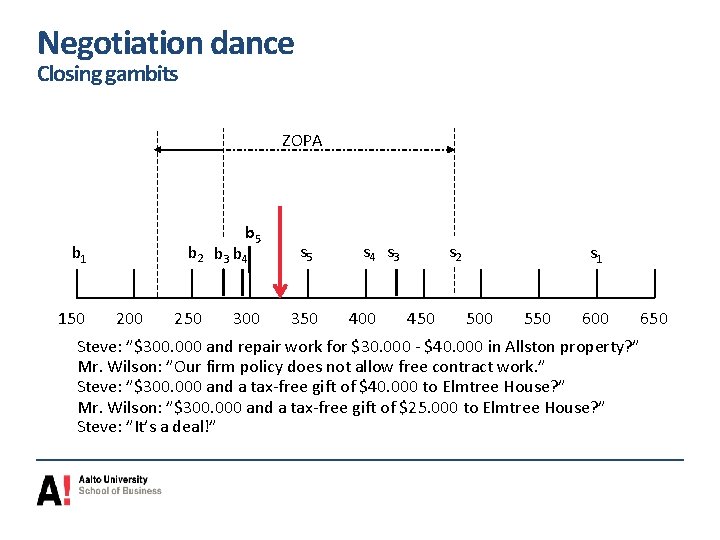
Preparing a strategy continued: who should make the first offer and how large? What should Steve’s opening tactics be? a. If Steve makes the first offer - The probabilistic assessment of Mr. Wilson’s reservation price is very broad -> the first offer might be too high and sour the atmosphere - $750. 000? b. If Mr. Wilson makes the first offer - Steve prefers this alternative (good idea!) - Final point of agreement can be predicted to be close to midway between the two opening offers (assuming that the midway is within ZOPA) - Steve aims at getting $350. 000 - Should Steve bluff or not, if Mr. Wilson’s offer is above $220. 000 (which is Steve’s true reservation price)?
Negotiation dance Reservation Prices and ZOPA Elmtree’s reservation price 150 200 250 300 350 The probable range of Mr. Wilson’s reservation price 400 Price in $000 s 450 500 550 600 650
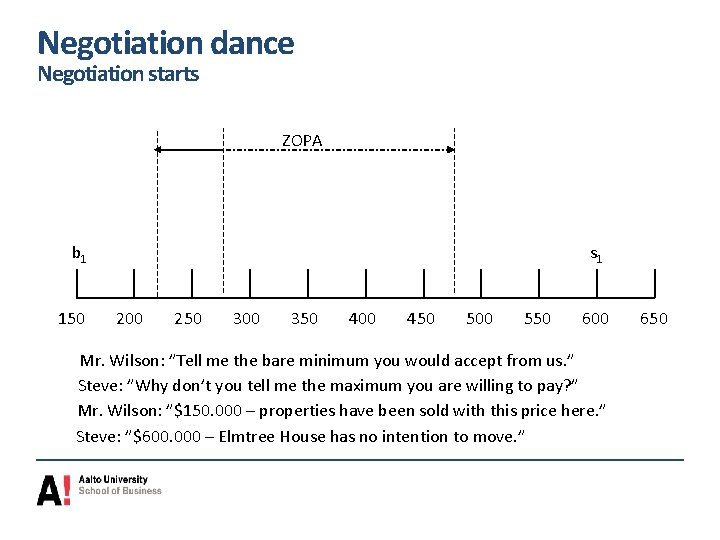
Negotiation dance Negotiation starts ZOPA b 1 150 s 1 200 250 300 350 400 450 500 550 600 Mr. Wilson: ”Tell me the bare minimum you would accept from us. ” Steve: ”Why don’t you tell me the maximum you are willing to pay? ” Mr. Wilson: ”$150. 000 – properties have been sold with this price here. ” Steve: ”$600. 000 – Elmtree House has no intention to move. ” 650
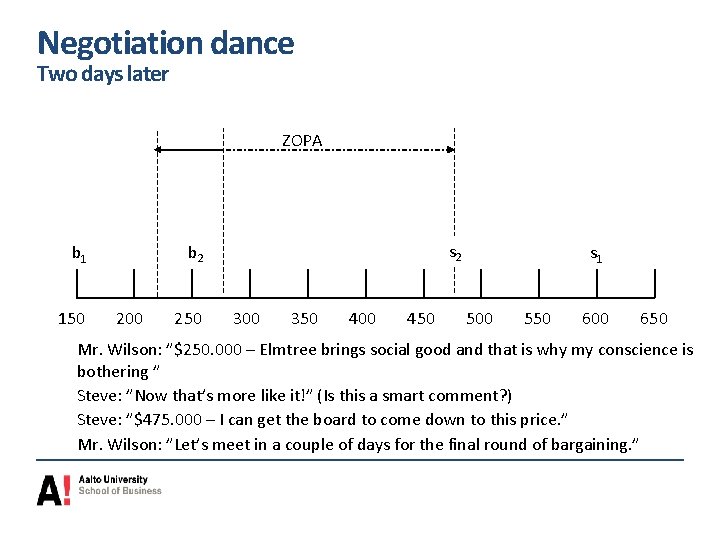
Negotiation dance Two days later ZOPA 150 s 2 b 1 200 250 300 350 400 450 s 1 500 550 600 650 Mr. Wilson: ”$250. 000 – Elmtree brings social good and that is why my conscience is bothering ” Steve: ”Now that’s more like it!” (Is this a smart comment? ) Steve: ”$475. 000 – I can get the board to come down to this price. ” Mr. Wilson: ”Let’s meet in a couple of days for the final round of bargaining. ”
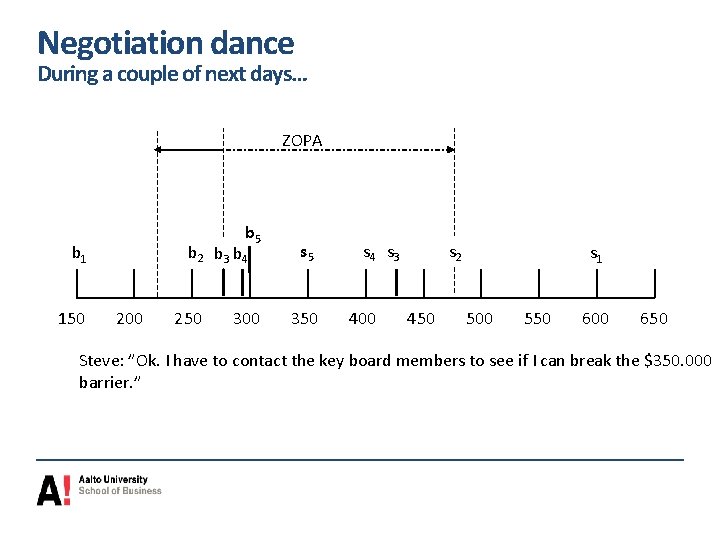
Negotiation dance During a couple of next days… ZOPA b 5 b 2 b 3 b 4 b 1 150 200 250 300 s 5 350 s 4 s 3 400 s 2 450 s 1 500 550 600 650 Steve: ”Ok. I have to contact the key board members to see if I can break the $350. 000 barrier. ”
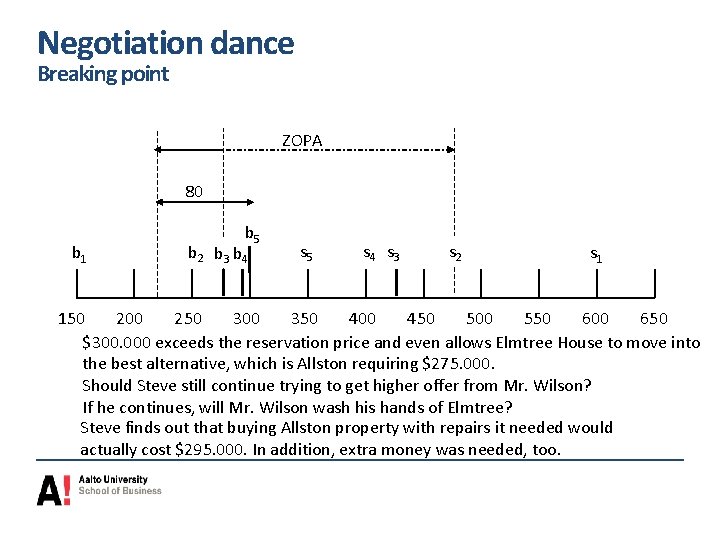
Negotiation dance Breaking point ZOPA 80 b 1 b 5 b 2 b 3 b 4 s 5 s 4 s 3 s 2 s 1 150 200 250 300 350 400 450 500 550 600 650 $300. 000 exceeds the reservation price and even allows Elmtree House to move into the best alternative, which is Allston requiring $275. 000. Should Steve still continue trying to get higher offer from Mr. Wilson? If he continues, will Mr. Wilson wash his hands of Elmtree? Steve finds out that buying Allston property with repairs it needed would actually cost $295. 000. In addition, extra money was needed, too.
Negotiation dance Closing gambits ZOPA b 5 b 2 b 3 b 4 b 1 150 200 250 300 s 5 350 s 4 s 3 400 s 2 450 s 1 500 550 600 Steve: ”$300. 000 and repair work for $30. 000 - $40. 000 in Allston property? ” Mr. Wilson: ”Our firm policy does not allow free contract work. ” Steve: ”$300. 000 and a tax-free gift of $40. 000 to Elmtree House? ” Mr. Wilson: ”$300. 000 and a tax-free gift of $25. 000 to Elmtree House? ” Steve: ”It’s a deal!” 650
Fundamental strategies 1. 2. Push for settlement near opponent’s reservation price Get the other party to change their reservation price Seller’s reservation price s The keys to implementing the strategies are: • Discovering the other party’s reservation price • Influencing the other party’s reservation price Zone of possible agreement Settlement x* Buyer’s surplus Seller’s surplus b Buyer’s reservation price Price Source: Lewicki, Barry & Sounders: Negotiation. 2010. Mc. Graw-Hills.
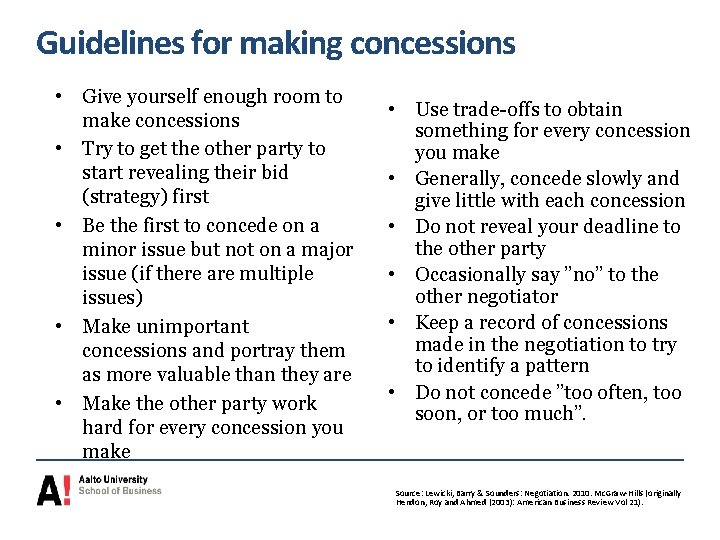
Guidelines for making concessions • Give yourself enough room to make concessions • Try to get the other party to start revealing their bid (strategy) first • Be the first to concede on a minor issue but not on a major issue (if there are multiple issues) • Make unimportant concessions and portray them as more valuable than they are • Make the other party work hard for every concession you make • Use trade-offs to obtain something for every concession you make • Generally, concede slowly and give little with each concession • Do not reveal your deadline to the other party • Occasionally say ”no” to the other negotiator • Keep a record of concessions made in the negotiation to try to identify a pattern • Do not concede ”too often, too soon, or too much”. Source: Lewicki, Barry & Sounders: Negotiation. 2010. Mc. Graw-Hills (originally Hendon, Roy and Ahmed (2003): American Business Review Vol 21).
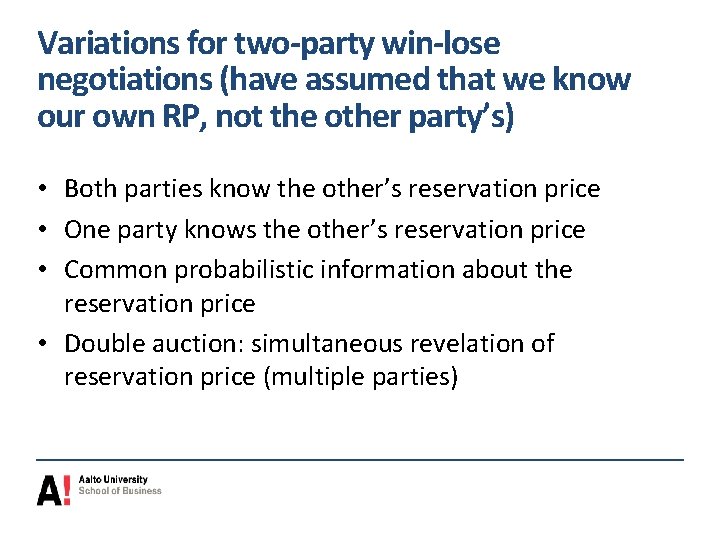
Variations for two-party win-lose negotiations (have assumed that we know our own RP, not the other party’s) • Both parties know the other’s reservation price • One party knows the other’s reservation price • Common probabilistic information about the reservation price • Double auction: simultaneous revelation of reservation price (multiple parties)
Both parties know the other’s reservation price • If b < s, there is no ZOPA, and therefore, no agreement • If b > s, a potential share of (b – s) is to be shared • How to share it? - Natural: The value in the middle of ZOPA? - Could you argue for a larger share? - An example of a rich man and a poor man sharing $200 (different tax brackets) (Raiffa: page 116)
One party knows the other’s reservation price • Let’s assume that the buyer knows the reservation price of the seller (s) but the seller does not know the reservation price of the buyer (b) • If the negotiations start, the seller knows that b > s, i. e. there is a ZOPA, but it is unclear how much bigger b is - The buyer can and will use the knowledge of s to her advantage - The seller can update knowledge of b from the buyer’s bids - The buyer usually acts as the reservation price (b) is lower than it actually is - The final contract: depends on how skillful they are - The seller cannot usually figure out the actual reservation price (of the buyer) even afterwards
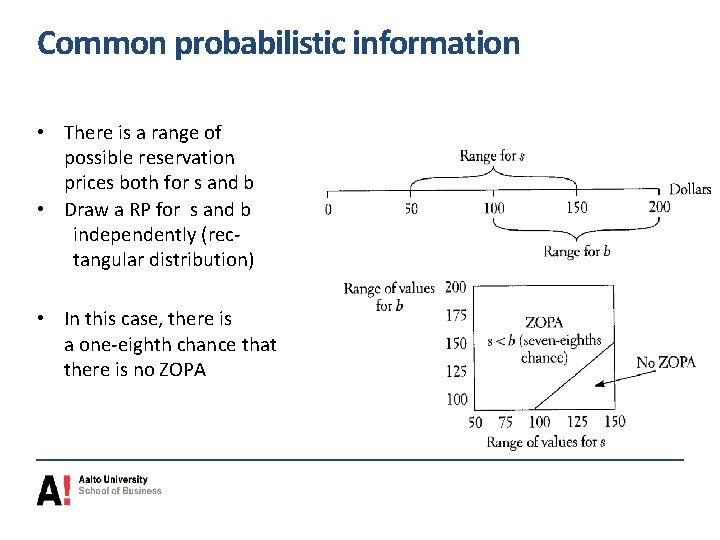
Common probabilistic information • There is a range of possible reservation prices both for s and b • Draw a RP for s and b independently (rectangular distribution) • In this case, there is a one-eighth chance that there is no ZOPA
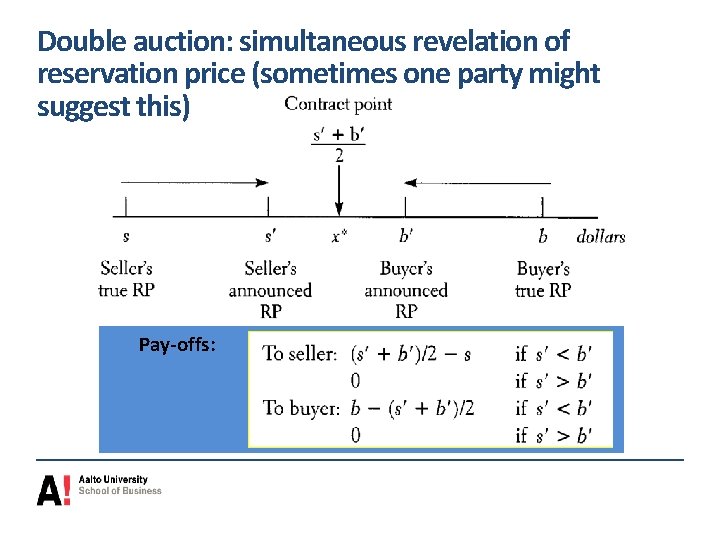
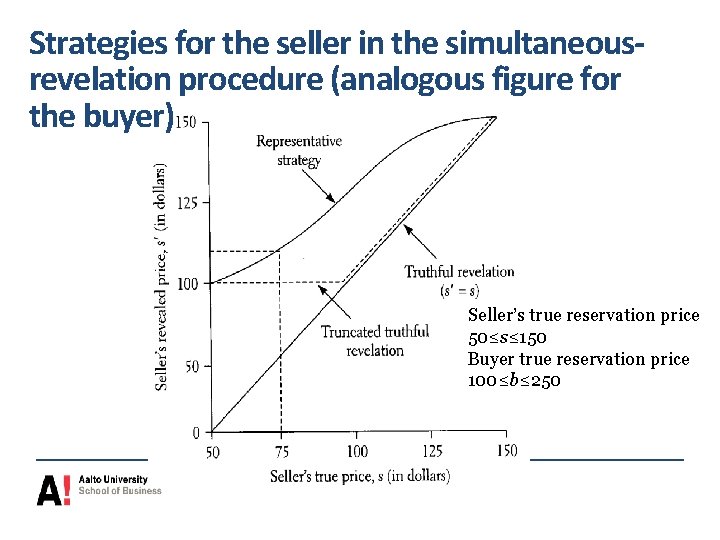
Double auction: simultaneous revelation of reservation price (sometimes one party might suggest this) Pay-offs:
Strategies for the seller in the simultaneousrevelation procedure (analogous figure for the buyer) Seller’s true reservation price 50≤s≤ 150 Buyer true reservation price 100≤b≤ 250
Equilibrium strategy – Non-Equilibrium strategy • Both “lie” (or exaggerate their RPs) – but not “too” much (otherwise we have no ZOPA) • Truth vs. lie is not an equilibrium strategy (if the other party knows that we are telling the truth, they should lie; however, if we know that they are lying, we should too)
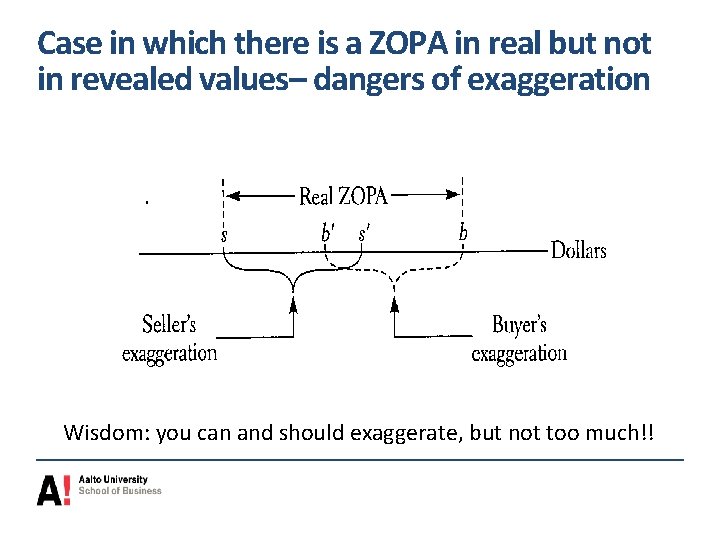
Case in which there is a ZOPA in real but not in revealed values– dangers of exaggeration Wisdom: you can and should exaggerate, but not too much!!
Introducing complexities • Uncertainty • Time – Sequential search – The strike game – The escalation game
Uncertainty • By breaking a problem into separate parts, the decision maker can tap the experience and deeper knowledge that various experts have on parts of the problem - Use of a decision-tree • Speak the language of probability - What does “a pretty good chance” mean? • 20 – 30% or 60 – 80%? - Words are too imprecise • However, the expected monetary value is not always the best decision-making criterion - Utility incorporates attitudes towards risk
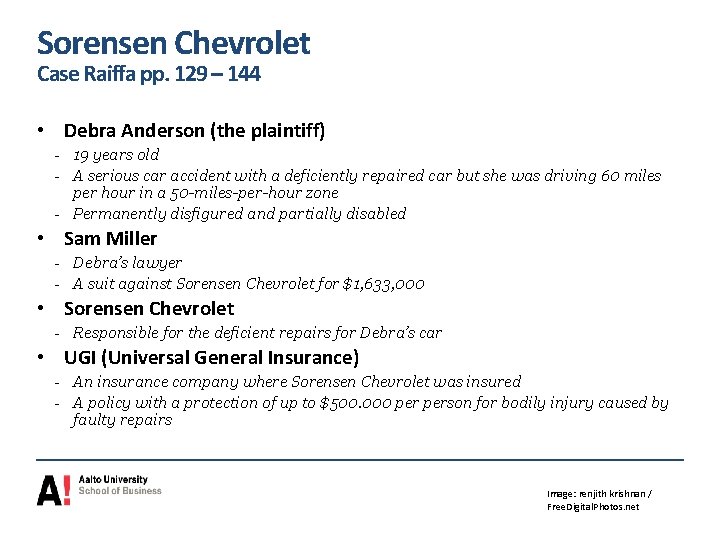
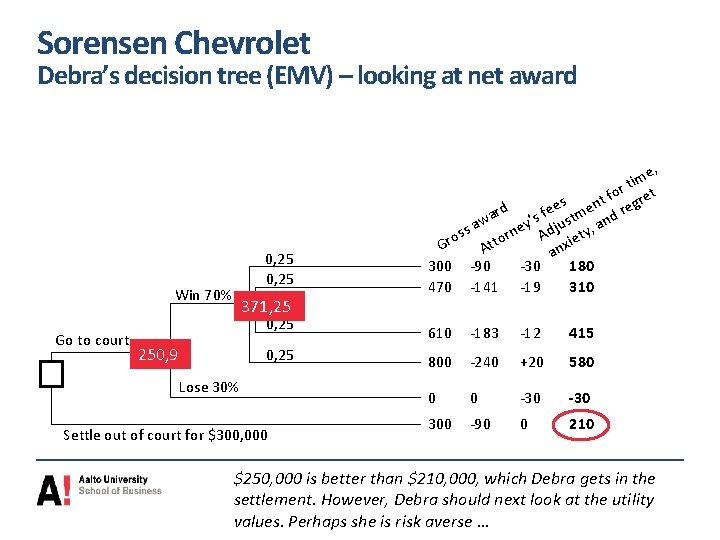
Sorensen Chevrolet Case Raiffa pp. 129 – 144 • Debra Anderson (the plaintiff) - 19 years old - A serious car accident with a deficiently repaired car but she was driving 60 miles per hour in a 50 -miles-per-hour zone - Permanently disfigured and partially disabled • Sam Miller - Debra’s lawyer - A suit against Sorensen Chevrolet for $1, 633, 000 • Sorensen Chevrolet - Responsible for the deficient repairs for Debra’s car • UGI (Universal General Insurance) - An insurance company where Sorensen Chevrolet was insured - A policy with a protection of up to $500. 000 person for bodily injury caused by faulty repairs Image: renjith krishnan / Free. Digital. Photos. net
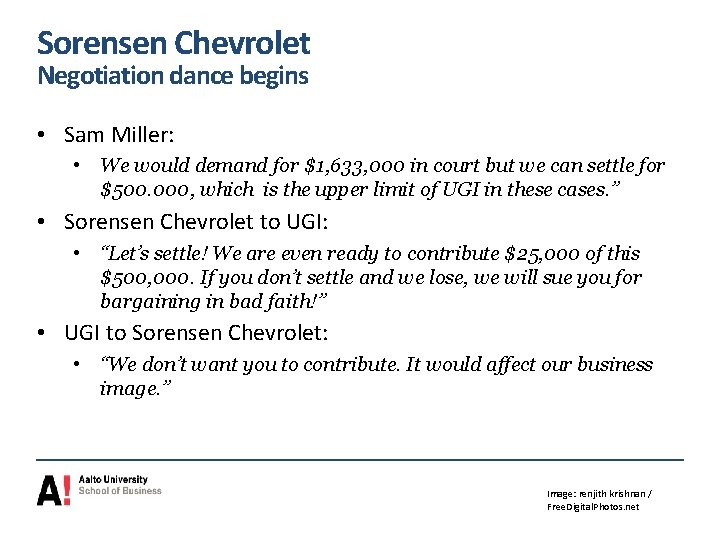
Sorensen Chevrolet Negotiation dance begins • Sam Miller: • We would demand for $1, 633, 000 in court but we can settle for $500. 000, which is the upper limit of UGI in these cases. ” • Sorensen Chevrolet to UGI: • “Let’s settle! We are even ready to contribute $25, 000 of this $500, 000. If you don’t settle and we lose, we will sue you for bargaining in bad faith!” • UGI to Sorensen Chevrolet: • “We don’t want you to contribute. It would affect our business image. ” Image: renjith krishnan / Free. Digital. Photos. net
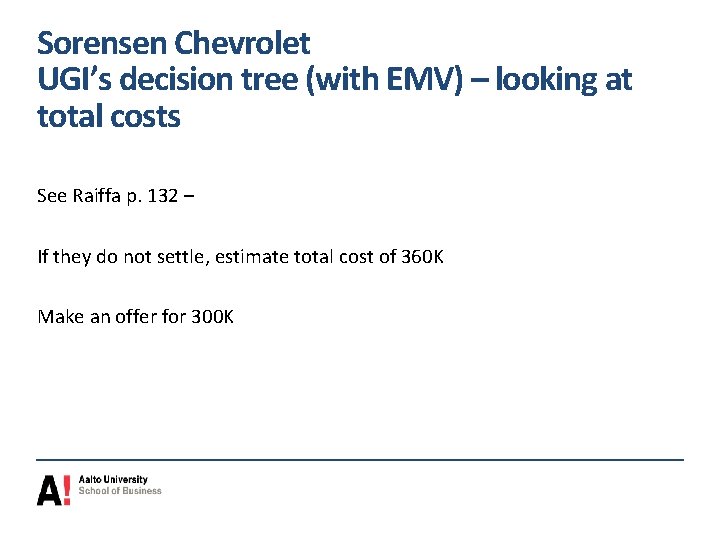
Sorensen Chevrolet UGI’s decision tree (with EMV) – looking at total costs See Raiffa p. 132 – If they do not settle, estimate total cost of 360 K Make an offer for 300 K
Sorensen Chevrolet Debra’s decision tree (EMV) – looking at net award 0, 25 Win 70% Go to court 371, 25 0, 25 250, 9 0, 25 Lose 30% Settle out of court for $300, 000 e, m i rt t o f s ent egre e d e f m nd r ar t s ’ s w ey dju ty, a sa n s r A ie o o x Gr Att an 300 -90 -30 180 470 -141 -19 310 610 -183 -12 415 800 -240 +20 580 0 0 -30 300 -90 0 210 $250, 000 is better than $210, 000, which Debra gets in the settlement. However, Debra should next look at the utility values. Perhaps she is risk averse …
Introducing complexities Time • • Timing of concessions Sequential search The management-union strike game The escalation game
Timing of concessions • Real negotiators don’t only have to decide what to do (bid) – they often have to choose when • Should I make an offer now, or wait? Should I accept their offer, reject it or make a counter offer, or wait? • Does the passage of time put me in a better position, or worse? • Richard Zeckhauser’s studies with American and Israeli subjects - Big cultural differences, Americans were more impatient • Many times, it is as important what you don’t say as what you say
Should I deal with my counterpart, or wait for someone else to come along? Sequential search – Which offer/candidate to accept? Problem: Select the smartest candidate • 100 candidates are presented to you in a randomized sequential order • If the candidate is passed by, you can’t return to that candidate Solution: ? ? ? Good news: • There is 38 % probability to find the smartest candidate by using Raiffa’s strategy: let 38 candidates go by and make note of the best candidate. Then continue the search. As soon as you find a better candidate (than the best among the first 38=), stop. • See Raiffa for proof (page 163)
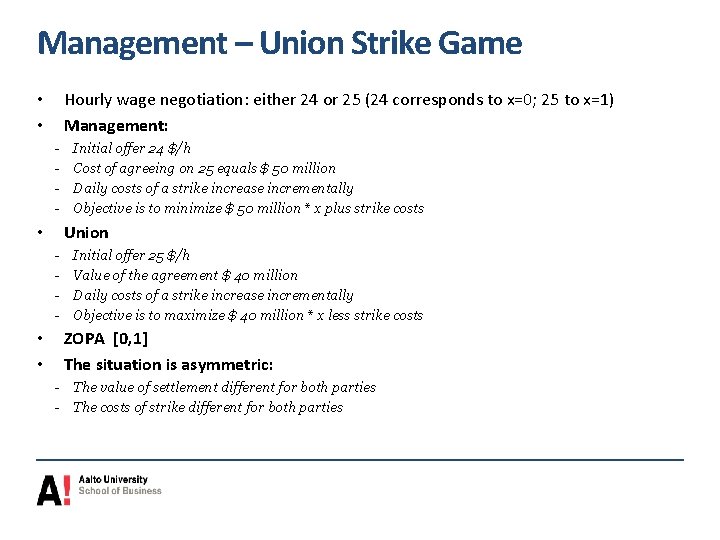
Management – Union Strike Game Hourly wage negotiation: either 24 or 25 (24 corresponds to x=0; 25 to x=1) Management: • • - Union • - • • Initial offer 24 $/h Cost of agreeing on 25 equals $ 50 million Daily costs of a strike increase incrementally Objective is to minimize $ 50 million * x plus strike costs Initial offer 25 $/h Value of the agreement $ 40 million Daily costs of a strike increase incrementally Objective is to maximize $ 40 million * x less strike costs ZOPA [0, 1] The situation is asymmetric: - The value of settlement different for both parties - The costs of strike different for both parties
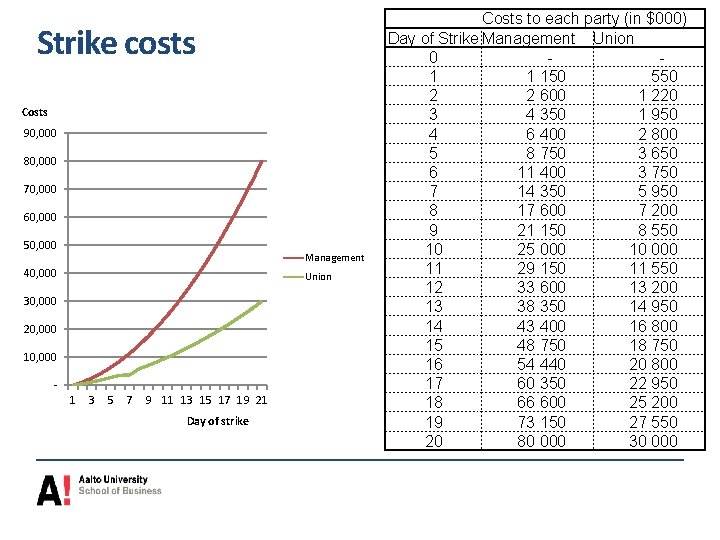
Strike costs Costs 90, 000 80, 000 70, 000 60, 000 50, 000 Management 40, 000 Union 30, 000 20, 000 1 3 5 7 9 11 13 15 17 19 21 Day of strike Costs to each party (in $000) Day of Strike Management Union 0 - 1 1 150 550 2 2 600 1 220 3 4 350 1 950 4 6 400 2 800 5 8 750 3 650 6 11 400 3 750 7 14 350 5 950 8 17 600 7 200 9 21 150 8 550 10 25 000 10 000 11 29 150 11 550 12 33 600 13 200 13 38 350 14 950 14 43 400 16 800 15 48 750 18 750 16 54 440 20 800 17 60 350 22 950 18 66 600 25 200 19 73 150 27 550 20 80 000 30 000
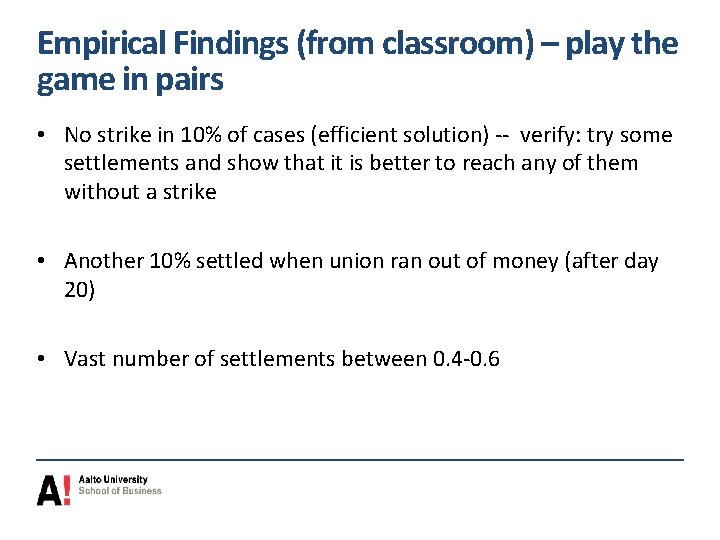
Empirical Findings (from classroom) – play the game in pairs • No strike in 10% of cases (efficient solution) -- verify: try some settlements and show that it is better to reach any of them without a strike • Another 10% settled when union ran out of money (after day 20) • Vast number of settlements between 0. 4 -0. 6
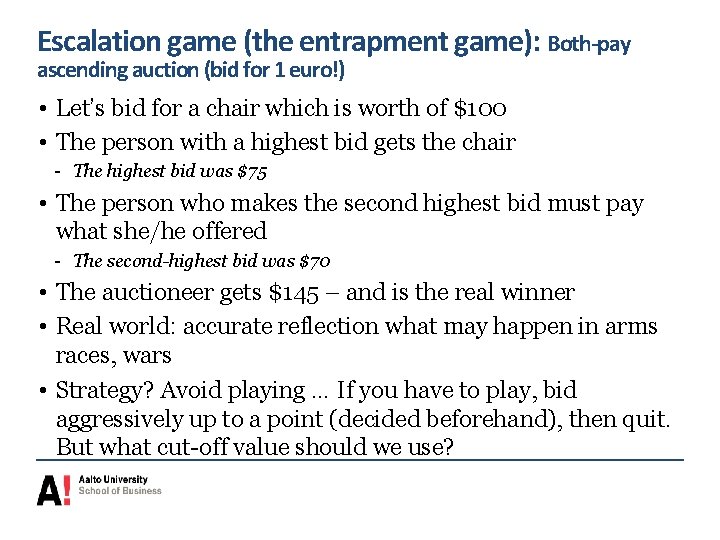
Escalation game (the entrapment game): Both-pay ascending auction (bid for 1 euro!) • Let’s bid for a chair which is worth of $100 • The person with a highest bid gets the chair - The highest bid was $75 • The person who makes the second highest bid must pay what she/he offered - The second-highest bid was $70 • The auctioneer gets $145 – and is the real winner • Real world: accurate reflection what may happen in arms races, wars • Strategy? Avoid playing … If you have to play, bid aggressively up to a point (decided beforehand), then quit. But what cut-off value should we use?
Hardball tactics in negotiations
Hardball tactics • Designed to pressure negotiators to do things they would not otherwise do • Not clear exactly how often or how well these tactics work, but they work best against poorly prepared negotiators • Many people find hardball tactics offensive and are motivated for revenge when such tactics are used against them • These tactics do more harm than good in negotiations • Each tactic involves risk for the person using it, including harm to reputation, lost deals, negative publicity, and consequences of the other party's revenge • It is important that negotiators understand hardball tactics and how they work, so they can recognize and understand them if hardball tactics are used against them
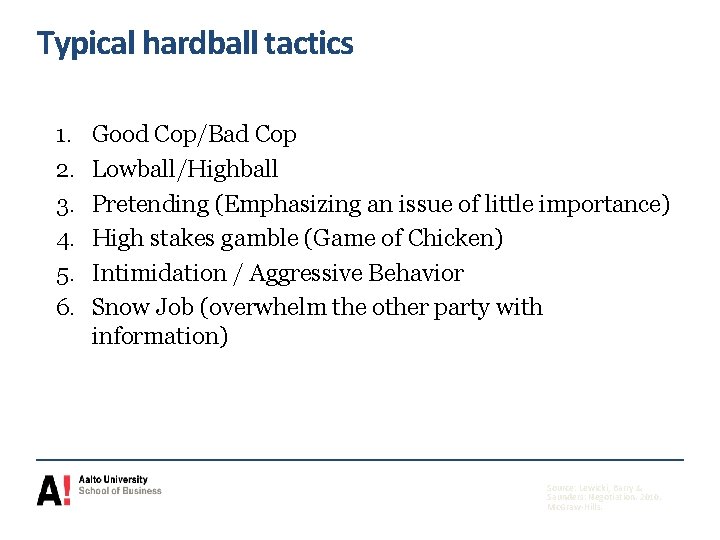
Typical hardball tactics 1. 2. 3. 4. 5. 6. Good Cop/Bad Cop Lowball/Highball Pretending (Emphasizing an issue of little importance) High stakes gamble (Game of Chicken) Intimidation / Aggressive Behavior Snow Job (overwhelm the other party with information) Source: Lewicki, Barry & Saunders: Negotiation. 2010. Mc. Graw-Hills.
1. Good Cop / Bad Cop Police interrogation technique • One person rough, intimidating • One helpful • Bad cop goes to cool off (make a phone call) and good cop negotiates a confession • Easy to identify, but it often works • Easy to call-out – simply state that you know what they are up to • Difficult for negotiators to act out. Takes a lot of energy that might be used to reaching the goals Source: Lewicki, Barry & Saunders: Negotiation. 2010. Mc. Graw-Hills.
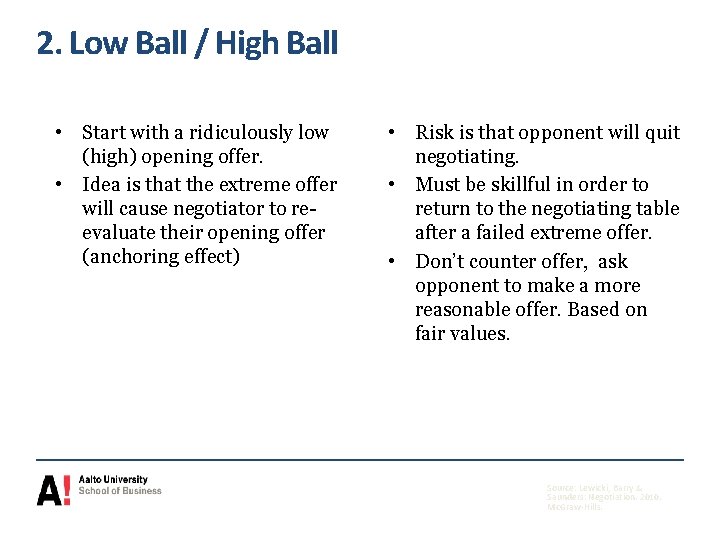
2. Low Ball / High Ball • Start with a ridiculously low (high) opening offer. • Idea is that the extreme offer will cause negotiator to reevaluate their opening offer (anchoring effect) • Risk is that opponent will quit negotiating. • Must be skillful in order to return to the negotiating table after a failed extreme offer. • Don’t counter offer, ask opponent to make a more reasonable offer. Based on fair values. Source: Lewicki, Barry & Saunders: Negotiation. 2010. Mc. Graw-Hills.
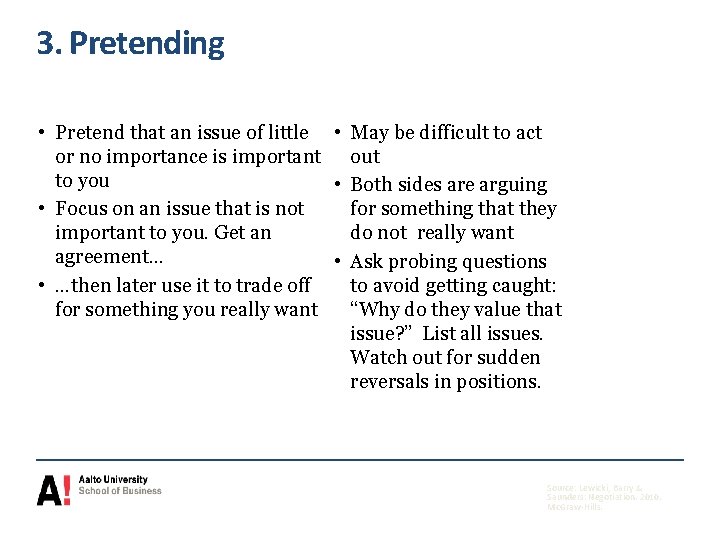
3. Pretending • Pretend that an issue of little • May be difficult to act or no importance is important out to you • Both sides are arguing • Focus on an issue that is not for something that they important to you. Get an do not really want agreement… • Ask probing questions • …then later use it to trade off to avoid getting caught: for something you really want “Why do they value that issue? ” List all issues. Watch out for sudden reversals in positions. Source: Lewicki, Barry & Saunders: Negotiation. 2010. Mc. Graw-Hills.
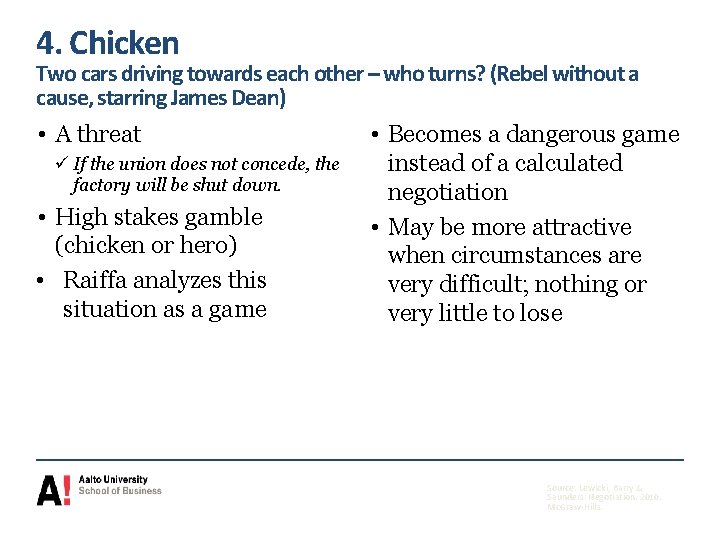
4. Chicken Two cars driving towards each other – who turns? (Rebel without a cause, starring James Dean) • A threat ü If the union does not concede, the factory will be shut down. • High stakes gamble (chicken or hero) • Raiffa analyzes this situation as a game • Becomes a dangerous game instead of a calculated negotiation • May be more attractive when circumstances are very difficult; nothing or very little to lose Source: Lewicki, Barry & Saunders: Negotiation. 2010. Mc. Graw-Hills.
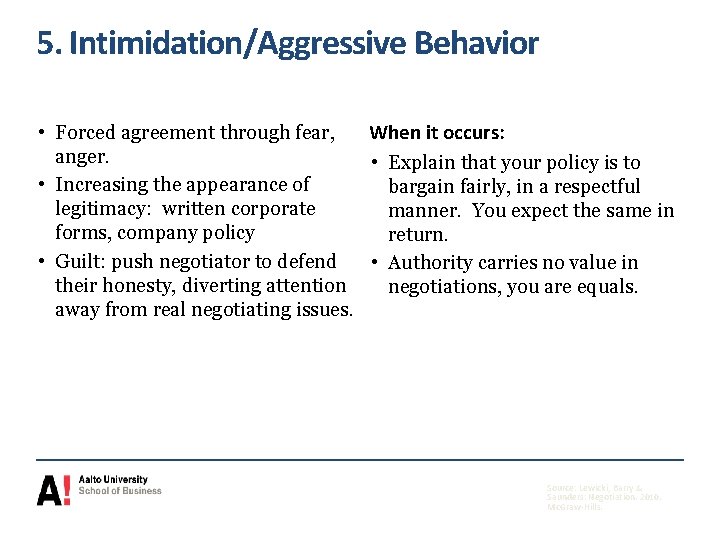
5. Intimidation/Aggressive Behavior • Forced agreement through fear, When it occurs: anger. • Explain that your policy is to • Increasing the appearance of bargain fairly, in a respectful legitimacy: written corporate manner. You expect the same in forms, company policy return. • Guilt: push negotiator to defend • Authority carries no value in their honesty, diverting attention negotiations, you are equals. away from real negotiating issues. Source: Lewicki, Barry & Saunders: Negotiation. 2010. Mc. Graw-Hills.
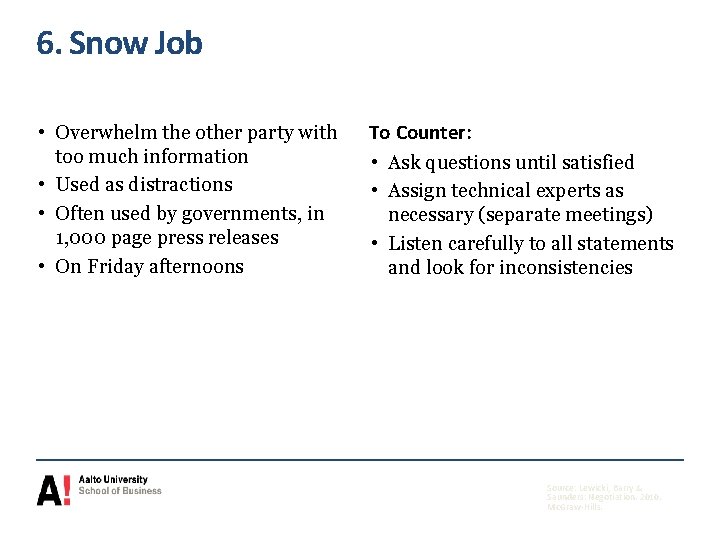
6. Snow Job • Overwhelm the other party with too much information • Used as distractions • Often used by governments, in 1, 000 page press releases • On Friday afternoons To Counter: • Ask questions until satisfied • Assign technical experts as necessary (separate meetings) • Listen carefully to all statements and look for inconsistencies Source: Lewicki, Barry & Saunders: Negotiation. 2010. Mc. Graw-Hills.
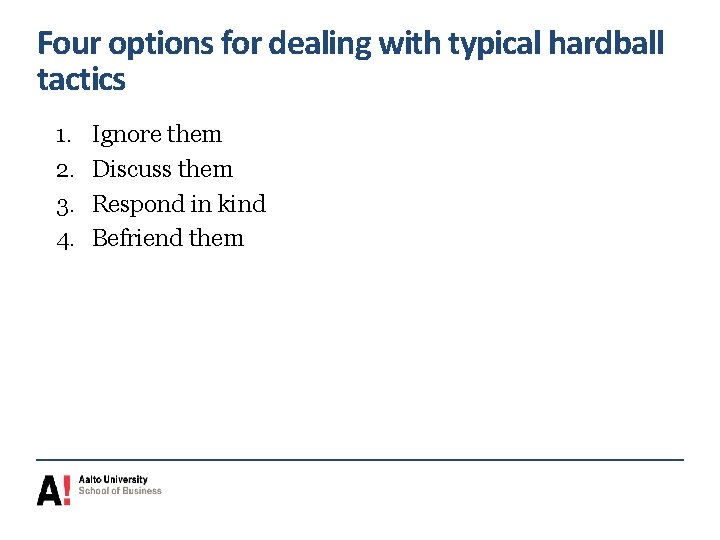
Four options for dealing with typical hardball tactics 1. 2. 3. 4. Ignore them Discuss them Respond in kind Befriend them
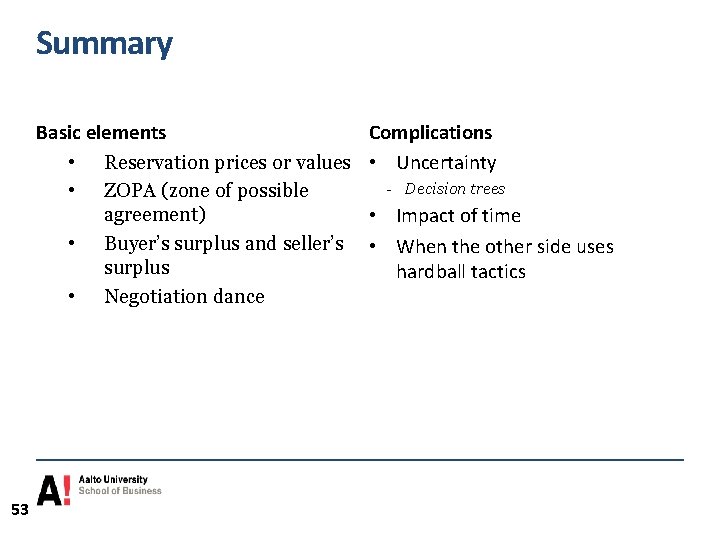
Summary Basic elements • Reservation prices or values • ZOPA (zone of possible agreement) • Buyer’s surplus and seller’s surplus • Negotiation dance 53 Complications • Uncertainty - Decision trees • Impact of time • When the other side uses hardball tactics