
discourse and dialogue 12 padziernik 2006 bruckenkurs text
discourse and dialogue 12 październik 2006 bruckenkurs – text structure and dialogue
What is a unit of communication? Theories M: hi. d 4 oftodiscourse d 6. meaning depend in part on a J: uh–huh. of the basic units of a dicouse and the relations specification (week passes) that can hold among them. Discourse processing requires an ability to determine to which portions of a discourse an J: a 3 to a 7. individual utterance relates. Thus the role of discourse M: hmmm. structure in discourse processing derives both from its role in (2 weeks pass) delimiting units of discourse meaning and. . . M: Queen beats the laufer at e 1. Check. . 12 październik 2006 bruckenkurs – text structure and dialogue
What is a discourse? “Assume that “Consider, for you example, have collected the difference an arbitrary between setpassages of well-formed (18. 71) and independently and (18. 72). interpretable Assume thatutterances, you have collected for instance, an arbitrary setrandomly by of well-formed selecting and one independently sentencefrom interpretable eachof ofthe utterances, previousfor instance, of chapters bythis randomly book. Do selecting you have oneasentence discourse? from Almost eachcertainly of the not. ~. previous not The reason chapters reason is is of that this these book. utterances, Almost utterances, certainly when juxtaposed, not. juxtaposed, Do you have a discourse? will not exhibit. The coherence. reason is. Consider, that theseforutterances, example, the when difference juxtaposed, between passages will not (18. 71) exhibit (18. 71)coherence. ” and(18. 72). ” (Jurafsky and Martin: 695) vs…. 12 październik 2006 bruckenkurs – text structure and dialogue
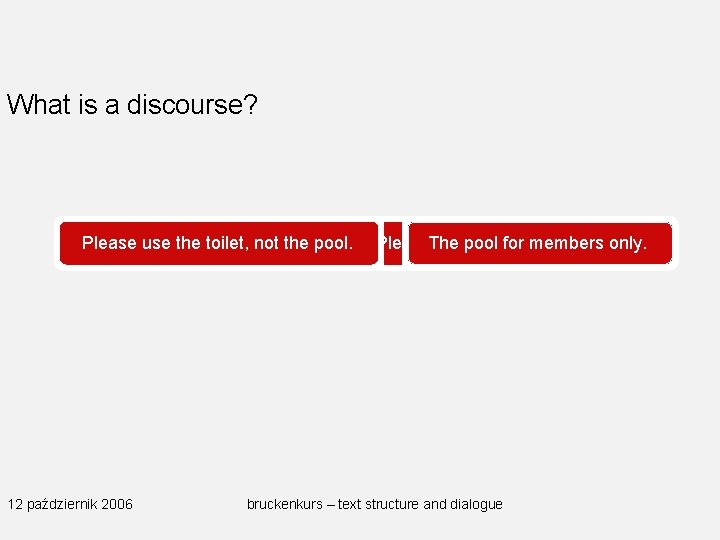
What is a discourse? The pooluse forthe members only. Please toilet, not the pool. 12 październik 2006 Please. The usepool the toilet, for members not the pool. only. bruckenkurs – text structure and dialogue
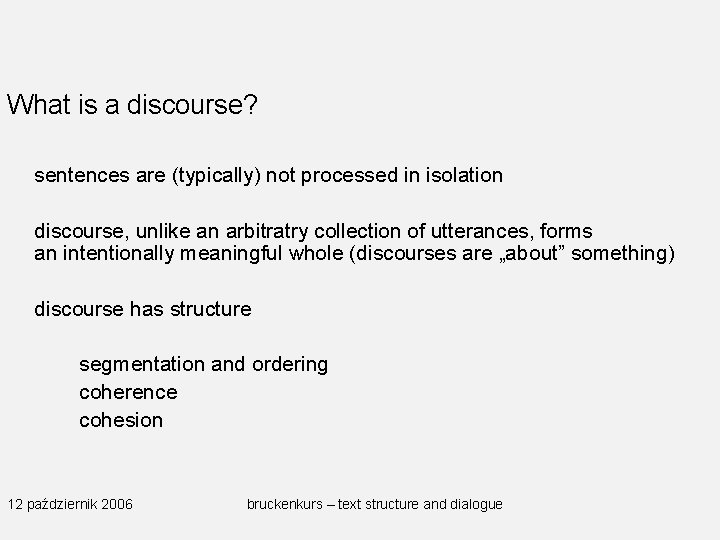
What is a discourse? sentences are (typically) not processed in isolation discourse, unlike an arbitratry collection of utterances, forms an intentionally meaningful whole (discourses are „about” something) discourse has structure segmentation and ordering coherence cohesion 12 październik 2006 bruckenkurs – text structure and dialogue
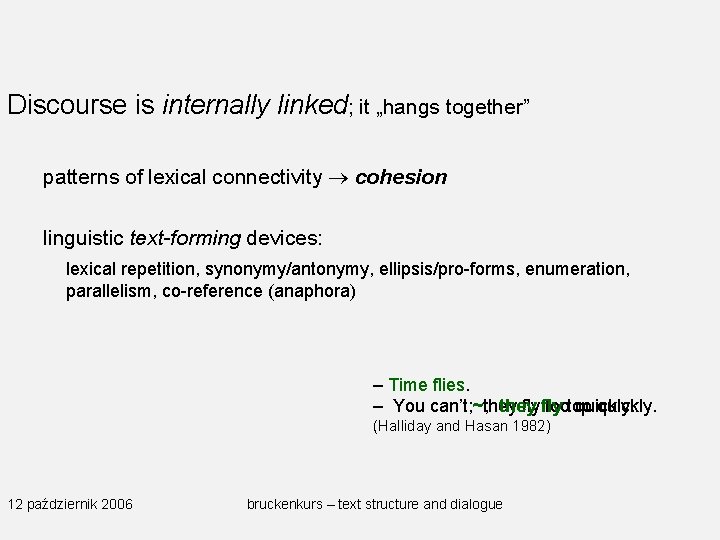
Discourse is internally linked; it „hangs together” patterns of lexical connectivity cohesion linguistic text-forming devices: lexical repetition, synonymy/antonymy, ellipsis/pro-forms, enumeration, parallelism, co-reference (anaphora) – Time flies. – You can’t; ~; they fly tootoo quickly. (Halliday and Hasan 1982) 12 październik 2006 bruckenkurs – text structure and dialogue
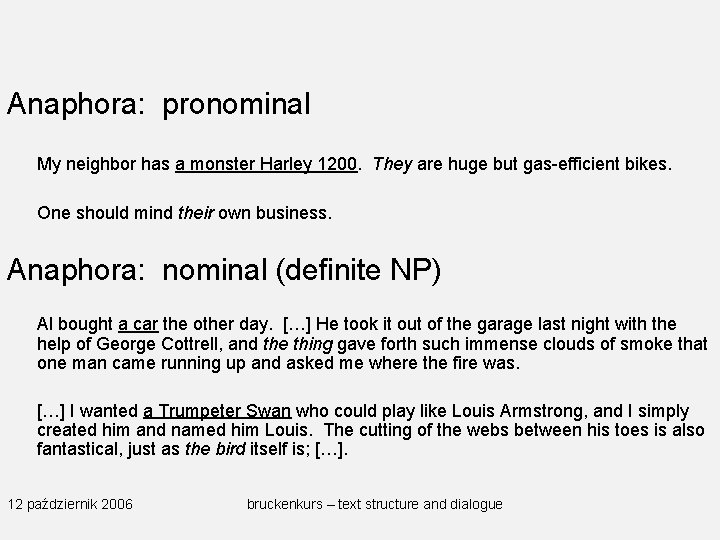
Anaphora: pronominal My neighbor has a monster Harley 1200. They are huge but gas-efficient bikes. One should mind their own business. Anaphora: nominal (definite NP) Al bought a car the other day. […] He took it out of the garage last night with the help of George Cottrell, and the thing gave forth such immense clouds of smoke that one man came running up and asked me where the fire was. […] I wanted a Trumpeter Swan who could play like Louis Armstrong, and I simply created him and named him Louis. The cutting of the webs between his toes is also fantastical, just as the bird itself is; […]. 12 październik 2006 bruckenkurs – text structure and dialogue
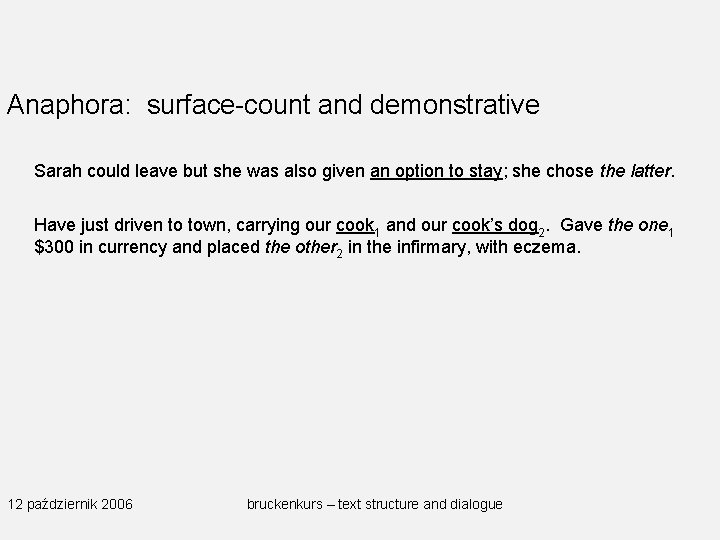
Anaphora: surface-count and demonstrative Sarah could leave but she was also given an option to stay; she chose the latter. Have just driven to town, carrying our cook 1 and our cook’s dog 2. Gave the one 1 $300 in currency and placed the other 2 in the infirmary, with eczema. 12 październik 2006 bruckenkurs – text structure and dialogue
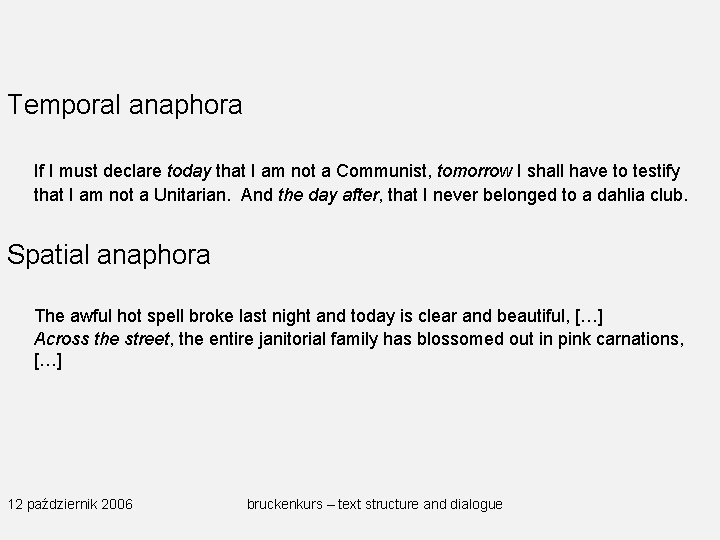
Temporal anaphora If I must declare today that I am not a Communist, tomorrow I shall have to testify that I am not a Unitarian. And the day after, that I never belonged to a dahlia club. Spatial anaphora The awful hot spell broke last night and today is clear and beautiful, […] Across the street, the entire janitorial family has blossomed out in pink carnations, […] 12 październik 2006 bruckenkurs – text structure and dialogue
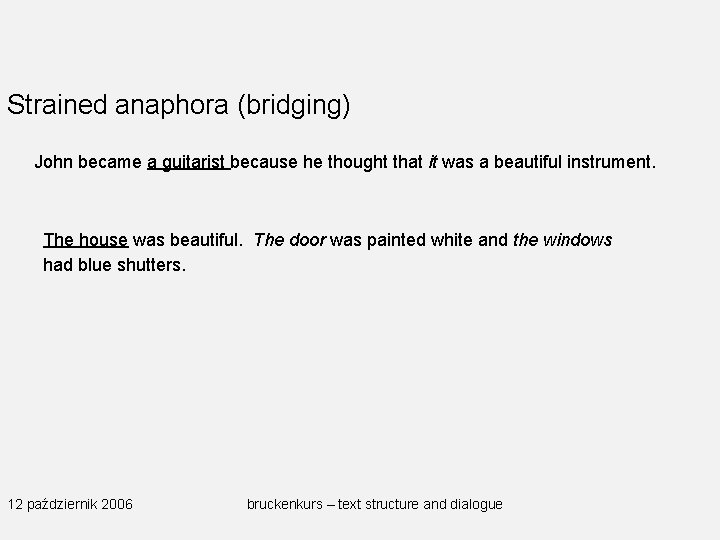
Strained anaphora (bridging) John became a guitarist because he thought that it was a beautiful instrument. The house was beautiful. The door was painted white and the windows had blue shutters. 12 październik 2006 bruckenkurs – text structure and dialogue
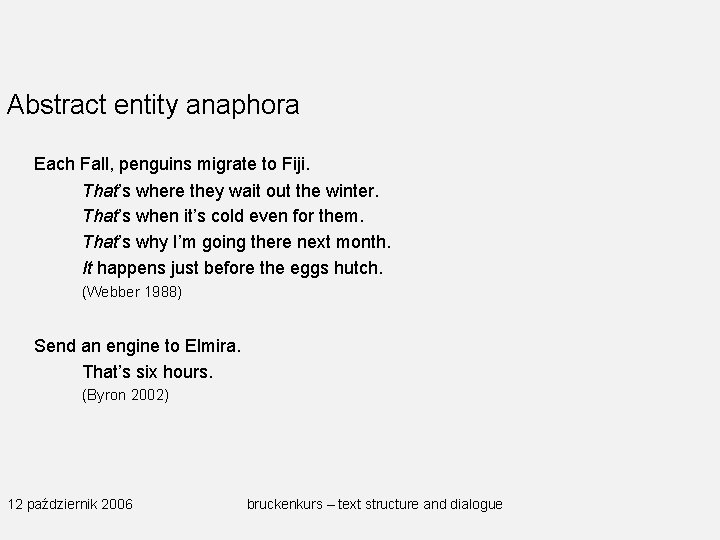
Abstract entity anaphora Each Fall, penguins migrate to Fiji. That’s where they wait out the winter. That’s when it’s cold even for them. That’s why I’m going there next month. It happens just before the eggs hutch. (Webber 1988) Send an engine to Elmira. That’s six hours. (Byron 2002) 12 październik 2006 bruckenkurs – text structure and dialogue
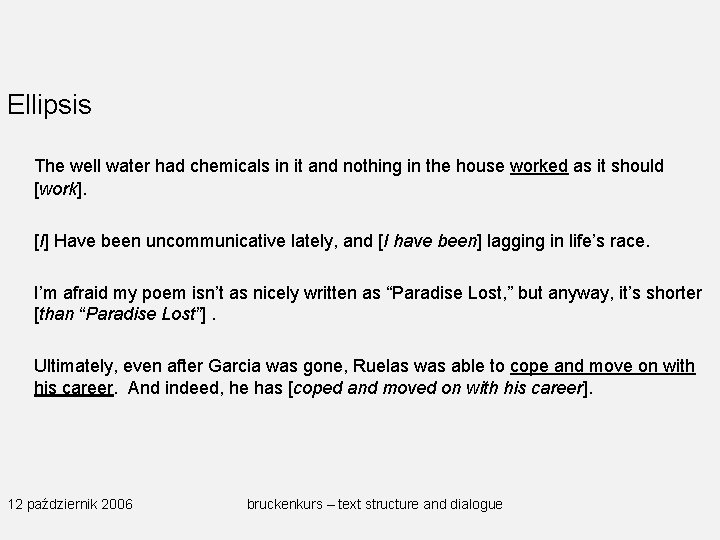
Ellipsis The well water had chemicals in it and nothing in the house worked as it should [work]. [I] Have been uncommunicative lately, and [I have been] lagging in life’s race. I’m afraid my poem isn’t as nicely written as “Paradise Lost, ” but anyway, it’s shorter [than “Paradise Lost”]. Ultimately, even after Garcia was gone, Ruelas was able to cope and move on with his career. And indeed, he has [coped and moved on with his career]. 12 październik 2006 bruckenkurs – text structure and dialogue
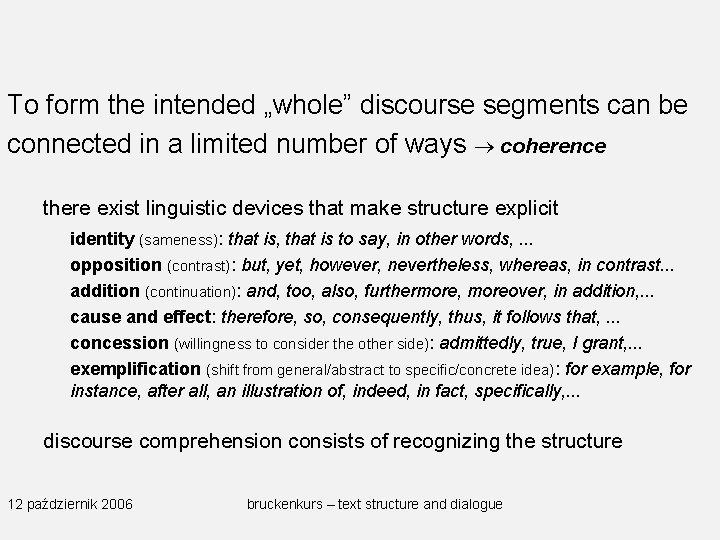
To form the intended „whole” discourse segments can be connected in a limited number of ways coherence there exist linguistic devices that make structure explicit identity (sameness): that is, that is to say, in other words, . . . opposition (contrast): but, yet, however, nevertheless, whereas, in contrast. . . addition (continuation): and, too, also, furthermore, moreover, in addition, . . . cause and effect: therefore, so, consequently, thus, it follows that, . . . concession (willingness to consider the other side): admittedly, true, I grant, . . . exemplification (shift from general/abstract to specific/concrete idea): for example, for instance, after all, an illustration of, indeed, in fact, specifically, . . . discourse comprehension consists of recognizing the structure 12 październik 2006 bruckenkurs – text structure and dialogue
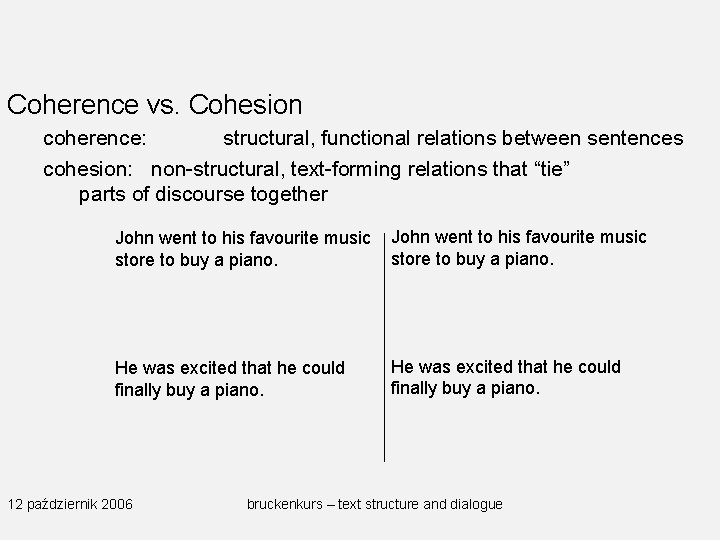
Coherence vs. Cohesion coherence: structural, functional relations between sentences cohesion: non-structural, text-forming relations that “tie” parts of discourse together John went to his favourite music store to buy a piano. He was excited that he could finally buy a piano. 12 październik 2006 bruckenkurs – text structure and dialogue
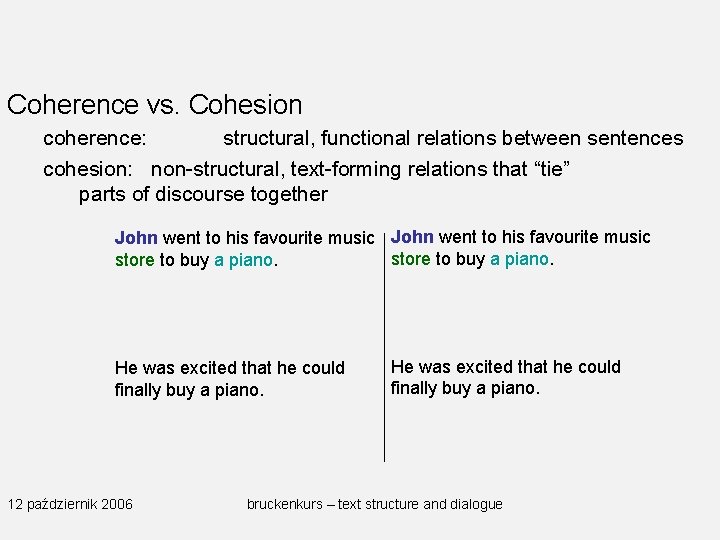
Coherence vs. Cohesion coherence: structural, functional relations between sentences cohesion: non-structural, text-forming relations that “tie” parts of discourse together John went to his favourite music store to buy a piano. He was excited that he could finally buy a piano. 12 październik 2006 He was excited that he could finally buy a piano. bruckenkurs – text structure and dialogue
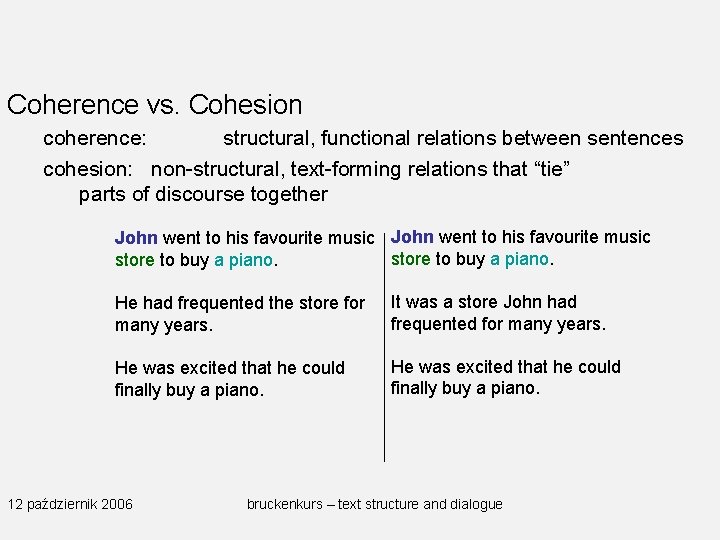
Coherence vs. Cohesion coherence: structural, functional relations between sentences cohesion: non-structural, text-forming relations that “tie” parts of discourse together John went to his favourite music store to buy a piano. He had frequented the store for many years. It was a store John had frequented for many years. He was excited that he could finally buy a piano. 12 październik 2006 bruckenkurs – text structure and dialogue
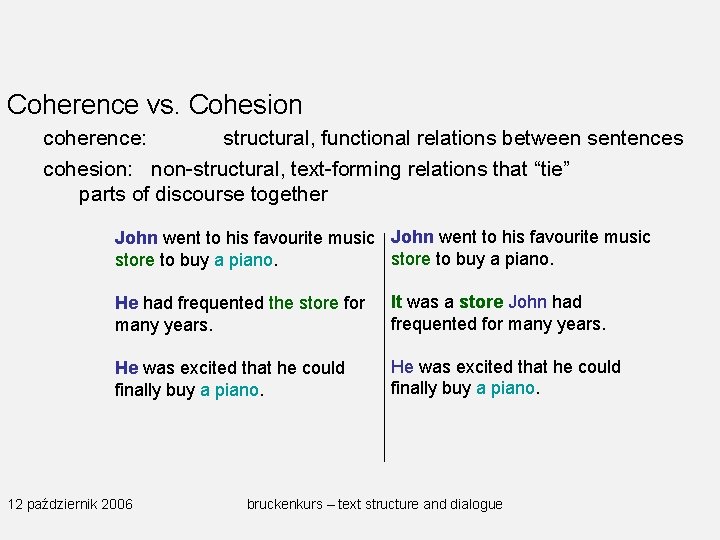
Coherence vs. Cohesion coherence: structural, functional relations between sentences cohesion: non-structural, text-forming relations that “tie” parts of discourse together John went to his favourite music store to buy a piano. He had frequented the store for many years. It was a store John had frequented for many years. He was excited that he could finally buy a piano. 12 październik 2006 bruckenkurs – text structure and dialogue
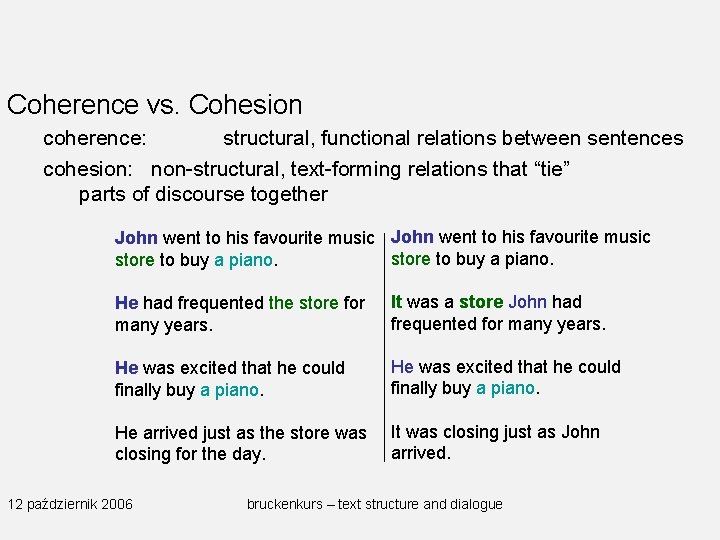
Coherence vs. Cohesion coherence: structural, functional relations between sentences cohesion: non-structural, text-forming relations that “tie” parts of discourse together John went to his favourite music store to buy a piano. He had frequented the store for many years. It was a store John had frequented for many years. He was excited that he could finally buy a piano. He arrived just as the store was closing for the day. It was closing just as John arrived. 12 październik 2006 bruckenkurs – text structure and dialogue
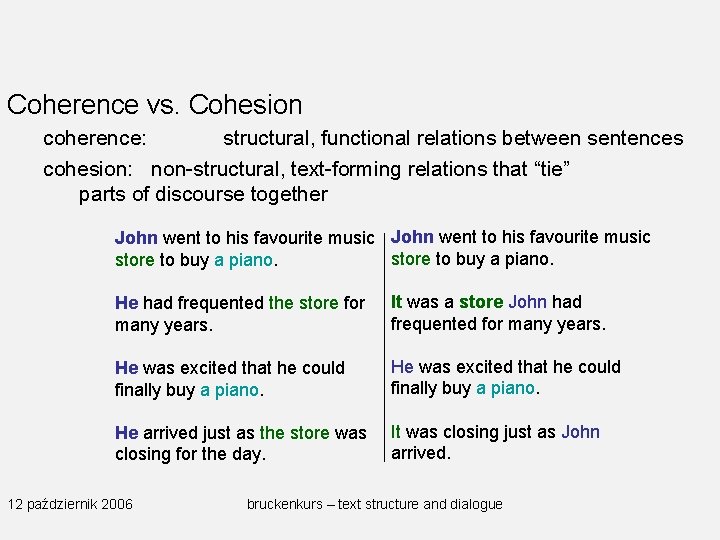
Coherence vs. Cohesion coherence: structural, functional relations between sentences cohesion: non-structural, text-forming relations that “tie” parts of discourse together John went to his favourite music store to buy a piano. He had frequented the store for many years. It was a store John had frequented for many years. He was excited that he could finally buy a piano. He arrived just as the store was closing for the day. It was closing just as John arrived. 12 październik 2006 bruckenkurs – text structure and dialogue
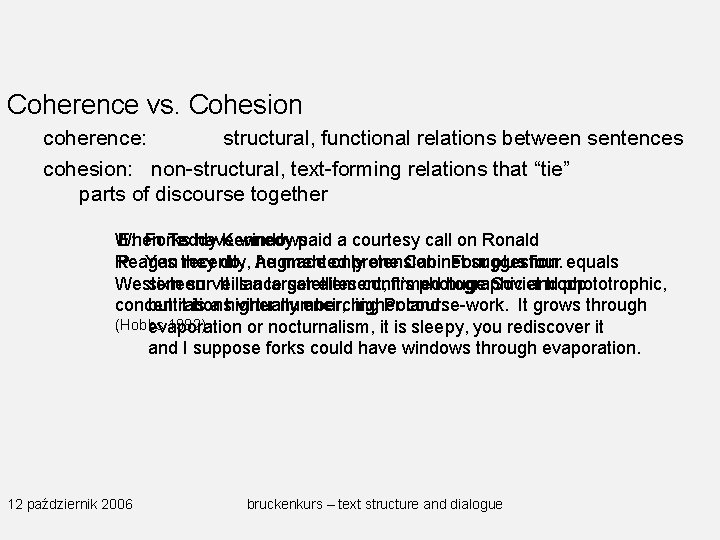
Coherence vs. Cohesion coherence: structural, functional relations between sentences cohesion: non-structural, text-forming relations that “tie” parts of discourse together When E: Forks Teddy have Kennedy windows. paid a courtesy call on Ronald Reagan P: Yes they recently, do. Augmented he made only pretension. one Cabinet Four suggestion. plus four equals Western sixteen. surveillance It is a larger satellites element, confirmed it’s photographic huge Soviet and troop phototrophic, concentrations but it is a higher virtually number, encircling higher Poland. course-work. It grows through (Hobbs 1982) evaporation or nocturnalism, it is sleepy, you rediscover it and I suppose forks could have windows through evaporation. 12 październik 2006 bruckenkurs – text structure and dialogue
Discourse modeling: intentional approach discourse participants have certain goals (agendas) to achieve utterances : actions that realize the intentions speaker’s plan wrt. communicating intentions ties the discourse together discourse understanding : recognizing speaker’s intentions 12 październik 2006 bruckenkurs – text structure and dialogue
Intentional Approach (Grosz and Sidner 86) three dimensions of discourse linguistic structure : the utterances intentional structure : hierarchy of intentions (communicative goals) attentional structure : model of objects, properties and relations that are salient at each point in discourse (dynamically changing) 12 październik 2006 bruckenkurs – text structure and dialogue
Intentional Approach (Grosz and Sidner 86) Linguistic structure discourse segments + relations that hold between them 12 październik 2006 bruckenkurs – text structure and dialogue
Intentional Approach (Grosz and Sidner 86) Linguistic structure discourse segments + relations that hold between them (para-) linguistic expressions reflect discourse structure cue phrases, aspect, tense, intonation, gesture discourse structure constraints discourse interpretation anaphora resolution 12 październik 2006 bruckenkurs – text structure and dialogue
Intentional Approach (Grosz and Sidner 86) Attentional structure participants’ focus of attention (what is „attended to”) modeled by focus spaces: objects and relations in focus changes: insertion and deletion rules 12 październik 2006 bruckenkurs – text structure and dialogue
Intentional Approach (Grosz and Sidner 86) Intentional structure Discourse Purpose (DP) purpose/intention held by discourse initiator e. g. make hearer: intend to perform a task, believe a fact, believe that one fact supports another fact, identify an object, identify a property of an object assumption: one per discourse 12 październik 2006 bruckenkurs – text structure and dialogue
Intentional Approach (Grosz and Sidner 86) Intentional structure Discourse Segment Purpose (DSP) how given segment contributes to DP 12 październik 2006 bruckenkurs – text structure and dialogue
Intentional Approach (Grosz and Sidner 86) Intentional structure Hierarchy of intentions dominance DSP 1 dominates DSP 2 if satisfying DSP 2 is intended to provide part of satisfaction of DSP 1 precedence DSP 1 precedes DSP 2 if DSP 1 must be satisfied before DSP 2 12 październik 2006 bruckenkurs – text structure and dialogue
Intentional Approach (Grosz and Sidner 86) Intentional structure Hierarchy of intentions dominance DSP 1 dominates DSP 2 if satisfying DSP 2 is intended to provide part of satisfaction of DSP 1 precedence DSP 1 precedes DSP 2 if DSP 1 must be satisfied before DSP 2 12 październik 2006 bruckenkurs – text structure and dialogue
Discourse modeling: functional approach relations between discourse units relations may be made explicit by linguistic cues model: domain-independent rhetorical structure compositionally built discourse tree 12 październik 2006 bruckenkurs – text structure and dialogue
Rhetorical Structure Theory (Mann and Thompson 87) nucleus(N) vs. satellite(S) segments core vs. peripheral part of the message „nuclearity principle” relations defined in terms of: constraints on the nucleus constraints on the satellite constraints on the comination of N and S effect achieved on the text receiver „classical RST”: 24 relations, (Mann, 2005): 30 relations 12 październik 2006 bruckenkurs – text structure and dialogue
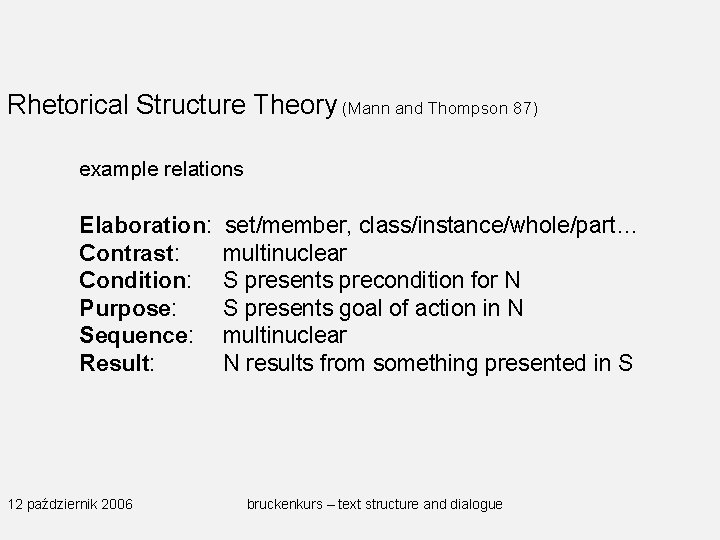
Rhetorical Structure Theory (Mann and Thompson 87) example relations Elaboration: Contrast: Condition: Purpose: Sequence: Result: 12 październik 2006 set/member, class/instance/whole/part… multinuclear S presents precondition for N S presents goal of action in N multinuclear N results from something presented in S bruckenkurs – text structure and dialogue
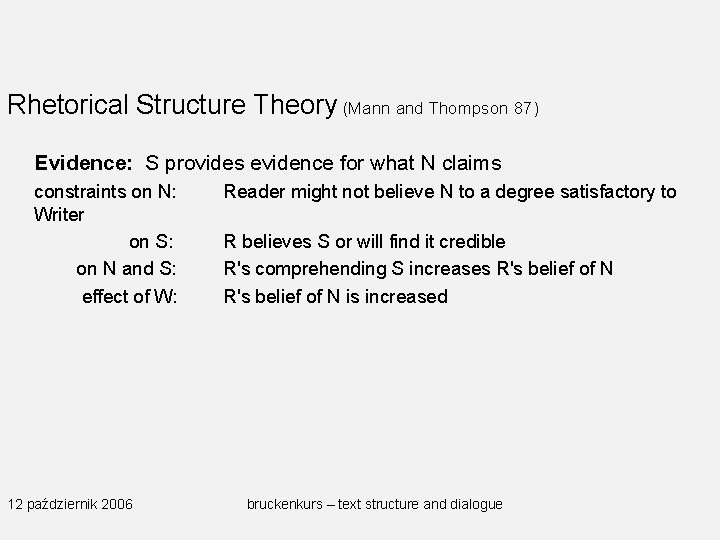
Rhetorical Structure Theory (Mann and Thompson 87) Evidence: S provides evidence for what N claims constraints on N: Writer on S: on N and S: effect of W: 12 październik 2006 Reader might not believe N to a degree satisfactory to R believes S or will find it credible R's comprehending S increases R's belief of N is increased bruckenkurs – text structure and dialogue
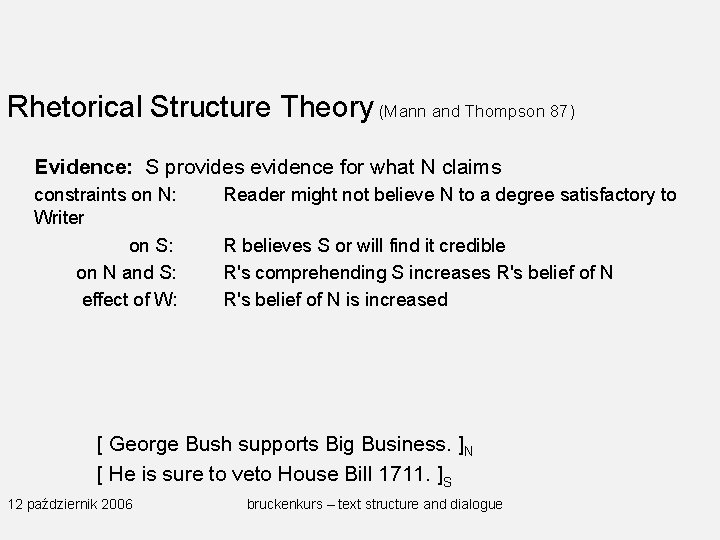
Rhetorical Structure Theory (Mann and Thompson 87) Evidence: S provides evidence for what N claims constraints on N: Writer on S: on N and S: effect of W: Reader might not believe N to a degree satisfactory to R believes S or will find it credible R's comprehending S increases R's belief of N is increased [ George Bush supports Big Business. ]N [ He is sure to veto House Bill 1711. ]S 12 październik 2006 bruckenkurs – text structure and dialogue
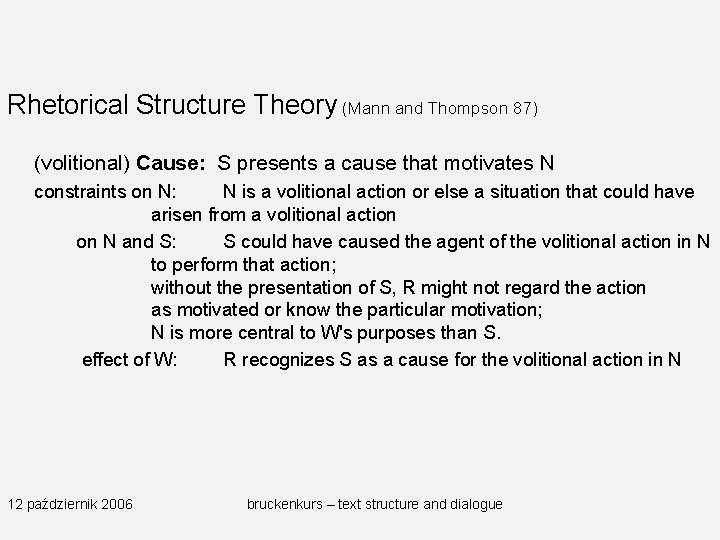
Rhetorical Structure Theory (Mann and Thompson 87) (volitional) Cause: S presents a cause that motivates N constraints on N: N is a volitional action or else a situation that could have arisen from a volitional action on N and S: S could have caused the agent of the volitional action in N to perform that action; without the presentation of S, R might not regard the action as motivated or know the particular motivation; N is more central to W's purposes than S. effect of W: R recognizes S as a cause for the volitional action in N 12 październik 2006 bruckenkurs – text structure and dialogue
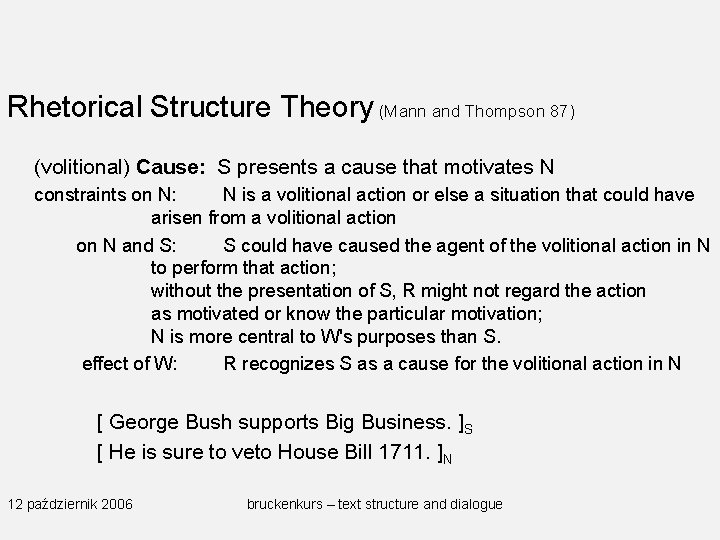
Rhetorical Structure Theory (Mann and Thompson 87) (volitional) Cause: S presents a cause that motivates N constraints on N: N is a volitional action or else a situation that could have arisen from a volitional action on N and S: S could have caused the agent of the volitional action in N to perform that action; without the presentation of S, R might not regard the action as motivated or know the particular motivation; N is more central to W's purposes than S. effect of W: R recognizes S as a cause for the volitional action in N [ George Bush supports Big Business. ]S [ He is sure to veto House Bill 1711. ]N 12 październik 2006 bruckenkurs – text structure and dialogue
Problems with RST 12 październik 2006 bruckenkurs – text structure and dialogue
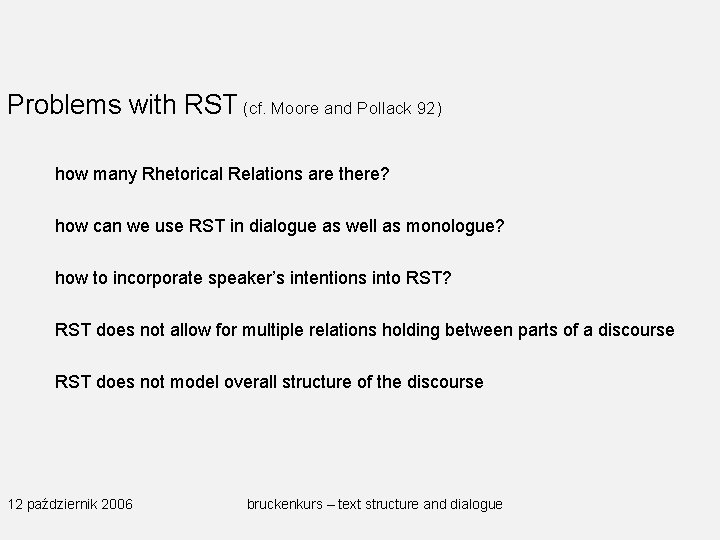
Problems with RST (cf. Moore and Pollack 92) how many Rhetorical Relations are there? how can we use RST in dialogue as well as monologue? how to incorporate speaker’s intentions into RST? RST does not allow for multiple relations holding between parts of a discourse RST does not model overall structure of the discourse 12 październik 2006 bruckenkurs – text structure and dialogue
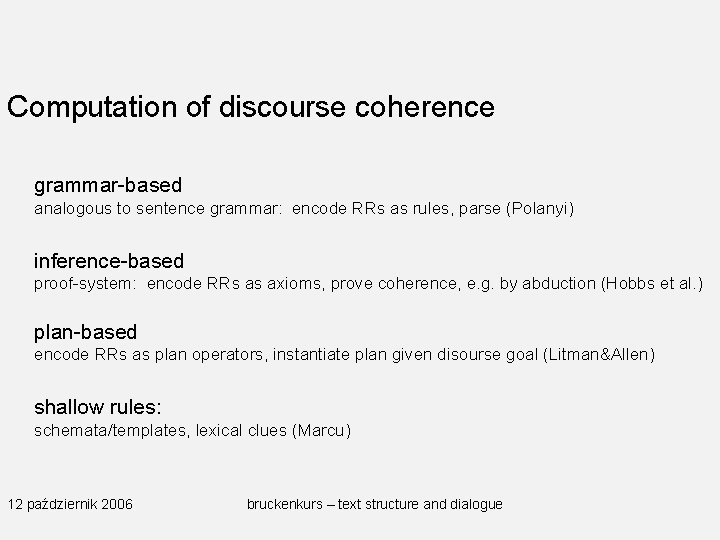
Computation of discourse coherence grammar-based analogous to sentence grammar: encode RRs as rules, parse (Polanyi) inference-based proof-system: encode RRs as axioms, prove coherence, e. g. by abduction (Hobbs et al. ) plan-based encode RRs as plan operators, instantiate plan given disourse goal (Litman&Allen) shallow rules: schemata/templates, lexical clues (Marcu) 12 październik 2006 bruckenkurs – text structure and dialogue
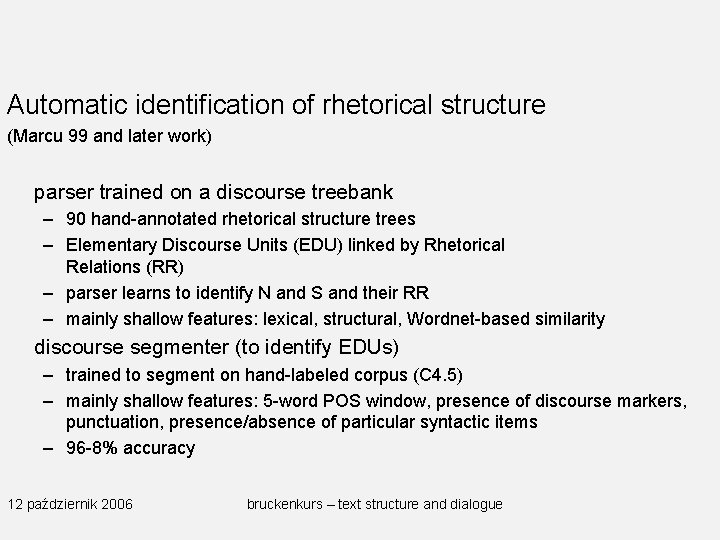
Automatic identification of rhetorical structure (Marcu 99 and later work) parser trained on a discourse treebank – 90 hand-annotated rhetorical structure trees – Elementary Discourse Units (EDU) linked by Rhetorical Relations (RR) – parser learns to identify N and S and their RR – mainly shallow features: lexical, structural, Wordnet-based similarity discourse segmenter (to identify EDUs) – trained to segment on hand-labeled corpus (C 4. 5) – mainly shallow features: 5 -word POS window, presence of discourse markers, punctuation, presence/absence of particular syntactic items – 96 -8% accuracy 12 październik 2006 bruckenkurs – text structure and dialogue
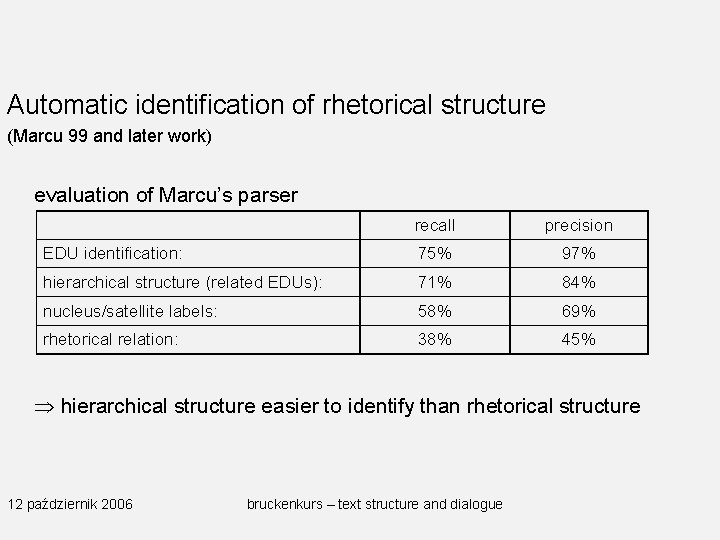
Automatic identification of rhetorical structure (Marcu 99 and later work) evaluation of Marcu’s parser recall precision EDU identification: 75% 97% hierarchical structure (related EDUs): 71% 84% nucleus/satellite labels: 58% 69% rhetorical relation: 38% 45% hierarchical structure easier to identify than rhetorical structure 12 październik 2006 bruckenkurs – text structure and dialogue
Dialog 12 październik 2006 bruckenkurs – text structure and dialogue
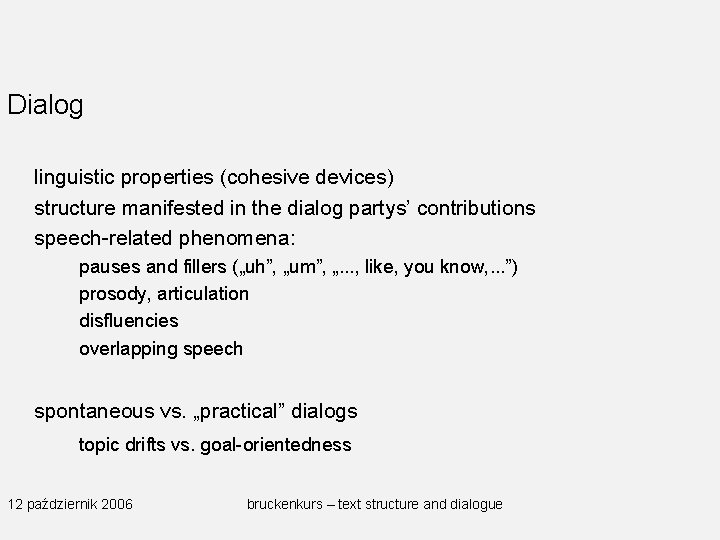
Dialog linguistic properties (cohesive devices) structure manifested in the dialog partys’ contributions speech-related phenomena: pauses and fillers („uh”, „um”, „. . . , like, you know, . . . ”) prosody, articulation disfluencies overlapping speech spontaneous vs. „practical” dialogs topic drifts vs. goal-orientedness 12 październik 2006 bruckenkurs – text structure and dialogue
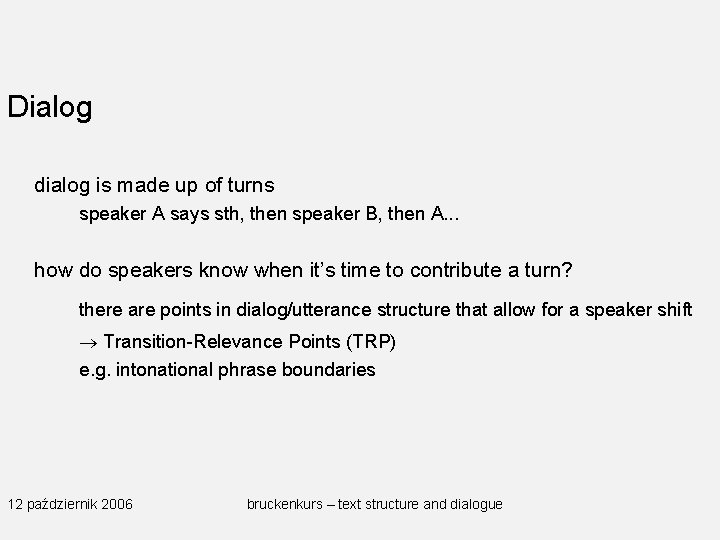
Dialog dialog is made up of turns speaker A says sth, then speaker B, then A. . . how do speakers know when it’s time to contribute a turn? there are points in dialog/utterance structure that allow for a speaker shift Transition-Relevance Points (TRP) e. g. intonational phrase boundaries 12 październik 2006 bruckenkurs – text structure and dialogue
Dialog dialog is made up of turns speaker A says sth, then speaker B, then A. . . turn taking rules determine who is expected to speak next at each TRP of each turn: if current speaker has selected A as next speaker, then A must speak next if current speaker does not select next speaker, any other speaker may take next turn if no one else takes next turn, the current speaker may take next turn 12 październik 2006 bruckenkurs – text structure and dialogue
Dialog some turns specifically select who the next speaker will be adjacency pairs regularly occuring, conventionalized sequences conventions introduce obligations to respond (and preferred responses) greeting : greeting complement : downplayer offer : acceptance question : answer accusation : denial request : grant set up next speaker expectations (‘significant silence’ dispreferred) 12 październik 2006 bruckenkurs – text structure and dialogue
Dialog entering a conversation we (typically) have a certain intention paradigmatic use of language: making statements. . . BUT there also other things we can do with words e. g. make requests, ask questions, give orders, make promises, give thanks, offer apologies aspects of the speaker's intention: the act of saying something, what one does in saying it (requesting or promising) how one is trying to affect the audience 12 październik 2006 bruckenkurs – text structure and dialogue
Dialog: speech acts certain actions we take in communication are designed to get our interlocutor(s) to do things on the basis of understanding of what we mean doing things with words: Austin, 1962, later Searle, Davis speech acts utterances are multi-dimentional acts that affect the context in which they are spoken 12 październik 2006 bruckenkurs – text structure and dialogue
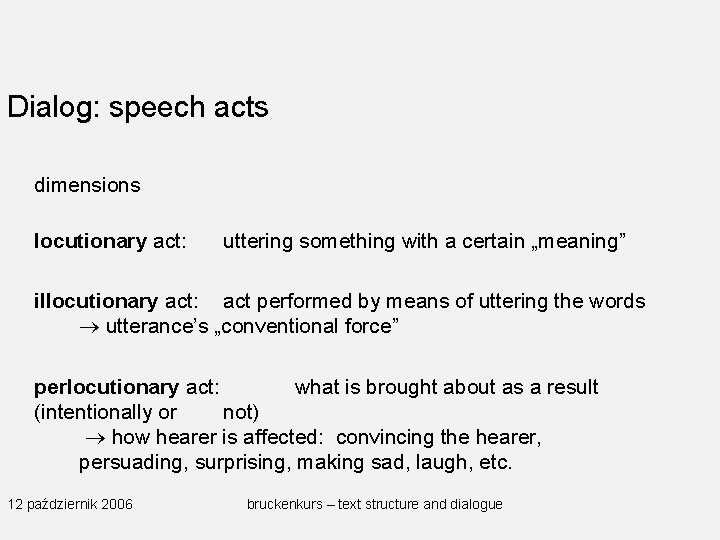
Dialog: speech acts dimensions locutionary act: uttering something with a certain „meaning” illocutionary act: act performed by means of uttering the words utterance’s „conventional force” perlocutionary act: what is brought about as a result (intentionally or not) how hearer is affected: convincing the hearer, persuading, surprising, making sad, laugh, etc. 12 październik 2006 bruckenkurs – text structure and dialogue
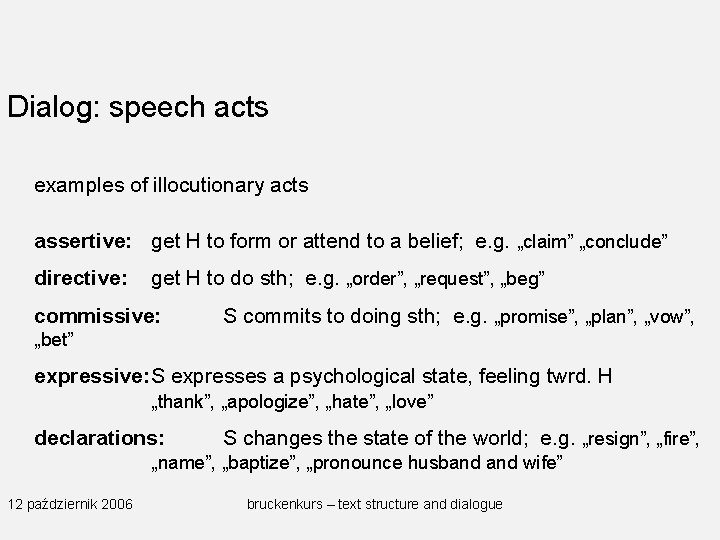
Dialog: speech acts examples of illocutionary acts assertive: get H to form or attend to a belief; e. g. „claim” „conclude” directive: get H to do sth; e. g. „order”, „request”, „beg” commissive: S commits to doing sth; e. g. „promise”, „plan”, „vow”, „bet” expressive: S expresses a psychological state, feeling twrd. H „thank”, „apologize”, „hate”, „love” declarations: S changes the state of the world; e. g. „resign”, „fire”, „name”, „baptize”, „pronounce husband wife” 12 październik 2006 bruckenkurs – text structure and dialogue
Dialog: joint activity when entering a conversation, we pressupose that there exists certain shared knowledge common ground introduced by Stalnaker (1978) based on older family of notions: common knowledge (Lewis, 1969), mutual knowledge or belief (Schiffler, 1972) 12 październik 2006 bruckenkurs – text structure and dialogue
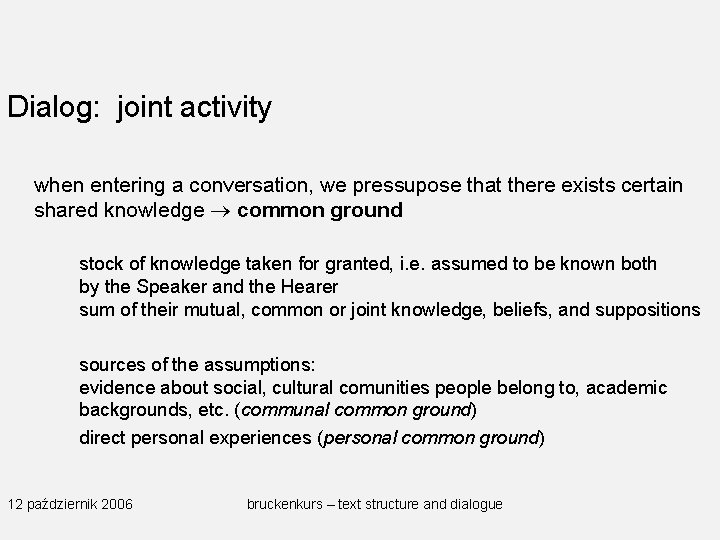
Dialog: joint activity when entering a conversation, we pressupose that there exists certain shared knowledge common ground stock of knowledge taken for granted, i. e. assumed to be known both by the Speaker and the Hearer sum of their mutual, common or joint knowledge, beliefs, and suppositions sources of the assumptions: evidence about social, cultural comunities people belong to, academic backgrounds, etc. (communal common ground) direct personal experiences (personal common ground) 12 październik 2006 bruckenkurs – text structure and dialogue
Dialog: joint activity when entering a conversation, we pressupose that there exists certain shared knowledge common ground What does it mean „You and I (mutually) know that p”? 12 październik 2006 bruckenkurs – text structure and dialogue
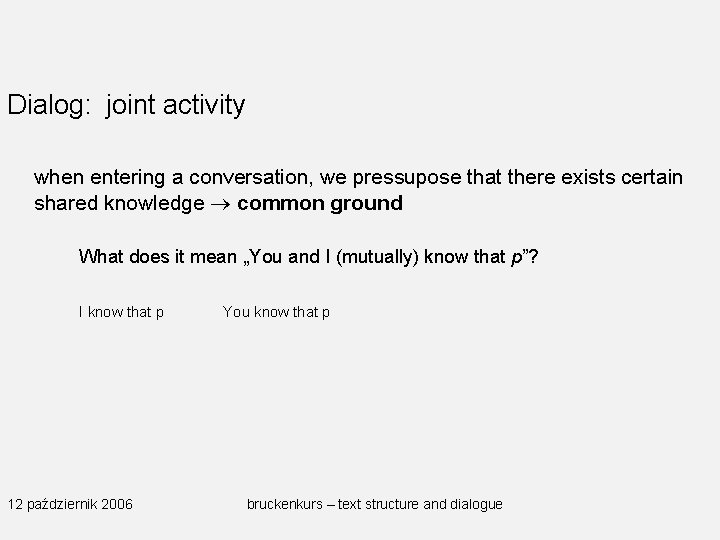
Dialog: joint activity when entering a conversation, we pressupose that there exists certain shared knowledge common ground What does it mean „You and I (mutually) know that p”? I know that p 12 październik 2006 You know that p bruckenkurs – text structure and dialogue
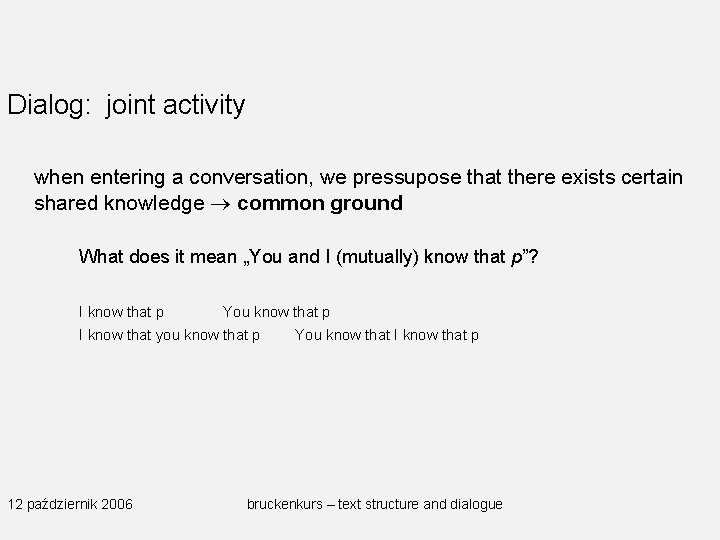
Dialog: joint activity when entering a conversation, we pressupose that there exists certain shared knowledge common ground What does it mean „You and I (mutually) know that p”? I know that p You know that p I know that you know that p 12 październik 2006 You know that I know that p bruckenkurs – text structure and dialogue
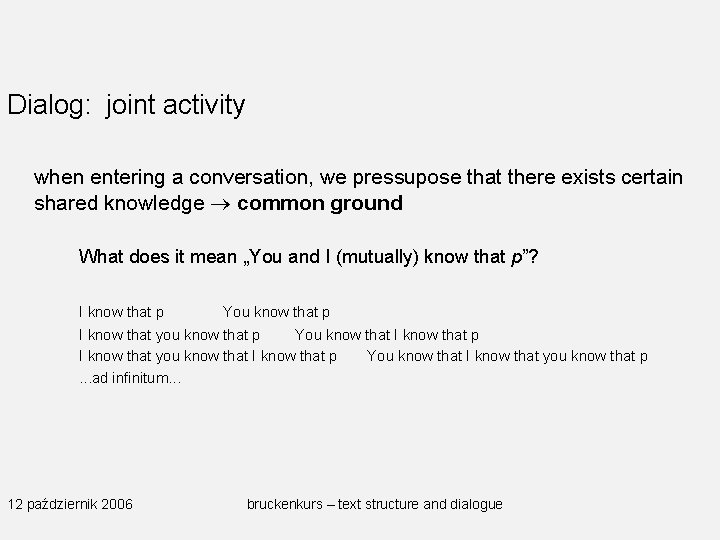
Dialog: joint activity when entering a conversation, we pressupose that there exists certain shared knowledge common ground What does it mean „You and I (mutually) know that p”? I know that p You know that p I know that you know that p You know that I know that p I know that you know that I know that p You know that I know that you know that p. . . ad infinitum. . . 12 październik 2006 bruckenkurs – text structure and dialogue
Dialog: joint activity communication relies on collaboration Gricean Cooperative Principle + principles of rational behaviour cooperatively interpret and contribute 12 październik 2006 bruckenkurs – text structure and dialogue
Dialog: joint activity communication relies on collaboration Gricean Cooperative Principle + principles of rational behaviour cooperatively interpret and contribute crucial: establishing shared knowledge (adding to common ground) grounding 12 październik 2006 bruckenkurs – text structure and dialogue
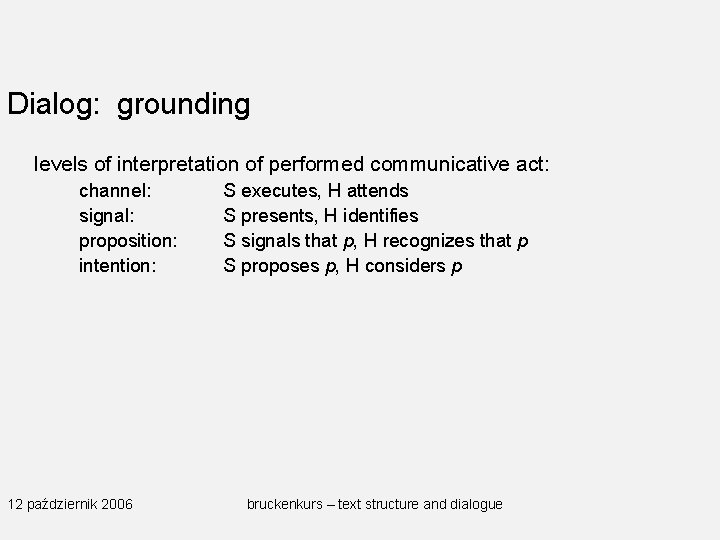
Dialog: grounding levels of interpretation of performed communicative act: channel: signal: proposition: intention: 12 październik 2006 S executes, H attends S presents, H identifies S signals that p, H recognizes that p S proposes p, H considers p bruckenkurs – text structure and dialogue
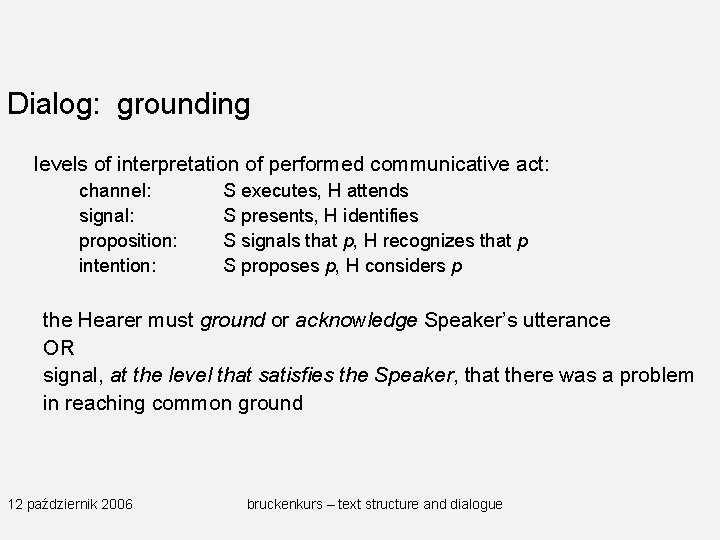
Dialog: grounding levels of interpretation of performed communicative act: channel: signal: proposition: intention: S executes, H attends S presents, H identifies S signals that p, H recognizes that p S proposes p, H considers p the Hearer must ground or acknowledge Speaker’s utterance OR signal, at the level that satisfies the Speaker, that there was a problem in reaching common ground 12 październik 2006 bruckenkurs – text structure and dialogue
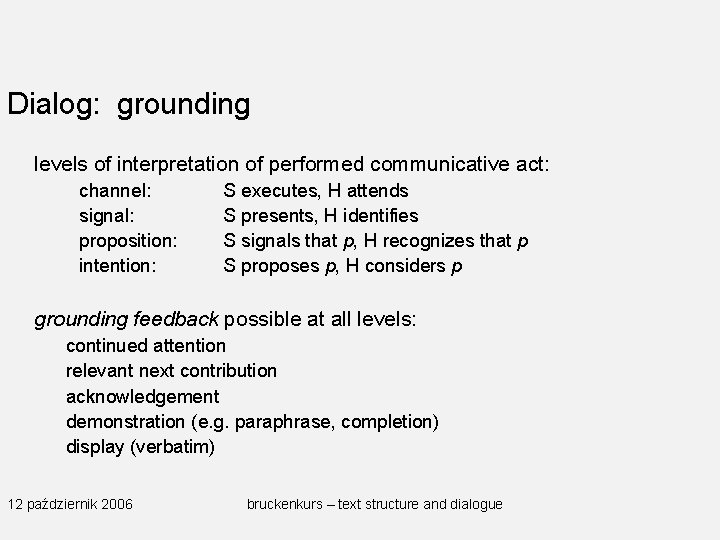
Dialog: grounding levels of interpretation of performed communicative act: channel: signal: proposition: intention: S executes, H attends S presents, H identifies S signals that p, H recognizes that p S proposes p, H considers p grounding feedback possible at all levels: continued attention relevant next contribution acknowledgement demonstration (e. g. paraphrase, completion) display (verbatim) 12 październik 2006 bruckenkurs – text structure and dialogue
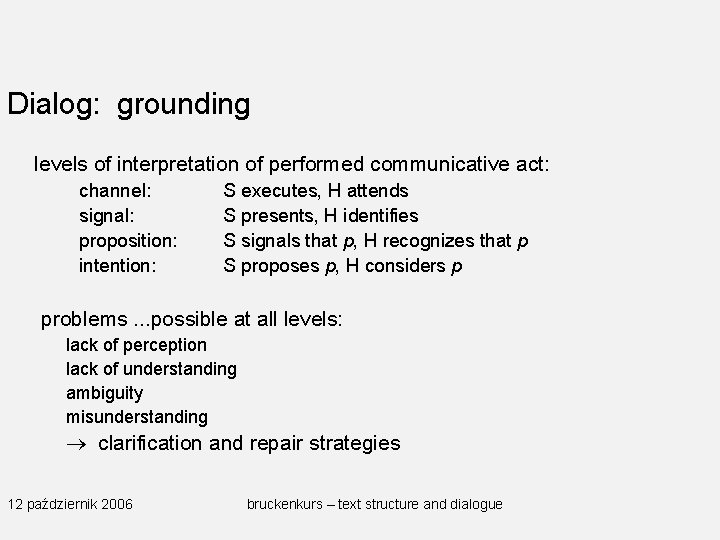
Dialog: grounding levels of interpretation of performed communicative act: channel: signal: proposition: intention: S executes, H attends S presents, H identifies S signals that p, H recognizes that p S proposes p, H considers p problems. . . possible at all levels: lack of perception lack of understanding ambiguity misunderstanding clarification and repair strategies 12 październik 2006 bruckenkurs – text structure and dialogue
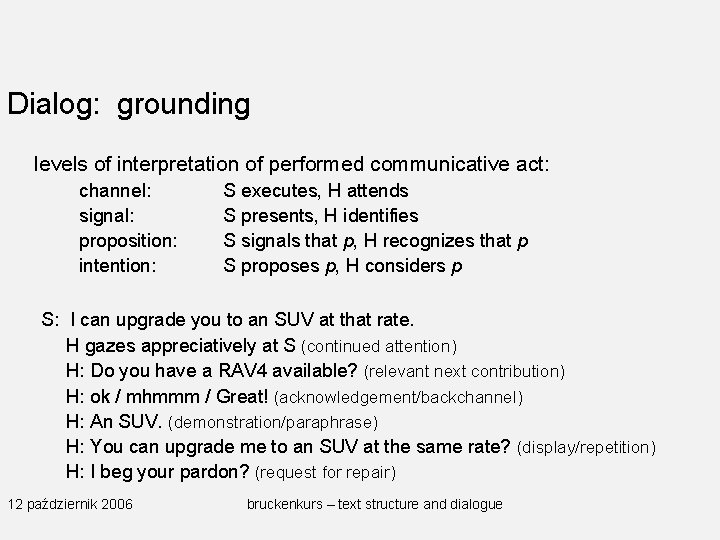
Dialog: grounding levels of interpretation of performed communicative act: channel: signal: proposition: intention: S executes, H attends S presents, H identifies S signals that p, H recognizes that p S proposes p, H considers p S: I can upgrade you to an SUV at that rate. H gazes appreciatively at S (continued attention) H: Do you have a RAV 4 available? (relevant next contribution) H: ok / mhmmm / Great! (acknowledgement/backchannel) H: An SUV. (demonstration/paraphrase) H: You can upgrade me to an SUV at the same rate? (display/repetition) H: I beg your pardon? (request for repair) 12 październik 2006 bruckenkurs – text structure and dialogue

12 październik 2006 bruckenkurs – text structure and dialogue
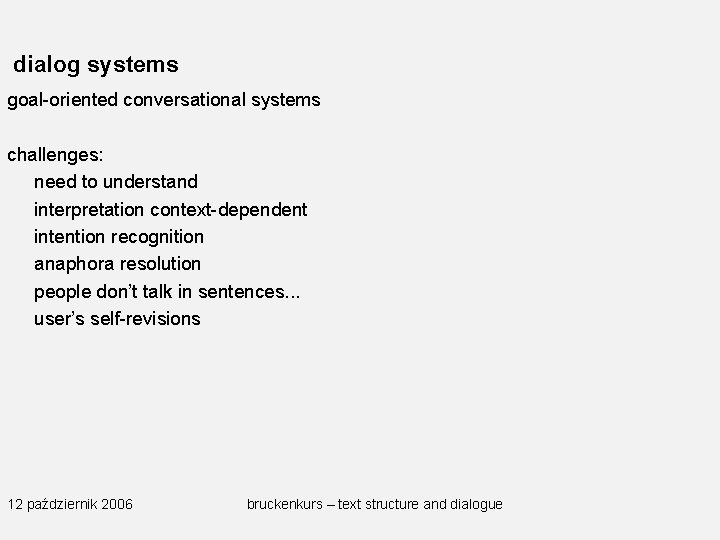
dialog systems goal-oriented conversational systems challenges: need to understand interpretation context-dependent intention recognition anaphora resolution people don’t talk in sentences. . . user’s self-revisions 12 październik 2006 bruckenkurs – text structure and dialogue
dialog systems goal-oriented conversational systems how: interactions in a limited domain prime users to adopt vocabulary the system knows partition interaction into manageable stages let the system take the initiative (predictability) 12 październik 2006 bruckenkurs – text structure and dialogue
dialog systems example tasks: retrieve information-seeking dialogue seek to satisfy constraints negotiation dialogue perform action command-control dialog collaborate on solving a problem-solving dialog instruct tutorial/instructional dialogue 12 październik 2006 bruckenkurs – text structure and dialogue
dialog systems modality: type of communication channel used to convey or acquire information natural-language: spoken or textual keyboard-based or both pointing devices graphics, drawing gesture combination of one of more of above (multi-modal systems) 12 październik 2006 bruckenkurs – text structure and dialogue
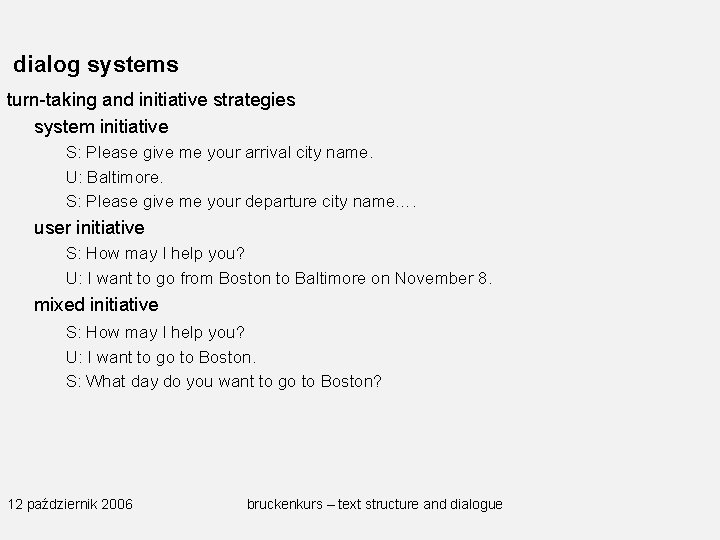
dialog systems turn-taking and initiative strategies system initiative S: Please give me your arrival city name. U: Baltimore. S: Please give me your departure city name…. user initiative S: How may I help you? U: I want to go from Boston to Baltimore on November 8. mixed initiative S: How may I help you? U: I want to go to Boston. S: What day do you want to go to Boston? 12 październik 2006 bruckenkurs – text structure and dialogue
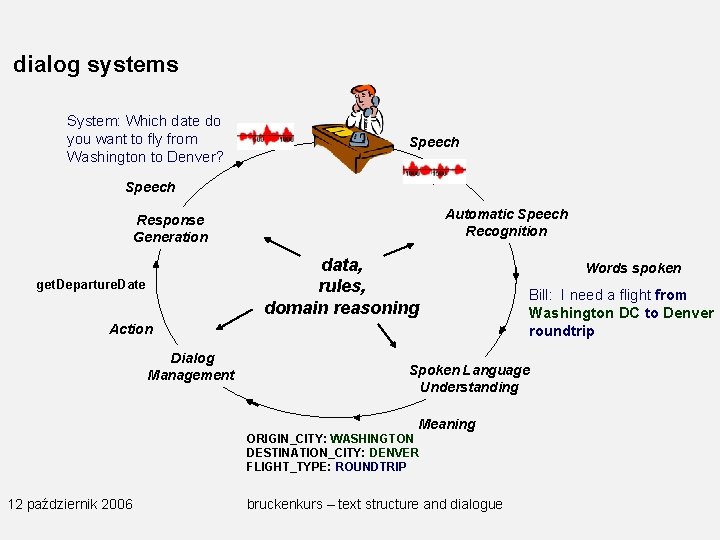
dialog systems System: Which date do you want to fly from Washington to Denver? Speech Automatic Speech Recognition Response Generation data, rules, domain reasoning get. Departure. Date Action Dialog Management Bill: I need a flight from Washington DC to Denver roundtrip Spoken Language Understanding Meaning ORIGIN_CITY: WASHINGTON DESTINATION_CITY: DENVER FLIGHT_TYPE: ROUNDTRIP 12 październik 2006 Words spoken bruckenkurs – text structure and dialogue
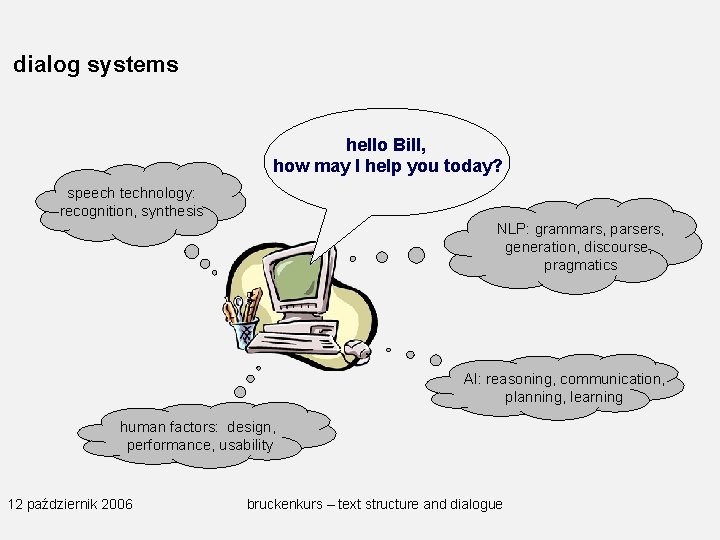
dialog systems hello Bill, how may I help you today? speech technology: recognition, synthesis NLP: grammars, parsers, generation, discourse, pragmatics AI: reasoning, communication, planning, learning human factors: design, performance, usability 12 październik 2006 bruckenkurs – text structure and dialogue
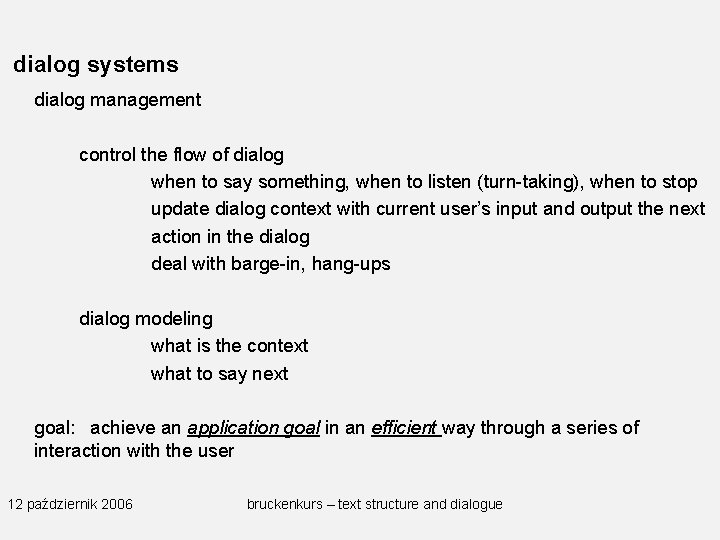
dialog systems dialog management control the flow of dialog when to say something, when to listen (turn-taking), when to stop update dialog context with current user’s input and output the next action in the dialog deal with barge-in, hang-ups dialog modeling what is the context what to say next goal: achieve an application goal in an efficient way through a series of interaction with the user 12 październik 2006 bruckenkurs – text structure and dialogue

12 październik 2006 bruckenkurs – text structure and dialogue
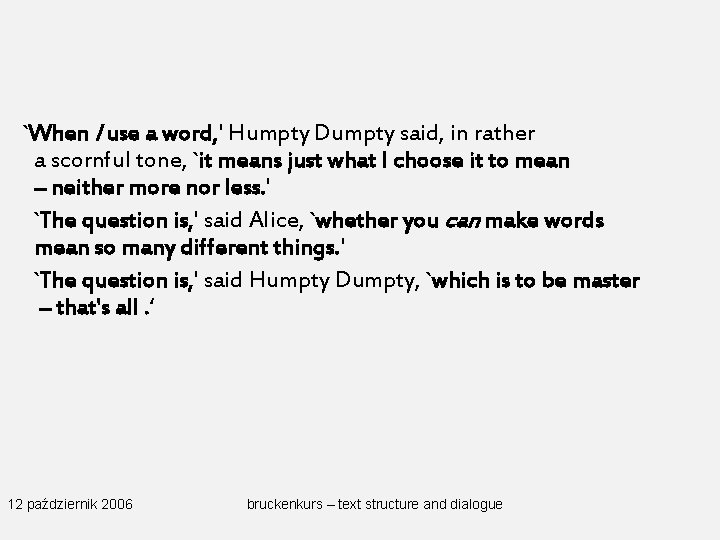
`When I use a word, ' Humpty Dumpty said, in rather a scornful tone, `it means just what I choose it to mean – neither more nor less. ' `The question is, ' said Alice, `whether you can make words mean so many different things. ' `The question is, ' said Humpty Dumpty, `which is to be master – that's all. ‘ 12 październik 2006 bruckenkurs – text structure and dialogue
References D. Byron. Resolving Pronominal Reference to Abstract Entities. Proceedings of ACL-02, pp. 80– 87, 2002 B. J. Grosz, K. Sparck-Jones, B. L. . Webber. Readings in Natural Language Processing, Morgan Kaufmann Publishers, 1986 B. J. Grosz and C. L. . Sidner. Attention, intentions, and the structure of discourse. Computational Linguistics 12(3): 175– 204. 1986 M. Halliday, R. Hasan. Cohesion in English. Harlow: Longman, 1976 J. Hobbs. Towards an Understanding of Coherence in Discourse, in W. Lehnert & M. Ringle (eds. ), Strategies for Natural-Language Processing, Hillsdale NJ: Erlbaum, 1982 W. C. Mann and S. A. Thompson. Rhetorical structure theory: A theory of text organization. Technical Report ISI/RS-87 -190, USC/ISI, 1987 D. Marcu. A decision-based approach to rhetorical parsing. Proceedings of ACL-99, pp. 365– 372, 1999 B. L. . Webber. Discourse deixis: Reference to discourse segments. Proceedings of ACL-88, pp. 113– 123, 1988 E. B. White. Letters of E. B. White, ed. D. L. Guth, Harper & Row, New York, 1972 (example sentences with anaphora) 12 październik 2006 bruckenkurs – text structure and dialogue
- Slides: 75