
University of Tampere CS Department Jyrki Nummenmaa Reverse
- Slides: 31
University of Tampere, CS Department Jyrki Nummenmaa Reverse Engineering Modified from original slides by Tarja Systä Software Engineering – http: //www. cs. uta. fi/se
Reverse Engineering? University of Tampere, CS Department Jyrki Nummenmaa • ‘Trying to figure out the structure and behaviour of existing software by building general-level static and dynamic models’ • Links: – http: //www. rigi. csc. uvic. ca/UVic. Rev. Tut/F 4 rev. html • Compact information on reverse engineering – http: //users. ece. gatech. edu/~linda/revengr/revrepos. html • Reengineering Resource Repository • Listings of tools, literature, … Software Engineering – http: //www. cs. uta. fi/se
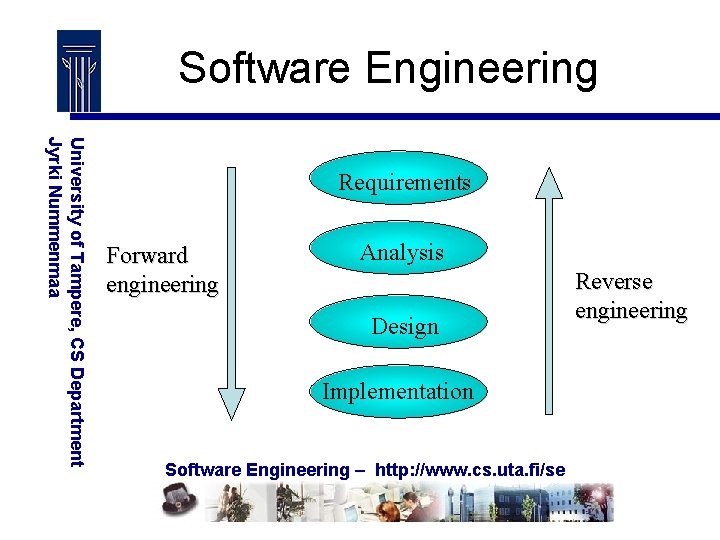
Software Engineering University of Tampere, CS Department Jyrki Nummenmaa Requirements Forward engineering Analysis Design Implementation Software Engineering – http: //www. cs. uta. fi/se Reverse engineering
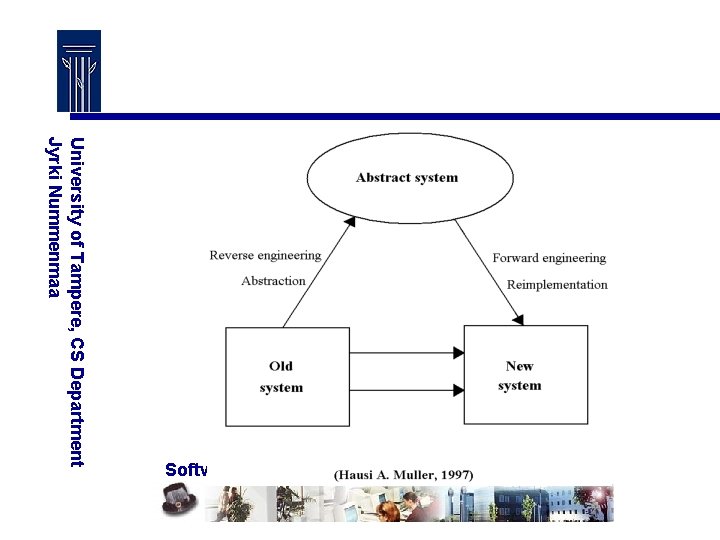
University of Tampere, CS Department Jyrki Nummenmaa Software Engineering – http: //www. cs. uta. fi/se
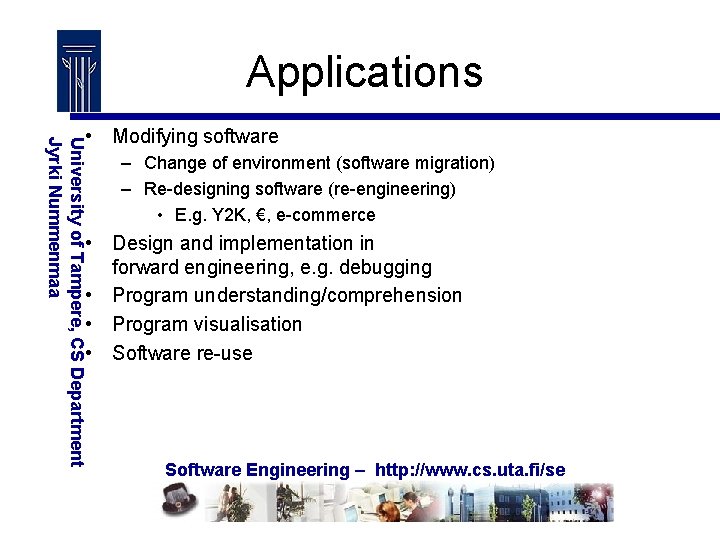
Applications University of Tampere, CS Department Jyrki Nummenmaa • Modifying software – Change of environment (software migration) – Re-designing software (re-engineering) • E. g. Y 2 K, €, e-commerce • Design and implementation in forward engineering, e. g. debugging • Program understanding/comprehension • Program visualisation • Software re-use Software Engineering – http: //www. cs. uta. fi/se
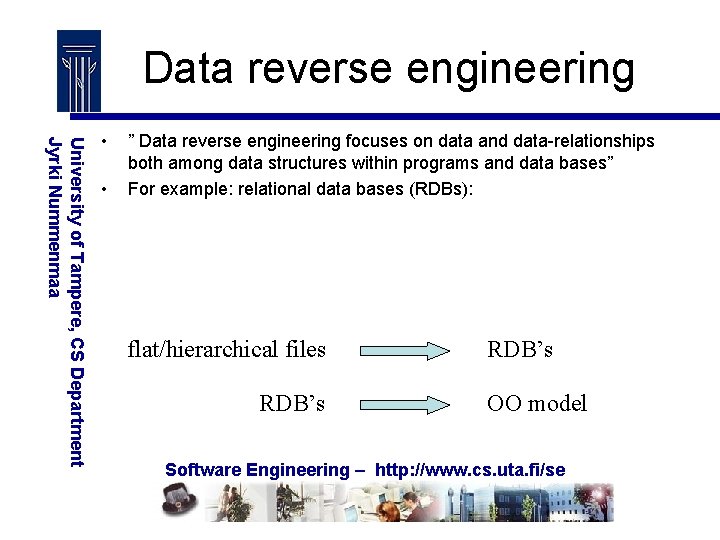
Data reverse engineering University of Tampere, CS Department Jyrki Nummenmaa • • ” Data reverse engineering focuses on data and data-relationships both among data structures within programs and data bases” For example: relational data bases (RDBs): flat/hierarchical files RDB’s OO model Software Engineering – http: //www. cs. uta. fi/se
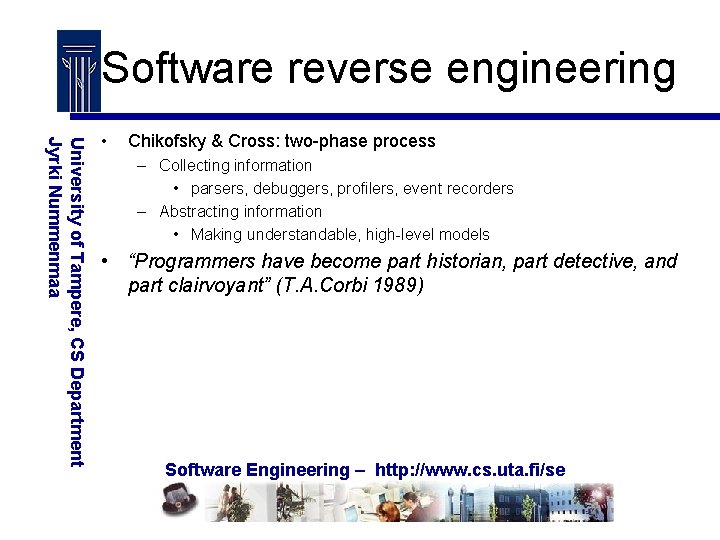
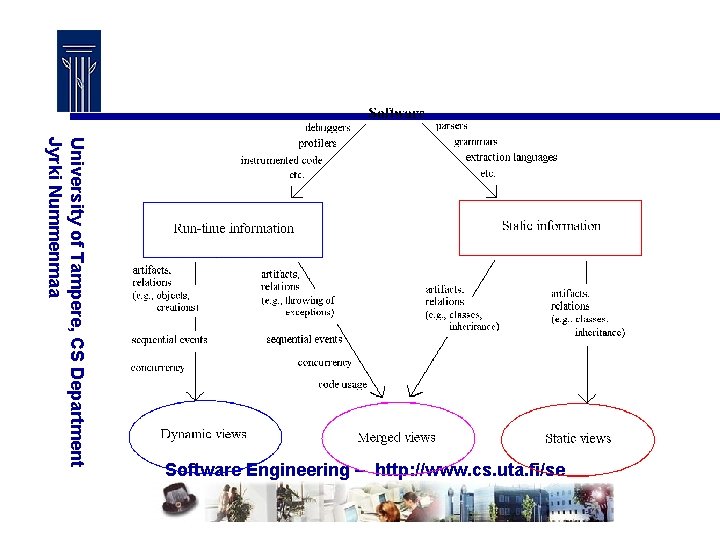
Software reverse engineering University of Tampere, CS Department Jyrki Nummenmaa • Chikofsky & Cross: two-phase process – Collecting information • parsers, debuggers, profilers, event recorders – Abstracting information • Making understandable, high-level models • “Programmers have become part historian, part detective, and part clairvoyant” (T. A. Corbi 1989) Software Engineering – http: //www. cs. uta. fi/se
University of Tampere, CS Department Jyrki Nummenmaa Software Engineering – http: //www. cs. uta. fi/se
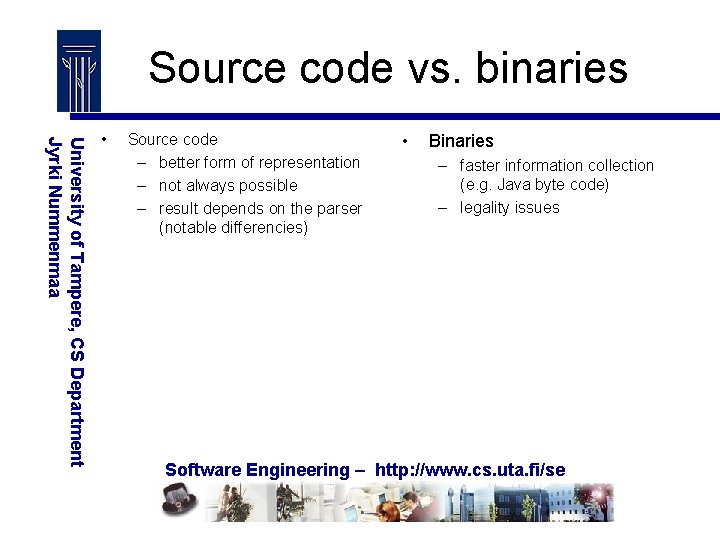
Source code vs. binaries University of Tampere, CS Department Jyrki Nummenmaa • Source code – better form of representation – not always possible – result depends on the parser (notable differencies) • Binaries – faster information collection (e. g. Java byte code) – legality issues Software Engineering – http: //www. cs. uta. fi/se
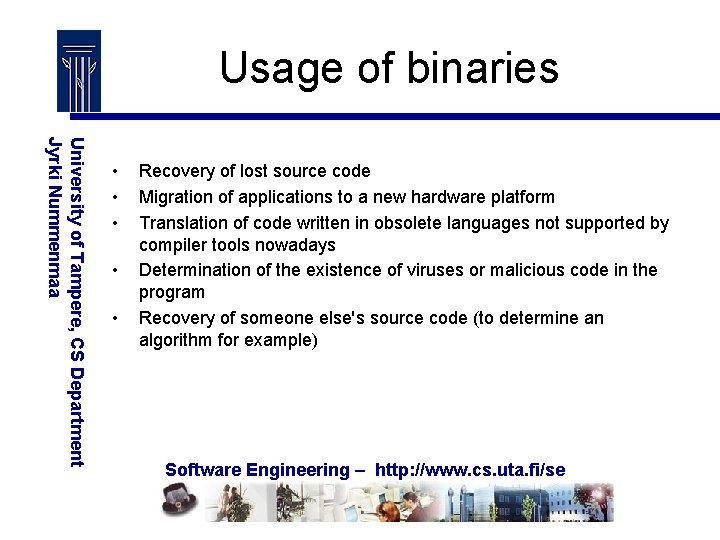
Usage of binaries University of Tampere, CS Department Jyrki Nummenmaa • • • Recovery of lost source code Migration of applications to a new hardware platform Translation of code written in obsolete languages not supported by compiler tools nowadays Determination of the existence of viruses or malicious code in the program Recovery of someone else's source code (to determine an algorithm for example) Software Engineering – http: //www. cs. uta. fi/se
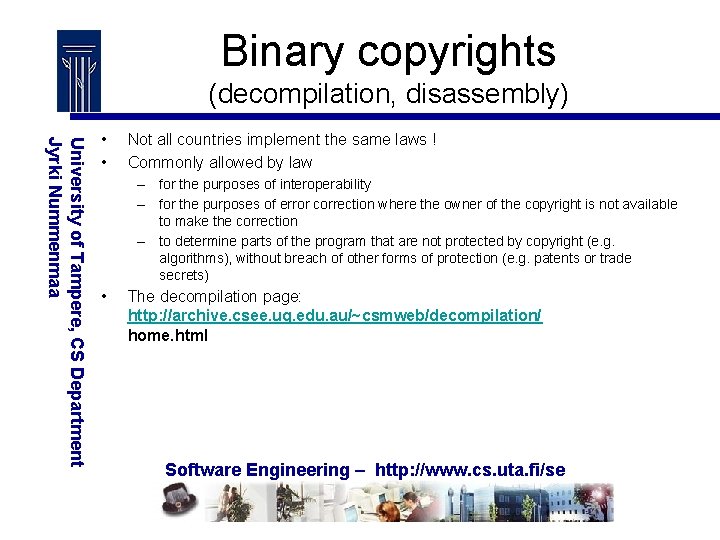
Binary copyrights (decompilation, disassembly) University of Tampere, CS Department Jyrki Nummenmaa • • Not all countries implement the same laws ! Commonly allowed by law – for the purposes of interoperability – for the purposes of error correction where the owner of the copyright is not available to make the correction – to determine parts of the program that are not protected by copyright (e. g. algorithms), without breach of other forms of protection (e. g. patents or trade secrets) • The decompilation page: http: //archive. csee. uq. edu. au/~csmweb/decompilation/ home. html Software Engineering – http: //www. cs. uta. fi/se
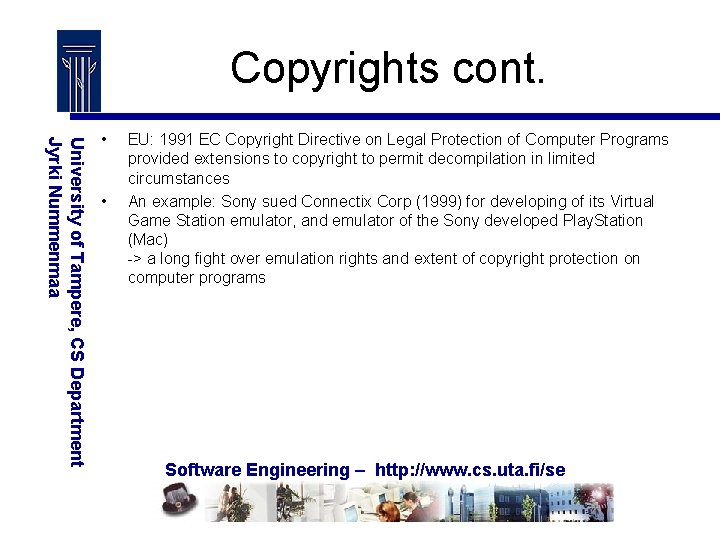
Copyrights cont. University of Tampere, CS Department Jyrki Nummenmaa • • EU: 1991 EC Copyright Directive on Legal Protection of Computer Programs provided extensions to copyright to permit decompilation in limited circumstances An example: Sony sued Connectix Corp (1999) for developing of its Virtual Game Station emulator, and emulator of the Sony developed Play. Station (Mac) -> a long fight over emulation rights and extent of copyright protection on computer programs Software Engineering – http: //www. cs. uta. fi/se
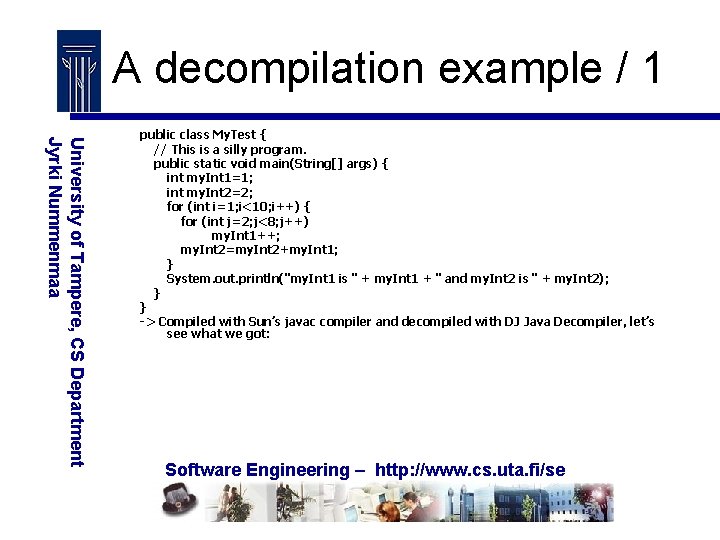
A decompilation example / 1 University of Tampere, CS Department Jyrki Nummenmaa public class My. Test { // This is a silly program. public static void main(String[] args) { int my. Int 1=1; int my. Int 2=2; for (int i=1; i<10; i++) { for (int j=2; j<8; j++) my. Int 1++; my. Int 2=my. Int 2+my. Int 1; } System. out. println("my. Int 1 is " + my. Int 1 + " and my. Int 2 is " + my. Int 2); } } -> Compiled with Sun’s javac compiler and decompiled with DJ Java Decompiler, let’s see what we got: Software Engineering – http: //www. cs. uta. fi/se
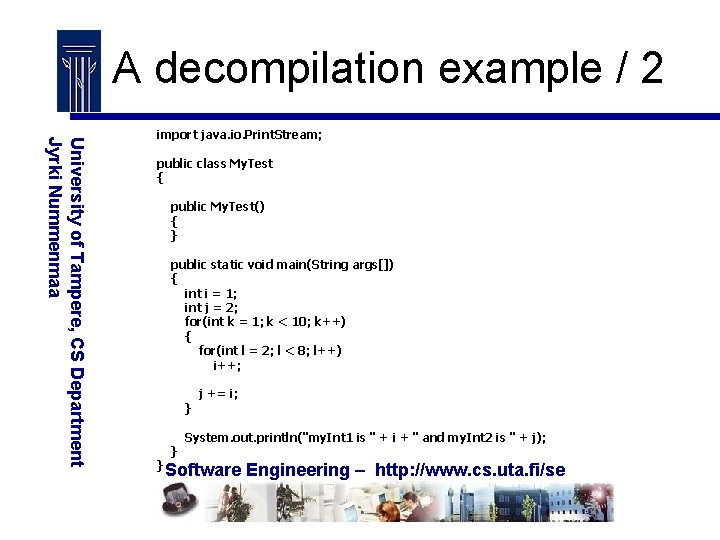
A decompilation example / 2 University of Tampere, CS Department Jyrki Nummenmaa import java. io. Print. Stream; public class My. Test { public My. Test() { } public static void main(String args[]) { int i = 1; int j = 2; for(int k = 1; k < 10; k++) { for(int l = 2; l < 8; l++) i++; } } j += i; System. out. println("my. Int 1 is " + i + " and my. Int 2 is " + j); }Software Engineering – http: //www. cs. uta. fi/se
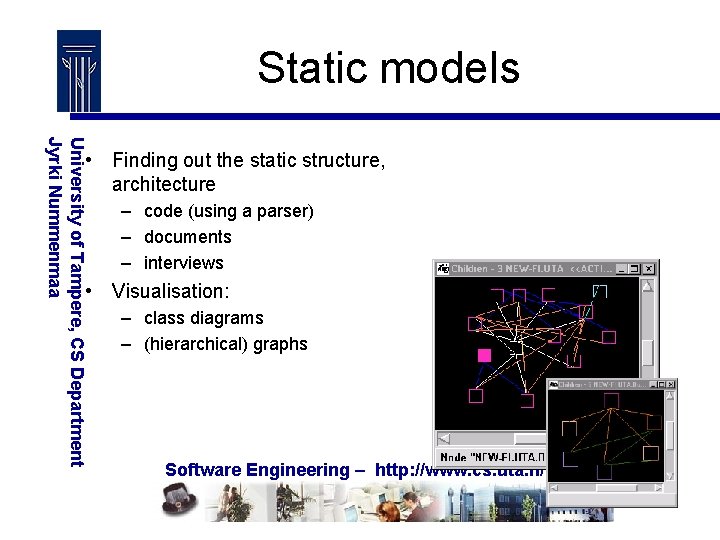
Static models University of Tampere, CS Department Jyrki Nummenmaa • Finding out the static structure, architecture – code (using a parser) – documents – interviews • Visualisation: – class diagrams – (hierarchical) graphs Software Engineering – http: //www. cs. uta. fi/se
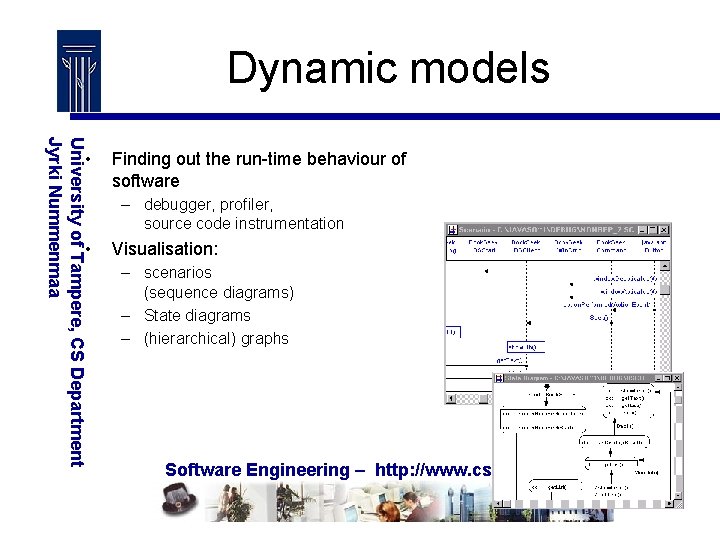
Dynamic models University of Tampere, CS Department Jyrki Nummenmaa • • Finding out the run-time behaviour of software – debugger, profiler, source code instrumentation Visualisation: – scenarios (sequence diagrams) – State diagrams – (hierarchical) graphs Software Engineering – http: //www. cs. uta. fi/se
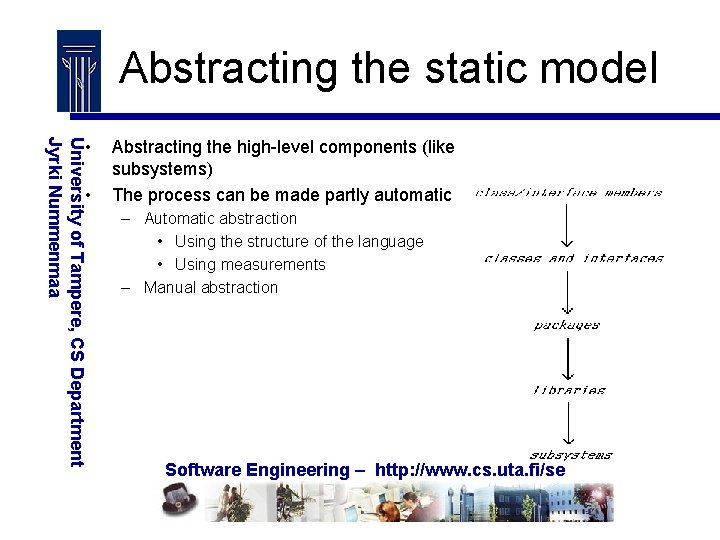
Abstracting the static model University of Tampere, CS Department Jyrki Nummenmaa • • Abstracting the high-level components (like subsystems) The process can be made partly automatic – Automatic abstraction • Using the structure of the language • Using measurements – Manual abstraction Software Engineering – http: //www. cs. uta. fi/se
Metrics University of Tampere, CS Department Jyrki Nummenmaa • Numeric measurements from software (or software projects) • More on these later in this course Software Engineering – http: //www. cs. uta. fi/se
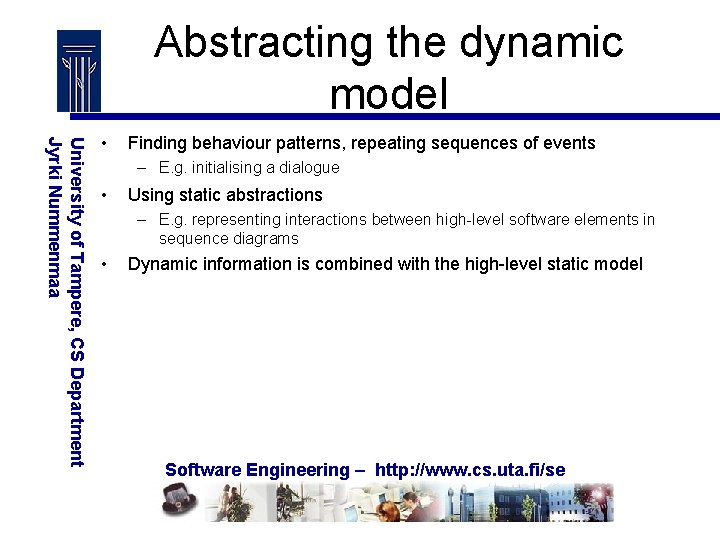
Abstracting the dynamic model University of Tampere, CS Department Jyrki Nummenmaa • Finding behaviour patterns, repeating sequences of events – E. g. initialising a dialogue • Using static abstractions – E. g. representing interactions between high-level software elements in sequence diagrams • Dynamic information is combined with the high-level static model Software Engineering – http: //www. cs. uta. fi/se
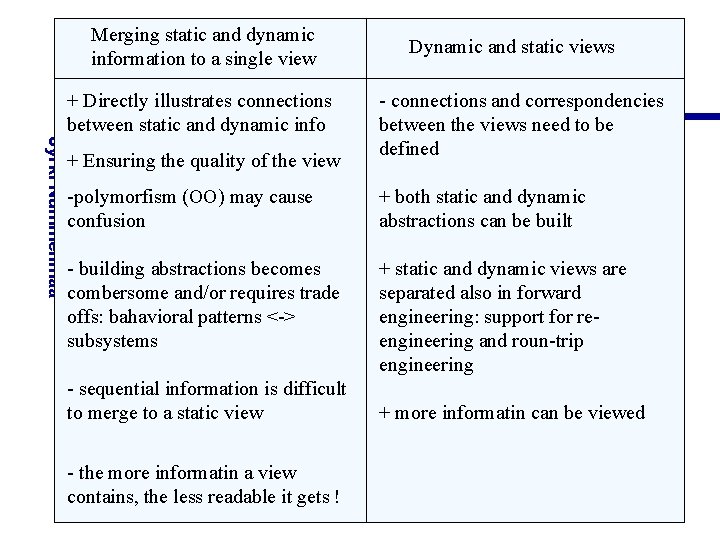
Merging static and dynamic information to a single view + Directly illustrates connections between static and dynamic info University of Tampere, CS Department Jyrki Nummenmaa + Ensuring the quality of the view Dynamic and static views - connections and correspondencies between the views need to be defined -polymorfism (OO) may cause confusion + both static and dynamic abstractions can be built - building abstractions becomes combersome and/or requires trade offs: bahavioral patterns <-> subsystems + static and dynamic views are separated also in forward engineering: support for reengineering and roun-trip engineering - sequential information is difficult to merge to a static view + more informatin can be viewed Software a. Engineering – http: //www. cs. uta. fi/se - the more informatin view contains, the less readable it gets !
Analysing the static model University of Tampere, CS Department Jyrki Nummenmaa • • • Syntax, type checking, interfaces Control and data flow analysis Structure analysis Slicing and dicing (different ways to partition the software) Measuring the complexity Navigation Software Engineering – http: //www. cs. uta. fi/se
Analysing the dynamic model University of Tampere, CS Department Jyrki Nummenmaa • • Object creation and related dependencies Dynamic binding, polymorphism Method calls Looking for dead code/reachability analysis Memory management Performance and related problems Concurrency Software Engineering – http: //www. cs. uta. fi/se
Reverse engineering for OO software University of Tampere, CS Department Jyrki Nummenmaa • • • Dynamic behavior may be hard to detect from static model (creating and deleting objects, garbage collection, dynamic binding, …) -> this emphasises dynamic modelling Pure object languages support encapsulation (classes, packages, …) -> helps in static reverse engineering -> increases usability of metrics OO paradigm supports the use of design patterns -> reusability applications (pattern recognition) Software Engineering – http: //www. cs. uta. fi/se
Round-trip engineering University of Tampere, CS Department Jyrki Nummenmaa • • • Forward and backword (reverse) engineering combined Most typical OO example: producing source code from class diagrams and class diagrams from source code. As another example, a design tool may support automatic (or mostly automatic) translation from ER-model to relational model and back. Software Engineering – http: //www. cs. uta. fi/se
Why round-trip engineering? /2 University of Tampere, CS Department Jyrki Nummenmaa • • • Assume that you first model your software using UML. Typically, it is possible to automatically generate source code files (say, Java) from a class diagram. Eventually someone will touch the source code in such a way that the class diagram is no longer valid and the classes are not to be re-generated from the class diagram. After that, you will just spend the rest of project hoping that no-one will have a look at the class diagrams Of course, you may manually update your class diagrams Software Engineering – http: //www. cs. uta. fi/se
Why round-trip engineering? /3 University of Tampere, CS Department Jyrki Nummenmaa • • Some software development tools automatically generate source code. However, it may be that they do not generate the UML diagrams. Or, if they do, they may be in a format, which your UML design tools do not know how to read. Again, of course, you may manually update your class diagrams Software Engineering – http: //www. cs. uta. fi/se
Tools University of Tampere, CS Department Jyrki Nummenmaa • Tools supporting creation of high-level models • Tools supporting metrics • Forward & reverse engineering – re-engineering & round-trip-engineering &testing • Other tools – parser generators – design pattern recognition Software Engineering – http: //www. cs. uta. fi/se
Tools University of Tampere, CS Department Jyrki Nummenmaa • Rigi (University of Victoria, Canada) – http: //www. rigi. csc. uvic. ca/ – a research prototype that represents an open and public domain reverse engineering tool – user programmable – analysis for: C, C++, COBOL, PL/AS, La. Te. X • SNIFF+ (Take. Five Software) – a software development environment that also provides reverse engineering capabilities Software Engineering – http: //www. cs. uta. fi/se
Tools • University of Tampere, CS Department Jyrki Nummenmaa Mc. Cabe’s Visual Reengineering Toolset and Visual Quality Toolset – various views – software metrics (complexity and structuredness) • shown as specific colors on the views • Logiscope (CS Verilog) – reverse eng, code testing, static and dynamic testing, metrics – analysis for: C, C++, Java, ADA • ESW (Viasoft Inc. ) – forward and reverse engineering (maintenance), metrics, testing Software Engineering – http: //www. cs. uta. fi/se
Tools University of Tampere, CS Department Jyrki Nummenmaa • Refine (Reasoning Systems Inc. ) – an open and programmable tool that works in the Refinery environment • tools for generating source code parsing and conversion tools • – features for analyzing and re-engineering code – analysis for: Ada, C, Cobol Imagix 4 D (Imagix Corp. ) – http: //www. powersoftware. com/english/im/index. html – a closed tool that provides a large set of built-in functionalities – several views (also 3 D) – analysis for: C/C++ Software Engineering – http: //www. cs. uta. fi/se
Tools for OO languages University of Tampere, CS Department Jyrki Nummenmaa • Produce a class diagram from code – – – – Rational Rose (Rational Software Corp. ) Paradigm Plus (Computer Associates International) OEW (Innovative Software Gmb. H) Graphical Designer (Advanced Software Technologies Inc. ) Domain Objects (Domain Objects Inc. ) COOL: Jex (Sterling Software Inc. ) Fujaba (Paderborn University). . . Software Engineering – http: //www. cs. uta. fi/se