
Three School of Bargaining Ethics Negotiations By Andrs
Three School of Bargaining Ethics Negotiations By: Andrés Banús & Rita Benmakhlouf

The Three Schools Schoo l SCHOOL
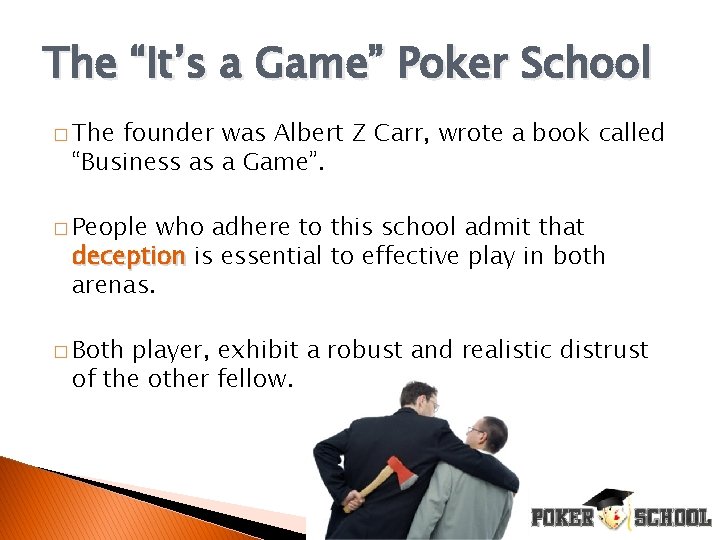
The “It’s a Game” Poker School � The founder was Albert Z Carr, wrote a book called “Business as a Game”. � People who adhere to this school admit that deception is essential to effective play in both arenas. � Both player, exhibit a robust and realistic distrust of the other fellow.
How to Play � Someone opens, and then people take turns proposing terms to each other. You can play or pass in each round. � The goal is to get the other side to agree to terms that are close as possible to your last proposal.
Flaws in the Game � The fact that bargaining is a game, the idealists and the pragmatists do not agree about this idea. � Every player is supposed to know the rules. This is impossible since the rules change in different industries and regions of the world. � The laws differ even within a single jurisdiction, so often a lawyer is needed to decide what to do.
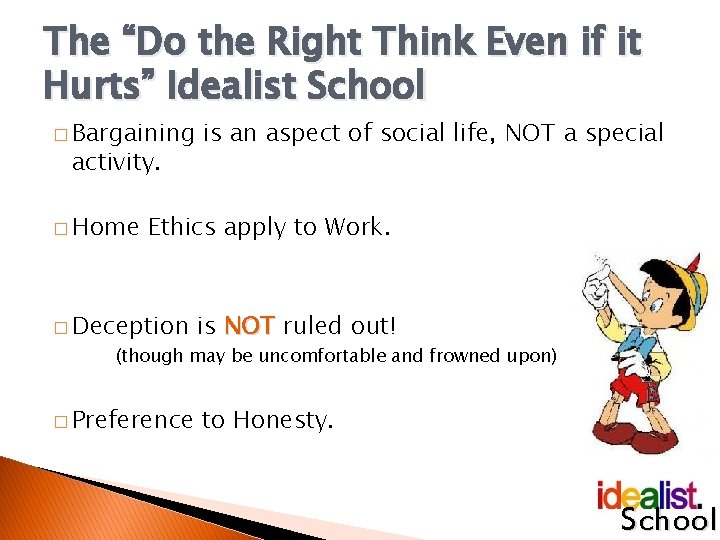
The “Do the Right Think Even if it Hurts” Idealist School � Bargaining activity. � Home is an aspect of social life, NOT a special Ethics apply to Work. � Deception is NOT ruled out! � Preference to Honesty. (though may be uncomfortable and frowned upon) School
The Goody Two-Shoes � Filled with Romanticism. (Draws it’s power from Philosophy & Religion) � Negotiation � Tie is NOT a game! Business with Social Life. School
The ‘’ what goes around comes around’’ Pragmatist School � In common with the Poker School, they view deception as a necessary part of the negotiation process. � They prefer not to use misleading statements or lie if there is practical alternative. � People adhere to this school more for prudential than idealistic reasons. SCHOO
� Pragmatist sometimes draw fine distinction between lies about hard core facts of a transaction. � Pragmatists have different technique such as , to avoid answering questions, false justification. SCHOO
The Ethical Schools in Action! � Assume you are negotiating to sell a commercial building and the other party asks whether you have another offer. (You DO NOT) NOT � What would the three schools recommend? Schoo l SCHOOL
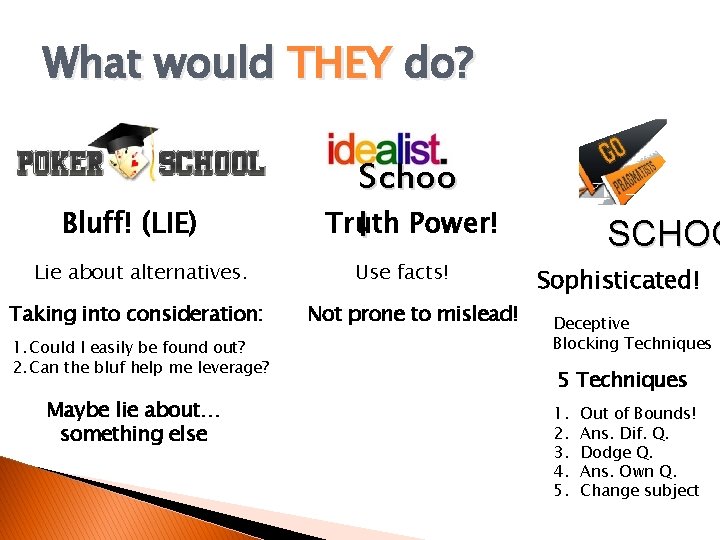
What would THEY do? Bluff! (LIE) Lie about alternatives. Taking into consideration: 1. Could I easily be found out? 2. Can the bluf help me leverage? Maybe lie about… something else Schoo Truth l Power! Use facts! Not prone to mislead! SCHOO Sophisticated! Deceptive Blocking Techniques 5 Techniques 1. 2. 3. 4. 5. Out of Bounds! Ans. Dif. Q. Dodge Q. Ans. Own Q. Change subject
What could ANYONE do? � BLOCK! � Preserve leverage (without being deceptive) � Preserve relationships and reputation. Poker Players tend to like more leverage. � Pragmatics discourage this if if lie may come back to haunt you.
Which school do YOU belong to? Schoo l SCHOOL

Thank you for your attention!
- Slides: 14