Chapter 5 Choosing Your Strategy Winlose strategies Recap






- Slides: 22
Chapter 5 Choosing Your Strategy
Win-lose strategies: Recap • Also known as bargaining, haggling or positional bargaining – Get what you want using power – Power generates resistance as reaction – Conditions: big power difference & short-term concern – Riskier on average than win-win © Pearson Education South Asia Pte Ltd 2
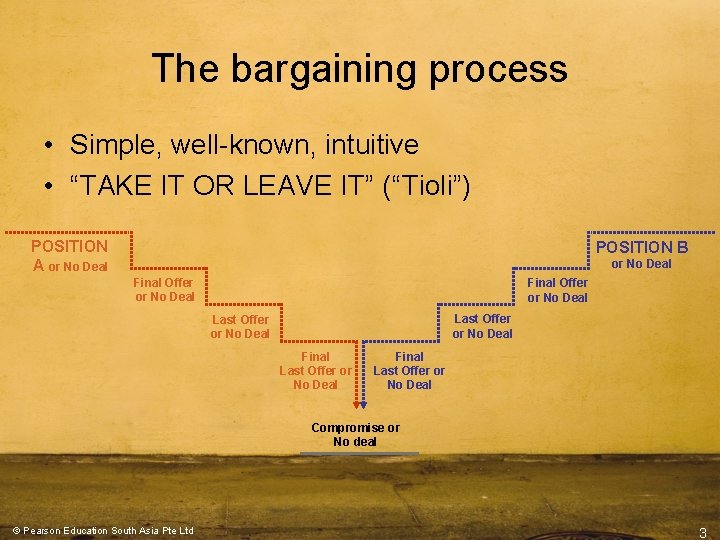
The bargaining process • Simple, well-known, intuitive • “TAKE IT OR LEAVE IT” (“Tioli”) POSITION A or No Deal POSITION B or No Deal Final Offer or No Deal Last Offer or No Deal Final Last Offer or No Deal Compromise or No deal © Pearson Education South Asia Pte Ltd 3
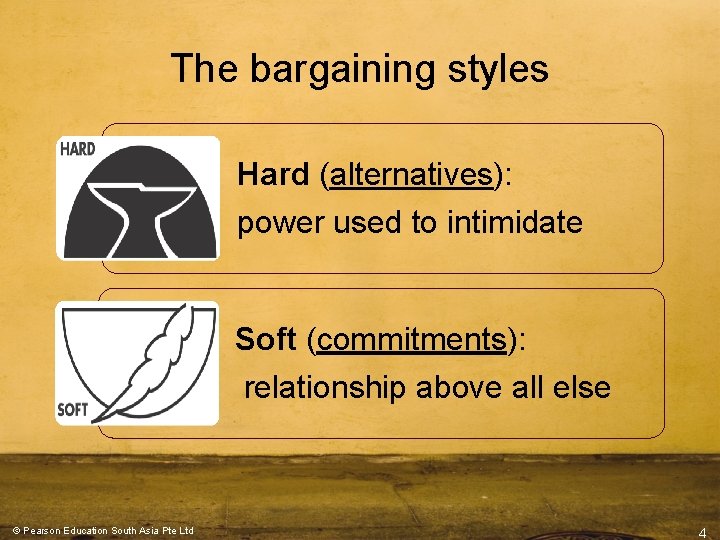
The bargaining styles Hard (alternatives): power used to intimidate Soft (commitments): relationship above all else © Pearson Education South Asia Pte Ltd 4
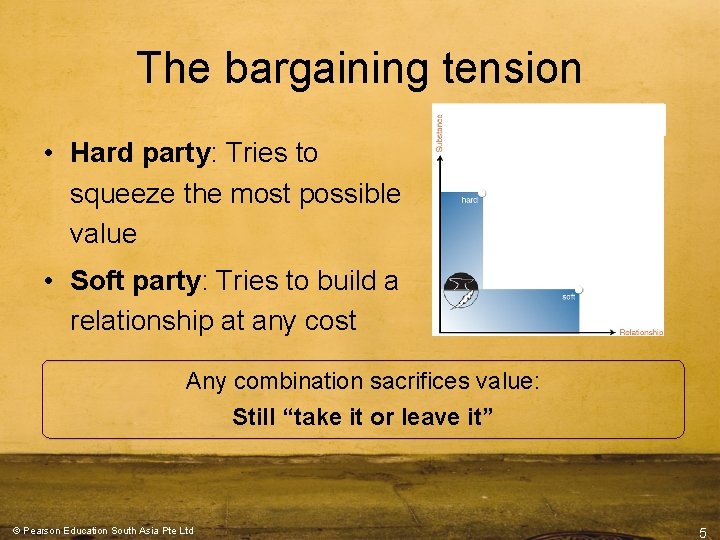
The bargaining tension • Hard party: Tries to squeeze the most possible value • Soft party: Tries to build a relationship at any cost Any combination sacrifices value: Still “take it or leave it” © Pearson Education South Asia Pte Ltd 5
Win-win strategies: Recap • Get what you want independently from power • Collaboration and communication: no resistance • Tit-for-tat: proactive, clear communication towards a value-focused process • Higher value at lower risk than win-lose Value © Pearson Education South Asia Pte Ltd 6
Win-win processes Strategy Focus Risk Interest-based Interests X Positions Discuss few interests and still fall into a bargaining trap Mutual gains Options to benefit everyone Create too many options and still bargain to split them Principled Win-win choices Overwhelming number of decisions and lose focus Value Negotiation Value Adopt win-lose if failure to consider ways towards value © Pearson Education South Asia Pte Ltd 7
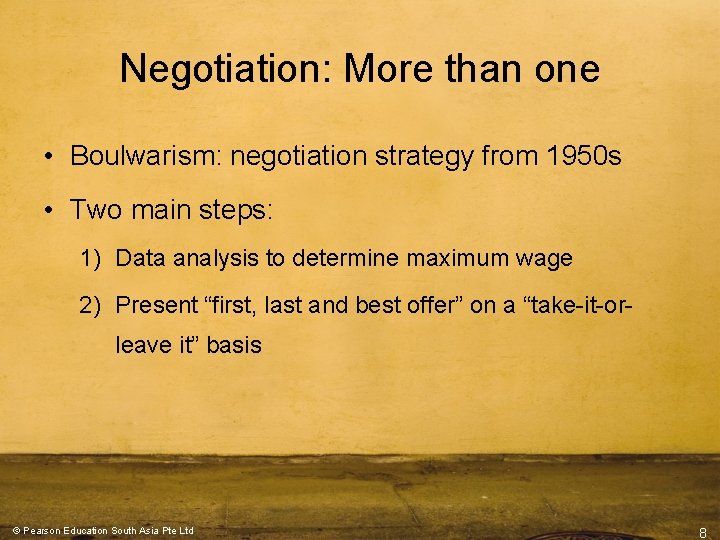
Negotiation: More than one • Boulwarism: negotiation strategy from 1950 s • Two main steps: 1) Data analysis to determine maximum wage 2) Present “first, last and best offer” on a “take-it-orleave it” basis © Pearson Education South Asia Pte Ltd 8
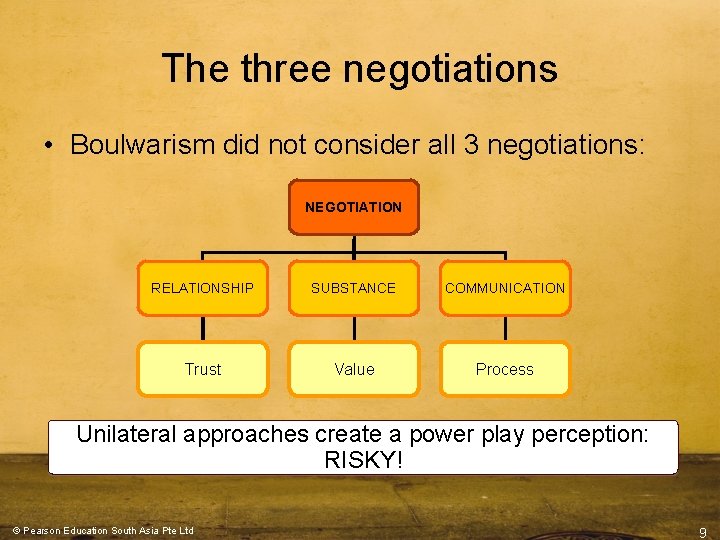
The three negotiations • Boulwarism did not consider all 3 negotiations: NEGOTIATION RELATIONSHIP SUBSTANCE COMMUNICATION Trust Value Process Unilateral approaches create a power play perception: RISKY! © Pearson Education South Asia Pte Ltd 9
The three win-lose negotiations • Win-lose strategies treat each negotiation as a different power source NEGOTIATION RELATIONSHIP SUBSTANCE COMMUNICATION Manipulation Power differences Information asymmetry © Pearson Education South Asia Pte Ltd 10
The three win-win negotiations • Win-win strategies explore all three negotiations to unlock their value potential – Independent – Simultaneous NEGOTIATION RELATIONSHIP SUBSTANCE COMMUNICATION Trust Value Process – Parallel – Interconnected © Pearson Education South Asia Pte Ltd 11
The three win-win negotiations • Ultimate purpose of relationship & communication negotiation: – To maximize the substance negotiation value NEGOTIATION RELATIONSHIP SUBSTANCE COMMUNICATION Trust Value Process © Pearson Education South Asia Pte Ltd 12
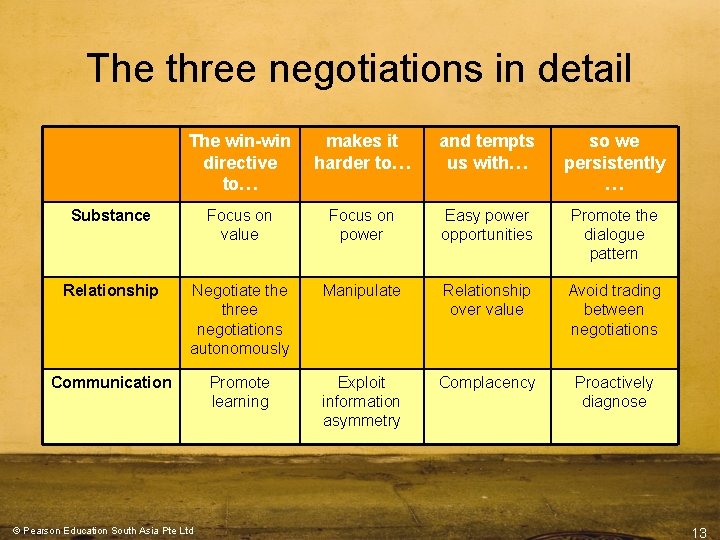
The three negotiations in detail The win-win directive to… makes it harder to… and tempts us with… so we persistently … Substance Focus on value Focus on power Easy power opportunities Promote the dialogue pattern Relationship Negotiate three negotiations autonomously Manipulate Relationship over value Avoid trading between negotiations Communication Promote learning Exploit information asymmetry Complacency Proactively diagnose © Pearson Education South Asia Pte Ltd 13
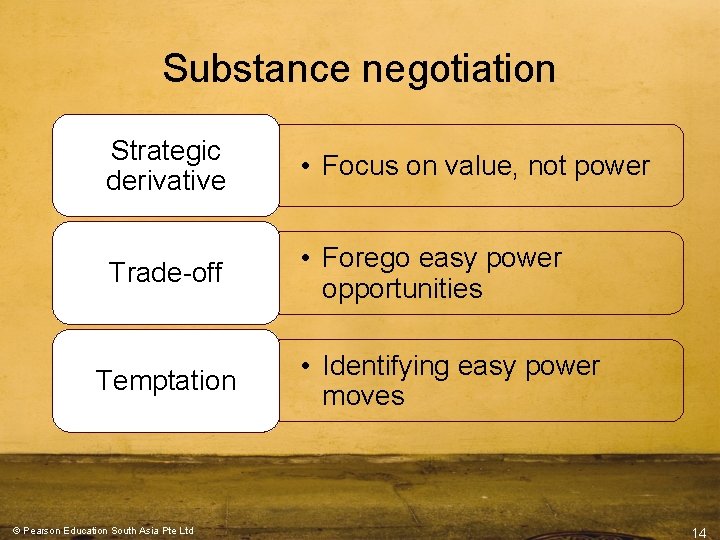
Substance negotiation Strategic derivative • Focus on value, not power Trade-off • Forego easy power opportunities Temptation © Pearson Education South Asia Pte Ltd • Identifying easy power moves 14
Focus on value • Demonstrates to the other party that there is no need for a race for power • Can be difficult in two situations: 1) The only thing they concentrate on is power 2) Easy power moves continuously present themselves © Pearson Education South Asia Pte Ltd 15
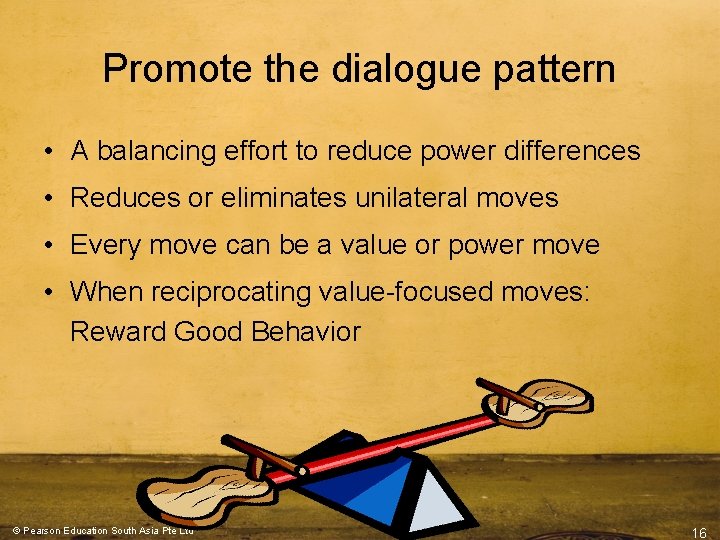
Promote the dialogue pattern • A balancing effort to reduce power differences • Reduces or eliminates unilateral moves • Every move can be a value or power move • When reciprocating value-focused moves: Reward Good Behavior © Pearson Education South Asia Pte Ltd 16
Relationship negotiation Strategic derivative • Negotiate 3 negotiations autonomously Trade-off • Forego getting value for free Temptation • Relationship over value © Pearson Education South Asia Pte Ltd 17
Negotiate autonomously • Mixing the 3 negotiations rewards bad behavior • Example: FARC in Colombia – The president gave away piece of land (substance) in hopes of starting a relationship + communication process – Established a negative negotiation pattern of unilateral substance demands © Pearson Education South Asia Pte Ltd 18
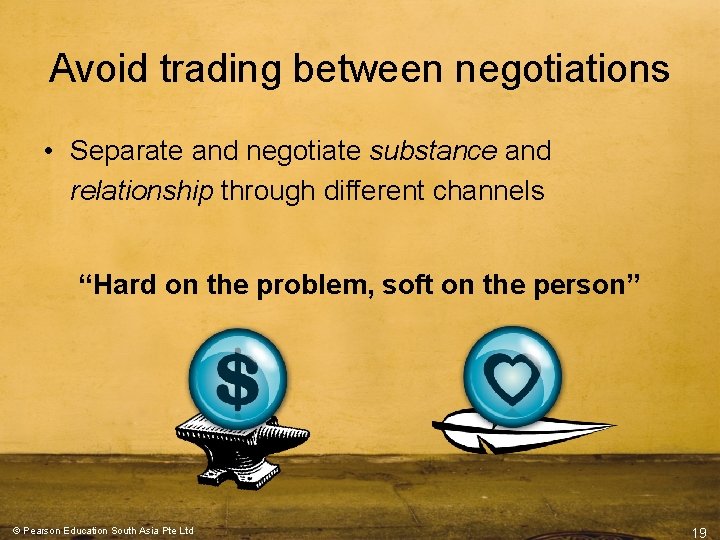
Avoid trading between negotiations • Separate and negotiate substance and relationship through different channels “Hard on the problem, soft on the person” © Pearson Education South Asia Pte Ltd 19
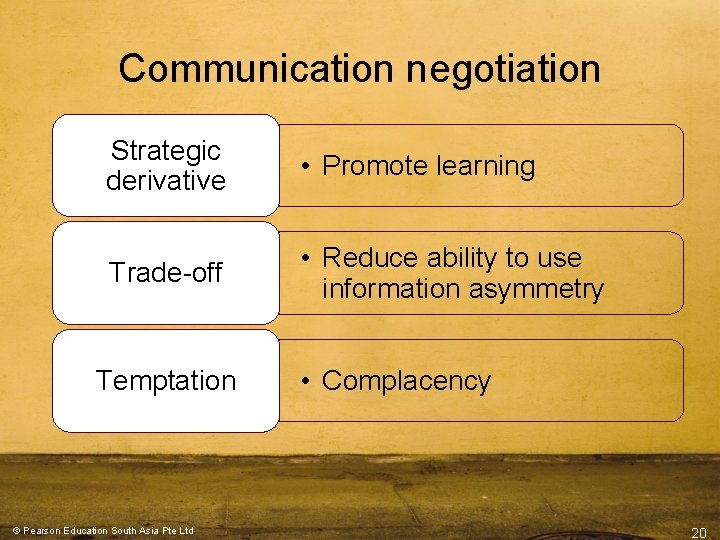
Communication negotiation Strategic derivative • Promote learning Trade-off • Reduce ability to use information asymmetry Temptation © Pearson Education South Asia Pte Ltd • Complacency 20
Promote learning • Learn as much as possible from the available data – Boulwarism failed the hardest: Did not learn what the unions’ interests really were Learning reduces information asymmetry and the temptation to bargain. © Pearson Education South Asia Pte Ltd 21
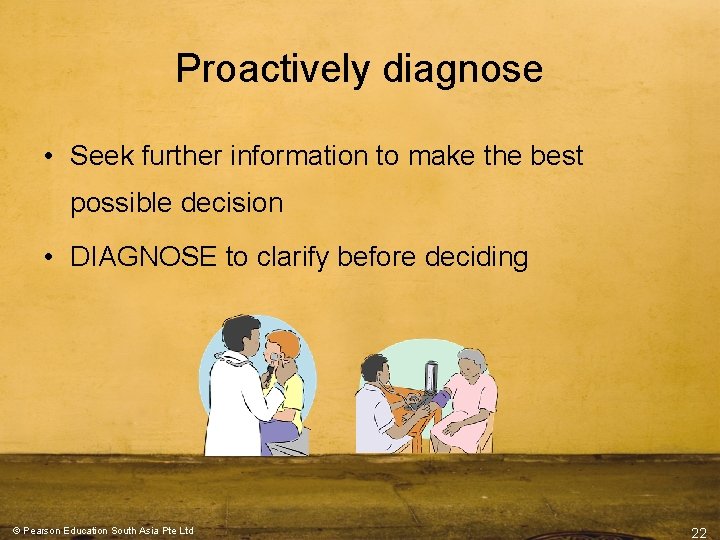
Proactively diagnose • Seek further information to make the best possible decision • DIAGNOSE to clarify before deciding © Pearson Education South Asia Pte Ltd 22