National Program of Cancer Registries Education and Training


- Slides: 93
National Program of Cancer Registries Education and Training Series How to Collect High Quality Cancer Surveillance Data
NAACCR Administers NPCR-Education Contract for the Centers for Disease Control and Prevention (CDC) Awarded in _____2001 Contract Number: #200 -2001 -00044
Anatomy of the Colon and Rectum
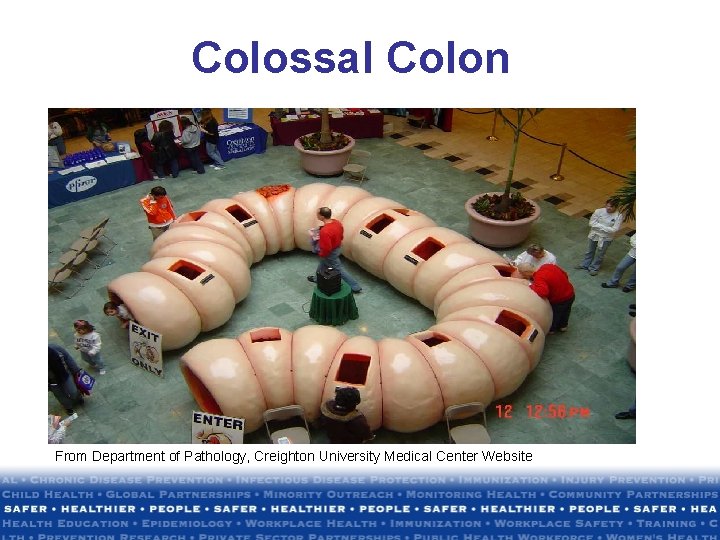
Colossal Colon From Department of Pathology, Creighton University Medical Center Website
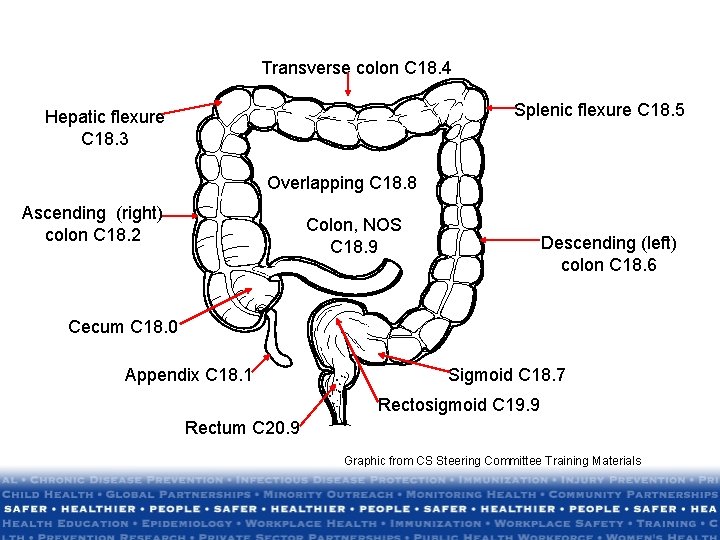
Transverse colon C 18. 4 Splenic flexure C 18. 5 Hepatic flexure C 18. 3 Overlapping C 18. 8 Ascending (right) colon C 18. 2 Colon, NOS C 18. 9 Descending (left) colon C 18. 6 Cecum C 18. 0 Appendix C 18. 1 Sigmoid C 18. 7 Rectosigmoid C 19. 9 Rectum C 20. 9 Graphic from CS Steering Committee Training Materials
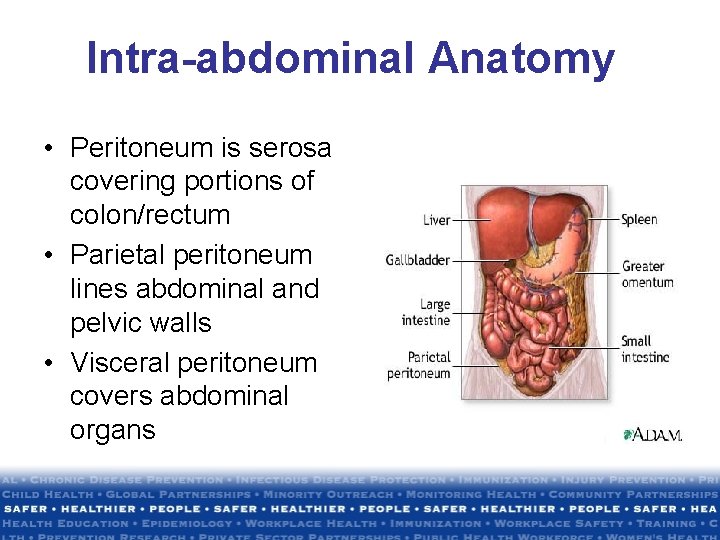
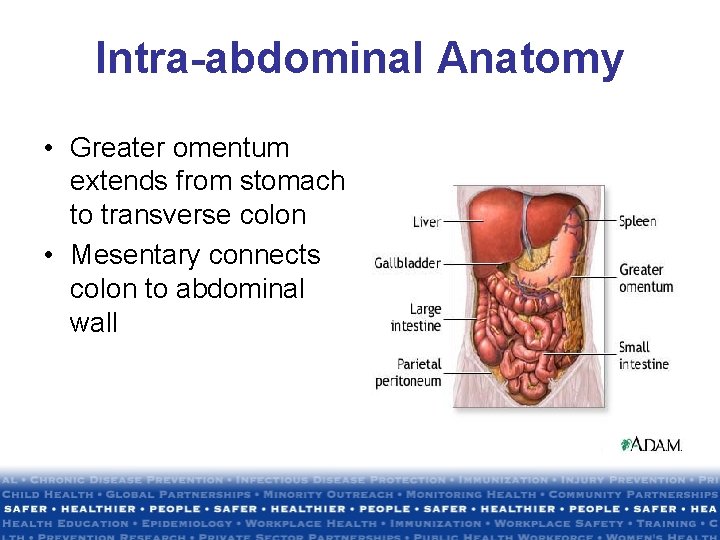
Intra-abdominal Anatomy • Peritoneum is serosa covering portions of colon/rectum • Parietal peritoneum lines abdominal and pelvic walls • Visceral peritoneum covers abdominal organs
Intra-abdominal Anatomy • Greater omentum extends from stomach to transverse colon • Mesentary connects colon to abdominal wall
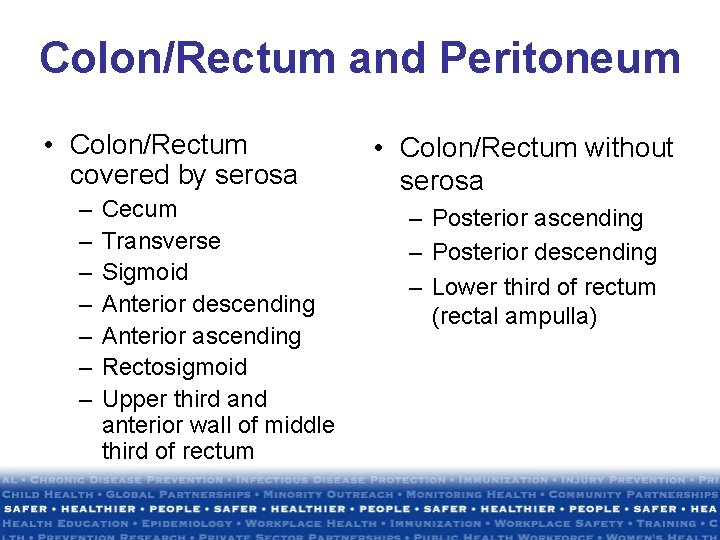
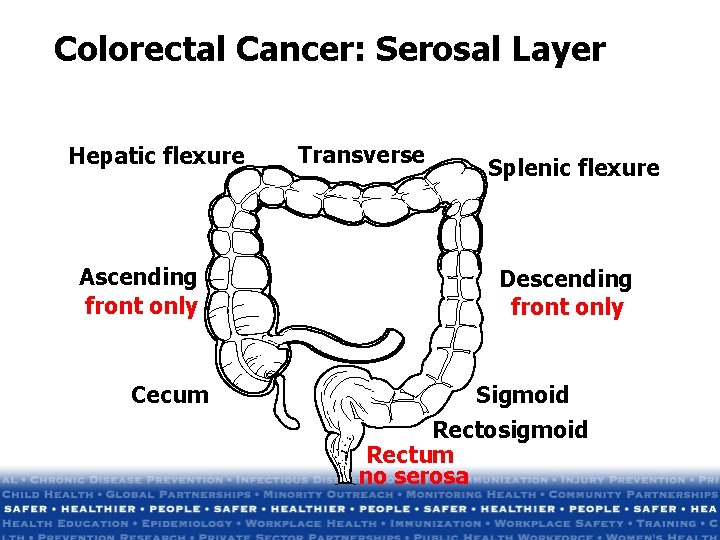
Colon/Rectum and Peritoneum • Colon/Rectum covered by serosa – – – – Cecum Transverse Sigmoid Anterior descending Anterior ascending Rectosigmoid Upper third anterior wall of middle third of rectum • Colon/Rectum without serosa – Posterior ascending – Posterior descending – Lower third of rectum (rectal ampulla)
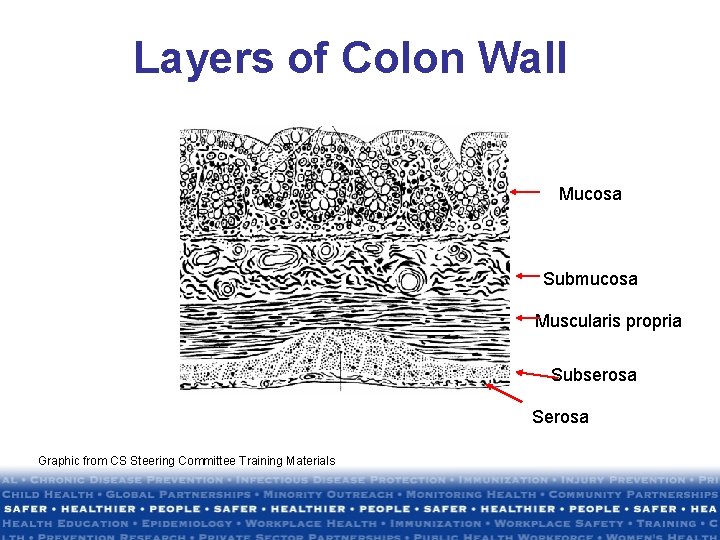
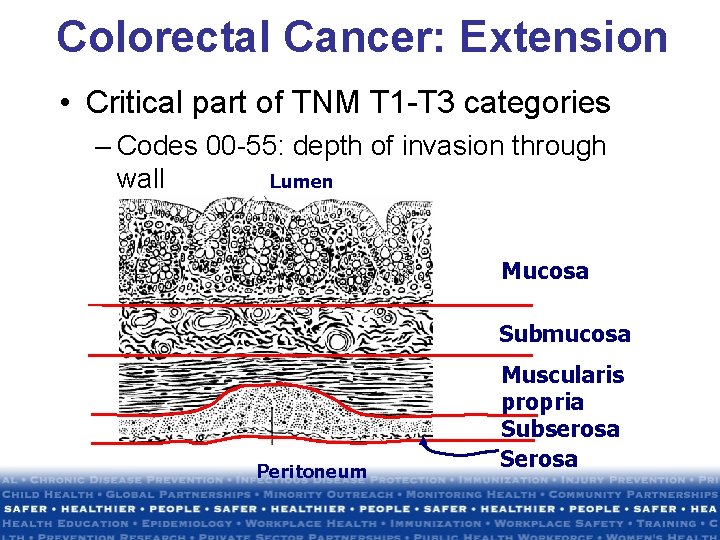
Layers of Colon Wall Mucosa Submucosa Muscularis propria Subserosa Serosa Graphic from CS Steering Committee Training Materials
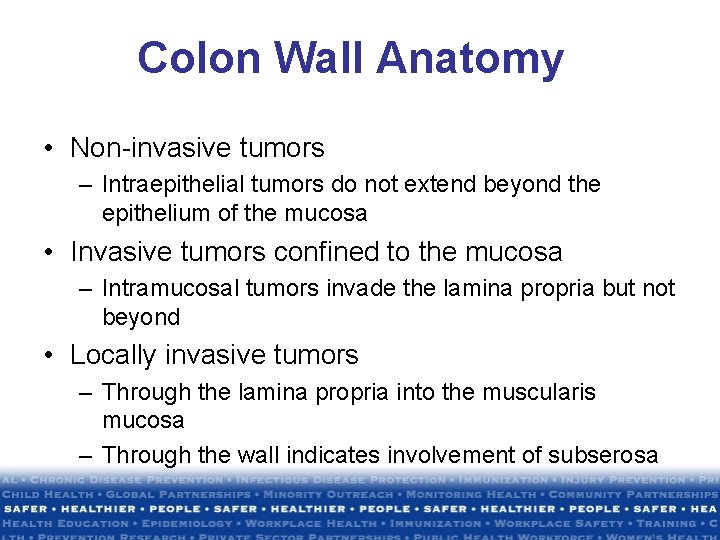
Colon Wall Anatomy • Non-invasive tumors – Intraepithelial tumors do not extend beyond the epithelium of the mucosa • Invasive tumors confined to the mucosa – Intramucosal tumors invade the lamina propria but not beyond • Locally invasive tumors – Through the lamina propria into the muscularis mucosa – Through the wall indicates involvement of subserosa
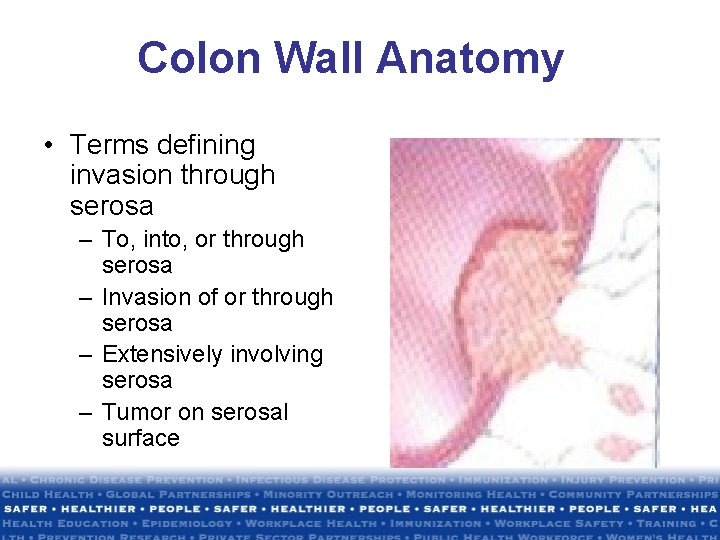
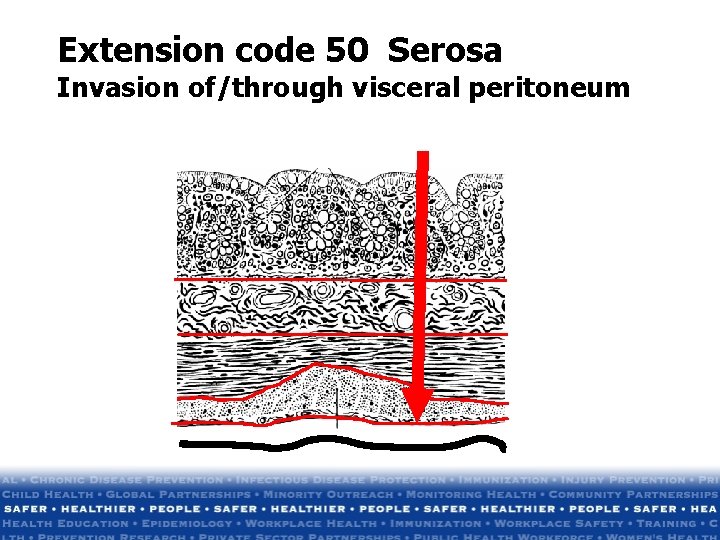
Colon Wall Anatomy • Terms defining invasion through serosa – To, into, or through serosa – Invasion of or through serosa – Extensively involving serosa – Tumor on serosal surface
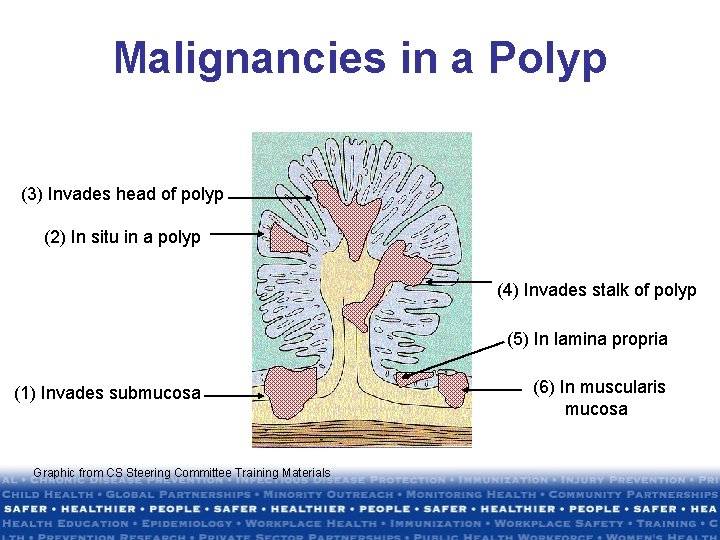
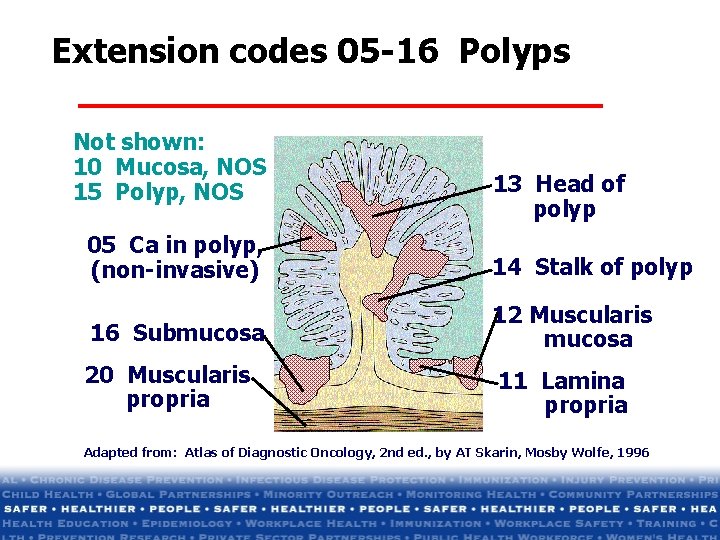
Malignancies in a Polyp (3) Invades head of polyp (2) In situ in a polyp (4) Invades stalk of polyp (5) In lamina propria (1) Invades submucosa Graphic from CS Steering Committee Training Materials (6) In muscularis mucosa
ICD-O-3 Histology Coding Colon and Rectum
Caution!! Pre-2007 Multiple Primary and Histology Rules used in the following slides are based on 2006 rules.
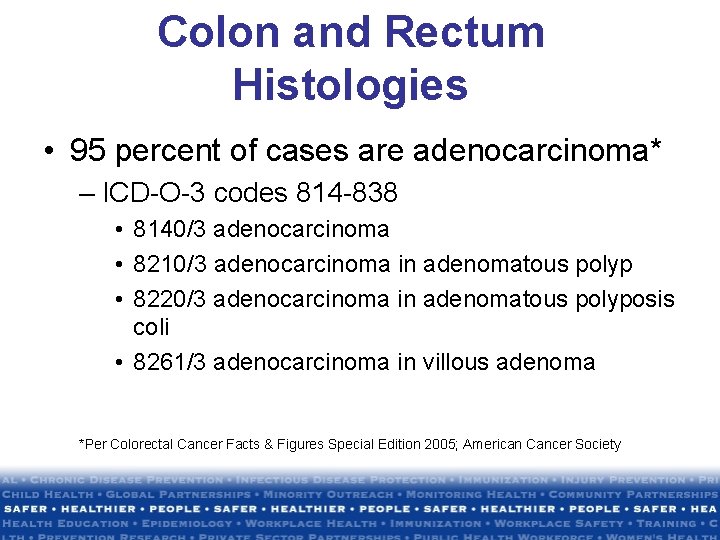
Colon and Rectum Histologies • 95 percent of cases are adenocarcinoma* – ICD-O-3 codes 814 -838 • 8140/3 adenocarcinoma • 8210/3 adenocarcinoma in adenomatous polyp • 8220/3 adenocarcinoma in adenomatous polyposis coli • 8261/3 adenocarcinoma in villous adenoma *Per Colorectal Cancer Facts & Figures Special Edition 2005; American Cancer Society
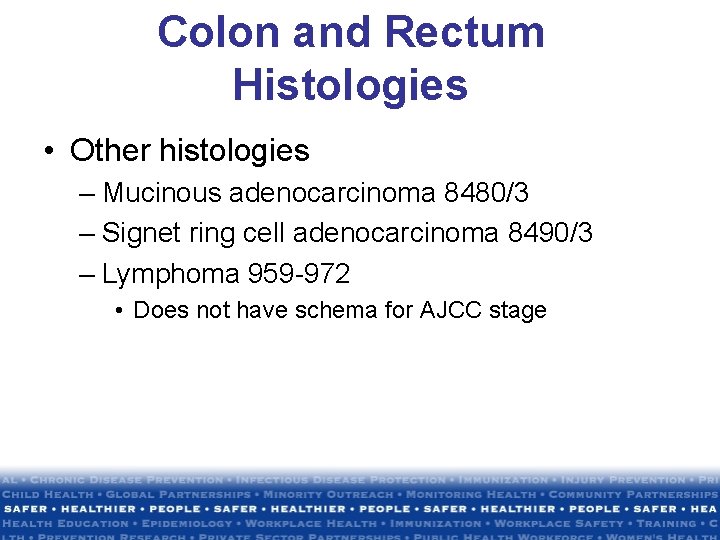
Colon and Rectum Histologies • Other histologies – Mucinous adenocarcinoma 8480/3 – Signet ring cell adenocarcinoma 8490/3 – Lymphoma 959 -972 • Does not have schema for AJCC stage
Histology Coding Rules: Colon/Rectum • Rules are a hierarchy • Use rules in priority order with rule 1 having highest priority • Use the first rule that applies • Rules from SEER Program Coding and Staging Manual (PCSM) 2004, pages 8687
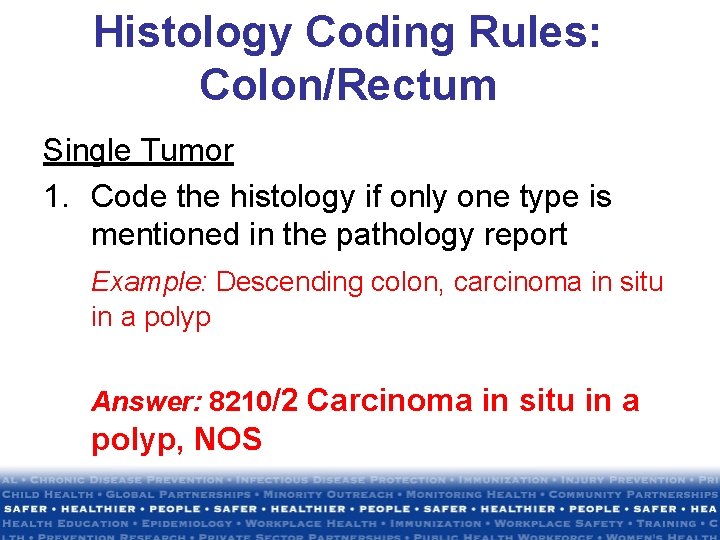
Histology Coding Rules: Colon/Rectum Single Tumor 1. Code the histology if only one type is mentioned in the pathology report Example: Descending colon, carcinoma in situ in a polyp Answer: 8210/2 Carcinoma in situ in a polyp, NOS
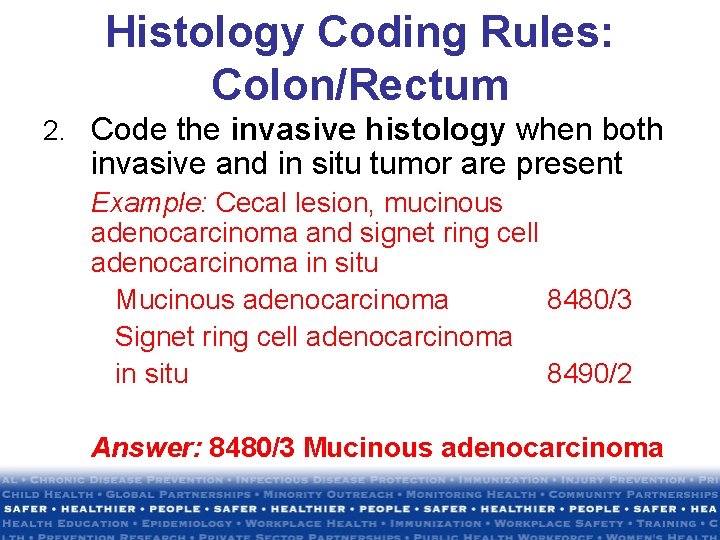
Histology Coding Rules: Colon/Rectum 2. Code the invasive histology when both invasive and in situ tumor are present Example: Cecal lesion, mucinous adenocarcinoma and signet ring cell adenocarcinoma in situ Mucinous adenocarcinoma 8480/3 Signet ring cell adenocarcinoma in situ 8490/2 Answer: 8480/3 Mucinous adenocarcinoma
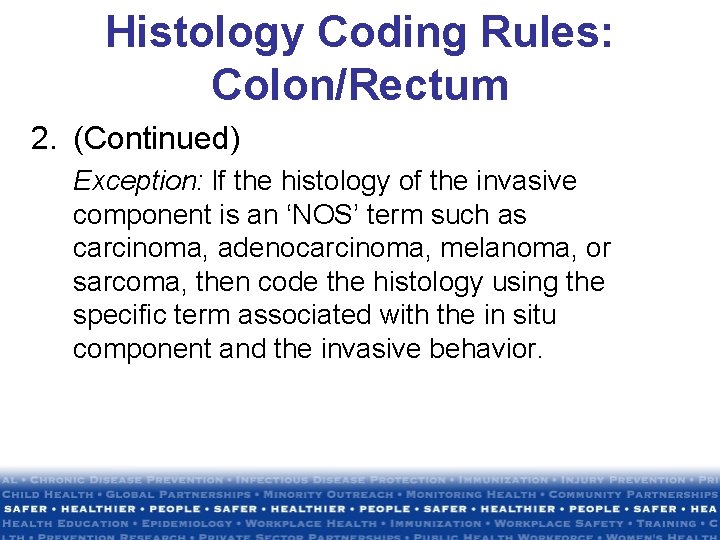
Histology Coding Rules: Colon/Rectum 2. (Continued) Exception: If the histology of the invasive component is an ‘NOS’ term such as carcinoma, adenocarcinoma, melanoma, or sarcoma, then code the histology using the specific term associated with the in situ component and the invasive behavior.
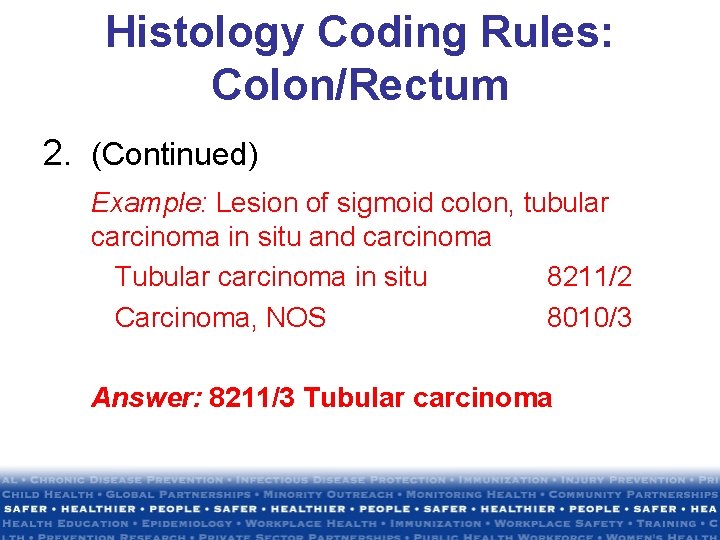
Histology Coding Rules: Colon/Rectum 2. (Continued) Example: Lesion of sigmoid colon, tubular carcinoma in situ and carcinoma Tubular carcinoma in situ 8211/2 Carcinoma, NOS 8010/3 Answer: 8211/3 Tubular carcinoma
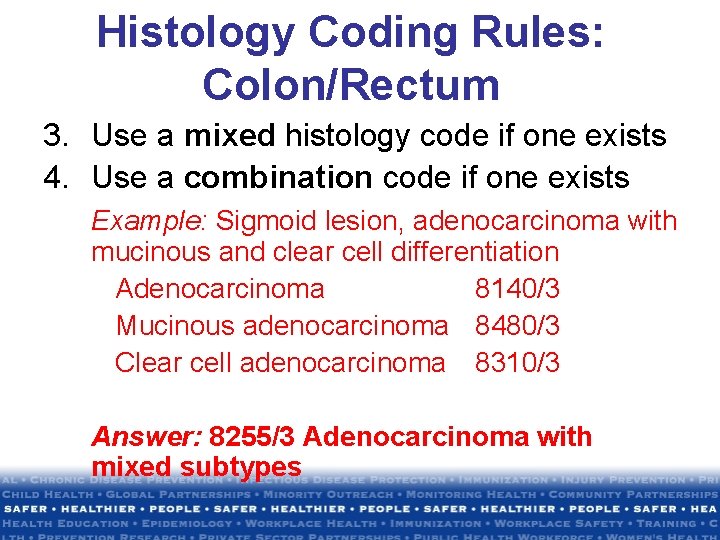
Histology Coding Rules: Colon/Rectum 3. Use a mixed histology code if one exists 4. Use a combination code if one exists Example: Sigmoid lesion, adenocarcinoma with mucinous and clear cell differentiation Adenocarcinoma 8140/3 Mucinous adenocarcinoma 8480/3 Clear cell adenocarcinoma 8310/3 Answer: 8255/3 Adenocarcinoma with mixed subtypes
Histology Coding Rules: Colon/Rectum 5. Code the more specific term when one of the terms is ‘NOS’ and the other is a more specific description of the same histology
Histology Coding Rules: Colon/Rectum 5. (Continued) Example: Descending colon lesion, adenocarcinoma and signet ring cell adenocarcinoma Adenocarcinoma 8140/3 Signet ring cell adenocarcinoma 8490/3 Answer: 8490/3 Signet ring cell adenocarcinoma
Histology Coding Rules: Colon/Rectum 6. Code the majority of the tumor Terms that mean majority of tumor: Predominantly; with features of; major; type (eff. 1/1/99); with…. differentiation (eff. 1/1/99); pattern and architecture (if in CAP protocol; eff. 1/1/2003) Terms documented in SEER PCSM 2004, page 85
Histology Coding Rules: Colon/Rectum 6. (Continued) Example: Splenic flexure tumor, signet ring cell carcinoma with features of mucinous carcinoma Signet ring cell carcinoma 8490/3 Mucinous carcinoma 8480/3 Answer: 8480/3 Mucinous carcinoma
Histology Coding Rules: Colon/Rectum 6. Code the majority of the tumor Terms that DO NOT mean majority of tumor With foci of; focus of/focal; areas of; elements of; component (eff. 1/1/99) Terms documented in SEER PCSM 2004, page 85
Histology Coding Rules: Colon/Rectum 6. (Continued) Example: Cecal tumor, solid carcinoma with focal signet ring cell carcinoma Solid carcinoma 8230/3 Signet ring cell carcinoma 8490/3 Answer: 8230/3 Solid carcinoma
Histology Coding Rules: Colon/Rectum 7. Code the numerically higher ICD-O-3 code Example: Descending colon lesion, clear cell adenocarcinoma and colloid adenocarcinoma Clear cell adenocarcinoma 8310/3 Colloid adenocarcinoma 8480/3 Answer: 8480/3, colloid adenocarcinoma
Histology Coding Rules: Colon/Rectum Multiple Tumors with Different Behaviors in Same Organ Reported as Single Primary Code the histology of the invasive tumor when one lesion is in situ and the other is invasive Example: 2 separate sigmoid polyps 1) adenocarcinoma in situ in polyp 8210/2 2) adenocarcinoma in polyp stalk 8210/3 Answer: 8210/3 Adenocarcinoma in polyp
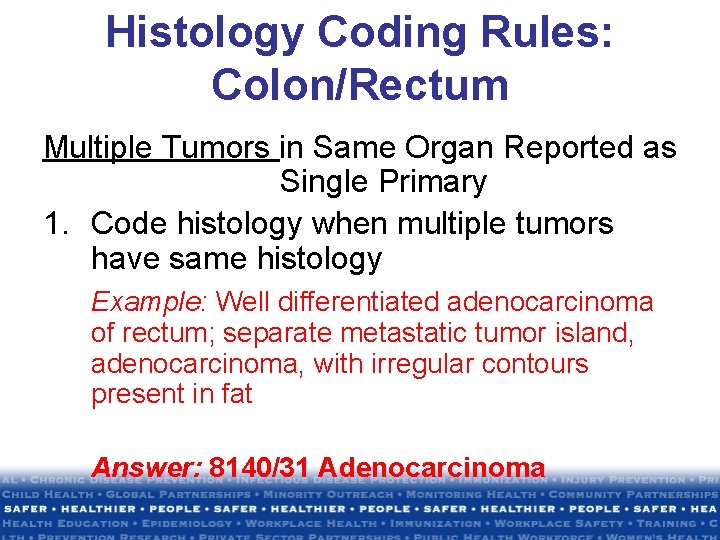
Histology Coding Rules: Colon/Rectum Multiple Tumors in Same Organ Reported as Single Primary 1. Code histology when multiple tumors have same histology Example: Well differentiated adenocarcinoma of rectum; separate metastatic tumor island, adenocarcinoma, with irregular contours present in fat Answer: 8140/31 Adenocarcinoma
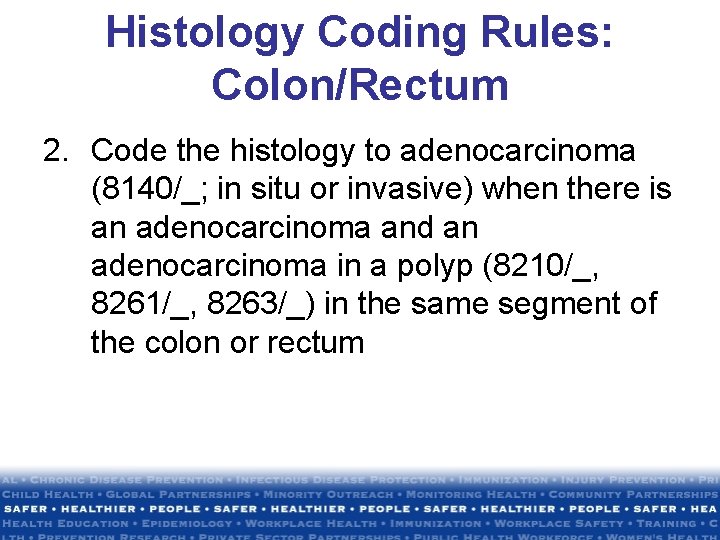
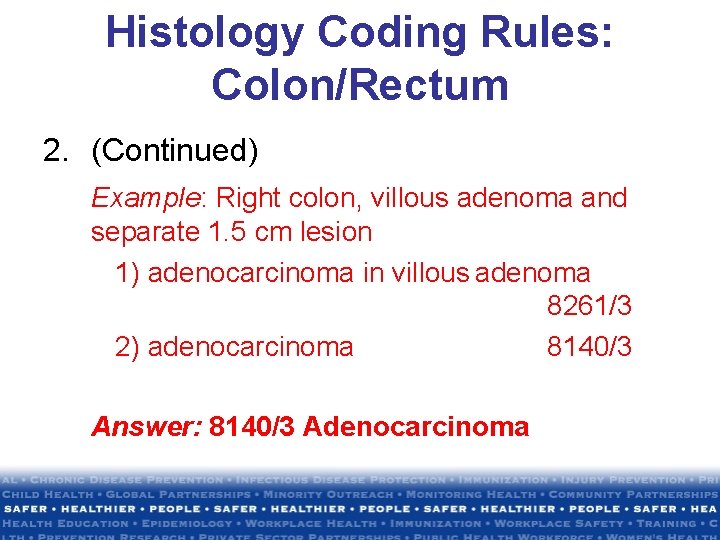
Histology Coding Rules: Colon/Rectum 2. Code the histology to adenocarcinoma (8140/_; in situ or invasive) when there is an adenocarcinoma and an adenocarcinoma in a polyp (8210/_, 8261/_, 8263/_) in the same segment of the colon or rectum
Histology Coding Rules: Colon/Rectum 2. (Continued) Example: Right colon, villous adenoma and separate 1. 5 cm lesion 1) adenocarcinoma in villous adenoma 8261/3 2) adenocarcinoma 8140/3 Answer: 8140/3 Adenocarcinoma
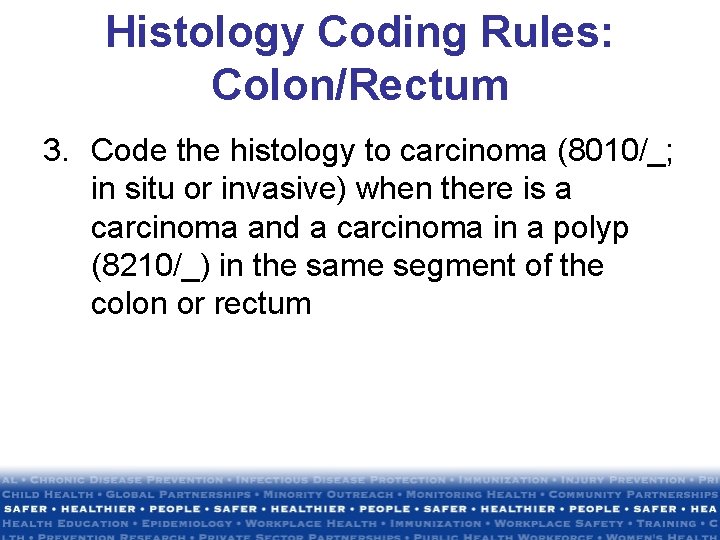
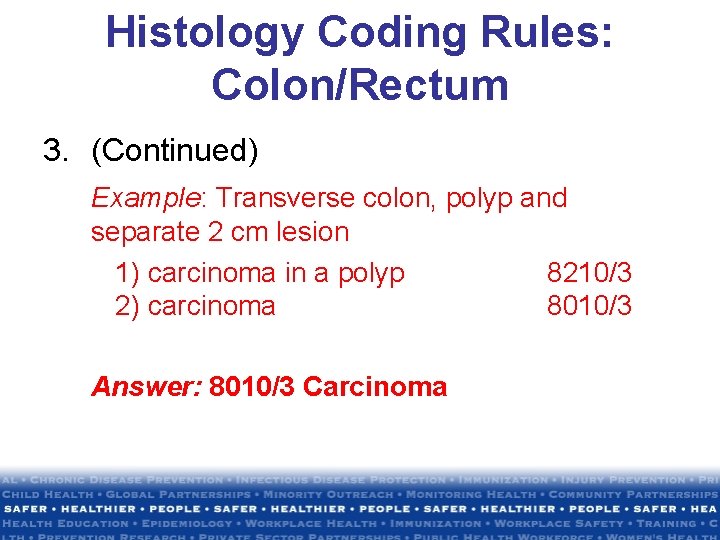
Histology Coding Rules: Colon/Rectum 3. Code the histology to carcinoma (8010/_; in situ or invasive) when there is a carcinoma and a carcinoma in a polyp (8210/_) in the same segment of the colon or rectum
Histology Coding Rules: Colon/Rectum 3. (Continued) Example: Transverse colon, polyp and separate 2 cm lesion 1) carcinoma in a polyp 8210/3 2) carcinoma 8010/3 Answer: 8010/3 Carcinoma
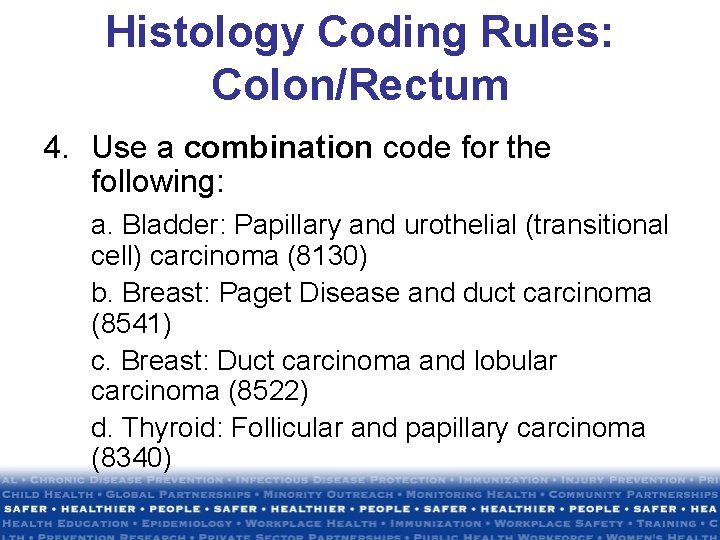
Histology Coding Rules: Colon/Rectum 4. Use a combination code for the following: a. Bladder: Papillary and urothelial (transitional cell) carcinoma (8130) b. Breast: Paget Disease and duct carcinoma (8541) c. Breast: Duct carcinoma and lobular carcinoma (8522) d. Thyroid: Follicular and papillary carcinoma (8340)
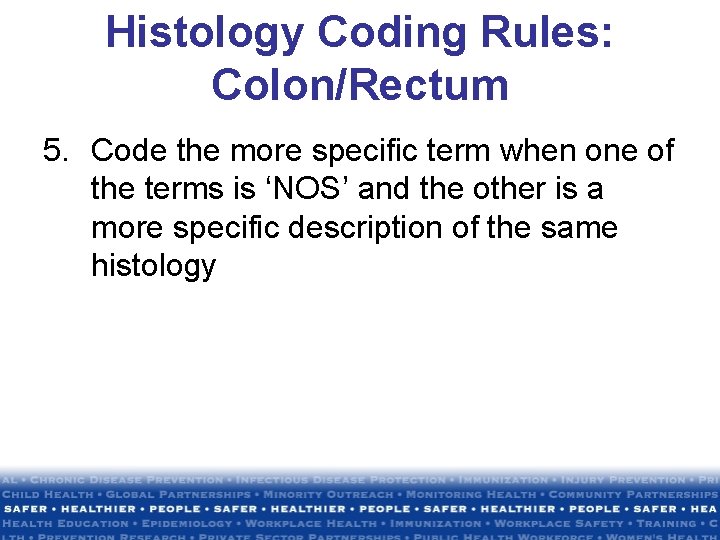
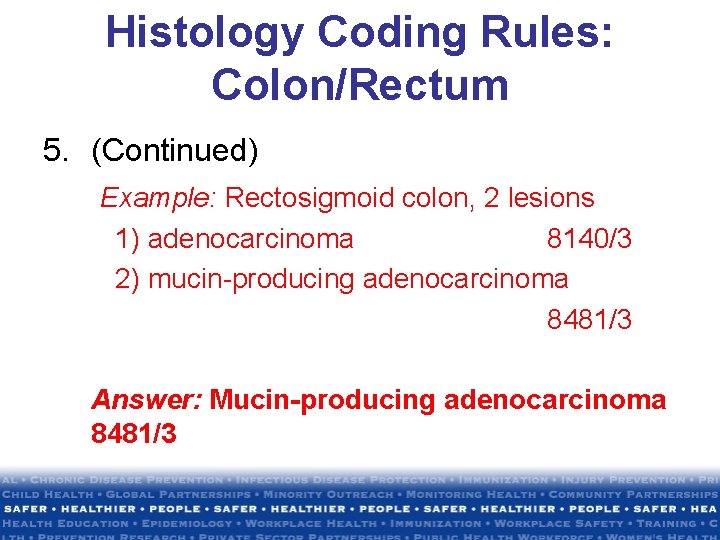
Histology Coding Rules: Colon/Rectum 5. Code the more specific term when one of the terms is ‘NOS’ and the other is a more specific description of the same histology
Histology Coding Rules: Colon/Rectum 5. (Continued) Example: Rectosigmoid colon, 2 lesions 1) adenocarcinoma 8140/3 2) mucin-producing adenocarcinoma 8481/3 Answer: Mucin-producing adenocarcinoma 8481/3
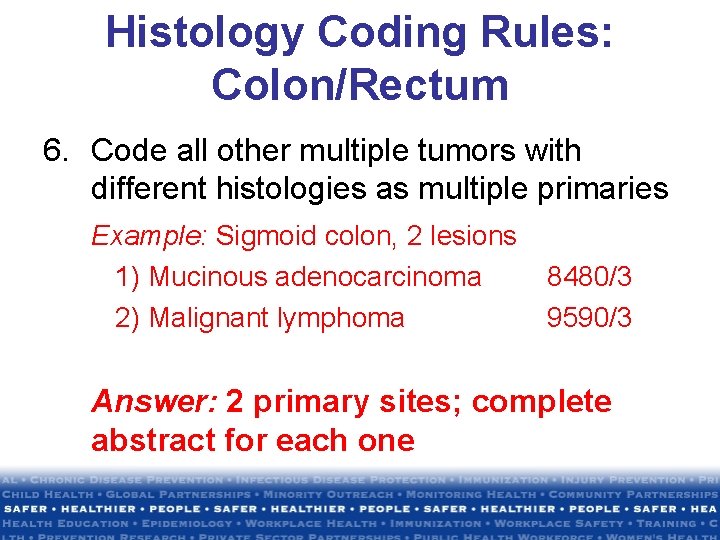
Histology Coding Rules: Colon/Rectum 6. Code all other multiple tumors with different histologies as multiple primaries Example: Sigmoid colon, 2 lesions 1) Mucinous adenocarcinoma 2) Malignant lymphoma 8480/3 9590/3 Answer: 2 primary sites; complete abstract for each one
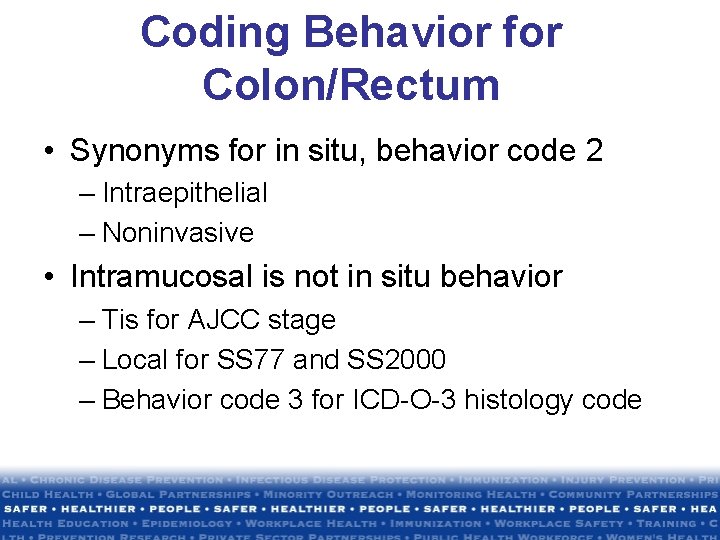
Coding Behavior for Colon/Rectum • Synonyms for in situ, behavior code 2 – Intraepithelial – Noninvasive • Intramucosal is not in situ behavior – Tis for AJCC stage – Local for SS 77 and SS 2000 – Behavior code 3 for ICD-O-3 histology code
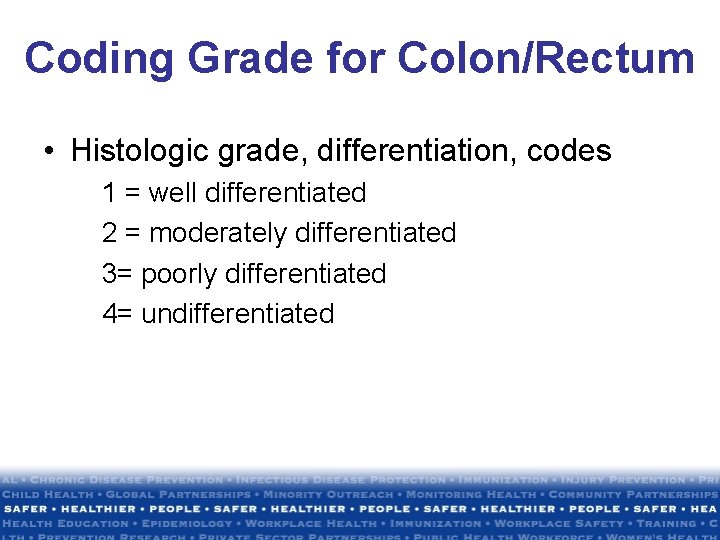
Coding Grade for Colon/Rectum • Histologic grade, differentiation, codes 1 = well differentiated 2 = moderately differentiated 3= poorly differentiated 4= undifferentiated
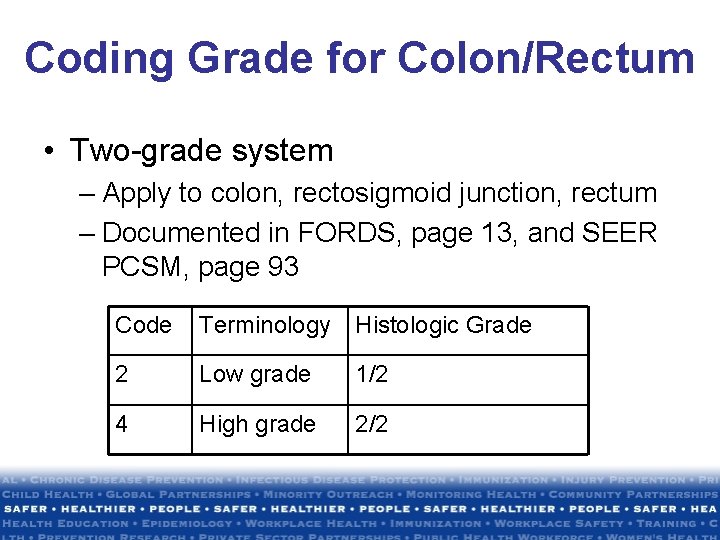
Coding Grade for Colon/Rectum • Two-grade system – Apply to colon, rectosigmoid junction, rectum – Documented in FORDS, page 13, and SEER PCSM, page 93 Code Terminology Histologic Grade 2 Low grade 1/2 4 High grade 2/2
Abstracting Colon and Rectum Cases
Date of Diagnosis: Colon/Rectum • Review all sources for first date of diagnosis – Physical exams – Imaging reports – Pathologic confirmation – Physicians and nurses notes – Consultation reports
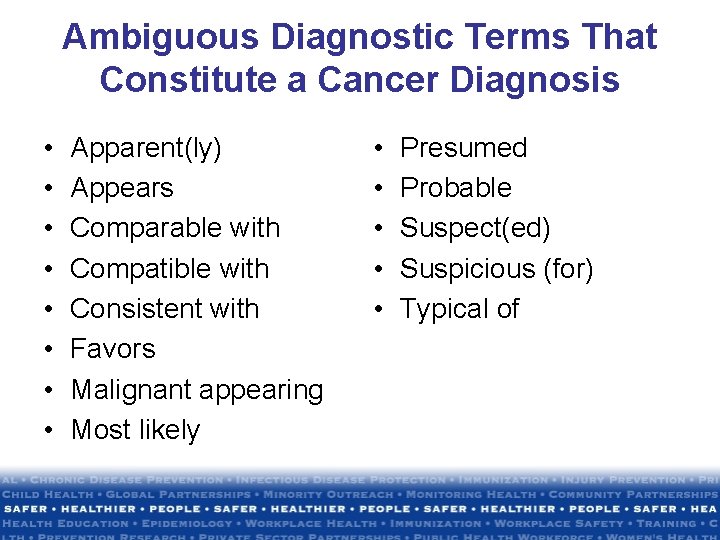
Ambiguous Diagnostic Terms That Constitute a Cancer Diagnosis • • Apparent(ly) Appears Comparable with Compatible with Consistent with Favors Malignant appearing Most likely • • • Presumed Probable Suspect(ed) Suspicious (for) Typical of
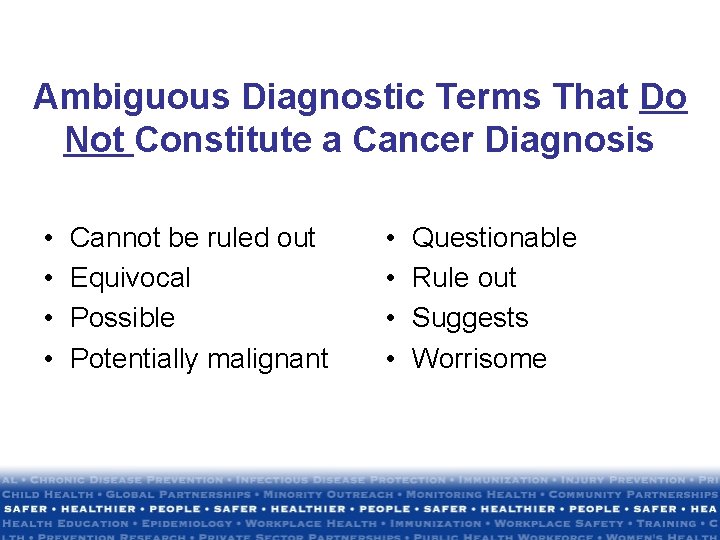
Ambiguous Diagnostic Terms That Do Not Constitute a Cancer Diagnosis • • Cannot be ruled out Equivocal Possible Potentially malignant • • Questionable Rule out Suggests Worrisome
Colon/Rectum Cancer Work-up • Physical examination – Digital rectal examination (DRE) • X-rays and scans – Barium enema – Computerized tomography (CT) scans of abdomen and pelvis
Colon/Rectum Cancer Work-up • Sigmoidoscopy • Colonoscopy • Biopsy
The Anatomy of Collaborative Staging: Colon and Rectum Presentation developed by Collaborative Staging Steering Committee American Joint Committee on Cancer ajcc@facs. org
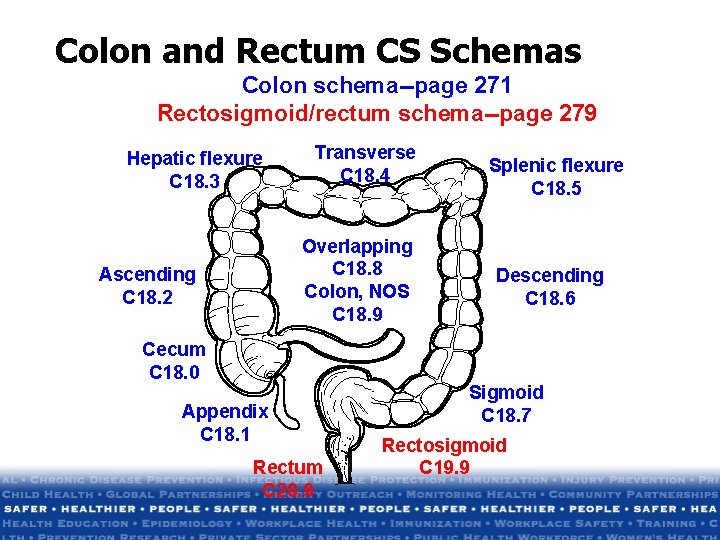
Colon and Rectum CS Schemas Colon schema--page 271 Rectosigmoid/rectum schema--page 279 Hepatic flexure C 18. 3 Transverse C 18. 4 Overlapping C 18. 8 Colon, NOS C 18. 9 Ascending C 18. 2 Cecum C 18. 0 Appendix C 18. 1 Rectum C 20. 9 Splenic flexure C 18. 5 Descending C 18. 6 Sigmoid C 18. 7 Rectosigmoid C 19. 9
Colorectal Cancer: Extension • Critical part of TNM T 1 -T 3 categories – Codes 00 -55: depth of invasion through Lumen wall Mucosa Submucosa Peritoneum Muscularis propria Subserosa Serosa
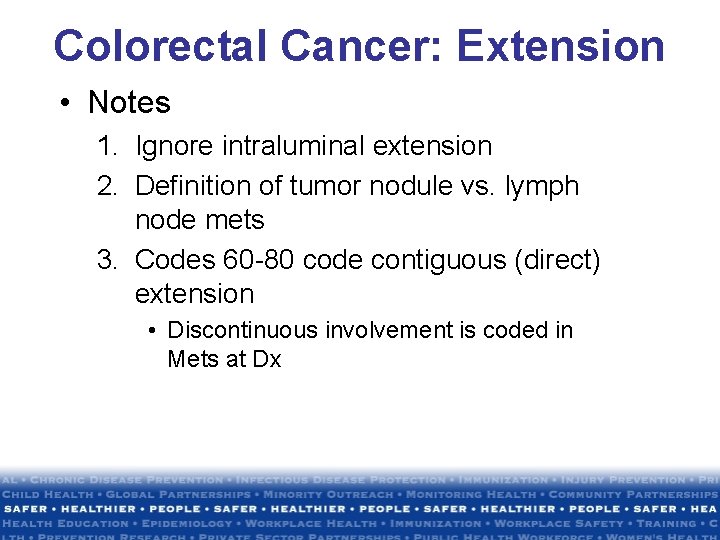
Colorectal Cancer: Extension • Notes 1. Ignore intraluminal extension 2. Definition of tumor nodule vs. lymph node mets 3. Codes 60 -80 code contiguous (direct) extension • Discontinuous involvement is coded in Mets at Dx
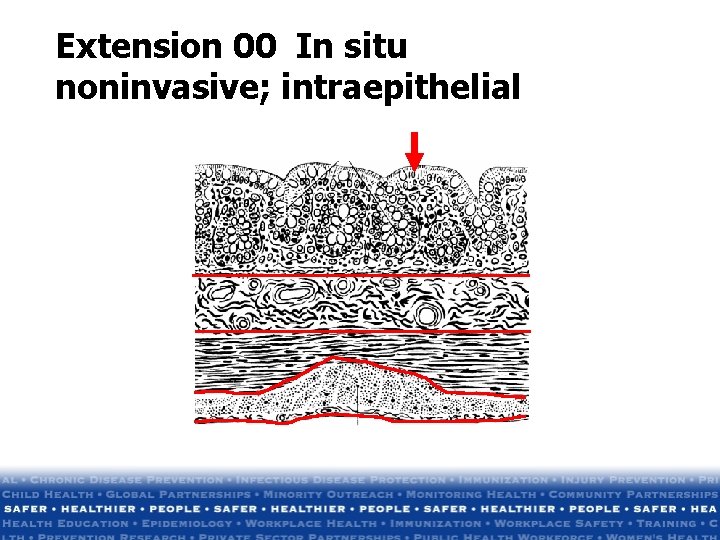
Extension 00 In situ noninvasive; intraepithelial
Extension codes 05 -16 Polyps Not shown: 10 Mucosa, NOS 15 Polyp, NOS 13 Head of polyp 05 Ca in polyp, (non-invasive) 14 Stalk of polyp 16 Submucosa 12 Muscularis mucosa 20 Muscularis propria 11 Lamina propria Adapted from: Atlas of Diagnostic Oncology, 2 nd ed. , by AT Skarin, Mosby Wolfe, 1996
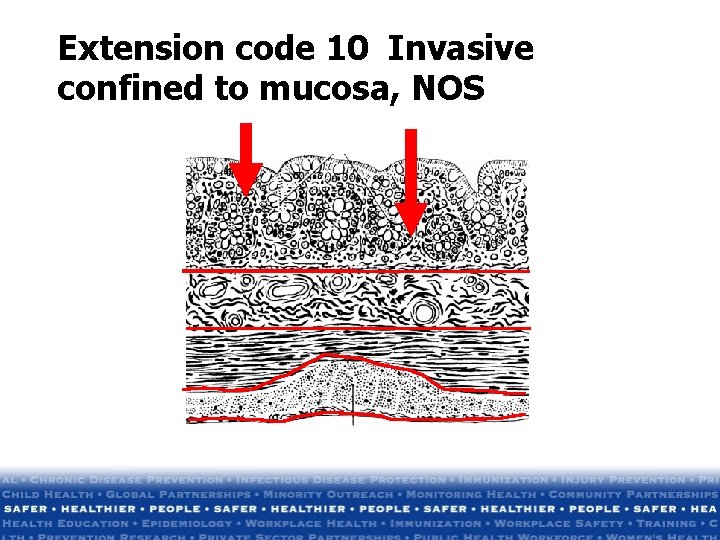
Extension code 10 Invasive confined to mucosa, NOS
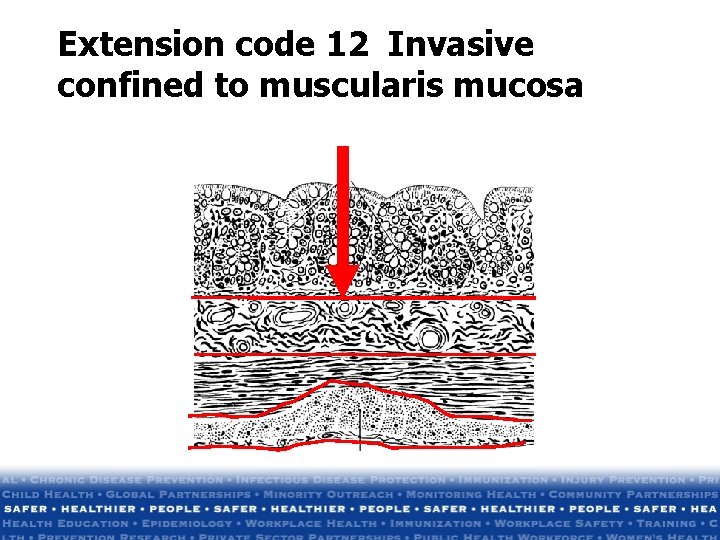
Extension code 12 Invasive confined to muscularis mucosa
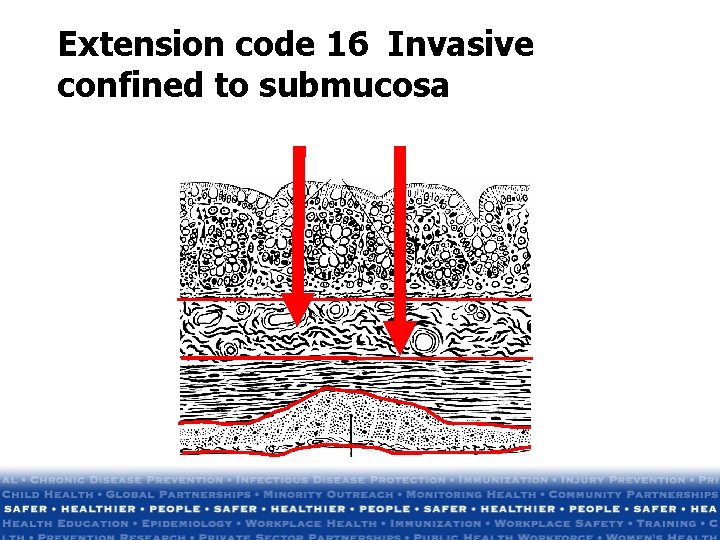
Extension code 16 Invasive confined to submucosa
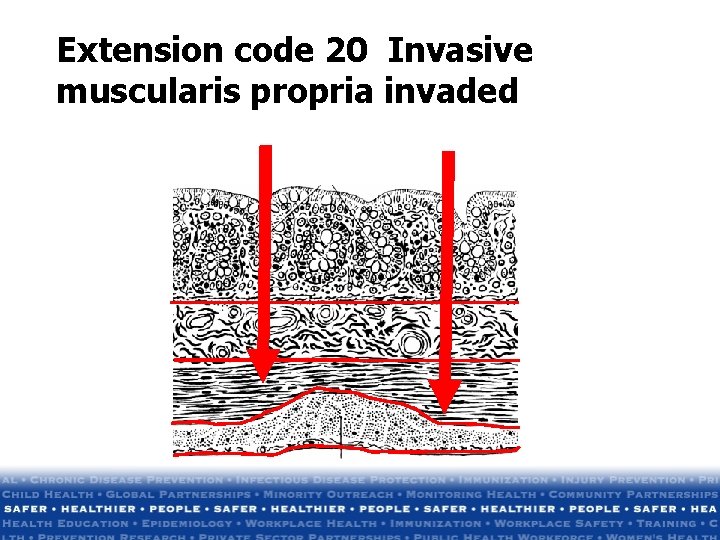
Extension code 20 Invasive muscularis propria invaded
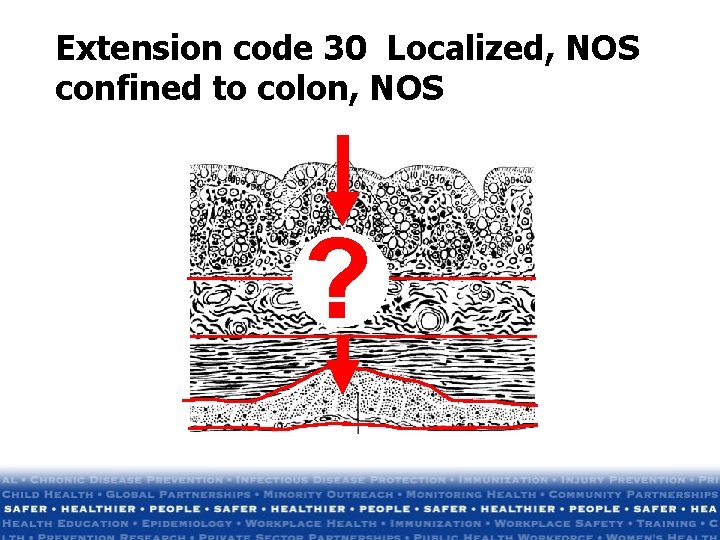
Extension code 30 Localized, NOS confined to colon, NOS ?
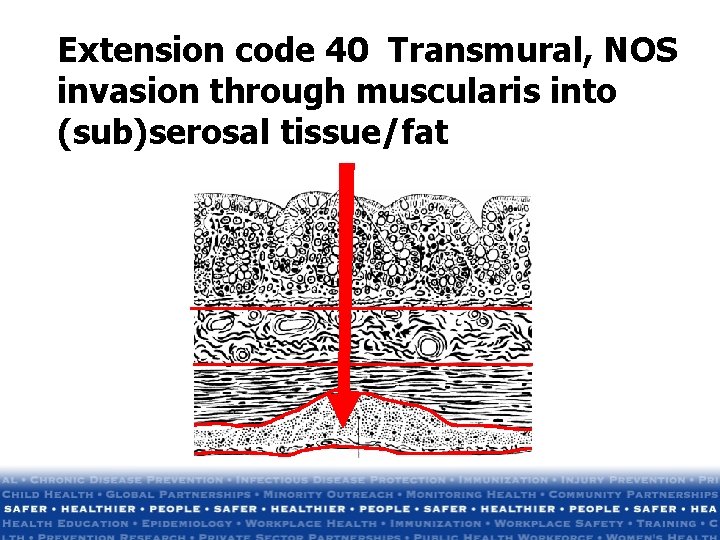
Extension code 40 Transmural, NOS invasion through muscularis into (sub)serosal tissue/fat
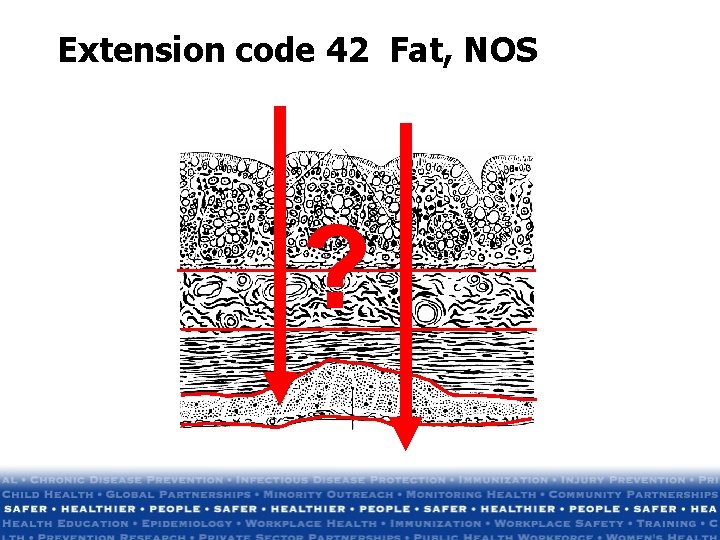
Extension code 42 Fat, NOS ?
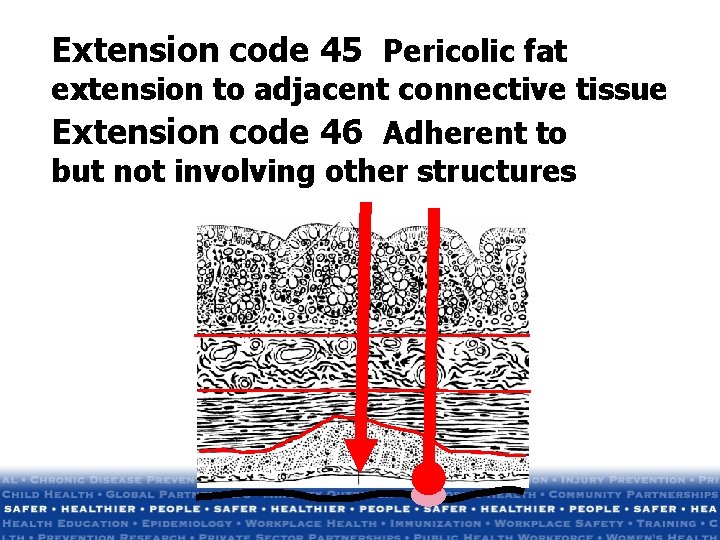
Extension code 45 Pericolic fat extension to adjacent connective tissue Extension code 46 Adherent to but not involving other structures
Extension code 50 Serosa Invasion of/through visceral peritoneum
Colorectal Cancer: Serosal Layer Hepatic flexure Ascending front only Cecum Transverse Splenic flexure Descending front only Sigmoid Rectosigmoid Rectum no serosa
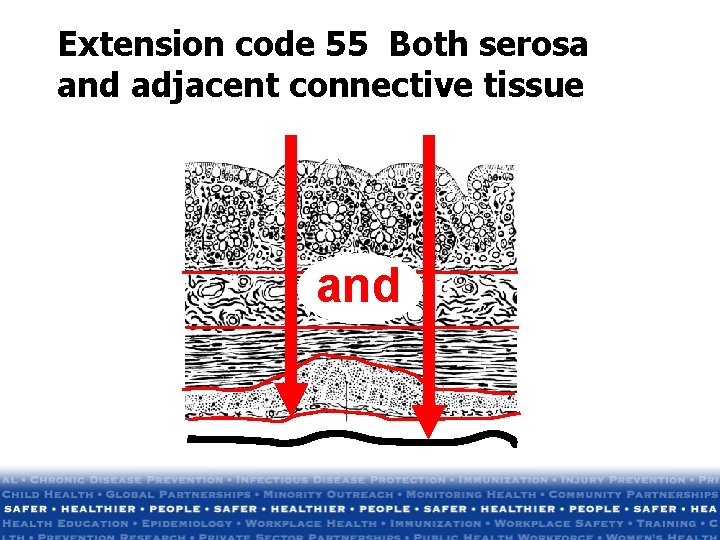
Extension code 55 Both serosa and adjacent connective tissue and
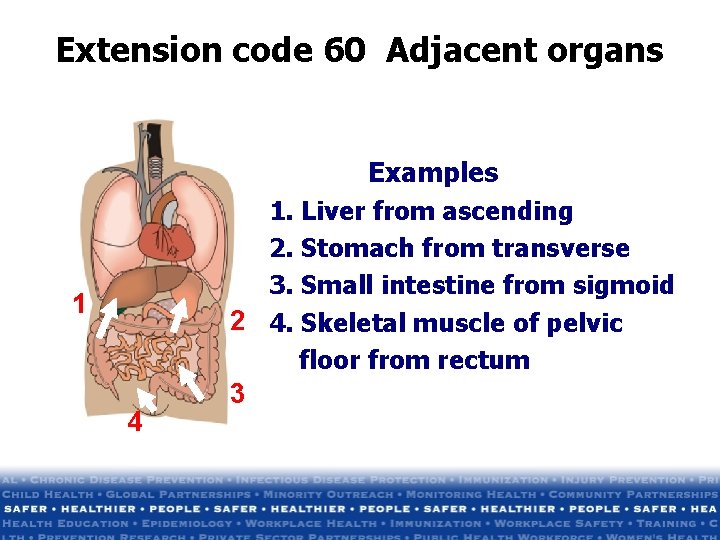
Extension code 60 Adjacent organs 1 4 Examples 1. Liver from ascending 2. Stomach from transverse 3. Small intestine from sigmoid 2 4. Skeletal muscle of pelvic floor from rectum 3
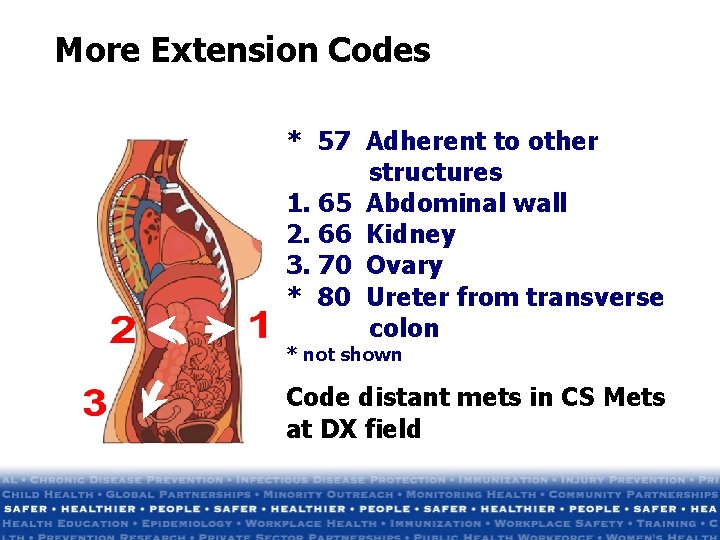
More Extension Codes * 57 Adherent to other structures 1. 65 Abdominal wall 2. 66 Kidney 3. 70 Ovary * 80 Ureter from transverse colon * not shown Code distant mets in CS Mets at DX field
Colorectal Cancer: CS Lymph Nodes • Notes 1. Regional nodes only 2. Definition of tumor nodule vs. regional node mets: code smooth nodules here 3. Inferior mesenteric nodes are distant for cecum, appendix, ascending, transverse, hepatic flexure; superior mesenteric nodes are distant for all colon sites
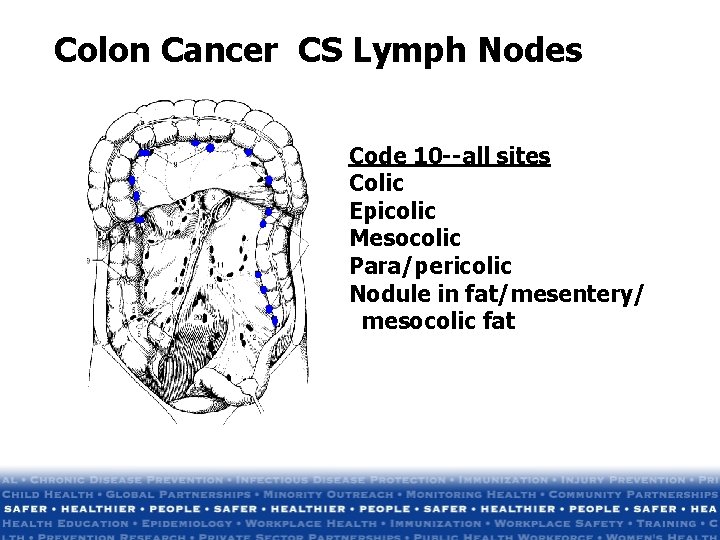
Colon Cancer CS Lymph Nodes Code 10 --all sites Colic Epicolic Mesocolic Para/pericolic Nodule in fat/mesentery/ mesocolic fat
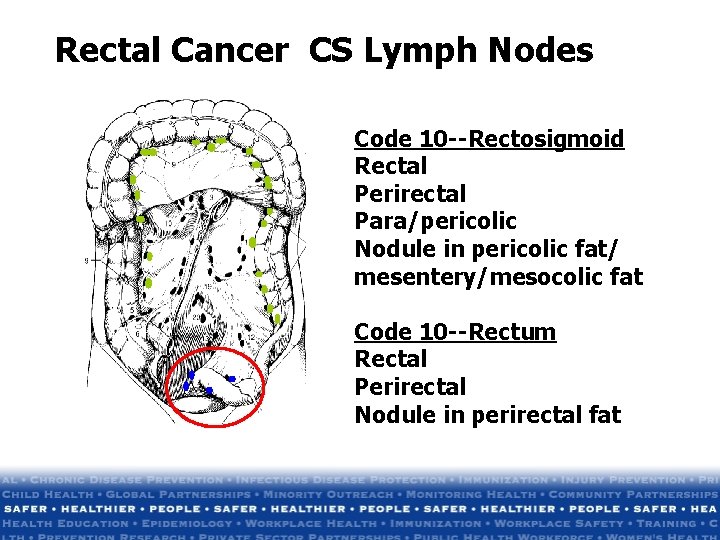
Rectal Cancer CS Lymph Nodes Code 10 --Rectosigmoid Rectal Perirectal Para/pericolic Nodule in pericolic fat/ mesentery/mesocolic fat Code 10 --Rectum Rectal Perirectal Nodule in perirectal fat
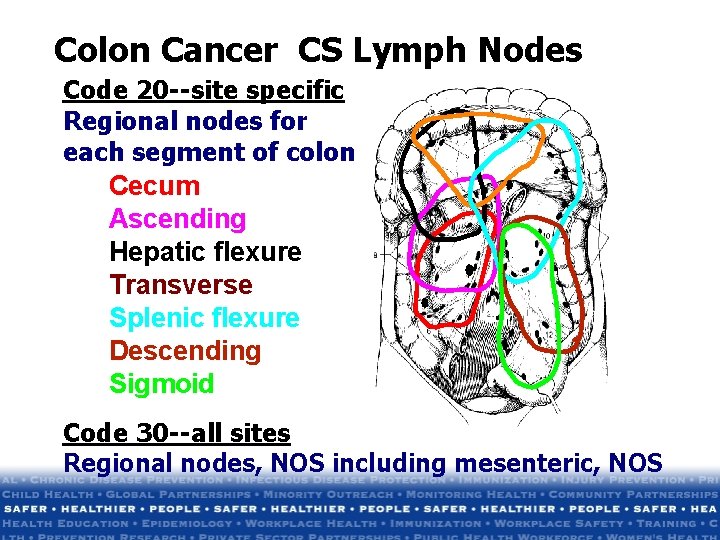
Colon Cancer CS Lymph Nodes Code 20 --site specific Regional nodes for each segment of colon Cecum Ascending Hepatic flexure Transverse Splenic flexure Descending Sigmoid Code 30 --all sites Regional nodes, NOS including mesenteric, NOS
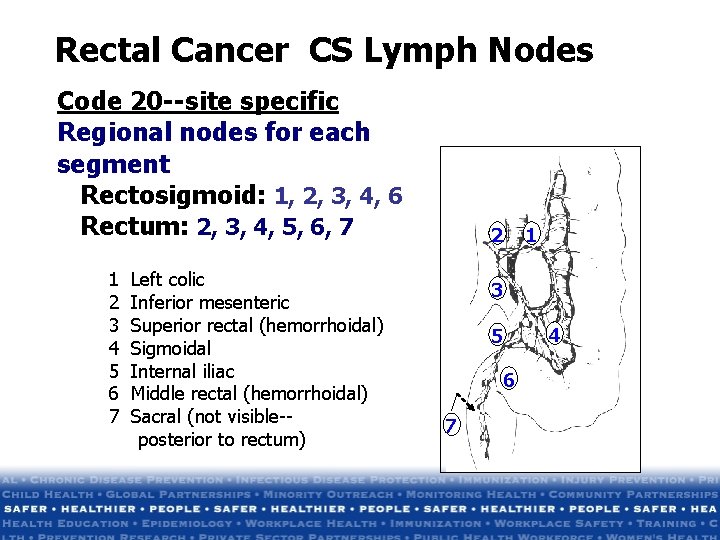
Rectal Cancer CS Lymph Nodes Code 20 --site specific Regional nodes for each segment Rectosigmoid: 1, 2, 3, 4, 6 Rectum: 2, 3, 4, 5, 6, 7 1 2 3 4 5 6 7 Left colic Inferior mesenteric Superior rectal (hemorrhoidal) Sigmoidal Internal iliac Middle rectal (hemorrhoidal) Sacral (not visible-posterior to rectum) 2 1 3 5 6 7 4
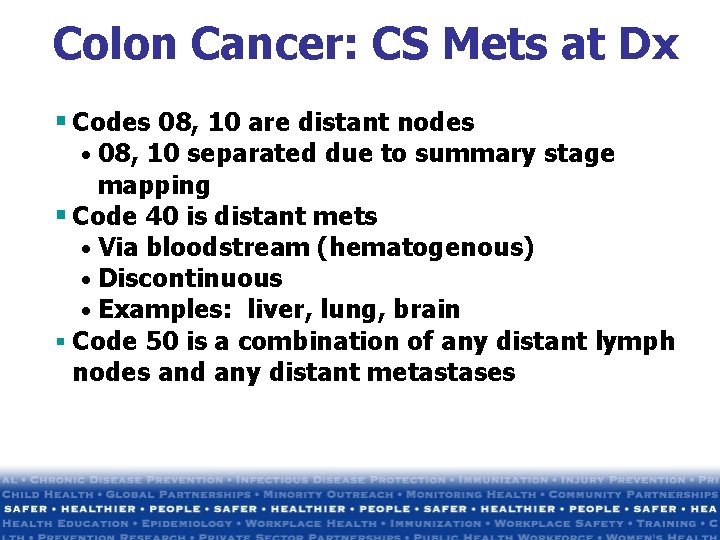
Colon Cancer: CS Mets at Dx § Codes 08, 10 are distant nodes • 08, 10 separated due to summary stage mapping § Code 40 is distant mets • Via bloodstream (hematogenous) • Discontinuous • Examples: liver, lung, brain § Code 50 is a combination of any distant lymph nodes and any distant metastases
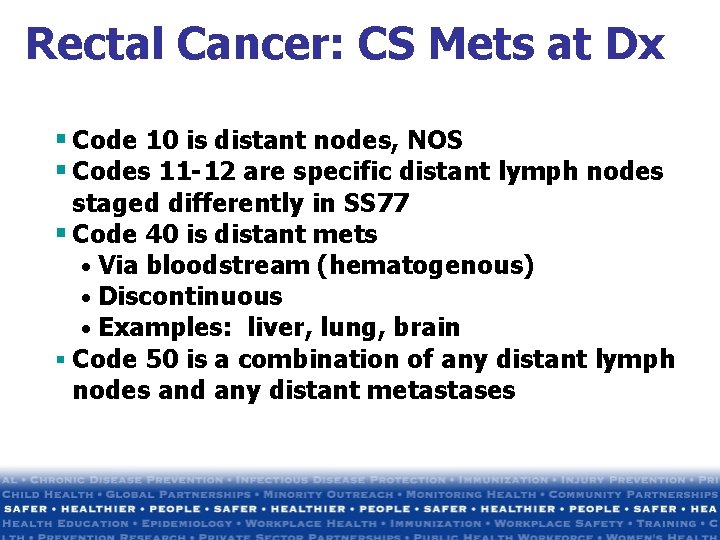
Rectal Cancer: CS Mets at Dx § Code 10 is distant nodes, NOS § Codes 11 -12 are specific distant lymph nodes staged differently in SS 77 § Code 40 is distant mets • Via bloodstream (hematogenous) • Discontinuous • Examples: liver, lung, brain § Code 50 is a combination of any distant lymph nodes and any distant metastases
First Course Treatment Colorectal Cancer
First Course Treatment • Intended to affect tumor by – Modification – Control – Removal – Destruction • Includes curative and palliative treatment
Surgical Procedure of Primary Site • Standard treatment for colon and rectum cancer is resection of primary tumor and regional lymph nodes • Codes and definitions are site-specific for colon, rectosigmoid, and rectum
Surgical Procedure of Primary Site • En bloc resection – Resection of primary site and other contiguous organs during the same procedure
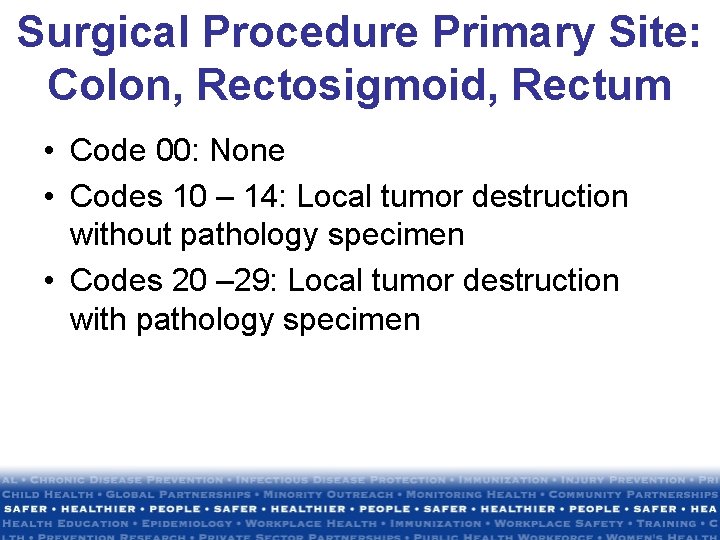
Surgical Procedure Primary Site: Colon, Rectosigmoid, Rectum • Code 00: None • Codes 10 – 14: Local tumor destruction without pathology specimen • Codes 20 – 29: Local tumor destruction with pathology specimen
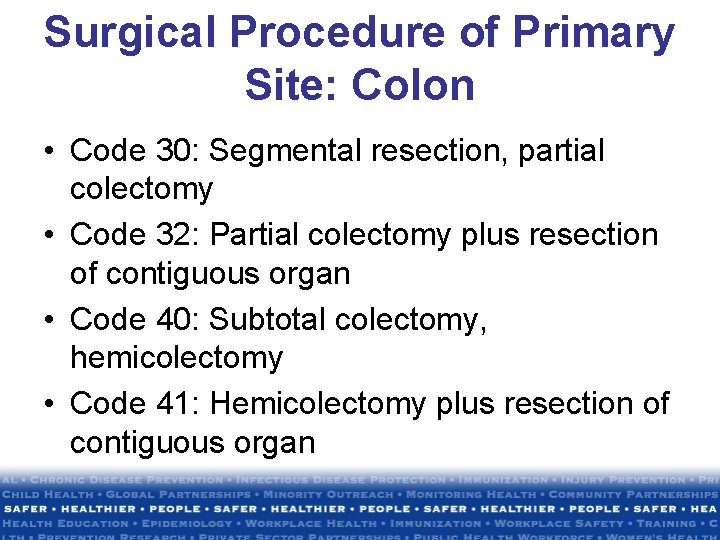
Surgical Procedure of Primary Site: Colon • Code 30: Segmental resection, partial colectomy • Code 32: Partial colectomy plus resection of contiguous organ • Code 40: Subtotal colectomy, hemicolectomy • Code 41: Hemicolectomy plus resection of contiguous organ
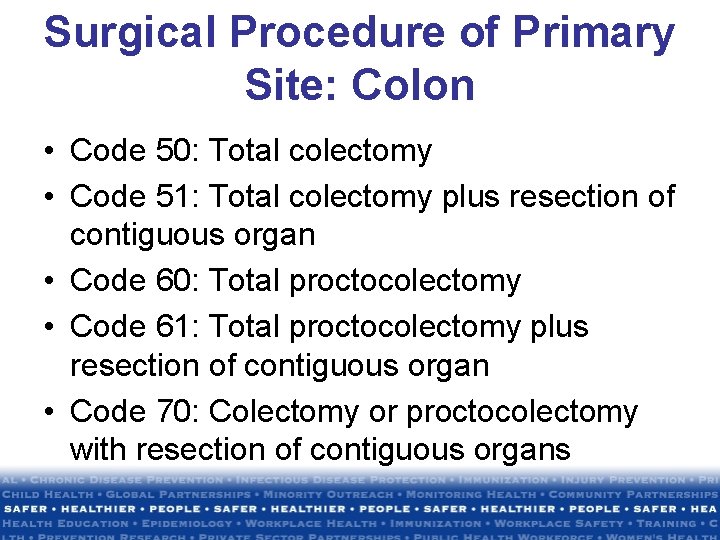
Surgical Procedure of Primary Site: Colon • Code 50: Total colectomy • Code 51: Total colectomy plus resection of contiguous organ • Code 60: Total proctocolectomy • Code 61: Total proctocolectomy plus resection of contiguous organ • Code 70: Colectomy or proctocolectomy with resection of contiguous organs
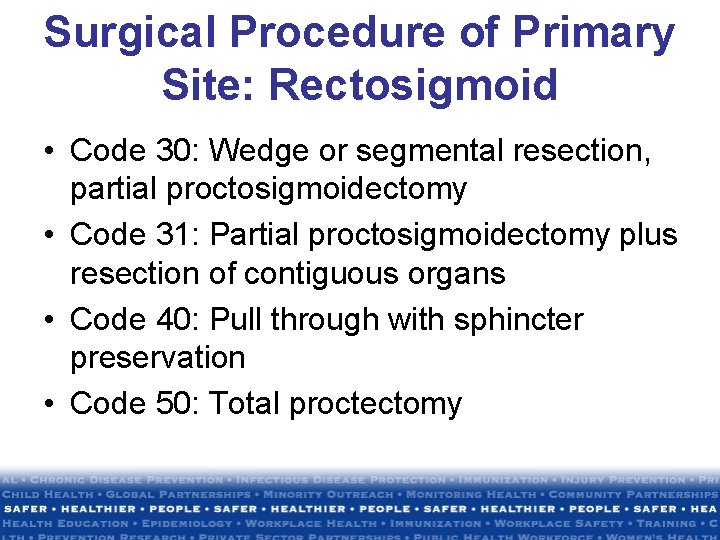
Surgical Procedure of Primary Site: Rectosigmoid • Code 30: Wedge or segmental resection, partial proctosigmoidectomy • Code 31: Partial proctosigmoidectomy plus resection of contiguous organs • Code 40: Pull through with sphincter preservation • Code 50: Total proctectomy
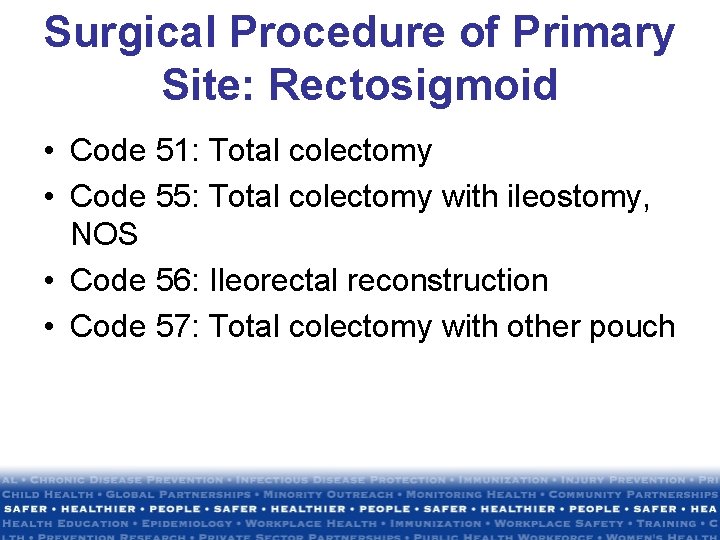
Surgical Procedure of Primary Site: Rectosigmoid • Code 51: Total colectomy • Code 55: Total colectomy with ileostomy, NOS • Code 56: Ileorectal reconstruction • Code 57: Total colectomy with other pouch
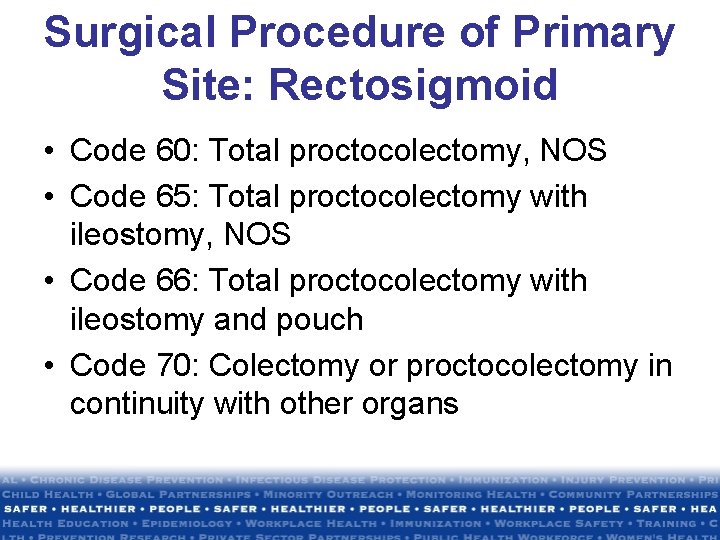
Surgical Procedure of Primary Site: Rectosigmoid • Code 60: Total proctocolectomy, NOS • Code 65: Total proctocolectomy with ileostomy, NOS • Code 66: Total proctocolectomy with ileostomy and pouch • Code 70: Colectomy or proctocolectomy in continuity with other organs
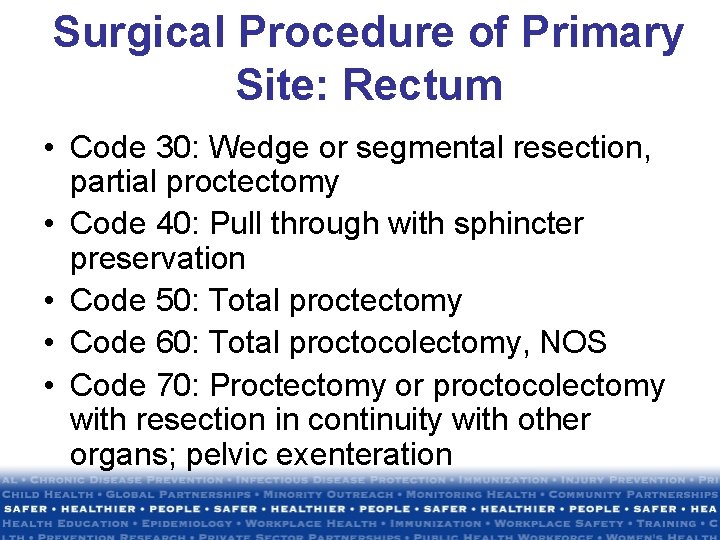
Surgical Procedure of Primary Site: Rectum • Code 30: Wedge or segmental resection, partial proctectomy • Code 40: Pull through with sphincter preservation • Code 50: Total proctectomy • Code 60: Total proctocolectomy, NOS • Code 70: Proctectomy or proctocolectomy with resection in continuity with other organs; pelvic exenteration
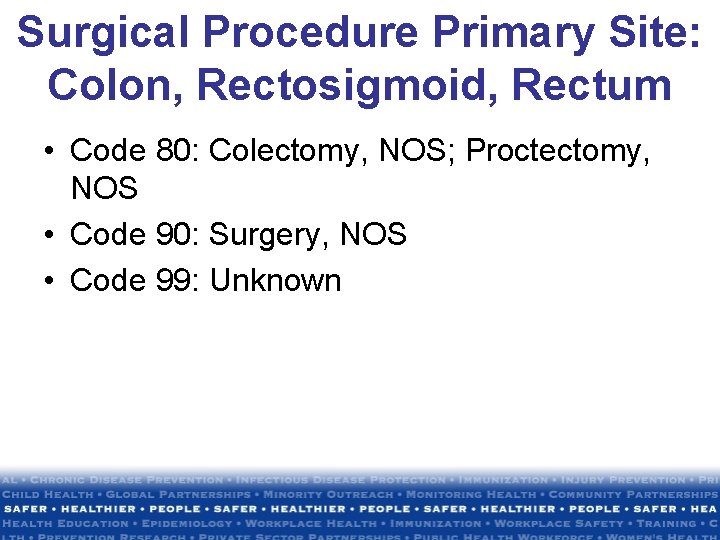
Surgical Procedure Primary Site: Colon, Rectosigmoid, Rectum • Code 80: Colectomy, NOS; Proctectomy, NOS • Code 90: Surgery, NOS • Code 99: Unknown
Scope of Regional LN Surgery • Resection of primary tumor and regional lymph nodes is standard treatment for colon and rectal cancer • Code resection of regional lymph nodes for colon or rectum in this data item
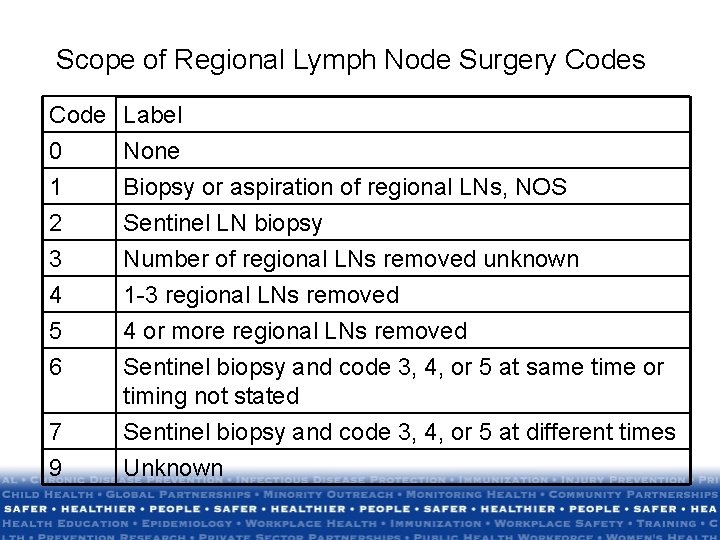
Scope of Regional Lymph Node Surgery Codes Code 0 1 2 Label None Biopsy or aspiration of regional LNs, NOS Sentinel LN biopsy 3 4 5 6 Number of regional LNs removed unknown 1 -3 regional LNs removed 4 or more regional LNs removed Sentinel biopsy and code 3, 4, or 5 at same time or timing not stated Sentinel biopsy and code 3, 4, or 5 at different times Unknown 7 9
Surgical Procedure/Other Site • Record removal of distant lymph nodes or other tissues beyond the primary site – Surgical removal of liver metastasis for colon and rectum • Do not record removal of tissues removed en bloc with the primary site • Do not record incidental removal of tissue – Appendectomy with colon cancer surgery
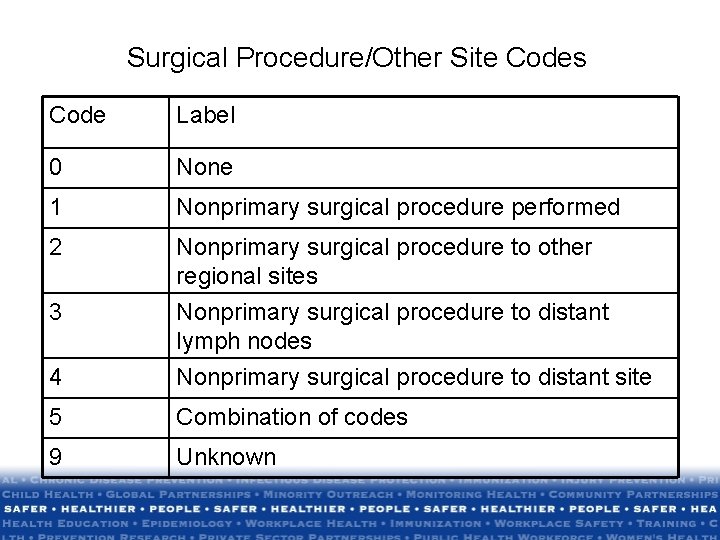
Surgical Procedure/Other Site Codes Code Label 0 None 1 Nonprimary surgical procedure performed 2 Nonprimary surgical procedure to other regional sites 3 4 Nonprimary surgical procedure to distant lymph nodes Nonprimary surgical procedure to distant site 5 Combination of codes 9 Unknown
Radiation Therapy Colon and Rectum • Radiation therapy is not standard treatment for colon cancer • Radiation therapy is used with surgery to treat rectal cancer – Pre-operative treatment to shrink tumor prior to surgery – Post-operative treatment to prevent metastasis and recurrence
Chemotherapy for Colon and Rectum • Single-agent chemotherapy – 5 -FU, Vincristine, Irinotecan, Oxaliplatin, Capecitabine, Bevacizumab, and Cetuximab • Multiagent chemotherapy – FOLFIRI: folic acid (ancillary drug), 5 -FU (chemo), Irinotecan (chemo) – FOLFOX: Oxaliplatin (chemo), 5 -FU (chemo), Leucovorin (ancillary drug) – 5 -FU and Vincristine
Immunotherapy for Colon and Rectum • Immunotherapy alters body’s immune system to destroy cancer cells – Levamisole – Interferon – Both may be given in conjunction with 5 -FU chemotherapy • Make sure immunotherapy is first course treatment