Molecules Atoms Stoichiometry Limiting Reagent Percentage Yield Interpreting




- Slides: 21
Molecules, Atoms & Stoichiometry Limiting Reagent Percentage Yield
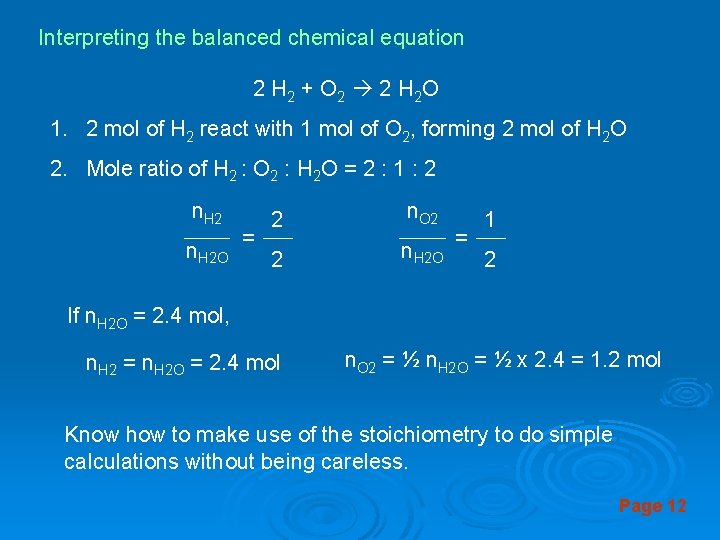
Interpreting the balanced chemical equation 2 H 2 + O 2 2 H 2 O 1. 2 mol of H 2 react with 1 mol of O 2, forming 2 mol of H 2 O 2. Mole ratio of H 2 : O 2 : H 2 O = 2 : 1 : 2 n. H 2 O = 2 n. O 2 2 n. H 2 O = 1 2 If n. H 2 O = 2. 4 mol, n. H 2 = n. H 2 O = 2. 4 mol n. O 2 = ½ n. H 2 O = ½ x 2. 4 = 1. 2 mol Know how to make use of the stoichiometry to do simple calculations without being careless. Page 12
Example 1: For the reaction C 3 H 8 + 5 O 2 3 CO 2 + 4 H 2 O i. If 1. 20 x 10 -2 mol of CO 2 have to be produced, much O 2 is required for the reaction? ii. If one wishes to produce 1. 2 x 10 -2 mol of CO 2, would 6. 00 x 10 -3 mol of C 3 H 8 be sufficient for the reaction? how i) From the balanced equation: n. O 2 n. CO 2 = 5 3 n. O 2 = 5/3 x n. CO 2 = 5/3 x (1. 2 x 10 -2) = 2. 00 x 10 -3 mol 2. 00 x 10 -2 mol of O 2 is produced. Page 12
Example 1: For the reaction C 3 H 8 + 5 O 2 3 CO 2 + 4 H 2 O i. If 1. 20 x 10 -2 mol of CO 2 have to be produced, much O 2 is required for the reaction? ii. If one wishes to produce 1. 2 x 10 -2 mol of CO 2, would 6. 00 x 10 -3 mol of C 3 H 8 be sufficient for the reaction? how ii) From the balanced equation: n. C 3 H 8 n. CO 2 = 1 3 n. C 3 H 8 = 1/3 x n. CO 2 = 1/3 x (1. 2 x 10 -2) = 4. 00 x 10 -3 mol Yes, 6. 00 x 10 -3 mol of C 3 H 8 is sufficient. Page 12
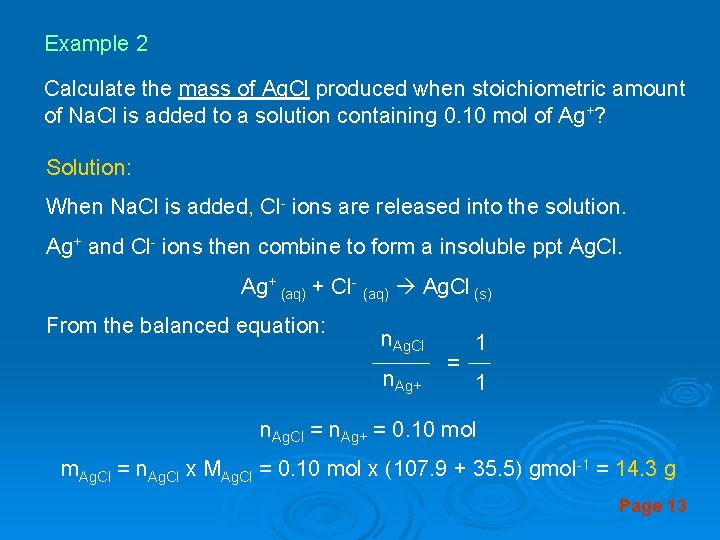
Example 2 Calculate the mass of Ag. Cl produced when stoichiometric amount of Na. Cl is added to a solution containing 0. 10 mol of Ag+? Solution: When Na. Cl is added, Cl- ions are released into the solution. Ag+ and Cl- ions then combine to form a insoluble ppt Ag. Cl. Ag+ (aq) + Cl- (aq) Ag. Cl (s) From the balanced equation: n. Ag. Cl n. Ag+ = 1 1 n. Ag. Cl = n. Ag+ = 0. 10 mol m. Ag. Cl = n. Ag. Cl x MAg. Cl = 0. 10 mol x (107. 9 + 35. 5) gmol-1 = 14. 3 g Page 13
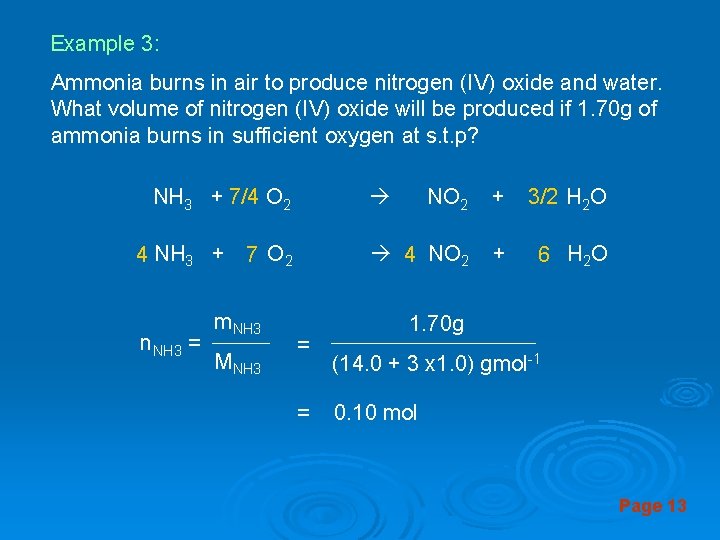
Example 3: Ammonia burns in air to produce nitrogen (IV) oxide and water. What volume of nitrogen (IV) oxide will be produced if 1. 70 g of ammonia burns in sufficient oxygen at s. t. p? NH 3 + 7/4 O 2 4 NH 3 + 7 O 2 n. NH 3 = m. NH 3 MNH 3 NO 2 + 3/2 H 2 O 4 NO 2 + 6 H 2 O = = 1. 70 g (14. 0 + 3 x 1. 0) gmol-1 0. 10 mol Page 13
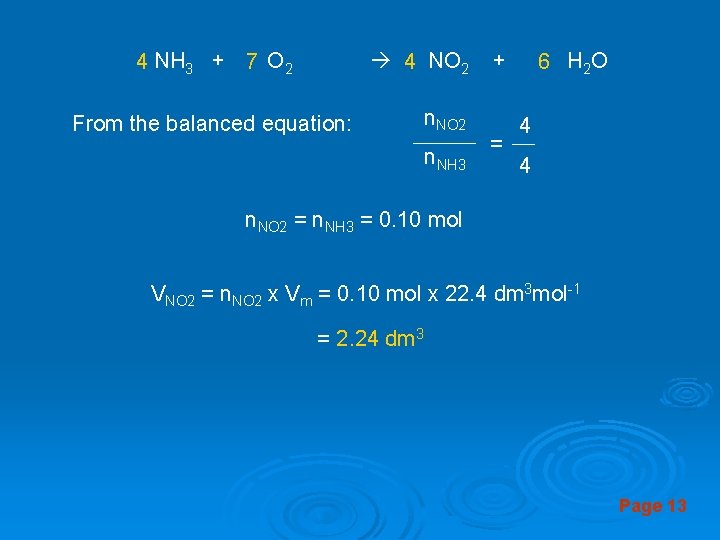
4 NH 3 + 7 O 2 4 NO 2 From the balanced equation: n. NO 2 n. NH 3 + = 6 H 2 O 4 4 n. NO 2 = n. NH 3 = 0. 10 mol VNO 2 = n. NO 2 x Vm = 0. 10 mol x 22. 4 dm 3 mol-1 = 2. 24 dm 3 Page 13
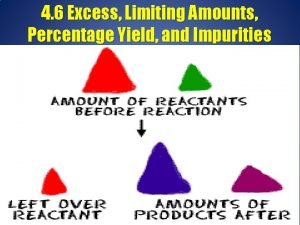
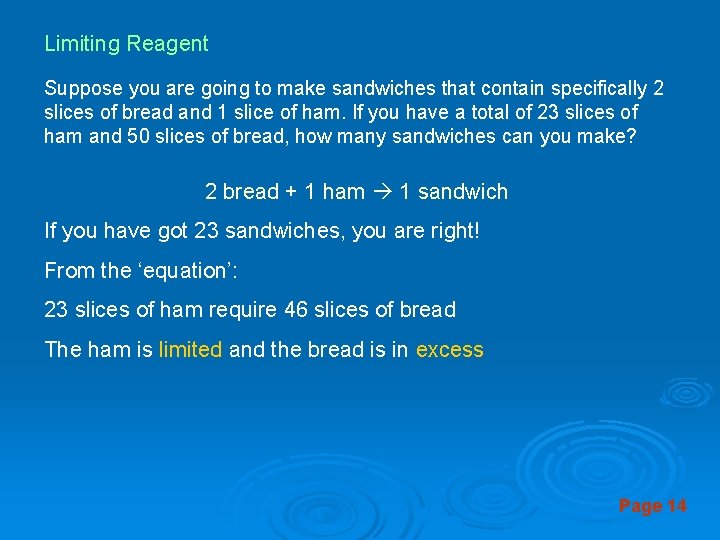
Limiting Reagent Suppose you are going to make sandwiches that contain specifically 2 slices of bread and 1 slice of ham. If you have a total of 23 slices of ham and 50 slices of bread, how many sandwiches can you make? 2 bread + 1 ham 1 sandwich If you have got 23 sandwiches, you are right! From the ‘equation’: 23 slices of ham require 46 slices of bread The ham is limited and the bread is in excess Page 14
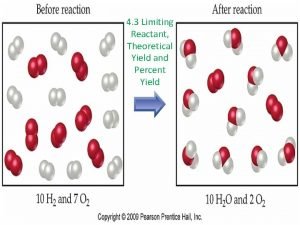
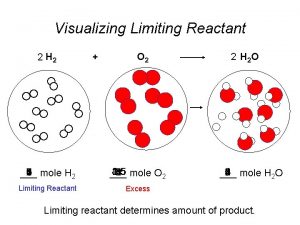
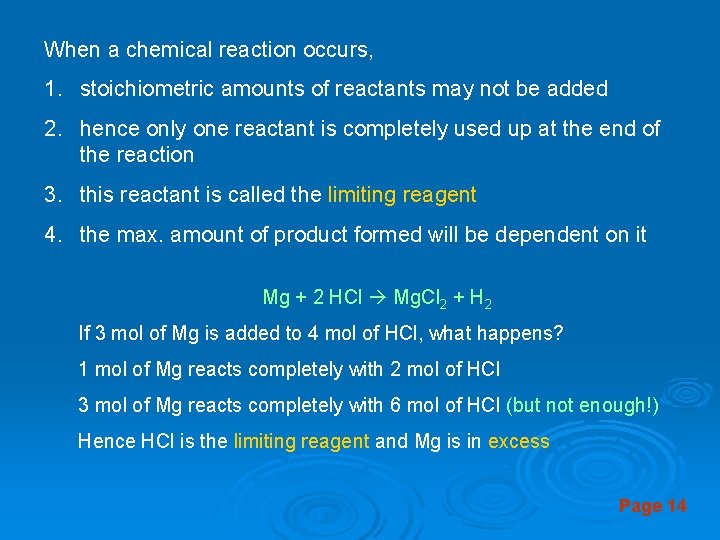
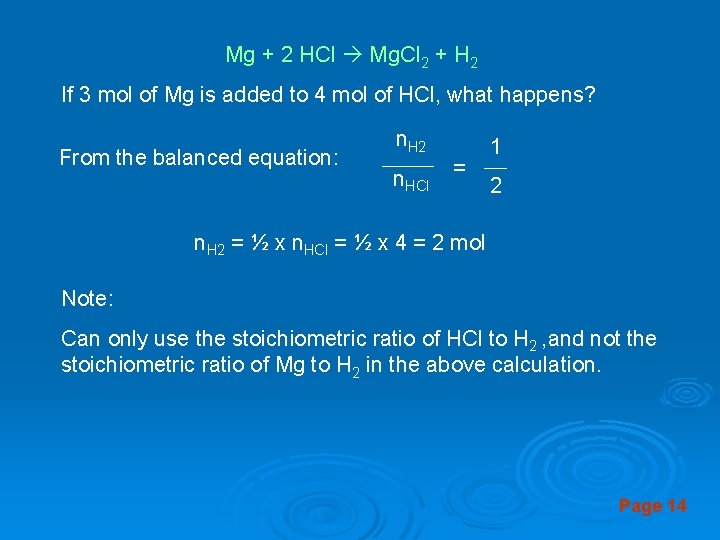
When a chemical reaction occurs, 1. stoichiometric amounts of reactants may not be added 2. hence only one reactant is completely used up at the end of the reaction 3. this reactant is called the limiting reagent 4. the max. amount of product formed will be dependent on it Mg + 2 HCl Mg. Cl 2 + H 2 If 3 mol of Mg is added to 4 mol of HCl, what happens? 1 mol of Mg reacts completely with 2 mol of HCl 3 mol of Mg reacts completely with 6 mol of HCl (but not enough!) Hence HCl is the limiting reagent and Mg is in excess Page 14
Mg + 2 HCl Mg. Cl 2 + H 2 If 3 mol of Mg is added to 4 mol of HCl, what happens? From the balanced equation: n. H 2 n. HCl = 1 2 n. H 2 = ½ x n. HCl = ½ x 4 = 2 mol Note: Can only use the stoichiometric ratio of HCl to H 2 , and not the stoichiometric ratio of Mg to H 2 in the above calculation. Page 14
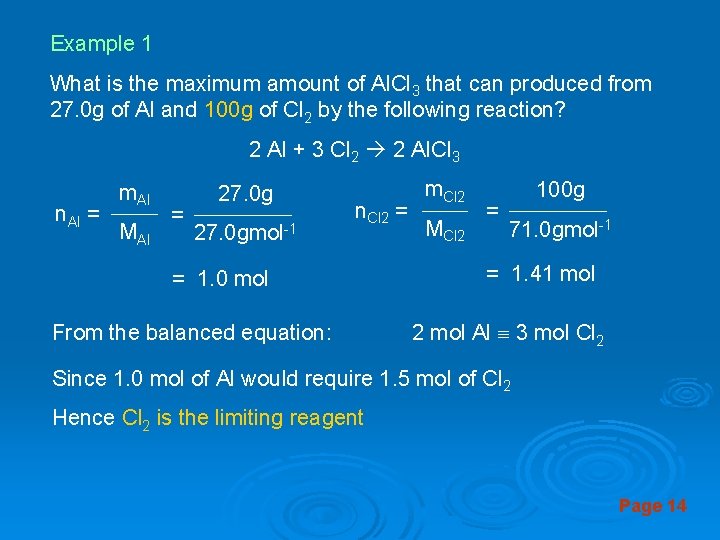
Example 1 What is the maximum amount of Al. Cl 3 that can produced from 27. 0 g of Al and 100 g of Cl 2 by the following reaction? 2 Al + 3 Cl 2 2 Al. Cl 3 n. Al = m. Al MAl = 27. 0 gmol-1 n. Cl 2 = = 1. 0 mol From the balanced equation: m. Cl 2 MCl 2 = 100 g 71. 0 gmol-1 = 1. 41 mol 2 mol Al 3 mol Cl 2 Since 1. 0 mol of Al would require 1. 5 mol of Cl 2 Hence Cl 2 is the limiting reagent Page 14
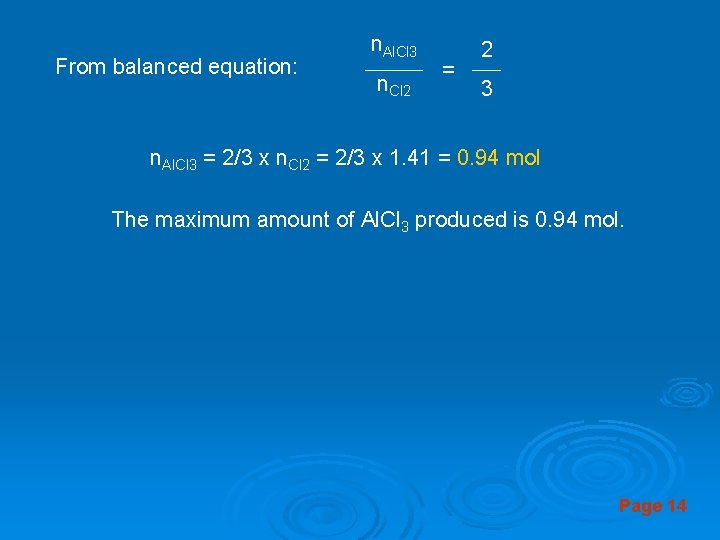
From balanced equation: n. Al. Cl 3 n. Cl 2 = 2 3 n. Al. Cl 3 = 2/3 x n. Cl 2 = 2/3 x 1. 41 = 0. 94 mol The maximum amount of Al. Cl 3 produced is 0. 94 mol. Page 14
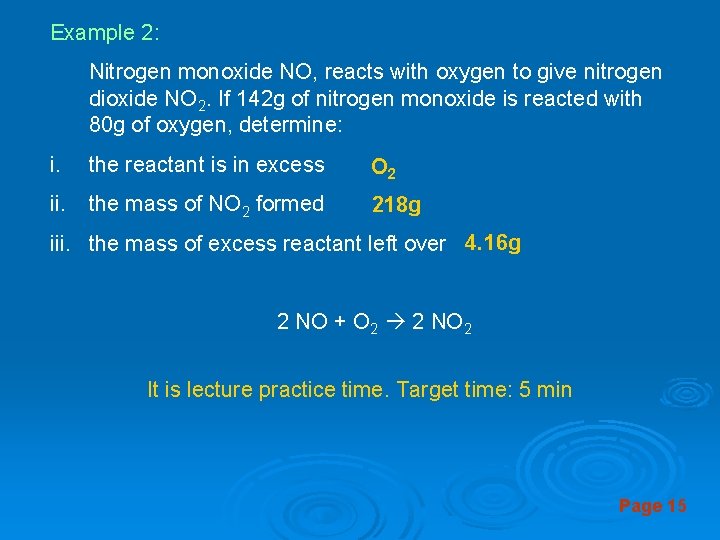
Example 2: Nitrogen monoxide NO, reacts with oxygen to give nitrogen dioxide NO 2. If 142 g of nitrogen monoxide is reacted with 80 g of oxygen, determine: i. the reactant is in excess O 2 ii. the mass of NO 2 formed 218 g iii. the mass of excess reactant left over 4. 16 g 2 NO + O 2 2 NO 2 It is lecture practice time. Target time: 5 min Page 15
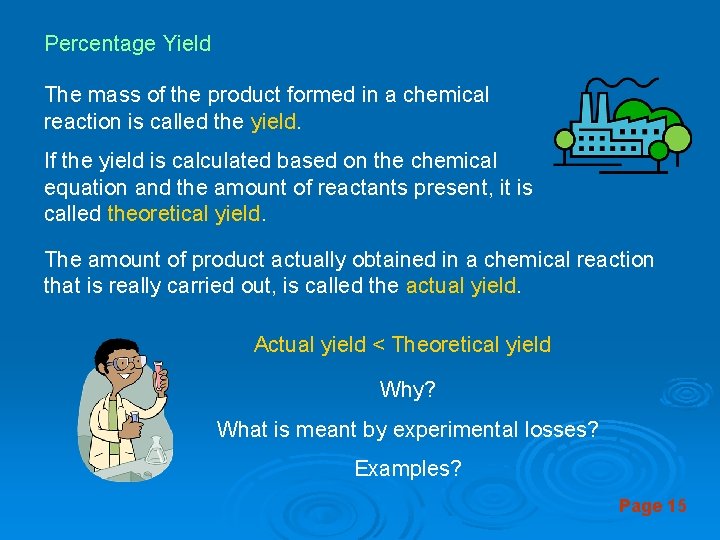
Percentage Yield The mass of the product formed in a chemical reaction is called the yield. If the yield is calculated based on the chemical equation and the amount of reactants present, it is called theoretical yield. The amount of product actually obtained in a chemical reaction that is really carried out, is called the actual yield. Actual yield < Theoretical yield Why? What is meant by experimental losses? Examples? Page 15
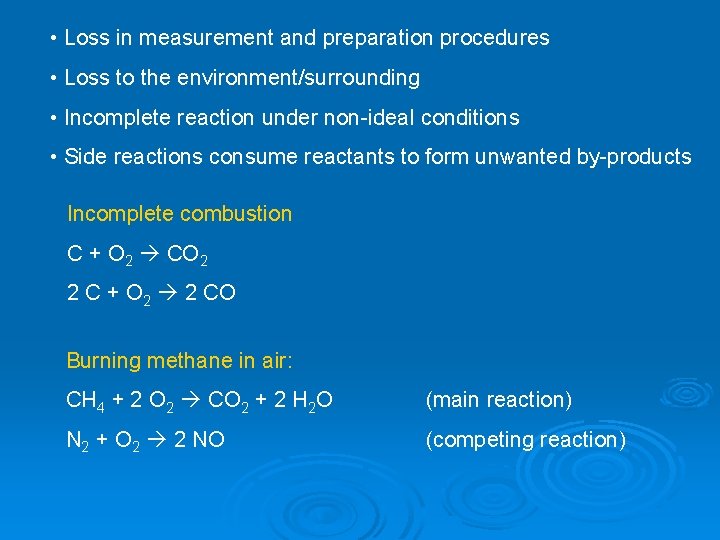
• Loss in measurement and preparation procedures • Loss to the environment/surrounding • Incomplete reaction under non-ideal conditions • Side reactions consume reactants to form unwanted by-products Incomplete combustion C + O 2 CO 2 2 C + O 2 2 CO Burning methane in air: CH 4 + 2 O 2 CO 2 + 2 H 2 O (main reaction) N 2 + O 2 2 NO (competing reaction)
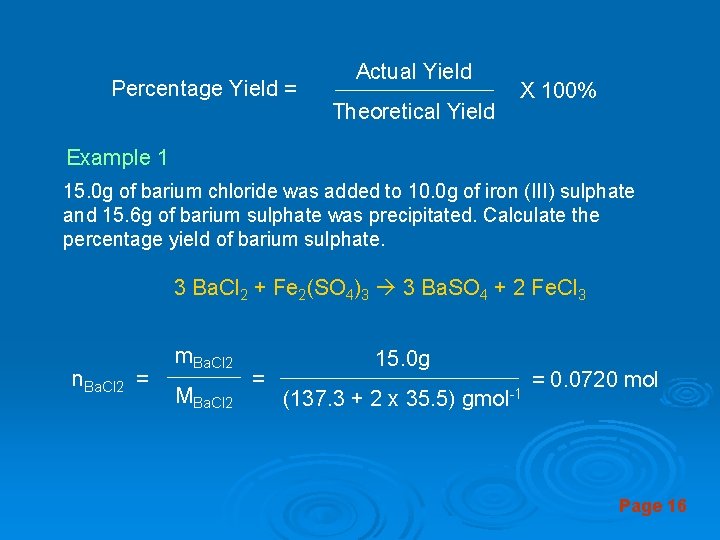
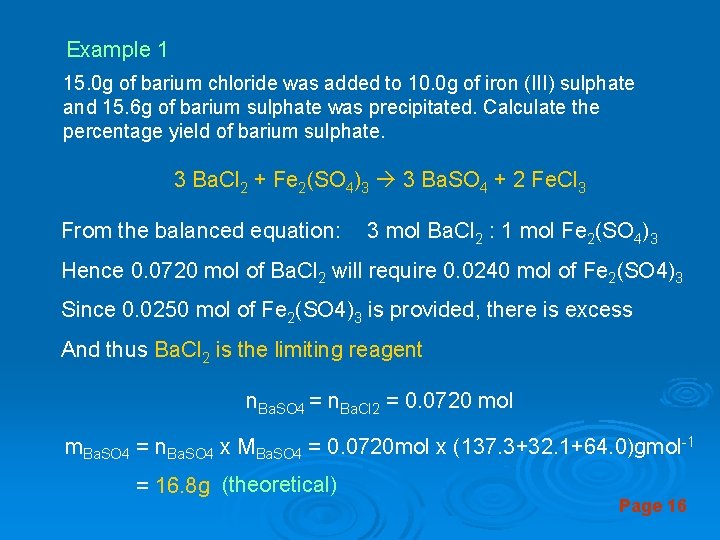
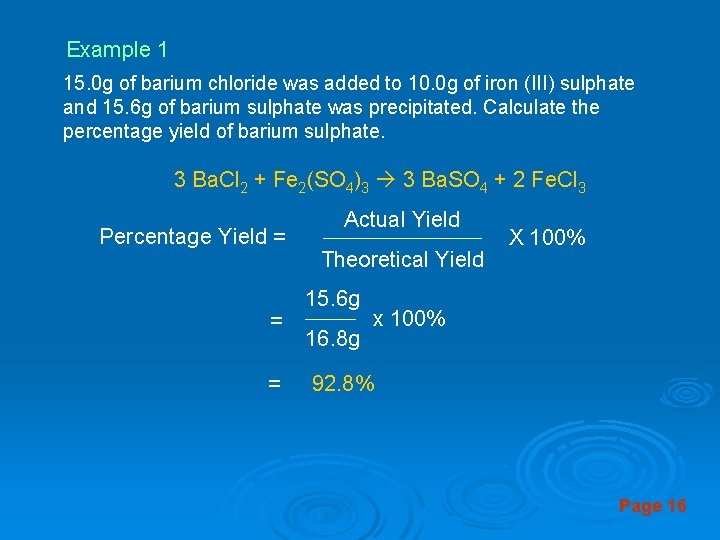
Percentage Yield = Actual Yield Theoretical Yield X 100% Example 1 15. 0 g of barium chloride was added to 10. 0 g of iron (III) sulphate and 15. 6 g of barium sulphate was precipitated. Calculate the percentage yield of barium sulphate. 3 Ba. Cl 2 + Fe 2(SO 4)3 3 Ba. SO 4 + 2 Fe. Cl 3 n. Ba. Cl 2 = m. Ba. Cl 2 MBa. Cl 2 = 15. 0 g (137. 3 + 2 x 35. 5) gmol-1 = 0. 0720 mol Page 16
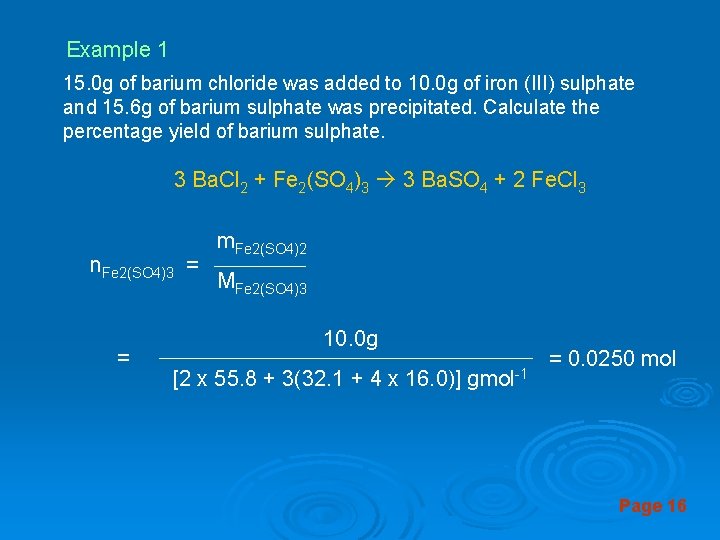
Example 1 15. 0 g of barium chloride was added to 10. 0 g of iron (III) sulphate and 15. 6 g of barium sulphate was precipitated. Calculate the percentage yield of barium sulphate. 3 Ba. Cl 2 + Fe 2(SO 4)3 3 Ba. SO 4 + 2 Fe. Cl 3 n. Fe 2(SO 4)3 = = m. Fe 2(SO 4)2 MFe 2(SO 4)3 10. 0 g [2 x 55. 8 + 3(32. 1 + 4 x 16. 0)] gmol-1 = 0. 0250 mol Page 16
Example 1 15. 0 g of barium chloride was added to 10. 0 g of iron (III) sulphate and 15. 6 g of barium sulphate was precipitated. Calculate the percentage yield of barium sulphate. 3 Ba. Cl 2 + Fe 2(SO 4)3 3 Ba. SO 4 + 2 Fe. Cl 3 From the balanced equation: 3 mol Ba. Cl 2 : 1 mol Fe 2(SO 4)3 Hence 0. 0720 mol of Ba. Cl 2 will require 0. 0240 mol of Fe 2(SO 4)3 Since 0. 0250 mol of Fe 2(SO 4)3 is provided, there is excess And thus Ba. Cl 2 is the limiting reagent n. Ba. SO 4 = n. Ba. Cl 2 = 0. 0720 mol m. Ba. SO 4 = n. Ba. SO 4 x MBa. SO 4 = 0. 0720 mol x (137. 3+32. 1+64. 0)gmol-1 = 16. 8 g (theoretical) Page 16
Example 1 15. 0 g of barium chloride was added to 10. 0 g of iron (III) sulphate and 15. 6 g of barium sulphate was precipitated. Calculate the percentage yield of barium sulphate. 3 Ba. Cl 2 + Fe 2(SO 4)3 3 Ba. SO 4 + 2 Fe. Cl 3 Percentage Yield = = = Actual Yield Theoretical Yield 15. 6 g 16. 8 g X 100% x 100% 92. 8% Page 16
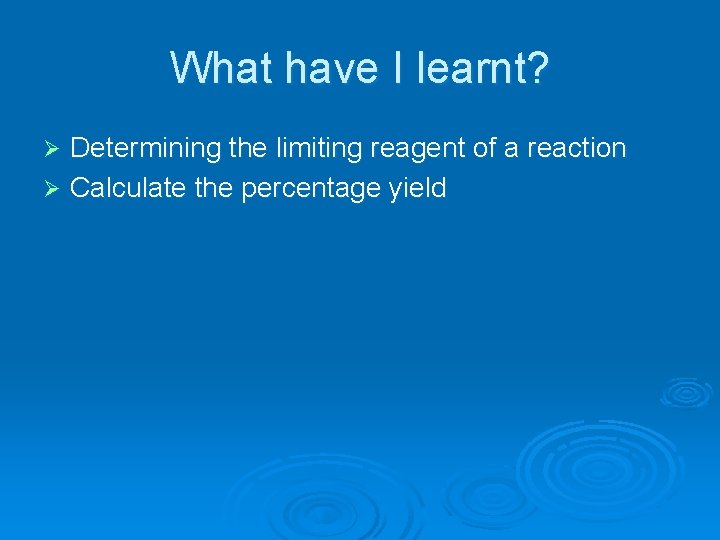
What have I learnt? Determining the limiting reagent of a reaction Ø Calculate the percentage yield Ø
End of Lecture 4 “A bore is a man who deprives you of solitude without providing you with company” Gian Vincenzo Gravina