Module 3 Naval Skills Chapter 1 Deck Seamanship

- Slides: 71
Module 3 – Naval Skills Chapter 1 – Deck Seamanship Section 2 – Handling Fiber Line
What You Will Learn to Do Demonstrate an understanding of basic care, makeup and use of fiber lines and wire ropes, ground tackle and deck equipment, as it relates to basic seamanship
Objectives 1. Describe the proper procedure for handling fiber rope 2. Describe how to tie knots, bends and hitches 3. Cite the importance of securing at sea
Key Terms CPS Key Term Questions 1 -13
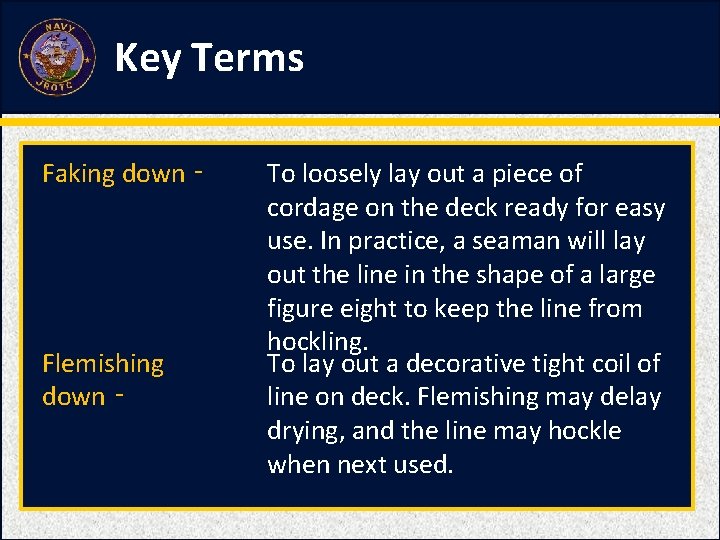
Key Terms Faking down ‑ Flemishing down ‑ To loosely lay out a piece of cordage on the deck ready for easy use. In practice, a seaman will lay out the line in the shape of a large figure eight to keep the line from hockling. To lay out a decorative tight coil of line on deck. Flemishing may delay drying, and the line may hockle when next used.
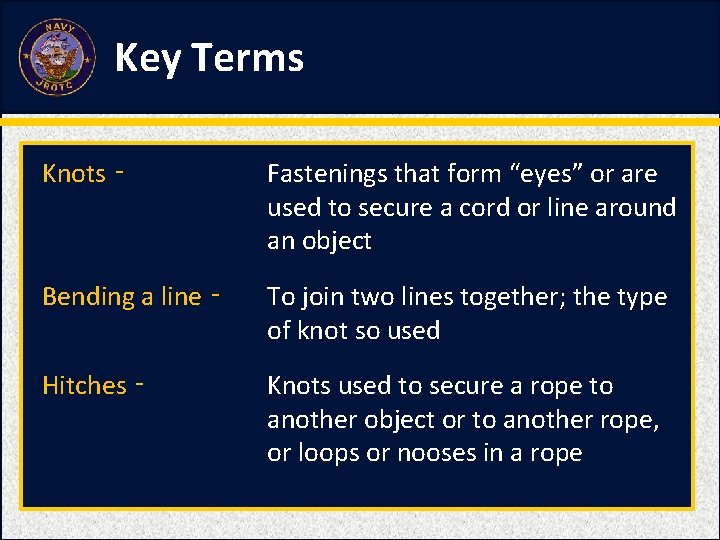
Key Terms Knots ‑ Fastenings that form “eyes” or are used to secure a cord or line around an object Bending a line ‑ To join two lines together; the type of knot so used Hitches ‑ Knots used to secure a rope to another object or to another rope, or loops or nooses in a rope
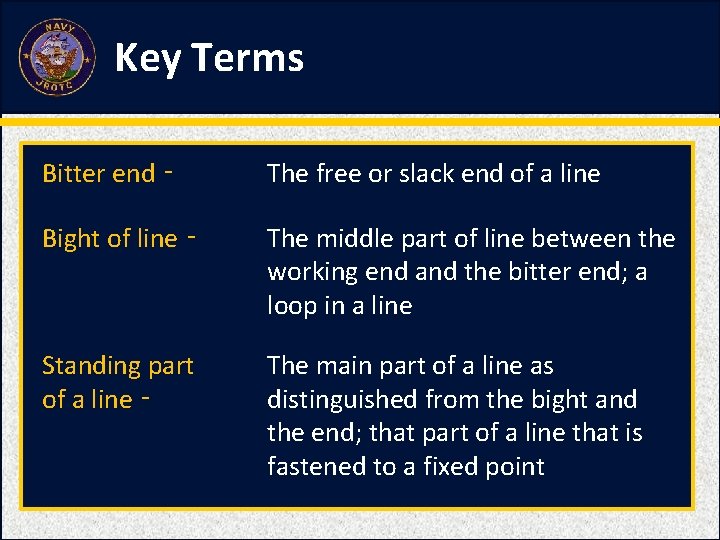
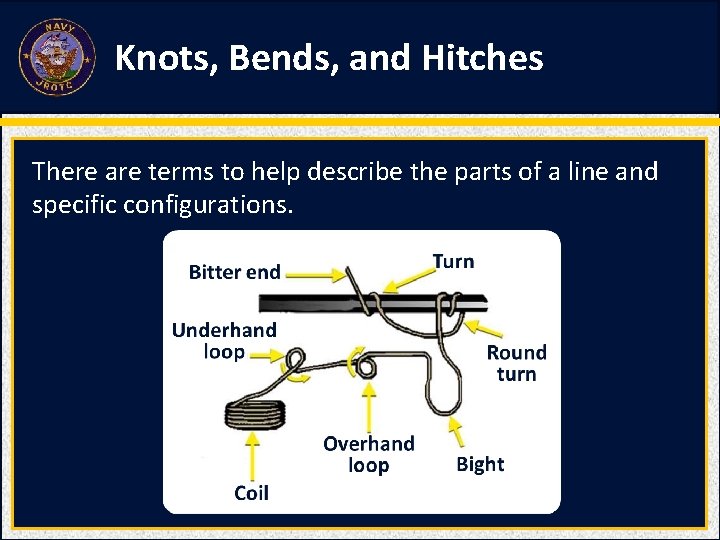
Key Terms Bitter end ‑ The free or slack end of a line Bight of line ‑ The middle part of line between the working end and the bitter end; a loop in a line Standing part of a line ‑ The main part of a line as distinguished from the bight and the end; that part of a line that is fastened to a fixed point
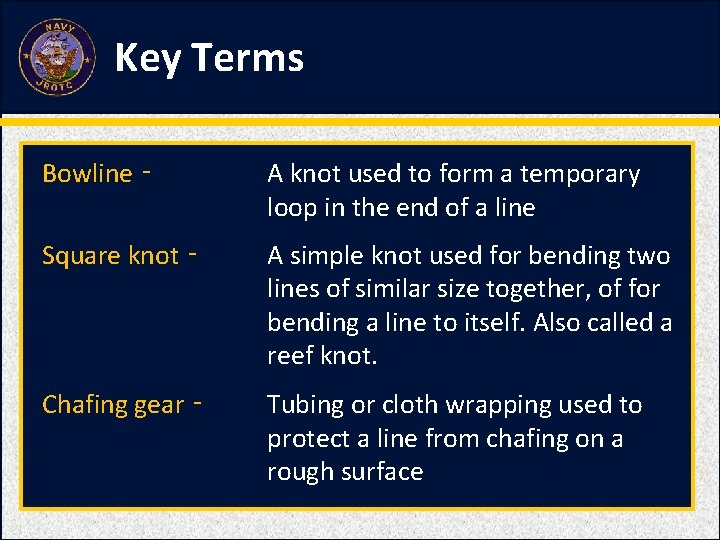
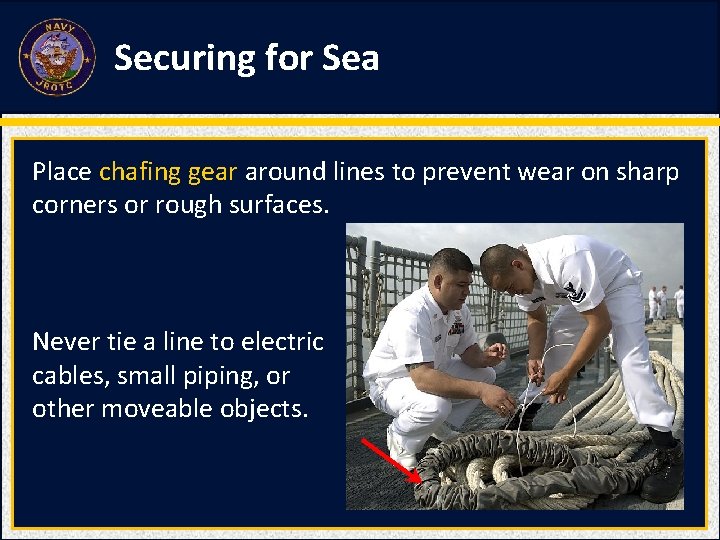
Key Terms Bowline ‑ A knot used to form a temporary loop in the end of a line Square knot ‑ A simple knot used for bending two lines of similar size together, of for bending a line to itself. Also called a reef knot. Chafing gear ‑ Tubing or cloth wrapping used to protect a line from chafing on a rough surface
Key Terms Fid ‑ A long, tapered, wooden tool used to open the strands of a line for splicing Padeye ‑ Any of several devices affixed to a surface by bolts or welding that provide a point of attachment
Opening Question What care can be taken to extend the life of natural fiber line? (Use CPS “Pick a Student” for this question. )
Warm Up Questions CPS Lesson Questions 1 - 2
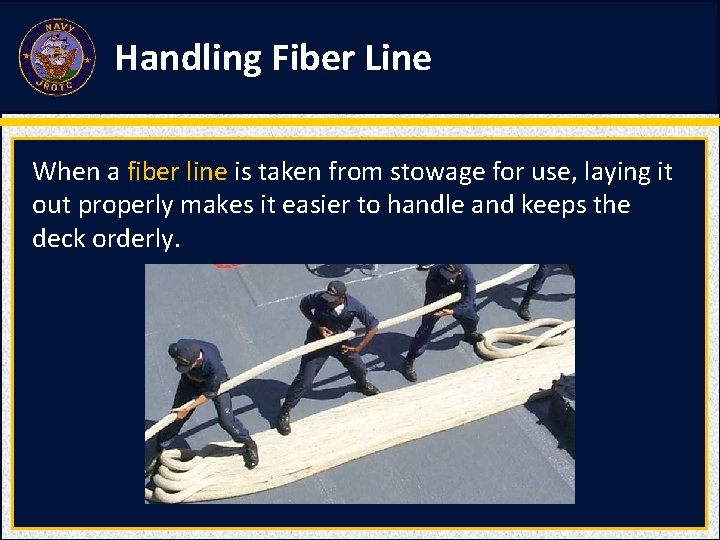
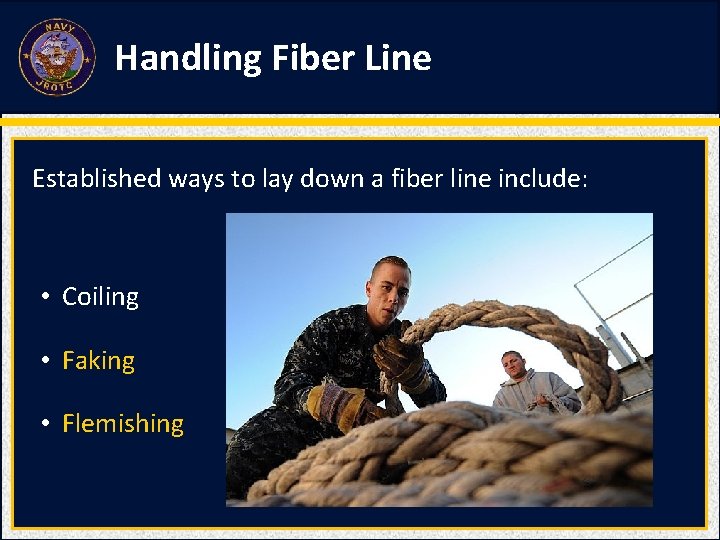
Handling Fiber Line When a fiber line is taken from stowage for use, laying it out properly makes it easier to handle and keeps the deck orderly.
Handling Fiber Line Established ways to lay down a fiber line include: • Coiling • Faking • Flemishing
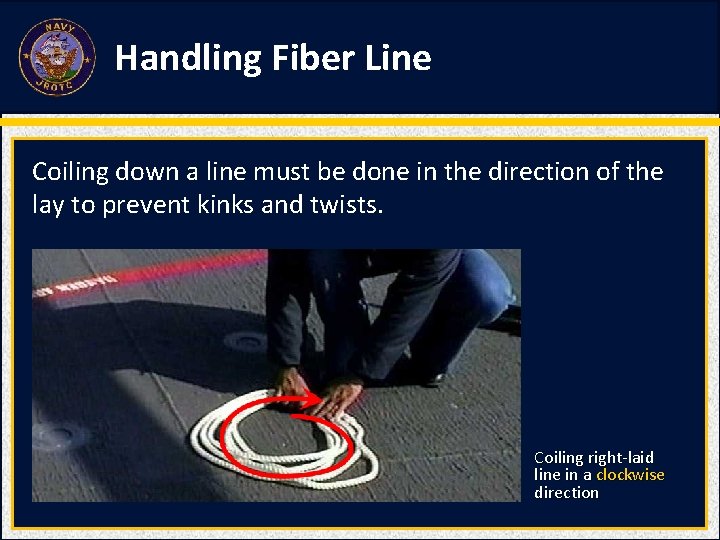
Handling Fiber Line Coiling down a line must be done in the direction of the lay to prevent kinks and twists. Coiling right-laid line in a clockwise direction
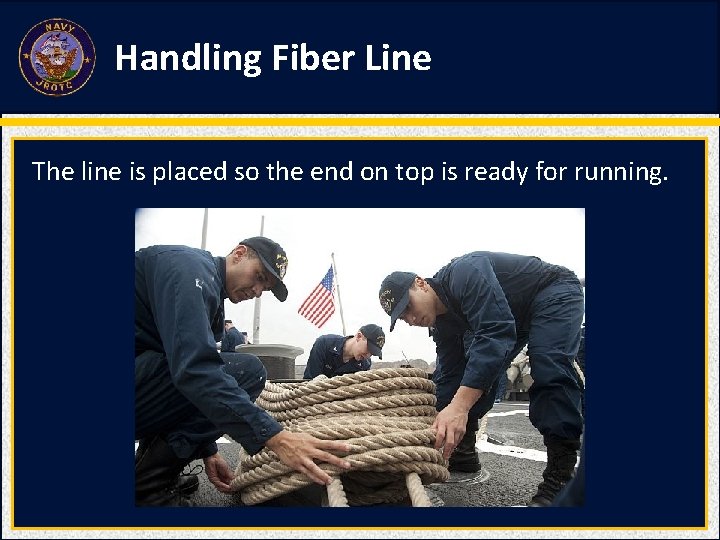
Handling Fiber Line The line is placed so the end on top is ready for running.
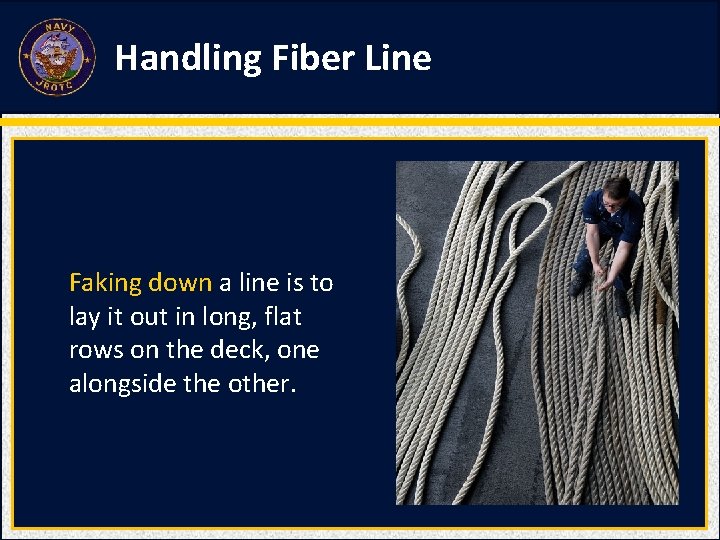
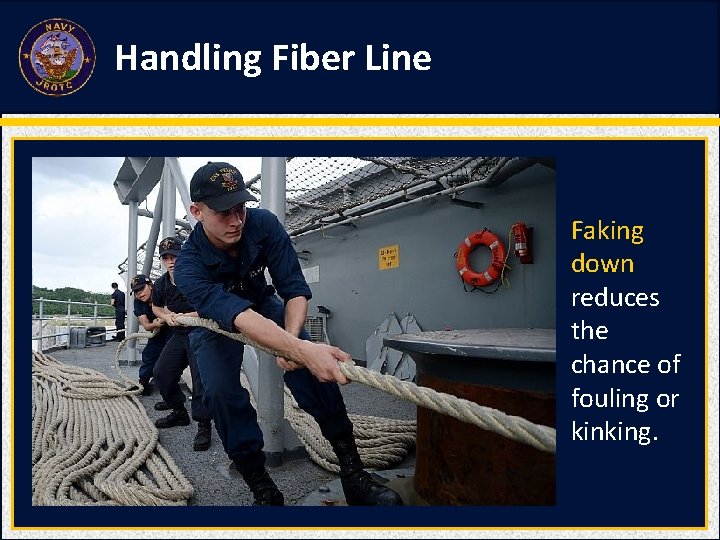
Handling Fiber Line Faking down a line is to lay it out in long, flat rows on the deck, one alongside the other.
Handling Fiber Line Faking down reduces the chance of fouling or kinking.
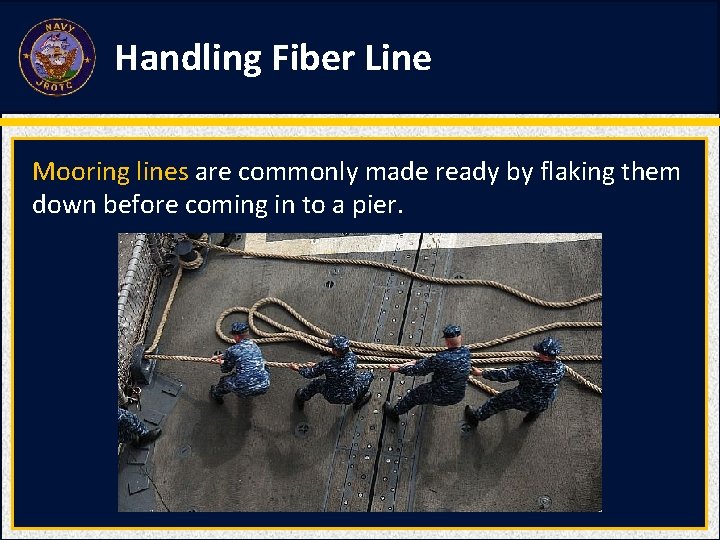
Handling Fiber Line Mooring lines are commonly made ready by flaking them down before coming in to a pier.
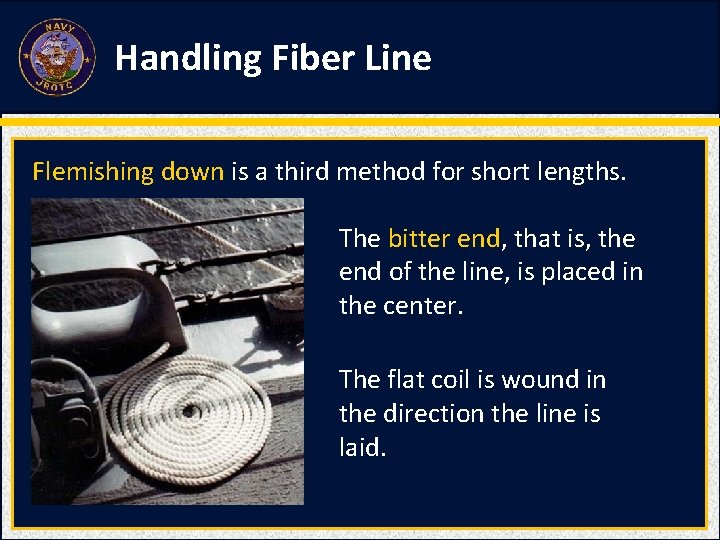
Handling Fiber Line Flemishing down is a third method for short lengths. The bitter end, that is, the end of the line, is placed in the center. The flat coil is wound in the direction the line is laid.
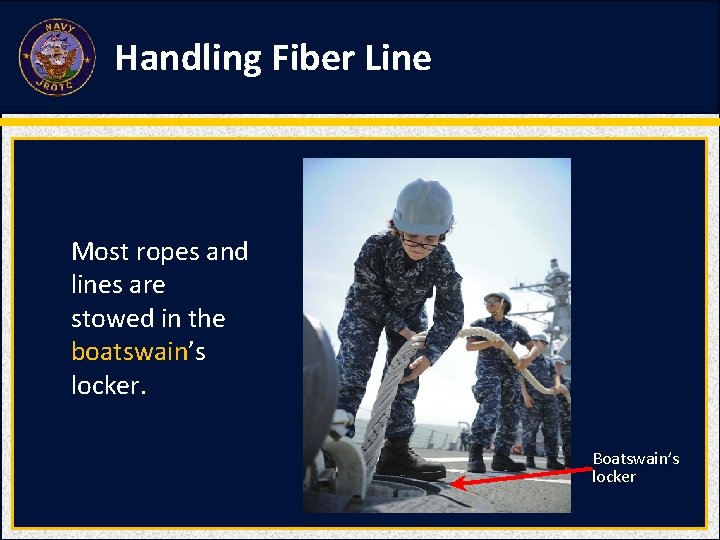
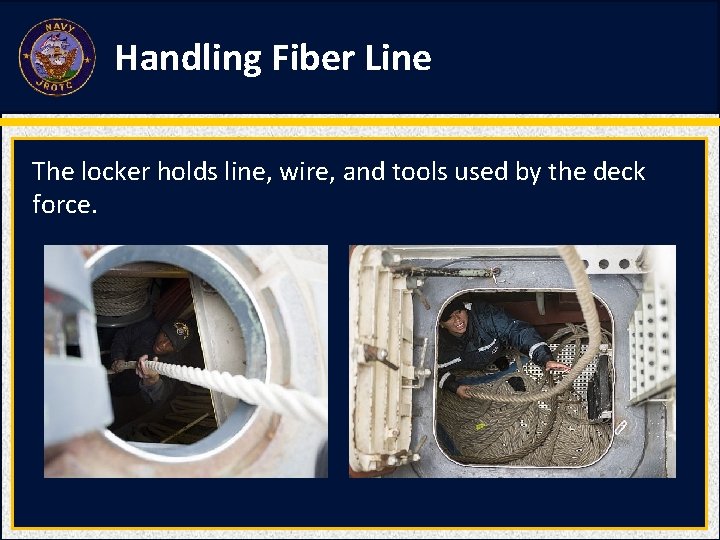
Handling Fiber Line Most ropes and lines are stowed in the boatswain’s locker. Boatswain’s locker
Handling Fiber Line The locker holds line, wire, and tools used by the deck force.
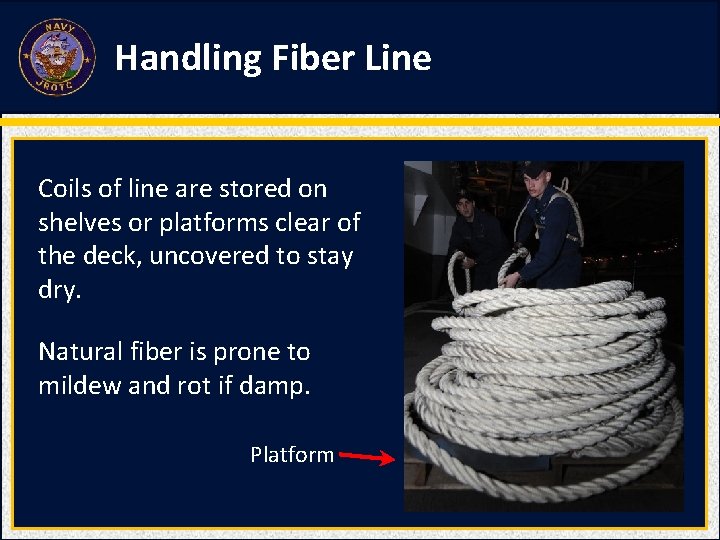
Handling Fiber Line Coils of line are stored on shelves or platforms clear of the deck, uncovered to stay dry. Natural fiber is prone to mildew and rot if damp. Platform
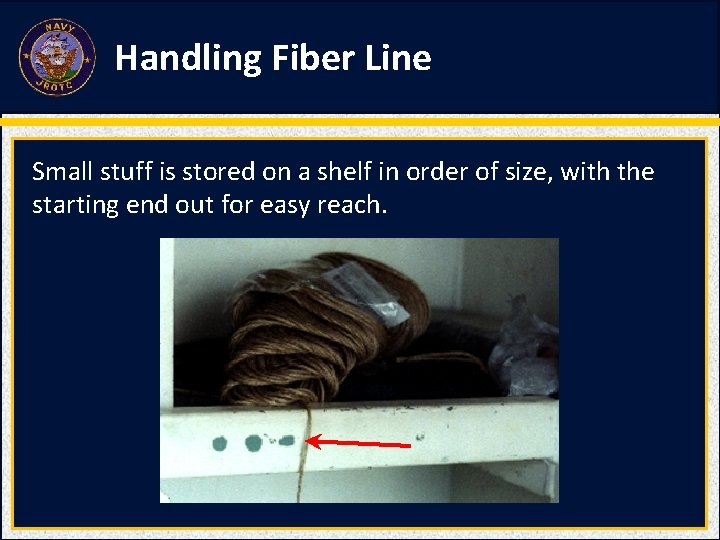
Handling Fiber Line Small stuff is stored on a shelf in order of size, with the starting end out for easy reach.
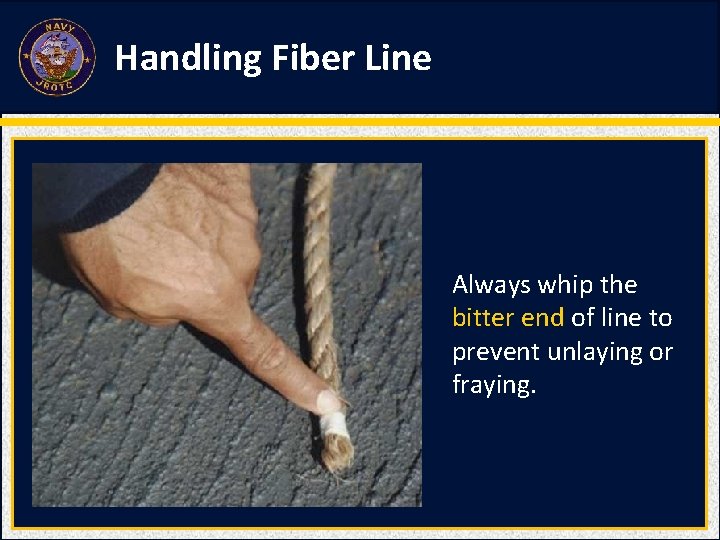
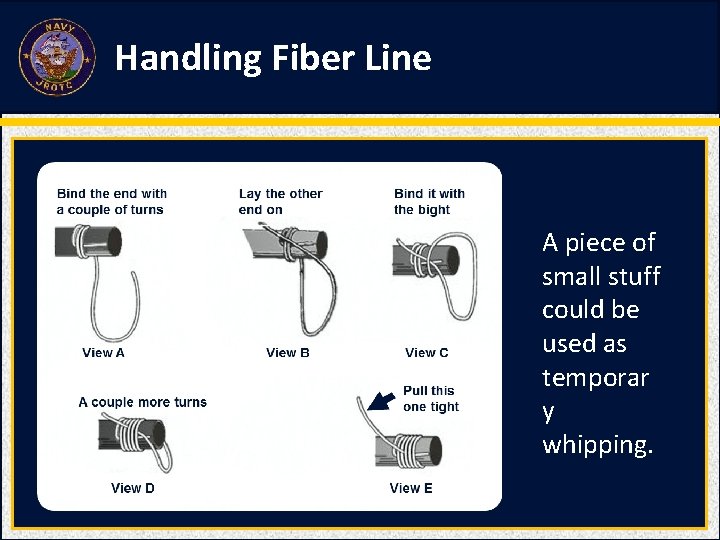
Handling Fiber Line Always whip the bitter end of line to prevent unlaying or fraying.
Handling Fiber Line A piece of small stuff could be used as temporar y whipping.
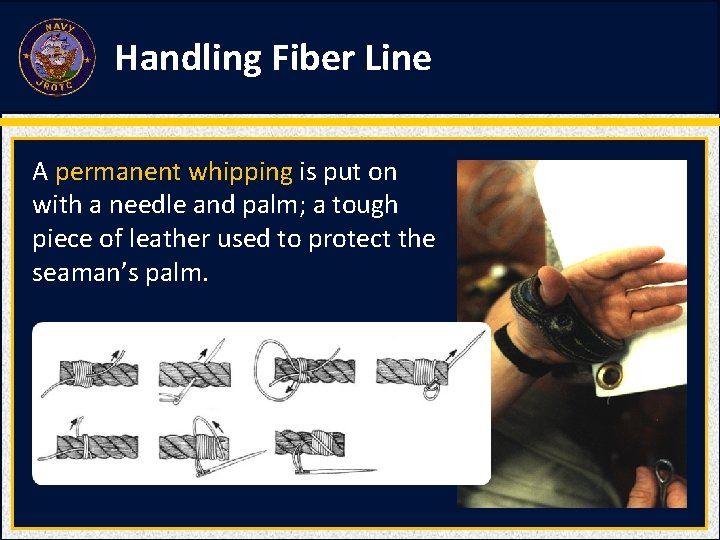
Handling Fiber Line A permanent whipping is put on with a needle and palm; a tough piece of leather used to protect the seaman’s palm.
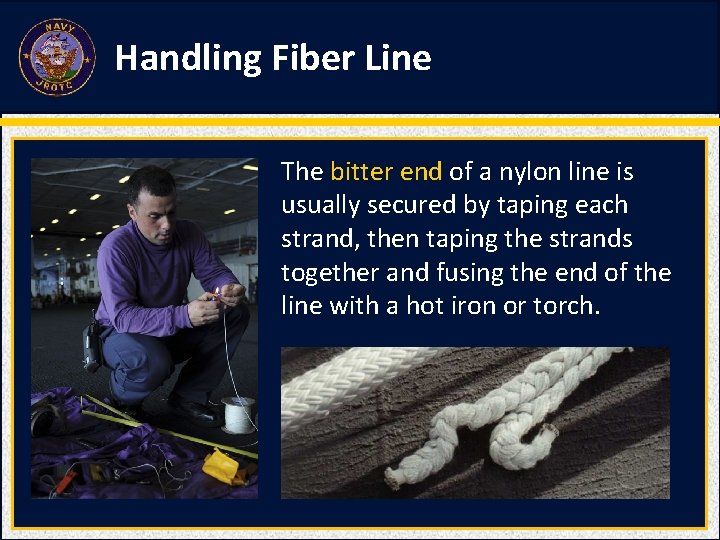
Handling Fiber Line The bitter end of a nylon line is usually secured by taping each strand, then taping the strands together and fusing the end of the line with a hot iron or torch.
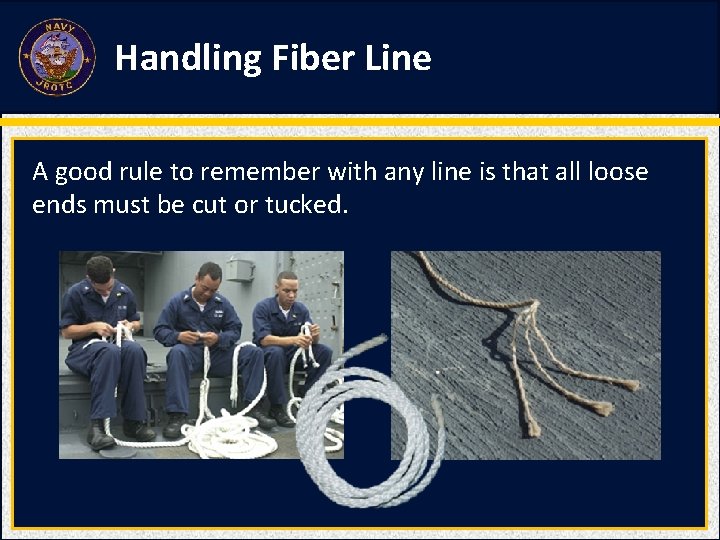
Handling Fiber Line A good rule to remember with any line is that all loose ends must be cut or tucked.
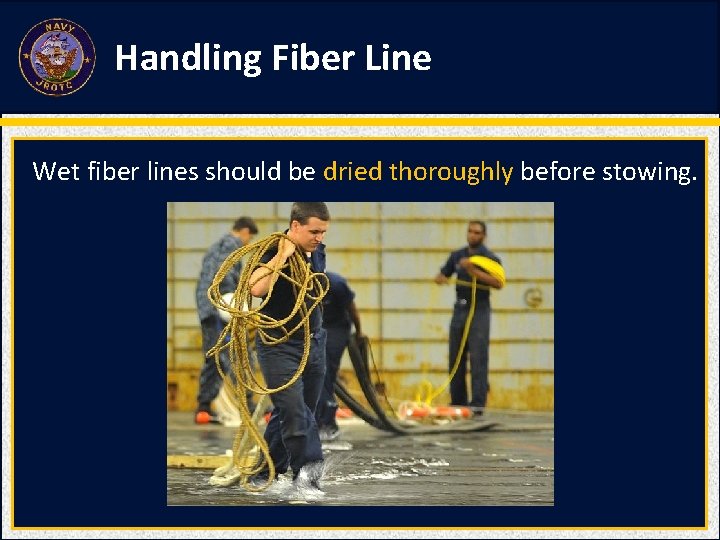
Handling Fiber Line Wet fiber lines should be dried thoroughly before stowing.
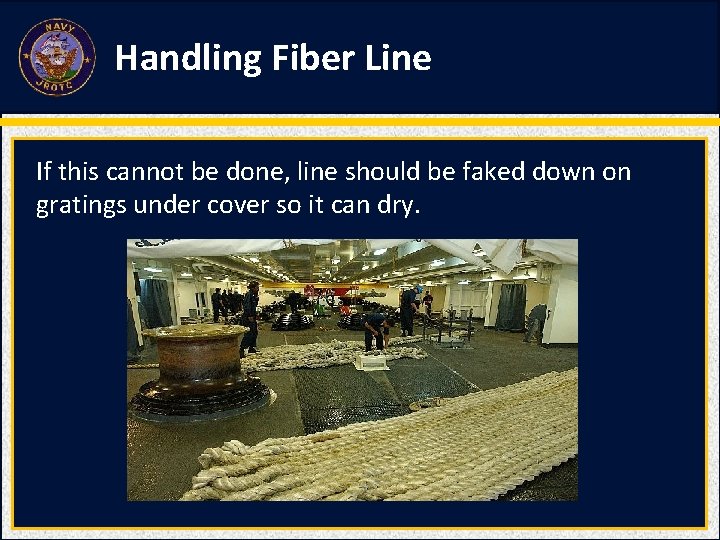
Handling Fiber Line If this cannot be done, line should be faked down on gratings under cover so it can dry.
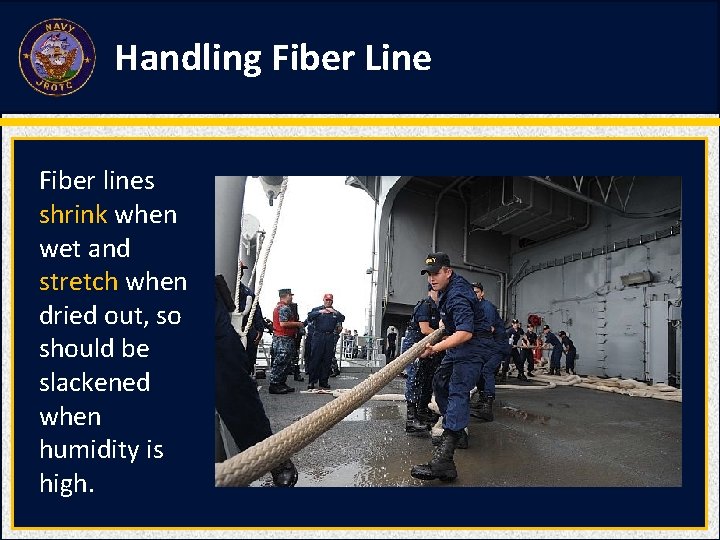
Handling Fiber Line Fiber lines shrink when wet and stretch when dried out, so should be slackened when humidity is high.
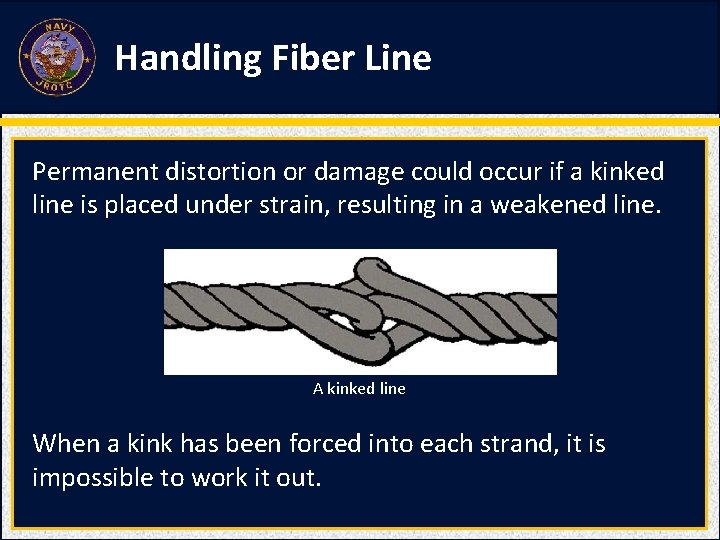
Handling Fiber Line Permanent distortion or damage could occur if a kinked line is placed under strain, resulting in a weakened line. A kinked line When a kink has been forced into each strand, it is impossible to work it out.
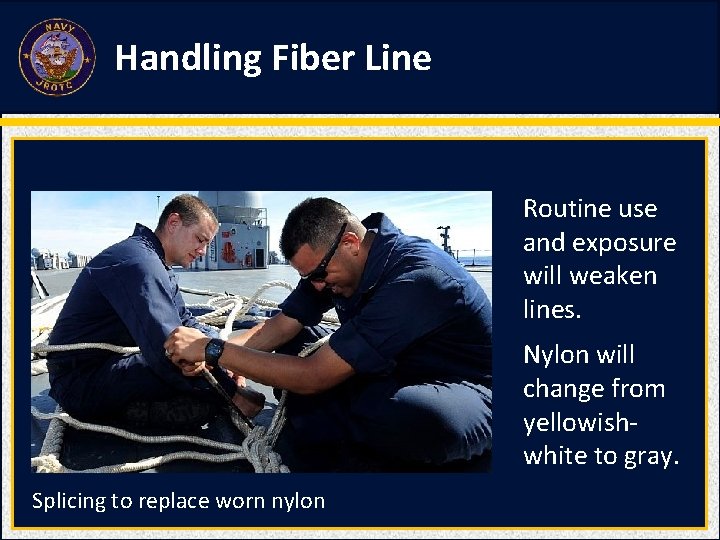
Handling Fiber Line Routine use and exposure will weaken lines. Nylon will change from yellowishwhite to gray. Splicing to replace worn nylon
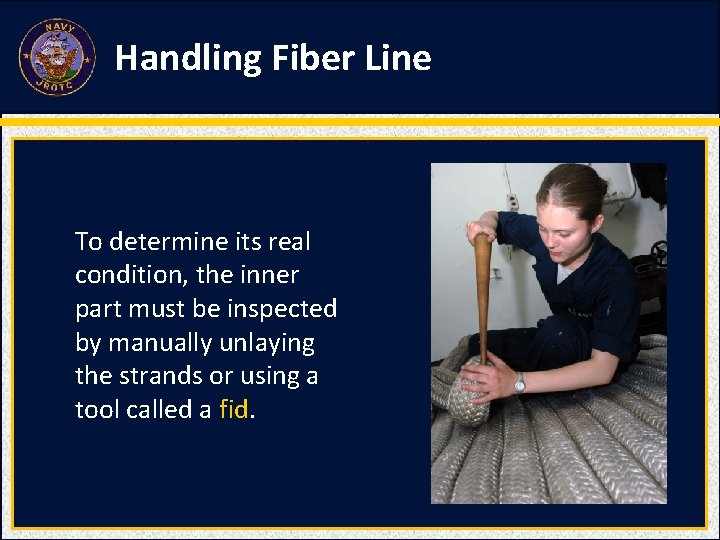
Handling Fiber Line To determine its real condition, the inner part must be inspected by manually unlaying the strands or using a tool called a fid.
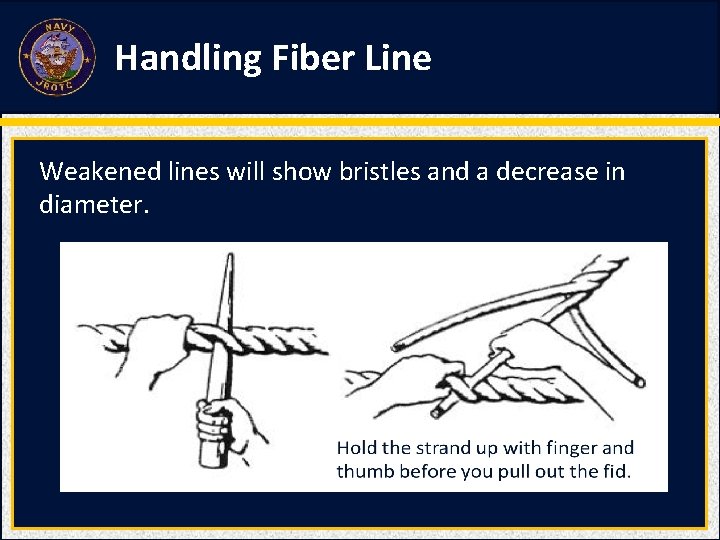
Handling Fiber Line Weakened lines will show bristles and a decrease in diameter.
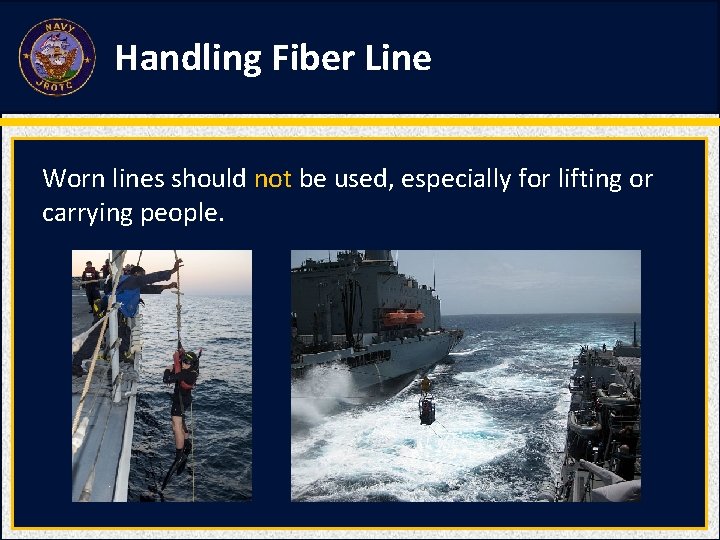
Handling Fiber Line Worn lines should not be used, especially for lifting or carrying people.
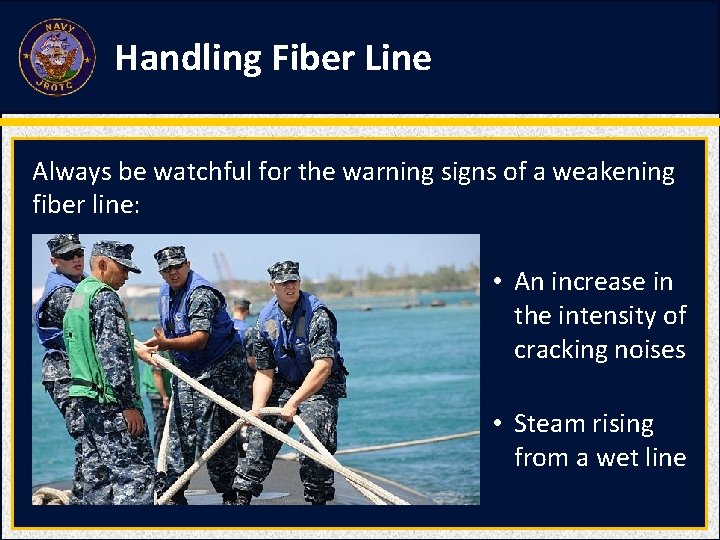
Handling Fiber Line Always be watchful for the warning signs of a weakening fiber line: • An increase in the intensity of cracking noises • Steam rising from a wet line
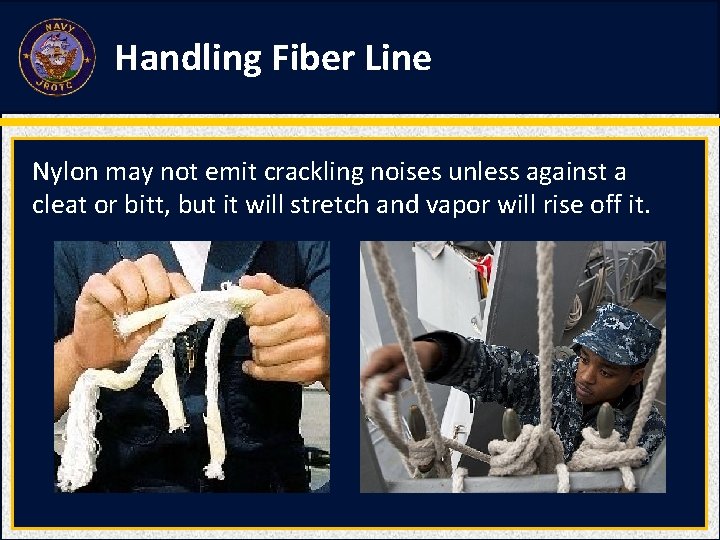
Handling Fiber Line Nylon may not emit crackling noises unless against a cleat or bitt, but it will stretch and vapor will rise off it.
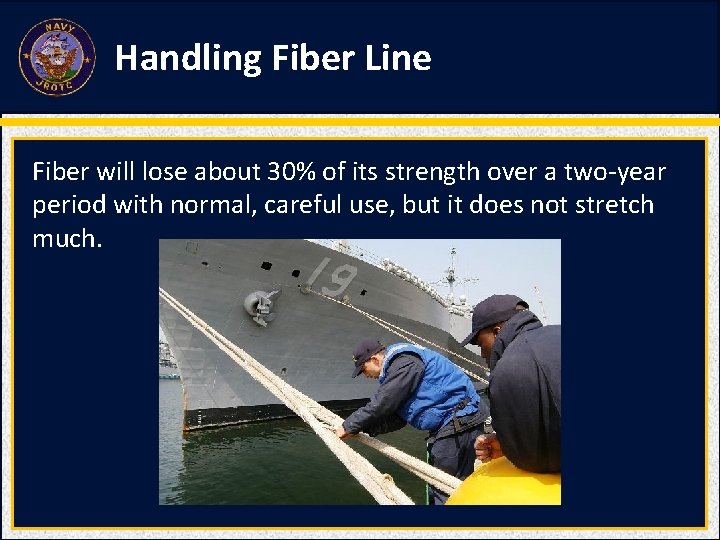
Handling Fiber Line Fiber will lose about 30% of its strength over a two-year period with normal, careful use, but it does not stretch much.
Check On Learning Questions CPS Lesson Questions 3 - 4
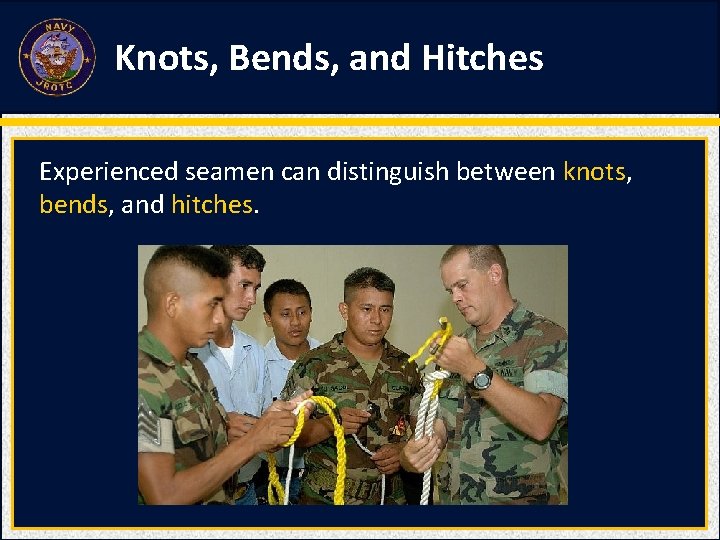
Knots, Bends, and Hitches Experienced seamen can distinguish between knots, bends, and hitches.
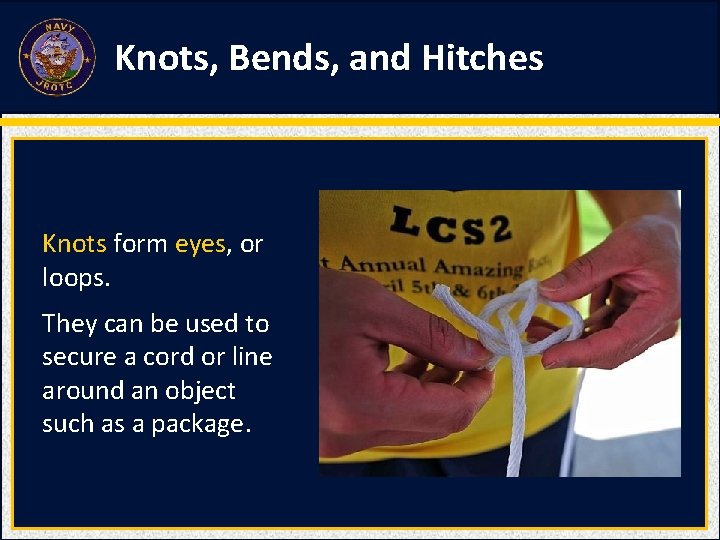
Knots, Bends, and Hitches Knots form eyes, or loops. They can be used to secure a cord or line around an object such as a package.
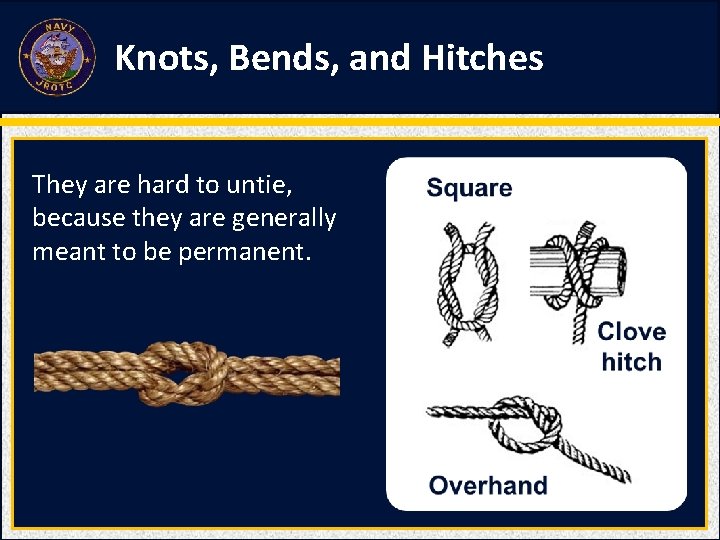
Knots, Bends, and Hitches They are hard to untie, because they are generally meant to be permanent.
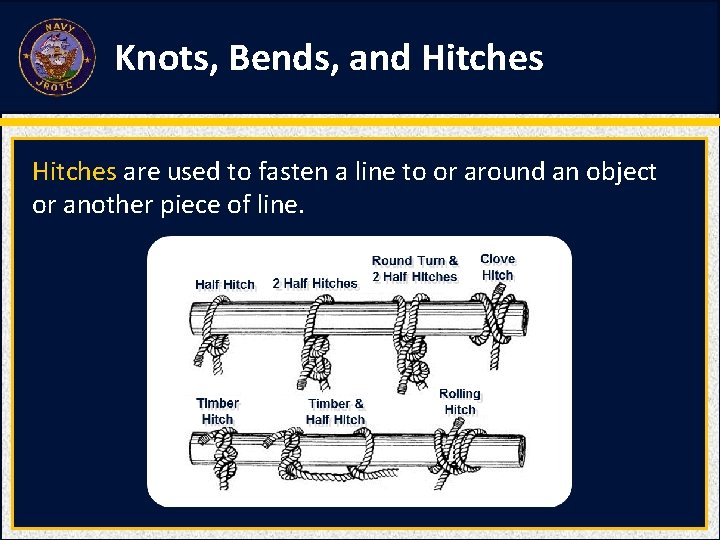
Knots, Bends, and Hitches are used to fasten a line to or around an object or another piece of line.
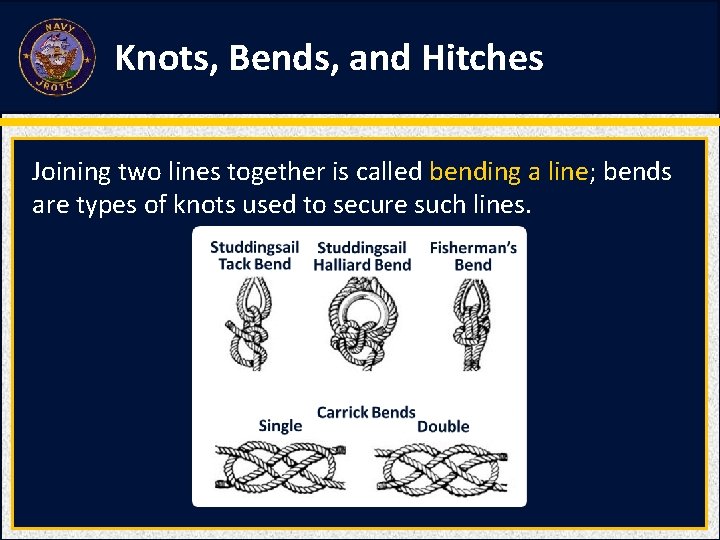
Knots, Bends, and Hitches Joining two lines together is called bending a line; bends are types of knots used to secure such lines.
Knots, Bends, and Hitches In the Navy, seamen are expected to know how to tie: • Square knots • Bowlines • Becket bends, single and double • Round turns • Two half hitches Most also should know the clove hitch.
Knots, Bends, and Hitches There are terms to help describe the parts of a line and specific configurations.
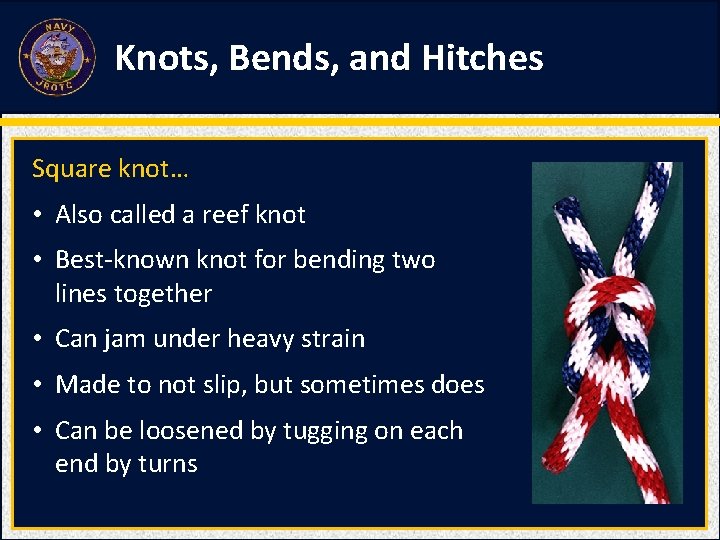
Knots, Bends, and Hitches Square knot… • Also called a reef knot • Best-known knot for bending two lines together • Can jam under heavy strain • Made to not slip, but sometimes does • Can be loosened by tugging on each end by turns
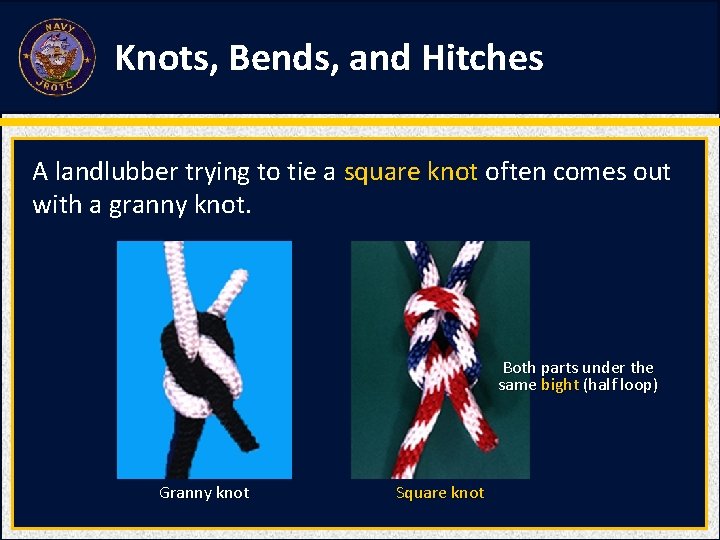
Knots, Bends, and Hitches A landlubber trying to tie a square knot often comes out with a granny knot. Both parts under the same bight (half loop) Granny knot Square knot
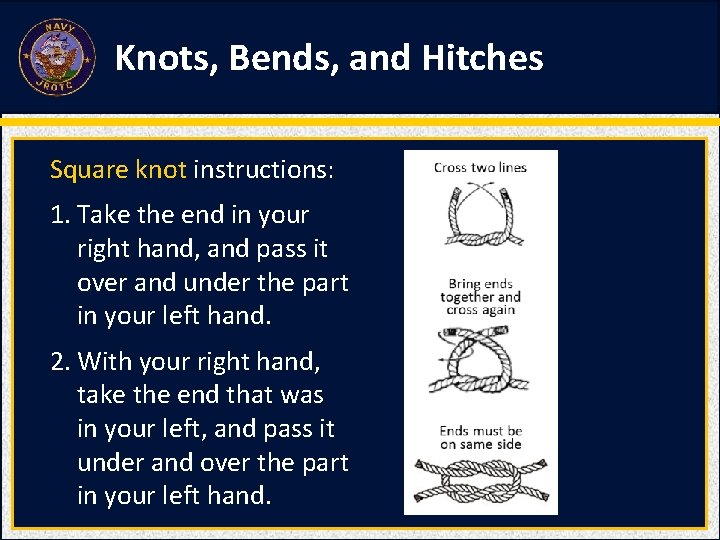
Knots, Bends, and Hitches Square knot instructions: 1. Take the end in your right hand, and pass it over and under the part in your left hand. 2. With your right hand, take the end that was in your left, and pass it under and over the part in your left hand.
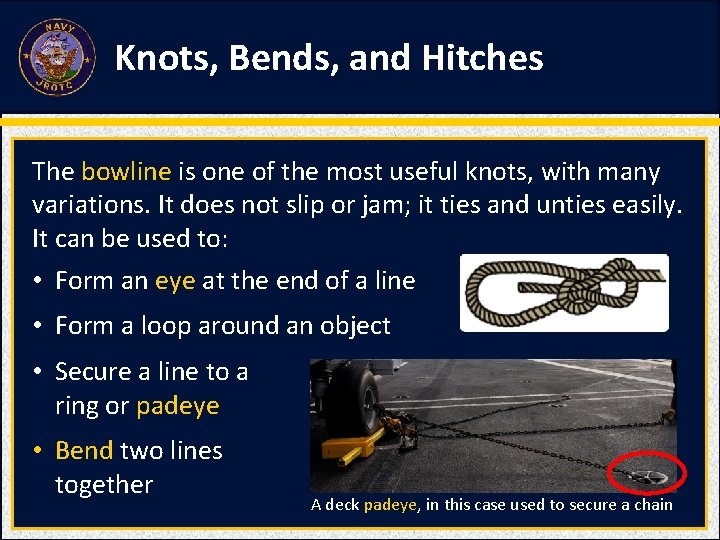
Knots, Bends, and Hitches The bowline is one of the most useful knots, with many variations. It does not slip or jam; it ties and unties easily. It can be used to: • Form an eye at the end of a line • Form a loop around an object • Secure a line to a ring or padeye • Bend two lines together A deck padeye, in this case used to secure a chain
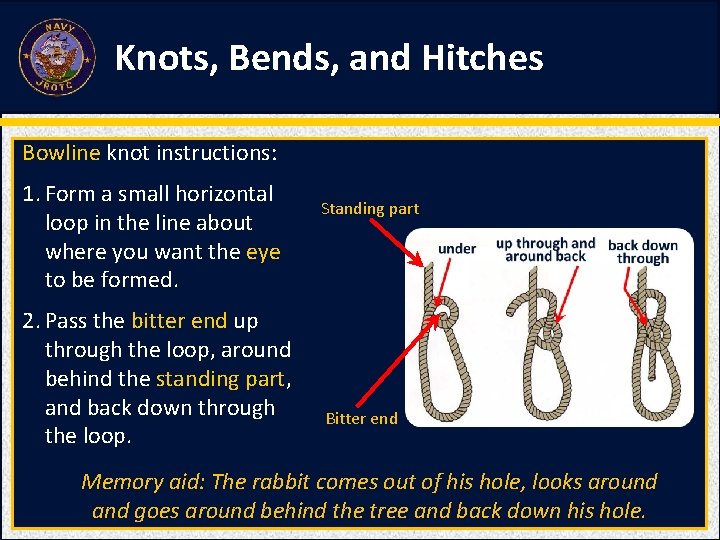
Knots, Bends, and Hitches Bowline knot instructions: 1. Form a small horizontal loop in the line about where you want the eye to be formed. 2. Pass the bitter end up through the loop, around behind the standing part, and back down through the loop. Standing part Bitter end Memory aid: The rabbit comes out of his hole, looks around and goes around behind the tree and back down his hole.
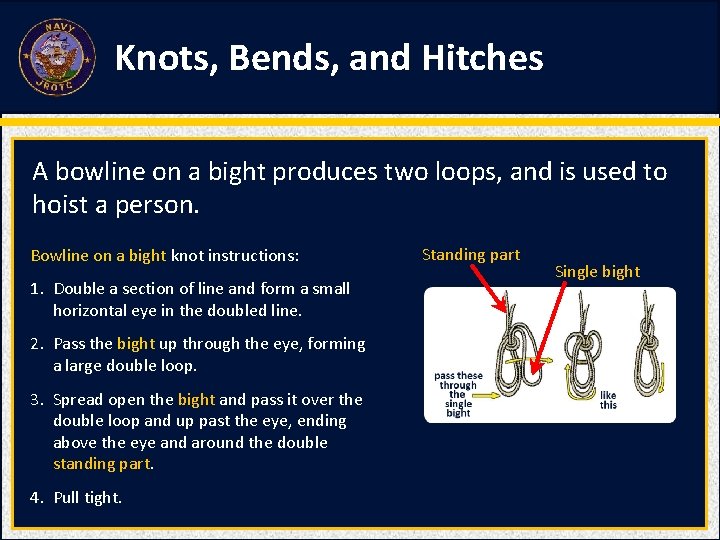
Knots, Bends, and Hitches A bowline on a bight produces two loops, and is used to hoist a person. Bowline on a bight knot instructions: 1. Double a section of line and form a small horizontal eye in the doubled line. 2. Pass the bight up through the eye, forming a large double loop. 3. Spread open the bight and pass it over the double loop and up past the eye, ending above the eye and around the double standing part. 4. Pull tight. Standing part Single bight
Check On Learning Questions CPS Lesson Questions 5 - 6
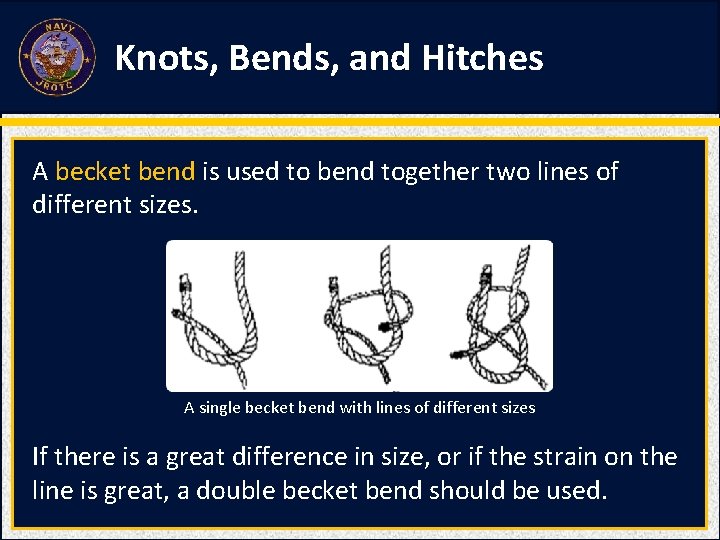
Knots, Bends, and Hitches A becket bend is used to bend together two lines of different sizes. A single becket bend with lines of different sizes If there is a great difference in size, or if the strain on the line is great, a double becket bend should be used.
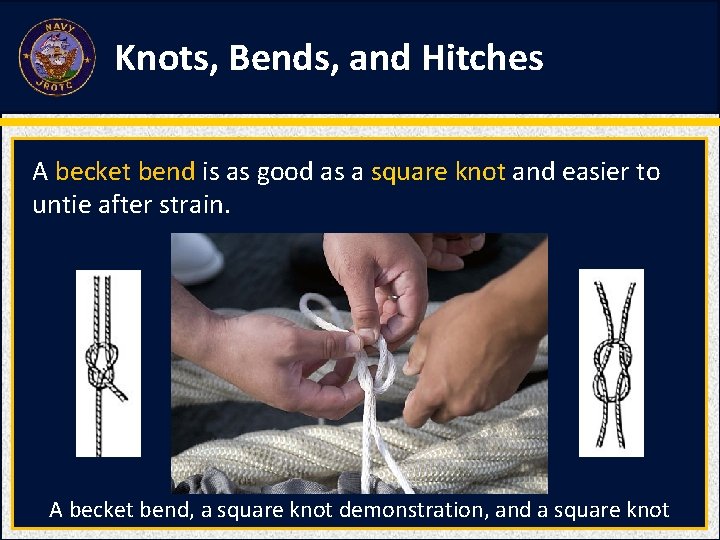
Knots, Bends, and Hitches A becket bend is as good as a square knot and easier to untie after strain. A becket bend, a square knot demonstration, and a square knot
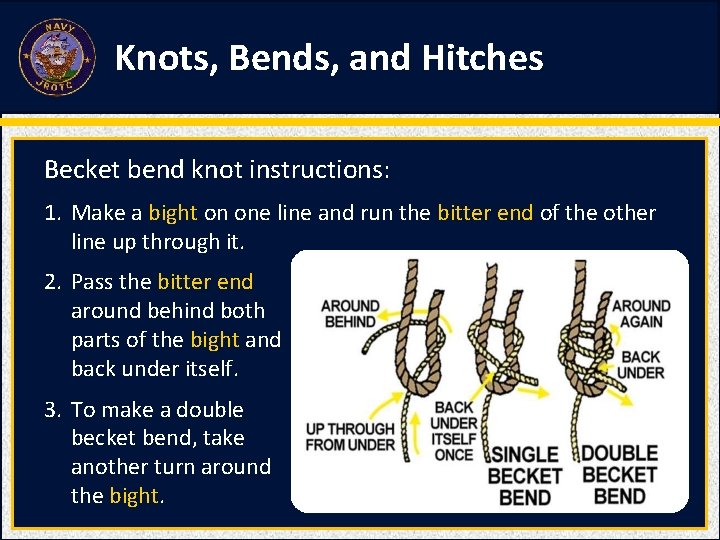
Knots, Bends, and Hitches Becket bend knot instructions: 1. Make a bight on one line and run the bitter end of the other line up through it. 2. Pass the bitter end around behind both parts of the bight and back under itself. 3. To make a double becket bend, take another turn around the bight.
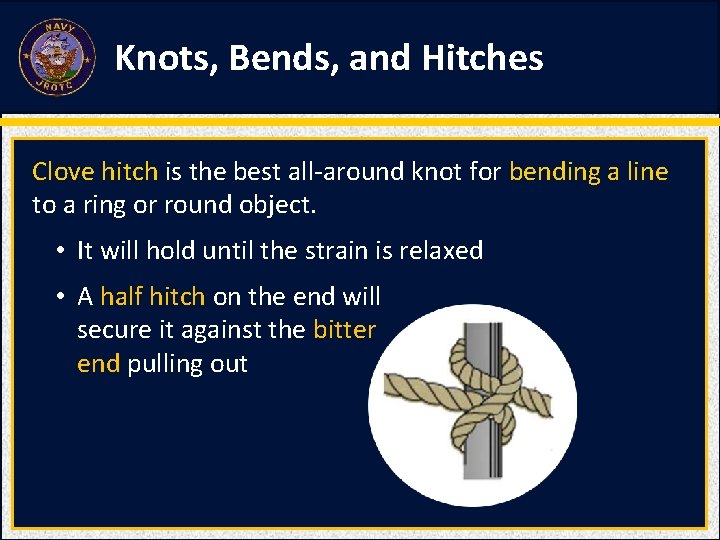
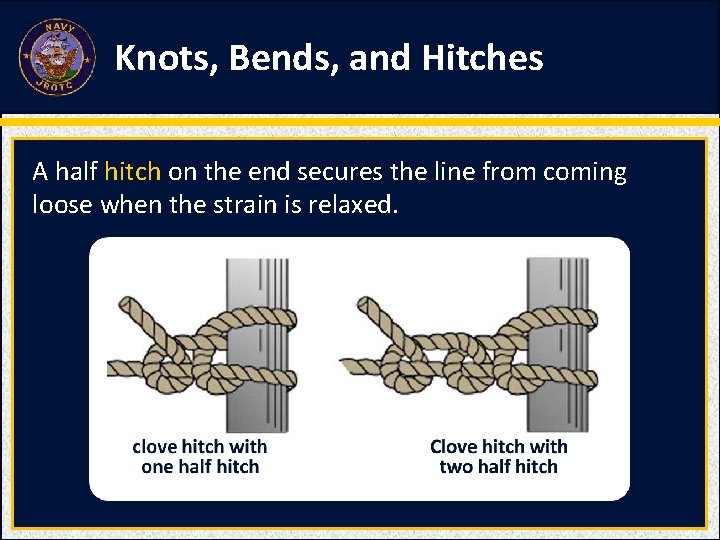
Knots, Bends, and Hitches Clove hitch is the best all-around knot for bending a line to a ring or round object. • It will hold until the strain is relaxed • A half hitch on the end will secure it against the bitter end pulling out
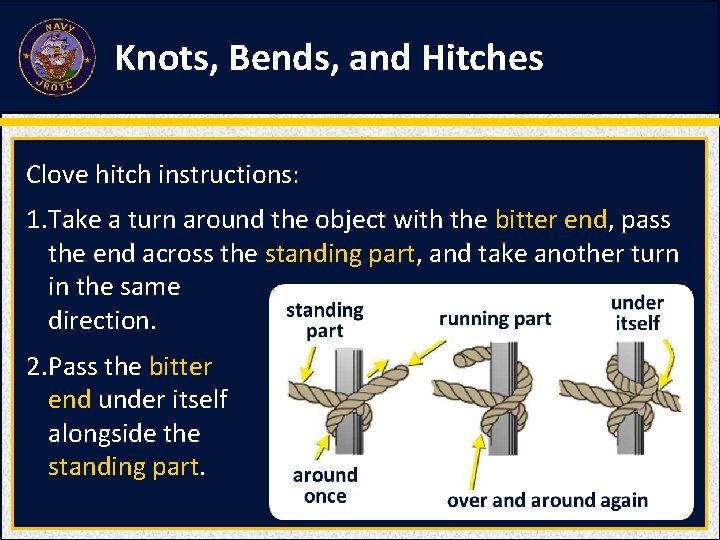
Knots, Bends, and Hitches Clove hitch instructions: 1. Take a turn around the object with the bitter end, pass the end across the standing part, and take another turn in the same direction. 2. Pass the bitter end under itself alongside the standing part.
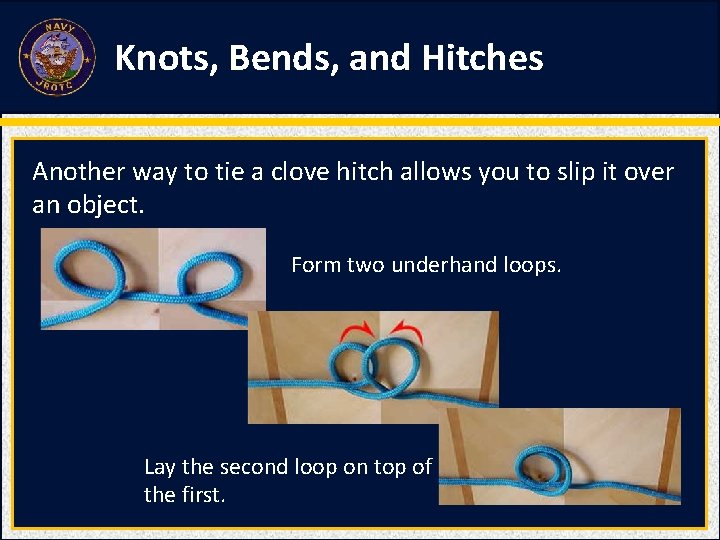
Knots, Bends, and Hitches Another way to tie a clove hitch allows you to slip it over an object. Form two underhand loops. Lay the second loop on top of the first.
Knots, Bends, and Hitches A half hitch on the end secures the line from coming loose when the strain is relaxed.
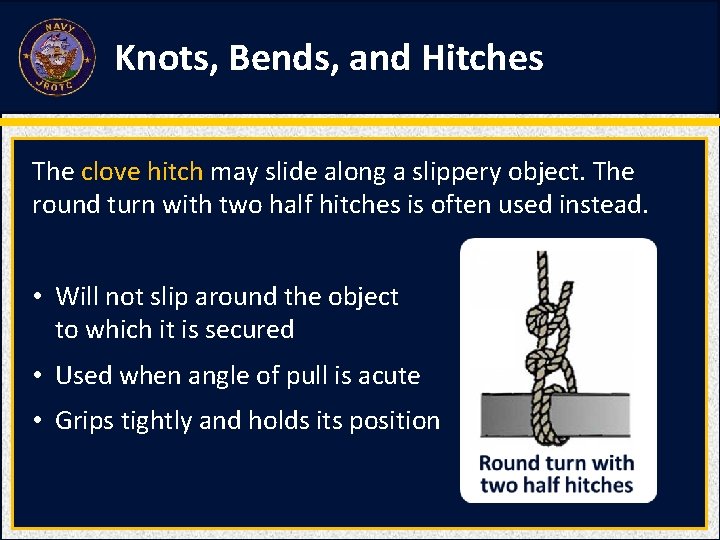
Knots, Bends, and Hitches The clove hitch may slide along a slippery object. The round turn with two half hitches is often used instead. • Will not slip around the object to which it is secured • Used when angle of pull is acute • Grips tightly and holds its position
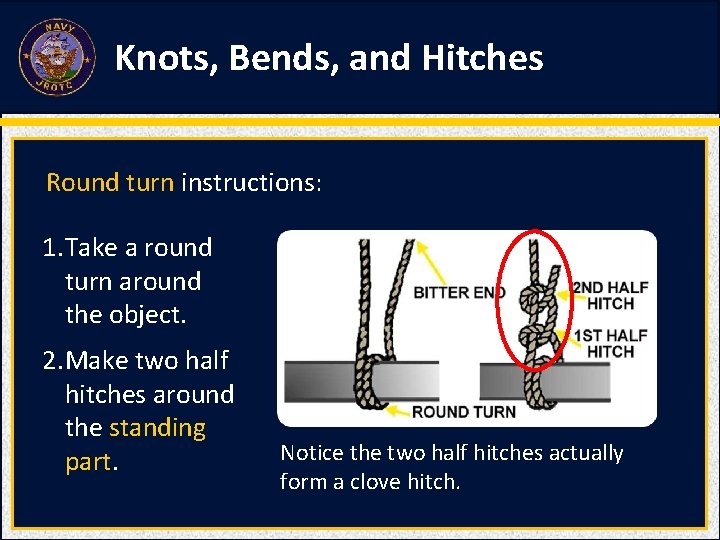
Knots, Bends, and Hitches Round turn instructions: 1. Take a round turn around the object. 2. Make two half hitches around the standing part. Notice the two half hitches actually form a clove hitch.
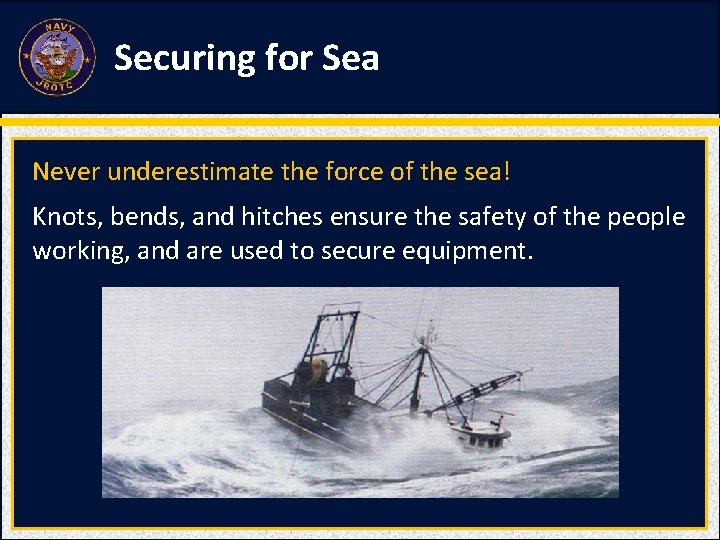
Securing for Sea Never underestimate the force of the sea! Knots, bends, and hitches ensure the safety of the people working, and are used to secure equipment.
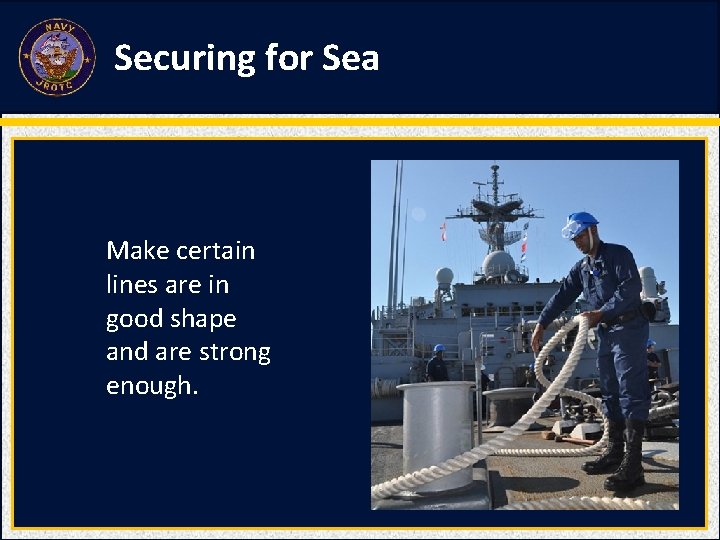
Securing for Sea Make certain lines are in good shape and are strong enough.
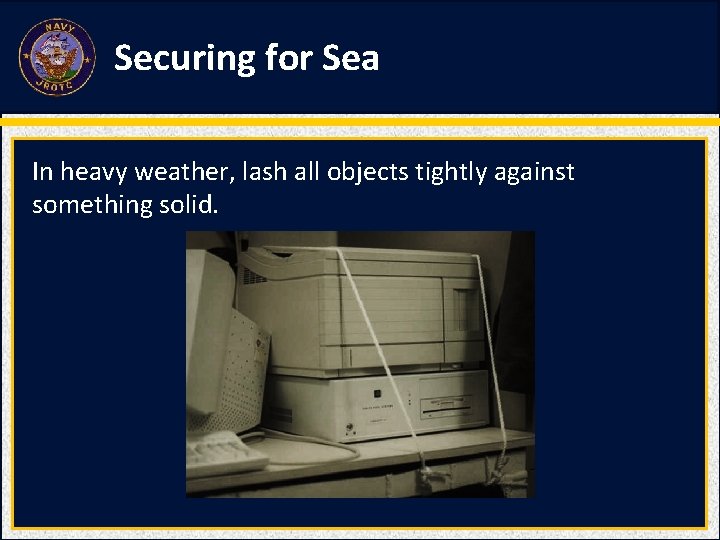
Securing for Sea In heavy weather, lash all objects tightly against something solid.
Securing for Sea Place chafing gear around lines to prevent wear on sharp corners or rough surfaces. Never tie a line to electric cables, small piping, or other moveable objects.
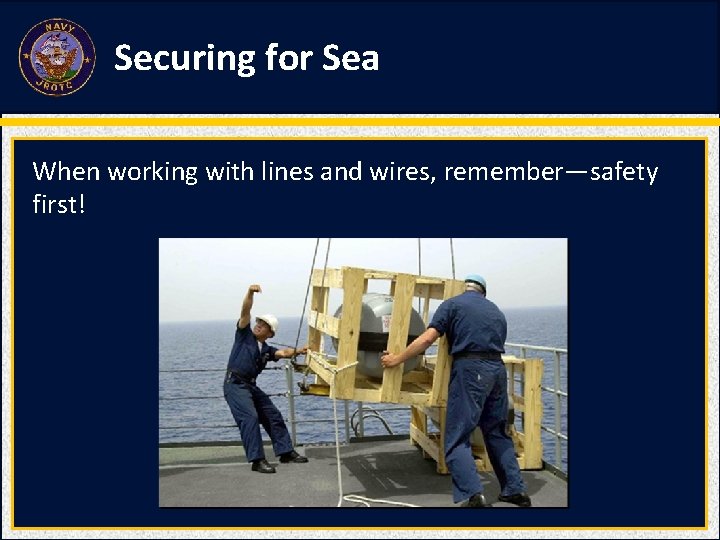
Securing for Sea When working with lines and wires, remember—safety first!
Review Question Which knots are essential for every Sailor to learn to tie? (Use CPS “Pick a Student” for this question. )
Closing Questions CPS Lesson Questions 7 - 8
Questions?