
Naval Architecture Introduction Standard Terminology Definitions Pertaining to



- Slides: 19
Naval Architecture Introduction “Standard Terminology & Definitions Pertaining to a Ship’s Structure”
Naval Architecture: An Introduction • The function of a ship is to transport goods from where their use is low to a place where it is higher. • Ships currently transport 95% of the world’s trade were the pattern of route and cargoes is continually changing. • Therefore ship design needs to maintain competency to meet these continuous developments and be subject to constant evolution. • Changes are driven by technological advancements, social trends and economic pressures. • Consequently recent trends in ship design include increasing vessels’ sizes to expand cargo capacity.
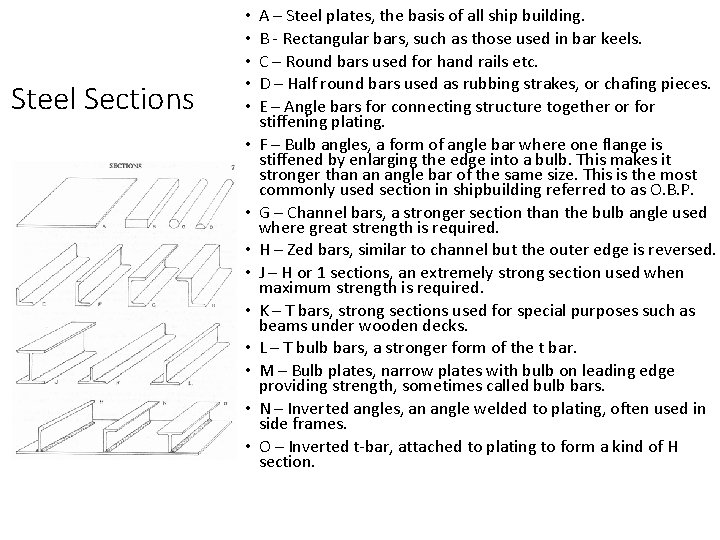
Naval Architecture: An Introduction • Naval Architecture is an interesting subject where you will develop an awareness of materials, structures and design techniques. • To understand how a ship is constructed it is important to recognise the basic components which are manipulated to form the hull and superstructure. • The diagram following graphically shows the different steel sections used in ship building. • You must take every opportunity to examine your current vessel thoroughly and identify throughout the ship where such sections are utilised. • In most modern vessels the construction is of steel. • However, as you will come to learn in future studies, the type and composition of the steel can vary enormously depending on the final task the vessel is to achieve. • For example an arctic survey vessel will use special high strength steel to resist impact damage from ice.
Steel Sections • • • • A – Steel plates, the basis of all ship building. B - Rectangular bars, such as those used in bar keels. C – Round bars used for hand rails etc. D – Half round bars used as rubbing strakes, or chafing pieces. E – Angle bars for connecting structure together or for stiffening plating. F – Bulb angles, a form of angle bar where one flange is stiffened by enlarging the edge into a bulb. This makes it stronger than an angle bar of the same size. This is the most commonly used section in shipbuilding referred to as O. B. P. G – Channel bars, a stronger section than the bulb angle used where great strength is required. H – Zed bars, similar to channel but the outer edge is reversed. J – H or 1 sections, an extremely strong section used when maximum strength is required. K – T bars, strong sections used for special purposes such as beams under wooden decks. L – T bulb bars, a stronger form of the t bar. M – Bulb plates, narrow plates with bulb on leading edge providing strength, sometimes called bulb bars. N – Inverted angles, an angle welded to plating, often used in side frames. O – Inverted t-bar, attached to plating to form a kind of H section.
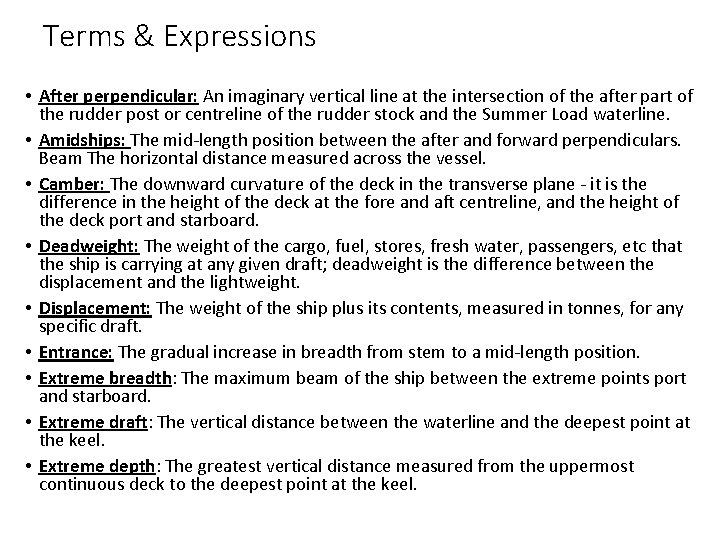
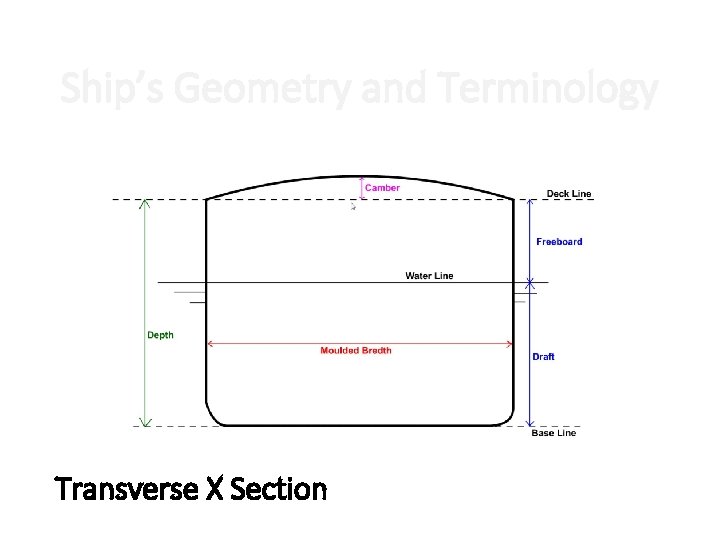
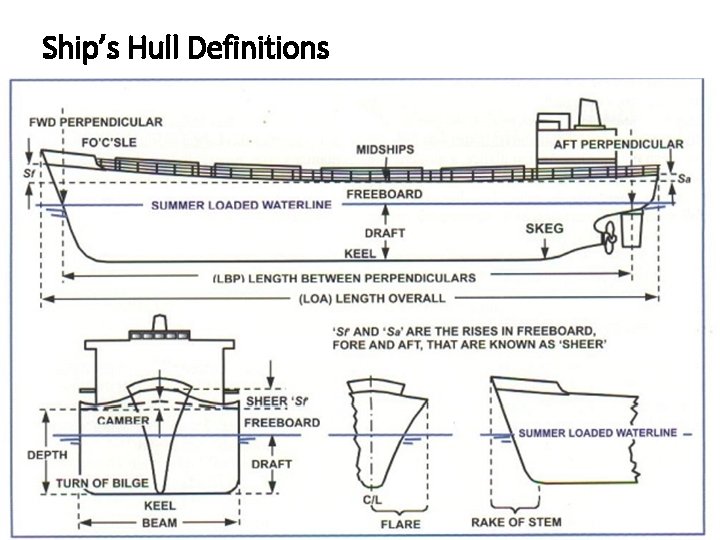
Terms & Expressions • After perpendicular: An imaginary vertical line at the intersection of the after part of the rudder post or centreline of the rudder stock and the Summer Load waterline. • Amidships: The mid-length position between the after and forward perpendiculars. Beam The horizontal distance measured across the vessel. • Camber: The downward curvature of the deck in the transverse plane - it is the difference in the height of the deck at the fore and aft centreline, and the height of the deck port and starboard. • Deadweight: The weight of the cargo, fuel, stores, fresh water, passengers, etc that the ship is carrying at any given draft; deadweight is the difference between the displacement and the lightweight. • Displacement: The weight of the ship plus its contents, measured in tonnes, for any specific draft. • Entrance: The gradual increase in breadth from stem to a mid-length position. • Extreme breadth: The maximum beam of the ship between the extreme points port and starboard. • Extreme draft: The vertical distance between the waterline and the deepest point at the keel. • Extreme depth: The greatest vertical distance measured from the uppermost continuous deck to the deepest point at the keel.
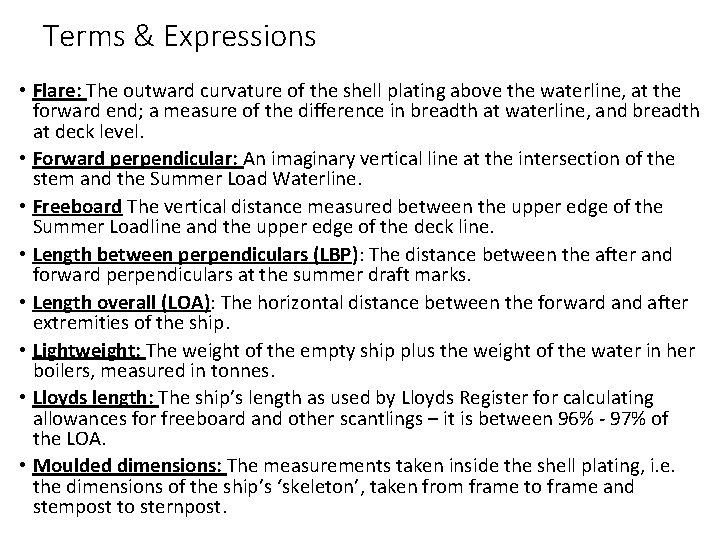
Terms & Expressions • Flare: The outward curvature of the shell plating above the waterline, at the forward end; a measure of the difference in breadth at waterline, and breadth at deck level. • Forward perpendicular: An imaginary vertical line at the intersection of the stem and the Summer Load Waterline. • Freeboard The vertical distance measured between the upper edge of the Summer Loadline and the upper edge of the deck line. • Length between perpendiculars (LBP): The distance between the after and forward perpendiculars at the summer draft marks. • Length overall (LOA): The horizontal distance between the forward and after extremities of the ship. • Lightweight: The weight of the empty ship plus the weight of the water in her boilers, measured in tonnes. • Lloyds length: The ship’s length as used by Lloyds Register for calculating allowances for freeboard and other scantlings – it is between 96% - 97% of the LOA. • Moulded dimensions: The measurements taken inside the shell plating, i. e. the dimensions of the ship’s ‘skeleton’, taken from frame to frame and stempost to sternpost.
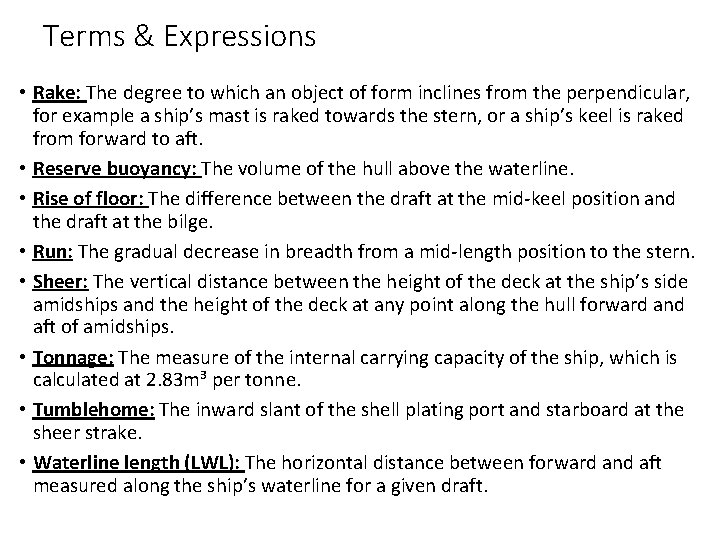
Terms & Expressions • Rake: The degree to which an object of form inclines from the perpendicular, for example a ship’s mast is raked towards the stern, or a ship’s keel is raked from forward to aft. • Reserve buoyancy: The volume of the hull above the waterline. • Rise of floor: The difference between the draft at the mid-keel position and the draft at the bilge. • Run: The gradual decrease in breadth from a mid-length position to the stern. • Sheer: The vertical distance between the height of the deck at the ship’s side amidships and the height of the deck at any point along the hull forward and aft of amidships. • Tonnage: The measure of the internal carrying capacity of the ship, which is calculated at 2. 83 m³ per tonne. • Tumblehome: The inward slant of the shell plating port and starboard at the sheer strake. • Waterline length (LWL): The horizontal distance between forward and aft measured along the ship’s waterline for a given draft.
Ship’s Geometry and Terminology
Ship’s Geometry and Terminology Transverse X Section
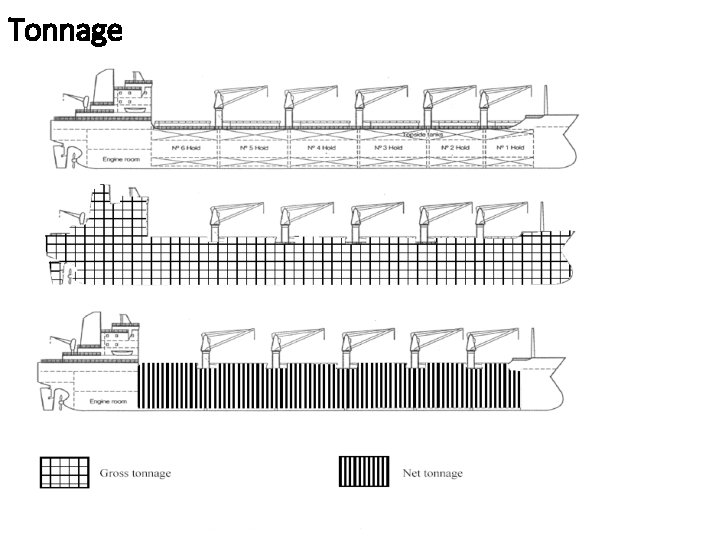
Tonnage
Ship’s Hull Definitions
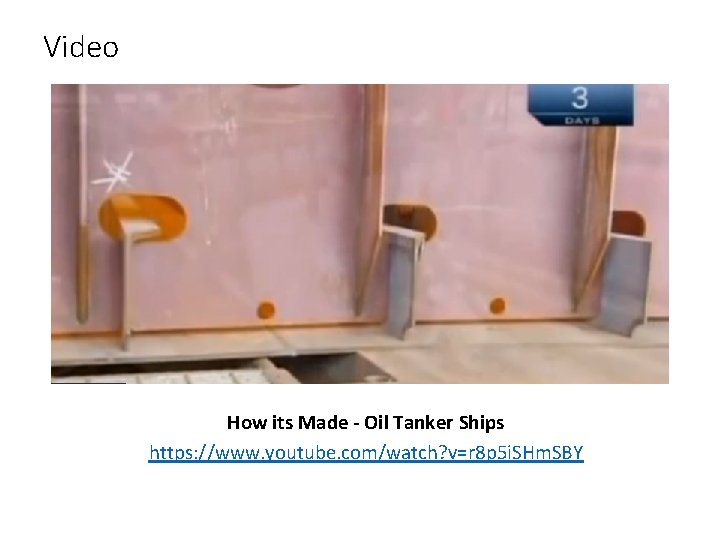
Video How its Made - Oil Tanker Ships https: //www. youtube. com/watch? v=r 8 p 5 i. SHm. SBY
Understanding Ship Weight and Tonnage Measurements There at least six different ways a vessel’s “tonnage” is measured. 1. 2. 3. 4. 5. 6. Displacement Tonnage Standard Displacement Tonnage Deadweight Tonnage Lightweight Tonnage Gross Registered Tonnage Net Registered Tonnage Dinsmore, B. (2011). A Guide to Understanding Ship Weight and Tonnage Measurements. Available at : http: //www. themaritimesite. com/a-guide-tounderstanding-ship-weight-and-tonnage-measurements/ [Accessed 3/6/14]
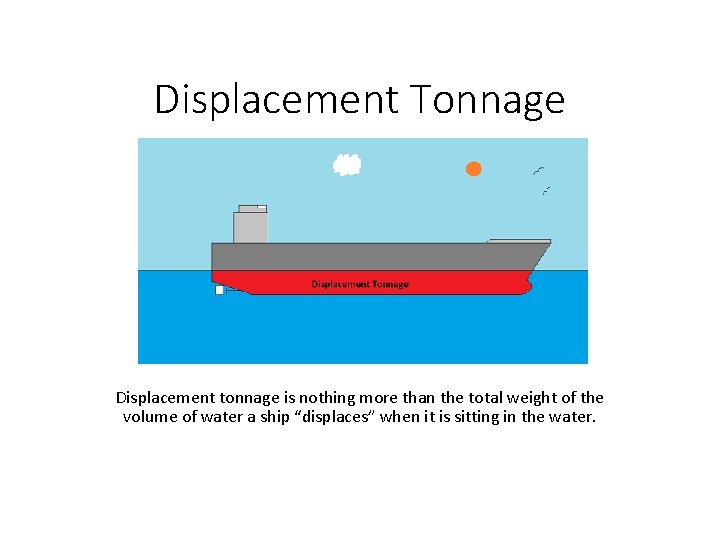
Displacement Tonnage Displacement tonnage is nothing more than the total weight of the volume of water a ship “displaces” when it is sitting in the water.
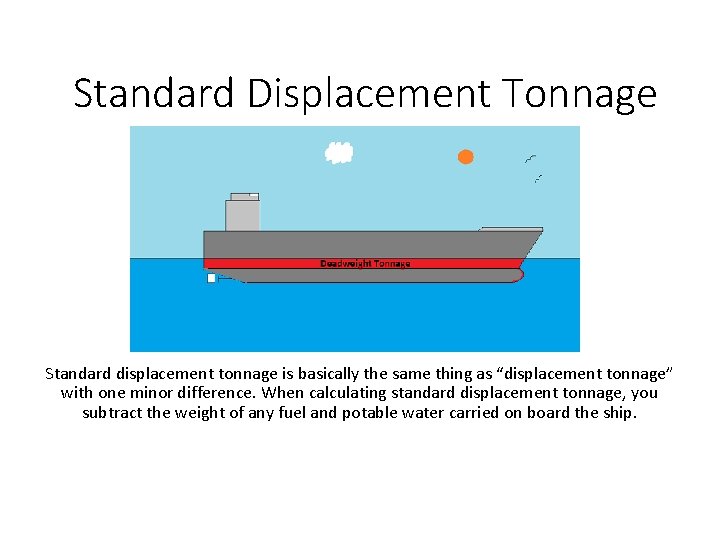
Standard Displacement Tonnage Standard displacement tonnage is basically the same thing as “displacement tonnage” with one minor difference. When calculating standard displacement tonnage, you subtract the weight of any fuel and potable water carried on board the ship.
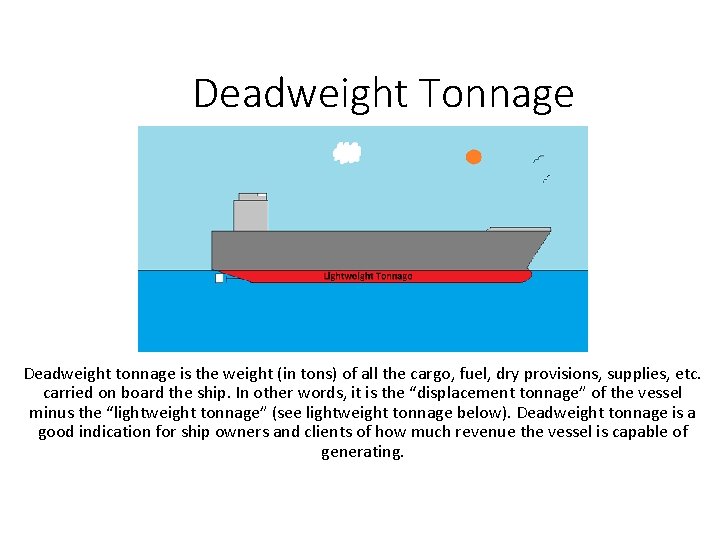
Deadweight Tonnage Deadweight tonnage is the weight (in tons) of all the cargo, fuel, dry provisions, supplies, etc. carried on board the ship. In other words, it is the “displacement tonnage” of the vessel minus the “lightweight tonnage” (see lightweight tonnage below). Deadweight tonnage is a good indication for ship owners and clients of how much revenue the vessel is capable of generating.
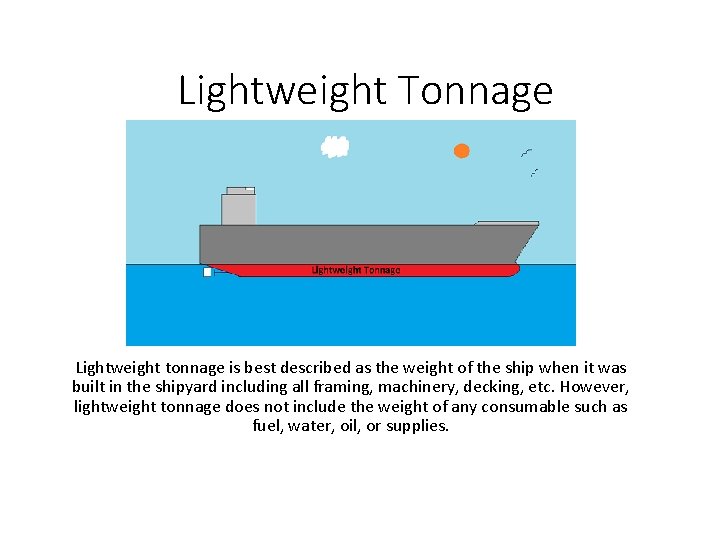
Lightweight Tonnage Lightweight tonnage is best described as the weight of the ship when it was built in the shipyard including all framing, machinery, decking, etc. However, lightweight tonnage does not include the weight of any consumable such as fuel, water, oil, or supplies.
Gross Registered Tonnage Gross registered tonnage is a measurement of volume of all enclosed spaces on a ship with 100 cubic feet = to one ton. For instance, if the total cubic volume of all the enclosed spaces on a ship were 340, 000 cubic feet, the gross registered tonnage will most likely be 3400 gross tons (340, 000 cu. feet/100 cu feet/ton = 3400 Gross Tons). Gross Tonnage or “Gross Tons” is what you’ll see most often on official ship documents and certificates, but you’ll also see “net tons” and “deadweight tons” (expressed as DWT) used from time to time.
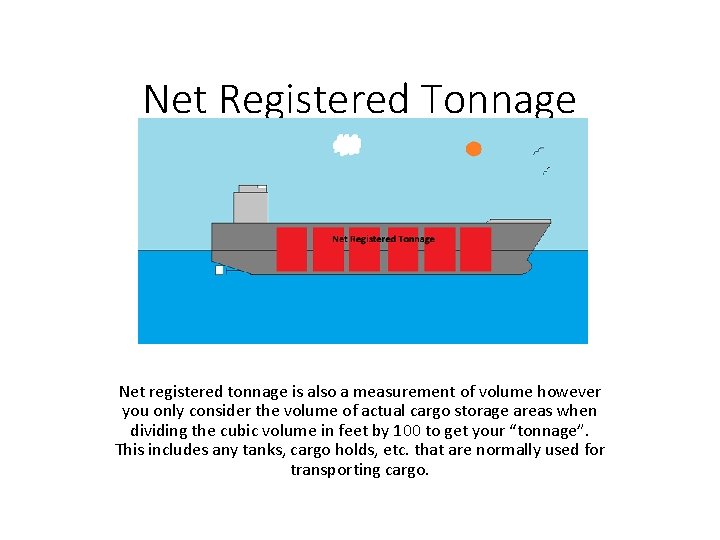
Net Registered Tonnage Net registered tonnage is also a measurement of volume however you only consider the volume of actual cargo storage areas when dividing the cubic volume in feet by 100 to get your “tonnage”. This includes any tanks, cargo holds, etc. that are normally used for transporting cargo.