Module 29 Veterinary Disaster Management The material in

- Slides: 45
Module 29 Veterinary Disaster Management The material in this module was created by the World Animal Protection in 2012 with updates from Dr Caroline Hewson. Free online resources To get free updates and additional materials, please go to www. animalmosaic. org/education/tertiary-education/
Why do vets need to learn about disaster management? 1 We have a professional duty of care to animals because they are sentient communities will look to us for help (Pennell & Paik, 2009) They do this because animals Injuries, disease, hunger and are a very significant part of many dehydration people’s lives, for livelihood and companionship Because our clients and Module 29: Veterinary Disaster Management Concepts in Animal Welfare © World Animal Protection 2014. Unless stated otherwise, image credits are World Animal Protection.
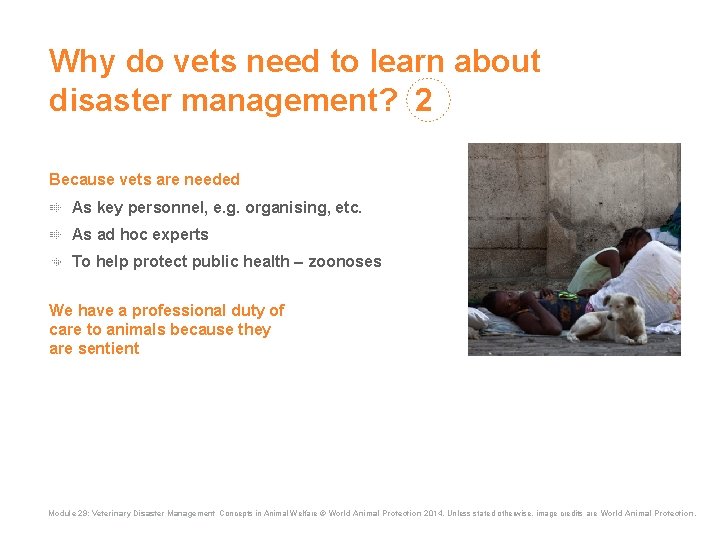
Why do vets need to learn about disaster management? 2 Because vets are needed As key personnel, e. g. organising, etc. As ad hoc experts To help protect public health zoonoses We have a professional duty of care to animals because they are sentient Module 29: Veterinary Disaster Management Concepts in Animal Welfare © World Animal Protection 2014. Unless stated otherwise, image credits are World Animal Protection.
This module will teach you What a disaster is Why it is essential to save animals in a disaster Why sometimes animals are not saved How disasters should be managed What your role is, as a vet Module 29: Veterinary Disaster Management Concepts in Animal Welfare © World Animal Protection 2014. Unless stated otherwise, image credits are World Animal Protection.
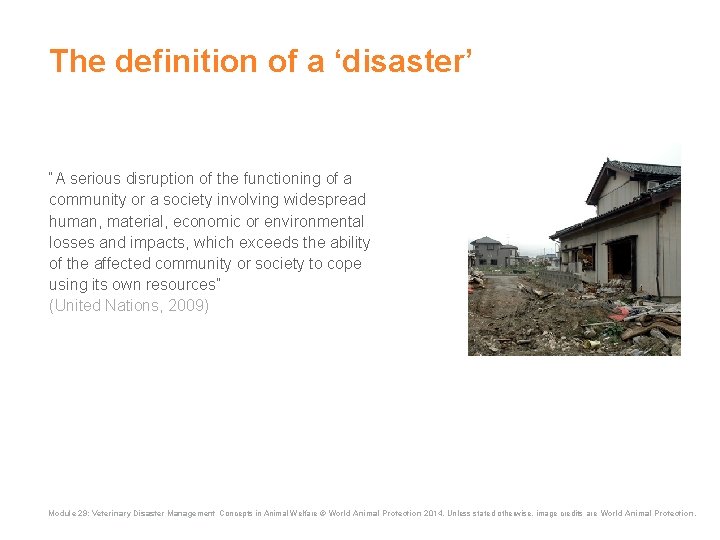
The definition of a ‘disaster’ “A serious disruption of the functioning of a community or a society involving widespread human, material, economic or environmental losses and impacts, which exceeds the ability of the affected community or society to cope using its own resources” (United Nations, 2009) Module 29: Veterinary Disaster Management Concepts in Animal Welfare © World Animal Protection 2014. Unless stated otherwise, image credits are World Animal Protection.
What is a ‘disaster’? A combination of elements from this three-point framework (UN, 2009) Hazards: any danger that may cause loss of life, injury, property damage, social and economic disruption, or environmental damage natural, e. g. earthquake, hurricane technological, e. g. chemical spill, nuclear radiation Vulnerability Insufficient capacity to cope with negative consequences Module 29: Veterinary Disaster Management Concepts in Animal Welfare © World Animal Protection 2014. Unless stated otherwise, image credits are World Animal Protection.
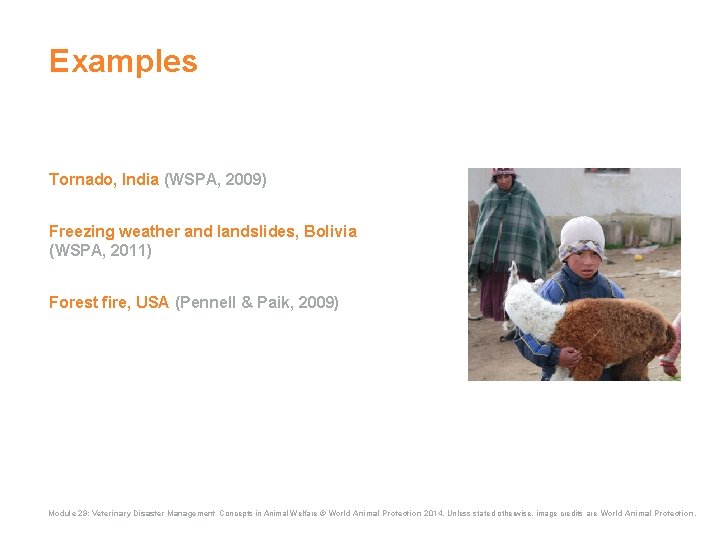
Examples Tornado, India (WSPA, 2009) Freezing weather and landslides, Bolivia (WSPA, 2011) Forest fire, USA (Pennell & Paik, 2009) Module 29: Veterinary Disaster Management Concepts in Animal Welfare © World Animal Protection 2014. Unless stated otherwise, image credits are World Animal Protection.
Another way of looking at disasters Outcome measures (Campbell & Knowles, 2011) 10 or more people reported killed 100 or more people reported affected The declaration of a state of emergency A call for international assistance Module 29: Veterinary Disaster Management Concepts in Animal Welfare © World Animal Protection 2014. Unless stated otherwise, image credits are World Animal Protection.
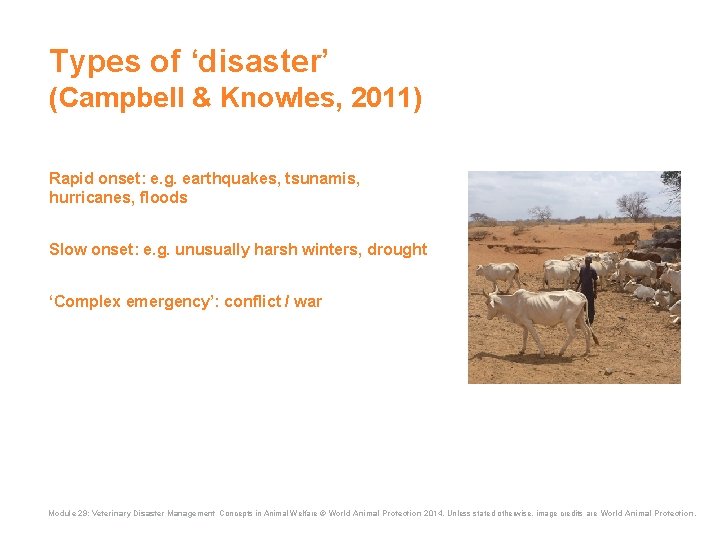
Types of ‘disaster’ (Campbell & Knowles, 2011) Rapid onset: e. g. earthquakes, tsunamis, hurricanes, floods Slow onset: e. g. unusually harsh winters, drought ‘Complex emergency’: conflict / war Module 29: Veterinary Disaster Management Concepts in Animal Welfare © World Animal Protection 2014. Unless stated otherwise, image credits are World Animal Protection.
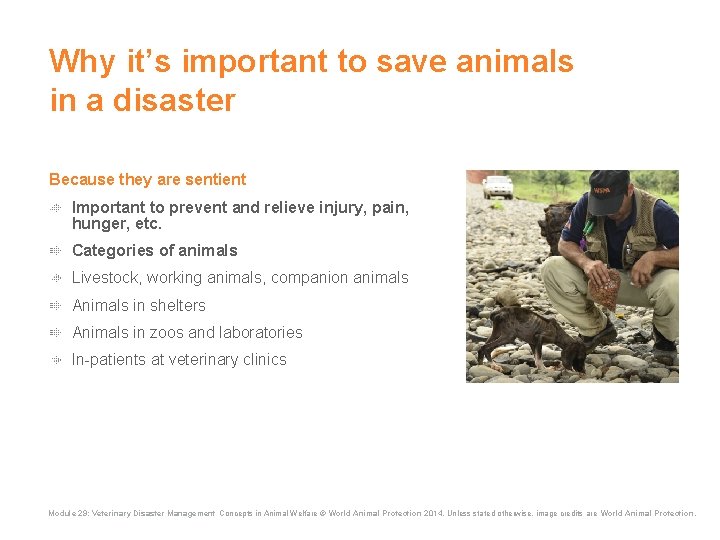
Why it’s important to save animals in a disaster Because they are sentient Important to prevent and relieve injury, pain, hunger, etc. Categories of animals Livestock, working animals, companion animals Animals in shelters Animals in zoos and laboratories In-patients at veterinary clinics Module 29: Veterinary Disaster Management Concepts in Animal Welfare © World Animal Protection 2014. Unless stated otherwise, image credits are World Animal Protection.
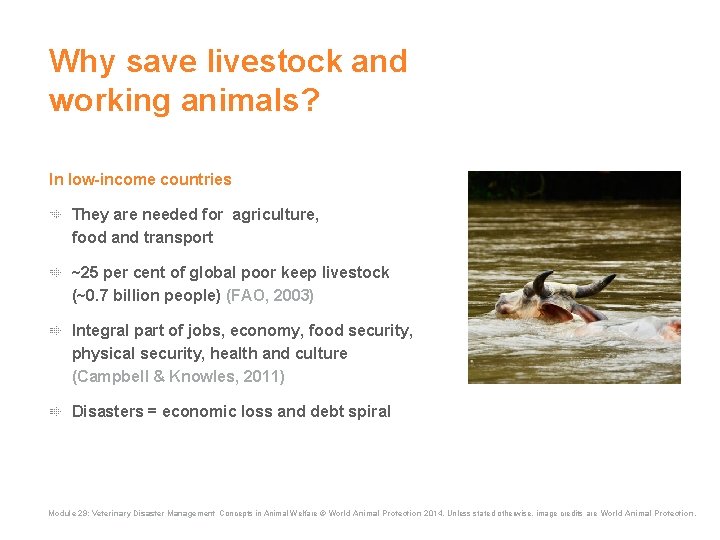
Why save livestock and working animals? In low-income countries They are needed for agriculture, food and transport ~25 per cent of global poor keep livestock (~0. 7 billion people) (FAO, 2003) Integral part of jobs, economy, food security, physical security, health and culture (Campbell & Knowles, 2011) Disasters = economic loss and debt spiral Module 29: Veterinary Disaster Management Concepts in Animal Welfare © World Animal Protection 2014. Unless stated otherwise, image credits are World Animal Protection.
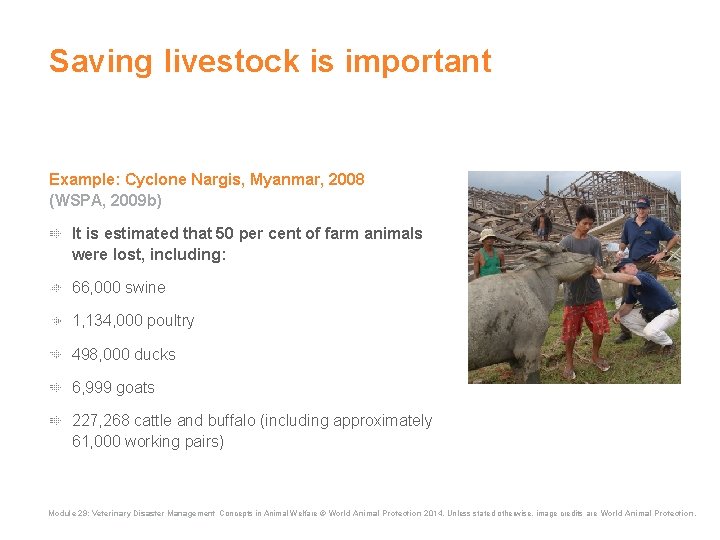
Saving livestock is important Example: Cyclone Nargis, Myanmar, 2008 (WSPA, 2009 b) It is estimated that 50 per cent of farm animals were lost, including: 66, 000 swine 1, 134, 000 poultry 498, 000 ducks 6, 999 goats 227, 268 cattle and buffalo (including approximately 61, 000 working pairs) Module 29: Veterinary Disaster Management Concepts in Animal Welfare © World Animal Protection 2014. Unless stated otherwise, image credits are World Animal Protection.
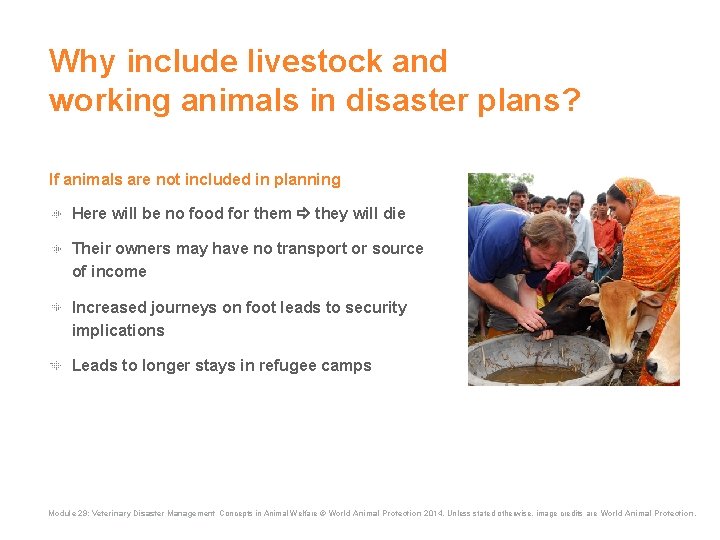
Why include livestock and working animals in disaster plans? If animals are not included in planning Here will be no food for them they will die Their owners may have no transport or source of income Increased journeys on foot leads to security implications Leads to longer stays in refugee camps Module 29: Veterinary Disaster Management Concepts in Animal Welfare © World Animal Protection 2014. Unless stated otherwise, image credits are World Animal Protection.
Why save companion animals? 1 They provide support and comfort for owners Owners often refuse to evacuate without them (Heath et al. , 2001) E. g. Mexico, Colombia, Costa Rica (Hesterberg et al. , 2012) One US county: ~10% of population (Columbia County, 2006) Module 29: Veterinary Disaster Management Concepts in Animal Welfare © World Animal Protection 2014. Unless stated otherwise, image credits are World Animal Protection.
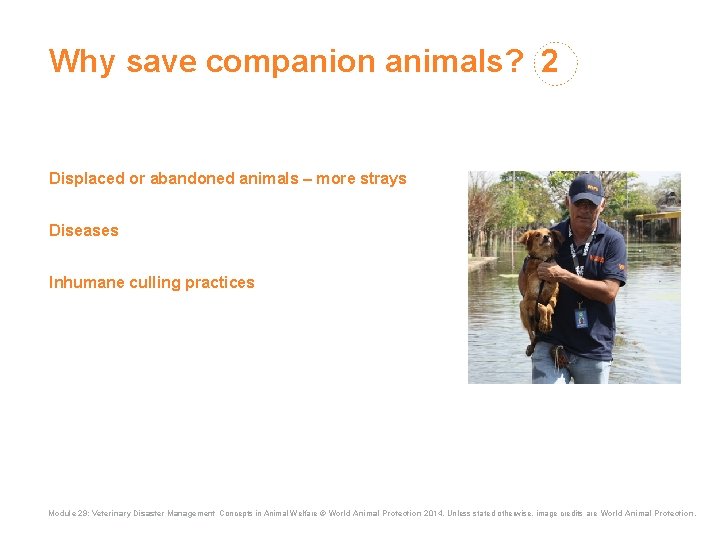
Why save companion animals? 2 Displaced or abandoned animals – more strays Diseases Inhumane culling practices Module 29: Veterinary Disaster Management Concepts in Animal Welfare © World Animal Protection 2014. Unless stated otherwise, image credits are World Animal Protection.
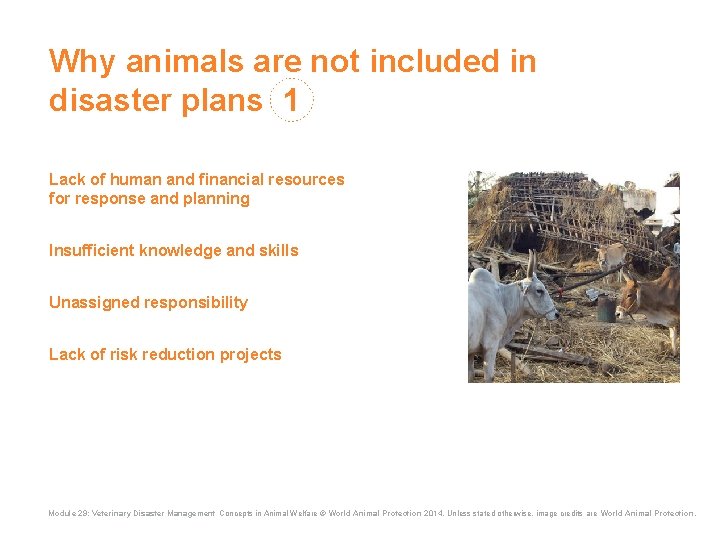
Why animals are not included in disaster plans 1 Lack of human and financial resources for response and planning Insufficient knowledge and skills Unassigned responsibility Lack of risk reduction projects Module 29: Veterinary Disaster Management Concepts in Animal Welfare © World Animal Protection 2014. Unless stated otherwise, image credits are World Animal Protection.
Why animals are not included in disaster plans 2 Authorities may not perceive animals as important Authorities may be overwhelmed with humanitarian problems Different attitudes to animals’ capacity to suffer Cultural attitudes regarding the value of some species, etc. Humanitarian NGOs lack the skills and facilities to care for animals Owners are not allowed to take their animals with them when they are evacuated Module 29: Veterinary Disaster Management Concepts in Animal Welfare © World Animal Protection 2014. Unless stated otherwise, image credits are World Animal Protection.
Other reasons why animals are not saved 1 Livestock owners lack the resources required to be prepared Logistical difficulties Mistrust of authorities (Hothersall, 2012) Philosophy: disaster as ‘act of God’, or fate (Hothersall, 2012) Frequency of occurrence (Hothersall, 2012) Role of vets Module 29: Veterinary Disaster Management Concepts in Animal Welfare © World Animal Protection 2014. Unless stated otherwise, image credits are World Animal Protection.
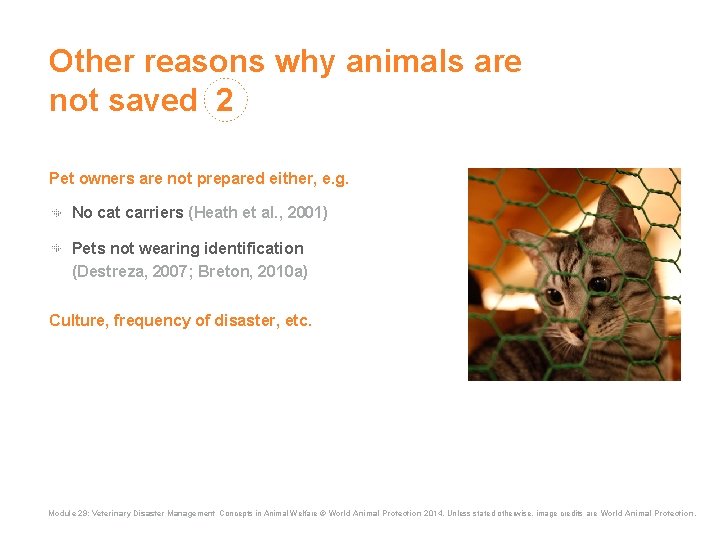
Other reasons why animals are not saved 2 Pet owners are not prepared either, e. g. No cat carriers (Heath et al. , 2001) Pets not wearing identification (Destreza, 2007; Breton, 2010 a) Culture, frequency of disaster, etc. Module 29: Veterinary Disaster Management Concepts in Animal Welfare © World Animal Protection 2014. Unless stated otherwise, image credits are World Animal Protection.
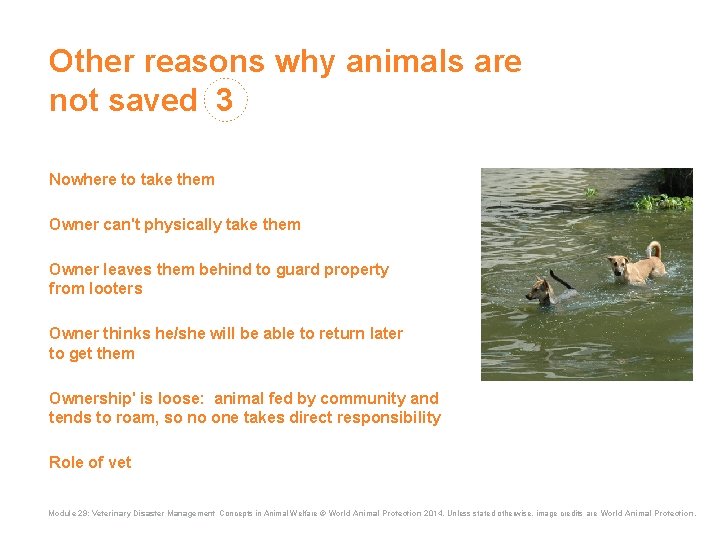
Other reasons why animals are not saved 3 Nowhere to take them Owner can't physically take them Owner leaves them behind to guard property from looters Owner thinks he/she will be able to return later to get them Ownership' is loose: animal fed by community and tends to roam, so no one takes direct responsibility Role of vet Module 29: Veterinary Disaster Management Concepts in Animal Welfare © World Animal Protection 2014. Unless stated otherwise, image credits are World Animal Protection.
Summary so far What a disaster is Why it is important to save animals in a disaster Why animals are not saved How disasters should be managed Module 29: Veterinary Disaster Management Concepts in Animal Welfare © World Animal Protection 2014. Unless stated otherwise, image credits are World Animal Protection.
Disaster management Preparing for disasters and responding to them Strategies in Prevention and mitigation Preparedness Response Recovery Module 29: Veterinary Disaster Management Concepts in Animal Welfare © World Animal Protection 2014. Unless stated otherwise, image credits are World Animal Protection.
Disaster response cycle Module 29: Veterinary Disaster Management Concepts in Animal Welfare © World Animal Protection 2014. Unless stated otherwise, image credits are World Animal Protection.
Mitigation Measures to ensure that emergencies are prevented, or their effects made less severe Structural measures Housing animals away from flood plains Managing grazing Non-structural measures Education programmes, e. g. advising owners about the risks of disasters Strengthening veterinary services (e. g. herd health management, epidemiology) Module 29: Veterinary Disaster Management Concepts in Animal Welfare © World Animal Protection 2014. Unless stated otherwise, image credits are World Animal Protection.
Preparedness Arrangements to ensure that, should a disaster occur, all the resources and services which may be needed to cope with the effects of a disaster can be rapidly mobilised and deployed, such as National warning systems Vaccination programmes Animal shelters Evacuation methods Storage of food and water Animal identification Veterinary clinic preparedness plans Module 29: Veterinary Disaster Management Concepts in Animal Welfare © World Animal Protection 2014. Unless stated otherwise, image credits are World Animal Protection.
Response Actions taken in anticipation of, during and immediately after impact to ensure that the effects are minimised and that people are given immediate relief and support, such as Static and mobile vet clinics Search and rescue operations Provision of emergency food Temporary shelters Reuniting owners with animals Module 29: Veterinary Disaster Management Concepts in Animal Welfare © World Animal Protection 2014. Unless stated otherwise, image credits are World Animal Protection.
Recovery Coordinated support of disaster-affected communities in Reconstructing their physical infrastructure Restoring emotional, social, economic and physical wellbeing Examples Veterinary care Risk reduction projects and contingency planning Module 29: Veterinary Disaster Management Concepts in Animal Welfare © World Animal Protection 2014. Unless stated otherwise, image credits are World Animal Protection.
Summary so far What a disaster is Why it is important to save animals in a disaster How disasters should be managed Your role, as a vet In response to a disaster In risk reduction and preparedness Module 29: Veterinary Disaster Management Concepts in Animal Welfare © World Animal Protection 2014. Unless stated otherwise, image credits are World Animal Protection.
Vet’s role: response Your priorities You and your family/other people – life support Staff and animals at your clinic/facility – follow preparedness plan Your community – Incident Command System Module 29: Veterinary Disaster Management Concepts in Animal Welfare © World Animal Protection 2014. Unless stated otherwise, image credits are World Animal Protection.
At your clinic/animal facility (Centonze, 2009; Breton, 2010 b) Incident Command System: staff roles, checklists, etc. Security Insurance and legal issues Where to board or relocate the animals in your care Medical record back-up Use of social media to interact with other clinics and the public (Merchant et al. , 2011) Continuity of operations – protocols for high-risk patients; alternatives for euthanasia, anaesthesia etc. Module 29: Veterinary Disaster Management Concepts in Animal Welfare © World Animal Protection 2014. Unless stated otherwise, image credits are World Animal Protection.
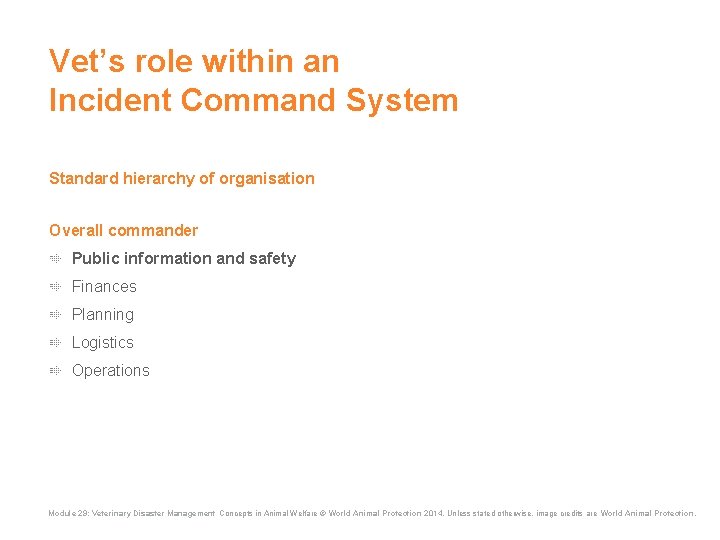
Vet’s role within an Incident Command System Standard hierarchy of organisation Overall commander Public information and safety Finances Planning Logistics Operations Module 29: Veterinary Disaster Management Concepts in Animal Welfare © World Animal Protection 2014. Unless stated otherwise, image credits are World Animal Protection.
Being a responder – the importance of training Incident Command System Management and care of animals, e. g. Use of ropes for large animals Hazardous materials and decontamination Mass vaccination Triage Euthanasia Public health issues and community education Managing your emotional well-being Human first aid/life support and initial care Module 29: Veterinary Disaster Management Concepts in Animal Welfare © World Animal Protection 2014. Unless stated otherwise, image credits are World Animal Protection.
Vet’s role: triage and decision-making Triage (Wingfield & Upp, 2008) Needs experience Field triage Medical triage Recommendations should reflect norms of care in that community (Madigan & Dacre, 2009) Different species Module 29: Veterinary Disaster Management Concepts in Animal Welfare © World Animal Protection 2014. Unless stated otherwise, image credits are World Animal Protection.
Vet’s role: euthanasia and humane killing Stray animals Zoo and laboratory animals Humane methods Module 29: Veterinary Disaster Management Concepts in Animal Welfare © World Animal Protection 2014. Unless stated otherwise, image credits are World Animal Protection.
Vet’s role: where to get training 1 Online training modules, US Department of Agriculture (http: //awic. nal. usda. gov/researchanimals/disaster-planning) LEGS (Livestock Emergencies Guidelines and Standards) courses, e. g. Africa, South America (www. livestock-emergency. net/wpcontent/uploads/2012/01/LEGS-Training. Coordinator-Job-Description-06 -Feb-20122. pdf) Module 29: Veterinary Disaster Management Concepts in Animal Welfare © World Animal Protection 2014. Unless stated otherwise, image credits are World Animal Protection.
Vet’s role: where to get training 2 World Animal Protection: Course for Veterinary Emergency Response Units (VERU) Organised group of veterinary students Trained for rapid response To benefit animals and community livelihoods in disasters Module 29: Veterinary Disaster Management Concepts in Animal Welfare © World Animal Protection 2014. Unless stated otherwise, image credits are World Animal Protection.
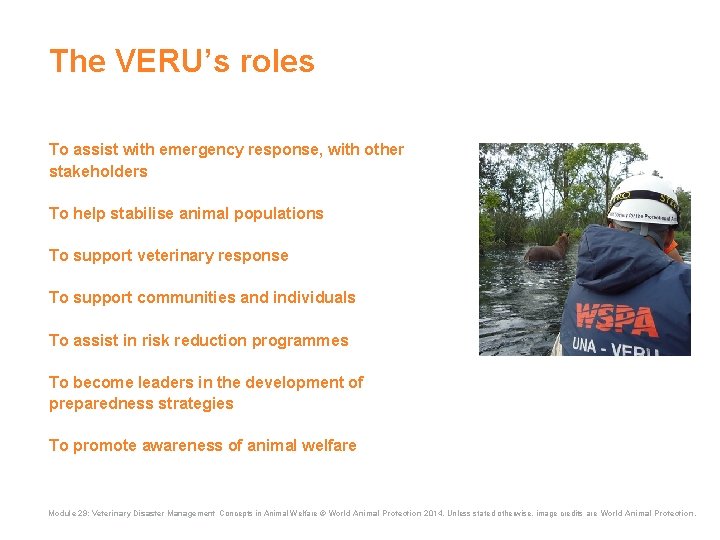
The VERU’s roles To assist with emergency response, with other stakeholders To help stabilise animal populations To support veterinary response To support communities and individuals To assist in risk reduction programmes To become leaders in the development of preparedness strategies To promote awareness of animal welfare Module 29: Veterinary Disaster Management Concepts in Animal Welfare © World Animal Protection 2014. Unless stated otherwise, image credits are World Animal Protection.
Review Your role, as a vet In response to a disaster In risk reduction and preparedness Module 29: Veterinary Disaster Management Concepts in Animal Welfare © World Animal Protection 2014. Unless stated otherwise, image credits are World Animal Protection.
Vet’s role in risk reduction: nationally Veterinary Emergency Response Units/ Animal Response Teams Community-based projects National planning/law include animals Collaboration with humanitarians Resources and training – handbooks, lectures, courses Demonstrations – drills Public service announcements Module 29: Veterinary Disaster Management Concepts in Animal Welfare © World Animal Protection 2014. Unless stated otherwise, image credits are World Animal Protection.
Vet’s role in risk reduction: locally Advising owners Tags on collars and permanent ID Importance of cat carriers (Heath et al. , 2001) Their preparedness plan Clinic preparedness plan Lobbying local authority to include animals Module 29: Veterinary Disaster Management Concepts in Animal Welfare © World Animal Protection 2014. Unless stated otherwise, image credits are World Animal Protection.
Conclusion It is essential to save animals in disasters Vets have a key role They can only fulfil it if they are prepared Clinic plan Participate in planning locally Self-care is also important Training is essential Module 29: Veterinary Disaster Management Concepts in Animal Welfare © World Animal Protection 2014. Unless stated otherwise, image credits are World Animal Protection.
Feedback: Please let us know what you think How have you used this module? What did you like about it? What did you not like? Do you have any tips to share? Please take part in our 10 minute survey here: https: //www. surveymonkey. com/s/BKP 3 D 6 H Your feedback will help other teachers like you Module 29: Veterinary Disaster Management Concepts in Animal Welfare © World Animal Protection 2014. Unless stated otherwise, image credits are World Animal Protection.
References Alexander, D. (2002). Principles of emergency planning and management. Harpenden, UK: Terra Publishing. in massive disasters: basic and advanced disaster life-support. Paper presented at Atlantic Coast Veterinary Conference , Atlantic City, New Jersey, Oct. 10 14. Retrieved from Breton, A. N. (2010 a). Disaster lessons learned. Paper presented www. vin. com/Members/Proceedings. plx? CID=acvc 2010& at Atlantic Coast Veterinary Conference, Atlantic City, New Jersey, Oct. PID=pr 57233&O=VIN 12– 14. Retrieved from www. vin. com/Members/Proceedings. plx? CID=acvc 2010&Destreza, K. (2007). Katrina response: rescue and recovery. Paper PID=pr 57289&O=VIN presented at International Veterinary Emergency and Critical Care Symposium, New Orleans, Sept. 26 -30. Retrieved from Breton, A. N. (2010 b). Creating a clinic disaster plan. Paper www. vin. com/Members/Proceedings. plx? CID=iveccs 2007 presented at Atlantic Coast Veterinary Conference, Atlantic City, &PID=pr 18644&O=VIN New Jersey, Oct. 12– 14. Retrieved from www. vin. com/Members/Proceedings. plx? CID=acvc 2010&FAO (2003). Livestock a resource neglected in poverty reduction strategy papers. Retrieved from PID=pr 57288&O=VIN http: //pdf. wri. org/ref/pplpi_03_livestock. pdf Campbell, R. , & Knowles, T. (2011). The economic impacts of losing livestock in a disaster. Report for the World Society for the Protection Heath, S. E. , Voeks, S. K. , & Glickman, L. (2001). Epidemiologic features of pet evacuation failure in a rapid-onset disaster. Journal of of Animals (WSPA), prepared by Economists at Large, Melbourne, the American Veterinary Medical Association, 218, 1898 -1904. Australia. Hesterberg, U. W. , Huertas, G. , & Appleby, M. C. (2012). Perceptions Centonze, L. (2009). Disaster preparedness. Paper presented at Atlantic Coast Veterinary Conference City, Atlantic City, New Jersey, of pet owners in urban Latin America on protection of their animals during disasters. Disaster Prevention and Management, 21, 37 -50. Oct. 12 -15. Retrieved from www. vin. com/Members/Proceedings. plx? CID=acvc 2009& Hothersall, B. (2012). Perceptions and practices of emergency PID=pr 53250&O=VIN preparedness amongst animal owners. Report prepared for WSPA by Dr B. Hothersall, University of Bristol. London: World Society for the Columbia County Animal Care and Control Department and Emergency Management Agency (2006). Columbia County, Georgia: Protection of Animals. Plan for handling animals in disasters. Retrieved from www. nh. gov/agric/divisions/animal_industry/documents/Columbia_Cou nty. pdf. Crowe, D. T. (2010). Veterinarians’ role in the care of man and animals Module 29: Veterinary Disaster Management Concepts in Animal Welfare © World Animal Protection 2014. Unless stated otherwise, image credits are World Animal Protection.
References Hunt, M. , Al-Awadi, H. , & Johnson, M. (2008). Psychological sequelae of pet loss following Hurricane Katrina. Anthrozoos, 21, 109 -122. Madigan, J. , & Dacre, I. (2009). Preparing for veterinary emergencies: disaster management and the Incident Command System. Revue scientifique et technique, OIE, 28, 627 -633. Merchant, R. M. , Elmer, S. , & Lurie, N. (2011). Integrating social media into emergency-preparedness efforts. New England Journal of Medicine, 365, 289 -291. &PID=pr 24881&O=VIN WSPA (2009). Case study: Safeguarding food production: animal welfare supporting disaster relief. London: World Society for the Protection of Animals. WSPA (2011). Case study: Protecting animals in disasters: Essential for community recovery. London: World Society for the Protection of Animals. Pennell, J. , & Paik, T. (2009). Veterinary procedures in response to disasters. Paper presented at Western Veterinary Conference, Las Vegas, Feb. 15– 19. Retrieved from www. vin. com/Members/Proceedings. plx? CID=wvc 2009& PID=pr 50596&O=VIN United Nations (UN) (2009). United Nations International Strategy for Disaster Reduction. Terminology. Retrieved from www. unisdr. org/we/inform/terminology Wingfield, W. E. , & Upp, J. J. (2008). Veterinary disaster triage: Making tough decisions. Paper presented at International Veterinary Emergency and Critical Care Symposium, Phoenix, Arizona, Sept. 1721. Retrieved from www. vin. com/Members/Proceedings. plx? CID=iveccs 2008 Module 29: Veterinary Disaster Management Concepts in Animal Welfare © World Animal Protection 2014. Unless stated otherwise, image credits are World Animal Protection.
Further Reading Livestock Emergencies Guidelines and Standards Project (LEGS), (2009). Livestock Emergencies Guidelines and Standards. Rugby, UK: Practical Action Publishing. Retrieved from http: //www. livestockemergency. net/userfiles/file/legs. pdf Nixon, M. J. (2008). First Responder's Guide To Animal Care. Retrieved from www. vin. com/proceedings/Proceedings. plx? CID=DISASTER 2006&O= Generic Wingfield, W. E. , & Palmer, S. B. (Eds. ) (2009). Veterinary disaster response. Chichester, UK: Wiley-Blackwell. Wingfield, W. E. , Nash, S. L. , Palmer, S. B. , & Upp, J. J. (Eds. ) (2009) Veterinary disaster medicine: Working animals. Chichester, UK: Wiley. Blackwell. Module 29: Veterinary Disaster Management Concepts in Animal Welfare © World Animal Protection 2014. Unless stated otherwise, image credits are World Animal Protection.