
Lao PDRs Status in Disaster Risk Management for




- Slides: 42
Lao PDR’s Status in Disaster Risk Management for Sustainable Development (DRM-SD) Capacity Building Assoc. Prof. Dr. Bouadam SENGKHAMKHOUTLAVONG National University of Laos bouadam_s@yahoo. com January 19 -21, 2016, Lane Xang Hotel, Vientiane, Lao PDR
Outline • • • Background Information Government Policies, Programmes and Strategies A self-monitoring and reporting mechanism Significant Progress Challenges and Opportunities Conclusions and Recommendations
Country Profile • Lao People’s Democratic Republic (Lao PDR) locates in Southeast Asia peninsula, sharing border with China, Vietnam, Cambodia, Thailand Myanmar • It is a land locked, elongated country of approximately 236, 800 square kilometers of which 80% is mountainous in that 47% is rain forest. • Population is 6. 8 million, 47 minorities groups, the population density is 24 / km 2 • Life expectancy at birth is 64 ( 61 for male and 68 for female ) • Literacy rate 77% (> 15 year old)
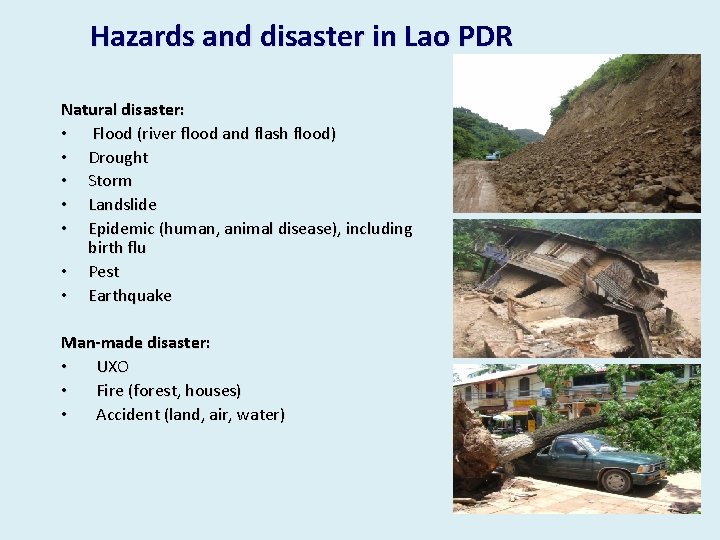
Hazards and disaster in Lao PDR Natural disaster: • Flood (river flood and flash flood) • Drought • Storm • Landslide • Epidemic (human, animal disease), including birth flu • Pest • Earthquake Man-made disaster: • UXO • Fire (forest, houses) • Accident (land, air, water)
Major Disasters in Lao PDR Great Impacts on Sustainable Development Fire (Forest and Urban) Drought UXO Flood Storm Earthquake
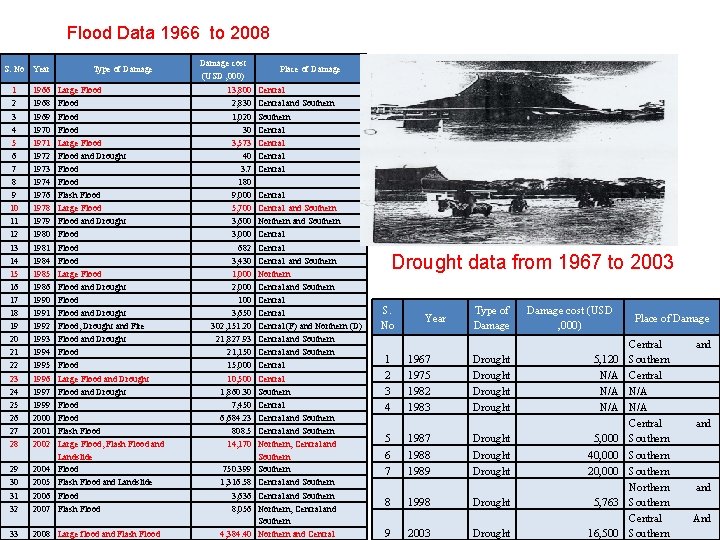
Flood Data 1966 to 2008 S. No Year Type of Damage 1 2 3 4 5 6 7 8 9 10 11 12 13 14 15 16 17 18 19 20 21 22 23 24 25 26 27 28 1966 1968 1969 1970 1971 1972 1973 1974 1976 1978 1979 1980 1981 1984 1985 1986 1990 1991 1992 1993 1994 1995 1996 1997 1999 2000 2001 2002 Large Flood Large Flood and Drought Flood Flash Flood Large Flood Flood and Drought Flood, Drought and Fire Flood and Drought Flood Large Flood and Drought Flood Flash Flood Large Flood, Flash Flood and Landslide Flood Flash Flood 29 30 31 32 2004 2005 2006 2007 33 2008 Large flood and Flash Flood Damage cost (USD , 000) 13, 800 2, 830 1, 020 30 3, 573 40 3. 7 180 9, 000 5, 700 3, 600 3, 000 682 3, 430 1, 000 2, 000 100 3, 650 302, 151. 20 21, 827. 93 21, 150 15, 000 10, 500 1, 860. 30 7, 450 6, 684. 23 808. 5 14, 170 750. 399 1, 316. 58 3, 636 8, 056 4, 384. 40 Place of Damage Central and Southern Central Central and Southern Northern and Southern Central and Southern Northern Central and Southern Central (F) and Northern (D) Central and Southern Central and Southern Central and Southern Northern, Central and Southern Northern and Central Drought data from 1967 to 2003 S. No 1 2 3 4 5 6 7 8 9 Year 1967 1975 1982 1983 1987 1988 1989 1998 2003 Type of Damage Drought Drought Drought Damage cost (USD , 000) 5, 120 N/A N/A 5, 000 40, 000 20, 000 5, 763 16, 500 Place of Damage Central Southern Central N/A Central Southern Northern Southern Central Southern and And
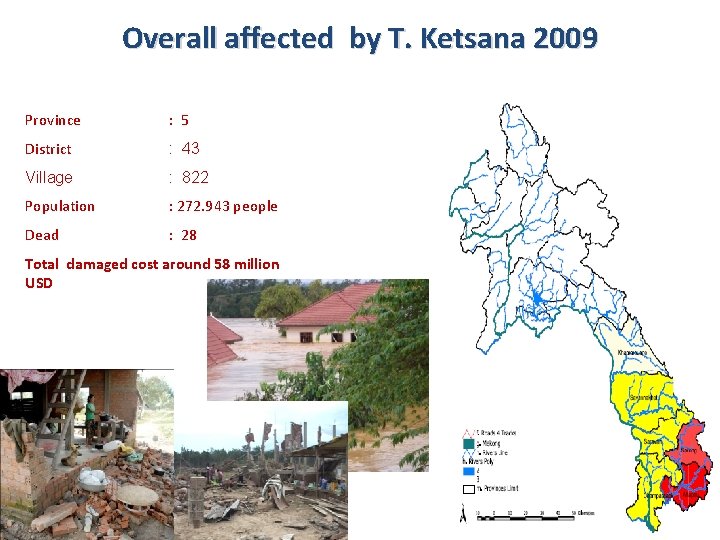
Overall affected by T. Ketsana 2009 Province : 5 District : 43 Village : 822 Population : 272. 943 people Dead : 28 Total damaged cost around 58 million USD
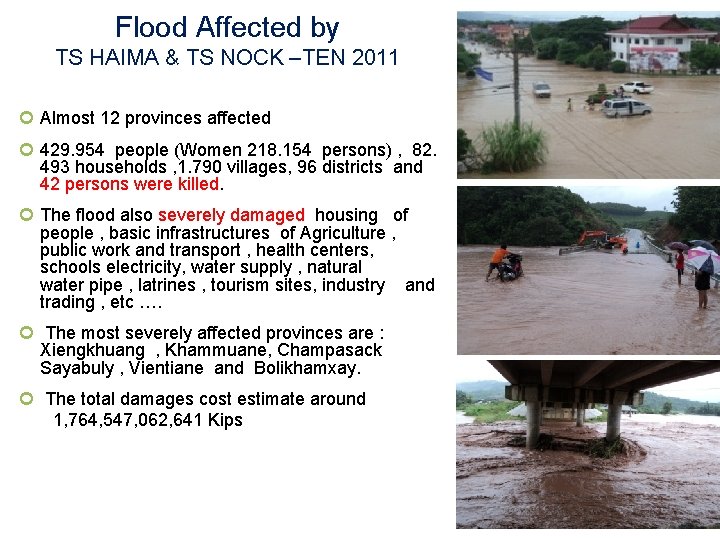
Flood Affected by TS HAIMA & TS NOCK –TEN 2011 Almost 12 provinces affected 429. 954 people (Women 218. 154 persons) , 82. 493 households , 1. 790 villages, 96 districts and 42 persons were killed. The flood also severely damaged housing of people , basic infrastructures of Agriculture , public work and transport , health centers, schools electricity, water supply , natural water pipe , latrines , tourism sites, industry and trading , etc …. The most severely affected provinces are : Xiengkhuang , Khammuane, Champasack Sayabuly , Vientiane and Bolikhamxay. The total damages cost estimate around 1, 764, 547, 062, 641 Kips
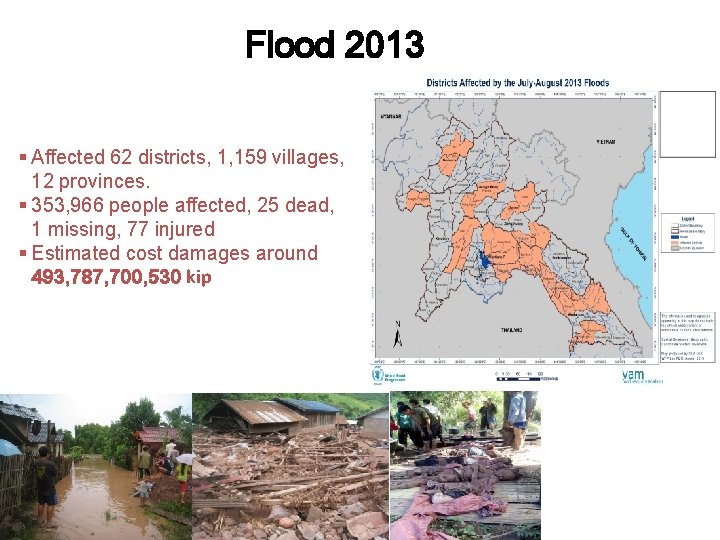
Flood 2013 § Affected 62 districts, 1, 159 villages, 12 provinces. § 353, 966 people affected, 25 dead, 1 missing, 77 injured § Estimated cost damages around 493, 787, 700, 530 kip
Assessment and Analysis Lao PDR faces significant threats from climate change given its dependence on agriculture and natural resources. Lao PDR subject to floods and droughts with significant impact on Agriculture, forestry, water resources, health and economic growth. Impact assessments had concluded recent regional changes in temperature have had discernible impact on the country’s physical and biological ecosystems, and that the frequency and severity of floods and drought are on the rise.
Government Policies, Programmes and Strategies Lao PDR has set up institutional mechanisms and policy frameworks to address climate change. • Lao PDR acceded to the UNFCCC in 1995, • Ratified the Kyoto Protocol in 2003. • In 2008, Lao PDR established a National Steering Committee on Climate Change and National Climate change Office to follow up on its international commitments
Government Policies, Programmes and Strategies Three main elements form the policy framework for climate change interventions: The National Adaptation Programme of Action (NAPA), submitted to UNFCCC in May 2009, forms the first element of the framework. The NAPPA set four criteria for prioritizing climate change adaptation projects. These were the capacity to deal with different degrees of severity in the impact from climate change, the contribution to poverty reduction, the linkages with other multilateral environmental agreements, and the value for economy and society. The first fiveyear NAPPA project was launched in 2011.
Government Policies, Programmes and Strategies Second element is the National Policy on Climate Change (NSCC), which was approved in early 2010. The NSCC identifies seven priority areas for adaptation and mitigation: agriculture and food security; forestry and land use change; water resources; energy and transport; industry; urban development; and public health. The NSCC also ensured that climate change was streamlined into Lao’s Seventh NSEDP (2011 -2015).
Government Policies, Programmes and Strategies The third element, the National Action Plan on climate change, was lunched in April 2013 by ministry of natural resources and environment. Its aims to translate the NSCC into action. Adaptation strategies focus mainly on water, agriculture and disaster risk management, with climate information services. The gaps in current adaptation programmes include energy and transport, urban areas, public health and gender.
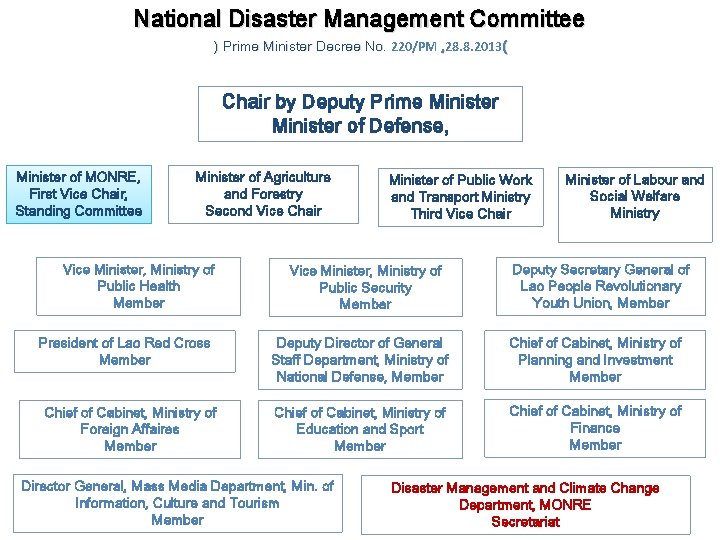
National Disaster Management Committee ) Prime Minister Decree No. 220/PM , 28. 8. 2013 ( , Chair by Deputy Prime Minister of Defense, Minister of MONRE, First Vice Chair, Standing Committee Minister of Agriculture and Forestry Second Vice Chair Vice Minister, Ministry of Public Health Member President of Lao Red Cross Member Chief of Cabinet, Ministry of Foreign Affaires Member Minister of Public Work and Transport Ministry Third Vice Chair Vice Minister, Ministry of Public Security Member Minister of Labour and Social Welfare Ministry Deputy Secretary General of Lao People Revolutionary Youth Union, Member Deputy Director of General Staff Department, Ministry of National Defense, Member Chief of Cabinet, Ministry of Planning and Investment Member Chief of Cabinet, Ministry of Education and Sport Member Chief of Cabinet, Ministry of Finance Member Director General, Mass Media Department, Min. of Information, Culture and Tourism Member Disaster Management and Climate Change Department, MONRE Secretariat
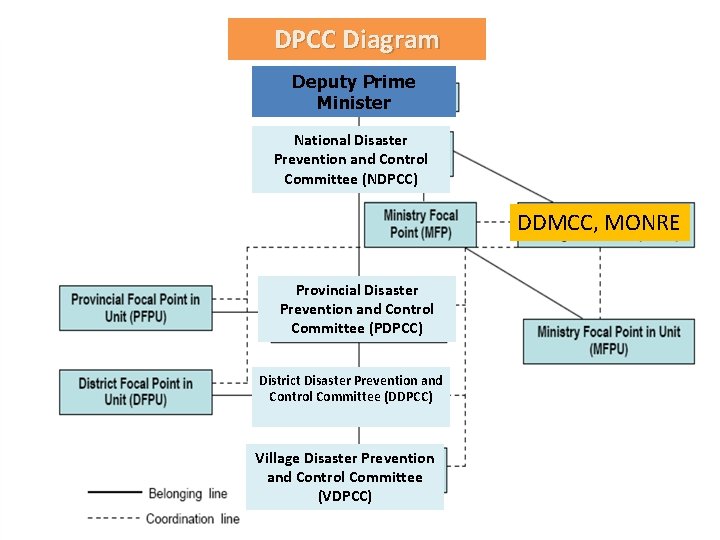
DPCC Diagram Deputy Prime Minister National Disaster Prevention and Control Committee (NDPCC) DDMCC, MONRE Provincial Disaster Prevention and Control Committee (PDPCC) District Disaster Prevention and Control Committee (DDPCC) Village Disaster Prevention and Control Committee (VDPCC)
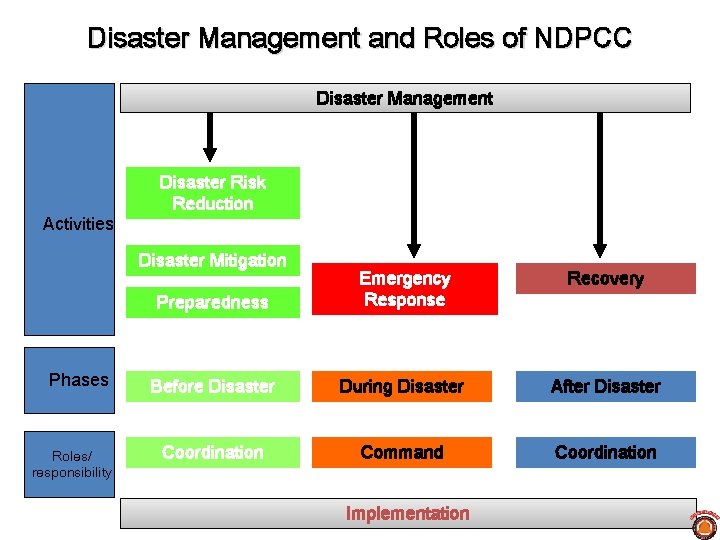
Disaster Management and Roles of NDPCC Disaster Management Activities Disaster Risk Reduction Disaster Mitigation Phases Roles/ responsibility Recovery Preparedness Emergency Response Before Disaster During Disaster After Disaster Coordination Command Coordination Implementation 17
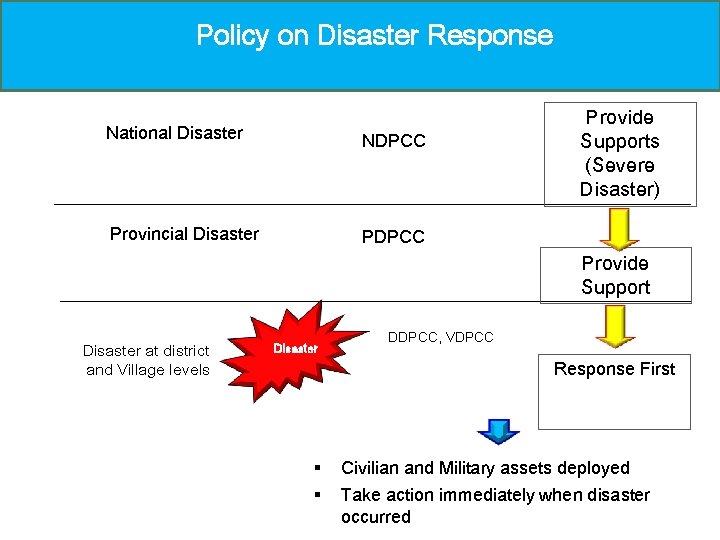
Policy on Disaster Response National Disaster NDPCC Provincial Disaster PDPCC Provide Supports (Severe Disaster) Provide Support Disaster at district and Village levels Disaster DDPCC, VDPCC Response First § § Civilian and Military assets deployed Take action immediately when disaster occurred
Disaster Emergency Response • The DPCC Committees at all levels is the lead • NDMO tasks: – Closely coordinate with DM focal point in Line Ministries, NDMO at local level to get update information on disaster situation, make analysis and report to NDMC for guiding response – Coordinate and cooperate with internal organization in mobilization of resources for emergency response as well as the join assessment • Emergency Operating Center had been set during the Emergency like Adhoc center – Nationally at the Meeting room of Deputy Prime Minister, Ministry of Defense – Local level, at the meeting room of Governor’s office • Inter-Agency Contingency Plan – IACP – EOC set at UN House (the meeting room) – NDMO involve in IASC, Inter-Cluster Coordination Group (ICCG), Emergency Task Force (ETF), Information Management Network (IMN)
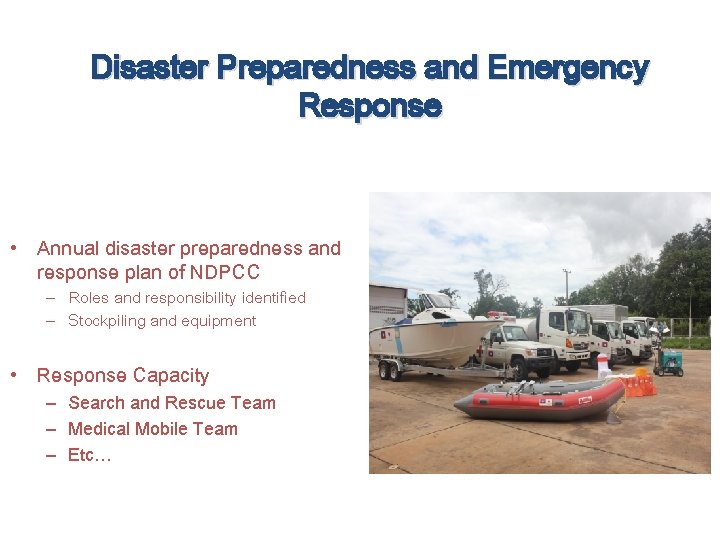
Disaster Preparedness and Emergency Response • Annual disaster preparedness and response plan of NDPCC – Roles and responsibility identified – Stockpiling and equipment • Response Capacity – Search and Rescue Team – Medical Mobile Team – Etc…
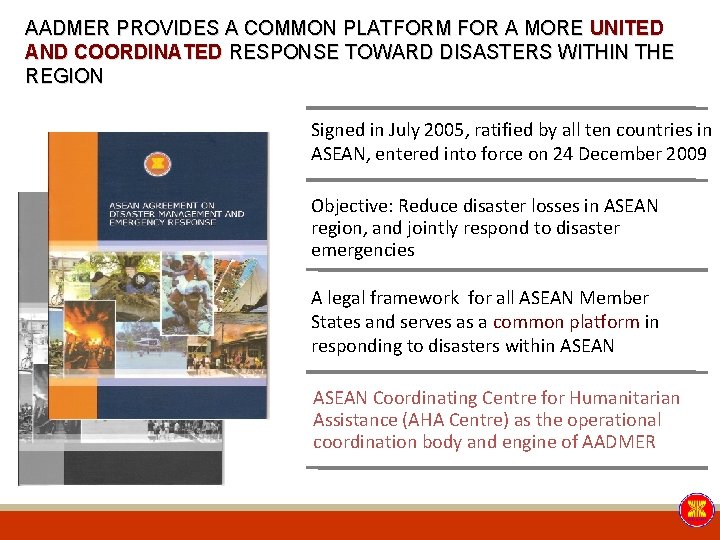
AADMER PROVIDES A COMMON PLATFORM FOR A MORE UNITED AND COORDINATED RESPONSE TOWARD DISASTERS WITHIN THE REGION Signed in July 2005, ratified by all ten countries in ASEAN, entered into force on 24 December 2009 Objective: Reduce disaster losses in ASEAN region, and jointly respond to disaster emergencies A legal framework for all ASEAN Member States and serves as a common platform in responding to disasters within ASEAN Coordinating Centre for Humanitarian Assistance (AHA Centre) as the operational coordination body and engine of AADMER
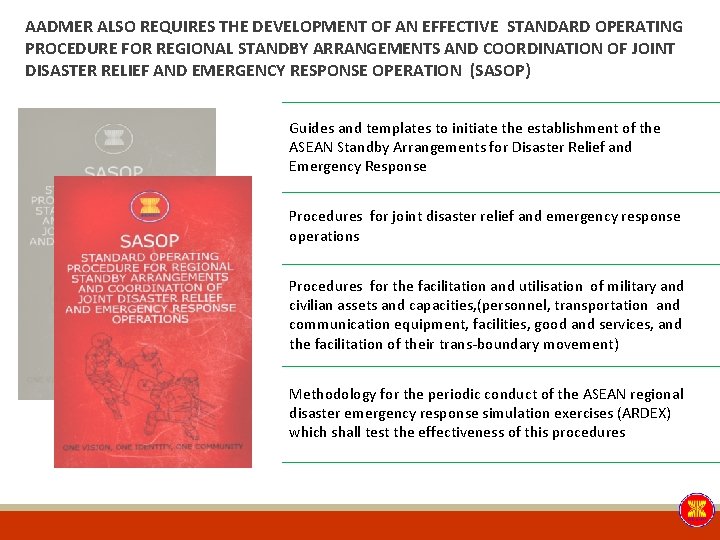
AADMER ALSO REQUIRES THE DEVELOPMENT OF AN EFFECTIVE STANDARD OPERATING PROCEDURE FOR REGIONAL STANDBY ARRANGEMENTS AND COORDINATION OF JOINT DISASTER RELIEF AND EMERGENCY RESPONSE OPERATION (SASOP) Guides and templates to initiate the establishment of the ASEAN Standby Arrangements for Disaster Relief and Emergency Response Procedures for joint disaster relief and emergency response operations Procedures for the facilitation and utilisation of military and civilian assets and capacities, (personnel, transportation and communication equipment, facilities, good and services, and the facilitation of their trans-boundary movement) Methodology for the periodic conduct of the ASEAN regional disaster emergency response simulation exercises (ARDEX) which shall test the effectiveness of this procedures Connecting ASEAN for Disaster Readiness
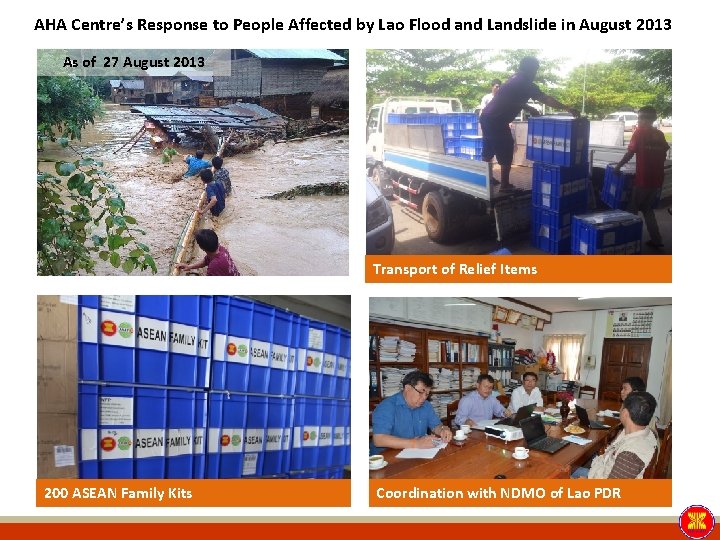
AHA Centre’s Response to People Affected by Lao Flood and Landslide in August 2013 As of 27 August 2013 Transport of Relief Items 200 ASEAN Family Kits Coordination with NDMO of Lao PDR
The Goals of DM Strategy Plan to 2020 1. Making Lao Society Safer and minimizing the impact of Disaster to people life, country economy, government’s and population Property. 2. To timely assist to the victims of disaster helping they mitigate disaster impact and quick return to normalcy. 3. Building completed legal system on disaster management and prevention of disaster impact to individual, community, society and country economy. 4. Making disaster management concept and environmental protection as unique to development and becoming cultural perception of society.
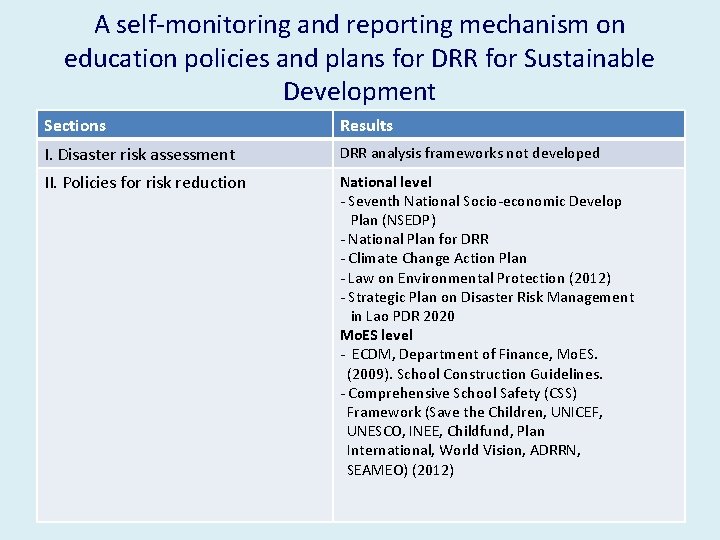
A self-monitoring and reporting mechanism on education policies and plans for DRR for Sustainable Development Sections Results I. Disaster risk assessment DRR analysis frameworks not developed II. Policies for risk reduction National level - Seventh National Socio-economic Develop Plan (NSEDP) - National Plan for DRR - Climate Change Action Plan - Law on Environmental Protection (2012) - Strategic Plan on Disaster Risk Management in Lao PDR 2020 Mo. ES level - ECDM, Department of Finance, Mo. ES. (2009). School Construction Guidelines. - Comprehensive School Safety (CSS) Framework (Save the Children, UNICEF, UNESCO, INEE, Childfund, Plan International, World Vision, ADRRN, SEAMEO) (2012)
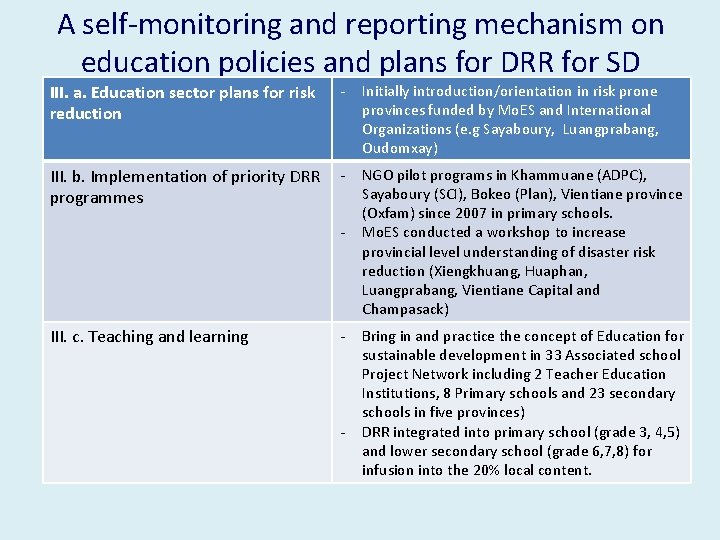
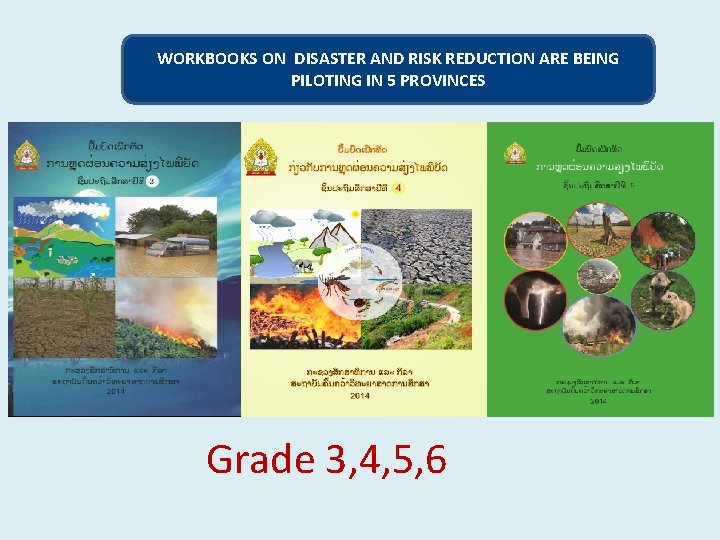
A self-monitoring and reporting mechanism on education policies and plans for DRR for SD III. a. Education sector plans for risk reduction - Initially introduction/orientation in risk prone provinces funded by Mo. ES and International Organizations (e. g Sayaboury, Luangprabang, Oudomxay) III. b. Implementation of priority DRR programmes - NGO pilot programs in Khammuane (ADPC), Sayaboury (SCI), Bokeo (Plan), Vientiane province (Oxfam) since 2007 in primary schools. Mo. ES conducted a workshop to increase provincial level understanding of disaster risk reduction (Xiengkhuang, Huaphan, Luangprabang, Vientiane Capital and Champasack) - III. c. Teaching and learning - - Bring in and practice the concept of Education for sustainable development in 33 Associated school Project Network including 2 Teacher Education Institutions, 8 Primary schools and 23 secondary schools in five provinces) DRR integrated into primary school (grade 3, 4, 5) and lower secondary school (grade 6, 7, 8) for infusion into the 20% local content.
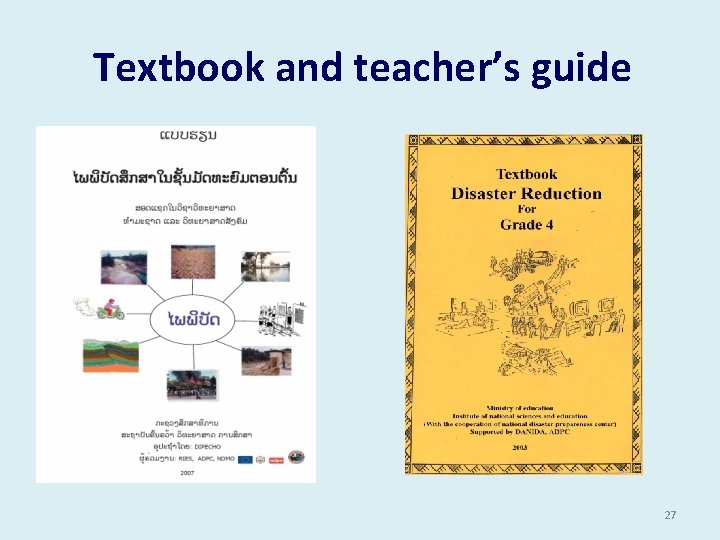
Textbook and teacher’s guide 27
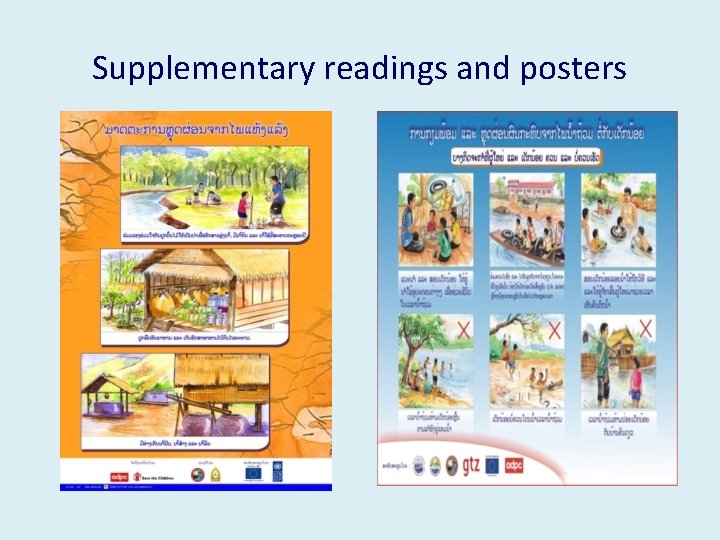
Supplementary readings and posters
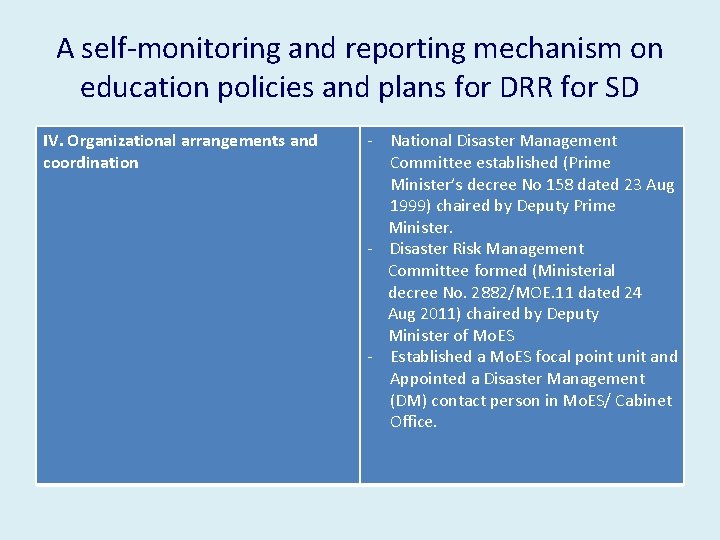
A self-monitoring and reporting mechanism on education policies and plans for DRR for SD IV. Organizational arrangements and coordination - National Disaster Management Committee established (Prime Minister’s decree No 158 dated 23 Aug 1999) chaired by Deputy Prime Minister. - Disaster Risk Management Committee formed (Ministerial decree No. 2882/MOE. 11 dated 24 Aug 2011) chaired by Deputy Minister of Mo. ES - Established a Mo. ES focal point unit and Appointed a Disaster Management (DM) contact person in Mo. ES/ Cabinet Office.
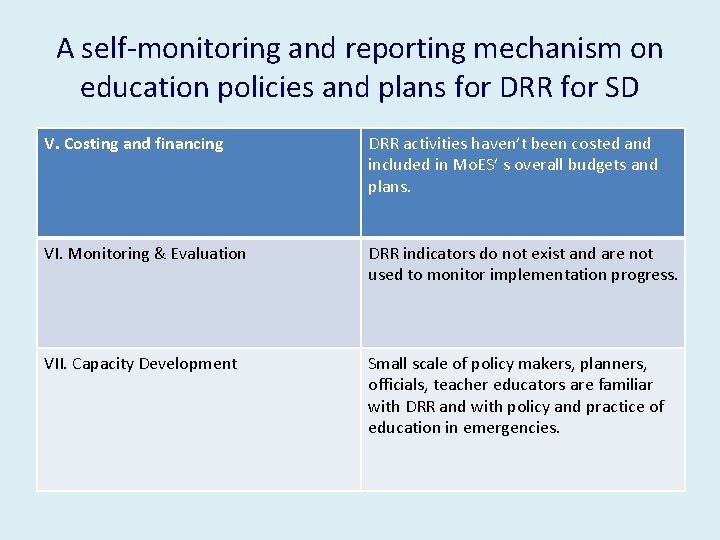
A self-monitoring and reporting mechanism on education policies and plans for DRR for SD V. Costing and financing DRR activities haven’t been costed and included in Mo. ES’ s overall budgets and plans. VI. Monitoring & Evaluation DRR indicators do not exist and are not used to monitor implementation progress. VII. Capacity Development Small scale of policy makers, planners, officials, teacher educators are familiar with DRR and with policy and practice of education in emergencies.
Significant Progress 1. Established of DDMC at All Districts. 2. Establish DM focal points and contact persons in all major government agencies, units, privates, factories and Other. 3. Enhance Capability and Building information dissemination to all 142 districts of Country. 4. Develop early warning information receiving points at risky to disaster villages. 5. Establish storages at provinces and some vulnerable to disaster districts.
Significant Progress 6. Continue sustainable public awareness and education programs through media 7. Expand DM training in all sectors at various level 8. Organizing drills and simulation exercises with participation of emergency rescue teams of sectors and population. 9. Enhance capability on cooperation with ASEAN, region and international on exchanging of expertise, information on DM and join implementing projects, simulation exercises and relief drills.
Significant Progress • New Prime Minister Decree No 220/PM dated 28/8/2013 on National Disaster Prevention and Management Committee • Drafting new TOR of Committee and members • Drafting National Disaster Risk Management Strategies 2016 -2020 • Drafting a new decree on Disaster Risk Management Committee in Mo. ES, its TOR and members • Appointed two contact persons at Mo. ES & Revising TOR of a focal point unit within Mo. ES.
Significant Progress in Education Sector • Drafting Mo. ES disaster risk management plan • Planning to integrate DRR into Education and Sport Development Plan (2016 -2020) • Improving our system and process for data collection on damage after a disaster • Ministry of Finance dedicated nearly USD 10, 000 to discuss the policy implications of integrating DRR into the national school curriculum, and to fund the training of the focal points on DM. • Supplied zinc roofing for schools affected by natural disaster (approximately USD 250, 000)
WORKBOOKS ON DISASTER AND RISK REDUCTION ARE BEING PILOTING IN 5 PROVINCES Grade 3, 4, 5, 6
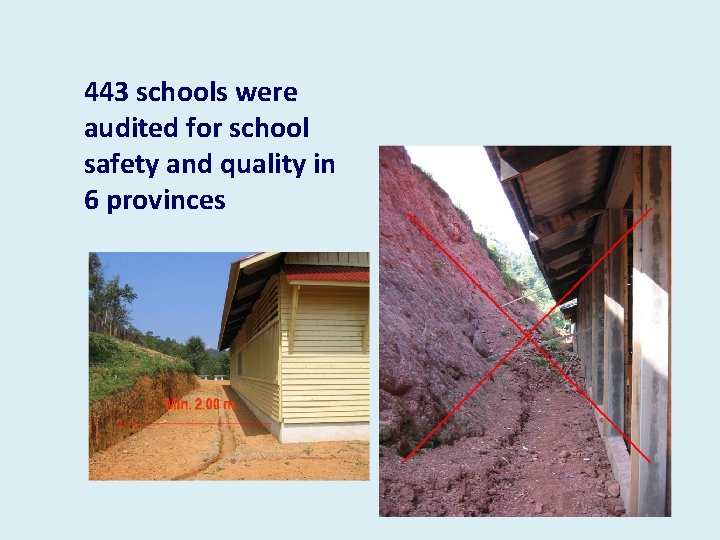
443 schools were audited for school safety and quality in 6 provinces
Usefulness of a self-monitoring and reporting questionnaire • A comprehensive monitoring tool • A practical guide for sector planning (identifying gaps and needs) • A good self study reference
Challenges and Opportunities. The main challenges lie in financial and capacity constraints. There is a need to improve the knowledge base with respect to climate modeling, potential impacts and mitigation and adaptation strategies. The still low levels of public awareness on climate change issues in another challenge, although this has improved over the past decade. Cross-sectoral coordination is another area that needs strengthening.
Limitation and Challenges • Limited/lack of resources both human and financial • Limited knowledge on DRR and management at the central/local/community levels. • Many of the worst hit areas by disasters are very remote and difficult to reach. • Lack of monitoring and assessment • Lack of baseline data on current school condition
Conclusion • Disaster Management is essential. There is a need to strengthen National Disaster Management Strategies by: • Develop a comprehensive Disaster Management Strategy for Lao PDR • Build the capacity of institutions dealing with DM • Building community disaster preparedness and response capacity are particularly important.
Recommendations • University should consider how best to provide coursework in DRR, DRR research project should be provided. • Develop strategic plan on disaster management in education sector • Use school block grant to support school disaster risk management • Annual national meeting on DRR management • Consultation meeting with concerned government agencies and international organizations • Monitoring and evaluation
Thank you Your recommendation are welcome