MITE 6304 Designing shared virtual environments for learning
- Slides: 41
MITE 6304 Designing shared virtual environments for learning THE UNIVERSITY OF HONG KONG Affordances and Patterns A means of describing technologies and pedagogies in conceptual terms, and facilitating the selection of technology to suit a particular pedagogy and the selection of a pedagogy to suit a desired outcome MITE 6304 Designing shared virtual learning environments HKU Faculty of Education
Definition THE UNIVERSITY OF HONG KONG • ‘Affordance’ refers to the perceived and actual properties of a thing, primarily those functional properties that determine just how the thing could possibly be used. (Salomon, 1993, p. 51)
Questions THE UNIVERSITY OF HONG KONG • How might the affordances of technologies be articulated? • Can these be developed into a taxonomy for ICT? • How might a critical knowledge and understanding of such affordances be used to support learning and teaching?
Affordances THE UNIVERSITY OF HONG KONG • The concept was introduced to Human Computer Interaction by Donald Norman in his book The Psychology of Everyday Things from 1988 • According to Norman (1988) an affordance is the design aspect of an object which suggest how the object should be used; a visual clue to its function and use.
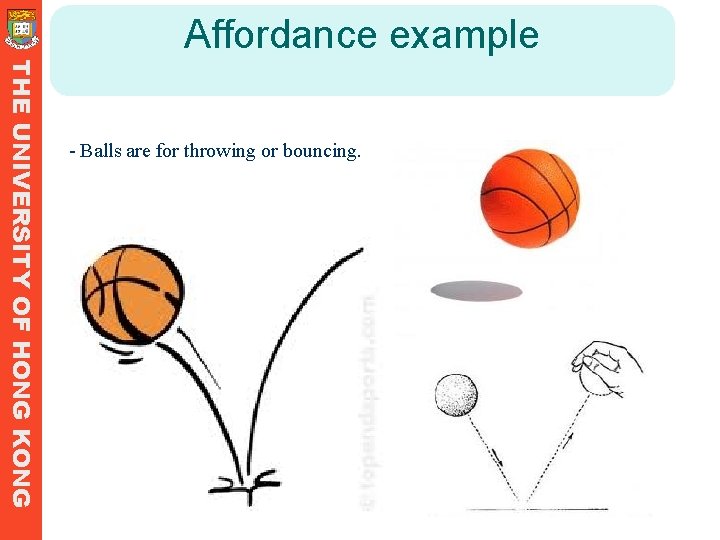
THE UNIVERSITY OF HONG KONG Definition of Affordance by Norman • ". . . the term affordance refers to the perceived and actual properties of the thing, primarily those fundamental properties that determine just how the thing could possibly be used. • Affordances provide strong clues to the operations of things. – – Plates are for pushing. Knobs are for turning. Slots are for inserting things into. Balls are for throwing or bouncing. • When affordances are taken advantage of, the user knows what to do just by looking: no picture, label, or instruction needed. " (Norman 1988, p. 9)
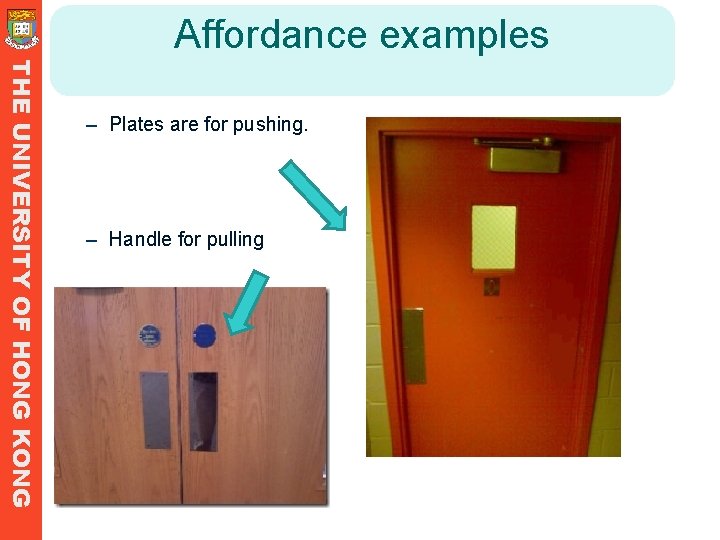
Affordance examples THE UNIVERSITY OF HONG KONG – Plates are for pushing. – Handle for pulling
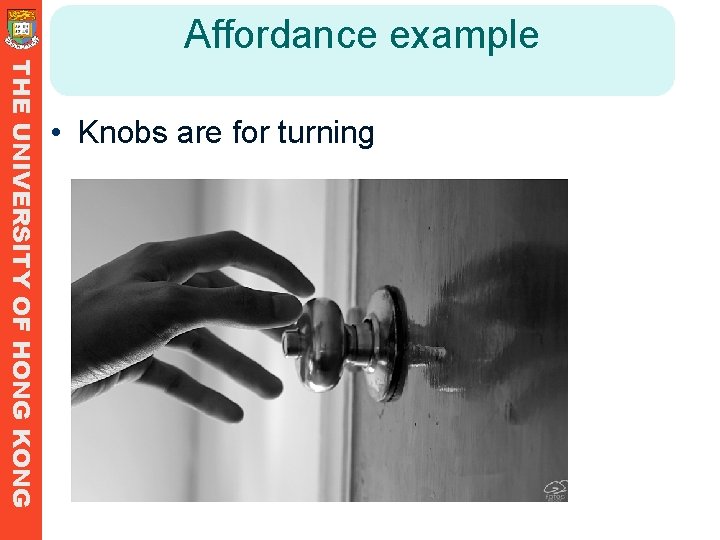
Affordance example THE UNIVERSITY OF HONG KONG • Knobs are for turning
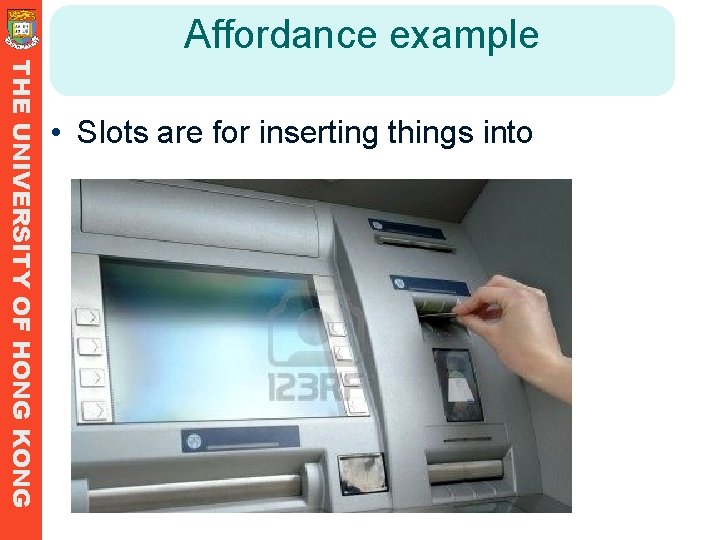
Affordance example THE UNIVERSITY OF HONG KONG • Slots are for inserting things into
Affordance example THE UNIVERSITY OF HONG KONG - Balls are for throwing or bouncing.
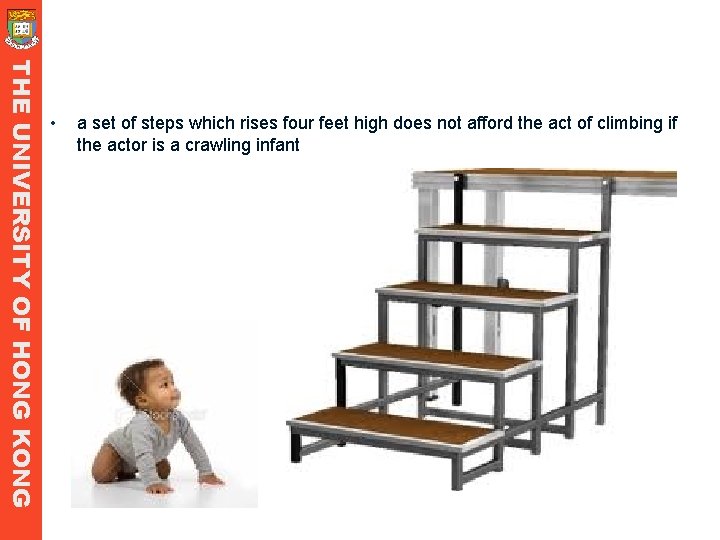
THE UNIVERSITY OF HONG KONG Definition of Affordance by Gibson • Psychologist James J. Gibson originally introduced the term in his 1977 article "The Theory of Affordances" and explored it more fully in his book The Ecological Approach to Visual Perception in 1979. • He defined affordances as all "action possibilities" latent in the environment, objectively measurable and independent of the individual's ability to recognize them, but always in relation to the actor and therefore dependent on their capabilities. – For instance, a set of steps which rises four feet high does not afford the act of climbing if the actor is a crawling infant.
THE UNIVERSITY OF HONG KONG • a set of steps which rises four feet high does not afford the act of climbing if the actor is a crawling infant
Affordance as action possibility THE UNIVERSITY OF HONG KONG • "an action possibility available in the environment to an individual, independent of the individual's ability to perceive this possibility" by Gibson (Mc. Grenere and Ho, 2000). • Gibson focuses only on the action capabilities of the actor and not on the perceptual and mental capabilities. Question: Does information that specify the affordance be dependant on the actor's experience and culture?
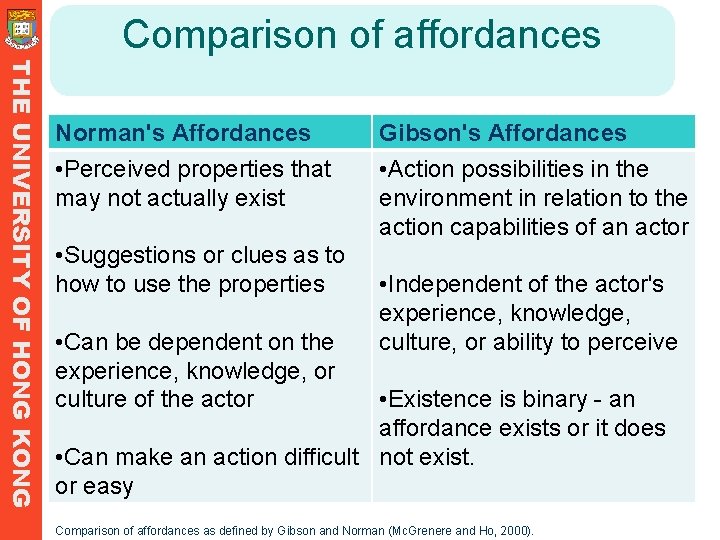
Comparison of affordances THE UNIVERSITY OF HONG KONG Norman's Affordances • Perceived properties that may not actually exist • Suggestions or clues as to how to use the properties • Can be dependent on the experience, knowledge, or culture of the actor Gibson's Affordances • Action possibilities in the environment in relation to the action capabilities of an actor • Independent of the actor's experience, knowledge, culture, or ability to perceive • Existence is binary - an affordance exists or it does • Can make an action difficult not exist. or easy Comparison of affordances as defined by Gibson and Norman (Mc. Grenere and Ho, 2000).
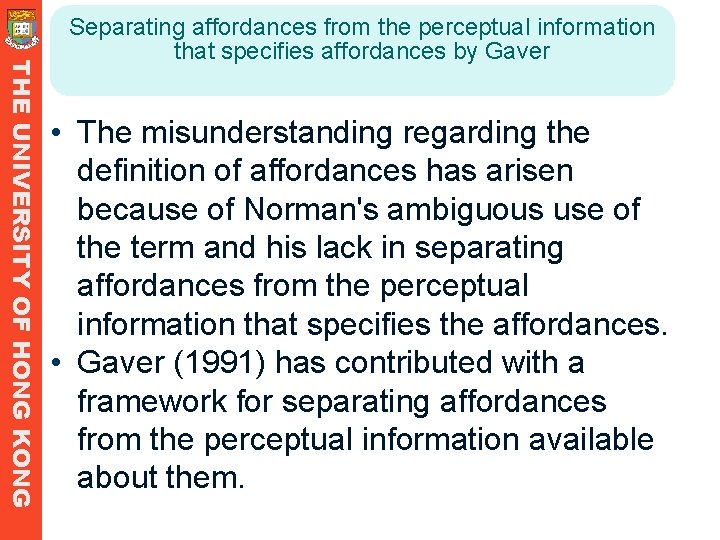
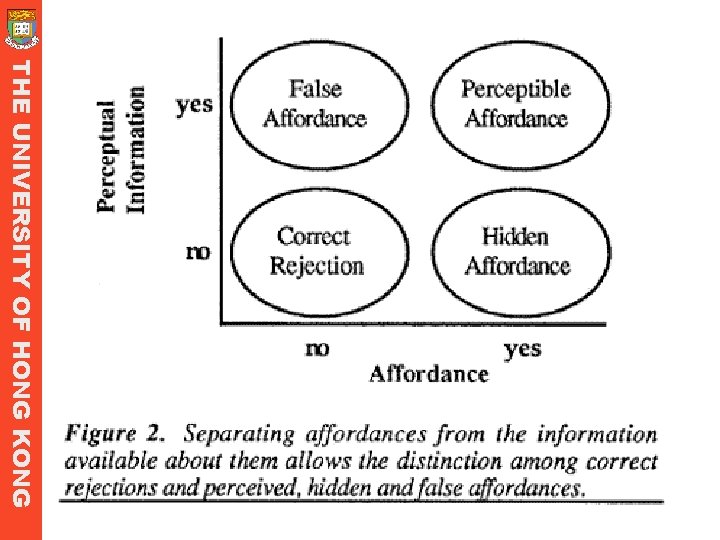
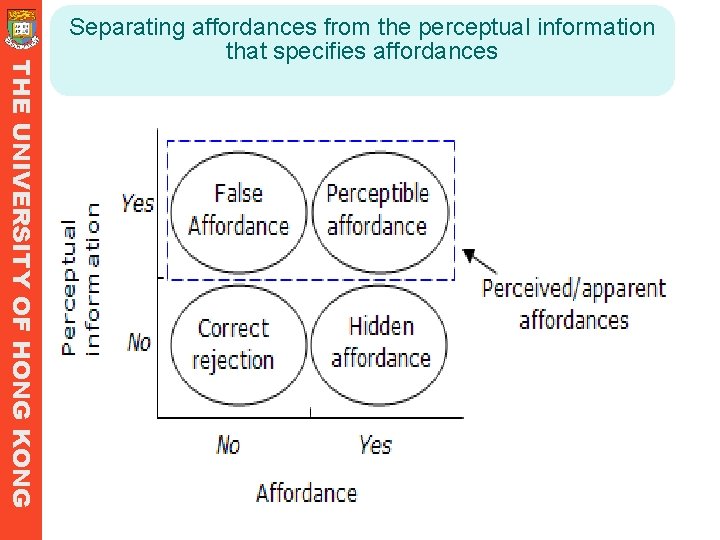
THE UNIVERSITY OF HONG KONG Separating affordances from the perceptual information that specifies affordances by Gaver • The misunderstanding regarding the definition of affordances has arisen because of Norman's ambiguous use of the term and his lack in separating affordances from the perceptual information that specifies the affordances. • Gaver (1991) has contributed with a framework for separating affordances from the perceptual information available about them.
THE UNIVERSITY OF HONG KONG
THE UNIVERSITY OF HONG KONG Separating affordances from the perceptual information that specifies affordances
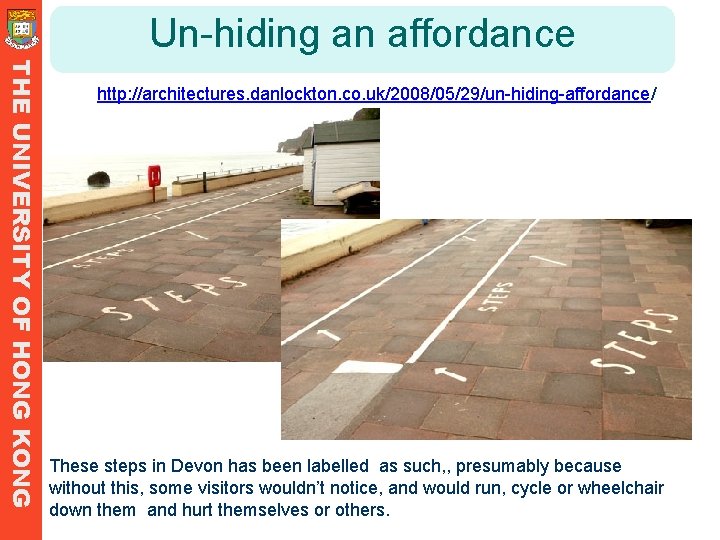
Un-hiding an affordance THE UNIVERSITY OF HONG KONG http: //architectures. danlockton. co. uk/2008/05/29/un-hiding-affordance/ These steps in Devon has been labelled as such, , presumably because without this, some visitors wouldn’t notice, and would run, cycle or wheelchair down them and hurt themselves or others.
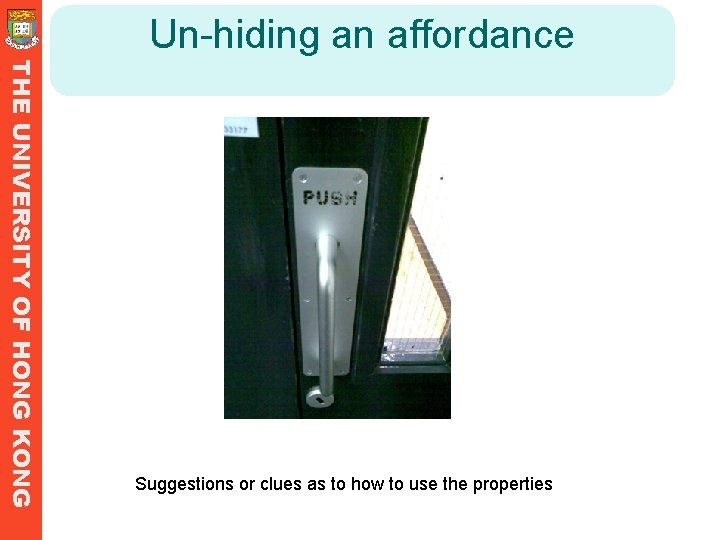
Un-hiding an affordance THE UNIVERSITY OF HONG KONG Suggestions or clues as to how to use the properties
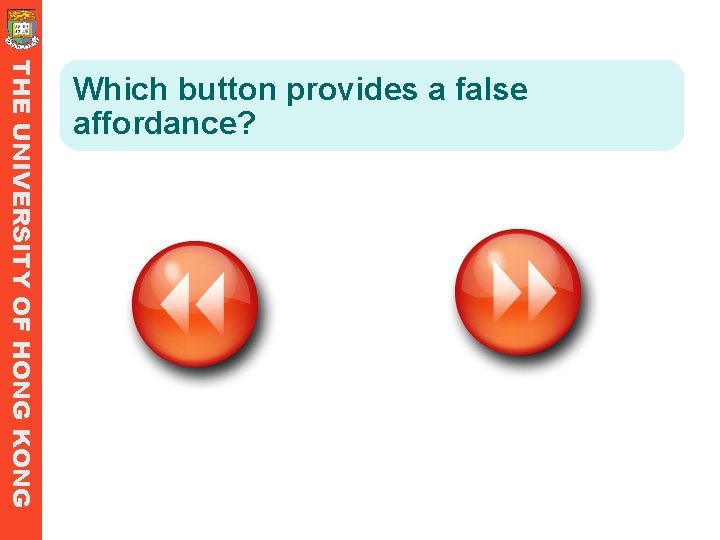
False affordance THE UNIVERSITY OF HONG KONG • a 'false affordance' exists when there is no action possibility but the information that specifies it is • (for example, a chair that look sturdy, but which is made of cardboard). – a 'correct rejection' exists when there is no affordance and no perceptual information to specify it – a 'hidden affordance' exists when the affordance is there but the specifying perceptual information is not (for example, a hidden door).
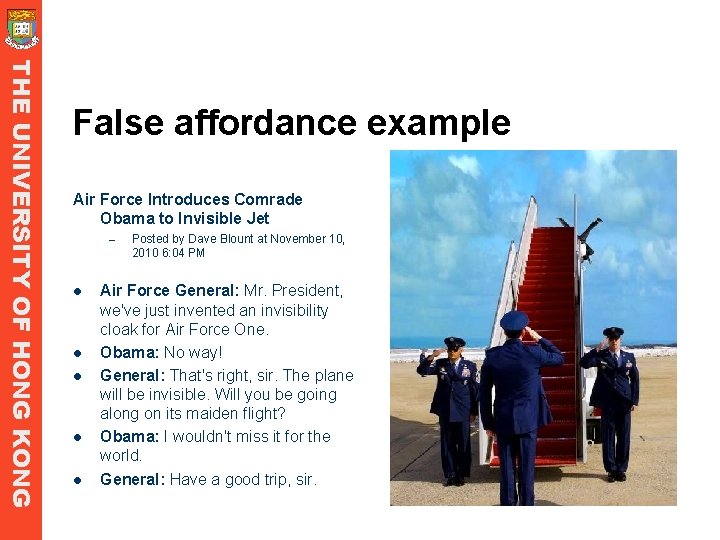
THE UNIVERSITY OF HONG KONG False affordance example Air Force Introduces Comrade Obama to Invisible Jet – l l l Posted by Dave Blount at November 10, 2010 6: 04 PM Air Force General: Mr. President, we've just invented an invisibility cloak for Air Force One. Obama: No way! General: That's right, sir. The plane will be invisible. Will you be going along on its maiden flight? Obama: I wouldn't miss it for the world. General: Have a good trip, sir.
THE UNIVERSITY OF HONG KONG Which button provides a false affordance?
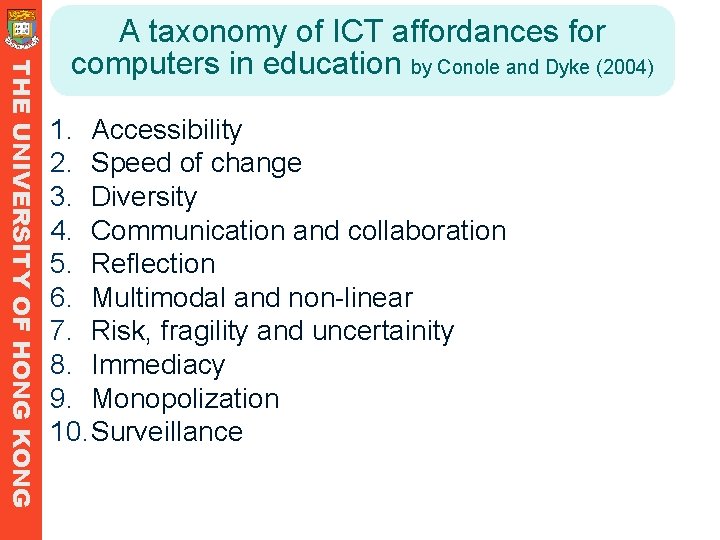
THE UNIVERSITY OF HONG KONG A taxonomy of ICT affordances for computers in education by Conole and Dyke (2004) 1. Accessibility 2. Speed of change 3. Diversity 4. Communication and collaboration 5. Reflection 6. Multimodal and non-linear 7. Risk, fragility and uncertainity 8. Immediacy 9. Monopolization 10. Surveillance
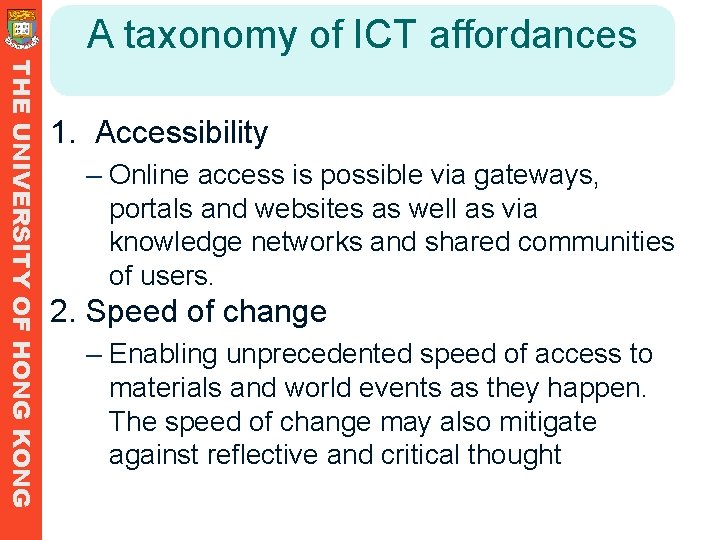
A taxonomy of ICT affordances THE UNIVERSITY OF HONG KONG 1. Accessibility – Online access is possible via gateways, portals and websites as well as via knowledge networks and shared communities of users. 2. Speed of change – Enabling unprecedented speed of access to materials and world events as they happen. The speed of change may also mitigate against reflective and critical thought
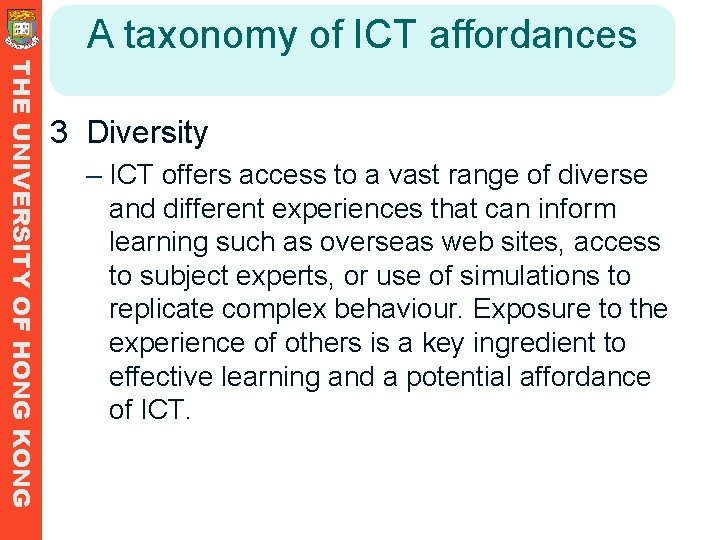
A taxonomy of ICT affordances THE UNIVERSITY OF HONG KONG 3 Diversity – ICT offers access to a vast range of diverse and different experiences that can inform learning such as overseas web sites, access to subject experts, or use of simulations to replicate complex behaviour. Exposure to the experience of others is a key ingredient to effective learning and a potential affordance of ICT.
A taxonomy of ICT affordances THE UNIVERSITY OF HONG KONG 4. Communication and collaboration – New technologies have opened up the possibility of new forms of dialogue and communication. – ICT offers the potential to develop new forms of online communities and new means of communicating and sharing information, • from signing up to particular mailing lists through to involvement in specialized discussion forums and chat rooms.
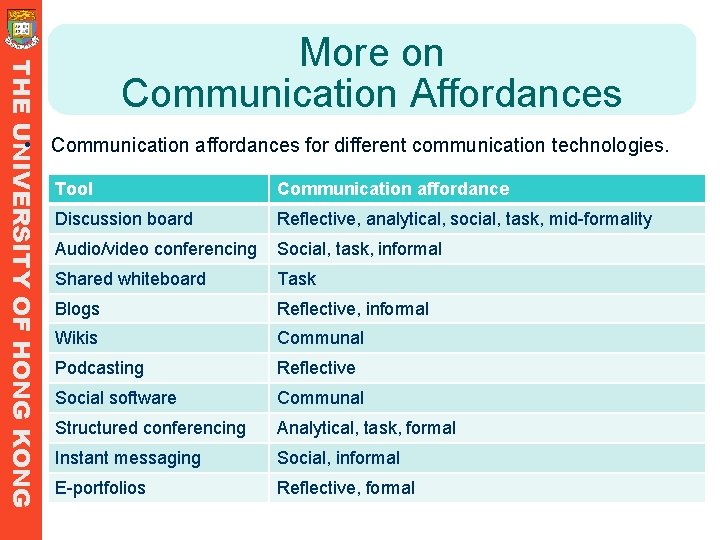
6 types of communication related to education: THE UNIVERSITY OF HONG KONG 1. Reflective – contains elements that relate to the individual’s experience 2. Analytical – analyzes, argues or proposes an idea 3. Social – not specifically focused on the subject area, and may be more chat-like 4. Task – focused on a specific task 5. Communal – either focuses on, or helps to create and maintain, the student community 6. Informal/formal – the communication may be informal or more formal in style
A taxonomy of ICT affordances THE UNIVERSITY OF HONG KONG 6. Reflection – Asynchronous technologies • Offer the potential for encouraging reflection and critique, with users engaging in discussions over a longer time frame than is possible in face-to-face discussions
A taxonomy of ICT affordances THE UNIVERSITY OF HONG KONG 7. Risk, fragility and uncertainty – The complex systems of ICT are vulnerable to abuses, to disruption from viruses and SPAM, or simply to the servers ‘being down’. The increased use of technologies by different groups of users often gives rise to unintended consequences.
A taxonomy of ICT affordances THE UNIVERSITY OF HONG KONG 8. Immediacy – The speed with which information can be exchanged via the web and email has led to a shift in user expectations in terms of response times to requests from other users. – This, in turn, has led to a consequential intensification of working patterns, with users being increasingly required to respond almost immediately to requests which, in the past, would have been dealt with over longer timeframes.
A taxonomy of ICT affordances THE UNIVERSITY OF HONG KONG 9. Monopolization – There is a tension between the benefits of diversification and sharing of developments, a central ethos of the open source community with that of monopolization and comodification, such as the dominance of particular software products to support office applications.
A taxonomy of ICT affordances THE UNIVERSITY OF HONG KONG 10. Surveillance – There is increasing concern about potential infringements on individuals which the infiltration of technological applications make possible. the increased default inclusion of monitoring tools within virtual learning environments that mean teachers have the power to monitor student activities more closely than ever before. – many of the new ‘smart’ devices and personal tags which are being included in commercial products that enable providers to target and personalize products more accurately. –
THE UNIVERSITY OF HONG KONG More on Communication Affordances • Communication affordances for different communication technologies. Tool Communication affordance Discussion board Reflective, analytical, social, task, mid-formality Audio/video conferencing Social, task, informal Shared whiteboard Task Blogs Reflective, informal Wikis Communal Podcasting Reflective Social software Communal Structured conferencing Analytical, task, formal Instant messaging Social, informal E-portfolios Reflective, formal
THE UNIVERSITY OF HONG KONG More on Communication Affordances • Affordances as a form of technological compliance – If you put people in a fast car, they tend to drive faster • Because technology suggests and permits it • People have a socially determined model of how to behave in a fast car. – If you want students to forge a community, then wiki would be useful – If you want students to engage in quick, social type interaction, then instant messaging is useful
Game affordance THE UNIVERSITY OF HONG KONG • Wijekmur et al. (2006) investigated K-12 students’ use of ICT and suggest that for many children the computer has a ‘game affordance’, rather than a learning one. • One student reported how another computer learning tool was introduced in their school and most students turned the learning environment into a game of trying to give as many incorrect responses as possible to the system.
Patterns THE UNIVERSITY OF HONG KONG • A pattern describes a problem which occurs over and over again in our environment, and then describes the core of the solution to that problem, in such a way that you can use this solution a million times over, without ever doing it the same way twice. Alexander et al (1977)
Patterns THE UNIVERSITY OF HONG KONG • This approach was then applied to software design, and then more recently to pedagogy. – Pedagogical patterns project (http: //www. pedagogicalpatterns. org) seeks to describe a set abstract patterns that can be used to inform teaching. – E-LEN project (http: //www 2. tisip. no/E-LEN/) uses patterns to promote reuse of teaching approaches and as a means of offering guidance to those creating e-learning materials.
THE UNIVERSITY OF HONG KONG Fields for Pattern • Problem/issues – describes the problem you are trying to solve • Audience/context – describes the context in which the problem arises • Forces – outlines the forces at work which create the tension • Solution – the suggested solution to the problem • Discussion/consequences/implementation – a space that can be used to add more notes that can aid others • Special resources – states whether any equipment or resources are required • Related pattern – links to any other patterns that may have a learning. • Example instances – a place to provide any examples.
THE UNIVERSITY OF HONG KONG A simple pattern template • Situation—problem—solution – The following might be a valid pattern for VLEs: • Situation: students should engage in discussion that is closely linked to course content • Problem: often there is a schism between content and discussion, so that students either do not engage in any discussion or it is not closely linked to the content. • Embed discussion tools within the content, so students do not need to come out of the content or start a new tool, but can engage in discussion when it is relevant. l Pemberton and Griffiths (1998)
Conclusion THE UNIVERSITY OF HONG KONG • If we can describe pedagogies, activity structures or learning outcomes in a canonical fashion, then we can match these against the technical description we have set out in affordances. • What both affordances and patterns provide is a means of thinking and talking about technology and pedagogy in a more abstract manner.
References THE UNIVERSITY OF HONG KONG • Martin Weller (2007) Virtual Learning Environments: Using, choosing and developing your VLE. Routledge. London and New York. • Conole, Grainne and Dyke, Martin (2004) ‘What are the affordances of information and communication technologies? ’ ALT-J 12: 2, 113— 124 • Gaver, William W. (1991): Technology Affordances. In: Robertson, Scott P. , Olson, Gary M. and Olson, Judith S. (eds. ) Proceedings of the ACM CHI 91 Human Factors in Computing Systems Conference April 28 - June 5, 1991, New Orleans, Louisiana. pp. 79 -84. • Gibson, James J. (1979): The Ecological Approach to Visual Perception. New Jersey, USA, Lawrence Erlbaum Associates
References THE UNIVERSITY OF HONG KONG • Mc. Grenere, Joanna and Ho, Wayne (2000): Affordances: Clarifying and Evolving a Concept. In: Proceedings of Graphics Interface 2000 May 15 -17, 2000, Montreal, Quebec, Canada. pp. 179 -186. • Norman, Donald A. (1999): Affordances, Conventions, and Design. In Interactions, 6 (3) pp. 38 -41 • Norman, Donald A. (1988): The Design of Everyday Things. New York, Doubleday • Norman, Donald A. (1999): Invisible Computer: Why Good Products Can Fail, the Personal Computer Is So Complex and Information Appliances Are the Solution. London, MIT Press • Sternberg, Robert J. (1996): Cognitive Psychology. 2 nd. Ed. . Harcourt Brace College Publishers