THE UNIVERSITY OF HONG KONG MITE 6304 Designing
- Slides: 20
THE UNIVERSITY OF HONG KONG MITE 6304 Designing Shared Virtual Environment for Learning HKU Faculty of Education
THE UNIVERSITY OF HONG KONG Pedagogies and e-learning HKU Faculty of Education
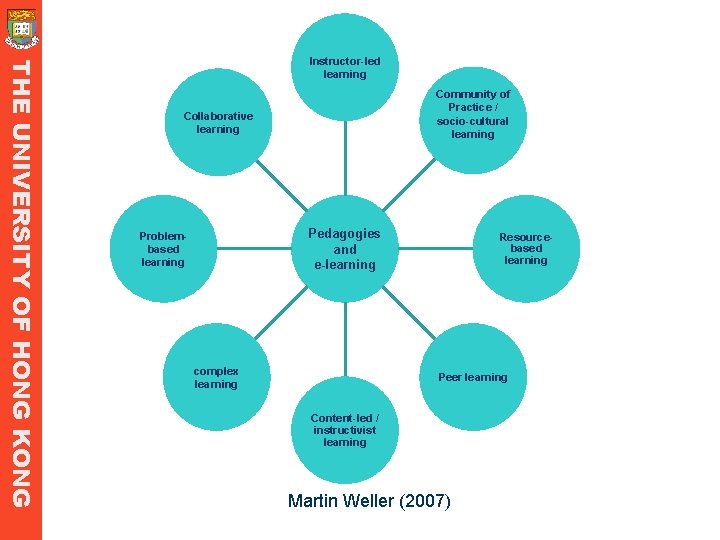
THE UNIVERSITY OF HONG KONG Instructor-led learning Community of Practice / socio-cultural learning Collaborative learning Pedagogies and e-learning Problembased learning complex learning Resourcebased learning Peer learning Content-led / instructivist learning Martin Weller (2007)
THE UNIVERSITY OF HONG KONG 1. Community of practice/ socio -cultural learning • Based around the principles of engagement, intelligibilities and participation. • Learning is a social process • An academic discipline represents a community
Tools in e-learning context THE UNIVERSITY OF HONG KONG • Discussion boards will play a central role. Students are brought into a culture • Webcasts and guest lectures can play an importance role, in allowing students to interact with other experts. • Well-populated resource area and library linkage would be suitable • Video clips will be beneficial in strong practical element • Audio and video aids student’s engagement with the community • News feed from discussion lists, newsgroup or forums. • • Example of webcast: http: //www. loc. gov/today/cyberlc/index. php Example of news feed: http: //news. bbc. co. uk/2/hi/help/rss/
2. Resource-based learning THE UNIVERSITY OF HONG KONG • Internet as a vast collection of resources – Encourages students to use a variety of resources to develop their understanding – Being able to analyse, select and critique resources is a major educational benefit. – Students perform as individuals or in groups in which they must solve a problem or produce an output by working with a range of resources – Approach that blends both discussion and the broadcast viewpoints
Tools in e-learning context THE UNIVERSITY OF HONG KONG • Threaded discussion board – Support dialogue between peers and the educator is vital • Integration databases, repositories and resource banks • VLEs are being use as content management systems. • Example of repository: http: //www. opendoar. org/
3. Peer learning THE UNIVERSITY OF HONG KONG • Social construct which is largely achieved by peer-to-peer interaction • Strong emphasis on interacting with and learning from peers • No hierarchy or degrees of membership, all individuals are on the same level • Possible to implement peer, or collaborative, learning without adopting a socio-cultural perspective learning
Tools in e-learning context THE UNIVERSITY OF HONG KONG • Effective communication tools are important • Asynchronous discussion boards • Synchronous tools allow real-time group meetings to facilitate debate, organize tasks, share ideas
THE UNIVERSITY OF HONG KONG 4. Content-led/Instructivist learning • Focuses mainly on content • Emphasis in largely on individuals interacting with that content
Tools in e-learning context THE UNIVERSITY OF HONG KONG • Easy of use of the academic interface to upload and organize content • A wide range of formats, including animation, text, images, videos and audios • Interactive content can be achieved through animation (e. g. Flash)
5. Complex learning THE UNIVERSITY OF HONG KONG • Focuses on the type of learning that takes place across or between courses • Development of complex skills such as critical thinking, analysis, synthesis and evaluation as well as metacognitive skills.
Tools in e-learning context THE UNIVERSITY OF HONG KONG • Interface is aimed at the individual educator, or small team, creating their specific course online. • Tools such as discussion boards, email and calendars are set up so that students on a particular course can access them • A portfolio area for students to collect information, evidence • Online diary (blog) to promote reflection and ongoing activities
6. Problem-based learning THE UNIVERSITY OF HONG KONG • Students are given an ‘ill-structured problem’ – Problem or scenario about which they do not currently possess enough information to reach a solution – Requires them to find the appropriate information and to gain any skills necessary to solve this problem
Tools in e-learning context THE UNIVERSITY OF HONG KONG • Synchronous and asynchronous communication tools • Aid document sharing and collaboration for groups • Use of shared workspaces or the use of attachments in discussion boards in peer learning • Use of formative assessment tools for students to gauge their own understanding.
7. Collaborative learning THE UNIVERSITY OF HONG KONG • Main advantage of the internet for distance education is that it allows collaboration and cooperation among students • Base much on the activity around group tasks and discussion • Include students working towards a joint goal, for instance constructing a group document or website • Focus on discussion – online debates
Tools in e-learning context THE UNIVERSITY OF HONG KONG • Asynchronous discussion tools will be important – Shared whiteboards, audio-conferencing, chat rooms and instant messaging
8. Instructor-led learning THE UNIVERSITY OF HONG KONG • Termed as information-transfer, didactic or instructivist model • Imparts knowledge to the students • Traditional mode of education.
Tools in e-learning context THE UNIVERSITY OF HONG KONG • To structure a course in folders. Populate these with lecture notes and presentations, and create a discussion forum alongside, and this gives a simple replication of a standard course.
References THE UNIVERSITY OF HONG KONG • Martin Weller (2007) Virtual Learning Environments: Using, choosing and developing your VLE. Routledge. London and New York. EBOOK Virtual learning environments [electronic resource] : using, choosing and developing your VLE / Mart Weller, Martin. London : Routledge, 2007. Limited Preview @ Google Book Search Click to access