Linking Temporal Records Pei Li 1 Xin Luna
- Slides: 46
Linking Temporal Records Pei Li 1, Xin Luna Dong 2, Andrea Maurino 1, Divesh Srivastava 2 1 Università di Milano Bicocca, 2 AT&T Labs-Research VLDB 2011, Seattle ISFR – Jan 28 th, 2010 Gianluigi Viscusi SEQUOIAS -DISCo Un. Mi. B
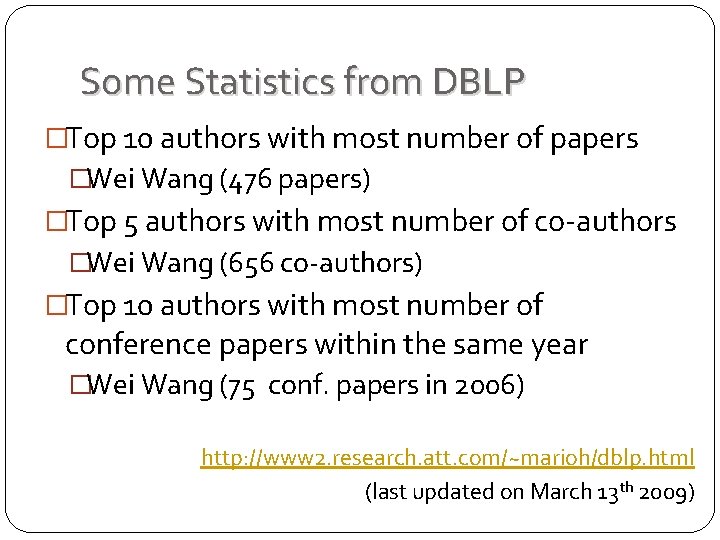
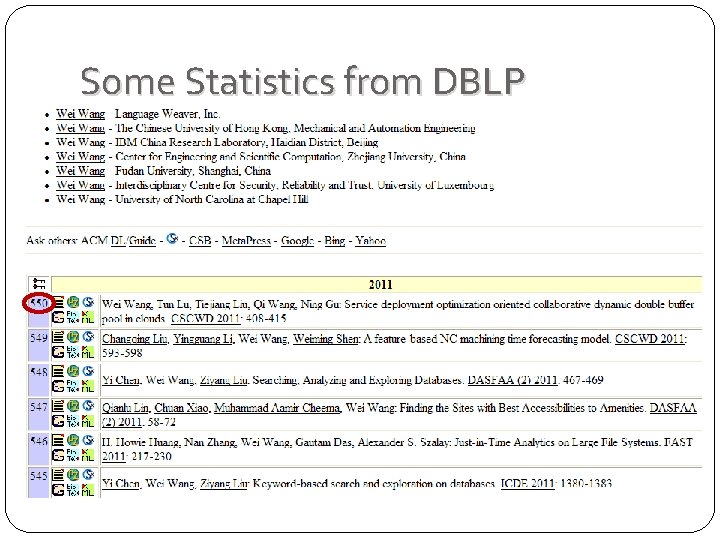
Some Statistics from DBLP �Top 10 authors with most number of papers �Wei Wang (476 papers) �Top 5 authors with most number of co-authors �Wei Wang (656 co-authors) �Top 10 authors with most number of conference papers within the same year �Wei Wang (75 conf. papers in 2006) http: //www 2. research. att. com/~marioh/dblp. html (last updated on March 13 th 2009)
Some Statistics from DBLP
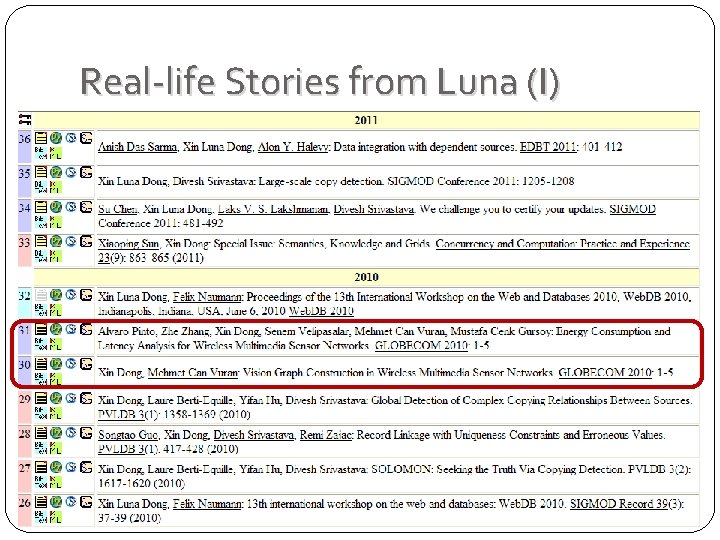
Real-life Stories from Luna (I)
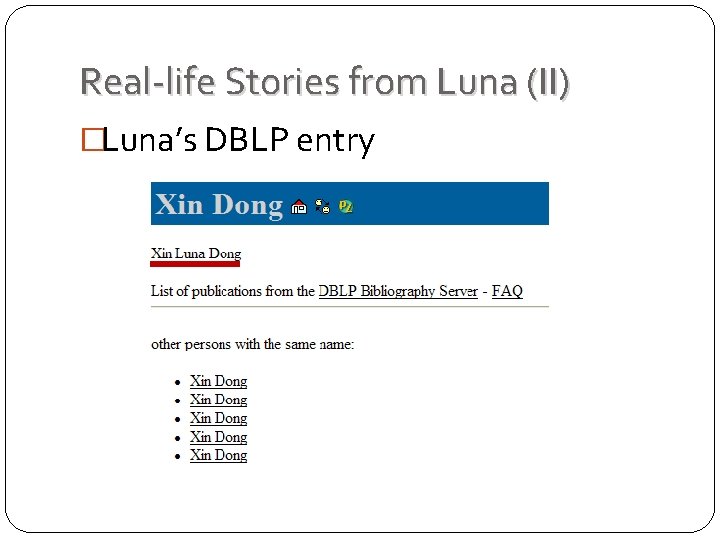
Real-life Stories from Luna (II) �Luna’s DBLP entry
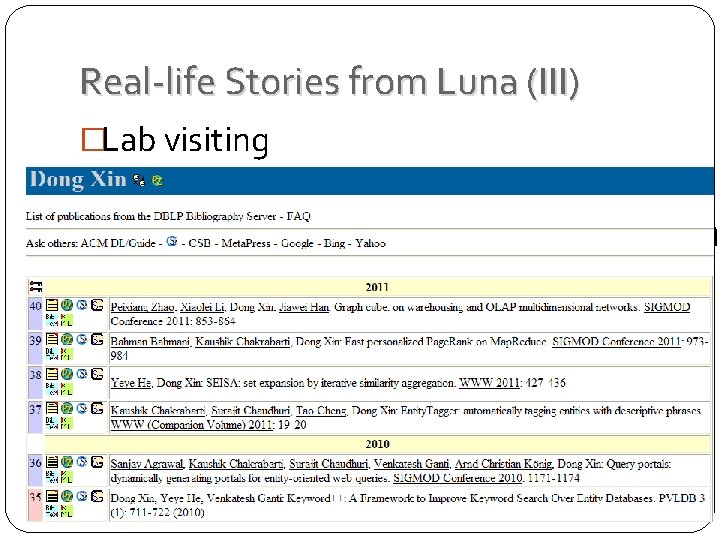
Real-life Stories from Luna (III) �Lab visiting Sorry, no entry is found for Xin Don
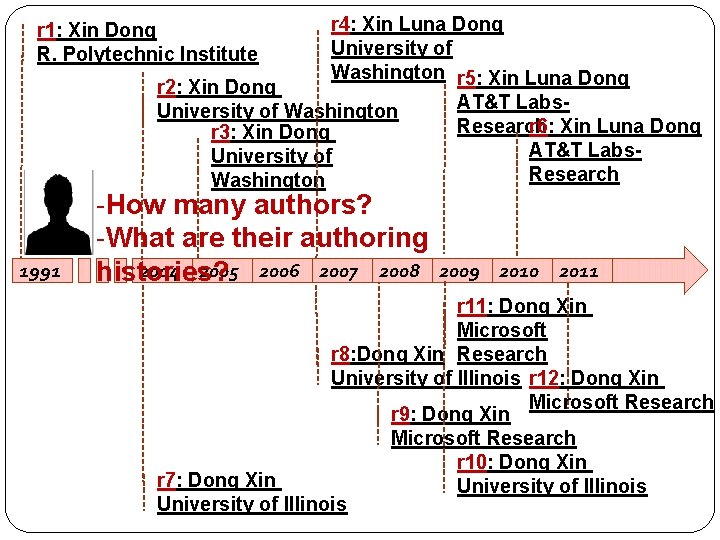
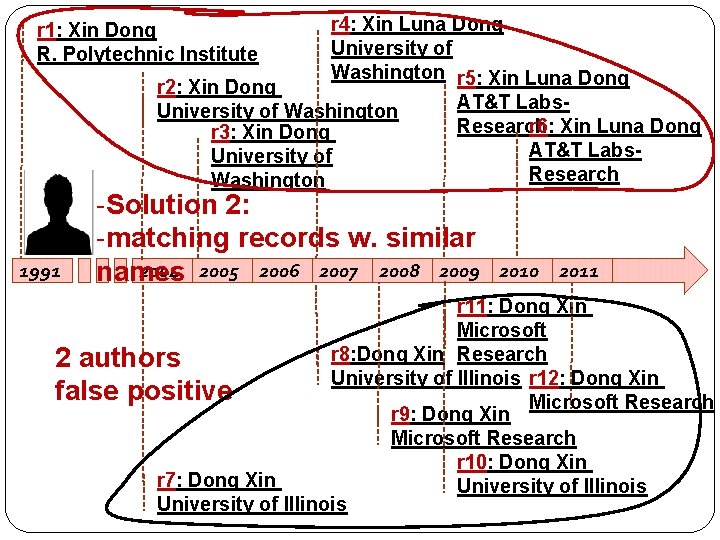
r 4: Xin Luna Dong University of Washington r 5: Xin Luna Dong r 2: Xin Dong AT&T Labs. University of Washington Research r 6: Xin Luna Dong r 3: Xin Dong AT&T Labs. University of Research Washington r 1: Xin Dong R. Polytechnic Institute 1991 -How many authors? -What are their authoring 1991 2004 2005 1991 2006 1991 2007 2008 histories? 2009 2010 2011 r 11: Dong Xin Microsoft r 8: Dong Xin Research University of Illinois r 12: Dong Xin Microsoft Research r 9: Dong Xin Microsoft Research r 10: Dong Xin r 7: Dong Xin University of Illinois
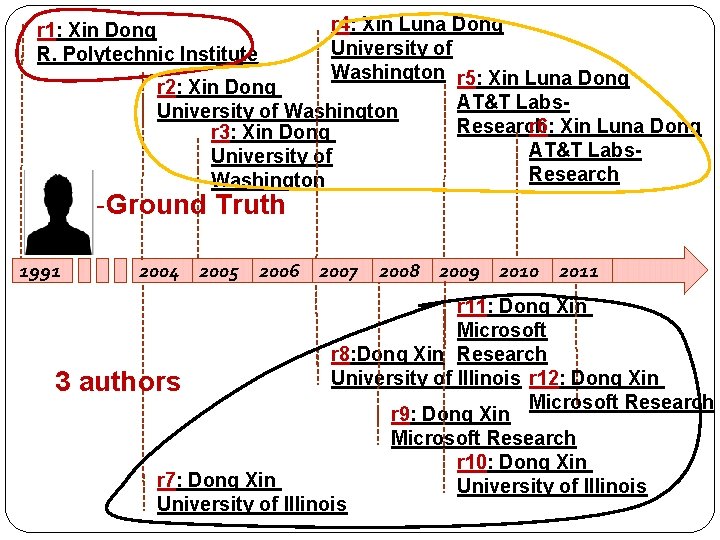
r 4: Xin Luna Dong University of Washington r 5: Xin Luna Dong r 2: Xin Dong AT&T Labs. University of Washington Research r 6: Xin Luna Dong r 3: Xin Dong AT&T Labs. University of Research Washington r 1: Xin Dong R. Polytechnic Institute -Ground Truth 1991 3 1991 2004 2005 1991 2006 1991 2007 2008 2009 2010 2011 r 11: Dong Xin Microsoft r 8: Dong Xin Research University of Illinois r 12: Dong Xin authors Microsoft Research r 9: Dong Xin Microsoft Research r 10: Dong Xin r 7: Dong Xin University of Illinois
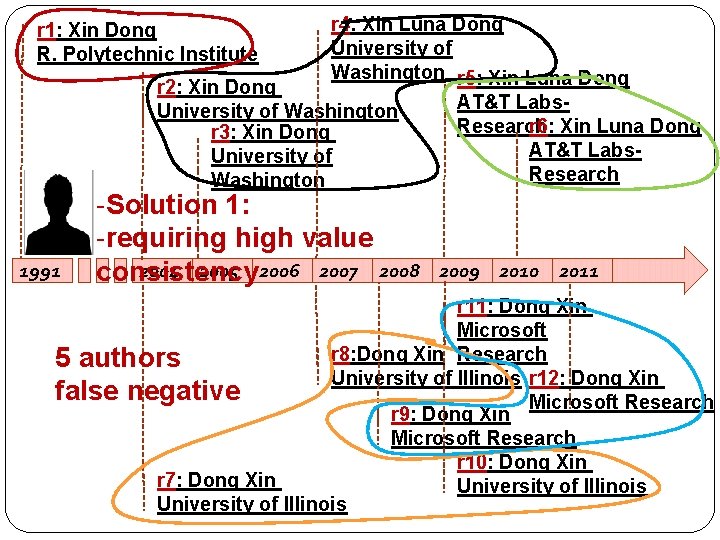
r 4: Xin Luna Dong University of Washington r 5: Xin Luna Dong r 2: Xin Dong AT&T Labs. University of Washington Research r 6: Xin Luna Dong r 3: Xin Dong AT&T Labs. University of Research Washington r 1: Xin Dong R. Polytechnic Institute 1991 -Solution 1: -requiring high value 1991 2004 2005 1991 2006 1991 2007 2008 consistency 2009 2010 2011 r 11: Dong Xin Microsoft r 8: Dong Xin Research 5 authors University of Illinois r 12: Dong Xin false negative Microsoft Research r 9: Dong Xin Microsoft Research r 10: Dong Xin r 7: Dong Xin University of Illinois
r 4: Xin Luna Dong University of Washington r 5: Xin Luna Dong r 2: Xin Dong AT&T Labs. University of Washington Research r 6: Xin Luna Dong r 3: Xin Dong AT&T Labs. University of Research Washington r 1: Xin Dong R. Polytechnic Institute 1991 -Solution 2: -matching records w. similar 1991 2004 2005 1991 2006 1991 2007 2008 2009 names 2010 2011 r 11: Dong Xin Microsoft r 8: Dong Xin Research 2 authors University of Illinois r 12: Dong Xin false positive Microsoft Research r 9: Dong Xin Microsoft Research r 10: Dong Xin r 7: Dong Xin University of Illinois
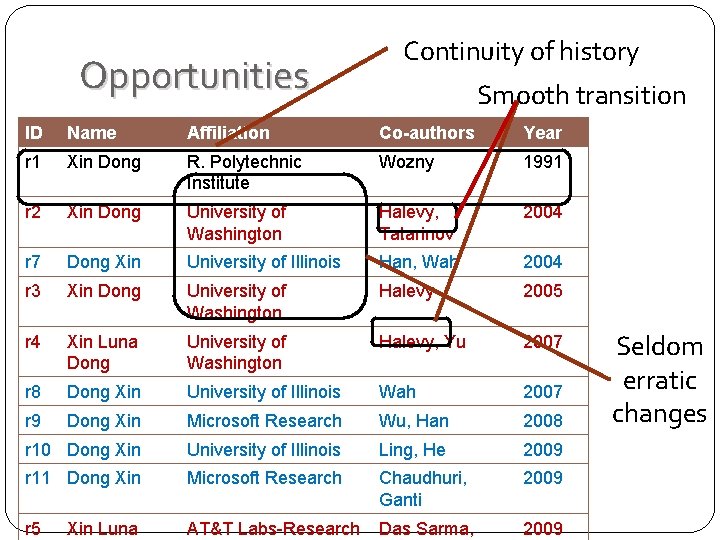
Opportunities Continuity of history Smooth transition ID Name Affiliation Co-authors Year r 1 Xin Dong R. Polytechnic Institute Wozny 1991 r 2 Xin Dong University of Washington Halevy, Tatarinov 2004 r 7 Dong Xin University of Illinois Han, Wah 2004 r 3 Xin Dong University of Washington Halevy 2005 r 4 Xin Luna Dong University of Washington Halevy, Yu 2007 r 8 Dong Xin University of Illinois Wah 2007 r 9 Dong Xin Microsoft Research Wu, Han 2008 r 10 Dong Xin University of Illinois Ling, He 2009 r 11 Dong Xin Microsoft Research Chaudhuri, Ganti 2009 r 5 AT&T Labs-Research Das Sarma, 2009 Xin Luna Seldom erratic changes
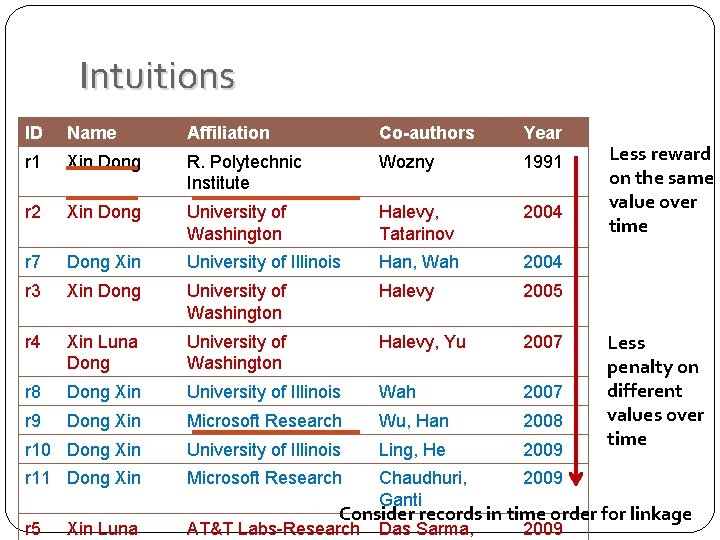
Intuitions ID Name Affiliation Co-authors Year r 1 Xin Dong R. Polytechnic Institute Wozny 1991 r 2 Xin Dong University of Washington Halevy, Tatarinov 2004 r 7 Dong Xin University of Illinois Han, Wah 2004 r 3 Xin Dong University of Washington Halevy 2005 r 4 Xin Luna Dong University of Washington Halevy, Yu 2007 r 8 Dong Xin University of Illinois Wah 2007 r 9 Dong Xin Microsoft Research Wu, Han 2008 r 10 Dong Xin University of Illinois Ling, He 2009 r 11 Dong Xin Microsoft Research Chaudhuri, Ganti 2009 r 5 AT&T Labs-Research Das Sarma, 2009 Xin Luna Less reward on the same value over time Less penalty on different values over time Consider records in time order for linkage
Outline �Motivation & intuitions �Problem statement �Solution �Decay �Temporal clustering �Experimental evaluation �Conclusions
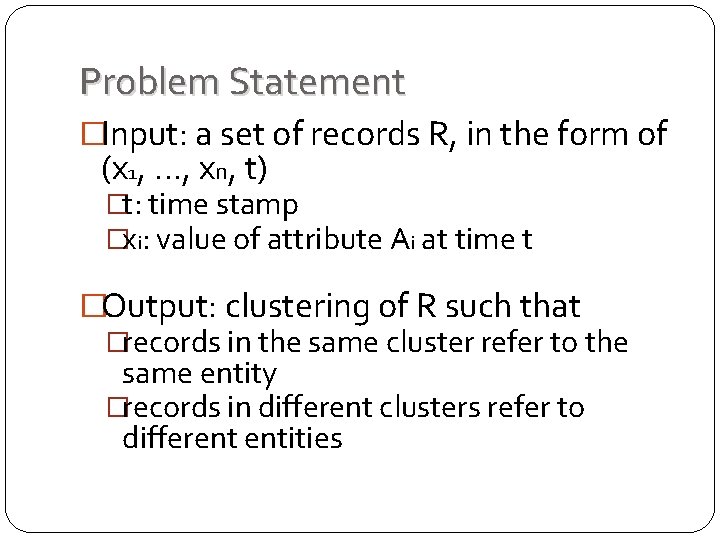
Problem Statement �Input: a set of records R, in the form of (x 1, …, xn, t) �t: time stamp �xi: value of attribute Ai at time t �Output: clustering of R such that �records in the same cluster refer to the same entity �records in different clusters refer to different entities
Outline �Motivation �Problem statement �Solution �Decay �Temporal clustering �Experimental evaluation �Conclusions
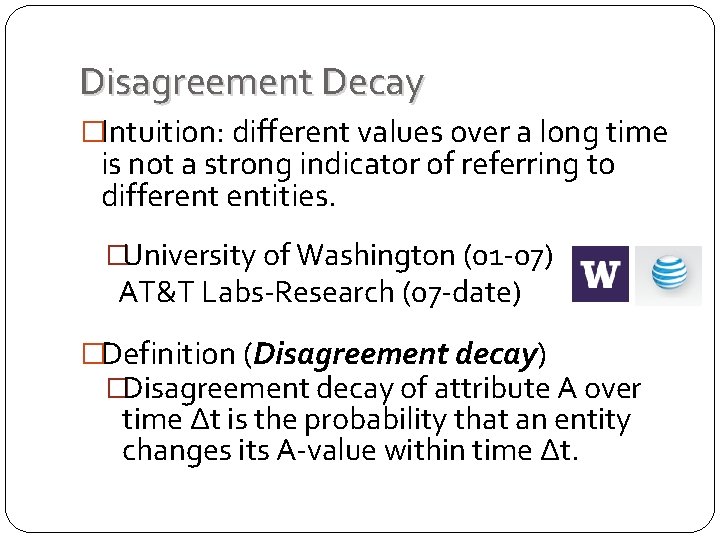
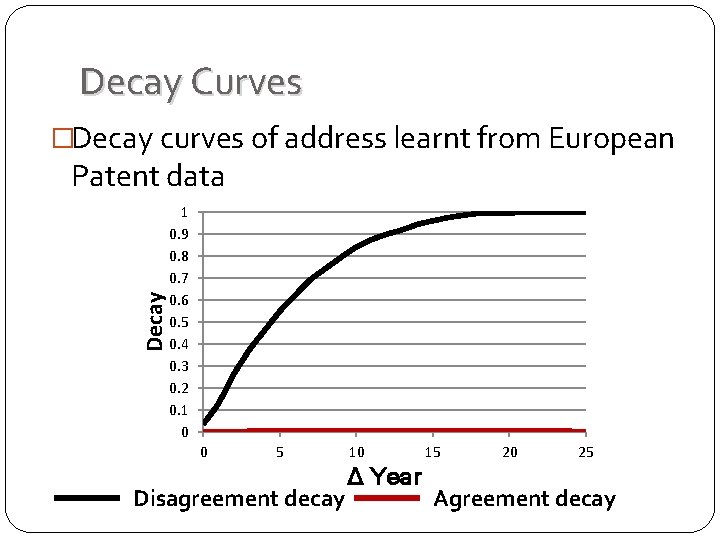
Disagreement Decay �Intuition: different values over a long time is not a strong indicator of referring to different entities. �University of Washington (01 -07) AT&T Labs-Research (07 -date) �Definition (Disagreement decay) �Disagreement decay of attribute A over time ∆t is the probability that an entity changes its A-value within time ∆t.
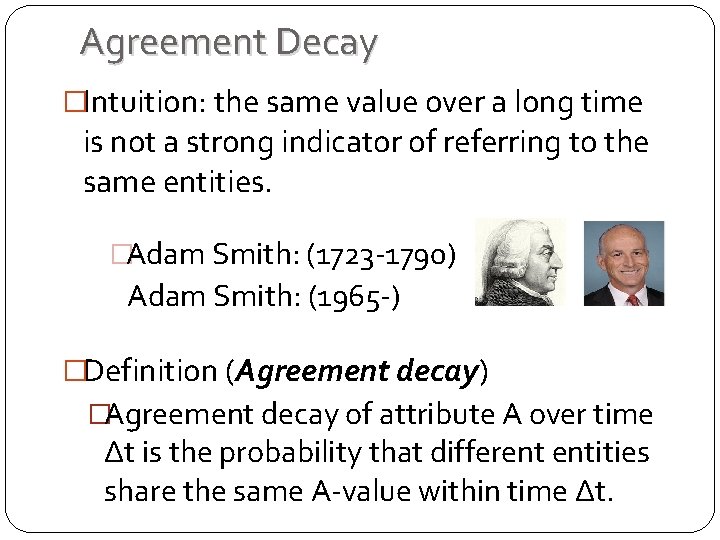
Agreement Decay �Intuition: the same value over a long time is not a strong indicator of referring to the same entities. �Adam Smith: (1723 -1790) Adam Smith: (1965 -) �Definition (Agreement decay) �Agreement decay of attribute A over time ∆t is the probability that different entities share the same A-value within time ∆t.
Decay Curves �Decay curves of address learnt from European Decay Patent data 1 0. 9 0. 8 0. 7 0. 6 0. 5 0. 4 0. 3 0. 2 0. 1 0 0 5 Disagreement decay 10 ∆ Year 15 20 25 Agreement decay
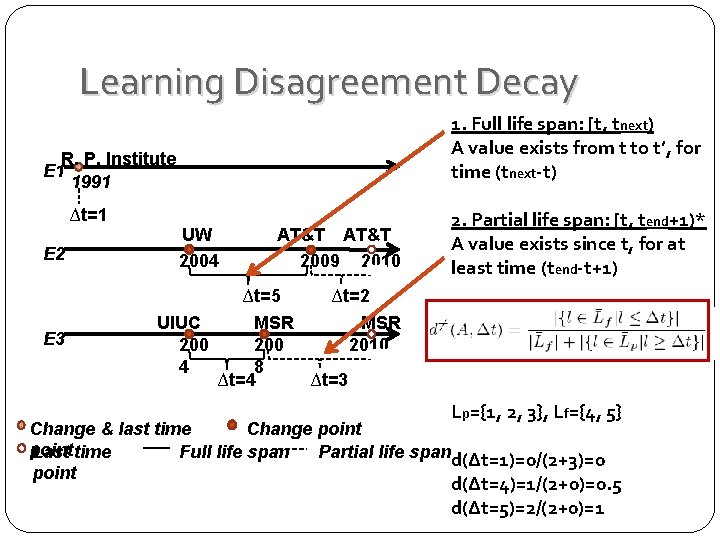
Learning Disagreement Decay 1. Full life span: [t, tnext) A value exists from t to t’, for time (tnext-t) R. P. Institute E 1 1991 ∆t=1 E 2 E 3 UW 2004 AT&T 2009 2010 2. Partial life span: [t, tend+1)* A value exists since t, for at least time (tend-t+1) ∆t=2 ∆t=5 UIUC MSR 200 2010 4 8 ∆t=4 ∆t=3 Lp={1, 2, 3}, Lf={4, 5} Change & last time Change point Last time Full life span Partial life spand(∆t=1)=0/(2+3)=0 point d(∆t=4)=1/(2+0)=0. 5 d(∆t=5)=2/(2+0)=1
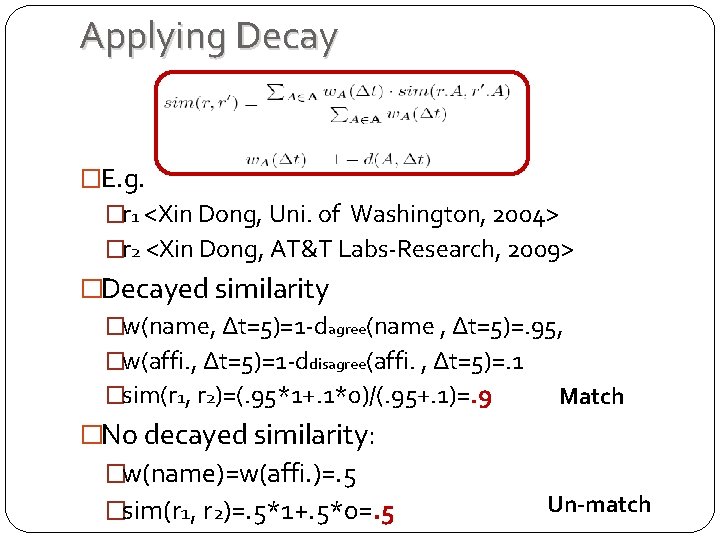
Applying Decay �E. g. �r 1 <Xin Dong, Uni. of Washington, 2004> �r 2 <Xin Dong, AT&T Labs-Research, 2009> �Decayed similarity �w(name, ∆t=5)=1 -dagree(name , ∆t=5)=. 95, �w(affi. , ∆t=5)=1 -ddisagree(affi. , ∆t=5)=. 1 �sim(r 1, r 2)=(. 95*1+. 1*0)/(. 95+. 1)=. 9 Match �No decayed similarity: �w(name)=w(affi. )=. 5 �sim(r 1, r 2)=. 5*1+. 5*0=. 5 Un-match
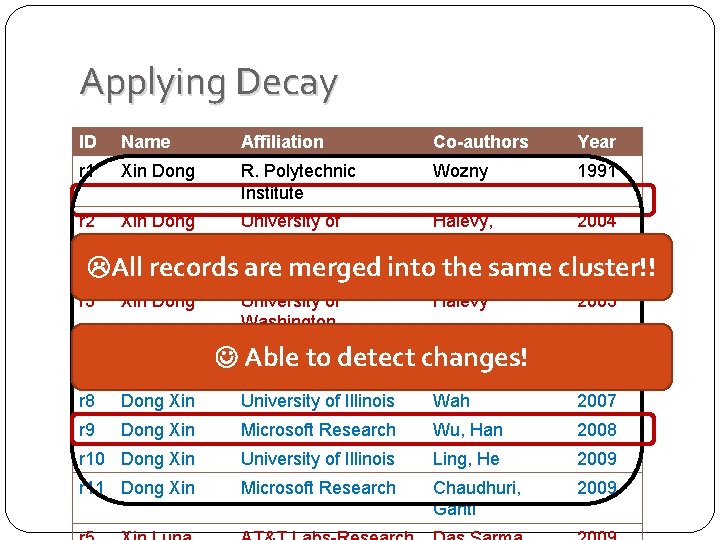
Applying Decay ID Name Affiliation Co-authors Year r 1 Xin Dong R. Polytechnic Institute Wozny 1991 r 2 Xin Dong University of Washington Halevy, Tatarinov 2004 University of Washington Halevy records are merged the. Wah same r 7 All Dong Xin University of Illinoisinto. Han, cluster!! 2004 r 3 Xin Dong r 4 Xin Luna Dong r 8 Dong Xin University of Illinois Wah 2007 r 9 Dong Xin Microsoft Research Wu, Han 2008 r 10 Dong Xin University of Illinois Ling, He 2009 r 11 Dong Xin Microsoft Research Chaudhuri, Ganti 2009 of Halevy, Yu University Able to detect changes! Washington 2005 2007
Outline �Motivation & intuitions �Problem statement �Solution �Decay �Temporal clustering �Experimental evaluation �Conclusions
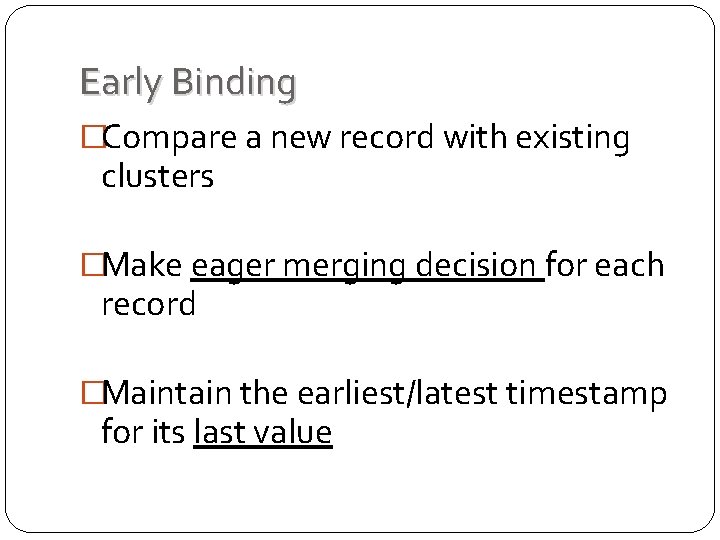
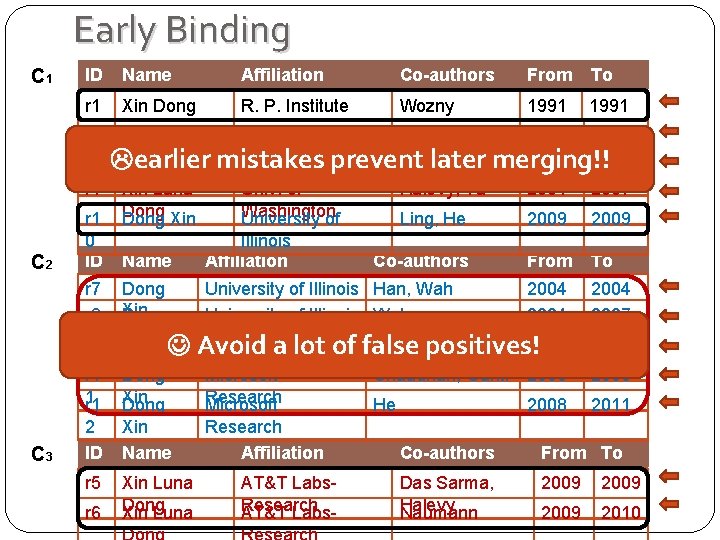
Early Binding �Compare a new record with existing clusters �Make eager merging decision for each record �Maintain the earliest/latest timestamp for its last value
Early Binding C 1 C 2 ID Name Affiliation Co-authors From To r 1 Xin Dong R. P. Institute Wozny 1991 r 2 r 3 Xin Dong earlier r 4 Xin Luna Dong Xin r 1 0 ID r 7 r 8 C 3 Washington University of Illinois Affiliation Ling, He 2009 Co-authors From To 2004 2007 Microsofta lot of false Wu, Han Avoid positives!2008 Name r 9 Dong Xin Dong r 1 1 r 1 Xin Dong 2 ID Xin Name r 5 Xin Luna Dong Xin Luna r 6 Univ. of Halevy, 2004 Washington Tatarinov Univ. of Halevy 2004 2005 mistakes prevent later merging!! Washington Univ. of Halevy, Yu 2004 2007 University of Illinois Han, Wah University of Illinois Wah Research Microsoft Research Affiliation AT&T Labs. Research AT&T Labs- Chaudhuri, Ganti 2008 2009 He 2008 2011 Co-authors From To Das Sarma, Halevy Naumann 2009 2010
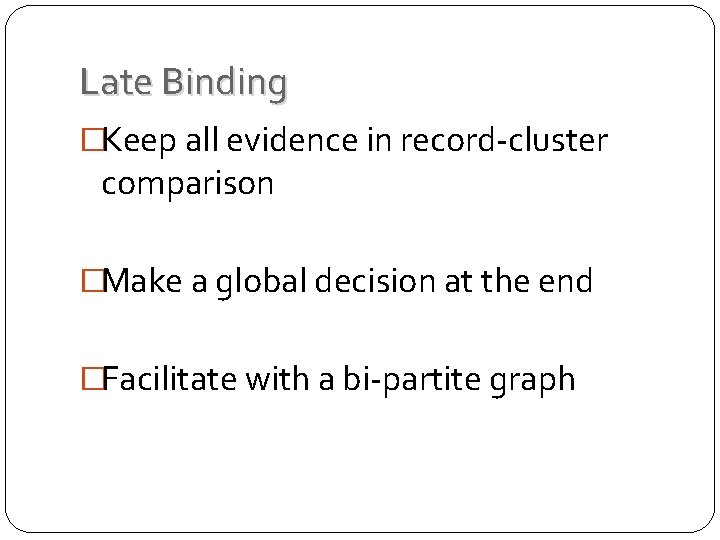
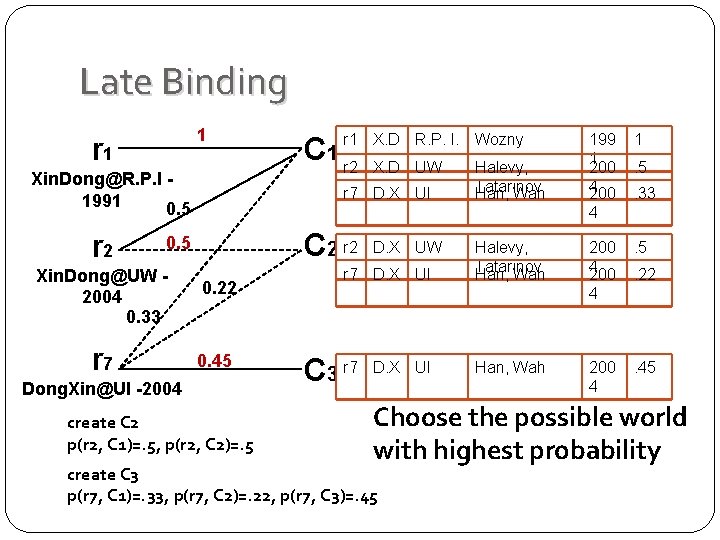
Late Binding �Keep all evidence in record-cluster comparison �Make a global decision at the end �Facilitate with a bi-partite graph
Late Binding 1 r 1 Xin. Dong@R. P. I 1991 0. 5 r 2 r 1 X. D R. P. I. Wozny C 1 r 2 X. D UW r 7 D. X UI Halevy, Tatarinov Han, Wah 199 1 200 4 200 1. 5. 33 4 C 2 r 2 0. 5 Xin. Dong@UW 2004 0. 33 0. 22 r 7 0. 45 Dong. Xin@UI -2004 create C 2 p(r 2, C 1)=. 5, p(r 2, C 2)=. 5 D. X UW r 7 D. X UI Halevy, Tatarinov Han, Wah 200 4 200 . 5. 22 4 C 3 r 7 D. X UI Han, Wah 200 4 . 45 Choose the possible world with highest probability create C 3 p(r 7, C 1)=. 33, p(r 7, C 2)=. 22, p(r 7, C 3)=. 45
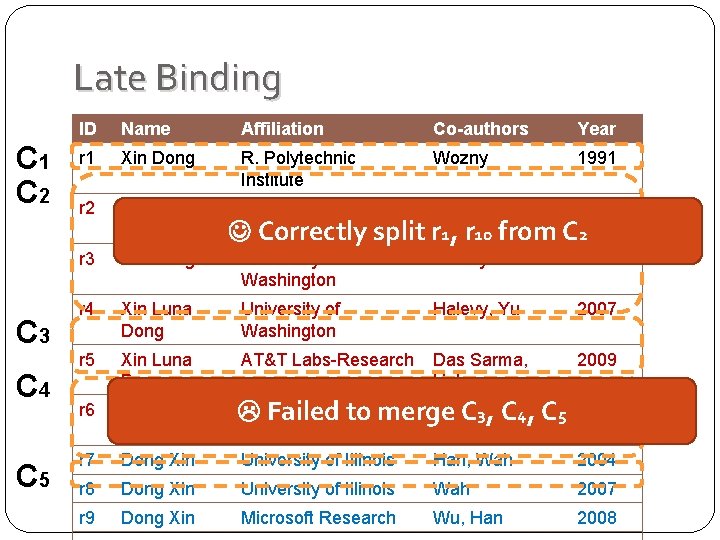
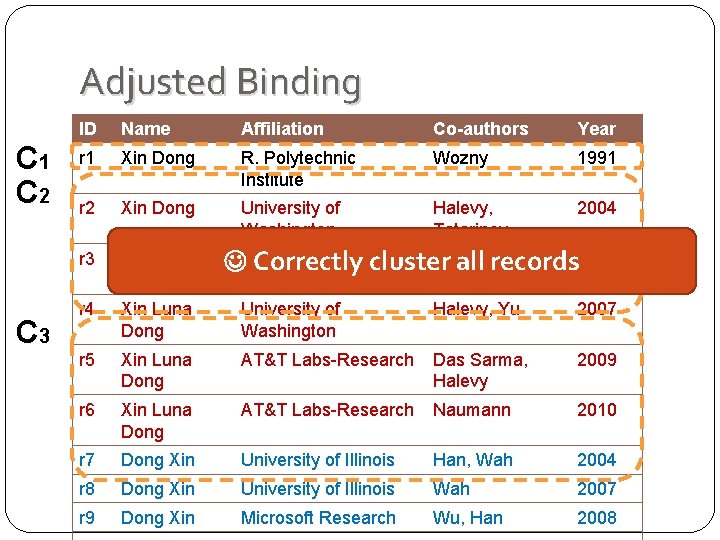
Late Binding C 1 C 2 C 3 C 4 C 5 ID Name Affiliation Co-authors Year r 1 Xin Dong R. Polytechnic Institute Wozny 1991 r 2 Xin Dong University of Washington Correctly r 3 Xin Dong University of Washington r 4 Xin Luna Dong University of Washington Halevy, Yu 2007 r 5 Xin Luna Dong AT&T Labs-Research Das Sarma, Halevy 2009 r 6 Xin Luna Dong AT&T Labs-Research Naumann Failed to merge C 3, C 4, C 5 2010 r 7 Dong Xin University of Illinois Han, Wah 2004 r 8 Dong Xin University of Illinois Wah 2007 r 9 Dong Xin Microsoft Research Wu, Han 2008 split Halevy, r. Tatarinov 1, r 10 from Halevy 2004 C 2 2005
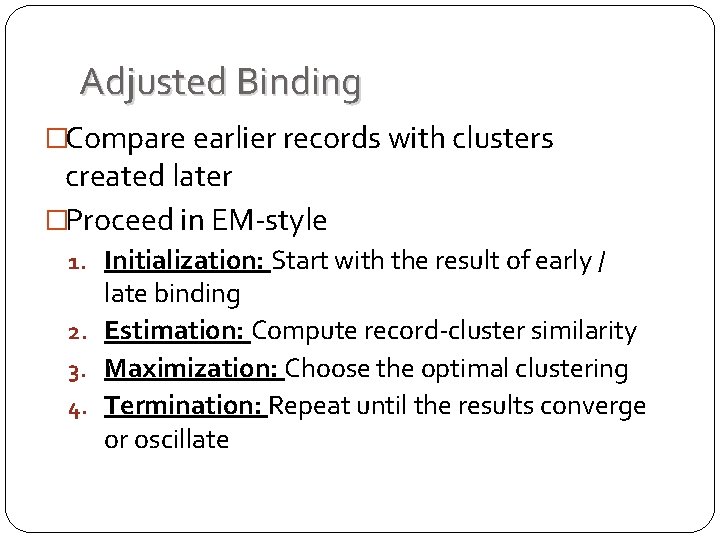
Adjusted Binding �Compare earlier records with clusters created later �Proceed in EM-style 1. Initialization: Start with the result of early / late binding 2. Estimation: Compute record-cluster similarity 3. Maximization: Choose the optimal clustering 4. Termination: Repeat until the results converge or oscillate
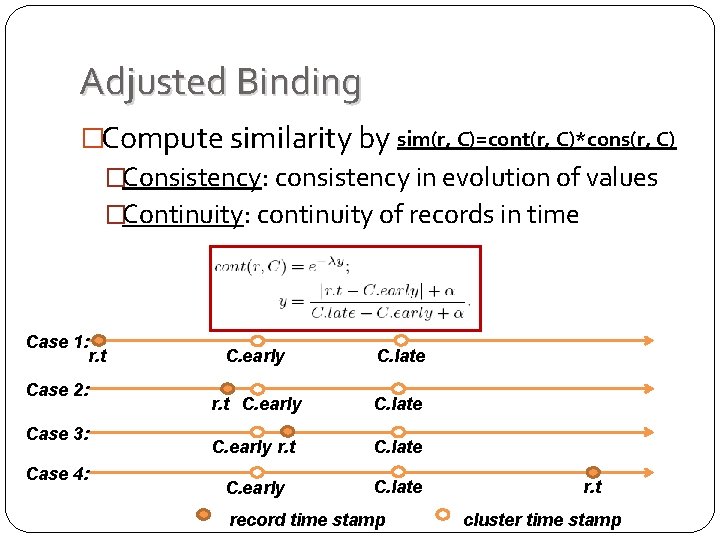
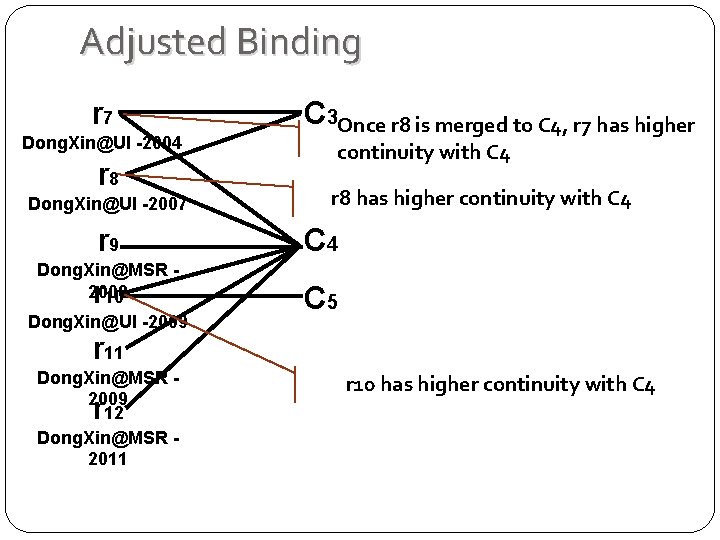
Adjusted Binding �Compute similarity by sim(r, C)=cont(r, C)*cons(r, C) �Consistency: consistency in evolution of values �Continuity: continuity of records in time Case 1: r. t Case 2: Case 3: Case 4: C. early C. late r. t C. early C. late C. early r. t C. late C. early C. late record time stamp r. t cluster time stamp
Adjusted Binding r 7 Dong. Xin@UI -2004 r 8 Dong. Xin@UI -2007 C 3 Once r 8 is merged to C 4, r 7 has higher continuity with C 4 r 8 has higher continuity with C 4 r 9 C 4 Dong. Xin@MSR 2008 10 Dong. Xin@UI -2009 C 5 r r 11 Dong. Xin@MSR 2009 12 Dong. Xin@MSR 2011 r r 10 has higher continuity with C 4
Adjusted Binding C 1 C 2 ID Name Affiliation Co-authors Year r 1 Xin Dong R. Polytechnic Institute Wozny 1991 r 2 Xin Dong University of Washington Halevy, Tatarinov 2004 r 3 Xin Dong of Halevy University Correctly cluster all records 2005 Washington C 3 r 4 Xin Luna Dong University of Washington Halevy, Yu 2007 r 5 Xin Luna Dong AT&T Labs-Research Das Sarma, Halevy 2009 r 6 Xin Luna Dong AT&T Labs-Research Naumann 2010 r 7 Dong Xin University of Illinois Han, Wah 2004 r 8 Dong Xin University of Illinois Wah 2007 r 9 Dong Xin Microsoft Research Wu, Han 2008
Outline �Motivation & intuitions �Problem statement �Solution �Decay �Temporal clustering �Experimental evaluation �Conclusions
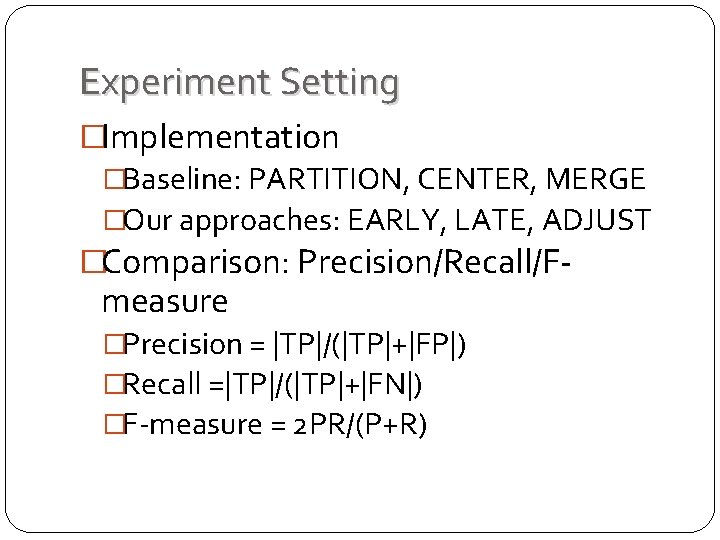
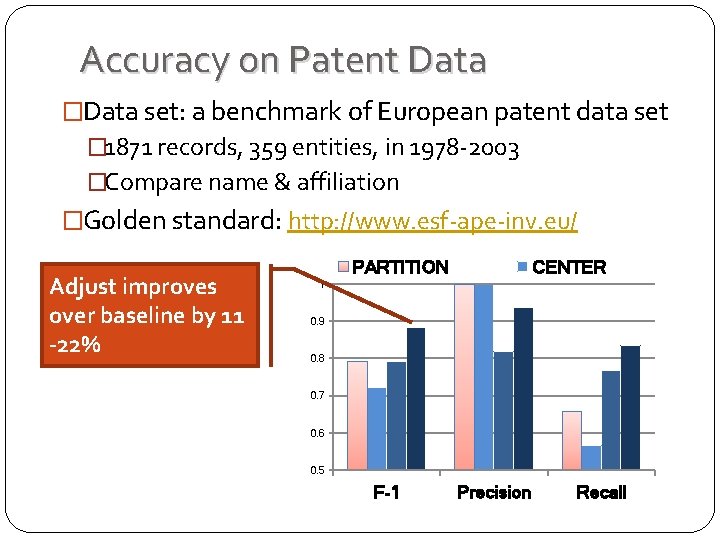
Experiment Setting �Implementation �Baseline: PARTITION, CENTER, MERGE �Our approaches: EARLY, LATE, ADJUST �Comparison: Precision/Recall/F- measure �Precision = |TP|/(|TP|+|FP|) �Recall =|TP|/(|TP|+|FN|) �F-measure = 2 PR/(P+R)
Accuracy on Patent Data �Data set: a benchmark of European patent data set � 1871 records, 359 entities, in 1978 -2003 �Compare name & affiliation �Golden standard: http: //www. esf-ape-inv. eu/ Adjust improves over baseline by 11 -22% PARTITION CENTER 1 0. 9 0. 8 0. 7 0. 6 0. 5 F-1 Precision Recall
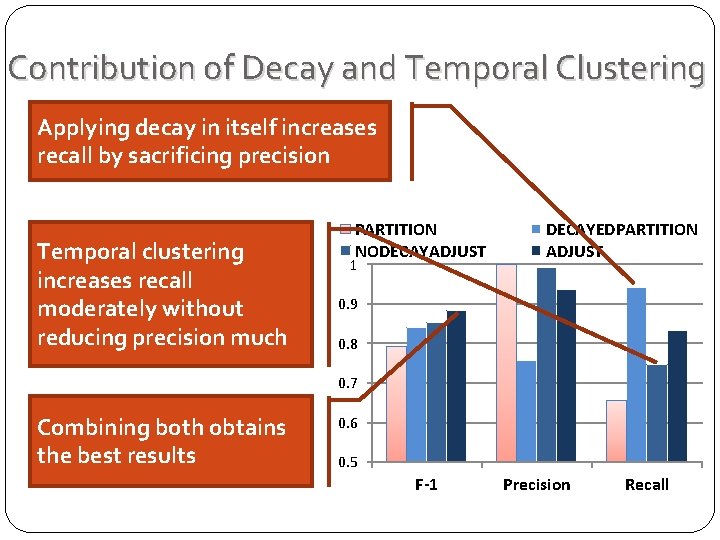
Contribution of Decay and Temporal Clustering Applying decay in itself increases recall by sacrificing precision Temporal clustering increases recall moderately without reducing precision much PARTITION NODECAYADJUST 1 DECAYEDPARTITION ADJUST 0. 9 0. 8 0. 7 Combining both obtains the best results 0. 6 0. 5 F-1 Precision Recall
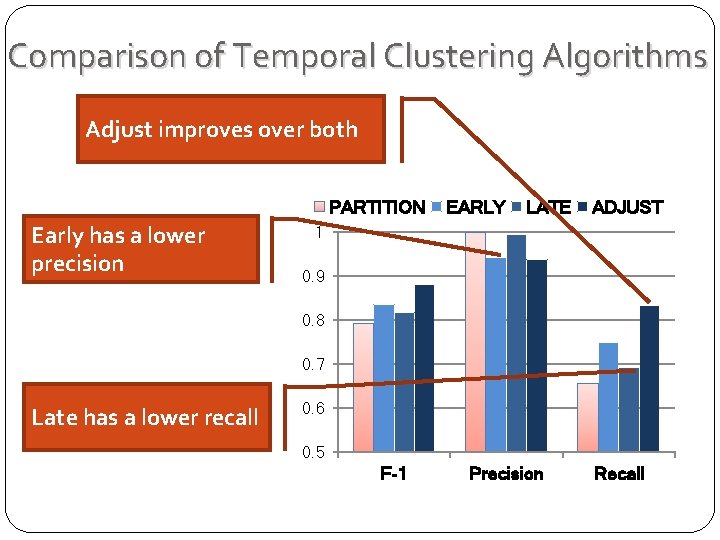
Comparison of Temporal Clustering Algorithms Adjust improves over both PARTITION Early has a lower precision EARLY LATE ADJUST 1 0. 9 0. 8 0. 7 Late has a lower recall 0. 6 0. 5 F-1 Precision Recall
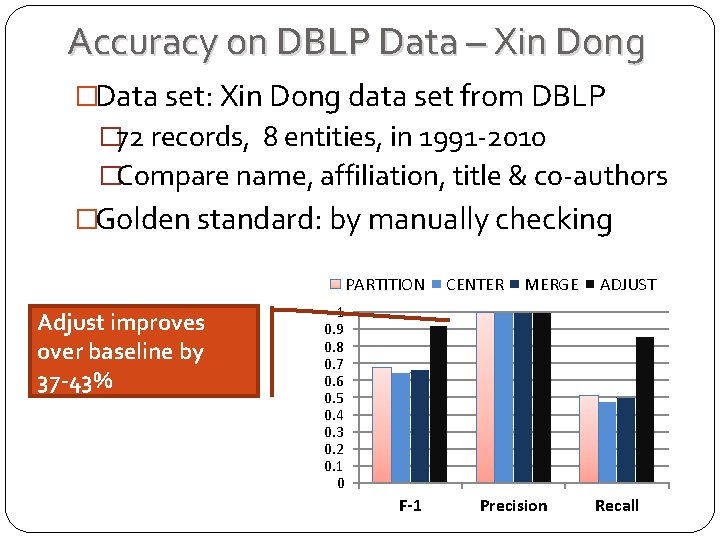
Accuracy on DBLP Data – Xin Dong �Data set: Xin Dong data set from DBLP � 72 records, 8 entities, in 1991 -2010 �Compare name, affiliation, title & co-authors �Golden standard: by manually checking PARTITION Adjust improves over baseline by 37 -43% CENTER MERGE ADJUST 1 0. 9 0. 8 0. 7 0. 6 0. 5 0. 4 0. 3 0. 2 0. 1 0 F-1 Precision Recall
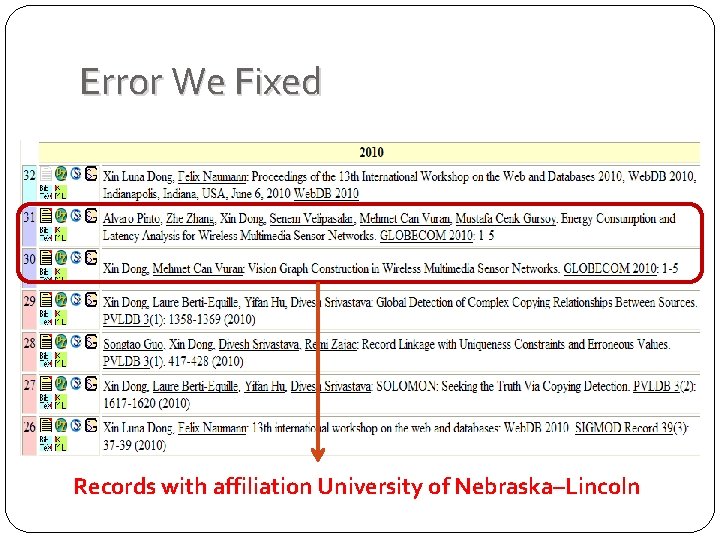
Error We Fixed Records with affiliation University of Nebraska–Lincoln
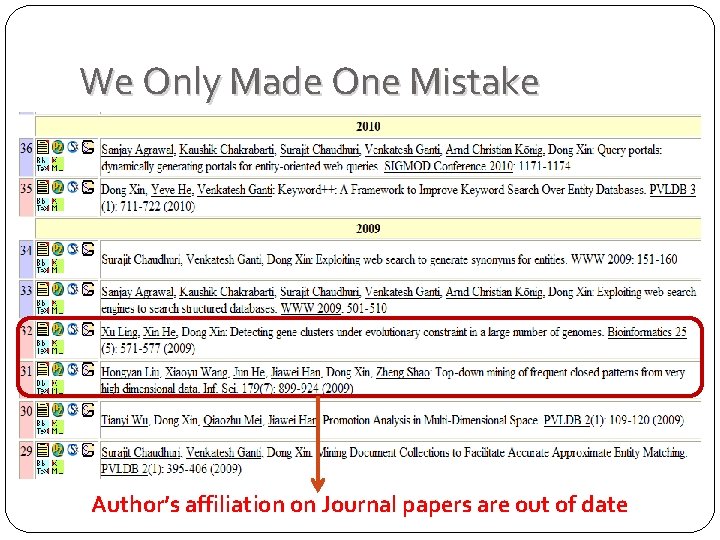
We Only Made One Mistake Author’s affiliation on Journal papers are out of date
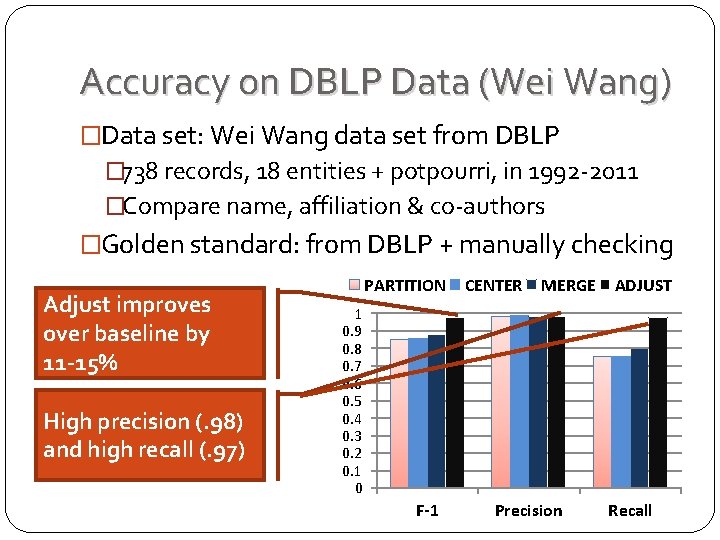
Accuracy on DBLP Data (Wei Wang) �Data set: Wei Wang data set from DBLP � 738 records, 18 entities + potpourri, in 1992 -2011 �Compare name, affiliation & co-authors �Golden standard: from DBLP + manually checking Adjust improves over baseline by 11 -15% High precision (. 98) and high recall (. 97) PARTITION CENTER MERGE ADJUST 1 0. 9 0. 8 0. 7 0. 6 0. 5 0. 4 0. 3 0. 2 0. 1 0 F-1 Precision Recall
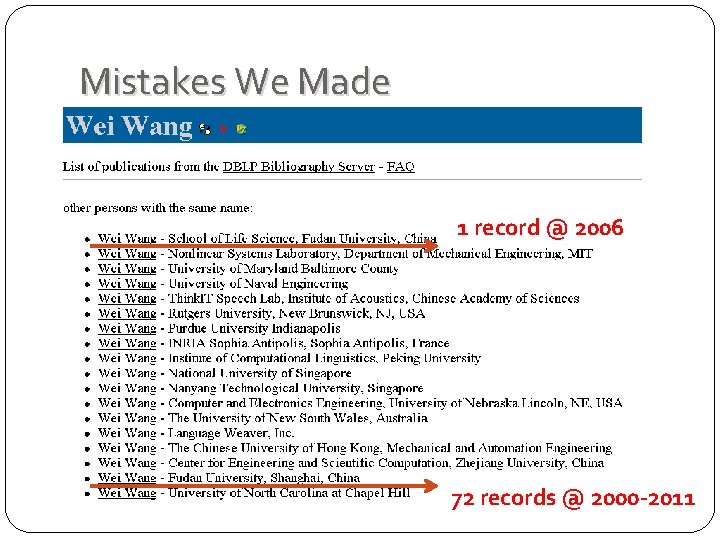
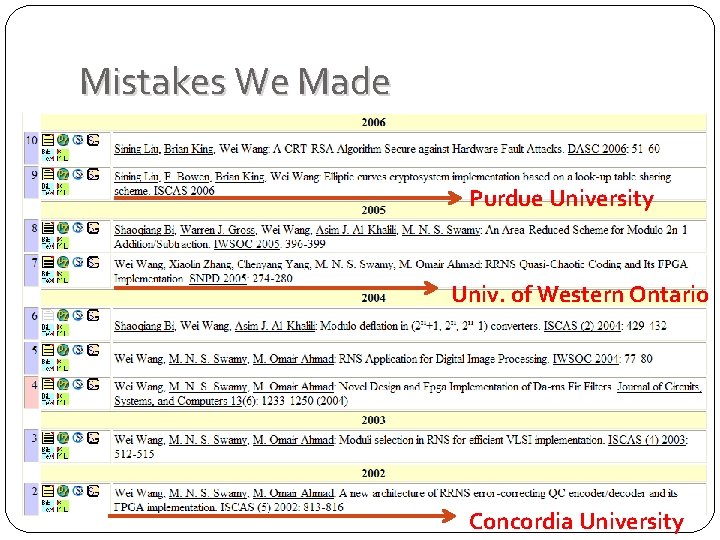
Mistakes We Made 1 record @ 2006 72 records @ 2000 -2011
Mistakes We Made Purdue University Univ. of Western Ontario Concordia University
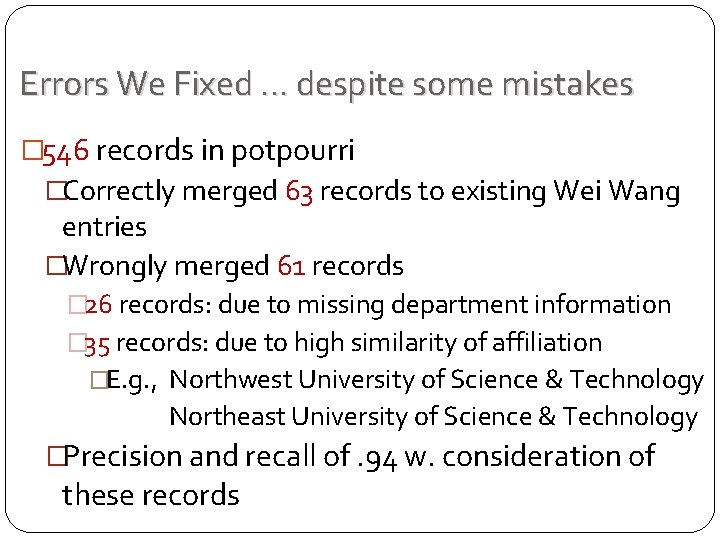
Errors We Fixed … despite some mistakes � 546 records in potpourri �Correctly merged 63 records to existing Wei Wang entries �Wrongly merged 61 records � 26 records: due to missing department information � 35 records: due to high similarity of affiliation �E. g. , Northwest University of Science & Technology Northeast University of Science & Technology �Precision and recall of. 94 w. consideration of these records
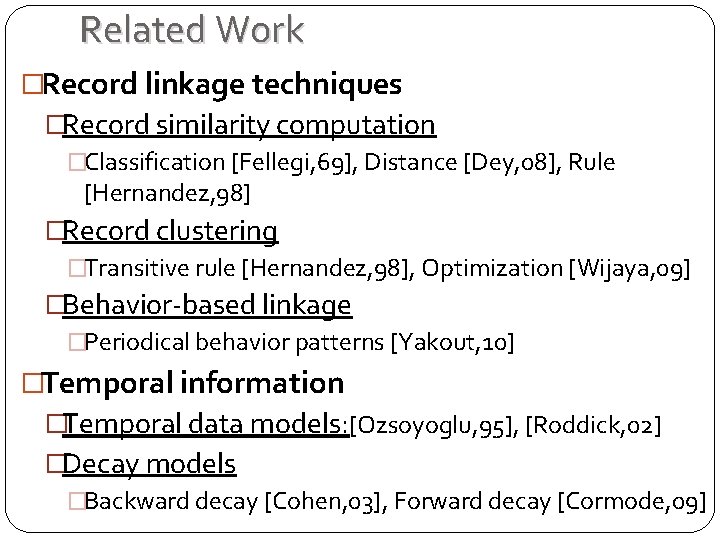
Related Work �Record linkage techniques �Record similarity computation �Classification [Fellegi, 69], Distance [Dey, 08], Rule [Hernandez, 98] �Record clustering �Transitive rule [Hernandez, 98], Optimization [Wijaya, 09] �Behavior-based linkage �Periodical behavior patterns [Yakout, 10] �Temporal information �Temporal data models: [Ozsoyoglu, 95], [Roddick, 02] �Decay models �Backward decay [Cohen, 03], Forward decay [Cormode, 09]
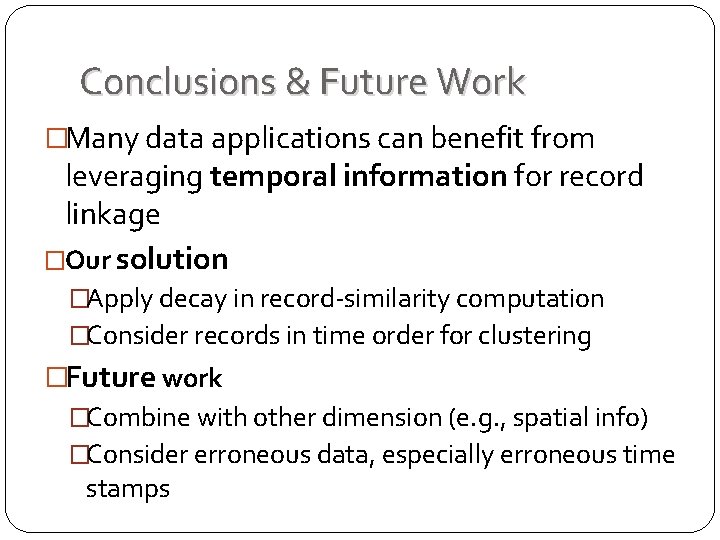
Conclusions & Future Work �Many data applications can benefit from leveraging temporal information for record linkage �Our solution �Apply decay in record-similarity computation �Consider records in time order for clustering �Future work �Combine with other dimension (e. g. , spatial info) �Consider erroneous data, especially erroneous time stamps
Thanks! Questions?