Ling 411 16 Language and Perception Language and


- Slides: 54
Ling 411 – 16 Language and Perception
Language and Perception: 3 Topics § The representation of phonological information needed for perception of syllables § Phonological recognition vs phonological perception § Influence of language on non-linguistic perception
Language and Perception: Topics § The representation of phonological information needed for perception of syllables § Phonological recognition vs phonological perception § Influence of language on non-linguistic perception
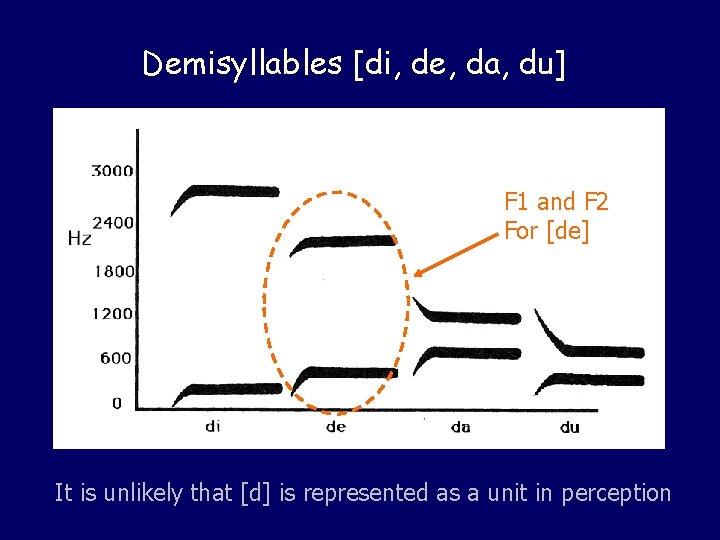
Demisyllables [di, de, da, du] F 1 and F 2 For [de] It is unlikely that [d] is represented as a unit in perception
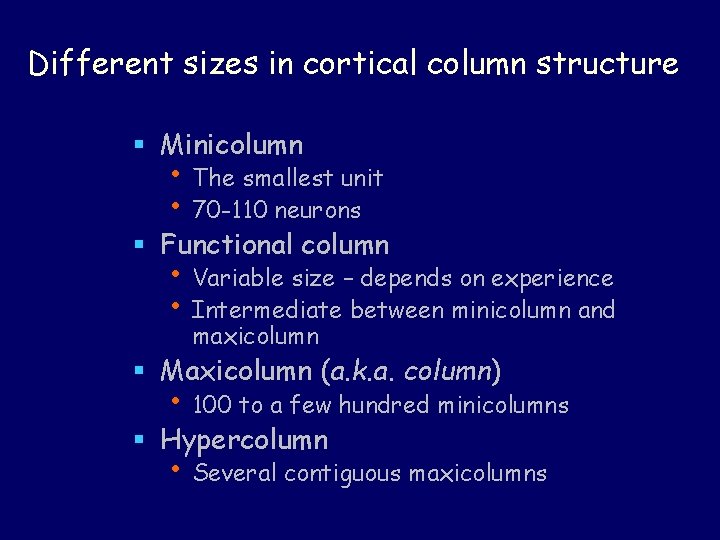
Different sizes in cortical column structure § Minicolumn • The smallest unit • 70 -110 neurons § Functional column • Variable size – depends on experience • Intermediate between minicolumn and maxicolumn § Maxicolumn (a. k. a. column) • 100 to a few hundred minicolumns § Hypercolumn • Several contiguous maxicolumns
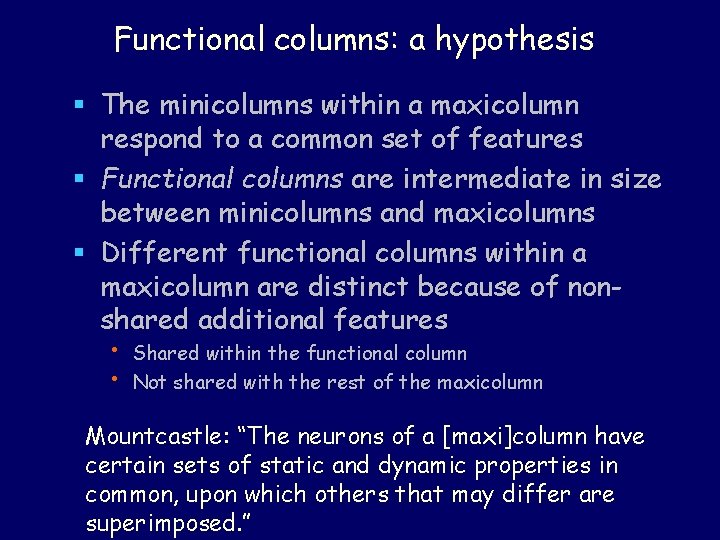
Functional columns: a hypothesis § The minicolumns within a maxicolumn respond to a common set of features § Functional columns are intermediate in size between minicolumns and maxicolumns § Different functional columns within a maxicolumn are distinct because of nonshared additional features • Shared within the functional column • Not shared with the rest of the maxicolumn Mountcastle: “The neurons of a [maxi]column have certain sets of static and dynamic properties in common, upon which others that may differ are superimposed. ”
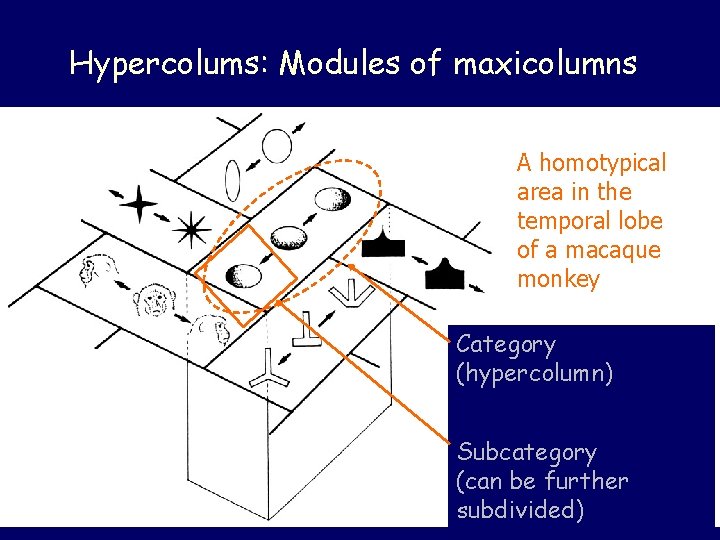
Similarly. . § Neurons of a hypercolumn may have similar response features, upon which others that differ may be superimposed § Result is maxicolumns in the hypercolumn sharing certain basic features while differing with respect to others § Such maxicolumns may be further subdivided into functional columns on the basis of additional features § That is, this columnar structure is representing categories and subcategories
Hypercolums: Modules of maxicolumns A homotypical area in the temporal lobe of a macaque monkey Category (hypercolumn) Subcategory (can be further subdivided)
Perceptual subcategories and columnar subdivisions of larger columns § Nodal specificity applies for maxicolumns as well as for minicolumns § The adjacency hypothesis likewise applies to larger categories and columns • Adjacency applies for adjacent maxicolumns § Subcategories of a category have similar function • Therefore their cardinal nodes should be in adjacent locations
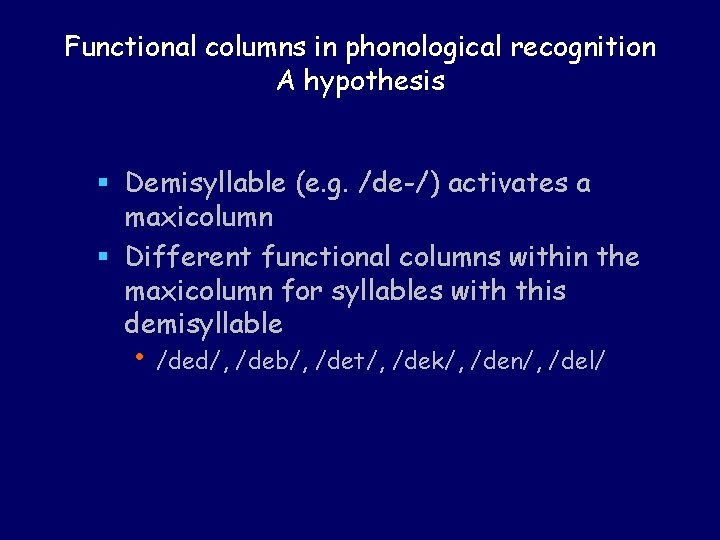
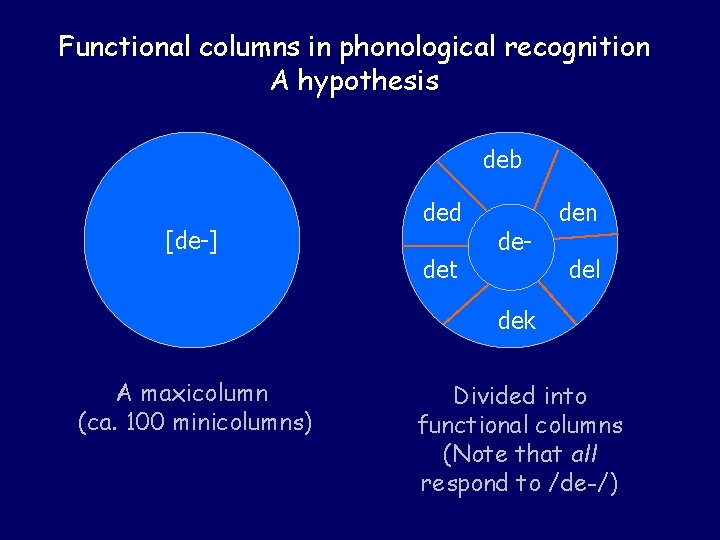
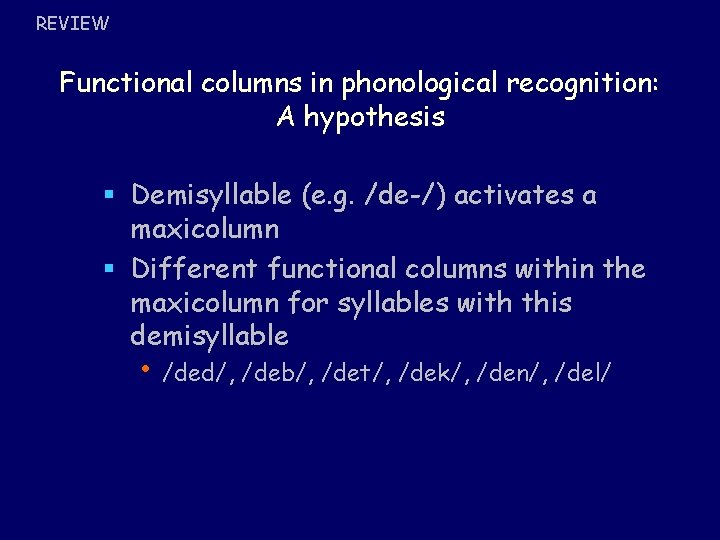
Functional columns in phonological recognition A hypothesis § Demisyllable (e. g. /de-/) activates a maxicolumn § Different functional columns within the maxicolumn for syllables with this demisyllable • /ded/, /deb/, /det/, /dek/, /den/, /del/
Functional columns in phonological recognition A hypothesis deb [de-] ded det de- den del dek A maxicolumn (ca. 100 minicolumns) Divided into functional columns (Note that all respond to /de-/)
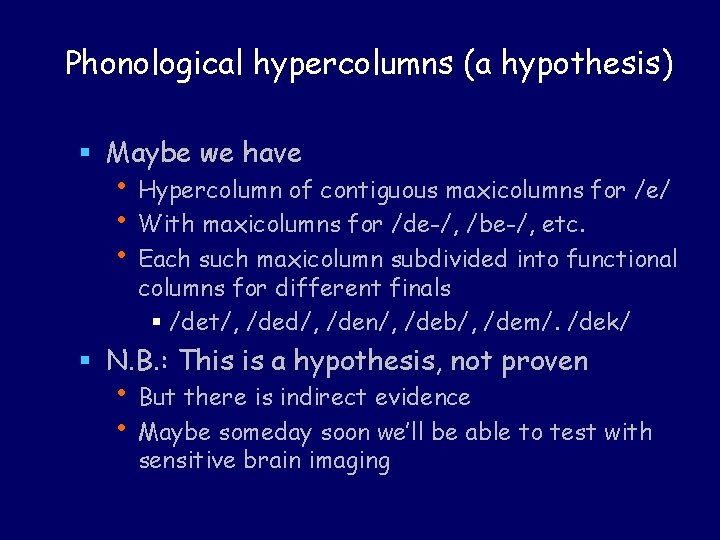
Phonological hypercolumns (a hypothesis) § Maybe we have • Hypercolumn of contiguous maxicolumns for /e/ • With maxicolumns for /de-/, /be-/, etc. • Each such maxicolumn subdivided into functional columns for different finals § /det/, /ded/, /den/, /deb/, /dem/. /dek/ § N. B. : This is a hypothesis, not proven • But there is indirect evidence • Maybe someday soon we’ll be able to test with sensitive brain imaging
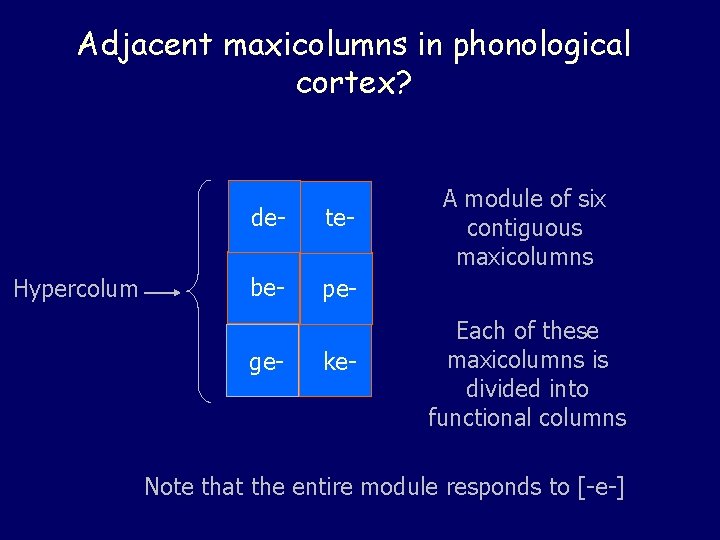
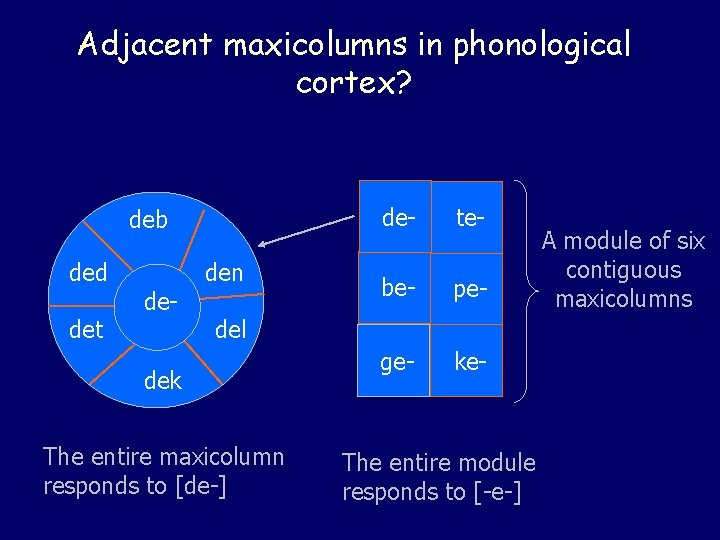
Adjacent maxicolumns in phonological cortex? Hypercolum de- te- be- pe- ge- ke- A module of six contiguous maxicolumns Each of these maxicolumns is divided into functional columns Note that the entire module responds to [-e-]
Adjacent maxicolumns in phonological cortex? deb ded det de- den de- te- be- pe- ge- ke- del dek The entire maxicolumn responds to [de-] The entire module responds to [-e-] A module of six contiguous maxicolumns
REVIEW Functional columns in phonological recognition: A hypothesis § Demisyllable (e. g. /de-/) activates a maxicolumn § Different functional columns within the maxicolumn for syllables with this demisyllable • /ded/, /deb/, /det/, /dek/, /den/, /del/
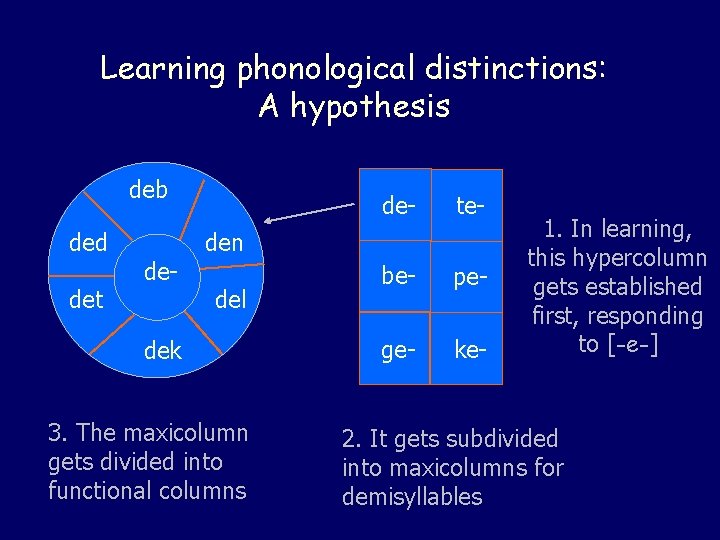
Learning phonological distinctions: A hypothesis deb ded det de- te- be- pe- ge- ke- den del dek 3. The maxicolumn gets divided into functional columns 1. In learning, this hypercolumn gets established first, responding to [-e-] 2. It gets subdivided into maxicolumns for demisyllables
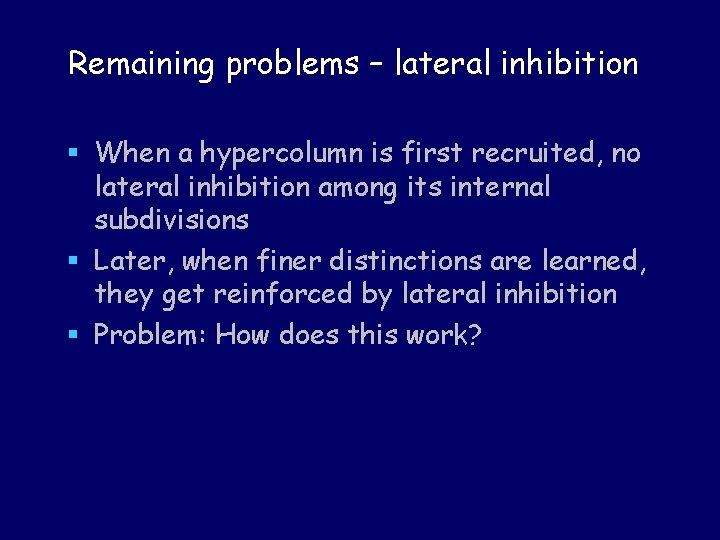
Remaining problems – lateral inhibition § When a hypercolumn is first recruited, no lateral inhibition among its internal subdivisions § Later, when finer distinctions are learned, they get reinforced by lateral inhibition § Problem: How does this work?
Indirect evidence for the hypothesis § Fits the structural organization demonstrated in monkey vision § Cortical structure and function have a high degree of uniformity § MEG is able to pick up different locations in Wernicke’s area for different vowels • MEG can only detect activity of at least 10, 000 contiguous apical dendrites (Papanicolaou) § Requires perhaps at least 250 adjacent minicolumns § The size of a maxicolumn or hypercolumn
Language and Perception: Topics § The representation of phonological information needed for perception of syllables § Phonological recognition vs phonological perception § Influence of language on non-linguistic perception
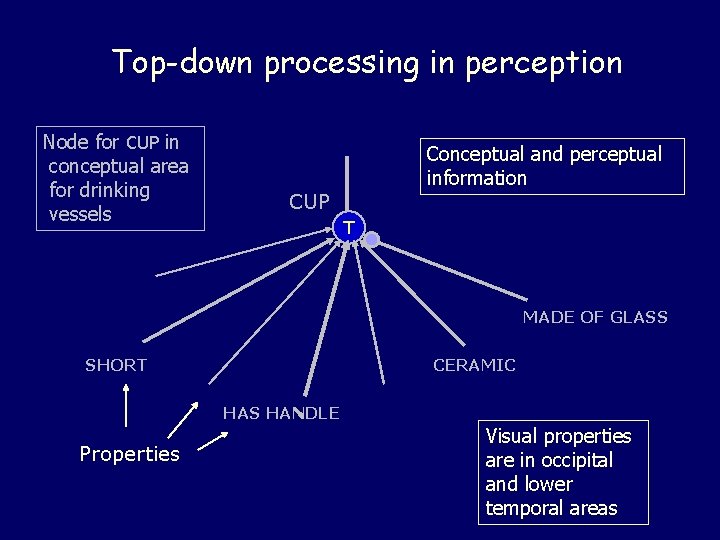
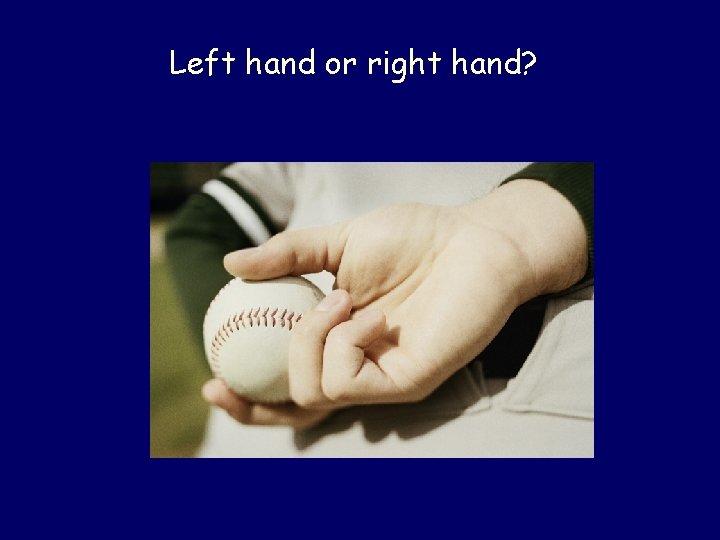
Perception – Refining a simple-minded view 1. Not just bottom-up • Top-down processing fills in unsensed details 2. Not confined to a single perceptual modality • The Mc. Gurk effect Visual input affects auditory perception Conceptual structure affects auditory perception § • 3. Not even confined to posterior cortex • Can also use motor neurons § § Experiment: left hand or right hand? Mirror neurons
Perception – Refining a simple-minded view 1. Not just bottom-up • Top-down processing fills in unsensed details 2. Not confined to a single perceptual modality • The Mc. Gurk effect Visual input affects auditory perception Conceptual structure affects auditory perception § • 3. Not even confined to posterior cortex • Can also use motor neurons § § Experiment: left hand or right hand? Mirror neurons
Top-down processing in perception Node for CUP in conceptual area for drinking vessels Conceptual and perceptual information CUP T MADE OF GLASS SHORT CERAMIC HAS HANDLE Properties Visual properties are in occipital and lower temporal areas
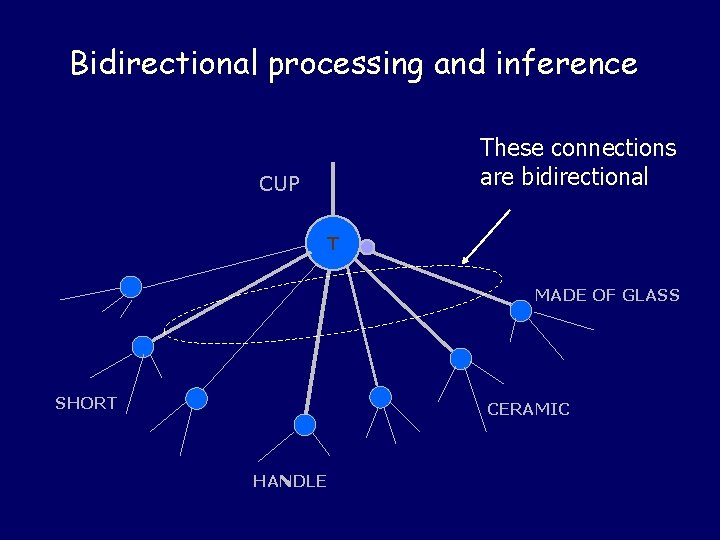
Bidirectional processing and inference These connections are bidirectional CUP T MADE OF GLASS SHORT CERAMIC HANDLE
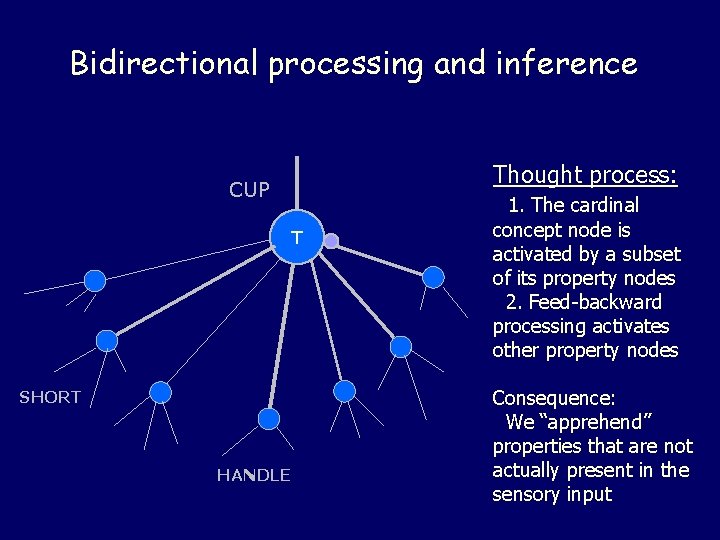
Bidirectional processing and inference Thought process: CUP T SHORT HANDLE 1. The cardinal concept node is activated by a subset of its property nodes 2. Feed-backward processing activates other property nodes Consequence: We “apprehend” properties that are not actually present in the sensory input
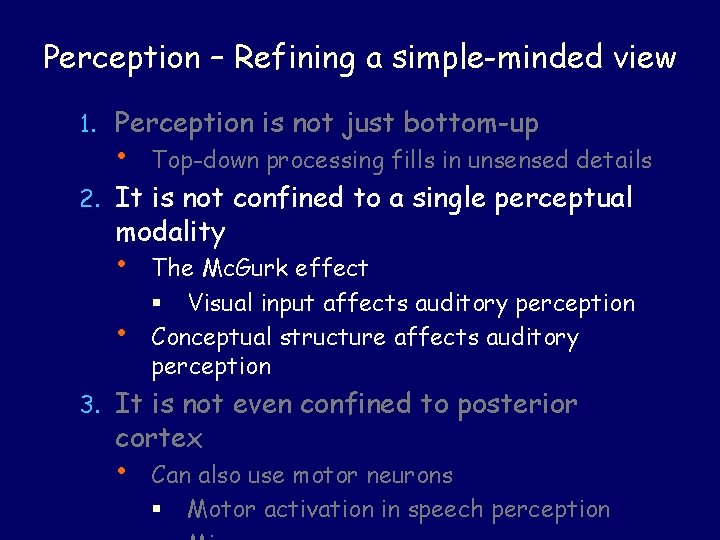
Perception – Refining a simple-minded view 1. Perception is not just bottom-up • Top-down processing fills in unsensed details 2. It is not confined to a single perceptual modality • • The Mc. Gurk effect § Visual input affects auditory perception Conceptual structure affects auditory perception 3. It is not even confined to posterior cortex • Can also use motor neurons § Motor activation in speech perception
The Mc. Gurk Effect http: //www. youtube. com/watch? v=a. FPtc 8 BVd. Jk § Acoustic syllable [ba] presented to subjects § with visual presentation of articulatory gestures for [ga] § Subjects typically heard [da] or [ga] § “Evidence has accumulated that visual speech modifies activity in the auditory cortex, even in the primary auditory cortex. ” Mikko Sams (2006)
Perception depends mainly on cortical structures already present before sensory input “Perception is hallucination constrained by sensory data” Shepherd
Perception – Refining a simple-minded view 1. Not just bottom-up • Top-down processing fills in unsensed details 2. Not confined to a single perceptual modality • The Mc. Gurk effect Visual input affects auditory perception Conceptual structure affects auditory perception § • 3. Not even confined to posterior cortex • Can also use motor neurons § § Experiment: left hand or right hand? Mirror neurons
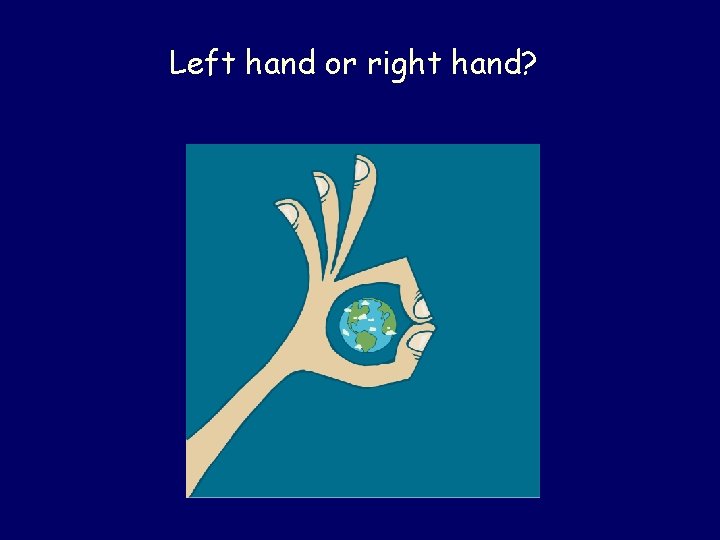
Left hand or right hand?
Left hand or right hand?
Left hand or right hand?
Left hand or right hand?
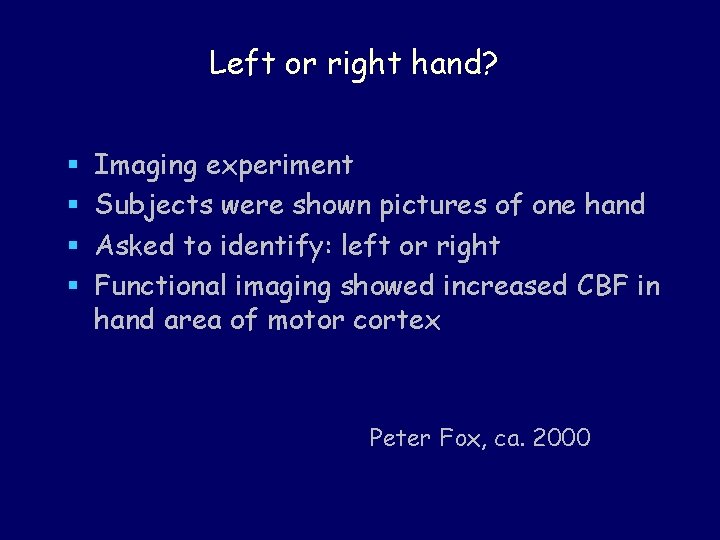
Left or right hand? § § Imaging experiment Subjects were shown pictures of one hand Asked to identify: left or right Functional imaging showed increased CBF in hand area of motor cortex Peter Fox, ca. 2000
Motor structures in perception § The left-hand vs. right-hand experiment § ‘Mirror neurons’ in motor cortex § Articulation as aid to phonological perception § Articulation in reading § Motor activity in listening to music § Watching an athletic event
Mirror Neurons § NY Times: “One mystery remains: What makes them so smart? ” (Jan. 10, 2006) § Answer: They are not smart in themselves • Their apparent smartness is a result of their • position: at top of a hierarchy Compare: § The general of an army § The head of a business § Similarly, high-level conceptual nodes • The “grandmother node”
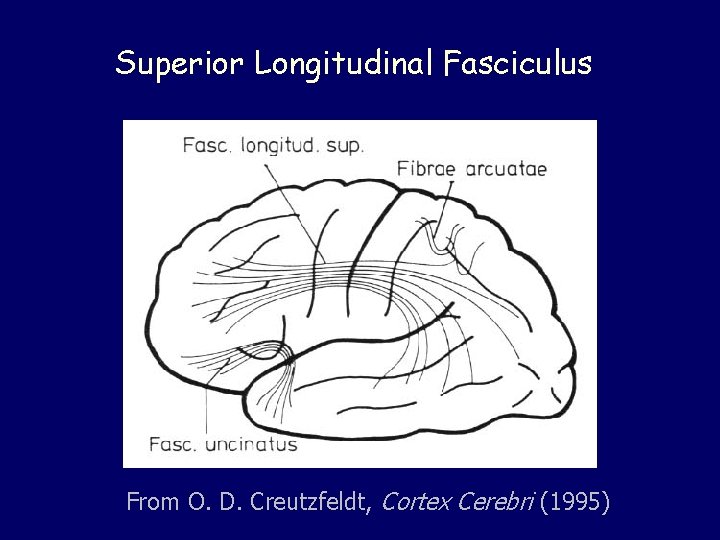
Mirror Neurons § What makes mirror neurons appear to be special? • Ans. : They receive input from visual perception • The superior longitudinal fasciculus § Connects visual perception to motor areas § How can a motor neuron receive perceptual input? • Motor neurons are supposed to operate top • down Answer: bidirectional processing § They also receive perceptual information • Bottom-up processing
Superior Longitudinal Fasciculus From O. D. Creutzfeldt, Cortex Cerebri (1995)
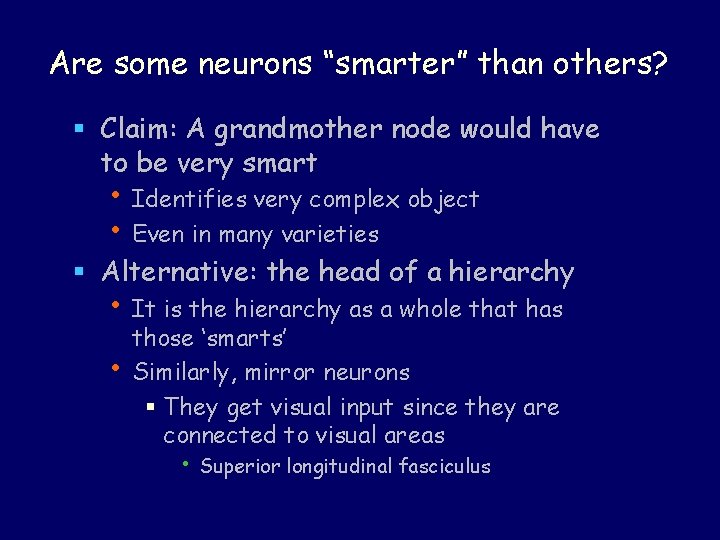
Are some neurons “smarter” than others? § Claim: A grandmother node would have to be very smart • Identifies very complex object • Even in many varieties § Alternative: the head of a hierarchy • It is the hierarchy as a whole that has • those ‘smarts’ Similarly, mirror neurons § They get visual input since they are connected to visual areas • Superior longitudinal fasciculus
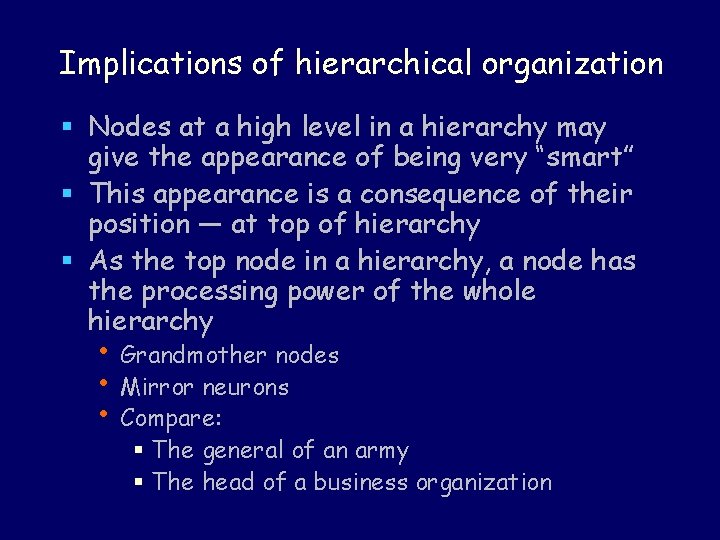
Implications of hierarchical organization § Nodes at a high level in a hierarchy may give the appearance of being very “smart” § This appearance is a consequence of their position — at top of hierarchy § As the top node in a hierarchy, a node has the processing power of the whole hierarchy • Grandmother nodes • Mirror neurons • Compare: § The general of an army § The head of a business organization
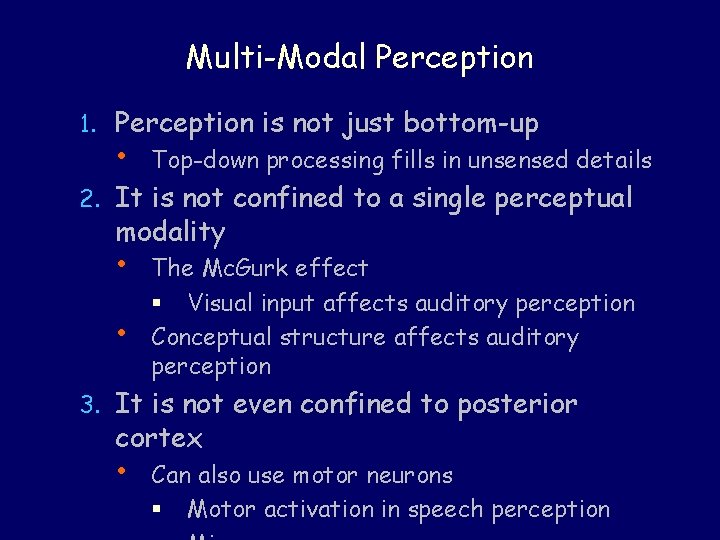
Multi-Modal Perception 1. Perception is not just bottom-up • Top-down processing fills in unsensed details 2. It is not confined to a single perceptual modality • • The Mc. Gurk effect § Visual input affects auditory perception Conceptual structure affects auditory perception 3. It is not even confined to posterior cortex • Can also use motor neurons § Motor activation in speech perception
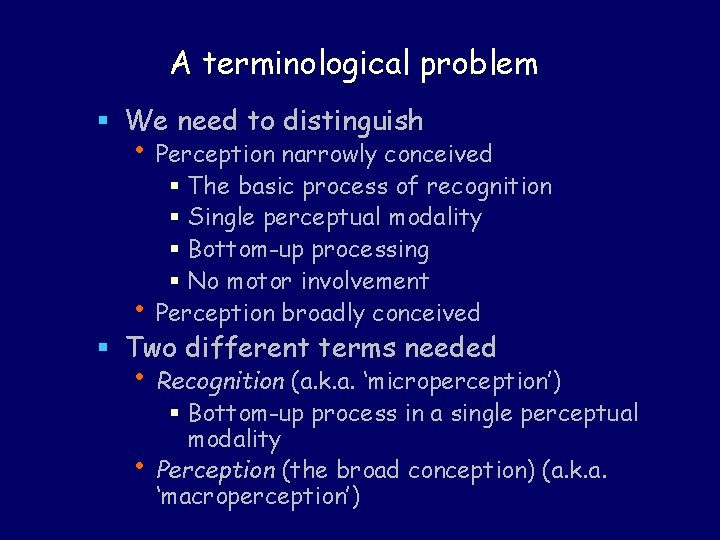
A terminological problem § We need to distinguish • Perception narrowly conceived • § The basic process of recognition § Single perceptual modality § Bottom-up processing § No motor involvement Perception broadly conceived § Two different terms needed • Recognition (a. k. a. ‘microperception’) • § Bottom-up process in a single perceptual modality Perception (the broad conception) (a. k. a. ‘macroperception’)
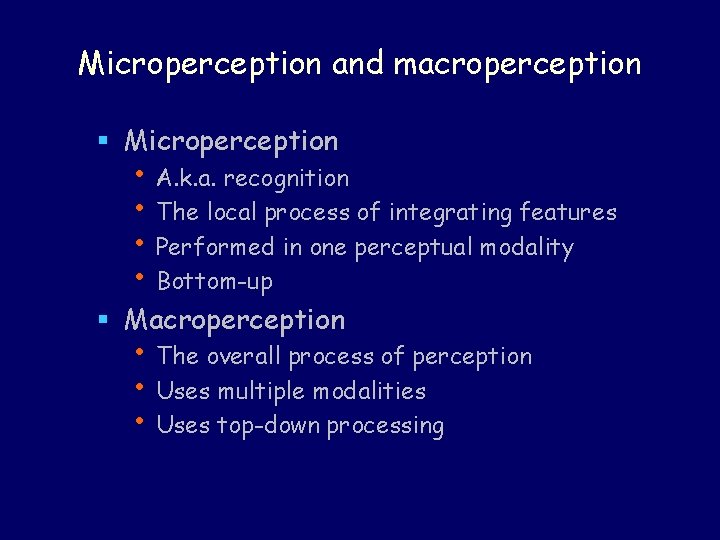
Microperception and macroperception § Microperception • A. k. a. recognition • The local process of integrating features • Performed in one perceptual modality • Bottom-up § Macroperception • The overall process of perception • Uses multiple modalities • Uses top-down processing
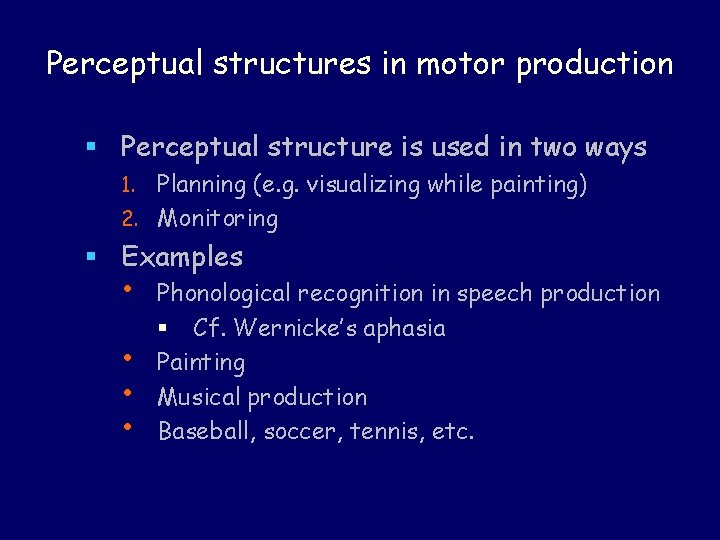
Perceptual structures in motor production § Perceptual structure is used in two ways Planning (e. g. visualizing while painting) 2. Monitoring 1. § Examples • • Phonological recognition in speech production § Cf. Wernicke’s aphasia Painting Musical production Baseball, soccer, tennis, etc.
Language and Perception: Topics § The representation of phonological information needed for perception of syllables § Phonological recognition vs phonological perception § Influence of language on non-linguistic perception
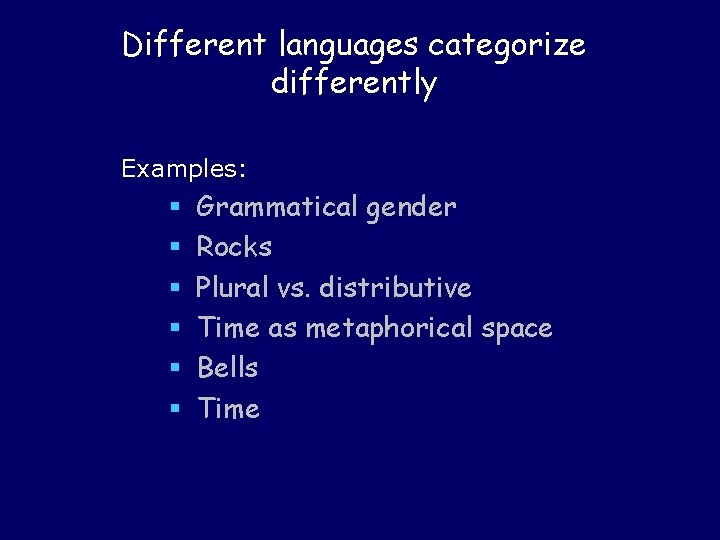
Different languages categorize differently Examples: § § § Grammatical gender Rocks Plural vs. distributive Time as metaphorical space Bells Time
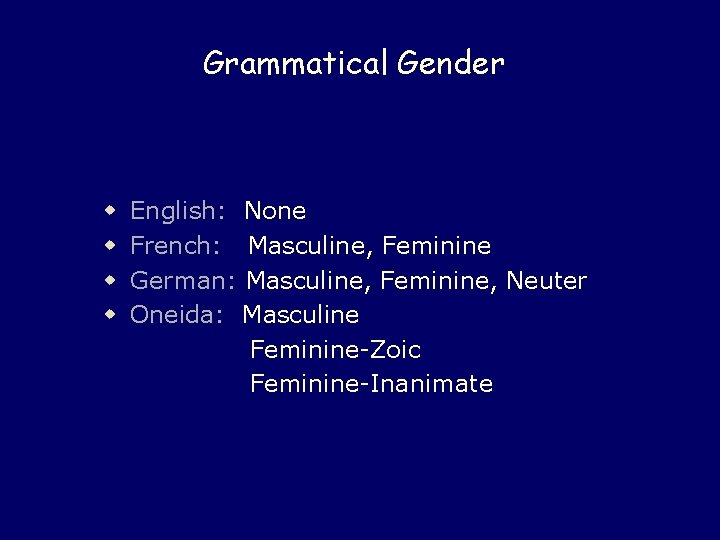
Grammatical Gender w w English: None French: Masculine, Feminine German: Masculine, Feminine, Neuter Oneida: Masculine Feminine-Zoic Feminine-Inanimate
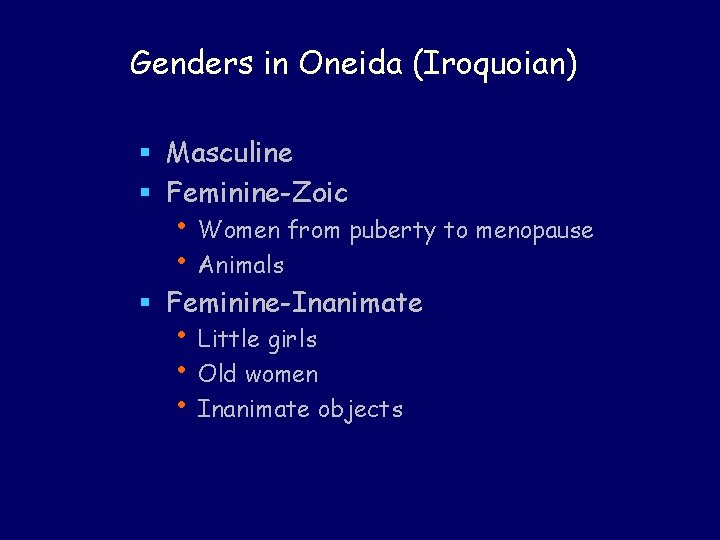
Genders in Oneida (Iroquoian) § Masculine § Feminine-Zoic • Women from puberty to menopause • Animals § Feminine-Inanimate • Little girls • Old women • Inanimate objects
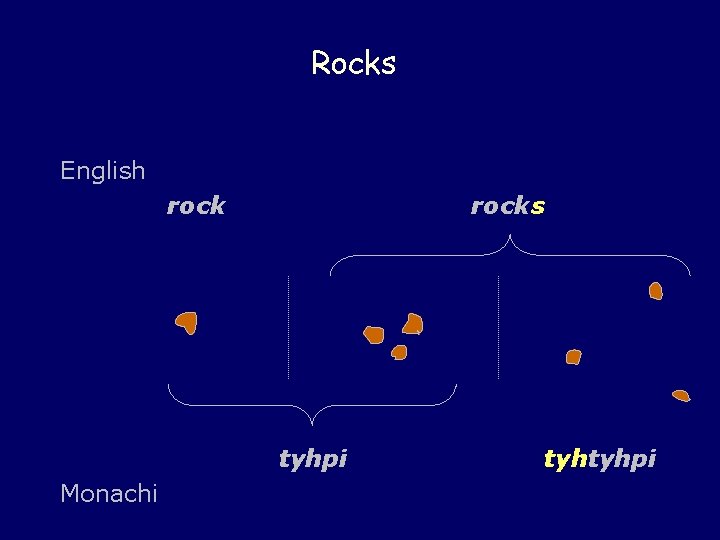
Rocks English rocks tyhpi Monachi tyhtyhpi
Bells – English and French § § § clochette sonnette grelot timbre glas (of a church) (on a cow) (of a door) (of a sleigh) (on a desk) (to announce a death)
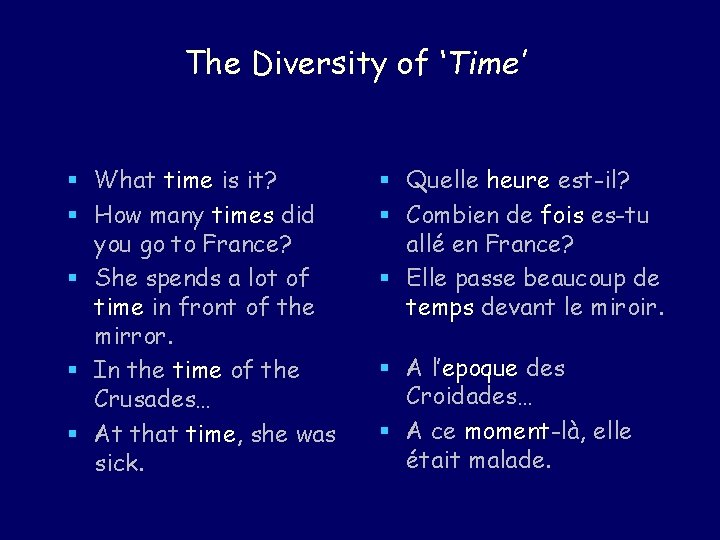
The Diversity of ‘Time’ § What time is it? § How many times did you go to France? § She spends a lot of time in front of the mirror. § In the time of the Crusades… § At that time, she was sick. § Quelle heure est-il? § Combien de fois es-tu allé en France? § Elle passe beaucoup de temps devant le miroir. § A l’epoque des Croidades… § A ce moment-là, elle était malade.
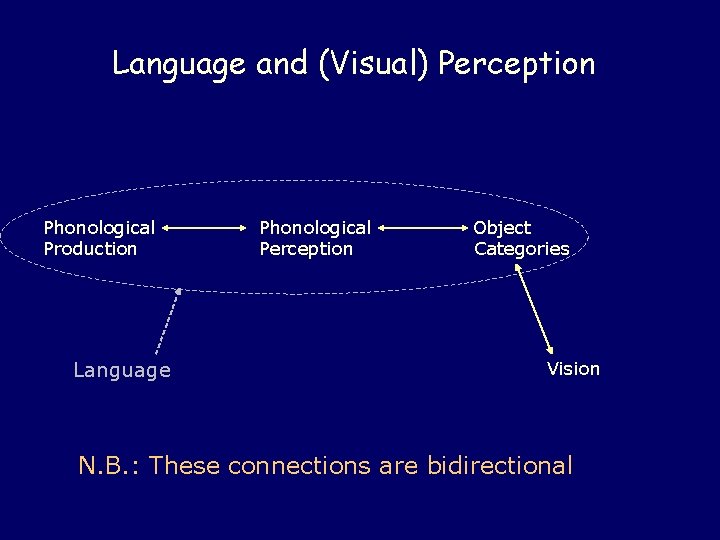
Language and (Visual) Perception Phonological Production Language Phonological Perception Object Categories Vision N. B. : These connections are bidirectional
Review Bidirectional connections § An established finding from neuroanatomy § Most corticocortical connections are bidirectional § It’s not because the connecting nerve fibers (axons) are themselves bidirectional § It’s because we find different but roughly parallel fibers going in opposite directions
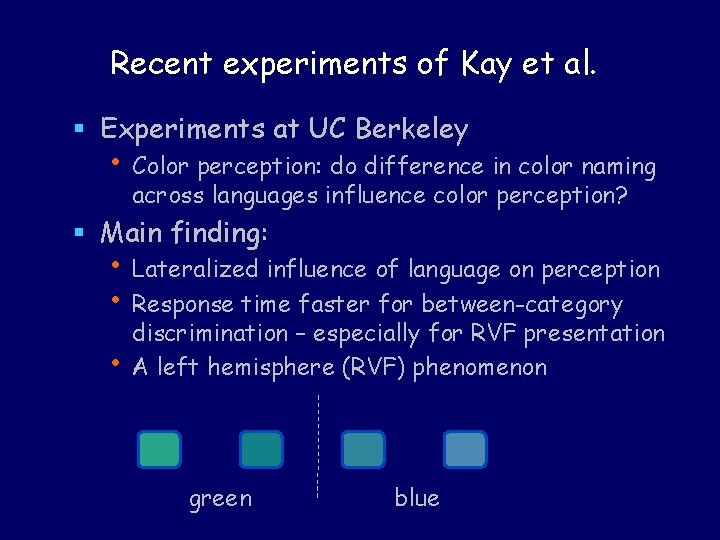
Recent experiments of Kay et al. § Experiments at UC Berkeley • Color perception: do difference in color naming across languages influence color perception? § Main finding: • Lateralized influence of language on perception • Response time faster for between-category • discrimination – especially for RVF presentation A left hemisphere (RVF) phenomenon green blue
end