Learning Predictive Models of Memory Landmarks E Horvitz
- Slides: 19
Learning Predictive Models of Memory Landmarks E. Horvitz, S. Dumais, and P. Koch, 26 th Annual Meeting of Cognitive Science Society, Chicago, 2004
Introduction q Episodic memory Memories are considered to be organized by episodes of significant events q Automated inference of memory landmark Could provide the basis for new kinds of personalized computer applications & services q Focus of this paper The construction, testing and application of predictive models of memory landmarks Based on events drawn from users’ online calendars
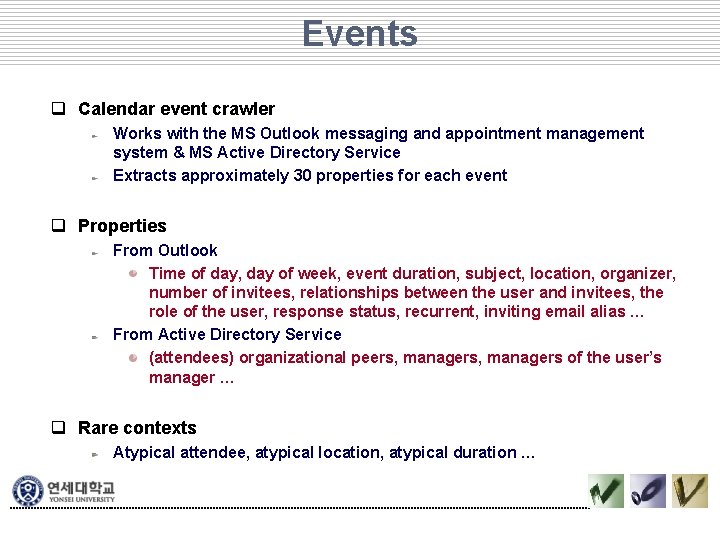
Events q Calendar event crawler Works with the MS Outlook messaging and appointment management system & MS Active Directory Service Extracts approximately 30 properties for each event q Properties From Outlook Time of day, day of week, event duration, subject, location, organizer, number of invitees, relationships between the user and invitees, the role of the user, response status, recurrent, inviting email alias … From Active Directory Service (attendees) organizational peers, managers of the user’s manager … q Rare contexts Atypical attendee, atypical location, atypical duration …
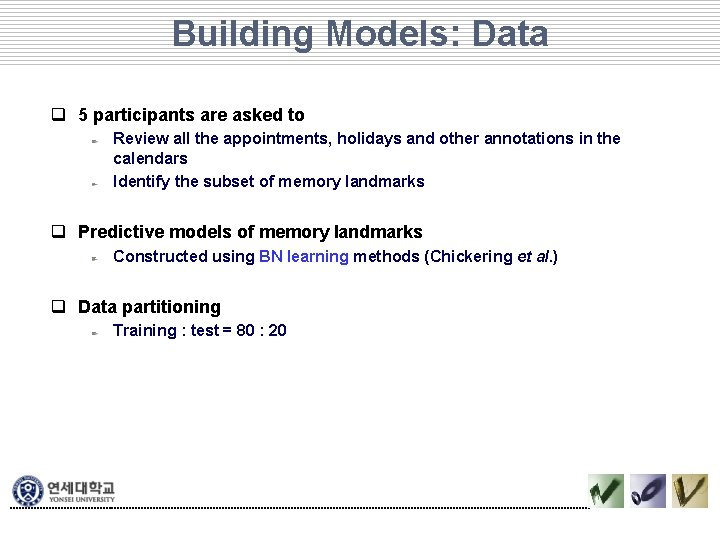
Building Models: Data q 5 participants are asked to Review all the appointments, holidays and other annotations in the calendars Identify the subset of memory landmarks q Predictive models of memory landmarks Constructed using BN learning methods (Chickering et al. ) q Data partitioning Training : test = 80 : 20
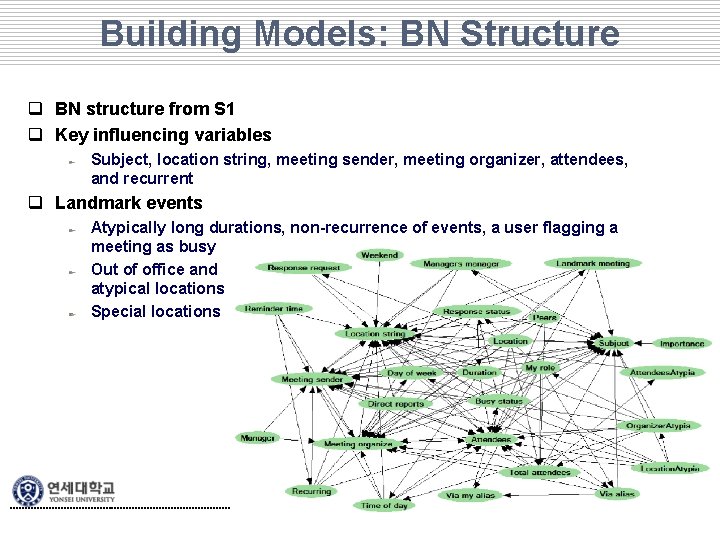
Building Models: BN Structure q BN structure from S 1 q Key influencing variables Subject, location string, meeting sender, meeting organizer, attendees, and recurrent q Landmark events Atypically long durations, non-recurrence of events, a user flagging a meeting as busy Out of office and atypical locations Special locations
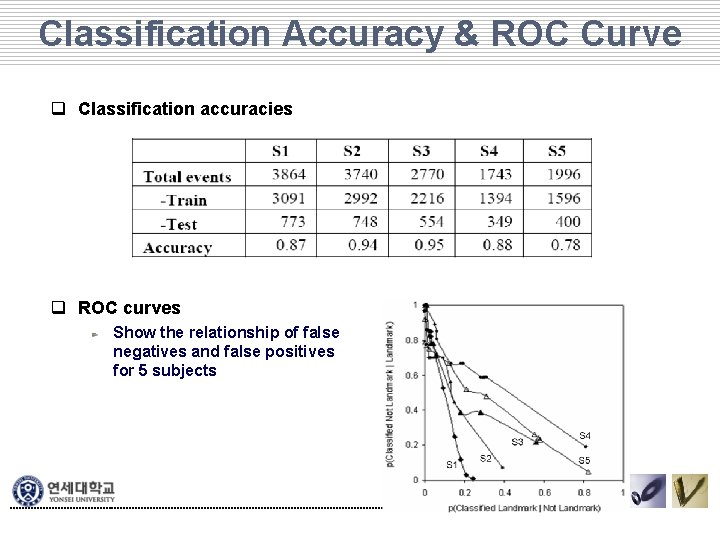
Classification Accuracy & ROC Curve q Classification accuracies q ROC curves Show the relationship of false negatives and false positives for 5 subjects
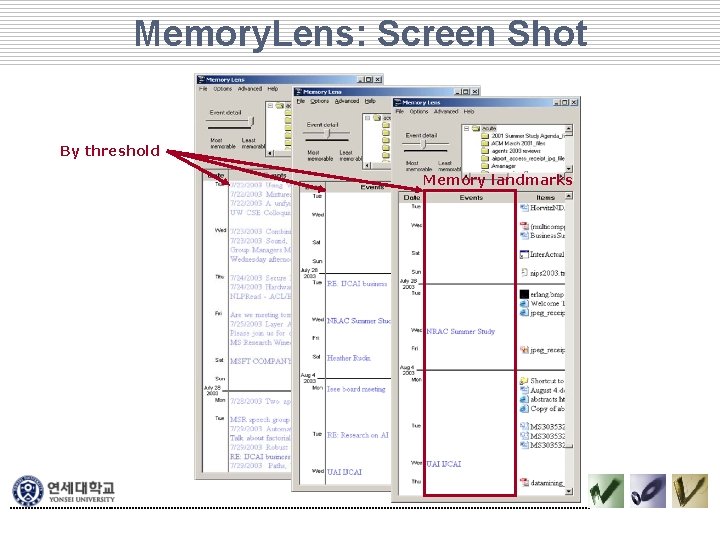
Memory. Lens: Characteristics q As a prototype Demonstrates how the predictive models might be used Focuses on providing users with a timeline of landmark events to assist them to find content across their computer store q Predictive model Allows users to train models on a portion of events from their calendar Constructed model predicts each event if it is a landmark
Memory. Lens: Screen Shot By threshold Memory landmarks
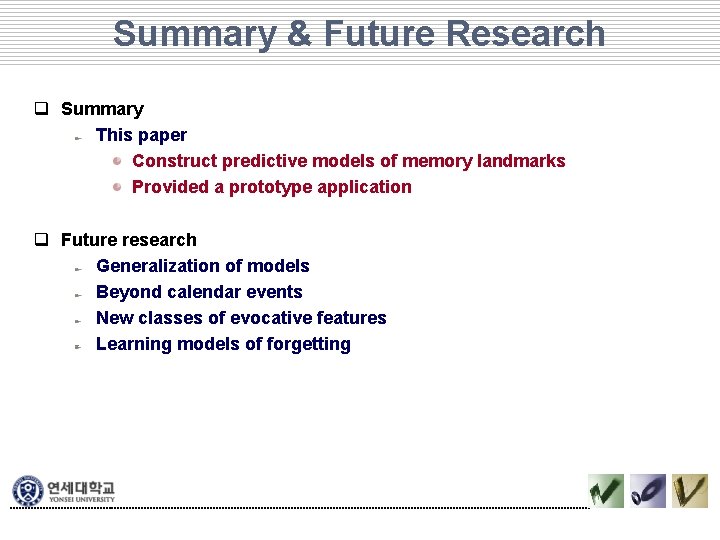
Summary & Future Research q Summary This paper Construct predictive models of memory landmarks Provided a prototype application q Future research Generalization of models Beyond calendar events New classes of evocative features Learning models of forgetting
Milestones in Time: The Value of Landmarks in Retrieving Information from Personal Stores M. Ringel, E. Cutrell, S. Dumais, and E. Horvitz, Proceedings of Interact 2003: Ninth International Conference on Human. Computer Interaction, Zurich, 2003.
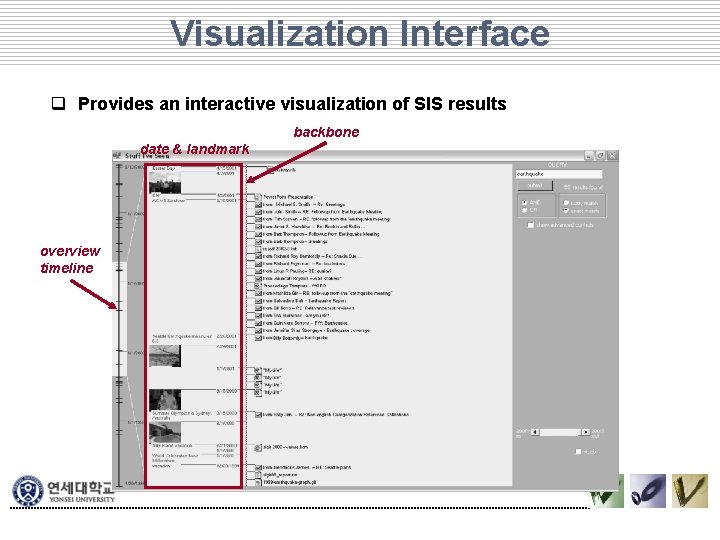
Introduction q Searching People employ various strategies when searching personal e-mails, files, or web bookmarks Though exact dates may not be remembered, people recall the relative times of important events in their lives q SIS (Stuff I’ve Seen) Provides timeline-based presentation of search results Provides results represented by public and personal landmark events Indexes the full text and metadata of all the documents, web pages and email that a user has seen
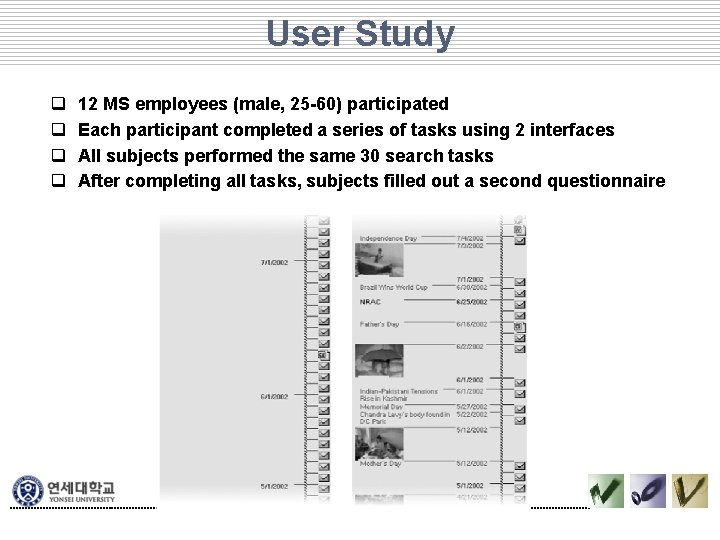
Visualization Interface q Provides an interactive visualization of SIS results backbone date & landmark overview timeline
Public Landmarks q Public landmarks Drawn from events that users typically be aware of All public landmarks have given priorities In this prototype, all users saw the same public landmarks q Holidays US holidays occurred from 1994 - 2004 Priorities are manually assigned based on American culture q News headlines from 1994 - 2001 are extracted from the world history timeline from MS Encarta, a multimedia encyclopedia 10 MS employees rate a set of news headlines on a scale of 1 - 10
Personal Landmarks q Personal landmarks These are unique for each user In this prototype, all landmarks are automatically generated q Calendar appointments Dates, times, and titles of appointments stored in MS Outlook calendar were automatically extracted as personal landmarks Each appointment has priority according to heuristics q Digital photographs Crawled the users’ digital photographs The first photo of the day is selected as a landmark for that day Similarly, the first one of the month and year also have high priority
User Study q q 12 MS employees (male, 25 -60) participated Each participant completed a series of tasks using 2 interfaces All subjects performed the same 30 search tasks After completing all tasks, subjects filled out a second questionnaire
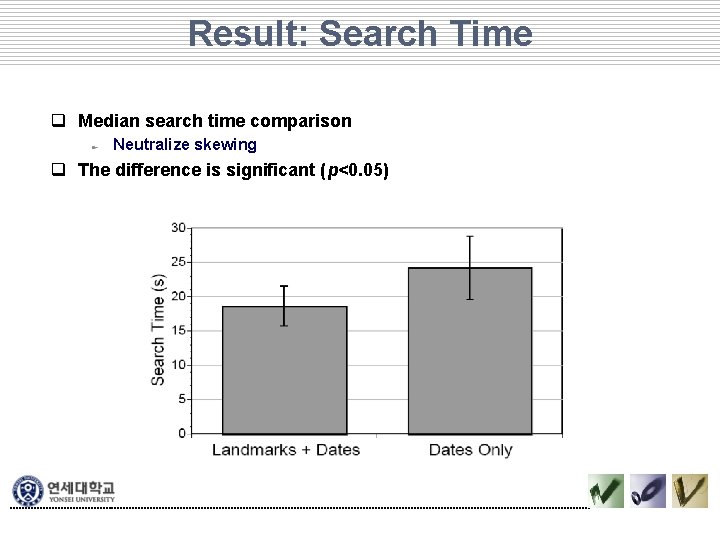
Result: Search Time q Median search time comparison Neutralize skewing q The difference is significant (p<0. 05)
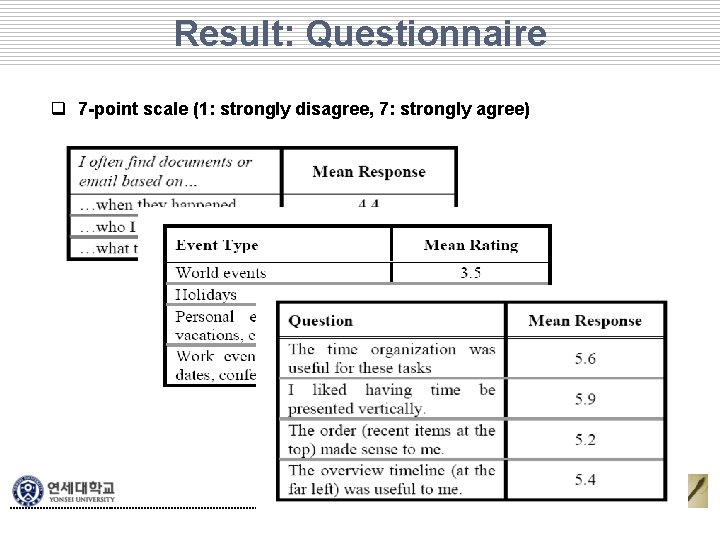
Result: Questionnaire q 7 -point scale (1: strongly disagree, 7: strongly agree)
Conclusions & Future Work q Conclusions A timeline-based visualization of search results An interface with public and personal landmark events aid people in locating the target of their search A user study found there was a significant time savings for searching q Future work Extending the type of events (personal & public, now) Refining heuristics in selecting and ranking landmarks