KS 4 Mathematics S 2 Pythagoras Theorem 1


- Slides: 60
KS 4 Mathematics S 2 Pythagoras’ Theorem 1 of 60 © Boardworks Ltd 2005
Contents S 2 Pythagoras’ Theorem A S 2. 1 Introducing Pythagoras’ Theorem A S 2. 2 Identifying right-angled triangles A S 2. 3 Pythagorean triples A S 2. 4 Finding unknown lengths A S 2. 5 Applying Pythagoras’ Theorem in 2 -D A S 2. 6 Applying Pythagoras’ Theorem in 3 -D 2 of 60 © Boardworks Ltd 2005
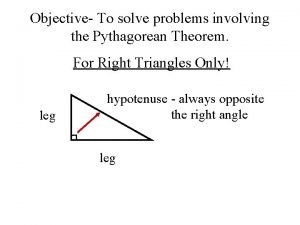
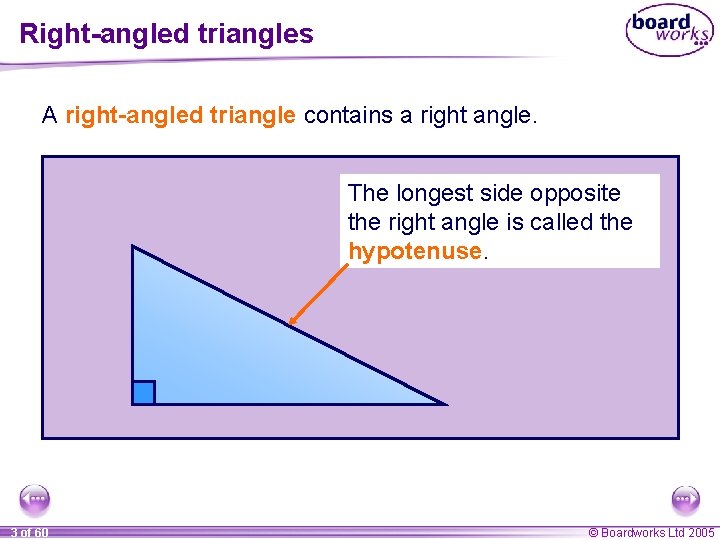
Right-angled triangles A right-angled triangle contains a right angle. The longest side opposite the right angle is called the hypotenuse. 3 of 60 © Boardworks Ltd 2005
Identify the hypotenuse 4 of 60 © Boardworks Ltd 2005
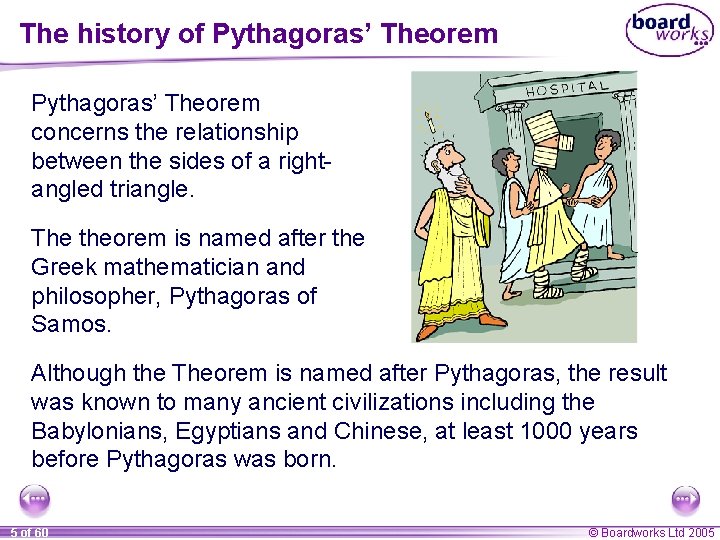
The history of Pythagoras’ Theorem concerns the relationship between the sides of a rightangled triangle. The theorem is named after the Greek mathematician and philosopher, Pythagoras of Samos. Although the Theorem is named after Pythagoras, the result was known to many ancient civilizations including the Babylonians, Egyptians and Chinese, at least 1000 years before Pythagoras was born. 5 of 60 © Boardworks Ltd 2005
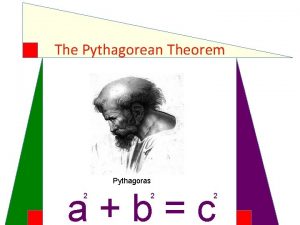
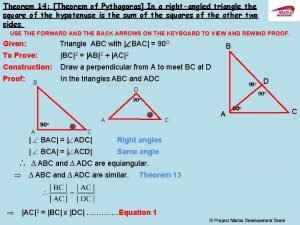
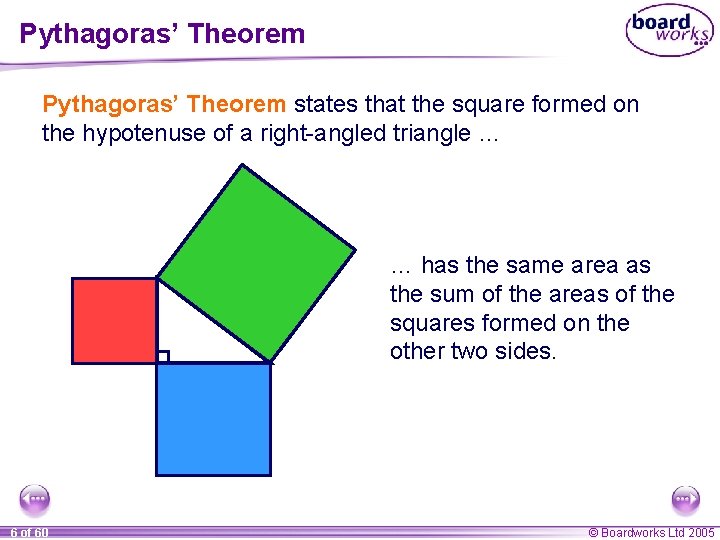
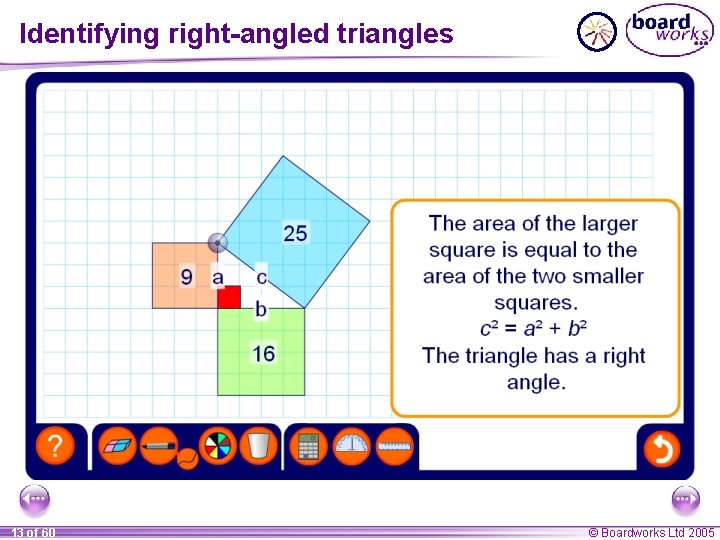
Pythagoras’ Theorem states that the square formed on the hypotenuse of a right-angled triangle … … has the same area as the sum of the areas of the squares formed on the other two sides. 6 of 60 © Boardworks Ltd 2005
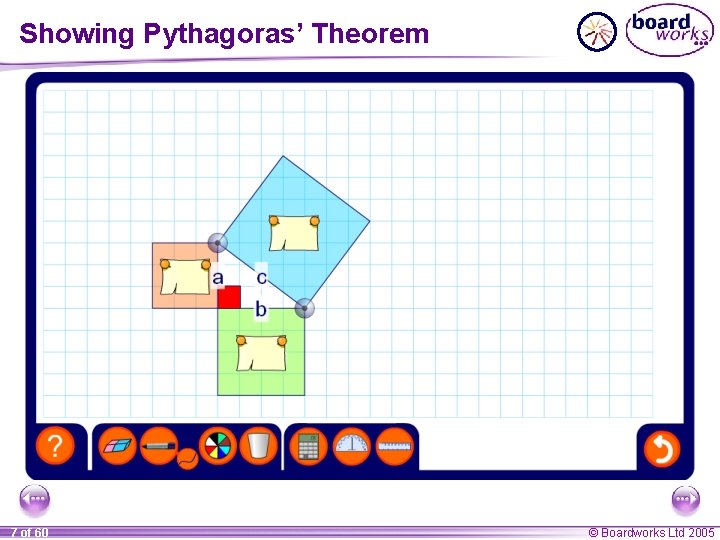
Showing Pythagoras’ Theorem 7 of 60 © Boardworks Ltd 2005
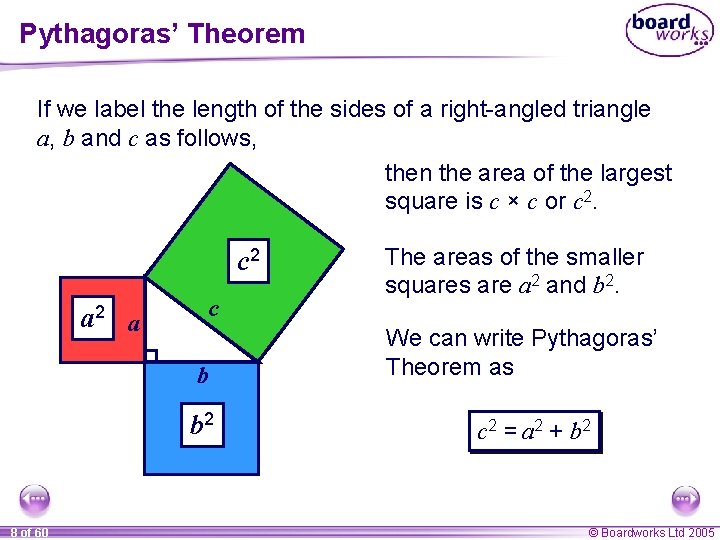
Pythagoras’ Theorem If we label the length of the sides of a right-angled triangle a, b and c as follows, then the area of the largest square is c × c or c 2 a c b b 2 8 of 60 The areas of the smaller squares are a 2 and b 2. We can write Pythagoras’ Theorem as c 2 = a 2 + b 2 © Boardworks Ltd 2005
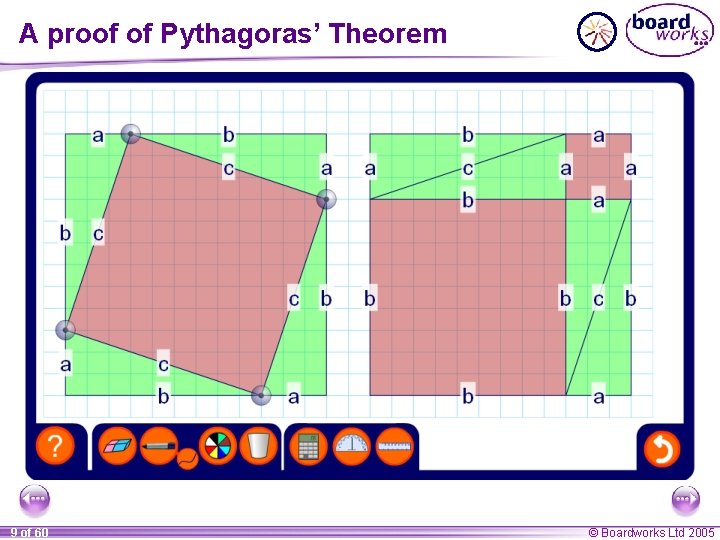
A proof of Pythagoras’ Theorem 9 of 60 © Boardworks Ltd 2005
Contents S 2 Pythagoras’ Theorem A S 2. 1 Introducing Pythagoras’ Theorem A S 2. 2 Identifying right-angled triangles A S 2. 3 Pythagorean triples A S 2. 4 Finding unknown lengths A S 2. 5 Applying Pythagoras’ Theorem in 2 -D A S 2. 6 Applying Pythagoras’ Theorem in 3 -D 10 of 60 © Boardworks Ltd 2005
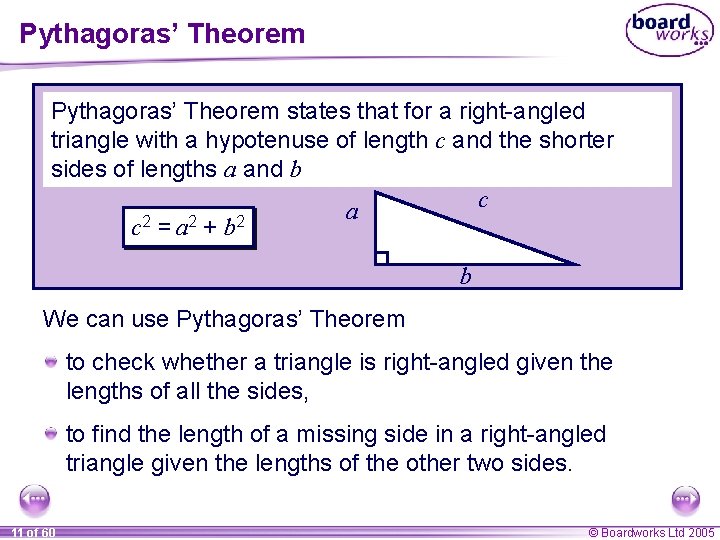
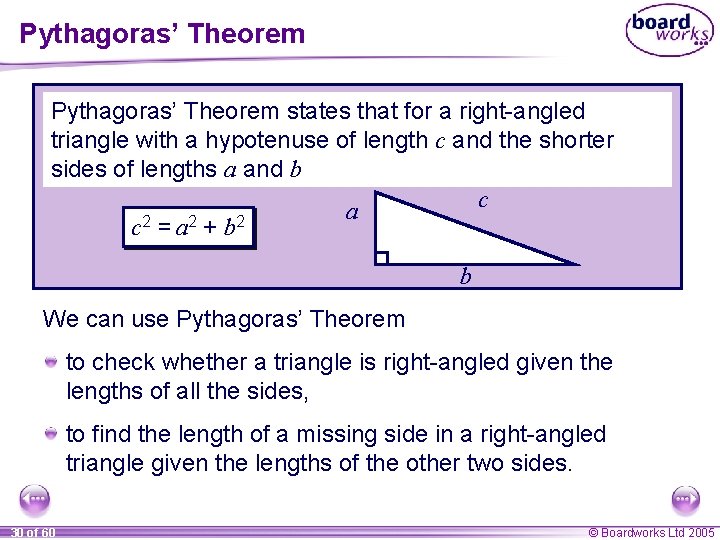
Pythagoras’ Theorem states that for a right-angled triangle with a hypotenuse of length c and the shorter sides of lengths a and b c a c 2 = a 2 + b 2 b We can use Pythagoras’ Theorem to check whether a triangle is right-angled given the lengths of all the sides, to find the length of a missing side in a right-angled triangle given the lengths of the other two sides. 11 of 60 © Boardworks Ltd 2005
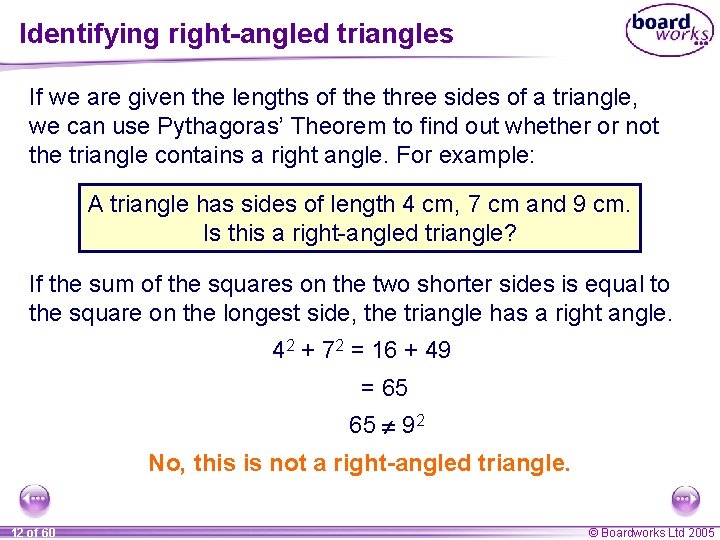
Identifying right-angled triangles If we are given the lengths of the three sides of a triangle, we can use Pythagoras’ Theorem to find out whether or not the triangle contains a right angle. For example: A triangle has sides of length 4 cm, 7 cm and 9 cm. Is this a right-angled triangle? If the sum of the squares on the two shorter sides is equal to the square on the longest side, the triangle has a right angle. 42 + 72 = 16 + 49 = 65 65 92 No, this is not a right-angled triangle. 12 of 60 © Boardworks Ltd 2005
Identifying right-angled triangles 13 of 60 © Boardworks Ltd 2005
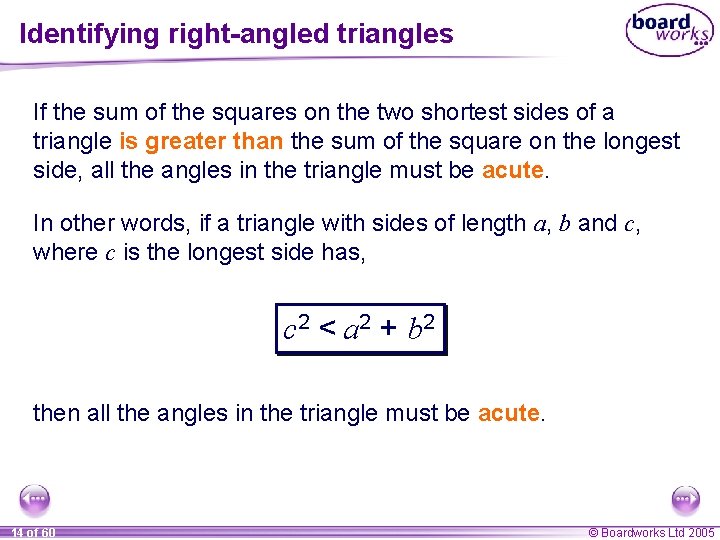
Identifying right-angled triangles If the sum of the squares on the two shortest sides of a triangle is greater than the sum of the square on the longest side, all the angles in the triangle must be acute. In other words, if a triangle with sides of length a, b and c, where c is the longest side has, c 2 < a 2 + b 2 then all the angles in the triangle must be acute. 14 of 60 © Boardworks Ltd 2005
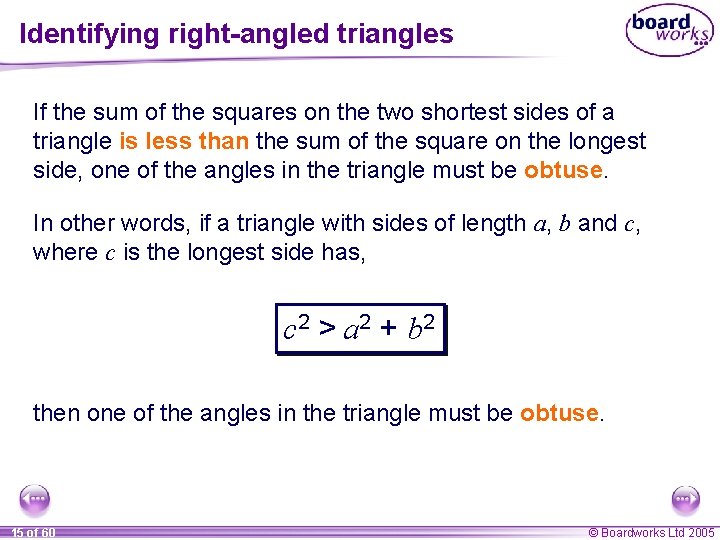
Identifying right-angled triangles If the sum of the squares on the two shortest sides of a triangle is less than the sum of the square on the longest side, one of the angles in the triangle must be obtuse. In other words, if a triangle with sides of length a, b and c, where c is the longest side has, c 2 > a 2 + b 2 then one of the angles in the triangle must be obtuse. 15 of 60 © Boardworks Ltd 2005
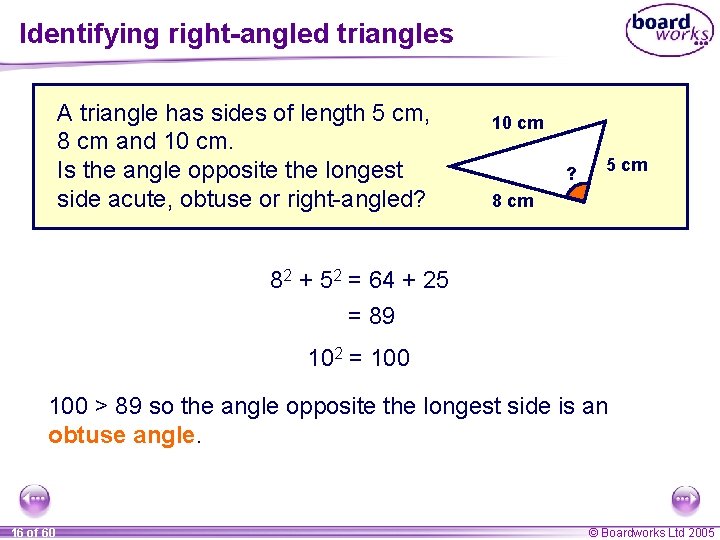
Identifying right-angled triangles A triangle has sides of length 5 cm, 8 cm and 10 cm. Is the angle opposite the longest side acute, obtuse or right-angled? 10 cm ? 5 cm 82 + 52 = 64 + 25 = 89 102 = 100 > 89 so the angle opposite the longest side is an obtuse angle. 16 of 60 © Boardworks Ltd 2005
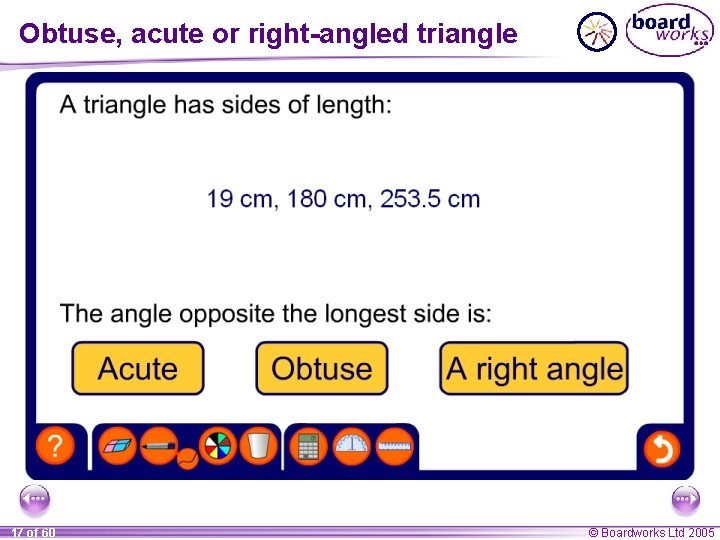
Obtuse, acute or right-angled triangle 17 of 60 © Boardworks Ltd 2005
Contents S 2 Pythagoras’ Theorem A S 2. 1 Introducing Pythagoras’ Theorem A S 2. 2 Identifying right-angled triangles A S 2. 3 Pythagorean triples A S 2. 4 Finding unknown lengths A S 2. 5 Applying Pythagoras’ Theorem in 2 -D A S 2. 6 Applying Pythagoras’ Theorem in 3 -D 18 of 60 © Boardworks Ltd 2005
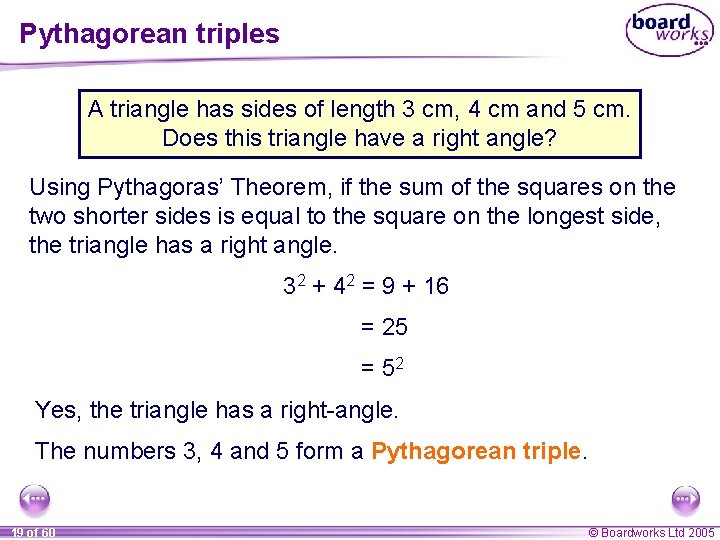
Pythagorean triples A triangle has sides of length 3 cm, 4 cm and 5 cm. Does this triangle have a right angle? Using Pythagoras’ Theorem, if the sum of the squares on the two shorter sides is equal to the square on the longest side, the triangle has a right angle. 32 + 42 = 9 + 16 = 25 = 52 Yes, the triangle has a right-angle. The numbers 3, 4 and 5 form a Pythagorean triple. 19 of 60 © Boardworks Ltd 2005
Pythagorean triples Ancient Egyptians used the fact that a triangle with sides of length 3, 4 and 5 contained a right-angle to mark out field boundaries and for building. 20 of 60 © Boardworks Ltd 2005
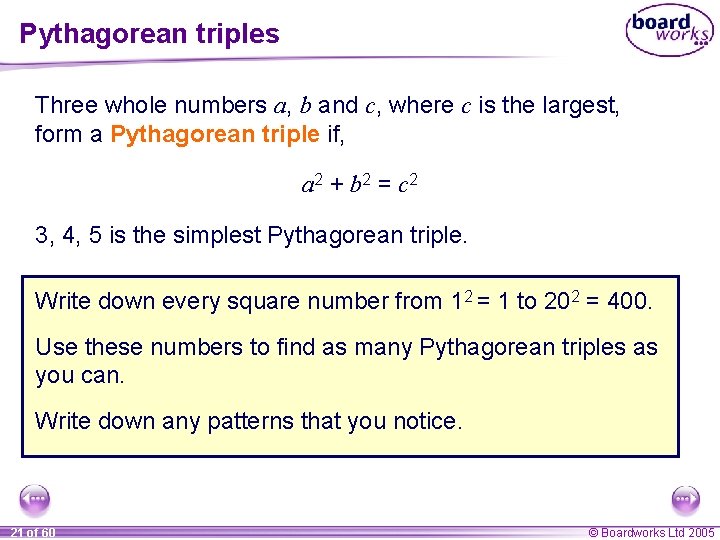
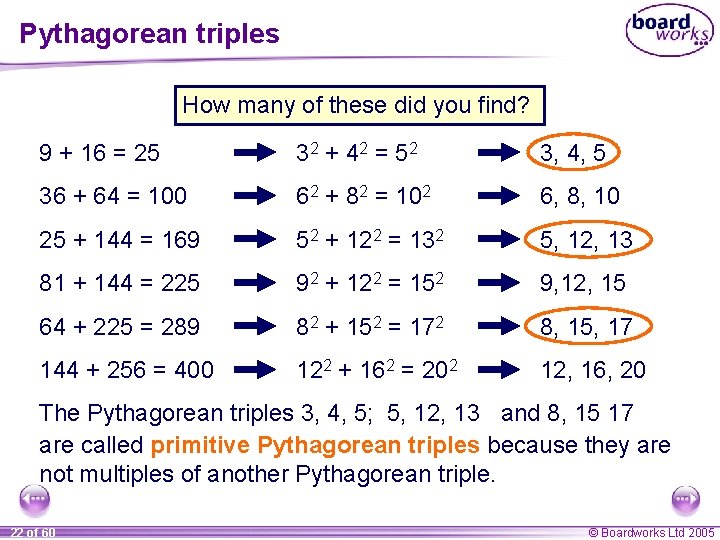
Pythagorean triples Three whole numbers a, b and c, where c is the largest, form a Pythagorean triple if, a 2 + b 2 = c 2 3, 4, 5 is the simplest Pythagorean triple. Write down every square number from 12 = 1 to 202 = 400. Use these numbers to find as many Pythagorean triples as you can. Write down any patterns that you notice. 21 of 60 © Boardworks Ltd 2005
Pythagorean triples How many of these did you find? 9 + 16 = 25 32 + 4 2 = 5 2 3, 4, 5 36 + 64 = 100 62 + 82 = 102 6, 8, 10 25 + 144 = 169 52 + 122 = 132 5, 12, 13 81 + 144 = 225 92 + 122 = 152 9, 12, 15 64 + 225 = 289 82 + 152 = 172 8, 15, 17 144 + 256 = 400 122 + 162 = 202 12, 16, 20 The Pythagorean triples 3, 4, 5; 5, 12, 13 and 8, 15 17 are called primitive Pythagorean triples because they are not multiples of another Pythagorean triple. 22 of 60 © Boardworks Ltd 2005
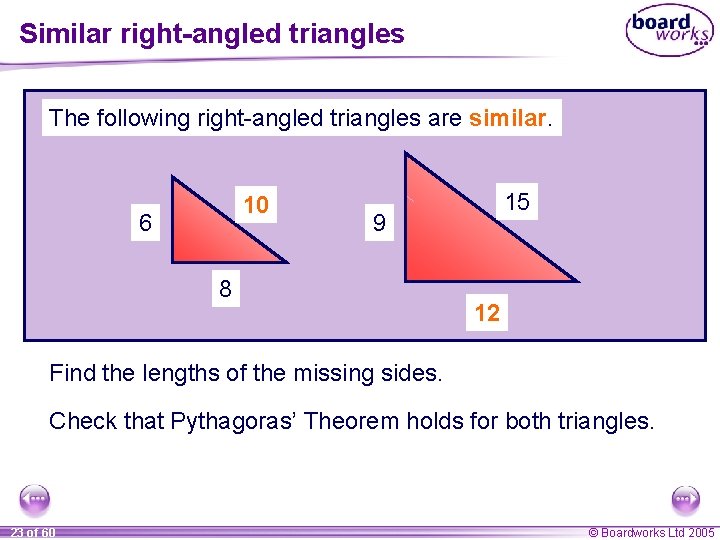
Similar right-angled triangles The following right-angled triangles are similar. 10 ? 6 15 9 8 12 ? Find the lengths of the missing sides. Check that Pythagoras’ Theorem holds for both triangles. 23 of 60 © Boardworks Ltd 2005
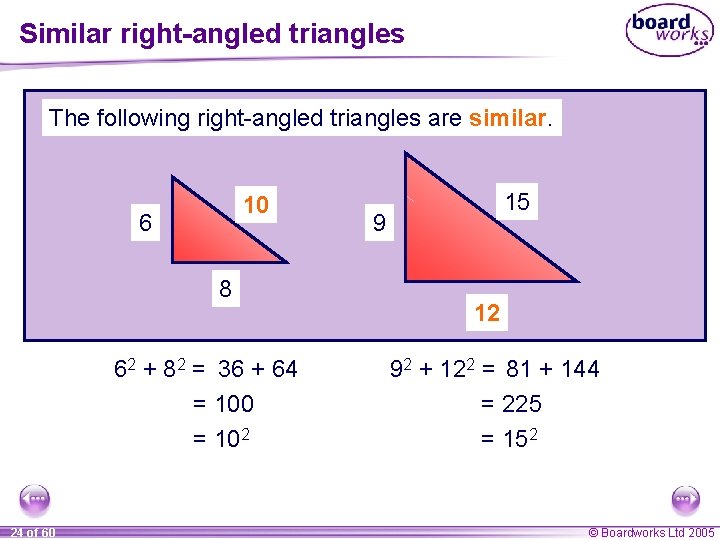
Similar right-angled triangles The following right-angled triangles are similar. 10 ? 6 8 62 + 82 = 36 + 64 = 100 = 102 24 of 60 15 9 12 ? 92 + 122 = 81 + 144 = 225 = 152 © Boardworks Ltd 2005
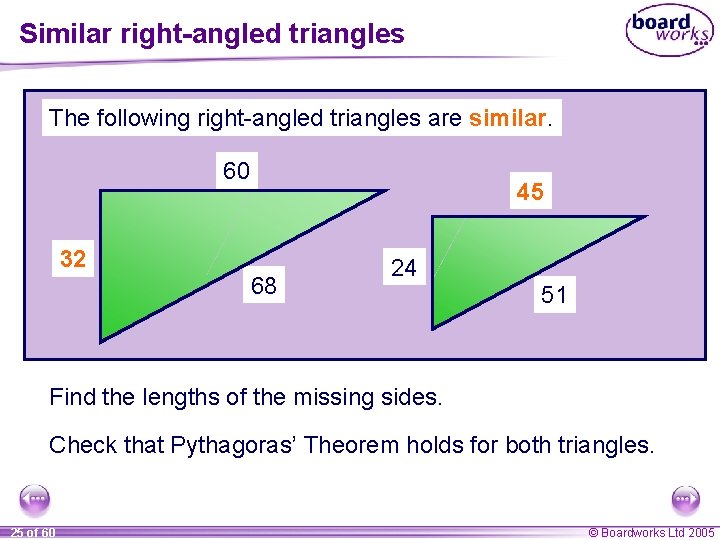
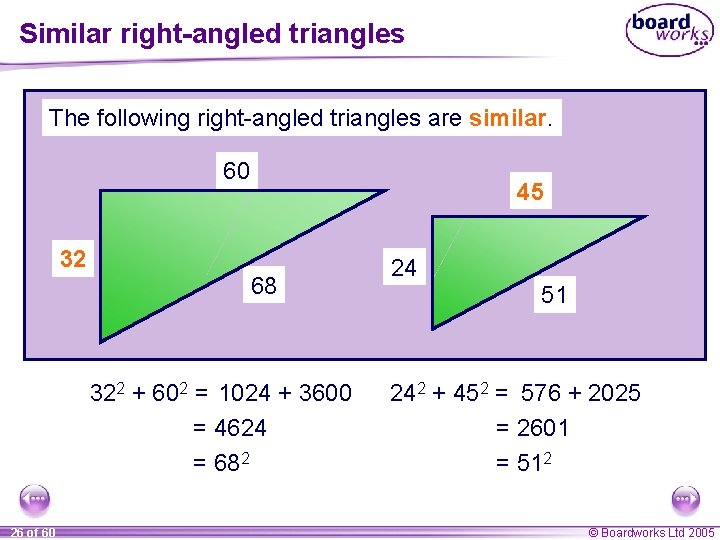
Similar right-angled triangles The following right-angled triangles are similar. 60 32 ? 45 ? 68 24 51 Find the lengths of the missing sides. Check that Pythagoras’ Theorem holds for both triangles. 25 of 60 © Boardworks Ltd 2005
Similar right-angled triangles The following right-angled triangles are similar. 60 32 45 68 322 + 602 = 1024 + 3600 = 4624 = 682 26 of 60 24 51 242 + 452 = 576 + 2025 = 2601 = 512 © Boardworks Ltd 2005
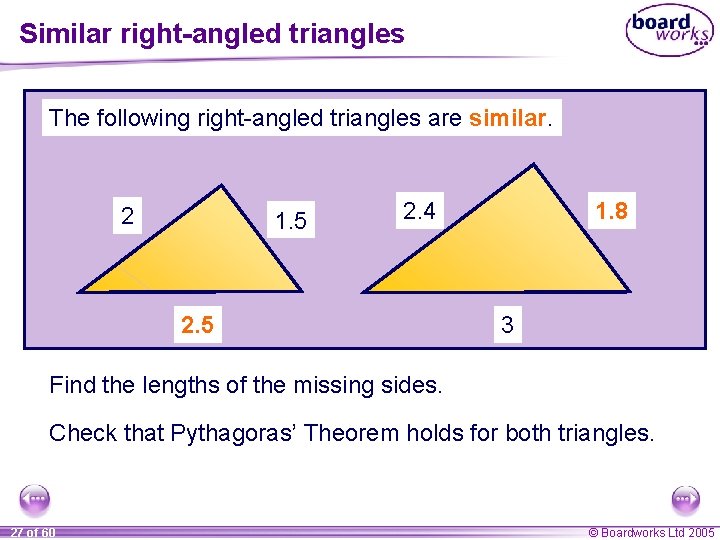
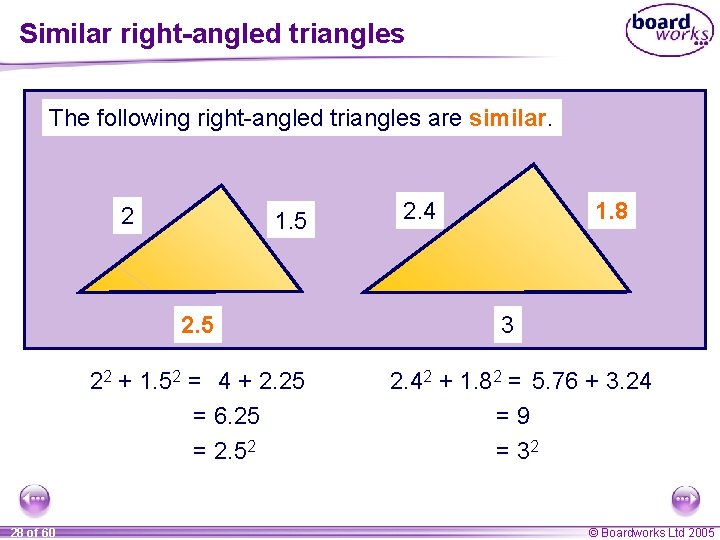
Similar right-angled triangles The following right-angled triangles are similar. 2 1. 5 2. 4 2. 5 ? 1. 8 ? 3 Find the lengths of the missing sides. Check that Pythagoras’ Theorem holds for both triangles. 27 of 60 © Boardworks Ltd 2005
Similar right-angled triangles The following right-angled triangles are similar. 2 1. 5 22 + 1. 52 = 4 + 2. 25 = 6. 25 = 2. 52 28 of 60 2. 4 1. 8 3 2. 42 + 1. 82 = 5. 76 + 3. 24 =9 = 32 © Boardworks Ltd 2005
Contents S 2 Pythagoras’ Theorem A S 2. 1 Introducing Pythagoras’ Theorem A S 2. 2 Identifying right-angled triangles A S 2. 3 Pythagorean triples A S 2. 4 Finding unknown lengths A S 2. 5 Applying Pythagoras’ Theorem in 2 -D A S 2. 6 Applying Pythagoras’ Theorem in 3 -D 29 of 60 © Boardworks Ltd 2005
Pythagoras’ Theorem states that for a right-angled triangle with a hypotenuse of length c and the shorter sides of lengths a and b c a c 2 = a 2 + b 2 b We can use Pythagoras’ Theorem to check whether a triangle is right-angled given the lengths of all the sides, to find the length of a missing side in a right-angled triangle given the lengths of the other two sides. 30 of 60 © Boardworks Ltd 2005
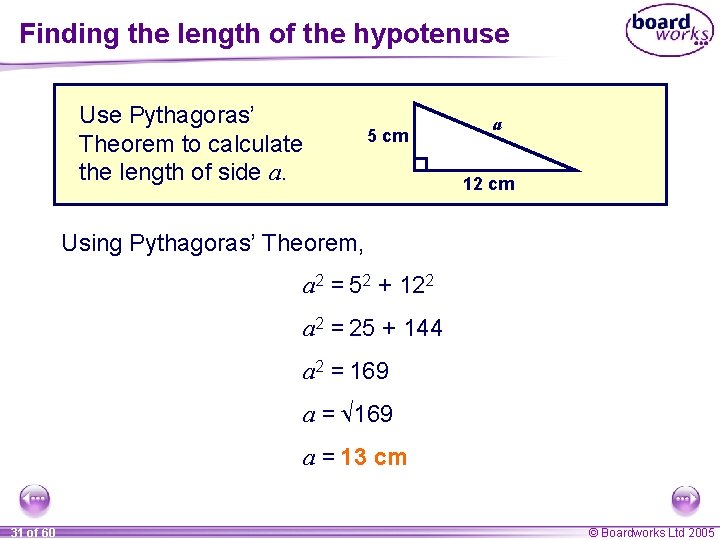
Finding the length of the hypotenuse Use Pythagoras’ Theorem to calculate the length of side a. 5 cm a 12 cm Using Pythagoras’ Theorem, a 2 = 52 + 122 a 2 = 25 + 144 a 2 = 169 a = 13 cm 31 of 60 © Boardworks Ltd 2005
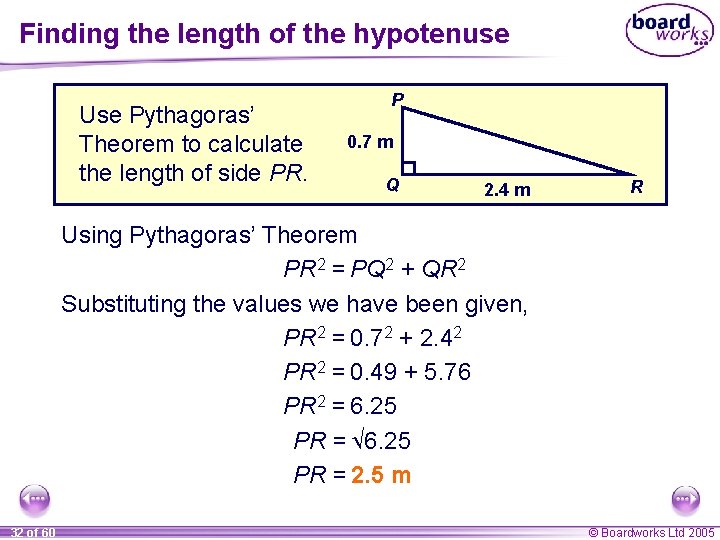
Finding the length of the hypotenuse Use Pythagoras’ Theorem to calculate the length of side PR. P 0. 7 m Q 2. 4 m R Using Pythagoras’ Theorem PR 2 = PQ 2 + QR 2 Substituting the values we have been given, PR 2 = 0. 72 + 2. 42 PR 2 = 0. 49 + 5. 76 PR 2 = 6. 25 PR = 2. 5 m 32 of 60 © Boardworks Ltd 2005
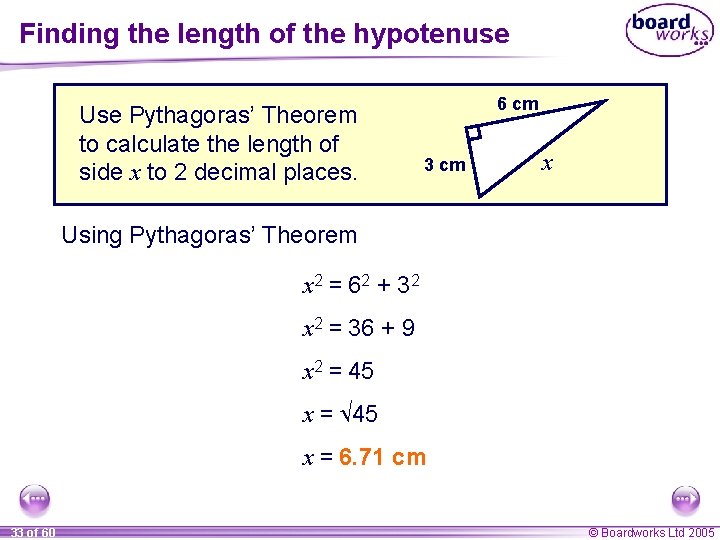
Finding the length of the hypotenuse Use Pythagoras’ Theorem to calculate the length of side x to 2 decimal places. 6 cm 3 cm x Using Pythagoras’ Theorem x 2 = 62 + 3 2 x 2 = 36 + 9 x 2 = 45 x = 6. 71 cm 33 of 60 © Boardworks Ltd 2005
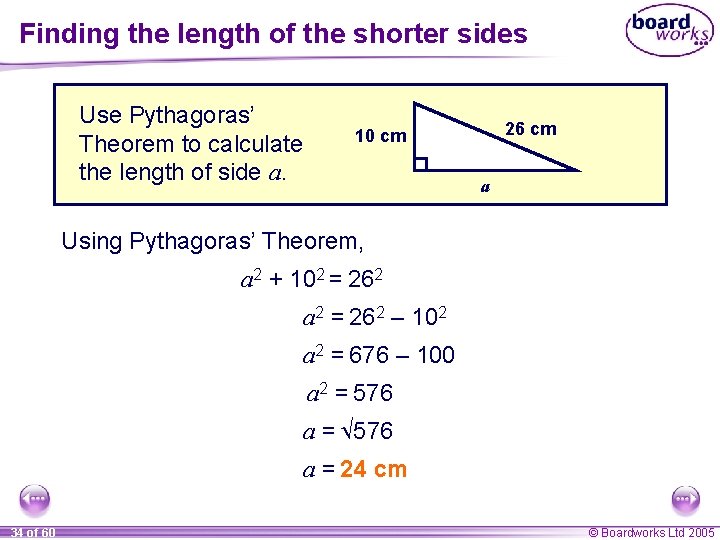
Finding the length of the shorter sides Use Pythagoras’ Theorem to calculate the length of side a. 26 cm 10 cm a Using Pythagoras’ Theorem, a 2 + 102 = 262 a 2 = 262 – 102 a 2 = 676 – 100 a 2 = 576 a = 24 cm 34 of 60 © Boardworks Ltd 2005
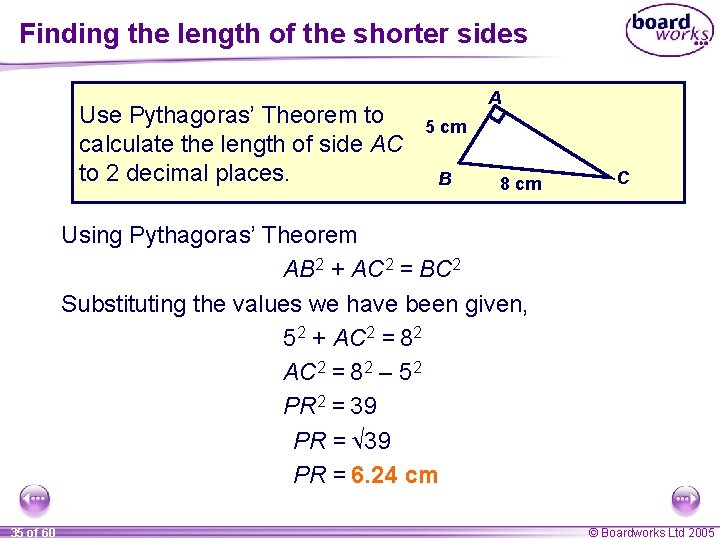
Finding the length of the shorter sides Use Pythagoras’ Theorem to calculate the length of side AC to 2 decimal places. A 5 cm B 8 cm C Using Pythagoras’ Theorem AB 2 + AC 2 = BC 2 Substituting the values we have been given, 52 + AC 2 = 82 – 52 PR 2 = 39 PR = 6. 24 cm 35 of 60 © Boardworks Ltd 2005
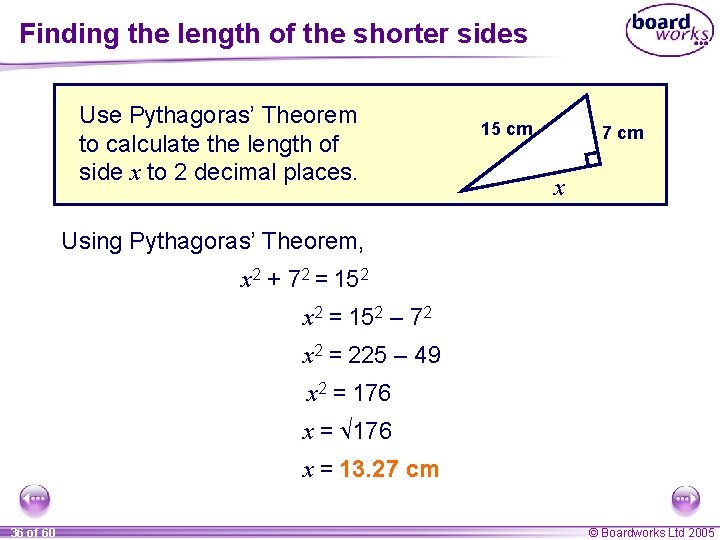
Finding the length of the shorter sides Use Pythagoras’ Theorem to calculate the length of side x to 2 decimal places. 15 cm 7 cm x Using Pythagoras’ Theorem, x 2 + 72 = 152 x 2 = 152 – 72 x 2 = 225 – 49 x 2 = 176 x = 13. 27 cm 36 of 60 © Boardworks Ltd 2005
Find the correct equation 37 of 60 © Boardworks Ltd 2005
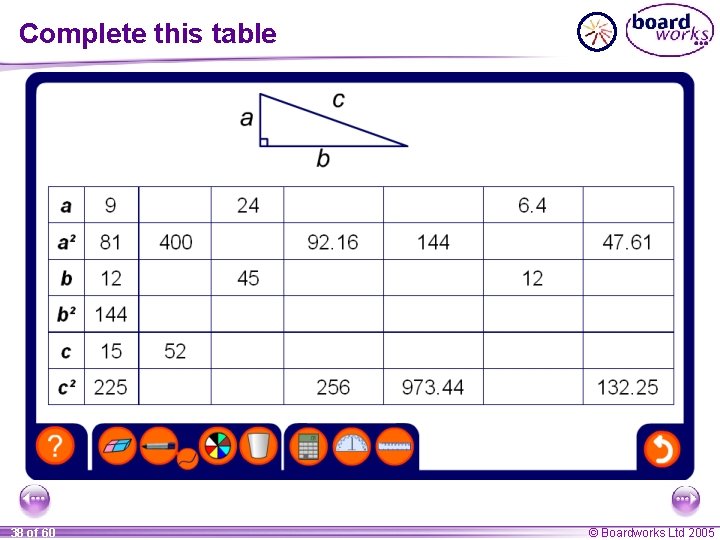
Complete this table 38 of 60 © Boardworks Ltd 2005
Contents S 2 Pythagoras’ Theorem A S 2. 1 Introducing Pythagoras’ Theorem A S 2. 2 Identifying right-angled triangles A S 2. 3 Pythagorean triples A S 2. 4 Finding unknown lengths A S 2. 5 Applying Pythagoras’ Theorem in 2 -D A S 2. 6 Applying Pythagoras’ Theorem in 3 -D 39 of 60 © Boardworks Ltd 2005
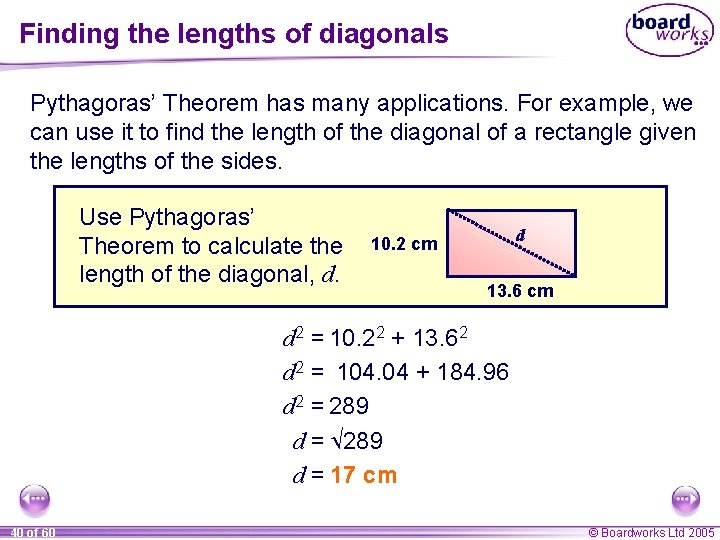
Finding the lengths of diagonals Pythagoras’ Theorem has many applications. For example, we can use it to find the length of the diagonal of a rectangle given the lengths of the sides. Use Pythagoras’ Theorem to calculate the length of the diagonal, d. d 10. 2 cm 13. 6 cm d 2 = 10. 22 + 13. 62 d 2 = 104. 04 + 184. 96 d 2 = 289 d = 17 cm 40 of 60 © Boardworks Ltd 2005
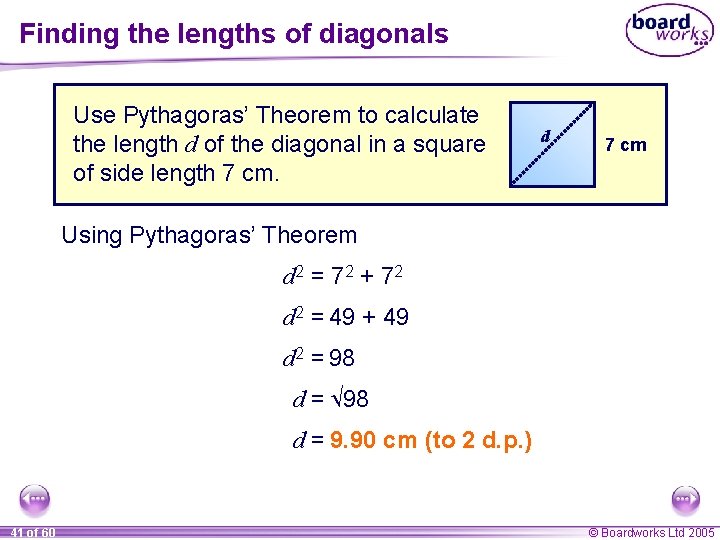
Finding the lengths of diagonals Use Pythagoras’ Theorem to calculate the length d of the diagonal in a square of side length 7 cm. d 7 cm Using Pythagoras’ Theorem d 2 = 72 + 72 d 2 = 49 + 49 d 2 = 98 d = 9. 90 cm (to 2 d. p. ) 41 of 60 © Boardworks Ltd 2005
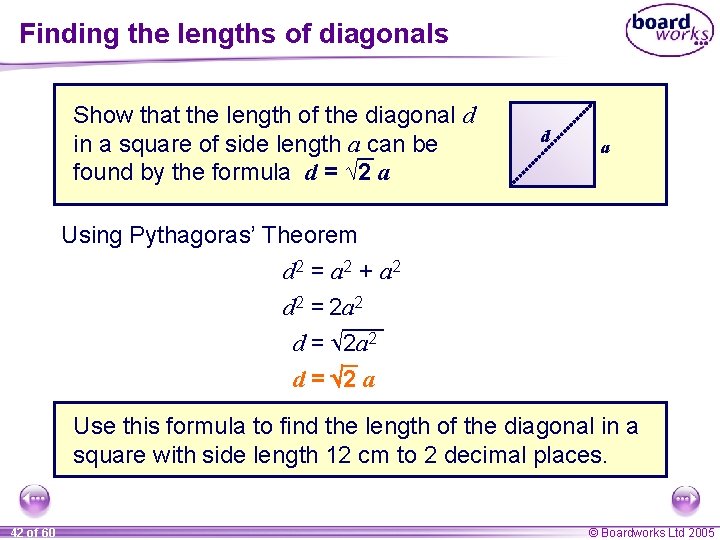
Finding the lengths of diagonals Show that the length of the diagonal d in a square of side length a can be found by the formula d = √ 2 a d a Using Pythagoras’ Theorem d 2 = a 2 + a 2 d 2 = 2 a 2 d = 2 a Use this formula to find the length of the diagonal in a square with side length 12 cm to 2 decimal places. 42 of 60 © Boardworks Ltd 2005
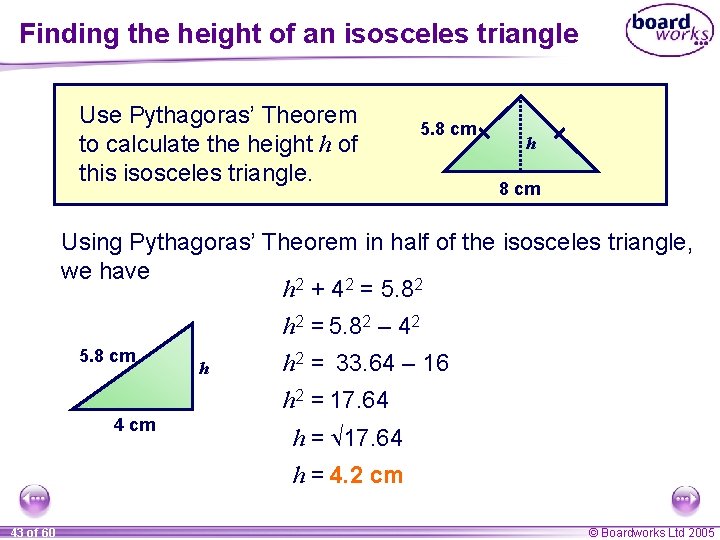
Finding the height of an isosceles triangle Use Pythagoras’ Theorem to calculate the height h of this isosceles triangle. 5. 8 cm h 8 cm Using Pythagoras’ Theorem in half of the isosceles triangle, we have h 2 + 42 = 5. 82 h 2 = 5. 82 – 42 5. 8 cm h h 2 = 33. 64 – 16 h 2 = 17. 64 4 cm h = 17. 64 h = 4. 2 cm 43 of 60 © Boardworks Ltd 2005
Finding the height of an equilateral triangle Use Pythagoras’ Theorem to calculate the height h of an equilateral triangle with side length 4 cm. h 4 cm Using Pythagoras’ Theorem in half of the equilateral triangle, we have h 2 + 22 = 42 h 4 cm 2 cm 44 of 60 h 2 = 42 – 22 h 2 = 16 – 4 h 2 = 12 h = 3. 46 cm (to 2 d. p. ) © Boardworks Ltd 2005
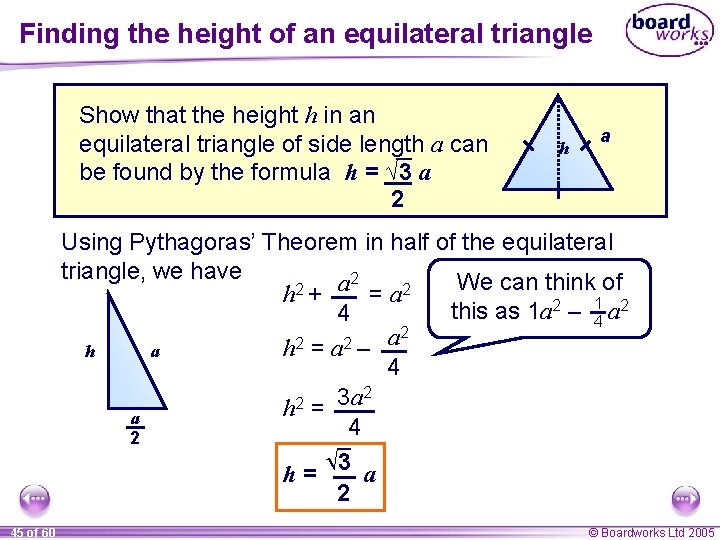
Finding the height of an equilateral triangle Show that the height h in an equilateral triangle of side length a can be found by the formula h = √ 3 a 2 h a Using Pythagoras’ Theorem in half of the equilateral triangle, we have 2 We can think of a 2 h + = a 2 this as 1 a 2 – 14 a 2 4 2 a 2 2 h =a – a h 4 2 3 a 2 h = a 4 2 h = 3 a 2 45 of 60 © Boardworks Ltd 2005
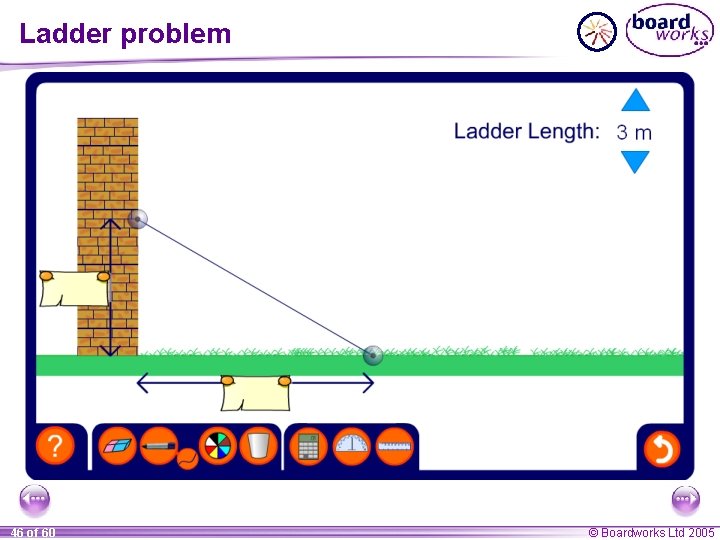
Ladder problem 46 of 60 © Boardworks Ltd 2005
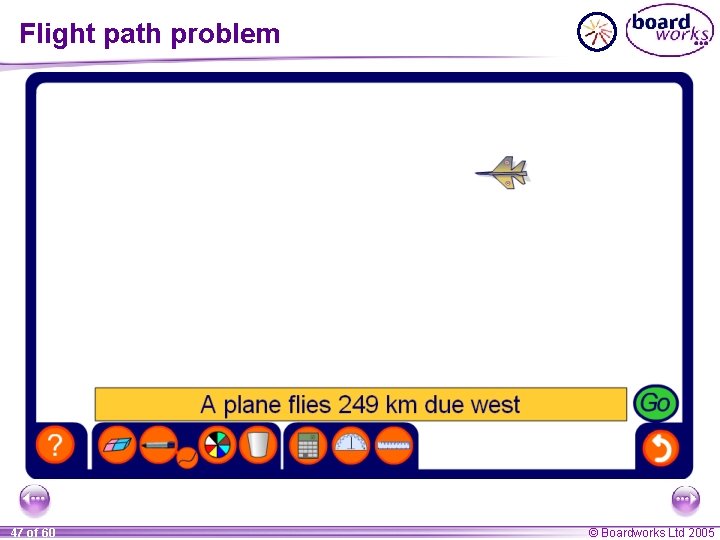
Flight path problem 47 of 60 © Boardworks Ltd 2005
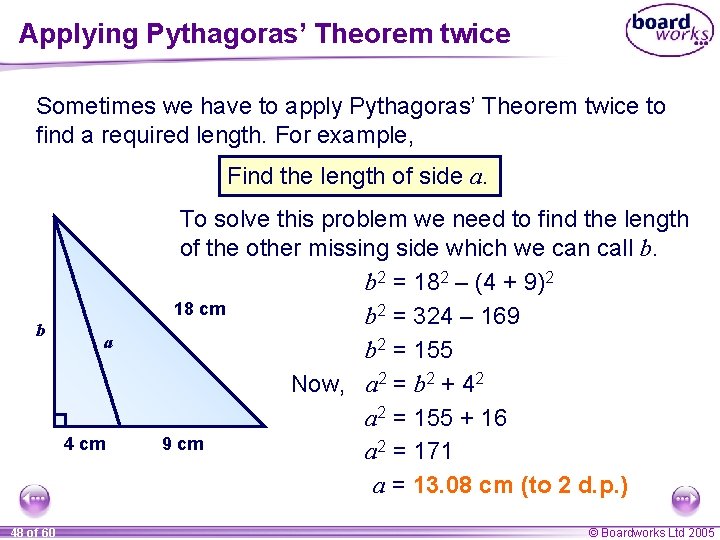
Applying Pythagoras’ Theorem twice Sometimes we have to apply Pythagoras’ Theorem twice to find a required length. For example, Find the length of side a. b a 4 cm 48 of 60 To solve this problem we need to find the length of the other missing side which we can call b. b 2 = 182 – (4 + 9)2 18 cm b 2 = 324 – 169 b 2 = 155 Now, a 2 = b 2 + 42 a 2 = 155 + 16 9 cm a 2 = 171 a = 13. 08 cm (to 2 d. p. ) © Boardworks Ltd 2005
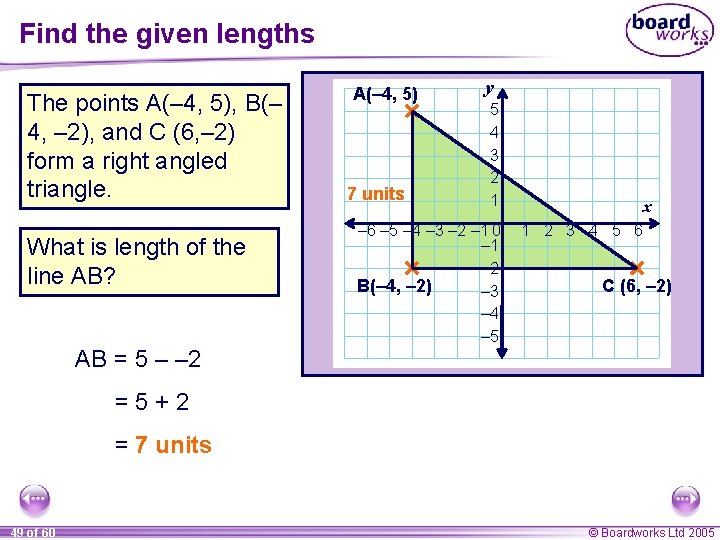
Find the given lengths The points A(– 4, 5), B(– 4, – 2), and C (6, – 2) form a right angled triangle. What is length of the line AB? A(– 4, 5) 7 units y 5 4 3 2 1 – 6 – 5 – 4 – 3 – 2 – 1 0 – 1 – 2 B(– 4, – 2) – 3 – 4 – 5 x 1 2 3 4 5 6 C (6, – 2) AB = 5 – – 2 =5+2 = 7 units 49 of 60 © Boardworks Ltd 2005
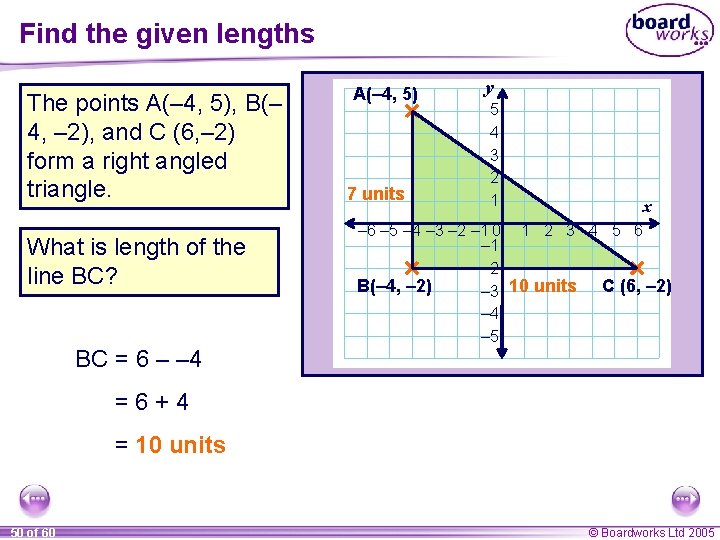
Find the given lengths The points A(– 4, 5), B(– 4, – 2), and C (6, – 2) form a right angled triangle. What is length of the line BC? A(– 4, 5) 7 units y 5 4 3 2 1 x – 6 – 5 – 4 – 3 – 2 – 1 0 1 2 3 4 5 6 – 1 – 2 B(– 4, – 2) C (6, – 2) – 3 10 units – 4 – 5 BC = 6 – – 4 =6+4 = 10 units 50 of 60 © Boardworks Ltd 2005
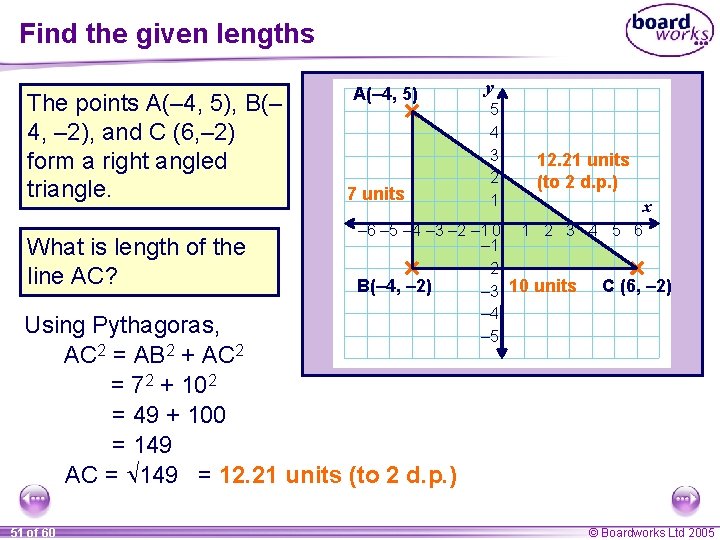
Find the given lengths The points A(– 4, 5), B(– 4, – 2), and C (6, – 2) form a right angled triangle. What is length of the line AC? A(– 4, 5) 7 units y 5 4 3 2 1 12. 21 units (to 2 d. p. ) x – 6 – 5 – 4 – 3 – 2 – 1 0 1 2 3 4 5 6 – 1 – 2 B(– 4, – 2) C (6, – 2) – 3 10 units – 4 – 5 Using Pythagoras, AC 2 = AB 2 + AC 2 = 72 + 102 = 49 + 100 = 149 AC = 149 = 12. 21 units (to 2 d. p. ) 51 of 60 © Boardworks Ltd 2005
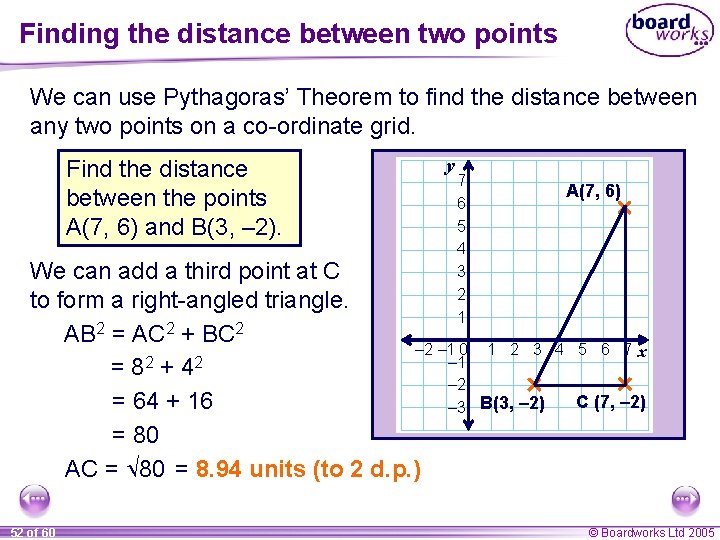
Finding the distance between two points We can use Pythagoras’ Theorem to find the distance between any two points on a co-ordinate grid. Find the distance between the points A(7, 6) and B(3, – 2). y 7 6 5 4 3 2 1 We can add a third point at C to form a right-angled triangle. AB 2 = AC 2 + BC 2 – 1 0 – 1 = 82 + 4 2 – 2 = 64 + 16 – 3 = 80 AC = 80 = 8. 94 units (to 2 d. p. ) 52 of 60 A(7, 6) 1 2 3 4 5 6 7 x B(3, – 2) C (7, – 2) © Boardworks Ltd 2005
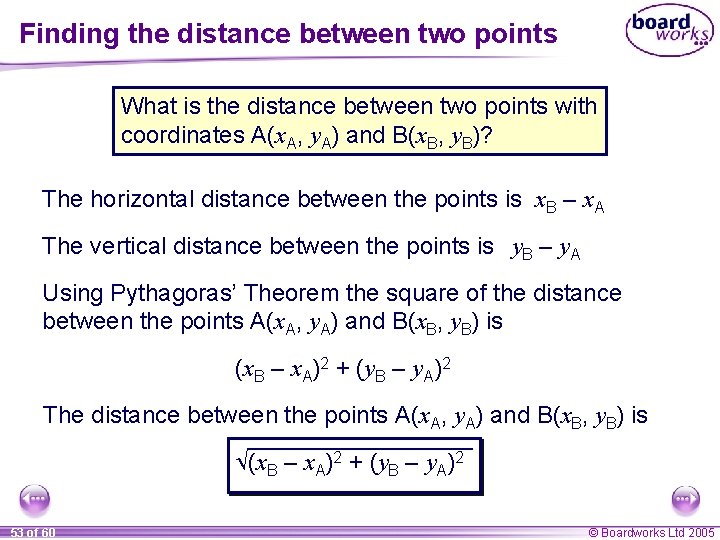
Finding the distance between two points What is the distance between two points with coordinates A(x. A, y. A) and B(x. B, y. B)? The horizontal distance between the points is x. B – x. A The vertical distance between the points is y. B – y. A Using Pythagoras’ Theorem the square of the distance between the points A(x. A, y. A) and B(x. B, y. B) is (x. B – x. A)2 + (y. B – y. A)2 The distance between the points A(x. A, y. A) and B(x. B, y. B) is (x. B – x. A)2 + (y. B – y. A)2 53 of 60 © Boardworks Ltd 2005
Solving problems using Pythagoras’ Theorem As we have seen Pythagoras’ Theorem can be used to solve a great many problems involving the lengths in right-angled triangles. When solving a problem using Pythagoras’ Theorem always do the following: Draw a clearly labelled diagram of the situation, making sure you identify which side is the hypotenuse and which are the shorter sides. State Pythagoras’ Theorem for the given side lengths before substituting any values. Make sure that your answer is sensible given the lengths of the other two sides. 54 of 60 © Boardworks Ltd 2005
Contents S 2 Pythagoras’ Theorem A S 2. 1 Introducing Pythagoras’ Theorem A S 2. 2 Identifying right-angled triangles A S 2. 3 Pythagorean triples A S 2. 4 Finding unknown lengths A S 2. 5 Applying Pythagoras’ Theorem in 2 -D A S 2. 6 Applying Pythagoras’ Theorem in 3 -D 55 of 60 © Boardworks Ltd 2005
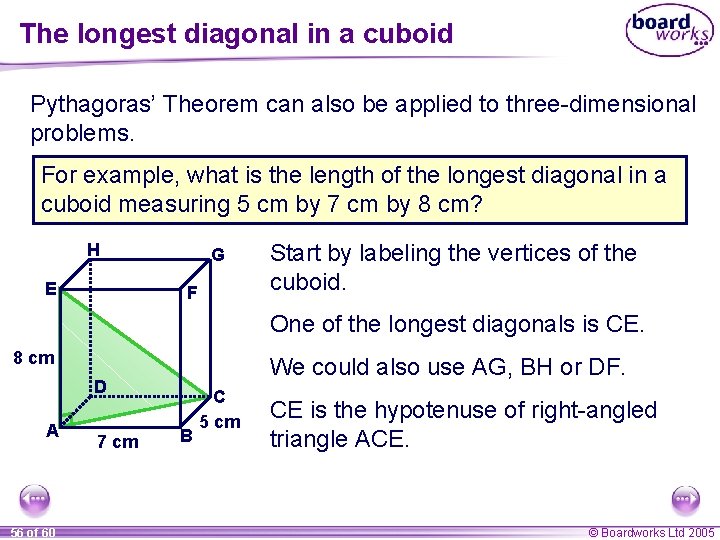
The longest diagonal in a cuboid Pythagoras’ Theorem can also be applied to three-dimensional problems. For example, what is the length of the longest diagonal in a cuboid measuring 5 cm by 7 cm by 8 cm? H E G F Start by labeling the vertices of the cuboid. One of the longest diagonals is CE. 8 cm We could also use AG, BH or DF. D A 56 of 60 7 cm B C 5 cm CE is the hypotenuse of right-angled triangle ACE. © Boardworks Ltd 2005
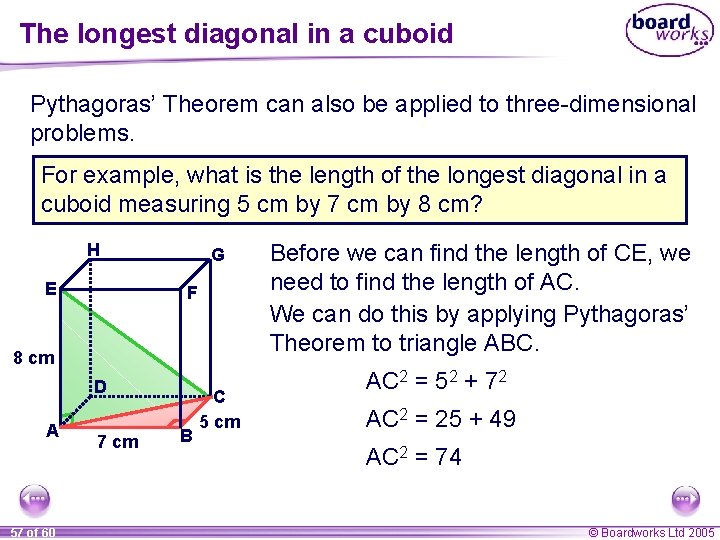
The longest diagonal in a cuboid Pythagoras’ Theorem can also be applied to three-dimensional problems. For example, what is the length of the longest diagonal in a cuboid measuring 5 cm by 7 cm by 8 cm? H E G F 8 cm D A 57 of 60 7 cm B C 5 cm Before we can find the length of CE, we need to find the length of AC. We can do this by applying Pythagoras’ Theorem to triangle ABC. AC 2 = 52 + 72 AC 2 = 25 + 49 AC 2 = 74 © Boardworks Ltd 2005
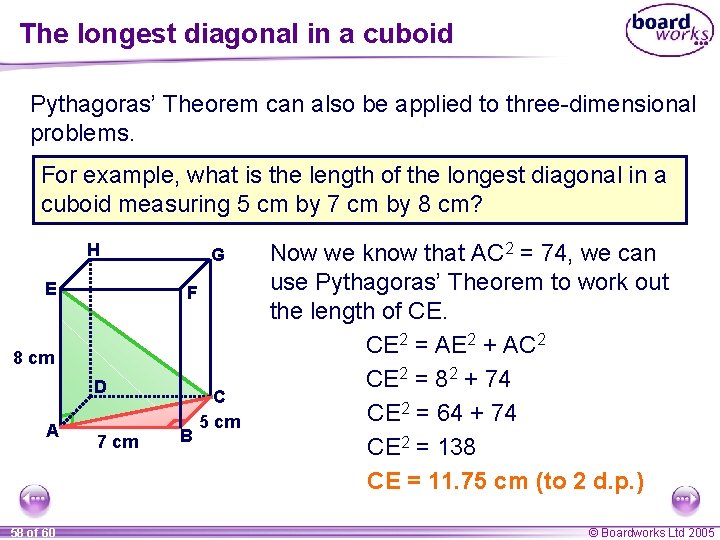
The longest diagonal in a cuboid Pythagoras’ Theorem can also be applied to three-dimensional problems. For example, what is the length of the longest diagonal in a cuboid measuring 5 cm by 7 cm by 8 cm? H E G F 8 cm D A 58 of 60 7 cm B C 5 cm Now we know that AC 2 = 74, we can use Pythagoras’ Theorem to work out the length of CE. CE 2 = AE 2 + AC 2 CE 2 = 82 + 74 CE 2 = 64 + 74 CE 2 = 138 CE = 11. 75 cm (to 2 d. p. ) © Boardworks Ltd 2005
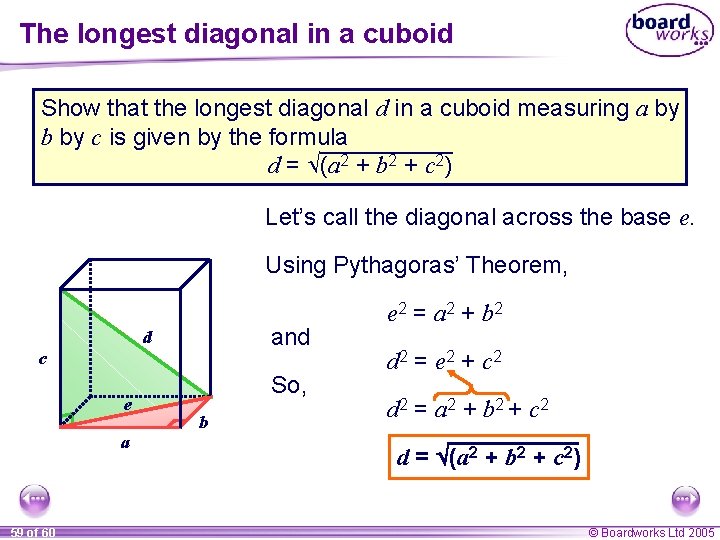
The longest diagonal in a cuboid Show that the longest diagonal d in a cuboid measuring a by b by c is given by the formula d = (a 2 + b 2 + c 2) Let’s call the diagonal across the base e. Using Pythagoras’ Theorem, and d c e a 59 of 60 So, b e 2 = a 2 + b 2 d 2 = e 2 + c 2 d 2 = a 2 + b 2 + c 2 d = (a 2 + b 2 + c 2) © Boardworks Ltd 2005
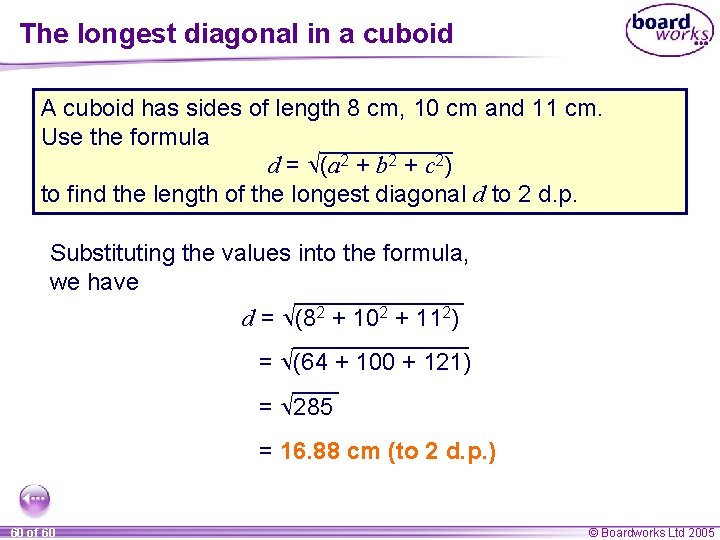
The longest diagonal in a cuboid A cuboid has sides of length 8 cm, 10 cm and 11 cm. Use the formula d = (a 2 + b 2 + c 2) to find the length of the longest diagonal d to 2 d. p. Substituting the values into the formula, we have d = (82 + 102 + 112) = (64 + 100 + 121) = 285 = 16. 88 cm (to 2 d. p. ) 60 of 60 © Boardworks Ltd 2005