
Pythagorean Theorem the square of the hypotenuse the


- Slides: 93
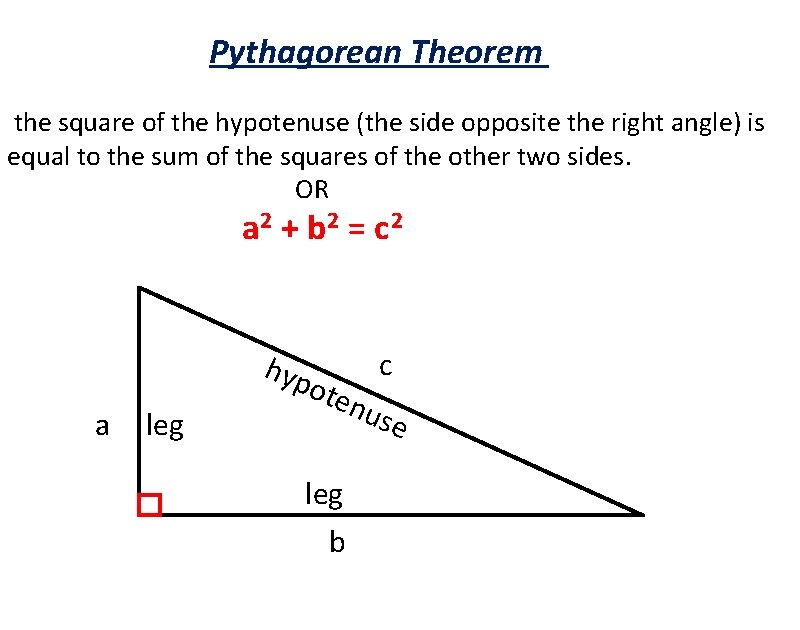
Pythagorean Theorem the square of the hypotenuse (the side opposite the right angle) is equal to the sum of the squares of the other two sides. OR a 2 + b 2 = c 2 hyp a leg ote n leg b c use
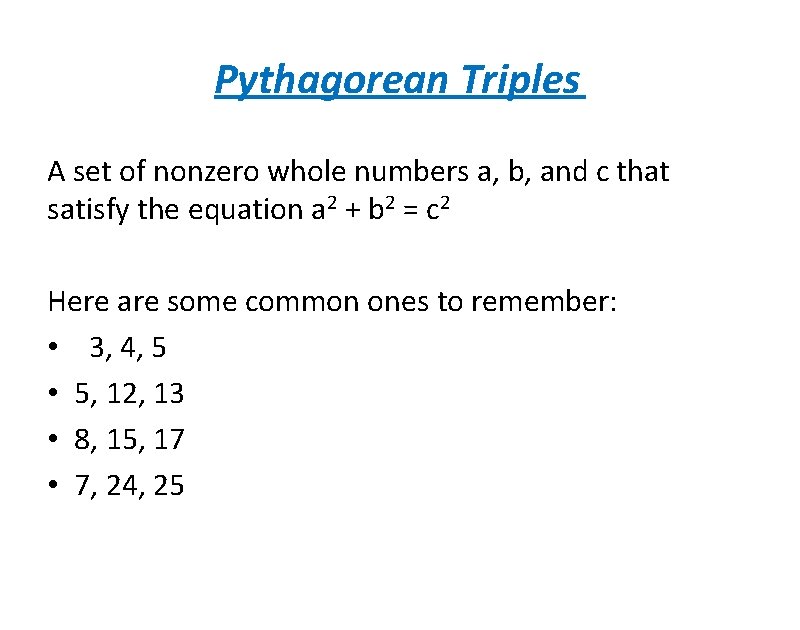
Pythagorean Triples A set of nonzero whole numbers a, b, and c that satisfy the equation a 2 + b 2 = c 2 Here are some common ones to remember: • 3, 4, 5 • 5, 12, 13 • 8, 15, 17 • 7, 24, 25
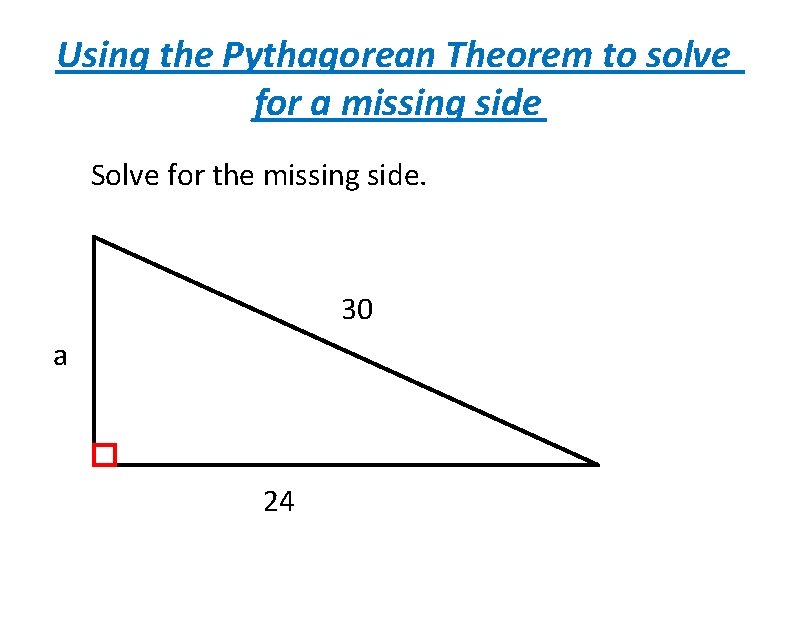
Using the Pythagorean Theorem to solve for a missing side Solve for the missing side. 30 a 24
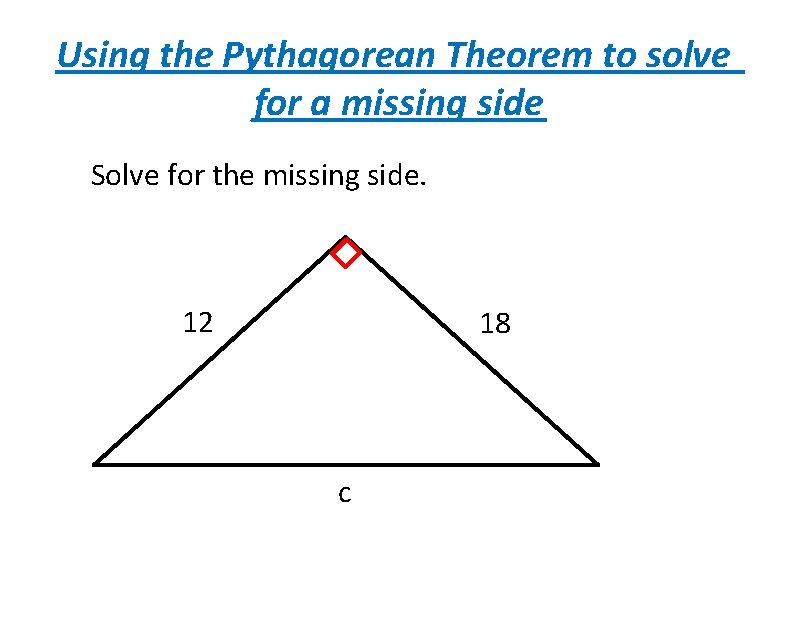
Using the Pythagorean Theorem to solve for a missing side Solve for the missing side. 12 18 c
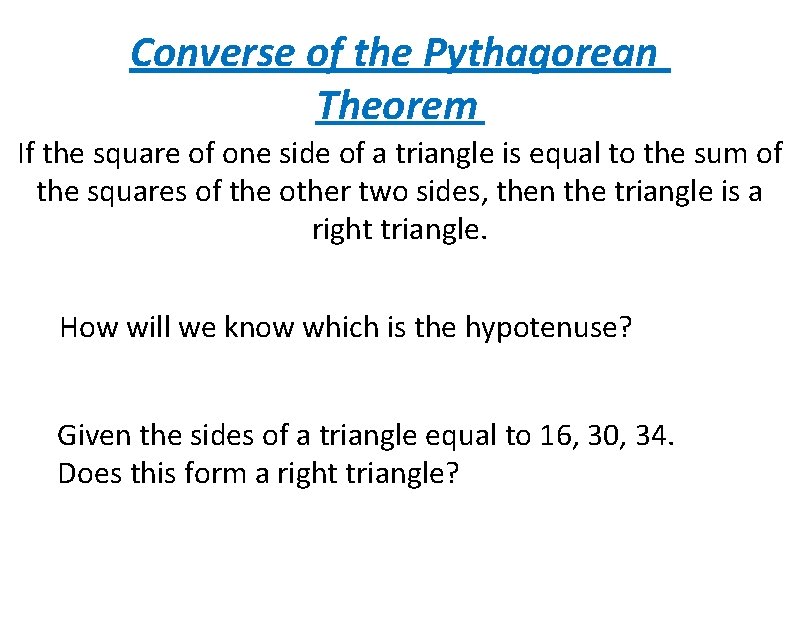
Converse of the Pythagorean Theorem If the square of one side of a triangle is equal to the sum of the squares of the other two sides, then the triangle is a right triangle. How will we know which is the hypotenuse? Given the sides of a triangle equal to 16, 30, 34. Does this form a right triangle?
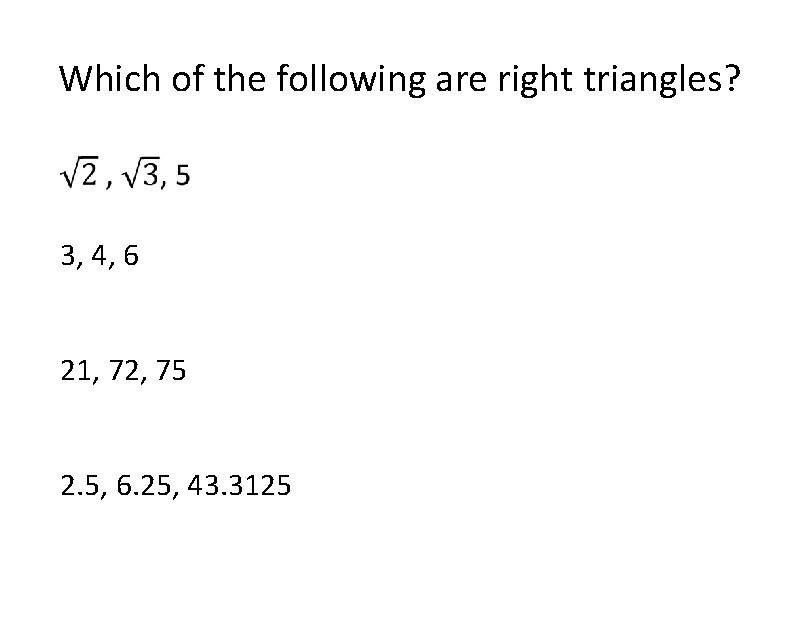
Which of the following are right triangles? 3, 4, 6 21, 72, 75 2. 5, 6. 25, 43. 3125
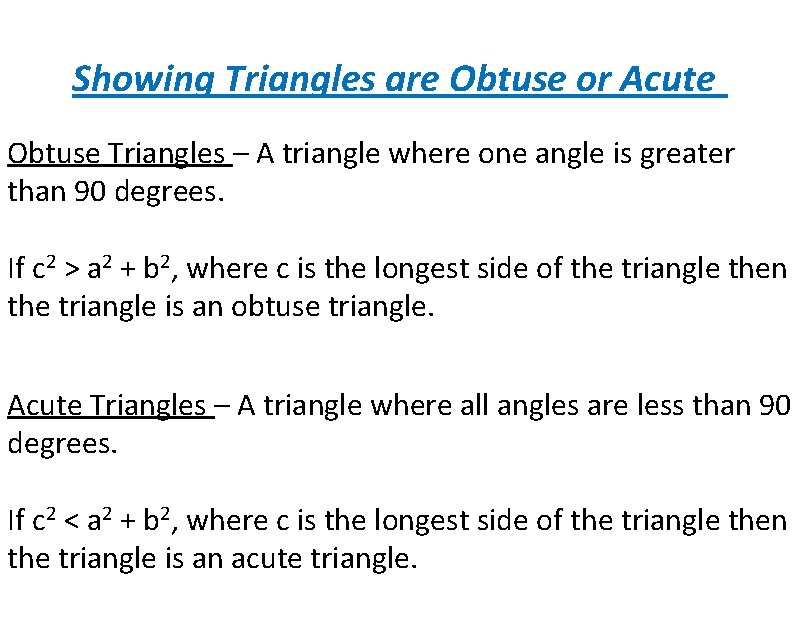
Showing Triangles are Obtuse or Acute Obtuse Triangles – A triangle where one angle is greater than 90 degrees. If c 2 > a 2 + b 2, where c is the longest side of the triangle then the triangle is an obtuse triangle. Acute Triangles – A triangle where all angles are less than 90 degrees. If c 2 < a 2 + b 2, where c is the longest side of the triangle then the triangle is an acute triangle.
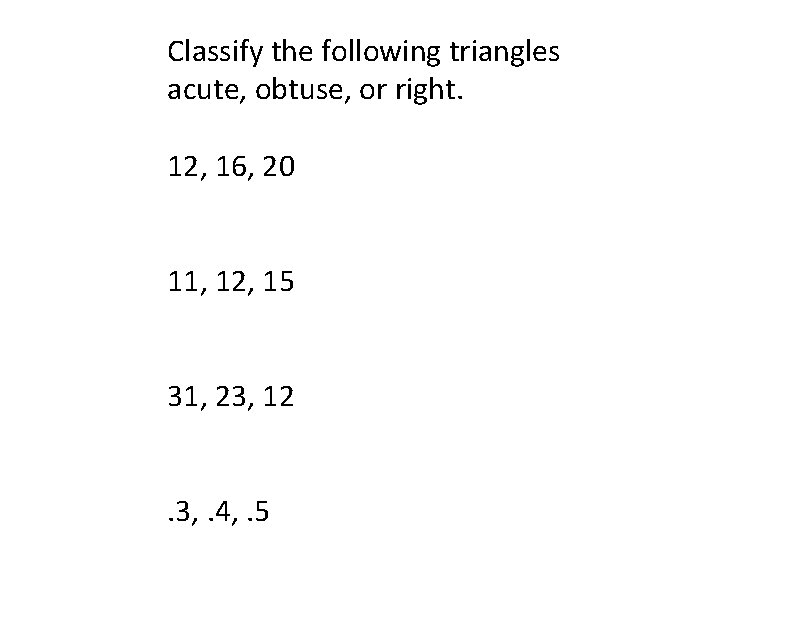
Classify the following triangles acute, obtuse, or right. 12, 16, 20 11, 12, 15 31, 23, 12. 3, . 4, . 5
End of Day 1 P 361 2 -16 evens, 22 -38 evens
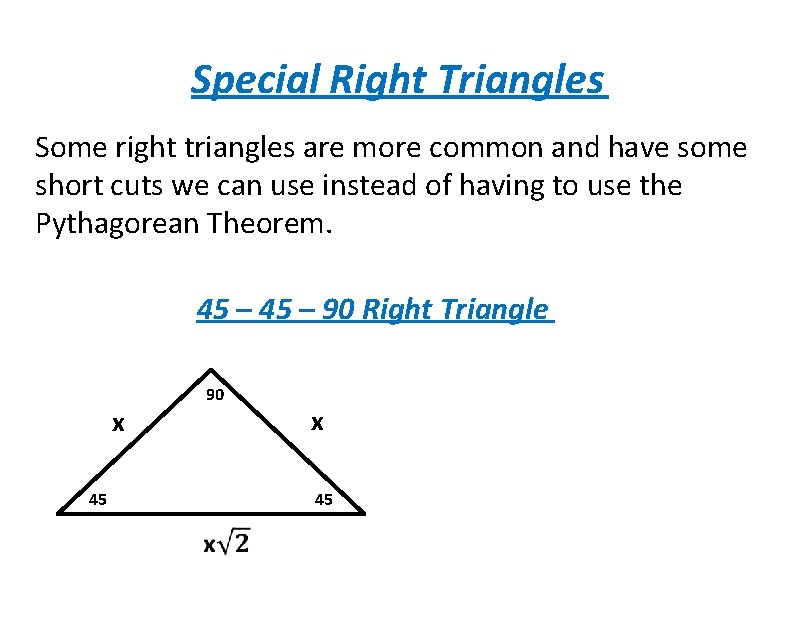
Special Right Triangles Some right triangles are more common and have some short cuts we can use instead of having to use the Pythagorean Theorem. 45 – 90 Right Triangle x 90 45 x 45
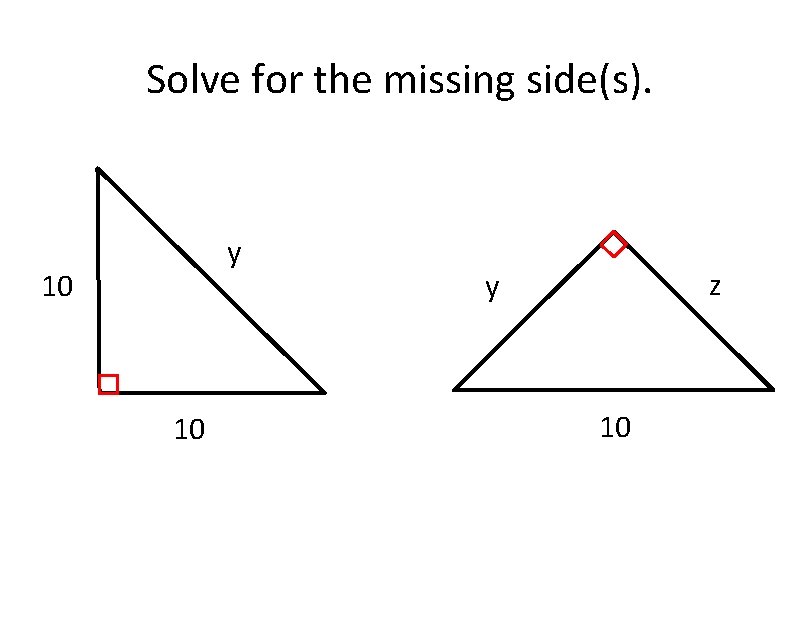
Solve for the missing side(s). y 10 10 z y 10
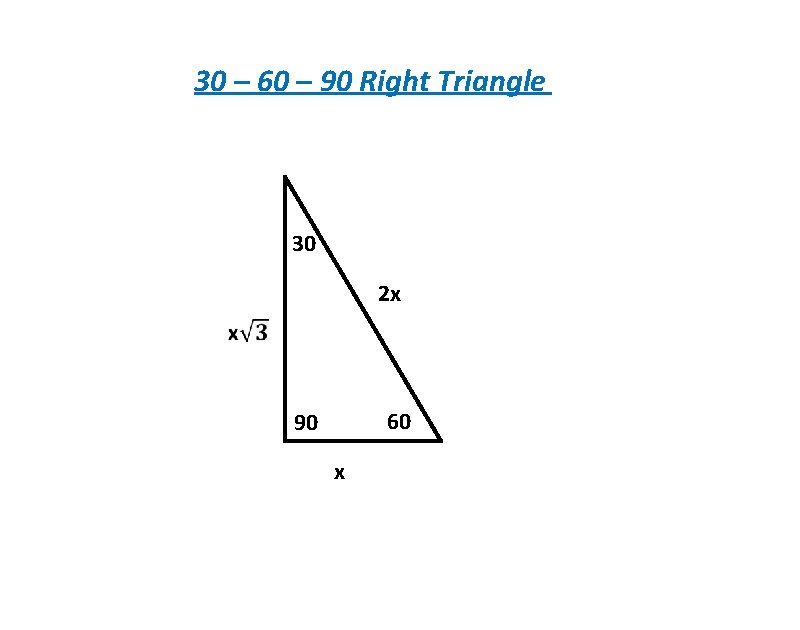
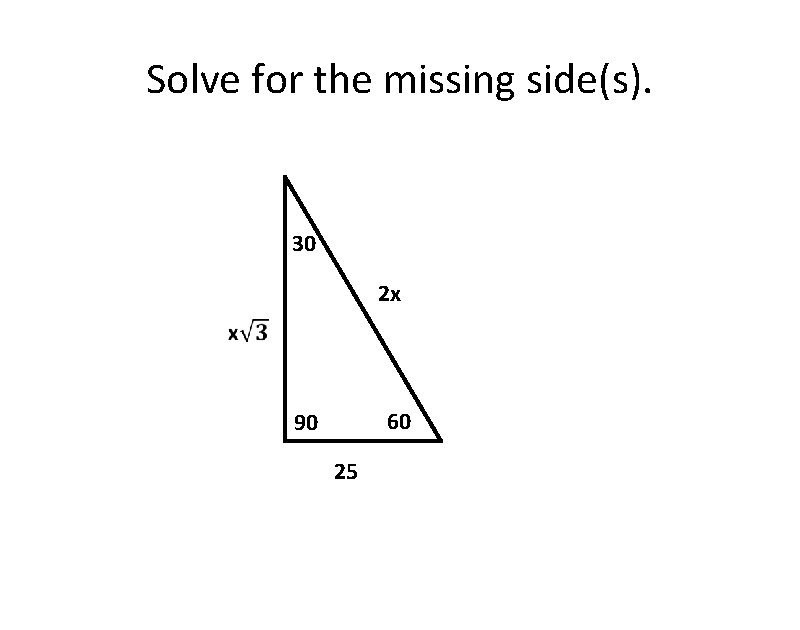
30 – 60 – 90 Right Triangle 30 2 x 60 90 x
Solve for the missing side(s). 30 2 x 60 90 25
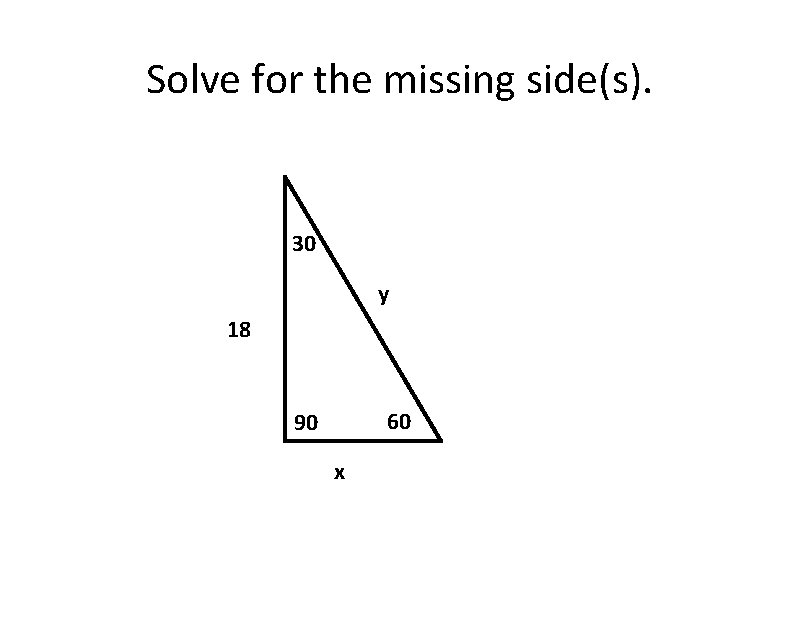
Solve for the missing side(s). 30 y 18 60 90 x
End of Day 2 P 369 2 -20 even and 24 -29 all
Math 2 Unit 4: "Right Triangle Trigonometry” Title: Using Trigonometric Ratios to find Sides. Objective: To use the trigonometric ratios to find the lengths of sides in right triangles.
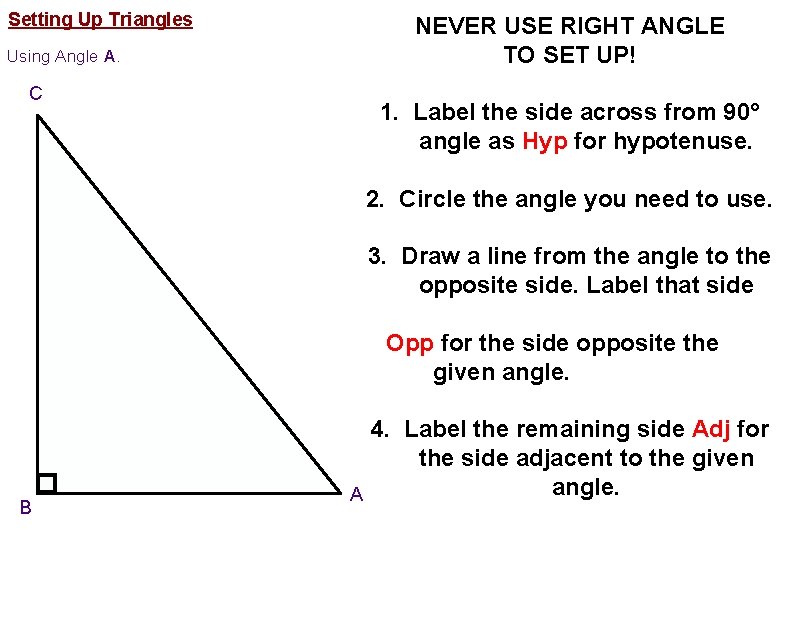
Setting Up Triangles NEVER USE RIGHT ANGLE TO SET UP! Using Angle A. C 1. Label the side across from 90° angle as Hyp for hypotenuse. 2. Circle the angle you need to use. 3. Draw a line from the angle to the opposite side. Label that side Opp for the side opposite the given angle. B A 4. Label the remaining side Adj for the side adjacent to the given angle.
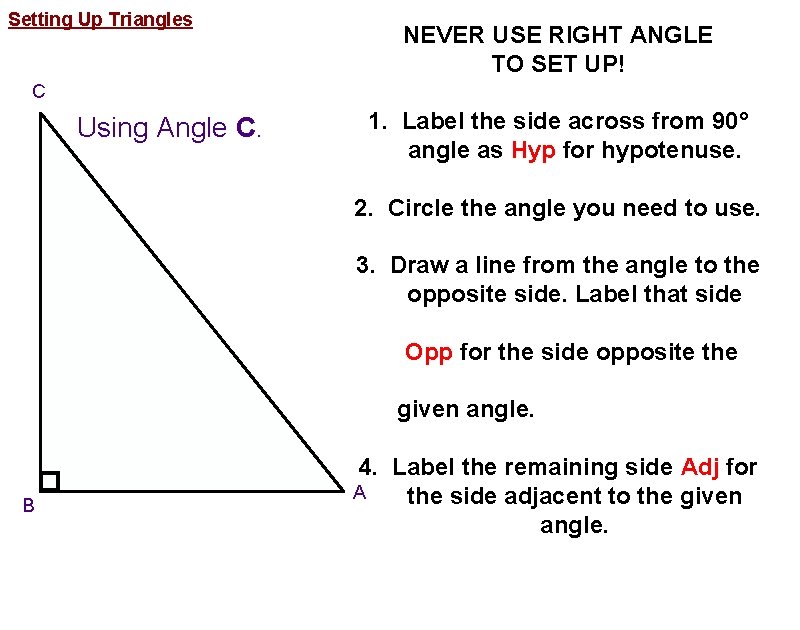
Setting Up Triangles NEVER USE RIGHT ANGLE TO SET UP! C Using Angle C. 1. Label the side across from 90° angle as Hyp for hypotenuse. 2. Circle the angle you need to use. 3. Draw a line from the angle to the opposite side. Label that side Opp for the side opposite the given angle. B 4. Label the remaining side Adj for A the side adjacent to the given angle.
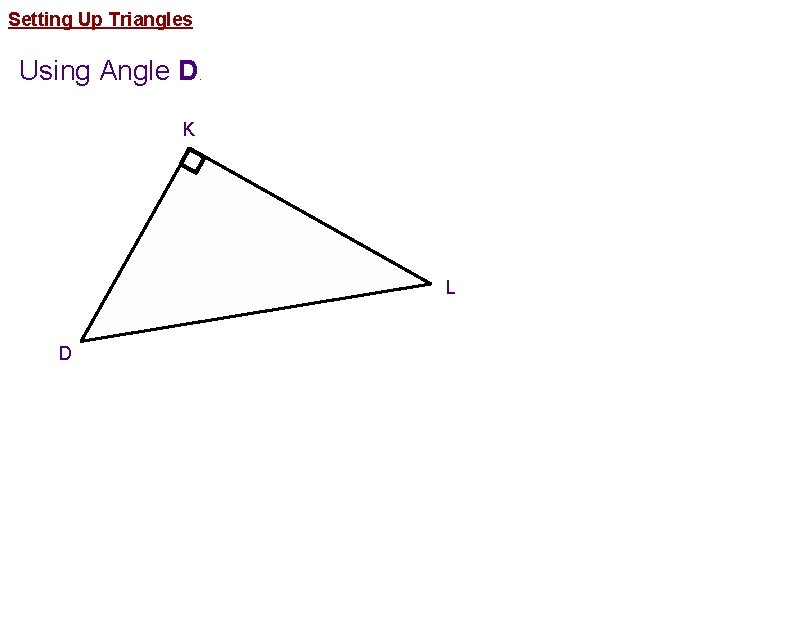
Setting Up Triangles Using Angle D. K L D
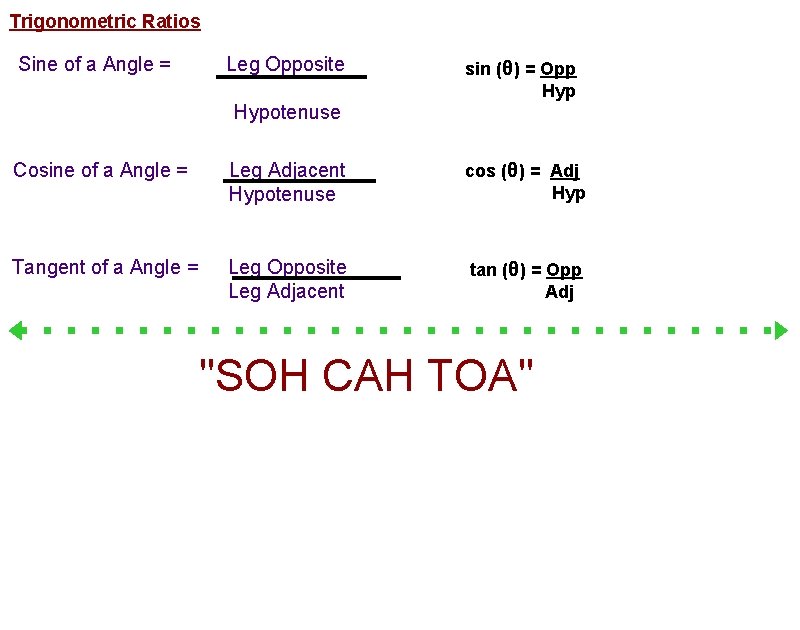
Trigonometric Ratios Sine of a Angle = Leg Opposite Hypotenuse sin (θ) = Opp Hyp Cosine of a Angle = Leg Adjacent Hypotenuse cos (θ) = Adj Hyp Tangent of a Angle = Leg Opposite Leg Adjacent tan (θ) = Opp Adj "SOH CAH TOA"
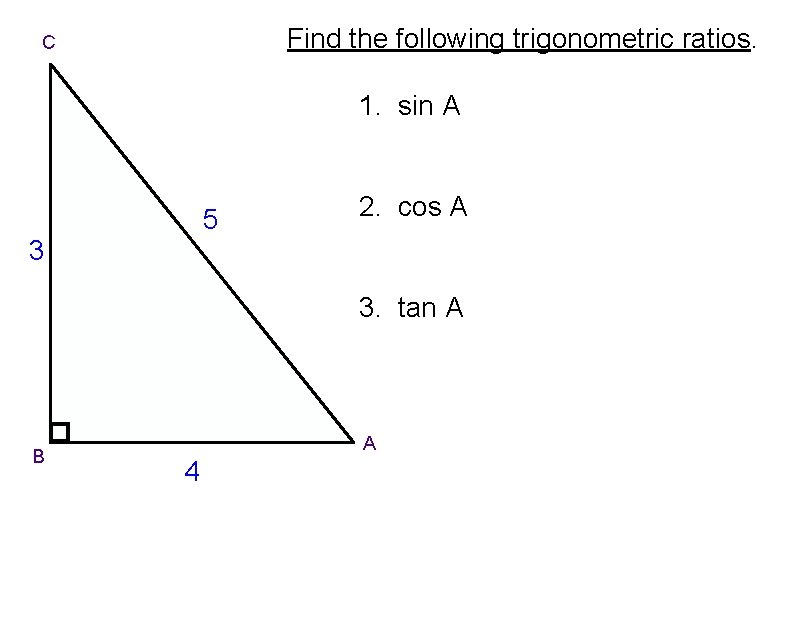
Find the following trigonometric ratios. C 1. sin A 5 3 2. cos A 3. tan A B A 4
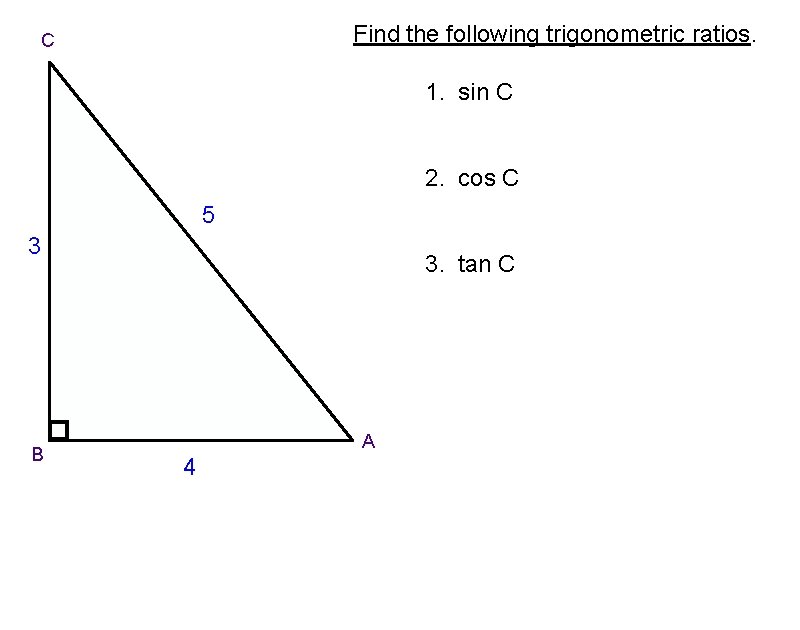
Find the following trigonometric ratios. C 1. sin C 2. cos C 5 3 B 3. tan C A 4
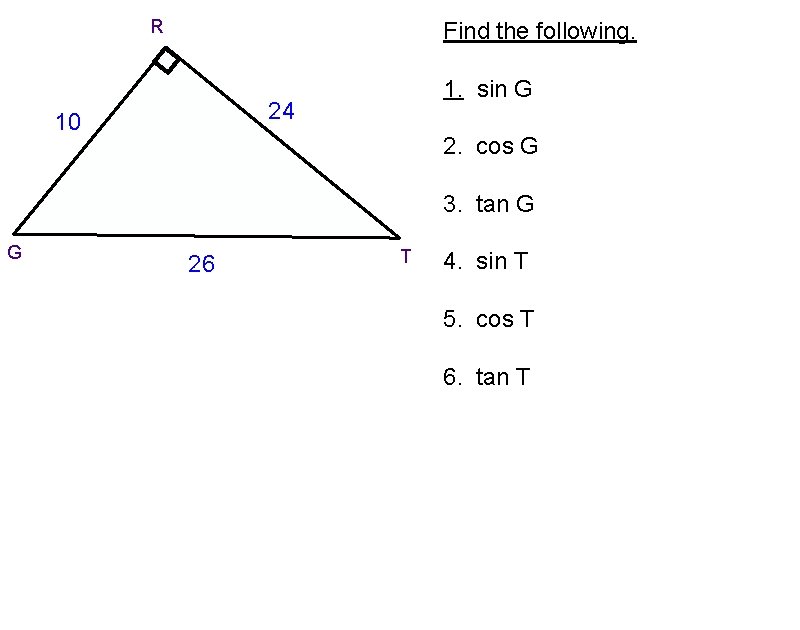
R Find the following. 1. sin G 24 10 2. cos G 3. tan G G 26 T 4. sin T 5. cos T 6. tan T
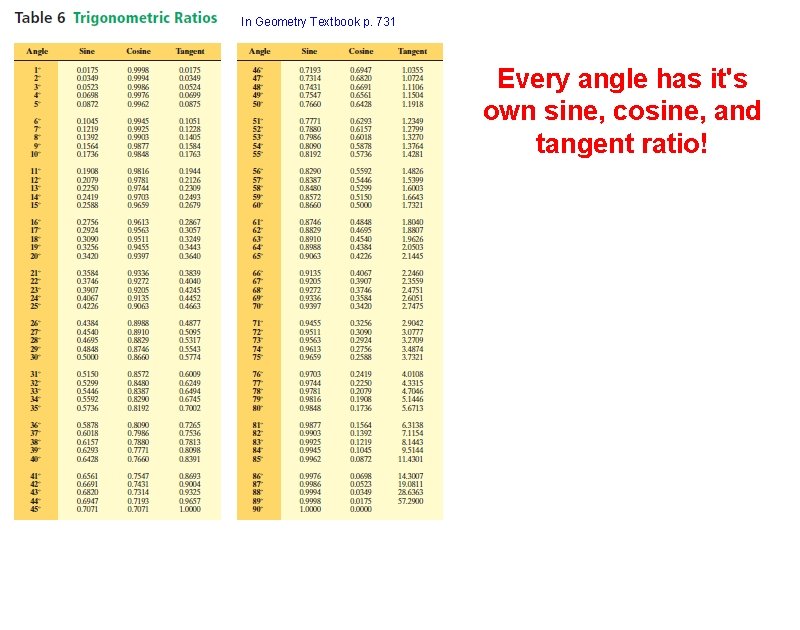
In Geometry Textbook p. 731 Every angle has it's own sine, cosine, and tangent ratio!
Officer Be N. Degrees gr De s ee gr De Deg rees D eg re es s ee gr De Check your P mode O es re g De T S es re g De es gre De
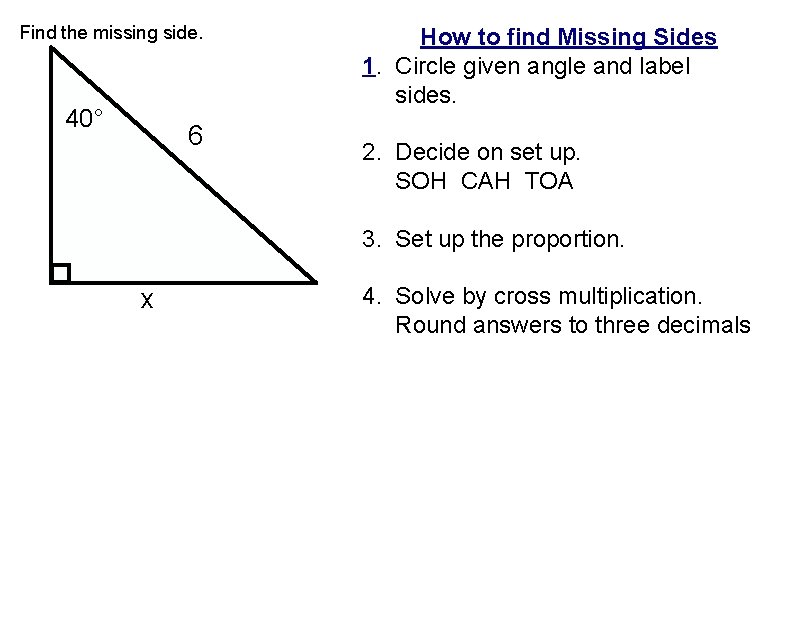
Find the missing side. 40° 6 How to find Missing Sides 1. Circle given angle and label sides. 2. Decide on set up. SOH CAH TOA 3. Set up the proportion. x 4. Solve by cross multiplication. Round answers to three decimals
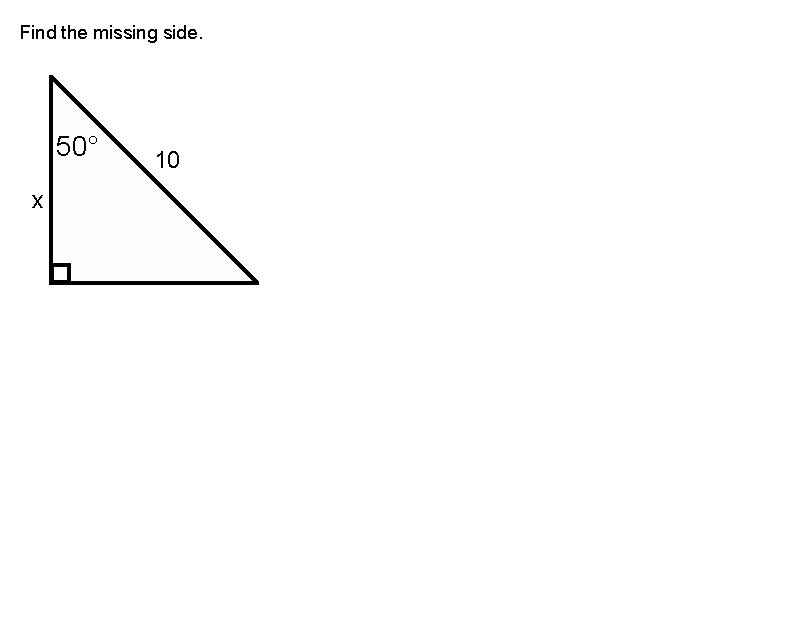
Find the missing side. 50° x 10
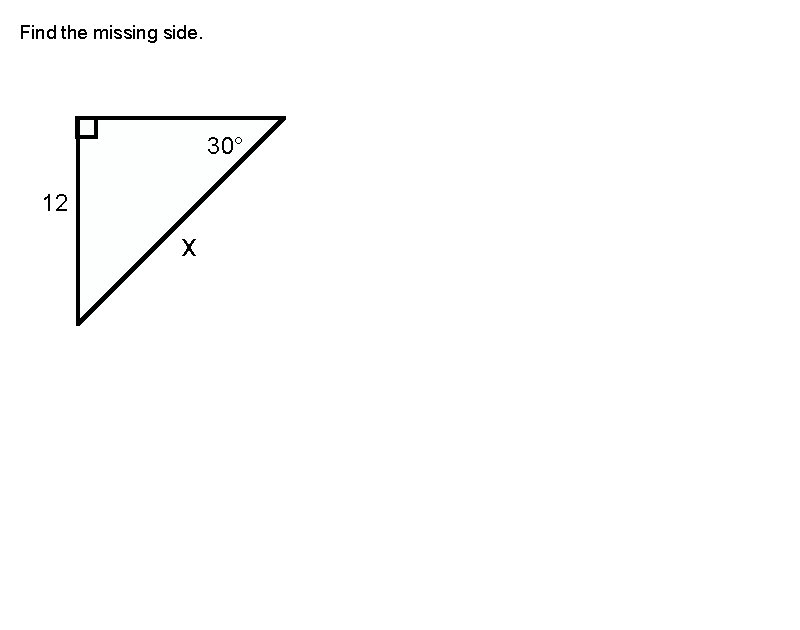
Find the missing side. 30° 12 x
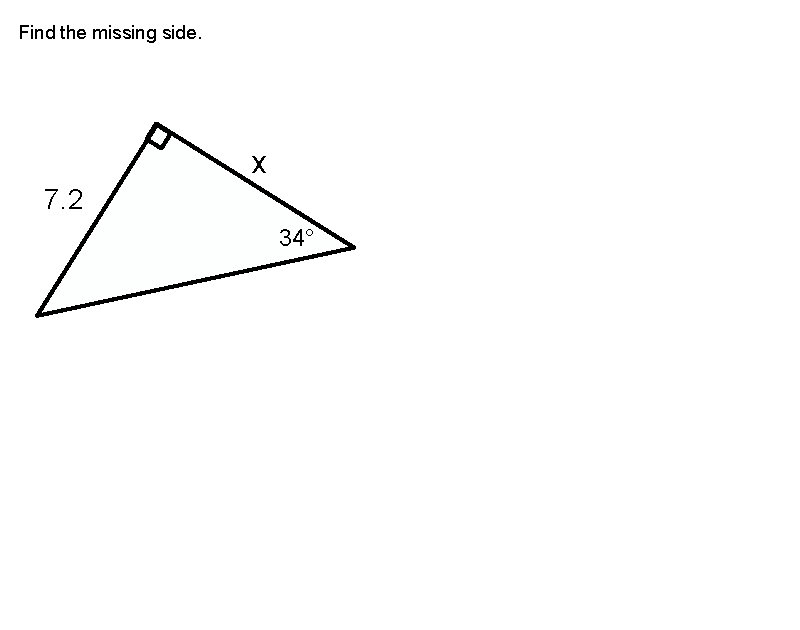
Find the missing side. x 7. 2 34°
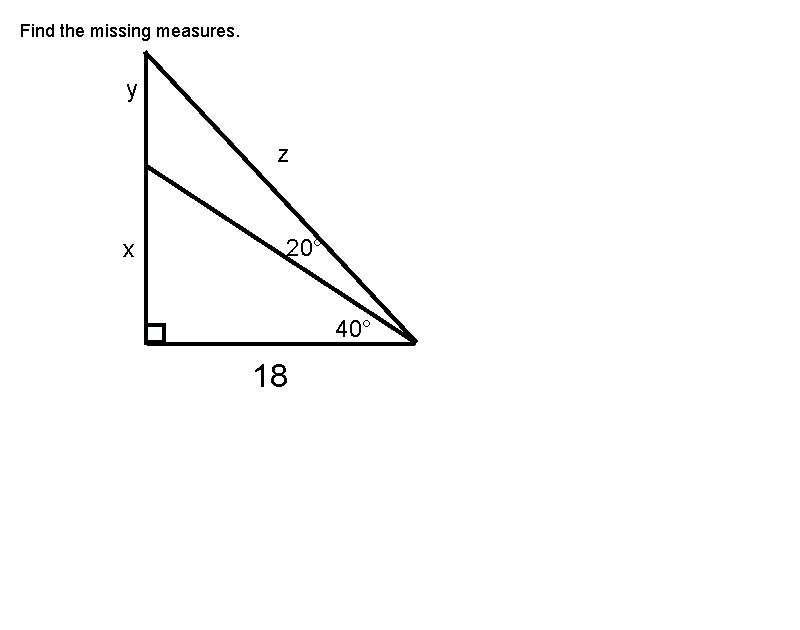
Find the missing measures. y z x 20° 40° 18
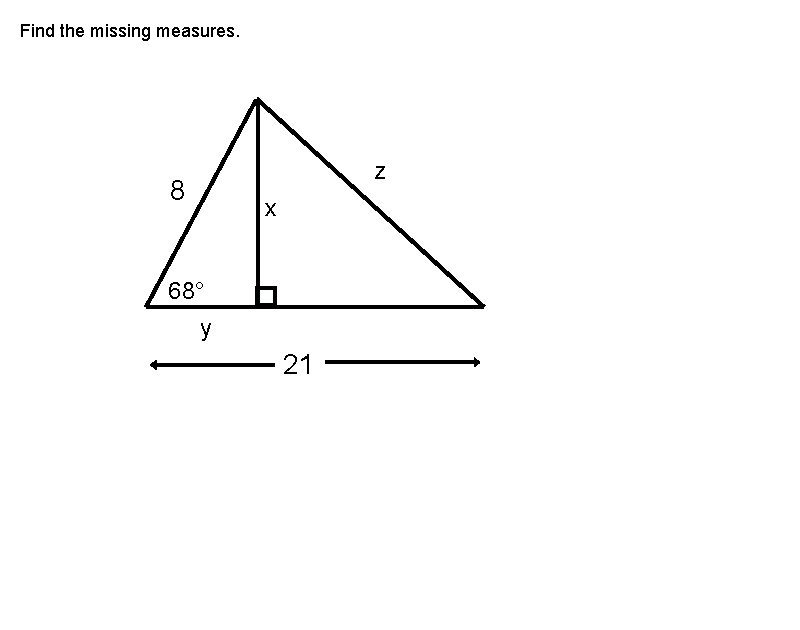
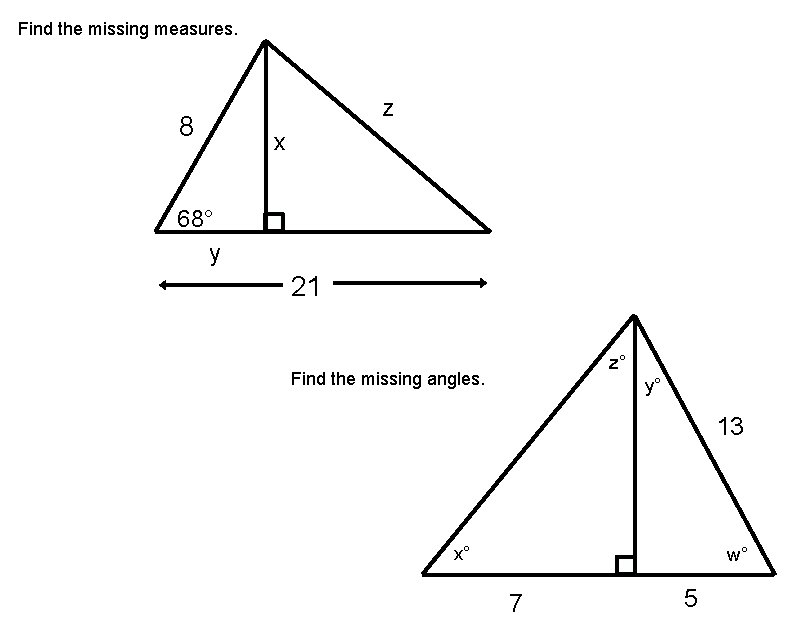
Find the missing measures. z 8 x 68° y 21
End of Day 3 P 479 3 -10, 28, 41 -43
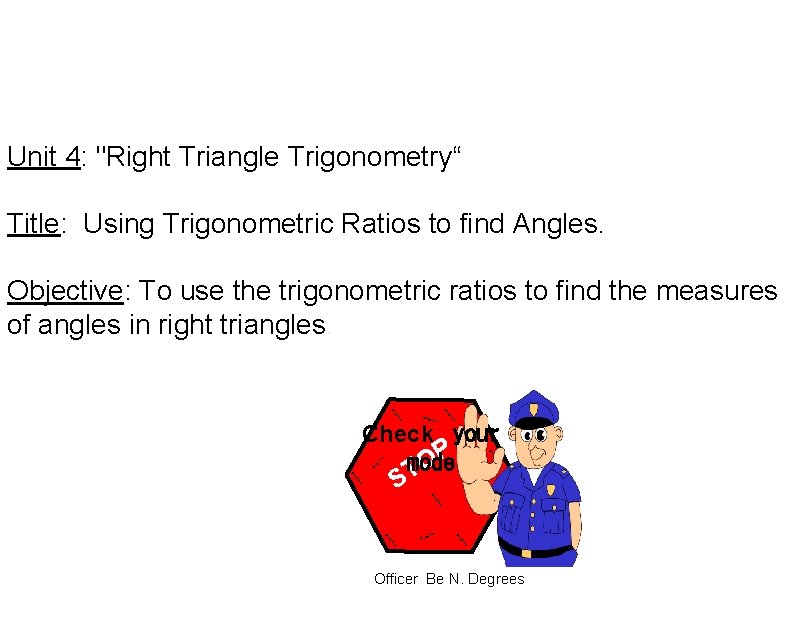
Unit 4: "Right Triangle Trigonometry“ Title: Using Trigonometric Ratios to find Angles. Objective: To use the trigonometric ratios to find the measures of angles in right triangles. rees s ee gr De Deg eg re es s ee gr De Check your P mode O T D s ee gr De S s ee gr De es gre De Officer Be N. Degrees
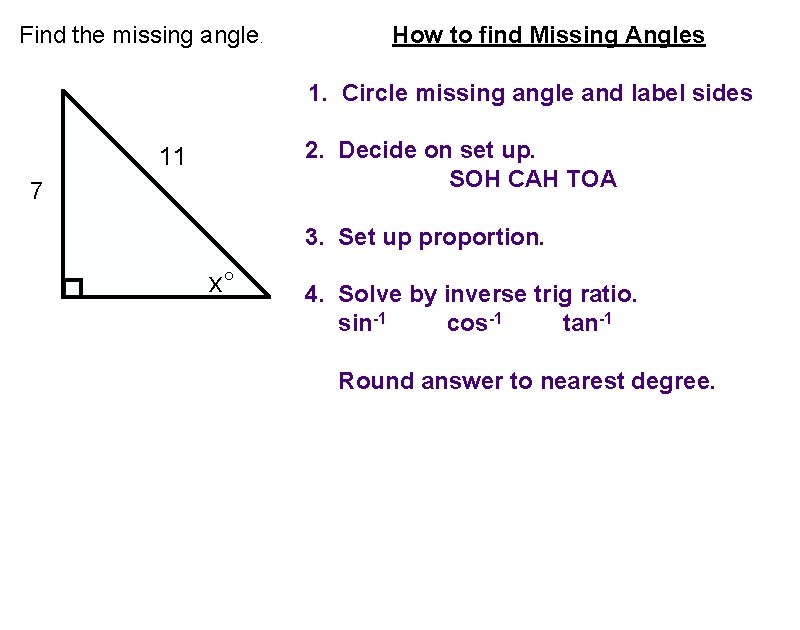
Find the missing angle. How to find Missing Angles 1. Circle missing angle and label sides 2. Decide on set up. SOH CAH TOA 11 7 3. Set up proportion. x° 4. Solve by inverse trig ratio. sin-1 cos-1 tan-1 Round answer to nearest degree.
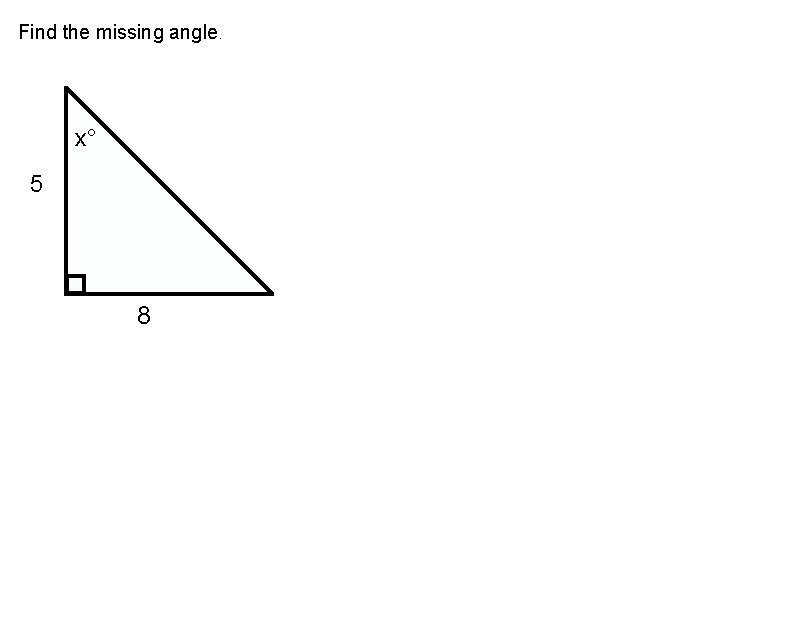
Find the missing angle. x° 5 8
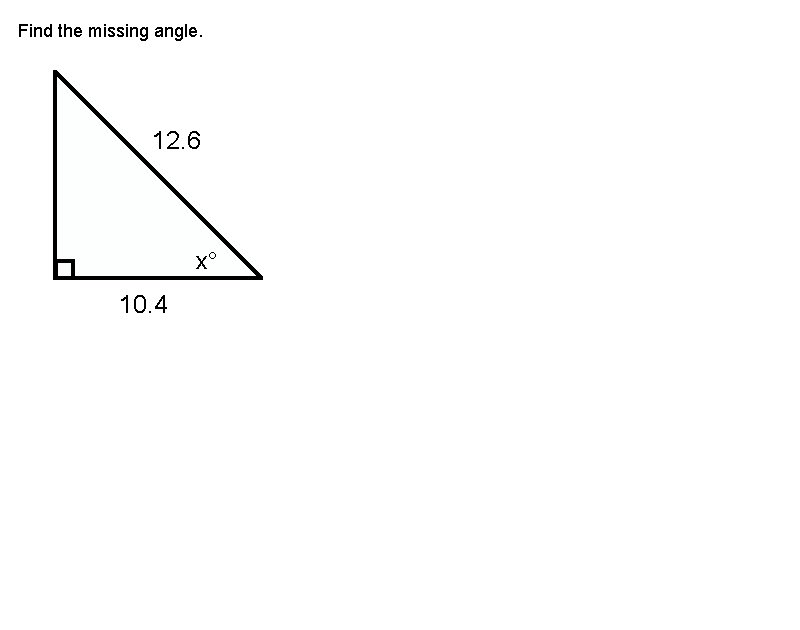
Find the missing angle. 12. 6 x° 10. 4
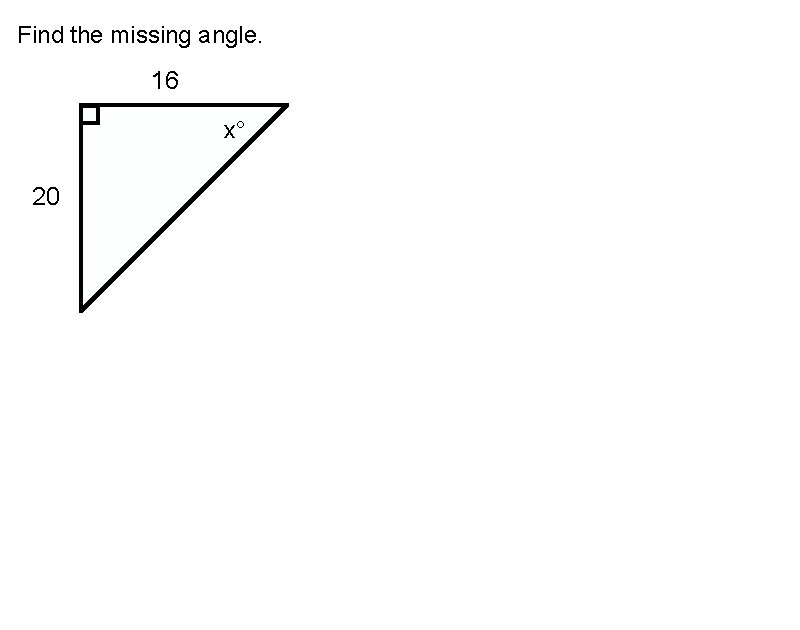
Find the missing angle. 16 x° 20
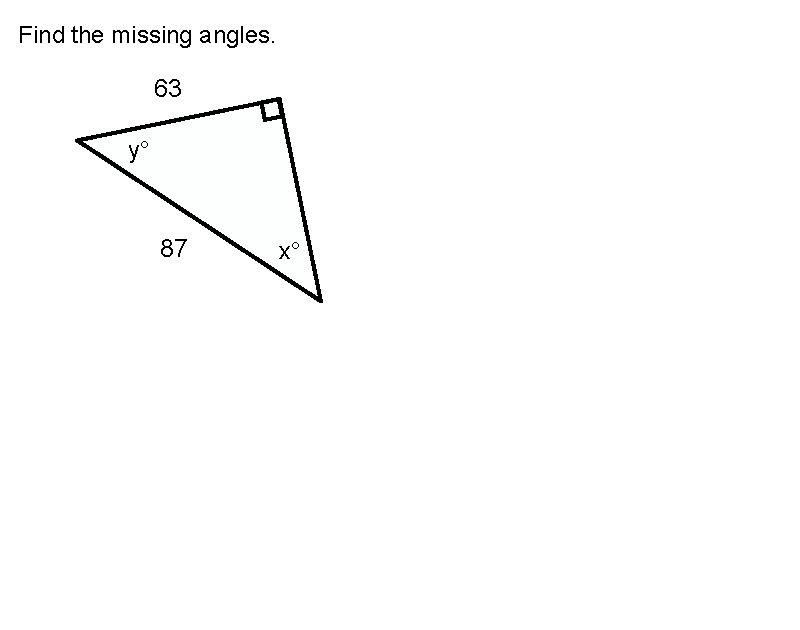
Find the missing angles. 63 y° 87 x°
Find the missing angles. z° y° 13 x° w° 7 5
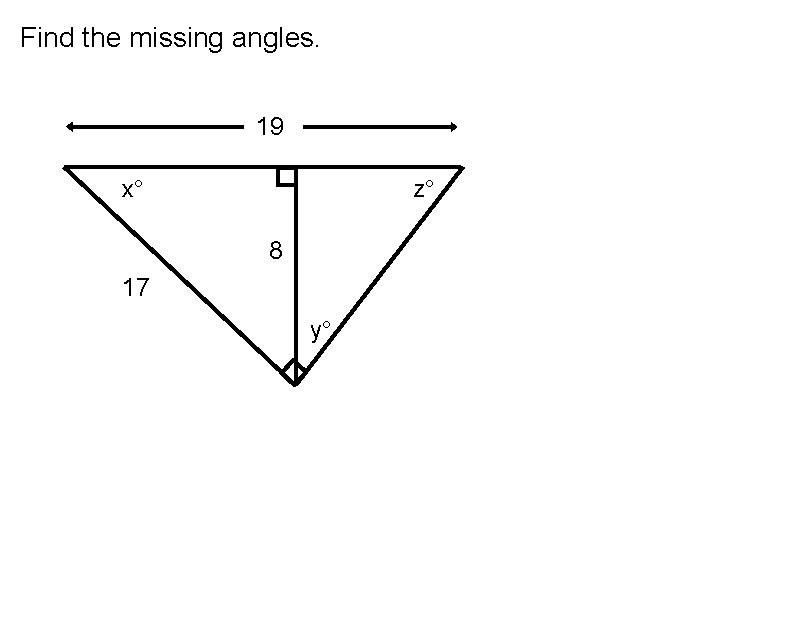
Find the missing angles. 19 z° x° 8 17 y°
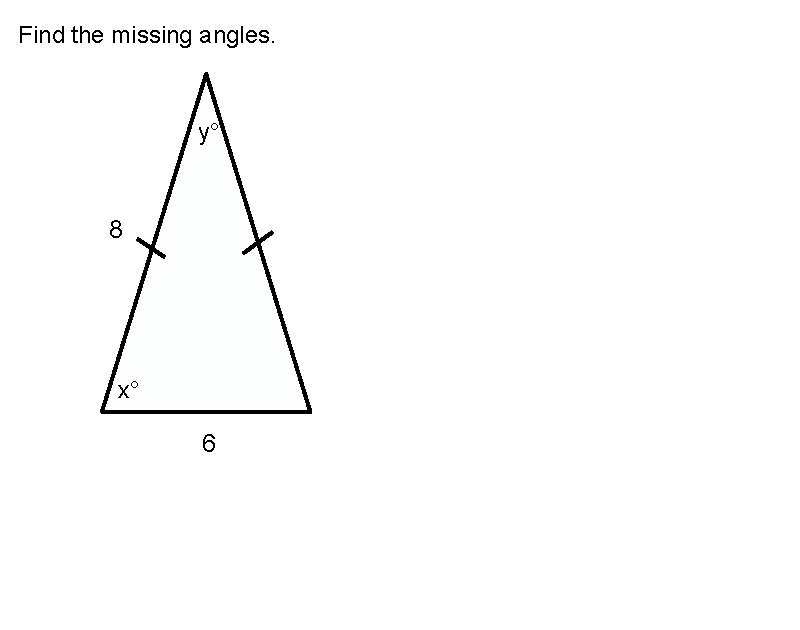
Find the missing angles. y° 8 x° 6
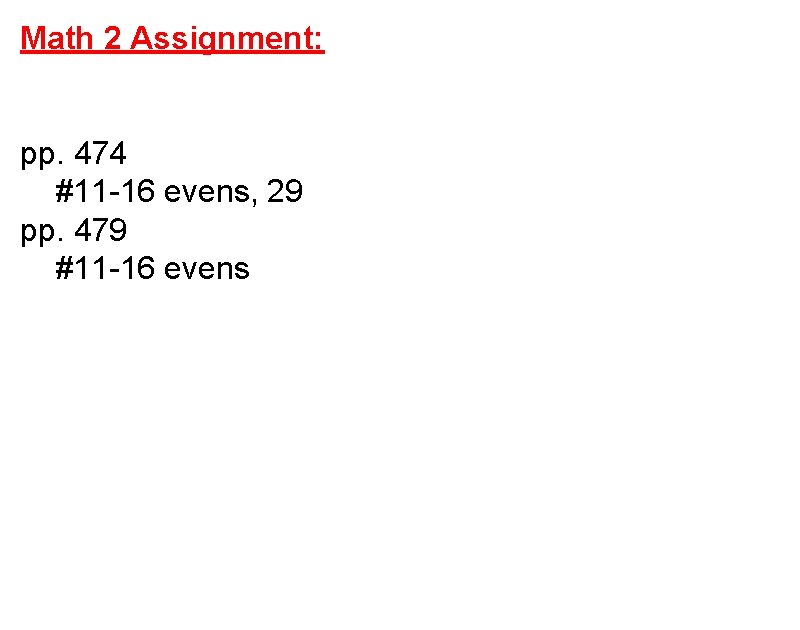
Math 2 Assignment: pp. 474 #11 -16 evens, 29 pp. 479 #11 -16 evens
Find the missing measures. 8 z x 68° y 21 z° Find the missing angles. y° 13 x° w° 7 5
Math 2 Unit 4 Lesson 2 Unit 4: "Right Triangle Trigonometry“ Title: Application - Angles of Elevation and Depression Objective: To use angles of elevation and angles of depression to find measures.
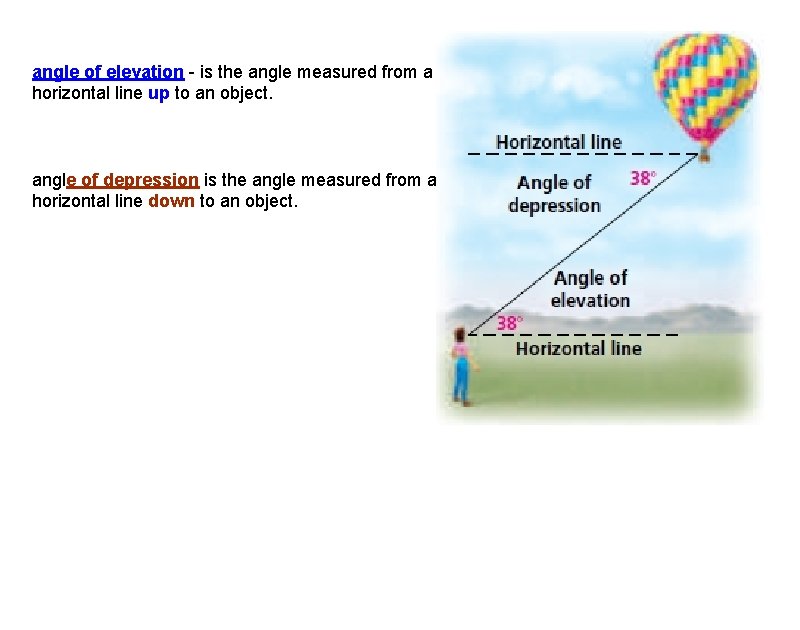
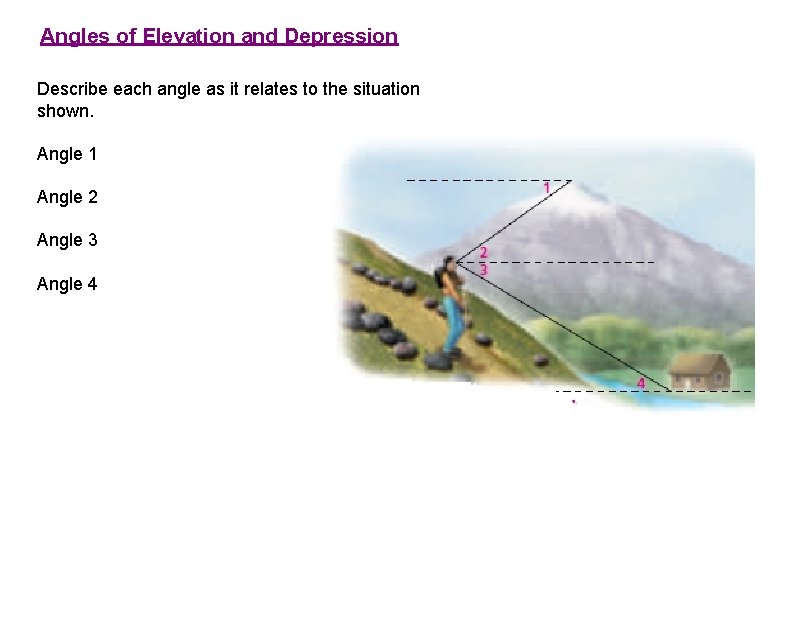
angle of elevation - is the angle measured from a horizontal line up to an object. angle of depression is the angle measured from a horizontal line down to an object.
Angles of Elevation and Depression Describe each angle as it relates to the situation shown. Angle 1 Angle 2 Angle 3 Angle 4
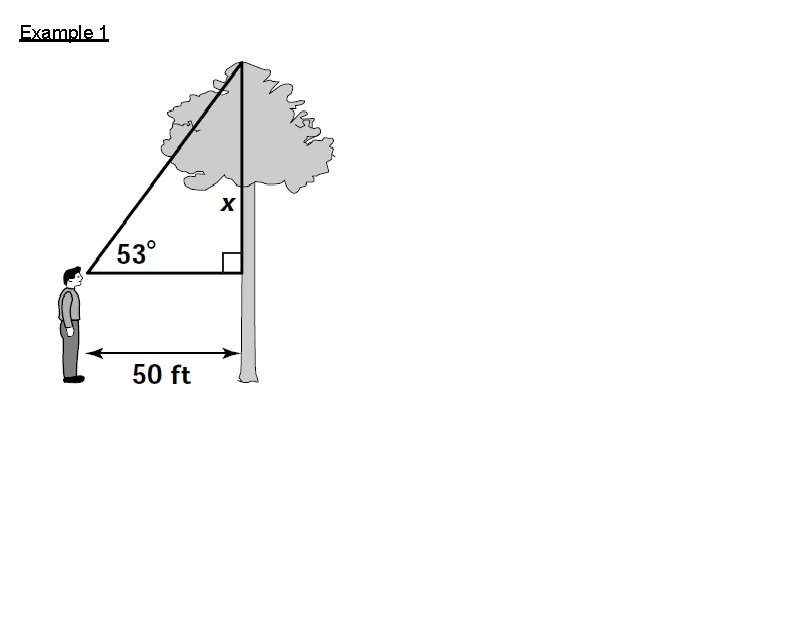
Example 1
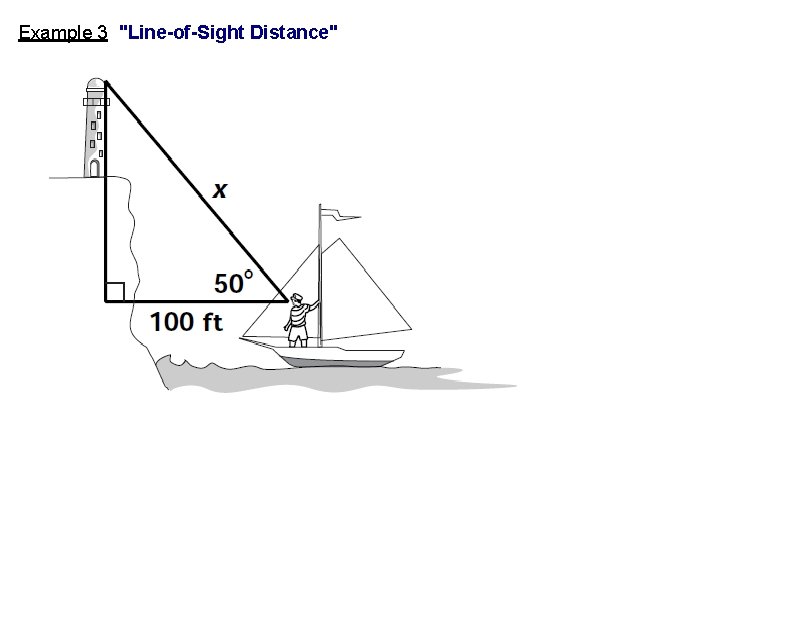
Example 3 "Line-of-Sight Distance"
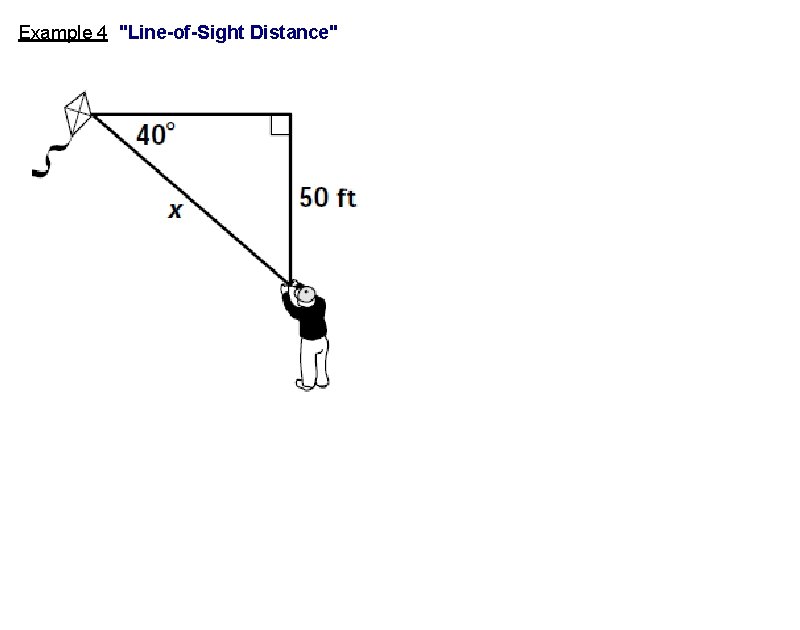
Example 4 "Line-of-Sight Distance"
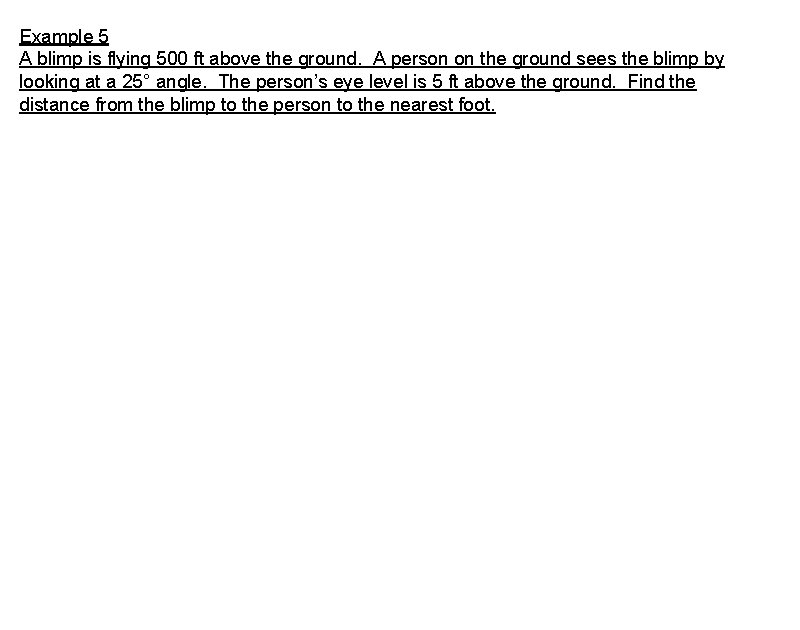
Example 5 A blimp is flying 500 ft above the ground. A person on the ground sees the blimp by looking at a 25° angle. The person’s eye level is 5 ft above the ground. Find the distance from the blimp to the person to the nearest foot.
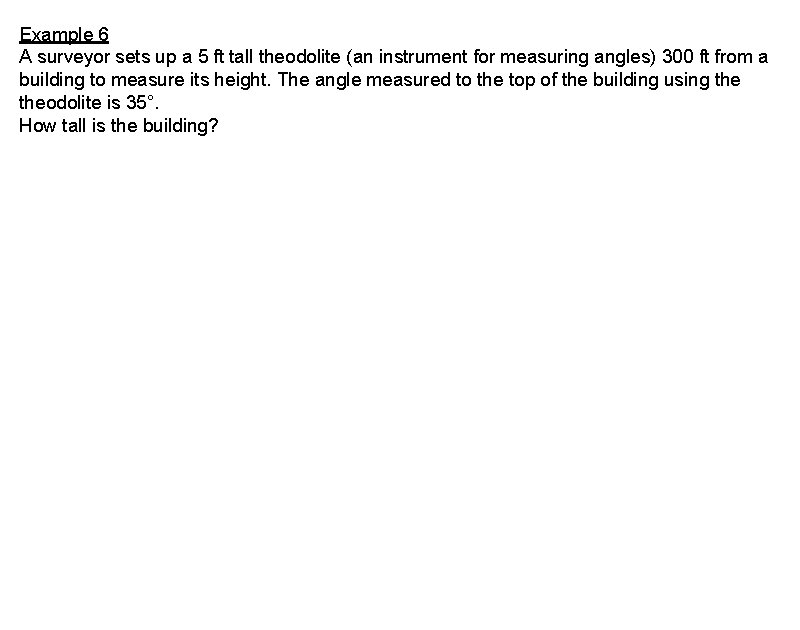
Example 6 A surveyor sets up a 5 ft tall theodolite (an instrument for measuring angles) 300 ft from a building to measure its height. The angle measured to the top of the building using theodolite is 35°. How tall is the building?
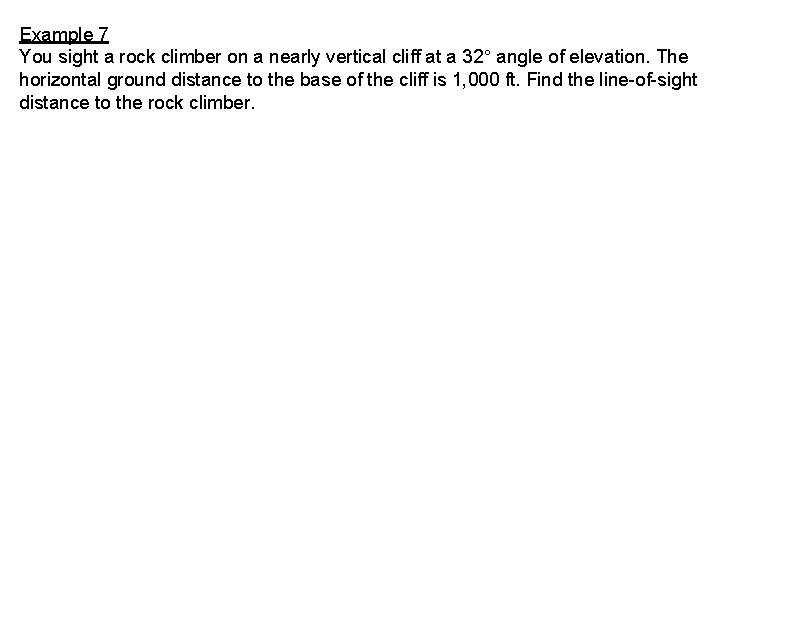
Example 7 You sight a rock climber on a nearly vertical cliff at a 32° angle of elevation. The horizontal ground distance to the base of the cliff is 1, 000 ft. Find the line-of-sight distance to the rock climber.
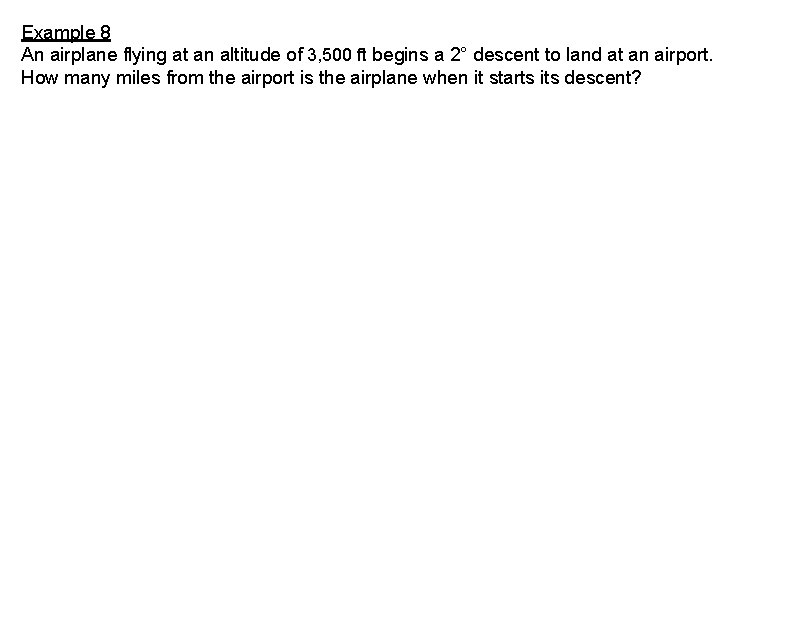
Example 8 An airplane flying at an altitude of 3, 500 ft begins a 2° descent to land at an airport. How many miles from the airport is the airplane when it starts its descent?
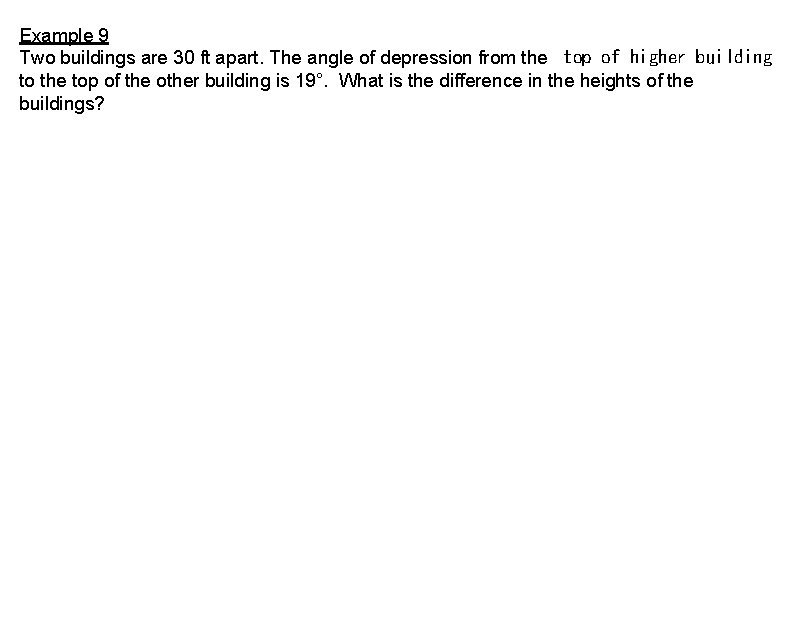
Example 9 Two buildings are 30 ft apart. The angle of depression from the top of higher building to the top of the other building is 19°. What is the difference in the heights of the buildings?
End of day 5 Math 2 Assignment: pp. 484 -486 #9 -19, 21, 23, 34
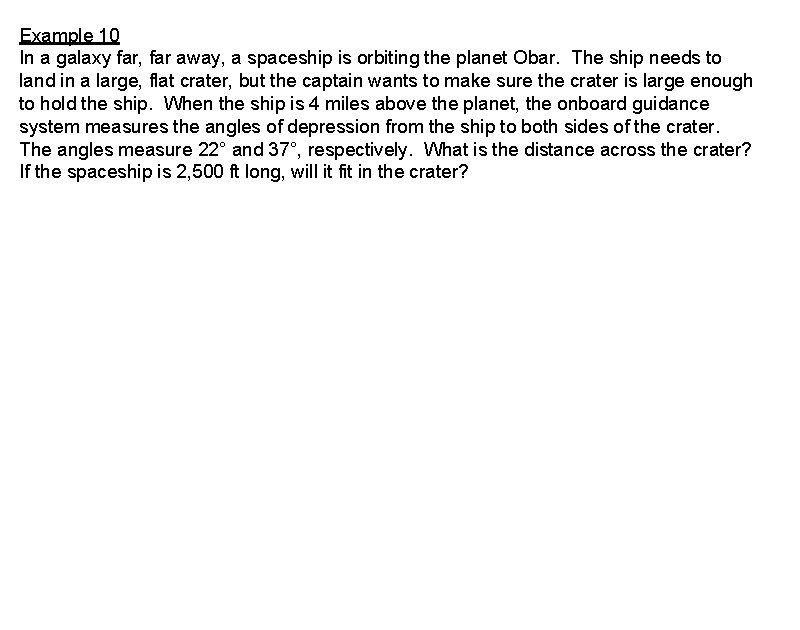
Example 10 In a galaxy far, far away, a spaceship is orbiting the planet Obar. The ship needs to land in a large, flat crater, but the captain wants to make sure the crater is large enough to hold the ship. When the ship is 4 miles above the planet, the onboard guidance system measures the angles of depression from the ship to both sides of the crater. The angles measure 22° and 37°, respectively. What is the distance across the crater? If the spaceship is 2, 500 ft long, will it fit in the crater?
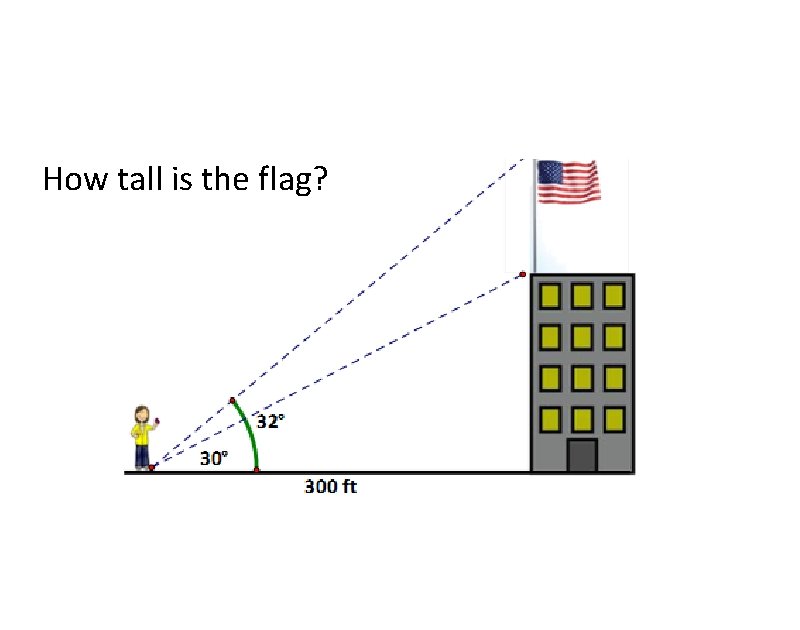
How tall is the flag?
Math 2 Unit 4 Lesson 4 Unit 4: "Right Triangle Trigonometry" Title: Application - Finding Area Using Trigonometric Ratios Objective: To find the area of triangles and regular polygons using trigonometry.
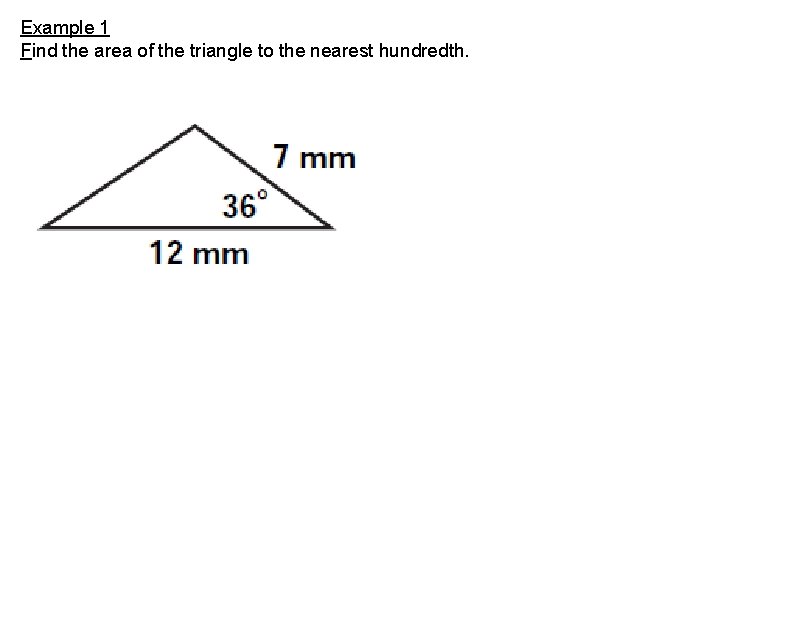
Example 1 Find the area of the triangle to the nearest hundredth.
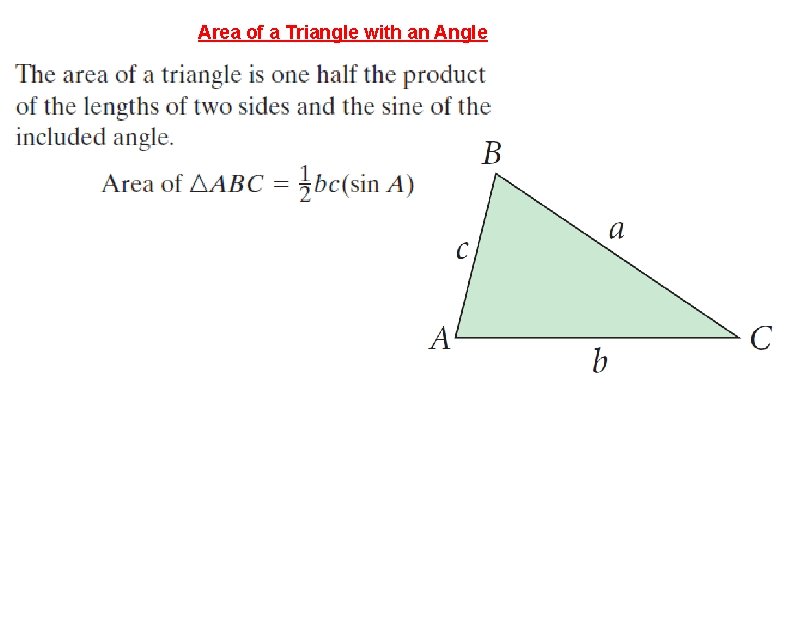
Area of a Triangle with an Angle
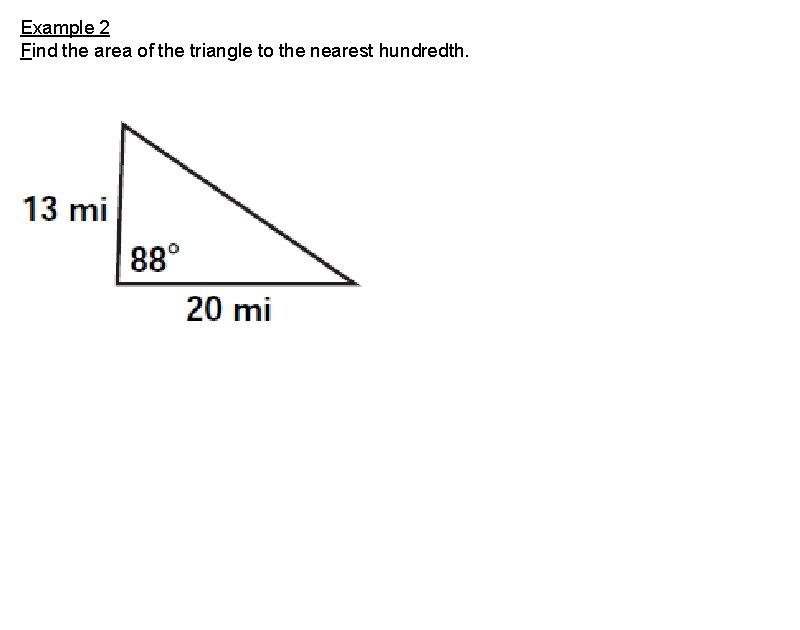
Example 2 Find the area of the triangle to the nearest hundredth.
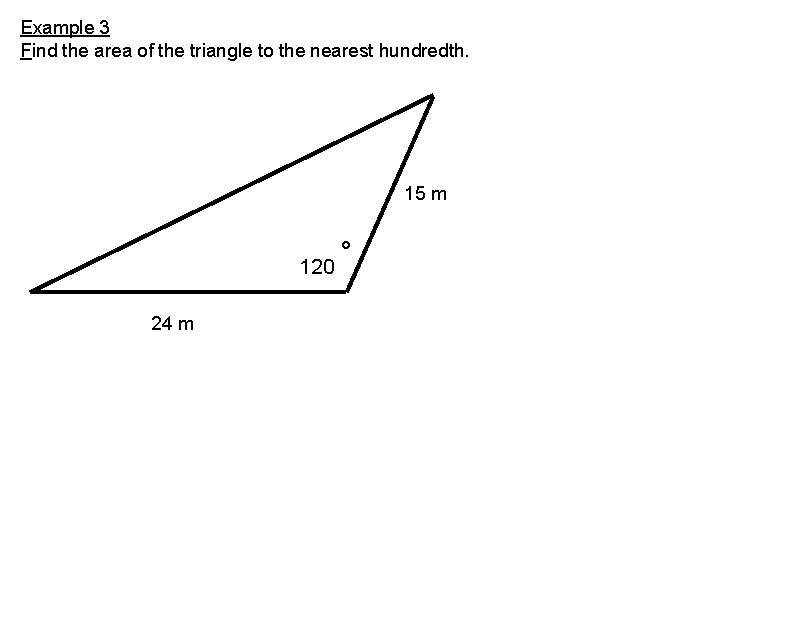
Example 3 Find the area of the triangle to the nearest hundredth. 15 m 120 24 m °
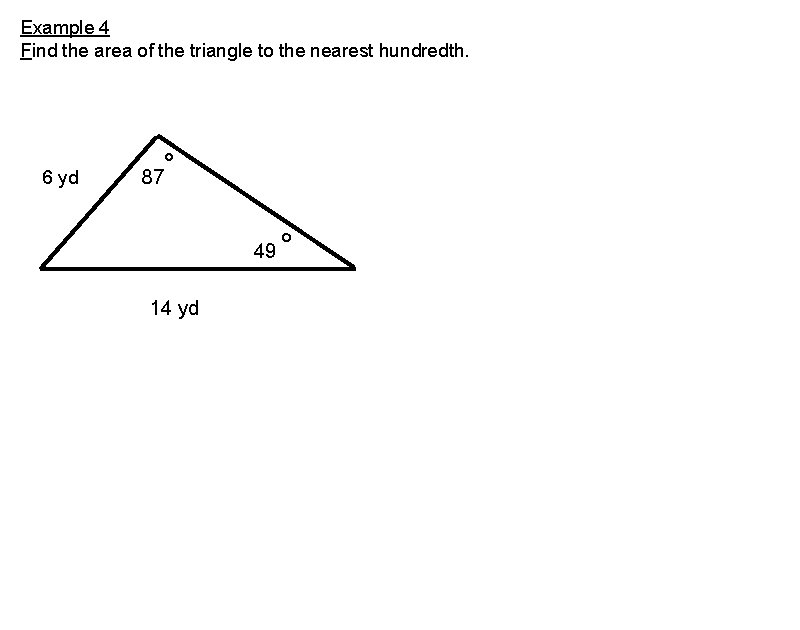
Example 4 Find the area of the triangle to the nearest hundredth. 6 yd ° 87 49 ° 14 yd
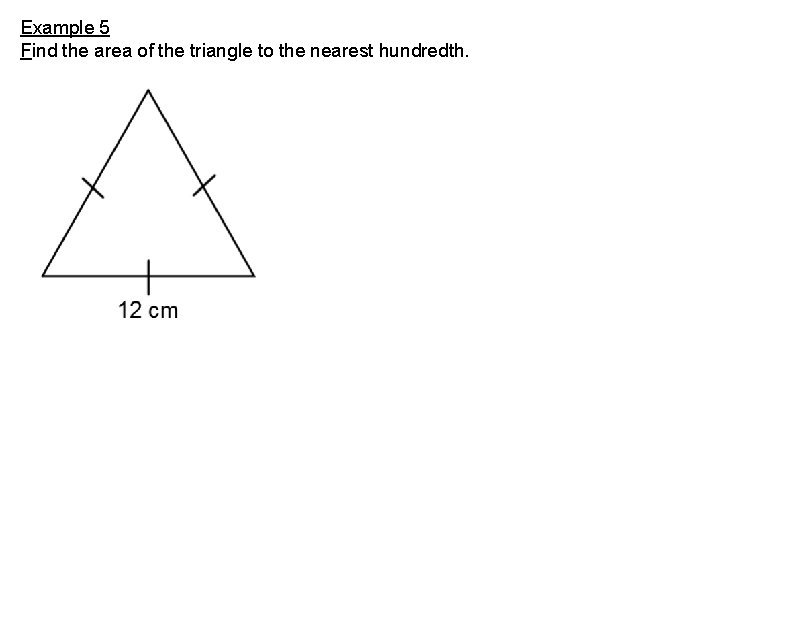
Example 5 Find the area of the triangle to the nearest hundredth.
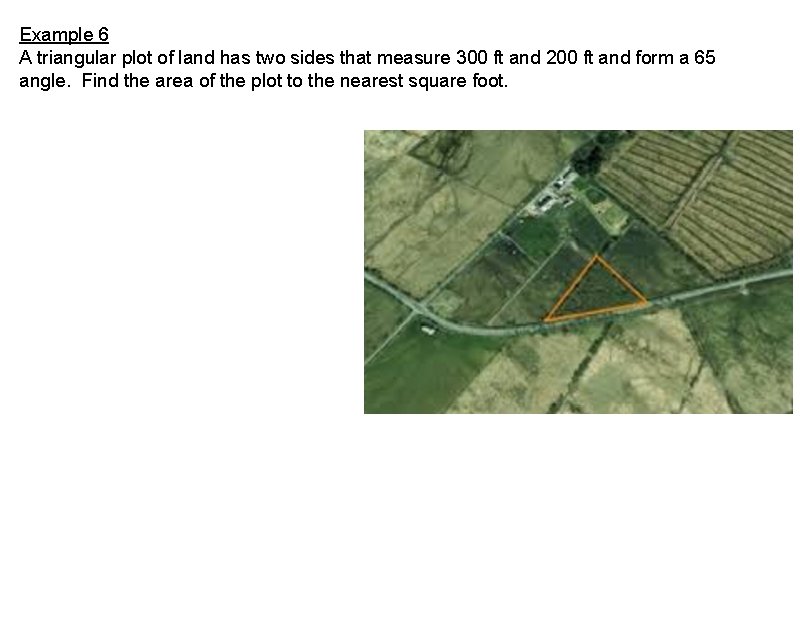
Example 6 A triangular plot of land has two sides that measure 300 ft and 200 ft and form a 65 angle. Find the area of the plot to the nearest square foot.
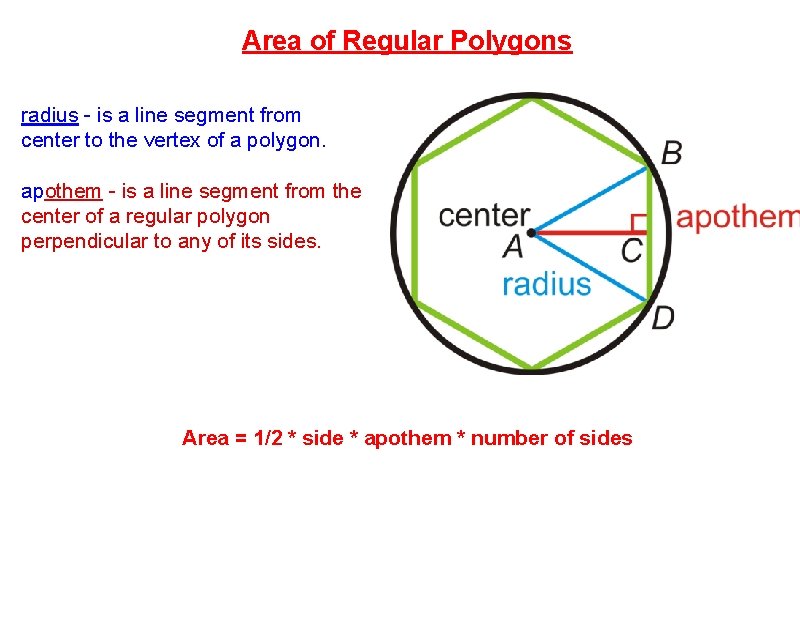
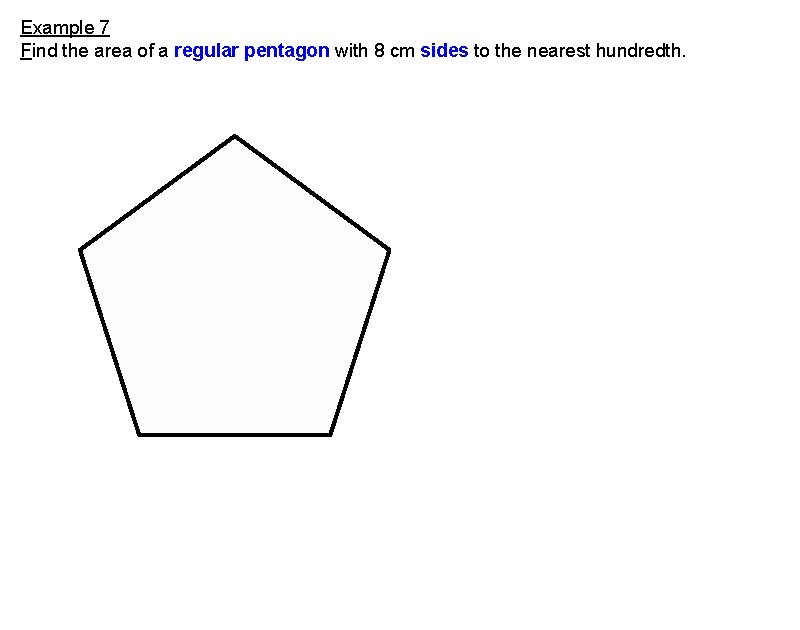
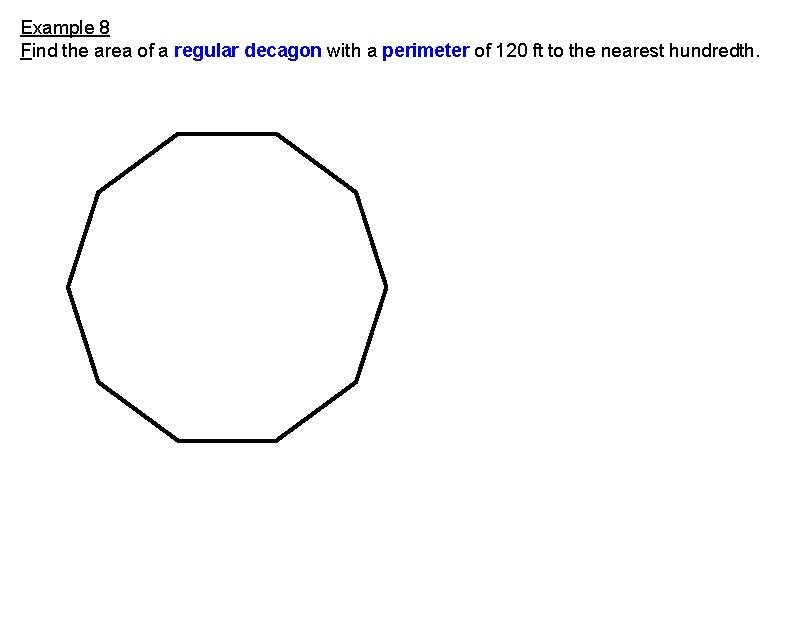
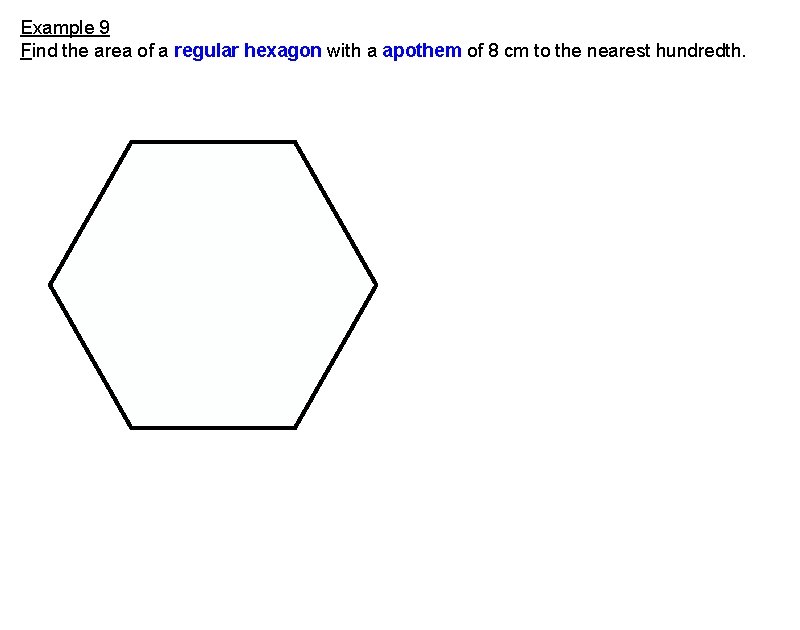
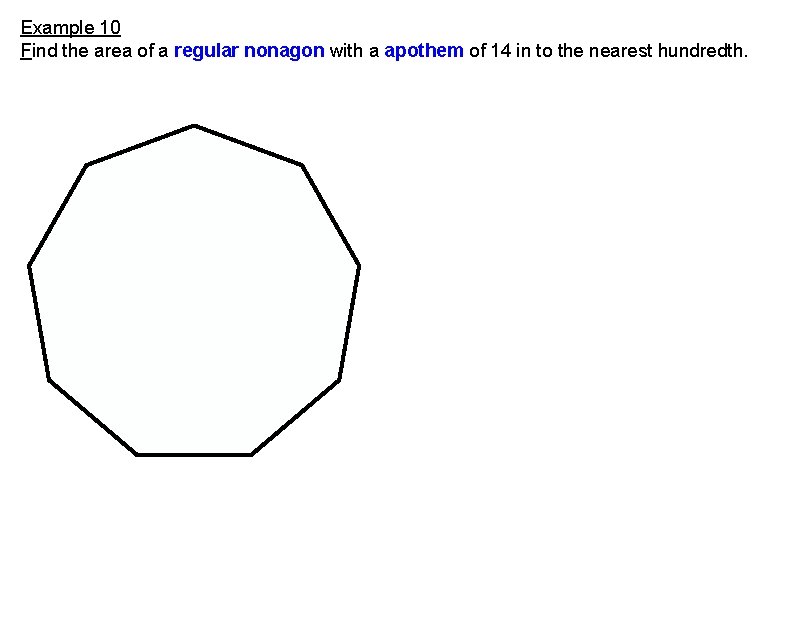
Area of Regular Polygons radius - is a line segment from center to the vertex of a polygon. apothem - is a line segment from the center of a regular polygon perpendicular to any of its sides. Area = 1/2 * side * apothem * number of sides
Example 7 Find the area of a regular pentagon with 8 cm sides to the nearest hundredth.
Example 8 Find the area of a regular decagon with a perimeter of 120 ft to the nearest hundredth.
Example 9 Find the area of a regular hexagon with a apothem of 8 cm to the nearest hundredth.
Example 10 Find the area of a regular nonagon with a apothem of 14 in to the nearest hundredth.
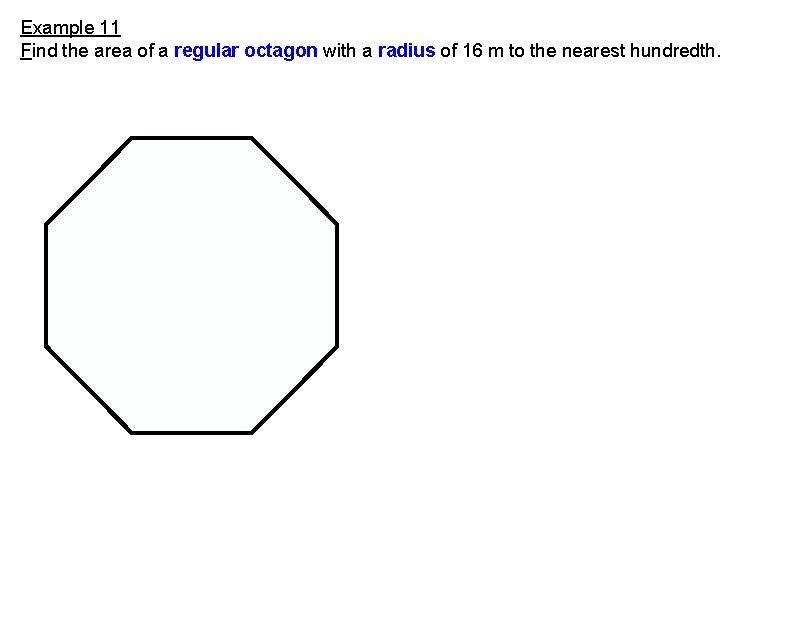
Example 11 Find the area of a regular octagon with a radius of 16 m to the nearest hundredth.
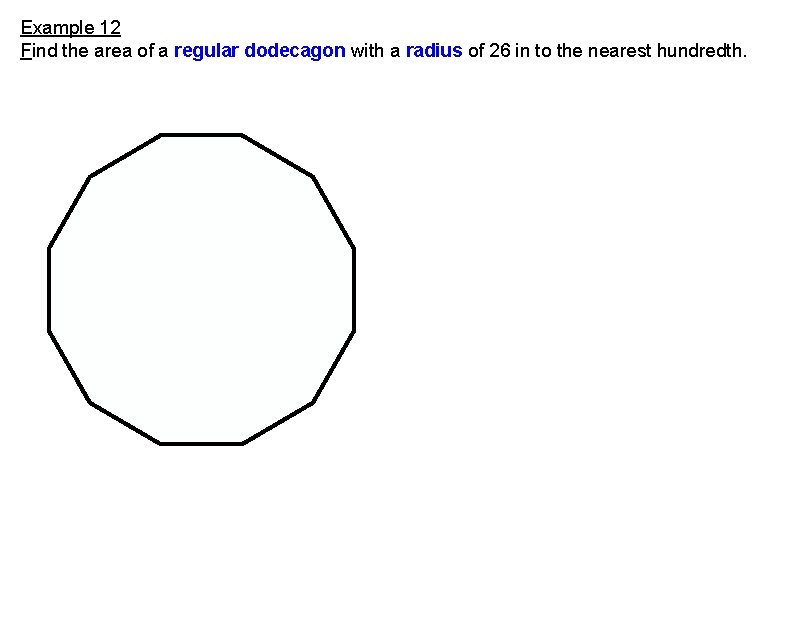
Example 12 Find the area of a regular dodecagon with a radius of 26 in to the nearest hundredth.
End of Day 5 Math 2 Assignment: pp. 500 #2 -16 evens and 22 -26 evens
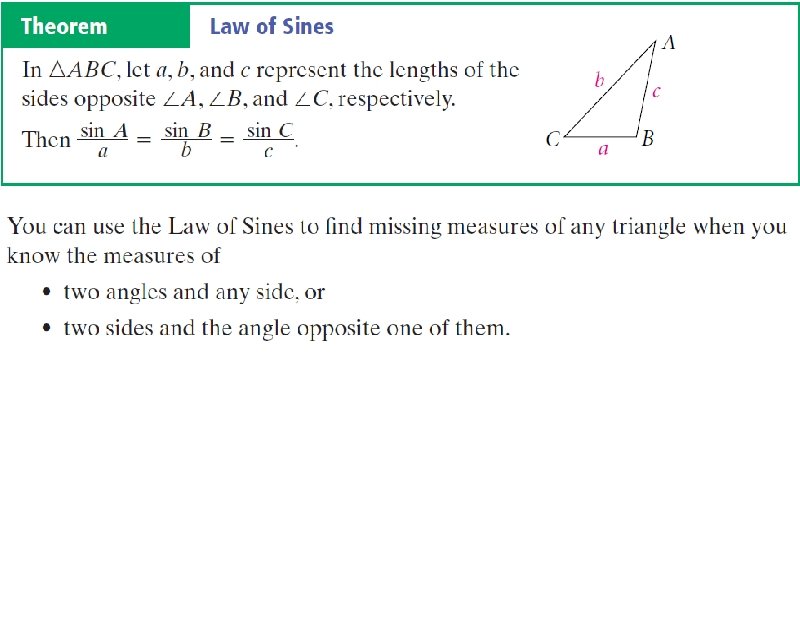
Math 2 Unit 4 Lesson 4 Title: Law of Sines Objectives: To learn to use the law of Sines to find missing sides and angles in triangles.
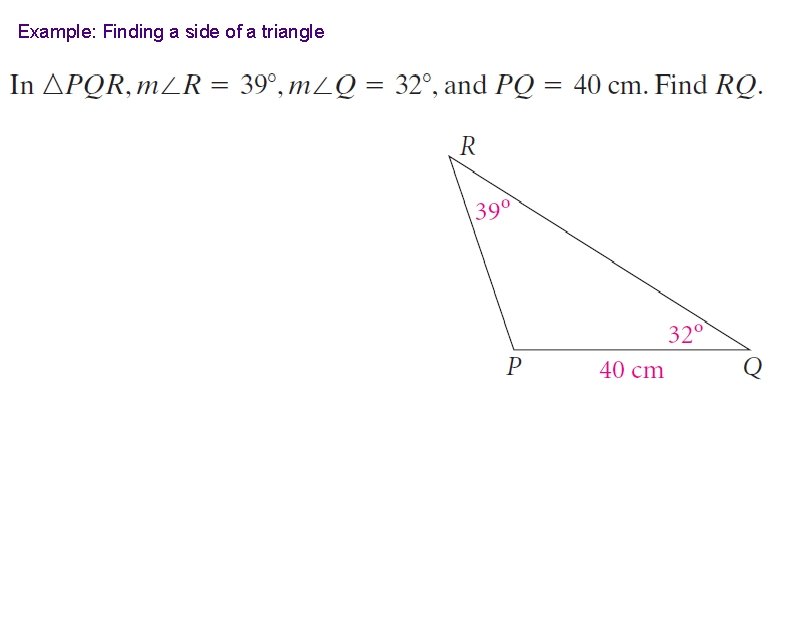
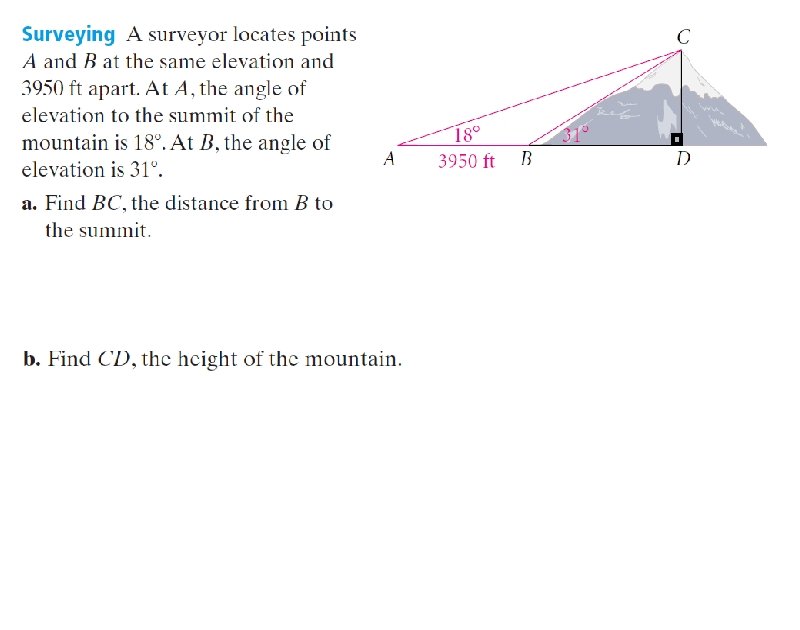
Example: Finding a side of a triangle
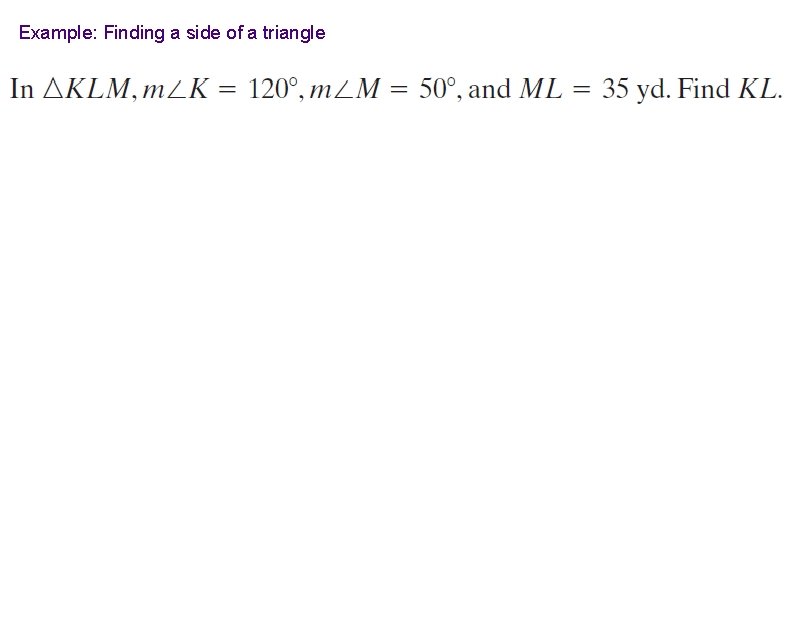
Example: Finding a side of a triangle
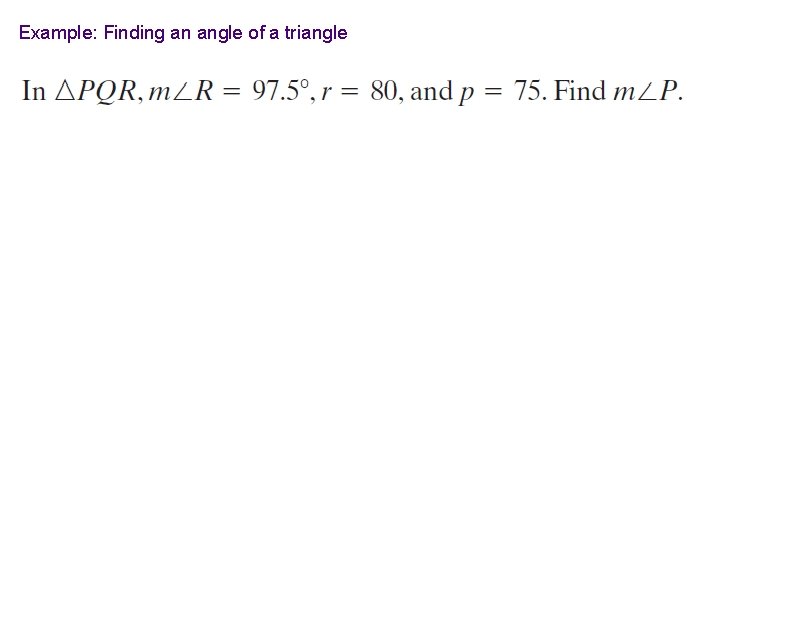
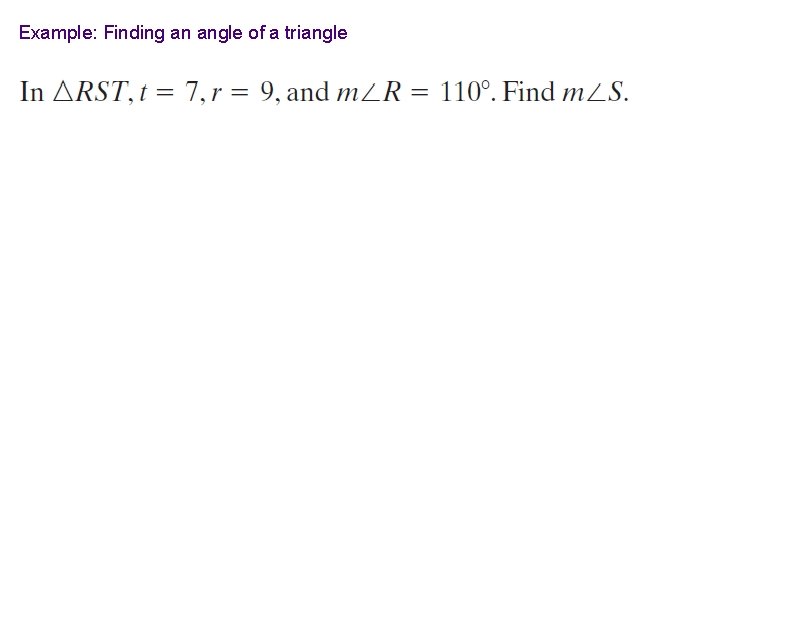
Example: Finding an angle of a triangle
Example: Finding an angle of a triangle
Assignment: Law of Sines Handout
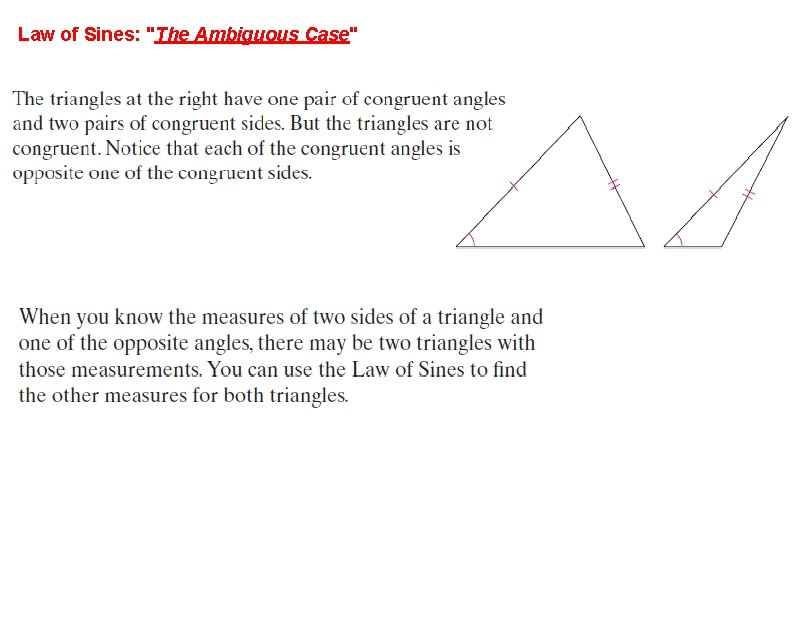
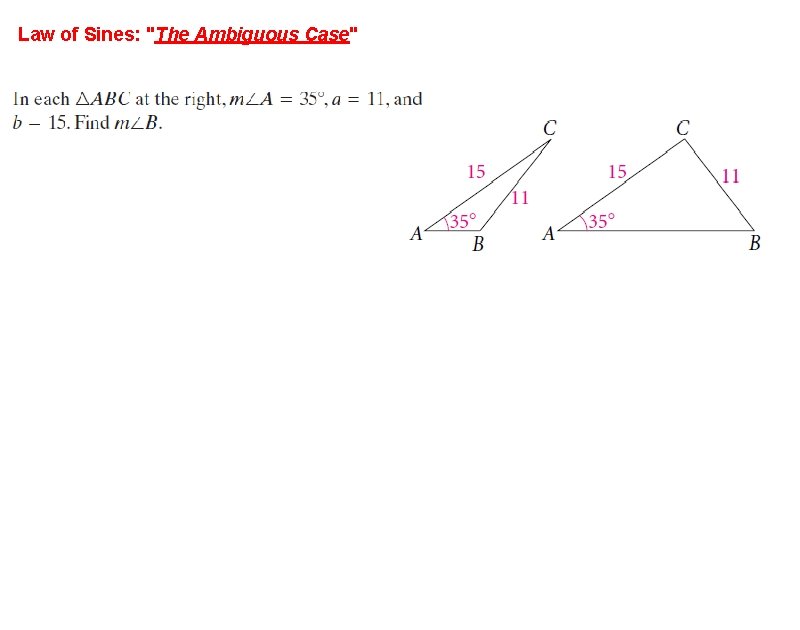
Law of Sines: "The Ambiguous Case"
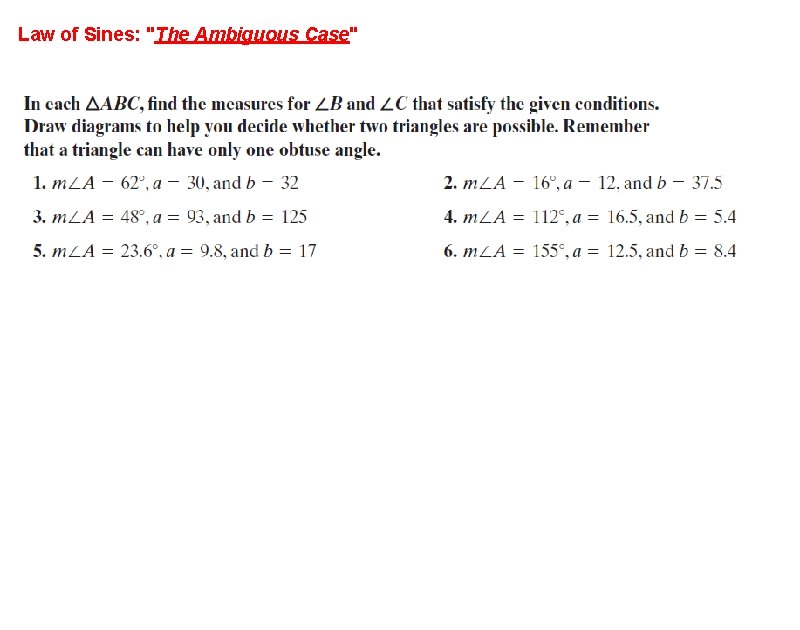
Law of Sines: "The Ambiguous Case"
Law of Sines: "The Ambiguous Case"
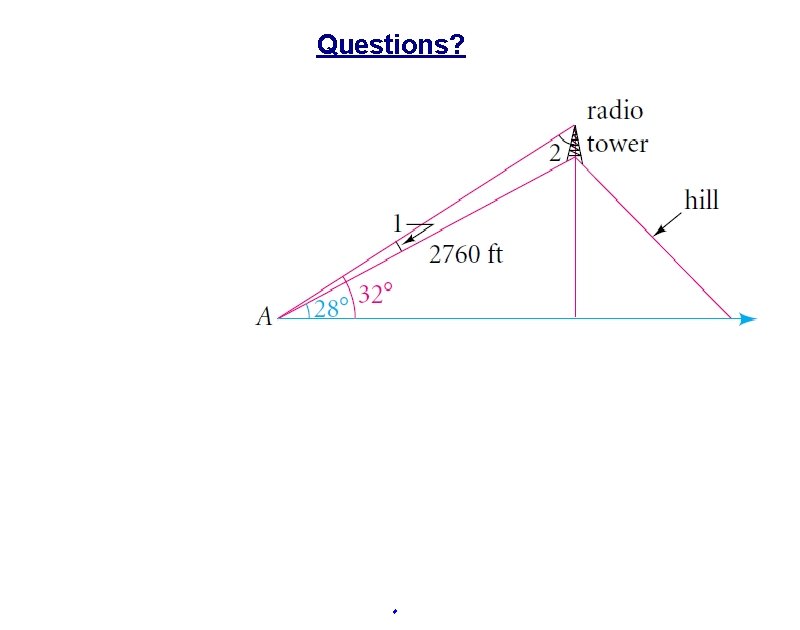
Questions?
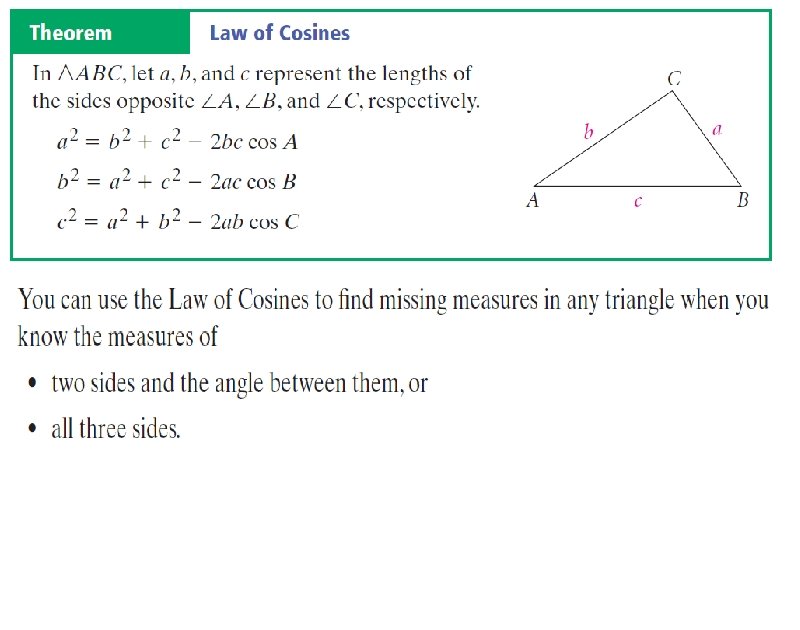
Math 2 Unit 4 Lesson 5 Title: Law of Cosines Objectives: To learn to use the law of cosines to find missing sides and angles in triangles.
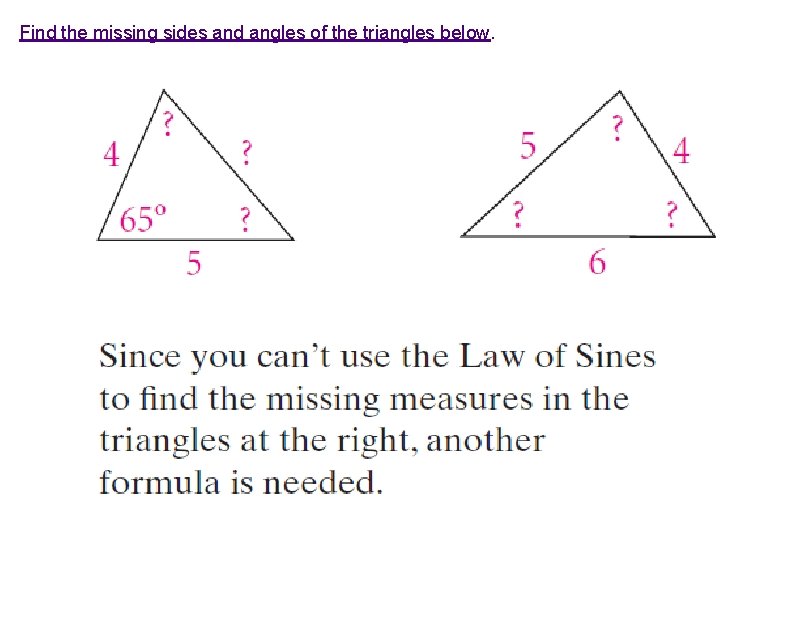
Find the missing sides and angles of the triangles below.
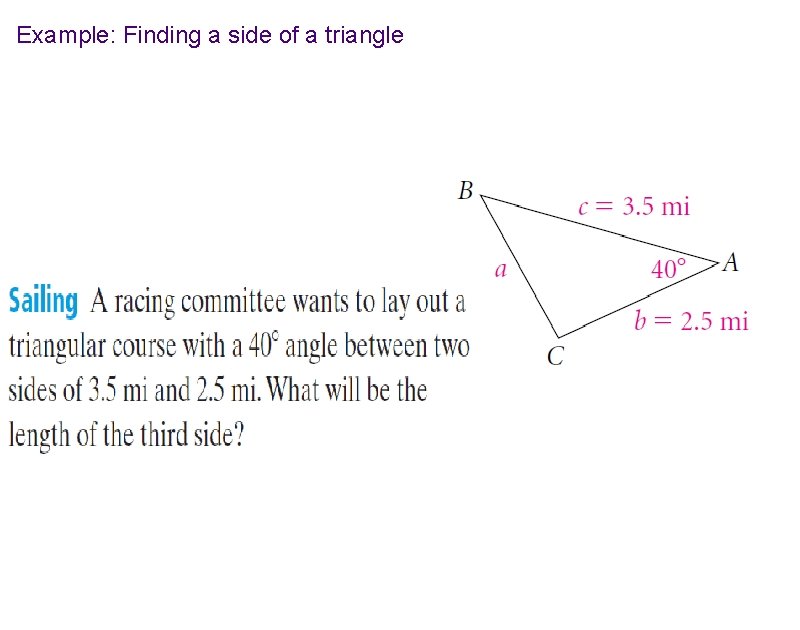
Example: Finding a side of a triangle
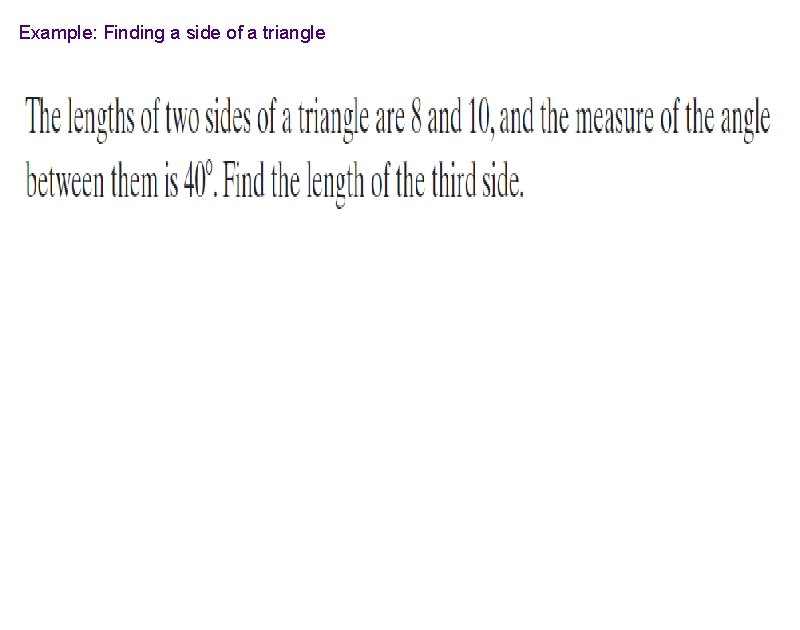
Example: Finding a side of a triangle
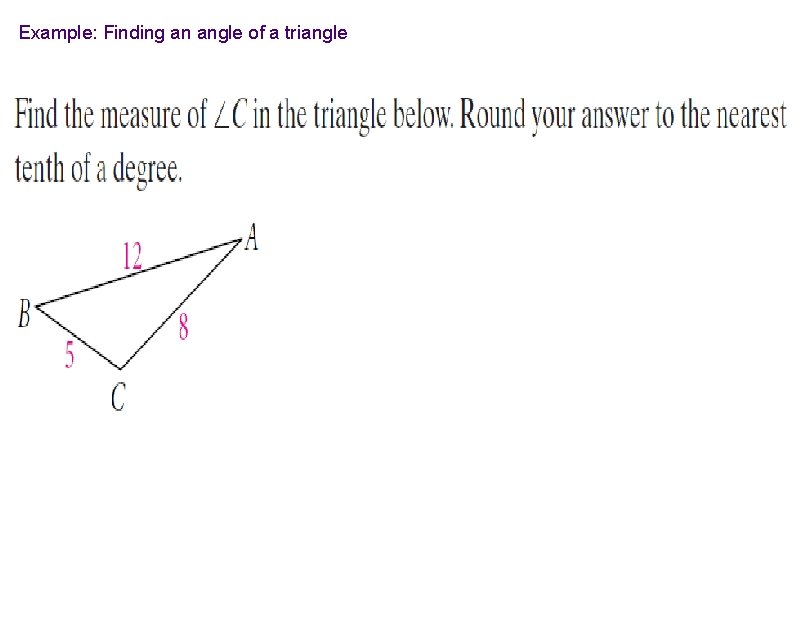
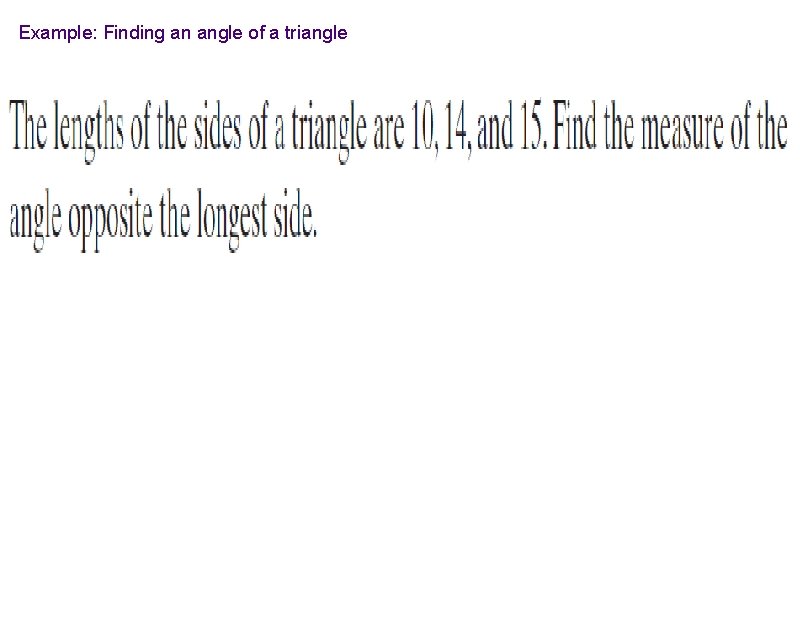
Example: Finding an angle of a triangle
Example: Finding an angle of a triangle
Assignment: Law of Cosines Handout End of Day 6