Knowledge Exchange Franz J Kurfess Cal Poly SLO

- Slides: 49
Knowledge Exchange Franz J. Kurfess Cal Poly SLO Computer Science Department 1
Acknowledgements Some of the material in these slides was developed for a lecture series sponsored by the European Community under the BPD program with Vilnius University as host institution 3
Use and Distribution of these Slides ❖ These slides are primarily intended for the students in classes I teach. In some cases, I only make PDF versions publicly available. If you would like to get a copy of the originals (Apple Key. Note or Microsoft Power. Point), please contact me via email at fkurfess@calpoly. edu. I hereby grant permission to use them in educational settings. If you do so, it would be nice to send me an email about it. If you’re considering using them in a commercial environment, please contact me first. © Franz J. Kurfess 4
Overview Knowledge Exchange ❖ Introduction ❖ Knowledge Capture v v ❖ Transfer of Knowledge v v ❖ Explicit Capture Extraction From Text Case-based Reasoning Enhancement of Existing Documents Communication v Basic Concepts v Language and Communication Natural Language Formal Languages Communication Models Distribution of Knowledge v Knowledge Repositories v Distribution Models © Franz J. Kurfess 5
Introduction Franz Kurfess: Knowledge Exchange 13
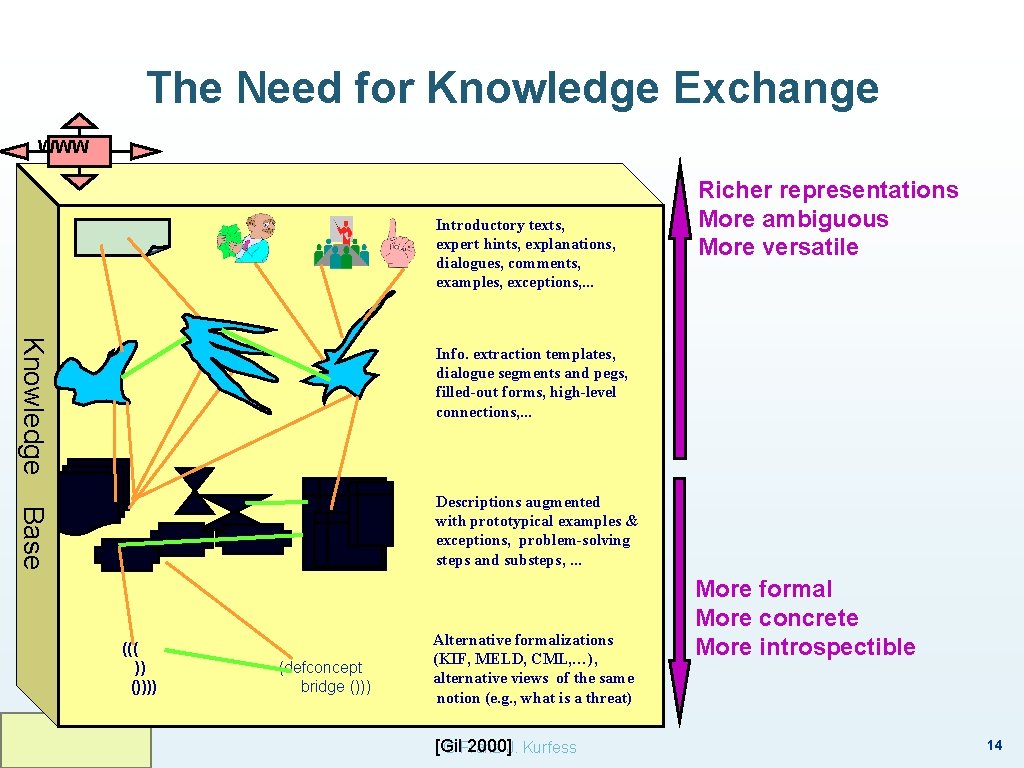
The Need for Knowledge Exchange WWW Introductory texts, expert hints, explanations, dialogues, comments, examples, exceptions, . . . Richer representations More ambiguous More versatile Knowledge Info. extraction templates, dialogue segments and pegs, filled-out forms, high-level connections, . . . Base Descriptions augmented with prototypical examples & exceptions, problem-solving steps and substeps, . . . ((( )) ()))) (defconcept bridge ())) Alternative formalizations (KIF, MELD, CML, …), alternative views of the same notion (e. g. , what is a threat) [Gil 2000]J. Kurfess © Franz More formal More concrete More introspectible 14
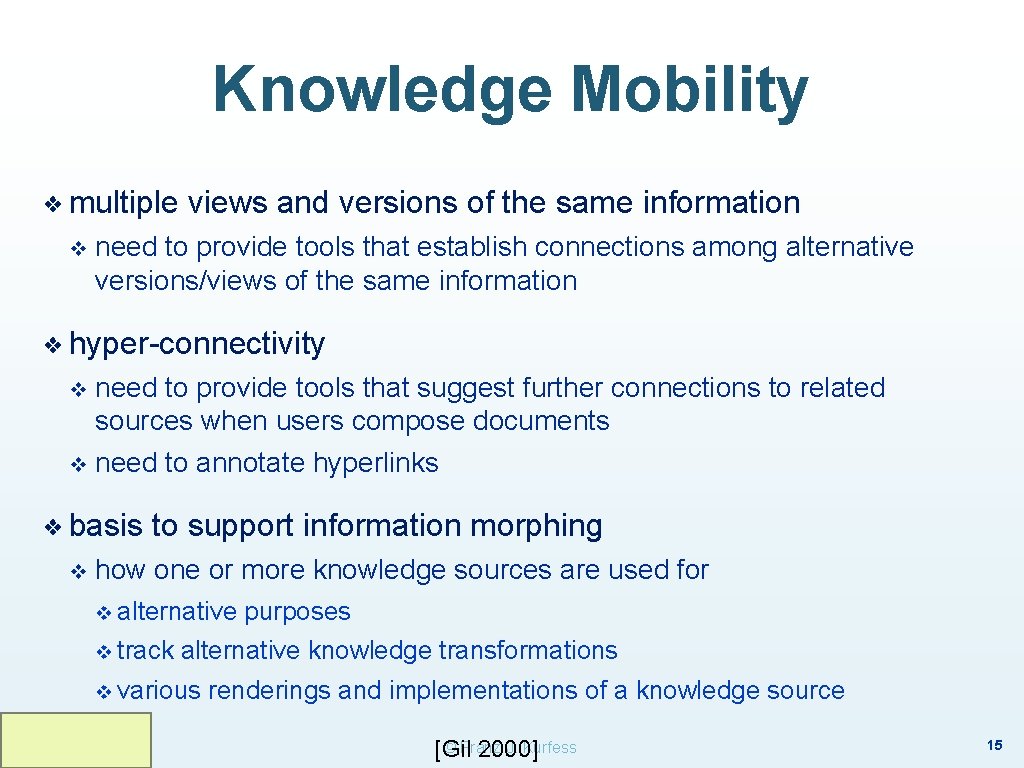
Knowledge Mobility ❖ multiple v views and versions of the same information need to provide tools that establish connections among alternative versions/views of the same information ❖ hyper-connectivity v need to provide tools that suggest further connections to related sources when users compose documents v need to annotate hyperlinks ❖ basis v to support information morphing how one or more knowledge sources are used for v alternative v track purposes alternative knowledge transformations v various renderings and implementations of a knowledge source © Franz J. Kurfess [Gil 2000] 15
Knowledge Capture ❖ before knowledge can be shared, it must be captured v in and encoding and representation that is suitable for the sender and recipient of the knowledge v the representation format must be suitable for transmission via a communication channel between sender and recipient v for human-to-human knowledge exchange, natural language in written or spoken form is often suitable and convenient © Franz J. Kurfess 16
Knowledge Capture Methods ❖ Explicit Capture ❖ Extraction from Documents v text v other formats ❖ Case-based Reasoning ❖ Enhancement of Existing Documents © Franz J. Kurfess 17
Explicit Capture ❖ conventional v interviews techniques for knowledge acquisition with experts, knowledge engineers ❖ advantages v carefully constructed v suitable knowledge representation methods v usually common-sense evaluation v sometimes formal evaluation v consistency checks, other formal aspects © Franz J. Kurfess 18
Extraction From Text ❖ syntactic level v keywords, descriptive features v construction ❖ semantic level v document v requires v sentence v natural structure information about structure (tags, DDT, RDF) structure language processing (NLP) ❖ pragmatic v context of an index, meta data level (thesaurus, ontology, NLP) © Franz J. Kurfess 19
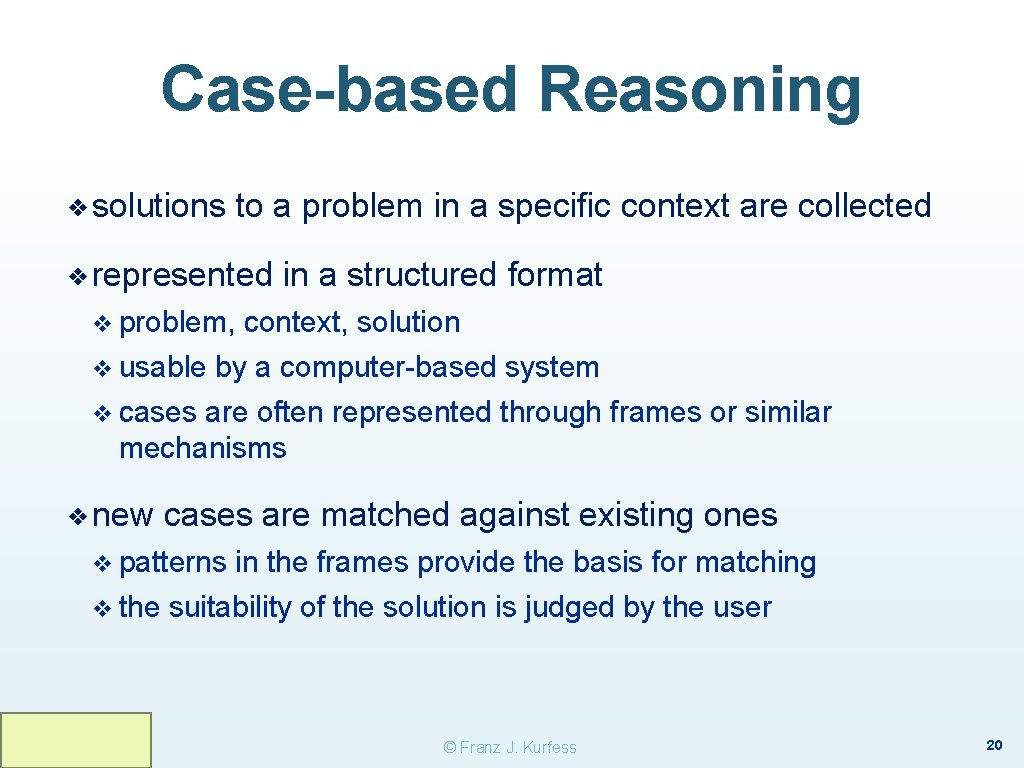
Case-based Reasoning ❖ solutions to a problem in a specific context are collected ❖ represented in a structured format v problem, context, solution v usable by a computer-based system v cases are often represented through frames or similar mechanisms ❖ new cases are matched against existing ones v patterns in the frames provide the basis for matching v the suitability of the solution is judged by the user © Franz J. Kurfess 20
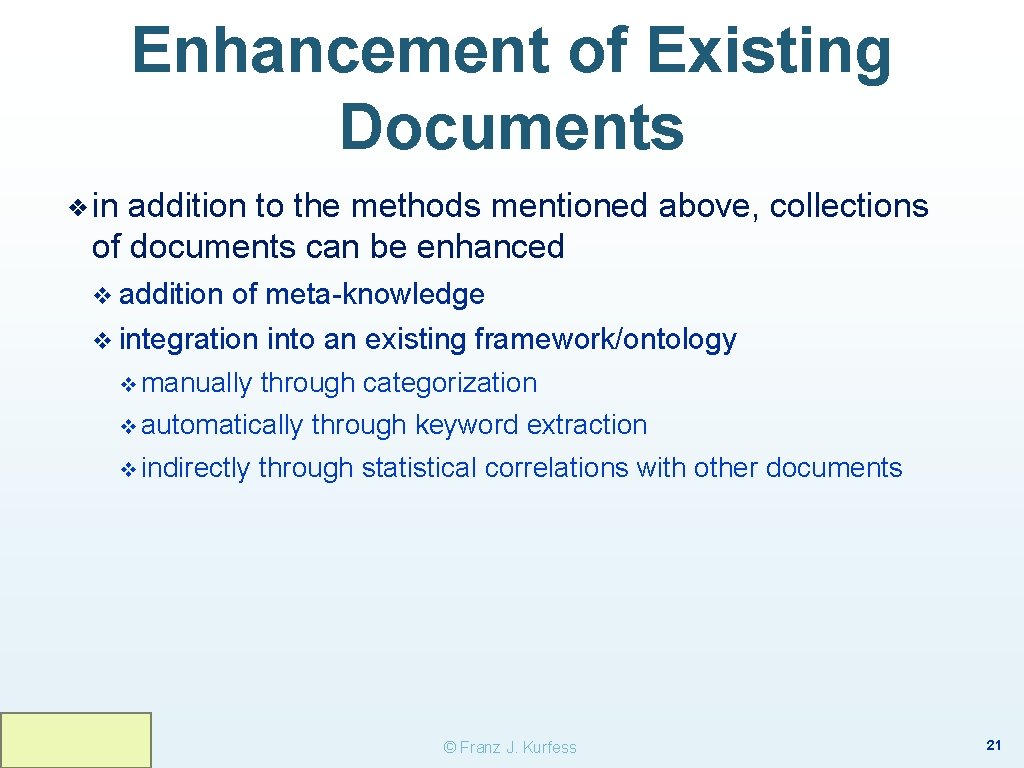
Enhancement of Existing Documents ❖ in addition to the methods mentioned above, collections of documents can be enhanced v addition of meta-knowledge v integration v manually into an existing framework/ontology through categorization v automatically v indirectly through keyword extraction through statistical correlations with other documents © Franz J. Kurfess 21
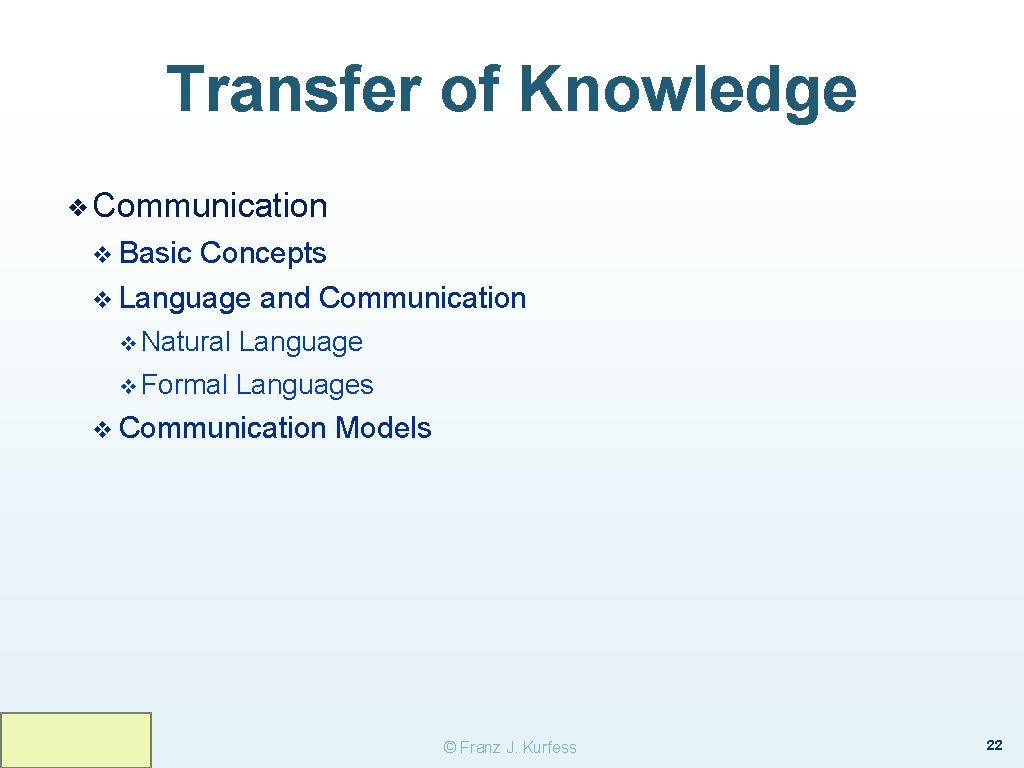
Transfer of Knowledge ❖ Communication v Basic Concepts v Language and Communication v Natural Language v Formal Languages v Communication Models © Franz J. Kurfess 22
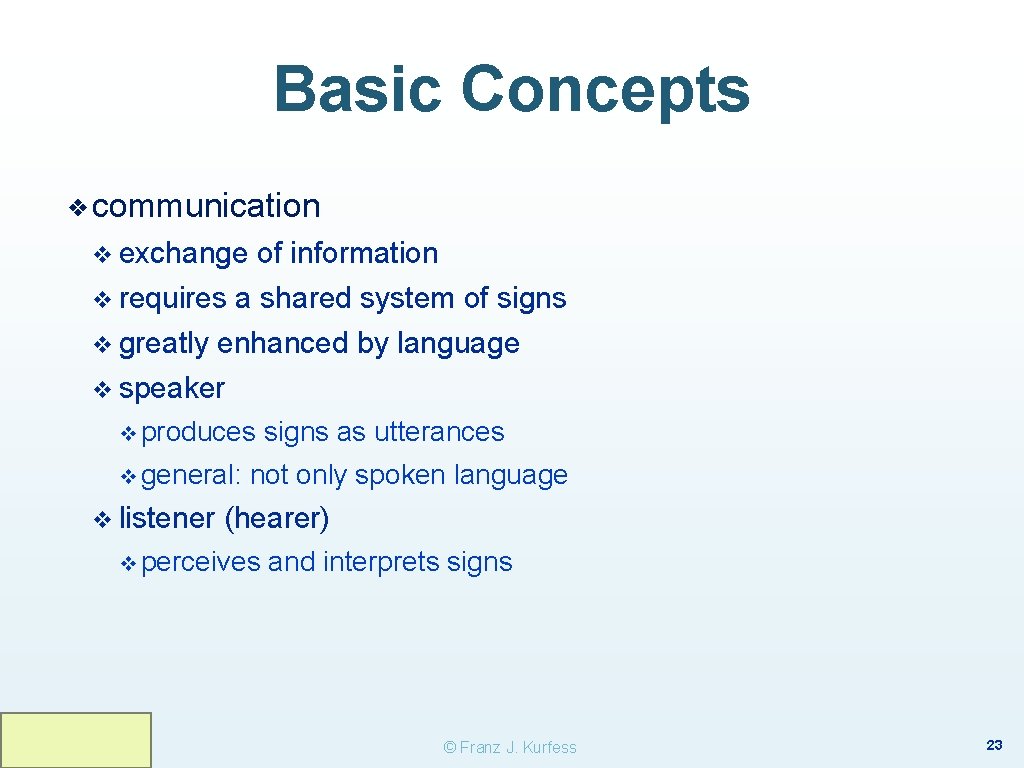
Basic Concepts ❖ communication v exchange of information v requires a shared system of signs v greatly enhanced by language v speaker v produces v general: v listener signs as utterances not only spoken language (hearer) v perceives and interprets signs © Franz J. Kurfess 23
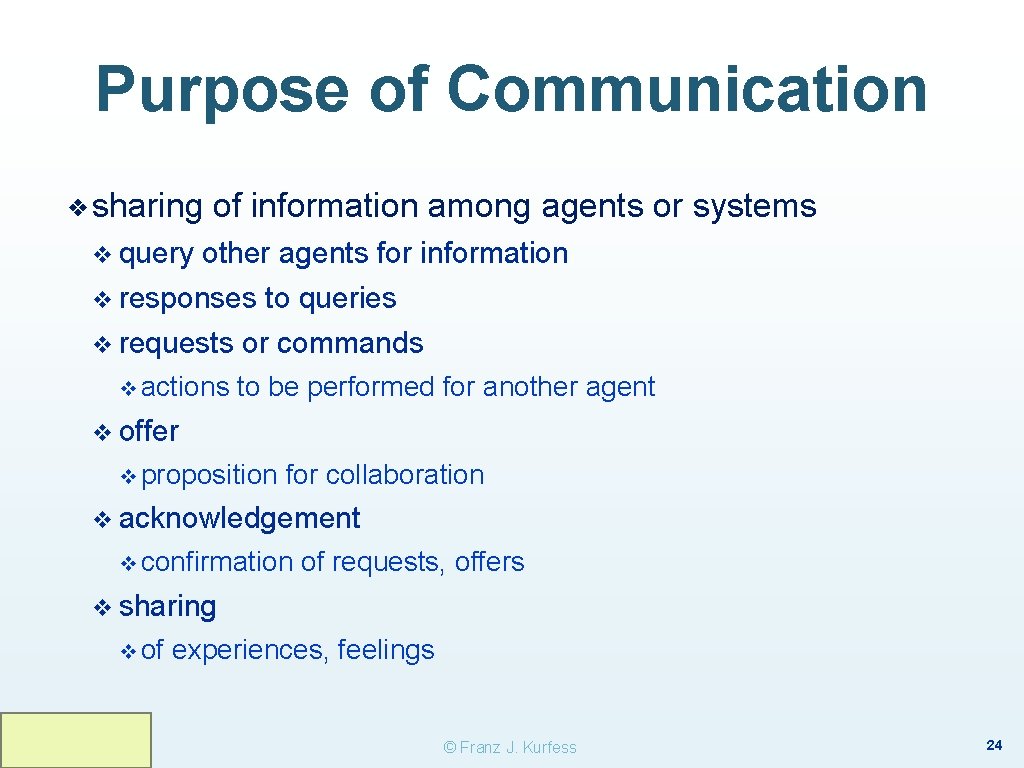
Purpose of Communication ❖ sharing of information among agents or systems v query other agents for information v responses to queries v requests or commands v actions to be performed for another agent v offer v proposition for collaboration v acknowledgement v confirmation of requests, offers v sharing v of experiences, feelings © Franz J. Kurfess 24
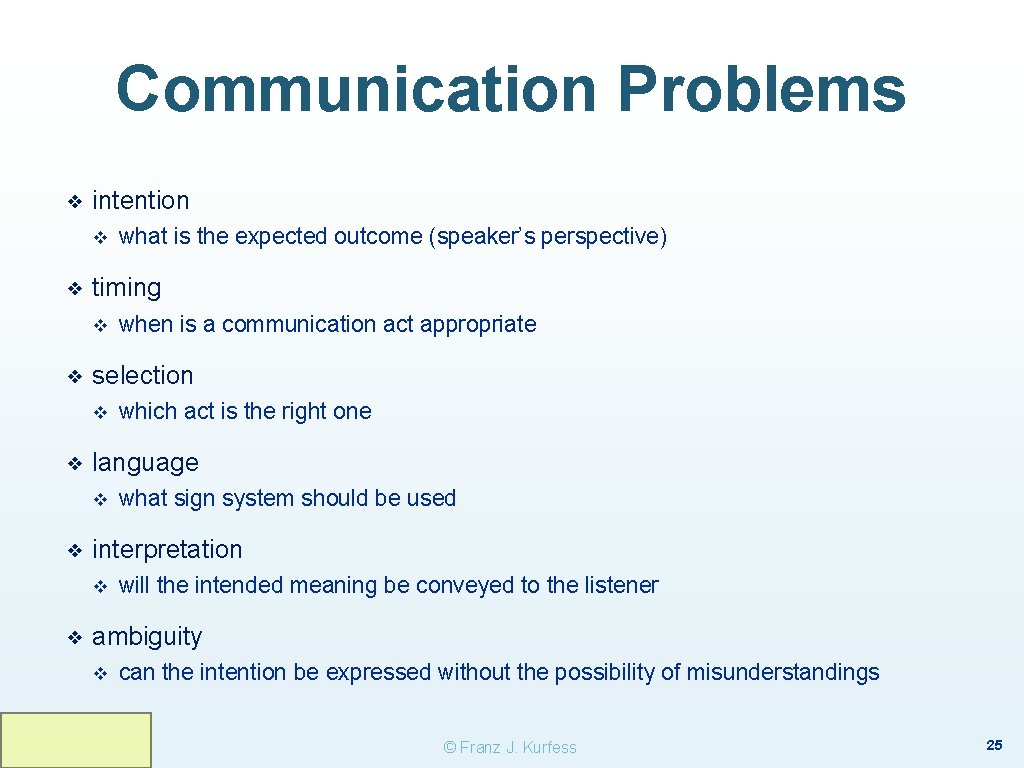
Communication Problems ❖ intention v ❖ timing v ❖ what sign system should be used interpretation v ❖ which act is the right one language v ❖ when is a communication act appropriate selection v ❖ what is the expected outcome (speaker’s perspective) will the intended meaning be conveyed to the listener ambiguity v can the intention be expressed without the possibility of misunderstandings © Franz J. Kurfess 25
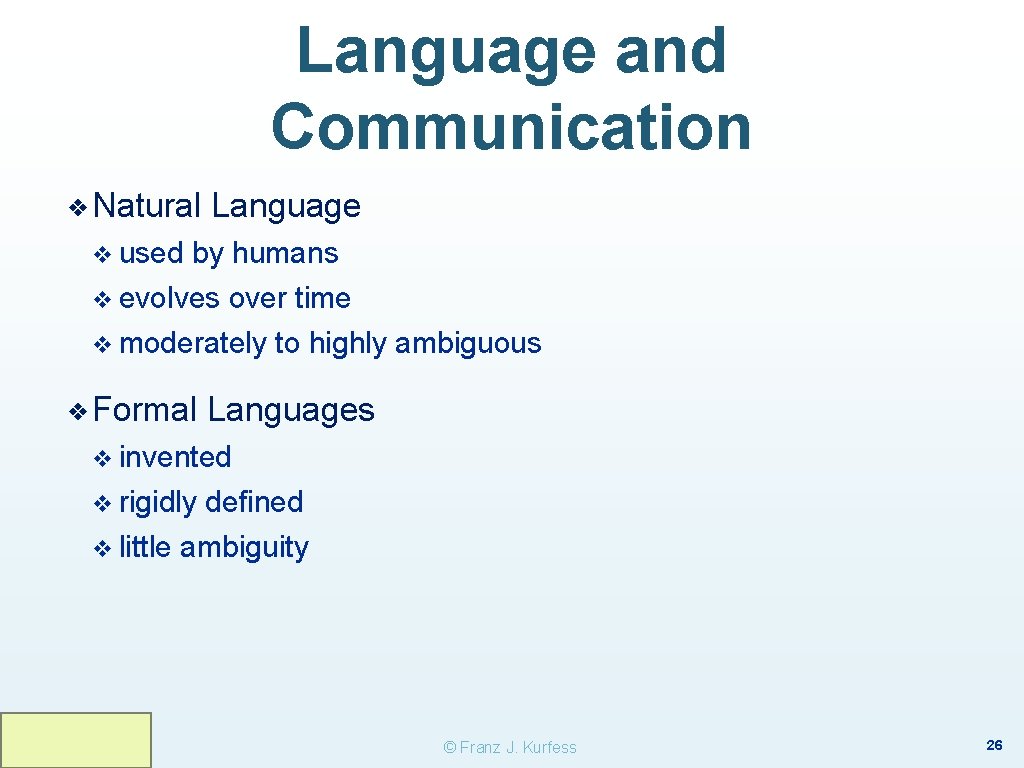
Language and Communication ❖ Natural Language v used by humans v evolves over time v moderately to highly ambiguous ❖ Formal Languages v invented v rigidly defined v little ambiguity © Franz J. Kurfess 26
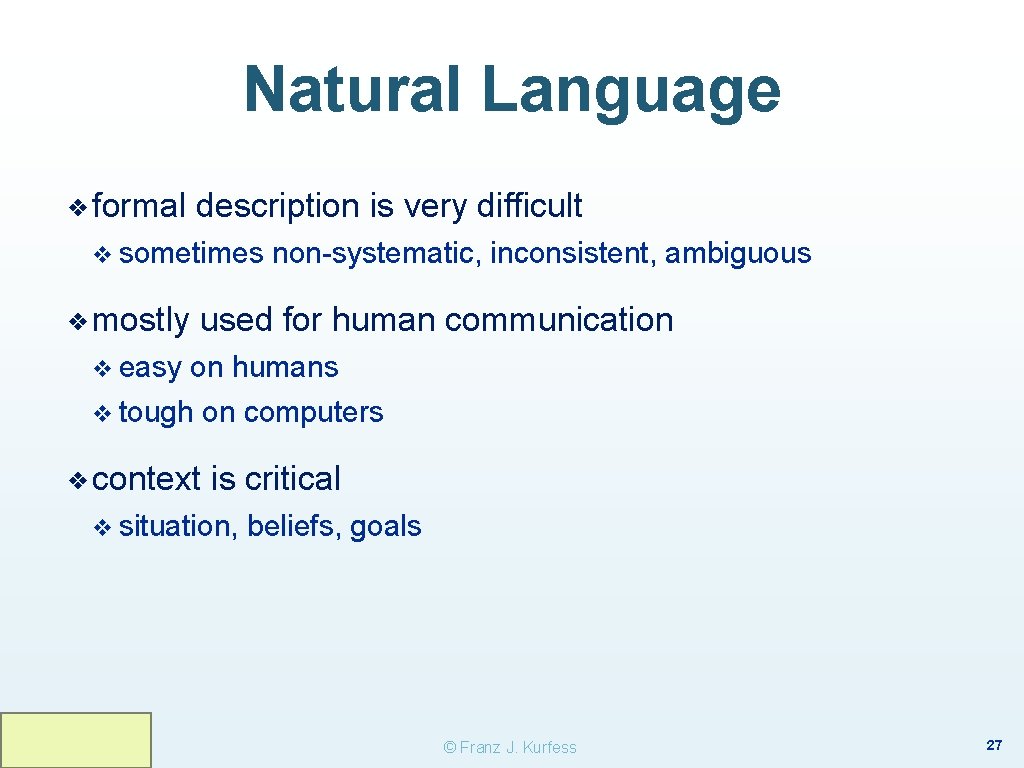
Natural Language ❖ formal description is very difficult v sometimes ❖ mostly non-systematic, inconsistent, ambiguous used for human communication v easy on humans v tough on computers ❖ context is critical v situation, beliefs, goals © Franz J. Kurfess 27
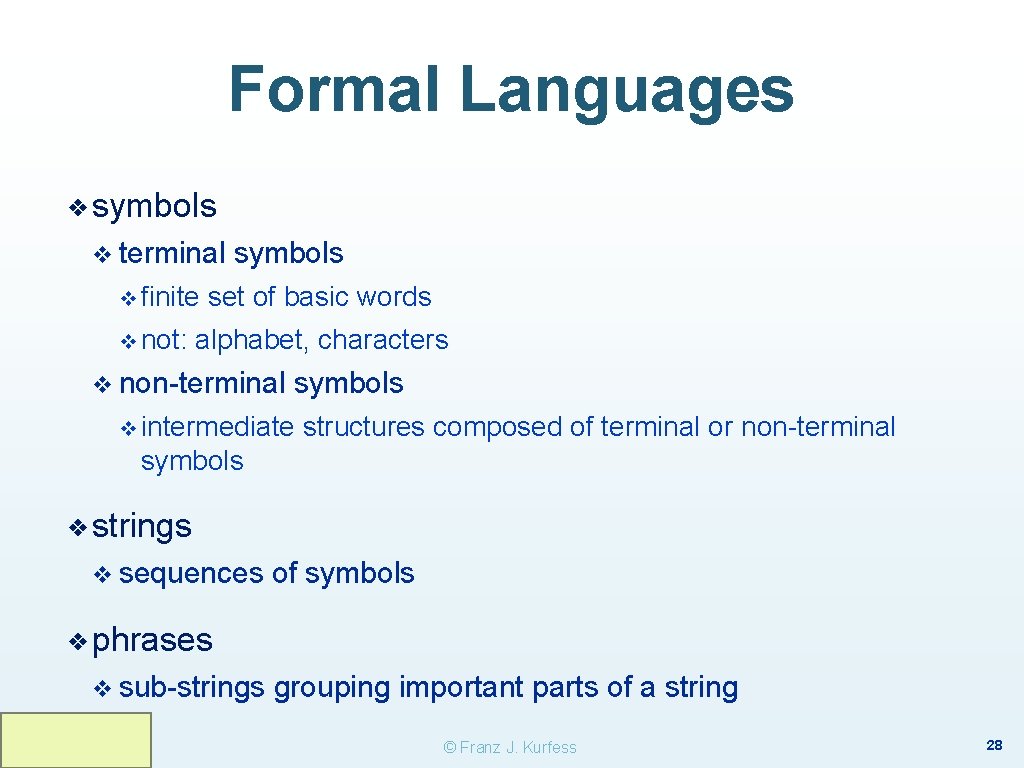
Formal Languages ❖ symbols v terminal v finite v not: symbols set of basic words alphabet, characters v non-terminal symbols v intermediate structures composed of terminal or non-terminal symbols ❖ strings v sequences of symbols ❖ phrases v sub-strings grouping important parts of a string © Franz J. Kurfess 28
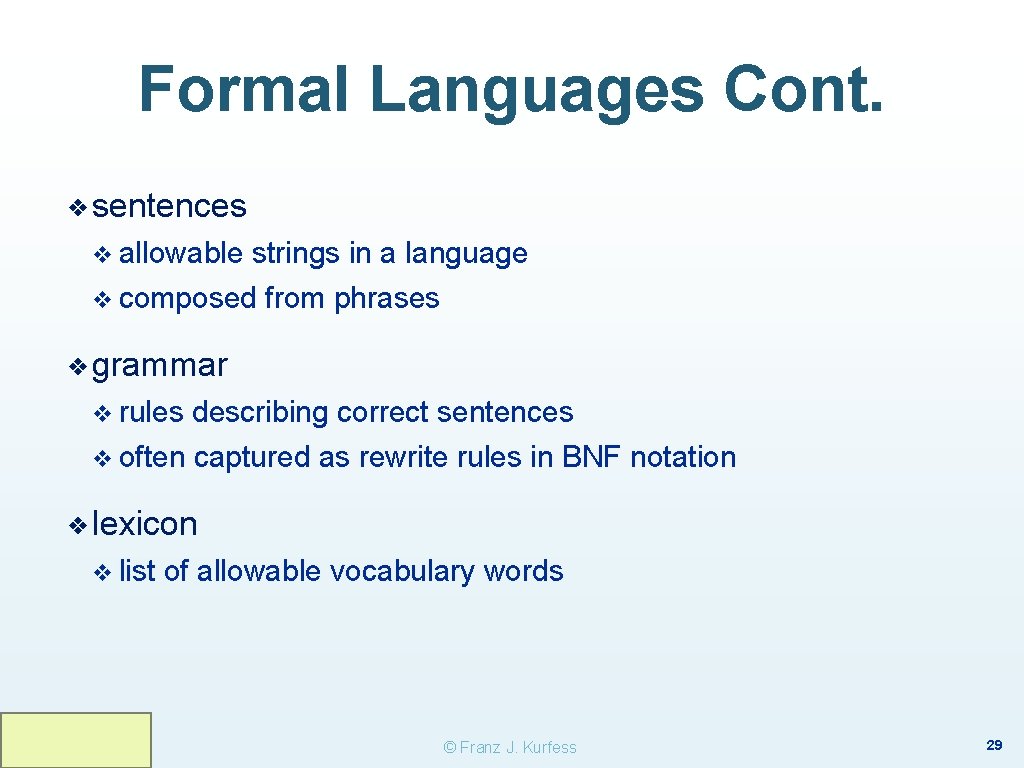
Formal Languages Cont. ❖ sentences v allowable strings in a language v composed from phrases ❖ grammar v rules describing correct sentences v often captured as rewrite rules in BNF notation ❖ lexicon v list of allowable vocabulary words © Franz J. Kurfess 29
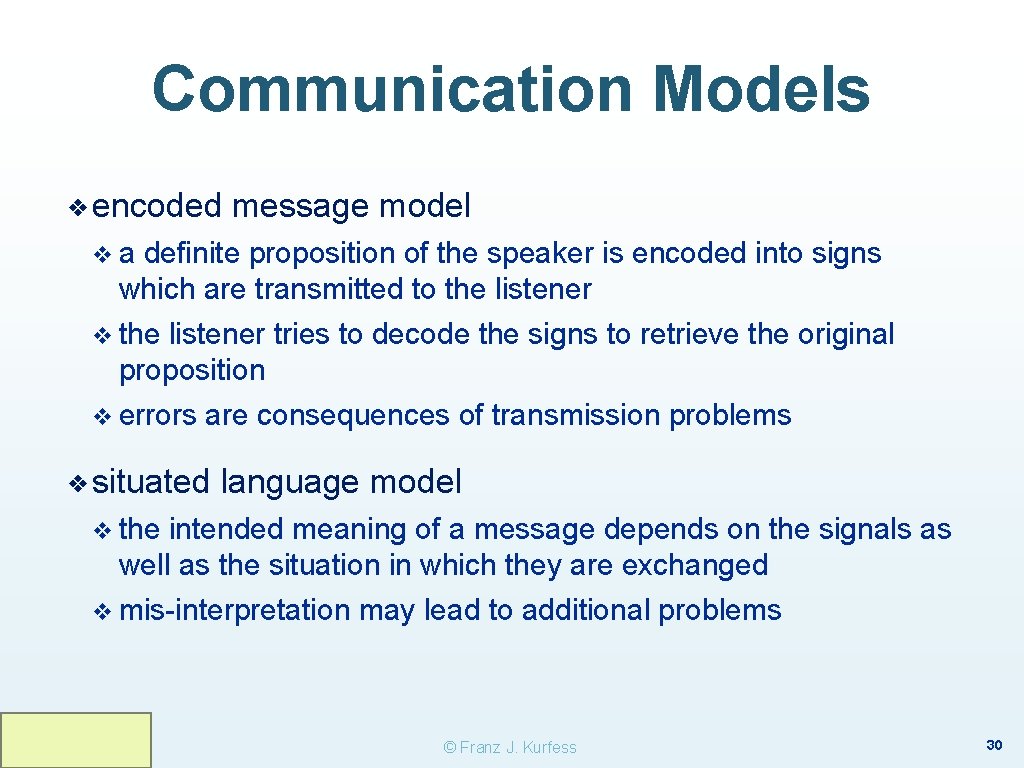
Communication Models ❖ encoded message model va definite proposition of the speaker is encoded into signs which are transmitted to the listener v the listener tries to decode the signs to retrieve the original proposition v errors are consequences of transmission problems ❖ situated language model v the intended meaning of a message depends on the signals as well as the situation in which they are exchanged v mis-interpretation may lead to additional problems © Franz J. Kurfess 30
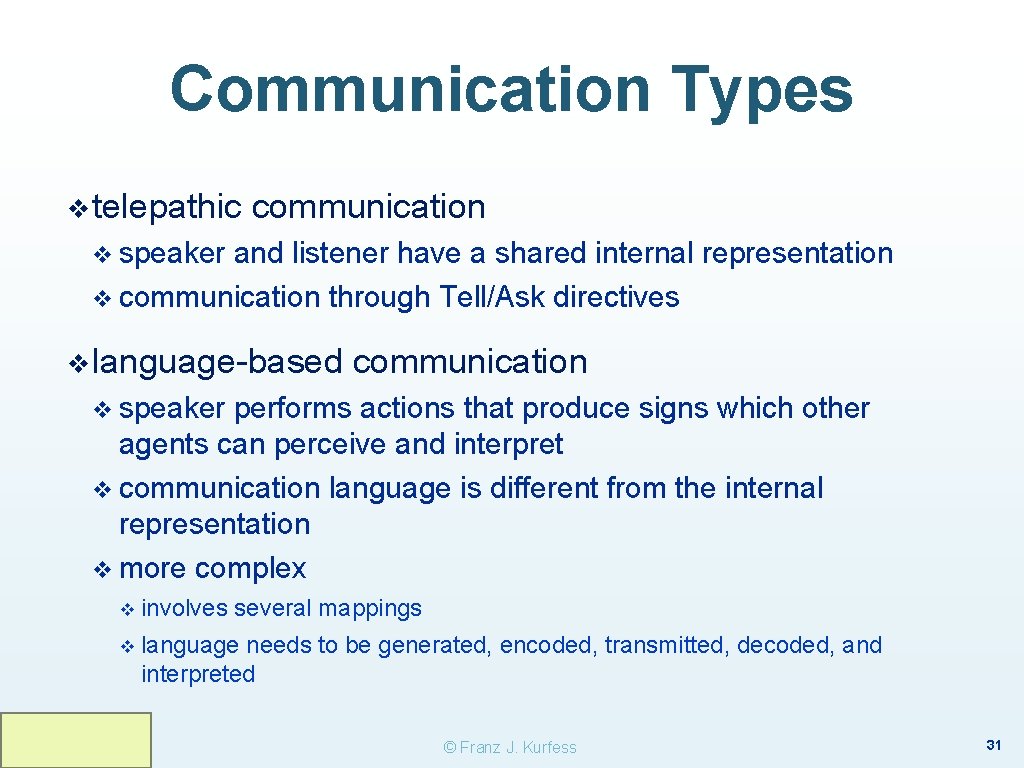
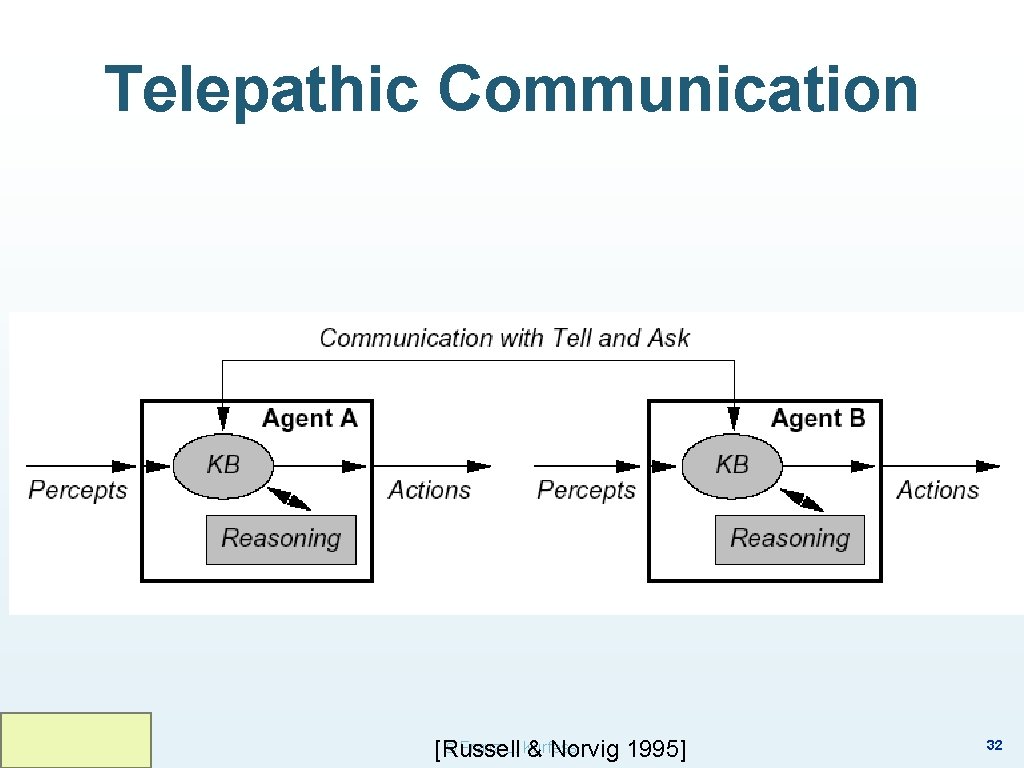
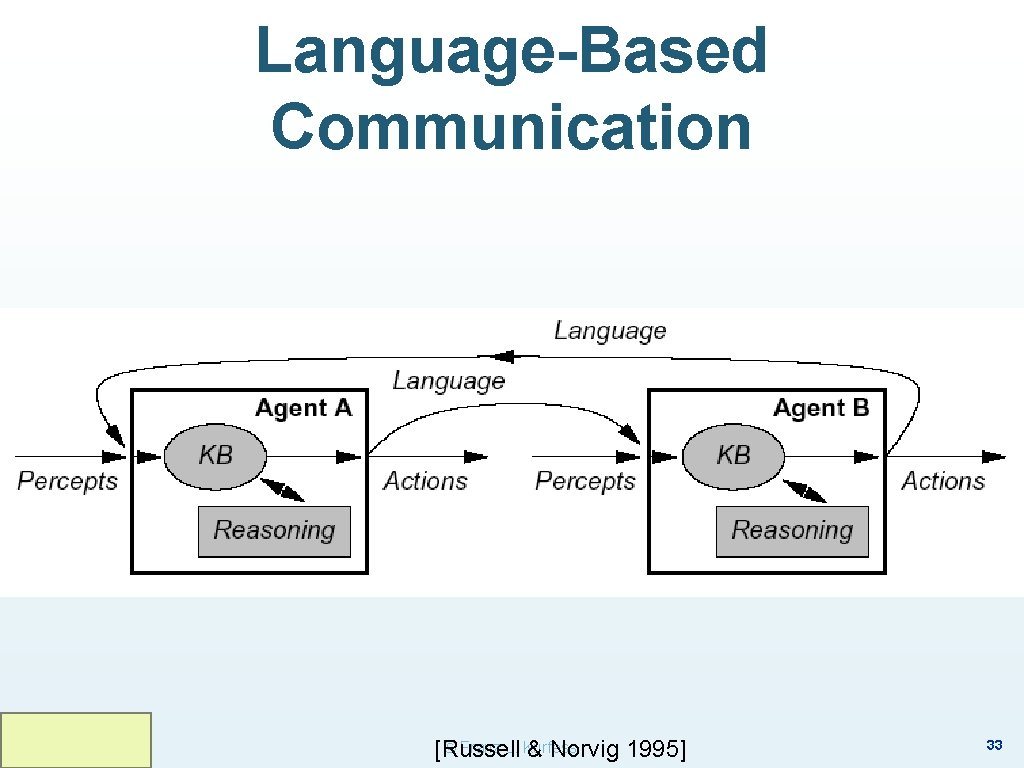
Communication Types ❖telepathic communication v speaker and listener have a shared internal representation v communication through Tell/Ask directives ❖language-based communication v speaker performs actions that produce signs which other agents can perceive and interpret v communication language is different from the internal representation v more complex v involves several mappings v language needs to be generated, encoded, transmitted, decoded, and interpreted © Franz J. Kurfess 31
Telepathic Communication © Franz J. Kurfess [Russell & Norvig 1995] 32
Language-Based Communication © Franz J. Kurfess [Russell & Norvig 1995] 33
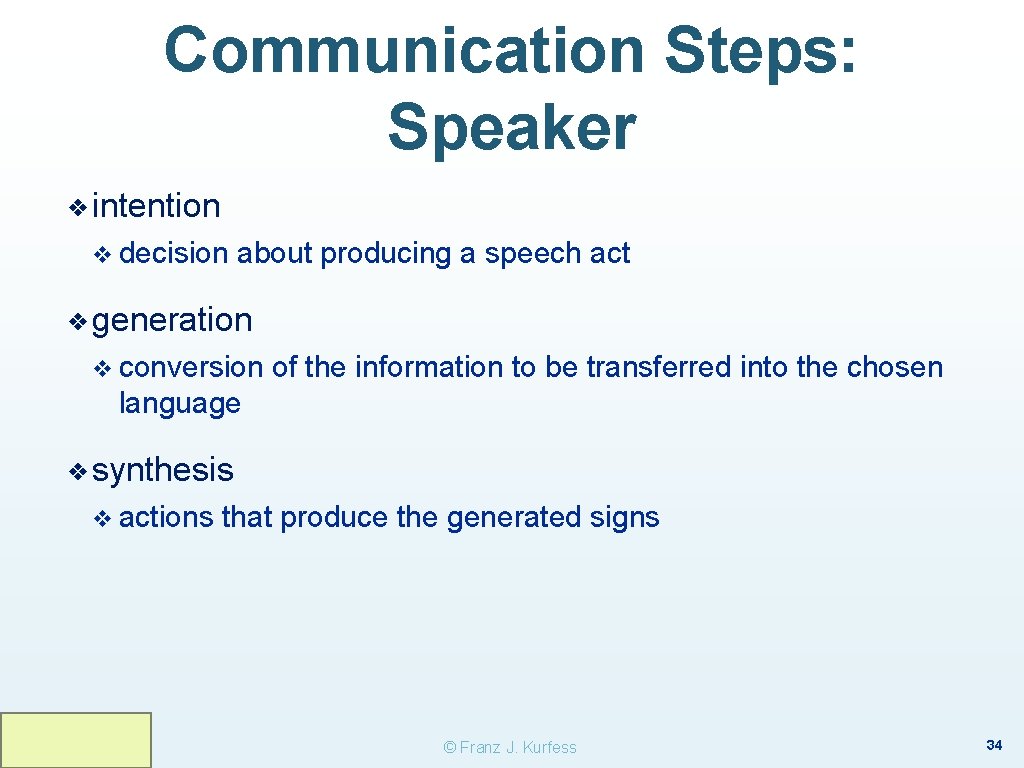
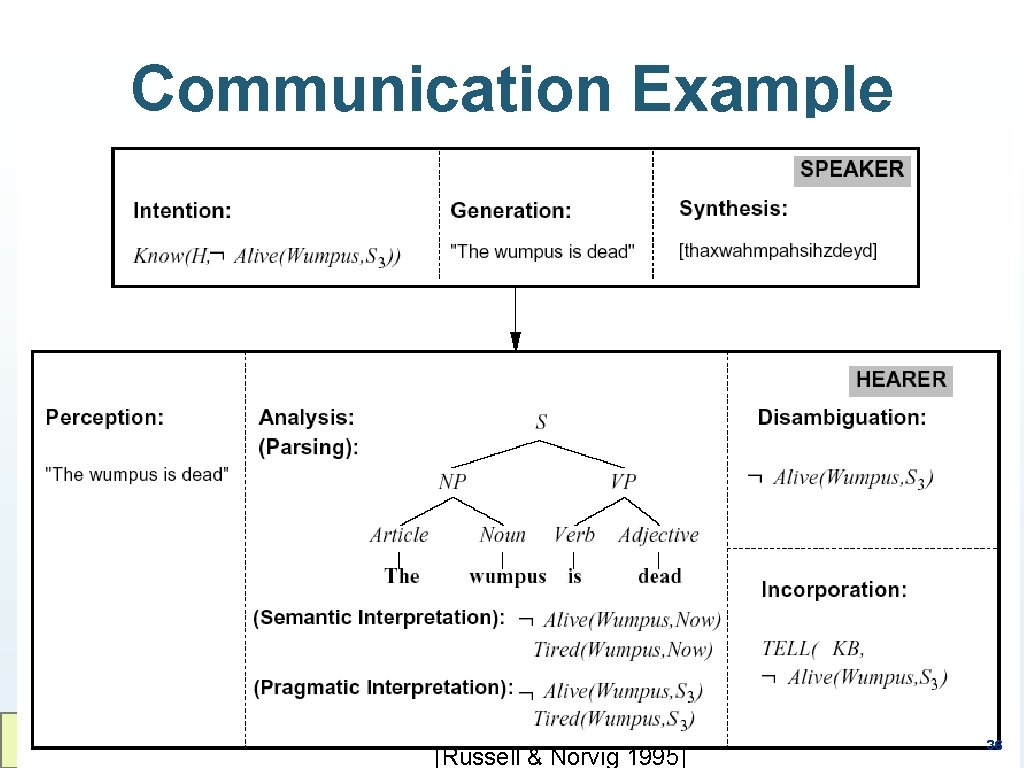
Communication Steps: Speaker ❖ intention v decision about producing a speech act ❖ generation v conversion of the information to be transferred into the chosen language ❖ synthesis v actions that produce the generated signs © Franz J. Kurfess 34
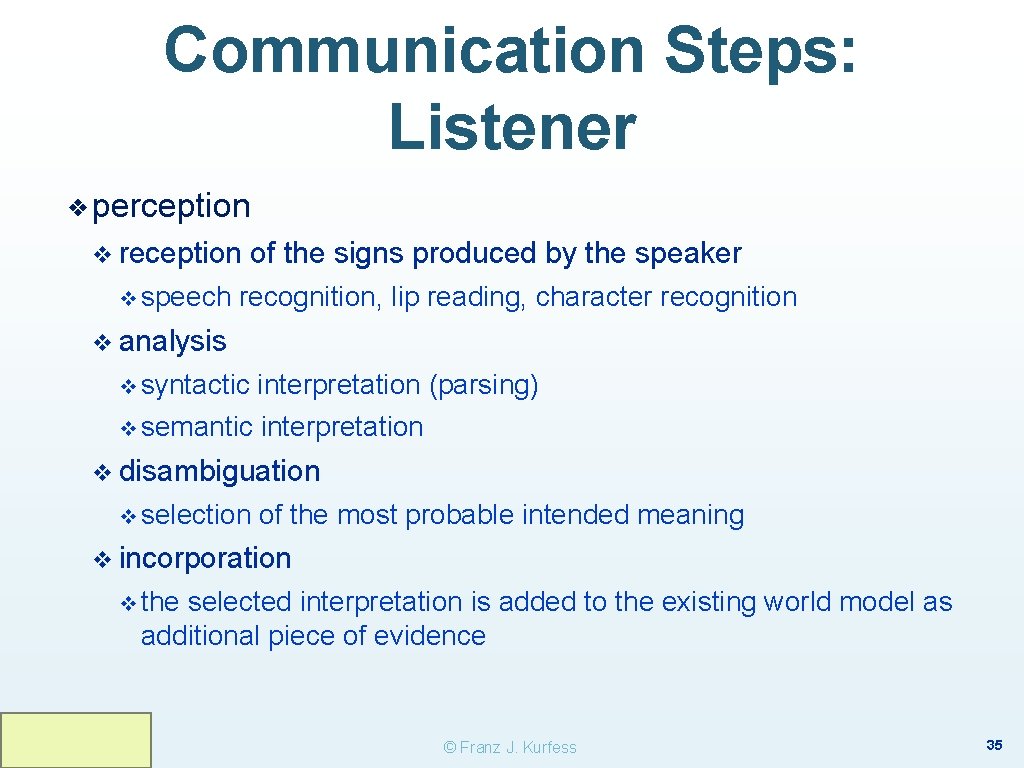
Communication Steps: Listener ❖ perception v reception v speech of the signs produced by the speaker recognition, lip reading, character recognition v analysis v syntactic interpretation (parsing) v semantic interpretation v disambiguation v selection of the most probable intended meaning v incorporation v the selected interpretation is added to the existing world model as additional piece of evidence © Franz J. Kurfess 35
Communication Example © Franz J. Kurfess [Russell & Norvig 1995] 36
Knowledge Exchange Perspectives Franz Kurfess: Knowledge Exchange 37
Different Perspectives ❖ Roles ❖ Scope ❖ Purpose © Franz J. Kurfess 38
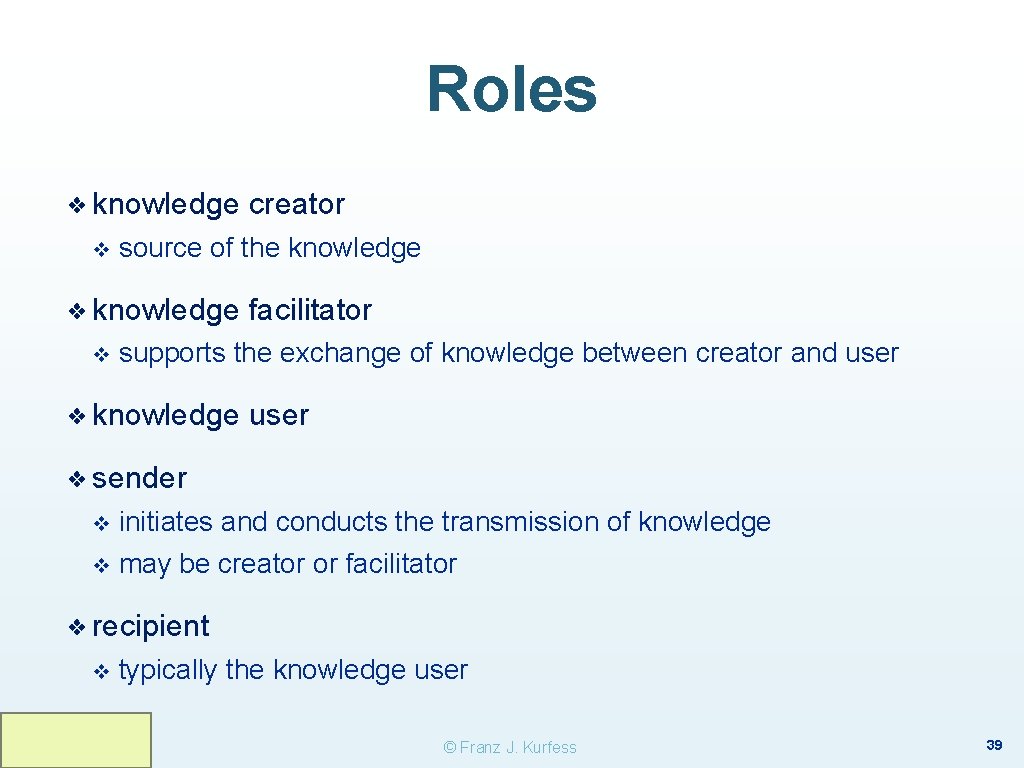
Roles ❖ knowledge v source of the knowledge ❖ knowledge v creator facilitator supports the exchange of knowledge between creator and user ❖ knowledge user ❖ sender initiates and conducts the transmission of knowledge v may be creator or facilitator v ❖ recipient v typically the knowledge user © Franz J. Kurfess 39
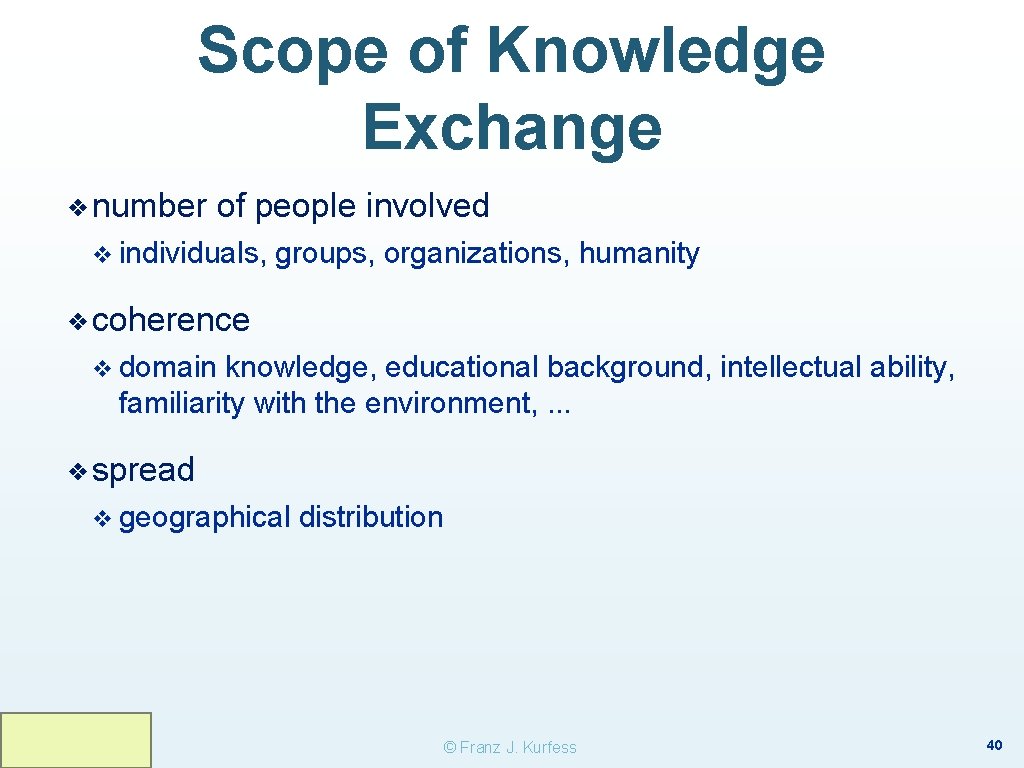
Scope of Knowledge Exchange ❖ number of people involved v individuals, groups, organizations, humanity ❖ coherence v domain knowledge, educational background, intellectual ability, familiarity with the environment, . . . ❖ spread v geographical distribution © Franz J. Kurfess 40
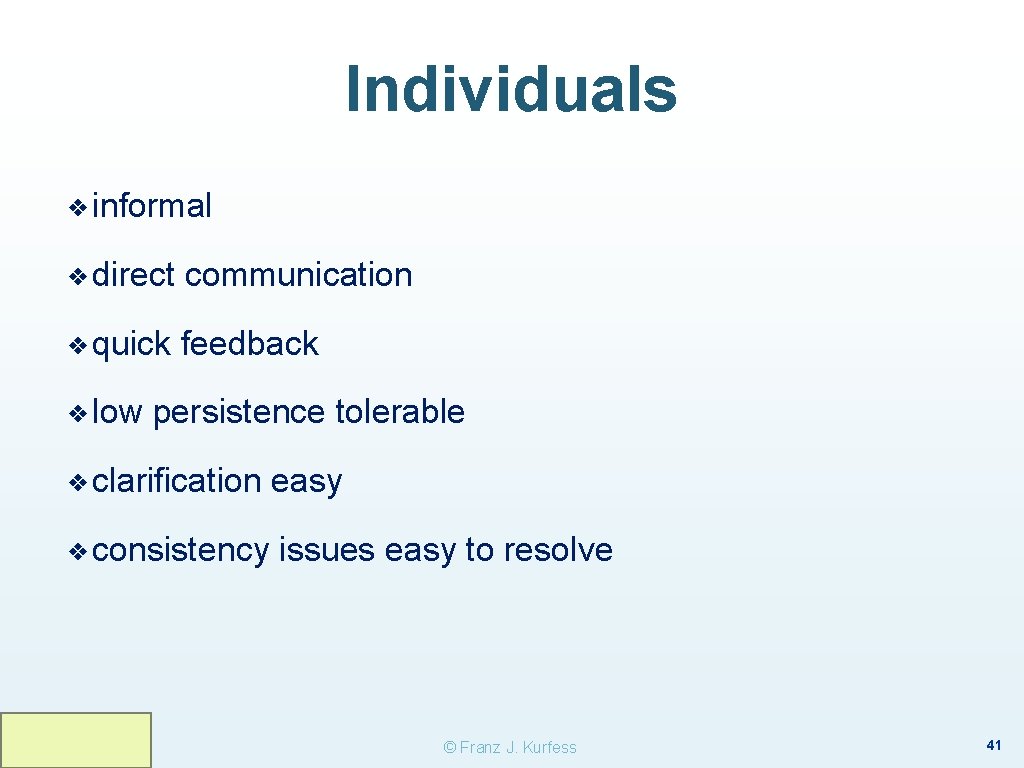
Individuals ❖ informal ❖ direct communication ❖ quick feedback ❖ low persistence tolerable ❖ clarification easy ❖ consistency issues easy to resolve © Franz J. Kurfess 41
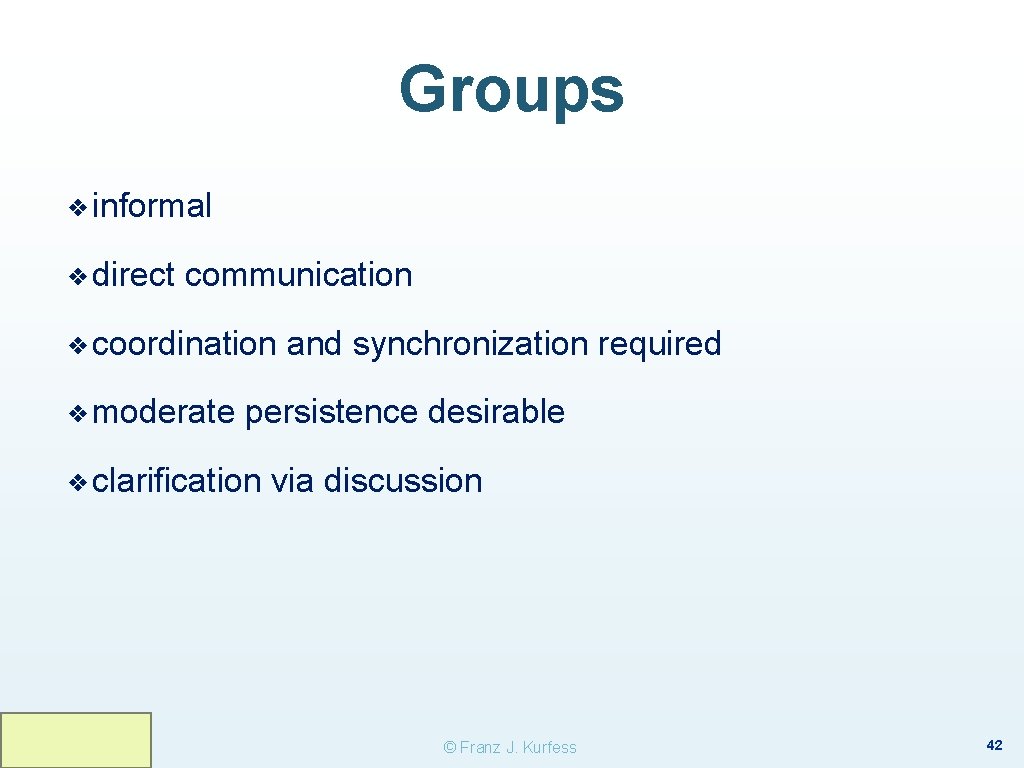
Groups ❖ informal ❖ direct communication ❖ coordination ❖ moderate and synchronization required persistence desirable ❖ clarification via discussion © Franz J. Kurfess 42
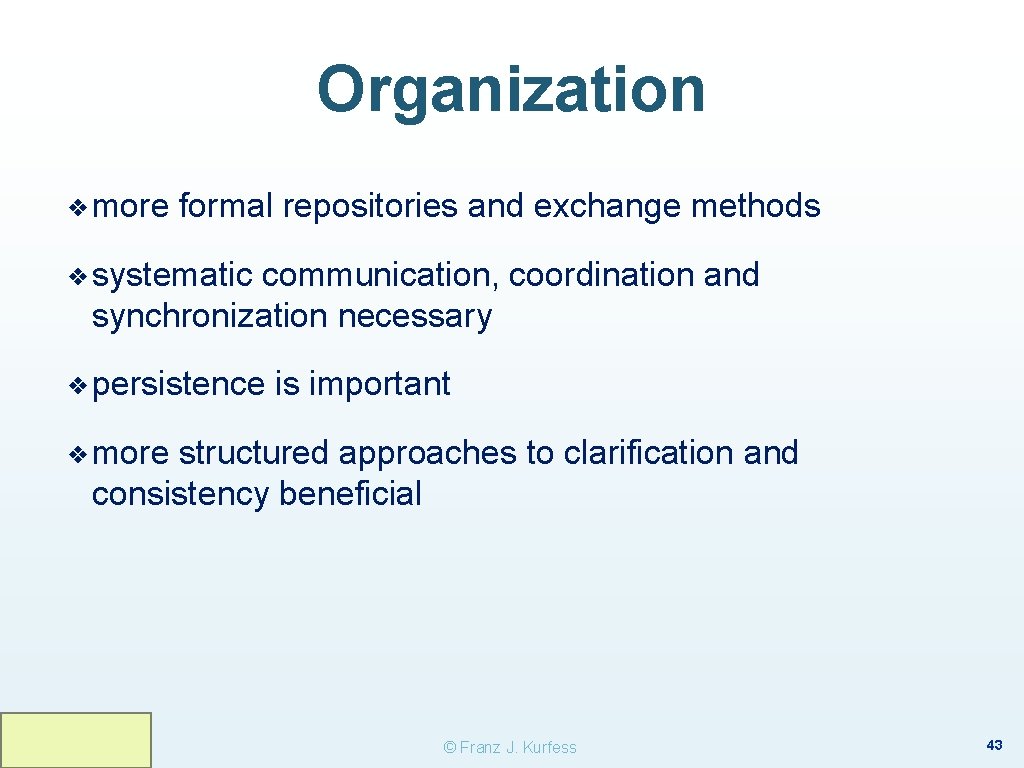
Organization ❖ more formal repositories and exchange methods ❖ systematic communication, coordination and synchronization necessary ❖ persistence is important ❖ more structured approaches to clarification and consistency beneficial © Franz J. Kurfess 43
Community ❖ formal “body of knowledge” v well-structured, reasonably controlled vocabulary, established repositories of knowledge, procedures for validation (“peer review”) ❖ established v journals, exchange methods official publications, books, conferences, portals ❖ professional v established organizations with controlled memberships communication, coordination, and synchronization methods © Franz J. Kurfess 44
Humanity ❖ no coherent “body of knowledge” ❖ communication, coordination, and synchronization of knowledge exchange across boundaries is difficult ❖ differences in vocabulary, methods, knowledge validation processes make exchange of knowledge difficult ❖ serious problems with clarification, resolution of inconsistencies are possible © Franz J. Kurfess 45
Purpose ❖ personal enrichment ❖ better product ❖ better working conditions ❖ commercial ❖ stronger ❖ societal advantage community benefits © Franz J. Kurfess 46
Knowledge Distribution Franz Kurfess: Knowledge Exchange 47
Distribution of Knowledge ❖ Knowledge v Digital Repositories Libraries ❖ Distribution Models © Franz J. Kurfess 48
Knowledge Repositories ❖ persistent v internal storage of digital documents representation in the original format v loss-less transformation may be acceptable ❖ transparent internal organization v multiple presentation methods for various users and usage methods ❖ multiple access methods v according to users’ needs and capabilities © Franz J. Kurfess 49
Wikipedia ❖ collaborative effort to capture knowledge ❖ contributions by volunteers v not restricted to “experts” ❖ liberal policy for entry modifications v editorial policies to limit abuse © Franz J. Kurfess 50
Scientific American “Edit This” ❖ public is invited to comment on some articles before they are published ❖ examples v “Science 2. 0: Great New Tool, or Great Risk? ” v “Does the U. S. Produce Too Many Scientists? ” © Franz J. Kurfess 51
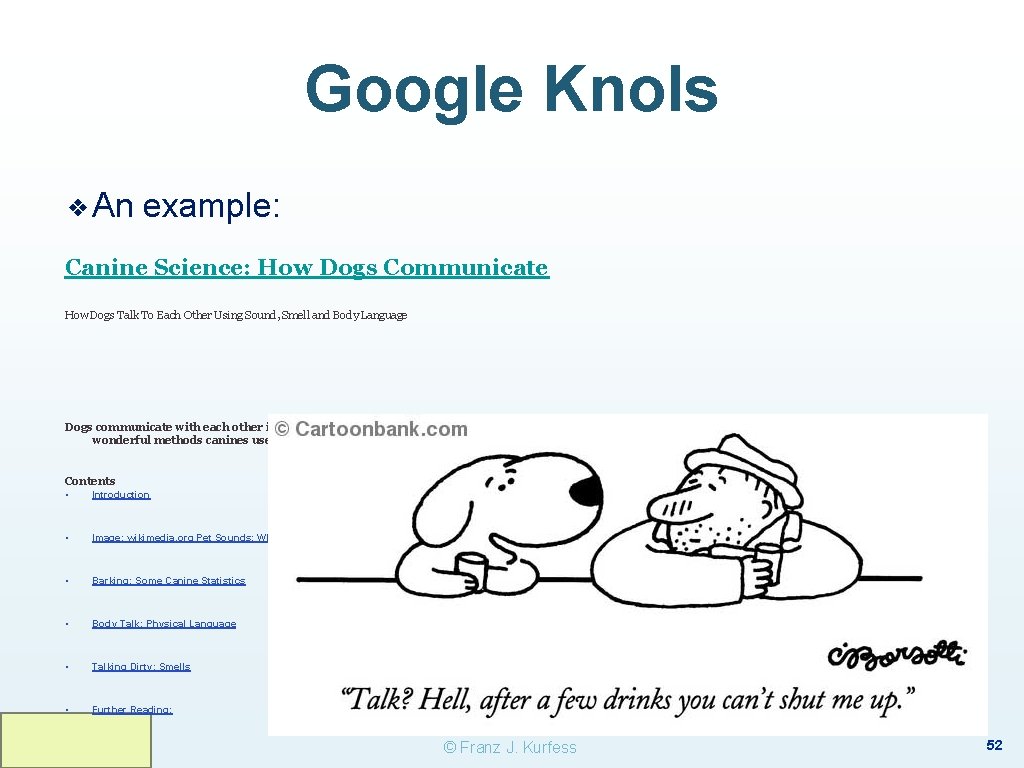
Google Knols ❖ An example: Canine Science: How Dogs Communicate How Dogs Talk To Each Other Using Sound, Smell and Body Language Dogs communicate with each other in a variety of ways, using sounds, smells and body language. This knol offers a guide to some of the weird and wonderful methods canines use to get their messages across. Contents • Introduction • Image: wikimedia. org Pet Sounds: What Dog Noises Mean • Barking: Some Canine Statistics • Body Talk: Physical Language • Talking Dirty: Smells • Further Reading: © Franz J. Kurfess 52
Educational Repositories ❖ Open Course Ware Initiative v MIT ❖ Connexions v Rice University and Connexions Consortium ❖ Merlot v California State University System is a “Sustaining Partner” © Franz J. Kurfess 53
General Repositories ❖ Instructables. com ❖ Slideshare. com ❖ Blogs ❖ Youtube and similar sites © Franz J. Kurfess 54
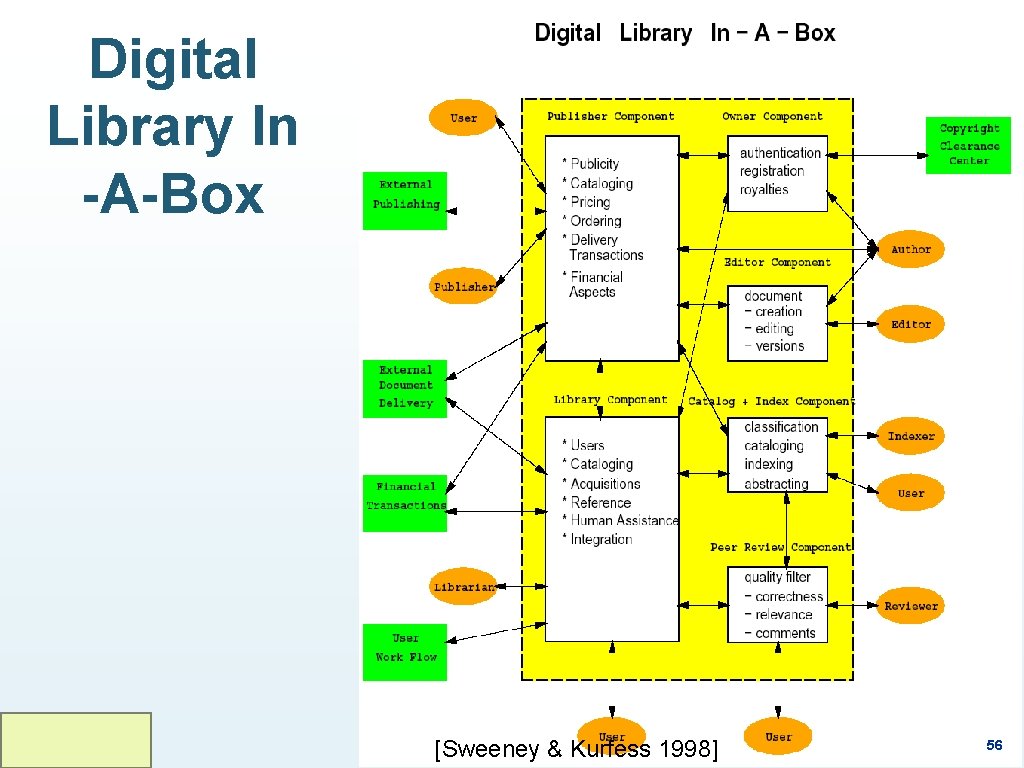
Digital Libraries ❖ collections of documents and artifacts stored and accessed via computers ❖ remotely accessible through networks ❖ enhanced functionality compared with paper-based libraries v access methods v organization principles v duplication ❖ implementation and usage unclear © Franz J. Kurfess 55
Digital Library In -A-Box © Franz J. Kurfess [Sweeney & Kurfess 1998] 56
© Franz J. Kurfess 64