
Knowledge Organization Franz J Kurfess Computer Science Department



- Slides: 62
Knowledge Organization Franz J. Kurfess Computer Science Department California Polytechnic State University San Luis Obispo, CA, U. S. A.
Acknowledgements Some of the material in these slides was developed for a lecture series sponsored by the European Community under the BPD program with Vilnius University as host institution
Use and Distribution of these Slides These slides are primarily intended for the students in classes I teach. In some cases, I only make PDF versions publicly available. If you would like to get a copy of the originals (Apple Key. Note or Microsoft Power. Point), please contact me via email at fkurfess@calpoly. edu. I hereby grant permission to use them in educational settings. If you do so, it would be nice to send me an email about it. If you’re considering using them in a commercial environment, please contact me first. ❖ Franz Kurfess: Knowledge Organization 5
Overview Knowledge Organization ❖ ❖ Motivation, Objectives Chapter Introduction ❖ ❖ Identification of Knowledge ❖ ❖ ❖ ❖ Natural Language Ontologies Knowledge Organization Tools ❖ ❖ Feature-based Categorization Hierarchical Categorization Knowledge Organization Methods ❖ ❖ Object Selection Naming and Description Categorization ❖ ❖ New topics, Terminology Editors, visualization tools, automated ontology construction Examples Important Concepts and Terms Chapter Summary Franz Kurfess: Knowledge Organization 6
Motivation and Objectives Franz Kurfess: Knowledge Organization 10
Motivation effective utilization of knowledge depends critically on its organization ❖ quick access ❖identification of relevant knowledge ❖assessment of available knowledge ❖ source, reliability, applicability ❖ knowledge organization is a difficult task, and requires complementary skills ❖ expertise in the domain ❖knowledge organization skills ❖ librarians ❖ Franz Kurfess: Knowledge Organization 11
Objectives be able to identify the main aspects dealing with the organization of knowledge ❖understand knowledge organization methods ❖apply the capabilities of computers to support knowledge organization ❖practice knowledge organization on small bodies of knowledge ❖evaluate frameworks and systems for knowledge organization ❖ Franz Kurfess: Knowledge Organization 12
Identification of Knowledge Object Selection ❖Naming and Description ❖ Franz Kurfess: Knowledge Organization 15
Object Selection what constitutes a “knowledge object” that is relevant for a particular task or topic ❖ physical object, document, concept ❖ how can this object be made available in the system ❖example: library ❖ is it worth while to add an object to the library’s collection ❖if so, how can it be integrated ❖ physical document: book, magazine, report, etc. ❖digital document: file, data base, Web page, etc. ❖ Franz Kurfess: Knowledge Organization 16
Naming and Description names serve two important roles ❖ identification ❖ ideally, a unique descriptor that allows the unambiguous selection of the object ❖often an ambiguous descriptor that requires context information ❖ location ❖ especially in digital systems, names are used as “address” for an object ❖ names, descriptions and relationships to related objects are specified in listings ❖ dictionary, glossary, thesaurus, ontology, index ❖ Franz Kurfess: Knowledge Organization 17
Knowledge Organization Methods Naming and Description Devices ❖ index, glossary, dictionary, thesaurus, ontology ❖ Natural Language (NL) ❖ Levels of NL Understanding ❖NL-based indexing ❖ Categorization ❖Ontologies ❖ Franz Kurfess: Knowledge Organization 18
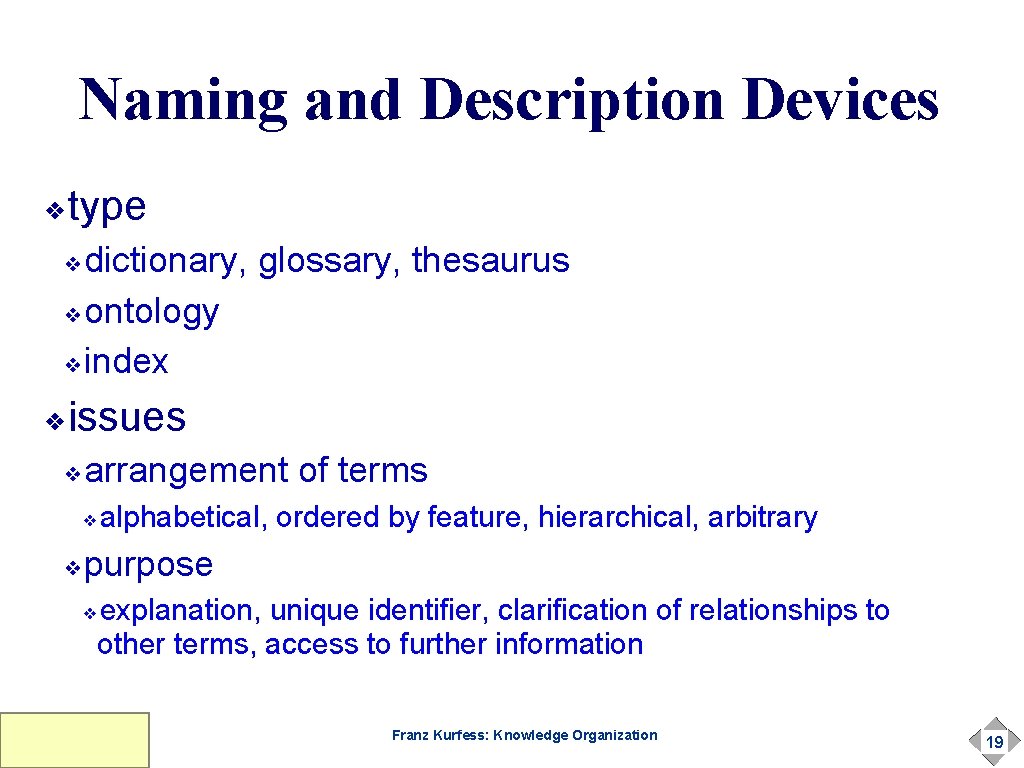
Naming and Description Devices type ❖ dictionary, glossary, thesaurus ❖ontology ❖index ❖ issues ❖ arrangement of terms ❖ alphabetical, ordered by feature, hierarchical, arbitrary ❖ purpose ❖ explanation, unique identifier, clarification of relationships to other terms, access to further information ❖ Franz Kurfess: Knowledge Organization 19
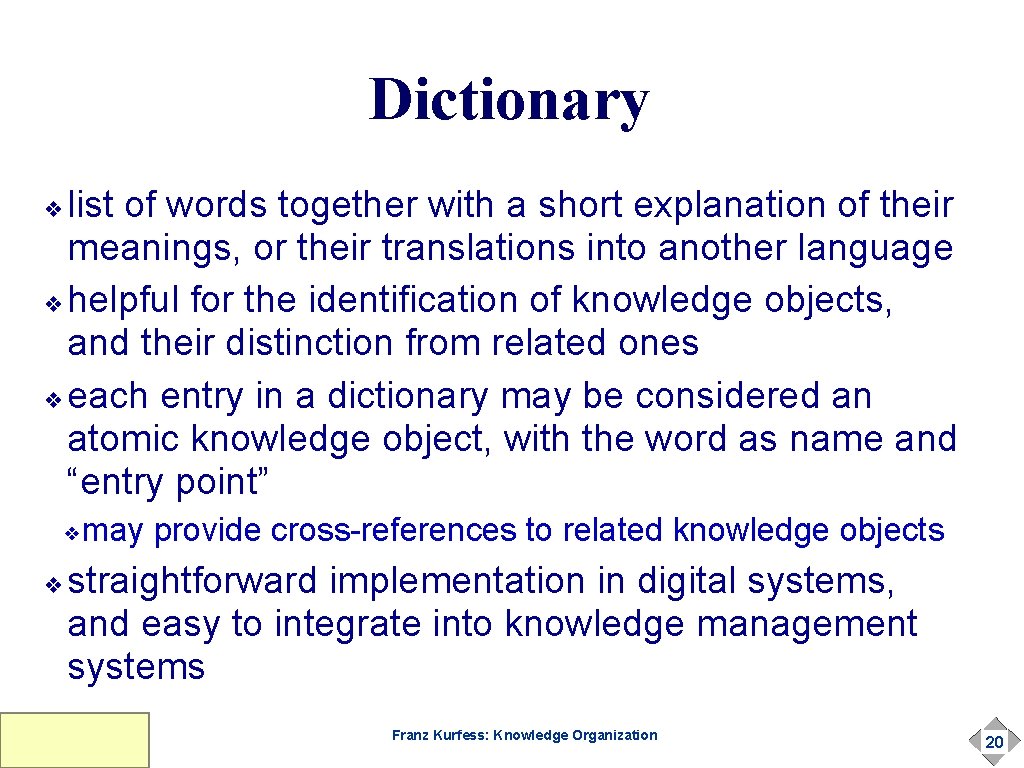
Dictionary list of words together with a short explanation of their meanings, or their translations into another language ❖ helpful for the identification of knowledge objects, and their distinction from related ones ❖ each entry in a dictionary may be considered an atomic knowledge object, with the word as name and “entry point” ❖ may provide cross-references to related knowledge objects ❖ ❖ straightforward implementation in digital systems, and easy to integrate into knowledge management systems Franz Kurfess: Knowledge Organization 20
Glossary list of words, expressions, or technical terms with an explanation of their meanings ❖ usually restricted to a particular book, document, activity, or topic ❖ provides a clarification of the intended meaning for knowledge objects ❖otherwise similar to dictionary ❖ Franz Kurfess: Knowledge Organization 21
Thesaurus collection of synonyms (word sets with identical or similar meanings) ❖ frequently includes words that are related in some other way, e. g. antonyms (opposite meanings), homonyms (same pronunciation or spelling) ❖ identifies and clarifies relationships between words ❖ not so much an explanation of their meanings ❖ may be used to expand search queries in order to find relevant documents that may not contain a particular word ❖ Franz Kurfess: Knowledge Organization 22
Thesaurus Types knowledge-based ❖linguistic ❖statistical ❖ Franz Kurfess: Knowledge Organization [Liddy 2000] 23
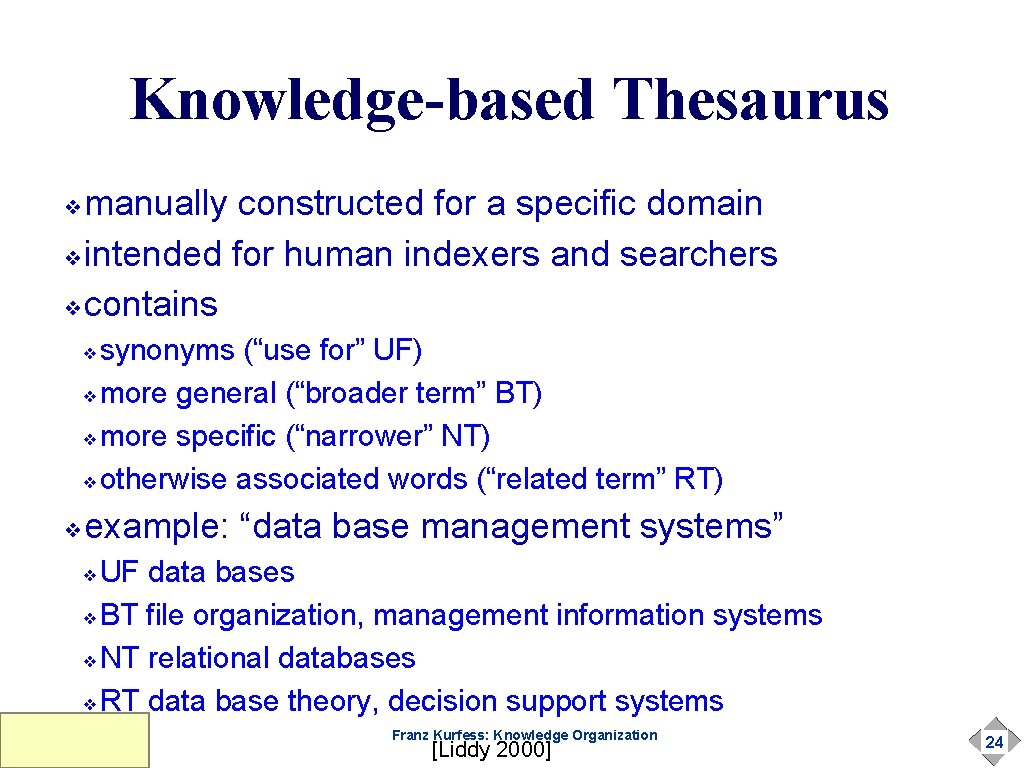
Knowledge-based Thesaurus manually constructed for a specific domain ❖intended for human indexers and searchers ❖contains ❖ synonyms (“use for” UF) ❖more general (“broader term” BT) ❖more specific (“narrower” NT) ❖otherwise associated words (“related term” RT) ❖ example: “data base management systems” ❖ UF data bases ❖BT file organization, management information systems ❖NT relational databases ❖RT data base theory, decision support systems ❖ Franz Kurfess: Knowledge Organization [Liddy 2000] 24
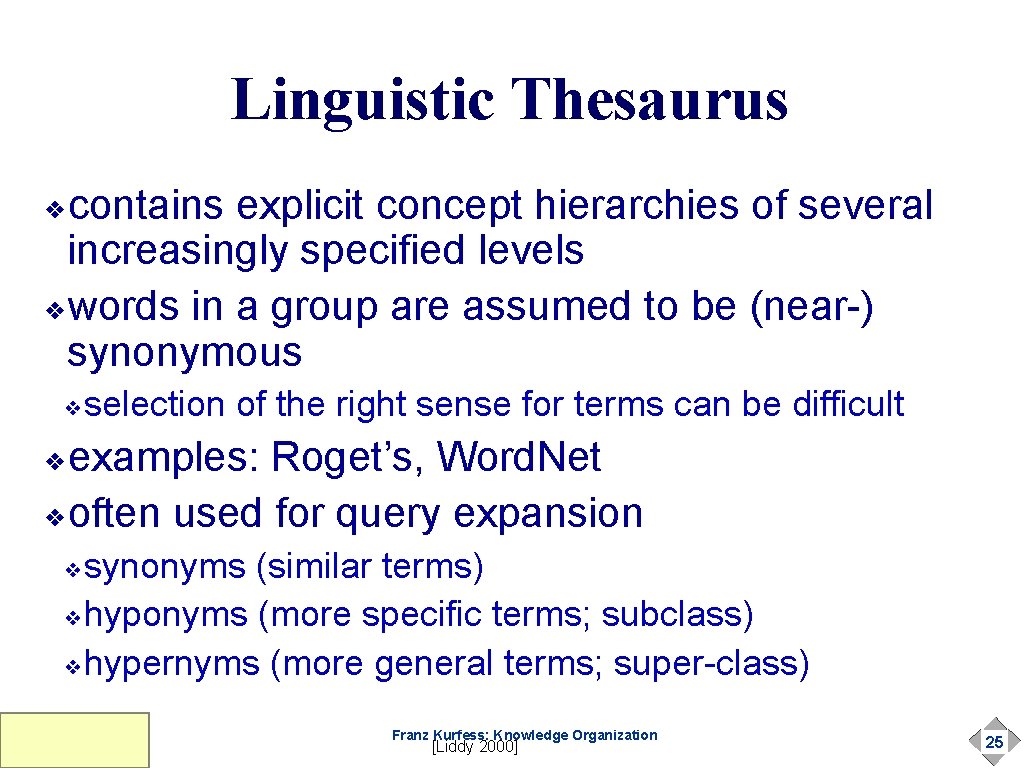
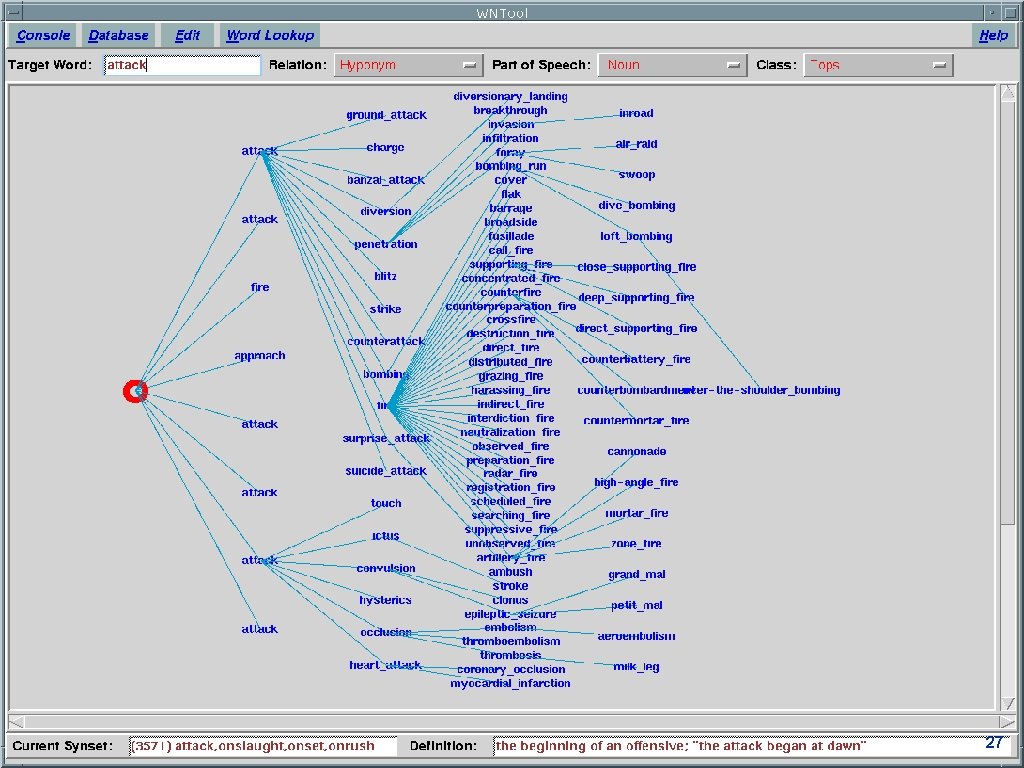
Linguistic Thesaurus contains explicit concept hierarchies of several increasingly specified levels ❖words in a group are assumed to be (near-) synonymous ❖ selection of the right sense for terms can be difficult ❖ examples: Roget’s, Word. Net ❖often used for query expansion ❖ synonyms (similar terms) ❖hyponyms (more specific terms; subclass) ❖hypernyms (more general terms; super-class) ❖ Franz Kurfess: Knowledge Organization [Liddy 2000] 25
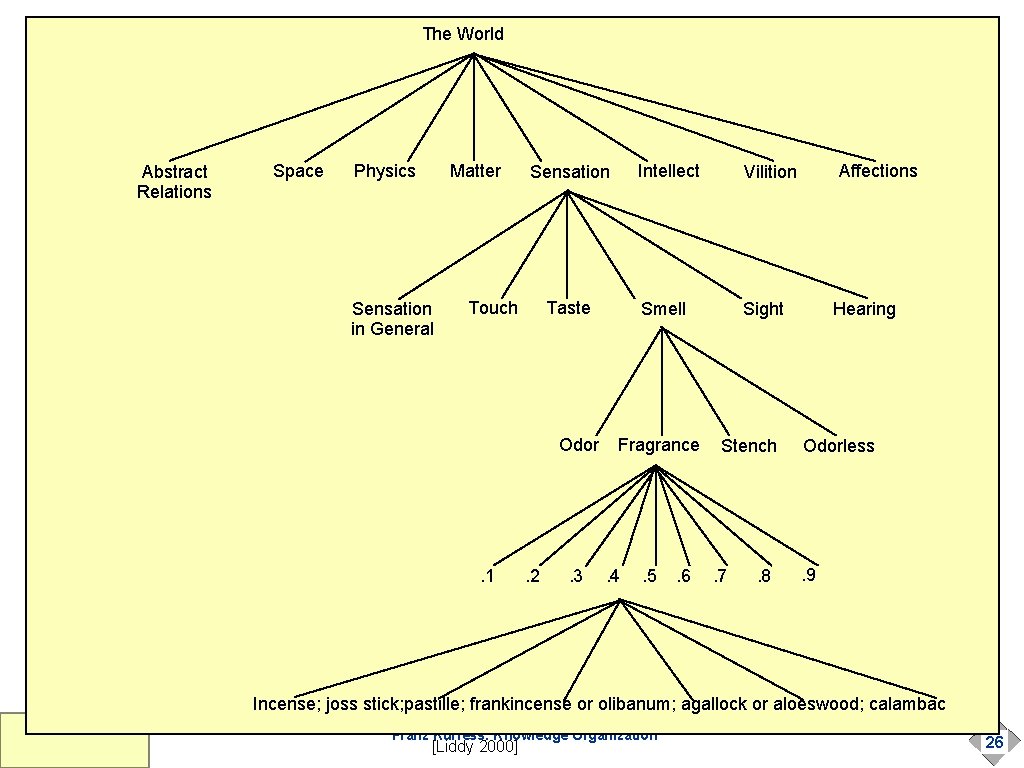
The World Example 1: Linguistic Thesaurus Abstract Relations Space Physics Matter Sensation in General Sensation Touch Taste Odor . 1 . 2 . 3 Intellect Vilition Smell Sight Fragrance . 4 . 5 . 6 Stench . 7 . 8 Affections Hearing Odorless . 9 Incense; joss stick; pastille; frankincense or olibanum; agallock or aloeswood; calambac Franz Kurfess: Knowledge Organization [Liddy 2000] 26
Example 2: Word. Net as Linguistic Thesaurus [Liddy 2000] Franz Kurfess: Knowledge Organization 27
Query Expansion in Search Engines look up each word in Word Net ❖ if the word is found, the set of synonyms from all Synsets are added to the query representation ❖ weigh each added word as 0. 8 rather than 1. 0 ❖ results better than plain SMART ❖ variable performance over queries ❖ major cause of error: the use of ambiguous words’ Synsets ❖ ❖ general thesauri such as Roget’s or Word. Net have not been shown conclusively to improve results may sacrifice precision to recall ❖ not domain specific ❖ not sense disambiguated ❖ Franz Kurfess: Knowledge Organization [Liddy 2000, Voorhees 1993] 28
Statistical Thesaurus ❖ automatic thesaurus construction classes of terms produced are not necessarily synonymous, nor broader, nor narrower ❖rather, words that tend to co-occur with head term ❖effectiveness varies considerably depending on technique used ❖ Franz Kurfess: Knowledge Organization [Liddy 2000] 29
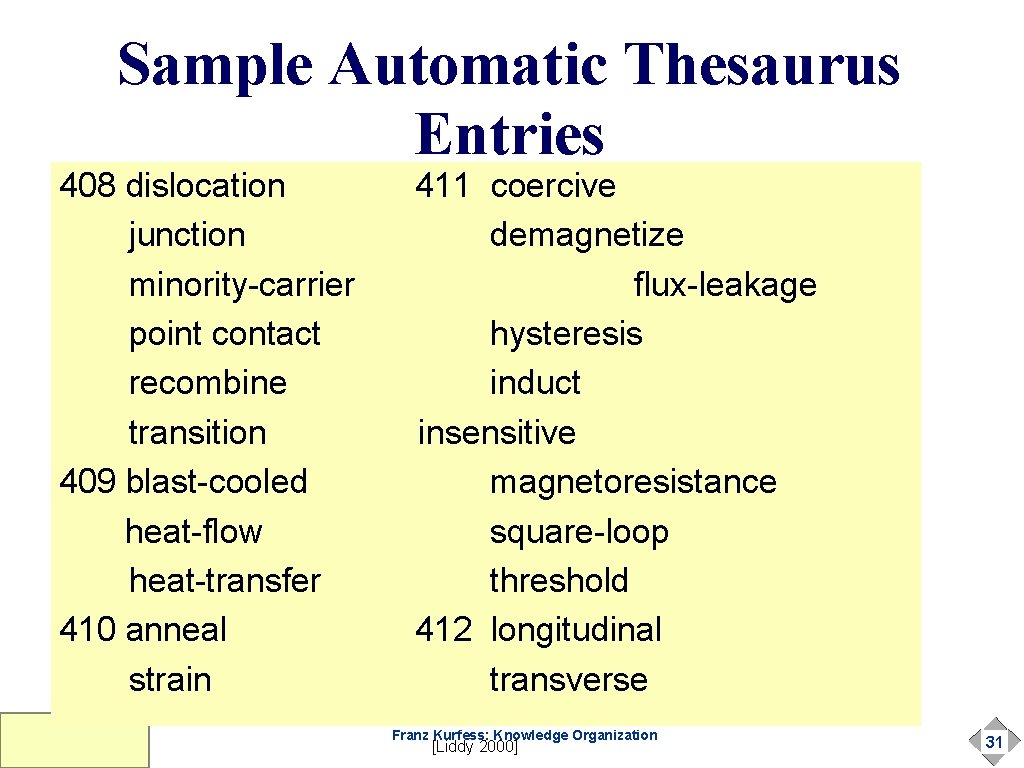
Automatic Thesaurus Construction (Salton) ❖ document collection based on index term similarities ❖compute vector similarities for each pair of documents ❖if sufficiently similar, create a thesaurus entry for each term which includes terms from similar document ❖ Franz Kurfess: Knowledge Organization [Liddy 2000] 30
Sample Automatic Thesaurus Entries 408 dislocation junction minority-carrier point contact recombine transition 409 blast-cooled heat-flow heat-transfer 410 anneal strain 411 coercive demagnetize flux-leakage hysteresis induct insensitive magnetoresistance square-loop threshold 412 longitudinal transverse Franz Kurfess: Knowledge Organization [Liddy 2000] 31
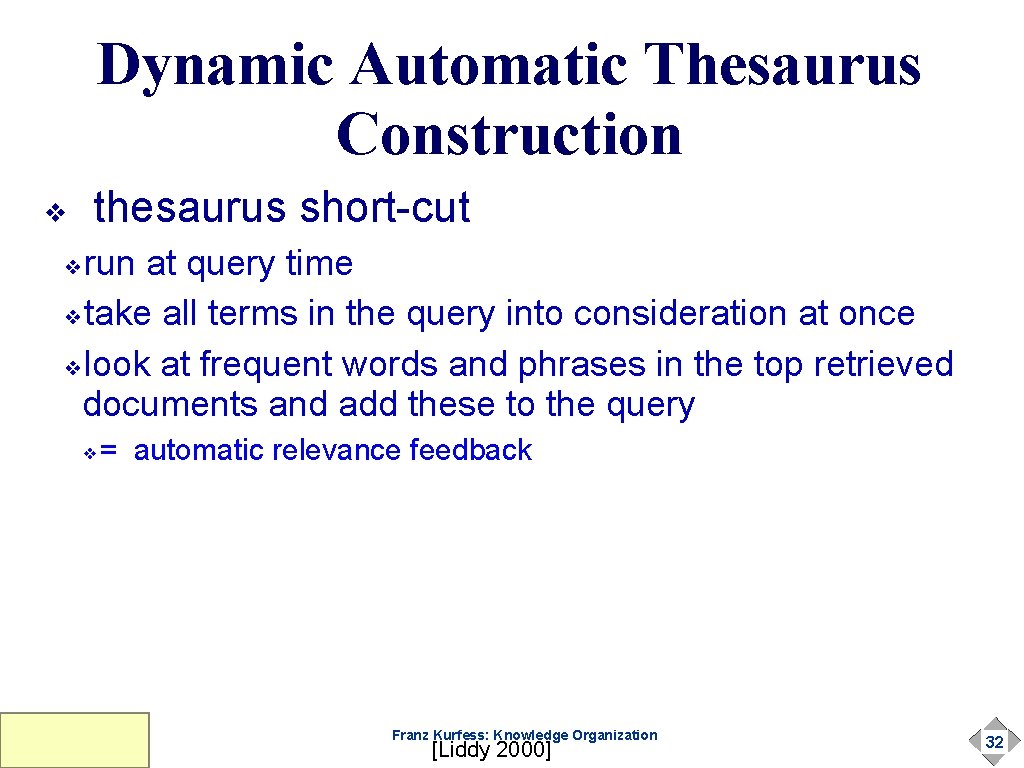
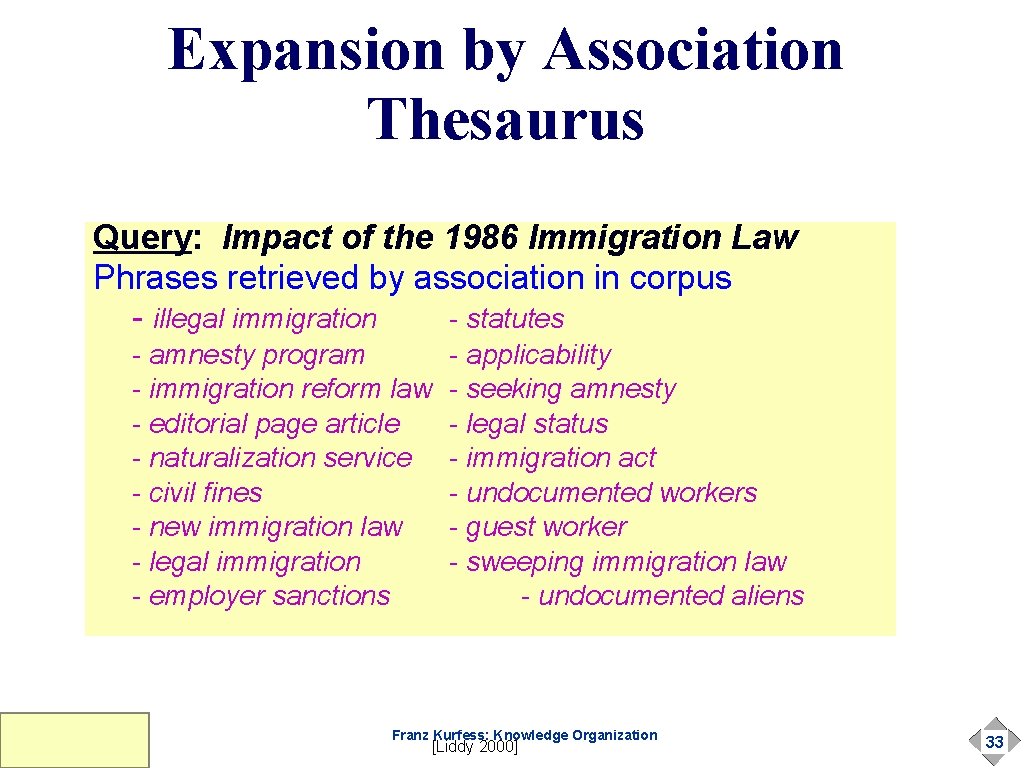
Dynamic Automatic Thesaurus Construction thesaurus short-cut ❖ run at query time ❖take all terms in the query into consideration at once ❖look at frequent words and phrases in the top retrieved documents and add these to the query ❖ = automatic relevance feedback ❖ Franz Kurfess: Knowledge Organization [Liddy 2000] 32
Expansion by Association Thesaurus Query: Impact of the 1986 Immigration Law Phrases retrieved by association in corpus - illegal immigration - statutes - amnesty program - immigration reform law - editorial page article - naturalization service - civil fines - new immigration law - legal immigration - employer sanctions - applicability - seeking amnesty - legal status - immigration act - undocumented workers - guest worker - sweeping immigration law - undocumented aliens Franz Kurfess: Knowledge Organization [Liddy 2000] 33
Index listing of words that appear in a set of documents, together with pointers to the locations where they appear ❖provides a reference to further information concerning a particular word or concept ❖constitutes the basis for computer-based search engines ❖ Franz Kurfess: Knowledge Organization 34
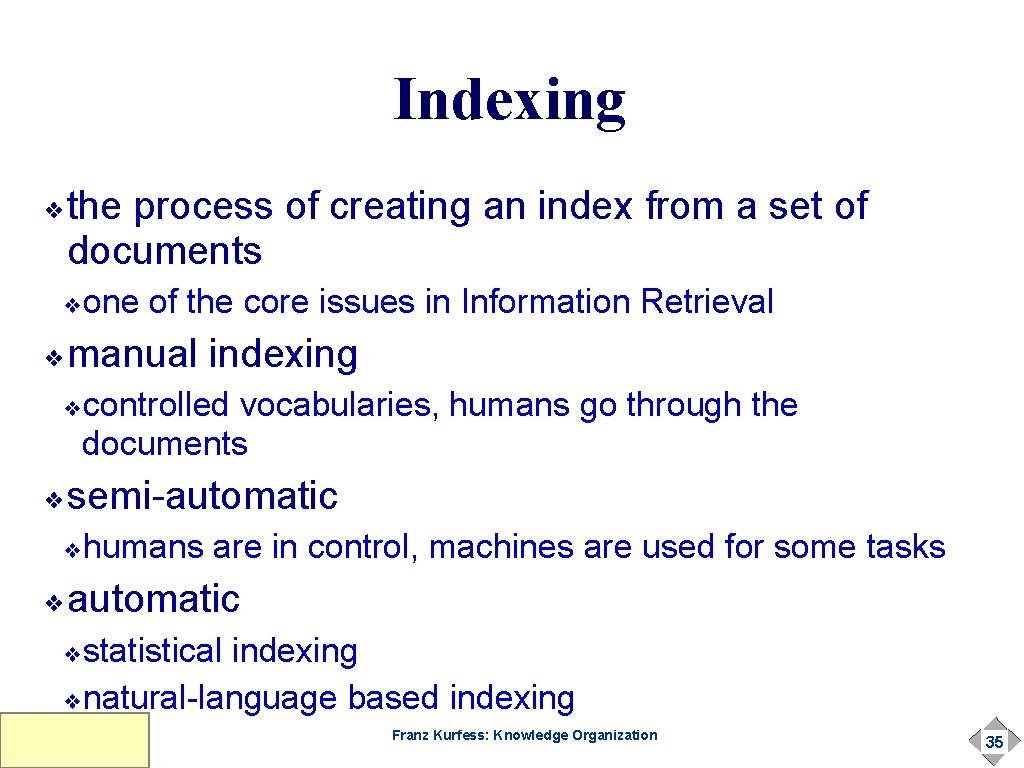
Indexing ❖ the process of creating an index from a set of documents one of the core issues in Information Retrieval ❖ ❖ manual indexing controlled vocabularies, humans go through the documents ❖ ❖ semi-automatic humans are in control, machines are used for some tasks ❖ ❖ automatic statistical indexing ❖natural-language based indexing ❖ Franz Kurfess: Knowledge Organization 35
Natural Language Methods Natural Language Processing ❖Natural Language Understanding ❖NLP-based Indexing ❖ Franz Kurfess: Knowledge Organization 36
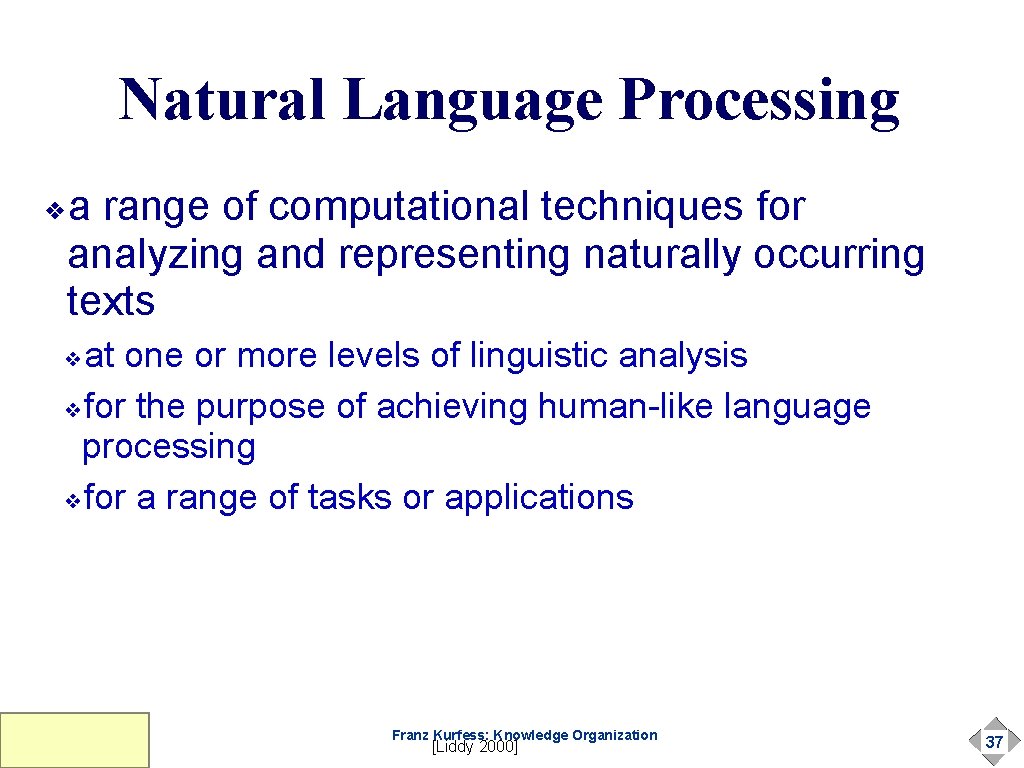
Natural Language Processing a range of computational techniques for analyzing and representing naturally occurring texts ❖ at one or more levels of linguistic analysis ❖for the purpose of achieving human-like language processing ❖for a range of tasks or applications ❖ Franz Kurfess: Knowledge Organization [Liddy 2000] 37
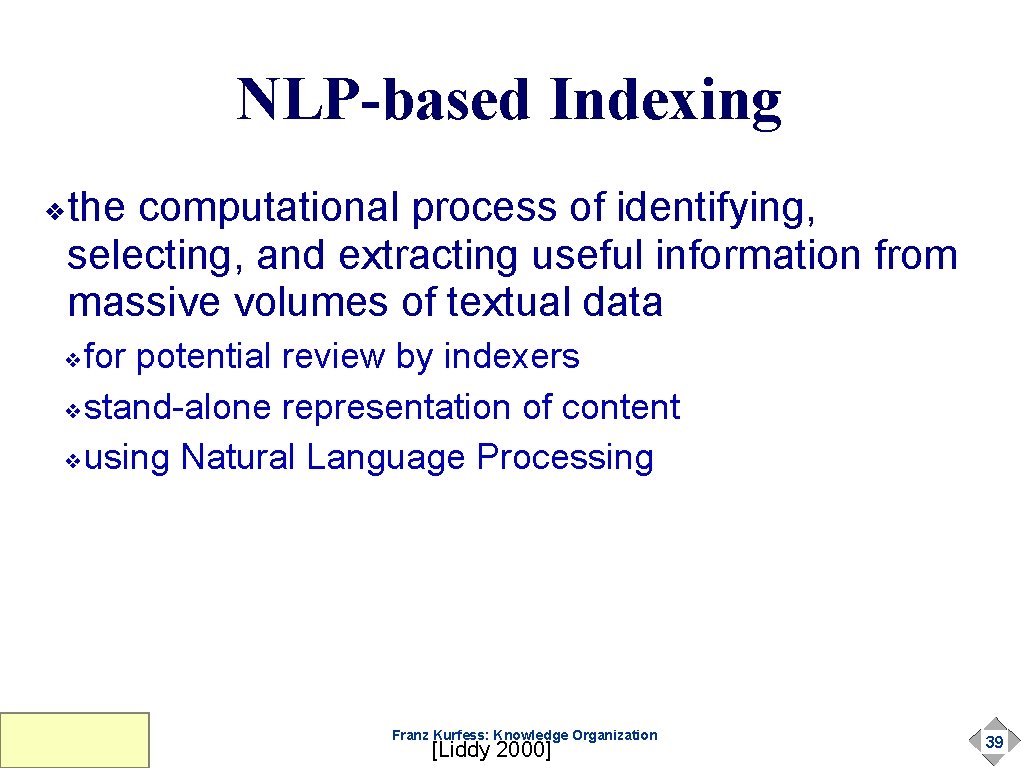
NLP-based Indexing the computational process of identifying, selecting, and extracting useful information from massive volumes of textual data ❖ for potential review by indexers ❖stand-alone representation of content ❖using Natural Language Processing ❖ Franz Kurfess: Knowledge Organization [Liddy 2000] 39
What can NLP Indexing do? phrase recognition ❖disambiguation ❖concept expansion ❖ Franz Kurfess: Knowledge Organization 40
Ontologies description ❖“representational promiscuity” ❖ontology types ❖usage of ontologies ❖ domain standards and vocabularies ❖ ontology development ❖ development process ❖specification languages ❖ Franz Kurfess: Knowledge Organization 41
Categorization Hierarchical Categorization ❖Feature-based Categorization ❖ Franz Kurfess: Knowledge Organization 42
Hierarchical Categorization a set of objects is divided into smaller and smaller subset, forming a hierarchical structure (tree) with the elementary objects as leaf nodes ❖ typically one feature is used to distinguish one category from another ❖often constitutes a relatively stable “backbone” of a knowledge organization scheme ❖re-organization requires a major effort ❖ Franz Kurfess: Knowledge Organization 43
Feature-based Categorization objects or documents are assigned to categories according to commonalties in specific features ❖can be used to dynamically group objects into categories that are of interest for a particular task or purpose ❖ re-organization is easy with computer support ❖ Franz Kurfess: Knowledge Organization 44
Ontology examines the relationships between words, and the corresponding concepts and objects ❖ in practice, it often combines aspects of thesaurus and dictionary ❖frequently uses a graph-based visual representation to indicated relationships between words ❖ used to identify and specify a vocabulary for a particular subject or task ❖ Franz Kurfess: Knowledge Organization 45
The Notion of Ontology ontology explicit specification of a shared conceptualization that holds in a particular context ❖captures a viewpoint on a domain: ❖ taxonomies of species ❖physical, functional, & behavioral system descriptions ❖task perspective: instruction, planning ❖ Franz Kurfess: Knowledge Organization [Schreiber 2000] 46
Ontology Types domain-oriented ❖ domain-specific ❖ medicine => cardiology => rhythm disorders ❖traffic light control system ❖ domain generalizations ❖ ❖ components, organs, documents task-oriented ❖ task-specific ❖ ❖ configuration design, instruction, planning task generalizations ❖ ❖ problems solving, e. g. upml generic ontologies ❖ “top-level categories” ❖units and dimensions ❖ Franz Kurfess: Knowledge Organization [Schreiber 2000] 48
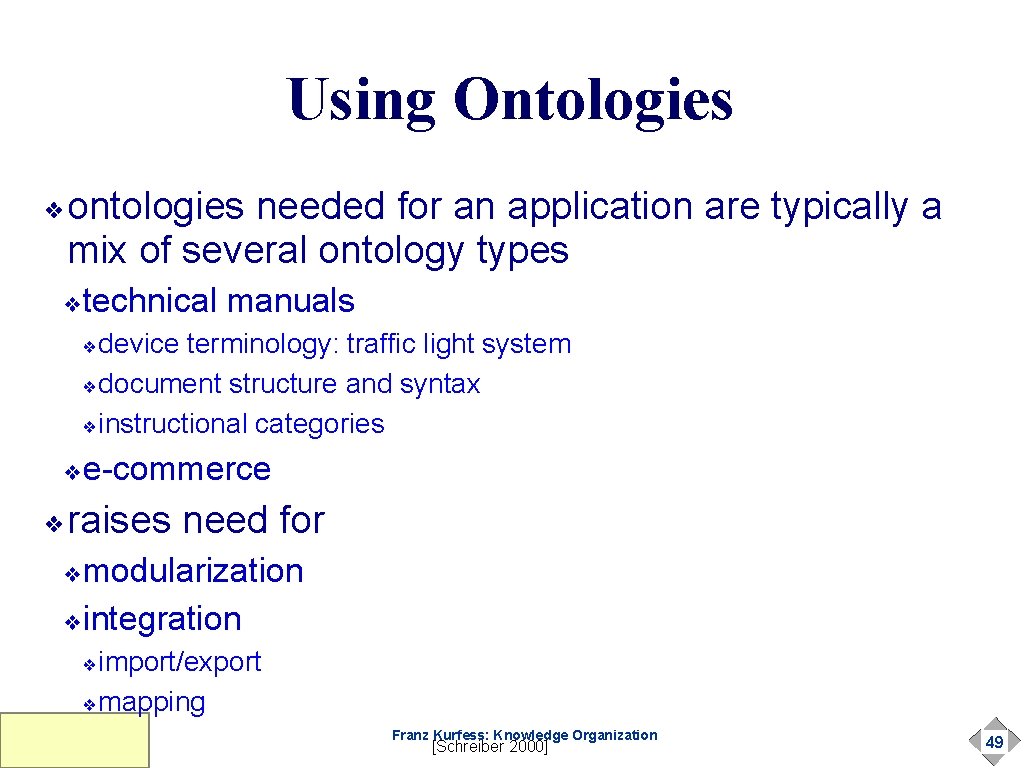
Using Ontologies ❖ ontologies needed for an application are typically a mix of several ontology types technical manuals ❖ device terminology: traffic light system ❖document structure and syntax ❖instructional categories ❖ e-commerce ❖ ❖ raises need for modularization ❖integration ❖ import/export ❖mapping ❖ Franz Kurfess: Knowledge Organization [Schreiber 2000] 49
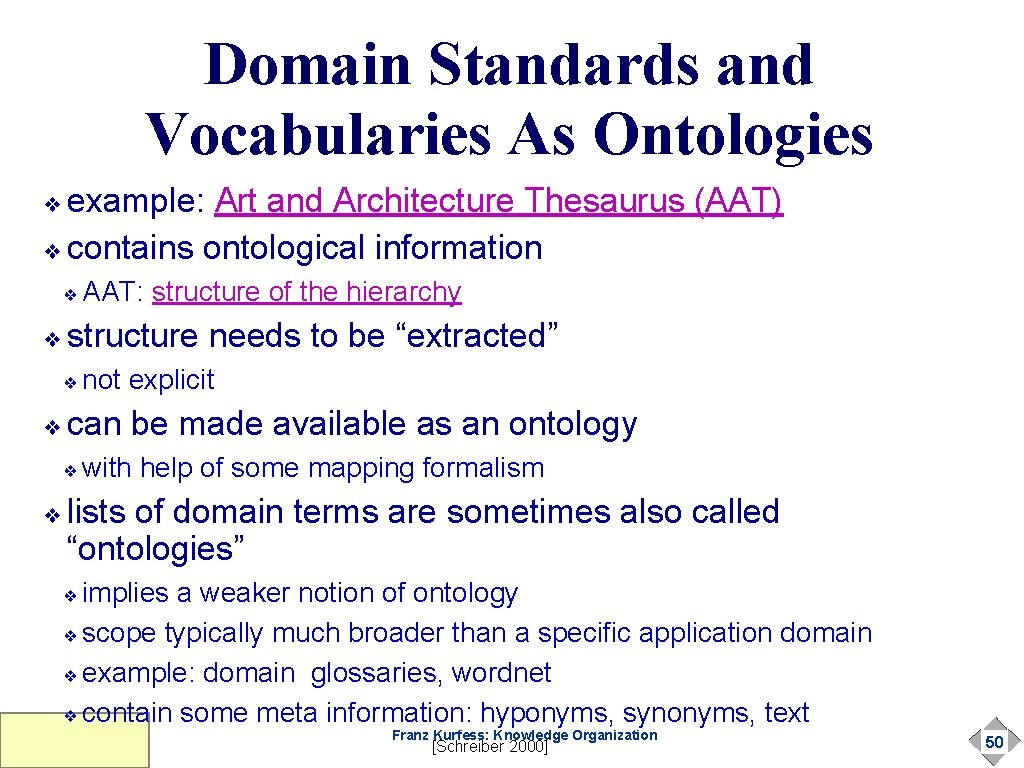
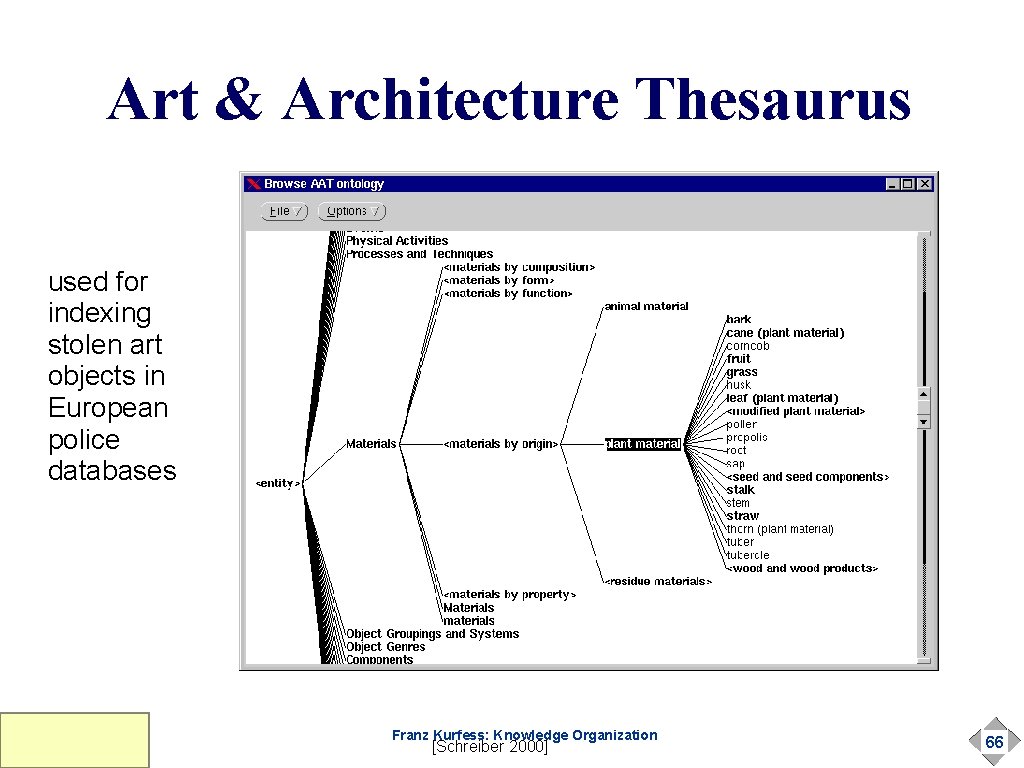
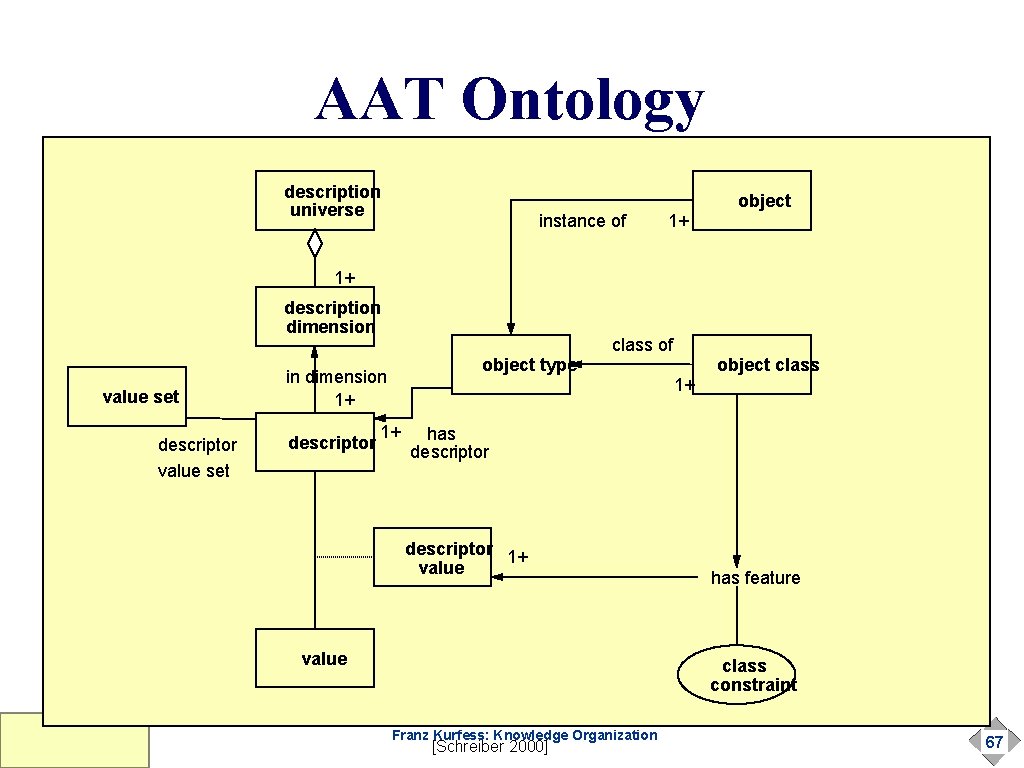
Domain Standards and Vocabularies As Ontologies example: Art and Architecture Thesaurus (AAT) ❖ contains ontological information ❖ ❖ ❖ structure needs to be “extracted” ❖ ❖ not explicit can be made available as an ontology ❖ ❖ AAT: structure of the hierarchy with help of some mapping formalism lists of domain terms are sometimes also called “ontologies” implies a weaker notion of ontology ❖ scope typically much broader than a specific application domain ❖ example: domain glossaries, wordnet ❖ contain some meta information: hyponyms, synonyms, text ❖ Franz Kurfess: Knowledge Organization [Schreiber 2000] 50
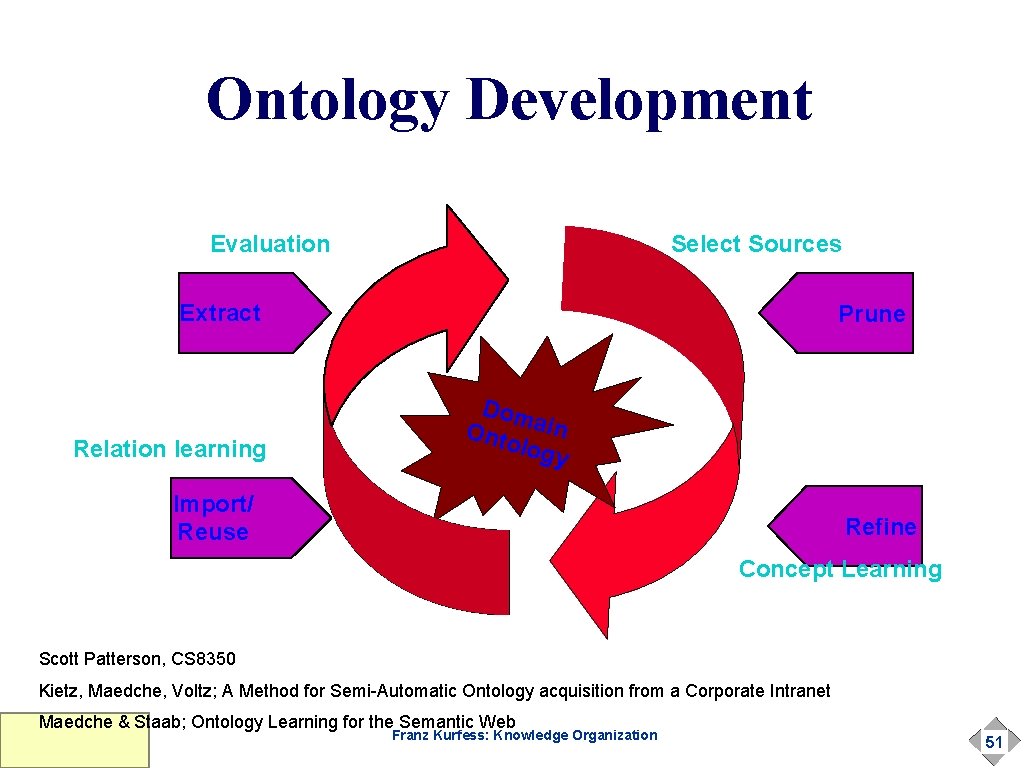
Ontology Development Evaluation Select Sources Extract Relation learning Prune Dom Onto ain logy Import/ Reuse Refine Concept Learning Scott Patterson, CS 8350 Kietz, Maedche, Voltz; A Method for Semi-Automatic Ontology acquisition from a Corporate Intranet Maedche & Staab; Ontology Learning for the Semantic Web Franz Kurfess: Knowledge Organization 51
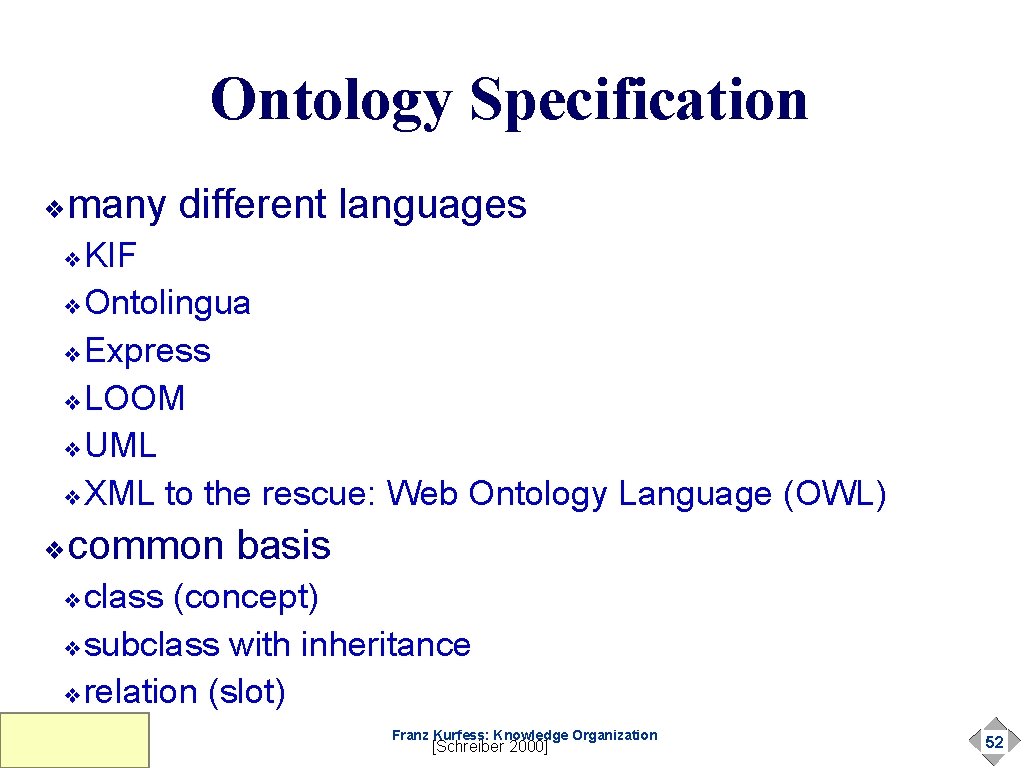
Ontology Specification many different languages ❖ KIF ❖Ontolingua ❖Express ❖LOOM ❖UML ❖XML to the rescue: Web Ontology Language (OWL) ❖ common basis ❖ class (concept) ❖subclass with inheritance ❖relation (slot) ❖ Franz Kurfess: Knowledge Organization [Schreiber 2000] 52
Knowledge Organization Examples ad-hoc via diagrams ❖concept-form-referent triangle ❖ontology mind map ❖comparison on knowledge organization methods ❖ taxonomy, thesaurus, topic map, ontology ❖ examples of ontologies ❖ Franz Kurfess: Knowledge Organization 53
Knowledge Organization Example (ad-hoc diagram) http: //keg. cs. tsinghua. edu. cn/persons/tj/Reports/Pswmp-Jie-Tang. ppt Franz Kurfess: Knowledge Organization 54
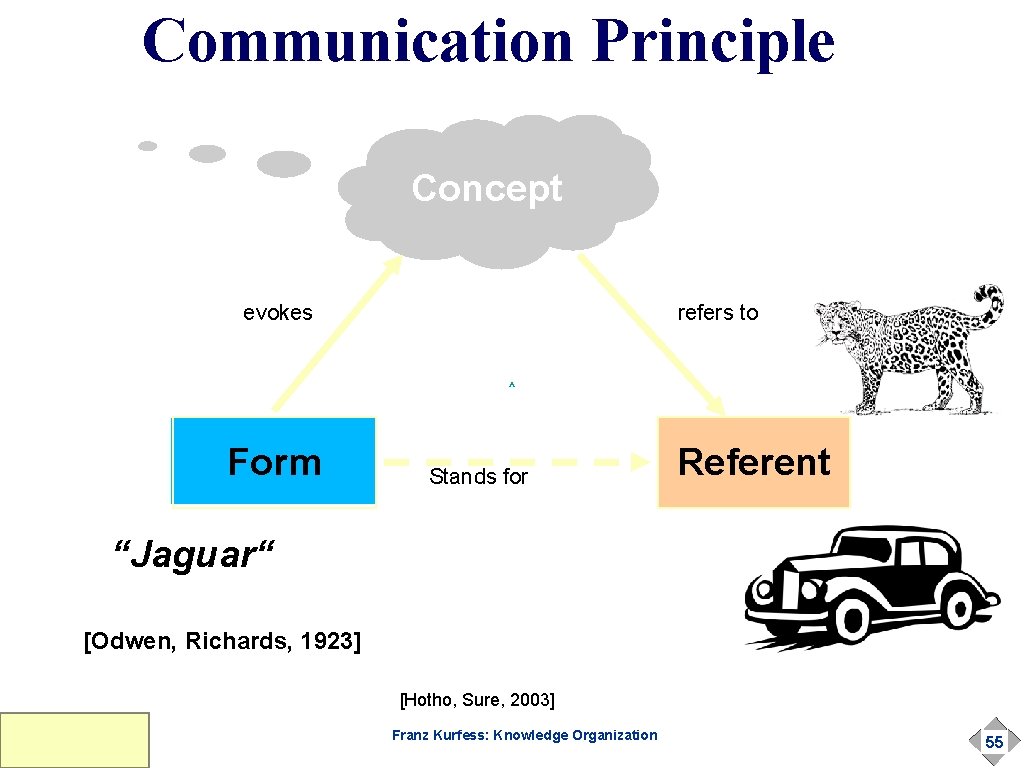
Communication Principle Concept evokes refers to ^ Form Stands for Referent “Jaguar“ [Odwen, Richards, 1923] [Hotho, Sure, 2003] Franz Kurfess: Knowledge Organization 55
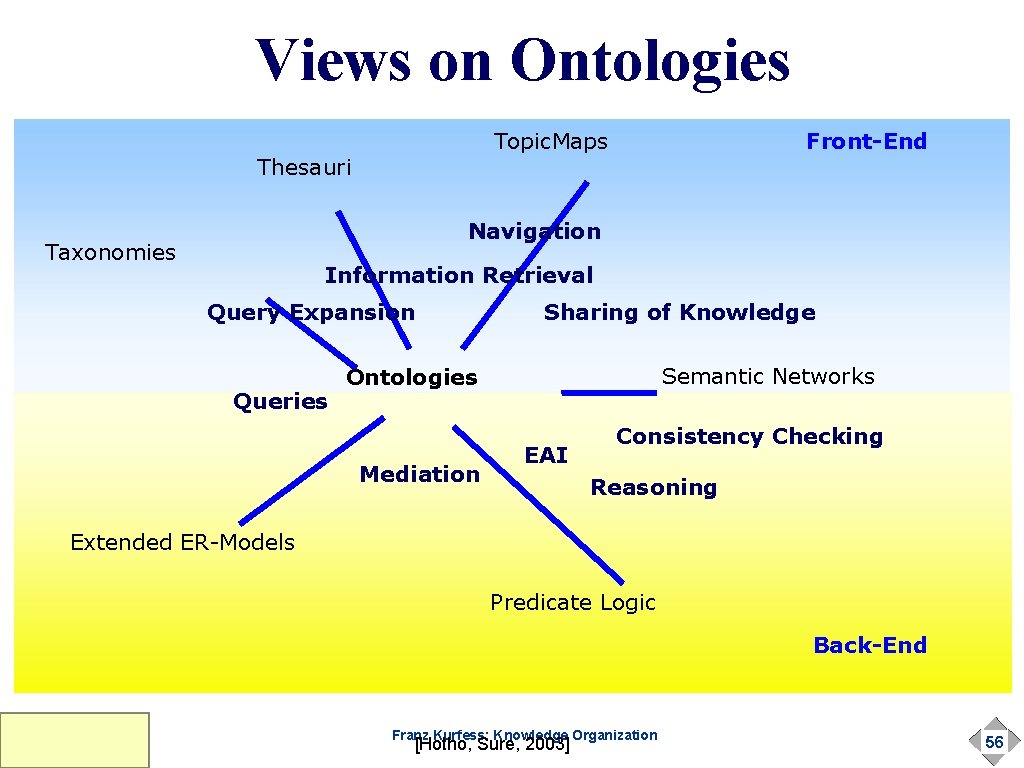
Views on Ontologies Topic. Maps Thesauri Front-End Navigation Taxonomies Information Retrieval Query Expansion Queries Sharing of Knowledge Semantic Networks Ontologies Mediation EAI Consistency Checking Reasoning Extended ER-Models Predicate Logic Back-End Franz Kurfess: Knowledge Organization [Hotho, Sure, 2003] 56
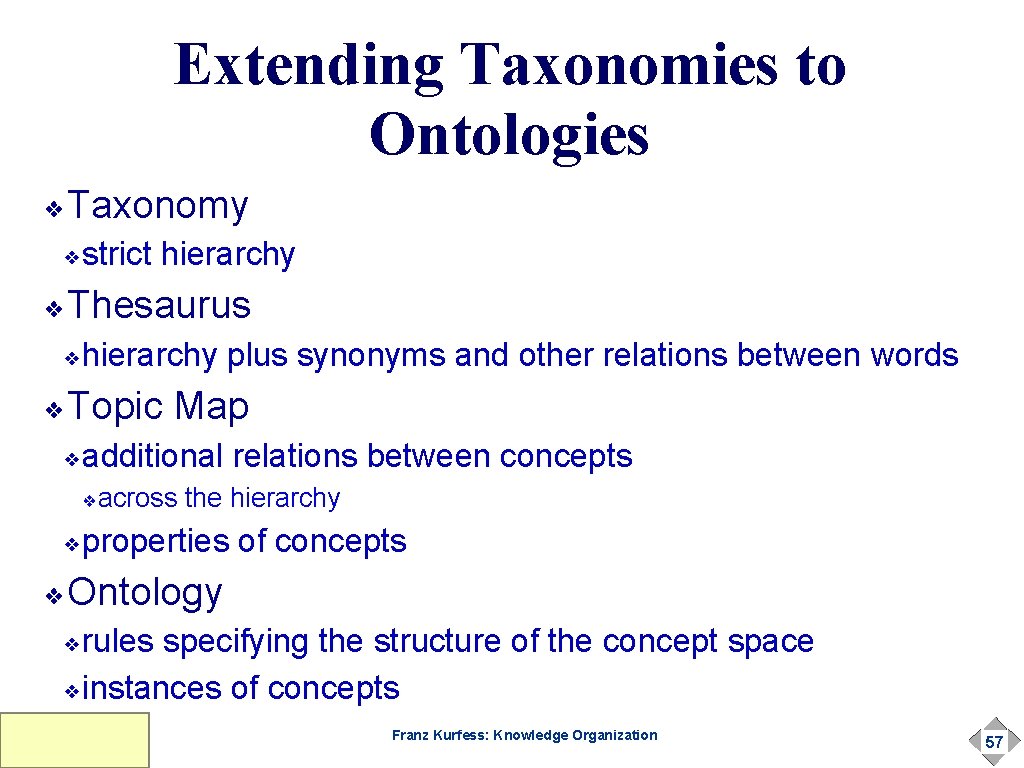
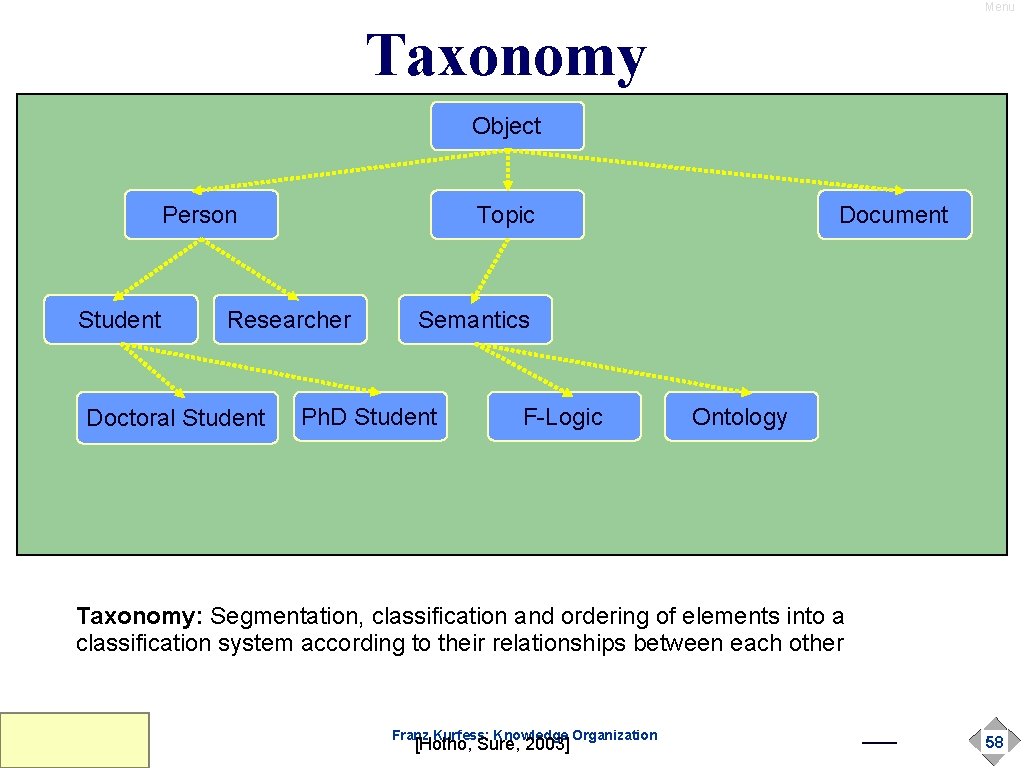
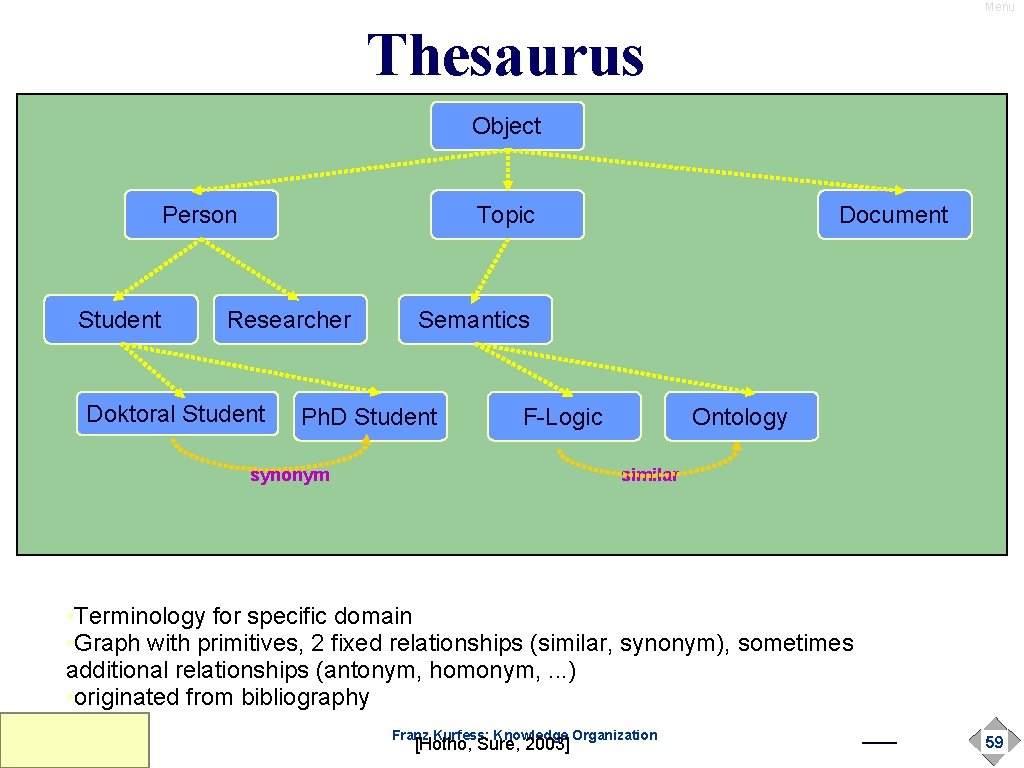
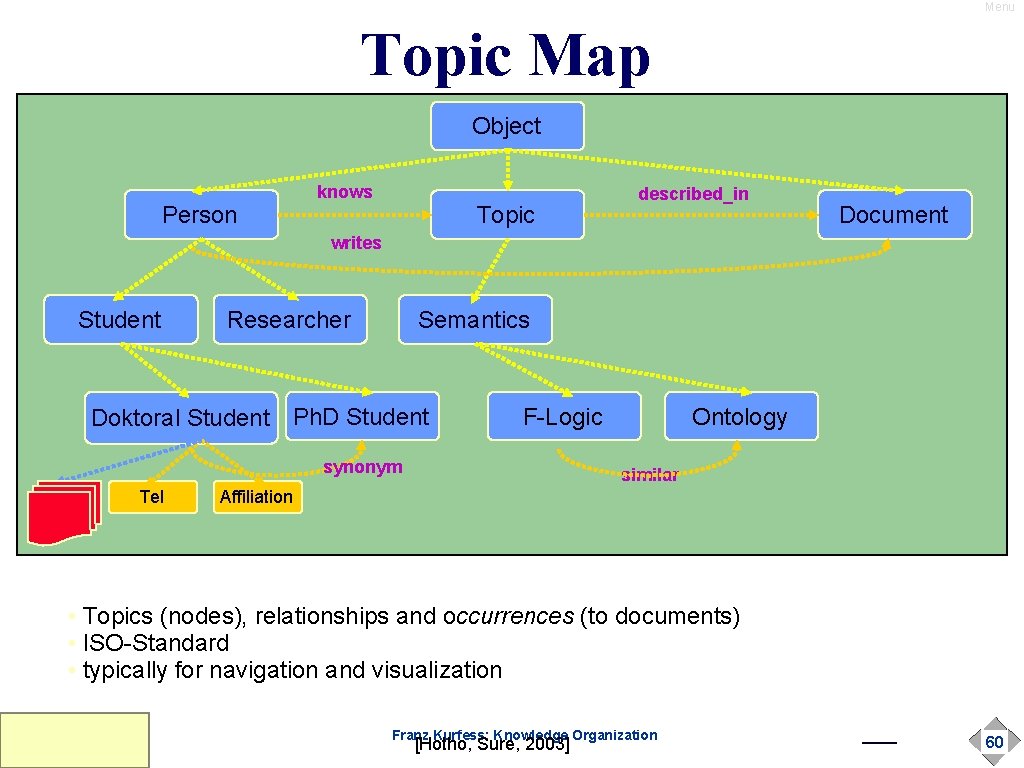
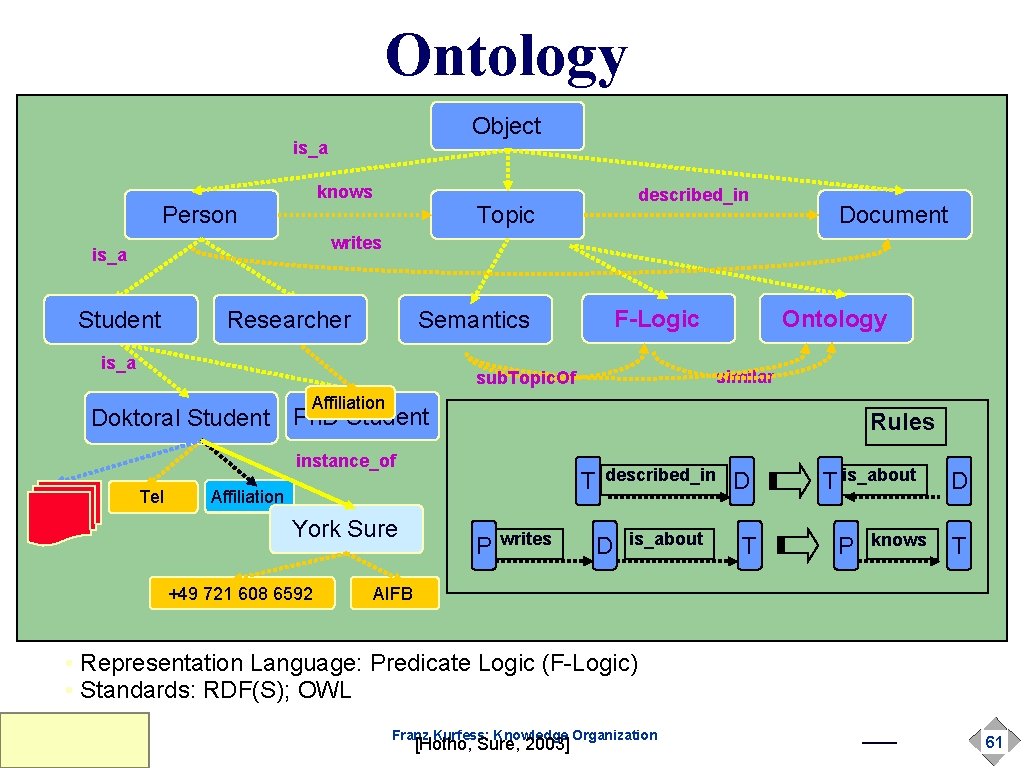
Extending Taxonomies to Ontologies ❖ Taxonomy strict hierarchy ❖ ❖ Thesaurus hierarchy plus synonyms and other relations between words ❖ ❖ Topic Map additional relations between concepts ❖ across the hierarchy ❖ properties of concepts ❖ ❖ Ontology rules specifying the structure of the concept space ❖instances of concepts ❖ Franz Kurfess: Knowledge Organization 57
Menu Taxonomy Object Person Student Topic Researcher Doctoral Student Document Semantics Ph. D Student F-Logic Ontology Taxonomy: Segmentation, classification and ordering of elements into a classification system according to their relationships between each other Franz Kurfess: Knowledge Organization [Hotho, Sure, 2003] 58
Menu Thesaurus Object Person Student Topic Researcher Doktoral Student Document Semantics Ph. D Student F-Logic synonym Ontology similar • Terminology for specific domain • Graph with primitives, 2 fixed relationships (similar, synonym), sometimes additional relationships (antonym, homonym, . . . ) • originated from bibliography Franz Kurfess: Knowledge Organization [Hotho, Sure, 2003] 59
Menu Topic Map Object Person knows Topic described_in Document writes Student Researcher Semantics Doktoral Student Ph. D Student F-Logic synonym Tel Ontology similar Affiliation • Topics (nodes), relationships and occurrences (to documents) • ISO-Standard • typically for navigation and visualization Franz Kurfess: Knowledge Organization [Hotho, Sure, 2003] 60
Ontology Object is_a knows Person described_in Topic Document writes is_a Student Researcher F-Logic Semantics is_a Ontology similar sub. Topic. Of Affiliation Doktoral Student Ph. D Student Rules instance_of Tel T Affiliation York Sure +49 721 608 6592 P writes described_in D is_about D T T is_about P knows D T AIFB • Representation Language: Predicate Logic (F-Logic) • Standards: RDF(S); OWL Franz Kurfess: Knowledge Organization [Hotho, Sure, 2003] 61
Knowledge Organization Examples Franz Kurfess: Knowledge Organization 63
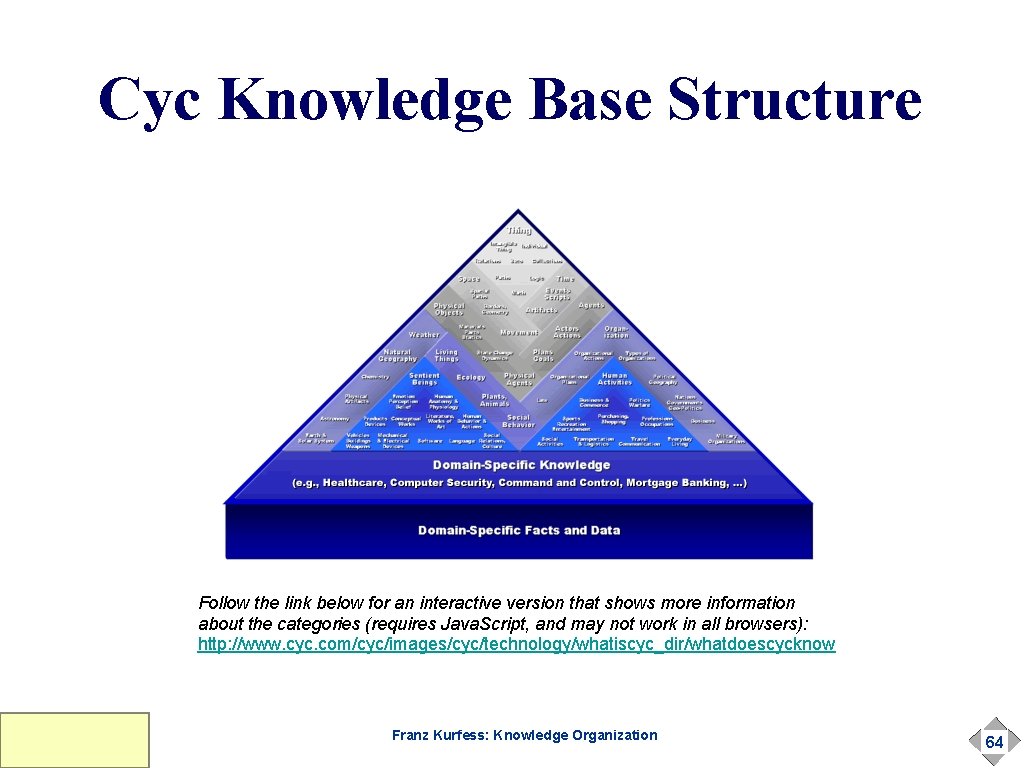
Cyc Knowledge Base Structure Follow the link below for an interactive version that shows more information about the categories (requires Java. Script, and may not work in all browsers): http: //www. cyc. com/cyc/images/cyc/technology/whatiscyc_dir/whatdoescycknow Franz Kurfess: Knowledge Organization 64
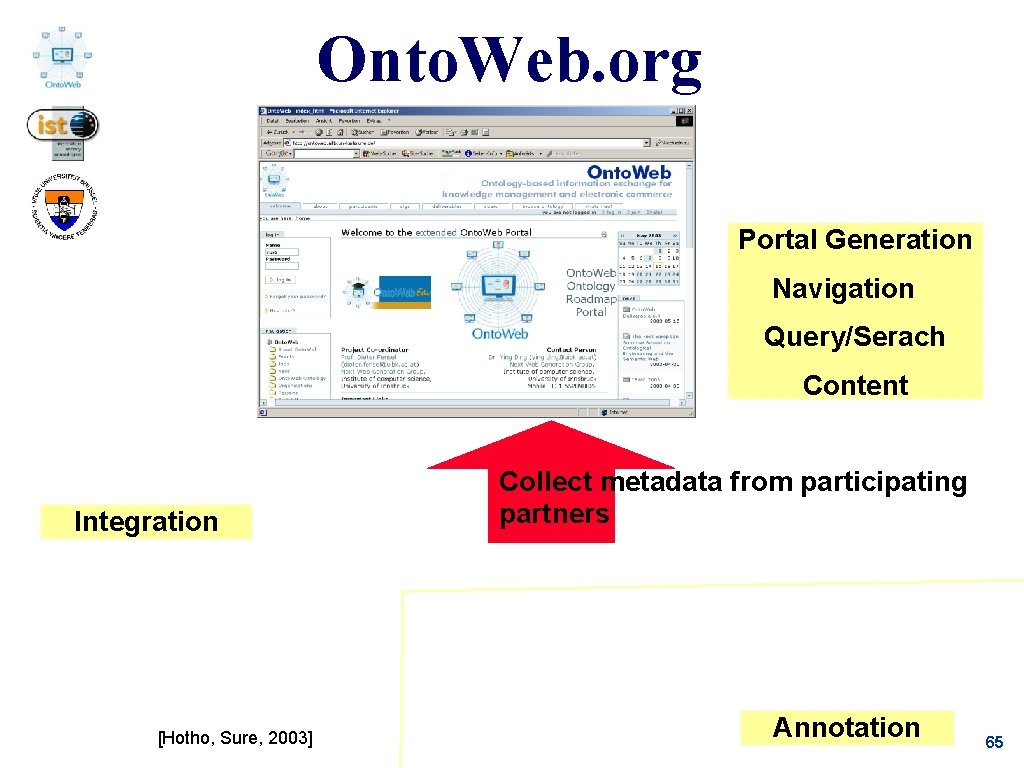
Onto. Web. org Portal Generation Navigation Query/Serach Content Integration [Hotho, Sure, 2003] Collect metadata from participating partners Franz Kurfess: Knowledge Organization Annotation 65
Art & Architecture Thesaurus used for indexing stolen art objects in European police databases Franz Kurfess: Knowledge Organization [Schreiber 2000] 66
AAT Ontology description universe instance of 1+ object 1+ description dimension value set descriptor value set object type in dimension 1+ descriptor 1+ class of 1+ object class has descriptor 1+ value has feature class constraint Franz Kurfess: Knowledge Organization [Schreiber 2000] 67
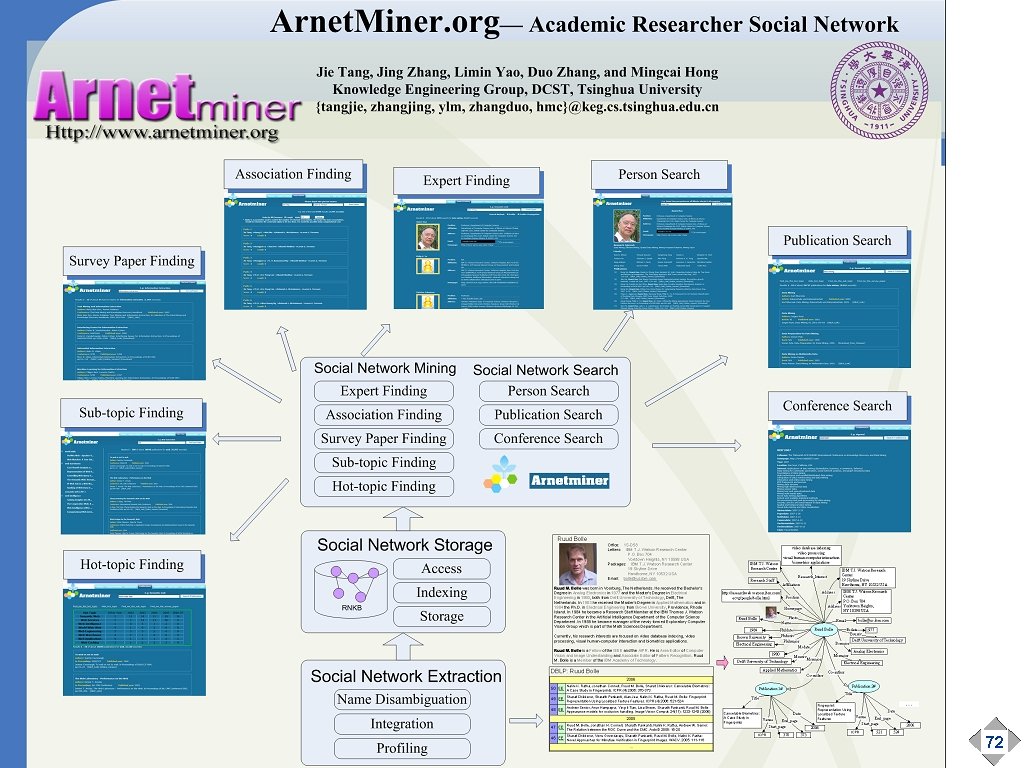
ARNET Miner 1 Franz Kurfess: Knowledge Organization 72
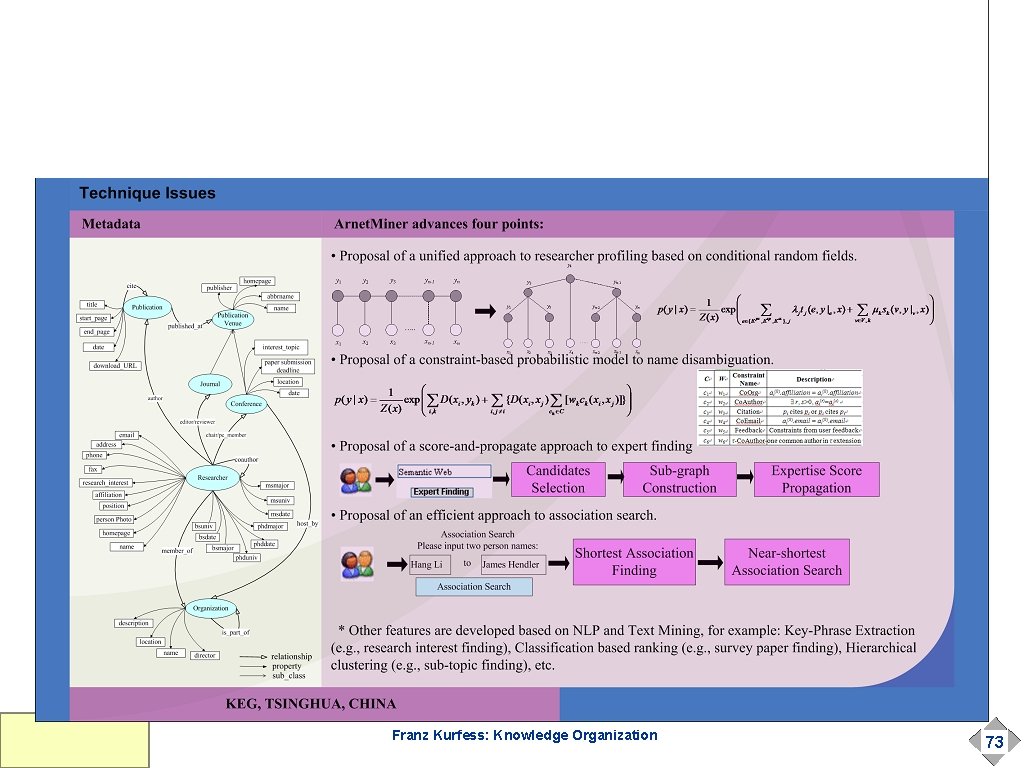
ARNET Miner 2 ` ❖ Franz Kurfess: Knowledge Organization 73
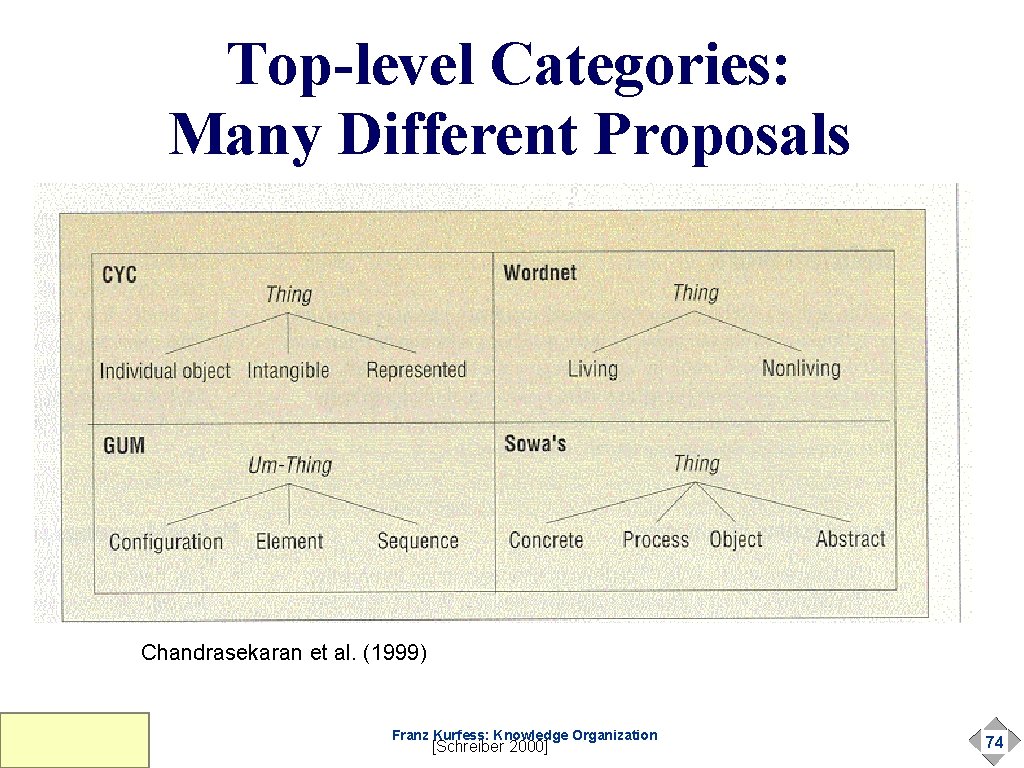
Top-level Categories: Many Different Proposals Chandrasekaran et al. (1999) Franz Kurfess: Knowledge Organization [Schreiber 2000] 74
Important Concepts and Terms ❖ ❖ ❖ ❖ ❖ ❖ ❖ automated reasoning belief network cognitive science computer science deduction frame human problem solving inference intelligence knowledge acquisition knowledge representation linguistics logic machine learning natural language ontology ontological commitment predicate logic probabilistic reasoning propositional logic psychology rational agent rationality reasoning rule-based system semantic network Franz Kurfess: Knowledge Organization 80
Summary Franz Kurfess: Knowledge Organization 81