Investment Appraisal Techniques Management Level Paper P 2








- Slides: 45
Investment Appraisal Techniques Management Level – Paper P 2 Advanced Management Accounting Lecture - 20 Vidya Rajawasam ACMA CGMA MBA
Investment Appraisal Techniques In the previous lectures we have discussed § Transfer pricing § Objectives of transfer pricing § Bases for setting transfer price
Investment Appraisal Techniques In this lecture we will discuss § § § The time value of money Compound interest Discounting Capital investment appraisal Net Present Value (NPV)
Investment Appraisal Techniques The time value of money Money received today is worth more than the same sum received in the future, i. e. it has a time value.
Investment Appraisal Techniques The time value of money This occurs for three reasons: • potential for earning interest/cost of finance • impact of inflation • effect of risk. When appraising investments, Discounted cash flow (DCF) techniques take account of this time value of money
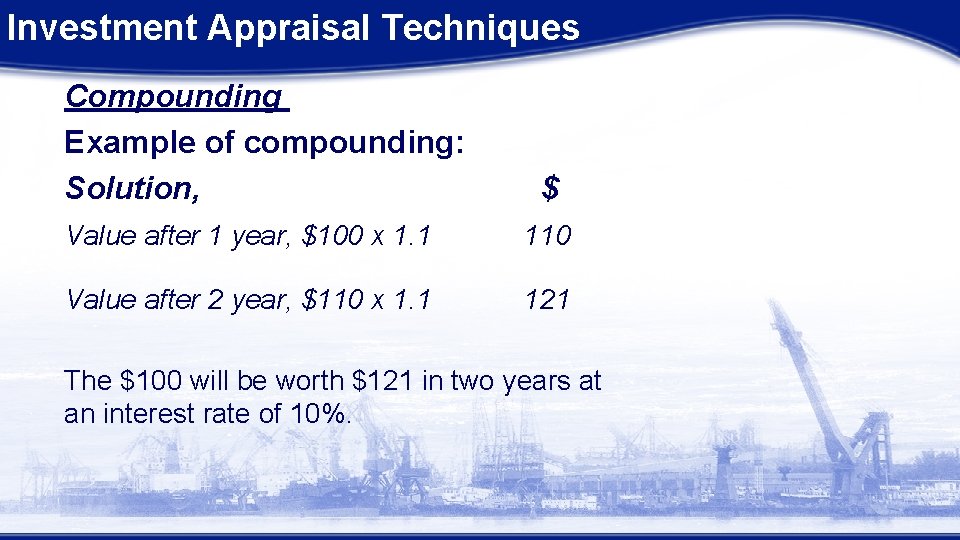
Investment Appraisal Techniques Compounding Example of compounding: An investment of $100 is to be made today. What is the value of the investment after two years if the interest rate is 10%?
Investment Appraisal Techniques Compounding Example of compounding: Solution, $ Value after 1 year, $100 x 1. 1 110 Value after 2 year, $110 x 1. 1 121 The $100 will be worth $121 in two years at an interest rate of 10%.
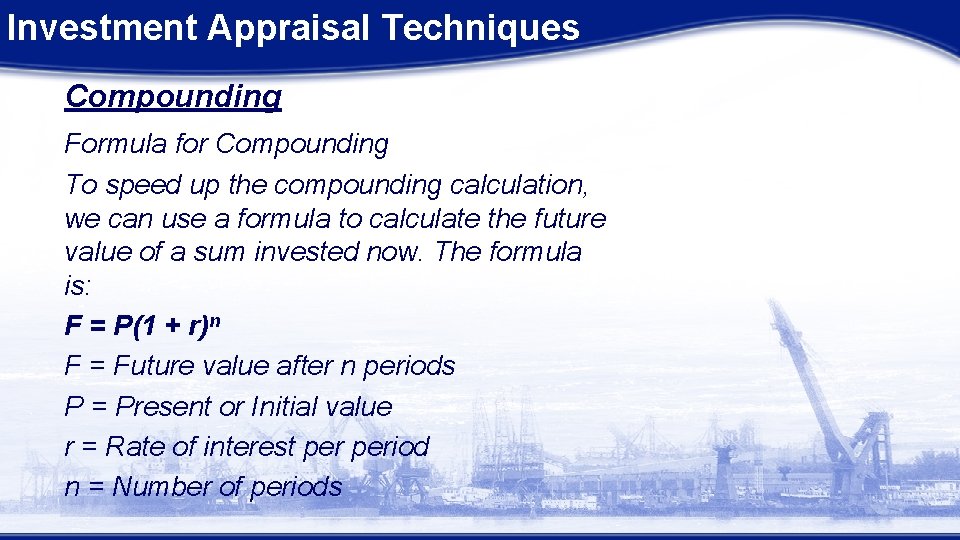
Investment Appraisal Techniques Compounding Formula for Compounding To speed up the compounding calculation, we can use a formula to calculate the future value of a sum invested now. The formula is: F = P(1 + r)n F = Future value after n periods P = Present or Initial value r = Rate of interest period n = Number of periods
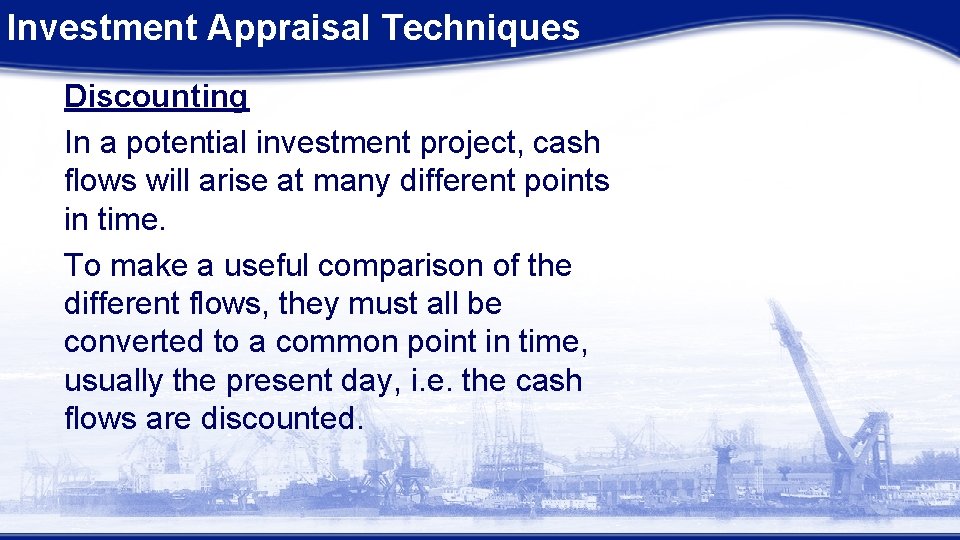
Investment Appraisal Techniques Discounting In a potential investment project, cash flows will arise at many different points in time. To make a useful comparison of the different flows, they must all be converted to a common point in time, usually the present day, i. e. the cash flows are discounted.
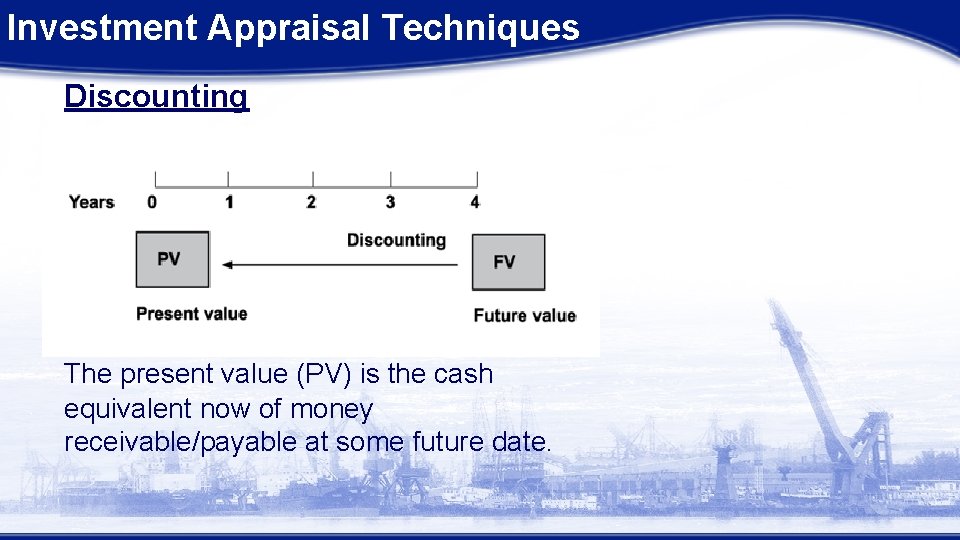
Investment Appraisal Techniques Discounting The present value (PV) is the cash equivalent now of money receivable/payable at some future date.
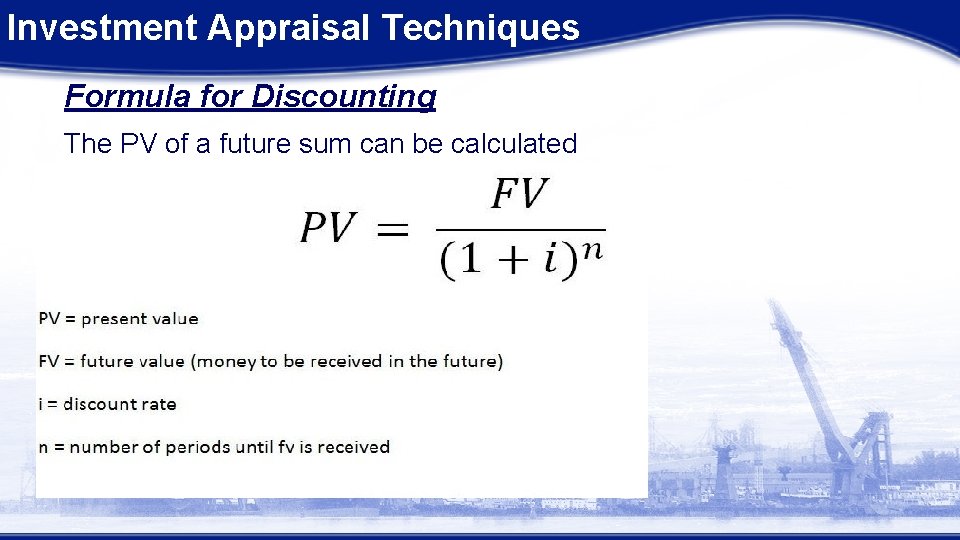
Investment Appraisal Techniques Formula for Discounting The PV of a future sum can be calculated using the formula:
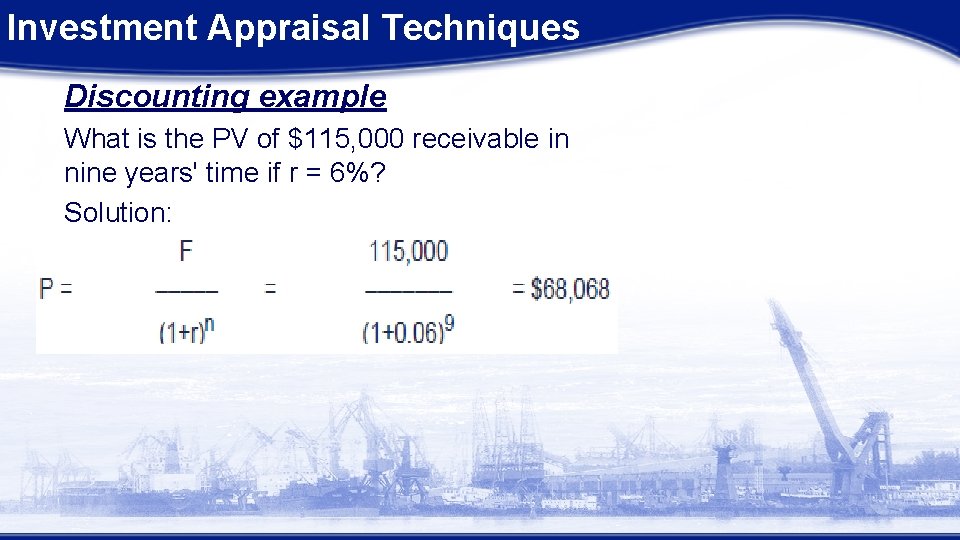
Investment Appraisal Techniques Discounting example What is the PV of $115, 000 receivable in nine years' time if r = 6%? Solution:
Investment Appraisal Techniques The cost of capital In discounted cash flow techniques, the rate of interest is required. There a number of alternative terms used to refer to the rate of interest: • cost of capital • discount rate • required return. There are different ways of determining a cost of capital.
Investment Appraisal Techniques Capital Investment Apprisal § § Initial assumptions All cash inflows and outflows are known with certainty. Sufficient funds are available to undertake the all profitable investments. There is zero inflation There is zero taxation
Investment Appraisal Techniques Capital Investment Apprisal § § Appraisal methods There four widely used Appraisal methods Net Present Value (NPV) Internal Rate of Return (IRR) The payback period Accounting Rate of Return (ARR) NPV and IRR are both considered as the time value of money. They are discounted cash flow techniques.
Investment Appraisal Techniques Net Present Value (NPV) To appraise the overall impact of a project using DCF techniques involves discounting all the relevant cash flows associated with the project back to their PV (present value). If we treat outflows of the project as negative and inflows as positive, the NPV of the project is the sum of the PVs of all flows that arise as a result of doing the project.
Investment Appraisal Techniques Net Present Value (NPV) Decision rule: The NPV represents the surplus funds (after funding the investment) earned on the project, therefore: § if the NPV is positive - the project is financially viable § if the NPV is zero - the project breaks even
Investment Appraisal Techniques Net Present Value (NPV) Decision rule: § if the NPV is negative - the project is not financially viable § if the company has two or more mutually exclusive projects under consideration it should choose the one with the highest NPV
Investment Appraisal Techniques Net Present Value (NPV) Assumptions in calculating the net present value The following assumptions are made about cash flows when calculating the net present value: § all cash flows occur at the start or end of a year § initial investments occur T 0 § other cash flows start one year after that (T 1).
Investment Appraisal Techniques Net Present Value (NPV) Assumptions in calculating the net present value § Also interest payments are never include within an NPV calculation as these are taken account of by the cost of capital.
Investment Appraisal Techniques Review MCQs The time value of money relates to ? a. Calculations based Compounding and discounting techniques. b. Provides in depth understanding of direct labour costs. c. Identifies risks related future cash inflows/outflows. d. Supports better pricing decisions
Investment Appraisal Techniques Review MCQs The time value of money relates to ? a. Calculations based Compounding and discounting techniques. b. Provides in depth understanding of direct labour costs. c. Identifies risks related future cash inflows/outflows. d. Supports better pricing decisions
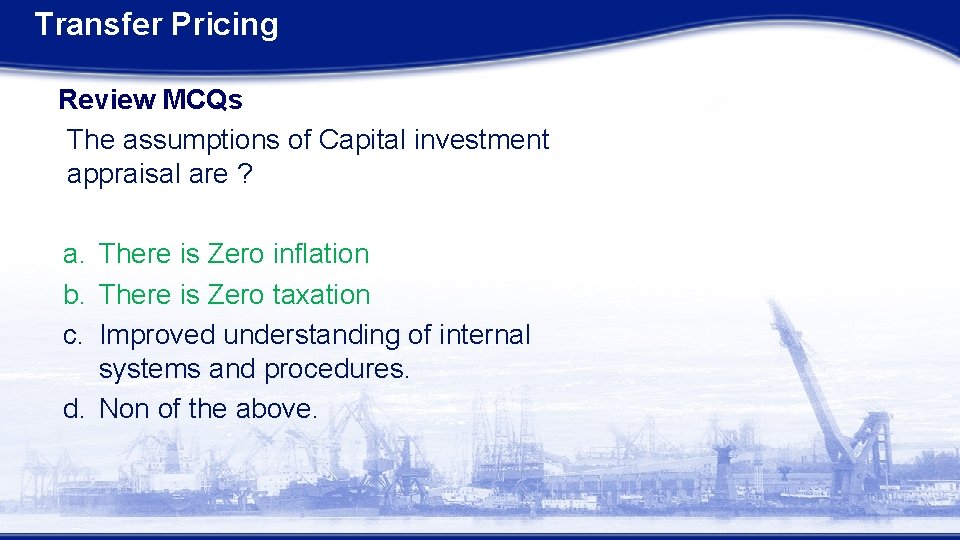
Transfer Pricing Review MCQs The assumptions of Capital investment appraisal are ? a. There is Zero inflation b. There is Zero taxation c. Improved understanding of internal systems and procedures. d. Non of the above.
Transfer Pricing Review MCQs The assumptions of Capital investment appraisal are ? a. There is Zero inflation b. There is Zero taxation c. Improved understanding of internal systems and procedures. d. Non of the above.
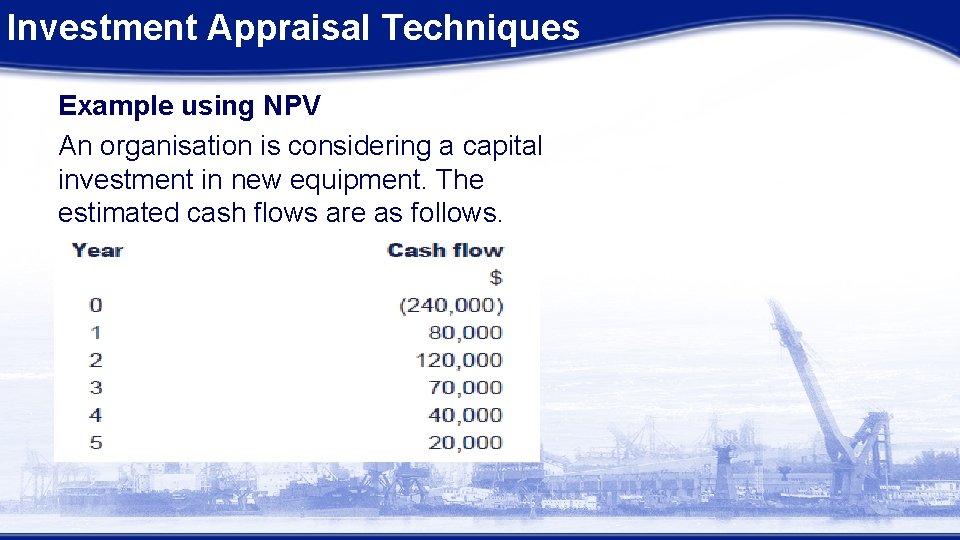
Investment Appraisal Techniques Example using NPV An organisation is considering a capital investment in new equipment. The estimated cash flows are as follows.
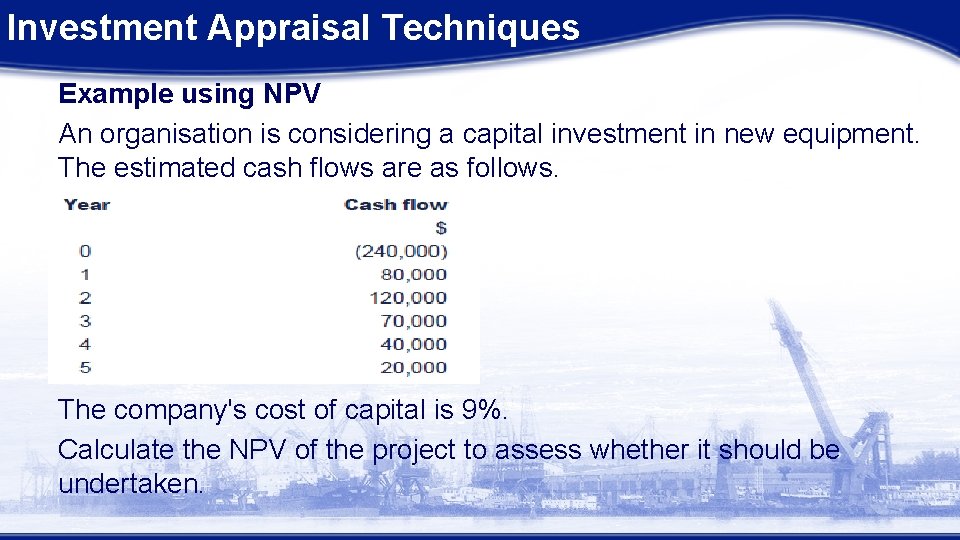
Investment Appraisal Techniques Example using NPV An organisation is considering a capital investment in new equipment. The estimated cash flows are as follows. The company's cost of capital is 9%. Calculate the NPV of the project to assess whether it should be undertaken.
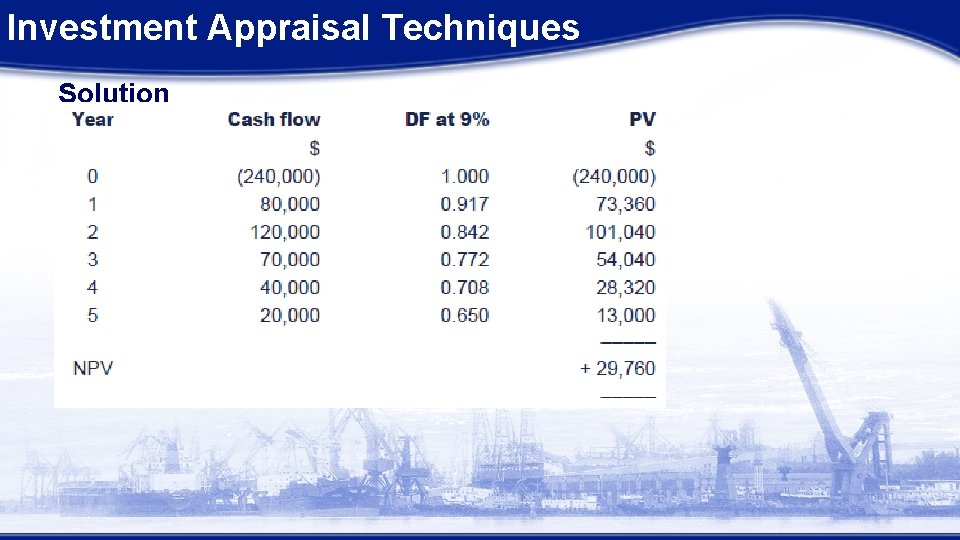
Investment Appraisal Techniques Solution
Investment Appraisal Techniques Solution The PV of cash inflows exceeds the PV of cash outflows by $29, 760, which means that the project will earn a DCF return in excess of 9%, i. e. it will earn a surplus of $29, 760 after paying the cost of financing. It should therefore be undertaken.
Investment Appraisal Techniques § § § Advantages and disadvantages of using NPV Advantages Theoretically the NPV method of investment appraisal is superior to all others. This is because it: considers the time value of money is an absolute measure of return is based on cash flows not profits considers the whole life of the project should lead to maximization of shareholder wealth.
Investment Appraisal Techniques Advantages and disadvantages of using NPV Disadvantages § It is difficult to explain to managers § It requires knowledge of the cost of capital § It is relatively complex.
Investment Appraisal Techniques Discounting factors The discount rate/ discount factor also refers to the interest rate used in discounted cash flow (DCF) analysis to determine the present value of future cash flows. The discount rate in DCF analysis takes into account not just the time value of money, but also the risk or uncertainty of future cash flows; the greater the uncertainty of future cash flows, the higher the discount rate
Investment Appraisal Techniques Discounting factors Discount factors can always be calculated using the formula (1 + r)-n. However in some special cases, time-saving techniques can be used. Discounting annuities An annuity is a constant annual cash flow for a number of years. Where an investment appraisal involves a constant annual cash flow, a special discount factor known as an annuity factor can be used.
Investment Appraisal Techniques Discounting actors Present Value Tables (1 + r)-n is called the discount factor (DF). This can be found from the formula, or from special Present Value tables in which many discount factors have already been calculated. There also Annuity Tables in which many annuity factors have already been calculated.
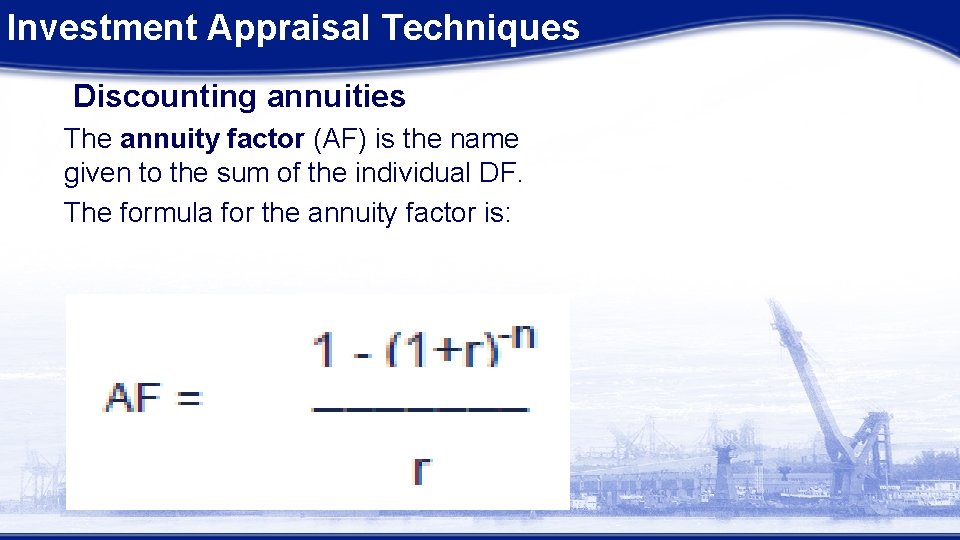
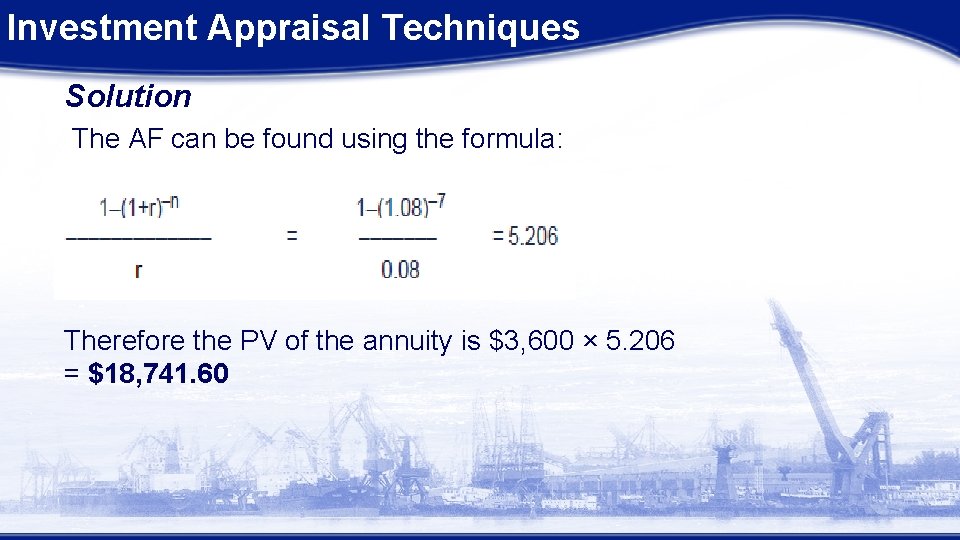
Investment Appraisal Techniques Discounting annuities The annuity factor (AF) is the name given to the sum of the individual DF. The formula for the annuity factor is:
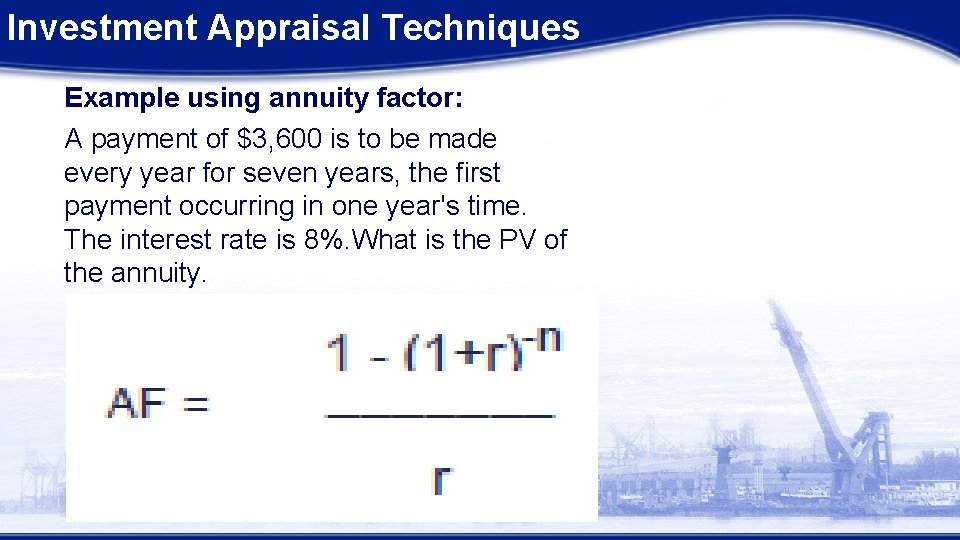
Investment Appraisal Techniques Example using annuity factor: A payment of $3, 600 is to be made every year for seven years, the first payment occurring in one year's time. The interest rate is 8%. What is the PV of the annuity.
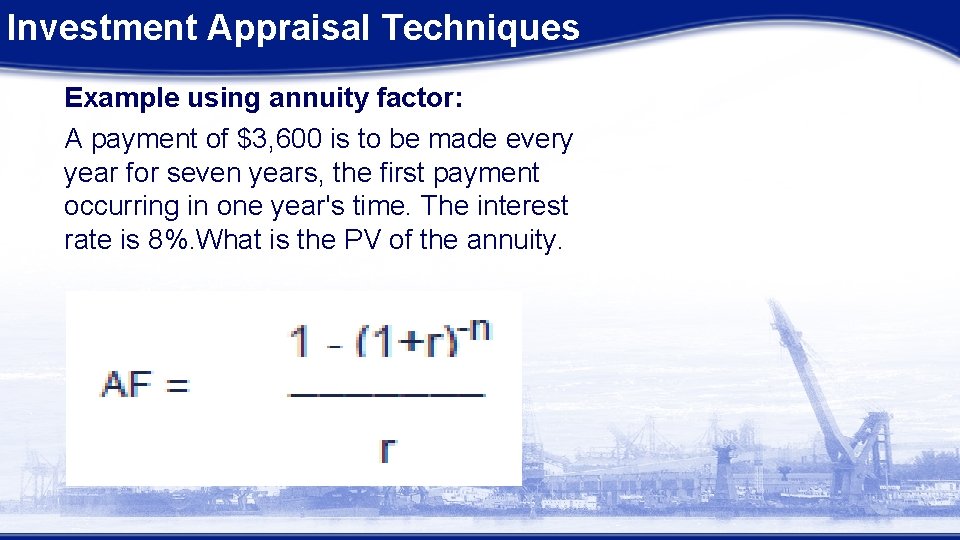
Investment Appraisal Techniques Example using annuity factor: A payment of $3, 600 is to be made every year for seven years, the first payment occurring in one year's time. The interest rate is 8%. What is the PV of the annuity.
Investment Appraisal Techniques Solution The AF can be found using the formula: Therefore the PV of the annuity is $3, 600 × 5. 206 = $18, 741. 60
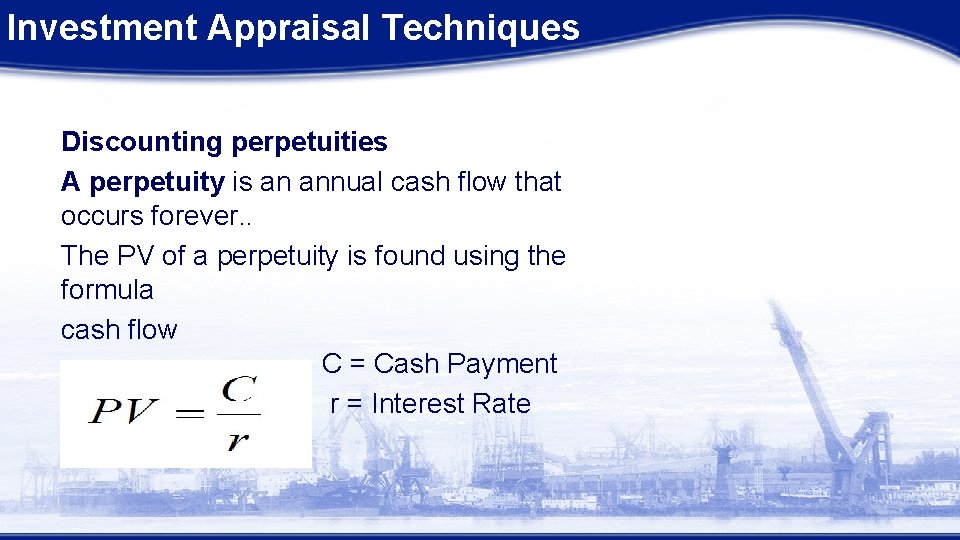
Investment Appraisal Techniques Discounting perpetuities A perpetuity is an annual cash flow that occurs forever. . The PV of a perpetuity is found using the formula cash flow C = Cash Payment r = Interest Rate
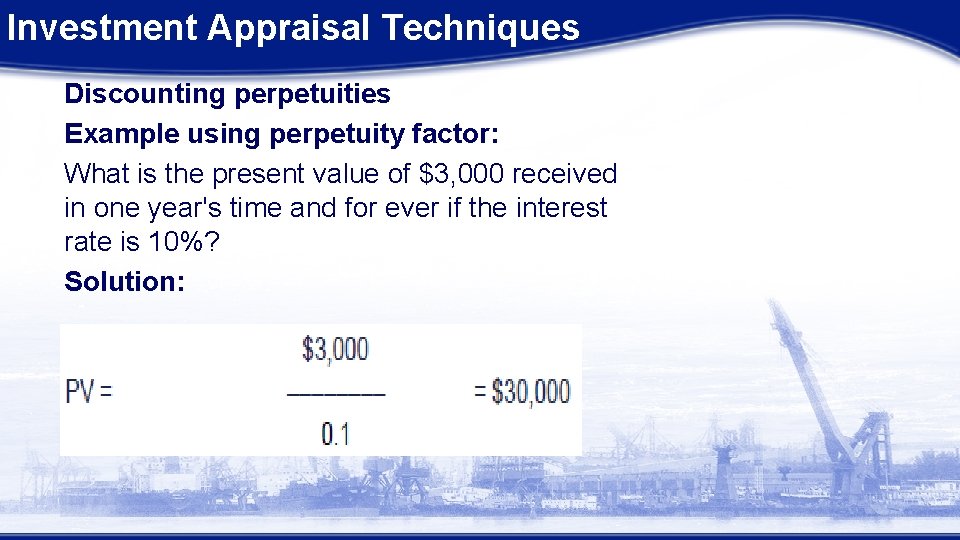
Investment Appraisal Techniques Discounting perpetuities Example using perpetuity factor: What is the present value of $3, 000 received in one year's time and for ever if the interest rate is 10%? Solution:
Investment Appraisal Techniques Review MCQs The disadvantages of using NPV are ? a. Difficult for some managers to understand the procedure. b. Identifies costs related to investments which cannot be recovered. c. Requires knowledge of cost of capital principles. d. Not suited for very large investment projects.
Investment Appraisal Techniques Review MCQs The disadvantages of using NPV are ? a. Difficult for some managers to understand the procedure. b. Identifies costs related to investments which cannot be recovered. c. Requires knowledge of cost of capital principles. d. Not suited for very large investment projects.
Investment Appraisal Techniques Review MCQs The advantages of using NPV are ? a. Recognizes the time value of money b. Identifies profits related to investments which cannot be recovered. c. Based on actual cash flows, not profits from investments. d. Non of the above.
Investment Appraisal Techniques Review MCQs The advantages of using NPV are ? a. Recognizes the time value of money b. Identifies profits related to investments which cannot be recovered. c. Based on actual cash flows, not profits from investments. d. Non of the above.
Investment Appraisal Techniques Lecture Summary We have discussed the § § § The time value of money Compound interest Discounting Capital investment appraisal Net Present Value (NPV)
Investment Appraisal Techniques Management Level – Paper P 2 Advanced Management Accounting Lecture - 20 Vidya Rajawasam ACMA CGMA MBA