
Fiduciary Key Risk Indicators FIDUCIARY INVESTMENT RISK MANAGEMENT
- Slides: 13
Fiduciary Key Risk Indicators FIDUCIARY INVESTMENT RISK MANAGEMENT ASSOCIATION NATIONAL CONFERENCE April 25 -29, 2009 New Orleans Presented by Rebecca Bugaj Zak, Counsel, Reed. Smith LLP Deborah Austin, Vice President, Director Personal Fiduciary Risk Mgmt and Compliance, Union Bank 1
KEY RISK INDICATORS § What are they? – Key Risk Indicator (“KRI”): Indicator of a possibility of a future adverse impact. – Indicator: Warning signals – Possibility: May or may not actually occur – Future: Trying to understand the future, not criticize past actions – Different than a Key Performance Indicator (“KPI”): Measures how well something is being done. 2
FIDUCIARY KEY RISK INDICATORS § What is their place of importance? – Enterprise Fiduciary Risk Management Program § Identifies, Monitors, Manages, and Reports Fiduciary Risks § Part Legal, Part Compliance, Part Operational – Fiduciary KRI’s are Integral to “Identification” 3
FIDUCIARY KEY RISK INDICATORS § Why are they important? They promote a culture of compliance with fiduciary principals and adherence to laws and regulations, which ultimately will… 1. Mitigate losses, legal expenses, and/or regulatory sanctions/penalties; and 2. Become a tool to promote business efficiencies and effectiveness as a driver of resources (people, technology, capital) 4
FIDUCIARY KEY RISK INDICATORS § Choosing Key Risk Indicators – Include Senior Management, Business Units (Fiduciary and Affiliates), Risk, Finance, Technology, Compliance, Legal, Ethics Office, Fraud/Investigative Units, and Internal Audit – Focus on critical areas for your institution § Your Business Model and Strategic Plans § Current Product Offerings § New Products/Acquisitions/Divestitures – Support risk monitoring – Support business decision making 5
FIDUCIARY KEY RISK INDICATORS § Build the framework – Not as easy as it sounds: Realistic implementation timeframes – Clear definition/hypothesis: What is being measured? Why? Is it meaningful? – Define categories, factors, sources, detail – Types of indicators: risk, performance, leading, lagging, control – Meaningful triggers for your institution – Management Responses to Triggers – Dynamic and evolving 6
FIDUCIARY KEY RISK INDICATORS § High-Level Indicator Categories – – – – – People Indicators Client/Business Indicators Fiduciary Oversight/Administration Indicators Compliance Indicators Legal Indicators Asset Management/Portfolio Indicators Audit/Regulatory Indicators Operational/Technology Indicators Affiliate and Third Party Provider Indicators 7
FIDUCIARY KEY RISK INDICATORS § More Detailed Indicators – – – – – Audit/Exam Issues Open, Past Due, High Risk Compliance Issues Open, Past Due, High Risk Pending and Open Litigation, Legal Expenses Employee Turnover Code of Ethics Violations New Product Initiatives Acquisitions/Divestiture Initiatives Client Complaints Accounts Closing (service, fee, performance issues) Reliance on third parties and completed monitoring 8
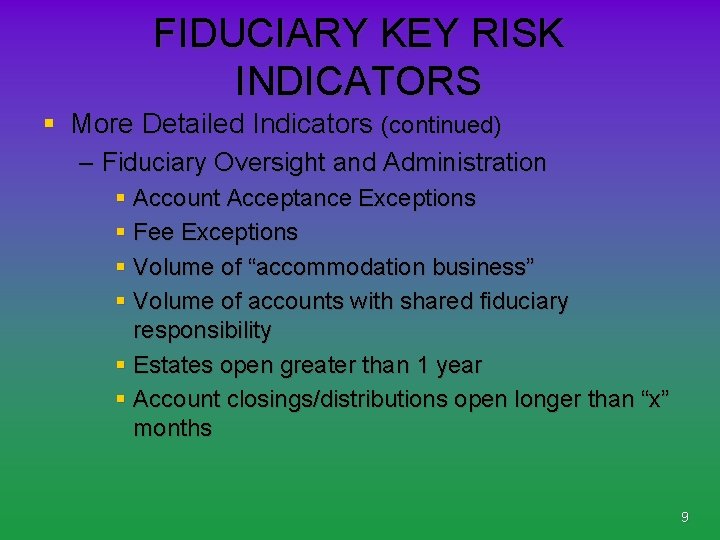
FIDUCIARY KEY RISK INDICATORS § More Detailed Indicators (continued) – Fiduciary Oversight and Administration § Account Acceptance Exceptions § Fee Exceptions § Volume of “accommodation business” § Volume of accounts with shared fiduciary responsibility § Estates open greater than 1 year § Account closings/distributions open longer than “x” months 9
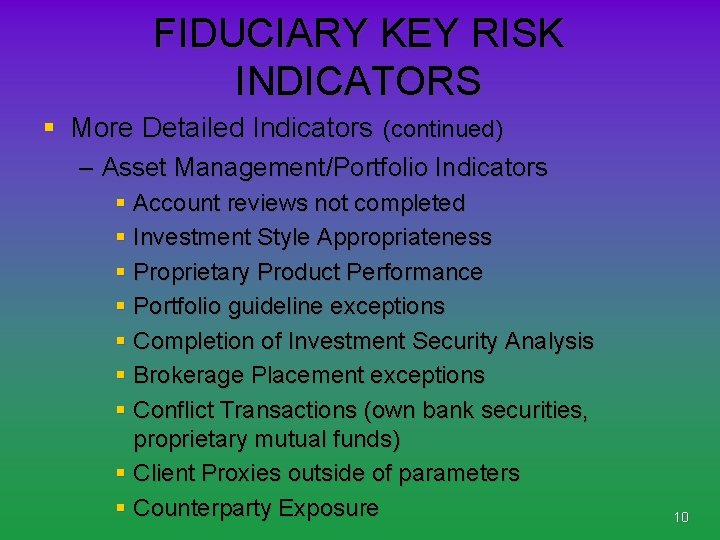
FIDUCIARY KEY RISK INDICATORS § More Detailed Indicators (continued) – Asset Management/Portfolio Indicators § Account reviews not completed § Investment Style Appropriateness § Proprietary Product Performance § Portfolio guideline exceptions § Completion of Investment Security Analysis § Brokerage Placement exceptions § Conflict Transactions (own bank securities, proprietary mutual funds) § Client Proxies outside of parameters § Counterparty Exposure 10
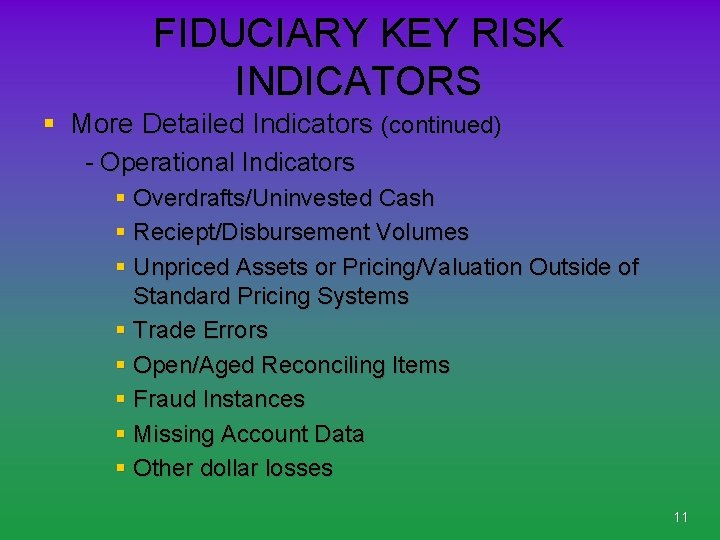
FIDUCIARY KEY RISK INDICATORS § More Detailed Indicators (continued) - Operational Indicators § Overdrafts/Uninvested Cash § Reciept/Disbursement Volumes § Unpriced Assets or Pricing/Valuation Outside of Standard Pricing Systems § Trade Errors § Open/Aged Reconciling Items § Fraud Instances § Missing Account Data § Other dollar losses 11
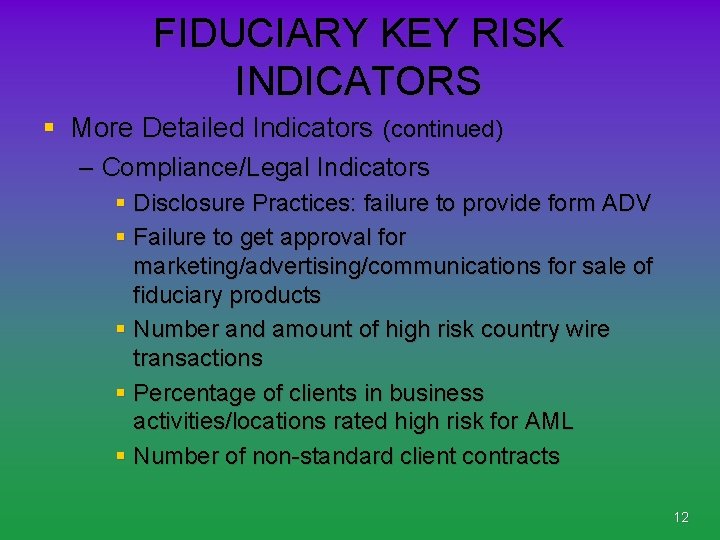
FIDUCIARY KEY RISK INDICATORS § More Detailed Indicators (continued) – Compliance/Legal Indicators § Disclosure Practices: failure to provide form ADV § Failure to get approval for marketing/advertising/communications for sale of fiduciary products § Number and amount of high risk country wire transactions § Percentage of clients in business activities/locations rated high risk for AML § Number of non-standard client contracts 12
FIDUCIARY KEY RISK INDICATORS § Trust Company Example – Frequency of review (Monthly/Quarterly) – Categories – Leading, Lagging and Concurrent – Established and agreed upon thresholds – Green, Yellow, Red indicator system – Change in risk (up, down, same) – Identify factors that contribute to the indicator and any change – Outlook – Who Tracks and Provides the Information? 13