Introduction to Criminology CRJ 270 Instructor Jorge Pierrott















- Slides: 52
Introduction to Criminology CRJ 270 Instructor: Jorge Pierrott Criminology Today, 7 th Edition Frank Schmalleger Copyright © 2015 by Pearson Education, Inc. All Rights Reserved
Criminology Today AN INTEGRATIVE INTRODUCTION SEVENTH EDITION CHAPTER 2 Where Do Theories Come From? Criminology Today, 7 th Edition Frank Schmalleger Copyright © 2015 by Pearson Education, Inc. All Rights Reserved
Chapter Objectives After reading this chapter, students should be able to answer the following questions: • What is evidence-based criminology? How does the meaning of the word evidence in evidence-based criminology differ from the evidence found at a crime scene or the evidence used in criminal trials? • What four eras have characterized the field of criminology over the past 100 years? • What is a theory? What purposes do theories serve? What role do research and experimentation play in theory building in criminology? • What is the role of criminological research in theory building? What is internal validity? External validity? How can threats to internal and external validity be addressed? Criminology Today, 7 th Edition Frank Schmalleger Copyright © 2015 by Pearson Education, Inc. All Rights Reserved
Chapter Objectives • What are the differences between quantitative and qualitative methods in the social sciences? What are the advantages and disadvantages of each method? • What are some of the ethical considerations involved in conducting criminological research? • How do criminological research and experimental criminology impact social policy? • What sections might a typical research report contain? Criminology Today, 7 th Edition Frank Schmalleger Copyright © 2015 by Pearson Education, Inc. All Rights Reserved
Why is the Criminological Theory Important? • Safe. Stat • Offender Risk and Needs Assessments Criminology Today, 7 th Edition Frank Schmalleger Copyright © 2015 by Pearson Education, Inc. All Rights Reserved
Evidence-Based Criminology • Evidence-based criminology § Founded upon the experimental method § Emphasizes randomized controlled experiments § “Evidence” refers to scientific findings continued on next slide Criminology Today, 7 th Edition Frank Schmalleger Copyright © 2015 by Pearson Education, Inc. All Rights Reserved
Evidence-Based Criminology • Increasing importance in the field § American Society of Criminology Division of Experimental Criminology § Academy of Experimental Criminology § Journal of Experimental Criminology Today, 7 th Edition Frank Schmalleger Copyright © 2015 by Pearson Education, Inc. All Rights Reserved
The Evolving Science of Criminology • John Laub’s eras of criminological thought § Golden Age of Research (1900 -1930) § Golden Age of Theory (1930 -1960) § Empirical testing of dominant theories (1960 -2000) § Current era/21 st century criminology contains “all possible offspring” of what came before continued on next slide Criminology Today, 7 th Edition Frank Schmalleger Copyright © 2015 by Pearson Education, Inc. All Rights Reserved
The Evolving Science of Criminology • Present-day criminology has moved away from armchair criminology and is more scientific. continued on next slide Criminology Today, 7 th Edition Frank Schmalleger Copyright © 2015 by Pearson Education, Inc. All Rights Reserved
The Evolving Science of Criminology • Scientific criminology involves: § The systematic collection of related facts § An emphasis on the scientific method § General laws, a field for experimentation or observation, control of academic discourse continued on next slide Criminology Today, 7 th Edition Frank Schmalleger Copyright © 2015 by Pearson Education, Inc. All Rights Reserved
The Evolving Science of Criminology • Scientific criminology involves: § Acceptance into the scientific tradition § Emphasis on a worthwhile subject • Modern criminology meets these criteria Criminology Today, 7 th Edition Frank Schmalleger Copyright © 2015 by Pearson Education, Inc. All Rights Reserved
Theory Building • Goal of criminological research: § Construct theories or models that improve our understanding of criminal behavior and help us create effective strategies to deal with the crime problem continued on next slide Criminology Today, 7 th Edition Frank Schmalleger Copyright © 2015 by Pearson Education, Inc. All Rights Reserved
Theory Building • Theory § A series of interrelated propositions that attempt to describe, explain, predict, and ultimately control some class of events § Test by how well they describe, predict reality Criminology Today, 7 th Edition Frank Schmalleger Copyright © 2015 by Pearson Education, Inc. All Rights Reserved
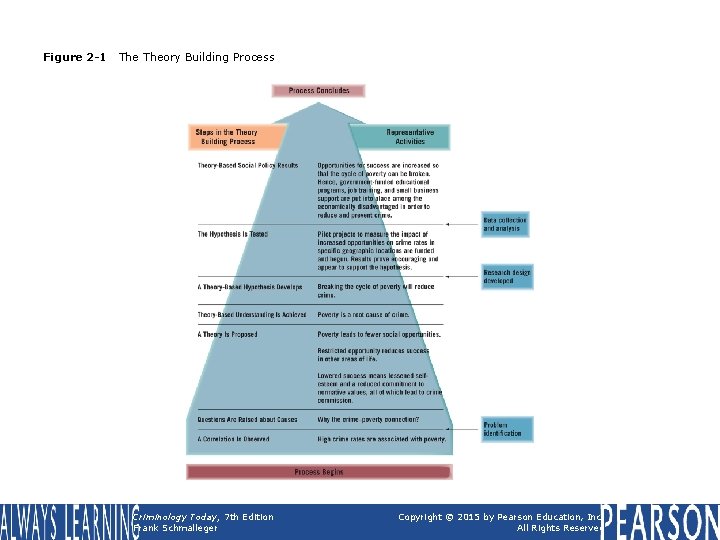
Figure 2 -1 Theory Building Process Criminology Today, 7 th Edition Frank Schmalleger Copyright © 2015 by Pearson Education, Inc. All Rights Reserved
Uses of Theory • Provide patterns for interpreting data § Population • Link studies together § Other similar studies can be linked • Supply frameworks within which concepts and variables have special significance § Who does it affect, how does it affect society? • Allow us to interpret the larger meaning of findings § Death penalty – Is a moral issue? Criminology Today, 7 th Edition Frank Schmalleger Copyright © 2015 by Pearson Education, Inc. All Rights Reserved
The Role of Research and Experimentation • Research § The use of standardized, systematic procedures in the search for knowledge. § Why is research important in Criminology? • Types of research § Pure vs. applied § Primary vs. secondary Criminology Today, 7 th Edition Frank Schmalleger Copyright © 2015 by Pearson Education, Inc. All Rights Reserved
Applied Research • Applied research consists of scientific inquiry that is designed and carried out with practical application in mind. • Meaning – A researcher is working toward some more or less practical goal. • What’s an example of this? § How to stop hate crimes? § How to stop bullying? Criminology Today, 7 th Edition Frank Schmalleger Copyright © 2015 by Pearson Education, Inc. All Rights Reserved
Pure Research • Pure research is undertaken simply for the sake of advancing scientific knowledge and “does not carry the promise or expectation of immediate, direct relevance. ” • Example: § Benjamin Franklin proving lightning is electricity. Criminology Today, 7 th Edition Frank Schmalleger Copyright © 2015 by Pearson Education, Inc. All Rights Reserved
Primary vs. Secondary • Which was primary and which was secondary? Criminology Today, 7 th Edition Frank Schmalleger Copyright © 2015 by Pearson Education, Inc. All Rights Reserved
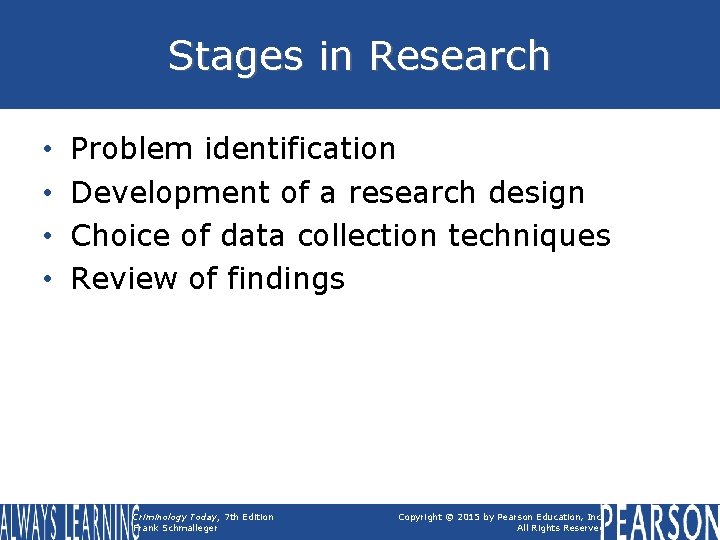
Stages in Research • • Problem identification Development of a research design Choice of data collection techniques Review of findings Criminology Today, 7 th Edition Frank Schmalleger Copyright © 2015 by Pearson Education, Inc. All Rights Reserved
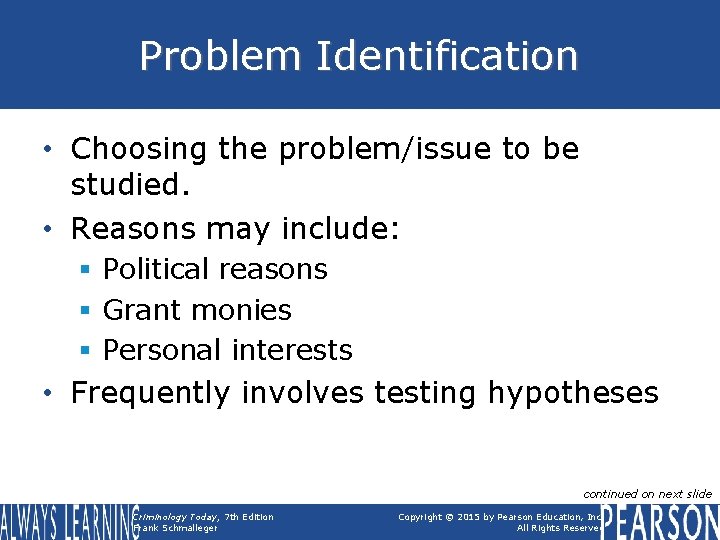
Problem Identification • Choosing the problem/issue to be studied. • Reasons may include: § Political reasons § Grant monies § Personal interests • Frequently involves testing hypotheses continued on next slide Criminology Today, 7 th Edition Frank Schmalleger Copyright © 2015 by Pearson Education, Inc. All Rights Reserved
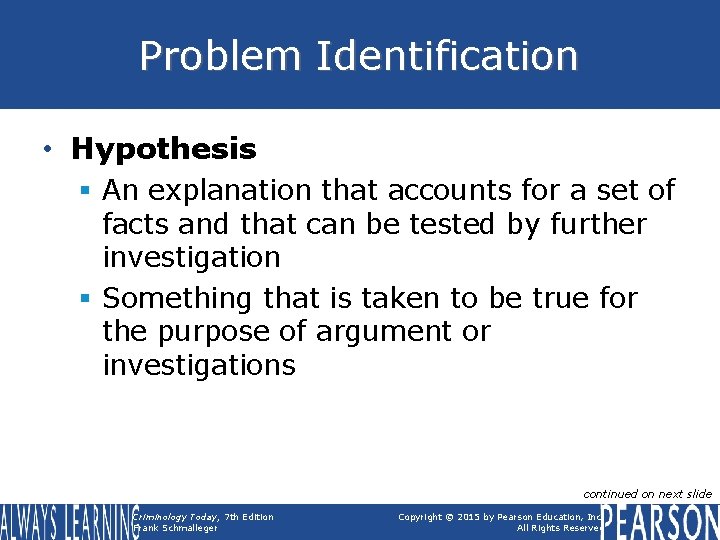
Problem Identification • Hypothesis § An explanation that accounts for a set of facts and that can be tested by further investigation § Something that is taken to be true for the purpose of argument or investigations continued on next slide Criminology Today, 7 th Edition Frank Schmalleger Copyright © 2015 by Pearson Education, Inc. All Rights Reserved
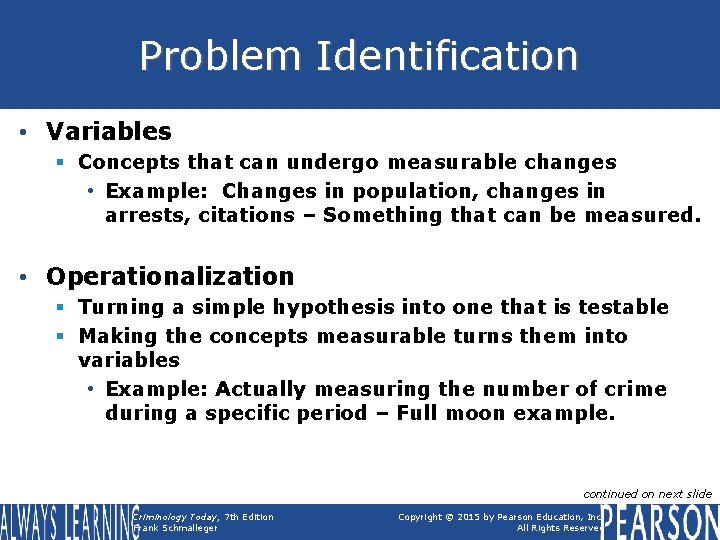
Problem Identification • Variables § Concepts that can undergo measurable changes • Example: Changes in population, changes in arrests, citations – Something that can be measured. • Operationalization § Turning a simple hypothesis into one that is testable § Making the concepts measurable turns them into variables • Example: Actually measuring the number of crime during a specific period – Full moon example. continued on next slide Criminology Today, 7 th Edition Frank Schmalleger Copyright © 2015 by Pearson Education, Inc. All Rights Reserved
Problem Identification • After concepts in hypothesis are measurable, hypothesis can be tested Criminology Today, 7 th Edition Frank Schmalleger Copyright © 2015 by Pearson Education, Inc. All Rights Reserved
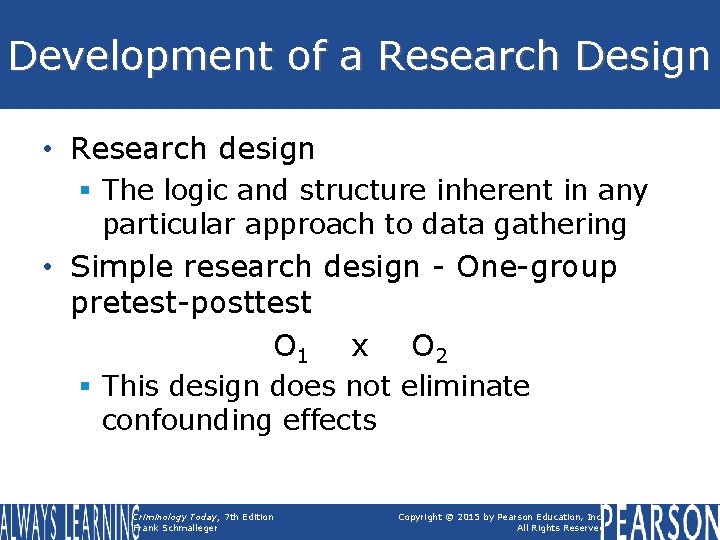
Development of a Research Design • Research design § The logic and structure inherent in any particular approach to data gathering • Simple research design - One-group pretest-posttest O 1 x O 2 § This design does not eliminate confounding effects Criminology Today, 7 th Edition Frank Schmalleger Copyright © 2015 by Pearson Education, Inc. All Rights Reserved
Validity in Research Designs • Internal validity § The certainty that experimental interventions did indeed cause the changes observed in the study group • External validity § The ability to generalize research findings to other settings Criminology Today, 7 th Edition Frank Schmalleger Copyright © 2015 by Pearson Education, Inc. All Rights Reserved
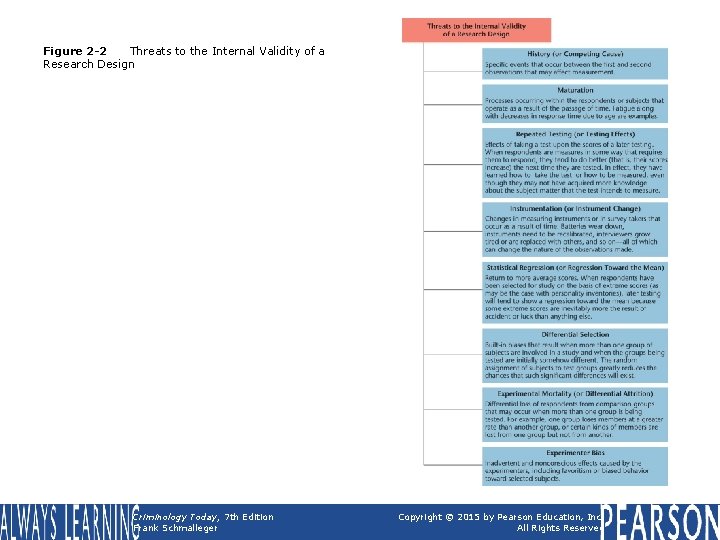
Figure 2 -2 Threats to the Internal Validity of a Research Design Criminology Today, 7 th Edition Frank Schmalleger Copyright © 2015 by Pearson Education, Inc. All Rights Reserved
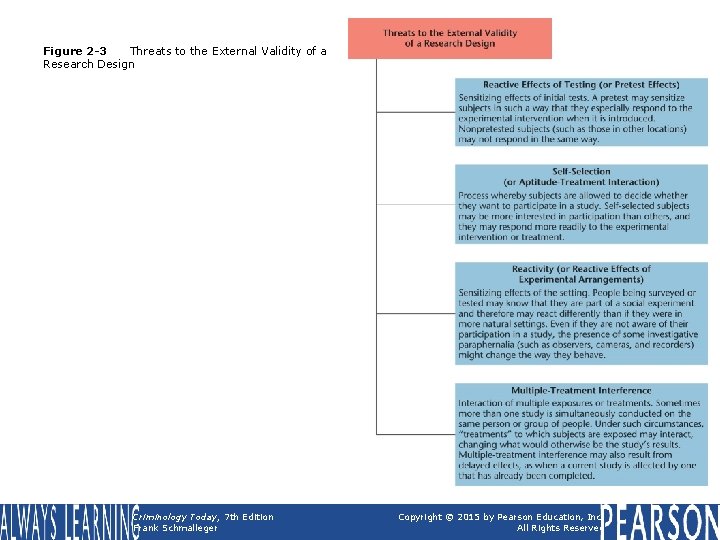
Figure 2 -3 Threats to the External Validity of a Research Design Criminology Today, 7 th Edition Frank Schmalleger Copyright © 2015 by Pearson Education, Inc. All Rights Reserved
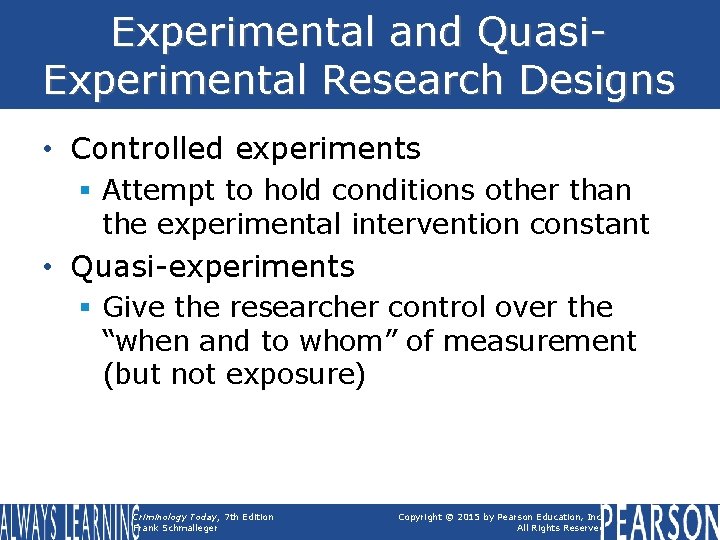
Experimental and Quasi. Experimental Research Designs • Controlled experiments § Attempt to hold conditions other than the experimental intervention constant • Quasi-experiments § Give the researcher control over the “when and to whom” of measurement (but not exposure) Criminology Today, 7 th Edition Frank Schmalleger Copyright © 2015 by Pearson Education, Inc. All Rights Reserved
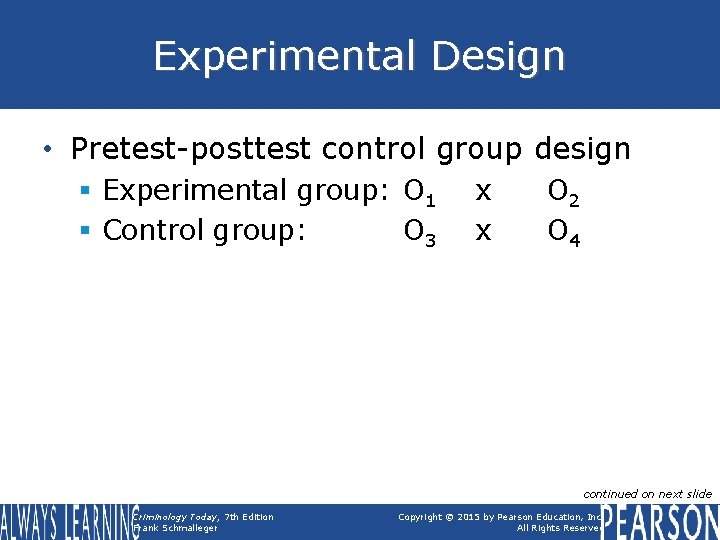
Experimental Design • Pretest-posttest control group design § Experimental group: O 1 § Control group: O 3 x x O 2 O 4 continued on next slide Criminology Today, 7 th Edition Frank Schmalleger Copyright © 2015 by Pearson Education, Inc. All Rights Reserved
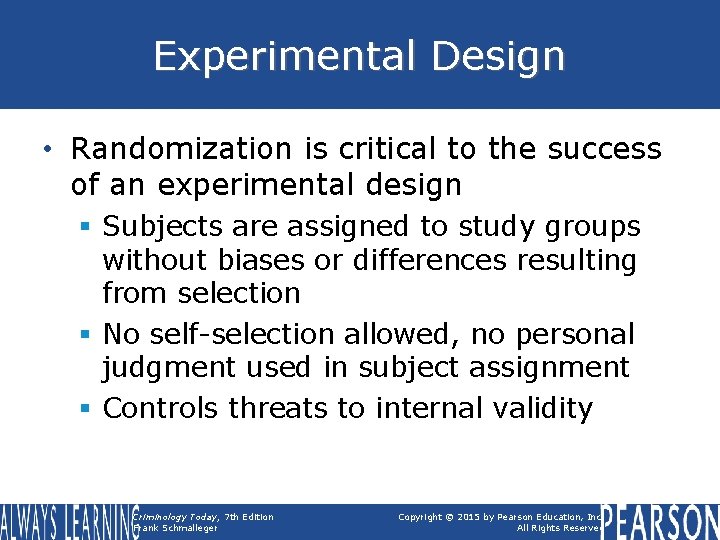
Experimental Design • Randomization is critical to the success of an experimental design § Subjects are assigned to study groups without biases or differences resulting from selection § No self-selection allowed, no personal judgment used in subject assignment § Controls threats to internal validity Criminology Today, 7 th Edition Frank Schmalleger Copyright © 2015 by Pearson Education, Inc. All Rights Reserved
Choice of Data-Collection Techniques • Data gathering strategies provide approaches to the accumulation of information needed for analysis • Selection based on: § § Ease/simplicity Cost Time Form required for data continued on next slide Criminology Today, 7 th Edition Frank Schmalleger Copyright © 2015 by Pearson Education, Inc. All Rights Reserved
Choice of Data-Collection Techniques • Key issue § Will the strategy produce information in a usable form? Criminology Today, 7 th Edition Frank Schmalleger Copyright © 2015 by Pearson Education, Inc. All Rights Reserved
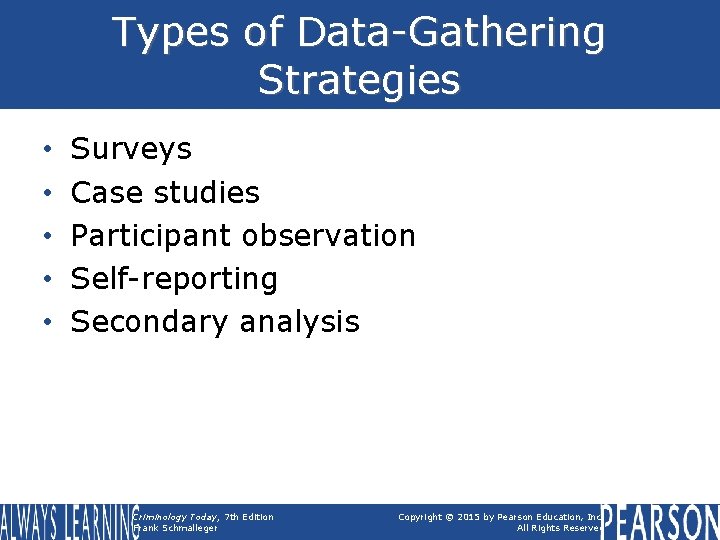
Types of Data-Gathering Strategies • • • Surveys Case studies Participant observation Self-reporting Secondary analysis Criminology Today, 7 th Edition Frank Schmalleger Copyright © 2015 by Pearson Education, Inc. All Rights Reserved
Surveys • Use questionnaires or surveys to gather “survey data” • May interview respondents in person, over the telephone, by e-mail, by fax, or by mail § Free tool – Survey Monkey Criminology Today, 7 th Edition Frank Schmalleger Copyright © 2015 by Pearson Education, Inc. All Rights Reserved
Case Studies • In-depth investigations into individual cases § Life history – a single subject is the focus of a case study • Suffer from high levels of subjectivity but provide the opportunity to examine individual cases in depth Criminology Today, 7 th Edition Frank Schmalleger Copyright © 2015 by Pearson Education, Inc. All Rights Reserved
Participant Observations • Involves various strategies in which the researcher observes a group by participating, to varying degrees, in the activities of the group • Researcher may operate undercover or make their purpose and identity known from the start continued on next slide Criminology Today, 7 th Edition Frank Schmalleger Copyright © 2015 by Pearson Education, Inc. All Rights Reserved
Participant Observations • Main types § Participant as observer § Observer as complete participant Criminology Today, 7 th Edition Frank Schmalleger Copyright © 2015 by Pearson Education, Inc. All Rights Reserved
Self-Reporting • Subjects are asked to report rates of certain behaviors, such as crime § May provide information when official records are lacking § Often considered a form of survey research • Introspection/personal reflection techniques – purely subjective Criminology Today, 7 th Edition Frank Schmalleger Copyright © 2015 by Pearson Education, Inc. All Rights Reserved
Secondary Analysis • New analysis or evaluation of existing data that was gathered by other researchers • Secondhand analysis of information originally collected for a different purpose Criminology Today, 7 th Edition Frank Schmalleger Copyright © 2015 by Pearson Education, Inc. All Rights Reserved
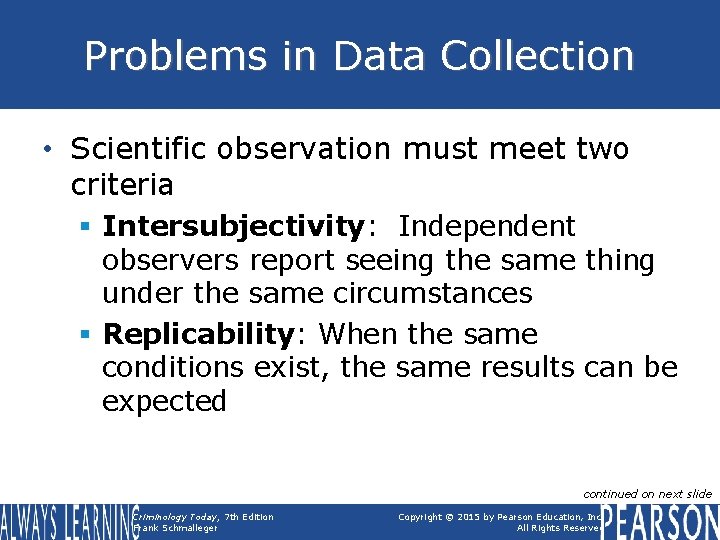
Problems in Data Collection • Scientific observation must meet two criteria § Intersubjectivity: Independent observers report seeing the same thing under the same circumstances § Replicability: When the same conditions exist, the same results can be expected continued on next slide Criminology Today, 7 th Edition Frank Schmalleger Copyright © 2015 by Pearson Education, Inc. All Rights Reserved
Problems in Data Collection • Observations meeting these criteria may still lead to unwarranted conclusions Criminology Today, 7 th Edition Frank Schmalleger Copyright © 2015 by Pearson Education, Inc. All Rights Reserved
Review of Findings • Most data subjected to some form of data analysis using statistical techniques § Descriptive statistics: describe, summarize, highlight relationships within data § Inferential statistics: attempt to generalize findings by specifying how likely they are to be true for other populations or locations Criminology Today, 7 th Edition Frank Schmalleger Copyright © 2015 by Pearson Education, Inc. All Rights Reserved
Quantitative versus Qualitative Methods • Quantitative methods § Techniques that produce measurable results that can be analyzed statistically § “Mystique of quantity” • Qualitative methods § Techniques that produce subjective results, or results that are difficult to quantify § Verstehen Criminology Today, 7 th Edition Frank Schmalleger Copyright © 2015 by Pearson Education, Inc. All Rights Reserved
Values and Ethics in the Conduct of Research • Values affect all stages of the research process § No research free from preconceptions, biases § Control their effect by being aware of them at the onset of the research continued on next slide Criminology Today, 7 th Edition Frank Schmalleger Copyright © 2015 by Pearson Education, Inc. All Rights Reserved
Values and Ethics in the Conduct of Research • Ethical issues do not affect validity but may impact the lives of researchers and subjects § § Protection of human subjects Privacy Need for disclosure of research methods Data confidentiality continued on next slide Criminology Today, 7 th Edition Frank Schmalleger Copyright © 2015 by Pearson Education, Inc. All Rights Reserved
Values and Ethics in the Conduct of Research • Informed consent § Strategy used to overcome ethical issues inherent in criminological research § Inform subjects as to nature of research, their anticipated role, the uses made of the data continued on next slide Criminology Today, 7 th Edition Frank Schmalleger Copyright © 2015 by Pearson Education, Inc. All Rights Reserved
Values and Ethics in the Conduct of Research • Institutional review boards § Established by universities, research organizations, government agencies § Examine research proposals to determine whether expectations of ethical conduct have been met before the proposals are submitted to funding organizations Criminology Today, 7 th Edition Frank Schmalleger Copyright © 2015 by Pearson Education, Inc. All Rights Reserved
Social Policy and Criminological Research • Ideally, research should significantly impact public crime control policy • Realistically § Public officials may be ignorant of current research § Public officials may ignore research findings Criminology Today, 7 th Edition Frank Schmalleger Copyright © 2015 by Pearson Education, Inc. All Rights Reserved
Writing the Research Report Title page Acknowledgements Table of contents Preface Abstract Introduction Review of existing literature • Description of existing situation • • Statement of hypothesis • Description of research plan • Disclaimers/limitations • Analysis/discussion • Summary/conclusions • Endnotes/footnotes • Appendices • List of references continued on next slide Criminology Today, 7 th Edition Frank Schmalleger Copyright © 2015 by Pearson Education, Inc. All Rights Reserved
Writing the Research Report • Refereed journals § Journals that use peer reviewers to gauge the quality of the manuscripts submitted to them § Manuscript submission requirements vary by journal Criminology Today, 7 th Edition Frank Schmalleger Copyright © 2015 by Pearson Education, Inc. All Rights Reserved
CLASS ACTIVITY Aprilville, a small town outside Bigcity, plans to implement a Neighborhood Watch program. The town mayor has asked you to find out if the program, once implemented, will have any effect on the town’s crime rate. Design a research study to answer this question: • Formulate one or more hypotheses and operationalize the concepts. • Choose a research design from those discussed in the chapter and explain why you selected this design. • Select a data-gathering strategy and explain why you chose this technique Criminology Today, 7 th Edition Frank Schmalleger Copyright © 2015 by Pearson Education, Inc. All Rights Reserved