Introduction to Criminal Law Dr Konrad Lipiski assistant









- Slides: 58
Introduction to Criminal Law Dr Konrad Lipiński assistant professor Department of Criminal Law
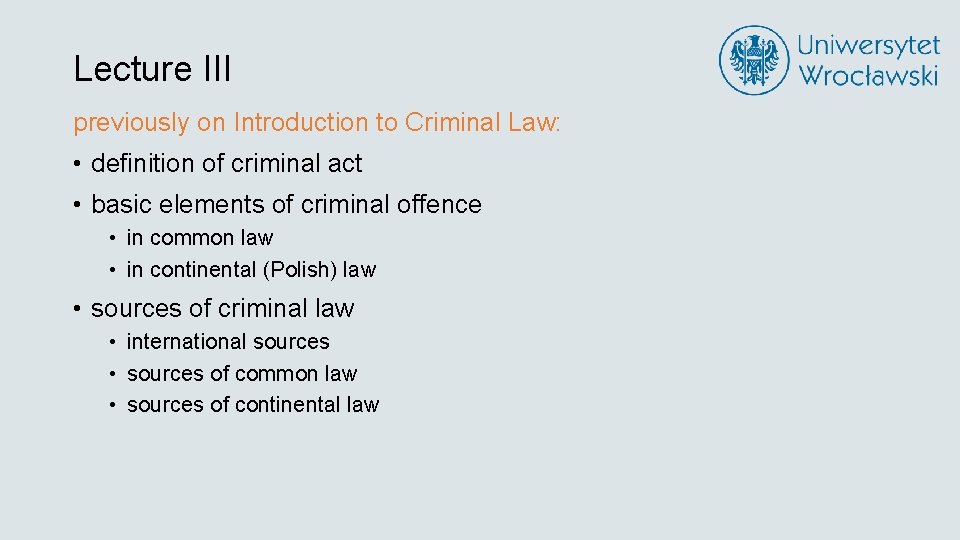
Lecture III previously on Introduction to Criminal Law: • definition of criminal act • basic elements of criminal offence • in common law • in continental (Polish) law • sources of criminal law • international sources • sources of common law • sources of continental law
Lecture III scope of the lecture • principles of criminal law • art. 7 ECHR • common law • continental law
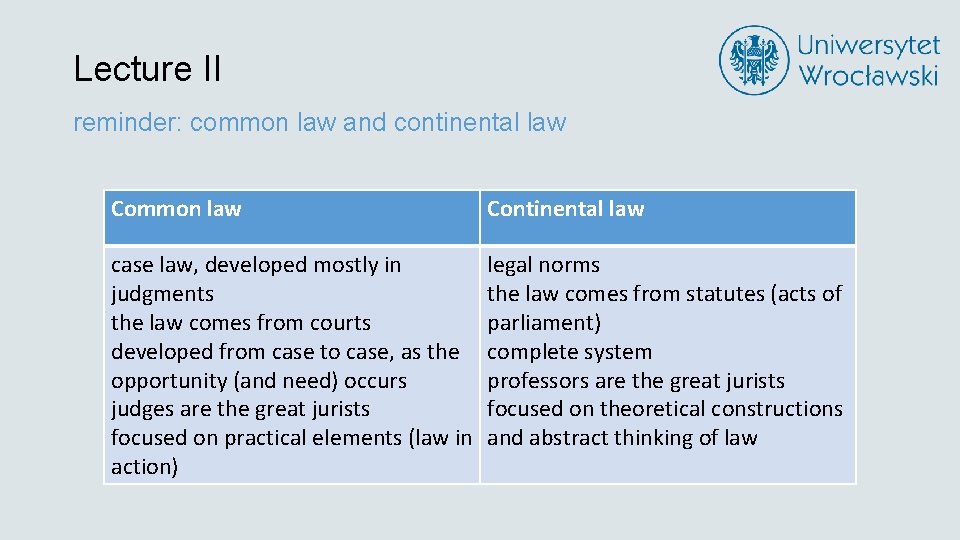
Lecture II reminder: common law and continental law Common law Continental law case law, developed mostly in judgments the law comes from courts developed from case to case, as the opportunity (and need) occurs judges are the great jurists focused on practical elements (law in action) legal norms the law comes from statutes (acts of parliament) complete system professors are the great jurists focused on theoretical constructions and abstract thinking of law
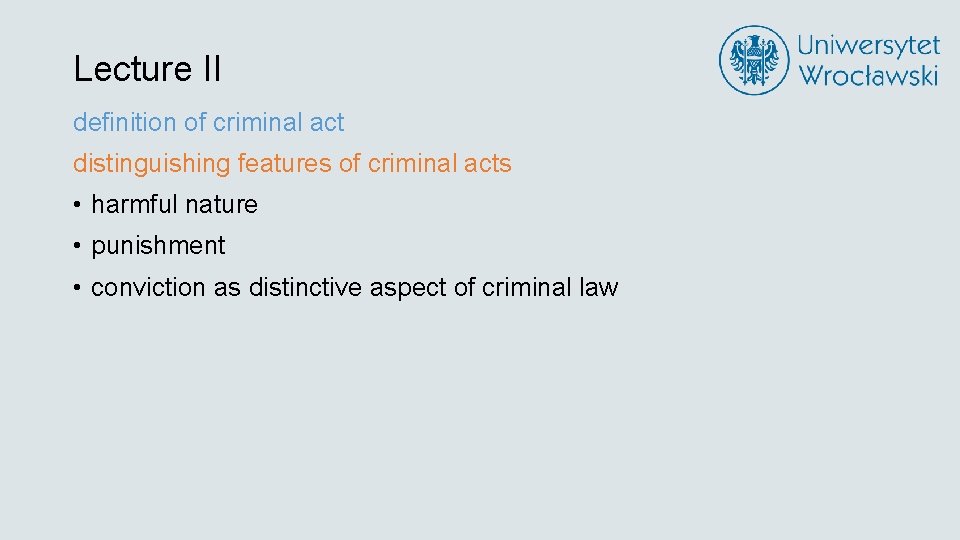
Lecture II definition of criminal act distinguishing features of criminal acts • harmful nature • punishment • conviction as distinctive aspect of criminal law
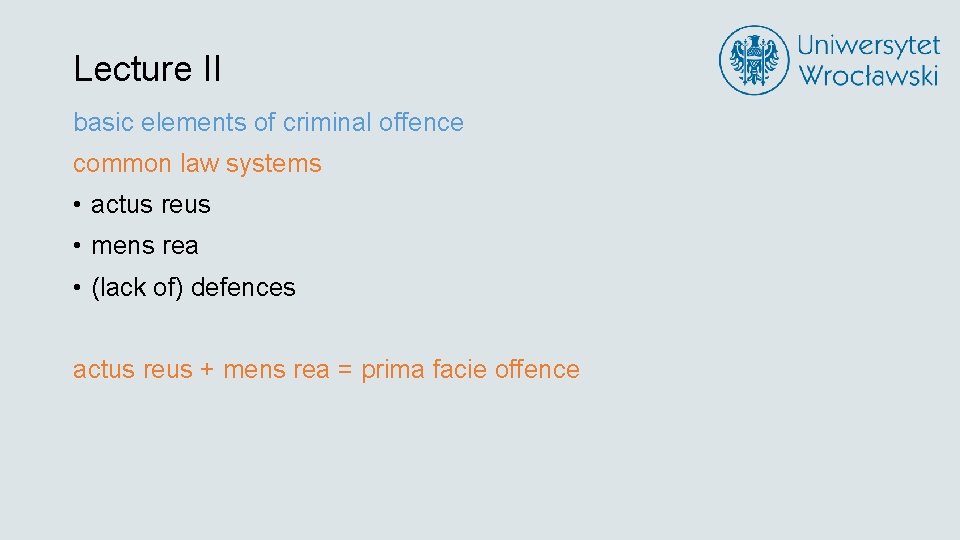
Lecture II basic elements of criminal offence common law systems • actus reus • mens rea • (lack of) defences actus reus + mens rea = prima facie offence
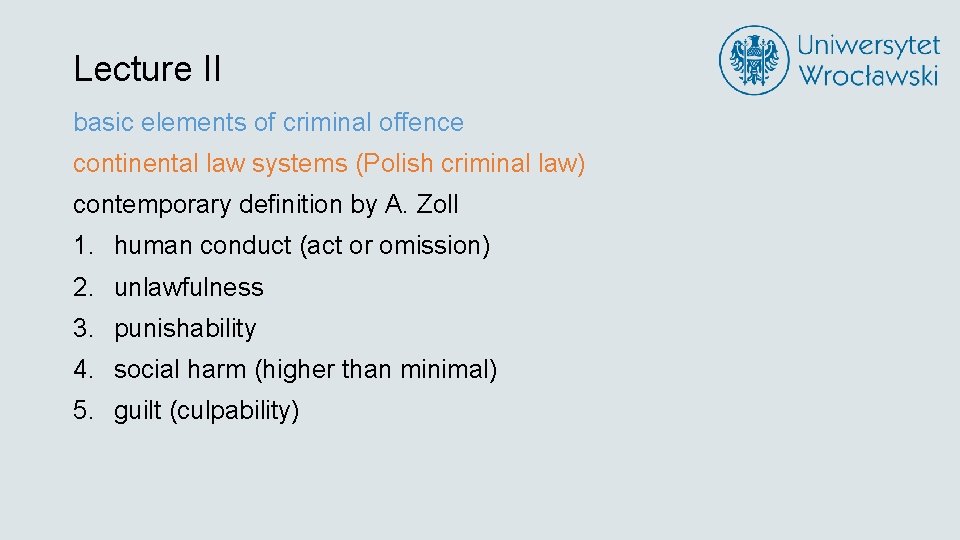
Lecture II basic elements of criminal offence continental law systems (Polish criminal law) contemporary definition by A. Zoll 1. human conduct (act or omission) 2. unlawfulness 3. punishability 4. social harm (higher than minimal) 5. guilt (culpability)
Lecture II basic elements of criminal offence contemporary definition of criminal offence by A. Zoll In this concept, criminal offence is a natural person’s conduct (act or omission), which is unlawful (in violation with law), punishable by criminal law, which causes social harm higher than minimal, if the guilt might be attributed to the offender.
Lecture II sources of criminal law • international sources • sources of common law (common law crimes) • sources of continental criminal law
Lecture III scope of the lecture • principles of criminal law • art. 7 ECHR • common law • continental law
Lecture II sources of criminal law continental (Polish) criminal law • constitution • statutes • Criminal Code of 1997 • other statutes
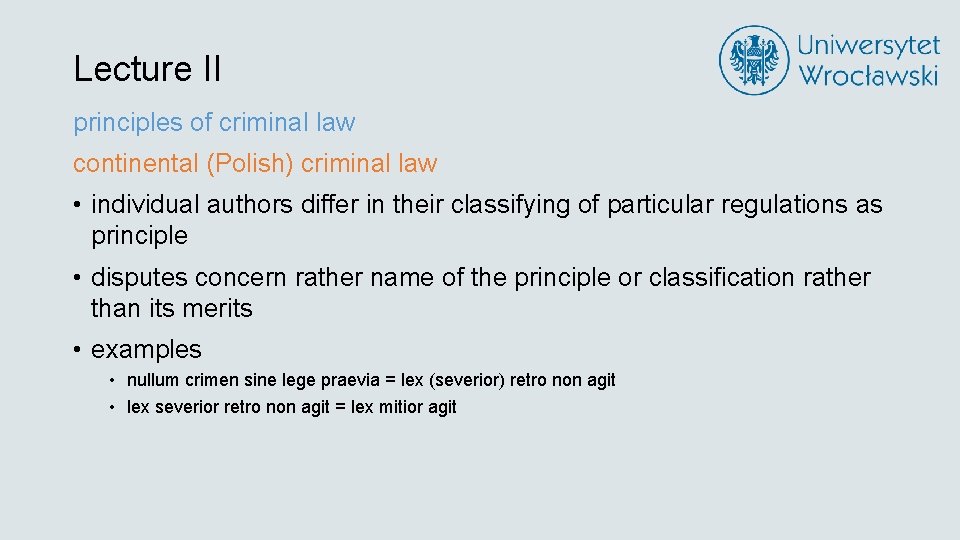
Lecture II principles of criminal law continental (Polish) criminal law • individual authors differ in their classifying of particular regulations as principle • disputes concern rather name of the principle or classification rather than its merits • examples • nullum crimen sine lege praevia = lex (severior) retro non agit • lex severior retro non agit = lex mitior agit
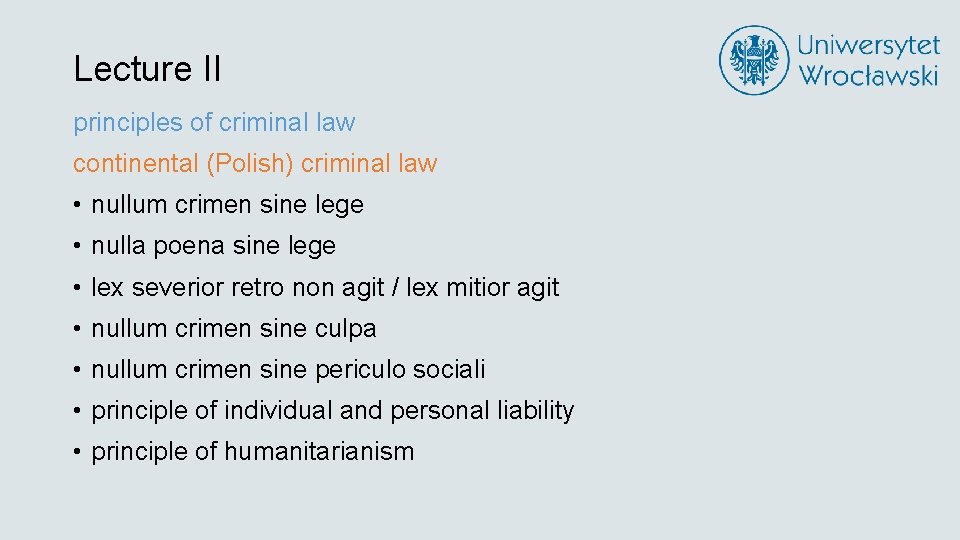
Lecture II principles of criminal law continental (Polish) criminal law • nullum crimen sine lege • nulla poena sine lege • lex severior retro non agit / lex mitior agit • nullum crimen sine culpa • nullum crimen sine periculo sociali • principle of individual and personal liability • principle of humanitarianism
Lecture II principles of criminal law • nullum crimen sine lege • „no offence without statute” • might be perceived as main principle
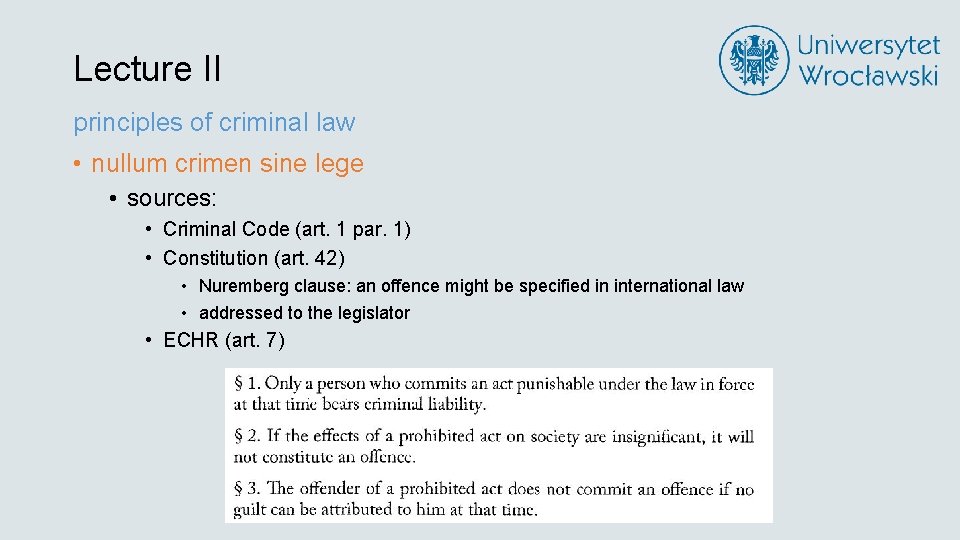
Lecture II principles of criminal law • nullum crimen sine lege • sources: • Criminal Code (art. 1 par. 1) • Constitution (art. 42) • Nuremberg clause: an offence might be specified in international law • addressed to the legislator • ECHR (art. 7)
Lecture II principles of criminal law • nullum crimen sine lege • • nullum crimen sine lege scripta nullum crimen sine lege stricta nullum crimen sine lege certa nullum crimen sine lege praevia
Lecture II principles of criminal law • nullum crimen sine lege scripta • scriptus (lat. ) = written • a principle, under which only a statute might serve as a source of criminal law • statute understood formally – act of Parliament, adopted in appropriate manner by both chambers of Parliament (Sejm and Senat), signed by the President and promulgated • theoretically an offence might be also specified in international law
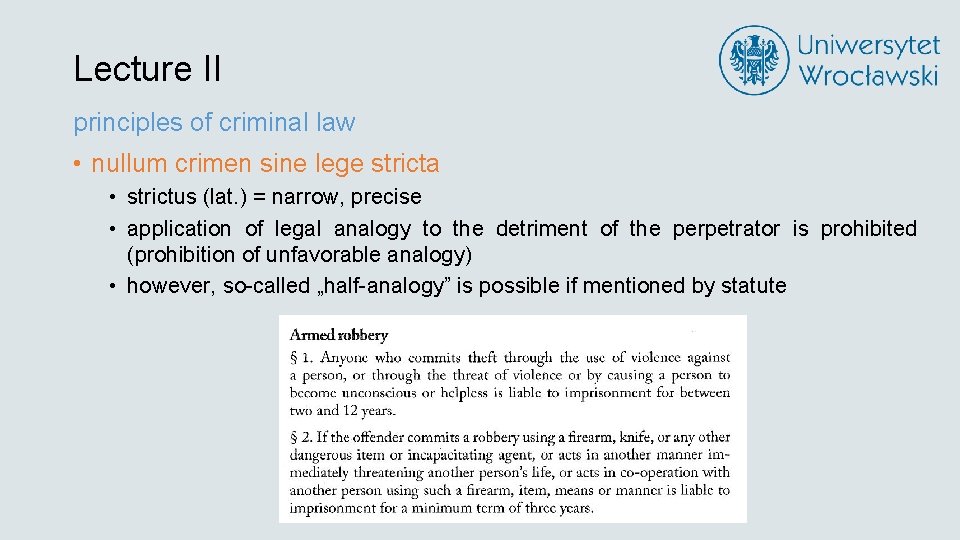
Lecture II principles of criminal law • nullum crimen sine lege stricta • strictus (lat. ) = narrow, precise • application of legal analogy to the detriment of the perpetrator is prohibited (prohibition of unfavorable analogy) • however, so-called „half-analogy” is possible if mentioned by statute
Lecture II principles of criminal law • nullum crimen sine lege certa • • certus (lat. ) = sure, definite provisions of law should be as precise as possible the legislator should not use uncertain terms negative examples: • • „who slanders…” „who libels…” „who displays pornographic material…” theft with burglary (breaking and entering / breaking in, not out)
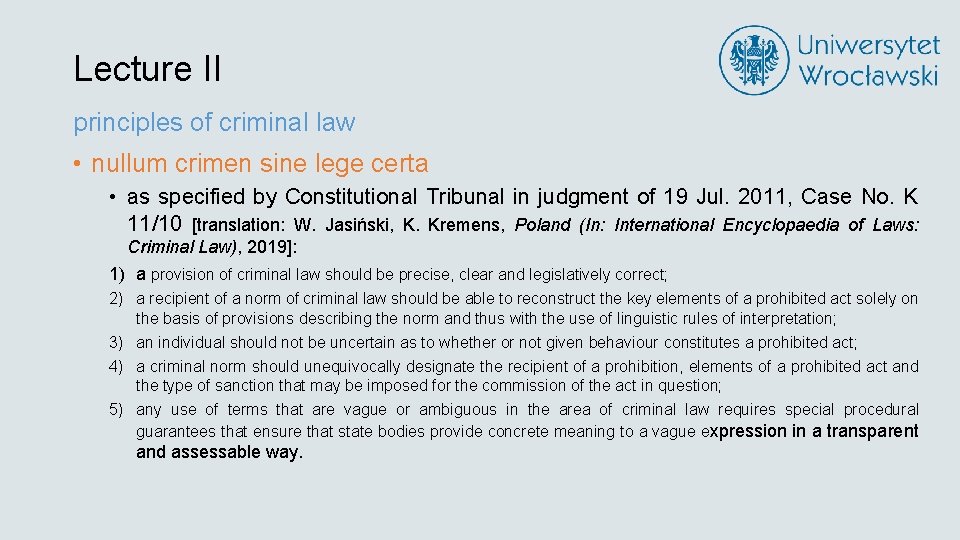
Lecture II principles of criminal law • nullum crimen sine lege certa • as specified by Constitutional Tribunal in judgment of 19 Jul. 2011, Case No. K 11/10 [translation: W. Jasiński, K. Kremens, Poland (In: International Encyclopaedia of Laws: Criminal Law), 2019]: 1) a provision of criminal law should be precise, clear and legislatively correct; 2) a recipient of a norm of criminal law should be able to reconstruct the key elements of a prohibited act solely on the basis of provisions describing the norm and thus with the use of linguistic rules of interpretation; 3) an individual should not be uncertain as to whether or not given behaviour constitutes a prohibited act; 4) a criminal norm should unequivocally designate the recipient of a prohibition, elements of a prohibited act and the type of sanction that may be imposed for the commission of the act in question; 5) any use of terms that are vague or ambiguous in the area of criminal law requires special procedural guarantees that ensure that state bodies provide concrete meaning to a vague expression in a transparent and assessable way.
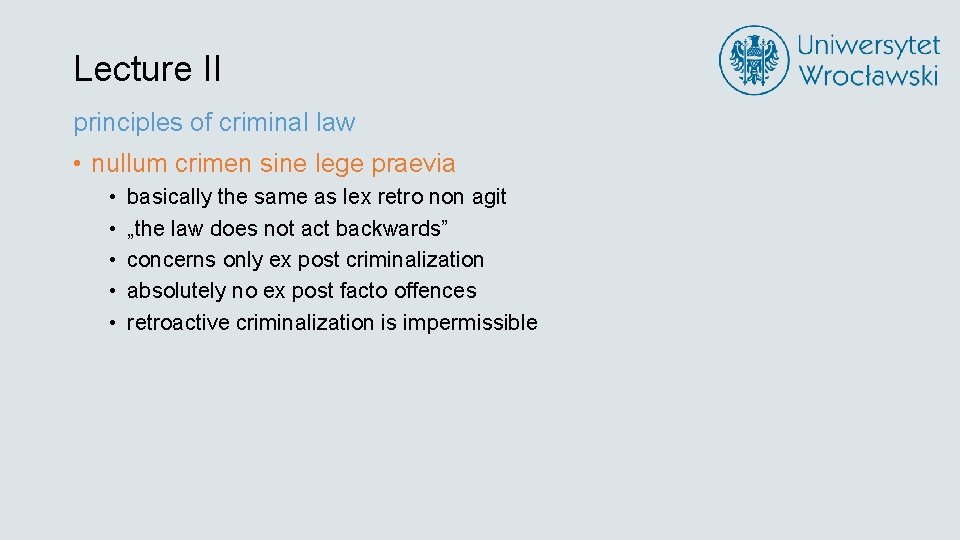
Lecture II principles of criminal law • nullum crimen sine lege praevia • • • basically the same as lex retro non agit „the law does not act backwards” concerns only ex post criminalization absolutely no ex post facto offences retroactive criminalization is impermissible
Lecture II principles of criminal law • nulla poena sine lege • „no punishment without statute” • closely related to nullum crimen sine lege • sometimes even perceived as one rule: nullum crimen, nulla poena sine lege • acts punishable by law need to be specified in statute • also a punishment (its limits) needs to be specified in statute
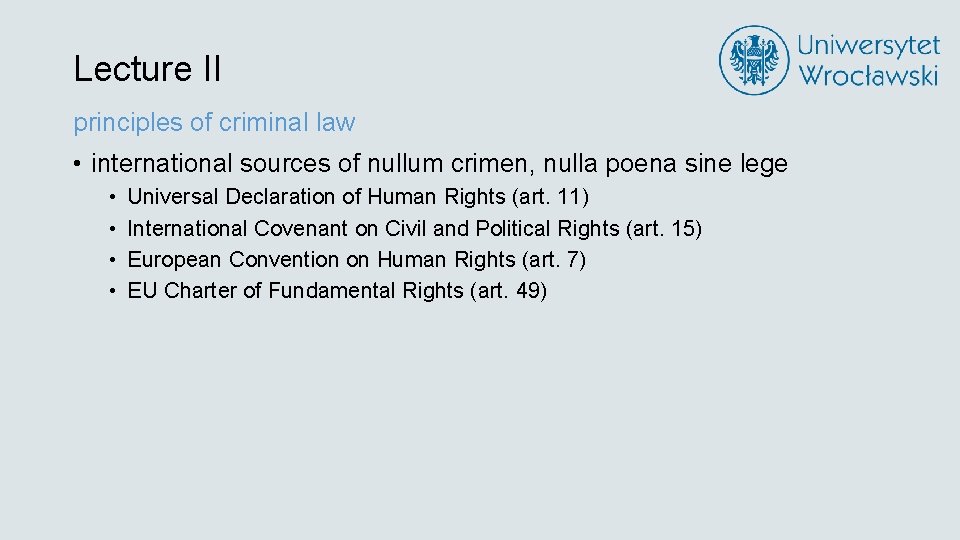
Lecture II principles of criminal law • international sources of nullum crimen, nulla poena sine lege • • Universal Declaration of Human Rights (art. 11) International Covenant on Civil and Political Rights (art. 15) European Convention on Human Rights (art. 7) EU Charter of Fundamental Rights (art. 49)
Lecture II principles of criminal law • nullum crimen, nulla poena sine lege in ECHR Article 7 No one shall be held guilty of any criminal offence on account of any act or omission which did not constitute a criminal offence under national or international law at the time when it was committed. Nor shall a heavier penalty be imposed than the one that was applicable at the time the criminal offence was committed.
Lecture II principles of criminal law • nullum crimen, nulla poena sine lege in ECHR • 3 important ECt. HR judgments: • Kokkinakis v. Greece • Vyerentsov v. Ukraine • Jorgic v Germany
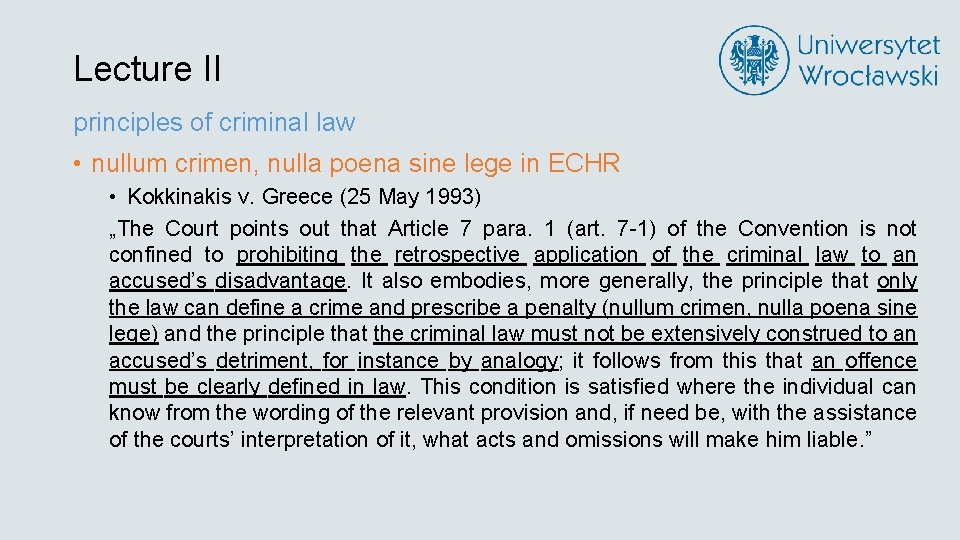
Lecture II principles of criminal law • nullum crimen, nulla poena sine lege in ECHR • Kokkinakis v. Greece (25 May 1993) „The Court points out that Article 7 para. 1 (art. 7 -1) of the Convention is not confined to prohibiting the retrospective application of the criminal law to an accused’s disadvantage. It also embodies, more generally, the principle that only the law can define a crime and prescribe a penalty (nullum crimen, nulla poena sine lege) and the principle that the criminal law must not be extensively construed to an accused’s detriment, for instance by analogy; it follows from this that an offence must be clearly defined in law. This condition is satisfied where the individual can know from the wording of the relevant provision and, if need be, with the assistance of the courts’ interpretation of it, what acts and omissions will make him liable. ”
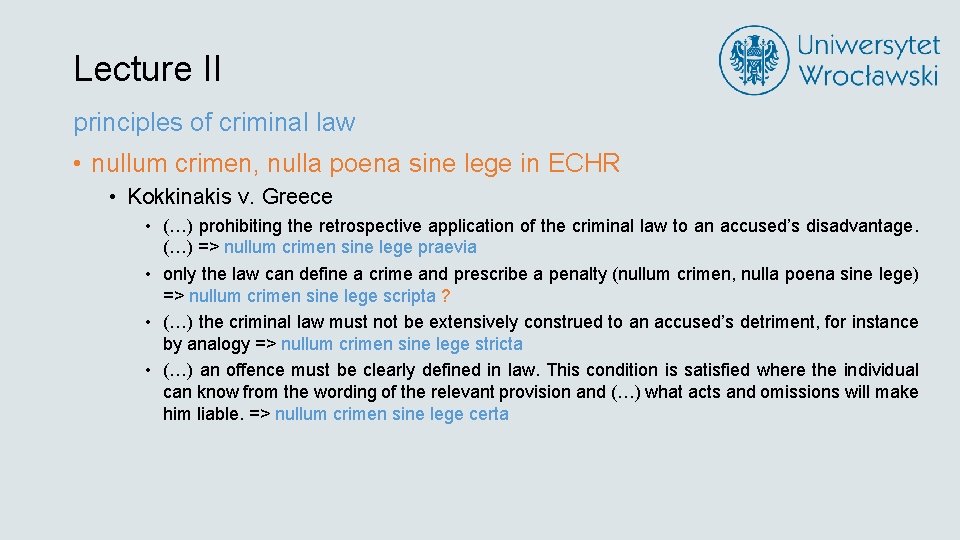
Lecture II principles of criminal law • nullum crimen, nulla poena sine lege in ECHR • Kokkinakis v. Greece • (…) prohibiting the retrospective application of the criminal law to an accused’s disadvantage. (…) => nullum crimen sine lege praevia • only the law can define a crime and prescribe a penalty (nullum crimen, nulla poena sine lege) => nullum crimen sine lege scripta ? • (…) the criminal law must not be extensively construed to an accused’s detriment, for instance by analogy => nullum crimen sine lege stricta • (…) an offence must be clearly defined in law. This condition is satisfied where the individual can know from the wording of the relevant provision and (…) what acts and omissions will make him liable. => nullum crimen sine lege certa
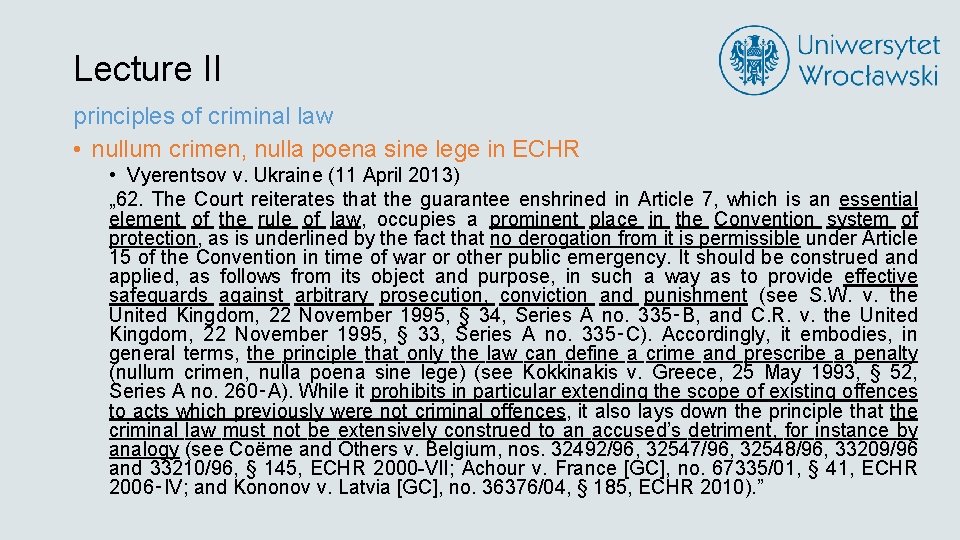
Lecture II principles of criminal law • nullum crimen, nulla poena sine lege in ECHR • Vyerentsov v. Ukraine (11 April 2013) „ 62. The Court reiterates that the guarantee enshrined in Article 7, which is an essential element of the rule of law, occupies a prominent place in the Convention system of protection, as is underlined by the fact that no derogation from it is permissible under Article 15 of the Convention in time of war or other public emergency. It should be construed and applied, as follows from its object and purpose, in such a way as to provide effective safeguards against arbitrary prosecution, conviction and punishment (see S. W. v. the United Kingdom, 22 November 1995, § 34, Series A no. 335‑B, and C. R. v. the United Kingdom, 22 November 1995, § 33, Series A no. 335‑C). Accordingly, it embodies, in general terms, the principle that only the law can define a crime and prescribe a penalty (nullum crimen, nulla poena sine lege) (see Kokkinakis v. Greece, 25 May 1993, § 52, Series A no. 260‑A). While it prohibits in particular extending the scope of existing offences to acts which previously were not criminal offences, it also lays down the principle that the criminal law must not be extensively construed to an accused’s detriment, for instance by analogy (see Coëme and Others v. Belgium, nos. 32492/96, 32547/96, 32548/96, 33209/96 and 33210/96, § 145, ECHR 2000 -VII; Achour v. France [GC], no. 67335/01, § 41, ECHR 2006‑IV; and Kononov v. Latvia [GC], no. 36376/04, § 185, ECHR 2010). ”
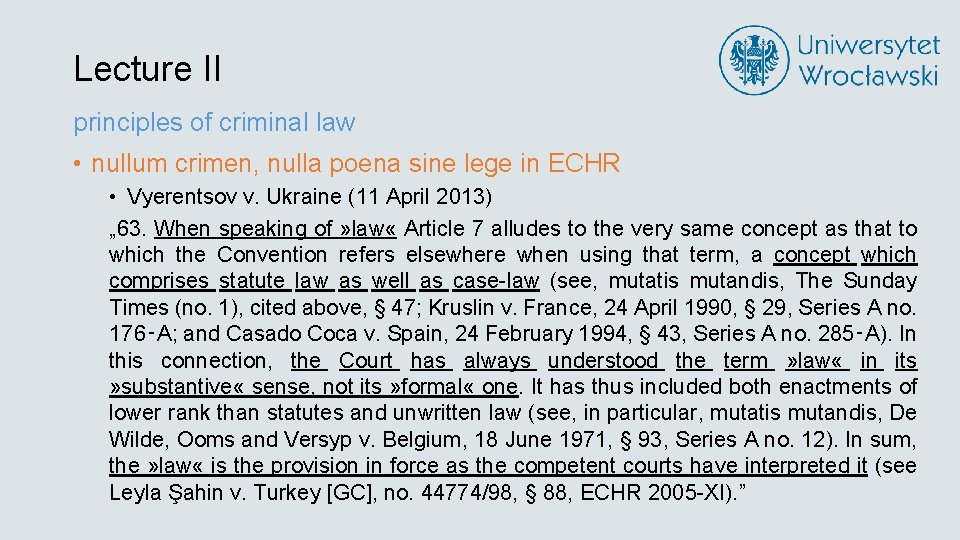
Lecture II principles of criminal law • nullum crimen, nulla poena sine lege in ECHR • Vyerentsov v. Ukraine (11 April 2013) „ 63. When speaking of » law « Article 7 alludes to the very same concept as that to which the Convention refers elsewhere when using that term, a concept which comprises statute law as well as case-law (see, mutatis mutandis, The Sunday Times (no. 1), cited above, § 47; Kruslin v. France, 24 April 1990, § 29, Series A no. 176‑A; and Casado Coca v. Spain, 24 February 1994, § 43, Series A no. 285‑A). In this connection, the Court has always understood the term » law « in its » substantive « sense, not its » formal « one. It has thus included both enactments of lower rank than statutes and unwritten law (see, in particular, mutatis mutandis, De Wilde, Ooms and Versyp v. Belgium, 18 June 1971, § 93, Series A no. 12). In sum, the » law « is the provision in force as the competent courts have interpreted it (see Leyla Şahin v. Turkey [GC], no. 44774/98, § 88, ECHR 2005 -XI). ”
Lecture II principles of criminal law • nullum crimen, nulla poena sine lege in ECHR • Vyerentsov v. Ukraine (11 April 2013) „ 64. Furthermore, the term » law « implies qualitative requirements, including those of accessibility and foreseeability (see, among other authorities, Cantoni v. France, 15 November 1996, § 29, Reports of Judgments and Decisions 1996‑V; Coëme and Others, cited above, § 145; and E. K. v. Turkey, no. 28496/95, § 51, 7 February 2002). These qualitative requirements must be satisfied as regards both the definition of an offence and the penalty that the offence in question carries (see Achour [GC], cited above, § 41). An individual must know from the wording of the relevant provision and, if need be, with the assistance of the courts’ interpretation thereof, what acts and omissions will render him criminally responsible and what penalty will be imposed for the act and/or omission in question (see, among other authorities, Cantoni, cited above, § 29). Furthermore, a law may still satisfy the requirement of » foreseeability « where the person concerned has to take appropriate legal advice to assess, to a degree that is reasonable in the circumstances, the consequences which a given action may entail (see, among other authorities, Cantoni, cited above, § 35, and Achour [GC], cited above, § 54). ”
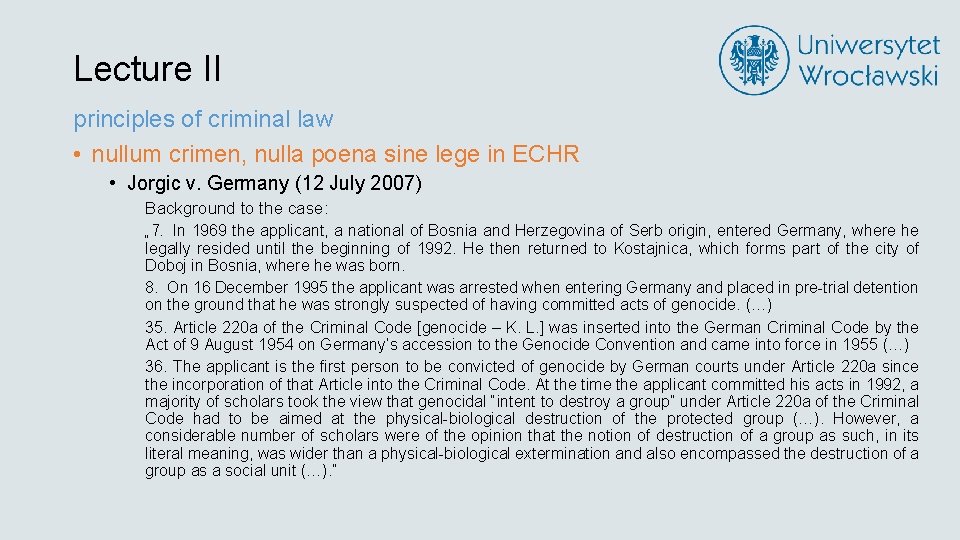
Lecture II principles of criminal law • nullum crimen, nulla poena sine lege in ECHR • Jorgic v. Germany (12 July 2007) Background to the case: „ 7. In 1969 the applicant, a national of Bosnia and Herzegovina of Serb origin, entered Germany, where he legally resided until the beginning of 1992. He then returned to Kostajnica, which forms part of the city of Doboj in Bosnia, where he was born. 8. On 16 December 1995 the applicant was arrested when entering Germany and placed in pre-trial detention on the ground that he was strongly suspected of having committed acts of genocide. (…) 35. Article 220 a of the Criminal Code [genocide – K. L. ] was inserted into the German Criminal Code by the Act of 9 August 1954 on Germany’s accession to the Genocide Convention and came into force in 1955 (…) 36. The applicant is the first person to be convicted of genocide by German courts under Article 220 a since the incorporation of that Article into the Criminal Code. At the time the applicant committed his acts in 1992, a majority of scholars took the view that genocidal “intent to destroy a group” under Article 220 a of the Criminal Code had to be aimed at the physical-biological destruction of the protected group (…). However, a considerable number of scholars were of the opinion that the notion of destruction of a group as such, in its literal meaning, was wider than a physical-biological extermination and also encompassed the destruction of a group as a social unit (…). ”
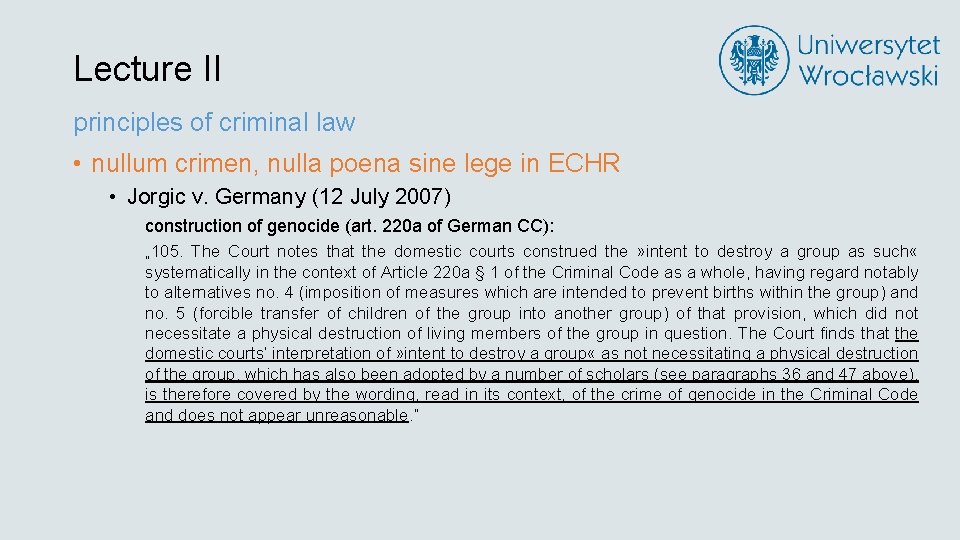
Lecture II principles of criminal law • nullum crimen, nulla poena sine lege in ECHR • Jorgic v. Germany (12 July 2007) construction of genocide (art. 220 a of German CC): „ 105. The Court notes that the domestic courts construed the » intent to destroy a group as such « systematically in the context of Article 220 a § 1 of the Criminal Code as a whole, having regard notably to alternatives no. 4 (imposition of measures which are intended to prevent births within the group) and no. 5 (forcible transfer of children of the group into another group) of that provision, which did not necessitate a physical destruction of living members of the group in question. The Court finds that the domestic courts’ interpretation of » intent to destroy a group « as not necessitating a physical destruction of the group, which has also been adopted by a number of scholars (see paragraphs 36 and 47 above), is therefore covered by the wording, read in its context, of the crime of genocide in the Criminal Code and does not appear unreasonable. ”
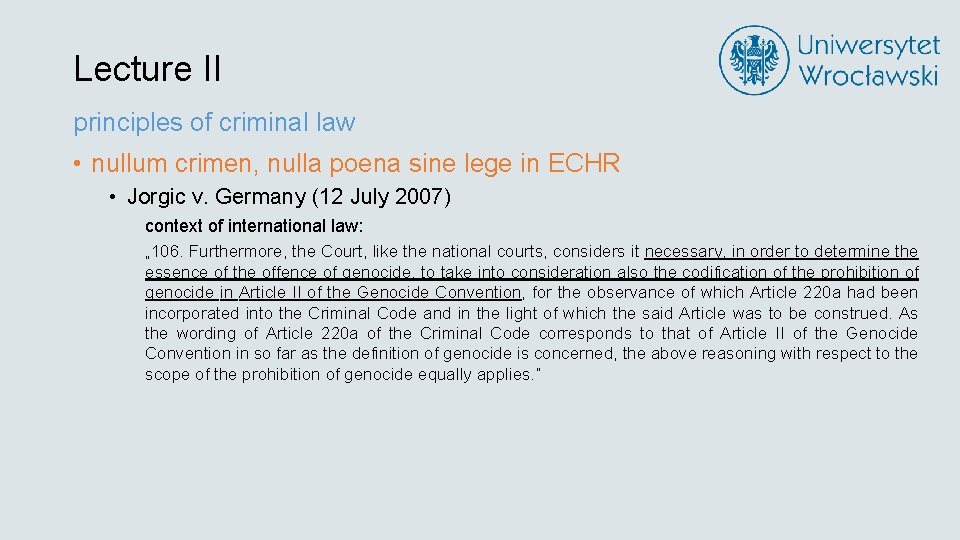
Lecture II principles of criminal law • nullum crimen, nulla poena sine lege in ECHR • Jorgic v. Germany (12 July 2007) context of international law: „ 106. Furthermore, the Court, like the national courts, considers it necessary, in order to determine the essence of the offence of genocide, to take into consideration also the codification of the prohibition of genocide in Article II of the Genocide Convention, for the observance of which Article 220 a had been incorporated into the Criminal Code and in the light of which the said Article was to be construed. As the wording of Article 220 a of the Criminal Code corresponds to that of Article II of the Genocide Convention in so far as the definition of genocide is concerned, the above reasoning with respect to the scope of the prohibition of genocide equally applies. ”
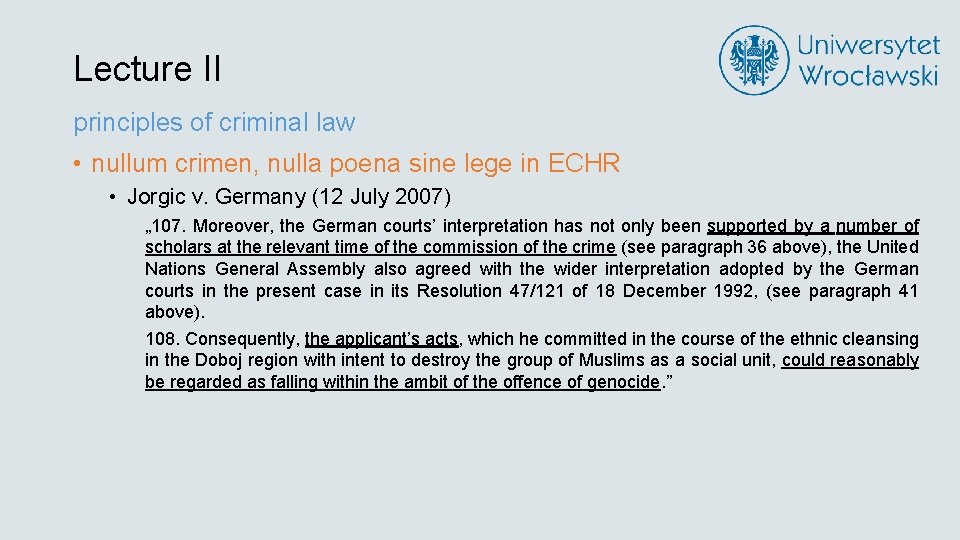
Lecture II principles of criminal law • nullum crimen, nulla poena sine lege in ECHR • Jorgic v. Germany (12 July 2007) „ 107. Moreover, the German courts’ interpretation has not only been supported by a number of scholars at the relevant time of the commission of the crime (see paragraph 36 above), the United Nations General Assembly also agreed with the wider interpretation adopted by the German courts in the present case in its Resolution 47/121 of 18 December 1992, (see paragraph 41 above). 108. Consequently, the applicant’s acts, which he committed in the course of the ethnic cleansing in the Doboj region with intent to destroy the group of Muslims as a social unit, could reasonably be regarded as falling within the ambit of the offence of genocide. ”
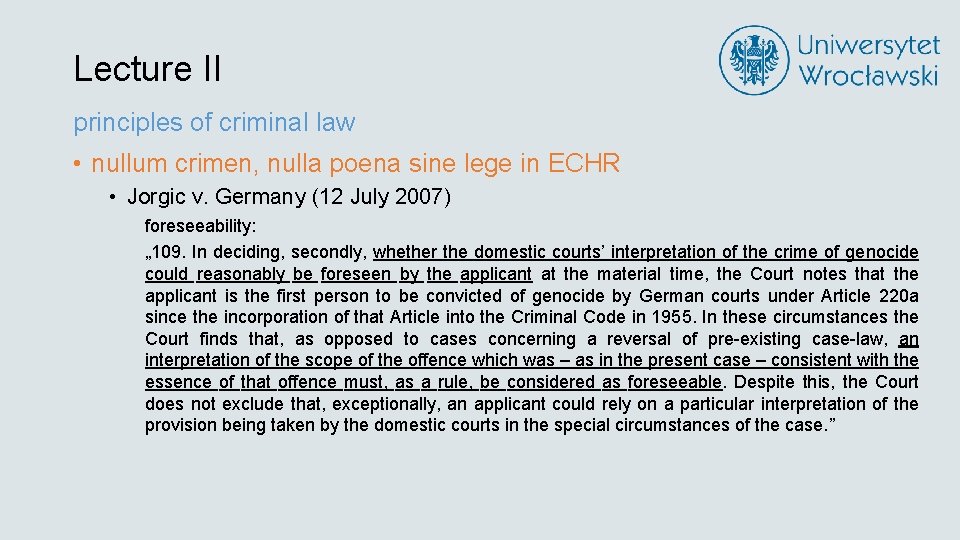
Lecture II principles of criminal law • nullum crimen, nulla poena sine lege in ECHR • Jorgic v. Germany (12 July 2007) foreseeability: „ 109. In deciding, secondly, whether the domestic courts’ interpretation of the crime of genocide could reasonably be foreseen by the applicant at the material time, the Court notes that the applicant is the first person to be convicted of genocide by German courts under Article 220 a since the incorporation of that Article into the Criminal Code in 1955. In these circumstances the Court finds that, as opposed to cases concerning a reversal of pre-existing case-law, an interpretation of the scope of the offence which was – as in the present case – consistent with the essence of that offence must, as a rule, be considered as foreseeable. Despite this, the Court does not exclude that, exceptionally, an applicant could rely on a particular interpretation of the provision being taken by the domestic courts in the special circumstances of the case. ”
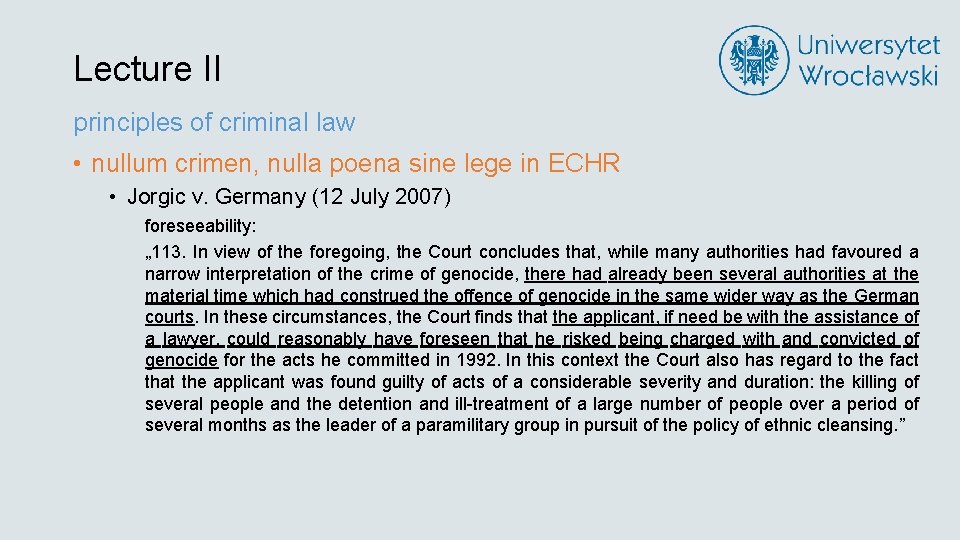
Lecture II principles of criminal law • nullum crimen, nulla poena sine lege in ECHR • Jorgic v. Germany (12 July 2007) foreseeability: „ 113. In view of the foregoing, the Court concludes that, while many authorities had favoured a narrow interpretation of the crime of genocide, there had already been several authorities at the material time which had construed the offence of genocide in the same wider way as the German courts. In these circumstances, the Court finds that the applicant, if need be with the assistance of a lawyer, could reasonably have foreseen that he risked being charged with and convicted of genocide for the acts he committed in 1992. In this context the Court also has regard to the fact that the applicant was found guilty of acts of a considerable severity and duration: the killing of several people and the detention and ill-treatment of a large number of people over a period of several months as the leader of a paramilitary group in pursuit of the policy of ethnic cleansing. ”
Lecture II principles of criminal law • nullum crimen, nulla poena sine lege in ECHR • Jorgic v. Germany (12 July 2007) foreseeability: „ 113. In view of the foregoing, the Court concludes that, while many authorities had favoured a narrow interpretation of the crime of genocide, there had already been several authorities at the material time which had construed the offence of genocide in the same wider way as the German courts. In these circumstances, the Court finds that the applicant, if need be with the assistance of a lawyer, could reasonably have foreseen that he risked being charged with and convicted of genocide for the acts he committed in 1992. In this context the Court also has regard to the fact that the applicant was found guilty of acts of a considerable severity and duration: the killing of several people and the detention and ill-treatment of a large number of people over a period of several months as the leader of a paramilitary group in pursuit of the policy of ethnic cleansing. ”
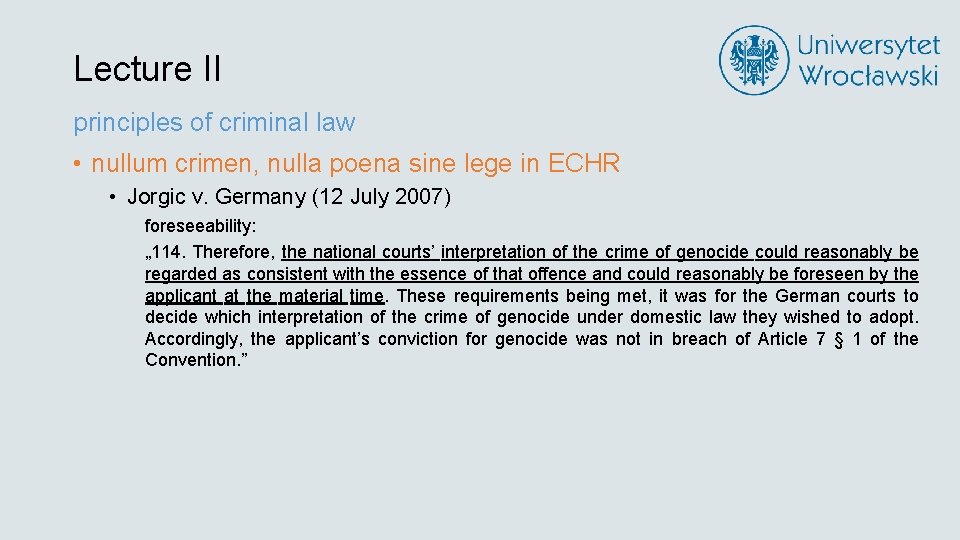
Lecture II principles of criminal law • nullum crimen, nulla poena sine lege in ECHR • Jorgic v. Germany (12 July 2007) foreseeability: „ 114. Therefore, the national courts’ interpretation of the crime of genocide could reasonably be regarded as consistent with the essence of that offence and could reasonably be foreseen by the applicant at the material time. These requirements being met, it was for the German courts to decide which interpretation of the crime of genocide under domestic law they wished to adopt. Accordingly, the applicant’s conviction for genocide was not in breach of Article 7 § 1 of the Convention. ”
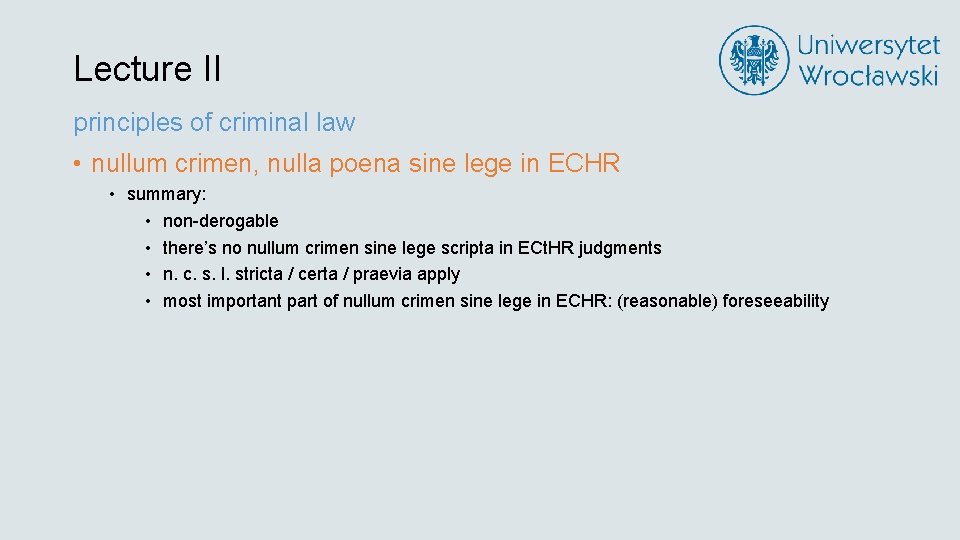
Lecture II principles of criminal law • nullum crimen, nulla poena sine lege in ECHR • summary: • non-derogable • there’s no nullum crimen sine lege scripta in ECt. HR judgments • n. c. s. l. stricta / certa / praevia apply • most important part of nullum crimen sine lege in ECHR: (reasonable) foreseeability
Lecture II principles of criminal law • nullum crimen sine lege in common law • = principle of legality • „being governed by rules which are fixed, knowable and certain” (A. Ashworth) • 3 sub-principles: • the principle of non-retroactivity • the principle of maximum certainty • the principle of strict construction of penal statutes
Lecture II principles of criminal law nullum crimen sine lege in common law • the principle of non-retroactivity • = nullum crimen sine lege praevia • a person should never be convicted or punished except in accordance with a previously declared offence governing the conduct in question • S. W. and C. R. v. United Kingdom: • „it is possible for the existing elements of an offence to be clarified or adapted to new circumstances or developments in society in so far as this can reasonably be brought under the original concept of the offence. The constituent elements of an offence may not however be essentially changed to the detriment of an accused any progressive development by way of interpretation must be reasonably foreseeable to him with the assistance of appropriate legal advice if necessary” • It is not that the law ought to exist before the conduct took place, but that it ought to have been foreseeable that the law would be changed in a particular direction
Lecture II principles of criminal law nullum crimen sine lege in common law • the principle of maximum certainty • • = nullum crimen sine lege certa „fair warning” and „void for vagueness” principles some vagueness is inevitable; it’s „maximum certainty”, not „absolute certainty” more general „quality of law” standard in ECHR – Sunday Times vs UK Case • „ 49. (…) Firstly, the law must be adequately accessible: the citizen must be able to have an indication that is adequate in the circumstances of the legal rules applicable to a given case. Secondly, a norm cannot be regarded as a "law" unless it is formulated with sufficient precision to enable the citizen to regulate his conduct: he must be able – if need be with appropriate advice – to foresee, to a degree that is reasonable in the circumstances, the consequences which a given action may entail”
Lecture II principles of criminal law nullum crimen sine lege in common law • the principle of maximum certainty • stems from respect for the citizen as a rational, autonomous individual and as a person with social and political duties who requires fair warning of the criminal law’s provisions and no undue difficulty in ascertaining them (A. Ashworth) • when the rules are vaguely drafted, they bestow considerable power on the agents of law enforcement
Lecture II principles of criminal law nullum crimen sine lege in common law • the principle of strict construction • = nullum crimen sine lege stricta • relates to the court’s task in interpreting legislation • reminder: construction = interpretation of law (statutes) • theoretical approach: any doubt in the meaning of a statutory provision should, by strict construction, be resolved in favour of the defendant
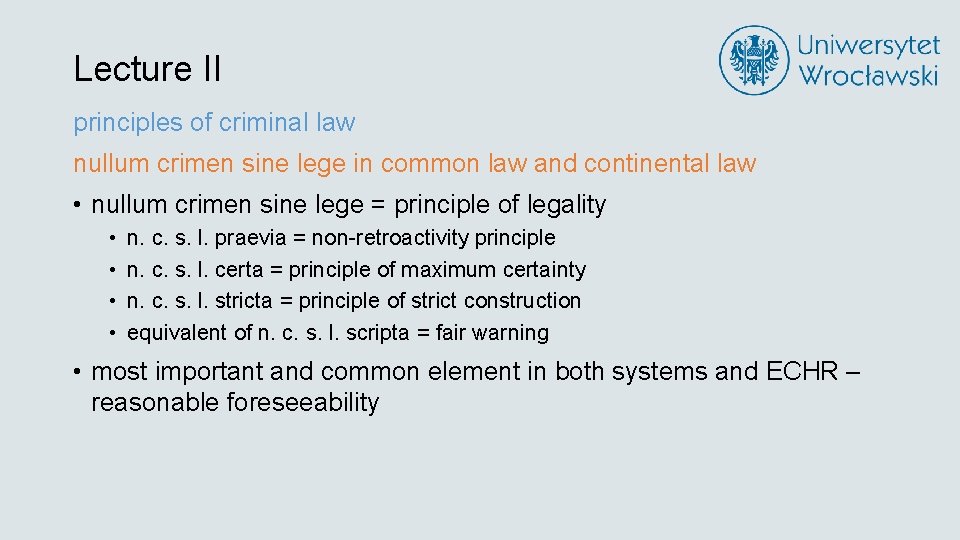
Lecture II principles of criminal law nullum crimen sine lege in common law and continental law • nullum crimen sine lege = principle of legality • • n. c. s. l. praevia = non-retroactivity principle n. c. s. l. certa = principle of maximum certainty n. c. s. l. stricta = principle of strict construction equivalent of n. c. s. l. scripta = fair warning • most important and common element in both systems and ECHR – reasonable foreseeability
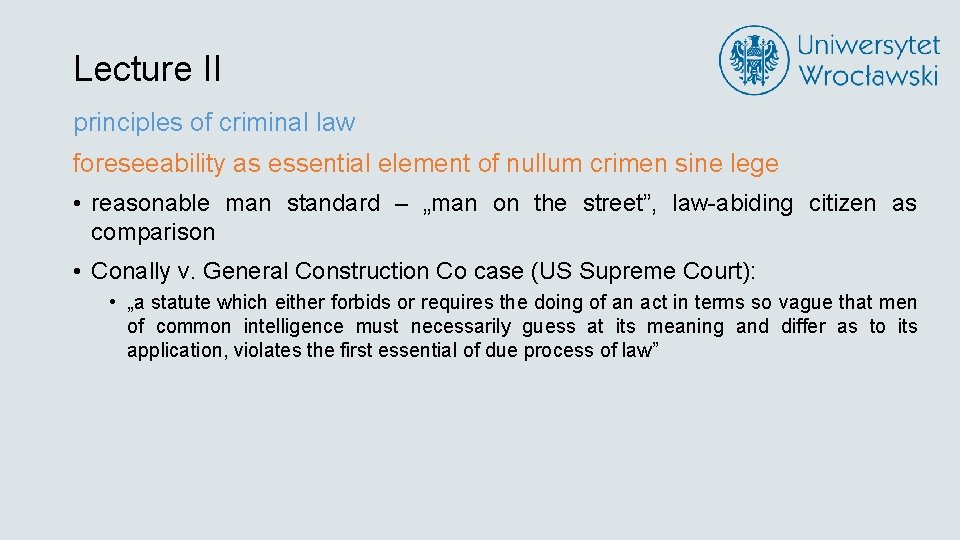
Lecture II principles of criminal law foreseeability as essential element of nullum crimen sine lege • reasonable man standard – „man on the street”, law-abiding citizen as comparison • Conally v. General Construction Co case (US Supreme Court): • „a statute which either forbids or requires the doing of an act in terms so vague that men of common intelligence must necessarily guess at its meaning and differ as to its application, violates the first essential of due process of law”
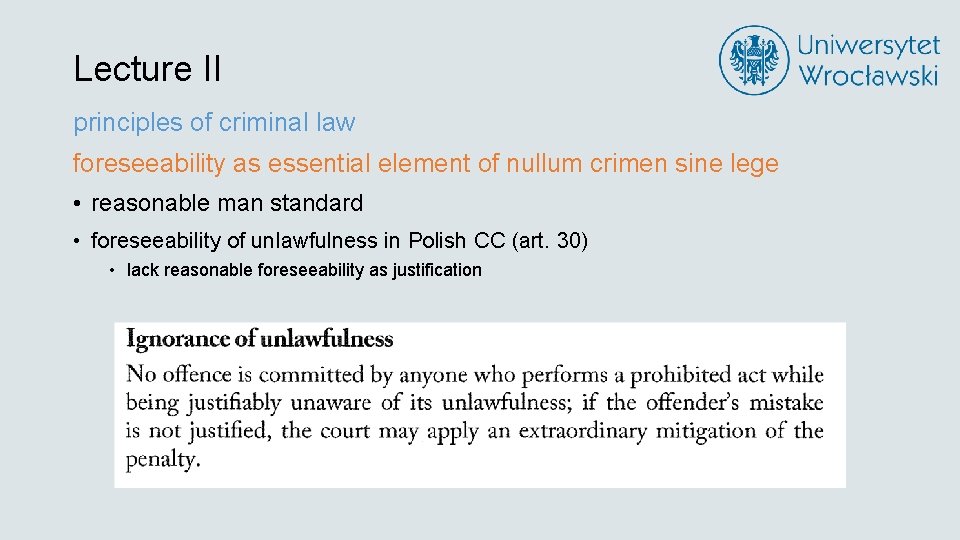
Lecture II principles of criminal law foreseeability as essential element of nullum crimen sine lege • reasonable man standard • foreseeability of unlawfulness in Polish CC (art. 30) • lack reasonable foreseeability as justification
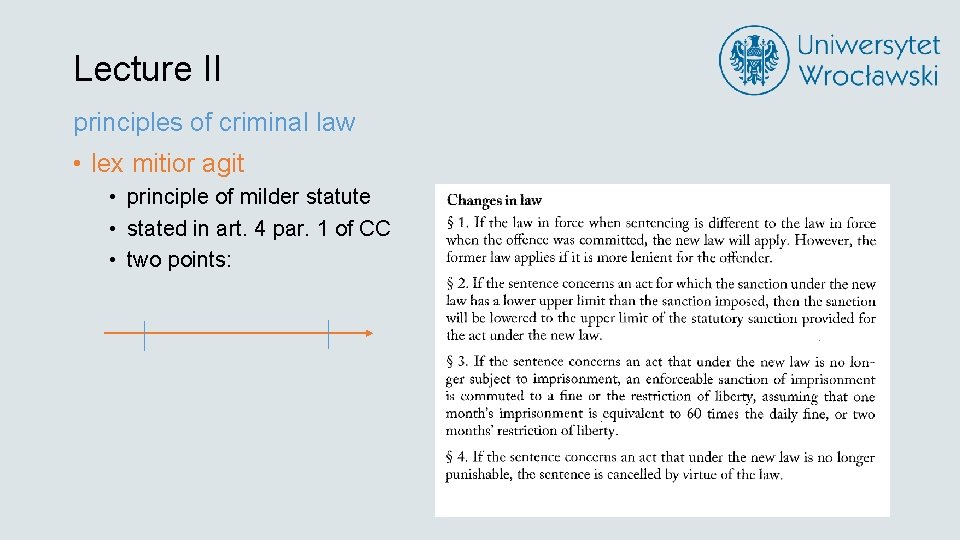
Lecture II principles of criminal law • lex mitior agit • principle of milder statute • stated in art. 4 par. 1 of CC • two points:
Lecture II principles of criminal law • lex retro non agit vs lex retro agit • lex retro non agit = nullum crimen sine lege praevia (art. 1 par. 1 CC) • lex retro agit = lex mitior agit (art. 4 par. 1 CC) • how can they coexist? • • lex mitior (retro) agit = lex severior retro non agit lex mitior concerns only previously prohibited offencs lex retro non agit concerns only ex post criminalization non-retroactivity of statutes constituting offences + retroactivity of milder statutes
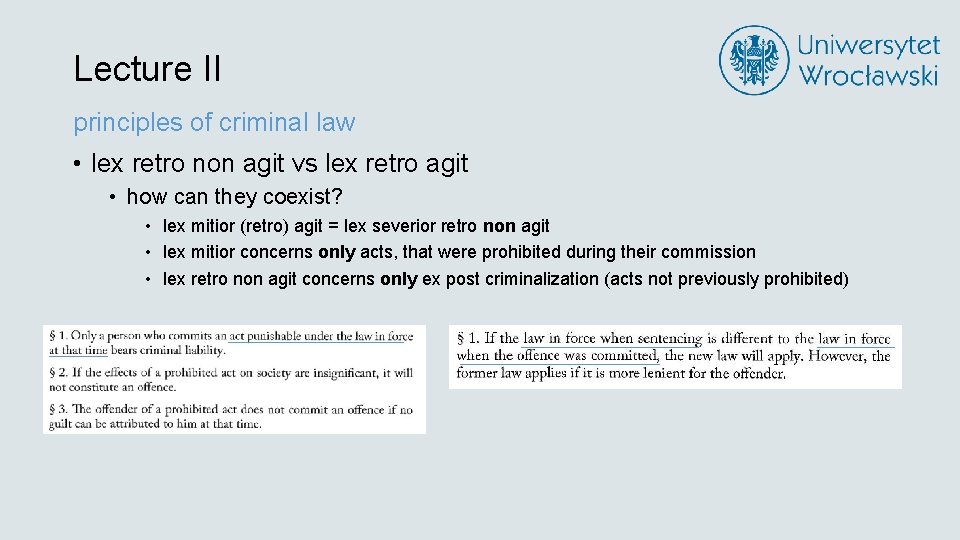
Lecture II principles of criminal law • lex retro non agit vs lex retro agit • how can they coexist? • lex mitior (retro) agit = lex severior retro non agit • lex mitior concerns only acts, that were prohibited during their commission • lex retro non agit concerns only ex post criminalization (acts not previously prohibited)
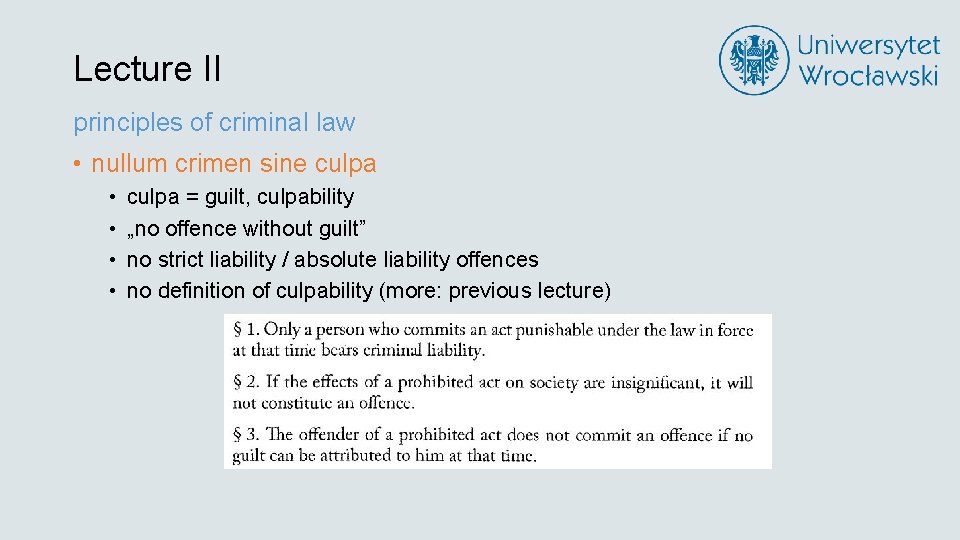
Lecture II principles of criminal law • nullum crimen sine culpa • • culpa = guilt, culpability „no offence without guilt” no strict liability / absolute liability offences no definition of culpability (more: previous lecture)
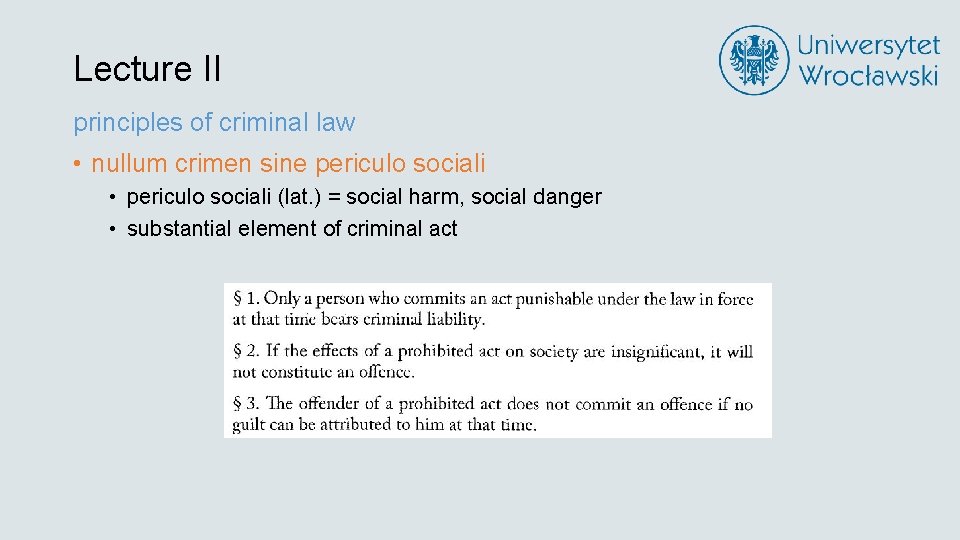
Lecture II principles of criminal law • nullum crimen sine periculo sociali • periculo sociali (lat. ) = social harm, social danger • substantial element of criminal act
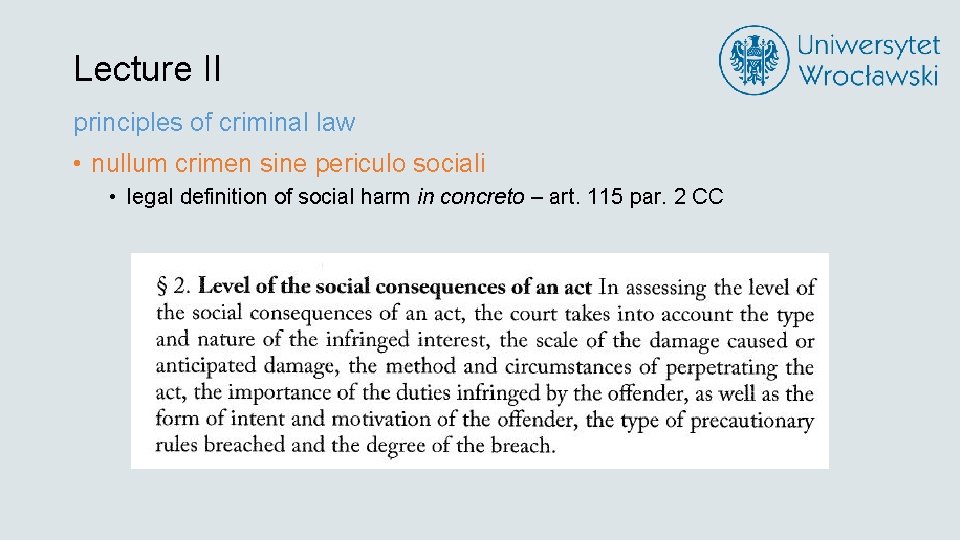
Lecture II principles of criminal law • nullum crimen sine periculo sociali • legal definition of social harm in concreto – art. 115 par. 2 CC
Lecture II principles of criminal law • nullum crimen sine periculo sociali • elements of social harm: • • • type and nature of infringed legal interest scale of the damage (done or possible) the method and circumstances of perpetrating the act importance of duties infringed by the offender form of intent and motivation type of precautionary rules breached by the perpetrator and the degree of the breach
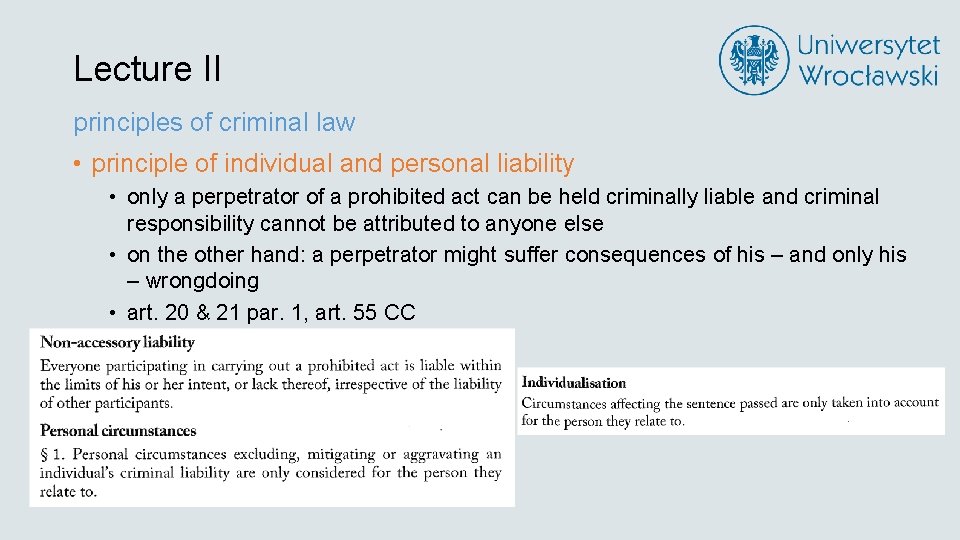
Lecture II principles of criminal law • principle of individual and personal liability • only a perpetrator of a prohibited act can be held criminally liable and criminal responsibility cannot be attributed to anyone else • on the other hand: a perpetrator might suffer consequences of his – and only his – wrongdoing • art. 20 & 21 par. 1, art. 55 CC
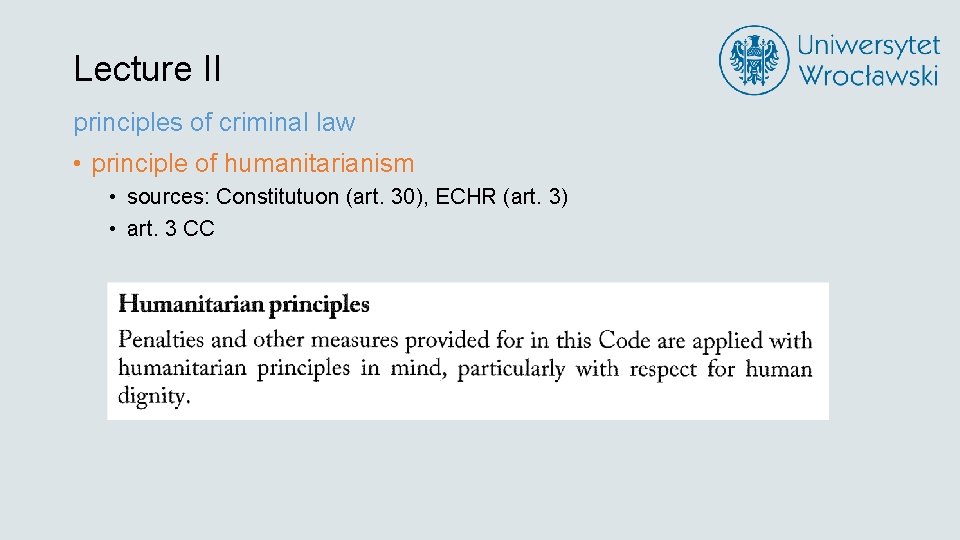
Lecture II principles of criminal law • principle of humanitarianism • sources: Constitutuon (art. 30), ECHR (art. 3) • art. 3 CC
Lecture II principles of criminal law • additional principle: ultima ratio • • principle of minimum criminalization criminal law as the last resort rather principle of criminalization than criminal law itself criminalization is justified only in order to protect individual autonomy or to protect social arrangements necessary to ensure that individuals have the capacity and facilities to exercise their autonomy • addressed to the legislator • legislator should consider possibility of tackling the problem firstly by other forms of regulation and control than criminal law
Thank you for your attention