INTERNATIONAL TRADE 1 2 3 4 Open economy





- Slides: 67
INTERNATIONAL TRADE 1. 2. 3. 4. Open economy. Forms of international economic relations. Theories of international trade. International trade policy.
1. Open economy. The national economic system is not closed to interaction with other national economic systems. Markets for goods and services, capital and labor, formed on supranational level, are the result of the interaction of the world demand, world prices and the world's supply, experiencing the merging cyclical fluctuations, operating in conditions of monopoly and competition.
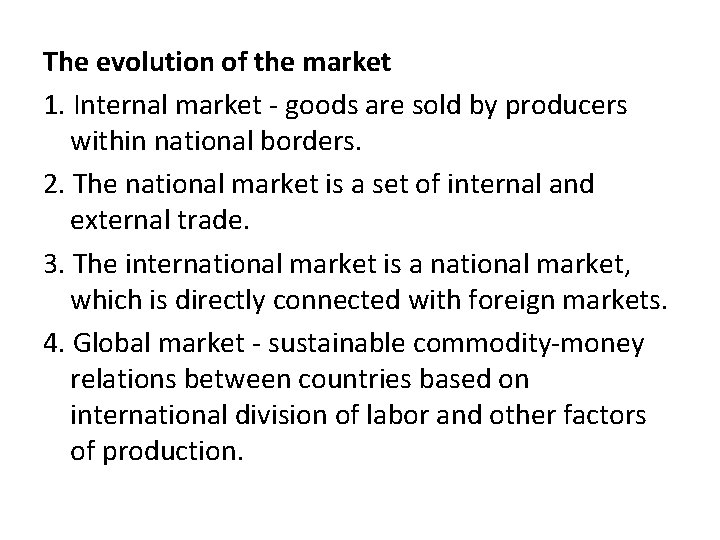
The evolution of the market 1. Internal market - goods are sold by producers within national borders. 2. The national market is a set of internal and external trade. 3. The international market is a national market, which is directly connected with foreign markets. 4. Global market - sustainable commodity-money relations between countries based on international division of labor and other factors of production.
Global market as a type of economic systems began when the development of productive factors and needs satisfaction could not be provided by national markets reserves. The crucial factors in its appearance were Great geographic discoveries (Columbus, Vasco da Gama, Magellan, etc. ) and growth of manufacturing.
Global market and world economy Global market — system of economic relations, characterized by the penetration of some countries into the economies of others through commodity circulation. The main example of the world market as an economic system is the export and import of goods. World economy — system of economic relations between countries, when the main link between them is not the goods & services exchange relations themselves, but the relations of production (international entrepreneurship). With the advent of the world economy, the export of goods is replaced by the export of factors of production and their international combination by entrepreneurs.
2. Forms of international economic relations • • • international trade in goods and services; capital flows and foreign investment; monetary and credit relations labor migration; exchange in the field of science and technology.
International trade is the main form of international economic relations, the aggregate foreign trade of all countries of the world. • Exports - sales of goods or services, which involves export them from the customs territory of the country. • Import - the purchase of goods or services and their import into the customs territory of the country, for their own consumption and/or sale on the domestic market. International trade consists of two counter-flows of goods export and import and is characterized by a trade balance and trade. • The trade turnover - the sum of exports and imports. • Trade balance - the difference between exports and imports. The ratio between the sum of the prices of goods exported to a certain country or group of countries, and the sum of the prices of the goods imported by them for a certain period.
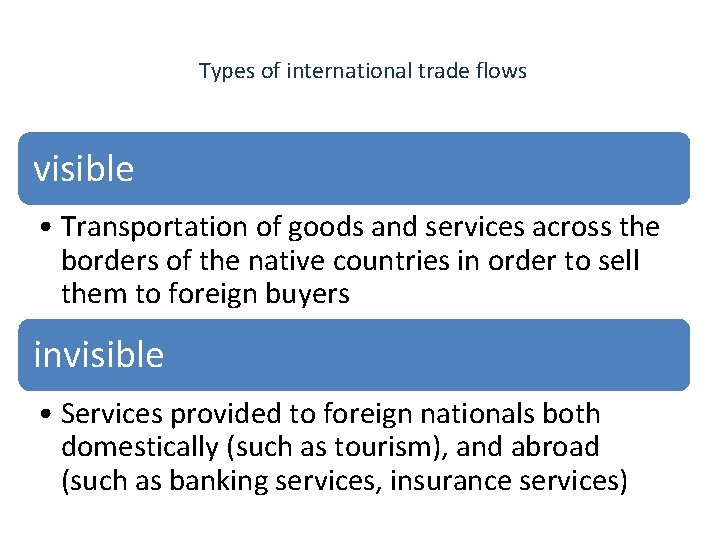
Types of international trade flows visible • Transportation of goods and services across the borders of the native countries in order to sell them to foreign buyers invisible • Services provided to foreign nationals both domestically (such as tourism), and abroad (such as banking services, insurance services)
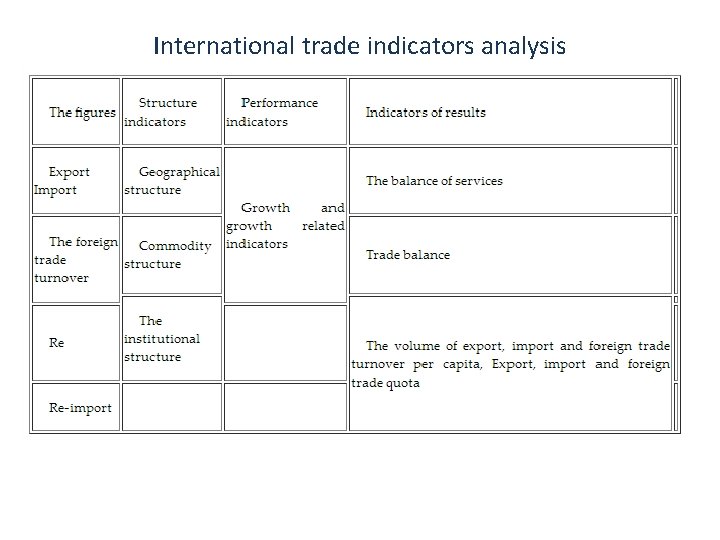
International trade indicators analysis
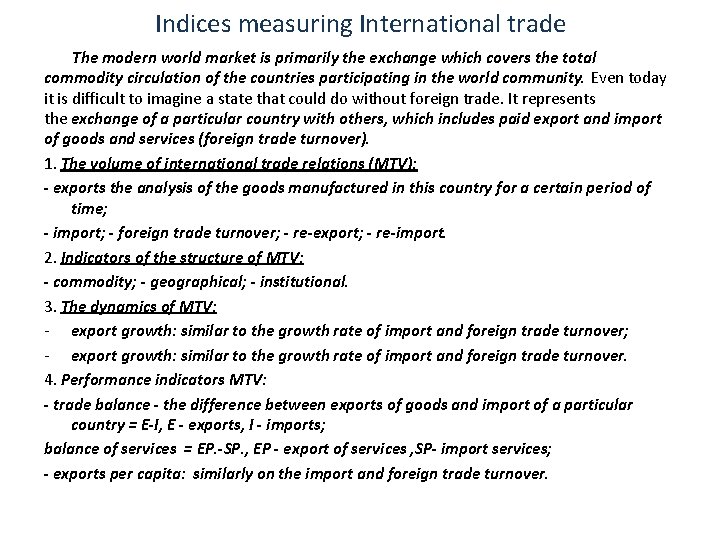
Indices measuring International trade The modern world market is primarily the exchange which covers the total commodity circulation of the countries participating in the world community. Even today it is difficult to imagine a state that could do without foreign trade. It represents the exchange of a particular country with others, which includes paid export and import of goods and services (foreign trade turnover). 1. The volume of international trade relations (MTV): - exports the analysis of the goods manufactured in this country for a certain period of time; - import; - foreign trade turnover; - re-export; - re-import. 2. Indicators of the structure of MTV: - commodity; - geographical; - institutional. 3. The dynamics of MTV: - export growth: similar to the growth rate of import and foreign trade turnover; - export growth: similar to the growth rate of import and foreign trade turnover. 4. Performance indicators MTV: - trade balance - the difference between exports of goods and import of a particular country = E-I, E - exports, I - imports; balance of services = EP. -SP. , EP - export of services , SP- import services; - exports per capita: similarly on the import and foreign trade turnover.
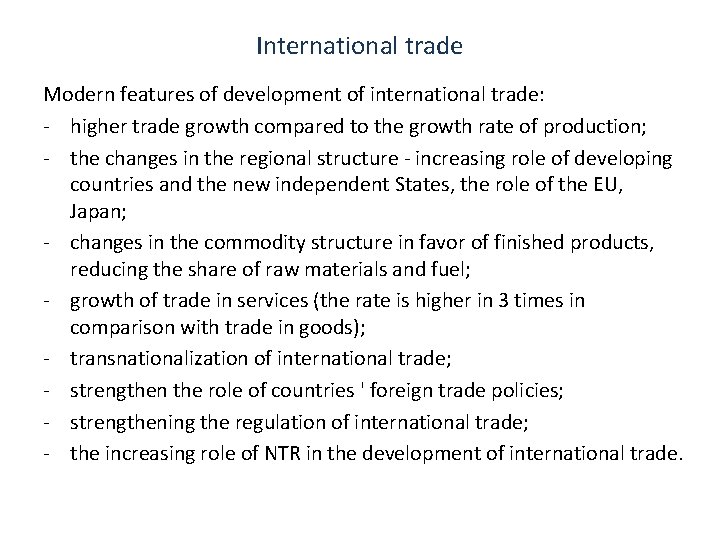
International trade Modern features of development of international trade: - higher trade growth compared to the growth rate of production; - the changes in the regional structure - increasing role of developing countries and the new independent States, the role of the EU, Japan; - changes in the commodity structure in favor of finished products, reducing the share of raw materials and fuel; - growth of trade in services (the rate is higher in 3 times in comparison with trade in goods); - transnationalization of international trade; - strengthen the role of countries ' foreign trade policies; - strengthening the regulation of international trade; - the increasing role of NTR in the development of international trade.
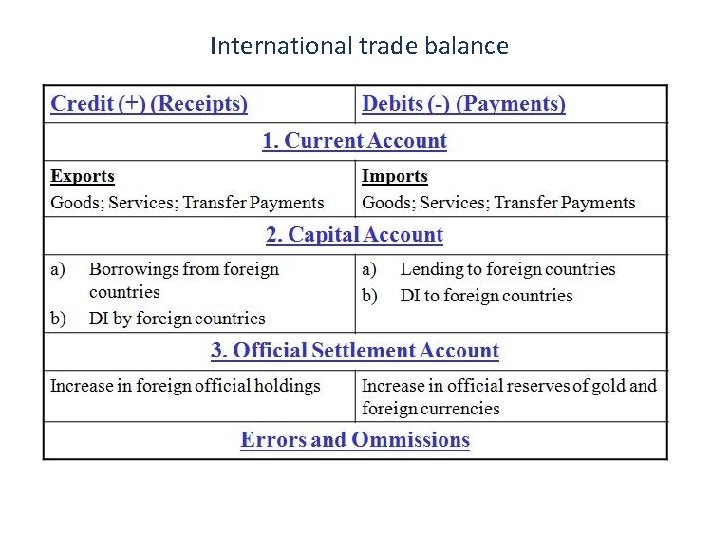
International trade balance
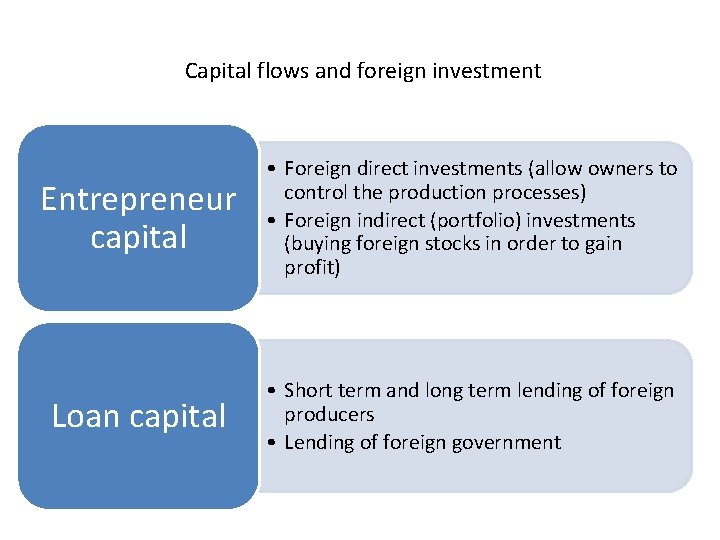
Capital flows and foreign investment Entrepreneur capital • Foreign direct investments (allow owners to control the production processes) • Foreign indirect (portfolio) investments (buying foreign stocks in order to gain profit) Loan capital • Short term and long term lending of foreign producers • Lending of foreign government
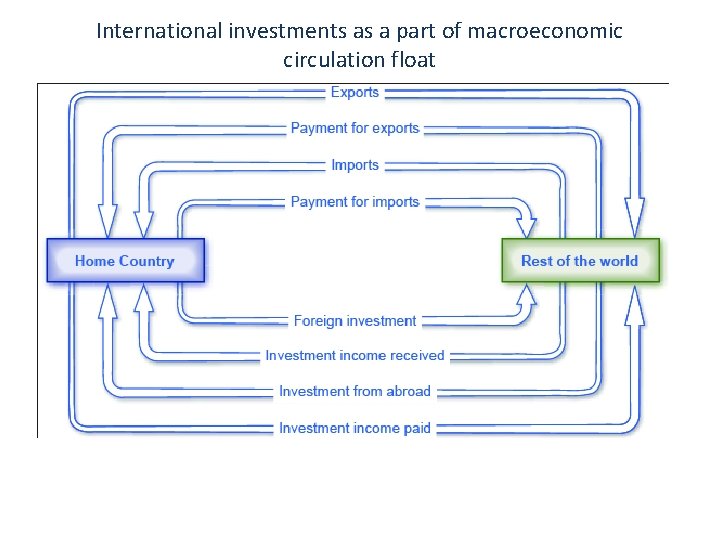
International investments as a part of macroeconomic circulation float
Labor migration
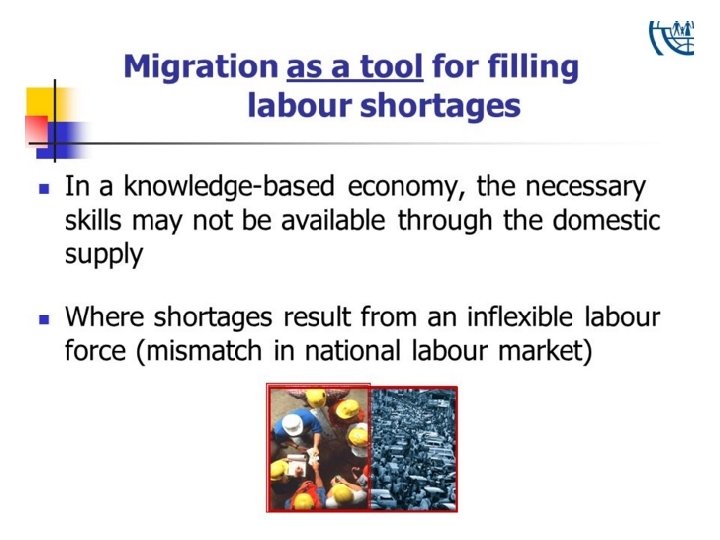
Labor migration Is a process of hiring working stuff from foreign countries. Advantages: - cover the shortage in skilled workers for raising economies; - push the technologic innovations Disadvantages: - stealing jobs of nationals - raising spending of donor countries which loose young and educated residents (decrease of national human capital) - Unregistered immigration leads to falls in national income and also in GDP
Labor migration
Labor migration
Labor migration
Forms of international entrepreneurship • 1. contract – joints of individuals and firms of different countries in order to realize some business or scientific project (such as franchising, outsourcing). • 2. joint capital – firms based on multinational ownership
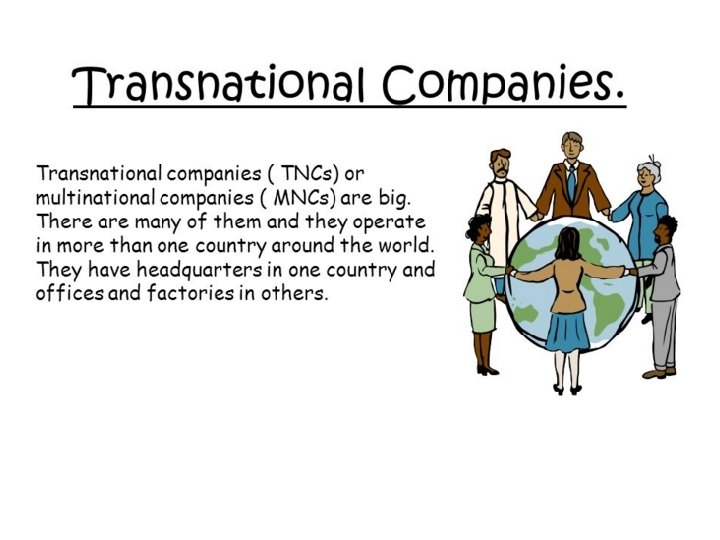
International firms
Exchange in the field of science and technology • Exchange with scientific information in order to avoid duplication of research topics • Exchange between scientists and high-skilled specialists • Transfer of technologies, inventories and knowhows on a paid basis (patents, licenses), • Joint scientific and technologic research in order to solve global problems and to concentrate funds • Joint firms to produce innovative goods and services
The main types of interstate economic cooperation 1. Interstate trade associations and alliances – long-term unions of countries for regulation of international trade, prevention of trade conflicts and getting interstate relations fair and well-ordered (World Trade Organization (WTO)). 2. Regional trade alliances – unions of neighbor countries in order to stimulate economic growth of the region (Commonwealth of Independent States, European Union, Common Market of Africa, etc. ) 3. Supranational political organizations – the political authorities created by many countries all over the world for solving global problems such as terrorism, crime, genocide and forming harmonious and mutually beneficial coexistence on the Earth planet (e. g. United Nations, Interpol, etc. ) 4. Supranational economic organizations – the economic institutions which try to solve some specific economic problems mostly in financial market (World Bank, International Monetary Fund, etc. )
3. Theories of international trade 1. Mercantilism (XVI – mid. XVIII); 2. Theory of Absolute Advantage and Comparative Advantage (mid. XVIII - ХIХ); 3. Theory of factors endowments (beg. ХХ); 4. Product Life-Cycle Theory (end. ХХ); 5. New Trade Theory 6. Porter’s Diamond Theory
An Overview of Trade Theory • Free Trade occurs when a government does not attempt to influence, through quotas or duties, what its citizens can buy from another country or what they can produce and sell to another country. • The Benefits of Trade allow a country to specialize in the manufacture and export of products that can be produced most efficiently in that country. • The Pattern of International Trade displays patterns that are easy to understand (Saudi Arabia/oil or Mexico/labor intensive goods). Others are not so easy to understand (Japan and cars). © Mc. Graw Hill Companies, Inc. , 2000
Mercantilism: mid-16 th century • A nation’s wealth depends on accumulated treasure • Gold and silver are the currency of trade. • Theory says you should have a trade surplus. – Maximize exports through subsidies. – Minimize imports through tariffs and quotas. • Flaw: “Zero-sum game”. © Mc. Graw Hill Companies, Inc. , 2000
Theory of Absolute Advantage • Adam Smith: Wealth of Nations (1776). • Capability of one country to produce more of a product with the same amount of input than another country. • Produce only goods where you are most efficient, trade for those where you are not efficient. – Trade between countries is, therefore, beneficial. • Assumes there is an absolute advantage balance among nations. • Ghana/cocoa. © Mc. Graw Hill Companies, Inc. , 2000
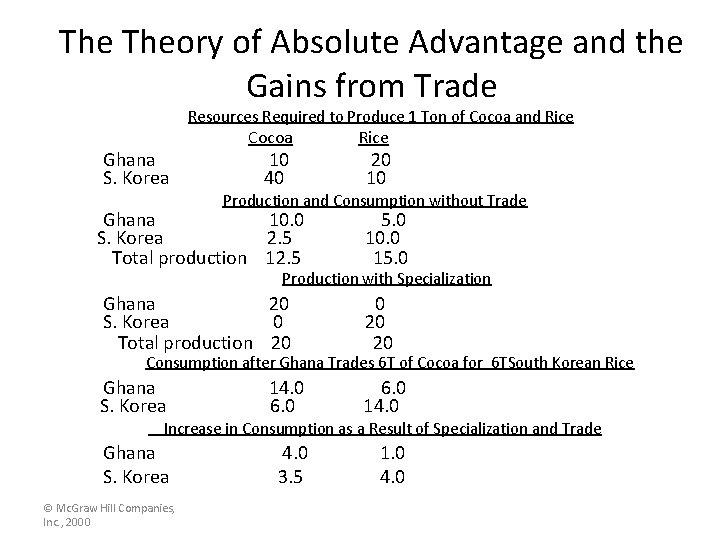
The Theory of Absolute Advantage and the Gains from Trade Resources Required to Produce 1 Ton of Cocoa and Rice Cocoa Rice Ghana 10 20 S. Korea 40 10 Production and Consumption without Trade Ghana 10. 0 5. 0 S. Korea 2. 5 10. 0 Total production 12. 5 15. 0 Production with Specialization Ghana 20 0 S. Korea 0 20 Total production 20 Consumption after Ghana Trades 6 T of Cocoa for 6 TSouth Korean Rice Ghana 14. 0 6. 0 S. Korea 6. 0 14. 0 Increase in Consumption as a Result of Specialization and Trade Ghana 4. 0 1. 0 S. Korea 3. 5 4. 0 © Mc. Graw Hill Companies, Inc. , 2000
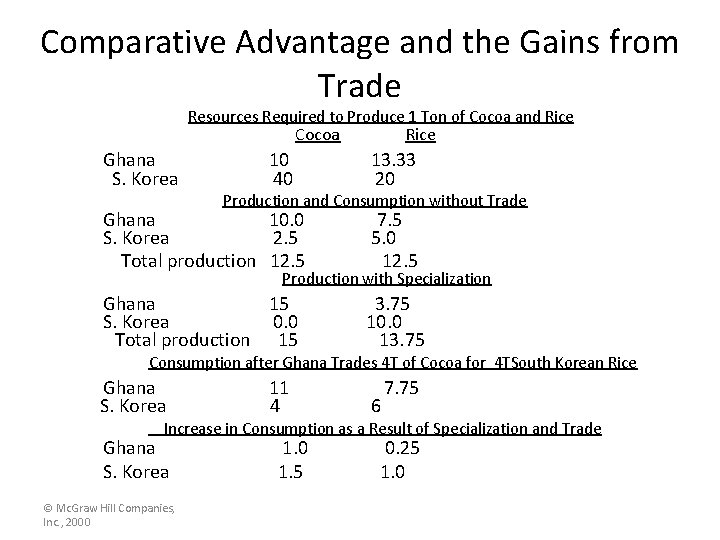
Theory of Comparative Advantage • David Ricardo: Principles of Political Economy (1817). – Extends free trade argument – Efficiency of resource utilization leads to more productivity. – Should import even if country is more efficient in the product’s production than country from which it is buying. • Look to see how much more efficient. If only comparatively efficient, than import. • Makes better use of resources • Trade is a positive-sum game. © Mc. Graw Hill Companies, Inc. , 2000
Comparative Advantage and the Gains from Trade Resources Required to Produce 1 Ton of Cocoa and Rice Cocoa Rice Ghana 10 13. 33 S. Korea 40 20 Production and Consumption without Trade Ghana 10. 0 7. 5 S. Korea 2. 5 5. 0 Total production 12. 5 Production with Specialization Ghana 15 3. 75 S. Korea 0. 0 10. 0 Total production 15 13. 75 Consumption after Ghana Trades 4 T of Cocoa for 4 TSouth Korean Rice Ghana 11 7. 75 S. Korea 4 6 Increase in Consumption as a Result of Specialization and Trade Ghana 1. 0 0. 25 S. Korea 1. 5 1. 0 © Mc. Graw Hill Companies, Inc. , 2000
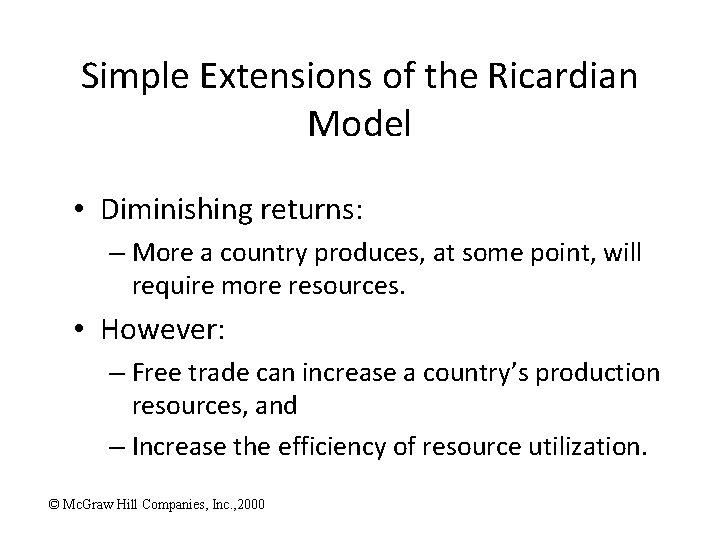
Simple Extensions of the Ricardian Model • Diminishing returns: – More a country produces, at some point, will require more resources. • However: – Free trade can increase a country’s production resources, and – Increase the efficiency of resource utilization. © Mc. Graw Hill Companies, Inc. , 2000
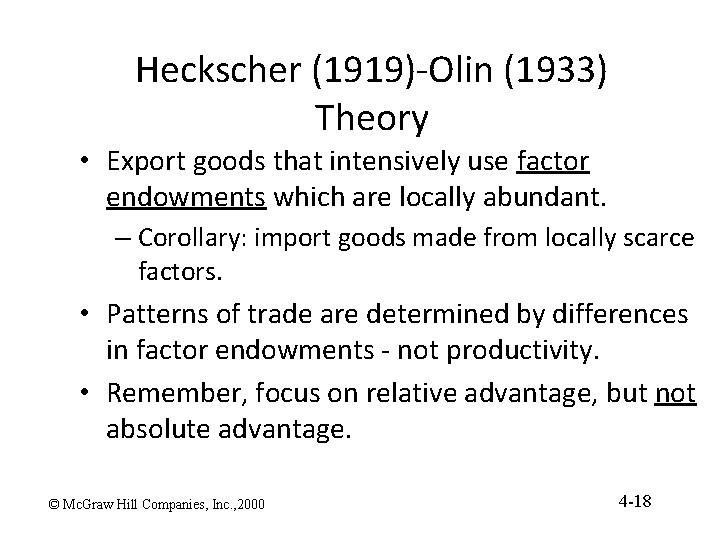
Heckscher (1919)-Olin (1933) Theory • Export goods that intensively use factor endowments which are locally abundant. – Corollary: import goods made from locally scarce factors. • Patterns of trade are determined by differences in factor endowments - not productivity. • Remember, focus on relative advantage, but not absolute advantage. © Mc. Graw Hill Companies, Inc. , 2000 4 -18
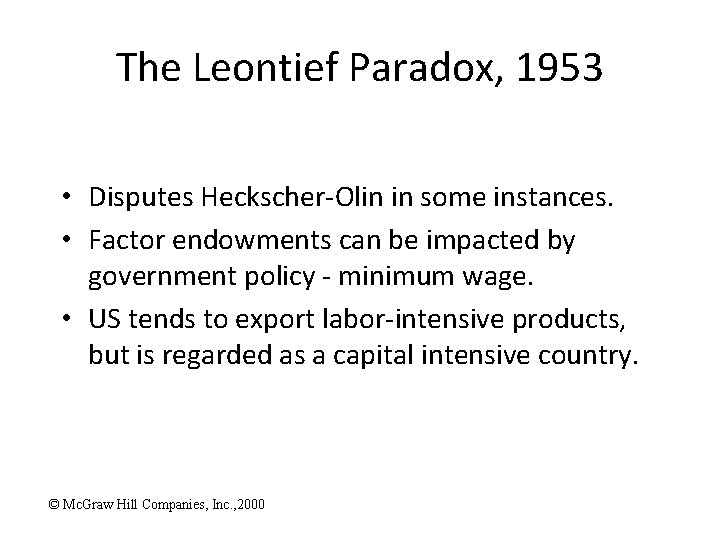
The Leontief Paradox, 1953 • Disputes Heckscher-Olin in some instances. • Factor endowments can be impacted by government policy - minimum wage. • US tends to export labor-intensive products, but is regarded as a capital intensive country. © Mc. Graw Hill Companies, Inc. , 2000
Heckscher vs Ricardo • Economists prefer Heckscher on theoretical grounds but is a relatively poor predictor of trade patterns. • Ricardo’s Comparative Advantage Theory, regarded as too limited for predicting trade patterns, actually predicts them with greater accuracy. • In the end, differences in productivity may be the key to determining trade patterns. © Mc. Graw Hill Companies, Inc. , 2000
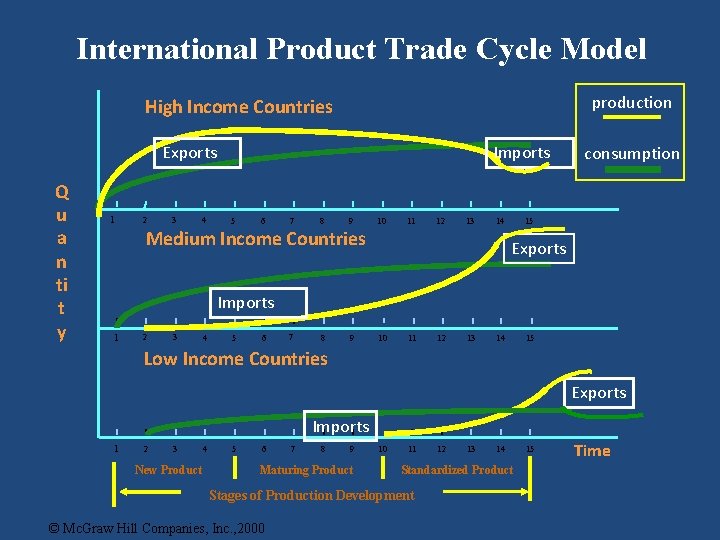
Product Life-Cycle Theory (Raymond Vernon, 1966) • As products mature, both location of sales and optimal production changes. • Affects the direction and flow of imports and exports. • Globalization and integration of the economy makes this theory less valid. © Mc. Graw Hill Companies, Inc. , 2000
International Product Trade Cycle Model production High Income Countries Exports Q u a n ti t y 1 2 3 4 Imports 5 6 7 8 9 10 11 12 13 14 Medium Income Countries consumption 15 Exports Imports 1 2 3 4 5 6 7 8 9 10 11 12 13 14 15 Low Income Countries Exports Imports 1 2 3 New Product 4 5 6 7 8 9 Maturing Product 10 11 13 14 Standardized Product Stages of Production Development © Mc. Graw Hill Companies, Inc. , 2000 12 15 Time
The New Trade Theory • Began to be recognized in the 1970 s. • Deals with the returns on specialization where substantial economies of scale are present. – Specialization increases output, ability to enhance economies of scale increase. © Mc. Graw Hill Companies, Inc. , 2000
Application of the New Trade Theory • Typically, requires industries with high, fixed costs. • World demand will support few competitors. • Competitors may emerge because “they got there first”. – first-mover advantage. • Some argue that it generates government intervention and strategic trade policy. © Mc. Graw Hill Companies, Inc. , 2000
First-Mover Advantage • Economies of scale may preclude new entrants. • Role of the government. © Mc. Graw Hill Companies, Inc. , 2000
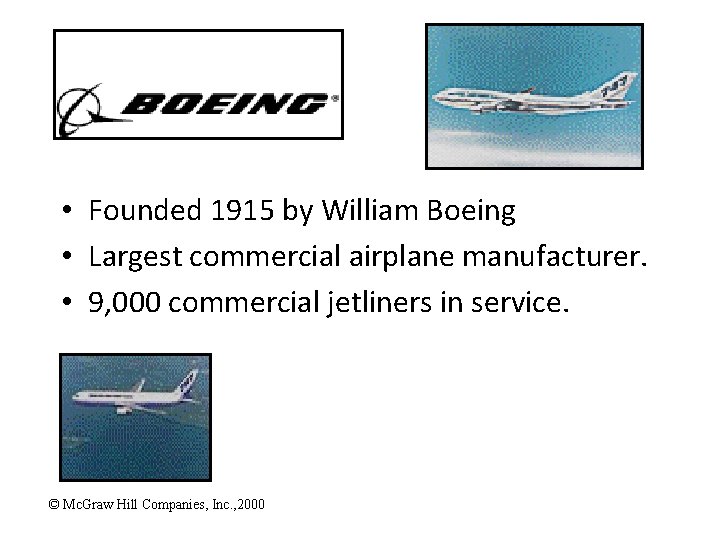
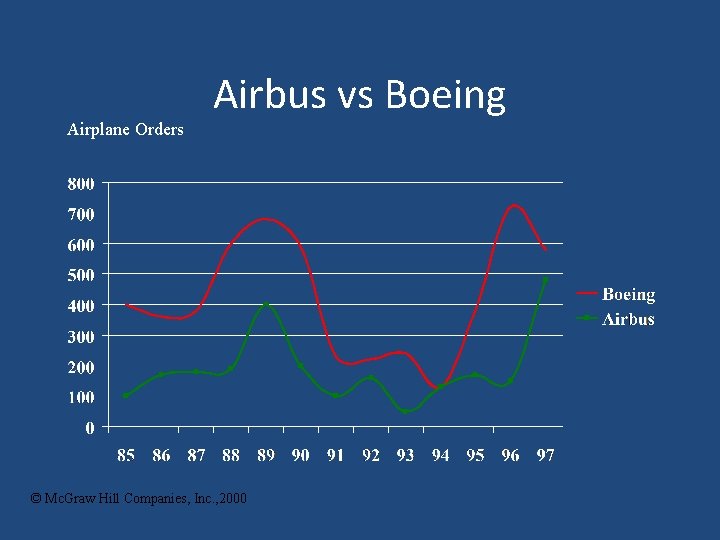
• Founded 1915 by William Boeing • Largest commercial airplane manufacturer. • 9, 000 commercial jetliners in service. © Mc. Graw Hill Companies, Inc. , 2000
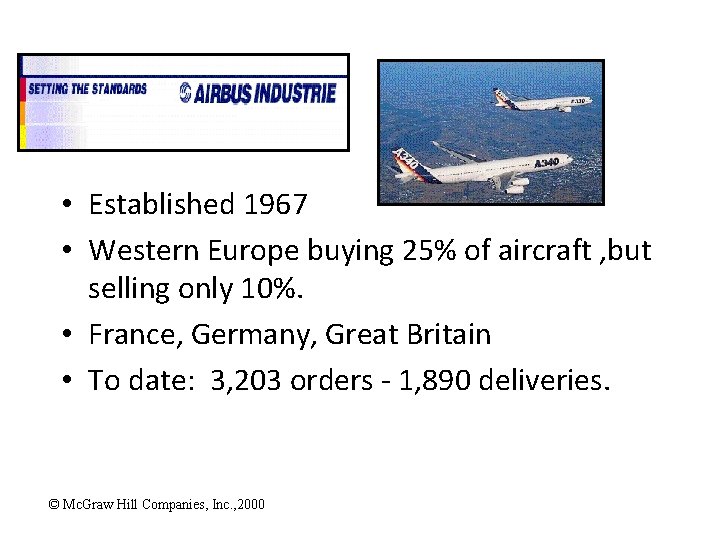
• Established 1967 • Western Europe buying 25% of aircraft , but selling only 10%. • France, Germany, Great Britain • To date: 3, 203 orders - 1, 890 deliveries. © Mc. Graw Hill Companies, Inc. , 2000
Airplane Orders Airbus vs Boeing © Mc. Graw Hill Companies, Inc. , 2000
Porter’s Diamond (Harvard Business School, 1990) • The Competitive Advantage of Nations. • Looked at 100 industries in 10 nations. – Thought existing theories didn’t go far enough. • Question: “Why does a nation achieve international success in a particular industry? ” © Mc. Graw Hill Companies, Inc. , 2000
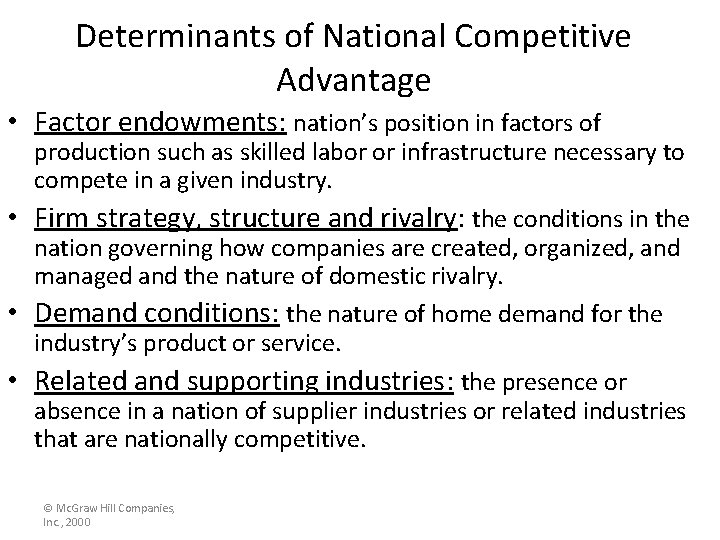
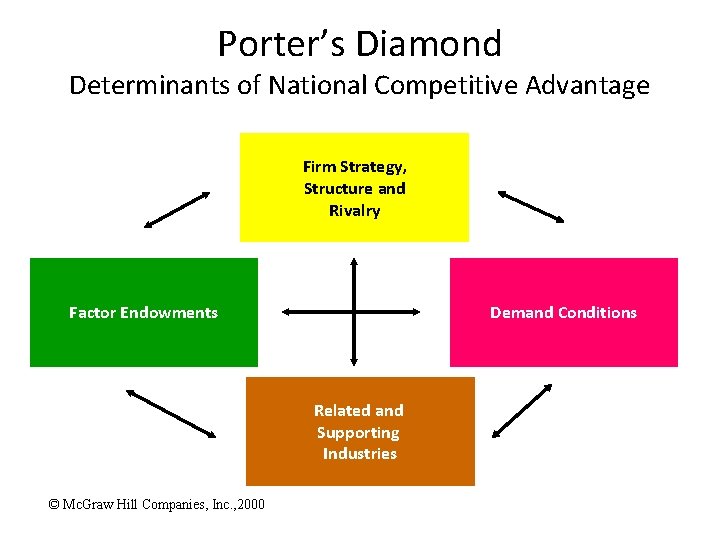
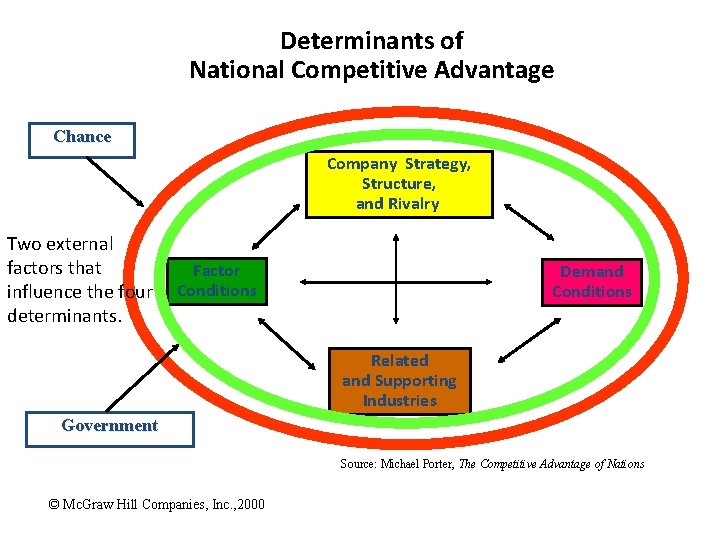
Determinants of National Competitive Advantage • Factor endowments: nation’s position in factors of production such as skilled labor or infrastructure necessary to compete in a given industry. • Firm strategy, structure and rivalry: the conditions in the nation governing how companies are created, organized, and managed and the nature of domestic rivalry. • Demand conditions: the nature of home demand for the industry’s product or service. • Related and supporting industries: the presence or absence in a nation of supplier industries or related industries that are nationally competitive. © Mc. Graw Hill Companies, Inc. , 2000
Porter’s Diamond Determinants of National Competitive Advantage Firm Strategy, Structure and Rivalry Factor Endowments Demand Conditions Related and Supporting Industries © Mc. Graw Hill Companies, Inc. , 2000
The Diamond • Success occurs where these attributes exist. – More/greater the attribute, the higher chance of success. • The diamond is mutually reinforcing. © Mc. Graw Hill Companies, Inc. , 2000
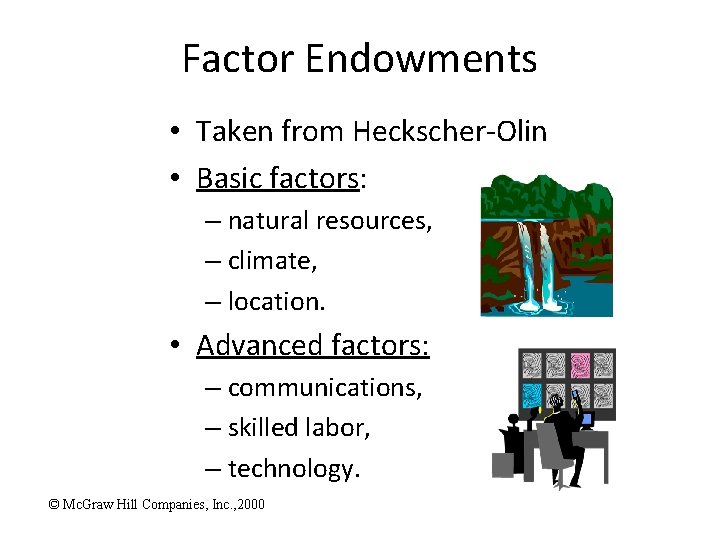
Factor Endowments • Taken from Heckscher-Olin • Basic factors: – natural resources, – climate, – location. • Advanced factors: – communications, – skilled labor, – technology. © Mc. Graw Hill Companies, Inc. , 2000
Advanced Factor Endowments • More likely to lead to competitive advantage. • Are the result of investment by people, companies, government. © Mc. Graw Hill Companies, Inc. , 2000
Relationship of Basic to Advanced Factors • Basic can provide an initial advantage. • Must be supported by advanced factors to maintain success. • No basics, then must invest in advanced factors. © Mc. Graw Hill Companies, Inc. , 2000
Demand Conditions • Demand creates the capabilities. • Look for sophisticated and demanding consumers. • impacts quality and innovation. © Mc. Graw Hill Companies, Inc. , 2000
Related and Supporting Industries • Creates clusters of supporting industries that are internationally competitive. • Must also meet requirements of other parts of the Diamond. © Mc. Graw Hill Companies, Inc. , 2000
Firm Strategy, Structure and Rivalry • Management ‘ideology’ can either help or hurt you. • Presence of domestic rivalry improves a company’s competitiveness. © Mc. Graw Hill Companies, Inc. , 2000
Evaluating Porter’s Theory • If Porter is right, country exports should reflect the presence of the four ‘diamond’ components. Countries will import goods from industries where some or all the components are missing. • The evidences are in future. ade World Tr © Mc. Graw Hill Companies, Inc. , 2000
Determinants of National Competitive Advantage Chance Company Strategy, Structure, and Rivalry Two external factors that Factor influence the four Conditions determinants. Demand Conditions Related and Supporting Industries Government Source: Michael Porter, The Competitive Advantage of Nations © Mc. Graw Hill Companies, Inc. , 2000
Porter’s diamond, but. . . • ‘Double Diamond’ - look to attributes of both countries. – Professor Alan Rugman, University of Toronto • Home country may ‘sound’ good, but – Company can rely on the host country. – Neighboring countries can too. – Canada and the U. S. © Mc. Graw Hill Companies, Inc. , 2000
Implications for Business • Location implications: makes sense to disperse production activities to countries where they can be performed most efficiently. • First-mover implications: It pays to invest substantial financial resources in building a firstmover, or early-mover, advantage. • Policy implications: promoting free trade is generally in the best interests of the home-country, although not always in the best interests of the firm. Even though, many firms promote open markets. © Mc. Graw Hill Companies, Inc. , 2000
What is a trade agreement? • A special agreed upon preferential arrangement among a group of nations governing their trade/economic relationship: • • Trade: Tariffs and other trade barriers Trade Policies: Trade with other countries Factor movements: Labor and capital mobility Economic policies: Monetary and fiscal policies
Types/Levels of Agreements • Preferential trade arrangements: Reduction of intra-group tariffs • Free trade area: Removal of intra-group tariffs • Customs Union: Common external tariffs • Common Market: Free factor mobility and service trade, fixed exchange rate • Economic Union: Common/coordinated economic policies and common currency • Regional agreement
Measuring Trade Flows • A relative measure: World Trade Share • Regional share of trade relative to the total share • Share of the trade block relative to the world trade • Trade Concentration ratio • Of the trade block
The welfare implications of trade/economic pacts: Trade creation and trade diversion • Trade creation: The lowering or removal of tariffs within a group of nations could result in an increase in the mount of trade among members. • Trade diversion: The lowering or removal of tariffs and other barriers within a group of nations could divert trade from (more efficient) non-members to (less efficient) members.
4. Foreign trade policy of the government Every government tries to do all their best to lead the national economic system to the prosperity and plentitude. The part of all state economic policy is the foreign trade policy. It includes the regulation of foreign sellers, investor and buyers access to the internal market by creation of laws, executive stuff and rules of activities
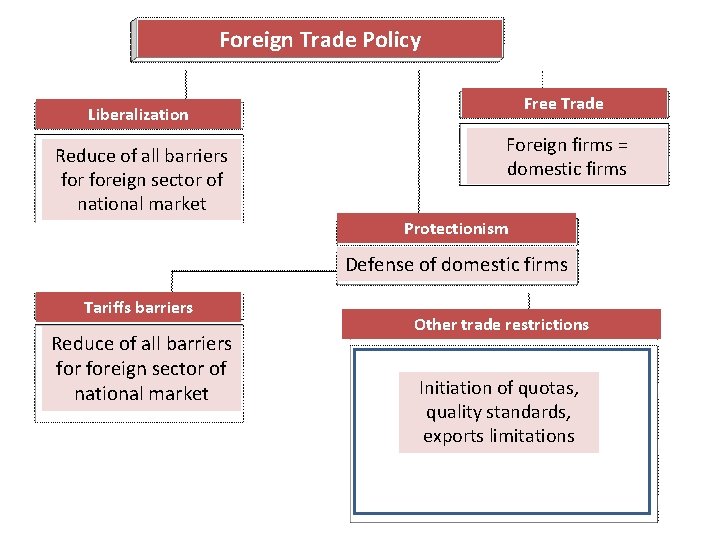
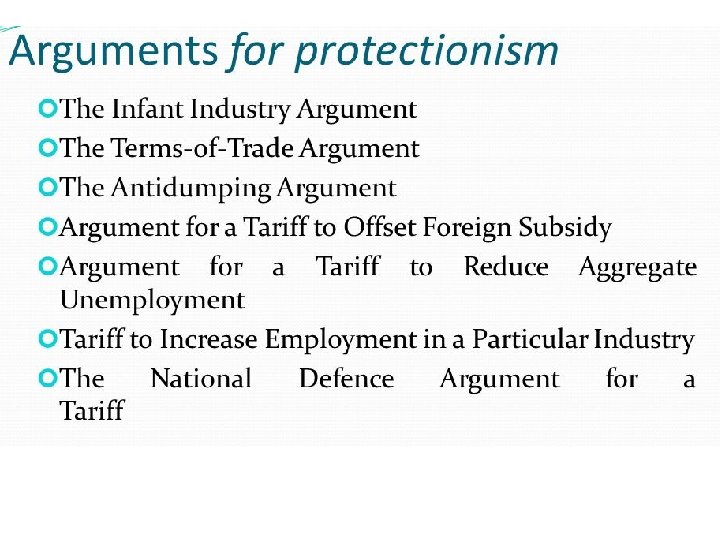
Foreign Trade Policy Free Trade Liberalization Reduce of all barriers foreign sector of national market Foreign firms = domestic firms Protectionism Defense of domestic firms Tariffs barriers Reduce of all barriers foreign sector of national market Other trade restrictions Initiation of quotas, quality standards, exports limitations
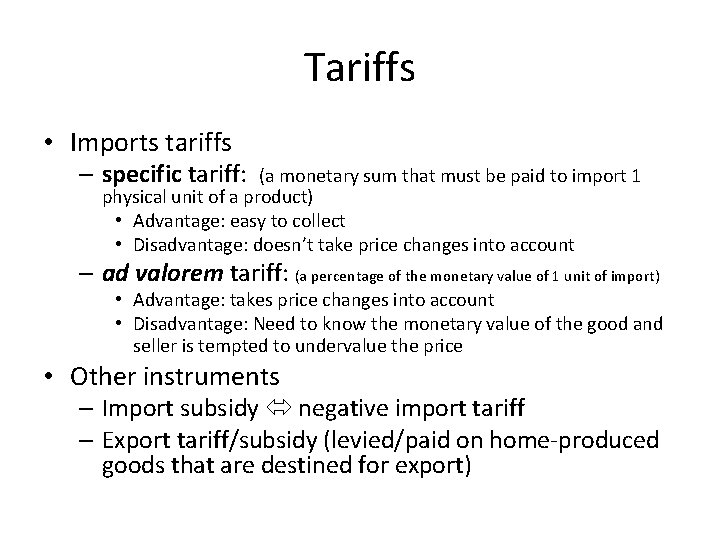
Tariffs • Imports tariffs – specific tariff: (a monetary sum that must be paid to import 1 physical unit of a product) • Advantage: easy to collect • Disadvantage: doesn’t take price changes into account – ad valorem tariff: (a percentage of the monetary value of 1 unit of import) • Advantage: takes price changes into account • Disadvantage: Need to know the monetary value of the good and seller is tempted to undervalue the price • Other instruments – Import subsidy negative import tariff – Export tariff/subsidy (levied/paid on home-produced goods that are destined for export)
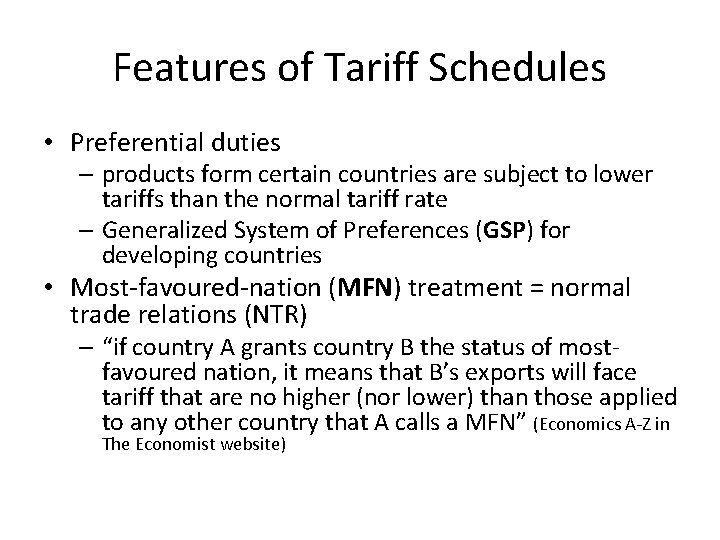
Features of Tariff Schedules • Preferential duties – products form certain countries are subject to lower tariffs than the normal tariff rate – Generalized System of Preferences (GSP) for developing countries • Most-favoured-nation (MFN) treatment = normal trade relations (NTR) – “if country A grants country B the status of mostfavoured nation, it means that B’s exports will face tariff that are no higher (nor lower) than those applied to any other country that A calls a MFN” (Economics A-Z in The Economist website)
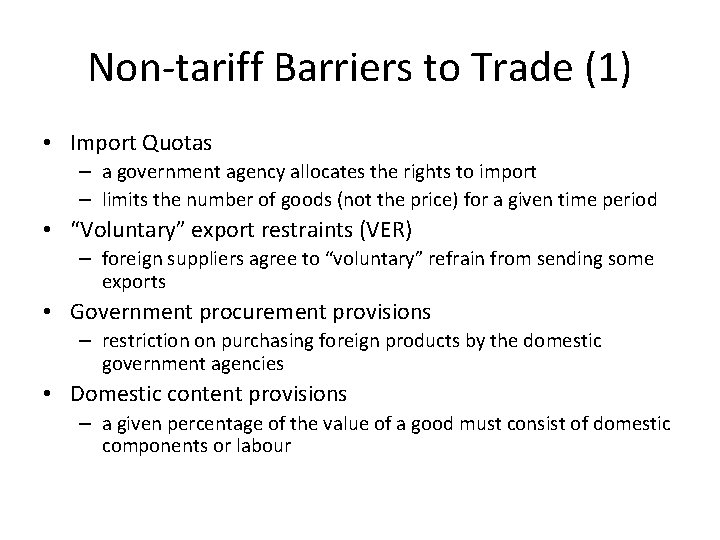
Non-tariff Barriers to Trade (1) • Import Quotas – a government agency allocates the rights to import – limits the number of goods (not the price) for a given time period • “Voluntary” export restraints (VER) – foreign suppliers agree to “voluntary” refrain from sending some exports • Government procurement provisions – restriction on purchasing foreign products by the domestic government agencies • Domestic content provisions – a given percentage of the value of a good must consist of domestic components or labour
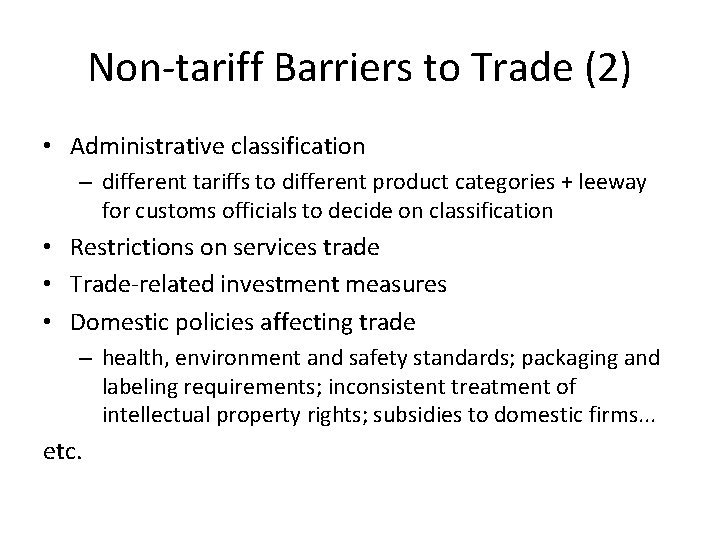
Non-tariff Barriers to Trade (2) • Administrative classification – different tariffs to different product categories + leeway for customs officials to decide on classification • Restrictions on services trade • Trade-related investment measures • Domestic policies affecting trade – health, environment and safety standards; packaging and labeling requirements; inconsistent treatment of intellectual property rights; subsidies to domestic firms. . . etc.