Chapter 7 Governmental Influence on Trade 6 1

- Slides: 26
Chapter 7 Governmental Influence on Trade 6 -1
Learning Objectives p p Explain why governments try to enhance and restrict trade Show the effects of pressure groups on trade policies Compare the potential and actual effects of government intervention on the free flow of trade Illustrate the major means by which trade is restricted and regulated 6 -2
Learning Objectives Demonstrate the business uncertainties and opportunities created by governmental trade policies p Discern how businesses may respond to import competition p Fathom how the growing complexity of products and trade regulations may affect the future p 6 -3
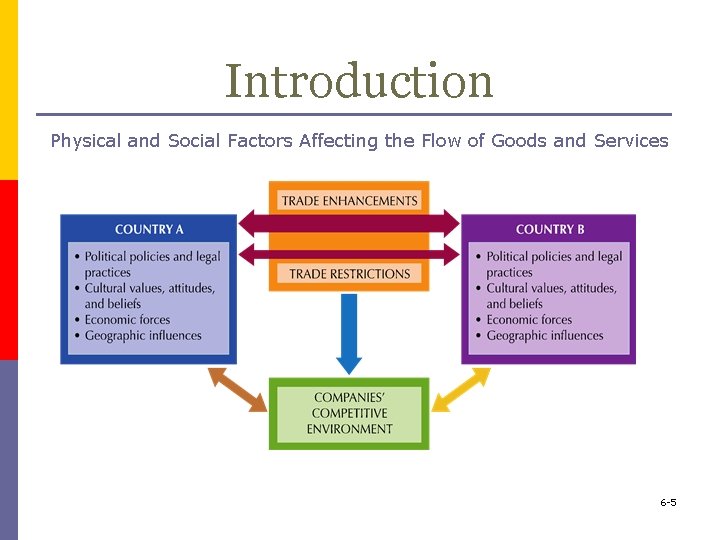
Introduction p Protectionism - policies that n n affect the ability of foreign producers to compete in your home market limit or enhance your company’s ability to sell abroad or acquire needed foreign supplies 6 -4
Introduction Physical and Social Factors Affecting the Flow of Goods and Services 6 -5
Conflicting Results of Trade Policies Governments intervene in trade to achieve economic, social, and political goals p Policymakers are challenged by p n n conflicting objectives interest groups 6 -6
The Role of Stakeholders Proposed policies on trade spark debate p Stakeholders include p n n p Workers Owners Suppliers Local politicians Consumers usually don’t care 6 -7
Economic Rationales for Government Intervention p Why governments intervene in trade n Economic rationales Fighting unemployment p Protecting infant industries p Promoting industrialization p Improving comparative position p n Non-economic rationales Maintaining essential industries p Promoting acceptable practices abroad p Maintaining or extending spheres of influence p Preserving national culture p 6 -8
Fighting Unemployment p p The unemployed are the most effective pressure group But, import restrictions n n n can lead to retaliation by other countries are less likely retaliated against effectively by small economies are less likely to be met with retaliation if implemented by small economies may decrease export jobs because of price increases for components may decrease export jobs because of lower incomes abroad 6 -9
Protecting ‘Infant Industries’ p The infant industry argument n p government protection of import competition is necessary to help certain industries evolve from high-cost to low-cost production Used by developing countries 6 -10
Developing an Industrial Base p Countries promote industrialization because it n n n brings faster growth than agriculture brings in investment funds diversifies the economy creates growth in manufactured goods reduces imports and promotes exports helps the nation-building process 6 -11
Economic Relationships With Other Countries p Trade controls can be used n n to improve the balance of payments to gain fair access to foreign markets p comparable access argument as a bargaining tool p believability and importance to control prices p dumping p optimum-tariff theory 6 -12
Noneconomic Rationales for Government Intervention p Noneconomic rationales include n n n Maintaining essential industries Preventing Shipments to “unfriendly” countries Promoting acceptable practices abroad Maintaining or extending spheres of influence Preserving national culture 6 -13
Maintaining Essential Industries p The essential industry argument n p protect essential industries so the country is not dependent on foreign supplies during war Countries must n n n determine which industries are essential consider costs and alternatives consider political consequences 6 -14
Promoting Acceptable Practices Abroad p Import trade controls can be used n n n to promote changes in foreign countries’ political policies or capabilities as a foreign policy weapon to pressure governments to alter their stances on a variety of issues p human rights p environmental protection 6 -15
Maintaining or Extending Spheres of Influence p Governments provide assistance and encourage imports from countries that join a political alliance or vote a preferred way within international bodies n p Cotonou Agreement A country’s trade restrictions may coerce governments to follow certain political actions or punish companies whose governments do not 6 -16
Preserving National Culture p In order to preserve national culture, countries n n limit foreign products and services in certain sectors p Canada’s cultural sovereignty prohibit exports of art and historical items deemed important to national heritage 6 -17
Instruments of Trade Control p Two types of trade controls n n those that indirectly affect the amount traded by directly influencing prices of exports or imports those that directly limit the amount of a good that can be traded 6 -18
Tariffs p Tariffs are also known as duties n p refer to a government levied tax on goods shipped internationally Tariffs may be levied n n n on goods entering, leaving, or passing through a country for protection or revenue on a per unit basis or a value basis p export tariffs p transit tariffs p import tariffs 6 -19
Nontariff Barriers: Direct Price Influencers p Subsidies n direct assistance to companies to make them more competitive p agricultural subsidies p overcoming market imperfections p valuation problems 6 -20
Nontariff Barriers: Direct Price Influencers p Aid and loans n n tied untied Customs valuation p Other direct-price influences p n special fees and requirements 6 -21
Nontariff Barriers: Quantity Controls p Quotas n limit the quantity of a product that can be imported or exported in a given time frame p Voluntary export restraint (VER) p Embargoes 6 -22
Nontariff Barriers: Quantity Controls “Buy local” legislation p Standards and labels p Specific permission requirements p n import or export license Administrative delays p Reciprocal requirements p n p Countertrade or offsets Restrictions on services 6 -23
Dealing with Governmental Trade Influencers p Companies facing import competition can n n Move abroad Seek other market niches Create greater efficiency or superior products Try to get governmental protection 6 -24
Tactics For Dealing With Import Competition Convince decision makers of the merits of particular policies p Involve the industry and stakeholders p Prepare for changes in the competitive environment p 6 -25
Dynamics and Complexity Trade restriction changes bring about winners and losers among countries, companies, and workers p Gains to consumers from freer trade may come at the expense of companies and workers p The international regulatory situation is becoming more complex p 6 -26