CHAPTER 20 International Trade Comparative Advantage and Protectionism

- Slides: 31
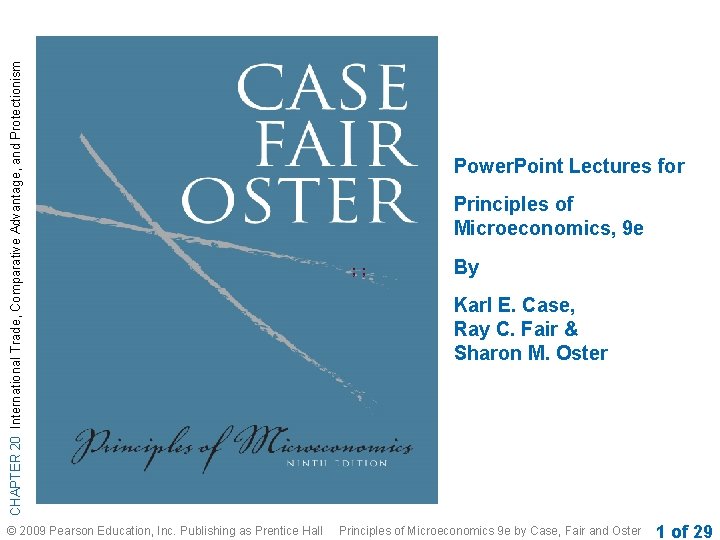
CHAPTER 20 International Trade, Comparative Advantage, and Protectionism © 2009 Pearson Education, Inc. Publishing as Prentice Hall Power. Point Lectures for Principles of Microeconomics, 9 e ; ; By Karl E. Case, Ray C. Fair & Sharon M. Oster Principles of Microeconomics 9 e by Case, Fair and Oster 1 of 29
CHAPTER 20 International Trade, Comparative Advantage, and Protectionism © 2009 Pearson Education, Inc. Publishing as Prentice Hall Principles of Microeconomics 9 e by Case, Fair and Oster 2 of 29
PART IV THE WORLD ECONOMY 20 International Trade, Comparative Advantage, and Protectionism Prepared by: Fernando & Yvonn Quijano © 2009 Pearson Education, Inc. Publishing as Prentice Hall Principles of Microeconomics 9 e by Case, Fair and Oster
CHAPTER 20 International Trade, Comparative Advantage, and Protectionism PART IV THE WORLD ECONOMY International Trade, Comparative Advantage, and Protectionism © 2009 Pearson Education, Inc. Publishing as Prentice Hall 20 CHAPTER OUTLINE Trade Surpluses and Deficits The Economic Basis for Trade: Comparative Advantage Absolute Advantage versus Comparative Advantage Terms of Trade Exchange Rates The Sources of Comparative Advantage The Heckscher-Ohlin Theorem Other Explanations for Observed Trade Flows Trade Barriers: Tariffs, Export Subsidies, and Quotas U. S. Trade Policies, GATT, and the WTO Free Trade or Protection? The Case for Free Trade The Case for Protection An Economic Consensus Principles of Microeconomics 9 e by Case, Fair and Oster 4 of 29
CHAPTER 20 International Trade, Comparative Advantage, and Protectionism The “internationalization” or “globalization” of the U. S. economy has occurred in the private and public sectors, in input and output markets, and in firms and households. © 2009 Pearson Education, Inc. Publishing as Prentice Hall Principles of Microeconomics 9 e by Case, Fair and Oster 5 of 29
CHAPTER 20 International Trade, Comparative Advantage, and Protectionism Trade Surpluses and Deficits trade surplus The situation when a country exports more than it imports. trade deficit The situation when a country imports more than it exports. © 2009 Pearson Education, Inc. Publishing as Prentice Hall Principles of Microeconomics 9 e by Case, Fair and Oster 6 of 29
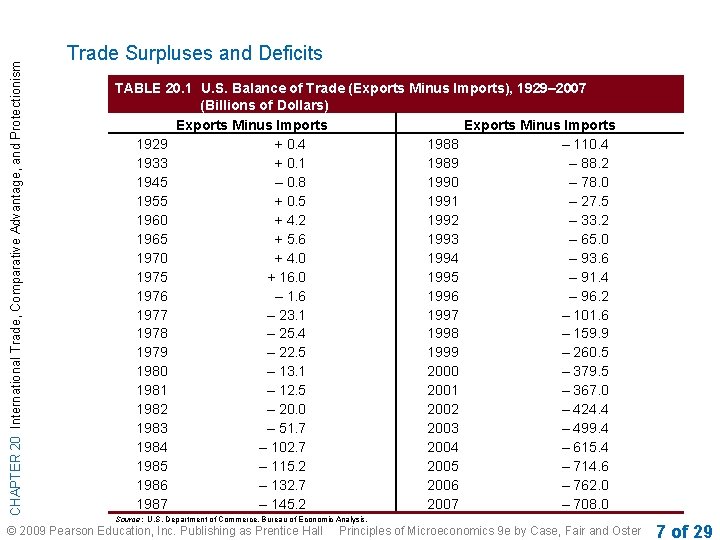
CHAPTER 20 International Trade, Comparative Advantage, and Protectionism Trade Surpluses and Deficits TABLE 20. 1 U. S. Balance of Trade (Exports Minus Imports), 1929– 2007 (Billions of Dollars) Exports Minus Imports 1929 + 0. 4 1988 – 110. 4 1933 + 0. 1 1989 – 88. 2 1945 – 0. 8 1990 – 78. 0 1955 + 0. 5 1991 – 27. 5 1960 + 4. 2 1992 – 33. 2 1965 + 5. 6 1993 – 65. 0 1970 + 4. 0 1994 – 93. 6 1975 + 16. 0 1995 – 91. 4 1976 – 1. 6 1996 – 96. 2 1977 – 23. 1 1997 – 101. 6 1978 – 25. 4 1998 – 159. 9 1979 – 22. 5 1999 – 260. 5 1980 – 13. 1 2000 – 379. 5 1981 – 12. 5 2001 – 367. 0 1982 – 20. 0 2002 – 424. 4 1983 – 51. 7 2003 – 499. 4 1984 – 102. 7 2004 – 615. 4 1985 – 115. 2 2005 – 714. 6 1986 – 132. 7 2006 – 762. 0 1987 – 145. 2 2007 – 708. 0 Source: U. S. Department of Commerce, Bureau of Economic Analysis. © 2009 Pearson Education, Inc. Publishing as Prentice Hall Principles of Microeconomics 9 e by Case, Fair and Oster 7 of 29
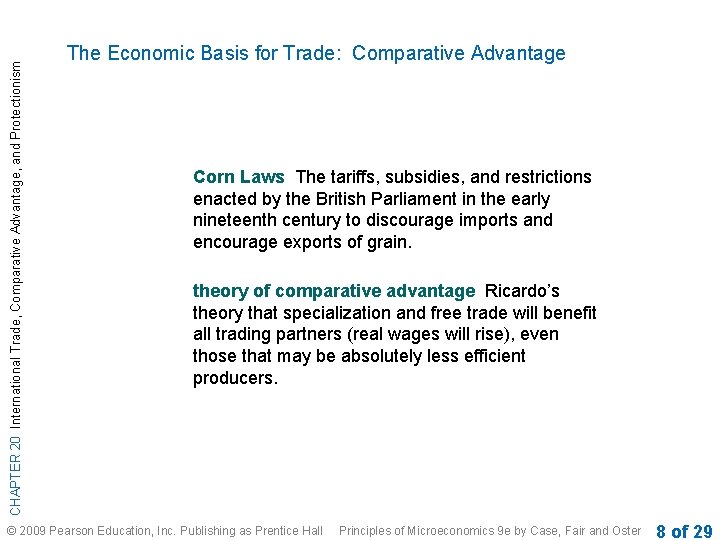
CHAPTER 20 International Trade, Comparative Advantage, and Protectionism The Economic Basis for Trade: Comparative Advantage Corn Laws The tariffs, subsidies, and restrictions enacted by the British Parliament in the early nineteenth century to discourage imports and encourage exports of grain. theory of comparative advantage Ricardo’s theory that specialization and free trade will benefit all trading partners (real wages will rise), even those that may be absolutely less efficient producers. © 2009 Pearson Education, Inc. Publishing as Prentice Hall Principles of Microeconomics 9 e by Case, Fair and Oster 8 of 29
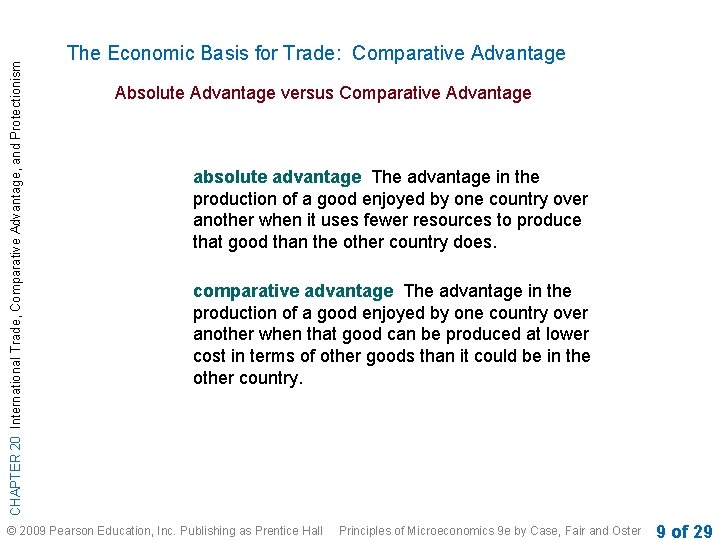
CHAPTER 20 International Trade, Comparative Advantage, and Protectionism The Economic Basis for Trade: Comparative Advantage Absolute Advantage versus Comparative Advantage absolute advantage The advantage in the production of a good enjoyed by one country over another when it uses fewer resources to produce that good than the other country does. comparative advantage The advantage in the production of a good enjoyed by one country over another when that good can be produced at lower cost in terms of other goods than it could be in the other country. © 2009 Pearson Education, Inc. Publishing as Prentice Hall Principles of Microeconomics 9 e by Case, Fair and Oster 9 of 29
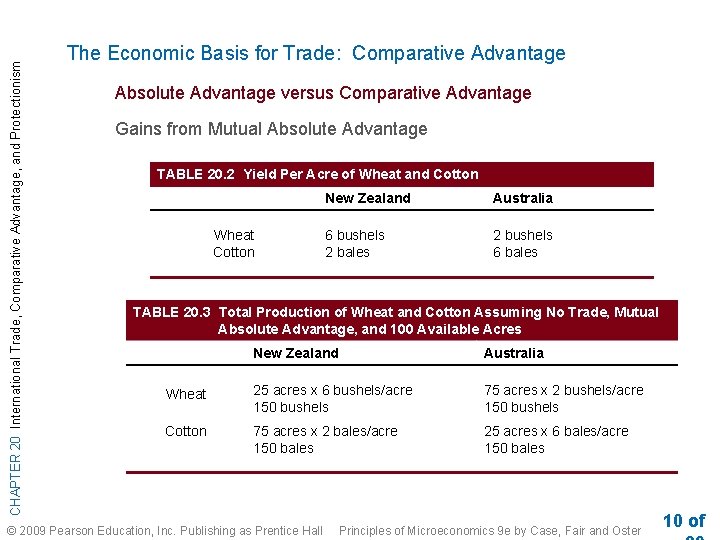
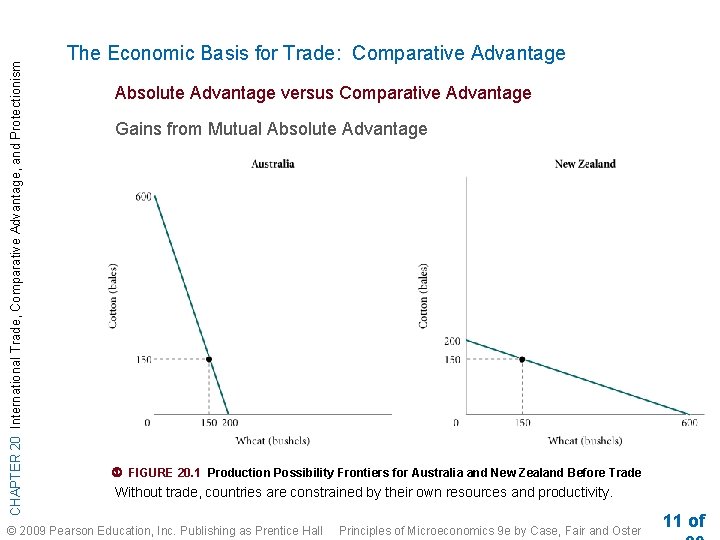
CHAPTER 20 International Trade, Comparative Advantage, and Protectionism The Economic Basis for Trade: Comparative Advantage Absolute Advantage versus Comparative Advantage Gains from Mutual Absolute Advantage TABLE 20. 2 Yield Per Acre of Wheat and Cotton Wheat Cotton New Zealand Australia 6 bushels 2 bales 2 bushels 6 bales TABLE 20. 3 Total Production of Wheat and Cotton Assuming No Trade, Mutual Absolute Advantage, and 100 Available Acres New Zealand Australia Wheat 25 acres x 6 bushels/acre 150 bushels 75 acres x 2 bushels/acre 150 bushels Cotton 75 acres x 2 bales/acre 150 bales 25 acres x 6 bales/acre 150 bales © 2009 Pearson Education, Inc. Publishing as Prentice Hall Principles of Microeconomics 9 e by Case, Fair and Oster 10 of
CHAPTER 20 International Trade, Comparative Advantage, and Protectionism The Economic Basis for Trade: Comparative Advantage Absolute Advantage versus Comparative Advantage Gains from Mutual Absolute Advantage FIGURE 20. 1 Production Possibility Frontiers for Australia and New Zealand Before Trade Without trade, countries are constrained by their own resources and productivity. © 2009 Pearson Education, Inc. Publishing as Prentice Hall Principles of Microeconomics 9 e by Case, Fair and Oster 11 of
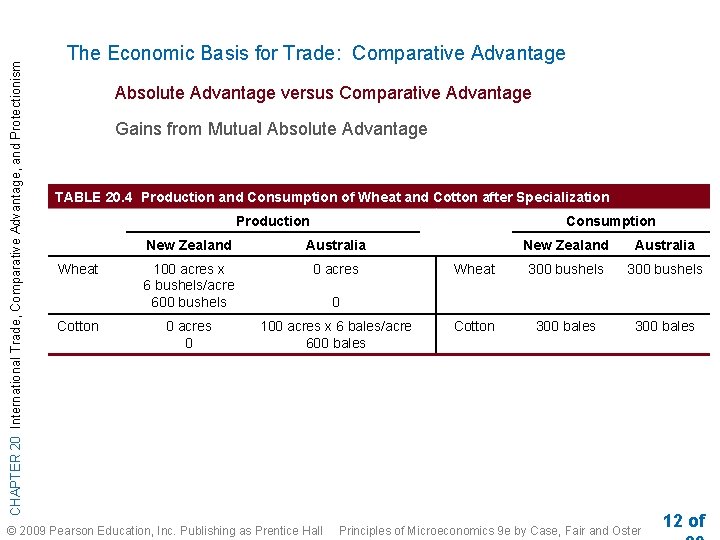
CHAPTER 20 International Trade, Comparative Advantage, and Protectionism The Economic Basis for Trade: Comparative Advantage Absolute Advantage versus Comparative Advantage Gains from Mutual Absolute Advantage TABLE 20. 4 Production and Consumption of Wheat and Cotton after Specialization Production Wheat Cotton Consumption New Zealand Australia 100 acres x 6 bushels/acre 600 bushels 0 acres 0 100 acres x 6 bales/acre 600 bales New Zealand Australia Wheat 300 bushels Cotton 300 bales 0 © 2009 Pearson Education, Inc. Publishing as Prentice Hall Principles of Microeconomics 9 e by Case, Fair and Oster 12 of
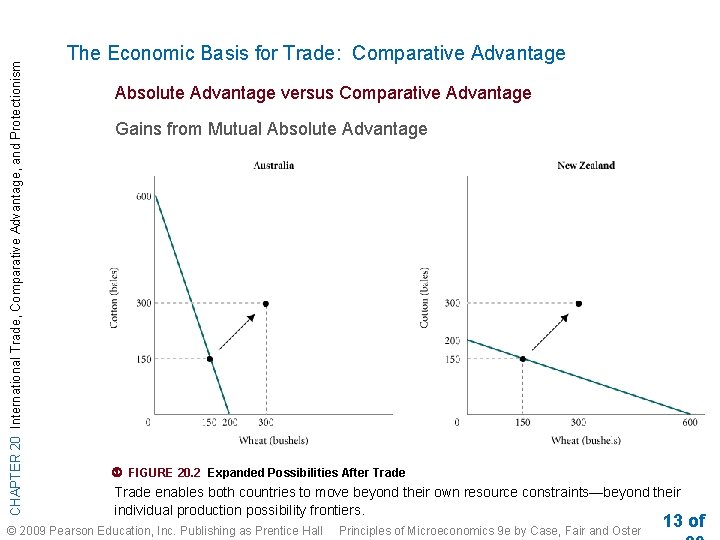
CHAPTER 20 International Trade, Comparative Advantage, and Protectionism The Economic Basis for Trade: Comparative Advantage Absolute Advantage versus Comparative Advantage Gains from Mutual Absolute Advantage FIGURE 20. 2 Expanded Possibilities After Trade enables both countries to move beyond their own resource constraints—beyond their individual production possibility frontiers. © 2009 Pearson Education, Inc. Publishing as Prentice Hall Principles of Microeconomics 9 e by Case, Fair and Oster 13 of
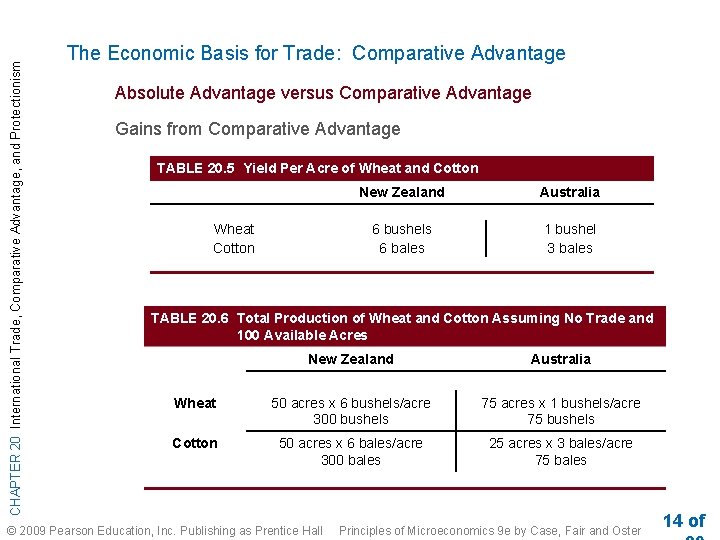
CHAPTER 20 International Trade, Comparative Advantage, and Protectionism The Economic Basis for Trade: Comparative Advantage Absolute Advantage versus Comparative Advantage Gains from Comparative Advantage TABLE 20. 5 Yield Per Acre of Wheat and Cotton Wheat Cotton New Zealand Australia 6 bushels 6 bales 1 bushel 3 bales TABLE 20. 6 Total Production of Wheat and Cotton Assuming No Trade and 100 Available Acres New Zealand Australia Wheat 50 acres x 6 bushels/acre 300 bushels 75 acres x 1 bushels/acre 75 bushels Cotton 50 acres x 6 bales/acre 300 bales 25 acres x 3 bales/acre 75 bales © 2009 Pearson Education, Inc. Publishing as Prentice Hall Principles of Microeconomics 9 e by Case, Fair and Oster 14 of
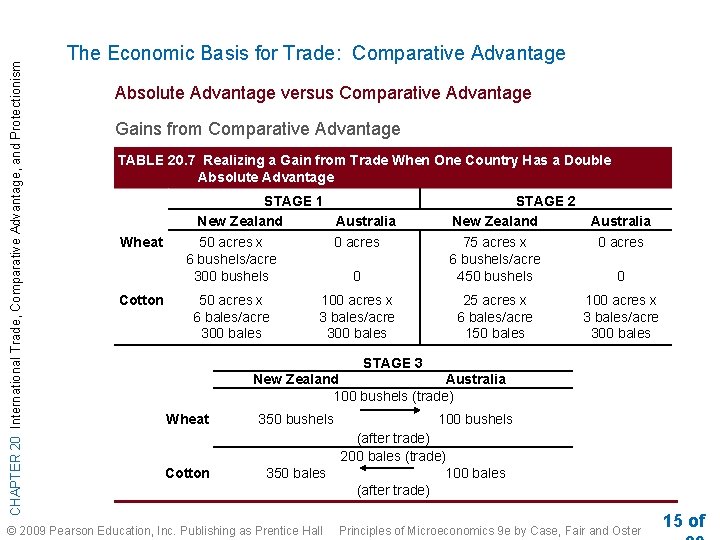
CHAPTER 20 International Trade, Comparative Advantage, and Protectionism The Economic Basis for Trade: Comparative Advantage Absolute Advantage versus Comparative Advantage Gains from Comparative Advantage TABLE 20. 7 Realizing a Gain from Trade When One Country Has a Double Absolute Advantage Wheat Cotton STAGE 1 New Zealand Australia 50 acres x 0 acres 6 bushels/acre 300 bushels 0 50 acres x 6 bales/acre 300 bales 100 acres x 3 bales/acre 300 bales STAGE 2 New Zealand 75 acres x 6 bushels/acre 450 bushels 25 acres x 6 bales/acre 150 bales Australia 0 acres 0 100 acres x 3 bales/acre 300 bales STAGE 3 New Zealand Australia 100 bushels (trade) Wheat Cotton 350 bushels 100 bushels (after trade) 200 bales (trade) 350 bales 100 bales (after trade) © 2009 Pearson Education, Inc. Publishing as Prentice Hall Principles of Microeconomics 9 e by Case, Fair and Oster 15 of
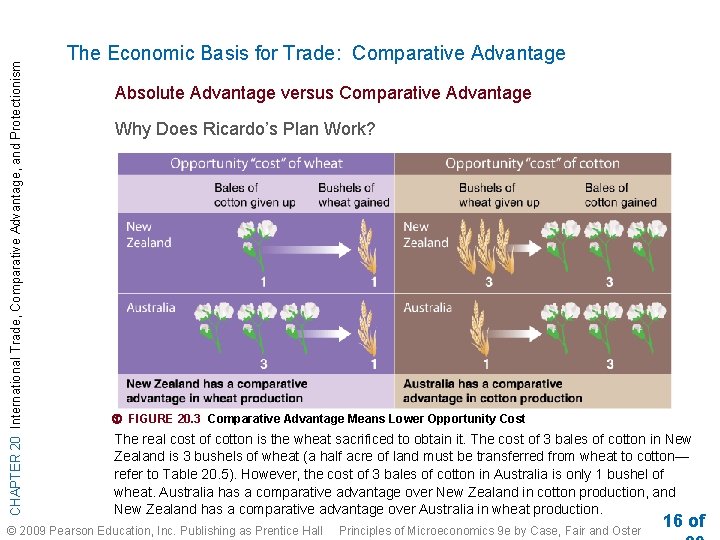
CHAPTER 20 International Trade, Comparative Advantage, and Protectionism The Economic Basis for Trade: Comparative Advantage Absolute Advantage versus Comparative Advantage Why Does Ricardo’s Plan Work? FIGURE 20. 3 Comparative Advantage Means Lower Opportunity Cost The real cost of cotton is the wheat sacrificed to obtain it. The cost of 3 bales of cotton in New Zealand is 3 bushels of wheat (a half acre of land must be transferred from wheat to cotton— refer to Table 20. 5). However, the cost of 3 bales of cotton in Australia is only 1 bushel of wheat. Australia has a comparative advantage over New Zealand in cotton production, and New Zealand has a comparative advantage over Australia in wheat production. © 2009 Pearson Education, Inc. Publishing as Prentice Hall Principles of Microeconomics 9 e by Case, Fair and Oster 16 of
CHAPTER 20 International Trade, Comparative Advantage, and Protectionism The Economic Basis for Trade: Comparative Advantage Terms of Trade terms of trade The ratio at which a country can trade domestic products for imported products. Exchange Rates exchange rate The ratio at which two currencies are traded. The price of one currency in terms of another. © 2009 Pearson Education, Inc. Publishing as Prentice Hall Principles of Microeconomics 9 e by Case, Fair and Oster 17 of
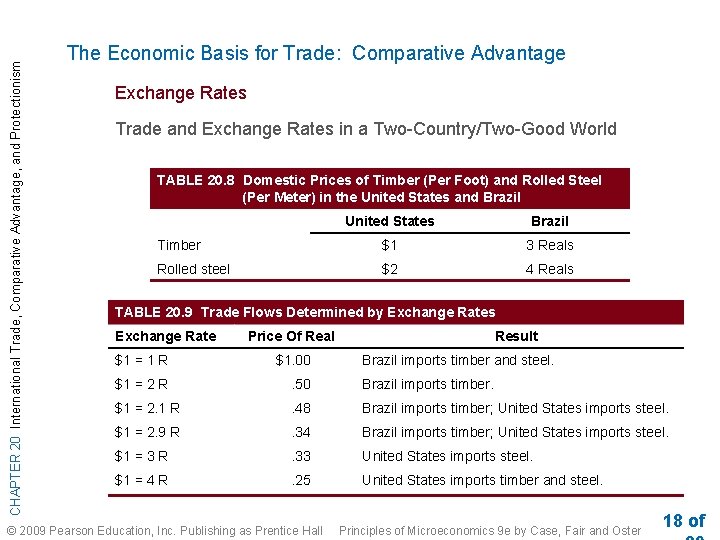
CHAPTER 20 International Trade, Comparative Advantage, and Protectionism The Economic Basis for Trade: Comparative Advantage Exchange Rates Trade and Exchange Rates in a Two-Country/Two-Good World TABLE 20. 8 Domestic Prices of Timber (Per Foot) and Rolled Steel (Per Meter) in the United States and Brazil United States Brazil Timber $1 3 Reals Rolled steel $2 4 Reals TABLE 20. 9 Trade Flows Determined by Exchange Rates Exchange Rate Price Of Real Result $1 = 1 R $1. 00 $1 = 2 R . 50 Brazil imports timber. $1 = 2. 1 R . 48 Brazil imports timber; United States imports steel. $1 = 2. 9 R . 34 Brazil imports timber; United States imports steel. $1 = 3 R . 33 United States imports steel. $1 = 4 R . 25 United States imports timber and steel. © 2009 Pearson Education, Inc. Publishing as Prentice Hall Brazil imports timber and steel. Principles of Microeconomics 9 e by Case, Fair and Oster 18 of
CHAPTER 20 International Trade, Comparative Advantage, and Protectionism The Economic Basis for Trade: Comparative Advantage Exchange Rates and Comparative Advantage If exchange rates end up in the right ranges, the free market will drive each country to shift resources into those sectors in which it enjoys a comparative advantage. Only those products in which a country has a comparative advantage will be competitive in world markets. © 2009 Pearson Education, Inc. Publishing as Prentice Hall Principles of Microeconomics 9 e by Case, Fair and Oster 19 of
CHAPTER 20 International Trade, Comparative Advantage, and Protectionism The Sources of Comparative Advantage factor endowments The quantity and quality of labor, land, and natural resources of a country. The Heckscher-Ohlin Theorem Heckscher-Ohlin theorem A theory that explains the existence of a country’s comparative advantage by its factor endowments: A country has a comparative advantage in the production of a product if that country is relatively well endowed with inputs used intensively in the production of that product. © 2009 Pearson Education, Inc. Publishing as Prentice Hall Principles of Microeconomics 9 e by Case, Fair and Oster 20 of
CHAPTER 20 International Trade, Comparative Advantage, and Protectionism The Sources of Comparative Advantage Other Explanations for Observed Trade Flows Comparative advantage is not the only reason countries trade. It does not explain why many countries import and export the same kinds of goods. Just as industries within a country differentiate their products to capture a domestic market, they also differentiate their products to please the wide variety of tastes that exists worldwide. Just as product differentiation is a natural response to diverse preferences within an economy, it is also a natural response to diverse preferences across economies. Some economists distinguish between gains from acquired comparative advantages and gains from natural comparative advantages. © 2009 Pearson Education, Inc. Publishing as Prentice Hall Principles of Microeconomics 9 e by Case, Fair and Oster 21 of
CHAPTER 20 International Trade, Comparative Advantage, and Protectionism Trade Barriers: Tariffs, Export Subsidies, and Quotas protection The practice of shielding a sector of the economy from foreign competition. tariff A tax on imports. export subsidies Government payments made to domestic firms to encourage exports. dumping A firm’s or an industry’s sale of products on the world market at prices below its own cost of production. quota A limit on the quantity of imports. © 2009 Pearson Education, Inc. Publishing as Prentice Hall Principles of Microeconomics 9 e by Case, Fair and Oster 22 of
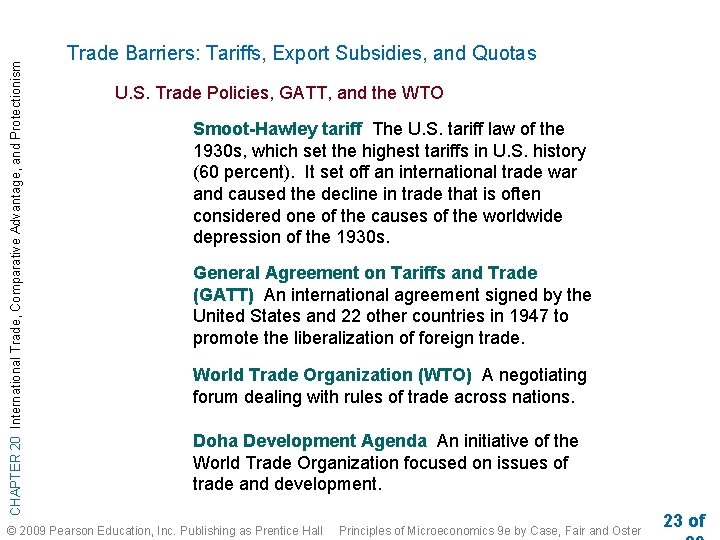
CHAPTER 20 International Trade, Comparative Advantage, and Protectionism Trade Barriers: Tariffs, Export Subsidies, and Quotas U. S. Trade Policies, GATT, and the WTO Smoot-Hawley tariff The U. S. tariff law of the 1930 s, which set the highest tariffs in U. S. history (60 percent). It set off an international trade war and caused the decline in trade that is often considered one of the causes of the worldwide depression of the 1930 s. General Agreement on Tariffs and Trade (GATT) An international agreement signed by the United States and 22 other countries in 1947 to promote the liberalization of foreign trade. World Trade Organization (WTO) A negotiating forum dealing with rules of trade across nations. Doha Development Agenda An initiative of the World Trade Organization focused on issues of trade and development. © 2009 Pearson Education, Inc. Publishing as Prentice Hall Principles of Microeconomics 9 e by Case, Fair and Oster 23 of
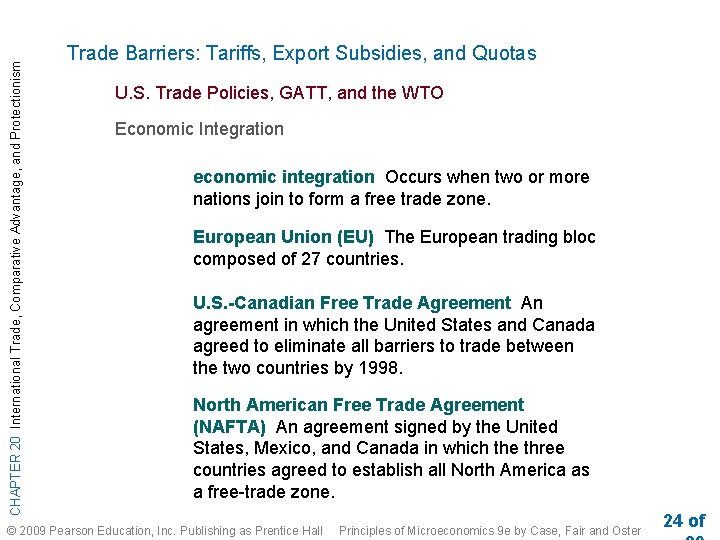
CHAPTER 20 International Trade, Comparative Advantage, and Protectionism Trade Barriers: Tariffs, Export Subsidies, and Quotas U. S. Trade Policies, GATT, and the WTO Economic Integration economic integration Occurs when two or more nations join to form a free trade zone. European Union (EU) The European trading bloc composed of 27 countries. U. S. -Canadian Free Trade Agreement An agreement in which the United States and Canada agreed to eliminate all barriers to trade between the two countries by 1998. North American Free Trade Agreement (NAFTA) An agreement signed by the United States, Mexico, and Canada in which the three countries agreed to establish all North America as a free-trade zone. © 2009 Pearson Education, Inc. Publishing as Prentice Hall Principles of Microeconomics 9 e by Case, Fair and Oster 24 of
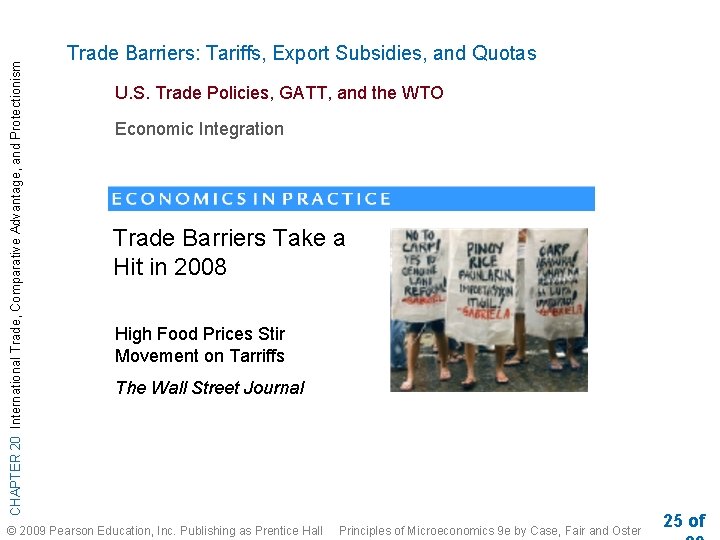
CHAPTER 20 International Trade, Comparative Advantage, and Protectionism Trade Barriers: Tariffs, Export Subsidies, and Quotas U. S. Trade Policies, GATT, and the WTO Economic Integration Trade Barriers Take a Hit in 2008 High Food Prices Stir Movement on Tarriffs The Wall Street Journal © 2009 Pearson Education, Inc. Publishing as Prentice Hall Principles of Microeconomics 9 e by Case, Fair and Oster 25 of
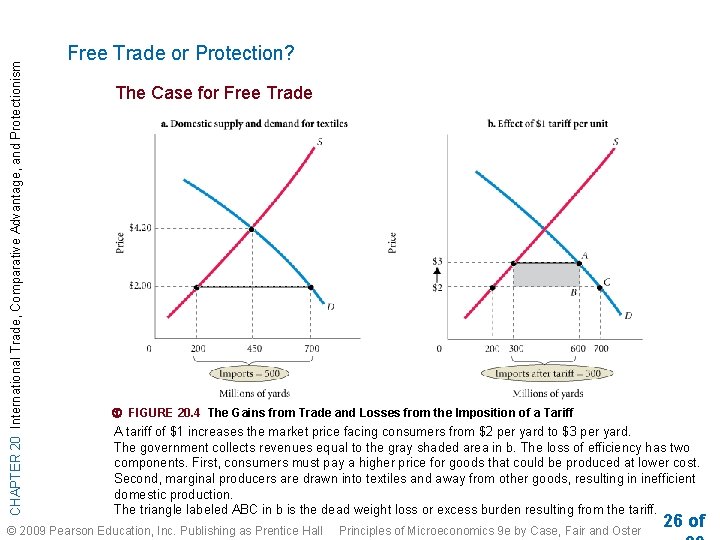
CHAPTER 20 International Trade, Comparative Advantage, and Protectionism Free Trade or Protection? The Case for Free Trade FIGURE 20. 4 The Gains from Trade and Losses from the Imposition of a Tariff A tariff of $1 increases the market price facing consumers from $2 per yard to $3 per yard. The government collects revenues equal to the gray shaded area in b. The loss of efficiency has two components. First, consumers must pay a higher price for goods that could be produced at lower cost. Second, marginal producers are drawn into textiles and away from other goods, resulting in inefficient domestic production. The triangle labeled ABC in b is the dead weight loss or excess burden resulting from the tariff. © 2009 Pearson Education, Inc. Publishing as Prentice Hall Principles of Microeconomics 9 e by Case, Fair and Oster 26 of
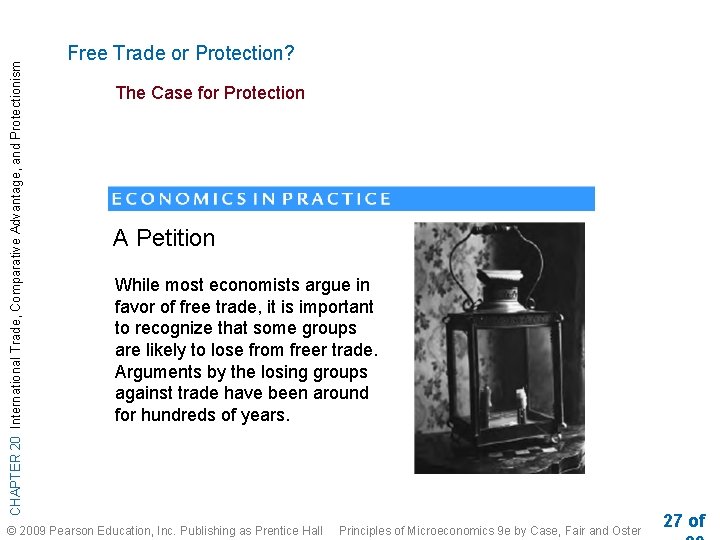
CHAPTER 20 International Trade, Comparative Advantage, and Protectionism Free Trade or Protection? The Case for Protection A Petition While most economists argue in favor of free trade, it is important to recognize that some groups are likely to lose from freer trade. Arguments by the losing groups against trade have been around for hundreds of years. © 2009 Pearson Education, Inc. Publishing as Prentice Hall Principles of Microeconomics 9 e by Case, Fair and Oster 27 of
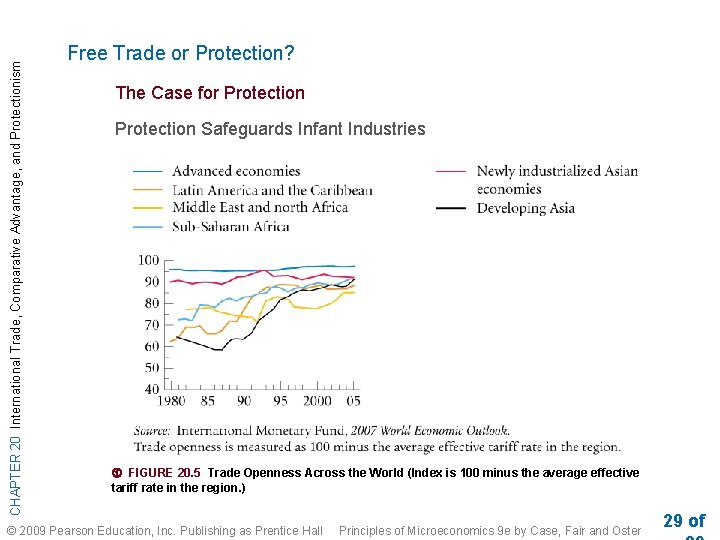
CHAPTER 20 International Trade, Comparative Advantage, and Protectionism Free Trade or Protection? The Case for Protection Saves Jobs Some Countries Engage in Unfair Trade Practices Cheap Foreign Labor Makes Competition Unfair Protection Safeguards National Security Protection Discourages Dependency Environmental Concerns Protection Safeguards Infant Industries infant industry A young industry that may need temporary protection from competition from the established industries of other countries to develop an acquired comparative advantage. © 2009 Pearson Education, Inc. Publishing as Prentice Hall Principles of Microeconomics 9 e by Case, Fair and Oster 28 of
CHAPTER 20 International Trade, Comparative Advantage, and Protectionism Free Trade or Protection? The Case for Protection Safeguards Infant Industries FIGURE 20. 5 Trade Openness Across the World (Index is 100 minus the average effective tariff rate in the region. ) © 2009 Pearson Education, Inc. Publishing as Prentice Hall Principles of Microeconomics 9 e by Case, Fair and Oster 29 of
CHAPTER 20 International Trade, Comparative Advantage, and Protectionism An Economic Consensus Critical to our study of international economics is the debate between free traders and protectionists. Foreign trade and full employment can be pursued simultaneously. Although economists disagree about many things, the vast majority of them favor free trade. © 2009 Pearson Education, Inc. Publishing as Prentice Hall Principles of Microeconomics 9 e by Case, Fair and Oster 30 of
CHAPTER 20 International Trade, Comparative Advantage, and Protectionism REVIEW TERMS AND CONCEPTS absolute advantage infant industry comparative advantage North American Free Trade Agreement (NAFTA) Corn Laws protection Doha Development Agenda quota dumping Smoot-Hawley tariff economic integration tariff European Union (EU) terms of trade exchange rate theory of comparative advantage export subsidies trade deficit factor endowments General Agreement on Tariffs and Trade (GATT) Heckscher-Ohlin theorem © 2009 Pearson Education, Inc. Publishing as Prentice Hall trade surplus U. S. -Canadian Free Trade Agreement World Trade Organization (WTO) Principles of Microeconomics 9 e by Case, Fair and Oster 31 of