
INTERNATIONAL TRADE THEORY International Trade Theory shaped the

- Slides: 16
INTERNATIONAL TRADE THEORY International Trade Theory – shaped the economic policy of many nations for the past 50 years. Competitive environment the International business competes Two Goals • Beneficial for a country to engage in international trade • Pattern of international trade in the world economy – pattern of exports and imports between countries
Trade Theory 1. Adam Smith’s Theory of Absolute advantage 2. Comparative theory by David Ricardo 3. Heckscher – Ohlin thoery Two Swedish Economists, Eli Heckscher and Bertil Ohlin All these theories agree that international trade is beneficial to the country
MERCANTILISM First theory of International trade emerged in the mid 16 th century – referred as Mercantilism. Its principal was gold and silver were the currency of trade between countries – which develops the nations wealth, prestige and power and essential to vigorous commerce - more export than import.
ABSOLUTE ADVANTAGE 1776 landmark book – the wealth of nations – Adam smith attacked by the Mercantilist assumption. - Zero sum game. • Country has an absolute advantage in the production of product • Countries differ in their ability to produce goods efficiently Example : French had a absolute advantage in the production of wine –worlds most efficient wine industry.
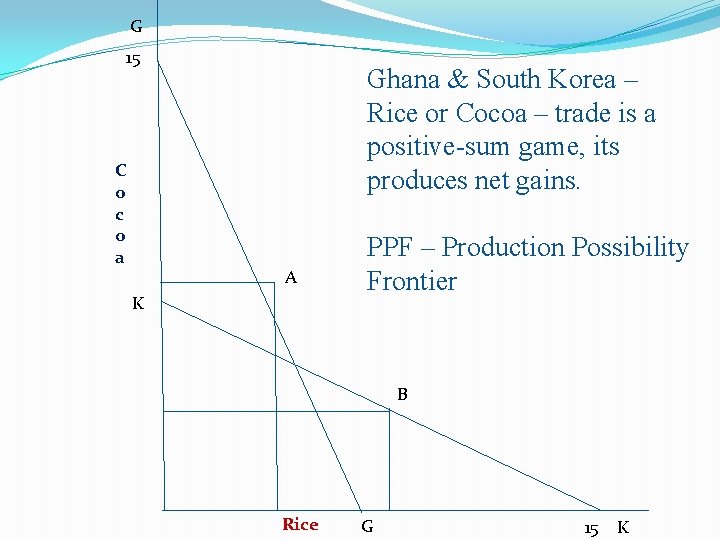
G 15 C o c o a Ghana & South Korea – Rice or Cocoa – trade is a positive-sum game, its produces net gains. A K PPF – Production Possibility Frontier B Rice G 15 K
COMPARATIVE ADVANTAGE One step further of Adam Smiths – One country has an absolute advantage in the production of all goods.
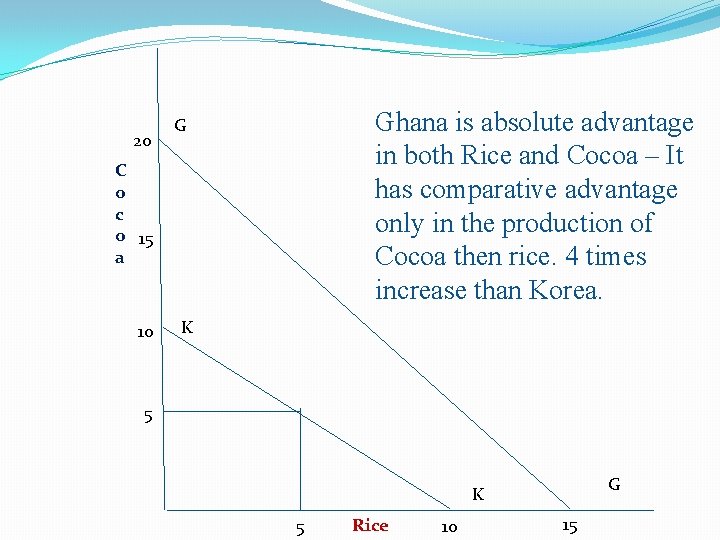
20 Ghana is absolute advantage in both Rice and Cocoa – It has comparative advantage only in the production of Cocoa then rice. 4 times increase than Korea. G C o c o 15 a 10 K 5 G K 5 Rice 10 15
ASSUMPTIONS ØTwo countries and two goals - real world – many countries and many goods ØTransportation costs ØPrice difference in different countries ØResources move free from one to other countries. ØConstant returns to scale ØCountry has fixed stock of resources ØEffects of trade on Income distribution
HECKSCHER – OHLIN THEORY v. Factor endowments- resources such as land, labour and capital v. This theory has common sense appeal use of factors that are locally scarce. v. United states – exporter of capital -intensive goods and an importer of labour-intensive goods. v. Result – Variance with prediction of theory known as Leontief Paradox – He is noble prize winner in economics. v. US – abundant in capital compared to other nations.
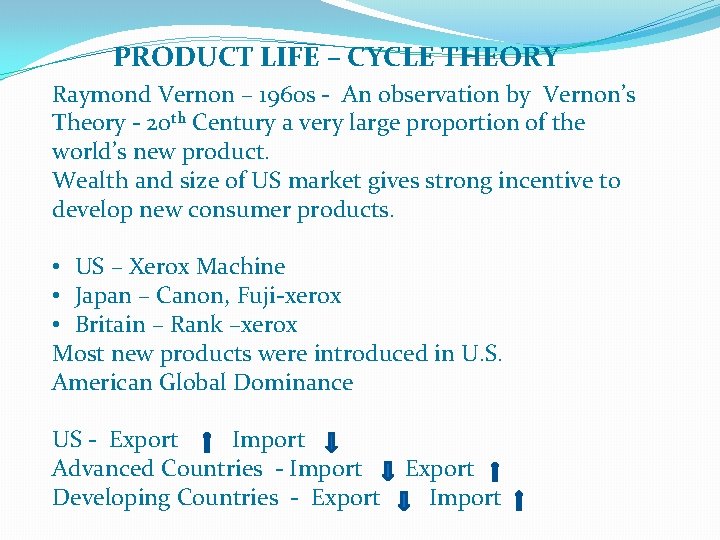
PRODUCT LIFE – CYCLE THEORY Raymond Vernon – 1960 s - An observation by Vernon’s Theory - 20 th Century a very large proportion of the world’s new product. Wealth and size of US market gives strong incentive to develop new consumer products. • US – Xerox Machine • Japan – Canon, Fuji-xerox • Britain – Rank –xerox Most new products were introduced in U. S. American Global Dominance US - Export Import Advanced Countries - Import Export Developing Countries - Export Import
NEW TRADE THEORY 1970’s – Economies of scale – unit cost reductions associated with large volume of output. Two important points: • Increase product variety and reducing costs • First mover advantages and the pattern of trade • Promoted the idea of strategic trade policy
PORTER’S THEORY 1990 – Michael Porter of the Harvard Business School – Porter looked 100 industries in 10 nations. Ø Japan - do well in - Automobile industry Ø Switzerland “ - Precision instrument & pharmaceuticals Ø Germany “ - Chemical industry Porter theories – four broad attributes 1) Factor Endowments (factors of production) 2) Demand conditions 3) Related and supporting industries 4) Firm strategy, structure and Rivalry
FOREIGN DIRECT INVESTMENT(FDI) • FDI occurs when a firm invests directly in facilities to produce/market a product in a foreign country. • Once a firm undertakes FDI, it becomes a multinational enterprise • Between 1990 -2005, Mexican Cement Marker makes FDI to establish operations in 50 countries (Cemex) • FDI takes two forms 1) Green field Investment 2) Acquiring or Merging with an existing firm in foreign country Example : Toyota prefer FDI to exporting – Japanese Car Manufactures
FDI IN THE WORLD ECONOMY 1. Horizontal foreign direct Investment FDI in the same industry in which a firm operates at home country 2. Vertical foreign direct Investment FDI in an industry that provides inputs for a firm’s domestic operations - Industry abroad sells the outputs of firm's - domestic FLOW OF FDI over a given time period ( a year) v. Stock of FDI - total accumulated value of foreignowned asset at a given time v. Outflows of FDI – Flow of FDI out of a country v. Inflows of FDI - Flow of FDI into a country
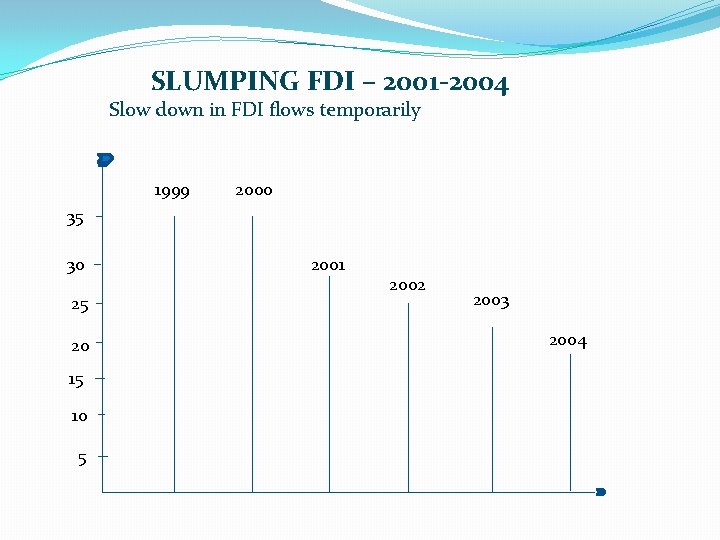
SLUMPING FDI – 2001 -2004 Slow down in FDI flows temporarily 1999 2000 35 30 25 20 15 10 5 2001 2002 2003 2004
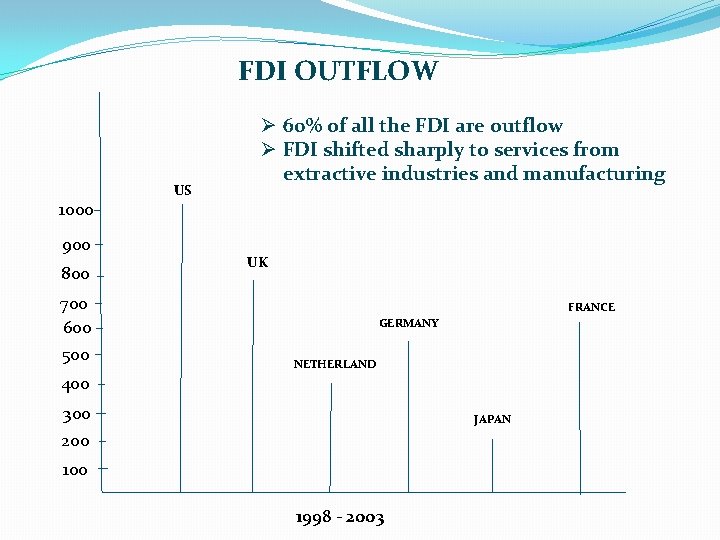
FDI OUTFLOW 1000 900 800 US Ø 60% of all the FDI are outflow Ø FDI shifted sharply to services from extractive industries and manufacturing UK 700 600 500 FRANCE GERMANY NETHERLAND 400 300 200 JAPAN 100 1998 - 2003