INFERTILITY l Assessment and treatment of patients with



- Slides: 54
INFERTILITY l Assessment and treatment of patients with fertility problems Dr Nitu Raje-Ghatge
Why learn about it? Its in the curriculum ! l l l Infertility – primary/ secondary Investigations eg hormone tests Knowledge of subfertility secondary care investigations Primary care management Knowledge of specialist treatments and surgical procedures
Why learn about it. . Expectations from secondary care services! l Inappropriate timing of referrals (early/late) l Incomplete /inadequate investigations
What is infertility? l NICE: Failure to conceive after regular UPSI for 2 years in the absence of reproductive pathology. P. S NICE suggests offer clinical investigations if failure to conceive after 1 year of UPSI. l GP NOTEBOOK: Infertility is the failure of conception in a couple having regular, unprotected coitus for 1 year, provided that normal intercourse is occurring not less than twice weekly.
Natural conception rates: l l l 80% of couples will be pregnant after 12 cycles. 50% of remaining will conceive during a 2 nd year ( hence cumulative rate 90%) 50% in the following 4 years.
PRIMARY/SECONDARY INFERTILITY l PRIMARY – Couple without a prior pregnancy l SECONDARY – Couple with previous pregnancy including miscarriage/ectopic.
Etiology: l l Male factors Female factors Unexplained -20% Mixed – 15%
Male Account for 25% l Hypogonadotrophic hypogonadism l Obstructive azoospermia Surgery l Erectile dysfunction l Anatomical - Hypospadias - Undescended/ maldescended testis
Female l Peritoneal factors 40%, - Endometriosis. l Tubal blockage 20%.
Etiology (female) l l l Ovulatory dysfunction 15 -20% - Hypothalamic/hypogonadotrophic hypogonadism - Hypothalamic pituitary dysfunction (PCOS) - Ovarian failure Uterine cavity abnormalities - Asherman's syndrome - Uterine fibroids. Cervical hostility 5 -10%, - Infection - Female sperm antibodies.
l Fertility may be impaired in poorly controlled diabetes.
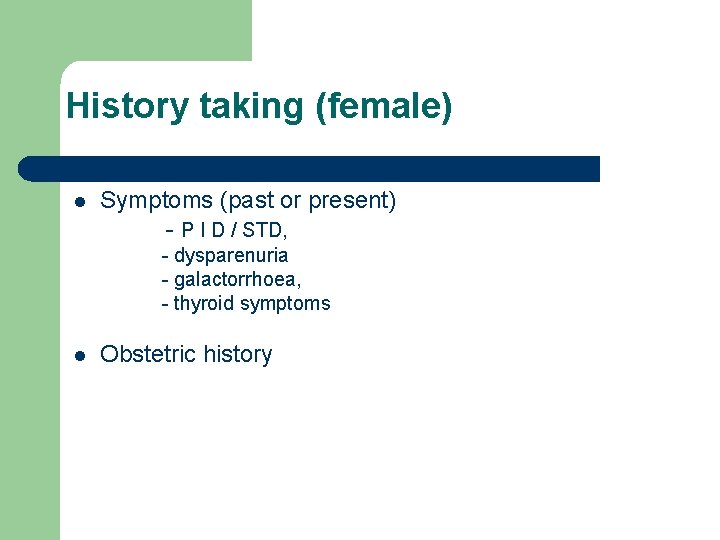
History taking (female) l Symptoms (past or present) - P I D / STD, - dysparenuria - galactorrhoea, - thyroid symptoms l Obstetric history
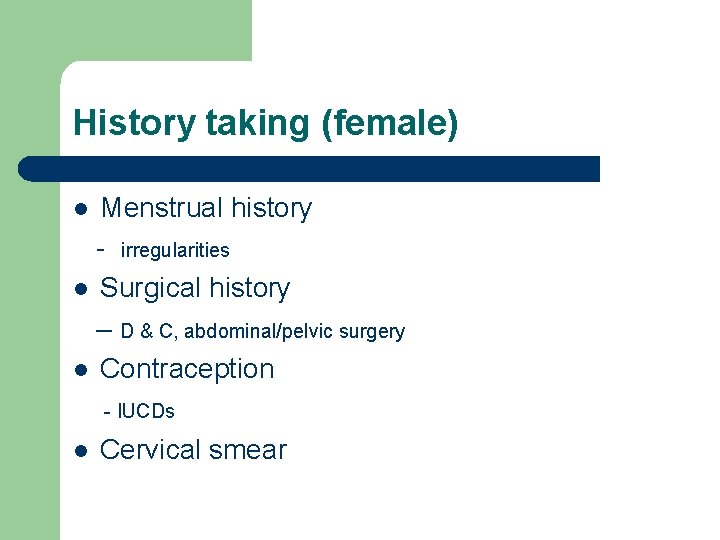
History taking (female) Menstrual history - irregularities l Surgical history – D & C, abdominal/pelvic surgery l Contraception l - IUCDs l Cervical smear
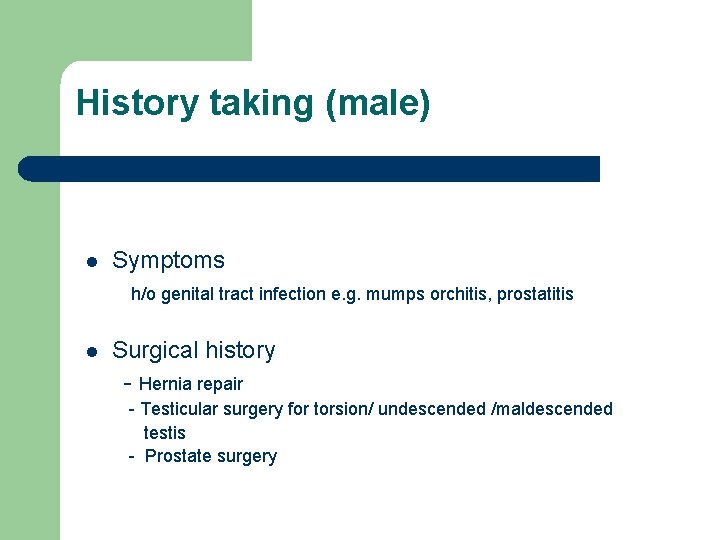
History taking (male) l Symptoms h/o genital tract infection e. g. mumps orchitis, prostatitis l Surgical history - Hernia repair - Testicular surgery for torsion/ undescended /maldescended testis - Prostate surgery
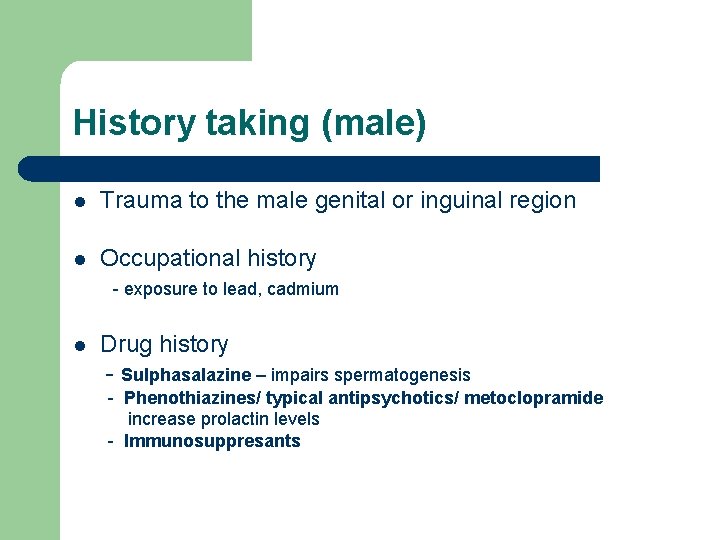
History taking (male) l Trauma to the male genital or inguinal region l Occupational history - exposure to lead, cadmium l Drug history - Sulphasalazine – impairs spermatogenesis - Phenothiazines/ typical antipsychotics/ metoclopramide increase prolactin levels - Immunosuppresants
IN BOTH l l l Smoking Alcohol intake Psychological factors
EXAMINATION General health and nutritional status l BMI <19 (F) > 29. (M/F) l SSC l
Female: Hirsuitism, galactorrhoea l Bimanual examination - adnexal masses (tubo/ovarian, ovarian cyst) l - tenderness (PID/ endometriosis) - Uterine fibroids
Male l l l Hypospadias Size and consistency of each testicle and epididymis; Presence of varicocele or hernia; Size of prostate. Gynaecomastia
Now what? ? Investigate Or Refer
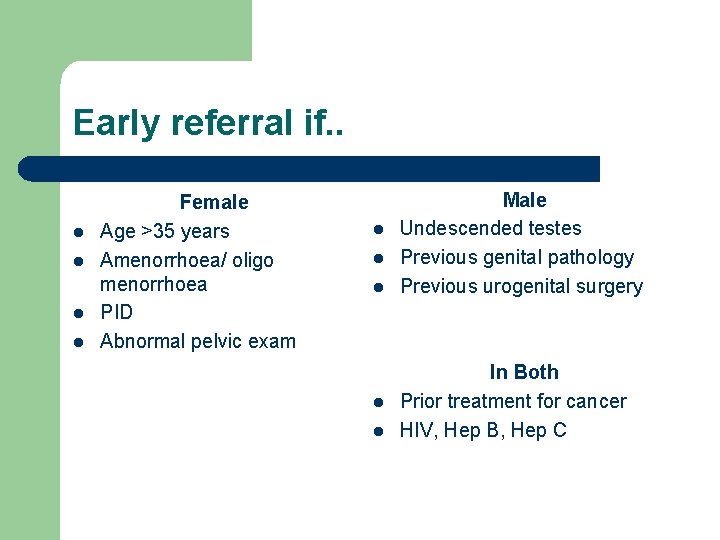
Early referral if. . l l Female Age >35 years Amenorrhoea/ oligo menorrhoea PID Abnormal pelvic exam l l l Male Undescended testes Previous genital pathology Previous urogenital surgery In Both Prior treatment for cancer HIV, Hep B, Hep C
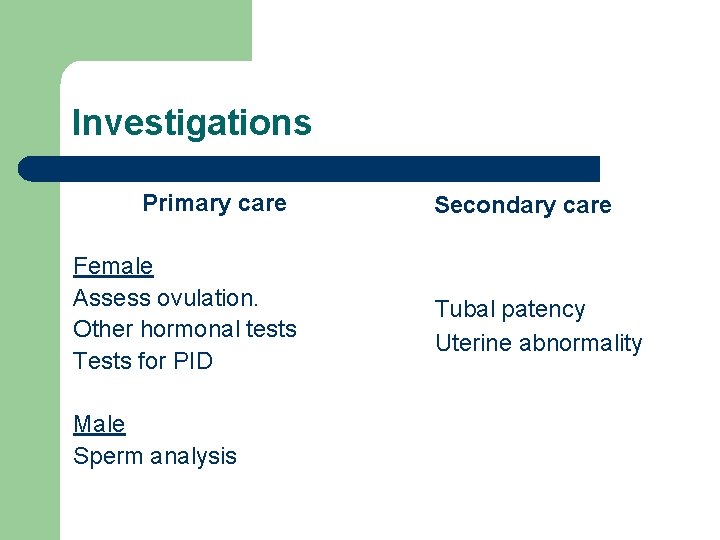
Investigations Primary care Female Assess ovulation. Other hormonal tests Tests for PID Male Sperm analysis Secondary care Tubal patency Uterine abnormality
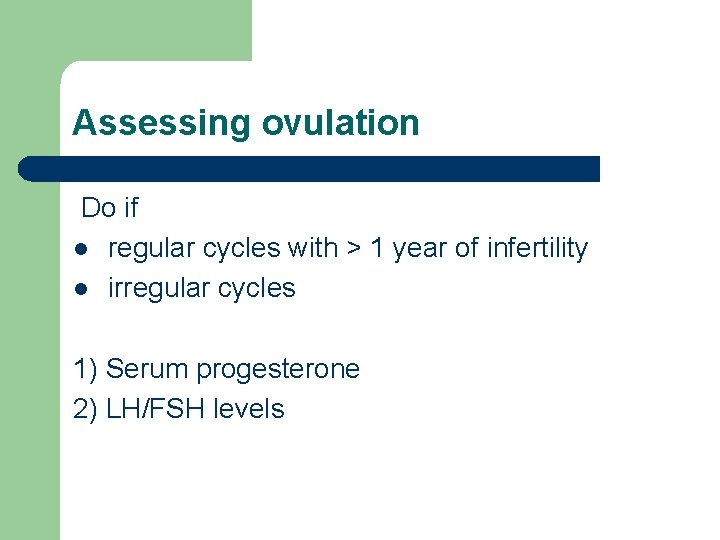
Assessing ovulation Do if l regular cycles with > 1 year of infertility l irregular cycles 1) Serum progesterone 2) LH/FSH levels
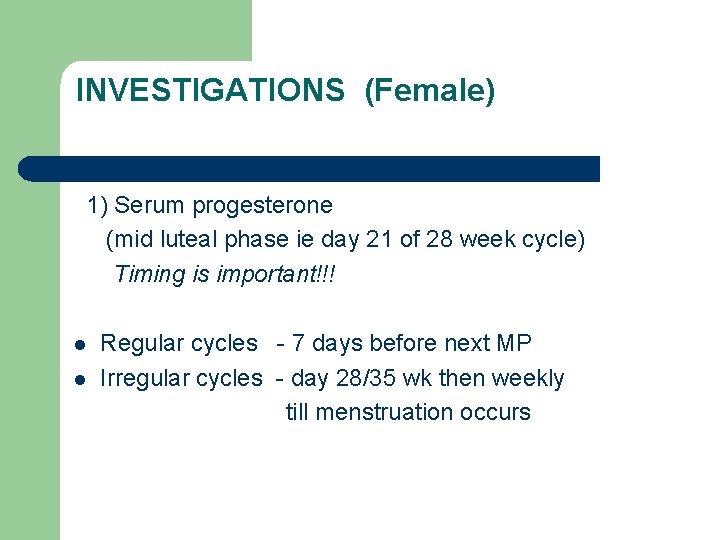
INVESTIGATIONS (Female) 1) Serum progesterone (mid luteal phase ie day 21 of 28 week cycle) Timing is important!!! l l Regular cycles - 7 days before next MP Irregular cycles - day 28/35 wk then weekly till menstruation occurs
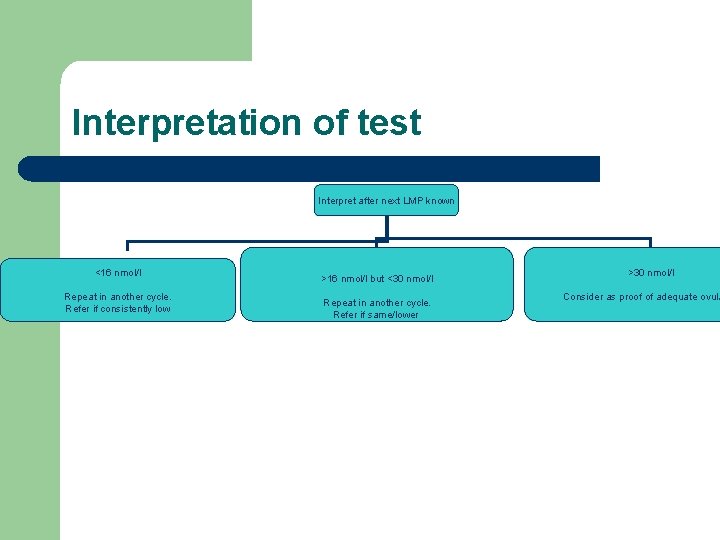
Interpretation of test Interpret after next LMP known <16 nmol/l Repeat in another cycle. Refer if consistently low >16 nmol/l but <30 nmol/l Repeat in another cycle. Refer if same/lower >30 nmol/l Consider as proof of adequate ovula
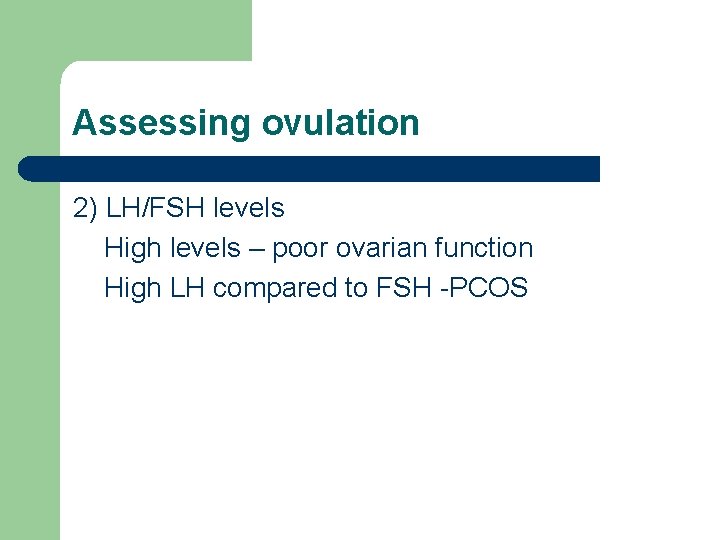
Assessing ovulation 2) LH/FSH levels High levels – poor ovarian function High LH compared to FSH -PCOS
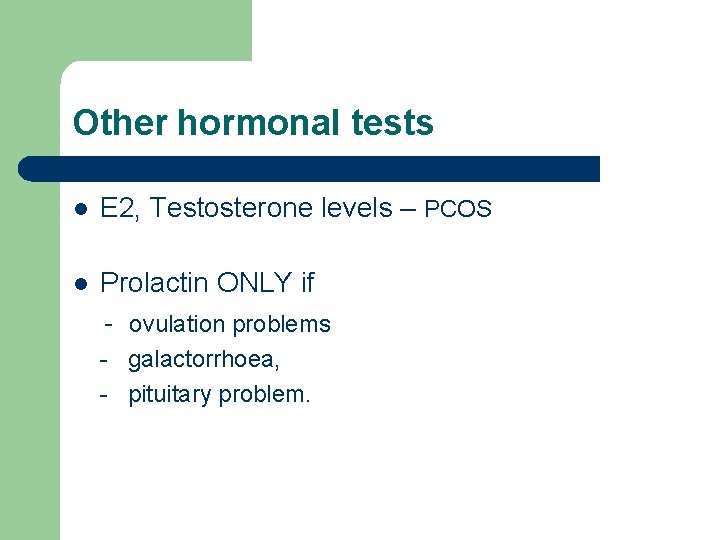
Other hormonal tests l E 2, Testosterone levels – PCOS l Prolactin ONLY if - ovulation problems - galactorrhoea, - pituitary problem.
Other hormonal tests l l Thyroid tests - only with symptoms/ signs Other androgen profile (DHEAS, Androstenedione, SBHG) – as per etiology
Tests for PID l l HVS Chlamydia screening
Don’t forget!! Rubella status - check immunity - Vaccinate if non immune, avoid conception for 3 months l
Cervical hostility Post coital test - no longer recommended by NICE l Mucus invasion test - doubtful significance l
Investigations (Male) Semen analysis l l Needs prior appointment with lab Abstinence for atleast 3 days Transport to lab in 30 - 60 min Repeat abnormal test in next 3 months, earlier if gross abnormality
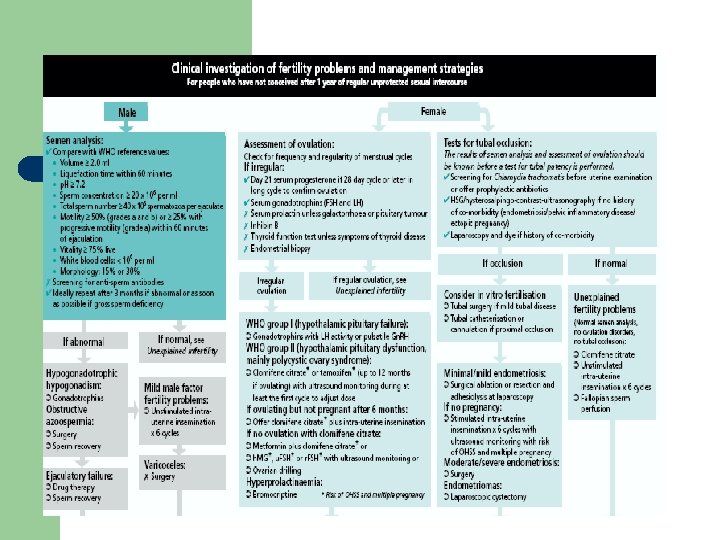
Semen analysis- interpretation (WHO values) l l l l Volume 2 mls or more Sperm concentration - 20 million/ml Sperm morphology - atleast 30% normal Sperm number - 40 million/ ejaculate Sperm motility – 50% Vitality – 75% WBC - <1 million/ml Anti sperm antibody tests- not recommended by NICE
Investigations in secondary care
Tests for uterine/tubal problems l l HSG/hystero salpingo-contrast USG Laparoscopy + dye test Done only when ovulation tests/Sperm tests normal. Choice of tests depends upon co morbidities
Management in primary care Principles of care l Couple centred management l Access to evidence based information l Counselling (third person) l Contact with fertility support groups l Specialist teams
Positive approach Reassure about cumulative pregnancy rates
Management in primary care l Lifestyle changes - Weight reduction, BMI 19 -29 - Smoking cessation- offer support groups - Alcohol reduction <1 -2 units/week for women <3 -4 units/week for men - S I every 2 -3 days - Information about OTC/ recreational drugs
Management in primary care l Pre conceptual advice - Folic acid supplementation - Rubella status - Cervical screening l Management of erectile dysfunction - psychosexual couselling - drugs
Management in secondary care l Depends upon the etiology. .
Hypogonadotrophic hypogonadism l l l Pulsatile Gn. RH Gonadotrophins with LH activity Bromocriptine ( for hyperprolactinaemia)
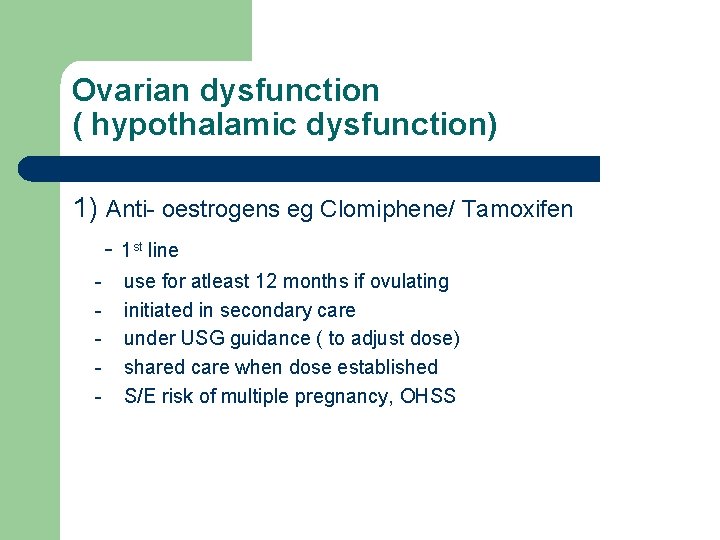
Ovarian dysfunction ( hypothalamic dysfunction) 1) Anti- oestrogens eg Clomiphene/ Tamoxifen - 1 st line - use for atleast 12 months if ovulating initiated in secondary care under USG guidance ( to adjust dose) shared care when dose established S/E risk of multiple pregnancy, OHSS
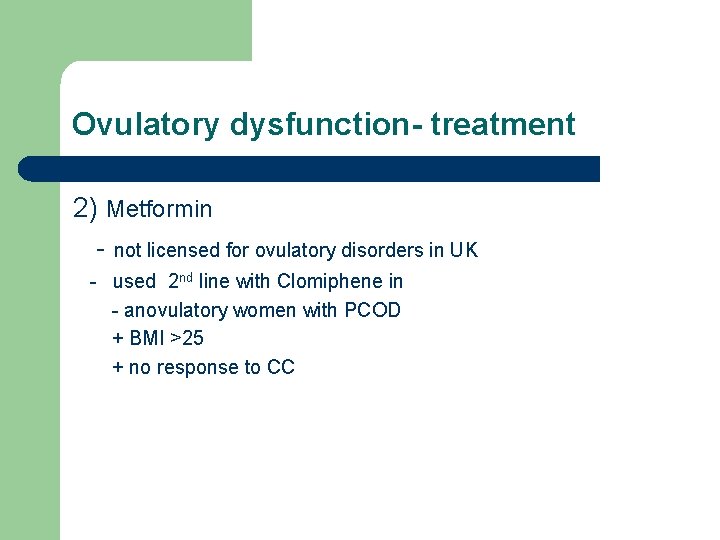
Ovulatory dysfunction- treatment 2) Metformin - not licensed for ovulatory disorders in UK - used 2 nd line with Clomiphene in - anovulatory women with PCOD + BMI >25 + no response to CC
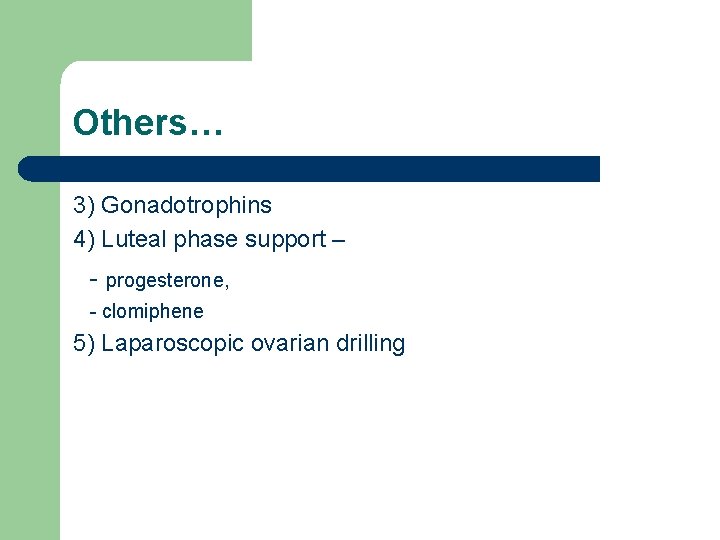
Others… 3) Gonadotrophins 4) Luteal phase support – - progesterone, - clomiphene 5) Laparoscopic ovarian drilling
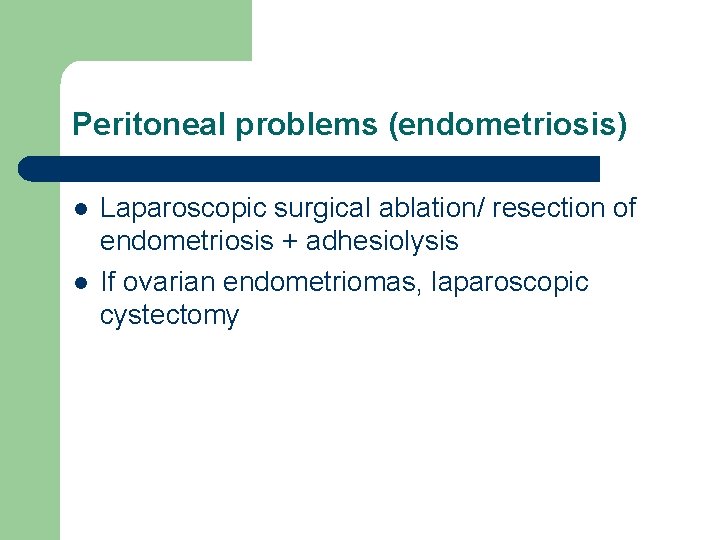
Peritoneal problems (endometriosis) l l Laparoscopic surgical ablation/ resection of endometriosis + adhesiolysis If ovarian endometriomas, laparoscopic cystectomy
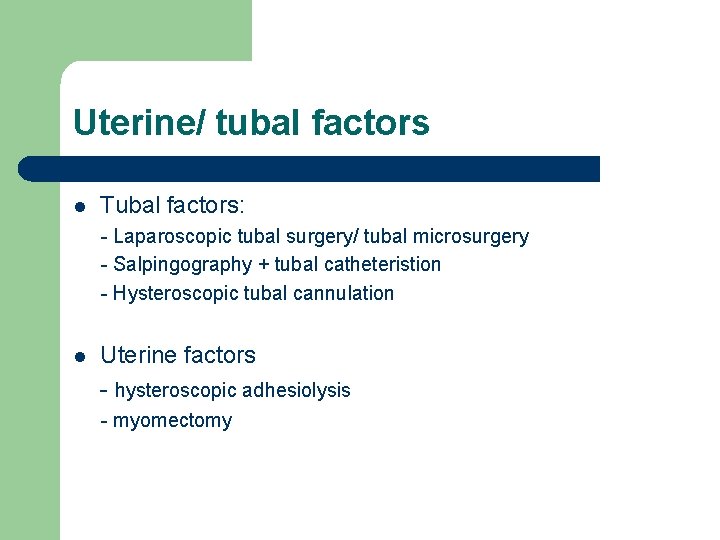
Uterine/ tubal factors l Tubal factors: - Laparoscopic tubal surgery/ tubal microsurgery - Salpingography + tubal catheteristion - Hysteroscopic tubal cannulation l Uterine factors - hysteroscopic adhesiolysis - myomectomy
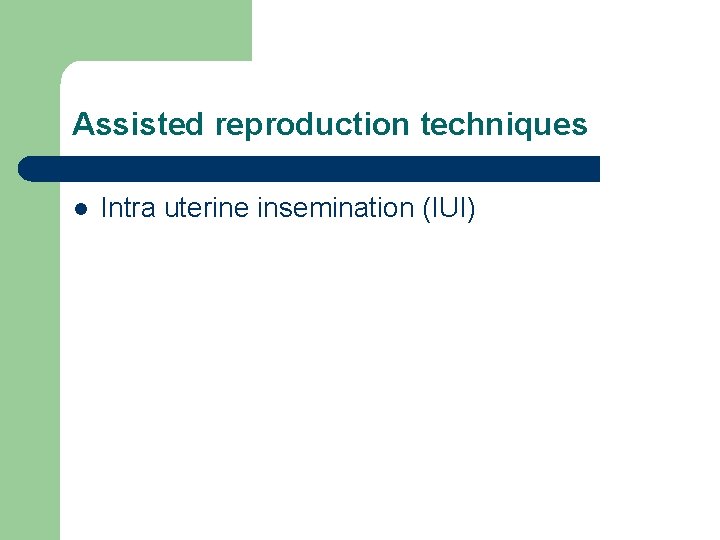
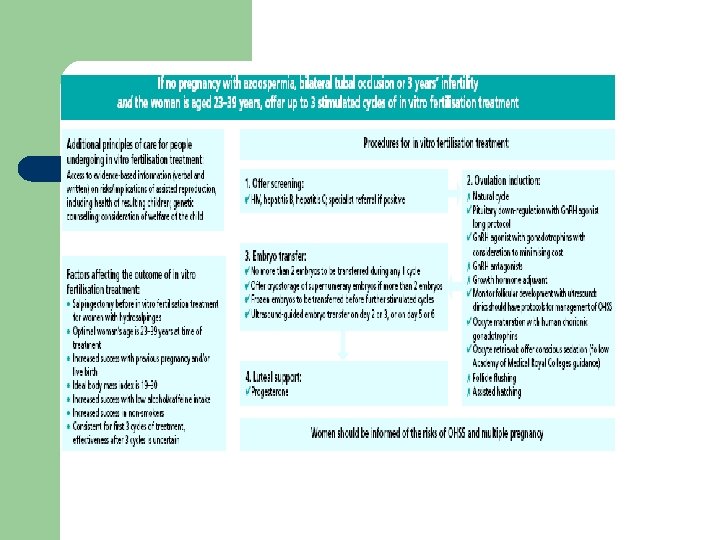
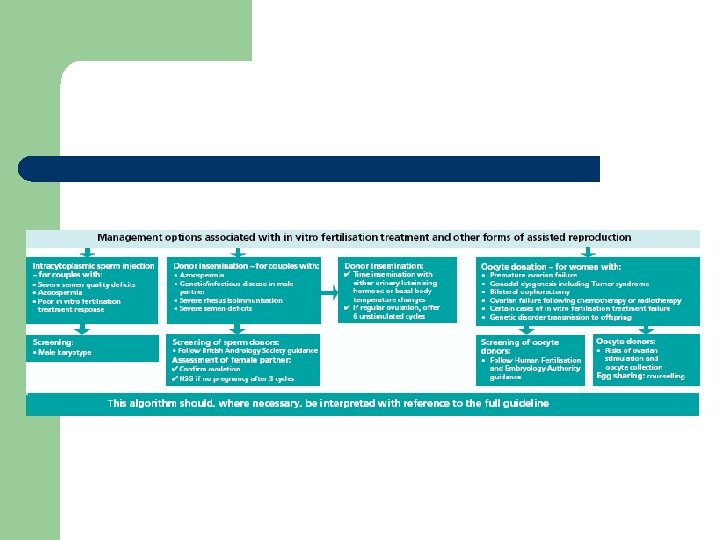
Assisted reproduction techniques l Intra uterine insemination (IUI)
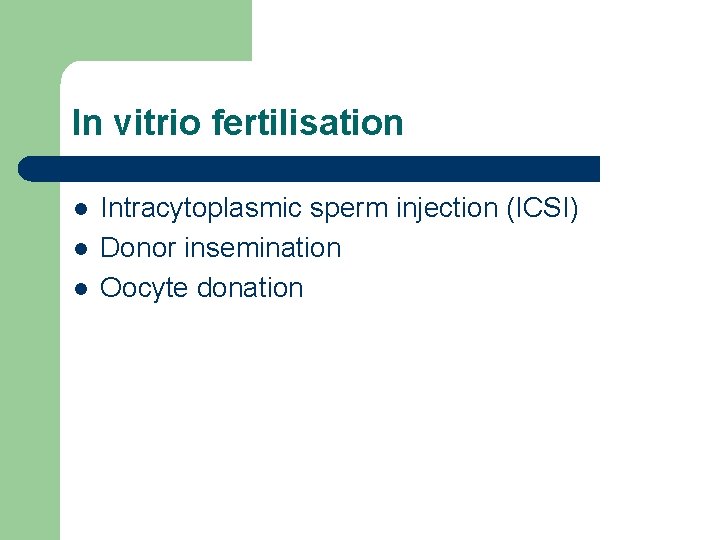
In vitrio fertilisation l l l Intracytoplasmic sperm injection (ICSI) Donor insemination Oocyte donation
ACON at CRH l l Satellite IVF unit Counselling, monitoring and most of treatment , except egg retrieval and embryo transfer.
Central unit l l l Clarendon Wing, LGI SJUH, Leeds CARE, Manchester
Questions…. . zzzz? ?