HYPERTENSIVE DISORDERS IN PREGNANCY CHIMEKA AWUTA COKER DEFINITION




- Slides: 34
HYPERTENSIVE DISORDERS IN PREGNANCY CHIMEKA AWUTA COKER
DEFINITION • Elevation of arterial pressure above the normal range. • It is the most common medical problem encountered in pregnancy complicating 2 -3% of pregnancies. • Normal range: <120/<80 mmhg • Stage. 1: 140 -159/90 -99 mmhg • Stage. 2: >160/100 mmhg • An increase in blood pressure by 30/15 mmhg in a pregnant woman warrants close observation • The pressure should be taken with the patient seated and calm
CLASSIFICATION • PREGNANCY INDUCED HYPERTENSION • PREECLAMPSIA-ECLAMPSIA • HELLP SYNDROME • CHRONIC HYPERTENSION WITH SUPERIMPOSED PREECLAMPSIA
COMMON RISK FACTORS • • • PRIMGRAVIDA POSITIVE FAMILY HX MULTIPLE PREGNANCY EXTREMES OF MATERNAL AGE(<18 >35) DIABETES MELLITUS HYDATIDIFORM MOLE HYDROPS FETALIS PRE. EXISTING HYPERTENSION BLACK RACE OBESITY
PREGNANCY INDUCED HYPERTENSION(gestational) • This means the rise in blood pressure as a result of the pregnancy. • It is encountered after 20 wks of gestation • Urinalysis does not elicit proteinuria • Normalization of blood pressure occurs postpartum • 1/3 of patients will develop preeclampsia • It maybe a harbinger of chronic hypertension later in life
TREATMENT • If the fetus is termed delivery is a resonable option • If the cervix is unfavourable and the disease is mild close observation and expectant management • If fetus is not termed : conservative management, antenatal fetal monitoring, outpatient vs inpatient • Serial lab. . also rule out severe disease
PREECLAMPSIA • This is defined as hypertension occuring after 20 wks of gestation together with proteinuria(300 mg) and oedema • Many primigravidas have BP of 100 -110/60 -70. . an increase in BP by 30/15 mmhg should be considered ominous • In the severe type the BP is usually >160/>100 mmhg when takenon two occasions 6 hrs apart • Proteinuria >2 g in 24 hrs or 2 -4+on dipstick testing • Cerebral or visual disturbance • Epigastric pain • Pulmonary oedema • Increased serum creatinine(>1. 2 mg/dl) • HELLP
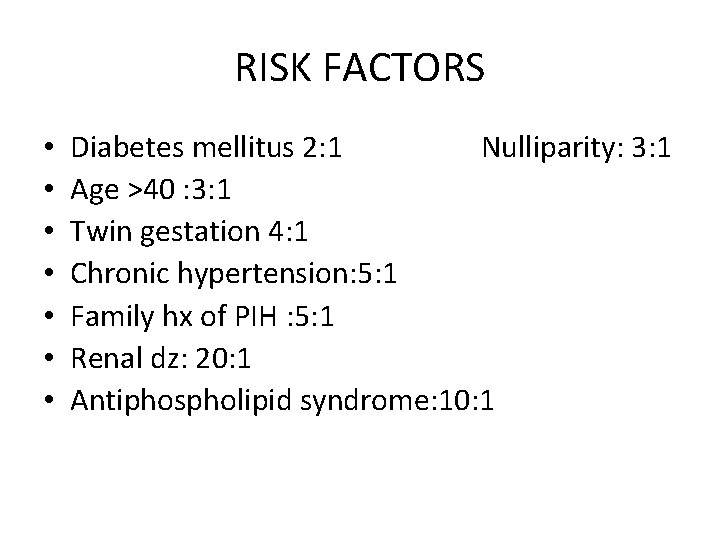
RISK FACTORS • • Diabetes mellitus 2: 1 Nulliparity: 3: 1 Age >40 : 3: 1 Twin gestation 4: 1 Chronic hypertension: 5: 1 Family hx of PIH : 5: 1 Renal dz: 20: 1 Antiphospholipid syndrome: 10: 1
PATHOPHYSIOLOGY • The exact mechanism is not known, however preeclampsia is a disorder of placental dysfunction leading to a syndrome of endothelial dysfunction with associated vasospasm • In most cases pathology demonstrates evidence of diffuse placental thrombosis, inflammatory placental decidual vasculopathy and or abnormal trophoblastic invasion of the endometrium • Another theory is that altered maternal immune response to fetal/placental tissue may contribute to the disease
cont • Imbalance between prostacyclin and thromboxane a 2 • Decreased GFR rates wih retension of salt and water are all theories • The pregnancy manifest dysfunction of multiple organ systems • CNS: eclampsia, cerebral haemorrhage as a result of thrombosis and fibrinoid necrosis of cerebral arterioles • HEPATIC: hepatic rupture, clotting dysfunction, HELLP syndrome • RENAL: glomeruloendotheliosis leading to < GFR, acute renal failure, cortical necrosis • CVS: Vasoconstriction leads to hypertension • The reduced blood volume causes chronic shock
cont • LUNGS: Pulmonary oedema seen more in patients with underlying chronic hypertension • Mendelsons syndrome(aspiration pneumonia in pregnancy) • BLOOD…DIC, Microangiopathic haemolytic anaemia, thrombocytopenia • FETUS: Placental abruptio, intrauterine growth retardation, still birth because of impaired uteroplacental ciculation
management • Ultimate cure is bedrest and delivery • Antihypertensives are withheld untill diastolic press exceed 100 mmhg and gestational age is 30 wks or less • Assess the gestational age • Assess cervix • Assess fetus 2 x a wk • Lab/urinalysis, creatinine etc • Warn patients of danger signs
INDICATIONS FOR DELIVERY BP >100 mmhg(diastolic) in a 24 hr period Persisitent headache Epigastric pain HELLP syndrome Pulmonary oedema Rising serum creatinine and abnormal liver fnx test • Unfavourable fetus • • •
TX Severe preeclamsia • • Prevent convulsions Control maternal pressure Initiation of delivery If severe preeclampsia dev at or beyond 36 wks delivery is the ultimate goal At 32 -34 wks consider for delivery and corticosteroids for the fetus At 23 -32 wks delivery may be delayed to reduce perinatal morbidity and mortality. Mother should be placed on mgso 4 for 24 hrs and given corticosteriods for fetal lung maturity… If < 32 WKS consider cesarian section. . if cervix is favourable consider oxytocin Less than 23 wks. . induction of labour to terminate pregnancy (vaginal delivery preferable)
ECCLAMPSIA • Occurs in 0. 2 -0. 5% of all pregnancies • 75% of the seizures occur before delivery • 50% postpartum ecclamptic seizures occur in first 48 hrs after delivery but may ooccur as late as 6 wks postpartum • The seizure activity is unrelated to other CNS disorders with or without resultant coma • Associated with 50000 death a year
pathophysiology • Platlet thrombi • Hypoxia due to localised vasocostiction
• Patients present with tonicclonic seizures ie one or two • Hyperventilates to compensate for resp and lactic acidosis • Head trauma • Tongue biting • Pulmonary oedema
Tx A. B. C Protect patient Iv access Catheterization, assess reflex and resp rate Mgso 4. . 4 -6 g stat in 250 mg 5%dextrose and run for 15 -30 min. . then 1 -2 g/hr for 24 hrs • If not effective admin another 2 g • Mgso 4 works as a centraly active anticonvulsant and blocks neuromuscular conduction • • •
Side effects • • • Resp rate< 12 Urine output<25 -30 cc/hr Hyporeflex Altered sensorium Antidote: 10 mls of 10% solution of calcium gluconate over 3 min iv
Alternatives • • Diazepam 5 -10 mg iv Sodium amytal 100 mgiv Pentobarbital 125 mg iv Dilantin 500 -1000 mg iv infusion
cont • • After the seizures Assess fetal well being Lab Effect delivery
complications • Pulmonary oedema; common after delivery because of reduced coloidal oncotic pressure • Tx. . frusemide 10 -20 mg iv • fluid restriction • Oliguria • DIC • SHOCK
HELLP syndrome • Haemolysis, elevated liver enzymes(2 x normal), low platlets(< 100000) • A variant of severe preeclampsia • Tx : lab • fetal assessment • steriods • antihypertensives
CHRONIC HYPERTENSION Occurs in 22% of women of childbearing age Hypertension occuring before 20 wk Hypertension persisting 6 wks postpartum In 80% of cases is idiopathic(primary) In 20% of cases is due to renal causes(secondary) ie chronic glomerulo nephritis, Ig. A nephropathy, diabetic glomerulonephritis • Others: cushings dz, thyrotoxicosis, pheochromocytoma • • •
• Patients are over 30 yrs, obese, multiparous, with diabetic or renal disease • Incidence higher in blacks, family hx, • Patients have hypertension without other signs of preeclampsia
mx • Lab: ideally prior to pregnancy(echo, ecg, opthamologic exam, renal sonography) • Assess fetus • Assess mother • Iv access • Antihypertensives to decrease incidence of strokes and heart failure in pregnant patients with diastolic press exceeding 110 mmhg • If the disease is mild benefits of antihypertensives is controvertial because the benefits are seen after 5 yrs and not 9 mnth
VASODILATORS • Key: avoid multiple doses in rapid succession • Avoid over tx • Hydralazine, Nifedipine, Nitropruside
cont • Avoid the rapid reduction of blood pressure • Precipitates fetal distress
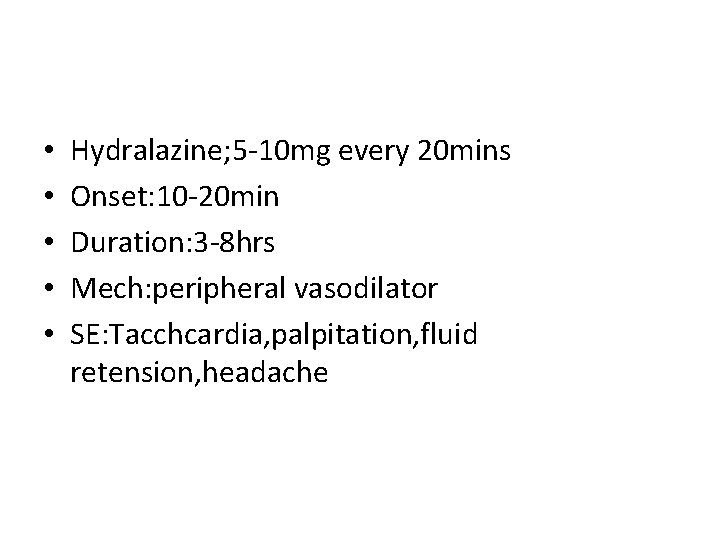
• • • Hydralazine; 5 -10 mg every 20 mins Onset: 10 -20 min Duration: 3 -8 hrs Mech: peripheral vasodilator SE: Tacchcardia, palpitation, fluid retension, headache
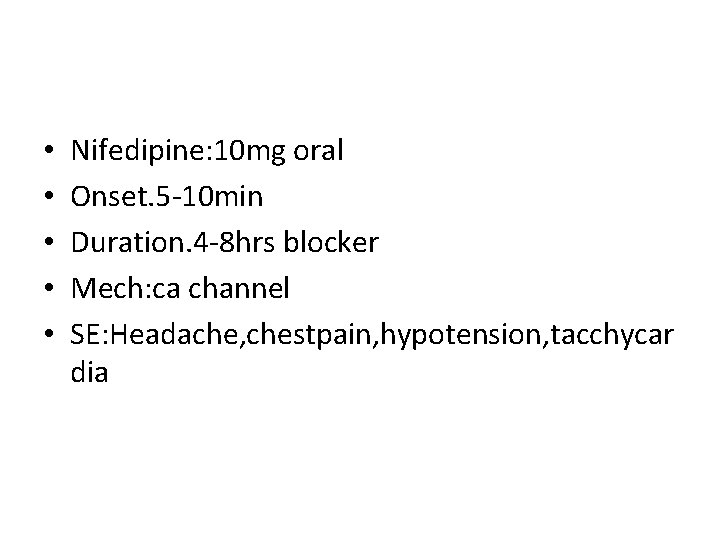
• • • Nifedipine: 10 mg oral Onset. 5 -10 min Duration. 4 -8 hrs blocker Mech: ca channel SE: Headache, chestpain, hypotension, tacchycar dia
• Labetalol: 20 mg, then 40 then 80 mg every 20 min…total 220 mg • Onset 1 -2 miduration 6 -16 hr • Mech: alpha-beta blocker • Admin: oral or iv • SE : Hypotension, urinary difficulty
• • • Methyl dopa: Central alpha adrenergic agonist 250 mg tds or qds Max effect 4 -6 hrs later SE. potural hypotension, hamolytic anaemia <5% of patients
complication • Main maternal complication is superimposed preecclampsia which occurs in 1/3 of patients(26 -34 wk). The prognosis is worse for both mother and fetus. . patient present with worsening hypertension together with non. dependent edema and proteinuria • Placenta abruptio • Prematurity • Intrauterine growth retardation • Stillbirth
NOTE • In all patients the criteria for diagnosis should be exhausted • FETAL monitoring and GA IS VERY IMPT • Always give mgso 4 as seizure prophylaxis • Delivery should be at a hospital and the timing is critical