
Management of Hypertensive Emergencies Dr Abdulkareem Alsuwiada FRCPC
Management of Hypertensive Emergencies Dr. Abdulkareem Alsuwiada, FRCPC, MSc
Learning Objectives n n To identify and triage severe hypertensive states accurately To effectively manage hypertensive crises with drug therapy

Hypertensive Urgency n “Severe elevation of blood pressure” n n Generally DBP >115 -130 No progressive end organ damage
Hypertensive Emergency § Hypertensive Emergency: Severe elevation in blood pressure in the presence of acute or ongoing end-organ damage.
“Recognition of hypertensive emergency depends on the clinical state of the patient, not on the absolute level of blood pressure”

Target Organs
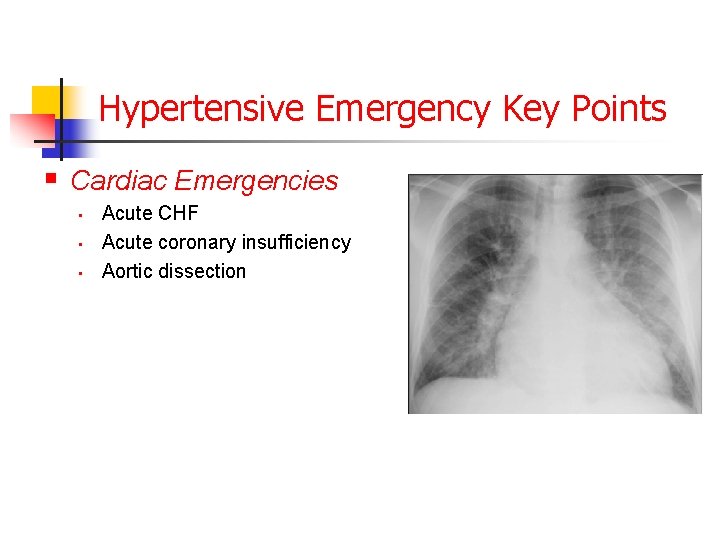
Hypertensive Emergency Key Points § Cardiac Emergencies • • • Acute CHF Acute coronary insufficiency Aortic dissection
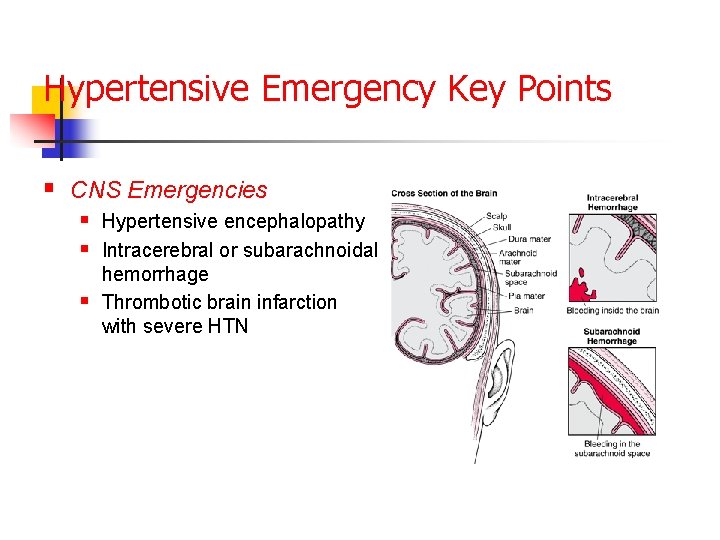
Hypertensive Emergency Key Points § CNS Emergencies § Hypertensive encephalopathy § Intracerebral or subarachnoidal § hemorrhage Thrombotic brain infarction with severe HTN
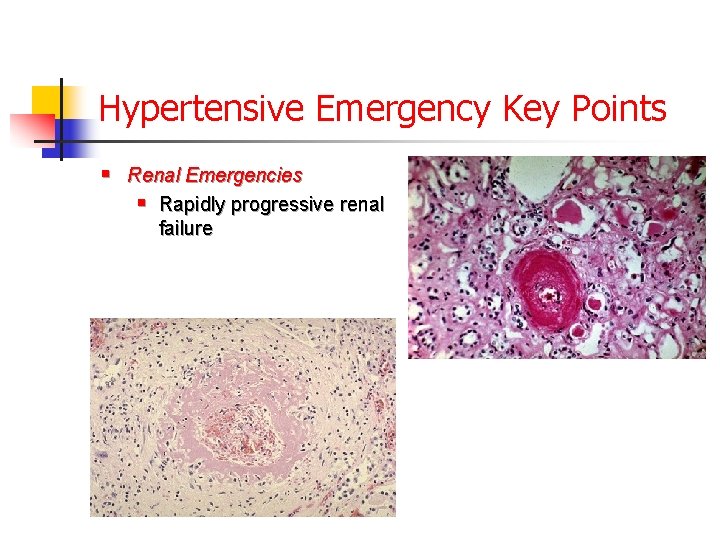
Hypertensive Emergency Key Points § Renal Emergencies § Rapidly progressive renal failure
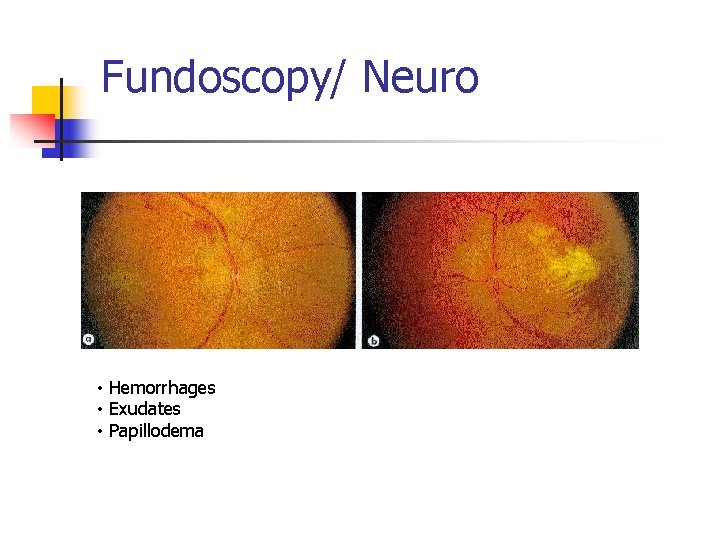
Fundoscopy/ Neuro • Hemorrhages • Exudates • Papillodema
Urgency vs. Emergency n Distinguishing between hypertensive emergency and urgency is a crucial step in appropriate management

Urgency vs. Emergency n Urgency n n No need to acutely lower blood pressure May be harmful to rapidly lower blood pressure Death not imminent Emergency n n Immediate control of BP essential Irreversible end organ damage or death within hours
Approach to Patients
Approach to patients n Recheck blood pressure! n n Appropriate size cuff Cuff not over clothing Check in all limbs History n n n Prior crises Renal disease Medications n Compliance n Recreational drugs
Approach to patients n Physical Exam n Signs of end organ damage?
Neuro n Hypertensive encephalopathy n n n Severe Headache Nausea/Vomiting Papilledema Visual Changes Seizures Focal Neurological Deficits n Ischemic vs hemorrhagic CVA
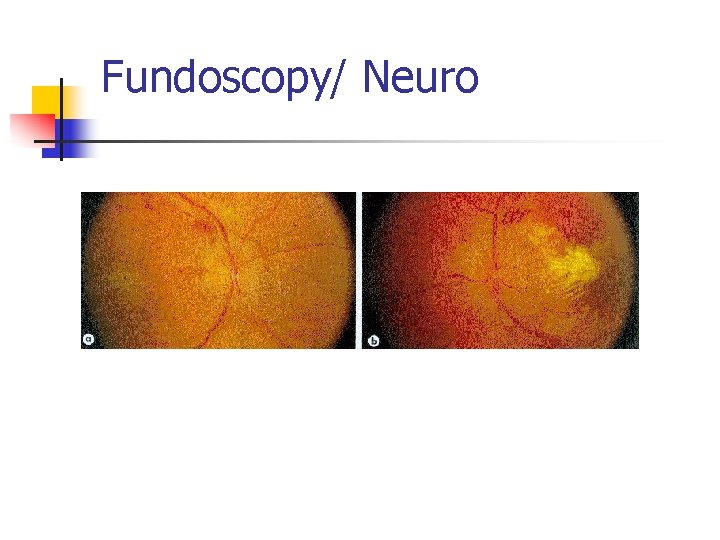
Fundoscopy/ Neuro
Cardiac n Cardiac ischemia n n n Chest pain EKG for ischemic changes Acute left ventricular failure n n Pulmonary edema Hypoxia EKG for left ventricular strain pattern CXR
Renal n n Electrolytes BUN/Cr n n n Chronic failure/insufficiency vs acute failure Cause vs effect UA with micro n n n Protein Blood Casts
Major Causes of Hypertensive Emergencies and Urgencies n n n Untreated essential hypertension Withdrawal / non-adherence to antihypertensive drug therapy Development of secondary hypertension
Major Causes of Hypertensive Emergencies and Urgencies n n Renal Disease Renal artery stenosis Pregnancy Endorine n n Pheochromocytoma Primary aldosteronism Glucocorticoid excess Renin-secreting tumors
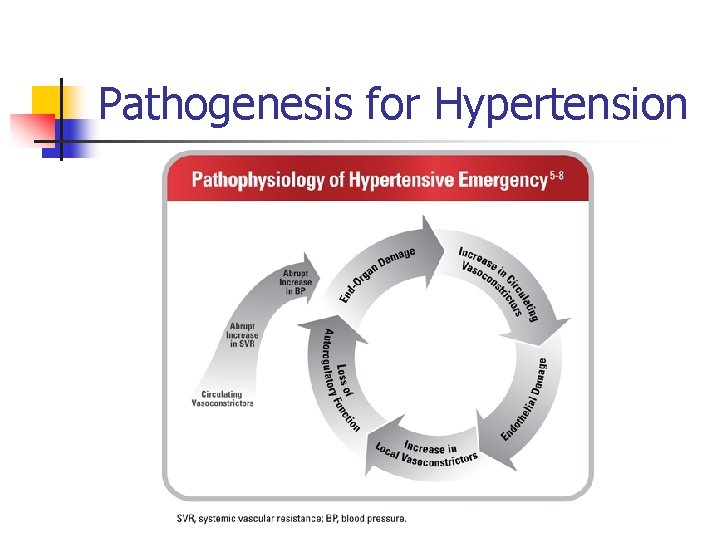
Pathogenesis for Hypertension n Arterial and arteriolar vasoconstriction n n Prevents the increase in pressure from being transmitted to the smaller, more distal vessels With increasingly severe hypertension n Autoregulation failure Vascular endothelial injury Plasma constituents (including fibrinoid material) to enter the vascular wall n n narrowing or obliterating the vascular lumen. Tissue edema and activation of endothelial vasoactive system
Pathogenesis for Hypertension
Pathogenesis for Hypertension n Arterial and arteriolar vasoconstriction n n Prevents the increase in pressure from being transmitted to the smaller, more distal vessels With increasingly severe hypertension n Autoregulation failure Vascular endothelial injury Plasma constituents (including fibrinoid material) to enter the vascular wall n n narrowing or obliterating the vascular lumen. Tissue edema and activation of endothelial vasoactive system
Goals of Treatment
Goals of Treatment n Prevent end organ damage n NOT normalize BP n Exceptions? ?
HTN Urgencies: Goals of Therapy n n n No proven benefit of rapid BP reduction in asymptomatic patients Goal BP <160/110 mm Hg over several hours, oral therapy Initial BP fall less than 25% in first six hours can be managed using oral antihypertensive agents in an outpatient or same-day observational setting Ensure follow-up: Long-term management
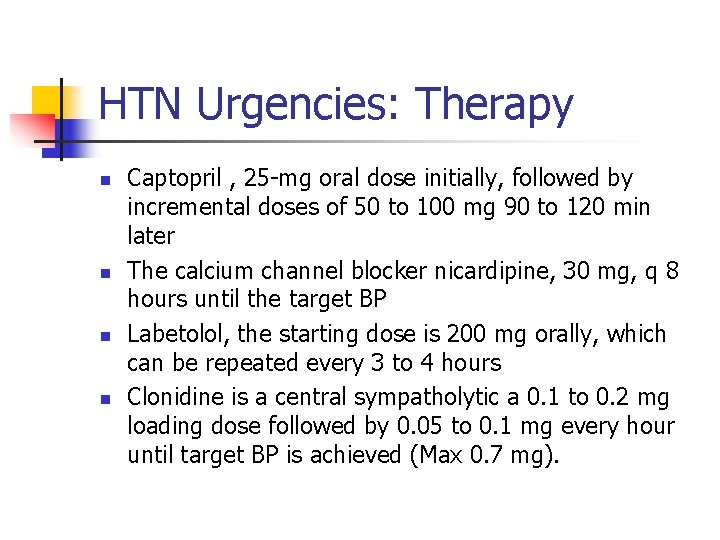
HTN Urgencies: Therapy n n Captopril , 25 -mg oral dose initially, followed by incremental doses of 50 to 100 mg 90 to 120 min later The calcium channel blocker nicardipine, 30 mg, q 8 hours until the target BP Labetolol, the starting dose is 200 mg orally, which can be repeated every 3 to 4 hours Clonidine is a central sympatholytic a 0. 1 to 0. 2 mg loading dose followed by 0. 05 to 0. 1 mg every hour until target BP is achieved (Max 0. 7 mg).
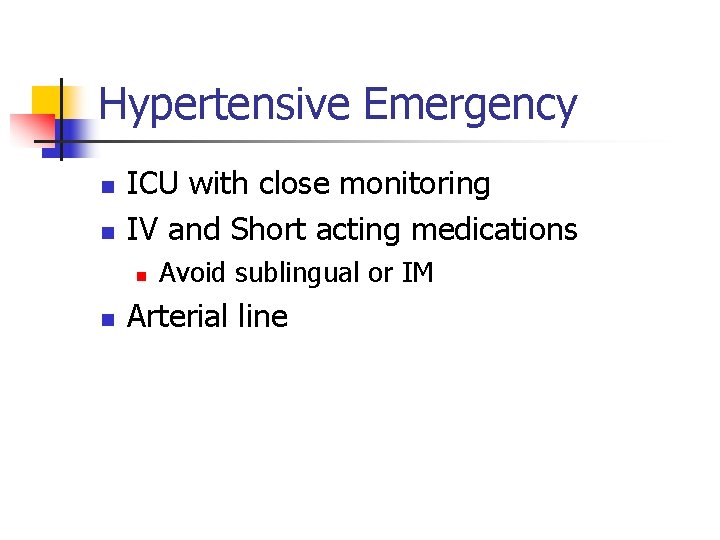
Hypertensive Emergency n n ICU with close monitoring IV and Short acting medications n n Avoid sublingual or IM Arterial line
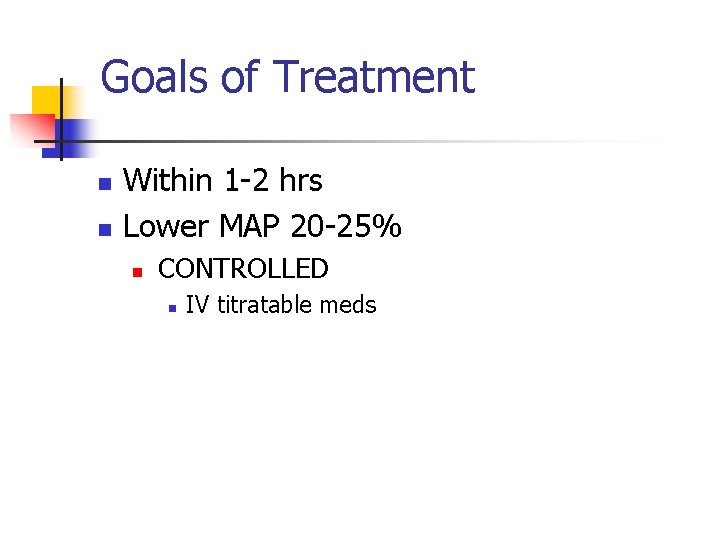
Goals of Treatment n n Within 1 -2 hrs Lower MAP 20 -25% n CONTROLLED n IV titratable meds
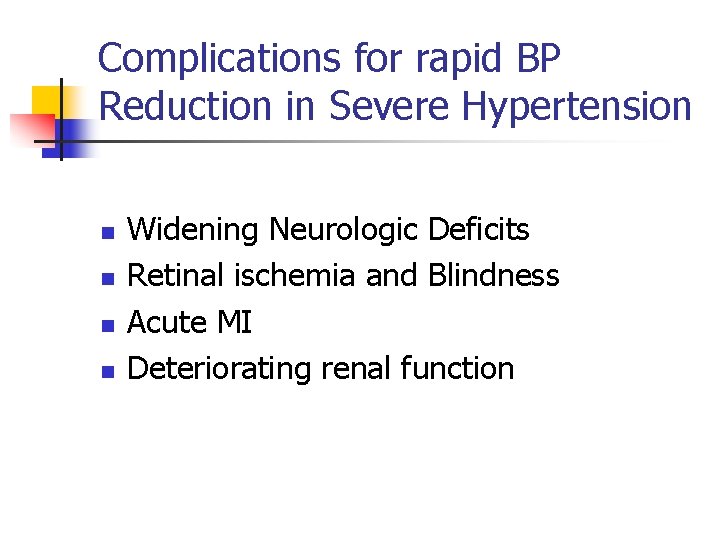
Complications for rapid BP Reduction in Severe Hypertension n n Widening Neurologic Deficits Retinal ischemia and Blindness Acute MI Deteriorating renal function

Goals of Treatment WHY ?
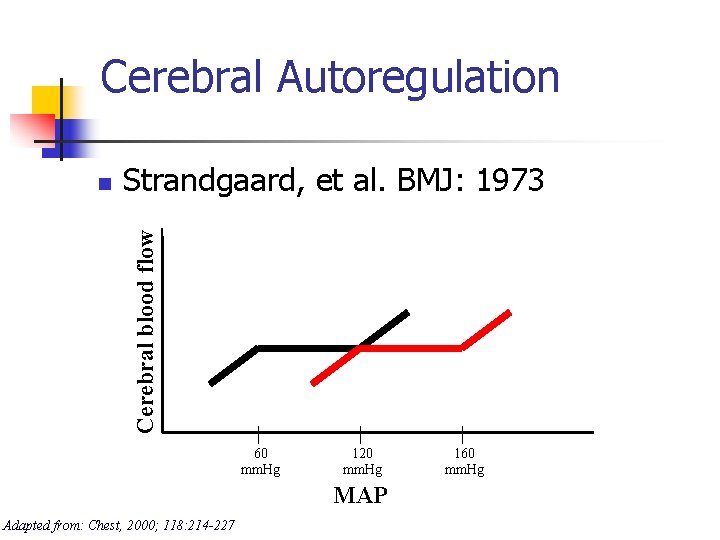
Cerebral Autoregulation Strandgaard, et al. BMJ: 1973 Cerebral blood flow n 60 mm. Hg 120 mm. Hg MAP Adapted from: Chest, 2000; 118: 214 -227 160 mm. Hg

Pharmacotherapy
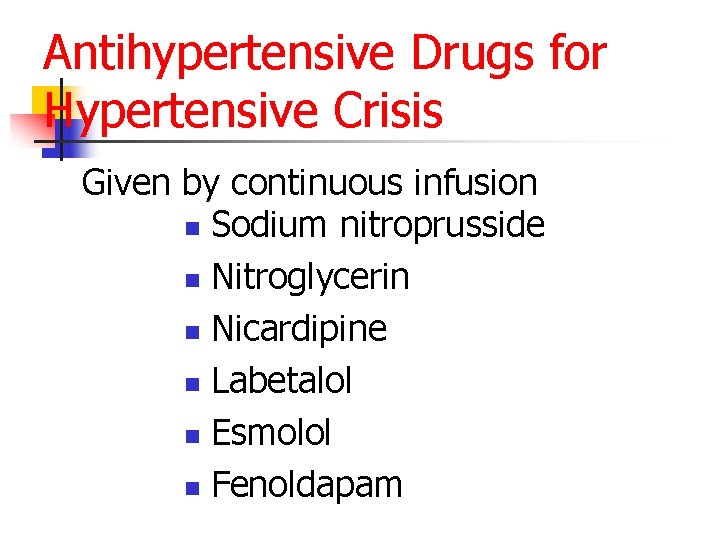
Antihypertensive Drugs for Hypertensive Crisis Given by continuous infusion n Sodium nitroprusside n Nitroglycerin n Nicardipine n Labetalol n Esmolol n Fenoldapam
Specific Treatment
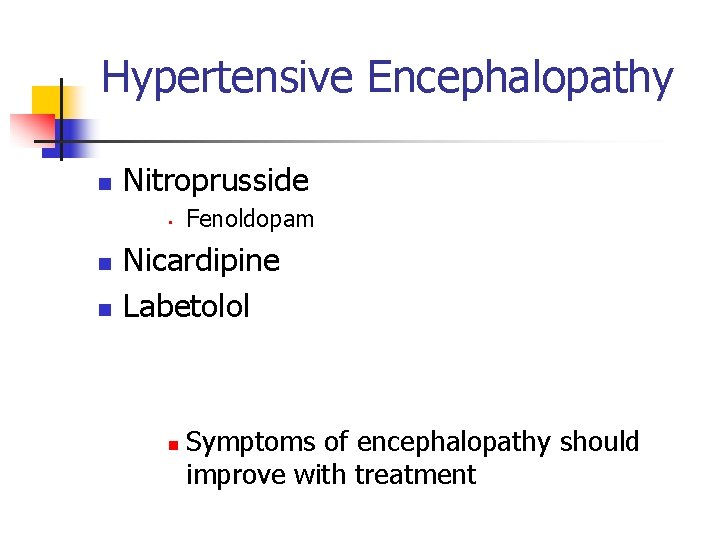
Hypertensive Encephalopathy n Nitroprusside • n n Fenoldopam Nicardipine Labetolol n Symptoms of encephalopathy should improve with treatment
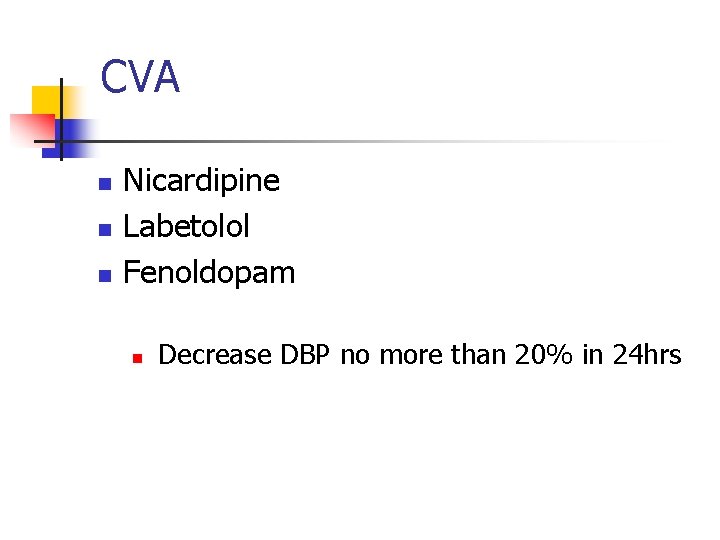
CVA n n n Nicardipine Labetolol Fenoldopam n Decrease DBP no more than 20% in 24 hrs
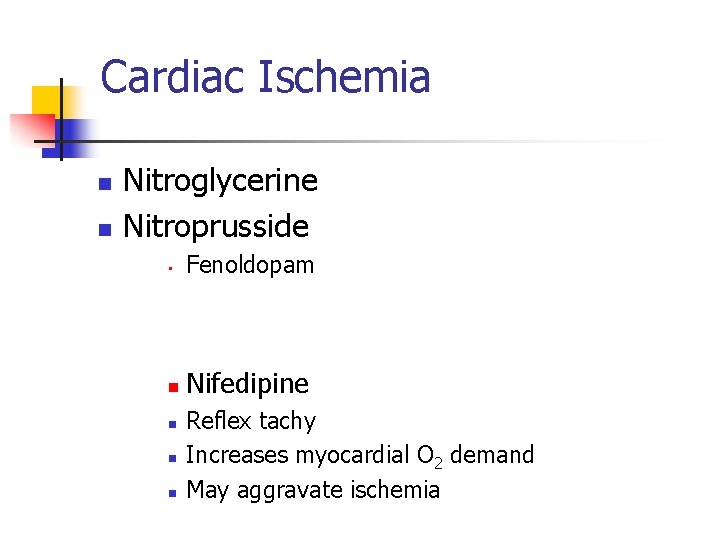
Cardiac Ischemia n n Nitroglycerine Nitroprusside • Fenoldopam n Nifedipine n n n Reflex tachy Increases myocardial O 2 demand May aggravate ischemia
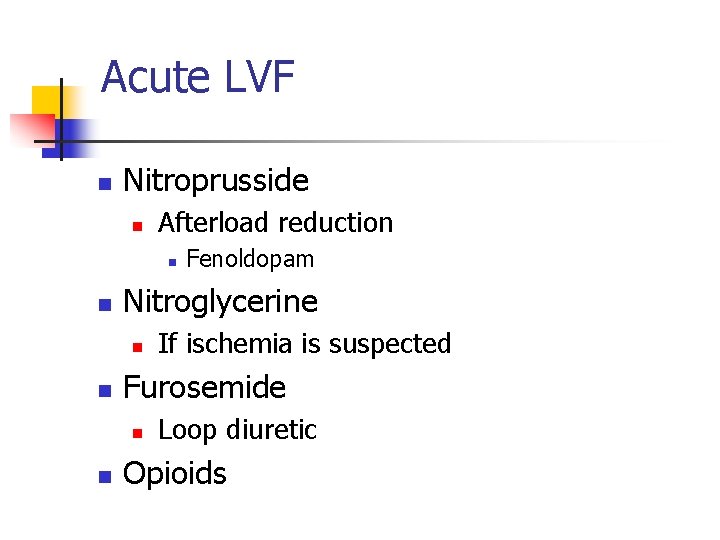
Acute LVF n Nitroprusside n Afterload reduction n n Nitroglycerine n n If ischemia is suspected Furosemide n n Fenoldopam Loop diuretic Opioids
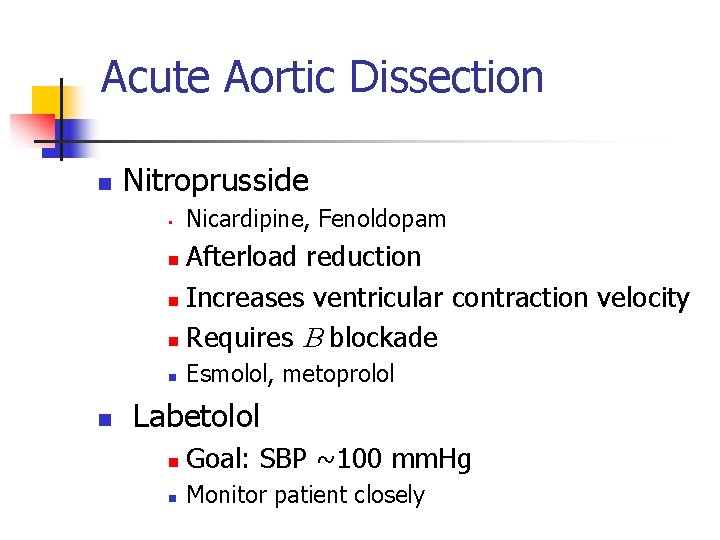
Acute Aortic Dissection n Nitroprusside • Nicardipine, Fenoldopam Afterload reduction n Increases ventricular contraction velocity n Requires B blockade n n n Esmolol, metoprolol Labetolol n Goal: SBP ~100 mm. Hg n Monitor patient closely
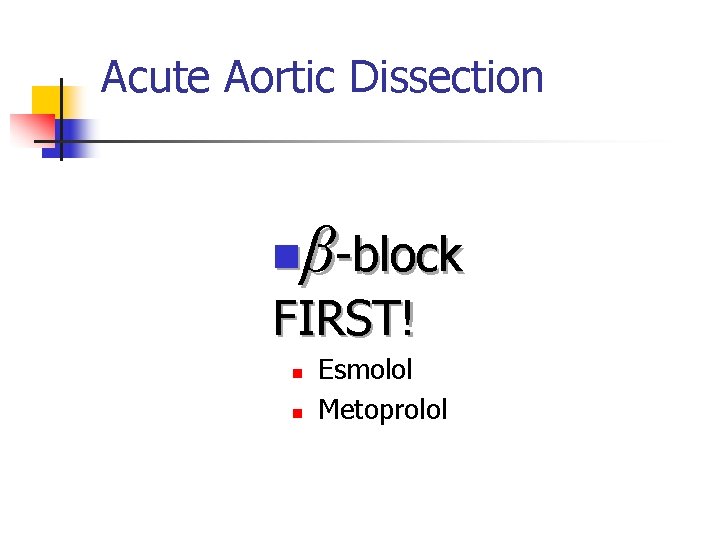
Acute Aortic Dissection β n -block FIRST! n n Esmolol Metoprolol
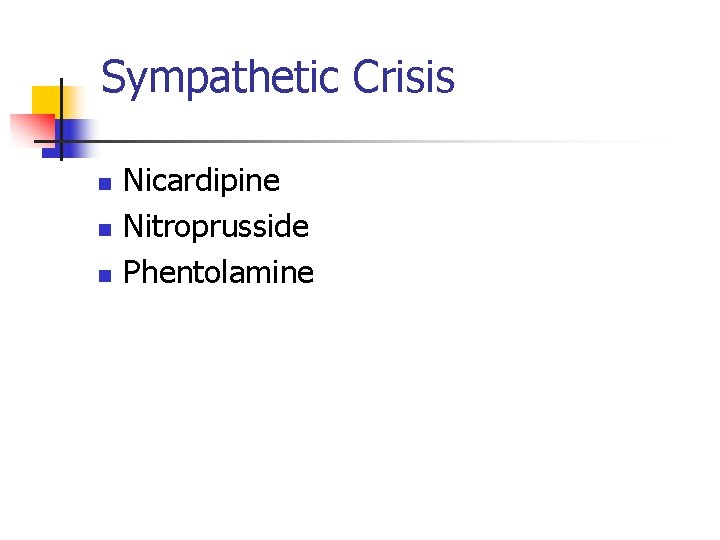
Sympathetic Crisis n n n Nicardipine Nitroprusside Phentolamine
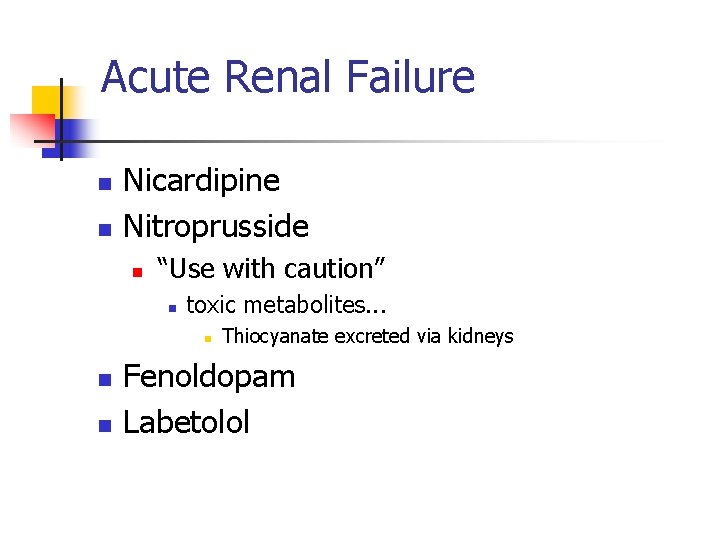
Acute Renal Failure n n Nicardipine Nitroprusside n “Use with caution” n toxic metabolites. . . n n n Thiocyanate excreted via kidneys Fenoldopam Labetolol
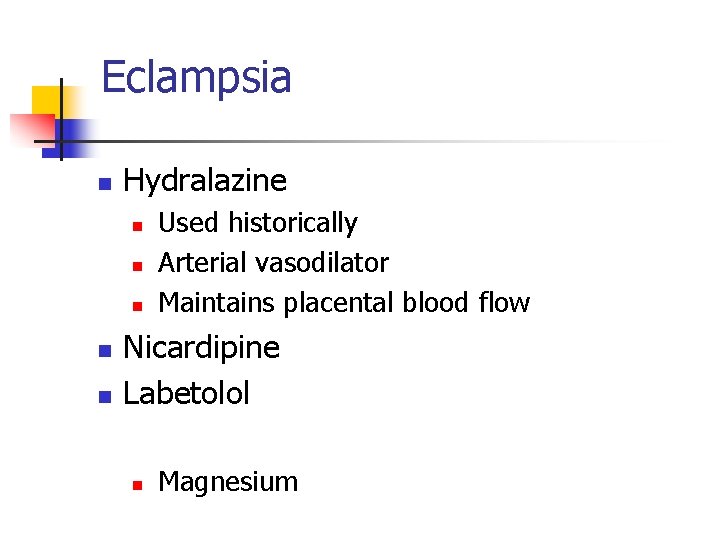
Eclampsia n Hydralazine n n n Used historically Arterial vasodilator Maintains placental blood flow Nicardipine Labetolol n Magnesium
The Discharged Patient
The discharged patient n JNC-VII Recommendations n Stage 2 n Combination tx n n Thiazide + ACEI, ARB, BB, CCB “Compelling Indications”. . .
The discharged patient n JNC-VII Recommendations n “Compelling Indications” n URGENCY: n n n ALL PATIENTS WITH HTN URGENCY BEING DISCHARGED HOME SHOULD BE PLACED ON COMBINATION THERAPY AND HAVE RAPID FOLLOW UP. THIAZIDE ACEI / ARB / BB / CCB
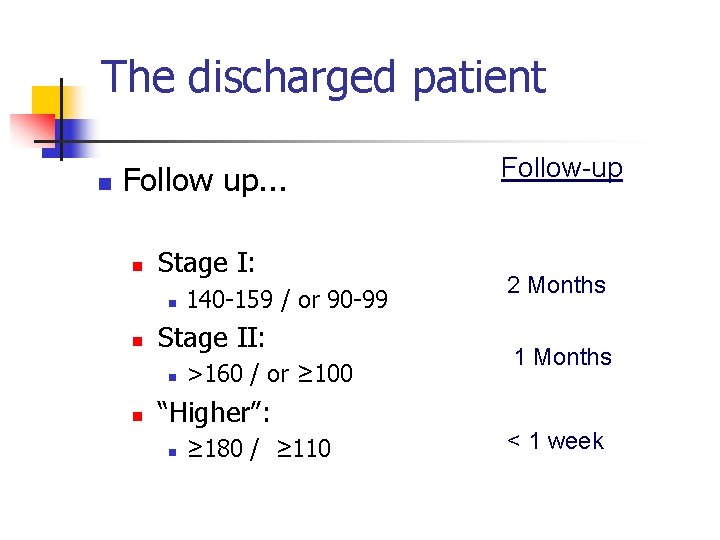
The discharged patient n Follow up. . . n Stage I: n n Stage II: n n 140 -159 / or 90 -99 >160 / or ≥ 100 “Higher”: n ≥ 180 / ≥ 110 Follow-up 2 Months 1 Months < 1 week
Goals of therapy in JNC 7 & Euro Guidelines n Maximum reduction in long-term total risk of cardiovascular morbidity and mortality: n n n Smoking Life style modification Lipid Diabetes Blood pressure n n < 140/90 If DM or renal disease n <130/80
The following 5 patients in ER n n n Patient A is a 65 -year-old man with nausea, vomiting, and confusion. Patient B is a 73 -year-old woman with sudden shortness of breath, pink sputum, and heavy chest pain. Patient C is a 56 -year-old man with sharp, tearing chest and back pain. Patient D is a 64 -year-old woman with a 6 -hour history of right-sided weakness. Patient E is a 51 -year-old woman with a mild headache, concerned about her history of hypertension.
n n all 5 patients arrive with identical vital signs: BP of 209/105 mm Hg Which of the 5 patients require emergent hypertension treatment?
Patient A is a 65 -year-old man with nausea, vomiting, and confusion. n n Hypertensive encephalopathy Pure vasodilators like nitroprusside have risks of intracranial shunting, which could increase intracranial pressure. Drug of choice: Intravenous labetalol, bolus or infusion. Target: Reduce MAP by 20% to 25% over 2 to 8 hours.
Patient B: 73 -year-old woman with sudden shortness of breath, pink sputum, and heavy chest pain. n n Physical examination reveals bilateral crackles in her lungs, an elevated JVP, and no heart murmurs. Acute pulmonary edema often presents with extreme hypertension, which overloads cardiac reserve. Drug of choice: Nitroglycerin infusion; IV enalaprilat or sublingual captopril. Target: Reduce MAP by 20% to 25% and symptomatic improvement.
Patient C: 56 -year-old man with sharp, tearing chest and back pain. n n Physical examination reveals differential BPs and evidence of a new aortic insufficiency murmur. Aortic dissection is largely a disease of hypertension. Drug of choice: Nitroprusside or esmolol infusion; labetalol boluses or infusion. Target: Rapidly reduce systolic BP to 110 mm Hg if there is no evidence of hypoperfusion.
Patient D: 64 -year-old woman with a 6 hour history of right-sided weakness. n n n Marked right-sided hemiplegia is noted. a higher MAP is essential to maintaining adequate cerebral blood flow and not extending the affected stroke territory. BP should not be lowered in the acute period except in extreme situations n n BP > 220/120 mm Hg in embolic CVA > 180/100 in hemorrhagic CVA
Patient D: 64 -year-old woman with a 6 hour history of right-sided weakness. n Drug of choice: Labetalol; nicardipine; hydralazine. n Target: n n If no thrombolytic is given, reduce BP only if it is greater than 220/120 mm Hg (embolic) or greater than 180/100 mm Hg (hemorrhagic) If a thrombolytic is given, reduce BP to 180/100 mm Hg.
Patient E: 51 -year-old woman with a mild headache, concerned about her history of hypertension. n These patients require gradual BP reduction over time on an outpatient basis
Summary n n Accurate history and timeline of onset Evaluate Target organ injury Set the time frame for intervention Appropriate “pace” of therapy n n n Initial reduction Stabilization Follow-up care/ Diagnostic studies
Questions. . . n Comments…
- Slides: 60