Human Vision Physiology CS 498 Virtual Reality UNIVERSITY

- Slides: 35
Human Vision: Physiology CS 498: Virtual Reality UNIVERSITY OF ILLINOIS AT URBANA-CHAMPAIGN Eric Shaffer
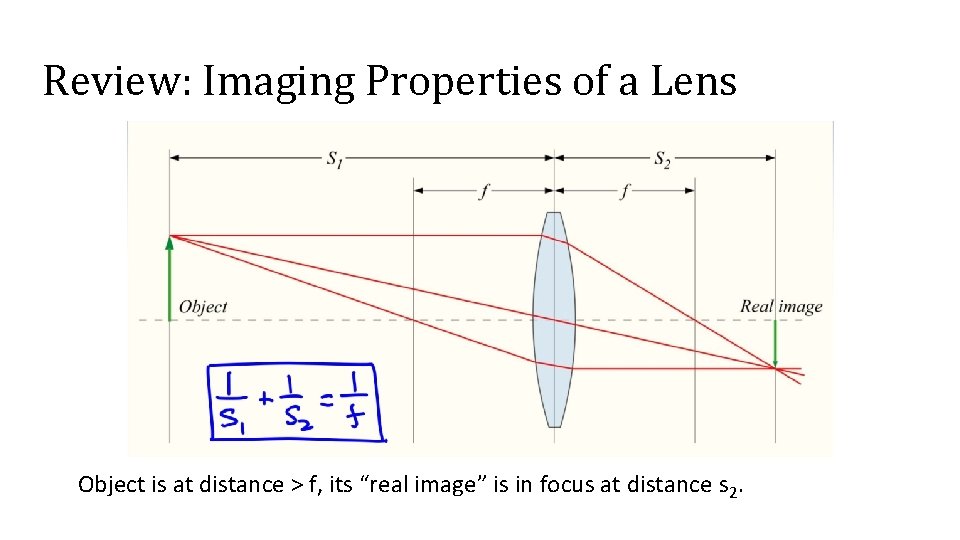
Review: Imaging Properties of a Lens Object is at distance > f, its “real image” is in focus at distance s 2.
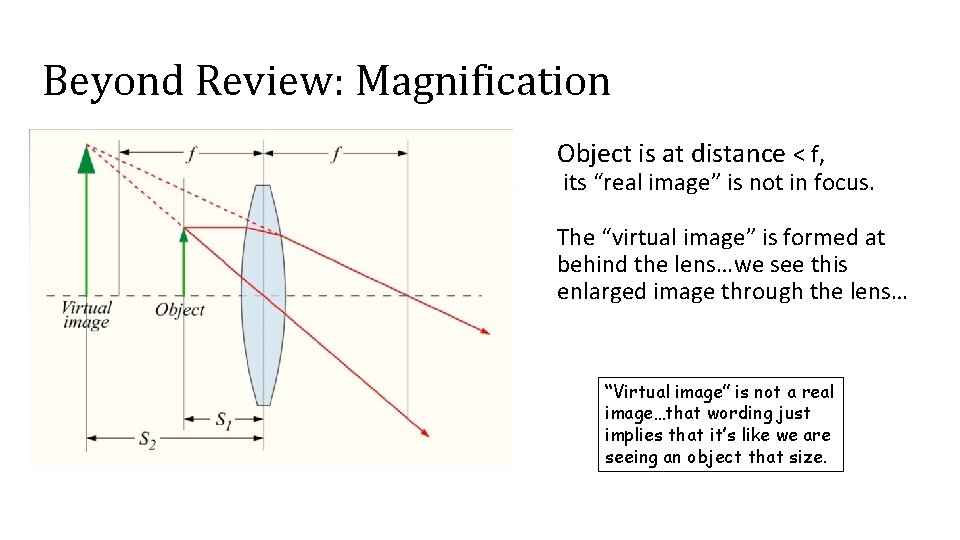
Beyond Review: Magnification Object is at distance < f, its “real image” is not in focus. The “virtual image” is formed at behind the lens…we see this enlarged image through the lens… “Virtual image” is not a real image…that wording just implies that it’s like we are seeing an object that size.
What is a Diopter? ● ● Diopter measures how much the lens bends light Magnification measure by what factor the size of the image is increased ○ These quantities are related…can you derive the conversion?
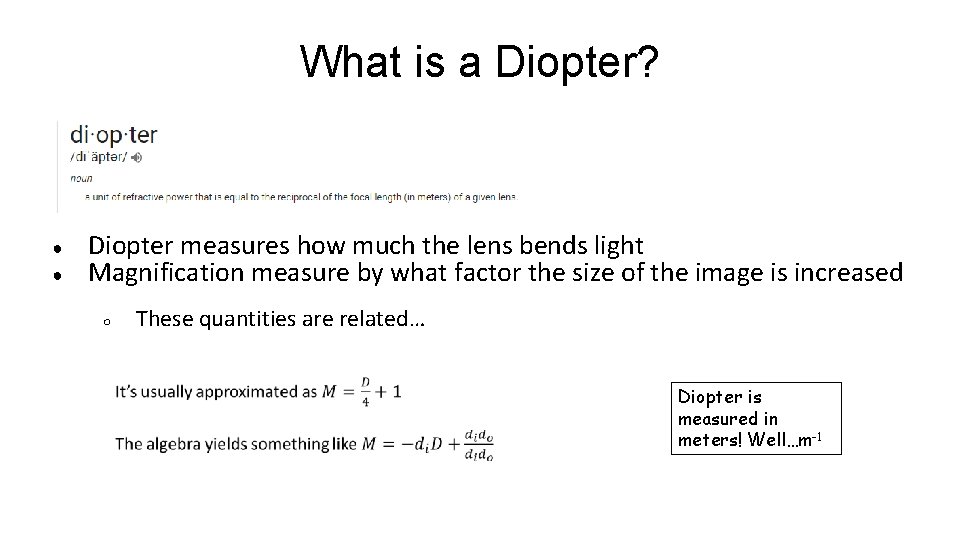
What is a Diopter? ● ● Diopter measures how much the lens bends light Magnification measure by what factor the size of the image is increased These quantities are related… ○ Diopter is measured in meters! Well…m-1
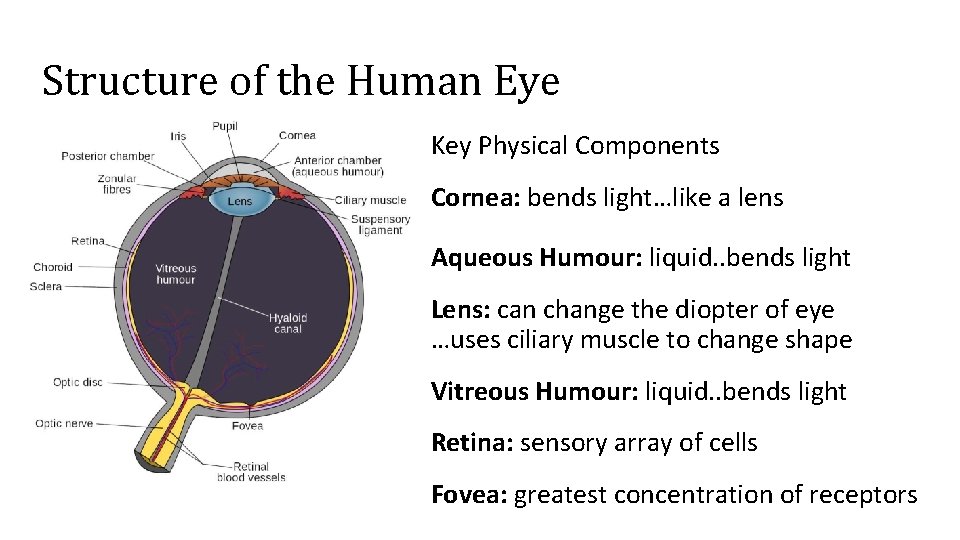
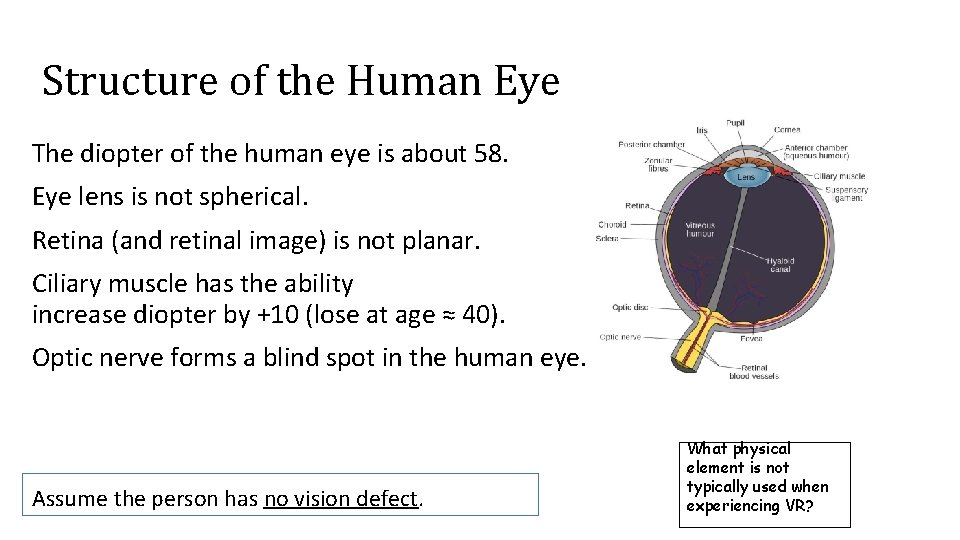
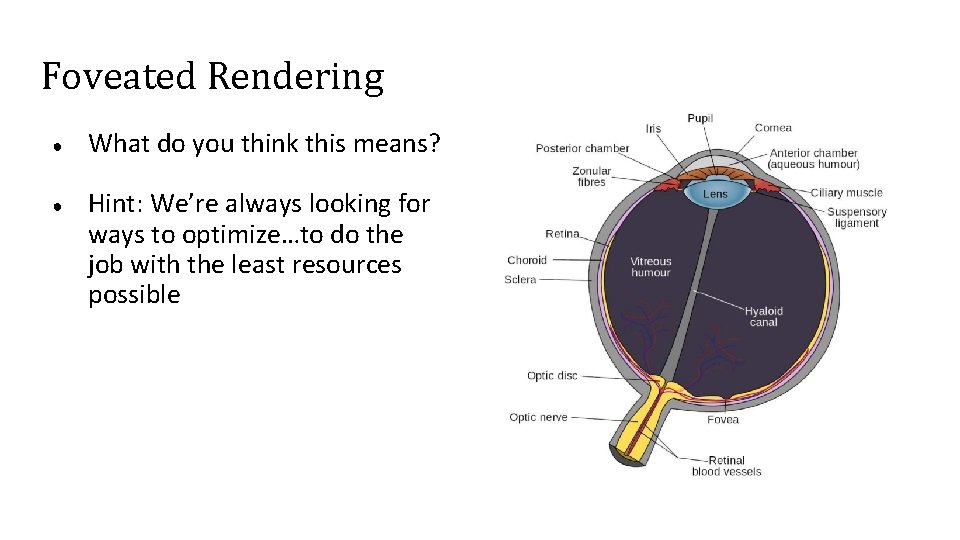
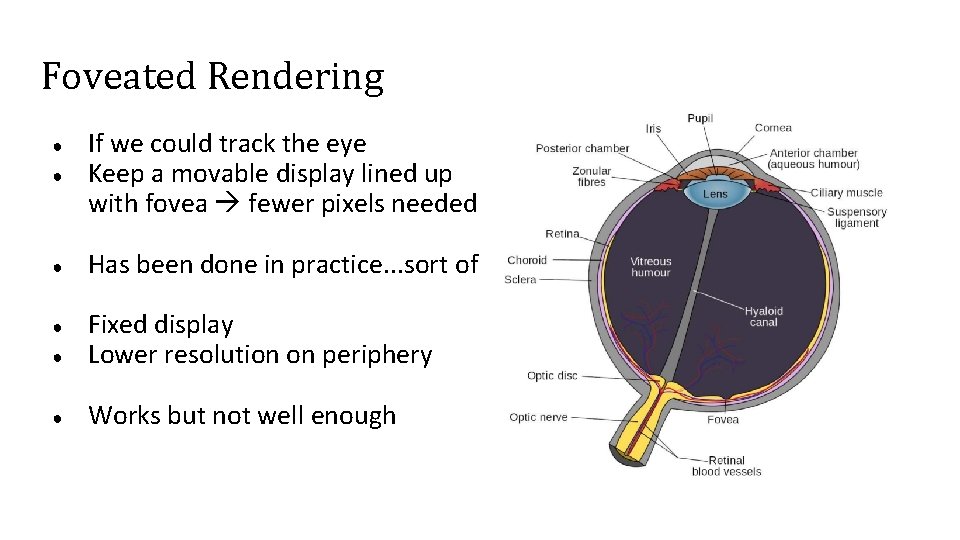
Structure of the Human Eye Key Physical Components Cornea: bends light…like a lens Aqueous Humour: liquid. . bends light Lens: can change the diopter of eye …uses ciliary muscle to change shape Vitreous Humour: liquid. . bends light Retina: sensory array of cells Fovea: greatest concentration of receptors
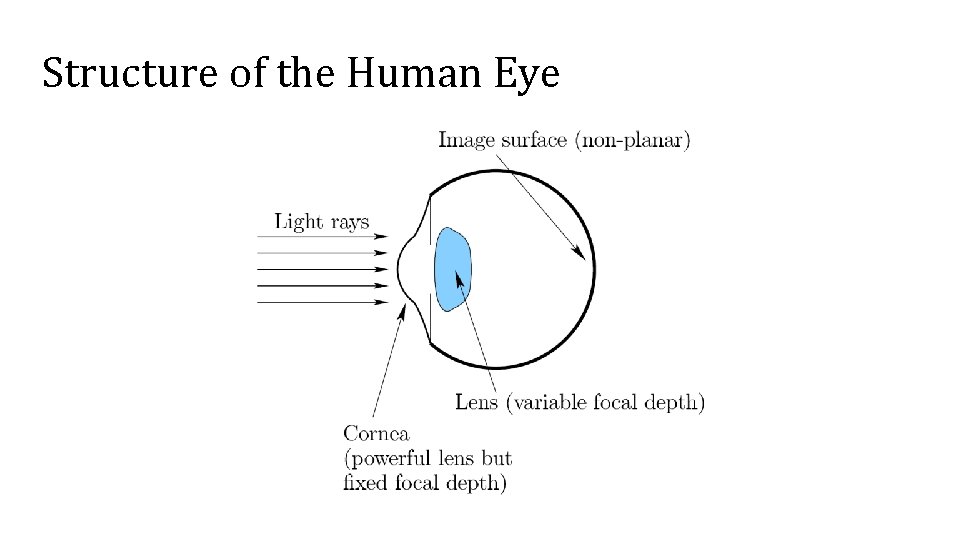
Structure of the Human Eye
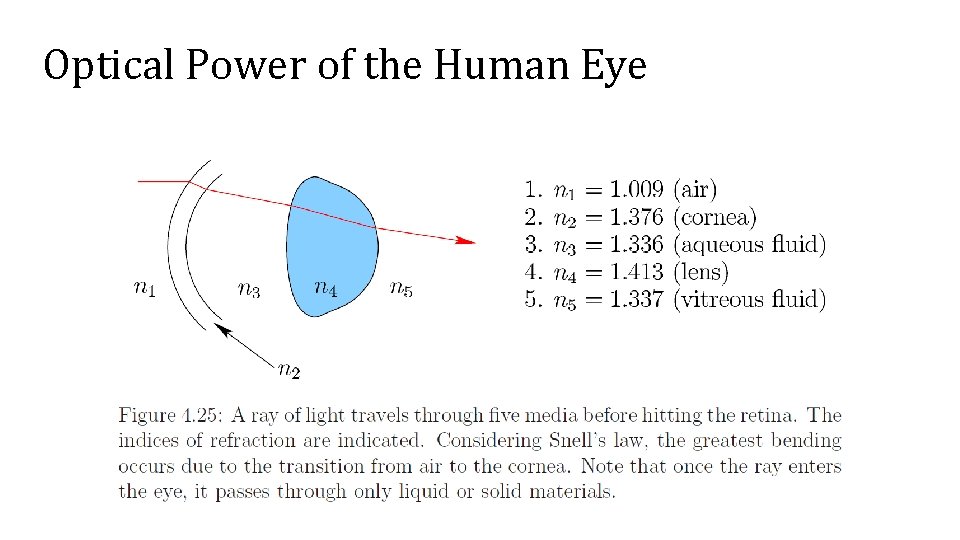
Optical Power of the Human Eye
Structure of the Human Eye The diopter of the human eye is about 58. Eye lens is not spherical. Retina (and retinal image) is not planar. Ciliary muscle has the ability increase diopter by +10 (lose at age ≈ 40). Optic nerve forms a blind spot in the human eye. Assume the person has no vision defect. What physical element is not typically used when experiencing VR?
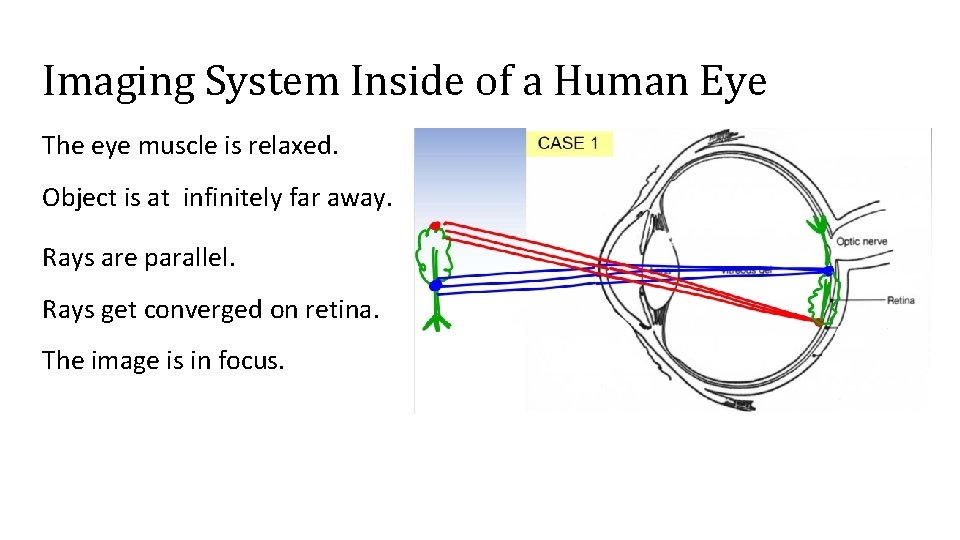
Imaging System Inside of a Human Eye The eye muscle is relaxed. Object is at infinitely far away. Rays are parallel. Rays get converged on retina. The image is in focus.
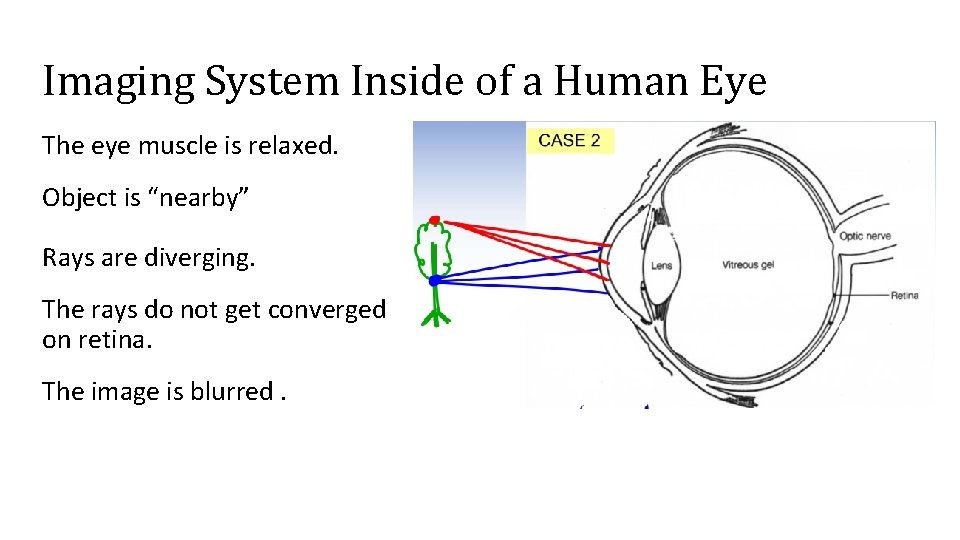
Imaging System Inside of a Human Eye The eye muscle is relaxed. Object is “nearby” Rays are diverging. The rays do not get converged on retina. The image is blurred.
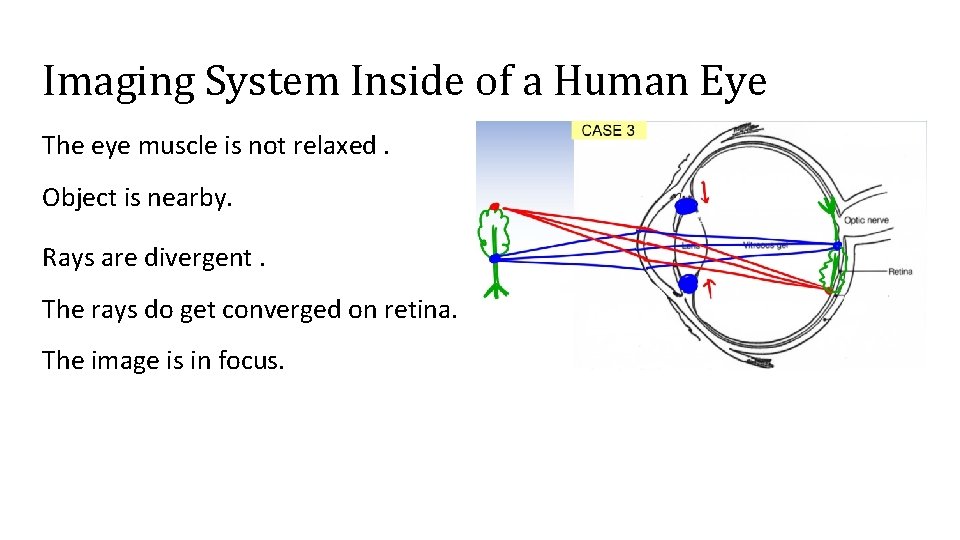
Imaging System Inside of a Human Eye The eye muscle is not relaxed. Object is nearby. Rays are divergent. The rays do get converged on retina. The image is in focus.
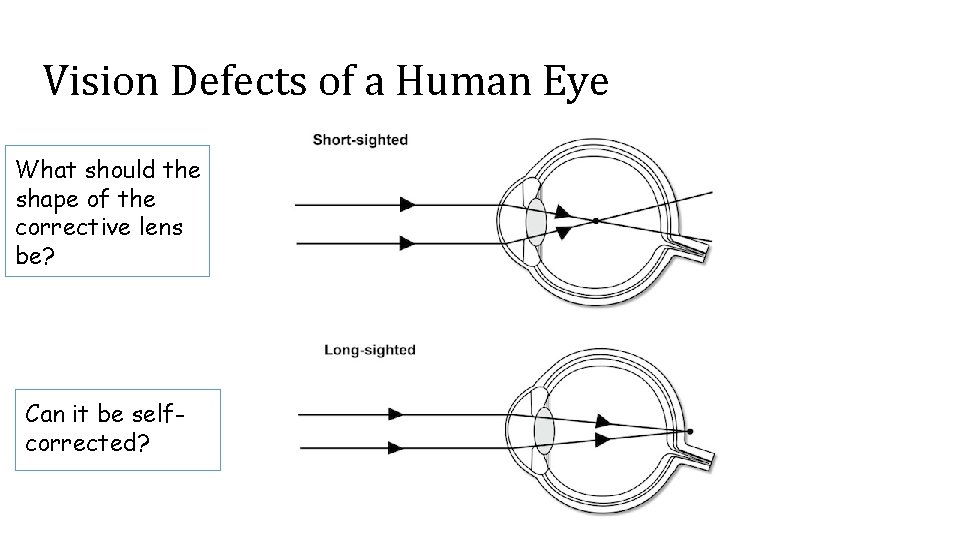
Vision Defects of a Human Eye What should the shape of the corrective lens be? Can it be selfcorrected?
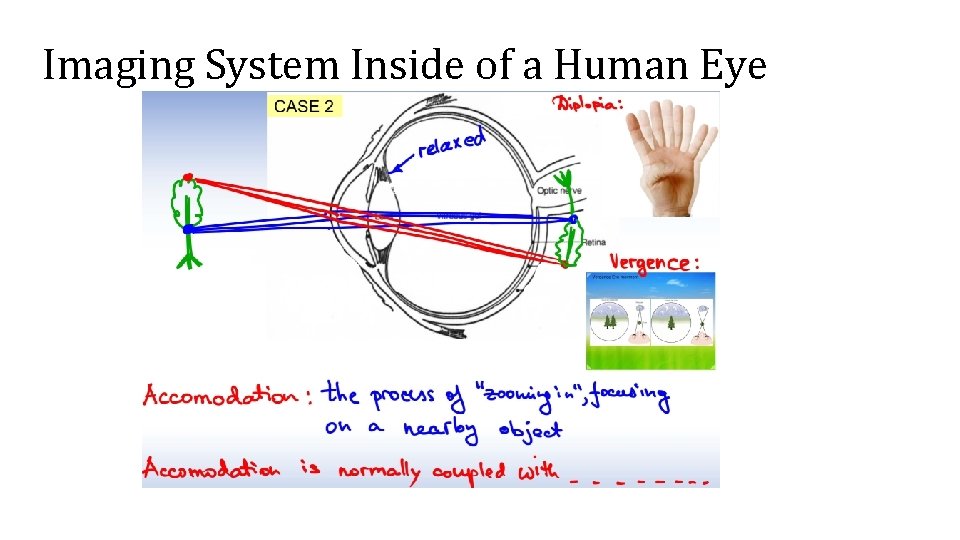
Imaging System Inside of a Human Eye
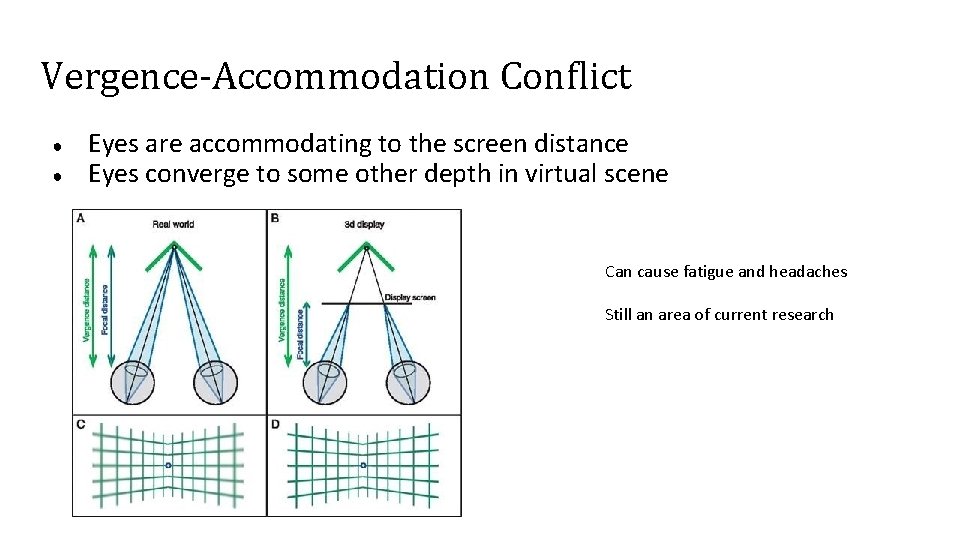
Vergence-Accommodation Conflict ● ● Eyes are accommodating to the screen distance Eyes converge to some other depth in virtual scene Can cause fatigue and headaches Still an area of current research
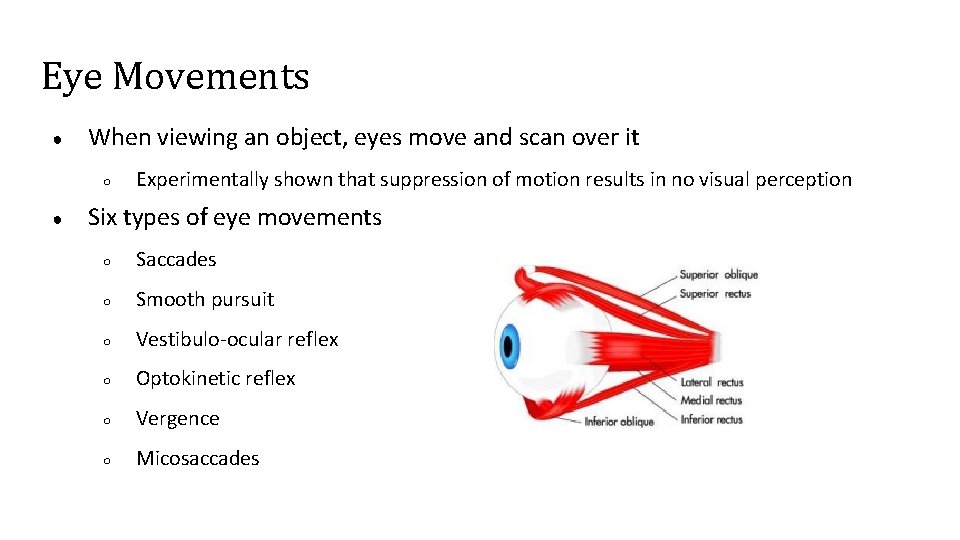
Eye Movements ● When viewing an object, eyes move and scan over it ○ ● Experimentally shown that suppression of motion results in no visual perception Six types of eye movements ○ Saccades ○ Smooth pursuit ○ Vestibulo-ocular reflex ○ Optokinetic reflex ○ Vergence ○ Micosaccades
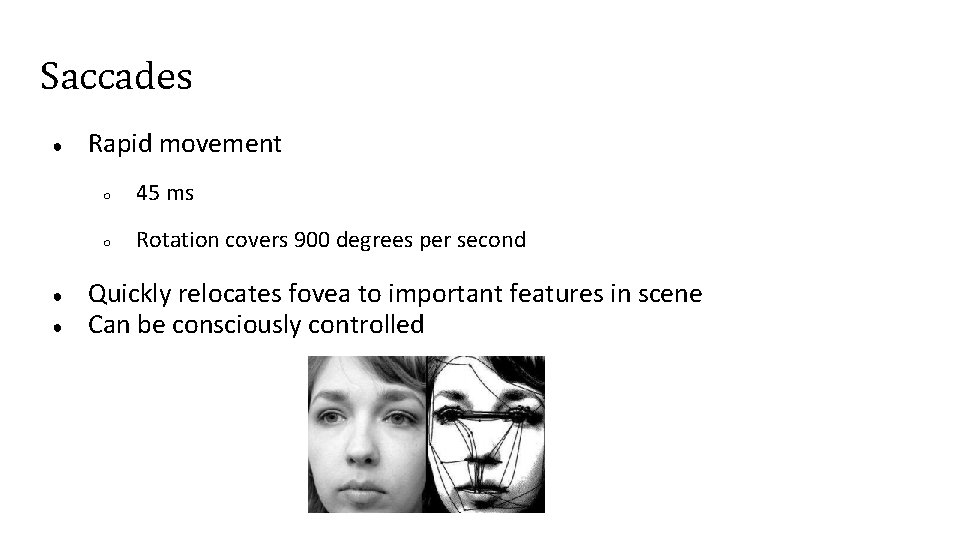
Saccades ● ● ● Rapid movement ○ 45 ms ○ Rotation covers 900 degrees per second Quickly relocates fovea to important features in scene Can be consciously controlled
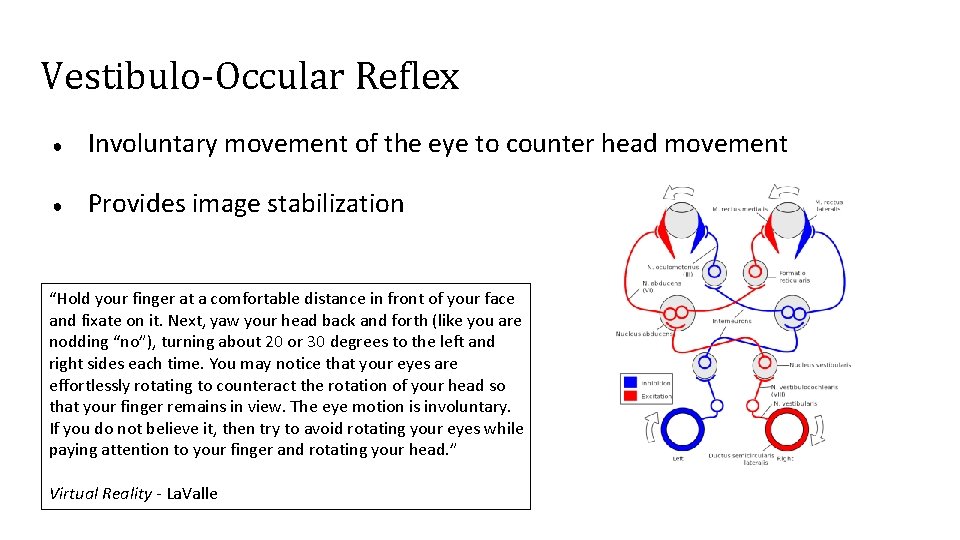
Vestibulo-Occular Reflex ● Involuntary movement of the eye to counter head movement ● Provides image stabilization “Hold your finger at a comfortable distance in front of your face and fixate on it. Next, yaw your head back and forth (like you are nodding “no”), turning about 20 or 30 degrees to the left and right sides each time. You may notice that your eyes are effortlessly rotating to counteract the rotation of your head so that your finger remains in view. The eye motion is involuntary. If you do not believe it, then try to avoid rotating your eyes while paying attention to your finger and rotating your head. ” Virtual Reality - La. Valle
Other Motions ● ● Smooth Pursuit ○ Slow rotation to track a target feature like a person walking by ○ Reduces motion blur on retina (blur due to slow photoreceptors) Optokinetic ○ ● Vergence ○ ● Rapid an involuntary feature tracking on fast-moving object Inward or outward rotation to focus Microsaccades ○ Involuntary rotations of less than 1 degree…erratic paths…not well understood
Optical Illusion of the Day: The fractal appears to move unless you fixate on single point.
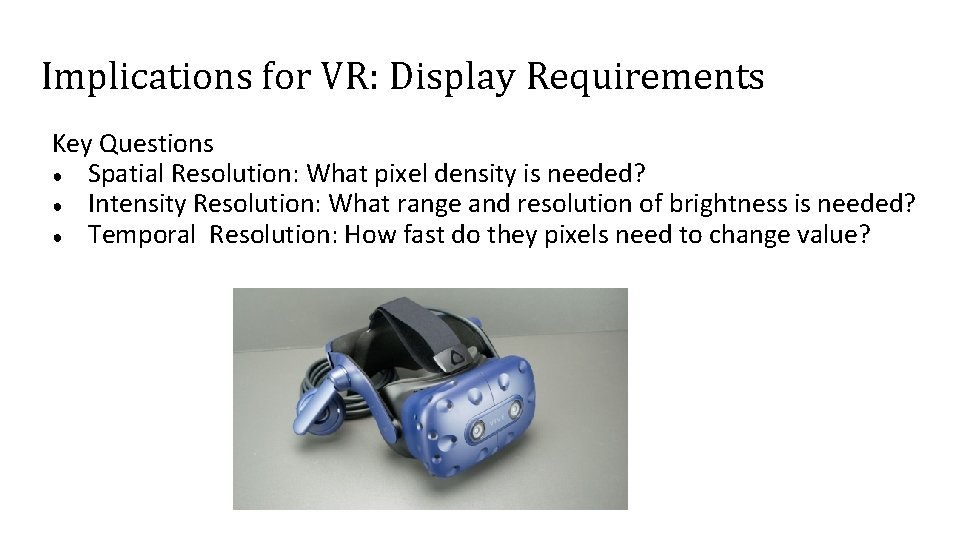
Implications for VR: Display Requirements Key Questions ● Spatial Resolution: What pixel density is needed? ● Intensity Resolution: What range and resolution of brightness is needed? ● Temporal Resolution: How fast do they pixels need to change value?
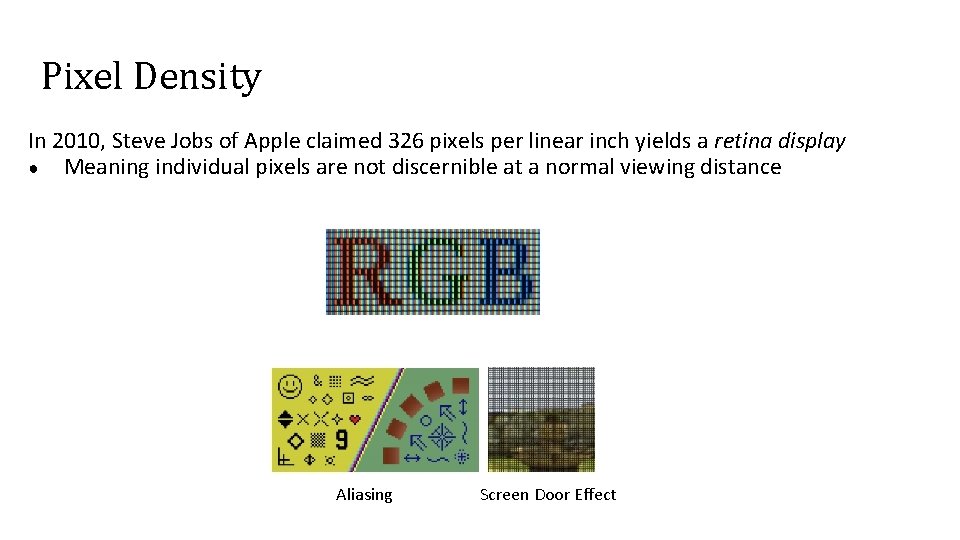
Pixel Density In 2010, Steve Jobs of Apple claimed 326 pixels per linear inch yields a retina display ● Meaning individual pixels are not discernible at a normal viewing distance Aliasing Screen Door Effect
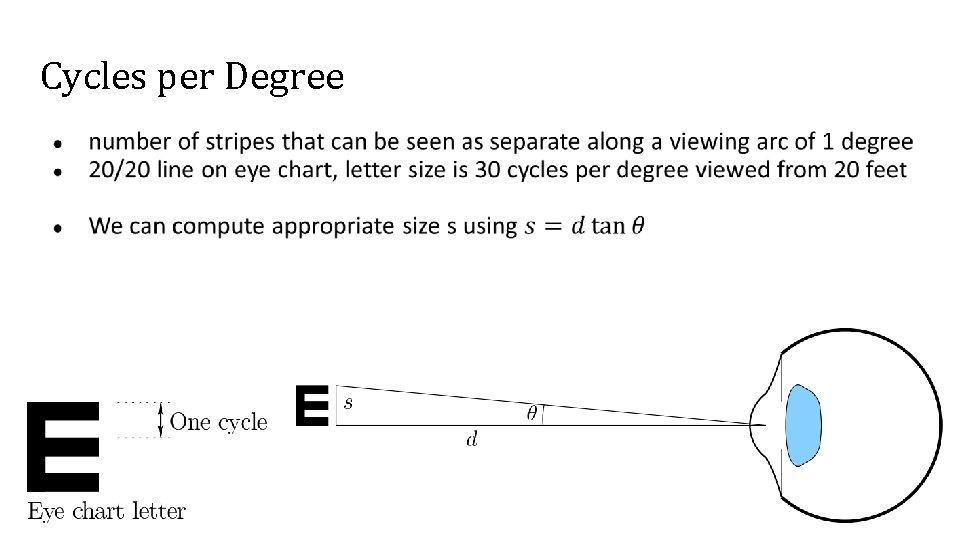
Cycles per Degree ●
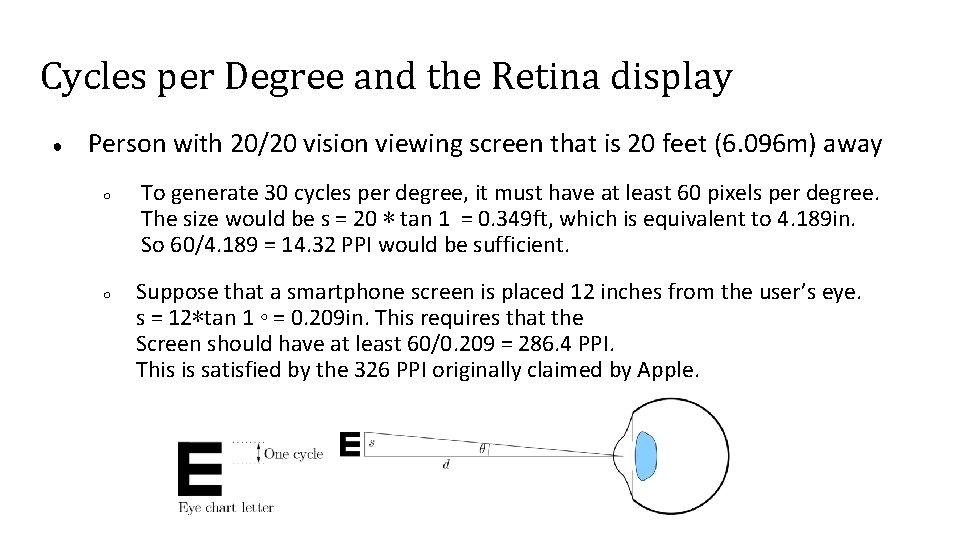
Cycles per Degree and the Retina display ● Person with 20/20 vision viewing screen that is 20 feet (6. 096 m) away ○ ○ To generate 30 cycles per degree, it must have at least 60 pixels per degree. The size would be s = 20 ∗ tan 1 = 0. 349 ft, which is equivalent to 4. 189 in. So 60/4. 189 = 14. 32 PPI would be sufficient. Suppose that a smartphone screen is placed 12 inches from the user’s eye. s = 12∗tan 1 ◦ = 0. 209 in. This requires that the Screen should have at least 60/0. 209 = 286. 4 PPI. This is satisfied by the 326 PPI originally claimed by Apple.
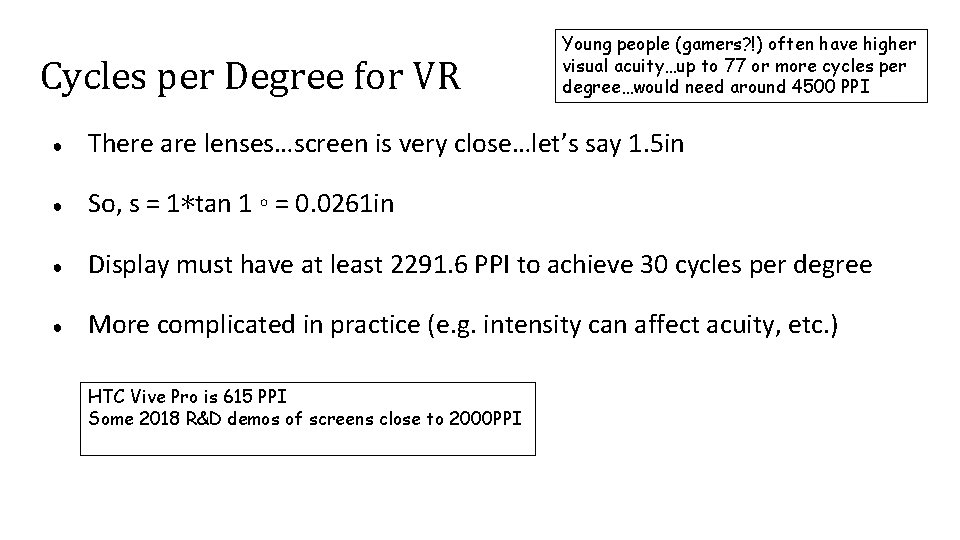
Cycles per Degree for VR Young people (gamers? !) often have higher visual acuity…up to 77 or more cycles per degree…would need around 4500 PPI ● There are lenses…screen is very close…let’s say 1. 5 in ● So, s = 1∗tan 1 ◦ = 0. 0261 in ● Display must have at least 2291. 6 PPI to achieve 30 cycles per degree ● More complicated in practice (e. g. intensity can affect acuity, etc. ) HTC Vive Pro is 615 PPI Some 2018 R&D demos of screens close to 2000 PPI
What about Field of View? ● Maximum human field of view is around 270 degrees ○ ● ● How does a human achieve that FOV without head movement? Cannot just bring a flat screen closer ○ Lens distortion at periphery ○ Also, super-close lenses would require VR subjects to remove their eyelashes…. Curved screen may help, but lens problem not yet solved…. .
Foveated Rendering ● ● What do you think this means? Hint: We’re always looking for ways to optimize…to do the job with the least resources possible
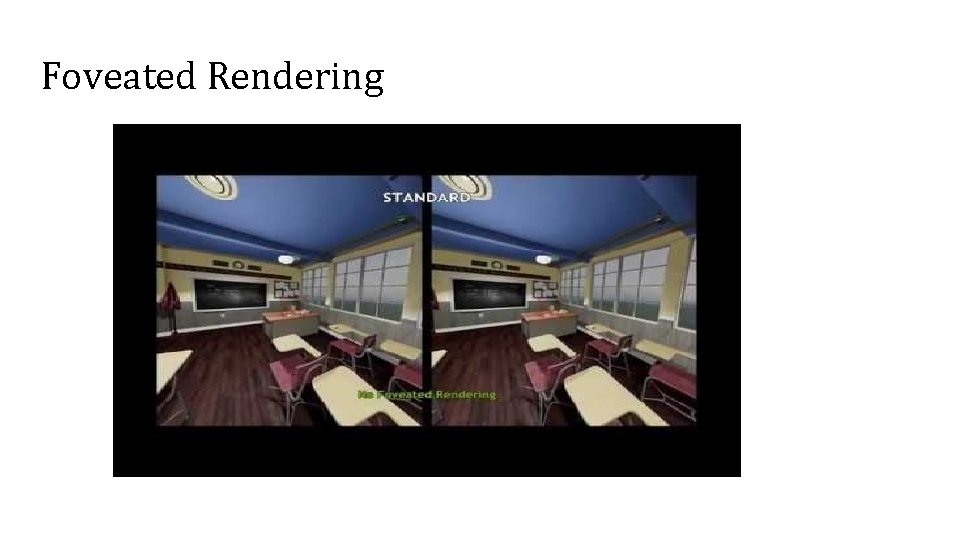
Foveated Rendering ● If we could track the eye Keep a movable display lined up with fovea fewer pixels needed ● Has been done in practice. . . sort of ● ● Fixed display Lower resolution on periphery ● Works but not well enough ●
Foveated Rendering
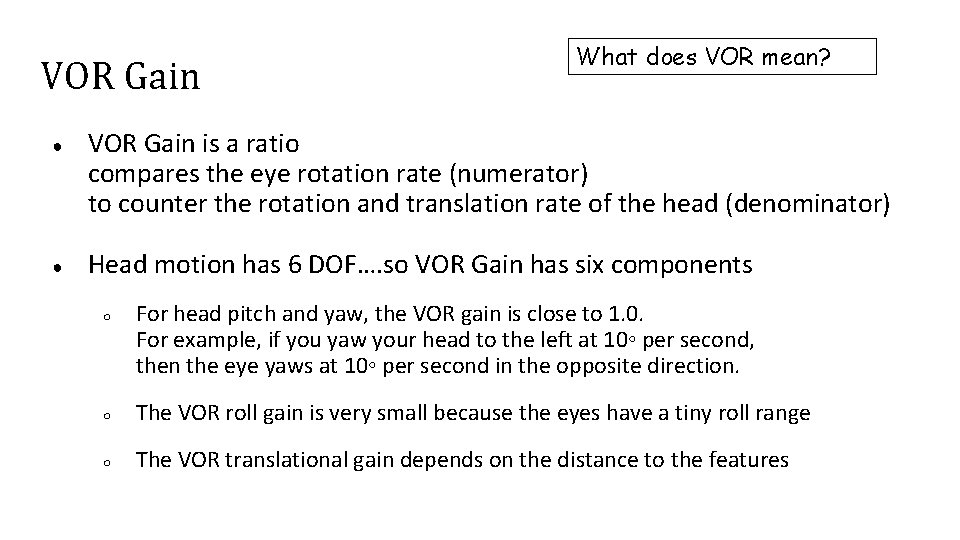
VOR Gain ● ● What does VOR mean? VOR Gain is a ratio compares the eye rotation rate (numerator) to counter the rotation and translation rate of the head (denominator) Head motion has 6 DOF…. so VOR Gain has six components ○ For head pitch and yaw, the VOR gain is close to 1. 0. For example, if you yaw your head to the left at 10◦ per second, then the eye yaws at 10◦ per second in the opposite direction. ○ The VOR roll gain is very small because the eyes have a tiny roll range ○ The VOR translational gain depends on the distance to the features
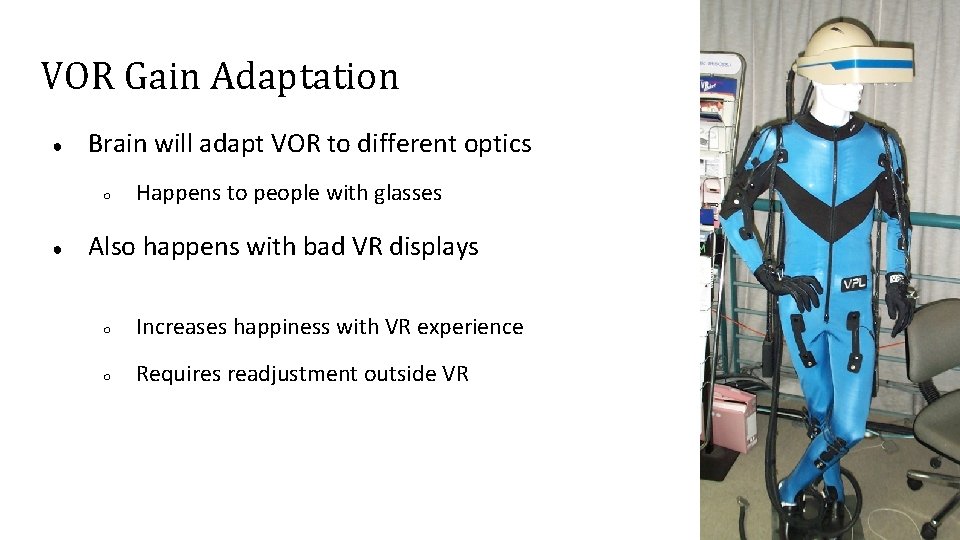
VOR Gain Adaptation ● Brain will adapt VOR to different optics ○ ● Happens to people with glasses Also happens with bad VR displays ○ Increases happiness with VR experience ○ Requires readjustment outside VR
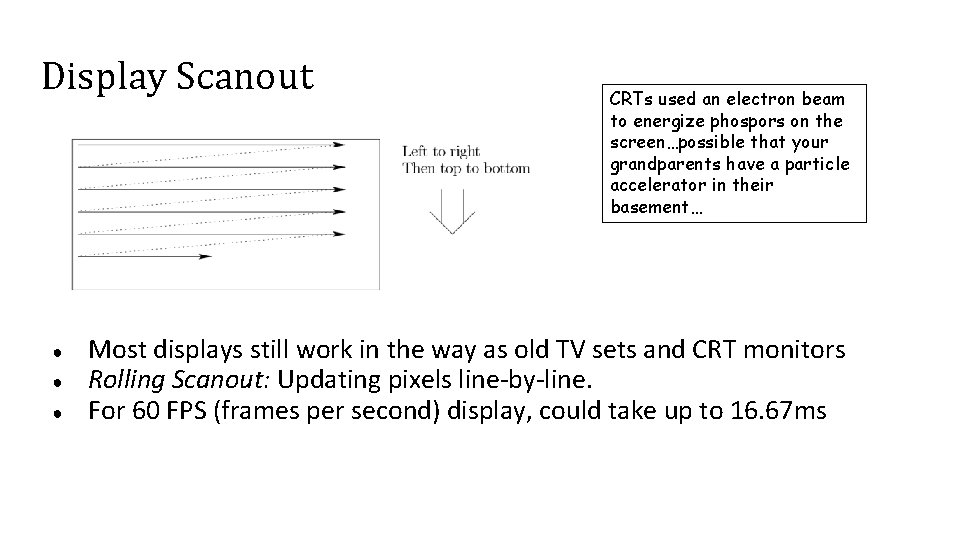
Display Scanout ● ● ● CRTs used an electron beam to energize phospors on the screen…possible that your grandparents have a particle accelerator in their basement… Most displays still work in the way as old TV sets and CRT monitors Rolling Scanout: Updating pixels line-by-line. For 60 FPS (frames per second) display, could take up to 16. 67 ms
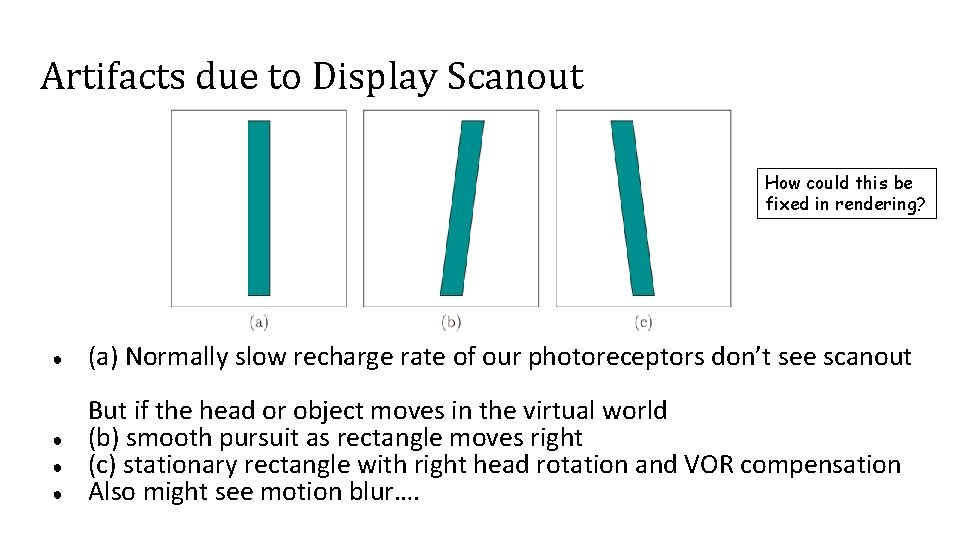
Artifacts due to Display Scanout How could this be fixed in rendering? ● (a) Normally slow recharge rate of our photoreceptors don’t see scanout ● ● ● But if the head or object moves in the virtual world (b) smooth pursuit as rectangle moves right (c) stationary rectangle with right head rotation and VOR compensation Also might see motion blur….
Retinal Image Slip ● We are only beginning to understand vision issues with VR ● Retinal Image Slip ○ In the real world, head/eye motion causes small sliding of image on retina ○ Evidence shows that this slip is different in VR than in real world ○ In VR, we see increased microsaccades ○ Which means…. ?
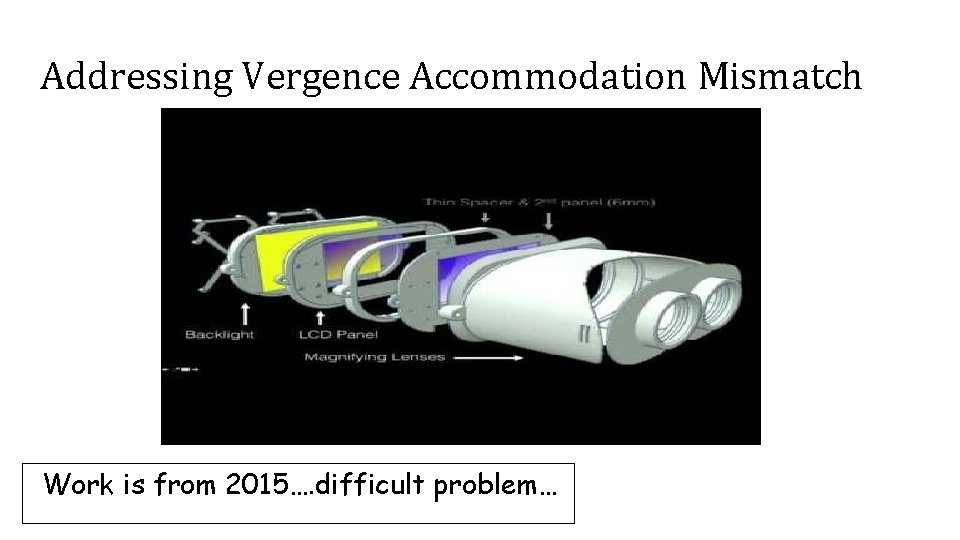
Addressing Vergence Accommodation Mismatch Work is from 2015…. difficult problem…