
Orientation CS 498 Virtual Reality UNIVERSITY OF ILLINOIS
- Slides: 38
Orientation CS 498: Virtual Reality UNIVERSITY OF ILLINOIS AT URBANA-CHAMPAIGN Eric Shaffer
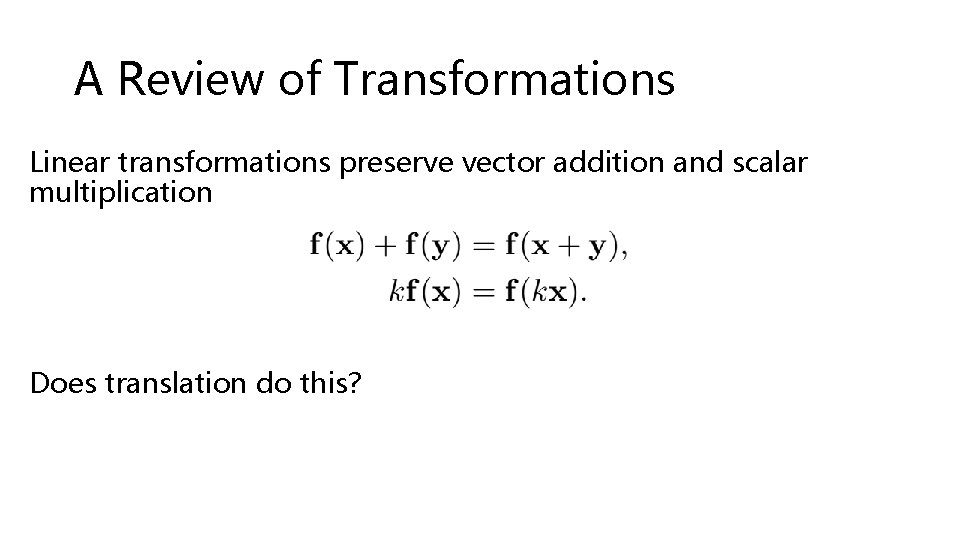
A Review of Transformations Linear transformations preserve vector addition and scalar multiplication Does translation do this?
Rigid-Body Transformations A rigid-body transformation preserves Euclidean distance between points Are all of Translation, Rotation, and Scale rigid-body transformations?
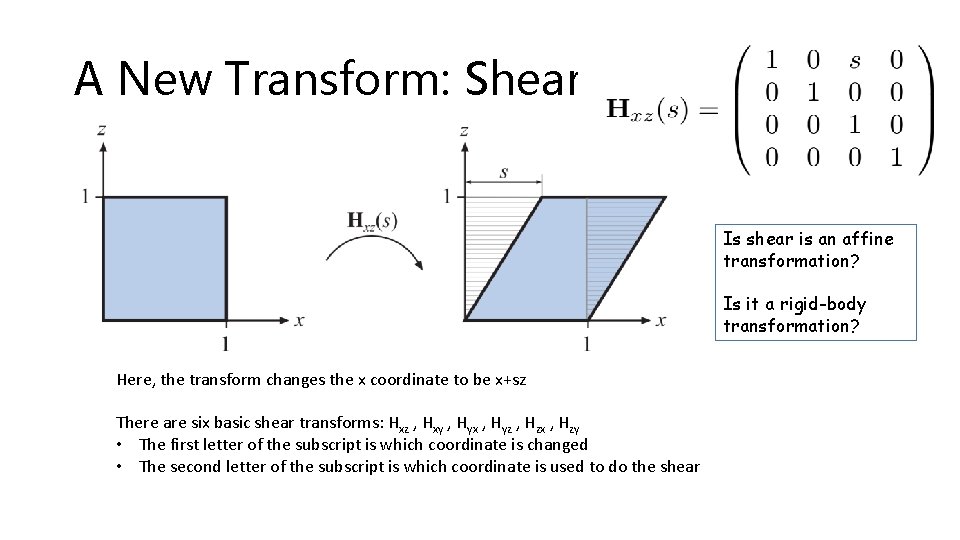
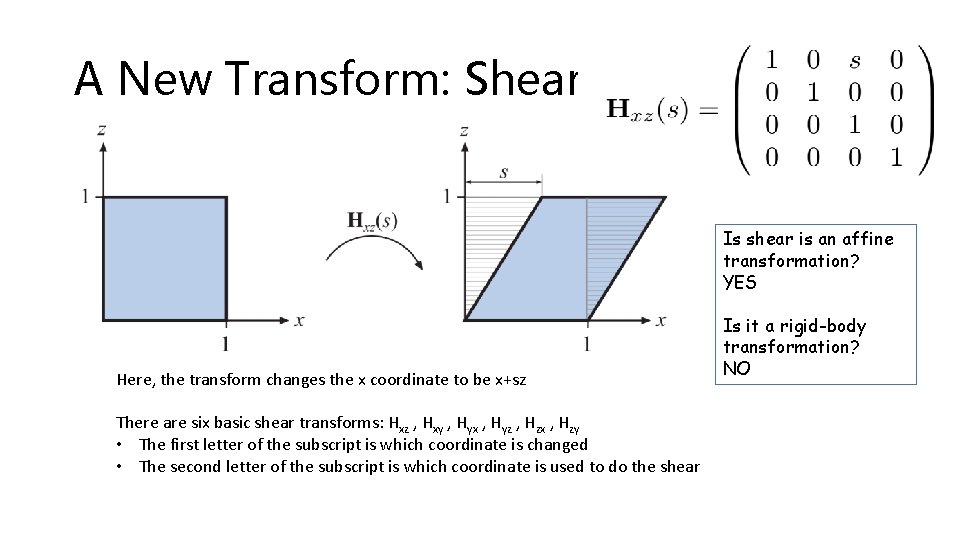
A New Transform: Shear Is shear is an affine transformation? Is it a rigid-body transformation? Here, the transform changes the x coordinate to be x+sz There are six basic shear transforms: Hxz , Hxy , Hyx , Hyz , Hzx , Hzy • The first letter of the subscript is which coordinate is changed • The second letter of the subscript is which coordinate is used to do the shear
A New Transform: Shear Is shear is an affine transformation? YES Here, the transform changes the x coordinate to be x+sz There are six basic shear transforms: Hxz , Hxy , Hyx , Hyz , Hzx , Hzy • The first letter of the subscript is which coordinate is changed • The second letter of the subscript is which coordinate is used to do the shear Is it a rigid-body transformation? NO
Concatenation of Transforms • We can concatenate transforms using matrix multiplication • Suppose we have translation T, scale S, and rotation R M = TRS is a composite transform • When applied to a point p we have Mp = T(R(Sp)) so M first scales then rotates then translates
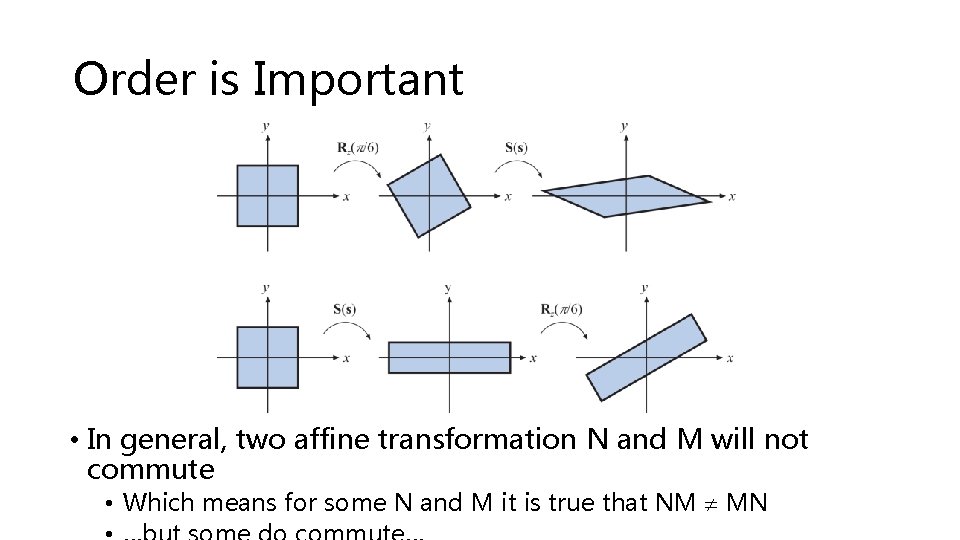
Order is Important • In general, two affine transformation N and M will not commute • Which means for some N and M it is true that NM MN
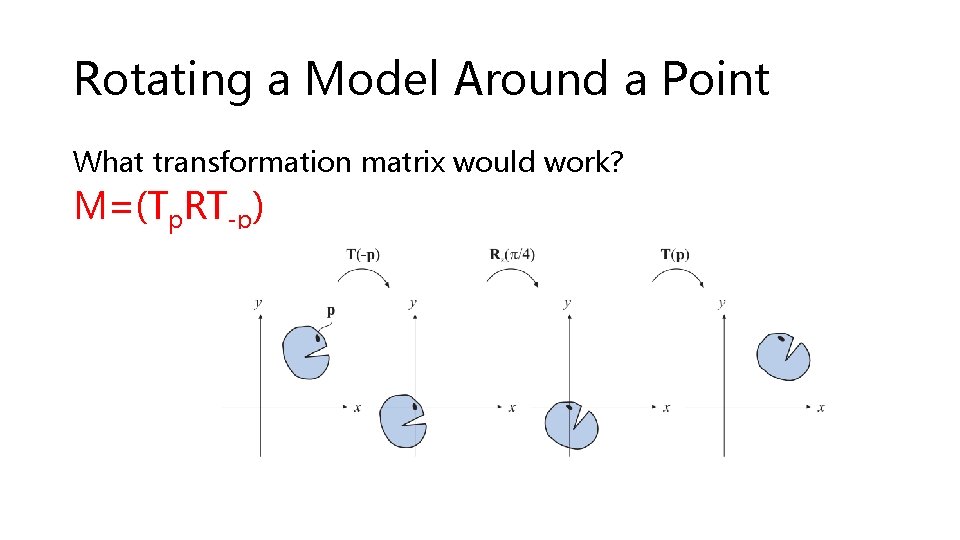
Rotating a Model Around a Point Suppose we have a model and a point p How can we get the model to rotate around p? What happens when we apply just a rotation R ? What transformation would work?
Rotating a Model Around a Point What transformation matrix would work? M=(Tp. RT-p)
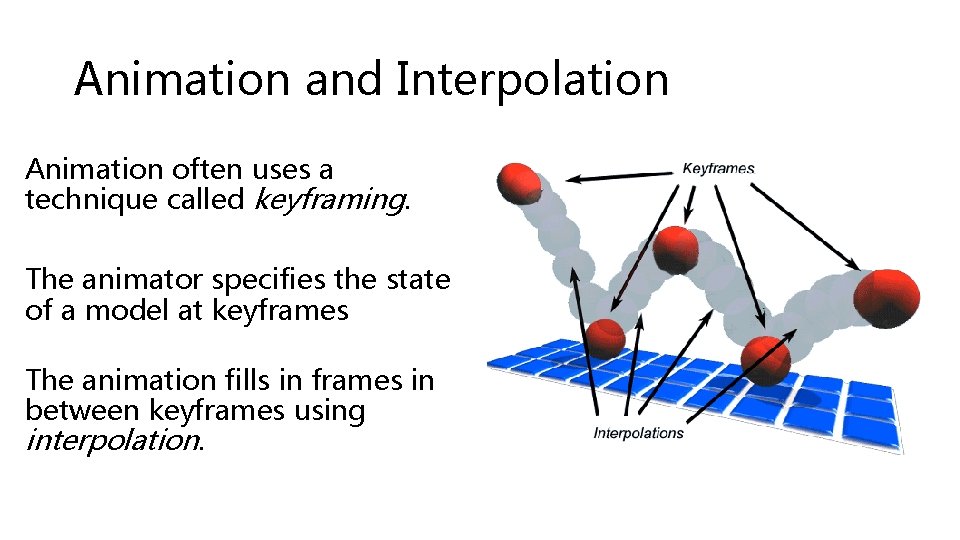
Animation and Interpolation Animation often uses a technique called keyframing. The animator specifies the state of a model at keyframes The animation fills in frames in between keyframes using interpolation.
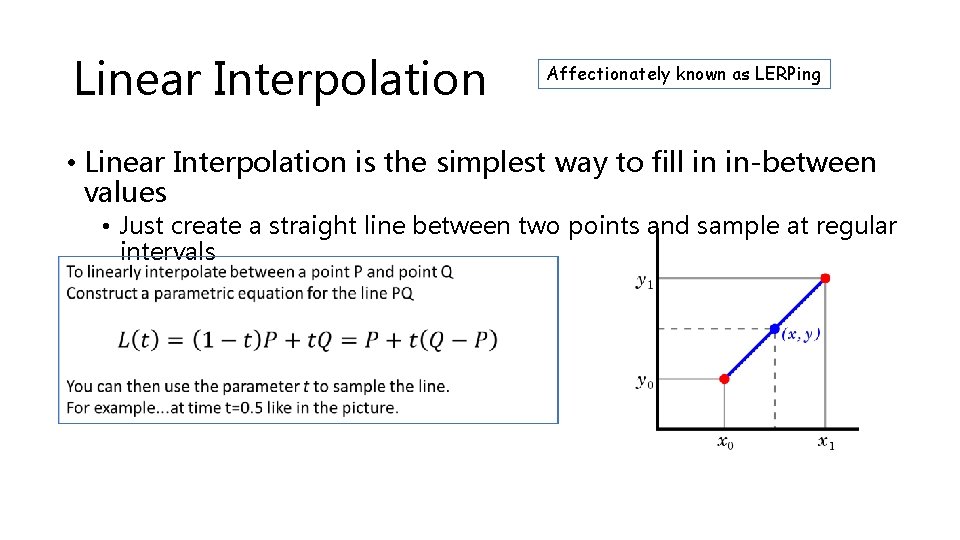
Linear Interpolation Affectionately known as LERPing • Linear Interpolation is the simplest way to fill in in-between values • Just create a straight line between two points and sample at regular intervals
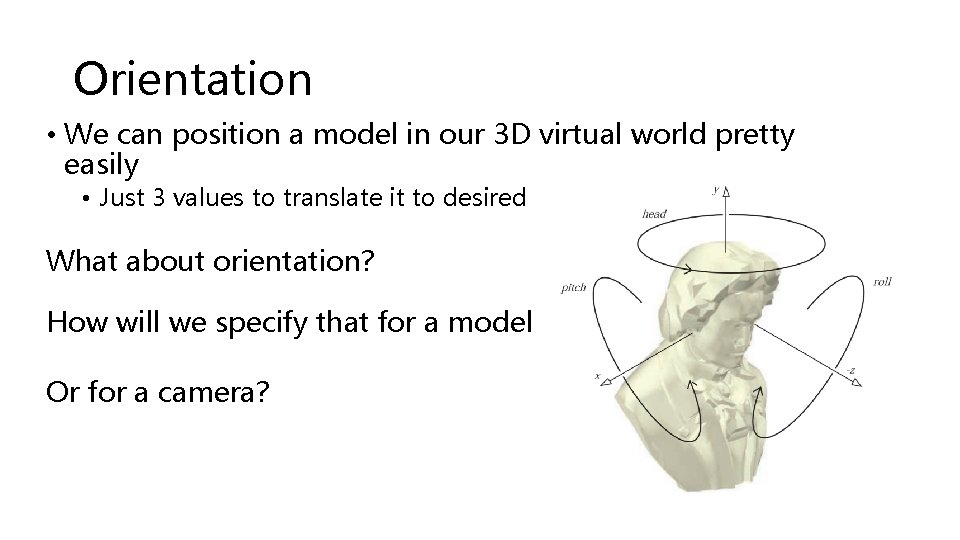
Orientation • We can position a model in our 3 D virtual world pretty easily • Just 3 values to translate it to desired position What about orientation? How will we specify that for a model? Or for a camera?
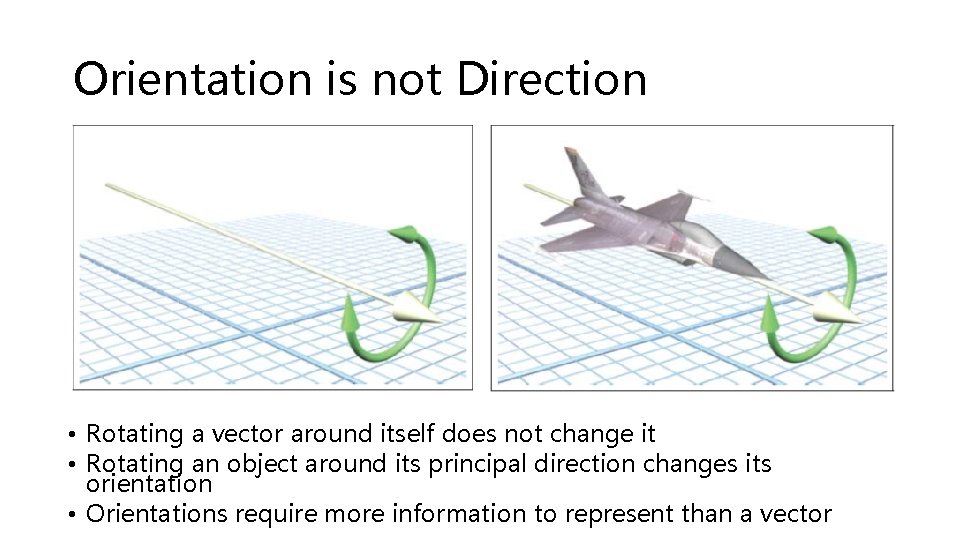
Orientation is not Direction • Rotating a vector around itself does not change it • Rotating an object around its principal direction changes its orientation • Orientations require more information to represent than a vector
Representing Orientations In 3 D…how much information is needed to represent a direction? How about an orientation? There are several popular options to encode orientation: • Euler angles • Rotation vectors (axis/angle) • 3 x 3 matrices • Quaternions
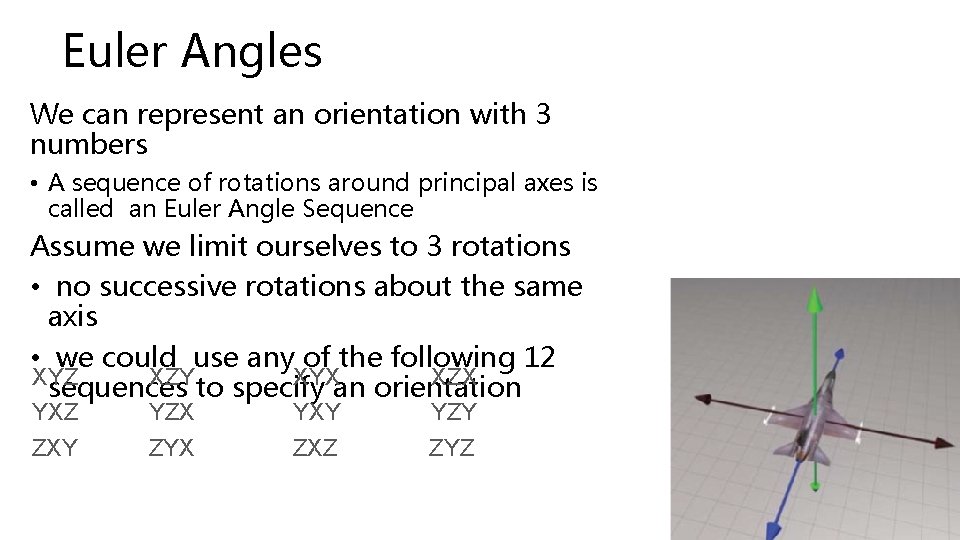
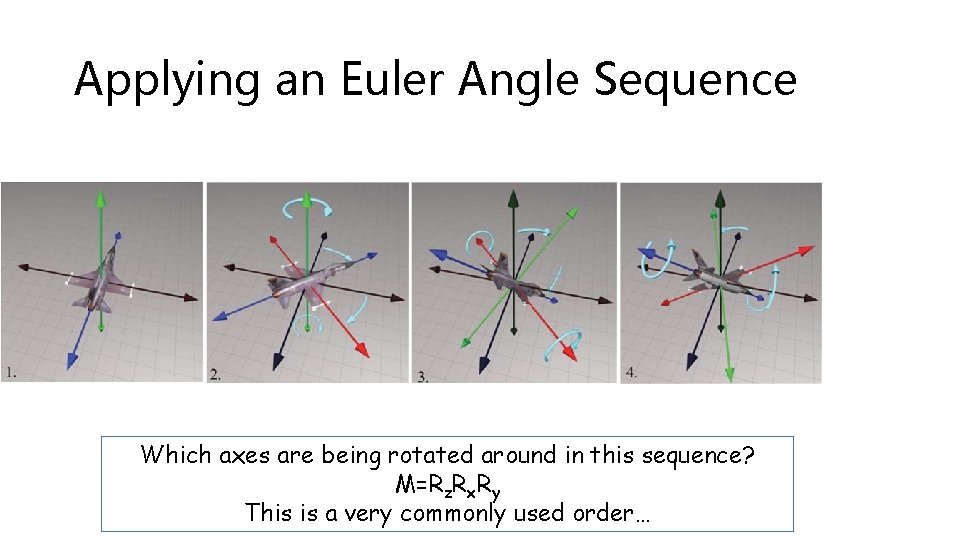
Euler Angles We can represent an orientation with 3 numbers • A sequence of rotations around principal axes is called an Euler Angle Sequence Assume we limit ourselves to 3 rotations • no successive rotations about the same axis • we could use any of the following 12 XYZ XZY XYX XZX sequences to specify an orientation YXZ ZXY YZX ZYX YXY ZXZ YZY ZYZ
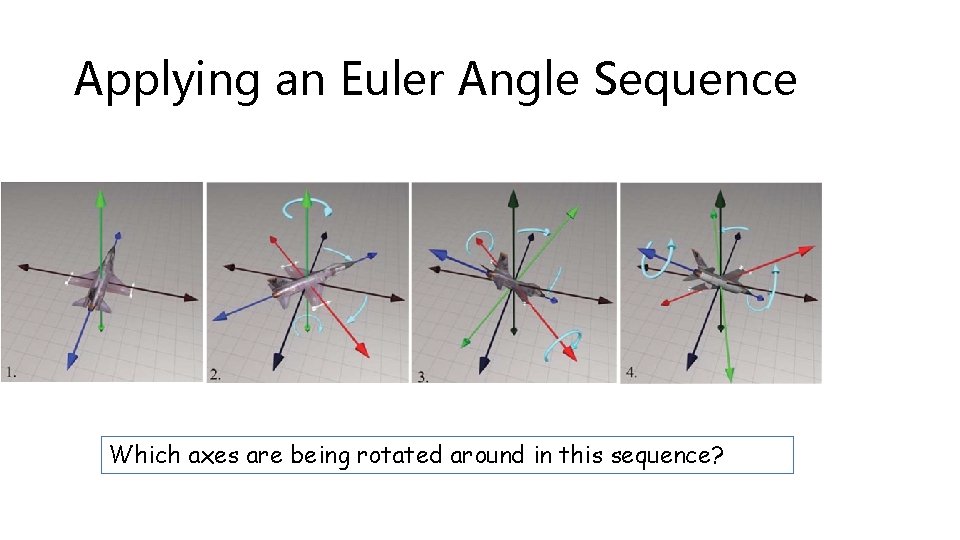
Applying an Euler Angle Sequence Which axes are being rotated around in this sequence?
Applying an Euler Angle Sequence Which axes are being rotated around in this sequence? M=Rz. Rx. Ry This is a very commonly used order…
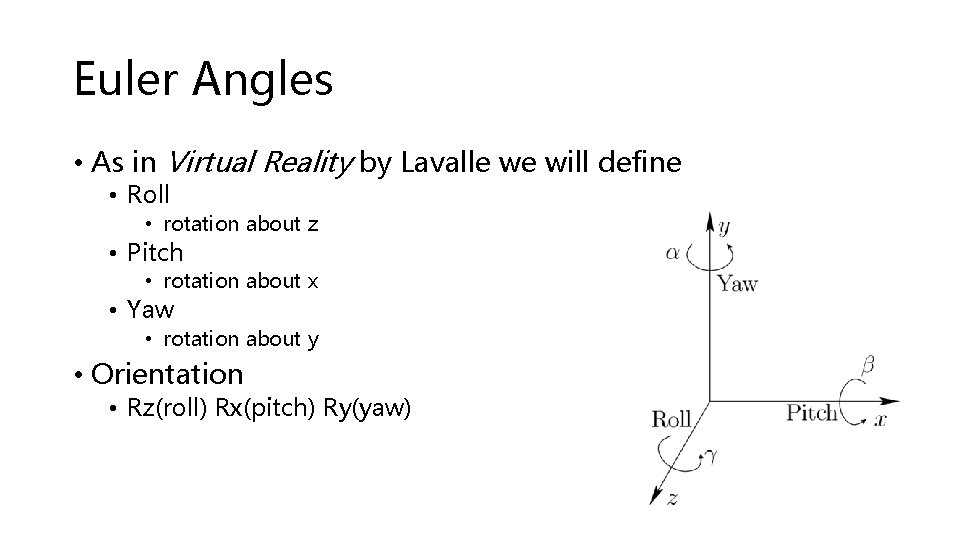
Euler Angles • As in Virtual Reality by Lavalle we will define • Roll • rotation about z • Pitch • rotation about x • Yaw • rotation about y • Orientation • Rz(roll) Rx(pitch) Ry(yaw)
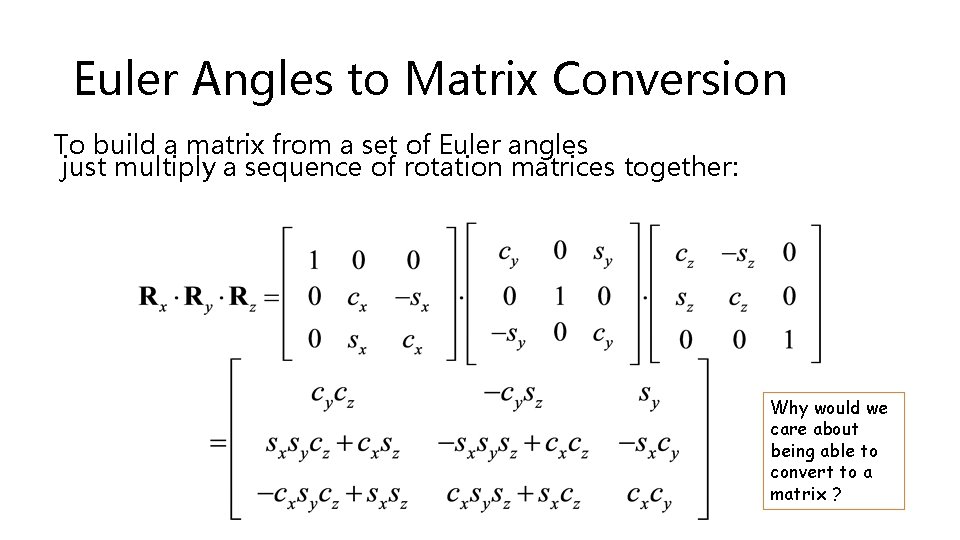
Euler Angles to Matrix Conversion To build a matrix from a set of Euler angles just multiply a sequence of rotation matrices together: Why would we care about being able to convert to a matrix ?
Euler Angles…Good and Bad • Euler angles can generate any possible orientation in 3 D (Good!) • Euler angles are used in a lot of applications…they are intuitive (Good!) • They are compact…requiring only 3 numbers (Good!) • Ambiguous: different triples can be same orientation (Bad!) • They do not interpolate in a obvious way (Bad!) • They can suffer from Gimbal lock (Bad! But not as bad as it sounds) • Conversion to/from a matrix requires several trig operations (Bad!)
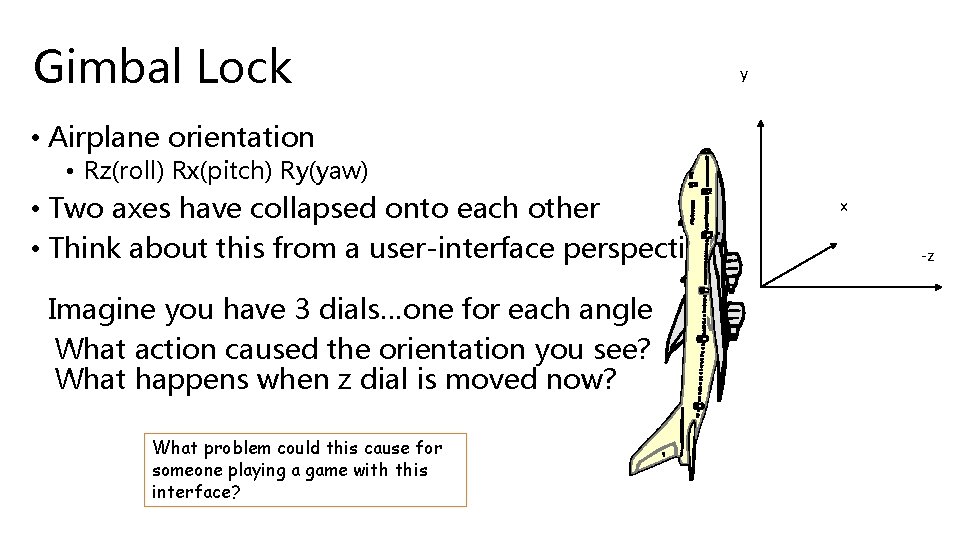
Gimbal Lock y • Airplane orientation • Rz(roll) Rx(pitch) Ry(yaw) • Two axes have collapsed onto each other • Think about this from a user-interface perspective Imagine you have 3 dials…one for each angle What action caused the orientation you see? What happens when z dial is moved now? What problem could this cause for someone playing a game with this interface? x -z
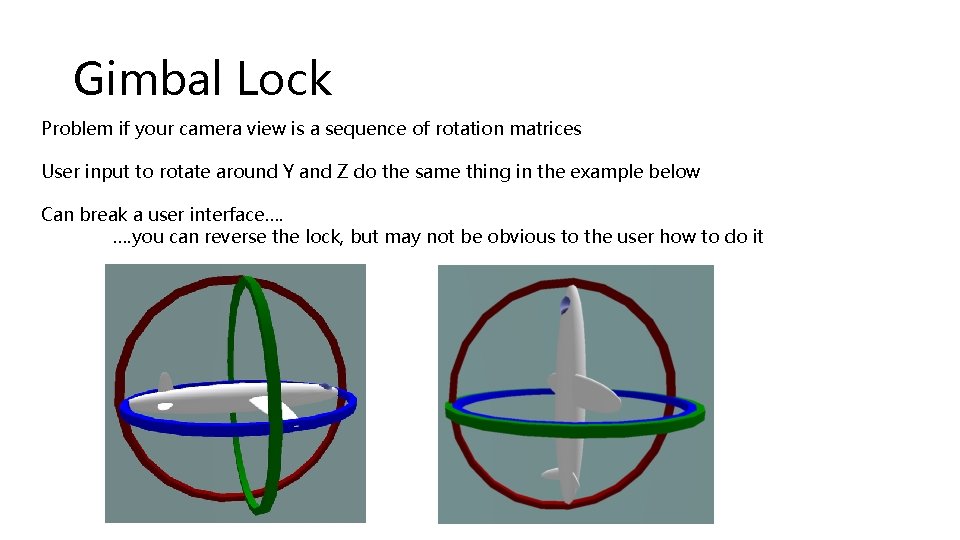
Gimbal Lock Problem if your camera view is a sequence of rotation matrices User input to rotate around Y and Z do the same thing in the example below Can break a user interface…. …. you can reverse the lock, but may not be obvious to the user how to do it
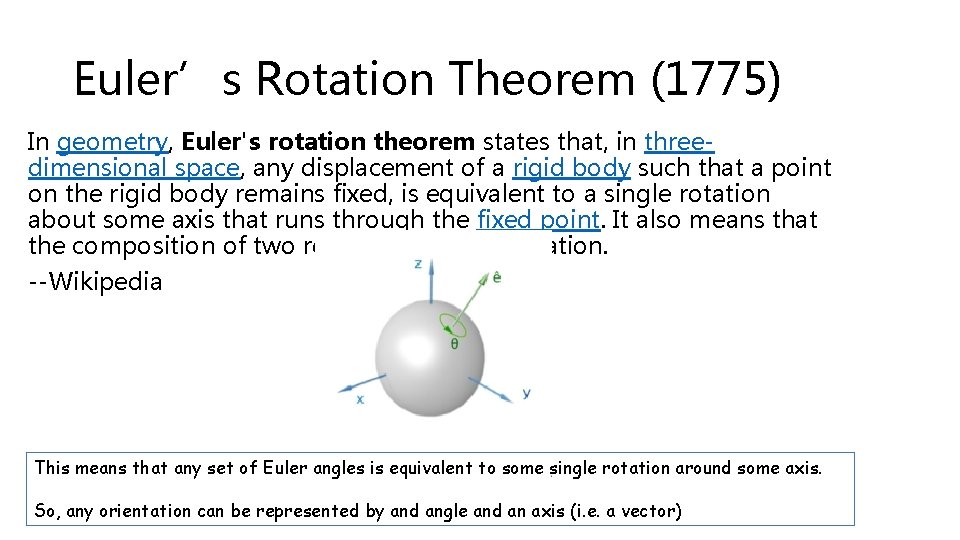
Euler’s Rotation Theorem (1775) In geometry, Euler's rotation theorem states that, in threedimensional space, any displacement of a rigid body such that a point on the rigid body remains fixed, is equivalent to a single rotation about some axis that runs through the fixed point. It also means that the composition of two rotations is also a rotation. --Wikipedia This means that any set of Euler angles is equivalent to some single rotation around some axis. So, any orientation can be represented by and angle and an axis (i. e. a vector)
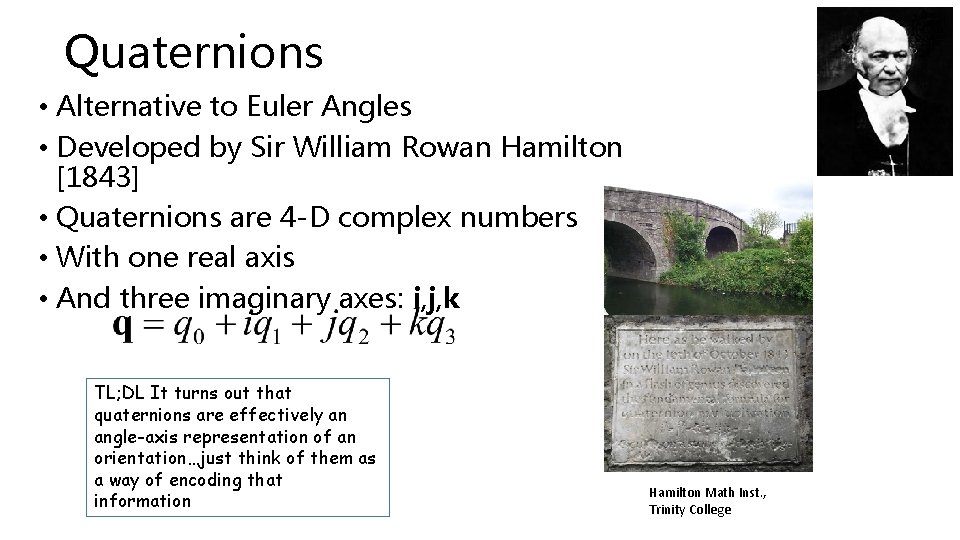
Quaternions • Alternative to Euler Angles • Developed by Sir William Rowan Hamilton [1843] • Quaternions are 4 -D complex numbers • With one real axis • And three imaginary axes: i, j, k TL; DL It turns out that quaternions are effectively an angle-axis representation of an orientation…just think of them as a way of encoding that information Hamilton Math Inst. , Trinity College
Quaternions • Introduced to Computer Graphics by Shoemake [1985] • Given an angle and axis, easy to convert to and from quaternion • Euler angle conversion to and from arbitrary axis and angle difficult • Quaternions allow stable and constant interpolation of orientations • Cannot be done easily with Euler angles
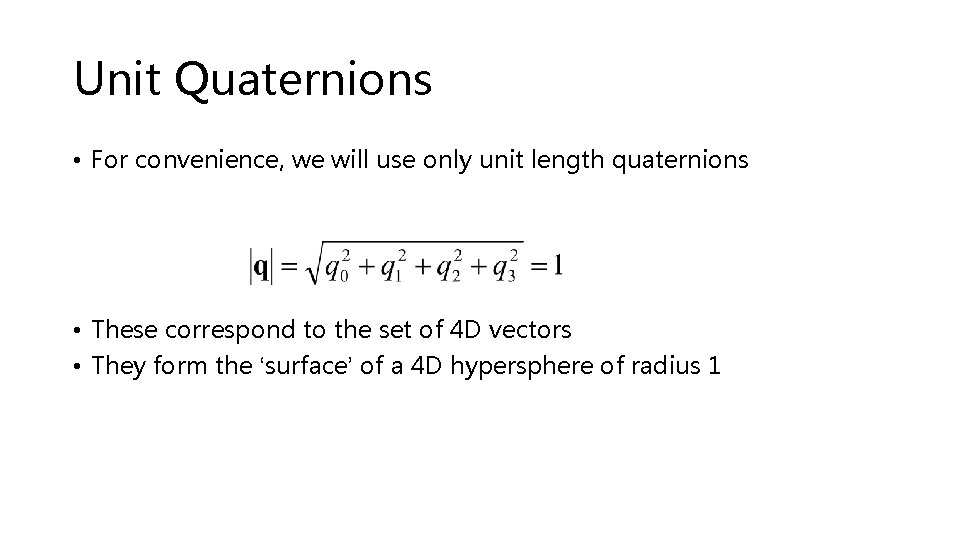
Unit Quaternions • For convenience, we will use only unit length quaternions • These correspond to the set of 4 D vectors • They form the ‘surface’ of a 4 D hypersphere of radius 1
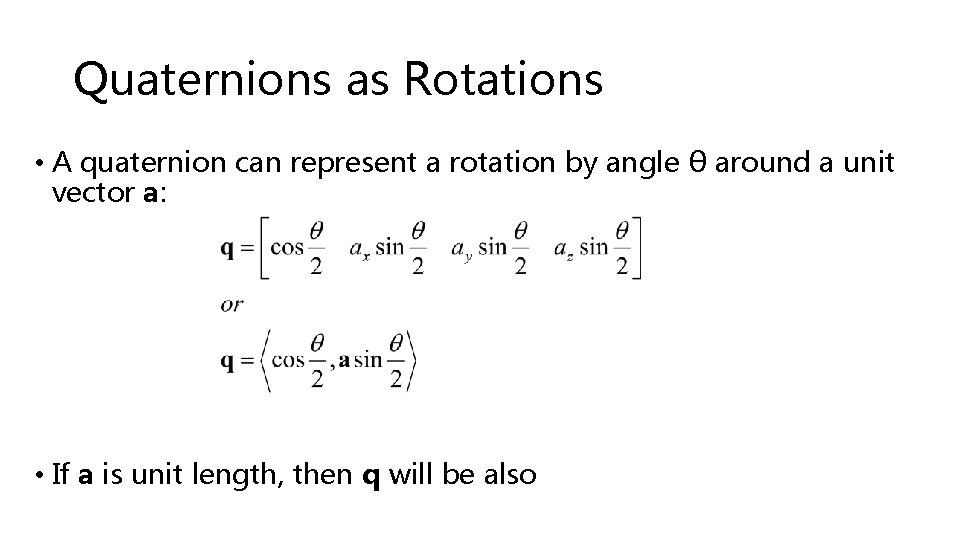
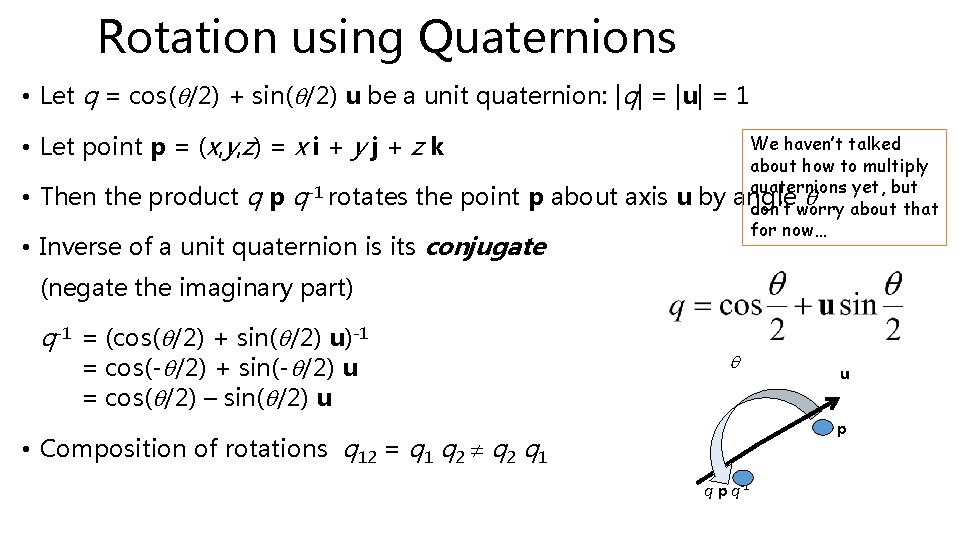
Quaternions as Rotations • A quaternion can represent a rotation by angle θ around a unit vector a: • If a is unit length, then q will be also
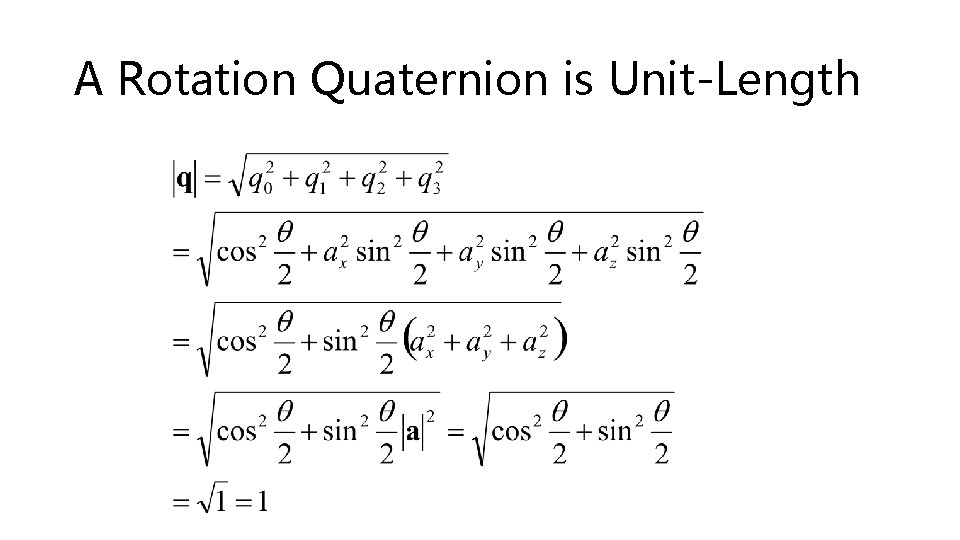
A Rotation Quaternion is Unit-Length
Rotation using Quaternions • Let q = cos(q/2) + sin(q/2) u be a unit quaternion: |q| = |u| = 1 • Let point p = (x, y, z) = x i + y j + z k • We haven’t talked about how to multiply quaternions yet, but Then the product q p q-1 rotates the point p about axis u by angle q don’t worry about that for now… • Inverse of a unit quaternion is its conjugate (negate the imaginary part) q-1 = (cos(q/2) + sin(q/2) u)-1 = cos(-q/2) + sin(-q/2) u = cos(q/2) – sin(q/2) u q u p • Composition of rotations q 12 = q 1 q 2 q 1 q p q-1
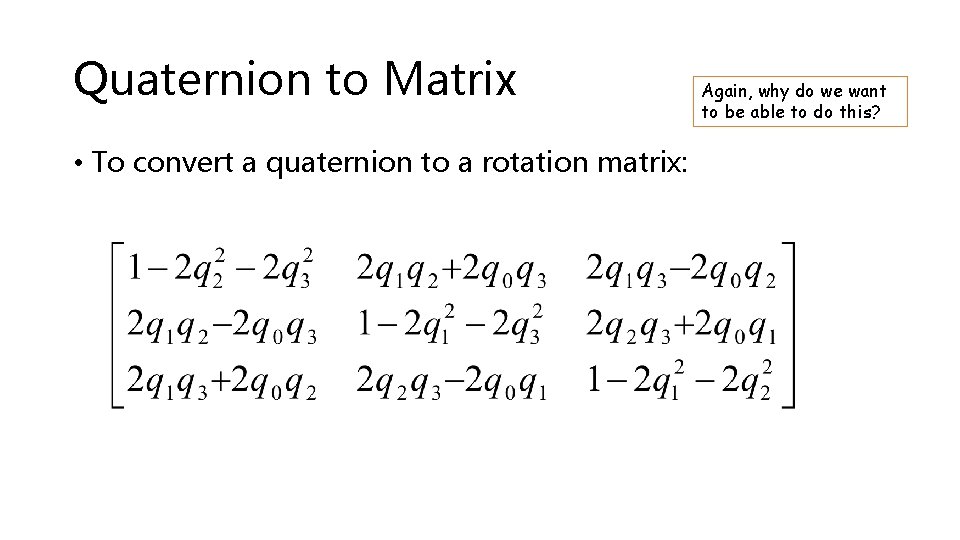
Quaternion to Matrix • To convert a quaternion to a rotation matrix: Again, why do we want to be able to do this?
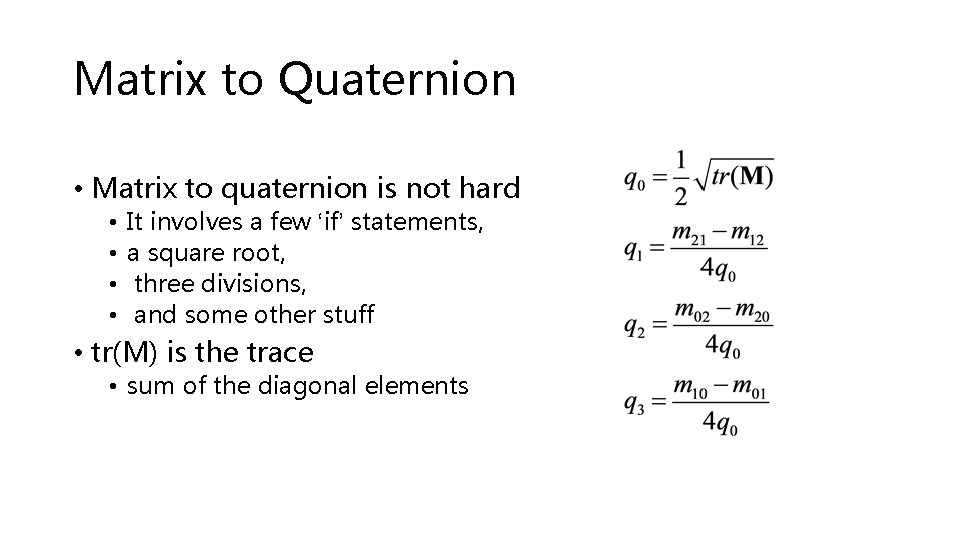
Matrix to Quaternion • Matrix to quaternion is not hard • • It involves a few ‘if’ statements, a square root, three divisions, and some other stuff • tr(M) is the trace • sum of the diagonal elements
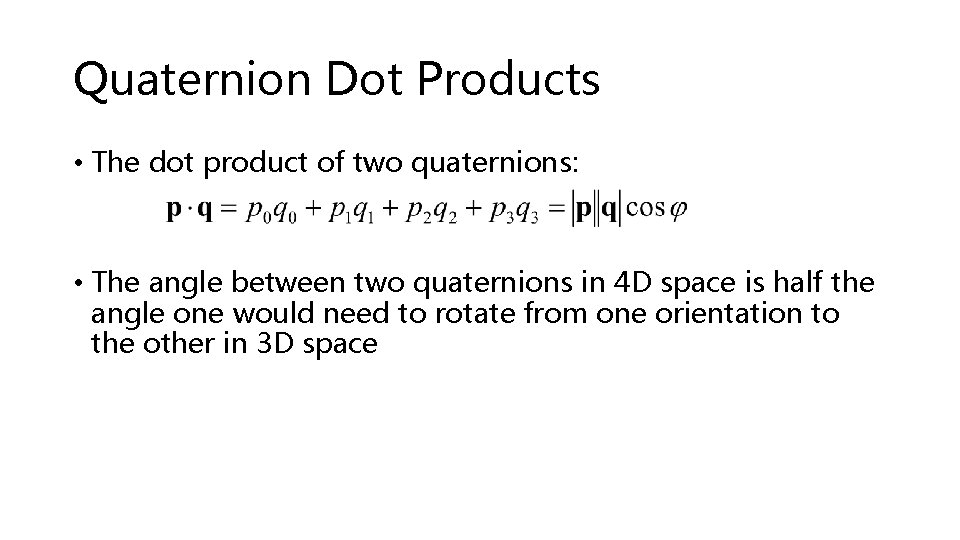
Quaternion Dot Products • The dot product of two quaternions: • The angle between two quaternions in 4 D space is half the angle one would need to rotate from one orientation to the other in 3 D space
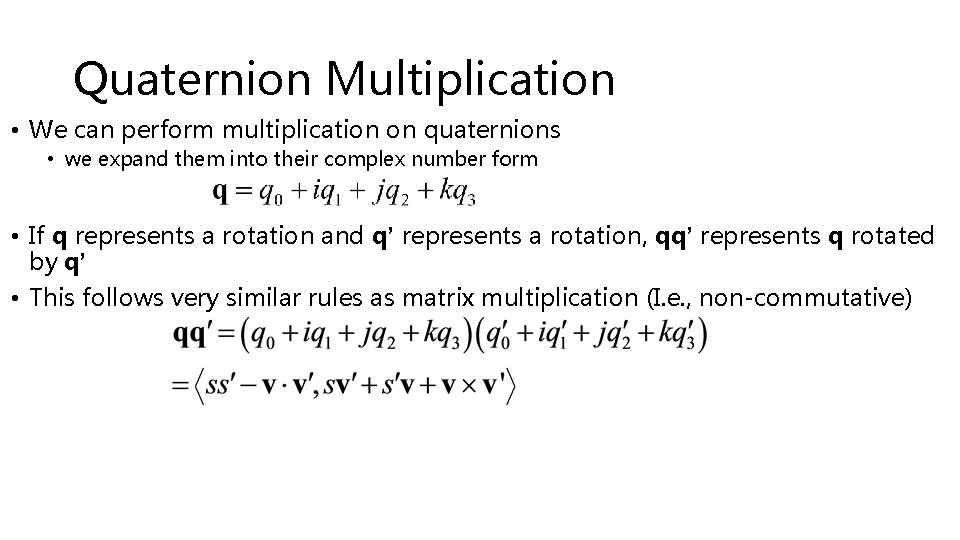
Quaternion Multiplication • We can perform multiplication on quaternions • we expand them into their complex number form • If q represents a rotation and q’ represents a rotation, qq’ represents q rotated by q’ • This follows very similar rules as matrix multiplication (I. e. , non-commutative)
Quaternion Multiplication • Two unit quaternions multiplied together results in another unit quaternion • This corresponds to the same property of complex numbers • Remember(? ) multiplication by complex numbers is like a rotation in the complex plane • Quaternions extend the planar rotations of complex numbers to 3 D rotations in space
Linear Interpolation • If we want to do a linear interpolation between two points a and b in normal space Lerp(t, a, b) = (1 -t)a + (t)b where t ranges from 0 to 1 • Note that the Lerp operation can be thought of as a weighted average (convex) • We could also write it in its additive blend form: Lerp(t, a, b) = a + t(b-a)
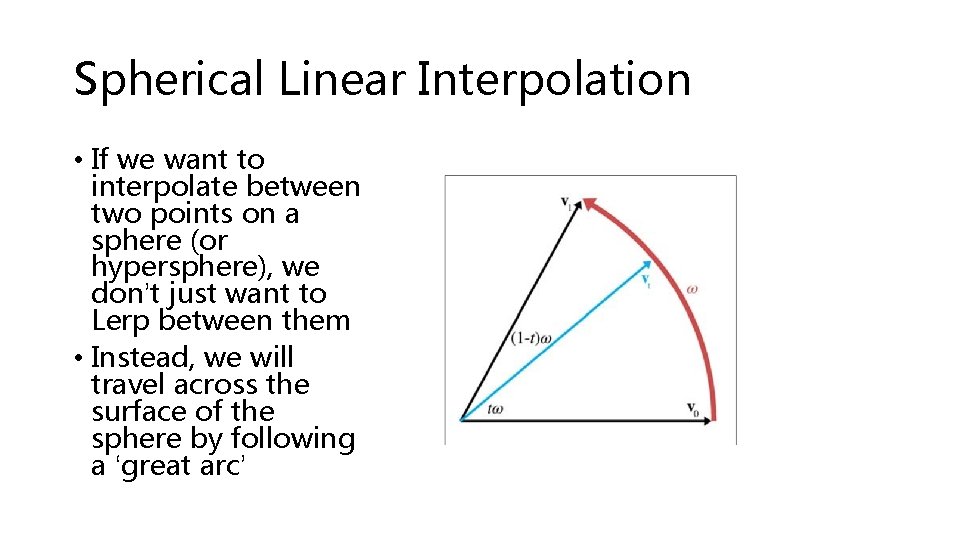
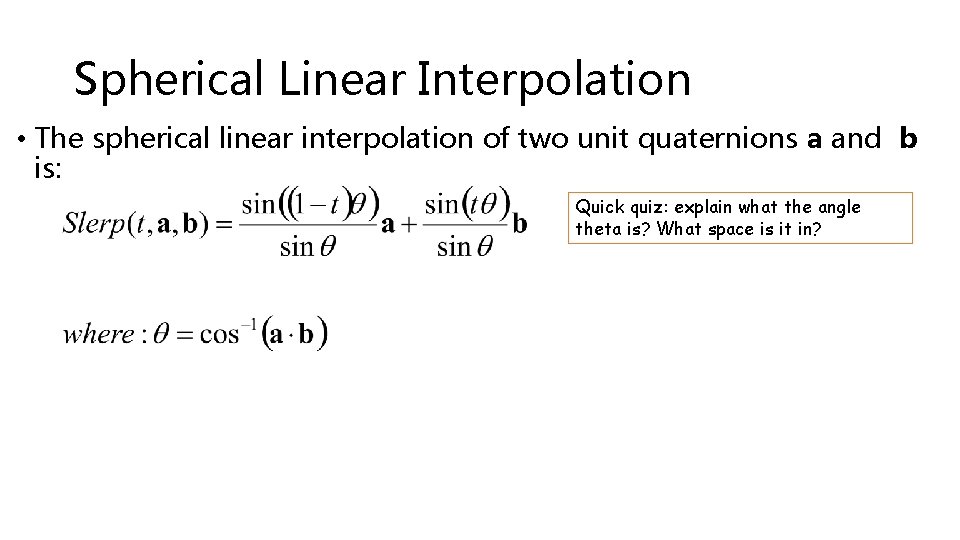
Spherical Linear Interpolation • If we want to interpolate between two points on a sphere (or hypersphere), we don’t just want to Lerp between them • Instead, we will travel across the surface of the sphere by following a ‘great arc’
Spherical Linear Interpolation • The spherical linear interpolation of two unit quaternions a and b is: Quick quiz: explain what the angle theta is? What space is it in?
Quaternion Interpolation • Useful for animating objects between two poses • Not useful for all camera orientations • up vector can become tilted annoy viewers • depends on application • Interpolated path through SLERP rotates • around a fixed axis • at a constant speed • so, no acceleration If we want to interpolate through a series of orientations q 1, q 2, …, qn is SLERP a good choice?