
1 Peter the Great SaintPetersburg Polytechnic University Institute
1 Peter the Great Saint-Petersburg Polytechnic University Institute of Energy and Transportation Systems "Engineering of Power Units and Transport Systems" Department “APPROVED” Pro-rector for R&D V. V. Sergheyev TECHNICAL MEMORANDUM of R&D Project "Research in the influence of RESURS NEXT lube oil additive on techno-economic and environmental performance of automobile engines, and part rebuilding with said additive – feasibility study" Test Director Shabanov A. Yu. St. Petersburg 2017
2 Project team: Shabanov A. Yu. Ph. D, professor, project manager, expert competence certificate Nr. РОСС RU. И 480. 04 ХД. Э 006, valid until 31. 12. 2017 Zaytsev A. B. Ph. D, associate professor Sidorov A. A. Ph. D, associate professor SUMMARY TAB 92 sheets, 53 ill. , 37 tables, 1 appendix PETROL ENGINE, NON-INTRUSIVE REBUILDING, FRICTION, WEAR This report presents the results of the research into the efficiency of antifriction remetallisant RESURS NEXT as an additive to lube oil for automobile petrol engine, and achievable rate of engine restoration (if any) through use of said additive. The authors developed procedure and methods of stand tests based on artificial standard defects scratched on friction surfaces. Test results has been analysed.
3 TABLE OF CONTENTS 1 Objective of the work. . . . . 5 2 Object of the research. . . . . 5 3 Test bed and metering equipment. . . . 7 Two car engines of VAZ family – 16 -valve injector engine type VAZ 2112 (1 st test series) and 8 -valve carburettor engine type 21083 (2 nd test series) – had been selected for the tests. . . . . 7 4 Test program. . . . . . 12 5. Test results. . . . . . 13 5. 1 Phase 1. Comparative tests of VAZ-2112 engine operating on lube oil with RESURS NEXT additive. . . . 13 5. 2. 1 Objectives of 2 nd test phase. . . . 31 5. 2. 2 Results of the motor tests. . . . 31 5. 2. 3 Visual inspection of engine conditions on completion of longterm test cycle. . . . . . 71 5. 2. 4 Measurements of cylinder leak-tightness. . . . . 71 5. Evaluation of the level of low-temperature sediments on engine parts after the long-term tests. . . . 75 6. Evaluation of the level of low-temperature sediments on engine parts after long-term tests. . . . . 77 7. Evaluation of parts rebuilding rate due to treatment with RESURS NEXT. . . . . 80 6. Conclusions. . . . . . 94 APPENDIX I. . . . . . 96 NOMENCLATURE n engine speed m engine strokes per cycle Nе engine effective power i indicated efficiency of engine м Effective efficiency of engine
4 е effective efficiency of engine ge effective specific fuel consumption NORMATIVE REFERENCES ГОСТ 17479. 1 -85. Motor oils. Classification and designation. Moscow, Standard Publishing House, 1984. ГОСТ 18509 -88. Tractor and combine diesel engines. Methods of bench tests. – Moscow, Standard Publishing House, 1988. – 70 p. ГОСТ 621 -87. Piston rings for internal combustion engines. General specifications. Moscow, Standard Publishing House, 1987, 34 p. ГОСТ 7. 32 -2001. The research report. Structure and rules of presentation. Moscow, Standard Publishing House, 2001, 22 p. ГОСТ 10541– 78. Universal motor and automobile carburettor engine oils. Specifications. ГОСТ 33– 2000. Petroleum products. Transparent and opaque liquids. Determination of kinematic viscosity and calculation of dynamic viscosity ГОСТ 14846 -81. Automobile engines. Methods of bench tests
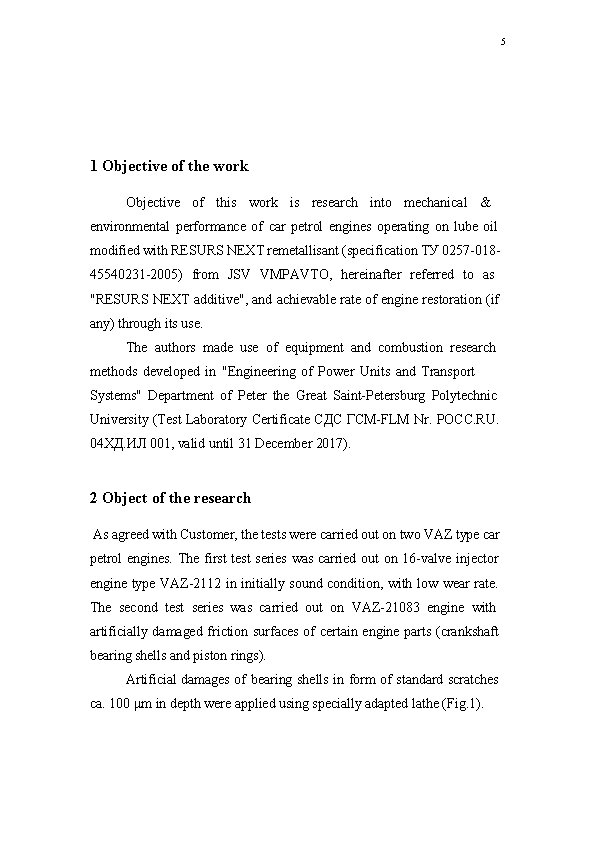
5 1 Objective of the work Objective of this work is research into mechanical & environmental performance of car petrol engines operating on lube oil modified with RESURS NEXT remetallisant (specification ТУ 0257 -01845540231 -2005) from JSV VMPAVTO, hereinafter referred to as "RESURS NEXT additive", and achievable rate of engine restoration (if any) through its use. The authors made use of equipment and combustion research methods developed in "Engineering of Power Units and Transport Systems" Department of Peter the Great Saint-Petersburg Polytechnic University (Test Laboratory Certificate СДС ГСМ-FLM Nr. РОСС. RU. 04 ХД. ИЛ 001, valid until 31 December 2017). 2 Object of the research As agreed with Customer, the tests were carried out on two VAZ type car petrol engines. The first test series was carried out on 16 -valve injector engine type VAZ-2112 in initially sound condition, with low wear rate. The second test series was carried out on VAZ-21083 engine with artificially damaged friction surfaces of certain engine parts (crankshaft bearing shells and piston rings). Artificial damages of bearing shells in form of standard scratches ca. 100 μm in depth were applied using specially adapted lathe (Fig. 1).
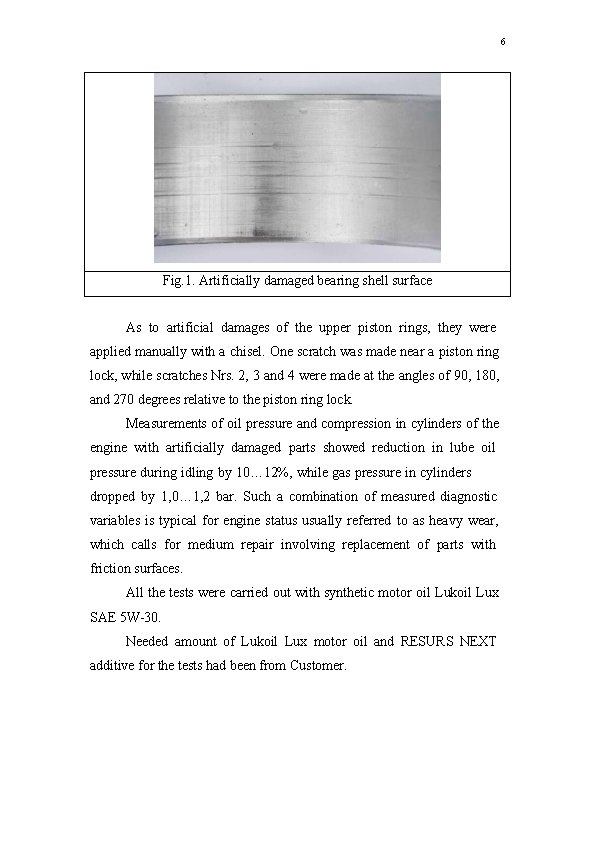
6 Fig. 1. Artificially damaged bearing shell surface As to artificial damages of the upper piston rings, they were applied manually with a chisel. One scratch was made near a piston ring lock, while scratches Nrs. 2, 3 and 4 were made at the angles of 90, 180, and 270 degrees relative to the piston ring lock. Measurements of oil pressure and compression in cylinders of the engine with artificially damaged parts showed reduction in lube oil pressure during idling by 10… 12%, while gas pressure in cylinders dropped by 1, 0… 1, 2 bar. Such a combination of measured diagnostic variables is typical for engine status usually referred to as heavy wear, which calls for medium repair involving replacement of parts with friction surfaces. All the tests were carried out with synthetic motor oil Lukoil Lux SAE 5 W-30. Needed amount of Lukoil Lux motor oil and RESURS NEXT additive for the tests had been from Customer.
7 3 Test bed and metering equipment Stand tests of motor oils were carried out on a special test bed belonging to "Engineering of Power Units and Transport Systems" Department of Peter the Great Saint-Petersburg Polytechnic University. Two car engines of VAZ family – 16 -valve injector engine type VAZ 2112 (1 st test series) and 8 -valve carburettor engine type 21083 (2 nd test series) – had been selected for the tests. The above engines, designed for front-wheel drive small class cars, are the most common models in Russia. The test bed is equipped with all the systems needed for its normal running in any operation mode, as well as process instrumentation and control/monitoring equipment, which enables recording of all the relevant parameters of engine and its systems (such as fuel supply, cooling, etc. ). The test bed is equipped with the following systems and devices: - dynamometer - remote control panel with monitoring equipment - engine-dynamometer coupling - engine cooling system - lube oil system - fuel supply system with fuel meter - aspiration system - exhaust system
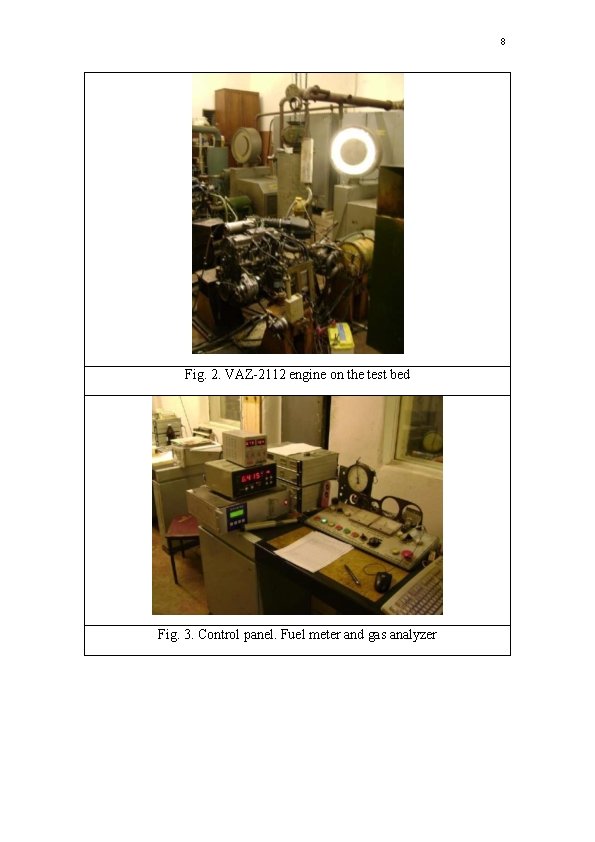
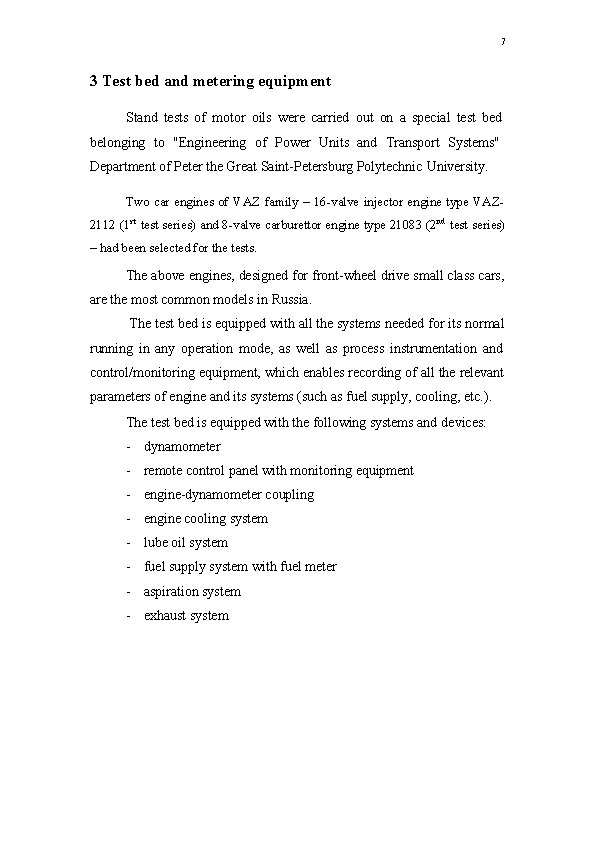
8 Fig. 2. VAZ-2112 engine on the test bed Fig. 3. Control panel. Fuel meter and gas analyzer
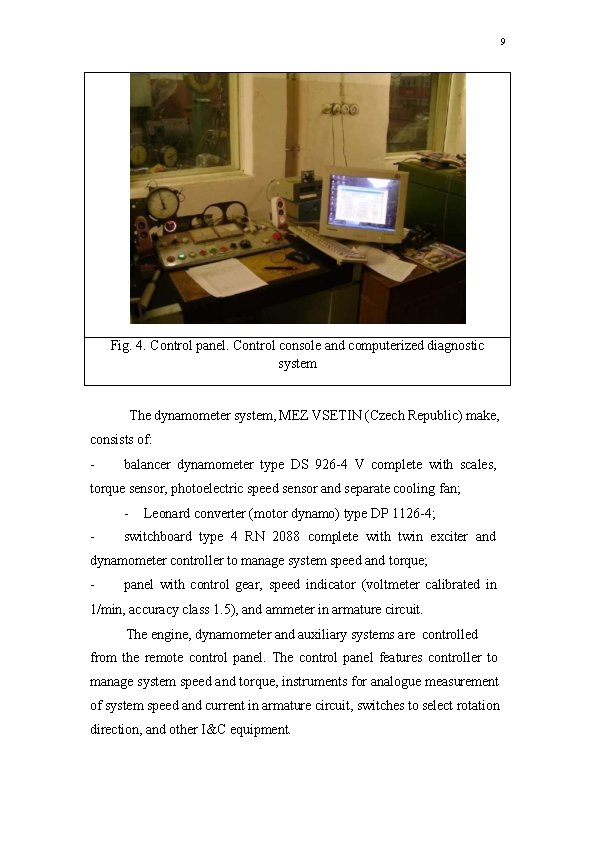
9 Fig. 4. Control panel. Control console and computerized diagnostic system The dynamometer system, MEZ VSETIN (Czech Republic) make, consists of: - balancer dynamometer type DS 926 -4 V complete with scales, torque sensor, photoelectric speed sensor and separate cooling fan; - Leonard converter (motor dynamo) type DP 1126 -4; switchboard type 4 RN 2088 complete with twin exciter and dynamometer controller to manage system speed and torque; - panel with control gear, speed indicator (voltmeter calibrated in 1/min, accuracy class 1. 5), and ammeter in armature circuit. The engine, dynamometer and auxiliary systems are controlled from the remote control panel. The control panel features controller to manage system speed and torque, instruments for analogue measurement of system speed and current in armature circuit, switches to select rotation direction, and other I&C equipment.
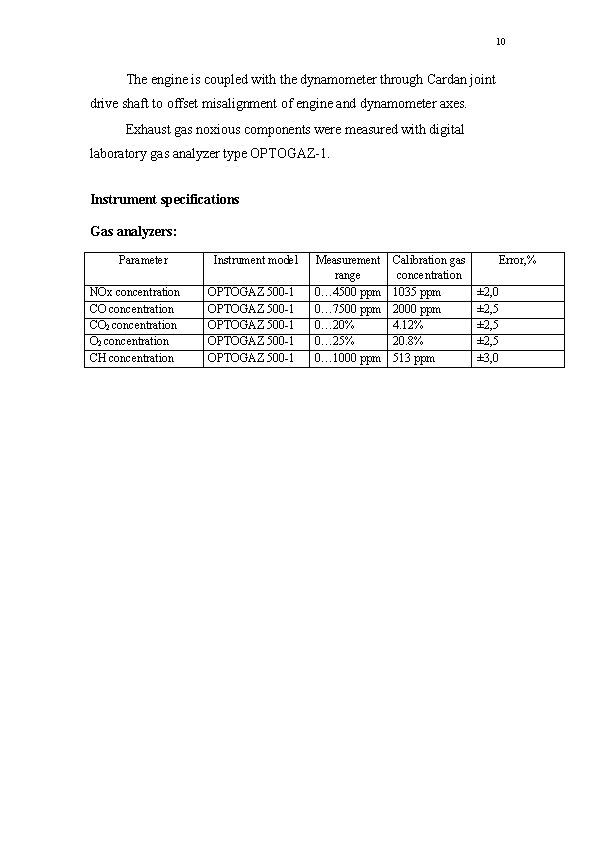
10 The engine is coupled with the dynamometer through Cardan joint drive shaft to offset misalignment of engine and dynamometer axes. Exhaust gas noxious components were measured with digital laboratory gas analyzer type OPTOGAZ-1. Instrument specifications Gas analyzers: Parameter NOx concentration CO 2 concentration CH concentration Instrument model OPTOGAZ 500 -1 OPTOGAZ 500 -1 Measurement range 0… 4500 ppm 0… 7500 ppm 0… 20% 0… 25% 0… 1000 ppm Calibration gas concentration 1035 ppm 2000 ppm 4. 12% 20. 8% 513 ppm Error, % ± 2, 0 ± 2, 5 ± 3, 0
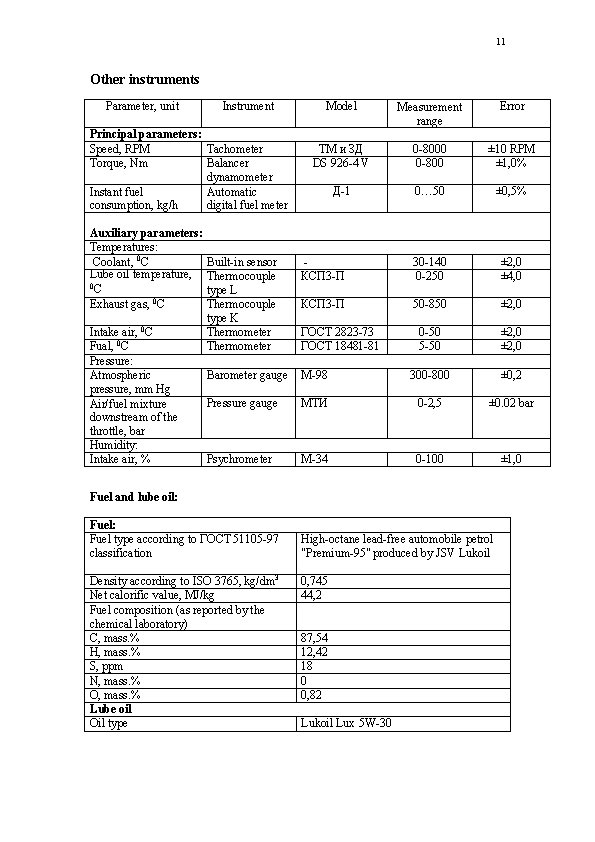
11 Other instruments Parameter, unit Instrument Principal parameters: Speed, RPM Tachometer Torque, Nm Balancer dynamometer Instant fuel Automatic consumption, kg/h digital fuel meter Auxiliary parameters: Temperatures: Coolant, 0 C Lube oil temperature, 0 C Exhaust gas, 0 C Intake air, 0 C Fual, 0 C Pressure: Atmospheric pressure, mm Hg Air/fuel mixture downstream of the throttle, bar Humidity: Intake air, % Model Measurement range Error ТМ и ЗД DS 926 -4 V 0 -8000 0 -800 ± 10 RPM ± 1, 0% Д-1 0… 50 ± 0, 5% Built-in sensor Thermocouple type L Thermocouple type K Thermometer КСП 3 -П 30 -140 0 -250 ± 2, 0 ± 4, 0 КСП 3 -П 50 -850 ± 2, 0 0 -50 5 -50 ± 2, 0 Barometer gauge М-98 300 -800 ± 0, 2 Pressure gauge МТИ 0 -2, 5 ± 0. 02 bar Psychrometer М-34 0 -100 ± 1, 0 ГОСТ 2823 -73 ГОСТ 18481 -81 Fuel and lube oil: Fuel type according to ГОСТ 51105 -97 classification Density according to ISO 3765, kg/dm 3 Net calorific value, MJ/kg Fuel composition (as reported by the chemical laboratory) С, mass. % Н, mass. % S, ppm N, mass. % O, mass. % Lube oil Oil type High-octane lead-free automobile petrol "Premium-95" produced by JSV Lukoil 0, 745 44, 2 87, 54 12, 42 18 0 0, 82 Lukoil Lux 5 W-30
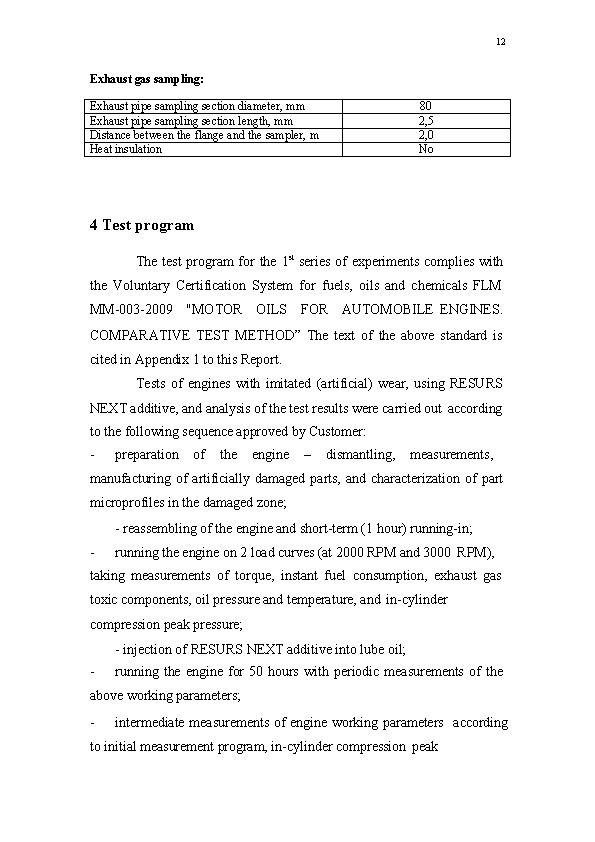
12 Exhaust gas sampling: Exhaust pipe sampling section diameter, mm Exhaust pipe sampling section length, mm Distance between the flange and the sampler, m Heat insulation 80 2, 5 2, 0 No 4 Test program The test program for the 1 st series of experiments complies with the Voluntary Certification System for fuels, oils and chemicals FLM ММ-003 -2009 "MOTOR OILS FOR AUTOMOBILE ENGINES. COMPARATIVE TEST METHOD” The text of the above standard is cited in Appendix 1 to this Report. Tests of engines with imitated (artificial) wear, using RESURS NEXT additive, and analysis of the test results were carried out according to the following sequence approved by Customer: - preparation of the engine – dismantling, measurements, manufacturing of artificially damaged parts, and characterization of part microprofiles in the damaged zone; - reassembling of the engine and short-term (1 hour) running-in; - running the engine on 2 load curves (at 2000 RPM and 3000 RPM), taking measurements of torque, instant fuel consumption, exhaust gas toxic components, oil pressure and temperature, and in-cylinder compression peak pressure; - injection of RESURS NEXT additive into lube oil; - running the engine for 50 hours with periodic measurements of the above working parameters; - intermediate measurements of engine working parameters according to initial measurement program, in-cylinder compression peak
13 pressure; dismantling of the engine, examination of selected parts and characterization of part microprofiles in the damaged zone; - reassembling of the engine, returning it onto the test bed, and short- term running-in; - repeated treatment the engine with RESURS NEXT additive; - running the engine for 50 hours with periodic measurements of the above mentioned working parameters; - final measurements of engine working parameters according to initial measurement program, in-cylinder compression peak pressure; dismantling of the engine, examination of selected parts and characterization of part microprofiles in the damaged zone; - reassembling the engine and refilling it with fresh oil (free of RESURS NEXT additive); - running the engine for 50 hours with periodic measurements of the above working parameters, so as to evaluate duration of treatment aftereffect; - measurements of engine working parameters according to initial measurement program, in-cylinder compression peak pressure; dismantling of the engine, examination of selected parts and characterization of microprofiles in their damaged zones; - processing and analysis of the test results. 5. Test results 1. Phase 1. Comparative tests of VAZ-2112 engine operating on lube oil with RESURS NEXT additive This part of the test program has been carried out with a view to evaluate instant effects of treatment of initially sound engine with
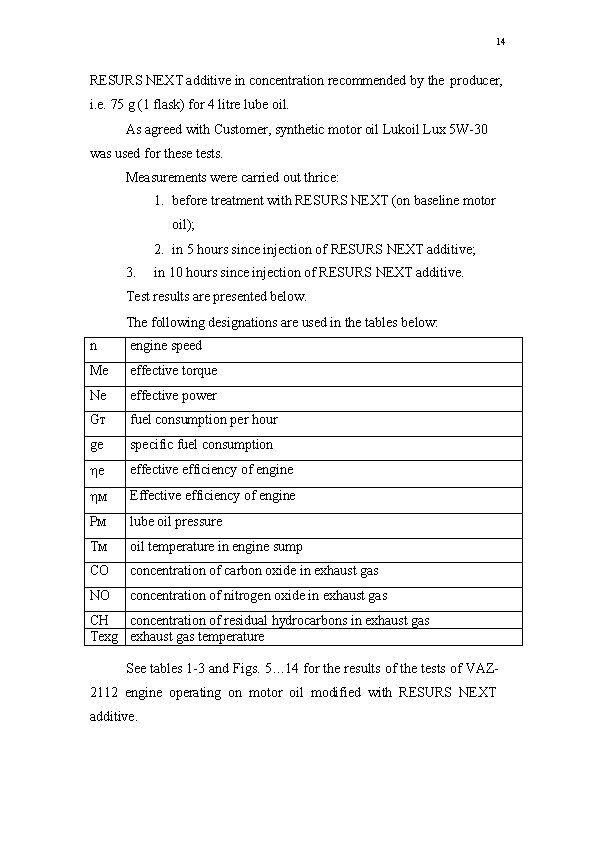
14 RESURS NEXT additive in concentration recommended by the producer, i. e. 75 g (1 flask) for 4 litre lube oil. As agreed with Customer, synthetic motor oil Lukoil Lux 5 W-30 was used for these tests. Measurements were carried out thrice: 1. before treatment with RESURS NEXT (on baseline motor oil); 2. in 5 hours since injection of RESURS NEXT additive; 3. in 10 hours since injection of RESURS NEXT additive. Test results are presented below. The following designations are used in the tables below: n engine speed Ме effective torque Nе effective power Gт fuel consumption per hour ge specific fuel consumption е effective efficiency of engine м Effective efficiency of engine Рм lube oil pressure Тм oil temperature in engine sump СО concentration of carbon oxide in exhaust gas NO concentration of nitrogen oxide in exhaust gas СН concentration of residual hydrocarbons in exhaust gas Texg exhaust gas temperature See tables 1 -3 and Figs. 5… 14 for the results of the tests of VAZ 2112 engine operating on motor oil modified with RESURS NEXT additive.
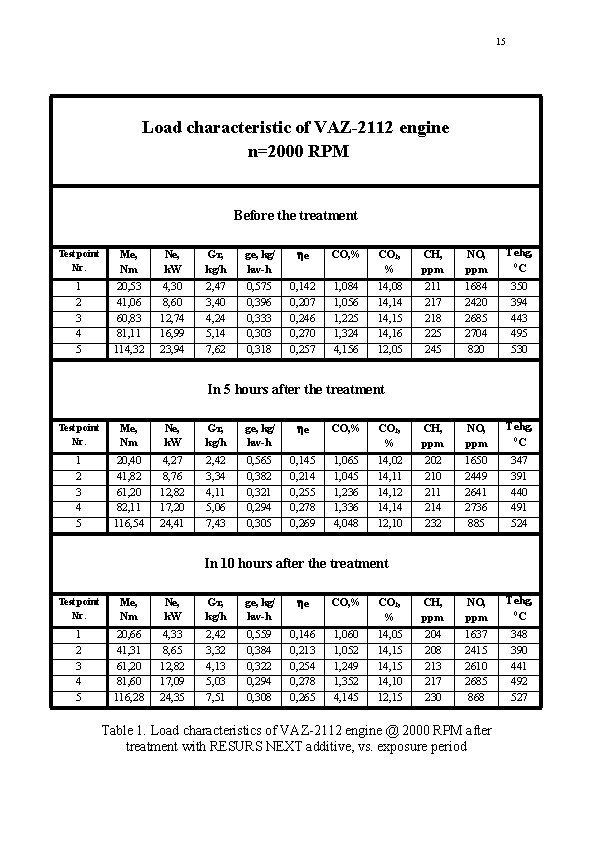
15 Load characteristic of VAZ-2112 engine n=2000 RPM Before the treatment Test point Nr. Me, Nm Nе, k. W Gт, kg/h ge, kg/ kw-h е СО, % СО 2, % CH, ppm NO, ppm Tehg, 0 C 1 2 3 4 5 20, 53 41, 06 60, 83 81, 11 114, 32 4, 30 8, 60 12, 74 16, 99 23, 94 2, 47 3, 40 4, 24 5, 14 7, 62 0, 575 0, 396 0, 333 0, 303 0, 318 0, 142 0, 207 0, 246 0, 270 0, 257 1, 084 1, 056 1, 225 1, 324 4, 156 14, 08 14, 14 14, 15 14, 16 12, 05 211 217 218 225 245 1684 2420 2685 2704 820 350 394 443 495 530 In 5 hours after the treatment Test point Nr. Me, Nm Nе, k. W Gт, kg/h ge, kg/ kw-h е СО, % СО 2, % CH, ppm NO, ppm Tehg, 0 C 1 2 3 4 5 20, 40 41, 82 61, 20 82, 11 116, 54 4, 27 8, 76 12, 82 17, 20 24, 41 2, 42 3, 34 4, 11 5, 06 7, 43 0, 565 0, 382 0, 321 0, 294 0, 305 0, 145 0, 214 0, 255 0, 278 0, 269 1, 065 1, 045 1, 236 1, 336 4, 048 14, 02 14, 11 14, 12 14, 14 12, 10 202 210 211 214 232 1650 2449 2641 2736 885 347 391 440 491 524 In 10 hours after the treatment Test point Nr. Me, Nm Nе, k. W Gт, kg/h ge, kg/ kw-h е СО, % СО 2, % CH, ppm NO, ppm Tehg, 0 C 1 2 3 4 5 20, 66 41, 31 61, 20 81, 60 116, 28 4, 33 8, 65 12, 82 17, 09 24, 35 2, 42 3, 32 4, 13 5, 03 7, 51 0, 559 0, 384 0, 322 0, 294 0, 308 0, 146 0, 213 0, 254 0, 278 0, 265 1, 060 1, 052 1, 249 1, 352 4, 145 14, 05 14, 15 14, 10 12, 15 204 208 213 217 230 1637 2415 2610 2685 868 348 390 441 492 527 Table 1. Load characteristics of VAZ-2112 engine @ 2000 RPM after treatment with RESURS NEXT additive, vs. exposure period
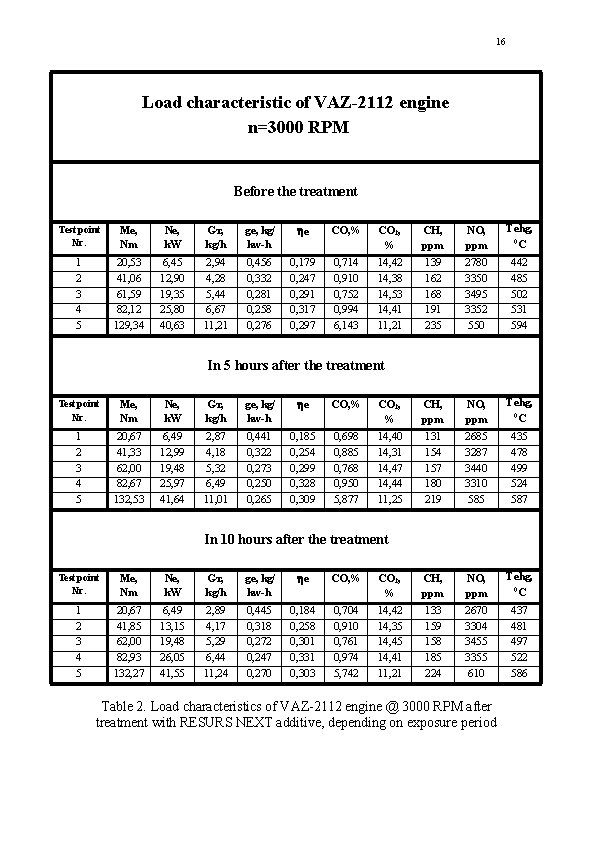
16 Load characteristic of VAZ-2112 engine n=3000 RPM Before the treatment Test point Nr. Me, Nm Nе, k. W Gт, kg/h ge, kg/ kw-h е СО, % СО 2, % CH, ppm NO, ppm Tehg, 0 C 1 2 3 4 5 20, 53 41, 06 61, 59 82, 12 129, 34 6, 45 12, 90 19, 35 25, 80 40, 63 2, 94 4, 28 5, 44 6, 67 11, 21 0, 456 0, 332 0, 281 0, 258 0, 276 0, 179 0, 247 0, 291 0, 317 0, 297 0, 714 0, 910 0, 752 0, 994 6, 143 14, 42 14, 38 14, 53 14, 41 11, 21 139 162 168 191 235 2780 3350 3495 3352 550 442 485 502 531 594 In 5 hours after the treatment Test point Nr. Me, Nm Nе, k. W Gт, kg/h ge, kg/ kw-h е СО, % СО 2, % CH, ppm NO, ppm Tehg, 0 C 1 2 3 4 5 20, 67 41, 33 62, 00 82, 67 132, 53 6, 49 12, 99 19, 48 25, 97 41, 64 2, 87 4, 18 5, 32 6, 49 11, 01 0, 441 0, 322 0, 273 0, 250 0, 265 0, 185 0, 254 0, 299 0, 328 0, 309 0, 698 0, 885 0, 768 0, 950 5, 877 14, 40 14, 31 14, 47 14, 44 11, 25 131 154 157 180 219 2685 3287 3440 3310 585 435 478 499 524 587 In 10 hours after the treatment Test point Nr. Me, Nm Nе, k. W Gт, kg/h ge, kg/ kw-h е СО, % СО 2, % CH, ppm NO, ppm Tehg, 0 C 1 2 3 4 5 20, 67 41, 85 62, 00 82, 93 132, 27 6, 49 13, 15 19, 48 26, 05 41, 55 2, 89 4, 17 5, 29 6, 44 11, 24 0, 445 0, 318 0, 272 0, 247 0, 270 0, 184 0, 258 0, 301 0, 331 0, 303 0, 704 0, 910 0, 761 0, 974 5, 742 14, 35 14, 41 11, 21 133 159 158 185 224 2670 3304 3455 3355 610 437 481 497 522 586 Table 2. Load characteristics of VAZ-2112 engine @ 3000 RPM after treatment with RESURS NEXT additive, depending on exposure period
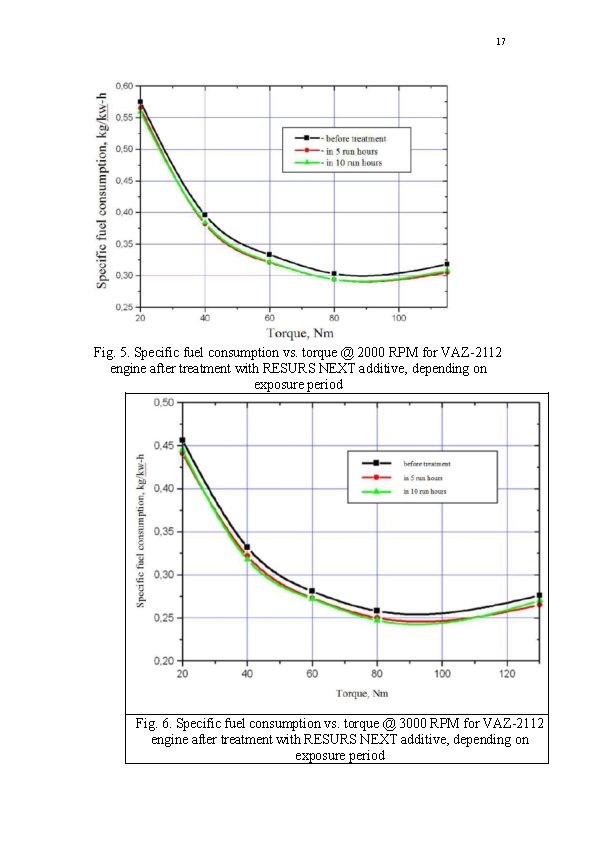
17 Fig. 5. Specific fuel consumption vs. torque @ 2000 RPM for VAZ-2112 engine after treatment with RESURS NEXT additive, depending on exposure period Fig. 6. Specific fuel consumption vs. torque @ 3000 RPM for VAZ-2112 engine after treatment with RESURS NEXT additive, depending on exposure period
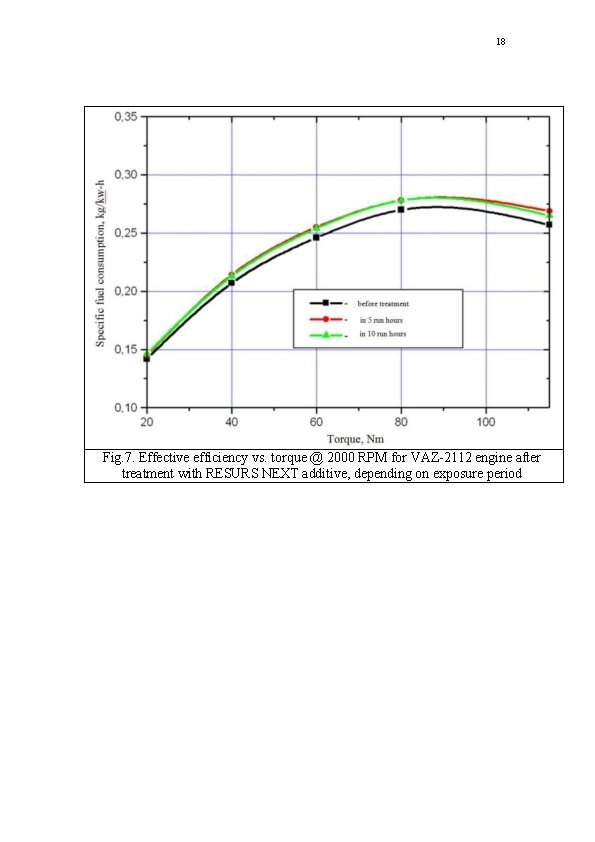
18 Fig. 7. Effective efficiency vs. torque @ 2000 RPM for VAZ-2112 engine after treatment with RESURS NEXT additive, depending on exposure period
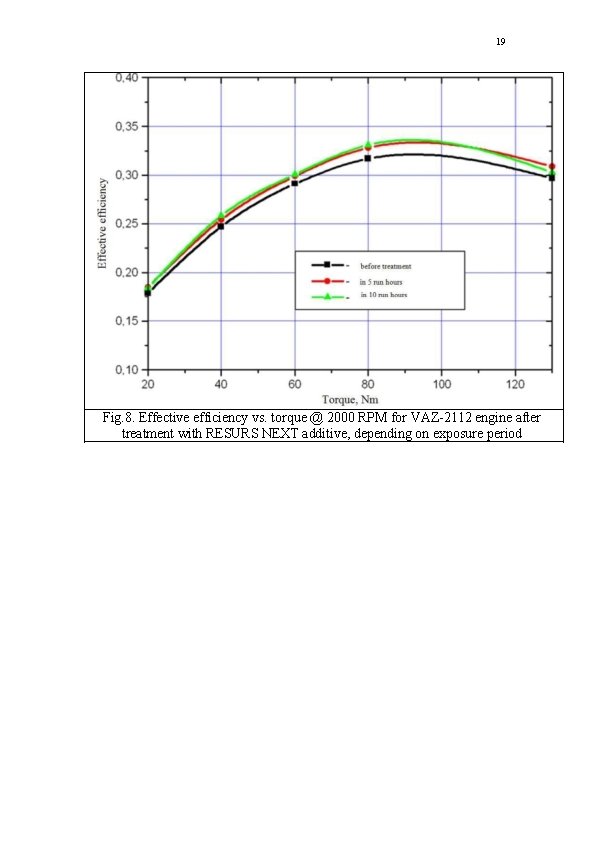
19 Fig. 8. Effective efficiency vs. torque @ 2000 RPM for VAZ-2112 engine after treatment with RESURS NEXT additive, depending on exposure period
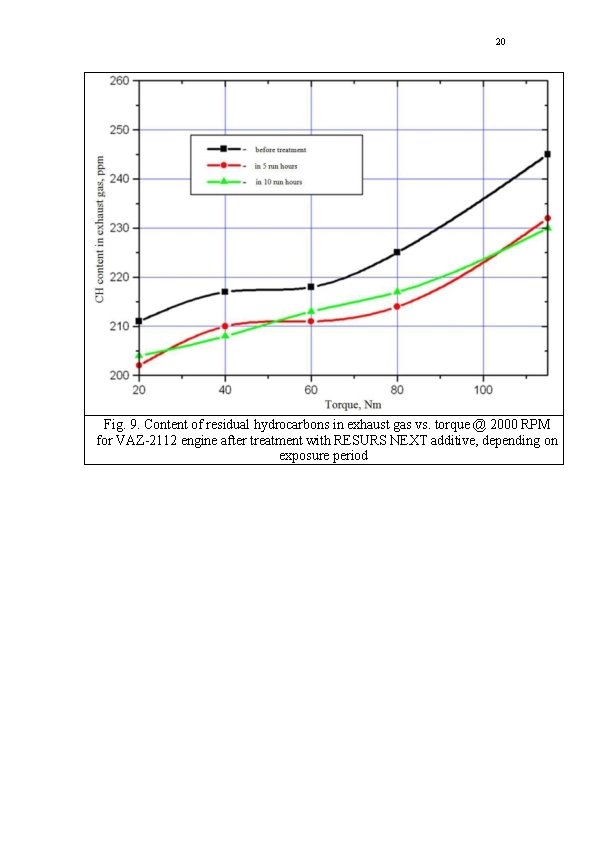
20 Fig. 9. Content of residual hydrocarbons in exhaust gas vs. torque @ 2000 RPM for VAZ-2112 engine after treatment with RESURS NEXT additive, depending on exposure period
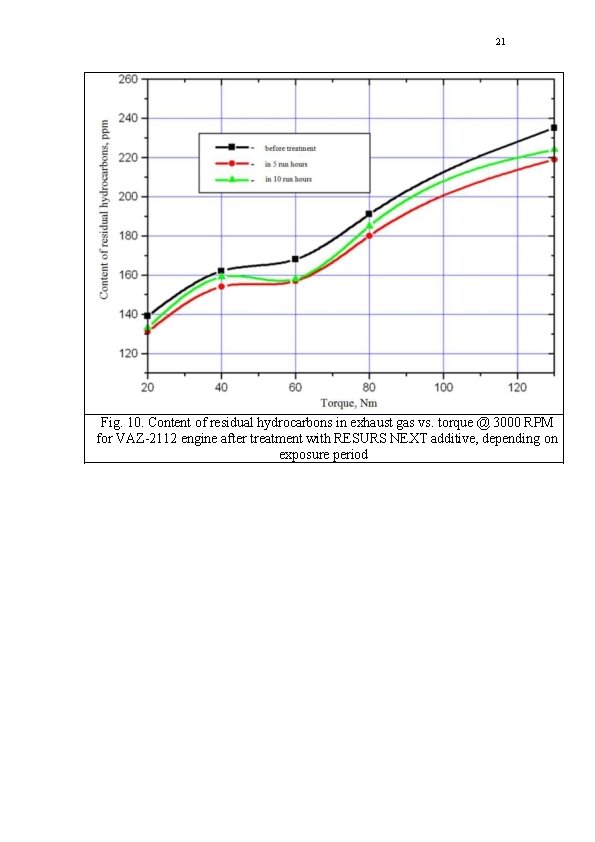
21 Fig. 10. Content of residual hydrocarbons in exhaust gas vs. torque @ 3000 RPM for VAZ-2112 engine after treatment with RESURS NEXT additive, depending on exposure period
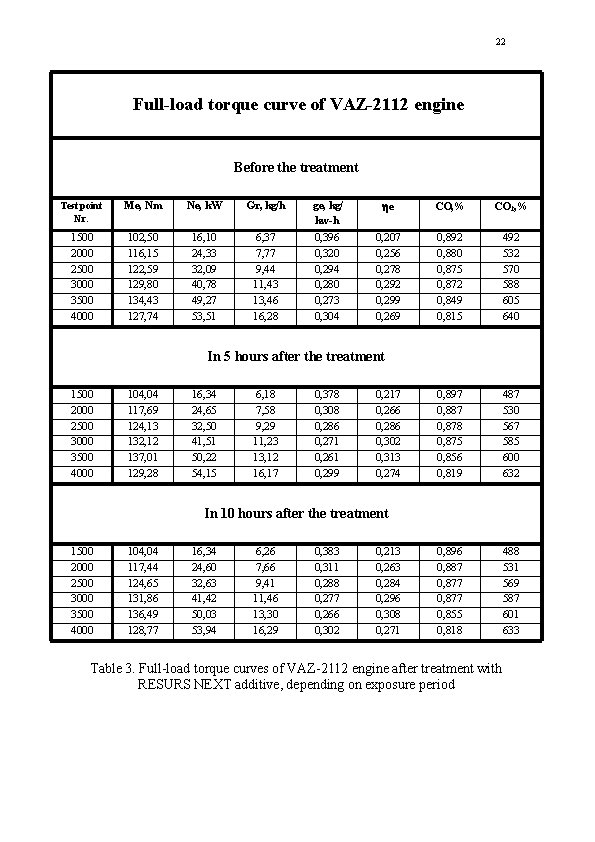
22 Full-load torque curve of VAZ-2112 engine Before the treatment Test point Nr. Me, Nm Nе, k. W Gт, kg/h ge, kg/ kw-h е СО, % СО 2, % 1500 2000 2500 3000 3500 4000 102, 50 116, 15 122, 59 129, 80 134, 43 127, 74 16, 10 24, 33 32, 09 40, 78 49, 27 53, 51 6, 37 7, 77 9, 44 11, 43 13, 46 16, 28 0, 396 0, 320 0, 294 0, 280 0, 273 0, 304 0, 207 0, 256 0, 278 0, 292 0, 299 0, 269 0, 892 0, 880 0, 875 0, 872 0, 849 0, 815 492 532 570 588 605 640 0, 897 0, 887 0, 878 0, 875 0, 856 0, 819 487 530 567 585 600 632 0, 896 0, 887 0, 877 0, 855 0, 818 488 531 569 587 601 633 In 5 hours after the treatment 1500 2000 2500 3000 3500 4000 104, 04 117, 69 124, 13 132, 12 137, 01 129, 28 16, 34 24, 65 32, 50 41, 51 50, 22 54, 15 6, 18 7, 58 9, 29 11, 23 13, 12 16, 17 0, 378 0, 308 0, 286 0, 271 0, 261 0, 299 0, 217 0, 266 0, 286 0, 302 0, 313 0, 274 In 10 hours after the treatment 1500 2000 2500 3000 3500 4000 104, 04 117, 44 124, 65 131, 86 136, 49 128, 77 16, 34 24, 60 32, 63 41, 42 50, 03 53, 94 6, 26 7, 66 9, 41 11, 46 13, 30 16, 29 0, 383 0, 311 0, 288 0, 277 0, 266 0, 302 0, 213 0, 263 0, 284 0, 296 0, 308 0, 271 Table 3. Full-load torque curves of VAZ-2112 engine after treatment with RESURS NEXT additive, depending on exposure period
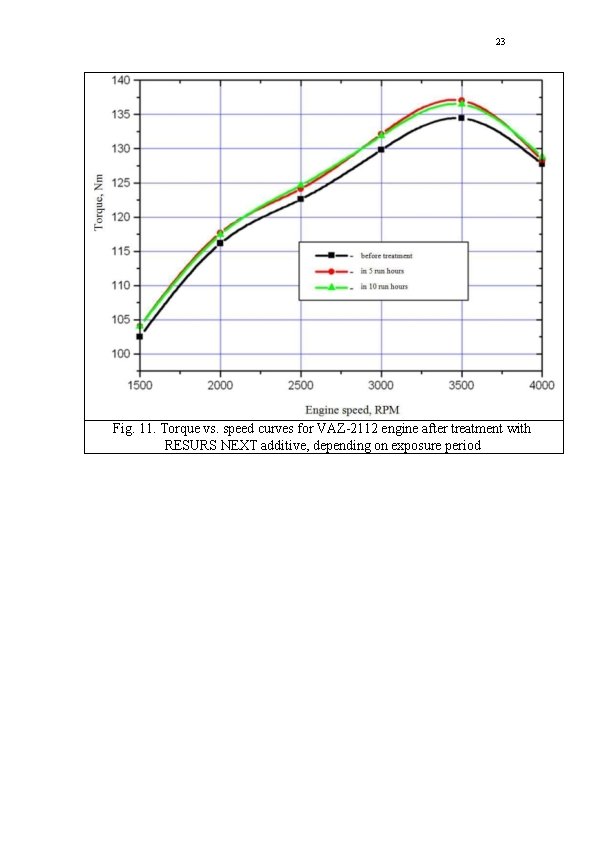
23 Fig. 11. Torque vs. speed curves for VAZ-2112 engine after treatment with RESURS NEXT additive, depending on exposure period
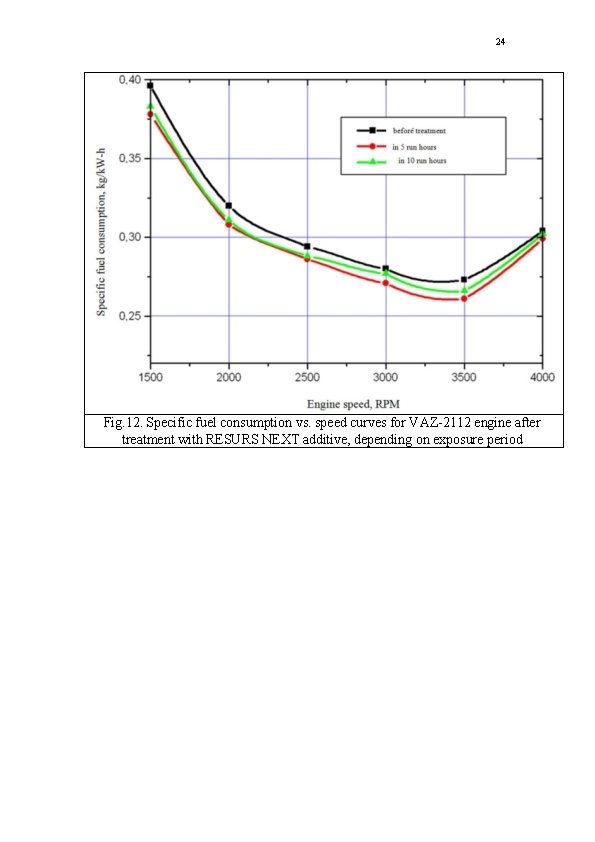
24 Fig. 12. Specific fuel consumption vs. speed curves for VAZ-2112 engine after treatment with RESURS NEXT additive, depending on exposure period
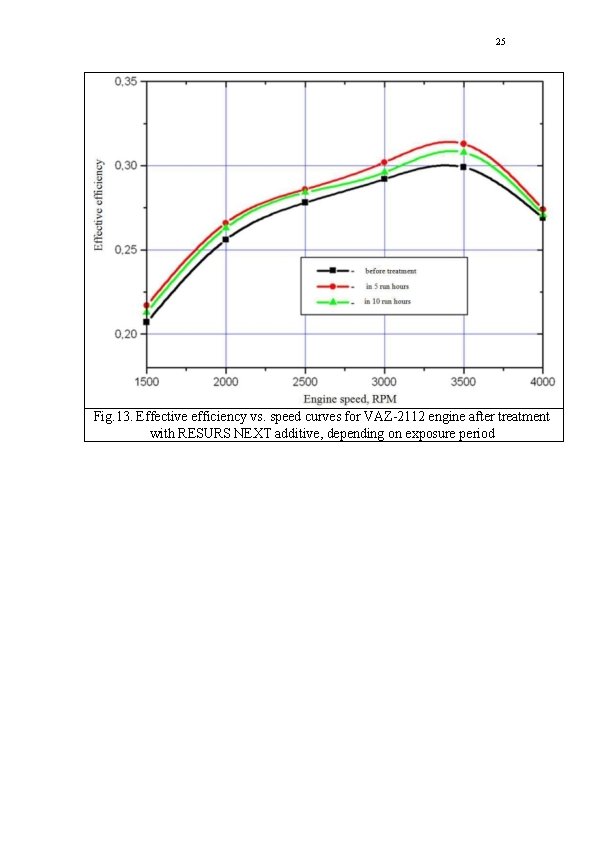
25 Fig. 13. Effective efficiency vs. speed curves for VAZ-2112 engine after treatment with RESURS NEXT additive, depending on exposure period
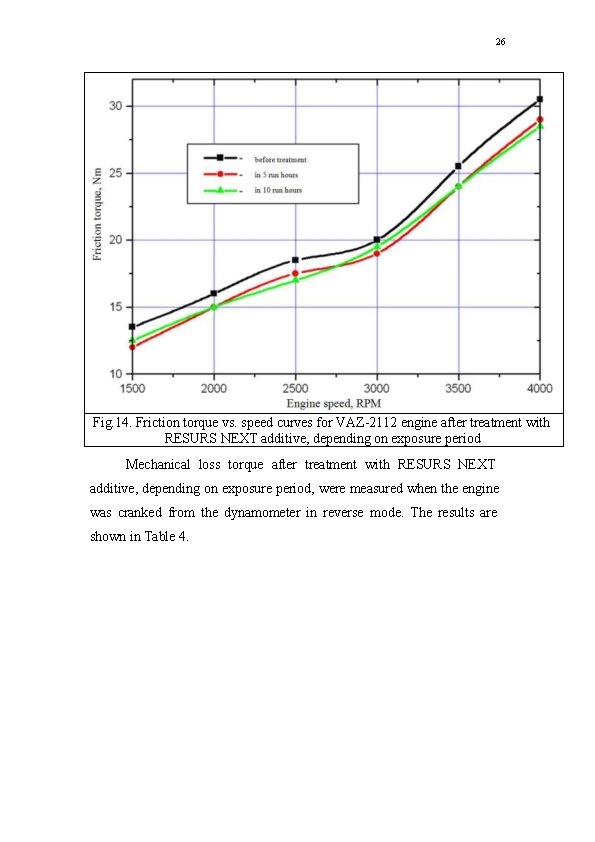
26 Fig. 14. Friction torque vs. speed curves for VAZ-2112 engine after treatment with RESURS NEXT additive, depending on exposure period Mechanical loss torque after treatment with RESURS NEXT additive, depending on exposure period, were measured when the engine was cranked from the dynamometer in reverse mode. The results are shown in Table 4.
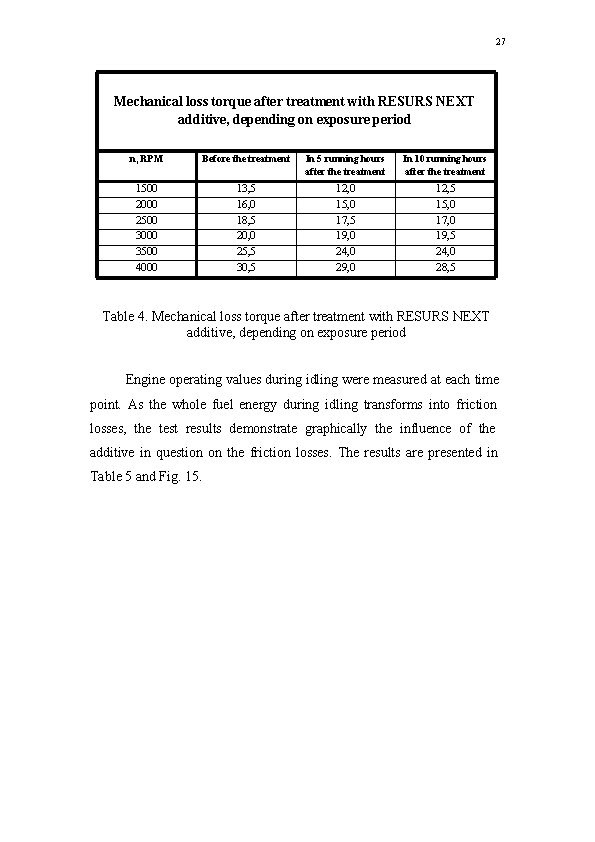
27 Mechanical loss torque after treatment with RESURS NEXT additive, depending on exposure period n, RPM Before the treatment In 5 running hours after the treatment In 10 running hours after the treatment 1500 2000 2500 3000 3500 4000 13, 5 16, 0 18, 5 20, 0 25, 5 30, 5 12, 0 15, 0 17, 5 19, 0 24, 0 29, 0 12, 5 15, 0 17, 0 19, 5 24, 0 28, 5 Table 4. Mechanical loss torque after treatment with RESURS NEXT additive, depending on exposure period Engine operating values during idling were measured at each time point. As the whole fuel energy during idling transforms into friction losses, the test results demonstrate graphically the influence of the additive in question on the friction losses. The results are presented in Table 5 and Fig. 15.
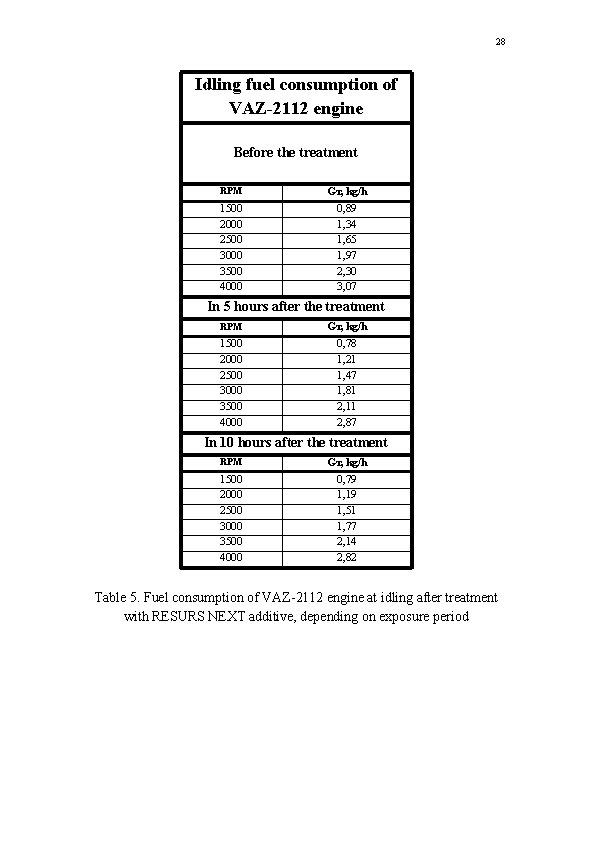
28 Idling fuel consumption of VAZ-2112 engine Before the treatment RPM Gт, kg/h 1500 2000 2500 3000 3500 4000 0, 89 1, 34 1, 65 1, 97 2, 30 3, 07 In 5 hours after the treatment RPM Gт, kg/h 1500 2000 2500 3000 3500 4000 0, 78 1, 21 1, 47 1, 81 2, 11 2, 87 In 10 hours after the treatment RPM Gт, kg/h 1500 2000 2500 3000 3500 4000 0, 79 1, 19 1, 51 1, 77 2, 14 2, 82 Table 5. Fuel consumption of VAZ-2112 engine at idling after treatment with RESURS NEXT additive, depending on exposure period
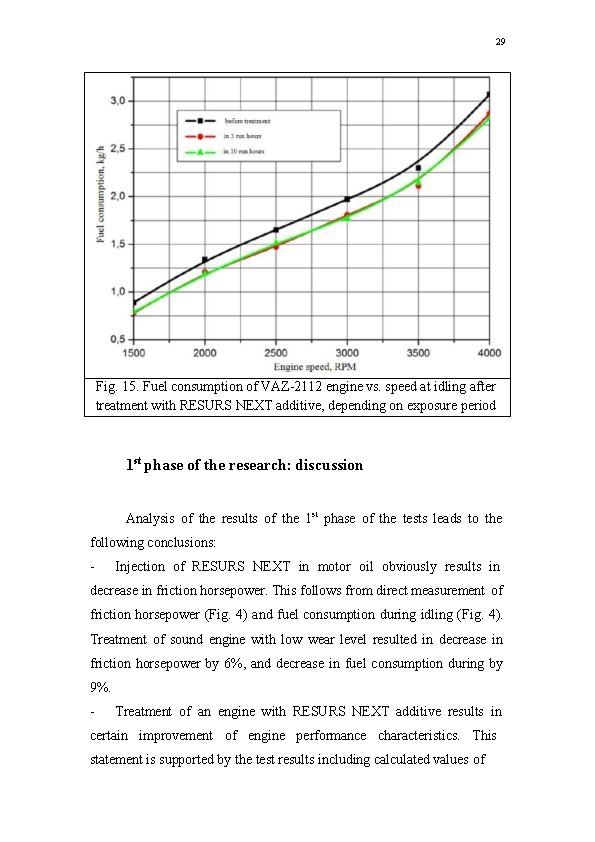
29 Fig. 15. Fuel consumption of VAZ-2112 engine vs. speed at idling after treatment with RESURS NEXT additive, depending on exposure period 1 st phase of the research: discussion Analysis of the results of the 1 st phase of the tests leads to the following conclusions: - Injection of RESURS NEXT in motor oil obviously results in decrease in friction horsepower. This follows from direct measurement of friction horsepower (Fig. 4) and fuel consumption during idling (Fig. 4). Treatment of sound engine with low wear level resulted in decrease in friction horsepower by 6%, and decrease in fuel consumption during by 9%. - Treatment of an engine with RESURS NEXT additive results in certain improvement of engine performance characteristics. This statement is supported by the test results including calculated values of
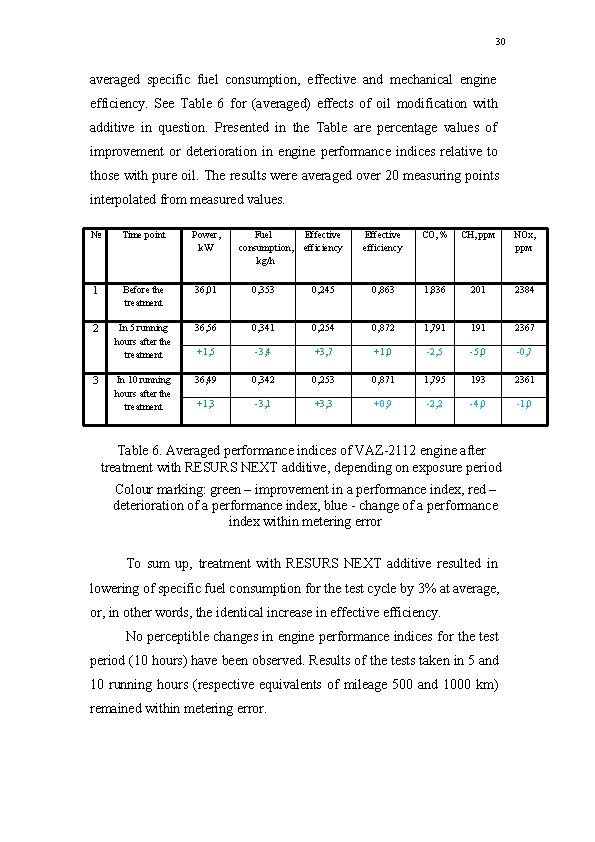
30 averaged specific fuel consumption, effective and mechanical engine efficiency. See Table 6 for (averaged) effects of oil modification with additive in question. Presented in the Table are percentage values of improvement or deterioration in engine performance indices relative to those with pure oil. The results were averaged over 20 measuring points interpolated from measured values. № Time point Power, k. W Fuel consumption, kg/h Effective efficiency CO, % CH, ррм NOx, ррм 1 Before the treatment 36, 01 0, 353 0, 245 0, 863 1, 836 201 2384 2 In 5 running hours after the treatment 36, 56 0, 341 0, 254 0, 872 1, 791 191 2367 +1, 5 -3, 4 +3, 7 +1, 0 -2, 5 -5, 0 -0, 7 In 10 running hours after the treatment 36, 49 0, 342 0, 253 0, 871 1, 795 193 2361 +1, 3 -3, 1 +3, 3 +0, 9 -2, 2 -4, 0 -1, 0 3 Table 6. Averaged performance indices of VAZ-2112 engine after treatment with RESURS NEXT additive, depending on exposure period Colour marking: green – improvement in a performance index, red – deterioration of a performance index, blue - change of a performance index within metering error To sum up, treatment with RESURS NEXT additive resulted in lowering of specific fuel consumption for the test cycle by 3% at average, or, in other words, the identical increase in effective efficiency. No perceptible changes in engine performance indices for the test period (10 hours) have been observed. Results of the tests taken in 5 and 10 running hours (respective equivalents of mileage 500 and 1000 km) remained within metering error.
31 5. 2 Phase 2. Long-term tests of VAZ-21083 engine with artificially damaged parts, running on motor oil modified with RESURS NEXT additive 1. Objectives of 2 nd test phase The objectives of this test phase were as follows: - confirmation of positive effects of RESURS NEXT additive on another car engine type; - check of achievable rate of engine restoration (if any) through the use of said additive; - evaluation of time-related changes in efficiency of the additive during long-term run period; - evaluation of dynamics in scale deposit on engine parts (both high- temperature and low-temperature) when using RESURS NEXT additive; - evaluation of the duration of treatment aftereffect, with the engine operating on fresh lube oil. The test were carried out in strict compliance with methods described above in Part 3 of this Report. The test results are presented below. 2. Results of the motor tests The engine with artificially damaged parts (piston rings and crankshaft bearing shells), primed with motor oil type Lukoil Lux 5 W-30 modified with RESURS NEXT additive, operated for 100 running hours (equivalent of cumulative 10000 km mileage). During the test period RESURS NEXT additive doses were injected into the oil twice, thus increasing its concentration stepwise. First, it was injected in the very beginning of the test run in recommended concentration, i. e. 75 g (1 flask) for 4 litre lube oil. The second injection of the additive of the same concentration took place in 50 running hours (equivalent of
32 cumulative 5000 km mileage). There were no intermediate oil changes between the 1 st and the 2 nd injections. On completion of the 1 st two test phases the engine was primed anew with fresh motor oil type Lukoil Lux 5 W-30, whereupon the 3 rd test phase (50 running hours) was carried out, in order to assess aftereffect of the treatment. Each test phase was finalized with complete dismantling of the engine, followed by fault detection, evaluation of level of scale sedimentation on parts' surfaces and changes in state of artificially damaged surfaces. Also, on completion of every test phase in-cylinder compression peak pressure was measured for each particular cylinder. See Tables 7… 12 and Figs. 16… 27 for test results of each test phase (load characteristics).
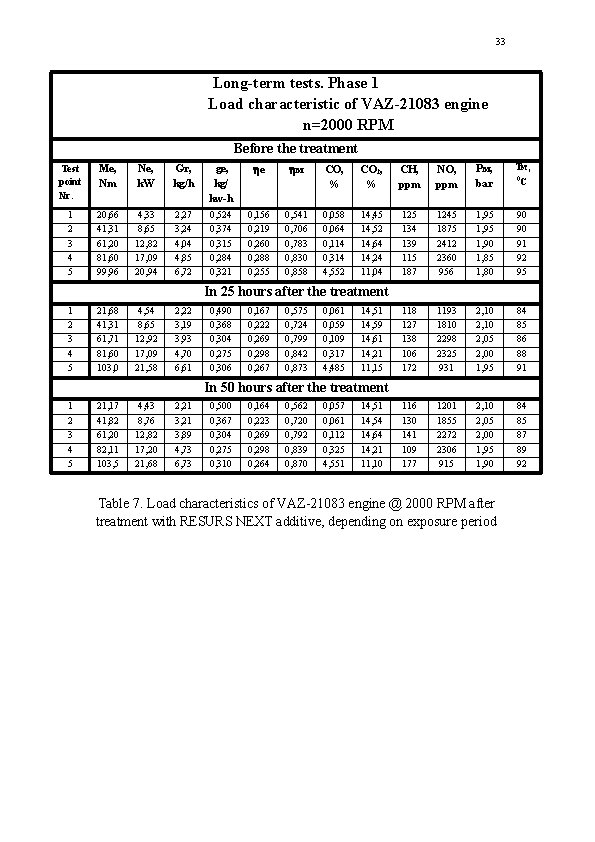
33 Long-term tests. Phase 1 Load characteristic of VAZ-21083 engine n=2000 RPM Before the treatment Test point Nr. Me, Nm Nе, k. W Gт, kg/h ge, kg/ kw-h е м СО, % СО 2, % CH, ppm NO, ppm Рм, bar Tм, 0 C 1 2 3 4 5 20, 66 41, 31 61, 20 81, 60 99, 96 4, 33 8, 65 12, 82 17, 09 20, 94 2, 27 3, 24 4, 04 4, 85 6, 72 0, 524 0, 374 0, 315 0, 284 0, 321 0, 156 0, 219 0, 260 0, 288 0, 255 0, 541 0, 706 0, 783 0, 830 0, 858 0, 064 0, 114 0, 314 4, 552 14, 45 14, 52 14, 64 14, 24 11, 04 125 134 139 115 187 1245 1875 2412 2360 956 1, 95 1, 90 1, 85 1, 80 90 90 91 92 95 118 127 138 106 172 1193 1810 2298 2325 931 2, 10 2, 05 2, 00 1, 95 84 85 86 88 91 116 130 141 109 177 1201 1855 2272 2306 915 2, 10 2, 05 2, 00 1, 95 1, 90 84 85 87 89 92 In 25 hours after the treatment 1 2 3 4 5 21, 68 41, 31 61, 71 81, 60 103, 0 4, 54 8, 65 12, 92 17, 09 21, 58 2, 22 3, 19 3, 93 4, 70 6, 61 0, 490 0, 368 0, 304 0, 275 0, 306 0, 167 0, 222 0, 269 0, 298 0, 267 0, 575 0, 724 0, 799 0, 842 0, 873 0, 061 0, 059 0, 109 0, 317 4, 485 14, 51 14, 59 14, 61 14, 21 11, 15 In 50 hours after the treatment 1 2 3 4 5 21, 17 41, 82 61, 20 82, 11 103, 5 4, 43 8, 76 12, 82 17, 20 21, 68 2, 21 3, 89 4, 73 6, 73 0, 500 0, 367 0, 304 0, 275 0, 310 0, 164 0, 223 0, 269 0, 298 0, 264 0, 562 0, 720 0, 792 0, 839 0, 870 0, 057 0, 061 0, 112 0, 325 4, 551 14, 54 14, 64 14, 21 11, 10 Table 7. Load characteristics of VAZ-21083 engine @ 2000 RPM after treatment with RESURS NEXT additive, depending on exposure period
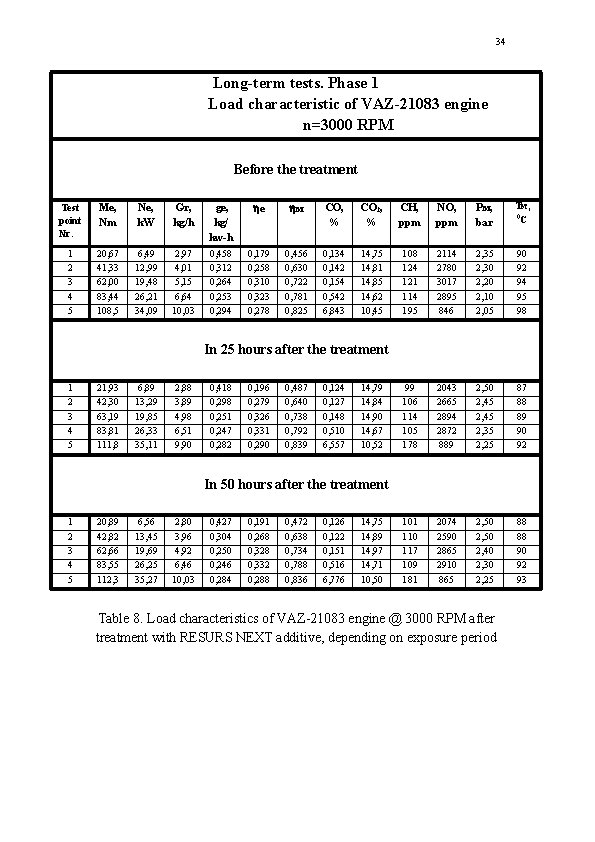
34 Long-term tests. Phase 1 Load characteristic of VAZ-21083 engine n=3000 RPM Before the treatment Test point Nr. Me, Nm Nе, k. W Gт, kg/h ge, kg/ kw-h е м СО, % СО 2, % CH, ppm NO, ppm Рм, bar Tм, 0 C 1 2 3 4 5 20, 67 41, 33 62, 00 83, 44 108, 5 6, 49 12, 99 19, 48 26, 21 34, 09 2, 97 4, 01 5, 15 6, 64 10, 03 0, 458 0, 312 0, 264 0, 253 0, 294 0, 179 0, 258 0, 310 0, 323 0, 278 0, 456 0, 630 0, 722 0, 781 0, 825 0, 134 0, 142 0, 154 0, 542 6, 843 14, 75 14, 81 14, 85 14, 62 10, 45 108 124 121 114 195 2114 2780 3017 2895 846 2, 35 2, 30 2, 20 2, 10 2, 05 90 92 94 95 98 99 106 114 105 178 2043 2665 2894 2872 889 2, 50 2, 45 2, 35 2, 25 87 88 89 90 92 101 110 117 109 181 2074 2590 2865 2910 865 2, 50 2, 40 2, 30 2, 25 88 88 90 92 93 In 25 hours after the treatment 1 2 3 4 5 21, 93 42, 30 63, 19 83, 81 111, 8 6, 89 13, 29 19, 85 26, 33 35, 11 2, 88 3, 89 4, 98 6, 51 9, 90 0, 418 0, 298 0, 251 0, 247 0, 282 0, 196 0, 279 0, 326 0, 331 0, 290 0, 487 0, 640 0, 738 0, 792 0, 839 0, 124 0, 127 0, 148 0, 510 6, 557 14, 79 14, 84 14, 90 14, 67 10, 52 In 50 hours after the treatment 1 2 3 4 5 20, 89 42, 82 62, 66 83, 55 112, 3 6, 56 13, 45 19, 69 26, 25 35, 27 2, 80 3, 96 4, 92 6, 46 10, 03 0, 427 0, 304 0, 250 0, 246 0, 284 0, 191 0, 268 0, 328 0, 332 0, 288 0, 472 0, 638 0, 734 0, 788 0, 836 0, 122 0, 151 0, 516 6, 776 14, 75 14, 89 14, 97 14, 71 10, 50 Table 8. Load characteristics of VAZ-21083 engine @ 3000 RPM after treatment with RESURS NEXT additive, depending on exposure period
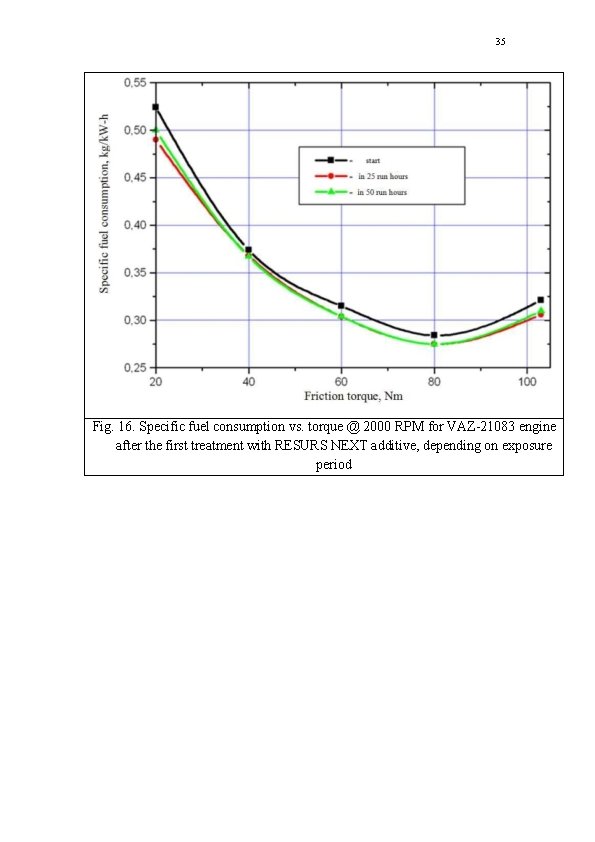
35 Fig. 16. Specific fuel consumption vs. torque @ 2000 RPM for VAZ-21083 engine after the first treatment with RESURS NEXT additive, depending on exposure period
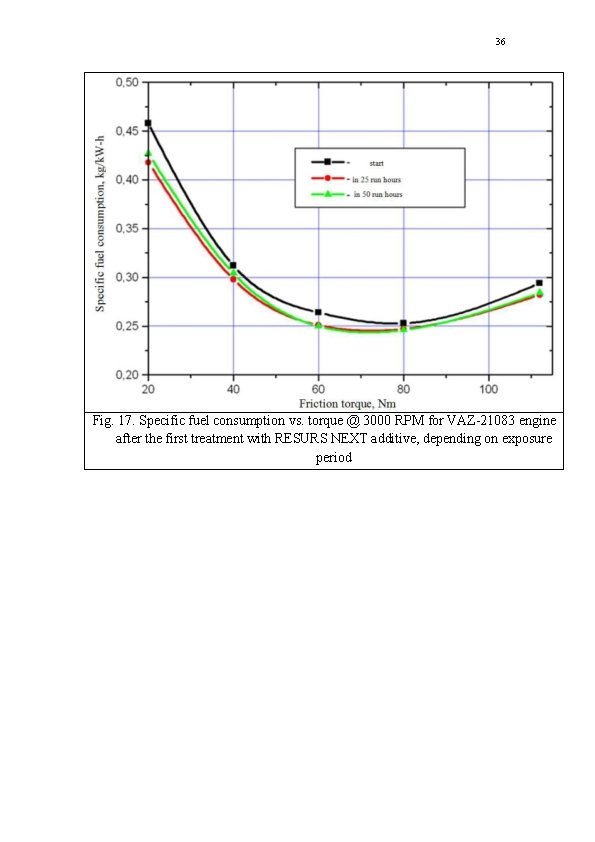
36 Fig. 17. Specific fuel consumption vs. torque @ 3000 RPM for VAZ-21083 engine after the first treatment with RESURS NEXT additive, depending on exposure period
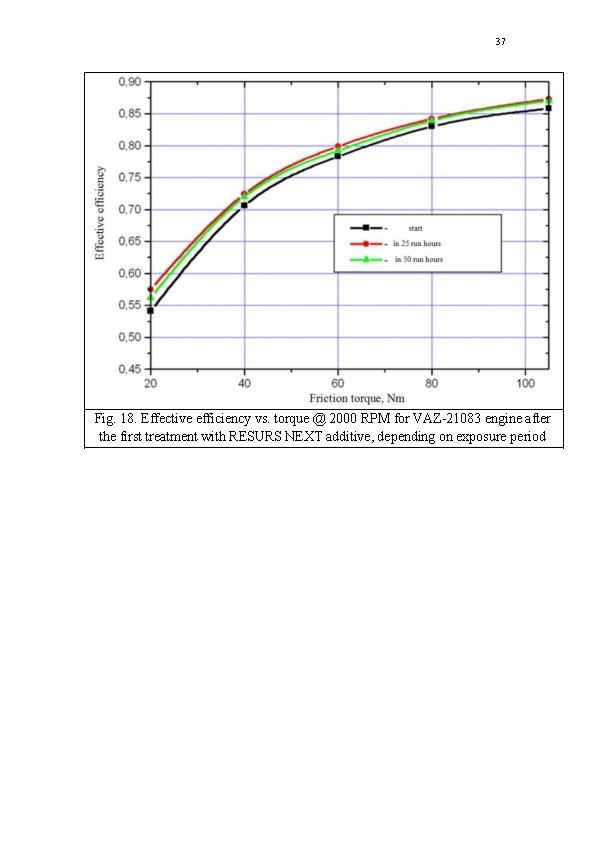
37 Fig. 18. Effective efficiency vs. torque @ 2000 RPM for VAZ-21083 engine after the first treatment with RESURS NEXT additive, depending on exposure period
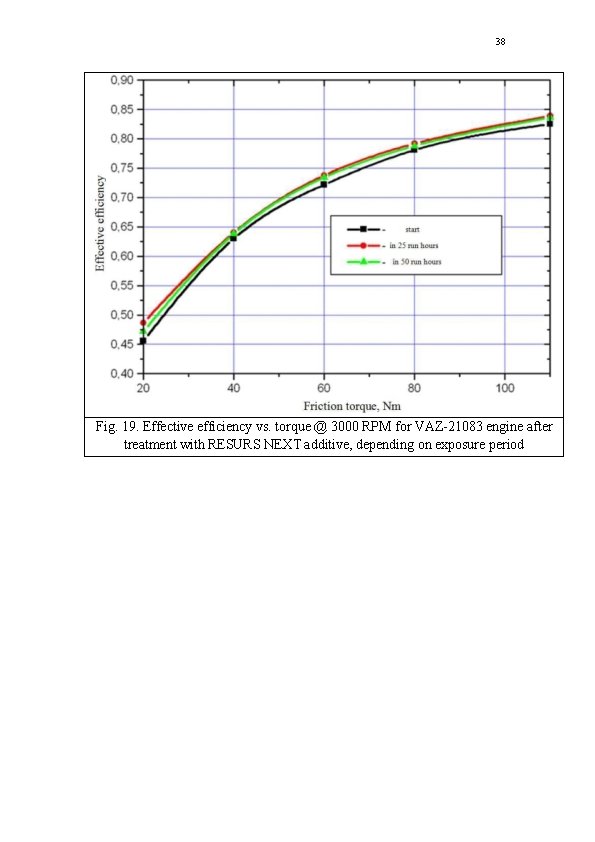
38 Fig. 19. Effective efficiency vs. torque @ 3000 RPM for VAZ-21083 engine after treatment with RESURS NEXT additive, depending on exposure period
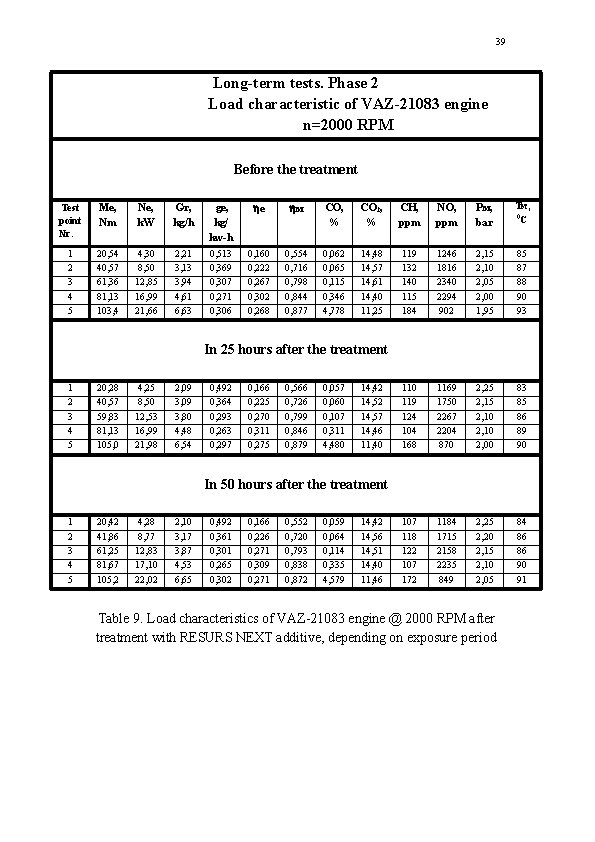
39 Long-term tests. Phase 2 Load characteristic of VAZ-21083 engine n=2000 RPM Before the treatment Test point Nr. Me, Nm Nе, k. W Gт, kg/h ge, kg/ kw-h е м СО, % СО 2, % CH, ppm NO, ppm Рм, bar Tм, 0 C 1 2 3 4 5 20, 54 40, 57 61, 36 81, 13 103, 4 4, 30 8, 50 12, 85 16, 99 21, 66 2, 21 3, 13 3, 94 4, 61 6, 63 0, 513 0, 369 0, 307 0, 271 0, 306 0, 160 0, 222 0, 267 0, 302 0, 268 0, 554 0, 716 0, 798 0, 844 0, 877 0, 062 0, 065 0, 115 0, 346 4, 778 14, 48 14, 57 14, 61 14, 40 11, 25 119 132 140 115 184 1246 1816 2340 2294 902 2, 15 2, 10 2, 05 2, 00 1, 95 85 87 88 90 93 110 119 124 104 168 1169 1750 2267 2204 870 2, 25 2, 10 2, 00 83 85 86 89 90 107 118 122 107 172 1184 1715 2158 2235 849 2, 25 2, 20 2, 15 2, 10 2, 05 84 86 86 90 91 In 25 hours after the treatment 1 2 3 4 5 20, 28 40, 57 59, 83 81, 13 105, 0 4, 25 8, 50 12, 53 16, 99 21, 98 2, 09 3, 80 4, 48 6, 54 0, 492 0, 364 0, 293 0, 263 0, 297 0, 166 0, 225 0, 270 0, 311 0, 275 0, 566 0, 726 0, 799 0, 846 0, 879 0, 057 0, 060 0, 107 0, 311 4, 480 14, 42 14, 57 14, 46 11, 40 In 50 hours after the treatment 1 2 3 4 5 20, 42 41, 86 61, 25 81, 67 105, 2 4, 28 8, 77 12, 83 17, 10 22, 02 2, 10 3, 17 3, 87 4, 53 6, 65 0, 492 0, 361 0, 301 0, 265 0, 302 0, 166 0, 226 0, 271 0, 309 0, 271 0, 552 0, 720 0, 793 0, 838 0, 872 0, 059 0, 064 0, 114 0, 335 4, 579 14, 42 14, 56 14, 51 14, 40 11, 46 Table 9. Load characteristics of VAZ-21083 engine @ 2000 RPM after treatment with RESURS NEXT additive, depending on exposure period
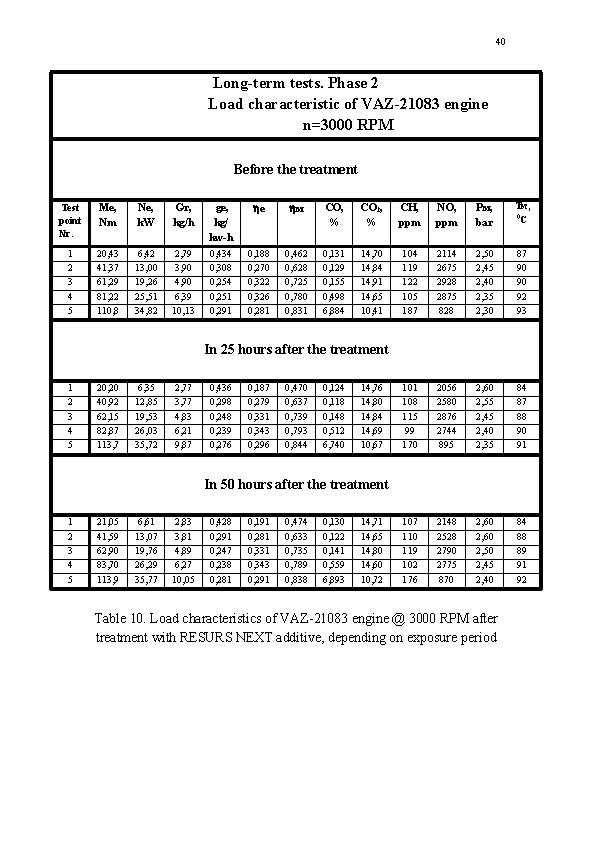
40 Long-term tests. Phase 2 Load characteristic of VAZ-21083 engine n=3000 RPM Before the treatment Test point Nr. Me, Nm Nе, k. W Gт, kg/h ge, kg/ kw-h е м СО, % СО 2, % CH, ppm NO, ppm Рм, bar Tм, 0 C 1 2 3 4 5 20, 43 41, 37 61, 29 81, 22 110, 8 6, 42 13, 00 19, 26 25, 51 34, 82 2, 79 3, 90 4, 90 6, 39 10, 13 0, 434 0, 308 0, 254 0, 251 0, 291 0, 188 0, 270 0, 322 0, 326 0, 281 0, 462 0, 628 0, 725 0, 780 0, 831 0, 129 0, 155 0, 498 6, 884 14, 70 14, 84 14, 91 14, 65 10, 41 104 119 122 105 187 2114 2675 2928 2875 828 2, 50 2, 45 2, 40 2, 35 2, 30 87 90 90 92 93 101 108 115 99 170 2056 2580 2876 2744 895 2, 60 2, 55 2, 40 2, 35 84 87 88 90 91 107 110 119 102 176 2148 2528 2790 2775 870 2, 60 2, 50 2, 45 2, 40 84 88 89 91 92 In 25 hours after the treatment 1 2 3 4 5 20, 20 40, 92 62, 15 82, 87 113, 7 6, 35 12, 85 19, 53 26, 03 35, 72 2, 77 3, 77 4, 83 6, 21 9, 87 0, 436 0, 298 0, 248 0, 239 0, 276 0, 187 0, 279 0, 331 0, 343 0, 296 0, 470 0, 637 0, 739 0, 793 0, 844 0, 124 0, 118 0, 148 0, 512 6, 740 14, 76 14, 80 14, 84 14, 69 10, 67 In 50 hours after the treatment 1 2 3 4 5 21, 05 41, 59 62, 90 83, 70 113, 9 6, 61 13, 07 19, 76 26, 29 35, 77 2, 83 3, 81 4, 89 6, 27 10, 05 0, 428 0, 291 0, 247 0, 238 0, 281 0, 191 0, 281 0, 331 0, 343 0, 291 0, 474 0, 633 0, 735 0, 789 0, 838 0, 130 0, 122 0, 141 0, 559 6, 893 14, 71 14, 65 14, 80 14, 60 10, 72 Table 10. Load characteristics of VAZ-21083 engine @ 3000 RPM after treatment with RESURS NEXT additive, depending on exposure period
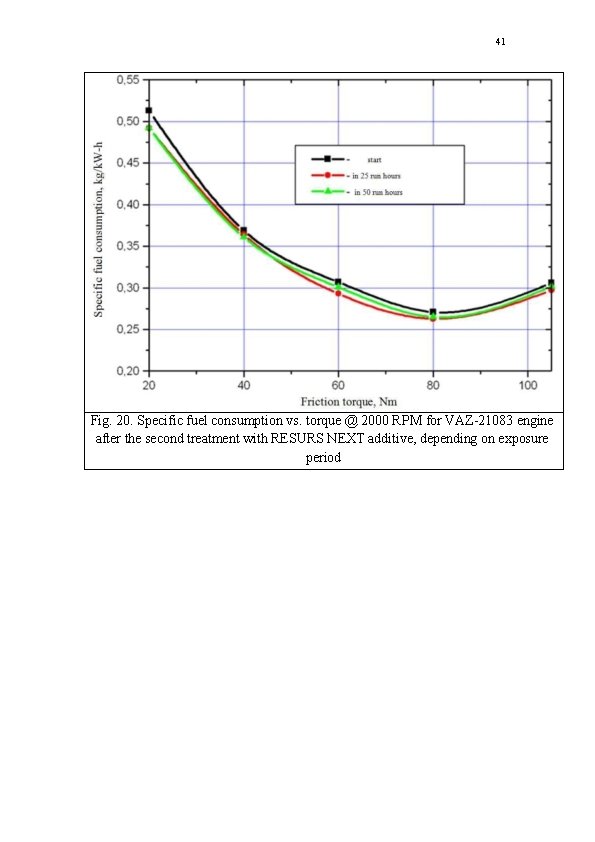
41 Fig. 20. Specific fuel consumption vs. torque @ 2000 RPM for VAZ-21083 engine after the second treatment with RESURS NEXT additive, depending on exposure period
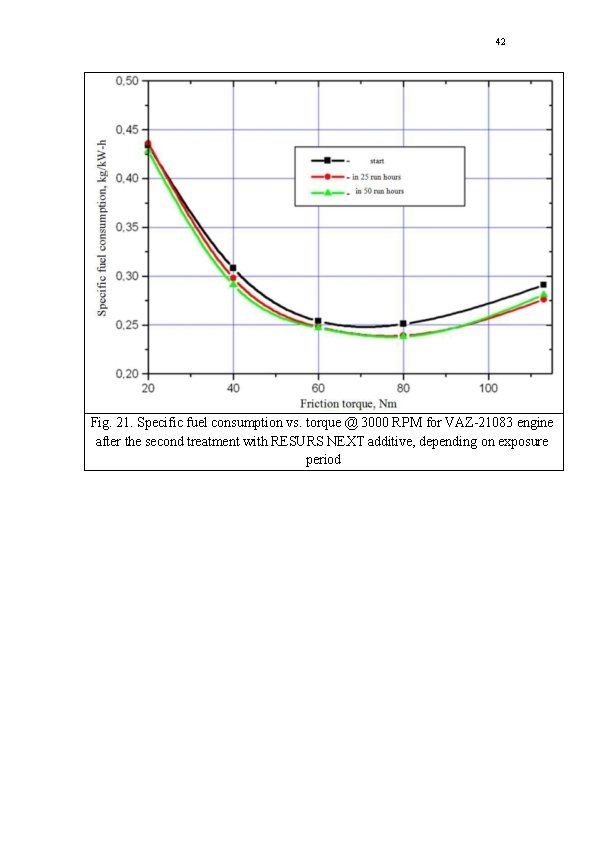
42 Fig. 21. Specific fuel consumption vs. torque @ 3000 RPM for VAZ-21083 engine after the second treatment with RESURS NEXT additive, depending on exposure period
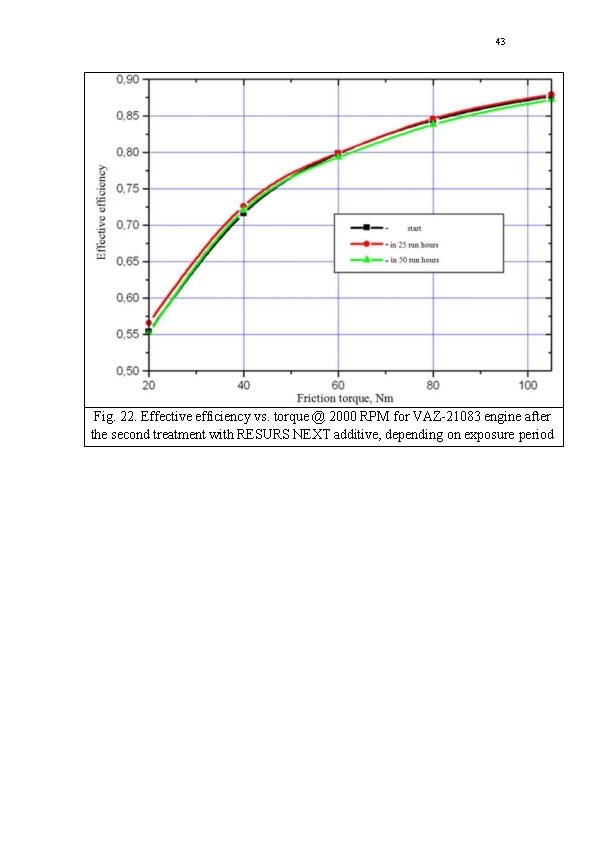
43 Fig. 22. Effective efficiency vs. torque @ 2000 RPM for VAZ-21083 engine after the second treatment with RESURS NEXT additive, depending on exposure period
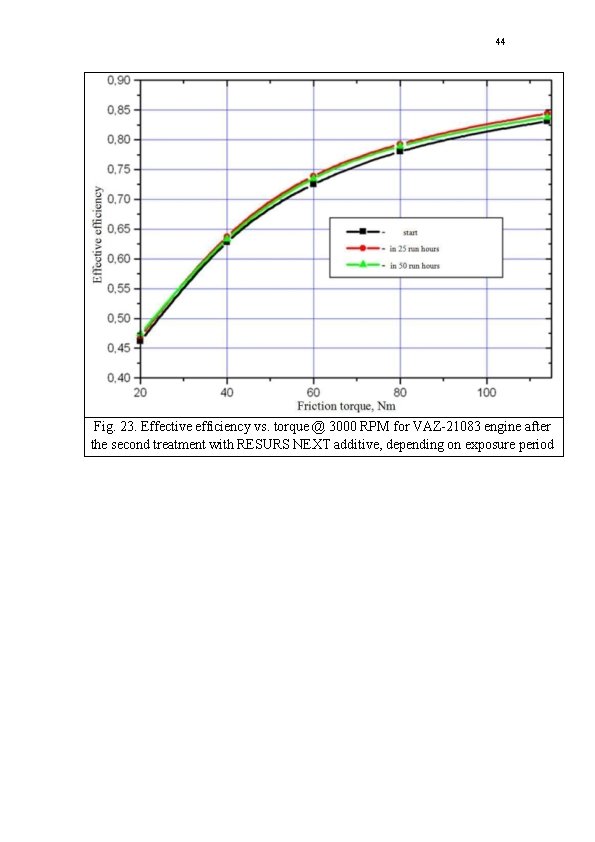
44 Fig. 23. Effective efficiency vs. torque @ 3000 RPM for VAZ-21083 engine after the second treatment with RESURS NEXT additive, depending on exposure period
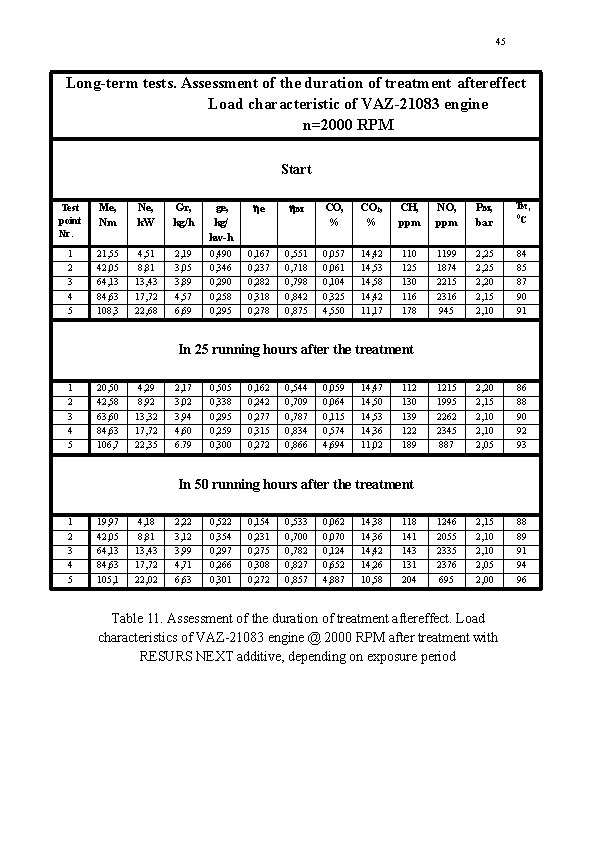
45 Long-term tests. Assessment of the duration of treatment aftereffect Load characteristic of VAZ-21083 engine n=2000 RPM Start Test point Nr. Me, Nm Nе, k. W Gт, kg/h ge, kg/ kw-h е м СО, % СО 2, % CH, ppm NO, ppm Рм, bar Tм, 0 C 1 2 3 4 5 21, 55 42, 05 64, 13 84, 63 108, 3 4, 51 8, 81 13, 43 17, 72 22, 68 2, 19 3, 05 3, 89 4, 57 6, 69 0, 490 0, 346 0, 290 0, 258 0, 295 0, 167 0, 237 0, 282 0, 318 0, 278 0, 551 0, 718 0, 798 0, 842 0, 875 0, 057 0, 061 0, 104 0, 325 4, 550 14, 42 14, 53 14, 58 14, 42 11, 17 110 125 130 116 178 1199 1874 2215 2316 945 2, 25 2, 20 2, 15 2, 10 84 85 87 90 91 1215 1995 2262 2345 887 2, 20 2, 15 2, 10 2, 05 86 88 90 92 93 1246 2055 2335 2376 695 2, 10 2, 05 2, 00 88 89 91 94 96 In 25 running hours after the treatment 1 2 3 4 5 20, 50 42, 58 63, 60 84, 63 106, 7 4, 29 8, 92 13, 32 17, 72 22, 35 2, 17 3, 02 3, 94 4, 60 6. 79 0, 505 0, 338 0, 295 0, 259 0, 300 0, 162 0, 242 0, 277 0, 315 0, 272 0, 544 0, 709 0, 787 0, 834 0, 866 0, 059 0, 064 0, 115 0, 574 4, 694 14, 47 14, 50 14, 53 14, 36 11, 02 112 130 139 122 189 In 50 running hours after the treatment 1 2 3 4 5 19, 97 42, 05 64, 13 84, 63 105, 1 4, 18 8, 81 13, 43 17, 72 22, 02 2, 22 3, 12 3, 99 4, 71 6, 63 0, 522 0, 354 0, 297 0, 266 0, 301 0, 154 0, 231 0, 275 0, 308 0, 272 0, 533 0, 700 0, 782 0, 827 0, 857 0, 062 0, 070 0, 124 0, 652 4, 887 14, 38 14, 36 14, 42 14, 26 10, 58 118 141 143 131 204 Table 11. Assessment of the duration of treatment aftereffect. Load characteristics of VAZ-21083 engine @ 2000 RPM after treatment with RESURS NEXT additive, depending on exposure period
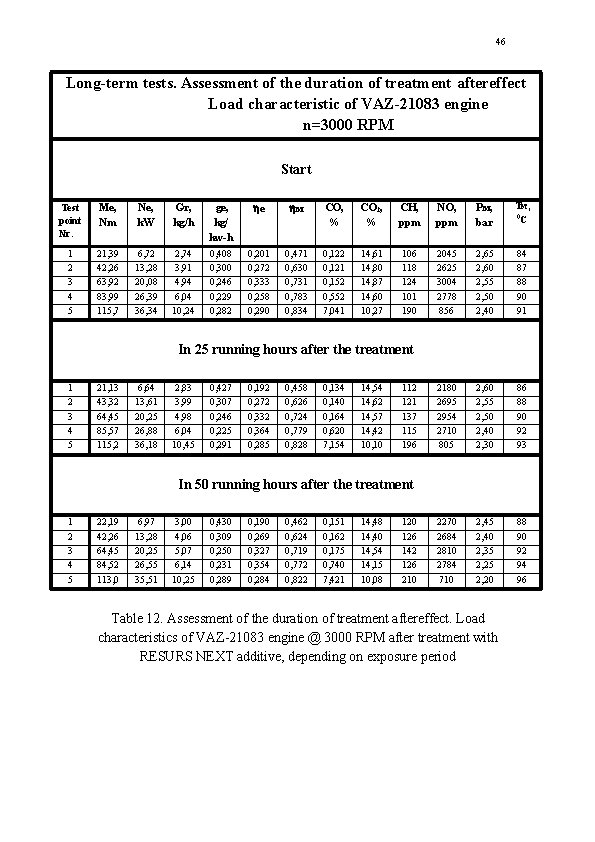
46 Long-term tests. Assessment of the duration of treatment aftereffect Load characteristic of VAZ-21083 engine n=3000 RPM Start Test point Nr. Me, Nm Nе, k. W Gт, kg/h ge, kg/ kw-h е м СО, % СО 2, % CH, ppm NO, ppm Рм, bar Tм, 0 C 1 2 3 4 5 21, 39 42, 26 63, 92 83, 99 115, 7 6, 72 13, 28 20, 08 26, 39 36, 34 2, 74 3, 91 4, 94 6, 04 10, 24 0, 408 0, 300 0, 246 0, 229 0, 282 0, 201 0, 272 0, 333 0, 258 0, 290 0, 471 0, 630 0, 731 0, 783 0, 834 0, 122 0, 121 0, 152 0, 552 7, 041 14, 61 14, 80 14, 87 14, 60 10, 27 106 118 124 101 190 2045 2625 3004 2778 856 2, 65 2, 60 2, 55 2, 50 2, 40 84 87 88 90 91 2180 2695 2954 2710 805 2, 60 2, 55 2, 50 2, 40 2, 30 86 88 90 92 93 2270 2684 2810 2784 710 2, 45 2, 40 2, 35 2, 20 88 90 92 94 96 In 25 running hours after the treatment 1 2 3 4 5 21, 13 43, 32 64, 45 85, 57 115, 2 6, 64 13, 61 20, 25 26, 88 36, 18 2, 83 3, 99 4, 98 6, 04 10, 45 0, 427 0, 307 0, 246 0, 225 0, 291 0, 192 0, 272 0, 332 0, 364 0, 285 0, 458 0, 626 0, 724 0, 779 0, 828 0, 134 0, 140 0, 164 0, 620 7, 154 14, 62 14, 57 14, 42 10, 10 112 121 137 115 196 In 50 running hours after the treatment 1 2 3 4 5 22, 19 42, 26 64, 45 84, 52 113, 0 6, 97 13, 28 20, 25 26, 55 35, 51 3, 00 4, 06 5, 07 6, 14 10, 25 0, 430 0, 309 0, 250 0, 231 0, 289 0, 190 0, 269 0, 327 0, 354 0, 284 0, 462 0, 624 0, 719 0, 772 0, 822 0, 151 0, 162 0, 175 0, 740 7, 421 14, 48 14, 40 14, 54 14, 15 10, 08 120 126 142 126 210 Table 12. Assessment of the duration of treatment aftereffect. Load characteristics of VAZ-21083 engine @ 3000 RPM after treatment with RESURS NEXT additive, depending on exposure period
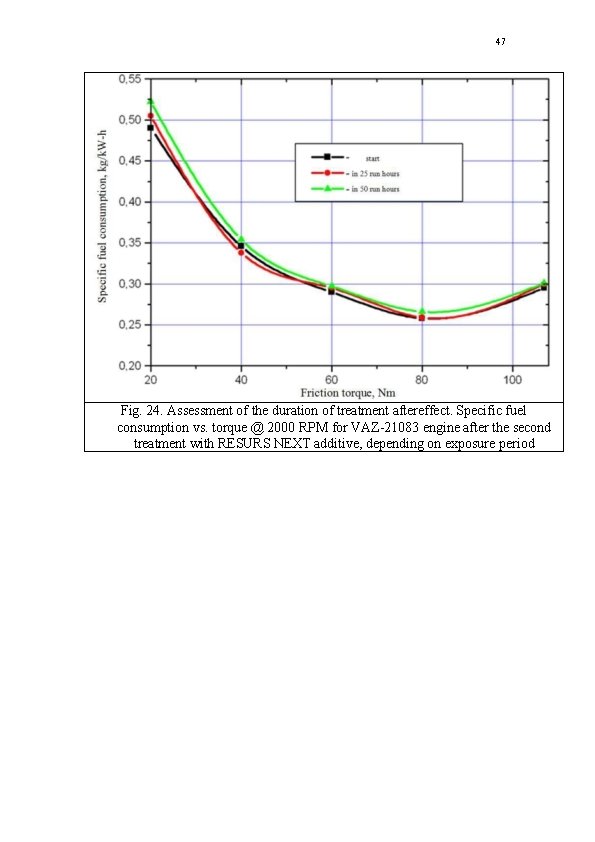
47 Fig. 24. Assessment of the duration of treatment aftereffect. Specific fuel consumption vs. torque @ 2000 RPM for VAZ-21083 engine after the second treatment with RESURS NEXT additive, depending on exposure period
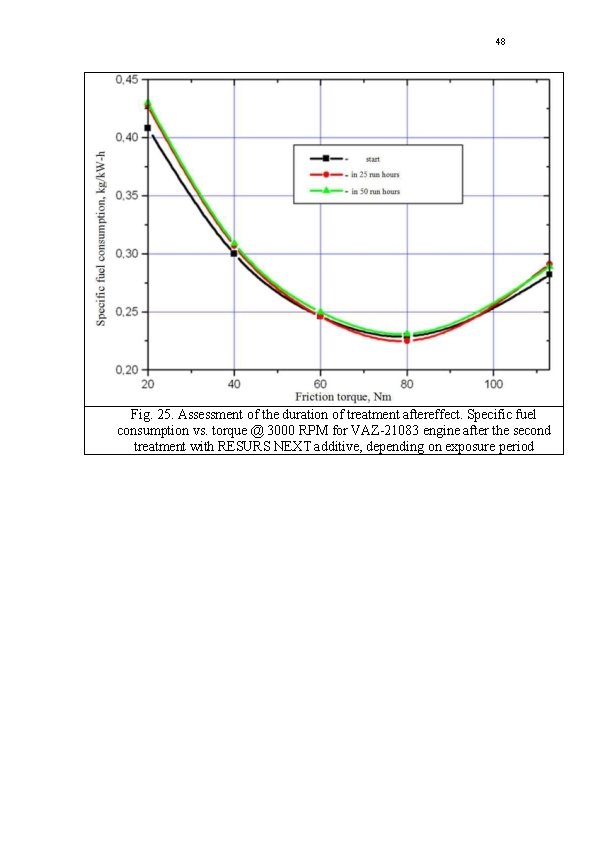
48 Fig. 25. Assessment of the duration of treatment aftereffect. Specific fuel consumption vs. torque @ 3000 RPM for VAZ-21083 engine after the second treatment with RESURS NEXT additive, depending on exposure period
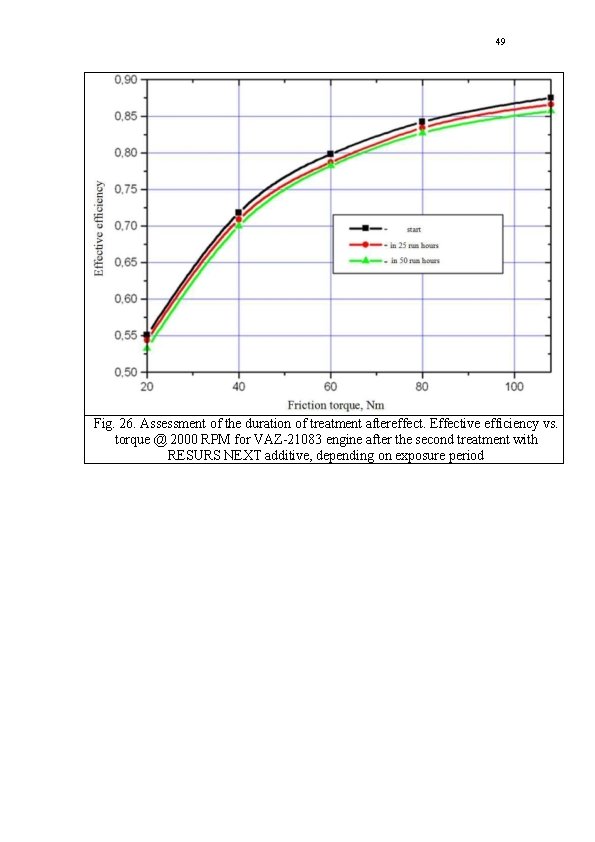
49 Fig. 26. Assessment of the duration of treatment aftereffect. Effective efficiency vs. torque @ 2000 RPM for VAZ-21083 engine after the second treatment with RESURS NEXT additive, depending on exposure period
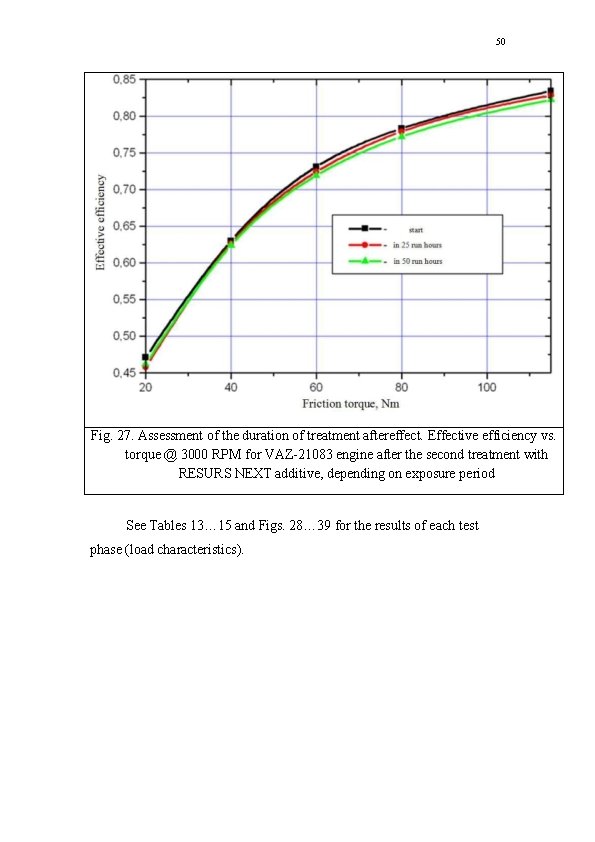
50 Fig. 27. Assessment of the duration of treatment aftereffect. Effective efficiency vs. torque @ 3000 RPM for VAZ-21083 engine after the second treatment with RESURS NEXT additive, depending on exposure period See Tables 13… 15 and Figs. 28… 39 for the results of each test phase (load characteristics).
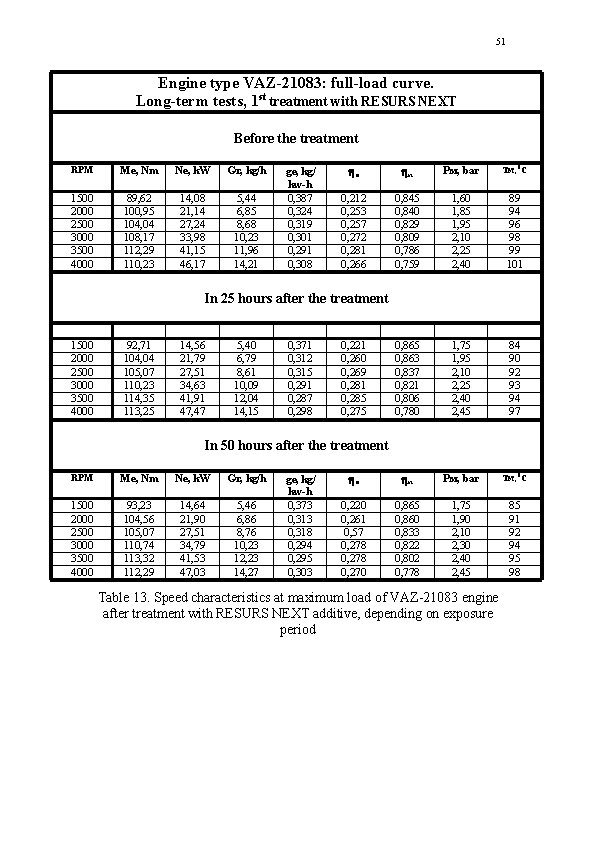
51 Engine type VAZ-21083: full-load curve. Long-term tests, 1 st treatment with RESURS NEXT Before the treatment RPM Me, Nm Nе, k. W Gт, kg/h 1500 2000 2500 3000 3500 4000 89, 62 100, 95 104, 04 108, 17 112, 29 110, 23 14, 08 21, 14 27, 24 33, 98 41, 15 46, 17 5, 44 6, 85 8, 68 10, 23 11, 96 14, 21 ge, kg/ kw-h 0, 387 0, 324 0, 319 0, 301 0, 291 0, 308 е м Рм, bar Tм, 0 C 0, 212 0, 253 0, 257 0, 272 0, 281 0, 266 0, 845 0, 840 0, 829 0, 809 0, 786 0, 759 1, 60 1, 85 1, 95 2, 10 2, 25 2, 40 89 94 96 98 99 101 0, 865 0, 863 0, 837 0, 821 0, 806 0, 780 1, 75 1, 95 2, 10 2, 25 2, 40 2, 45 84 90 92 93 94 97 е м Рм, bar Tм, 0 C 0, 220 0, 261 0, 57 0, 278 0, 270 0, 865 0, 860 0, 833 0, 822 0, 802 0, 778 1, 75 1, 90 2, 10 2, 30 2, 45 85 91 92 94 95 98 In 25 hours after the treatment 1500 2000 2500 3000 3500 4000 92, 71 104, 04 105, 07 110, 23 114, 35 113, 25 14, 56 21, 79 27, 51 34, 63 41, 91 47, 47 5, 40 6, 79 8, 61 10, 09 12, 04 14, 15 0, 371 0, 312 0, 315 0, 291 0, 287 0, 298 0, 221 0, 260 0, 269 0, 281 0, 285 0, 275 In 50 hours after the treatment RPM Me, Nm Nе, k. W Gт, kg/h 1500 2000 2500 3000 3500 4000 93, 23 104, 56 105, 07 110, 74 113, 32 112, 29 14, 64 21, 90 27, 51 34, 79 41, 53 47, 03 5, 46 6, 86 8, 76 10, 23 12, 23 14, 27 ge, kg/ kw-h 0, 373 0, 318 0, 294 0, 295 0, 303 Table 13. Speed characteristics at maximum load of VAZ-21083 engine after treatment with RESURS NEXT additive, depending on exposure period
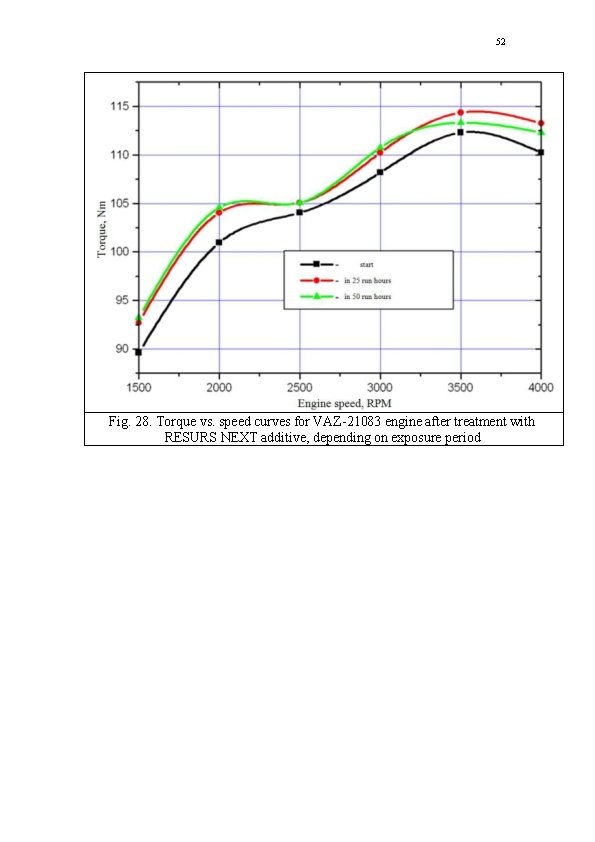
52 Fig. 28. Torque vs. speed curves for VAZ-21083 engine after treatment with RESURS NEXT additive, depending on exposure period
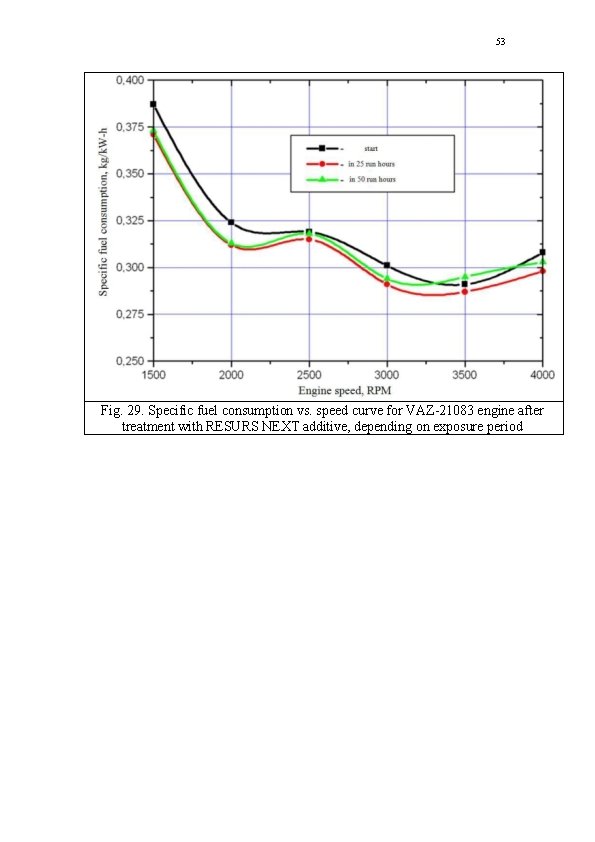
53 Fig. 29. Specific fuel consumption vs. speed curve for VAZ-21083 engine after treatment with RESURS NEXT additive, depending on exposure period
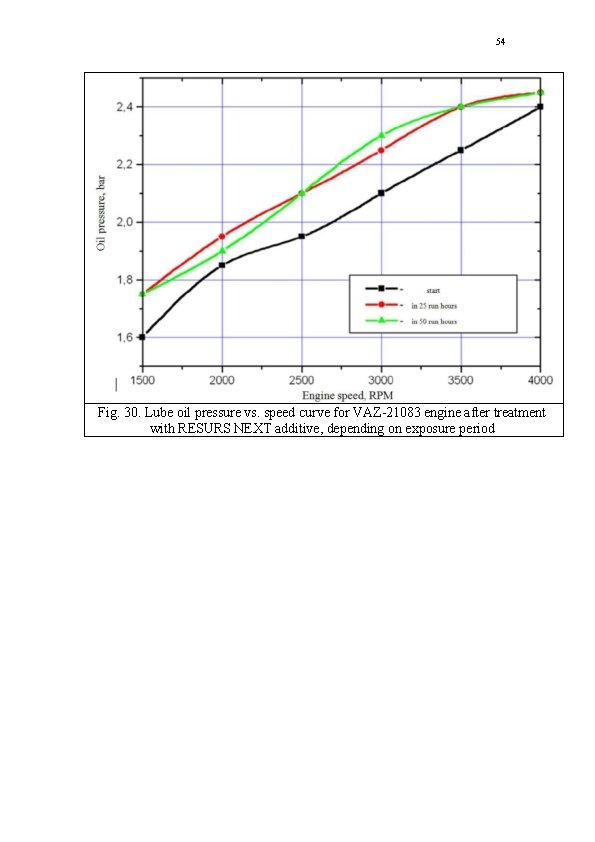
54 Fig. 30. Lube oil pressure vs. speed curve for VAZ-21083 engine after treatment with RESURS NEXT additive, depending on exposure period
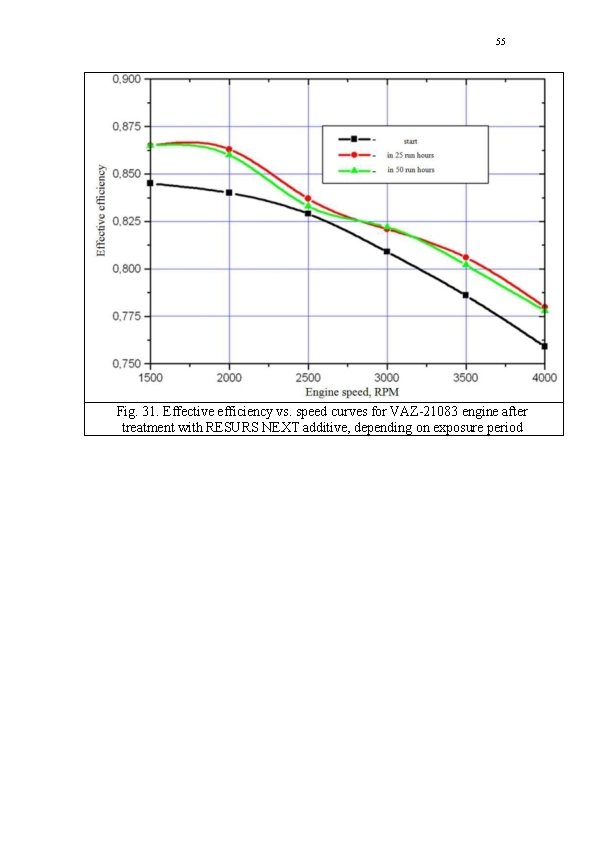
55 Fig. 31. Effective efficiency vs. speed curves for VAZ-21083 engine after treatment with RESURS NEXT additive, depending on exposure period
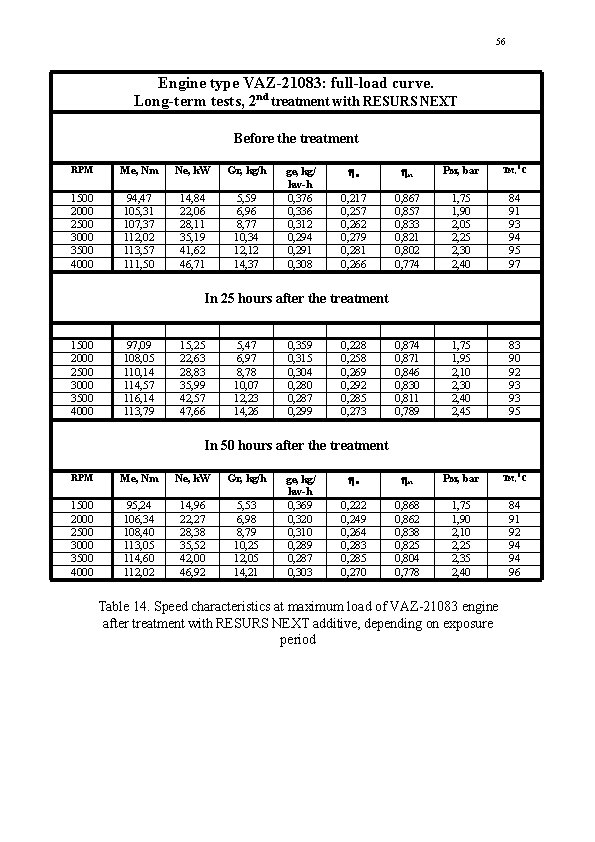
56 Engine type VAZ-21083: full-load curve. Long-term tests, 2 nd treatment with RESURS NEXT Before the treatment RPM Me, Nm Nе, k. W Gт, kg/h 1500 2000 2500 3000 3500 4000 94, 47 105, 31 107, 37 112, 02 113, 57 111, 50 14, 84 22, 06 28, 11 35, 19 41, 62 46, 71 5, 59 6, 96 8, 77 10, 34 12, 12 14, 37 ge, kg/ kw-h 0, 376 0, 336 0, 312 0, 294 0, 291 0, 308 е м Рм, bar Tм, 0 C 0, 217 0, 257 0, 262 0, 279 0, 281 0, 266 0, 867 0, 857 0, 833 0, 821 0, 802 0, 774 1, 75 1, 90 2, 05 2, 25 2, 30 2, 40 84 91 93 94 95 97 0, 874 0, 871 0, 846 0, 830 0, 811 0, 789 1, 75 1, 95 2, 10 2, 30 2, 45 83 90 92 93 93 95 е м Рм, bar Tм, 0 C 0, 222 0, 249 0, 264 0, 283 0, 285 0, 270 0, 868 0, 862 0, 838 0, 825 0, 804 0, 778 1, 75 1, 90 2, 10 2, 25 2, 35 2, 40 84 91 92 94 94 96 In 25 hours after the treatment 1500 2000 2500 3000 3500 4000 97, 09 108, 05 110, 14 114, 57 116, 14 113, 79 15, 25 22, 63 28, 83 35, 99 42, 57 47, 66 5, 47 6, 97 8, 78 10, 07 12, 23 14, 26 0, 359 0, 315 0, 304 0, 280 0, 287 0, 299 0, 228 0, 258 0, 269 0, 292 0, 285 0, 273 In 50 hours after the treatment RPM Me, Nm Nе, k. W Gт, kg/h 1500 2000 2500 3000 3500 4000 95, 24 106, 34 108, 40 113, 05 114, 60 112, 02 14, 96 22, 27 28, 38 35, 52 42, 00 46, 92 5, 53 6, 98 8, 79 10, 25 12, 05 14, 21 ge, kg/ kw-h 0, 369 0, 320 0, 310 0, 289 0, 287 0, 303 Table 14. Speed characteristics at maximum load of VAZ-21083 engine after treatment with RESURS NEXT additive, depending on exposure period
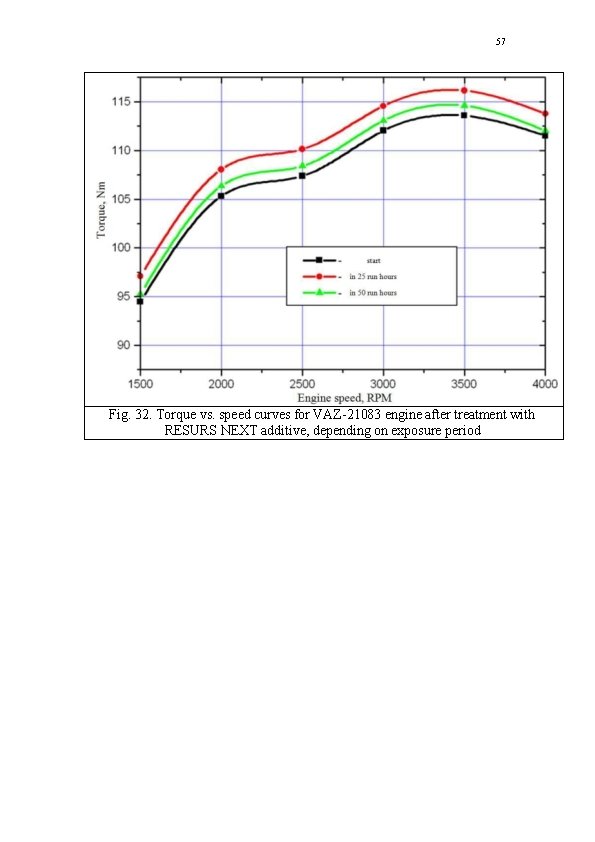
57 Fig. 32. Torque vs. speed curves for VAZ-21083 engine after treatment with RESURS NEXT additive, depending on exposure period
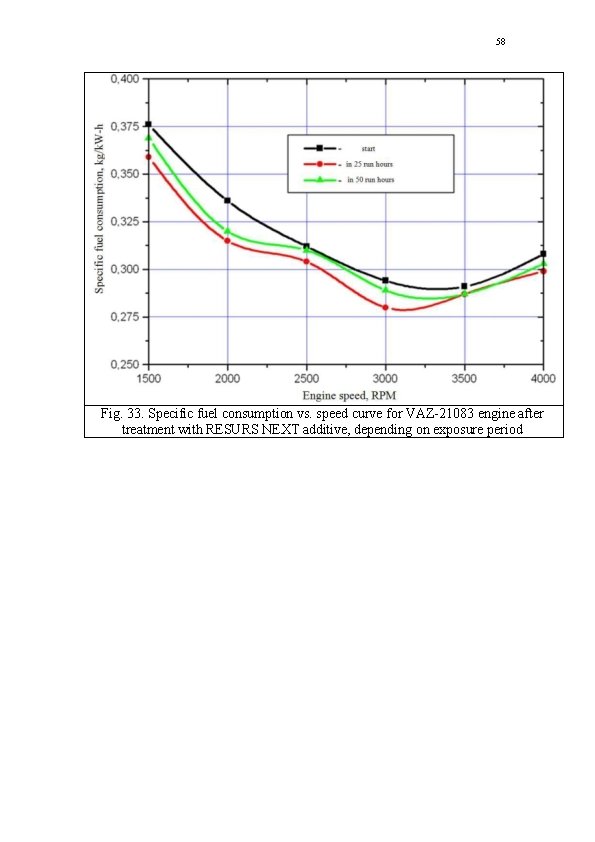
58 Fig. 33. Specific fuel consumption vs. speed curve for VAZ-21083 engine after treatment with RESURS NEXT additive, depending on exposure period
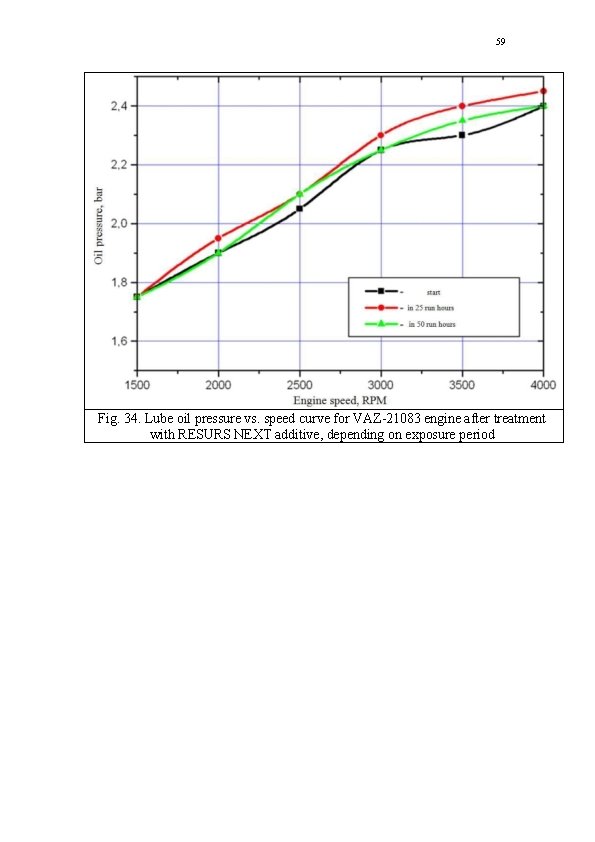
59 Fig. 34. Lube oil pressure vs. speed curve for VAZ-21083 engine after treatment with RESURS NEXT additive, depending on exposure period
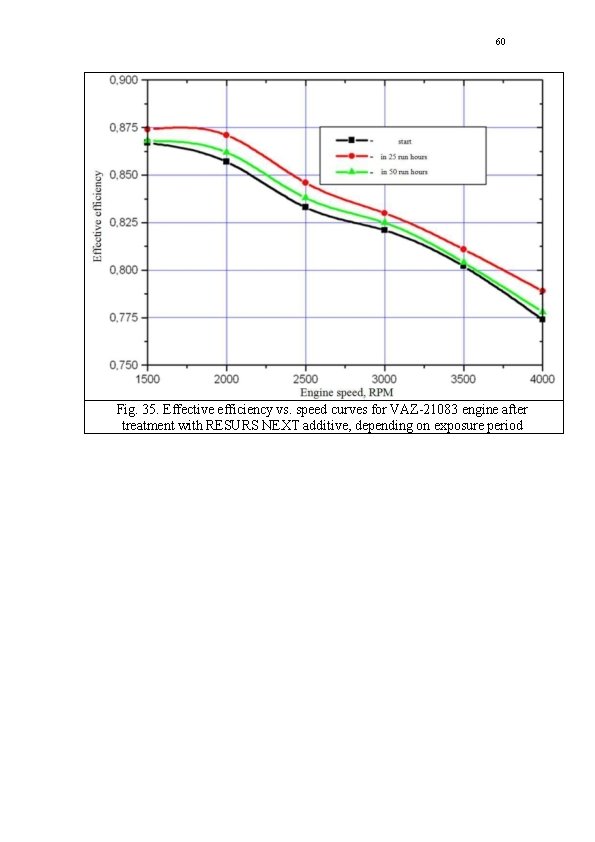
60 Fig. 35. Effective efficiency vs. speed curves for VAZ-21083 engine after treatment with RESURS NEXT additive, depending on exposure period
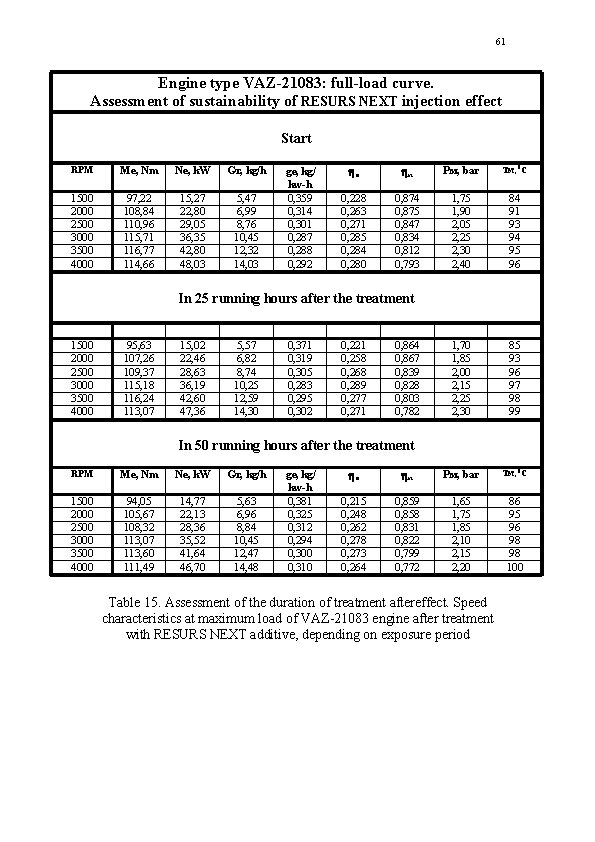
61 Engine type VAZ-21083: full-load curve. Assessment of sustainability of RESURS NEXT injection effect Start RPM Me, Nm Nе, k. W Gт, kg/h 1500 2000 2500 3000 3500 4000 97, 22 108, 84 110, 96 115, 71 116, 77 114, 66 15, 27 22, 80 29, 05 36, 35 42, 80 48, 03 5, 47 6, 99 8, 76 10, 45 12, 32 14, 03 ge, kg/ kw-h 0, 359 0, 314 0, 301 0, 287 0, 288 0, 292 е м Рм, bar Tм, 0 C 0, 228 0, 263 0, 271 0, 285 0, 284 0, 280 0, 874 0, 875 0, 847 0, 834 0, 812 0, 793 1, 75 1, 90 2, 05 2, 25 2, 30 2, 40 84 91 93 94 95 96 1, 70 1, 85 2, 00 2, 15 2, 25 2, 30 85 93 96 97 98 99 In 25 running hours after the treatment 1500 2000 2500 3000 3500 4000 95, 63 107, 26 109, 37 115, 18 116, 24 113, 07 15, 02 22, 46 28, 63 36, 19 42, 60 47, 36 5, 57 6, 82 8, 74 10, 25 12, 59 14, 30 0, 371 0, 319 0, 305 0, 283 0, 295 0, 302 0, 221 0, 258 0, 268 0, 289 0, 277 0, 271 0, 864 0, 867 0, 839 0, 828 0, 803 0, 782 In 50 running hours after the treatment RPM Me, Nm Nе, k. W Gт, kg/h 1500 2000 2500 3000 3500 4000 94, 05 105, 67 108, 32 113, 07 113, 60 111, 49 14, 77 22, 13 28, 36 35, 52 41, 64 46, 70 5, 63 6, 96 8, 84 10, 45 12, 47 14, 48 ge, kg/ kw-h 0, 381 0, 325 0, 312 0, 294 0, 300 0, 310 е м Рм, bar Tм, 0 C 0, 215 0, 248 0, 262 0, 278 0, 273 0, 264 0, 859 0, 858 0, 831 0, 822 0, 799 0, 772 1, 65 1, 75 1, 85 2, 10 2, 15 2, 20 86 95 96 98 98 100 Table 15. Assessment of the duration of treatment aftereffect. Speed characteristics at maximum load of VAZ-21083 engine after treatment with RESURS NEXT additive, depending on exposure period
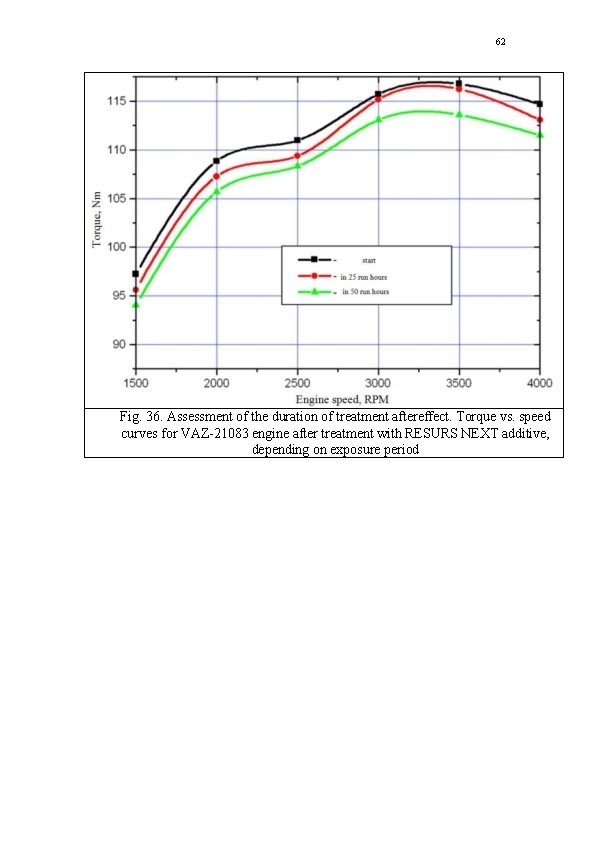
62 Fig. 36. Assessment of the duration of treatment aftereffect. Torque vs. speed curves for VAZ-21083 engine after treatment with RESURS NEXT additive, depending on exposure period
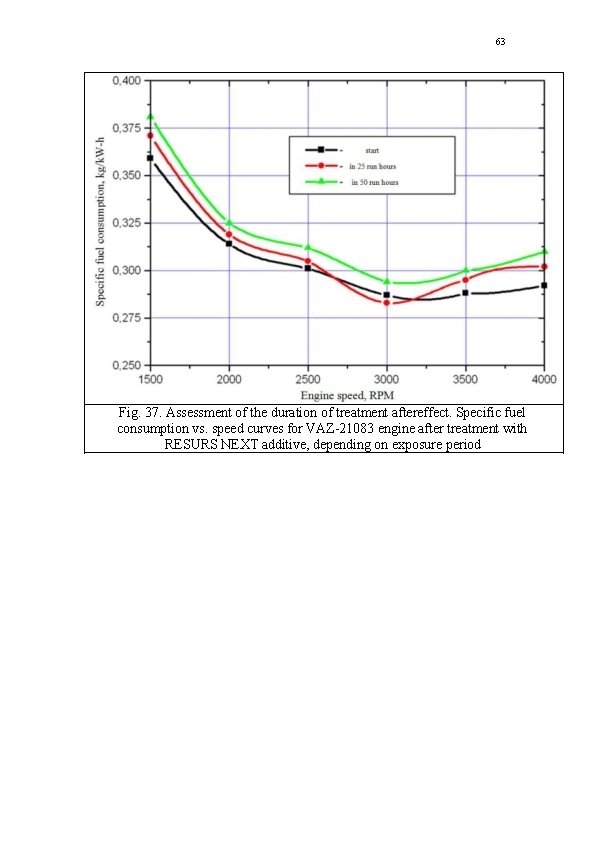
63 Fig. 37. Assessment of the duration of treatment aftereffect. Specific fuel consumption vs. speed curves for VAZ-21083 engine after treatment with RESURS NEXT additive, depending on exposure period
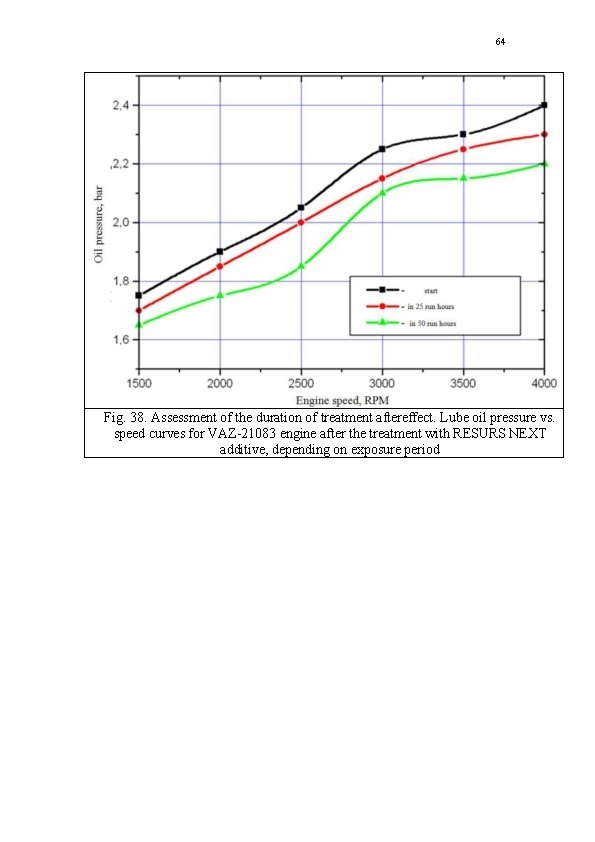
64 Fig. 38. Assessment of the duration of treatment aftereffect. Lube oil pressure vs. speed curves for VAZ-21083 engine after the treatment with RESURS NEXT additive, depending on exposure period
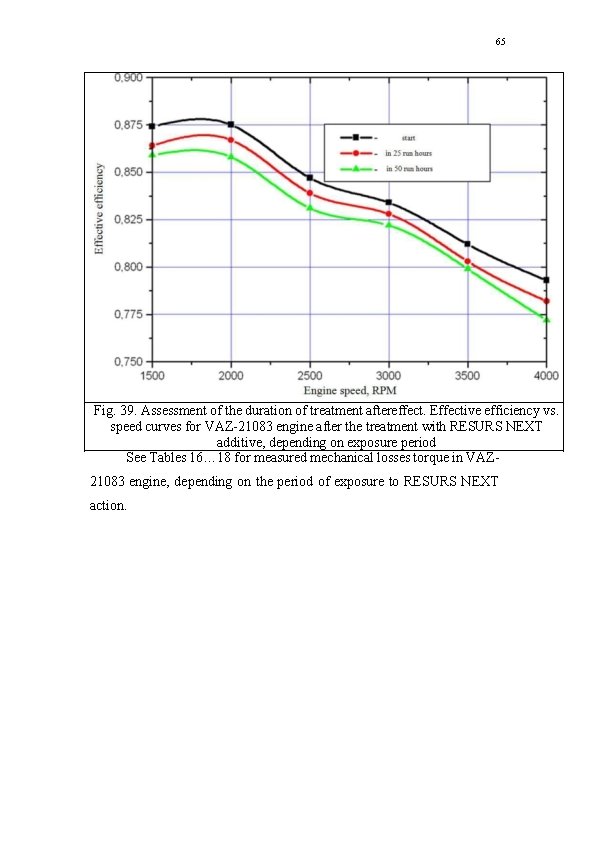
65 Fig. 39. Assessment of the duration of treatment aftereffect. Effective efficiency vs. speed curves for VAZ-21083 engine after the treatment with RESURS NEXT additive, depending on exposure period See Tables 16… 18 for measured mechanical losses torque in VAZ 21083 engine, depending on the period of exposure to RESURS NEXT action.
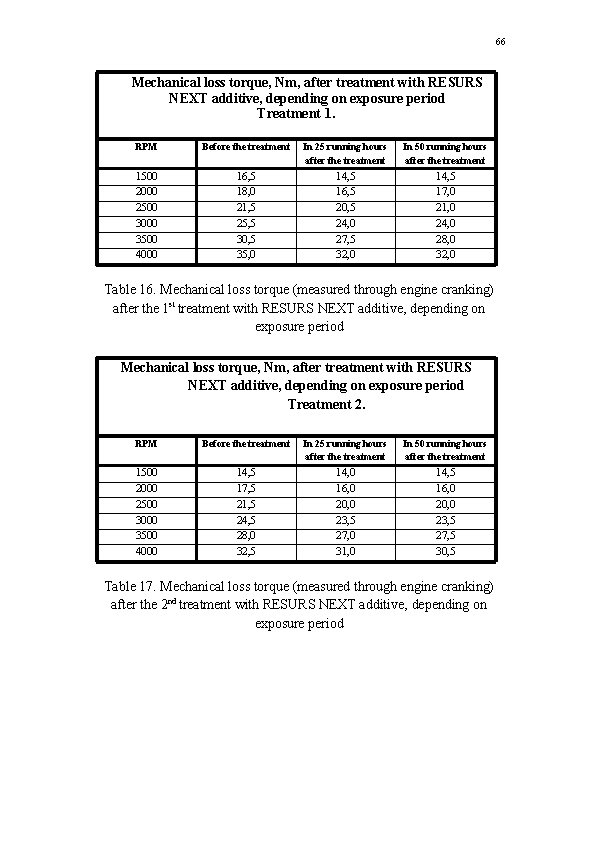
66 Mechanical loss torque, Nm, after treatment with RESURS NEXT additive, depending on exposure period Treatment 1. RPM Before the treatment In 25 running hours after the treatment In 50 running hours after the treatment 1500 2000 2500 3000 3500 4000 16, 5 18, 0 21, 5 25, 5 30, 5 35, 0 14, 5 16, 5 20, 5 24, 0 27, 5 32, 0 14, 5 17, 0 21, 0 24, 0 28, 0 32, 0 Table 16. Mechanical loss torque (measured through engine cranking) after the 1 st treatment with RESURS NEXT additive, depending on exposure period Mechanical loss torque, Nm, after treatment with RESURS NEXT additive, depending on exposure period Treatment 2. RPM Before the treatment In 25 running hours after the treatment In 50 running hours after the treatment 1500 2000 2500 3000 3500 4000 14, 5 17, 5 21, 5 24, 5 28, 0 32, 5 14, 0 16, 0 20, 0 23, 5 27, 0 31, 0 14, 5 16, 0 20, 0 23, 5 27, 5 30, 5 Table 17. Mechanical loss torque (measured through engine cranking) after the 2 nd treatment with RESURS NEXT additive, depending on exposure period
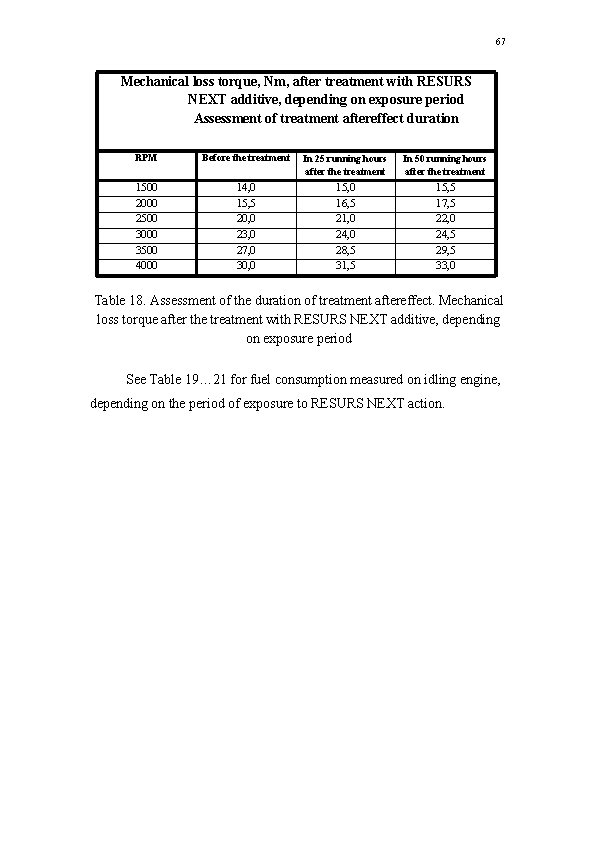
67 Mechanical loss torque, Nm, after treatment with RESURS NEXT additive, depending on exposure period Assessment of treatment aftereffect duration RPM Before the treatment In 25 running hours after the treatment In 50 running hours after the treatment 1500 2000 2500 3000 3500 4000 14, 0 15, 5 20, 0 23, 0 27, 0 30, 0 15, 0 16, 5 21, 0 24, 0 28, 5 31, 5 15, 5 17, 5 22, 0 24, 5 29, 5 33, 0 Table 18. Assessment of the duration of treatment aftereffect. Mechanical loss torque after the treatment with RESURS NEXT additive, depending on exposure period See Table 19… 21 for fuel consumption measured on idling engine, depending on the period of exposure to RESURS NEXT action.
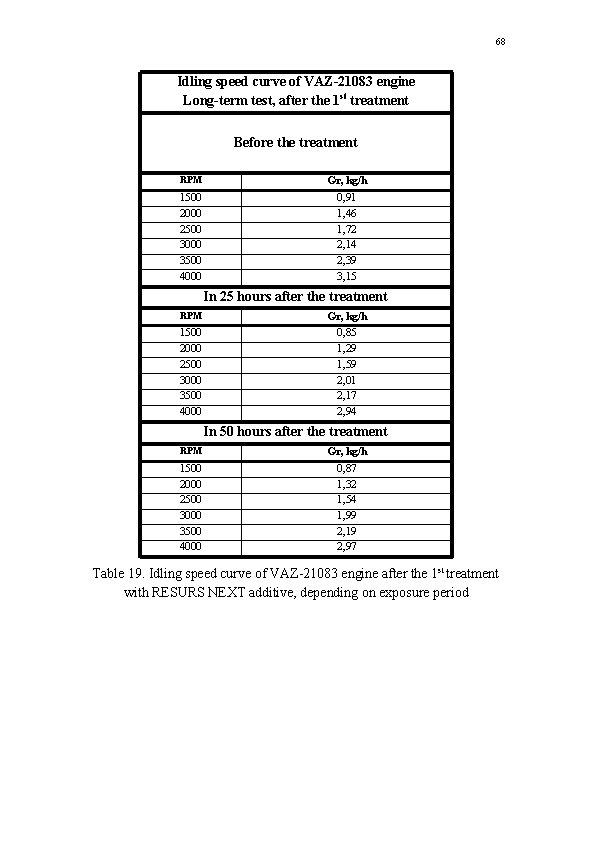
68 Idling speed curve of VAZ-21083 engine Long-term test, after the 1 st treatment Before the treatment RPM Gт, kg/h 1500 2000 2500 3000 3500 4000 0, 91 1, 46 1, 72 2, 14 2, 39 3, 15 In 25 hours after the treatment RPM Gт, kg/h 1500 2000 2500 3000 3500 4000 0, 85 1, 29 1, 59 2, 01 2, 17 2, 94 In 50 hours after the treatment RPM Gт, kg/h 1500 2000 2500 3000 3500 4000 0, 87 1, 32 1, 54 1, 99 2, 19 2, 97 Table 19. Idling speed curve of VAZ-21083 engine after the 1 st treatment with RESURS NEXT additive, depending on exposure period
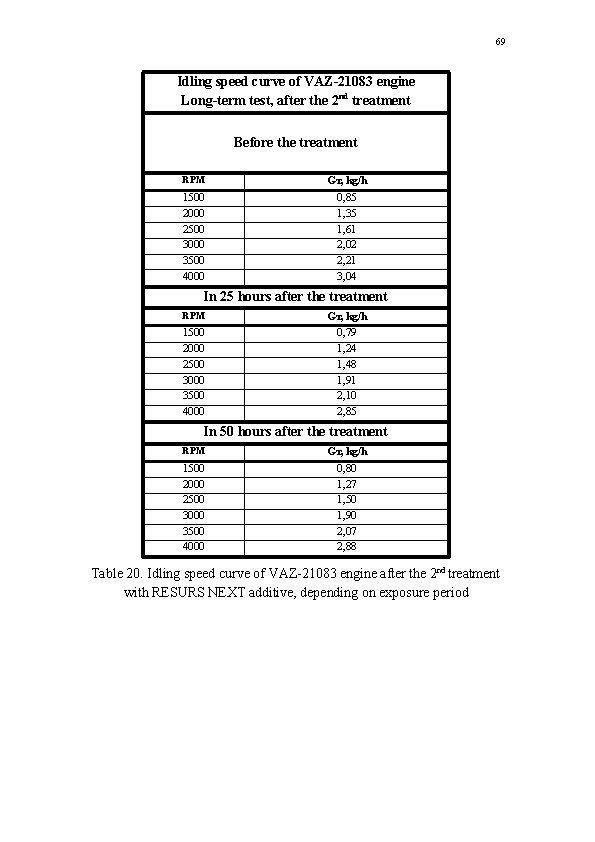
69 Idling speed curve of VAZ-21083 engine Long-term test, after the 2 nd treatment Before the treatment RPM Gт, kg/h 1500 2000 2500 3000 3500 4000 0, 85 1, 35 1, 61 2, 02 2, 21 3, 04 In 25 hours after the treatment RPM Gт, kg/h 1500 2000 2500 3000 3500 4000 0, 79 1, 24 1, 48 1, 91 2, 10 2, 85 In 50 hours after the treatment RPM Gт, kg/h 1500 2000 2500 3000 3500 4000 0, 80 1, 27 1, 50 1, 90 2, 07 2, 88 Table 20. Idling speed curve of VAZ-21083 engine after the 2 nd treatment with RESURS NEXT additive, depending on exposure period
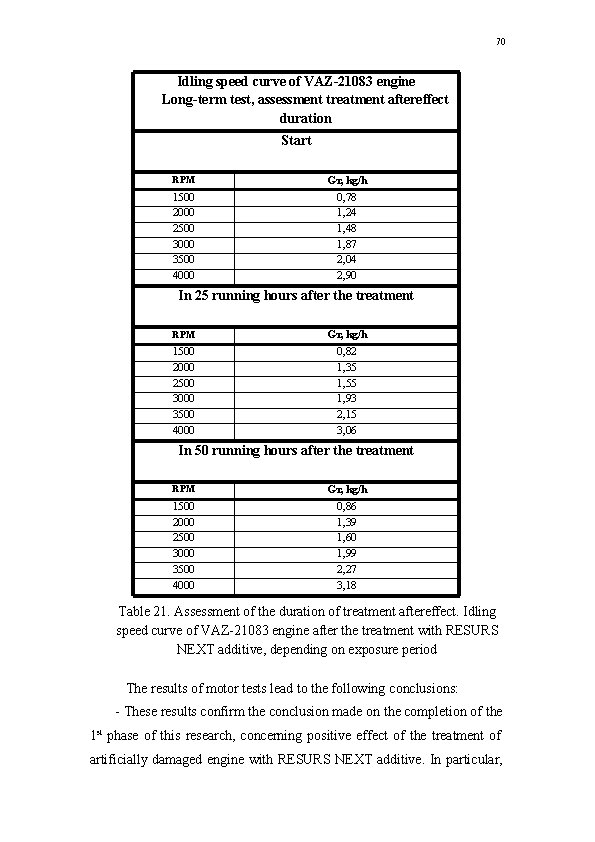
70 Idling speed curve of VAZ-21083 engine Long-term test, assessment treatment aftereffect duration Start RPM Gт, kg/h 1500 2000 2500 3000 3500 4000 0, 78 1, 24 1, 48 1, 87 2, 04 2, 90 In 25 running hours after the treatment RPM Gт, kg/h 1500 2000 2500 3000 3500 4000 0, 82 1, 35 1, 55 1, 93 2, 15 3, 06 In 50 running hours after the treatment RPM Gт, kg/h 1500 2000 2500 3000 3500 4000 0, 86 1, 39 1, 60 1, 99 2, 27 3, 18 Table 21. Assessment of the duration of treatment aftereffect. Idling speed curve of VAZ-21083 engine after the treatment with RESURS NEXT additive, depending on exposure period The results of motor tests lead to the following conclusions: - These results confirm the conclusion made on the completion of the 1 st phase of this research, concerning positive effect of the treatment of artificially damaged engine with RESURS NEXT additive. In particular,
71 specific fuel consumption decreased considerably (by 4… 6% after the 1 st treatment, and by another 2… 3% after the 2 nd treatment). - Mechanical loss power decreased by 5… 8% on average. This value is growing with increase in RESURS NEXT concentration. These data are also confirmed with measured values of fuel consumption during engine idling. - Furthermore, lube oil pressure and temperature curves witness the trend of partial restoration of friction surface. The same is true for the positive trend of cylinder leak-tightness. Details of engine rebuilding rate and trends of changes in engine operation values caused by treatment with RESURS NEXT additive are provided below. 3. Visual inspection of engine conditions on completion of long-term test cycle On completion of long-term test cycle the engine were removed from the test bed, dismantled and examined for possible faults. No faults were detected. 4. Measurements of cylinder leak-tightness (compression) have been taken in the beginning and in the end of each test cycle. The engine was cranked at constant speed of 250 RPM. Compression meter readings were averaged based on three measurements for each cylinder. The throttle was fully closed during the measurements. See Tables 22… 24 and bar charts on Figs. 40… 42 for the test results.
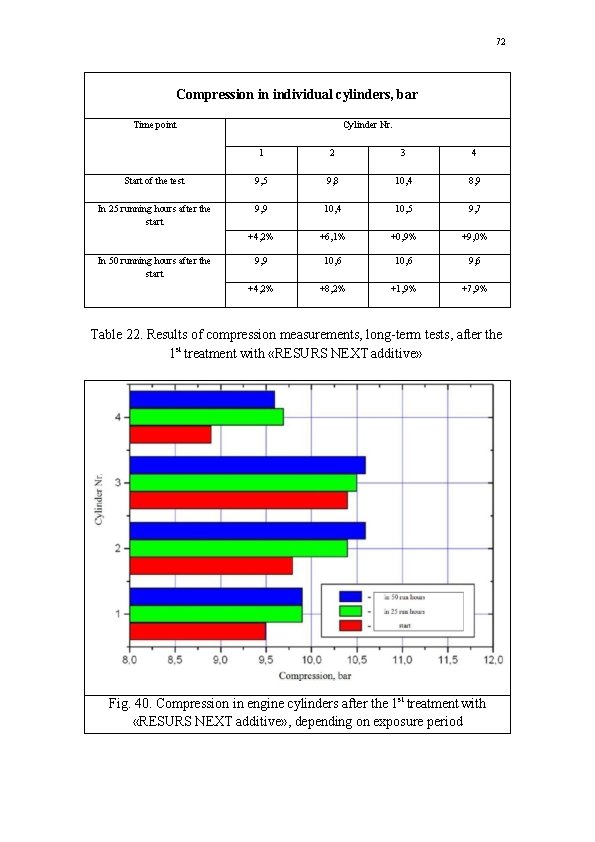
72 Compression in individual cylinders, bar Time point Cylinder Nr. 1 2 3 4 Start of the test 9, 5 9, 8 10, 4 8, 9 In 25 running hours after the start 9, 9 10, 4 10, 5 9, 7 +4, 2% +6, 1% +0, 9% +9, 0% 9, 9 10, 6 9, 6 +4, 2% +8, 2% +1, 9% +7, 9% In 50 running hours after the start Table 22. Results of compression measurements, long-term tests, after the 1 st treatment with «RESURS NEXT additive» Fig. 40. Compression in engine cylinders after the 1 st treatment with «RESURS NEXT additive» , depending on exposure period
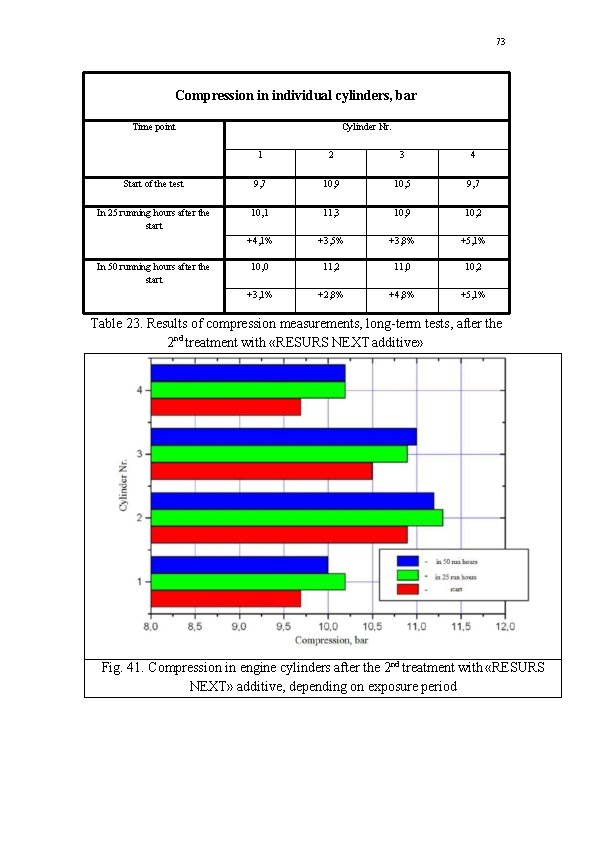
73 Compression in individual cylinders, bar Time point Cylinder Nr. 1 2 3 4 Start of the test 9, 7 10, 9 10, 5 9, 7 In 25 running hours after the start 10, 1 11, 3 10, 9 10, 2 +4, 1% +3, 5% +3, 8% +5, 1% 10, 0 11, 2 11, 0 10, 2 +3, 1% +2, 8% +4, 8% +5, 1% In 50 running hours after the start Table 23. Results of compression measurements, long-term tests, after the 2 nd treatment with «RESURS NEXT additive» Fig. 41. Compression in engine cylinders after the 2 nd treatment with «RESURS NEXT» additive, depending on exposure period
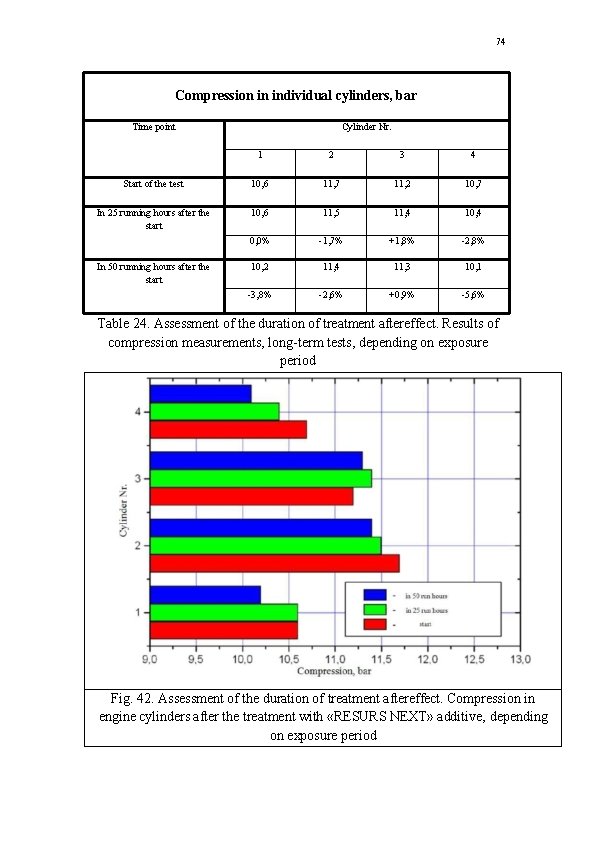
74 Compression in individual cylinders, bar Time point Cylinder Nr. 1 2 3 4 Start of the test 10, 6 11, 7 11, 2 10, 7 In 25 running hours after the start 10, 6 11, 5 11, 4 10, 4 0, 0% -1, 7% +1, 8% -2, 8% 10, 2 11, 4 11, 3 10, 1 -3, 8% -2, 6% +0, 9% -5, 6% In 50 running hours after the start Table 24. Assessment of the duration of treatment aftereffect. Results of compression measurements, long-term tests, depending on exposure period Fig. 42. Assessment of the duration of treatment aftereffect. Compression in engine cylinders after the treatment with «RESURS NEXT» additive, depending on exposure period
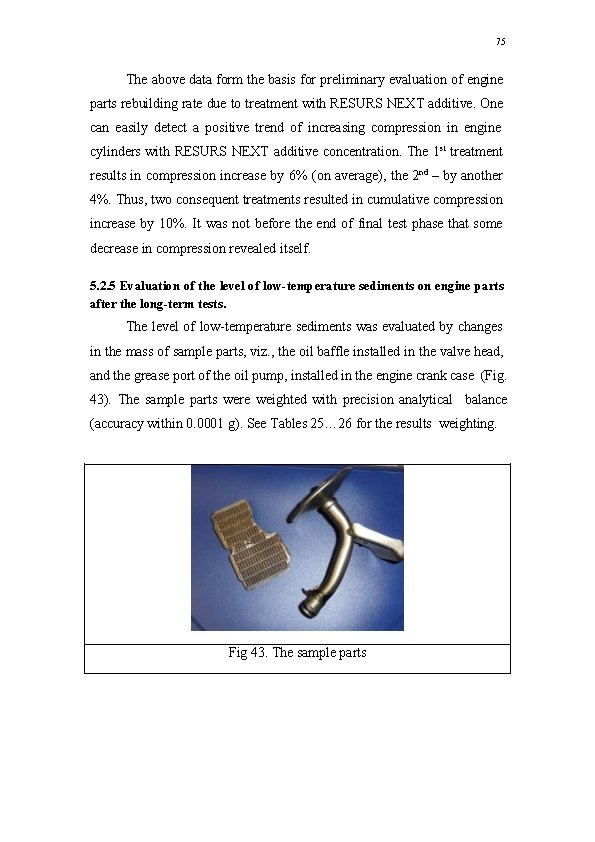
75 The above data form the basis for preliminary evaluation of engine parts rebuilding rate due to treatment with RESURS NEXT additive. One can easily detect a positive trend of increasing compression in engine cylinders with RESURS NEXT additive concentration. The 1 st treatment results in compression increase by 6% (on average), the 2 nd – by another 4%. Thus, two consequent treatments resulted in cumulative compression increase by 10%. It was not before the end of final test phase that some decrease in compression revealed itself. 5. 2. 5 Evaluation of the level of low-temperature sediments on engine parts after the long-term tests. The level of low-temperature sediments was evaluated by changes in the mass of sample parts, viz. , the oil baffle installed in the valve head, and the grease port of the oil pump, installed in the engine crank case (Fig. 43). The sample parts were weighted with precision analytical balance (accuracy within 0. 0001 g). See Tables 25… 26 for the results weighting. Fig 43. The sample parts
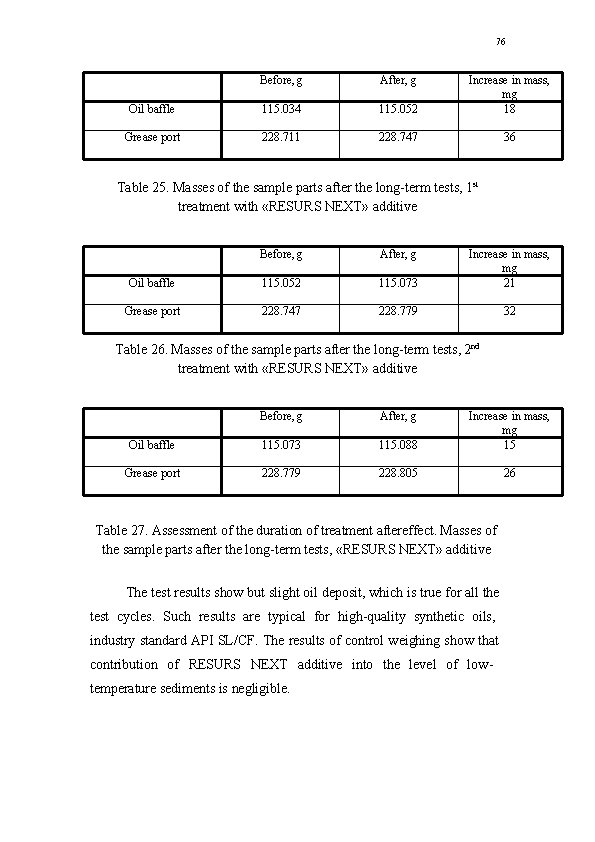
76 Before, g After, g Oil baffle 115. 034 115. 052 Increase in mass, mg 18 Grease port 228. 711 228. 747 36 Table 25. Masses of the sample parts after the long-term tests, 1 st treatment with «RESURS NEXT» additive Before, g After, g Oil baffle 115. 052 115. 073 Increase in mass, mg 21 Grease port 228. 747 228. 779 32 Table 26. Masses of the sample parts after the long-term tests, 2 nd treatment with «RESURS NEXT» additive Before, g After, g Oil baffle 115. 073 115. 088 Increase in mass, mg 15 Grease port 228. 779 228. 805 26 Table 27. Assessment of the duration of treatment aftereffect. Masses of the sample parts after the long-term tests, «RESURS NEXT» additive The test results show but slight oil deposit, which is true for all the test cycles. Such results are typical for high-quality synthetic oils, industry standard API SL/CF. The results of control weighing show that contribution of RESURS NEXT additive into the level of lowtemperature sediments is negligible.
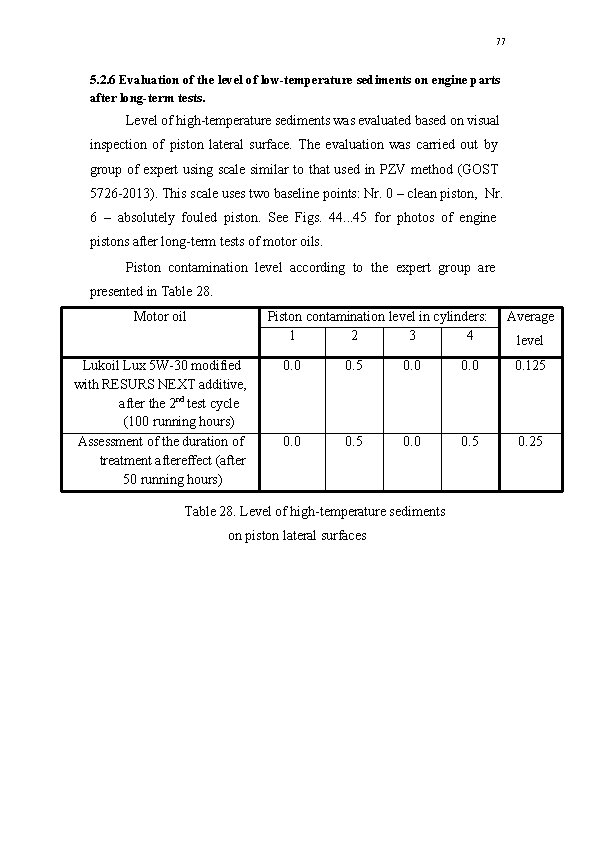
77 5. 2. 6 Evaluation of the level of low-temperature sediments on engine parts after long-term tests. Level of high-temperature sediments was evaluated based on visual inspection of piston lateral surface. The evaluation was carried out by group of expert using scale similar to that used in PZV method (GOST 5726 -2013). This scale uses two baseline points: Nr. 0 – clean piston, Nr. 6 – absolutely fouled piston. See Figs. 44. . . 45 for photos of engine pistons after long-term tests of motor oils. Piston contamination level according to the expert group are presented in Table 28. Motor oil Piston contamination level in cylinders: 1 2 3 4 Lukoil Lux 5 W-30 modified with RESURS NEXT additive, after the 2 nd test cycle (100 running hours) Assessment of the duration of treatment aftereffect (after 50 running hours) Average level 0. 0 0. 5 0. 0 0. 125 0. 0 0. 5 0. 25 Table 28. Level of high-temperature sediments on piston lateral surfaces
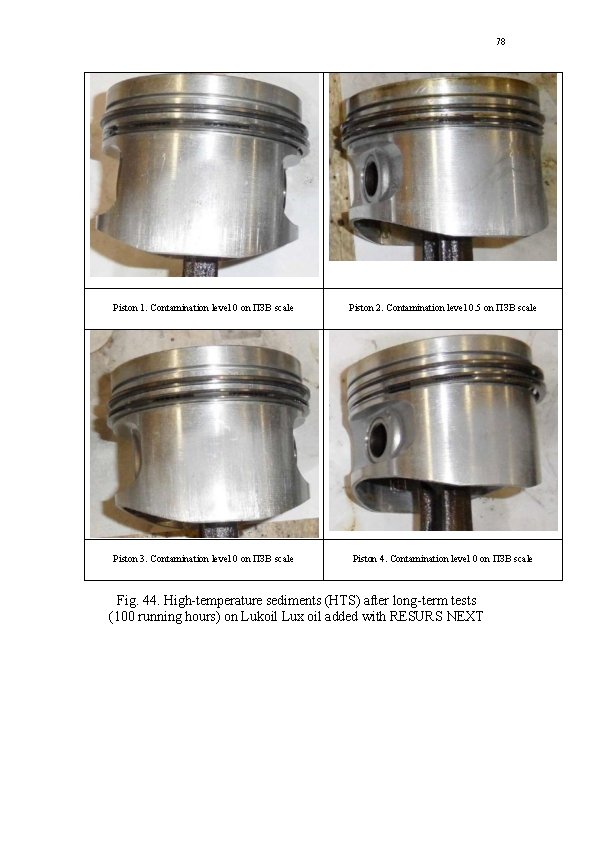
78 Piston 1. Contamination level 0 on ПЗВ scale Piston 2. Contamination level 0. 5 on ПЗВ scale Piston 3. Contamination level 0 on ПЗВ scale Piston 4. Contamination level 0 on ПЗВ scale Fig. 44. High-temperature sediments (HTS) after long-term tests (100 running hours) on Lukoil Lux oil added with RESURS NEXT
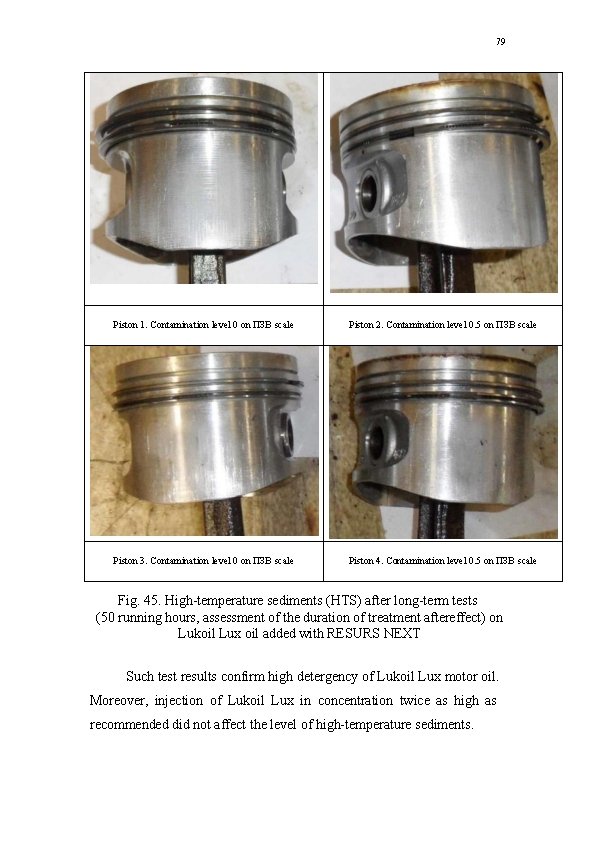
79 Piston 1. Contamination level 0 on ПЗВ scale Piston 2. Contamination level 0. 5 on ПЗВ scale Piston 3. Contamination level 0 on ПЗВ scale Piston 4. Contamination level 0. 5 on ПЗВ scale Fig. 45. High-temperature sediments (HTS) after long-term tests (50 running hours, assessment of the duration of treatment aftereffect) on Lukoil Lux oil added with RESURS NEXT Such test results confirm high detergency of Lukoil Lux motor oil. Moreover, injection of Lukoil Lux in concentration twice as high as recommended did not affect the level of high-temperature sediments.
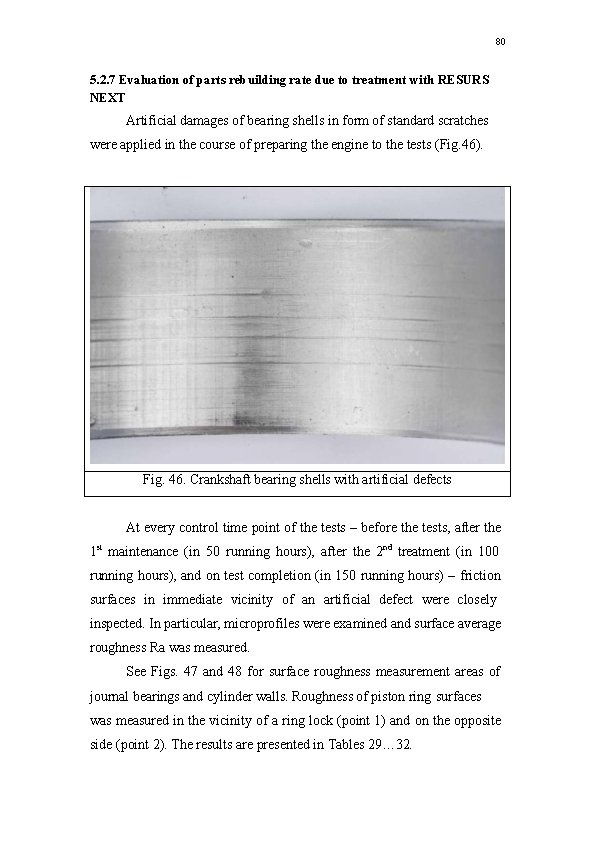
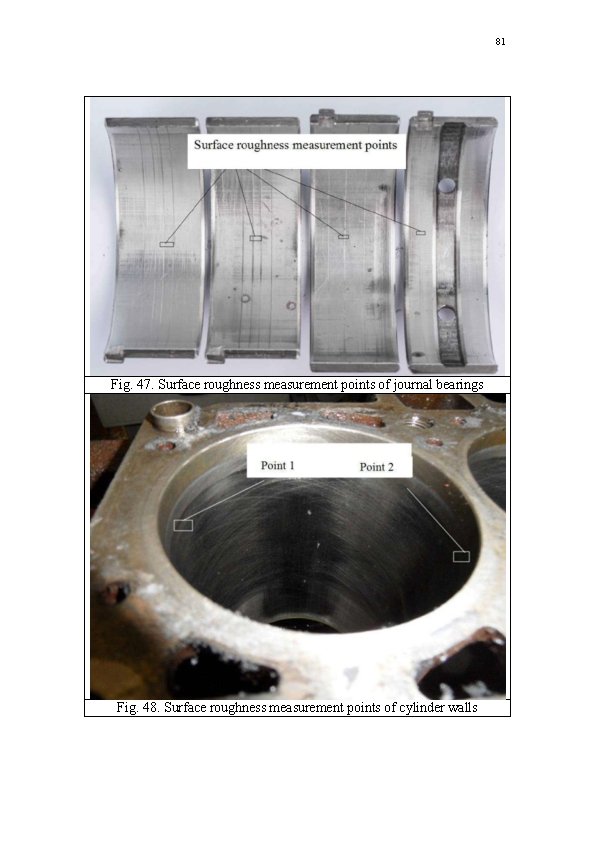
80 5. 2. 7 Evaluation of parts rebuilding rate due to treatment with RESURS NEXT Artificial damages of bearing shells in form of standard scratches were applied in the course of preparing the engine to the tests (Fig. 46). Fig. 46. Crankshaft bearing shells with artificial defects At every control time point of the tests – before the tests, after the 1 st maintenance (in 50 running hours), after the 2 nd treatment (in 100 running hours), and on test completion (in 150 running hours) – friction surfaces in immediate vicinity of an artificial defect were closely inspected. In particular, microprofiles were examined and surface average roughness Ra was measured. See Figs. 47 and 48 for surface roughness measurement areas of journal bearings and cylinder walls. Roughness of piston ring surfaces was measured in the vicinity of a ring lock (point 1) and on the opposite side (point 2). The results are presented in Tables 29… 32.
81 Fig. 47. Surface roughness measurement points of journal bearings Fig. 48. Surface roughness measurement points of cylinder walls
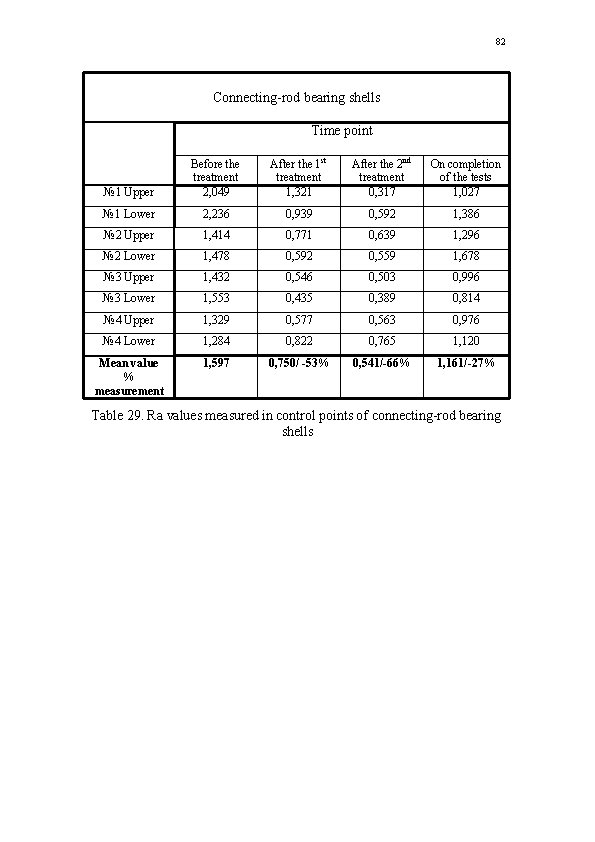
82 Connecting-rod bearing shells Time point № 1 Upper Before the treatment 2, 049 After the 1 st treatment 1, 321 After the 2 nd treatment 0, 317 On completion of the tests 1, 027 № 1 Lower 2, 236 0, 939 0, 592 1, 386 № 2 Upper 1, 414 0, 771 0, 639 1, 296 № 2 Lower 1, 478 0, 592 0, 559 1, 678 № 3 Upper 1, 432 0, 546 0, 503 0, 996 № 3 Lower 1, 553 0, 435 0, 389 0, 814 № 4 Upper 1, 329 0, 577 0, 563 0, 976 № 4 Lower 1, 284 0, 822 0, 765 1, 120 Mean value % measurement 1, 597 0, 750/ -53% 0, 541/-66% 1, 161/-27% Table 29. Ra values measured in control points of connecting-rod bearing shells
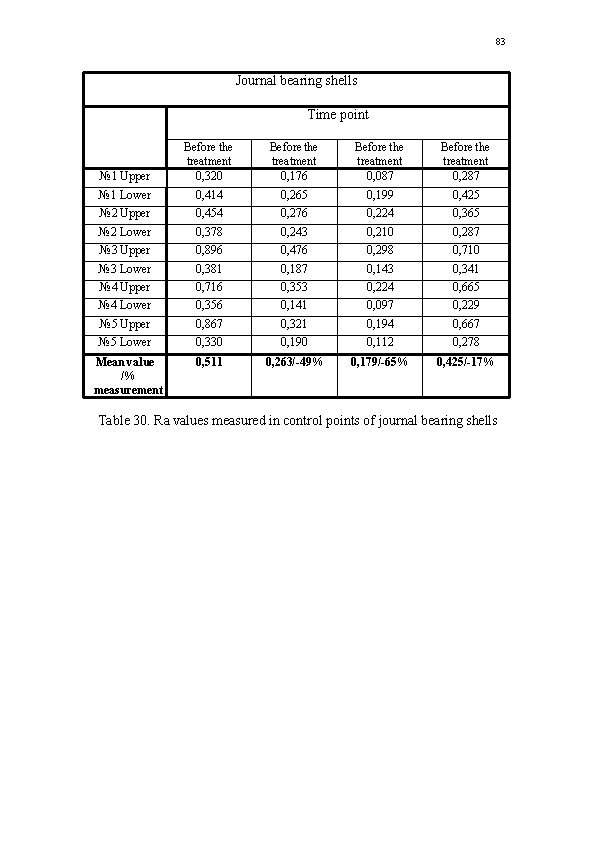
83 Journal bearing shells Time point № 1 Upper Before the treatment 0, 320 Before the treatment 0, 176 Before the treatment 0, 087 Before the treatment 0, 287 № 1 Lower 0, 414 0, 265 0, 199 0, 425 № 2 Upper 0, 454 0, 276 0, 224 0, 365 № 2 Lower 0, 378 0, 243 0, 210 0, 287 № 3 Upper 0, 896 0, 476 0, 298 0, 710 № 3 Lower 0, 381 0, 187 0, 143 0, 341 № 4 Upper 0, 716 0, 353 0, 224 0, 665 № 4 Lower 0, 356 0, 141 0, 097 0, 229 № 5 Upper 0, 867 0, 321 0, 194 0, 667 № 5 Lower 0, 330 0, 190 0, 112 0, 278 Mean value /% measurement 0, 511 0, 263/-49% 0, 179/-65% 0, 425/-17% Table 30. Ra values measured in control points of journal bearing shells
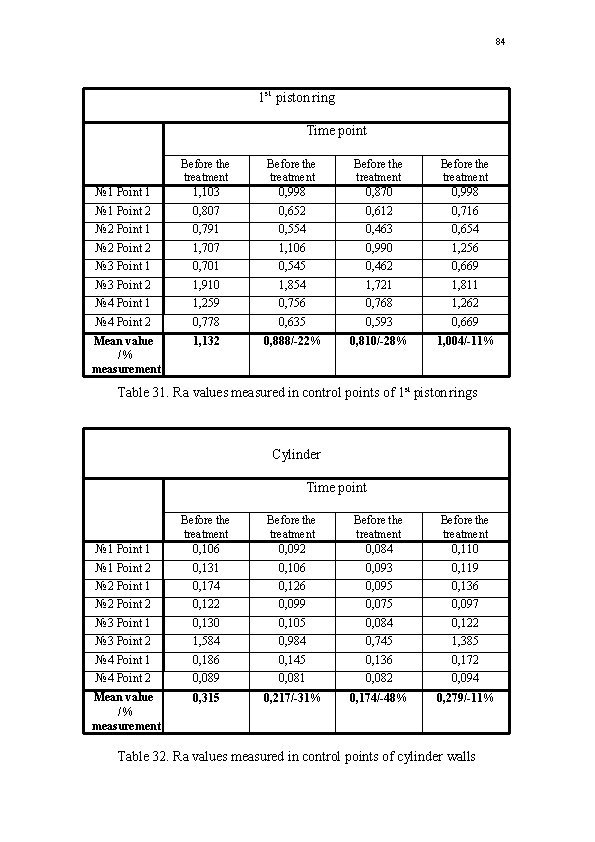
84 1 st piston ring Time point № 1 Point 1 Before the treatment 1, 103 Before the treatment 0, 998 Before the treatment 0, 870 Before the treatment 0, 998 № 1 Point 2 0, 807 0, 652 0, 612 0, 716 № 2 Point 1 0, 791 0, 554 0, 463 0, 654 № 2 Point 2 1, 707 1, 106 0, 990 1, 256 № 3 Point 1 0, 701 0, 545 0, 462 0, 669 № 3 Point 2 1, 910 1, 854 1, 721 1, 811 № 4 Point 1 1, 259 0, 756 0, 768 1, 262 № 4 Point 2 0, 778 0, 635 0, 593 0, 669 Mean value /% measurement 1, 132 0, 888/-22% 0, 810/-28% 1, 004/-11% Table 31. Ra values measured in control points of 1 st piston rings Cylinder Time point № 1 Point 1 Before the treatment 0, 106 Before the treatment 0, 092 Before the treatment 0, 084 Before the treatment 0, 110 № 1 Point 2 0, 131 0, 106 0, 093 0, 119 № 2 Point 1 0, 174 0, 126 0, 095 0, 136 № 2 Point 2 0, 122 0, 099 0, 075 0, 097 № 3 Point 1 0, 130 0, 105 0, 084 0, 122 № 3 Point 2 1, 584 0, 984 0, 745 1, 385 № 4 Point 1 0, 186 0, 145 0, 136 0, 172 № 4 Point 2 0, 089 0, 081 0, 082 0, 094 Mean value /% measurement 0, 315 0, 217/-31% 0, 174/-48% 0, 279/-11% Table 32. Ra values measured in control points of cylinder walls
85 The results of the measurements show clear trend of surface roughness decrease after each treatment with RESURS NEXT additive, which is obviously accounted for by decrease in scratch depth due to cladding with active component of the additive. This effect is more evident in parts with softer friction surfaces. Thus, total decrease in Ra of journal bearing shells after two treatments amounted to 50… 60%. For harder parts, such as chromium-plated piston ring surfaces and cylinder wall surfaces, the above effect is less manifest (30… 40%). This is a sign of partial restoration of worn engine, which is indirectly evidenced by higher compression in cylinders, lower mechanical losses power and lube oil pressure recorded during the tests. It should be noted that removal of the RESURS NEXT additive from motor oil results in visible reduction of partial restoration effects. 2 nd phase of the research: discussion Results of long-term testing of engine featuring parts with artificially damaged friction surfaces leads to the following conclusions. First of all, these results confirm the conclusion from the results of the 1 st phase of research, concerning considerable decrease in friction losses due to treatment of the engine with RESURS NEXT additive. This is supported by direct measurements of mechanical losses torque, fuel consumption and engine output taken at various phases of the test cycle. Presented in Tables 33… 35 are some calculated performance indices, averaged over the test cycle.
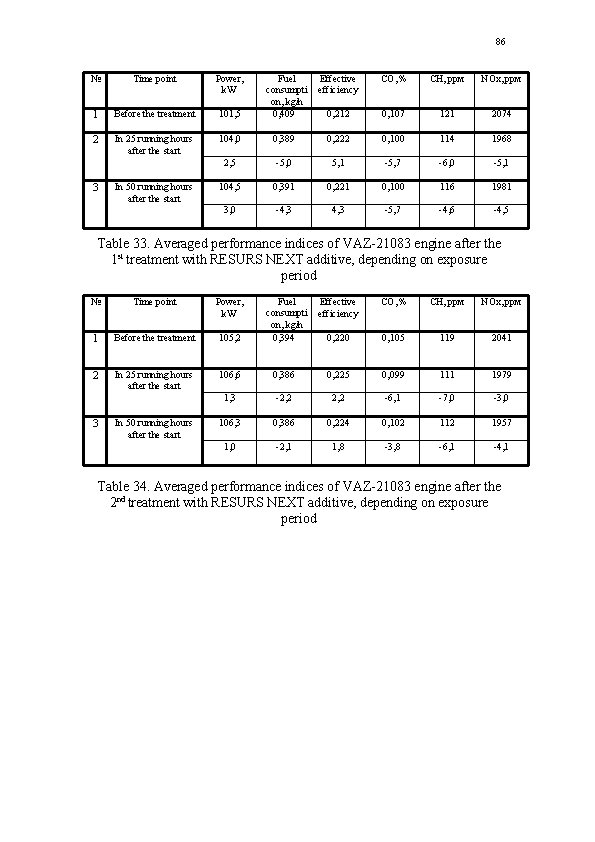
86 № Time point Power, k. W 1 Before the treatment 101, 5 2 In 25 running hours after the start 104, 0 3 In 50 running hours after the start Effective efficiency CO, % CH, ррм NOx, ррм 0, 212 0, 107 121 2074 0, 389 0, 222 0, 100 114 1968 2, 5 -5, 0 5, 1 -5, 7 -6, 0 -5, 1 104, 5 0, 391 0, 221 0, 100 116 1981 3, 0 -4, 3 -5, 7 -4, 6 -4, 5 Fuel consumpti on, kg/h 0, 409 Table 33. Averaged performance indices of VAZ-21083 engine after the 1 st treatment with RESURS NEXT additive, depending on exposure period № Time point Power, k. W 1 Before the treatment 105, 2 2 In 25 running hours after the start 106, 6 3 In 50 running hours after the start Effective efficiency CO, % CH, ррм NOx, ррм 0, 220 0, 105 119 2041 0, 386 0, 225 0, 099 111 1979 1, 3 -2, 2 -6, 1 -7, 0 -3, 0 106, 3 0, 386 0, 224 0, 102 112 1957 1, 0 -2, 1 1, 8 -3, 8 -6, 1 -4, 1 Fuel consumpti on, kg/h 0, 394 Table 34. Averaged performance indices of VAZ-21083 engine after the 2 nd treatment with RESURS NEXT additive, depending on exposure period
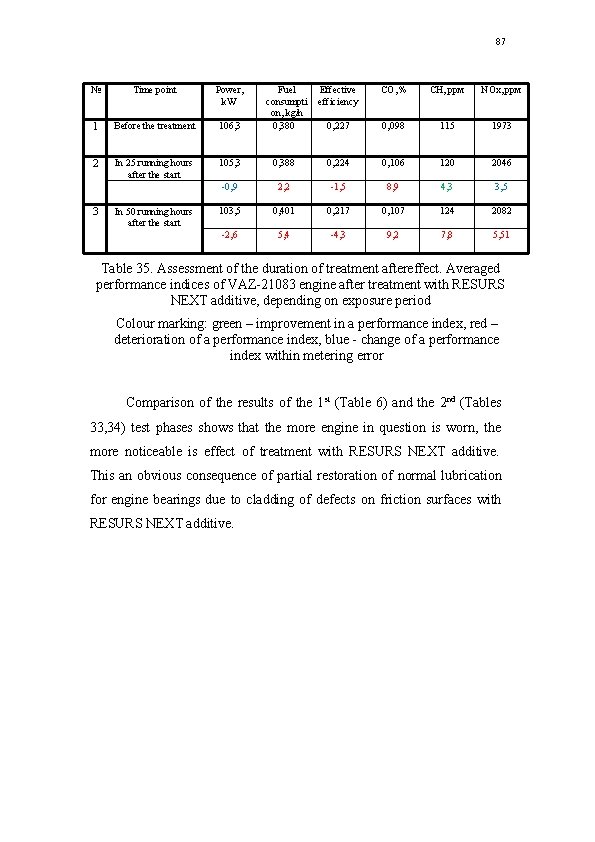
87 № Time point Power, k. W 1 Before the treatment 106, 3 2 In 25 running hours after the start 105, 3 3 In 50 running hours after the start Effective efficiency CO, % CH, ррм NOx, ррм 0, 227 0, 098 115 1973 0, 388 0, 224 0, 106 120 2046 -0, 9 2, 2 -1, 5 8, 9 4, 3 3, 5 103, 5 0, 401 0, 217 0, 107 124 2082 -2, 6 5, 4 -4, 3 9, 2 7, 8 5, 51 Fuel consumpti on, kg/h 0, 380 Table 35. Assessment of the duration of treatment aftereffect. Averaged performance indices of VAZ-21083 engine after treatment with RESURS NEXT additive, depending on exposure period Colour marking: green – improvement in a performance index, red – deterioration of a performance index, blue - change of a performance index within metering error Comparison of the results of the 1 st (Table 6) and the 2 nd (Tables 33, 34) test phases shows that the more engine in question is worn, the more noticeable is effect of treatment with RESURS NEXT additive. This an obvious consequence of partial restoration of normal lubrication for engine bearings due to cladding of defects on friction surfaces with RESURS NEXT additive.
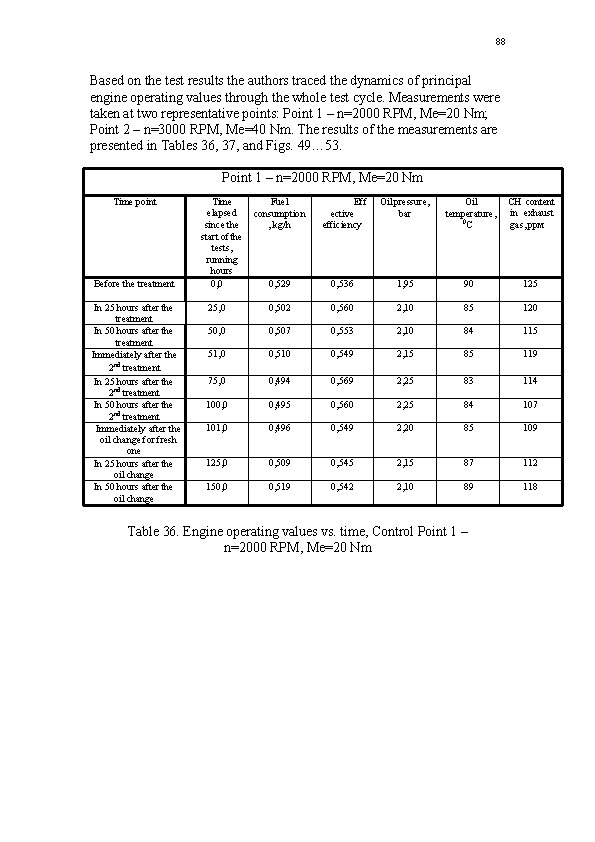
88 Based on the test results the authors traced the dynamics of principal engine operating values through the whole test cycle. Measurements were taken at two representative points: Point 1 – n=2000 RPM, Ме=20 Nm; Point 2 – n=3000 RPM, Ме=40 Nm. The results of the measurements are presented in Tables 36, 37, and Figs. 49… 53. Point 1 – n=2000 RPM, Ме=20 Nm Time point Before the treatment In 25 hours after the treatment In 50 hours after the treatment Immediately after the 2 nd treatment In 25 hours after the 2 nd treatment In 50 hours after the 2 nd treatment Immediately after the oil change for fresh one In 25 hours after the oil change In 50 hours after the oil change Time elapsed since the start of the tests, running hours 0, 0 Fuel consumption , kg/h Eff ective efficiency Oil pressure, bar Oil temperature, 0 C CH content in exhaust gas, ррм 0, 529 0, 536 1, 95 90 125 25, 0 0, 502 0, 560 2, 10 85 120 50, 0 0, 507 0, 553 2, 10 84 115 51, 0 0, 510 0, 549 2, 15 85 119 75, 0 0, 494 0, 569 2, 25 83 114 100, 0 0, 495 0, 560 2, 25 84 107 101, 0 0, 496 0, 549 2, 20 85 109 125, 0 0, 509 0, 545 2, 15 87 112 150, 0 0, 519 0, 542 2, 10 89 118 Table 36. Engine operating values vs. time, Control Point 1 – n=2000 RPM, Ме=20 Nm
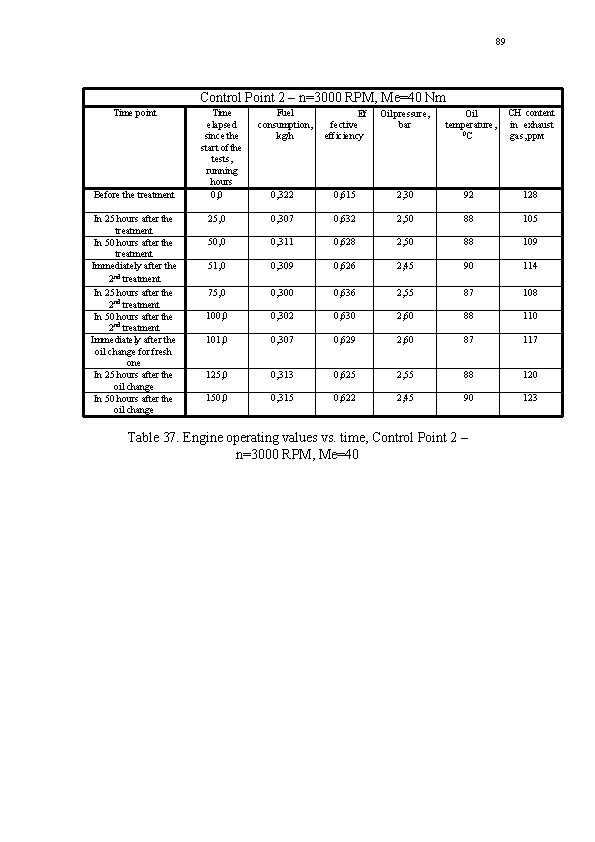
89 Control Point 2 – n=3000 RPM, Ме=40 Nm Time point Before the treatment In 25 hours after the treatment In 50 hours after the treatment Immediately after the 2 nd treatment In 25 hours after the 2 nd treatment In 50 hours after the 2 nd treatment Immediately after the oil change for fresh one In 25 hours after the oil change In 50 hours after the oil change Time elapsed since the start of the tests, running hours 0, 0 Fuel consumption, kg/h Ef fective efficiency Oil pressure, bar Oil temperature, 0 C CH content in exhaust gas, ррм 0, 322 0, 615 2, 30 92 128 25, 0 0, 307 0, 632 2, 50 88 105 50, 0 0, 311 0, 628 2, 50 88 109 51, 0 0, 309 0, 626 2, 45 90 114 75, 0 0, 300 0, 636 2, 55 87 108 100, 0 0, 302 0, 630 2, 60 88 110 101, 0 0, 307 0, 629 2, 60 87 117 125, 0 0, 313 0, 625 2, 55 88 120 150, 0 0, 315 0, 622 2, 45 90 123 Table 37. Engine operating values vs. time, Control Point 2 – n=3000 RPM, Ме=40
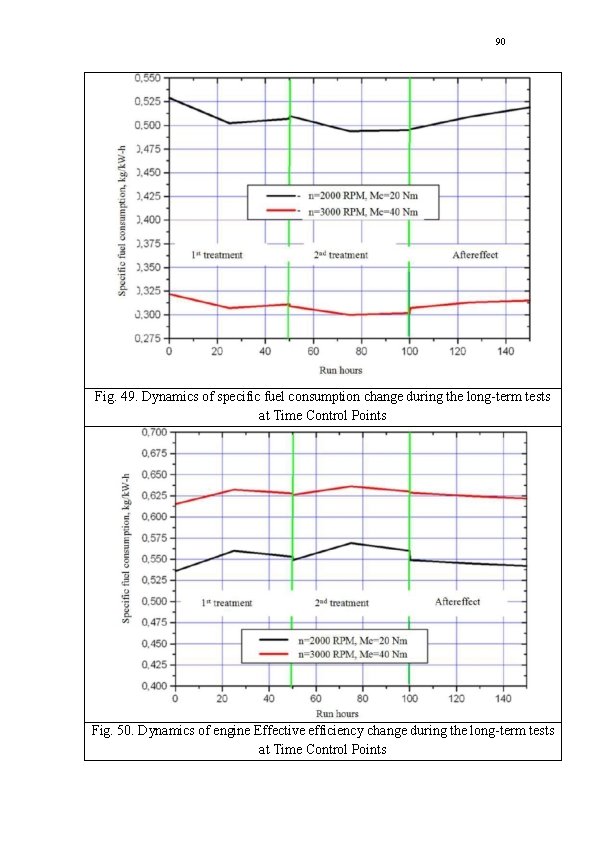
90 Fig. 49. Dynamics of specific fuel consumption change during the long-term tests at Time Control Points Fig. 50. Dynamics of engine Effective efficiency change during the long-term tests at Time Control Points
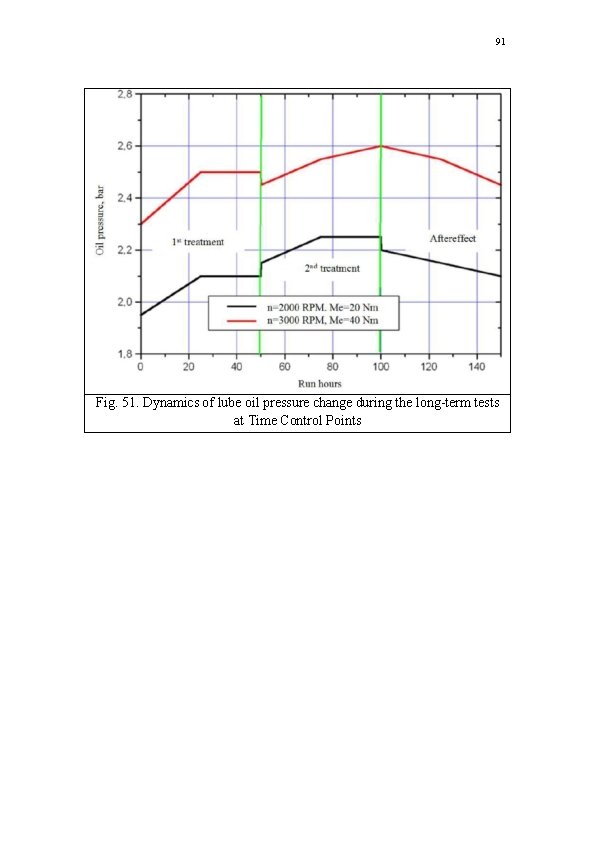
91 Fig. 51. Dynamics of lube oil pressure change during the long-term tests at Time Control Points
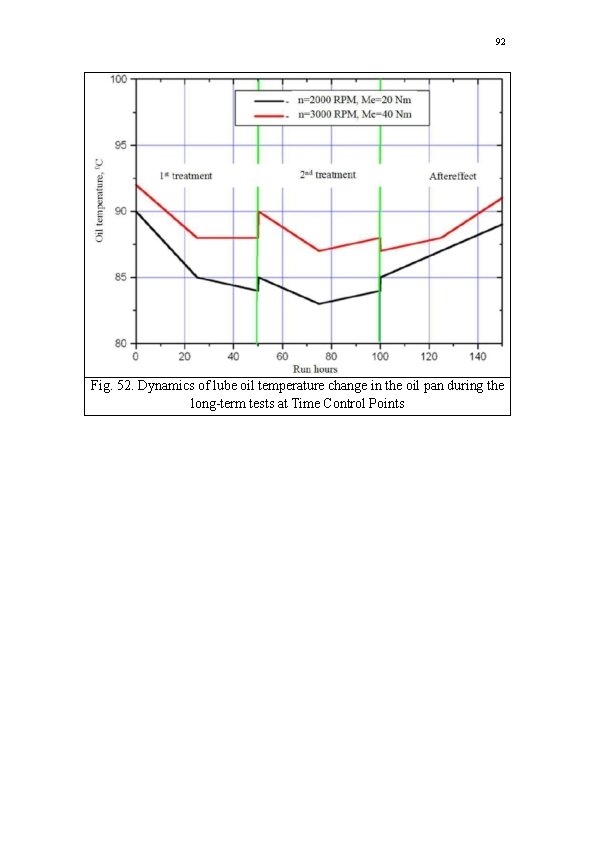
92 Fig. 52. Dynamics of lube oil temperature change in the oil pan during the long-term tests at Time Control Points
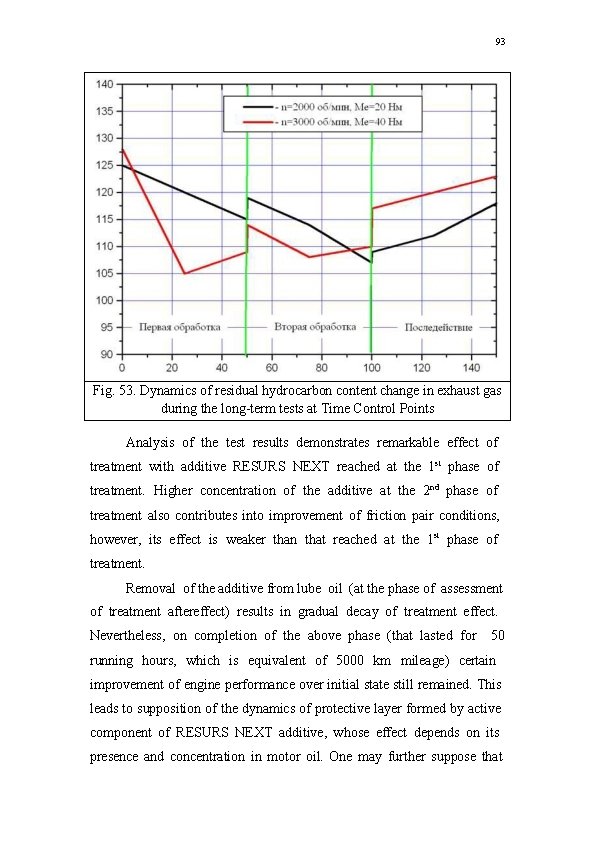
93 Fig. 53. Dynamics of residual hydrocarbon content change in exhaust gas during the long-term tests at Time Control Points Analysis of the test results demonstrates remarkable effect of treatment with additive RESURS NEXT reached at the 1 st phase of treatment. Higher concentration of the additive at the 2 nd phase of treatment also contributes into improvement of friction pair conditions, however, its effect is weaker than that reached at the 1 st phase of treatment. Removal of the additive from lube oil (at the phase of assessment of treatment aftereffect) results in gradual decay of treatment effect. Nevertheless, on completion of the above phase (that lasted for 50 running hours, which is equivalent of 5000 km mileage) certain improvement of engine performance over initial state still remained. This leads to supposition of the dynamics of protective layer formed by active component of RESURS NEXT additive, whose effect depends on its presence and concentration in motor oil. One may further suppose that
94 permanent presence of the additive in motor oil results in stabilization of said effect on certain level, which depends on engine initial conditions. Proof of this assumption, however, needs longer test cycle on a representative sample of engines varying in wear level. 6. Conclusions The results of the whole test cycle lead to the following conclusions: - Use of RESURS NEXT additive results in certain improvement in petrol engine performance, viz. , increase in power (by 2. . . 3%) and decrease in specific fuel consumption (by 2. . . 5% at average). Also, increase in lube oil pressure (by 5… 8%) and decrease in lube oil temperature (by 3… 70 С) are observed. Additionally, there is certain reduction in residual hydrocarbons (HC) contents in exhaust gas, which increases with RESURS NEXT concentration in motor oil. - Fuel economy is more pronounced in engines with middle and high wear level and damaged surfaces of friction pairs. Friction horsepower decreases by 8… 10% due to better leak-tightness of "piston-cylinder sleeve" pair (cumulative increase in compression after two treatments up to 10… 12%), better lubrication and restoration of lube oil pressure (by 7… 12%). Therefore, further fuel economy (by 5… 7%) is observed, as compared with fuel consumption of sound engine with low wear level. - Clear trend is observed of partial restoration of friction surfaces exposed to RESURS NEXT additive. It is readily apparent from the dynamics of changes in engine operating values, as well as direct measurement of roughness of friction pair surfaces, such as journal bearings, cylinder walls and piston rings. Total decrease in Ra of journal
95 bearing shells after two treatments amounted to 50… 60%, of piston rings and cylinder walls – to 30… 40%. - The 2 nd phase of the research showed a dependence of RESURS NEXT effect on its concentration in lube oil. The most pronounced effect is achieved at the 1 st phase, immediately after initial injection of the additive into lube oil. Further injection of RESURS NEXT in lube oil still contributes into engine performance improvement, but the rate of improvement drops down considerably. - After the removal of RESURS NEXT additive from lube oil (at the phase of assessment of treatment aftereffect) the effect of the treatment is retained for certain period of time, whereupon gradual decay of engine performance is observed. However, even after 50 running hours (which is equivalent of 5000 km mileage) of previously treated engine on fresh oil some residual effects are still there. - This leads to supposition of the dynamics of protective layer formed by active component of RESURS NEXT additive, whose effect depends on its presence and concentration in motor oil. One may further assume that permanent presence of the additive in motor oil results in stabilization of said effect on certain level, which depends on engine initial conditions. Proof of this assumption, however, needs longer test cycle on a representative sample of engines varying in wear level.
96 APPENDIX I STANDARD СДС ГСМ-FLM ММ-003 -2009 "MOTOR OILS FOR AUTOMOBILE ENGINES COMPARATIVE TEST METHOD”
97 STANDAR D voluntary certification schemes for fuels, lube oils and chemicals СДС ГСМ-FLM СТО ММ-003 -2009 MOTOR OILS FOR AUTOMOBILE ENGINES Comparative motor test method This instruction establishes comparative test method allowing evaluation of dependence of engine techno-economic and environmental performance on motor oil used. 1. METHOD BASICS The essence of the method is establishing guidelines regarding tests of motor oils from the viewpoint of their influence on: - engine power and fuel economy characteristics; - concentration of toxic components in exhaust gas; - engine friction horsepower.
98 Besides, evaluated is rate of change in oil properties at initial period after oil change in field. Tests shall be carried out on VAZ-2111 or VAZ-2112 engines installed on a motor test bed. Test engine shall be perfectly sound, with negligible wear rate (if any). 2. TEST EQUIPMENT, MATERIALS, AND CHEMICALS Test equipment, materials, and chemicals shall be as follows: - engine type ВАЗ-2111 or ВАЗ-2112; - motor test bed; - Lead-free motor petrol type REGULAR or PREMIUM, GOST 51105 3. PR EP AR ATION FOR THE TEST S 1. The tests shall be carried out on VAZ-2111 or VAZ-2112 type engine with new piston assembly and new journal bearing shells. 2. The engine shall be installed on the test bed and given running- in for 6 running hours according to Table 1. The engine shall be primed with lube oil to be tested. The amount of oil for running-in mode shall equal (3, 5± 0. 1) l.
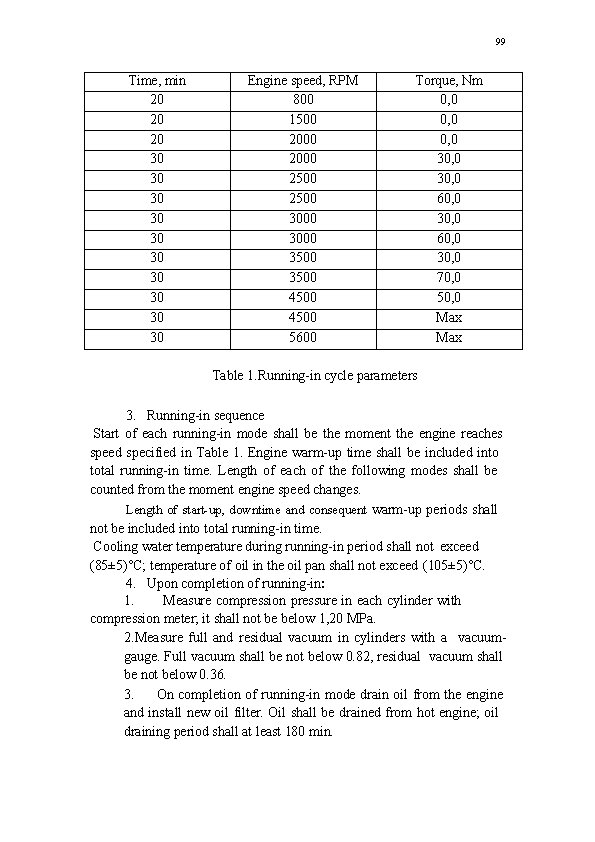
99 Time, min 20 20 20 30 30 30 Engine speed, RPM 800 1500 2000 2500 3000 3500 4500 5600 Torque, Nm 0, 0 30, 0 60, 0 30, 0 70, 0 50, 0 Мах Table 1. Running-in cycle parameters 3. Running-in sequence Start of each running-in mode shall be the moment the engine reaches speed specified in Table 1. Engine warm-up time shall be included into total running-in time. Length of each of the following modes shall be counted from the moment engine speed changes. Length of start-up, downtime and consequent warm-up periods shall not be included into total running-in time. Cooling water temperature during running-in period shall not exceed (85± 5)°С; temperature of oil in the oil pan shall not exceed (105± 5)°С. 4. Upon completion of running-in: 1. Measure compression pressure in each cylinder with compression meter; it shall not be below 1, 20 MPa. 2. Measure full and residual vacuum in cylinders with a vacuumgauge. Full vacuum shall be not below 0. 82, residual vacuum shall be not below 0. 36. 3. On completion of running-in mode drain oil from the engine and install new oil filter. Oil shall be drained from hot engine; oil draining period shall at least 180 min.
100 4 RUNNING THE TESTS 4. 1 In order to remove the remnants of used oil, change oil as follows: 1. Start the engine and warm up in idling mode until temperature in the oil pan reaches 800 C. 2. Shut off the engine, unscrew the drain plug and drain oil from the engine; oil draining period shall be at least 180 min. 3. Prime the engine with 1. 5 l of oil to be tested, start the engine and warm up in idling mode for 5 minutes. 4. Shut off the engine and drain the oil; oil draining period shall be at least 20 min. 5. Prime the engine with 1. 5 l of oil to be tested and repeat steps 4. 1. 3… 4. 1. 4. 6. Change the filter. 2. Prime the engine with (3, 5± 0, 1) l of oil to be tested; make sure that oil level in the oil pan is at the top mark of level indicator. 3. Ambient air temperature in motor compartment shall not exceed 40°С, relative humidity shall be within the range of 60%. . . 80%. 4. Start the engine, warm it up at constant speed and load until temperatures of coolant and oil in the oil pan stabilize. Take measurements of engine operating values (torque, crankshaft RPM, instant air flow, lube oil pressure, temperatures of coolant, exhaust gas and lube oil), and emissions of СО, СН, СО 2, NOx in operation modes specified in Table 2.
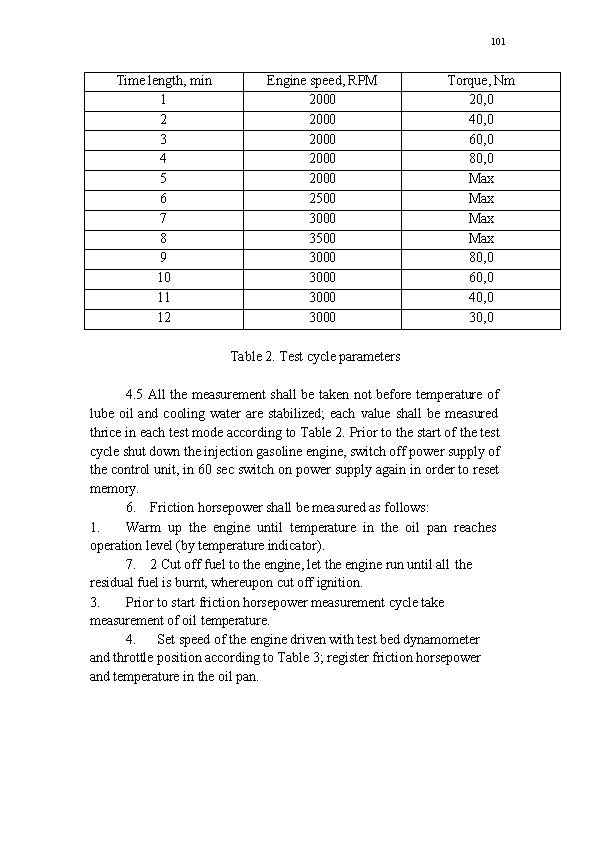
101 Time length, min 1 2 3 4 5 6 7 8 9 10 11 12 Engine speed, RPM 2000 2000 2500 3000 3000 Torque, Nm 20, 0 40, 0 60, 0 80, 0 Мах Мах 80, 0 60, 0 40, 0 30, 0 Table 2. Test cycle parameters 4. 5 All the measurement shall be taken not before temperature of lube oil and cooling water are stabilized; each value shall be measured thrice in each test mode according to Table 2. Prior to the start of the test cycle shut down the injection gasoline engine, switch off power supply of the control unit, in 60 sec switch on power supply again in order to reset memory. 6. Friction horsepower shall be measured as follows: 1. Warm up the engine until temperature in the oil pan reaches operation level (by temperature indicator). 7. 2 Cut off fuel to the engine, let the engine run until all the residual fuel is burnt, whereupon cut off ignition. 3. Prior to start friction horsepower measurement cycle take measurement of oil temperature. 4. Set speed of the engine driven with test bed dynamometer and throttle position according to Table 3; register friction horsepower and temperature in the oil pan.
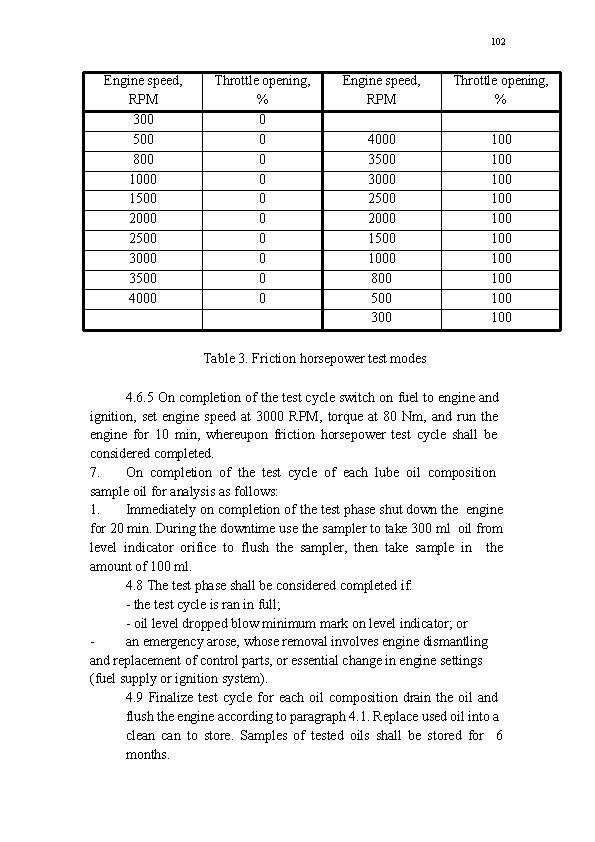
102 Engine speed, RPM 300 500 800 1000 1500 2000 2500 3000 3500 4000 Throttle opening, % 0 0 0 0 0 Engine speed, RPM Throttle opening, % 4000 3500 3000 2500 2000 1500 1000 800 500 300 100 100 100 Table 3. Friction horsepower test modes 4. 6. 5 On completion of the test cycle switch on fuel to engine and ignition, set engine speed at 3000 RPM, torque at 80 Nm, and run the engine for 10 min, whereupon friction horsepower test cycle shall be considered completed. 7. On completion of the test cycle of each lube oil composition sample oil for analysis as follows: 1. Immediately on completion of the test phase shut down the engine for 20 min. During the downtime use the sampler to take 300 ml oil from level indicator orifice to flush the sampler, then take sample in the amount of 100 ml. 4. 8 The test phase shall be considered completed if: - the test cycle is ran in full; - oil level dropped blow minimum mark on level indicator; or an emergency arose, whose removal involves engine dismantling and replacement of control parts, or essential change in engine settings (fuel supply or ignition system). 4. 9 Finalize test cycle for each oil composition drain the oil and flush the engine according to paragraph 4. 1. Replace used oil into a clean can to store. Samples of tested oils shall be stored for 6 months.
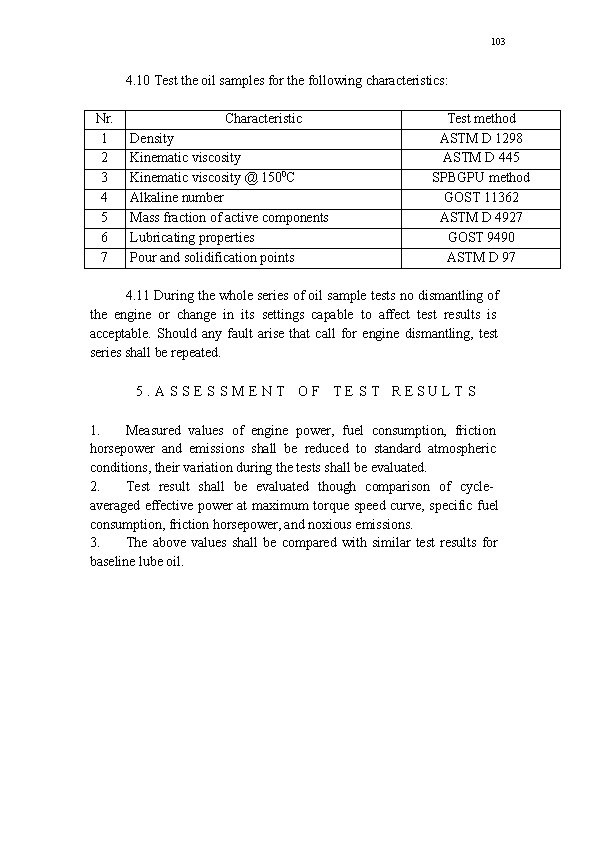
103 4. 10 Test the oil samples for the following characteristics: Nr. 1 2 3 4 5 6 7 Characteristic Density Kinematic viscosity @ 1500 C Alkaline number Mass fraction of active components Lubricating properties Pour and solidification points Test method ASTM D 1298 ASTM D 445 SPBGPU method GOST 11362 ASTM D 4927 GOST 9490 ASTM D 97 4. 11 During the whole series of oil sample tests no dismantling of the engine or change in its settings capable to affect test results is acceptable. Should any fault arise that call for engine dismantling, test series shall be repeated. 5. ASS ESSMENT OF TE ST RESULT S 1. Measured values of engine power, fuel consumption, friction horsepower and emissions shall be reduced to standard atmospheric conditions, their variation during the tests shall be evaluated. 2. Test result shall be evaluated though comparison of cycleaveraged effective power at maximum torque speed curve, specific fuel consumption, friction horsepower, and noxious emissions. 3. The above values shall be compared with similar test results for baseline lube oil.
- Slides: 103