HOW TO A C E the S A
- Slides: 20
HOW TO A. C. E. the S. A. Q. A Writing Strategy to Short Response Questions on the Advance Placement World History Exam.
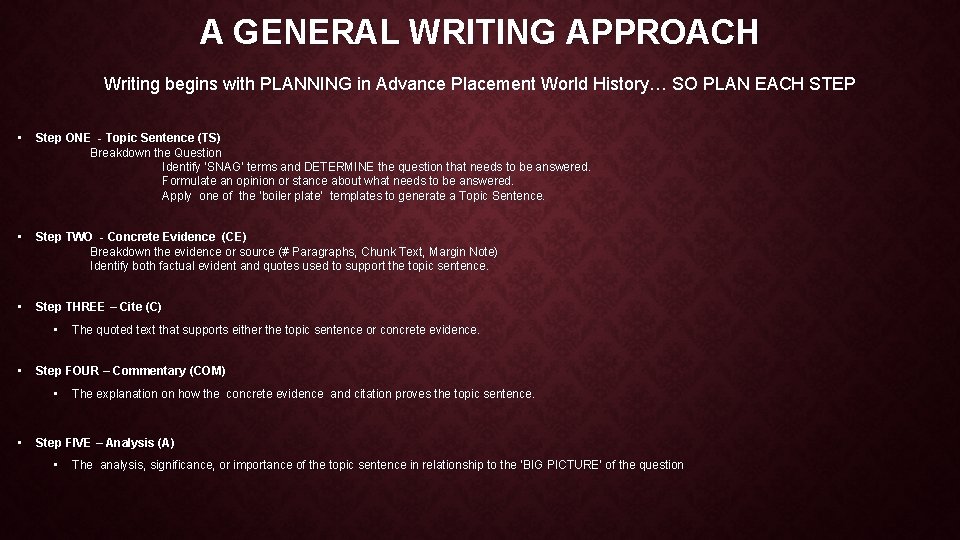
A GENERAL WRITING APPROACH Writing begins with PLANNING in Advance Placement World History… SO PLAN EACH STEP • Step ONE - Topic Sentence (TS) Breakdown the Question Identify ‘SNAG’ terms and DETERMINE the question that needs to be answered. Formulate an opinion or stance about what needs to be answered. Apply one of the ‘boiler plate’ templates to generate a Topic Sentence. • Step TWO - Concrete Evidence (CE) Breakdown the evidence or source (# Paragraphs, Chunk Text, Margin Note) Identify both factual evident and quotes used to support the topic sentence. • Step THREE – Cite (C) • • Step FOUR – Commentary (COM) • • The quoted text that supports either the topic sentence or concrete evidence. The explanation on how the concrete evidence and citation proves the topic sentence. Step FIVE – Analysis (A) • The analysis, significance, or importance of the topic sentence in relationship to the ‘BIG PICTURE’ of the question
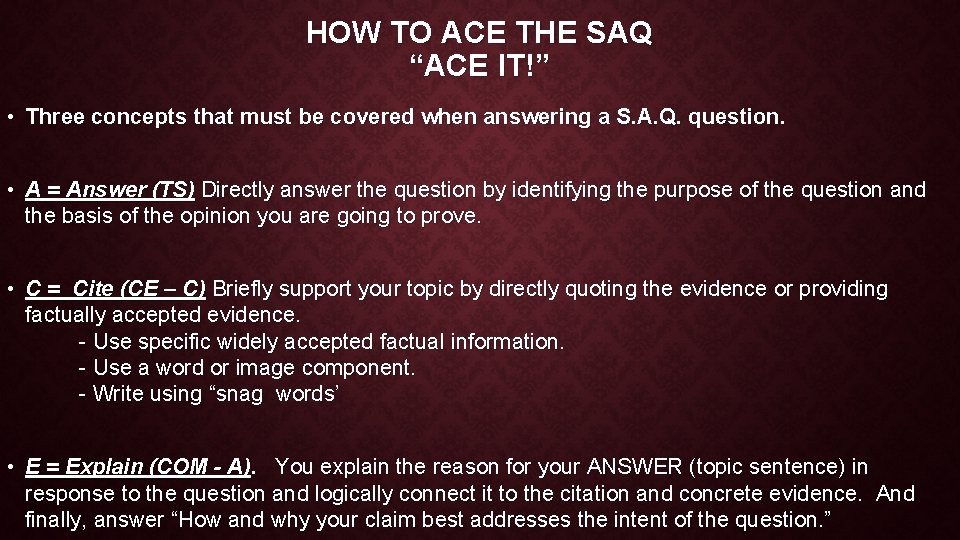
HOW TO ACE THE SAQ “ACE IT!” • Three concepts that must be covered when answering a S. A. Q. question. • A = Answer (TS) Directly answer the question by identifying the purpose of the question and the basis of the opinion you are going to prove. • C = Cite (CE – C) Briefly support your topic by directly quoting the evidence or providing factually accepted evidence. - Use specific widely accepted factual information. - Use a word or image component. - Write using “snag words’ • E = Explain (COM - A). You explain the reason for your ANSWER (topic sentence) in response to the question and logically connect it to the citation and concrete evidence. And finally, answer “How and why your claim best addresses the intent of the question. ”
ACE – A (ANSWER) • Depending on the prompt, this component requires you to directly answer the question by identifying a specific factual claim and expressing your answer (opinion) to the claim. • It is here where you confidently establish your argument. • It is similar to making a thesis/argument claim in an essay or topic/main idea sentence in a supporting paragraph.
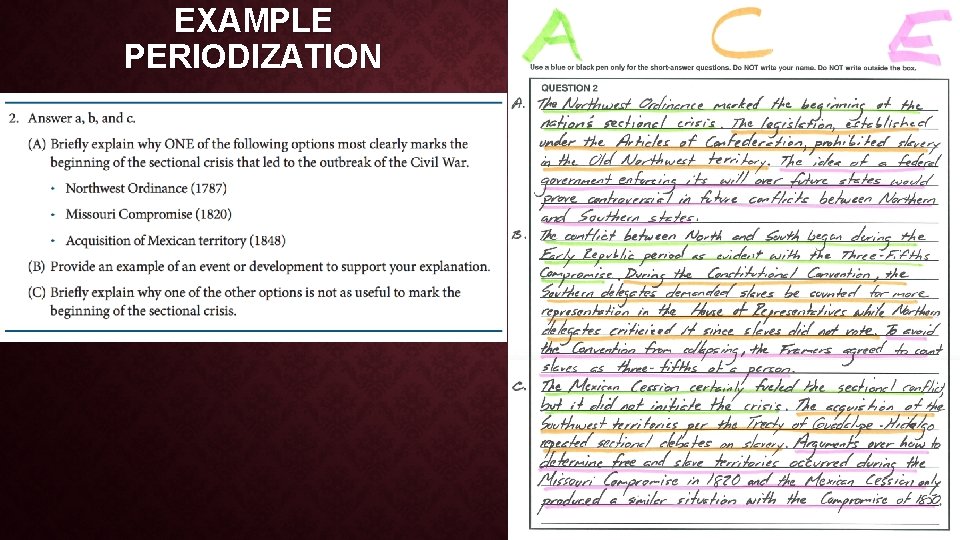
ACE – A (ANSWER) • In a situation of selecting provided options, identify the selected option. [SEE EXAMPLE PERIODIZATION] • In a situation of identifying a similarity or difference, be sure to directly address both components of comparison. [SEE EXAMPLE COMPARISON and EXAMPLE INTERPRETATION]
ACE – C (CITE) • Depending on the prompt, this component requires you to directly answer the question by identifying a specific historical claim, general historical assertion, or historical interpretative analysis from provided evidence • The definition/description should contain specific factual information/evidence directly relevant to the prompt and Answer.
ACE – C (CITE) • In a situation where the Answer was identifying a specific historical claim, you should define or describe the claim using the I. D. E. A. format. [SEE SLIDE - EXAMPLE CAUSATION] • In a situation where the Answer was a historical interpretative analysis, you should “snag a word or phrase” to substantiate the interpretative analysis. [SEE EXAMPLE INTERPRETATION] • This does not mean to quote a word or phrase. • In a situation where the Answer was identifying a claim from a list of options, you should define/describe the selected option. [SEE EXAMPLE PERIODIZATION]
ACE – E (EXPAND) • This last component requires you to explain how your Answer best addresses the prompt. • Like any writing prompt on the AP exam, there exists an intent and focus to assess historical understanding on a targeted historical learning objective, key concept, and/or historical thinking skill. • These questions are developed by historians and teachers of history. They are inherently designed to directly assess key concepts, but also assess broad historical phenomenon. • The explanation should connect or tie back the Answer to the prompt and fulfill its historical intent. • Why Expand? The explanation of the Answer should include a further connection to a direct or broad historical phenomenon relevant to the intent and focus of the question.
EXAMPLE CAUSATION • Prompt (Part A): Briefly explain ONE important political response to the sectional conflict over slavery during the 1850’s. • ANSWER: The Kansas Nebraska Act in 1854 was another attempt to settle the sectional conflict over slavery during the 1850’s. • CITE: The act split the Nebraska Territory into two new territories, Nebraska and Kansas, and allowed each territory to determine free state or slave state through popular sovereignty. • EXPAND: Although the Kansas Nebraska Act attempted to settle the conflict over slavery through a more democratic means, it consequently allowed slavery to expand beyond the Missouri Compromise line of 36’ 30 and was considered a political victory for “slave power. ”
EXAMPLE COMPARISON • Prompt (i. e. Part A): Briefly explain ONE important difference between the Northern regional economy and the Southern regional economy in the period from 1800 to 1850. • ANSWER: The Northern regional economy developed a new industrial and manufacturing base while the Southern regional economy preserved its predominantly agrarian society. • CITE: The Lowell System pioneered manufacturing and mass production in the North while the South continued to expand cash crop plantations, such as cotton. • EXPAND: The increase in factories in the North developed a more fluid wage-earning free labor class whereas the Southern plantation economy preserved the rigid social hierarchy and slave labor.
EXAMPLE PERIODIZATION
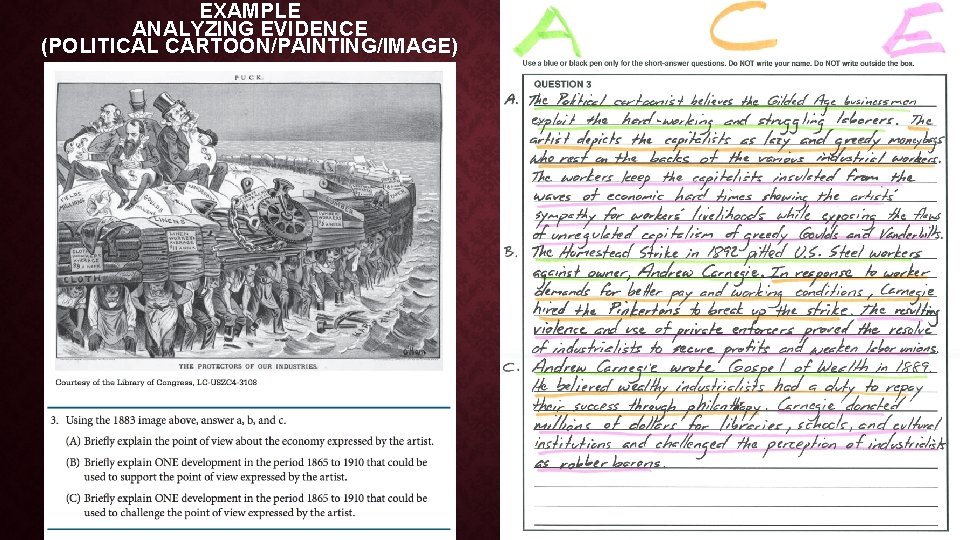
EXAMPLE ANALYZING EVIDENCE (POLITICAL CARTOON/PAINTING/IMAGE)
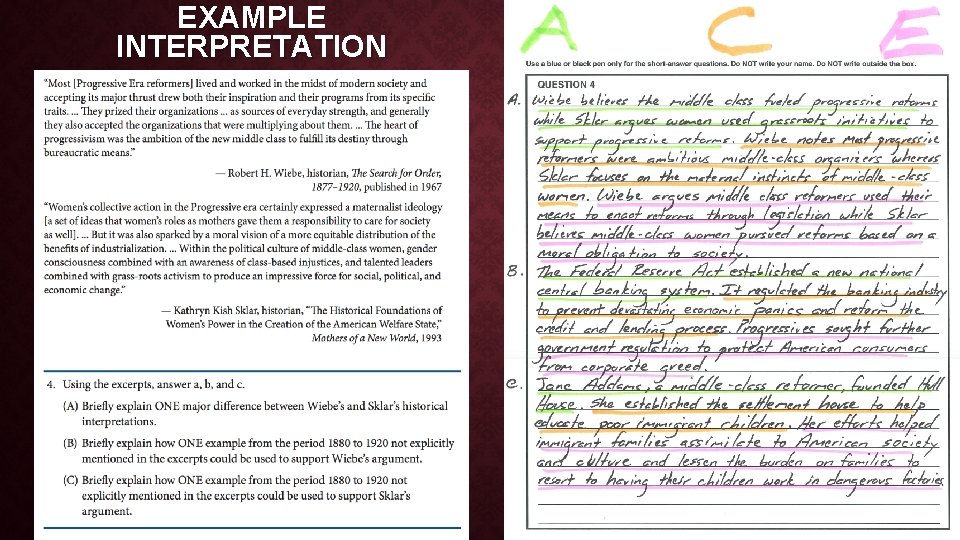
EXAMPLE INTERPRETATION
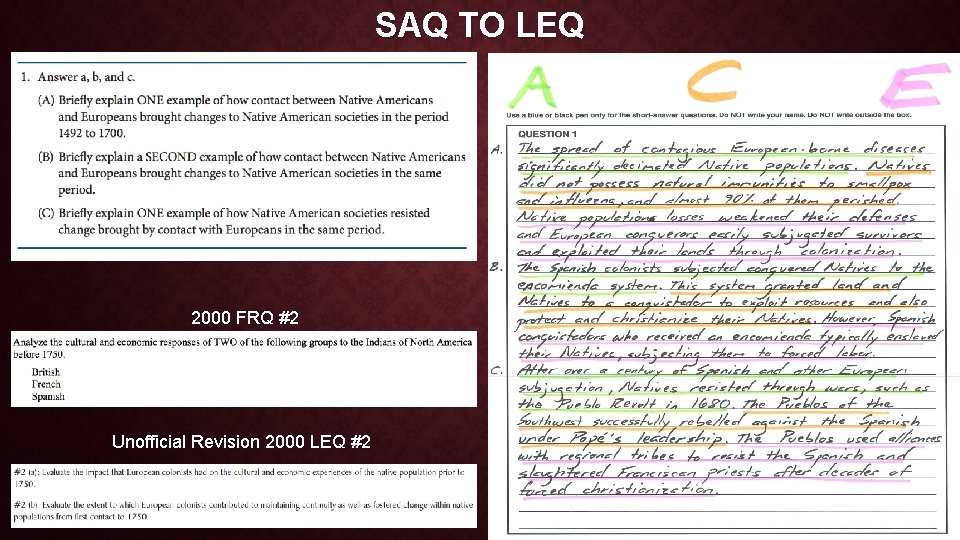
SAQ TO LEQ 2000 FRQ #2 Unofficial Revision 2000 LEQ #2
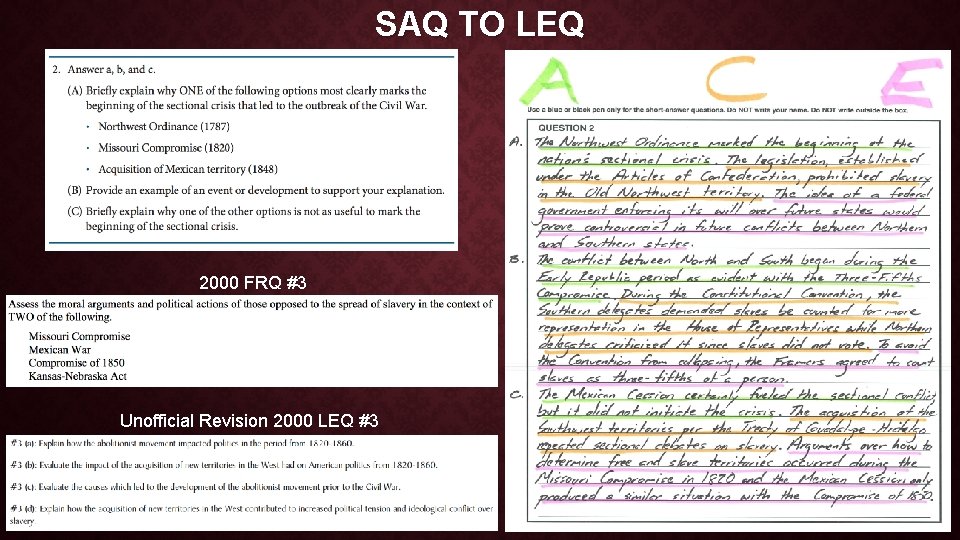
SAQ TO LEQ 2000 FRQ #3 Unofficial Revision 2000 LEQ #3
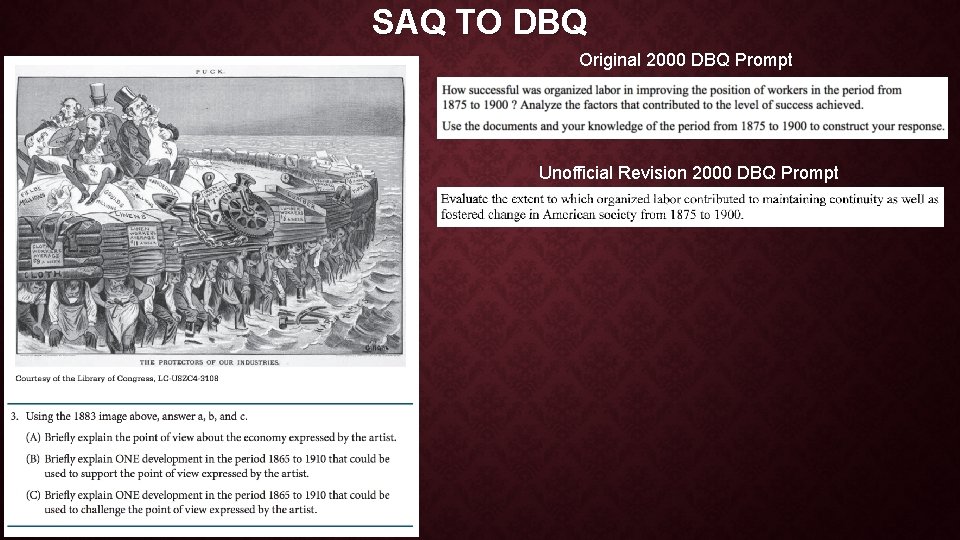
SAQ TO DBQ Original 2000 DBQ Prompt Unofficial Revision 2000 DBQ Prompt
RECOMMENDED ACE APPLICATION • Not designed to be an immediate writing solution. • Strategy should be applied regularly and consistently throughout the course. • Applied to different types of SAQs to address Historical Thinking Skills. • Practice, practice. • Ask an SAQ question part rather than an entire three-part SAQ. • Timing • Apply extended times in early development and application. • Administer questions in an exam-timed situation to assess mastery. • Allow students to adapt the strategy to their capabilities. • Adapt the strategy to your classroom, when preferred.
GENERAL WRITING GUIDELINES • Be explicit. • Always use specific factual and historical evidence and avoid answering only in generalizations. • Do not quote words or phrases from excerpts. [See Cite for further clarification. ] • Unnecessary phrases to avoid: “According to the historian…, ” “As seen in the excerpt/graph/image…, ” “As written/mentioned by…” • Use active verbs and active voice. • Diction and syntax play an important role in establishing a confident historical claim and assertion in addition to developing concise responses. • GENERAL -> Europeans brought over diseases to the Americas and it had an impact on Native populations. • GO FOR THIS -> Contagious European diseases decimated Native populations.
STRATEGIC VALUE OF ACE • Keeps SAQ responses concise. • Increases likelihood of earning each point, particularly on interpretation prompts. • Develops ability to prove and substantiate claims and explanations. • Serves as a scaffolding technique for DBQ and LEQ essay responses. • Encourages sophisticated historical writing. • Should be constantly and consistently applied with SAQ assessments. • Common application with other AP disciplines using writing as part of their assessments.
GENERAL SAQ GUIDELINES • Label each part in the left-side margins outside the box. • Use BOTH the ACE and the TS-CE-C-COM-A coding • Do not skip lines or double-line. • Do not indent. • Do not write an introduction or conclusion. This is not an essay. • Write in complete sentences. No bullet points or sentence fragments. • Complete each task in order; A, B, C. • You may write any of the four SAQs in any order. • Recommended to answer in the order of most confidence first.