Honors Chemistry 2020 2021 Anthony Petras Herndon High












- Slides: 28
Honors Chemistry 2020 -2021 Anthony Petras Herndon High
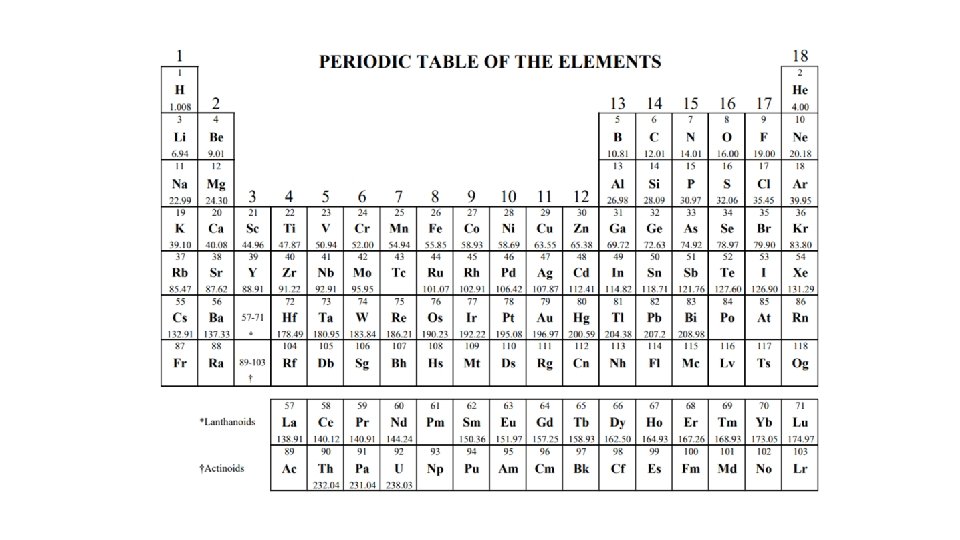
Day 19 • Start Recording • Today you need: Page of Periodic Tables, Periodic Table with Names, Pencil and Paper • Ionization Energy Practice • Ionization Energy and Valence Electrons Practice • Electron Affinity • Electronegativity • Atomic Radius Review • Ionization Energy Review • Periodic Trends Practice • Ions: Electron Configuration & Sizes • P-Block metal Ions • Size – Ions vs. Atoms • Isoelectric Set • Homework – 6 on-line quizzes due Monday 3: 00 pm • Old Homework – 6 on-line quizzes due last Monday 3: 00 pm • Test – 11/17/2020 & 11/18/2020 (25 Questions – 4 points each) • Extra Resources • Video Links
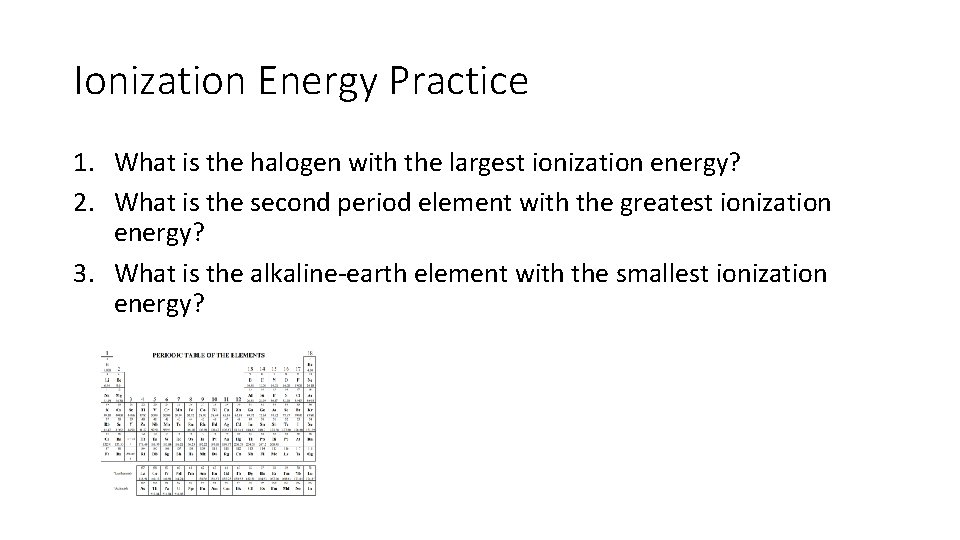
Ionization Energy Practice 1. What is the halogen with the largest ionization energy? 2. What is the second period element with the greatest ionization energy? 3. What is the alkaline-earth element with the smallest ionization energy?
Ionization Energy and Valence Electrons • Consider the energy required to remove several electrons in succession from aluminum in the gaseous state: • Al(g) Al+(g) + e. I 1 = 580 k. J/mol • Al+(g) Al 2+(g) + e. I 2 = 1815 k. J/mol • Al 2+(g) Al 3+(g) + e. I 3 = 2740 k. J/mol • Al 3+(g) Al 4+(g) + e. I 4 = 11, 600 k. J/mol • In a stepwise ionization process, it is always the highest-energy electron (the one bound least tightly) that is removed first. The first ionization energy, I 1, is the energy required to remove the highest-energy electron of an atom. Note that as more electrons are removed, the successive ionization energies increase. This is because as the atoms lose an electron they become positively charged. This increase in positive charge binds the remaining electrons more firmly. The big increase in aluminum’s ionization energy between I 3 and I 4 is because in the fourth step a core electron is being removed. Core electrons are bound more tightly than valence electrons.
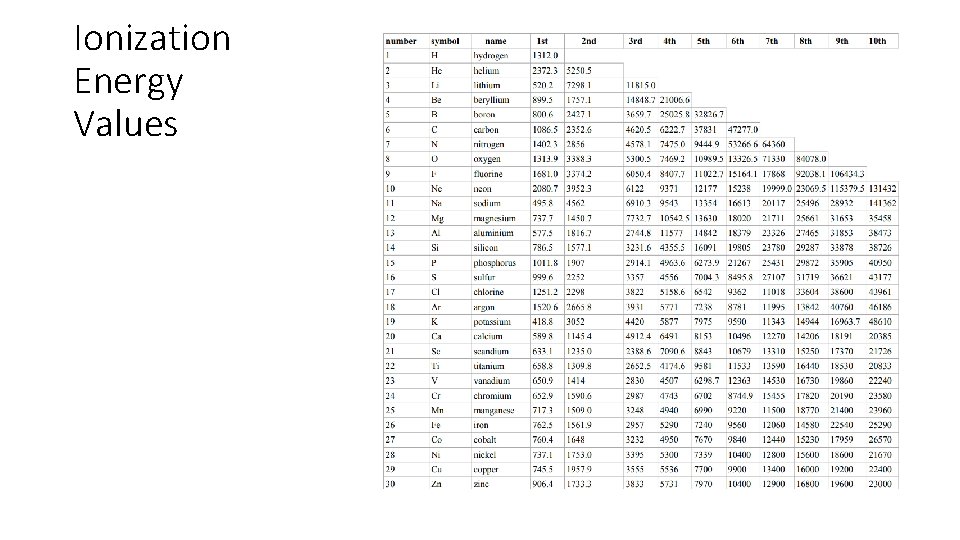
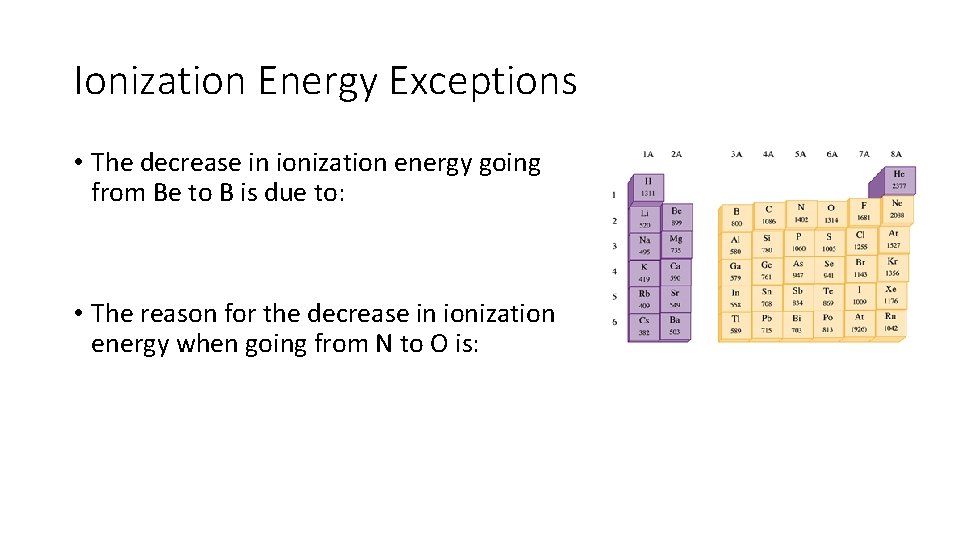
Ionization Energy Values
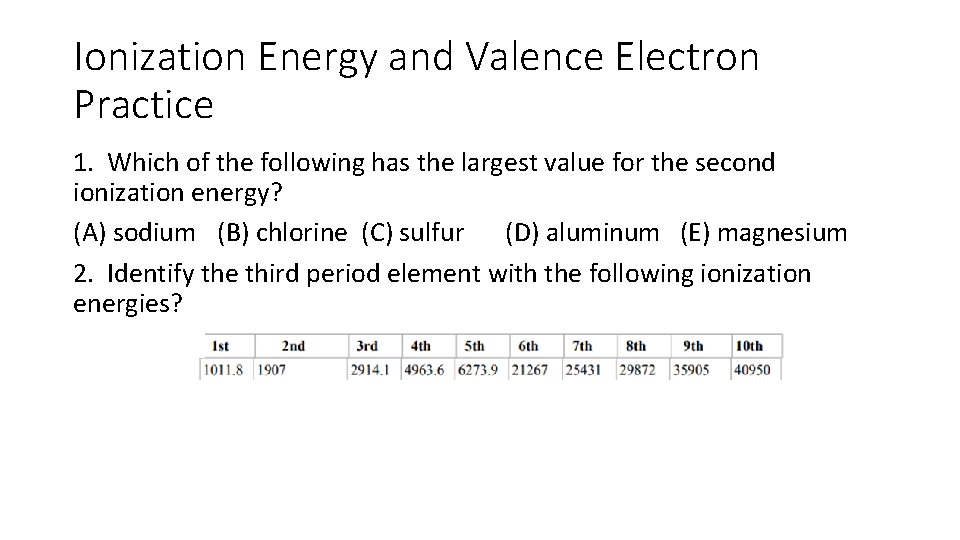
Ionization Energy and Valence Electron Practice 1. Which of the following has the largest value for the second ionization energy? (A) sodium (B) chlorine (C) sulfur (D) aluminum (E) magnesium 2. Identify the third period element with the following ionization energies?
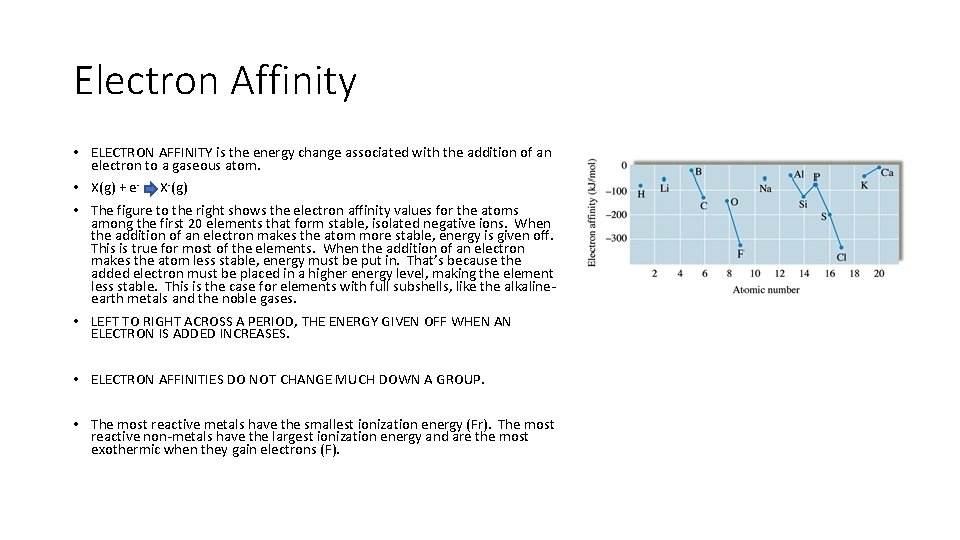
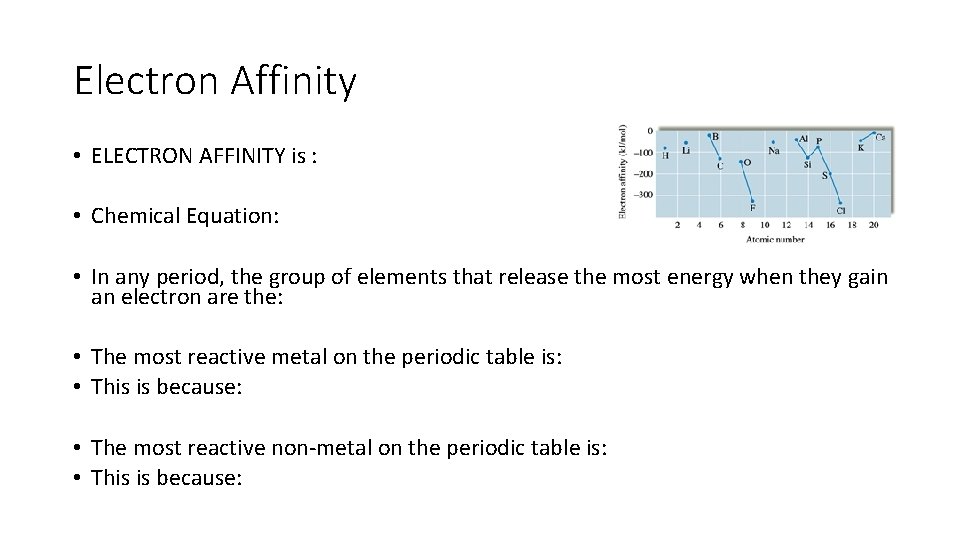
Electron Affinity • ELECTRON AFFINITY is the energy change associated with the addition of an electron to a gaseous atom. • X(g) + e- X-(g) • The figure to the right shows the electron affinity values for the atoms among the first 20 elements that form stable, isolated negative ions. When the addition of an electron makes the atom more stable, energy is given off. This is true for most of the elements. When the addition of an electron makes the atom less stable, energy must be put in. That’s because the added electron must be placed in a higher energy level, making the element less stable. This is the case for elements with full subshells, like the alkalineearth metals and the noble gases. • LEFT TO RIGHT ACROSS A PERIOD, THE ENERGY GIVEN OFF WHEN AN ELECTRON IS ADDED INCREASES. • ELECTRON AFFINITIES DO NOT CHANGE MUCH DOWN A GROUP. • The most reactive metals have the smallest ionization energy (Fr). The most reactive non-metals have the largest ionization energy and are the most exothermic when they gain electrons (F).
Electronegativity • ELECTRONEGATIVITY is defined as the tendency for an atom to attract electrons to itself when it is bonded to another atom. • LEFT TO RIGHT ACROSS A PERIOD, ELECTRONEGATIVITY INCREASES. One important note about electronegativity is that it does not apply to the noble gases. This is because the noble gas elements do not readily form compounds. • ELECTRONEGATIVITY DECREASES AS YOU MOVE DOWN A GROUP. This is again due to the shielding effect of the inner (core) electrons.
Atomic Radius • ATOMIC RADIUS is • LEFT TO RIGHT ACROSS A PERIOD, ATOMIC RADIUS: • This occurs because: • AS YOU GO DOWN A GROUP ATOMIC RADIUS: • This occurs because:
Atomic Radii Snowman Photos
Ionization Energy • IONIZATION ENERGY is: • Chemical Equation: • LEFT TO RIGHT ACROSS A PERIOD, FIRST IONIZATION ENERGY: • This occurs because: • AS YOU GO DOWN A GROUP, FIRST IONIZATION ENERGY: • This occurs because:
Ionization Energy Exceptions • The decrease in ionization energy going from Be to B is due to: • The reason for the decrease in ionization energy when going from N to O is:
Electron Affinity • ELECTRON AFFINITY is : • Chemical Equation: • In any period, the group of elements that release the most energy when they gain an electron are the: • The most reactive metal on the periodic table is: • This is because: • The most reactive non-metal on the periodic table is: • This is because:
Electronegativity • ELECTRONEGATIVITY is: • LEFT TO RIGHT ACROSS A PERIOD, ELECTRONEGATIVITY: • Electronegativity does not apply to the: • This is because: • AS YOU MOVE DOWN A GROUP, ELECTRONEGATIVITY:
Mixed Practice 1 -10 1. ______ The alkali with the largest atomic radius. 2. ______ The 5 th period metalloid with six valence electrons. 3. ______ The fourth period metal with the smallest atomic radius. 4. ______ The second period non-metal with the lowest electronegativity. 5. ______ The sixth period element with the greatest ionization energy. 6. ______ The lightest synthetic element. 7. ______ The element with 69 protons. 8. ______ The metal chalcogen with the highest ionization energy. 9. ______ The metalloid with six valence electrons that has the greatest electronegativity. 10. ______ The lightest nonmetal with 4 valence electrons.
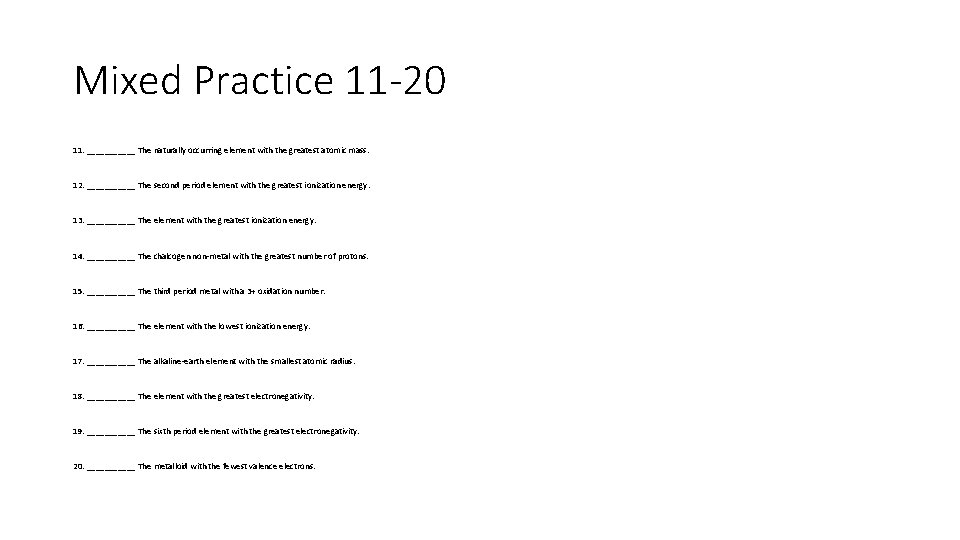
Mixed Practice 11 -20 11. ______ The naturally occurring element with the greatest atomic mass. 12. ______ The second period element with the greatest ionization energy. 13. ______ The element with the greatest ionization energy. 14. ______ The chalcogen non-metal with the greatest number of protons. 15. ______ The third period metal with a 3+ oxidation number. 16. ______ The element with the lowest ionization energy. 17. ______ The alkaline-earth element with the smallest atomic radius. 18. ______ The element with the greatest electronegativity. 19. ______ The sixth period element with the greatest electronegativity. 20. ______ The metalloid with the fewest valence electrons.
Group Properties Practice List the names of the different groupings on the periodic table: 1. ____________________ This group contains a metal, metalloid and non-metals. 2. ____________________ This series of elements that contains one synthetic element. 3. ____________________ This group of elements loses 2 electrons when they form ions. 4. ____________________ This group reacts with water and air. 5. ____________________ This term refers to elements that have properties of both metals and non-metals. 6. ____________________ The elements in this group are inert. 7. ____________________ This group contains solid, liquid & gaseous elements are room temperature. 8. ____________________ The elements in this group are harder and denser than the alkali metals. 9. ____________________ This group has a one valence electron. 10. ____________________ This group of elements is composed of mostly synthetic elements. 11. ____________________ This group contains the most reactive non-metals.
Ions: Electron Configuration and Sizes • In virtually every case, the atoms in a stable compound have a noble gas arrangement of electrons. • When two nonmetals react to form a covalent bond, they share electrons in a way that completes the valence electron configurations of both atoms. Both nonmetals attain noble gas electron configurations. • When a nonmetal and a metal react to form a binary ionic compound, the ions form so that the valence electron configuration of the nonmetal achieves the electron configuration of the next noble gas atom and the valence orbitals of the metal are emptied. • Metals lose valence electrons first. After the metal loses valence electrons, additional d orbital electrons can be removed if necessary. • For example: Write the electron configurations for the following ions. • Mn 4+ • Fe 3+
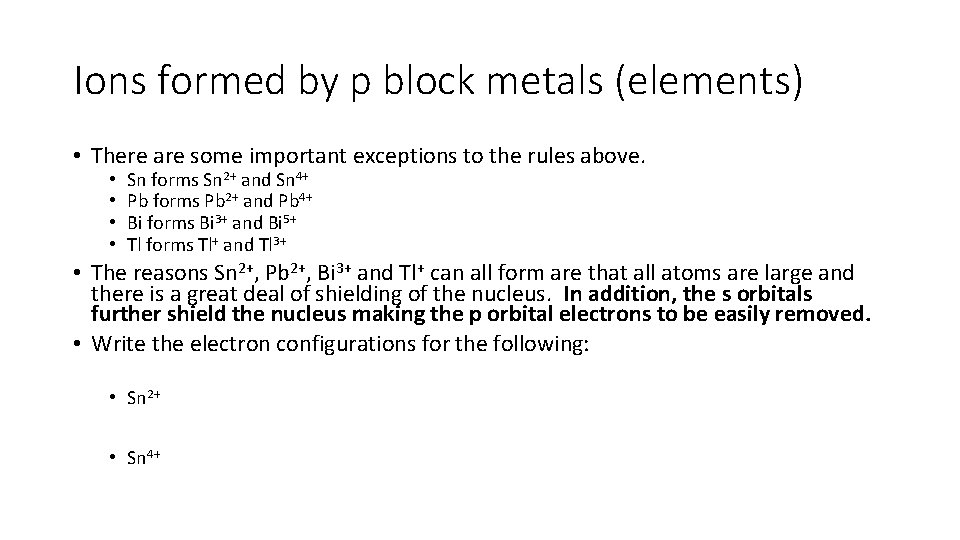
Ions formed by p block metals (elements) • There are some important exceptions to the rules above. • • Sn forms Sn 2+ and Sn 4+ Pb forms Pb 2+ and Pb 4+ Bi forms Bi 3+ and Bi 5+ Tl forms Tl+ and Tl 3+ • The reasons Sn 2+, Pb 2+, Bi 3+ and Tl+ can all form are that all atoms are large and there is a great deal of shielding of the nucleus. In addition, the s orbitals further shield the nucleus making the p orbital electrons to be easily removed. • Write the electron configurations for the following: • Sn 2+ • Sn 4+
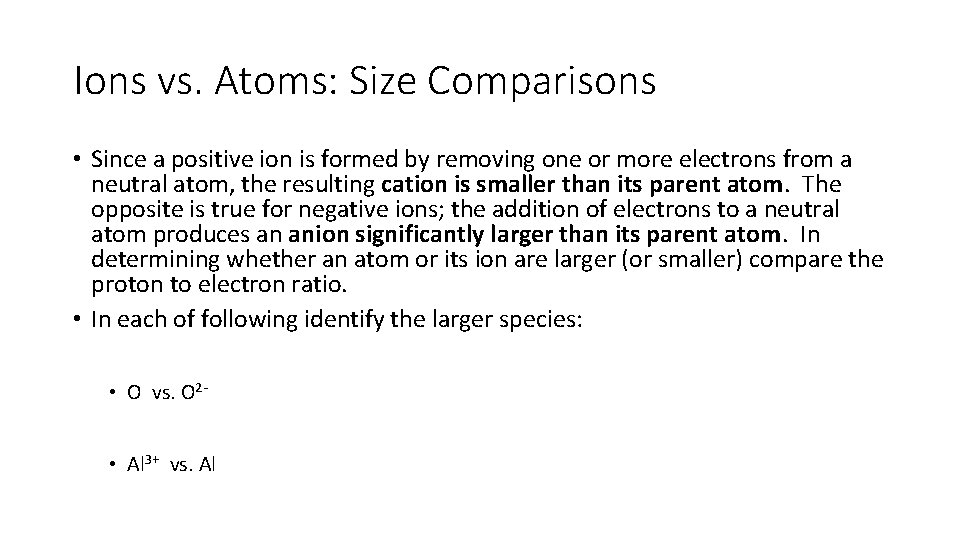
Ions vs. Atoms: Size Comparisons • Since a positive ion is formed by removing one or more electrons from a neutral atom, the resulting cation is smaller than its parent atom. The opposite is true for negative ions; the addition of electrons to a neutral atom produces an anion significantly larger than its parent atom. In determining whether an atom or its ion are larger (or smaller) compare the proton to electron ratio. • In each of following identify the larger species: • O vs. O 2 • Al 3+ vs. Al
Ionic Radius Trend & Isoelectric Set • Ion radius increases going down a group (just like atomic radius). Horizontally, the trend is complicated because metals on the left side of the periodic table form cations, and nonmetals on the right side of the periodic table form anions. For example, in the second period, C 4 - has the largest ionic radius and C 4+ has the smallest ionic radius. • One trend worth noting involves relative sizes of an isoelectric set. An isoelectric set is a group of atoms or ions with the same number of electrons. • Consider the ions O 2 -, F 1 -, Na 1+, Mg 2+ and Al 3+.
New Homework Complete the following 6 Chapter 3 on-line quizzes by 11/16/2020 3 pm. (periods 6 & 8) • mixed trends quiz 1 • mixed trends quiz 2 • period 2 trends quiz • period 3 trends quiz • period 4 trends quiz • period 5 trends quiz
Old Homework Complete the following 6 Chapter 3 on-line quizzes: Due 11/2 metal nonmetal or metalloid quiz name my family quiz 1 name my family quiz 2 periodic families quiz 1 periodic families quiz 2 periodic families quiz 3 Due: 11/9 • alkali metals trends quiz • alkaline earth metals trends quiz • atomic radius trends quiz • chalcogen trends quiz • electronegativity high low quiz • electronegativity trends quiz
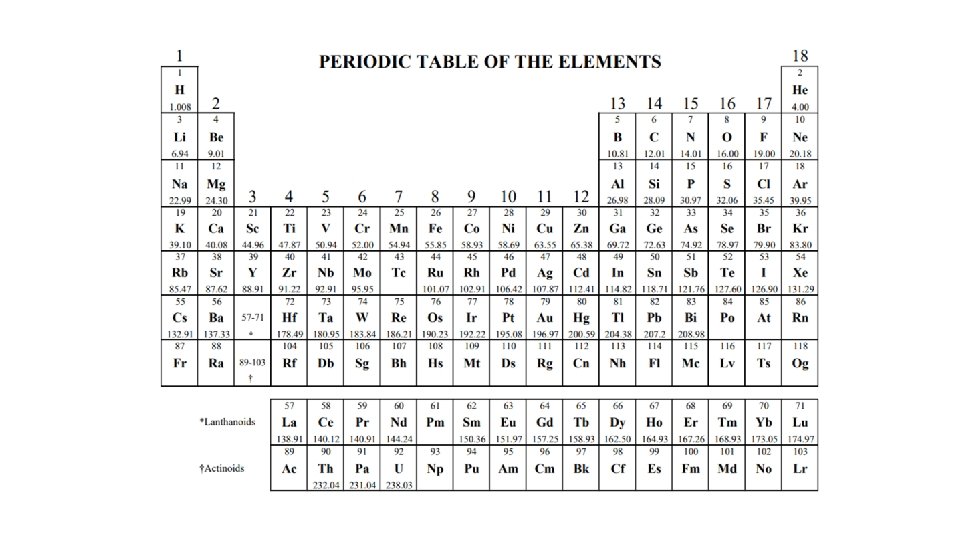
Extra Resources • Today’s Lesson draws upon the work and practice problems found in the documents below. These documents can be found in the Chapter 3 Honors Worksheet section on sartep. com. Pages of Periodic Tables Periodic Table Grouping Answers Periodic Table Trends Answers Ionic Trends Answers Chapter 3 Practice Test Answers
Recording Links – New Quarter – New Chapter – New Links Period 3: 16. https: //us. bbcollab. com/recording/85 fe 6 b 2 ce 21845 d 88 a 72 be 5 c 3175 a 7 f 8 15. https: //us. bbcollab. com/recording/df 0 cd 3 eaf 0 e 449 e 6 bd 36380 d 8 f 533 dc 7 Period 5: 19. https: //us. bbcollab. com/recording/de 925535 c 1 b 240 a 8 a 6082 efd 7 d 360038 18. https: //us. bbcollab. com/recording/907 b 9 c 12473 b 4 c 3 b 9681558 f 01234 a 44 17. https: //us. bbcollab. com/recording/a 43 ed 5 ce 418040 c 8 bcf 60 a 95679 b 4 ce 3 Period 6: 15. https: //us. bbcollab. com/recording/988 ae 7 e 4833 f 4 ba 9 ac 33 d 3 ce 45 d 25229 14. https: //us. bbcollab. com/recording/c 2522 b 9 da 3 c 54 c 49 a 0 d 1 bb 432 b 971538 Period 8: 16. https: //us. bbcollab. com/recording/7 f 71 c 6 e 25 e 5449 fa 9 d 11850 b 7 aa 6 c 775 15. https: //us. bbcollab. com/recording/2 d 9147 f 0 d 7 a 74 d 18804619 ba 853 dad 96 14. https: //us. bbcollab. com/recording/846916 cf 04 e 74122 a 6966 a 4 baca 82578 13. https: //us. bbcollab. com/recording/affadbac 958 d 467 bb 6 b 4 f 870 e 5 a 2 b 864